Such as the broadening of ASIO’s power to include “sabotage, promotion of communal violence, attacks on Australia’s defence system and any serious threat to Australia’s territorial and border integrity.”
Under current law, this is regardless of “whether these [words or actions] were directed from, or committed within, Australia or not.”
The biggest concerns centre on the “promotion of communal violence” and threats to national integrity.
Under existing laws on adult questioning, anyone who fails to comply with ASIO when they demand information can be imprisoned for five years.
Put simply, in these cases you do not have the right to remain silent.
Ramping up those concerns is the fact that neither inciting “communal violence” nor “threats to national integrity” are properly defined.
According to section 4 of the ASIO Act, foreign interference is defined as: “activities relating to Australia that are carried on by or on behalf of a foreign power.”
Activities included anything that is “detrimental to the interests of Australia “ or involves “a threat to any person.”
Promoting communal violence is defined as: “activities that are directed to promoting violence between different groups of persons in the Australian community.”
Added here is any activity that “endangers the peace, order or good government of the Commonwealth.”
In effect, publicly questioning COVID vaccines, lockdowns, mass immigration, and multiculturalism could be considered incitement and a threat to national stability (integrity).
As could critiquing Islam, or even criticising Albonomics that is currently edging Australia’s economy irreversibly towards’ Labor’s “we’re saving the world from climate change,” Net Zero Nanny State black hole.
By far one of the bill’s most prominent opponents, Senator Alex Antic, said on X that he’s disappointed it passed.
Antic also stated that he voted against the amendment because “extraordinary powers should never become ordinary.”
The South Australian Liberal Senator then declared the law an expansion of the surveillance state.
Antic told the Senate that the bill “doesn’t merely fine-tune existing arrangements.”
“It breaks in new powers and makes permanent extraordinary intrusions on the liberty of Australians.
“Compulsory questioning warrants,” Antic argued, “allow ASIO to compel a person who may never have been charged with an offence or may never be charged with an offence to appear and answer questions under threat of criminal penalty.”
Even telling anyone about being questioned or detained is now an offence.
“These are not ordinary investigative tools,” he stated. “They sit well outside the framework of the traditional criminal justice system.”
Since 9/11, the government has repeatedly extended what were meant to be temporary powers.
That’s because they were the exception, not a permanent rule.
“As it currently stands, the bill removes that sunset clause entirely.”
Making them permanent is a problem, Antic added.
“History shows that temporary emergency powers have a long and chequered history and habit of becoming permanent features.
“Worse still, the bill actually expands the reach of adult questioning warrants.
“The definition of an adult questioning matter will now be broadened under this bill to include sabotage and, most alarmingly, the promotion of communal violence.”
Criticising the loose language, Antic rightly pointed out that “Promotion of communal violence’ is particularly elastic.
“Vague drafting is the enemy of the rule of law.”
To this he added, “What does it actually mean? What does it capture?”
“Does it capture passionate political speech, advocacy that offends certain groups, legitimate protest or religious expression that crosses an often-ill-defined line?”
Antic then asserted, “In a free society, the state shouldn’t be handed an open-ended power to compel citizens to answer questions about speech or association that falls short of actual criminality.”
Blurring lines when it comes to criminality and rights, he further argued, removes certainty about where that line is drawn.
The even greater concern here is whether or not the law could be used to detain and question people against their will.
“The bill also retains the capacity to subject children as young as 14 to these processes. On its surface, that alone should give this chamber reason to pause.
“Security which is purchased at the price of permanent, expanded and coercive powers is a false bargain.”
Extraordinary laws require use-by dates.
“The rule of law requires that the state’s most intrusive rules remain exceptional, tightly confined, regularly scrutinised and subject to genuine sunset clauses.”
They should not, Antic protested, be “quietly normalised” and “quietly allowed to creep into the norm.”
Notably, Antic joined One Nation and The Greens in opposing the expansion of ASIO’s powers.
There’s something incredibly unsettling about the growing public sympathy for Lindsay Clancy, the Massachusetts mother accused of murdering her three young children.
Clancy is currently on trial for the deaths of Cora, 5, Dawson, 3, and Callan, 8 months. According to her defence, she was suffering from severe postpartum psychosis and was not criminally responsible for her actions.
Yet the bizarre reaction online has gone far beyond sympathy for a woman suffering a mere psychiatric crisis.
Women have actually begun publicly identifying with Clancy. Some have posted tearful videos with their own kids, accompanied by captions like “Same, Lindsay.”
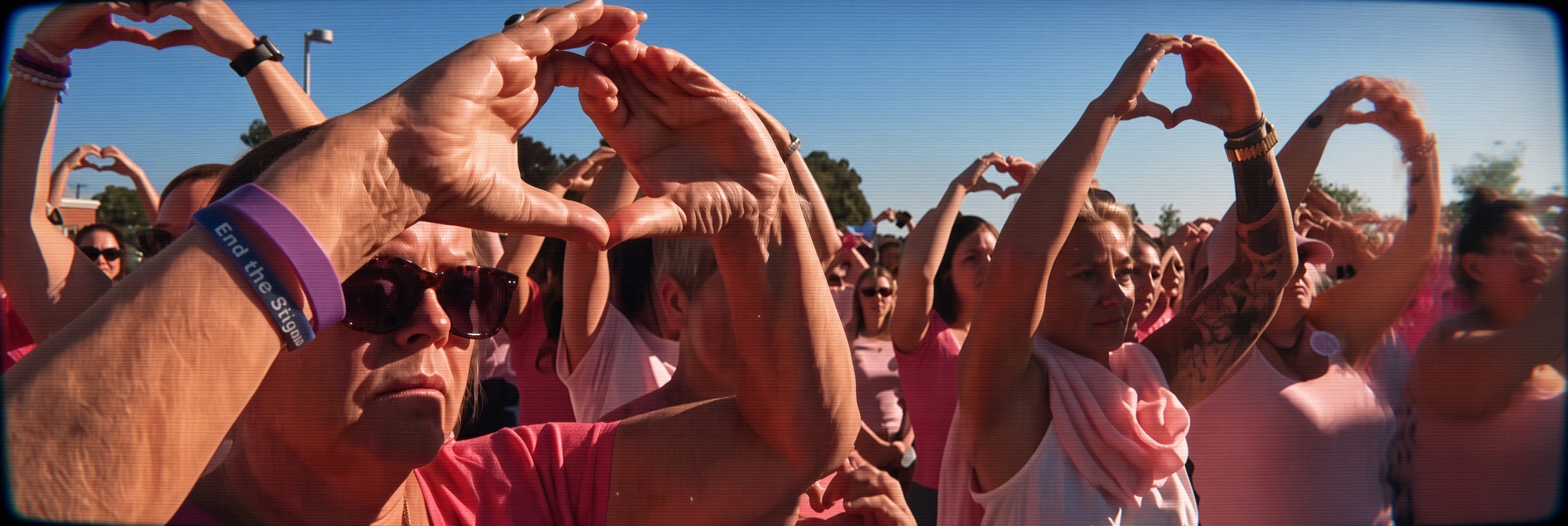
What’s more, hundreds of women have also rallied outside the courthouse in support of Clancy, wearing pink and carrying messages such as “She Needs Help” and “End the Stigma.”
And the internet has rightly responded with indignation that a woman accused of killing her own children has become, for some women, an object of identification and solidarity.
But as murderously insane as it is, perhaps there’s some grim logic to it.
For more than a century, feminists and the women’s rights movement have fought to establish that a woman has an absolute right to decide whether her child lives or dies. Abortion has been elevated into a defining symbol of female autonomy and liberation.
And once that has been normalised—once abortion has been accepted as one of the most fundamental rights a woman can exercise—an obvious question arises: What, exactly, makes the child inside the womb fundamentally different from the child outside it?
Human life is continuous from conception until natural death. As such, there is no magical moment during pregnancy when non-human life suddenly becomes human life. The child does not become a different kind of being when he or she passes through the birth canal.
Location doesn’t determine human worth. Size doesn’t determine human worth. Degree of dependency doesn’t determine human worth. The environment in which a child exists does not determine human worth.
A child does not become more human because he or she moves from the womb to the crib. That’s why abortion and infanticide are morally distinct in law but not in the underlying question of human value.
If an unborn child is a human being, then deliberately killing that child is the intentional killing of an innocent human life. Birth changes a human being’s location, not nature.
If Clancy had aborted her children in the womb, she would be celebrated for exercising her “right” as a woman to choose whether her children live or die.
Perhaps that’s why the “Same, Lindsay” trend is so disturbingly revealing. The Western world has spent decades teaching women that killing an unwanted child can be an expression of freedom, autonomy, and empowerment.
Today, there are social media and cultural campaigns, such as “Shout Your Abortion,” which exist to “normalize abortion,” as though killing an unborn baby is something to boast about.
So, should we really be surprised when the culture begins to lose its ability to articulate where the boundary of human value actually lies? Should we be surprised when the culture that celebrates the killing of children inside the womb begins to sympathise with those who kill children outside of the womb?
A society that “normalises” the deliberate destruction of millions of unborn children shouldn’t expect that attitude towards human life to remain confined to the womb. It should be obvious that when killing becomes routine, people become desensitised to killing.
This is the tragedy of the culture of death. It not only kills the children, but it also changes the society that watches.
The Archbishop of Brisbane has apologised after St John’s Anglican Cathedral was used in a Stan reality television program featuring pornography performer Lily Phillips, saying the church was misled by producers and condemning the program for attempting to “validate the porn-industry.”
Archbishop Jeremy Greaves issued the apology after Australian commentator Melinda Tankard Reist condemned the Anglican Diocese of Brisbane for allowing the cathedral to be used in Turned On: Dirty, Sexy Money, a Stan series centred on the sex industry and OnlyFans creators.
Tankard Reist accused the production of turning the 125-year-old cathedral into a “prop” for the program, questioning how the church could have permitted its sacred space to be used in a production promoting the commercialisation of sex.
The controversy centres on the program’s sixth episode, in which British pornography performer Lily Phillips is shown participating in a religious ceremony at St John’s Cathedral.
The ceremony was conducted by the Very Rev’d Dr Peter Catt, Dean of Brisbane. Phillips is shown responding “I do” when asked whether she turns to Christ, renounces evil and repents of her sins.
Tankard Reist argued that the cathedral had effectively been used to lend legitimacy to a production she described as part of a broader public-relations push for the pornography industry.
Greaves has now apologised, saying:
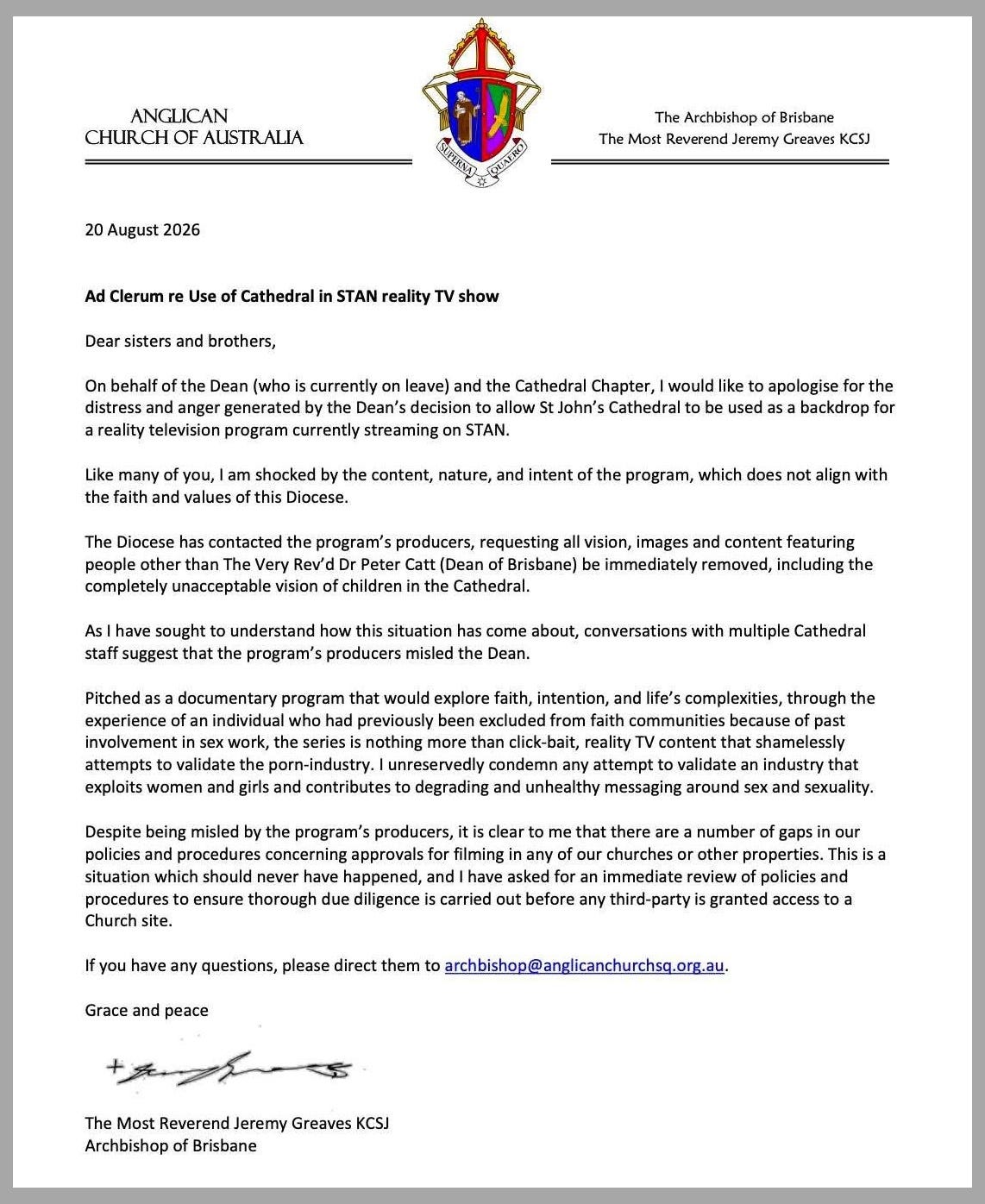
“On behalf of the Dean (who is currently on leave) and the Cathedral Chapter, I would like to apologise for the distress and anger generated by the Dean’s decision to allow St John’s Cathedral to be used as a backdrop for a reality television program currently streaming on STAN.”
The Archbishop said he was “shocked by the content, nature, and intent of the program,” which he said “does not align with the faith and values of this Diocese.”
Greaves said the program had been presented to the Dean very differently from the finished product.
Archbishop of Brisbane Reverend Jeremy Greaves’ statement.
“Pitched as a documentary program that would explore faith, intention, and life’s complexities, through the experience of an individual who had previously been excluded from faith communities because of past involvement in sex work, the series is nothing more than click-bait, reality TV content that shamelessly attempts to validate the porn-industry.”
He added:
“I unreservedly condemn any attempt to validate an industry that exploits women and girls and contributes to degrading and unhealthy messaging around sex and sexuality.”
According to Greaves, conversations with cathedral staff indicated that “the program’s producers misled the Dean.”
The Archbishop also acknowledged that the Diocese had failed to conduct adequate due diligence before allowing the filming.
“Despite being misled by the program’s producers, it is clear to me that there are a number of gaps in our policies and procedures concerning approvals for filming in any of our churches or other properties.”
Greaves said the Diocese had contacted the producers and requested that “all vision, images and content featuring people other than The Very Rev’d Dr Peter Catt (Dean of Brisbane) be immediately removed,” including footage showing children inside the cathedral.
“This is a situation which should never have happened,” Greaves said.
He announced an immediate review of the Diocese’s policies and procedures to ensure “thorough due diligence” before third parties are granted access to church sites.
The apology marks a stark repudiation of the production by the Diocese, which now says one of Brisbane’s most prominent Christian sites was used in a program whose portrayal of the sex industry directly conflicts with its stated values.
Australian aid worker Zomi Frankcom was killed on 1 April 2024 by multiple precision Israeli drone strikes while travelling in a humanitarian convoy in Gaza.
Australia’s Foreign Minister Penny Wong has said she is “outraged” over an Israeli government decision not to pursue criminal proceedings against those responsible for the death of Australian aid worker Zomi Frankcom, who was killed in an IDF strike in Gaza.
The IDF acknowledged serious failures, including mistaken identification and errors in decision-making, but concluded there was “no reasonable suspicion of criminal misconduct” sufficient to justify opening a criminal investigation, according to SBS News.
Frankcom was killed on 1 April 2024 while supporting a World Central Kitchen aid delivery in Gaza. Australia subsequently appointed former Chief of the Defence Force Air Chief Marshal Mark Binskin to assess Israel’s investigation and response. His report found that the deaths resulted from failures in IDF controls, mistaken identification, errors in decision-making and failures to comply with procedures and rules of engagement.
Importantly, the Australian investigation did not conclude that the strike was a deliberate attack on humanitarian workers. The report instead identified serious failures surrounding the identification and engagement of the vehicles.
Foreign Minister Penny Wong said Israel’s decision fell “far short” of the accountability Australia expects. She said Israel’s ambassador would be summoned and Australia’s ambassador in Israel had been instructed to convey the government’s position directly.
Wong also criticised the timing of the announcement, saying it was made on World Humanitarian Day and was “especially insulting” to Frankcom’s loved ones, humanitarians and Australians, according to the Australian Government statement.
World Central Kitchen has rejected the Israeli findings and called the decision unjustified, maintaining that the IDF knew its team was unarmed and knew the movements and identities of the humanitarian convoy, according to The Guardian. (Those are WCK’s claims and should be distinguished from the findings independently established by the Australian and Israeli investigations.)
The question now is whether Israel’s explanation will satisfy Australia, Frankcom’s family, and the wider community. For a democratic ally, scrutiny and accountability shouldn’t be seen as hostility. They’re fundamental to Western legal and moral traditions and therefore accompany military power.
Australian journalists demand transparency from politicians, businesses, and public figures they don’t like. They scrutinise their finances, question their motives and investigate who funds the organisations and causes behind them.
But when it comes to the media itself, there is considerably less enthusiasm for transparency.
South Australian Senator Alex Antic is seeking to change that.
Antic has introduced the Broadcasting Services Amendment (Register of Media Interests) Bill 2026, which would establish a public register requiring journalists and others working in the media to disclose what they earn, the gifts they receive and the source of those gifts.
“Today I am introducing the Broadcasting Services Amendment (Register of Media Interests) Bill 2026,” Antic said in announcing the legislation.
“If passed, the Bill would require journalists and others inside the media to publicly disclose what they earn, any gifts they receive and the origin of same.”
If the media really is as powerful and influential as journalists themselves insist, Australians have a legitimate interest in knowing who is financially connected to those shaping the information they consume.
In a video posted to social media, Antic drew a comparison between journalists and federal politicians.
“In this building I’m required to disclose everything I earn, everything I own, everything I take as a gift and put it on the Senator’s Register of Interest register,” he said.
“But journalists, despite the fact that they’re always telling you how important and relevant and influential they are, they don’t have to do that.”
Antic said his proposed register would require journalists to disclose “all of the gifts, all of the earnings they get” so Australians can see “who’s paying the piper.”
That question goes to the heart of the debate.
Politicians are routinely subjected to scrutiny over their financial interests because Australians understand that financial relationships can create conflicts of interest—or at the very least create the perception of one.
The same principle can reasonably be applied to journalists.
A reporter covering the pharmaceutical industry, for example, may be influenced—or perceived to be influenced—by financial relationships with pharmaceutical companies. A journalist reporting on politics may have relationships with political organisations, lobby groups or wealthy benefactors. A commentator advocating for particular causes may receive speaking fees, gifts, travel or other benefits from organisations that stand to benefit from their influence.
That does not necessarily mean the journalist is corrupt or dishonest.
But transparency allows the public to make its own judgment.
This is particularly relevant in an era when the traditional distinction between journalists, commentators, activists and influencers has become increasingly blurred. Media personalities can have enormous audiences and wield substantial influence over public opinion, elections and political debate.
If influence is the justification for greater scrutiny of politicians, it is difficult to argue that influence suddenly becomes irrelevant when the person wielding it works for a media organisation.
Of course, the proposal is likely to encounter fierce opposition from sections of the media, with concerns about privacy, editorial independence and the potential for such a register to be abused.
However, a genuinely independent journalist should have little to fear from allowing the public to know whether they have financial interests or relationships that could reasonably be relevant to their reporting.
The media has long insisted that Australians deserve to know who is funding political campaigns, lobbying organisations and advocacy groups.
Now Antic is asking whether Australians should also know who is financially supporting the people who tell them what to think about those issues.
That is not an unreasonable question, because “If the news media in this country are as influential as we are told, then Australians deserve to know this information.”
If journalists expect politicians to disclose their interests in the name of transparency, perhaps the people who scrutinise those politicians should be prepared to accept some transparency of their own.
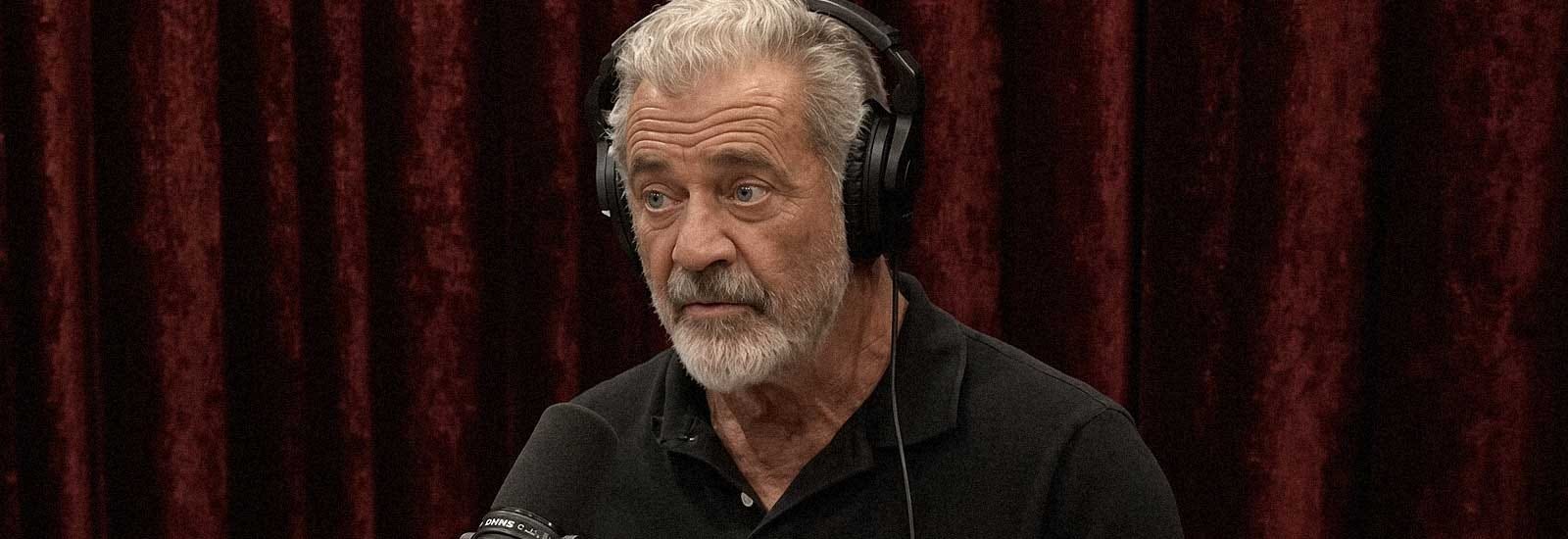
During his January 2025 appearance on The Joe Rogan Experience, Mel Gibson discussed the historical case for the resurrection in relation to his upcoming film, The Resurrection of the Christ.
Gibson argued that the Gospel accounts should be taken seriously, pointing in particular to the earliest witnesses who, according to Christian tradition, endured persecution and violent deaths rather than recant their testimony.
Gibson summed up his argument with a line that’s been memed and quoted across the internet: “No one dies for a lie.”
The claim is true, but it has also prompted an obvious objection that’s almost always raised in the comments section: If no one dies for a lie, then why do people so often die for false causes? What about suicide bombers, political assassins, militants and religious extremists who willingly sacrifice themselves for beliefs that are demonstrably false?
At first, that sounds like a pretty strong objection. However, it fundamentally misses the point. Here’s why:
There is a profound difference between dying for something that is false and dying for something you know to be false. People have obviously died throughout history for beliefs that were wrong. The question is whether someone would willingly endure persecution and death for a story they personally knew they had invented.
And this is what makes the Apostles’ testimony so compelling.
They weren’t simply repeating something they had heard from somebody else. They claimed to have personally seen the risen Christ. Their entire message rested on something they said they had witnessed themselves.
According to Christian tradition, Peter was crucified in Rome, Andrew was crucified in Greece, James was executed in Jerusalem, Thomas was killed by a spear in India, Philip was crucified in Hierapolis, Bartholomew was martyred in Armenia, Matthew was martyred in Africa, James the Less was killed in Jerusalem, Thaddaeus was martyred in Armenia or Persia, Simon the Zealot was martyred in Persia, and Matthias, who replaced Judas Iscariot, was also martyred.
Of course, none of this means that people cannot die for something that is false. Islamic militants, for example, may genuinely believe the religious claims for which they are willing to die. Their willingness to die demonstrates the sincerity of their belief. It does not demonstrate that the belief itself is true.
That is the distinction that matters here.
An Islamic terrorist is dying for something he believes to be true, but which he has received from others. He can be sincerely mistaken. The Apostles were claiming something very different. They claimed to have personally seen, heard and encountered the risen Christ.
If they had deliberately invented the resurrection, they would have known it was invented.
That makes their situation fundamentally different. They weren’t defending a belief they had inherited or repeating a story they had been told. They were claiming to be eyewitnesses to the central event they proclaimed.
So the argument is not, “Nobody ever dies for something false.” History obviously disproves that.
The argument is that people may die for a lie they sincerely believe, but why would multiple people willingly endure persecution and death for a testimony they personally knew was fabricated? What would they have to gain in their death?
The Apostles’ deaths do not, by themselves, prove the resurrection. But they do present a serious problem for the idea that the resurrection was simply a deliberate invention by its earliest witnesses.
It reminds me of something Charles Colson once said about the 1974 Watergate scandal. Colson was named one of the “Watergate Seven,” and pleaded guilty to obstruction of justice for attempting to discredit Pentagon analyst Daniel Ellsberg, who had leaked the top-secret Pentagon Papers to the New York Times in an effort to expose the U.S. involvement in the Vietnam War.
A year before his imprisonment, while he was still under investigation and facing arrest, Colson’s close friend, Thomas L. Phillips, gave him a copy of Mere Christianity by C.S. Lewis. Colson devoured the book and soon after became a Christian.
Colson, who was derided by the media at the time for converting to Christianity just prior to his trial, went on to serve seven months of his one-to-three-year sentence. But his newfound faith was no trivial ploy to reduce his punishment.
Upon his release, Colson went on to create Prison Fellowship Ministries, an organisation dedicated to ministering to inmates, former prisoners, and their families. He also established the Christian teaching and resource organisation, The Colson Centre.
In 1982, on Easter Sunday, Colson delivered a sermon to a group of prison inmates. One of the prisoners later recalled the atmosphere as Colson preached. The prisoners were “spellbound,” he said.
In his message, Colson spoke a little about his own experience meeting Christ and admitted that his involvement in the Watergate scandal played a crucial part in convincing him of the truth of the resurrection.
Colson explained:
I know the resurrection is a fact, and Watergate proved it to me.
How?
Because twelve men testified they had seen Jesus raised from the dead, then they proclaimed that truth for 40 years, never once denying it.
Every one was beaten, tortured, stoned and put in prison.
They would not have endured that if it weren’t true.
Watergate embroiled twelve of the most powerful men in the world and they couldn’t keep a lie for three weeks.
You’re telling me twelve apostles could keep a lie for 40 years?
Absolutely impossible.
So, the question is not merely, “Did they die for what they believed?” It is: “Did they have firsthand knowledge that what they were proclaiming was true or false?”
That’s the distinction the objection fails to address.
“Better to dwell in a corner of a housetop, Than in a house shared with a contentious woman.” Proverbs 21:9.
As a pastor, I have encountered many men whose lives are made to be a form of living hell because of their wives. These men usually handle it in different ways.
Some become absolute shells of men, who, though they would get some measure of respect in their profession, anyone who sees them around their wife immediately recognises who rules the roost, and they can see the visible signs of it in the man’s hunched shoulders.
Think Richard, in Keeping Up Appearances.
Some men react badly to a badly behaving wife and seek to tyrannise their wives. These men can become abusive in direct response to years of sexual, emotional and relational coercion, and something snaps inside of them.
Some men adjust their understanding of masculinity. They rationalise it by concluding that their wife is an “alpha” and they are just happy to be married, and they give off a modicum of being content in the situation. These women write their husbands emails of complaint, and make the decisions for him, and he is content to let it happen. His wife, or more often he, will generally tell people that he is the head, but she is the neck. Every now and then you will see a shadow in this man’s eye of pain at the level of disrespect he experiences on a daily basis.
Another subset of this previous group is men who are so lazy, emotionally, relationally, and in various other ways, that they actually do genuinely enjoy that their wife is the leader. It is easier. They have less conflict, because he simply concedes, “Yes, dear.” He probably even believes that men who say he should lead are at best closet misogynists, and he will avidly advocate his situation to anyone who asks. “We are a team,” he says, knowing full well that his wife is the Captain and the Referee.
To summarise, I have encountered more men who are dominated by their wives than men who are abusive. And I expect the numbers are far more weighted in that direction than we realise, because women are far more likely to talk about their situations than men are, and there is very little, if any, stigma for a woman to share about an abusive husband. Even in our claimed egalitarian age, it is still quite shameful for a man to admit to not being the man of his house. So many men suffer in silence and are often shut up when they try to speak.
What I want to do in this piece is address how to avoid falling into such a situation. I want to give some practical advice to men about how to stop their wife from becoming a difficult woman. It is my contention that in the right context, most women can become a difficult woman. But it is not my contention that this is necessarily the man’s fault. Women have agency, and this is often ignored by people who discuss these issues. However, that does not mean there are not things that a man can do to change that likelihood, and balance things in favour of a submissive and comparatively godly wife.
As for men whose wives have already completely subjected them? Well, perhaps they can implement some of this as well. But their job is harder, much harder. Lifelong relational patterns are hard to break out of; they do not develop overnight, nor come out of nowhere. Not every man is a leader, and not every man has the ability to change his environment. A leopard cannot change its spots, right? But God can do miracles. We live in light of these two realities. Just recognise that men in both of these situations are going to have to prepare themselves for conflict. Both, because it will happen, and secondly, because you don’t want to go too far. There are plenty of men who have gone too far in seeking to rein in a domineering woman, and they have suffered the loss of any moral authority as a result. So, be wise, gentlemen.
I want to begin with something Paul says in Titus. He gives this advice to the younger church leader,
“But as for you, speak the things which are proper for sound doctrine: 2 that the older men be sober, reverent, temperate, sound in faith, in love, in patience; 3 the older women likewise, that they be reverent in behavior, not slanderers, not given to much wine, teachers of good things— 4 that they admonish the young women to love their husbands, to love their children, 5 to be discreet, chaste, homemakers, good, obedient to their own husbands, that the word of God may not be blasphemed. 6 Likewise, exhort the young men to be sober-minded,…” (Titus 2:1-6).
This is advice for a church leader on what he is to teach about the character of various groups within society. There are some great principles for us to draw from here in beginning this discussion.
Firstly, men, if you want to avoid your wife becoming the difficult woman, you need to recognise how much almost every woman in this society has been robbed of the kind of environment they needed to become the kind of wives that Paul envisions in this passage. For one, whether they were raised in the Church or not, they have almost certainly been raised to either not know what this passage says, or, in the case of many Christians, to actively reject it, and call some of its elements outdated and sexist. Hence, from a very early age, the vast majority of women have been raised, either explicitly or implicitly, to rebel against being the submissive woman.
The vitriol I have heard in the mouths of some women about that term “submission” is incredible. I can bring to mind various examples, but I was once sitting at a conference lunch table just listening to the conversation around me, and the way one of the women just spat out how much she hated teaching that women should submit to husbands was quite telling. Especially considering it had nothing to do with any of the conference talks. I had no idea how the topic came up. She is only one example. I have seen this countless times.
Men, look at this: “3 the older women likewise, that they be reverent in behaviour, not slanderers, not given to much wine, teachers of good things…” You need to recognise that most older women who surrounded your potential wife or wife as they developed into a woman did not fall into any of these categories. Women like Paul describes do exist. I know plenty, but you have to look for them. In fact, our culture kind of likes to brag about women not being reverent. It rewards women who slander either their competition or even the men in their life, for at least sympathy from their friends, or worse, to gain his possessions. The wine-bibbing older woman is a staple represented in film and media. And “teachers of good things…” What have the vast majority of women been given over to teaching, since feminism became the dominant ideology, not just of our women, but of society in general?
So, you need to start from this basis: the woman in your life, who you want to marry, or are married to, has been terribly robbed by a culture that had no intention of teaching her how to be a good wife. In fact, the term “the good wife” has become a derogatory term in our modern culture.
So successful has been the Luciferian-inspired feminist movement that even many Christians think of the biblical wife as a lesser thing. You need to start from this basis. Just assume that, to some degree, your wife’s social context, her education, likely her family environment, and more, are antagonistic in some way towards her being the kind of wife you might have expected.
What Paul advises is that the older women need to be “reverent” and “teachers of good things…” He is not contradicting his teaching in other letters where he says that men should direct the teaching in the church, because he goes on to explain what he means: “4 that they admonish the young women to love their husbands, to love their children,…” In other words, Paul is saying that the older women need to be respectfully focused on teaching the younger women to fulfil their role. How the church needs this today, in increasing measure.
Hence, men, now that you have recognised that your wife has been robbed of the kind of encouragement and upbringing that most women of previous generations got, you need to find a church environment where she is going to be surrounded by older women who will teach her these things. If, and these women do exist, she learnt this from her mother and her mother is still a part of her life, then that is a boon to you. That is something to celebrate. Feminism has not achieved full acceptance in every household; hence there are oases in this cultural desert. But still, you need to be intentional about this.
You need to recognise that the divorce rate in the churches being roughly similar to the divorce rate in the culture is not an accident. It comes about in large part because most Christians simply do not have a Christian worldview. I cannot get this across to you strongly enough; you need to know this: the men I know who are going through either the destruction of their marriage or their marriage turning into a sexless wasteland all have something in common: they usually stopped going to church, meaning that their wife’s social context got shrunk down to her co-workers and other secular contexts. And many of them were part of churches where the women were dominant over the men, and hence their church context was not very different to secular contexts anyway.
A lot of men think they don’t need church. And, there are probably a small minority of Christian couples out there who are in this situation who can keep a relatively good marriage, while living an unbalanced Christian lifestyle; for it is impossible to be a healthy Christian and ignore the one-another passages in the Bible, that assume we are living in the context of the fellowship of believers. But the overwhelming observational evidence points to the opposite effect. Men, you might not feel the need for church. Your desire for interaction with other people, with whom you disagree on a host of things, will likely go down as you age. But if your wife is disconnected from an environment where other women are going to teach her how to better love and respect you, then you will suffer for it. Many men overlook this, and they suffer as a result.
Similarly, if you are in a church environment which encourages your wife to live like the world, it will have a similar effect. I have lost count of the number of men who have told me that their wife’s divorced friends have ruined their own marriage. This is a well-known phenomenon. The reason that divorce statistics are as high in the church as outside is simply that many Christians ignore what the Bible says about marriage and think that flying a Jesus bumper sticker on their car will make all the difference. But it won’t. Christianity is not the religion of lucky charms. As much as this kind of thinking often seeps back in. Exceptional men might be able to make up the difference themselves; the average Christian man needs this environment for his wife to aid him and his wife in their marriage.
You need to be intentional about spending serious amounts of time with other families who take what Paul says to Titus seriously. And, if the pastor’s wife, or elder’s wives, scorn what the scriptures say here, then you can be certain that your chances of facing a world of hurt in marriage will increase. Hence, to avoid having a difficult wife, find a church gathering where the older women “admonish the young women to love their husbands, to love their children,…” It is more important than cool music. It is more important than a cool youth program. It is more important than many of the surface things people look for in the church. And those surface things can exist within a church that does this well, but they do not necessarily go together.
You might find it strange that Titus has to “teach or admonish” the older women to love their husbands. But just consider how many women will kill their children in the womb given the chance? Now consider how many women will kick out the father of their children if given the chance? Here are just two indications that Paul, through the inspiration of the Holy Spirit, understood that loving her children and husband is something that a lot of women need coaching and teaching in. Just as many men need to be trained to love their wives. Paul also shows us that it is older women who will be the primary teachers in this role, not their husbands. It is natural for women to seek the counsel of other, wiser, older women. If your wife is surrounded by bad women, then you will suffer. You will both suffer.
This goes just as much for her being chaste and discreet. There is a bit of a misunderstanding in our culture that men are more obsessed with sex than women. Two things show this is not the case: (1) Go to the beach and look at how most women will dress if social pressure or character does not restrain them, and (2) Look at how women’s soft, and not so soft, porn dominates that reading market. Women and men are both created to be and are sexual creatures. If your wife does not have good influences in this regard, there is a strong possibility she will put herself on display for other men. This culture has trained her to do it.
If a husband has an attractive and desirable wife, which all men want, other men will be interested in her. There is nothing you can do about that. But you can challenge her for flirting with them. But even better if she has responsible, attractive and reverent older women to challenge her in this regard for you.
A lot of women want to be good wives, but as women are highly social creatures that are very impressionable by their environment, they can come under terrible influences from their friends. Be thoughtful about this. Her flirtatious, vivacious personality might have drawn you to her, but if this is not properly turned into discretion in your marriage, you might find yourself in for real trouble. There are countless men who do not give two hoots that she is your wife. She needs direction from wiser women on this as well.
And, of course, this last one is rejected by most Christians: “good, obedient to their own husbands, that the word of God may not be blasphemed.” I could tell you stories of even pastors’ wives who scorn this one. I could tell you accounts of older men and women who think this is too limiting for their grand-daughters or daughters. But I don’t have to. You know this one is under attack from society and the church. Some consider it sexist, out-of-date advice; others consider it an unachievable goal that pastors should be embarrassed to hold to, because it is out of reach to most working people today. Others just don’t care what the Bible says, whether Christian or not, and still others would like to follow this command but don’t know how.
If your wife is in an environment where the women scorn this verse, remind yourself that she and her friends were robbed of the culture that trained women to do this well, and acknowledge how she and you are being robbed, at the present moment, by our culture. Titus would not have to tell older women to teach this to younger women if it just came by nature. It doesn’t, at least not all of it. Humans have some level of inborn instinct, but most of what we learn has to be taught, and it can be untaught between the generations.
The culture of women being culture-bearers in the home has been effectively cut off. Even many women who would like to do this find themselves struggling to find other women to partner in doing it with them, because all their friends work during the day. Many of them are having to learn the skills of being productive in the home from scratch.
Even simple things like nutritious, affordable meals are a skill many women are re-learning. If you just ask your wife to be a homemaker, which is her role and you both believe it is, but you leave her to figure out all this on her own, then you might find her getting frustrated and restless in the home, and this has caused many problems for families and husbands. Even the desire to do things God’s way can go wrong without good discipleship.
I find it interesting how many women who do homeschooling, for instance, want to join co-ops of other women to help their kids learn in community. I thought it was supposed to be about schooling in the home? Often, these groups fracture because you have highly independent-minded people seeking to come together for a joint effort, a bit like Baptist church plants.
But the reason they do this is because of the strong desire for the women’s village that most women grew up in, throughout history. Our society has stripped that away from most women, and so doing things God’s way can be a lot harder. Just like it is harder for a man to keep a pure mind when half the women around him dress like they are selling themselves…which in many ways they are.
You need to actively make sure you are reinforcing these standards in your home, but that you are in an environment where others will reinforce them for you. And, by the grace of God, your wife will develop into the kind of woman who can help train other women in this. Which is why it is important to note that Paul says this to young men, “6 Likewise, exhort the young men to be sober-minded…” It is a very brief statement, compared to what he says for the young women. But consider what he is saying.
Many young men do not approach life in a serious way. In fact, many men take some time to develop into their masculine role of providers and guardians of their home. This is why car insurance is more expensive for young men, well into their 20’s. But the sooner you learn to approach these things seriously and diligently, the better off you will be.
But this also helps a man with his wife. Because his wife is much more likely to take him seriously if he takes himself seriously. She is also much more likely to take him seriously if other men, and other women, take him seriously. Men who cut their family and their wives off from a good church often get themselves in trouble in this area. Women like to see their men flourish amongst other men.
A lot of men think all they need to do is their job and centre their life around their wife. But these men show they have no understanding of feminine nature. Women want to see their husband measure up well against other men. If he doesn’t, this diminishes her view of him, and he is more likely to find he has a difficult wife. This one happens so often. Sure, there are exceptions; they can be found in the comments sections of discussions like this across the world. But don’t think you are so special as to be among the exceptions; you likely won’t be.
Take yourself seriously, take your faith seriously, take your wife’s social environment seriously. Many men think more of the social environment of their kids than their wife, and that is their biggest mistake. They often don’t even realise it is a mistake until their kids are out of the home and the wife has gone off to discover herself, because her reading club or co-workers convinced her to, that it is her right.
A lot more could be said about this issue. Men, you have been failed by our culture too, in many ways. Especially in the area of learning how to steward a wife. Most people are never taught this, and the most they learn is from their home environment, which can be hit and miss. And in a culture of broken homes is much more miss than hit.
I just want to briefly mention one more area before I conclude: sex.
Solomon says this,
“Drink water from your own cistern, And running water from your own well. 16 Should your fountains be dispersed abroad, Streams of water in the streets? 17 Let them be only your own, And not for strangers with you. 18 Let your fountain be blessed, And rejoice with the wife of your youth. 19 As a loving deer and a graceful doe, Let her breasts satisfy you at all times; And always be enraptured with her love. 20 For why should you, my son, be enraptured by an immoral woman, And be embraced in the arms of a seductress?” (Prov. 5:15-20).
Many men think that the key to pleasing their wife is being subservient to her. But it is not. I believe women are partially hardwired to joyfully follow a good man if she is trained by other women to do this well. I say partially because the fall has corrupted men and women. I think if a man follows the principles in this article that come from Scripture, his wife is more likely to want to follow him, and they are more likely to forge together well.
But don’t neglect sex in this equation, either. God has conditioned us to desire sex, enjoy sex and even regularly crave sex, both men and women – unless, of course, something has gone terribly wrong, which can happen in this world. If you build a healthy physical craving for each other, by stewarding this well early in your marriage, it will help bond you both together. Some men ruin this with porn, or he or his wife puts on weight, or the wife’s desire is ruined by antidepressants, or some other issues can get in the way. But if you are diligent in being “enraptured” in each other’s love, you will likely still have conflict, but you will come back together as one.
This area is overlooked as a powerful remedy to conflict. A woman who sexually desires her husband is much more willing to want to follow him. She might get things wrong. You might get things wrong. But work, intentionally, to stir up this desire. It will help you more than you know.
If this tap has run dry in your marriage, you will already know how it draws a chasm between both of you. This means you will have to work harder to get back to where you should be. But I think these principles can set you on the right track to getting back to a good place.
Of course, you can seek to do the right things, and your marriage can still fail. We live on the wrong side of paradise, so things can still go wrong. I do not believe that because a woman turns bad it is guaranteed to be her husband’s fault. It can be. But it could also be that you married a bad one. They exist too. But generally speaking, there are good and wise things a man can do to help his marriage have a better chance of success, and telling him to be more of a domesticated and neutered servant, based on a demented understanding of “laying down his life”, is the wrong advice.
Hindu Nationalists in Odisha, an eastern Indian state, want Christians out.
The fresh calls were made during a book launch in memory of local Hindu Nationalist leader Lakshmananda Saraswati, who was assassinated in 2008.
Although Communists (Maoists) admitted to killing Saraswati and four followers, his slaying was initially blamed on Christians.
As a result, Hindus hunted them down, slaughtered them and looted churches.
This is despite local authorities allegedly knowing that Maoists were responsible.
Instead of de-escalating the destruction, the government apparently buried this fact, thereby encouraging the persecution of Christians to continue.
An October 5, 2008 piece from The Hindu reported that Maoists “left two letters at the scene claiming responsibility for the killing.”
A spokesperson for the Communist Party of India then claimed the government “suppressed those letters to help rioters continue with their attacks on the [Christian] minority community.”
He added that Maoists killed the Hindu monk and political leader because he was “forcing tribals and Dalit Christians in Kandhamal to convert to Hinduism.”
Discussing the book launch, John Dayal, a New Delhi-based human rights advocate and author, claims “speakers at the commemoration called for the elimination of Christians from the Kandhamal district.”
Hinting at ethnic cleansing, he alleged that hardline Hindu Nationalists “view Kandhamal as a testing ground for a model that could be extended across the country.”
During the event, Dayal said they openly “called for a ‘church-free’ Odisha and for curbing the activity of people they termed “vidharmis” (infidels).
This “refers to Christian and Muslim citizens, implying their faith is foreign to India’s soil.” For instance, the belief that “to be Indian is to be Hindu.”
Some senior members of the Modi government were in attendance, he recalled, adding that the story of the slain Hindu political leader would be embedded in the school curriculum.
“The Government Medical College and Hospital in Phulbani would also be renamed after Saraswati.”
Commenting on the 2008 persecution of Christians, Dayal described the slaughter as “one of the worst outbreaks of anti-Christian violence in Independent India.
“The violence,” he recounted, “killed at least 39 Christians, though Christian families said they counted more than 100 dead.”
This includes “more than 40 women sexually assaulted, a Catholic nun and a young Hindu woman who was employed by a Christian NGO.”
Additionally, “395 churches were [reportedly] razed or torched, between 5,600 and 6,500 houses plundered or burnt down, over 600 villages ransacked and some 75,000 people left homeless.”
“Many Christian families were burnt alive,” Dayal said, “and thousands were forced to convert to Hinduism under threat of violence.
“Some Hindu families were also assaulted on suspicion of being friends with Christians, and supporters of the Indian National Congress or Congress party,” Modi’s opposition.
He then argued that the investigation and trial of those allegedly involved in the assassination were sketchy, saying, “Prosecutions crawled through the courts for over a decade and produced a conviction rate that lawyers still call a scandal.”
ICC said the book launch was just a guise that “marks a chilling escalation in the fusion of state authority and radical ideological movements.”
The presence of chief government officials, they asserted, “signals that the ‘church-free’ mandate is no longer a peripheral demand.”
Their anti-Christian activism, ICC remarked, is unconstitutional.
“By explicitly demanding a “ban on the activities of heretics,” the movement presents a direct challenge to Article 25 of the Indian Constitution, which guarantees the freedom to profess, practice, and propagate religion.”
What’s deeply concerning about this, ICC said, is that it’s “not merely a rhetorical flourish.”
It is “a calculated effort to dismantle the operational freedom of Christian institutions by framing their existence as an existential threat to the state.”
Foreign Minister Penny Wong will reportedly use the annual Gyngell Lecture at the Lowy Institute in Sydney to warn that “monoculturalism” poses a threat to Australia’s national security, which is ironic, given that the argument would inadvertently expose the monocultural assumption underpinning multiculturalism itself.
If the government has to warn Australians against thinking in “monocultural” terms, then it’s necessarily asserting that there’s a particular way Australians ought to think about culture, identity, and Australian society. It is to claim there must be some common cultural framework that every Australian is expected to accept.
So, whether one is militantly in favour of multiculturalism or militantly opposed to it, both positions ultimately require some degree of cultural uniformity. The disagreement is only over what that monoculture should consist of, and where its boundaries should be drawn.
Wong’s position inadvertently exposes the weakness in the idea that multiculturalism simply means allowing a genuine diversity of cultures, beliefs, and opinions to coexist.
Clearly, it doesn’t.
At some point, multiculturalism requires a shared doctrine that must be defended, and potentially enforced for the sake of “national security.” As such, multiculturalism can tolerate diversity of cultures and opinion only so long as there is agreement on multiculturalism itself.
Once people are free to reject the doctrine of multiculturalism, the ideological consensus that holds the system together will begin to unravel. In that sense, multiculturalism ultimately depends on a degree of monocultural agreement about the legitimacy of multiculturalism.
But if multiculturalism is compulsory, how is it meaningfully different from the monoculture it condemns?
The supposed champion of diversity therefore finds herself defending a monoculture of her own without even knowing it.
The question is not whether Australia will have a monoculture. The question is which monoculture will be imposed on the nation, what it will hold together, and how much diversity of thought it will tolerate before deeming those thoughts a “threat to national security.”
For decades now, “identity politics” has been one of the central targets of conservative critique. Conservatives have warned against a political approach that elevates group identity, such as race, sex, religion, or “sexual identity,” over and above individual character, shared citizenship, and equal treatment under the law.
Many of the criticisms were well founded. Identity politics can replace personal responsibility with one’s inherited status, fragment national unity into competing factions, and justify unequal treatment in the name of “fairness.” Rather than encouraging merit, civic responsibility, and unity, it can work to entrench division, incentivise grievance, and undermine the principle of equality under the law.
But there was a fatal flaw in the conservative response, and we are paying for it today. Conservatives recognised the potential danger of identity politics, but then convinced themselves that the only solution was to abandon their own identity. There can be no “identity politics” if there are no identities to favour.
At its heart, identity politics exploits that universal human instinct of tribalism. Human beings naturally organise themselves into groups, or tribes—families, societies, peoples, nations, religious communities, and cultures—and they develop loyalties to those particular groups. That instinct is not inherently good or evil. It depends entirely upon where those loyalties are directed and to what end they serve.
For years, “identity politics” has been deployed against the straight, White, Christian, and conservative populations across the Western world—favouring anyone and everyone that doesn’t fall into one or more of those “oppressor” categories. Conservatives were correct to recognise the danger of a system that increasingly defined people according to their group identity and distributed social favour accordingly. Especially when they favoured groups that largely excluded the rightful heirs.
But instead of challenging the premise that identity should determine political treatment, conservatives often accepted it and then simply disarmed themselves. They were told to combat identity politics by rejecting their own collective identity, suppressing their own group loyalties, dissolving their sense of shared heritage, and trusting that individual merit and colour-blind virtues would ultimately prevail.
Meanwhile, virtually every other group was free to organise around its own interests.
And that was the fundamental mistake.
Conservatives abandoned the language of identity while their opponents became increasingly proficient in it. Conservatives were encouraged to see themselves as isolated individuals first and foremost, and members of a people, culture, or civilisation only reluctantly, while others were, and still are, encouraged to organise collectively, articulate their collective interests, cultivate solidarity, and demand political recognition.
You see, conservatives didn’t change the rules of the game. They just gave up playing.
Their opposition to identity politics made them hostile to their own identities. Taken to its logical extreme, their approach became a profoundly anti-national and even globalist posture, without knowing it. This is because identity is unavoidable. Every community, every society distinguishes between insiders and outsiders. Every nation has a common people, a history, a culture, a territory, and a conception of who belongs. Every community, family, organisation, and institution has relationships of loyalty and obligation. Every collective is defined by who is in, and who is out.
The alternative is not a world without identity. It is a world in which meaningful identities are progressively dissolved, individuals are reduced to atomised citizens of an increasingly borderless order, and traditional loyalties are treated as divisive and disorderly.
That’s why the conservative strategy of simply condemning all forms of identity politics has been so crippling. It imposed a standard upon the conservatives that no other faction was prepared to adopt. Conservatives were expected to avoid their own in-group loyalties, refuse collective interests, and condemn any assertion of their own identity, even as competing groups mobilised on those very grounds.
While Conservatives were preoccupied with denouncing every expression of identity politics, others were organising around their identities, defining friend and enemy, building solidarity, and advancing their collective interests.
The problem here is not that people organise around identity. The problem is that Conservatives believed they could be the only group that refused to do so and still somehow succeed.
In truth, they cannot change the way others play the game. But they can refuse to remain uniquely disarmed.
That doesn’t require racial supremacy, hatred, or contempt for outsiders. These are all dishonest terms used to dissuade the “Straight, White, Christian” from engaging in the same collective thinking as everybody else. Nor does it require abandoning the principle of individual dignity or equal justice under the law. It means recognising that people have legitimate obligations to their own families, communities, nations, cultures, and children—and that a civilisation has the right to preserve the inheritance it received and pass it on to the next generation.
For Christians, that obligation must be governed by biblical principles rather than racial animus. We’re not called to despise the foreign, but neither are we commanded to despise our own neighbour, abandon our inheritance, or neglect our responsibility towards our children.
Recognising our shared identity and acting to preserve what has been entrusted to us is not inherently supremacist. Despite what our opponents say, it is not hatred or bigotry. It is responsibility and love.
Diagnosing the threat of “identity politics” simply wasn’t enough. By abandoning their own identity while others strengthened theirs, Conservatives did not abolish tribalism—they simply ensured that they would be the tribe least willing to defend itself.
So, the choice that is before us is not between identity politics and no identity politics. That choice doesn’t exist. It’ll never exist.
The choice is between recognising identity responsibly or surrendering the field to those who recognise it without restraint.
We can’t change the way others play the game.
But we can stop pretending that refusing to play is a winning strategy.
Elon Musk’s social media platform X just scored another significant legal victory in Australia’s Federal Court after a judge ruled that the company can’t simultaneously be regulated under two separate online safety frameworks.
Justice Elizabeth Raper rejected the eSafety Commissioner’s position that the Relevant Electronic Services (RES) Standard applied to X because of features including its direct messaging and encrypted chat functionality.
The RES Standard regulates relevant electronic services, a category that includes certain services providing instant messaging, SMS, MMS or chat functionality.
eSafety’s current guidance specifically states that a social media service with a messaging feature can also be required to comply with the Relevant Electronic Services Standard for certain types of unlawful material.
The regulator’s own guidance took the opposite position, stating that a service could qualify as a relevant electronic service “regardless of whether” it also met the definition of another type of service under the Act or an industry code.
However, the Federal Court rejected eSafety’s interpretation that a service could fall within both the “social media service” and “relevant electronic service” definitions under the Online Safety Act.
“I accept X Corp’s characterisation of the facts that the RES Standard has been made by the commissioner... as a standard applicable to participants in a different section of the online industry, that are specified... as ‘providers of relevant electronic services’,” the judge said.
“The commissioner’s construction would not sit comfortably with the Act’s structure.
“It would allow the commissioner, as has happened here, to create a standard and apply it to a provider who is already the subject of another industry sector code and effectively bypass the consultative industry-led model.”
As such, the Court ruled that the RES Standard did not apply to X because X fell within the social media services regulatory framework.
X initiated legal proceedings challenging eSafety’s application of the RES Standard to the platform, arguing that the Standard did not apply to its service or, alternatively, was not validly made.
It is unclear if the regulator will appeal the court’s decision.
Australian radio host Kyle Sandilands has admitted he was “so wrong” to promote COVID-19 vaccination during the pandemic, saying broadcasters were “fooled” by the government and that important information about the vaccines was withheld from the public.
Speaking on Kyle Sandilands Live, Sandilands reflected on his role in the national vaccination campaign and the pro-vaccine song Get Vaxxed Baby, which he recorded in 2021.
“I will admit, I was so wrong,” Sandilands said.
“I was involved, and a lot of people, a lot of broadcasters, TV presenters were — we were all fooled at one stage by the government. Remember I did that dumb song? Get Vax Baby? Oh, I thought I was doing the right thing.”
Sandilands said he had not been paid to promote the campaign, despite speculation at the time, and argued that he was simply trying to communicate what authorities had presented as an urgent public-health message.
“I was trying, like everyone else, to get the message out that we were told was imperative,” he said.
He then criticised the government’s communication surrounding COVID-19 transmission and vaccination, arguing that Australians were not adequately informed that vaccinated people could still contract and transmit the virus.
“What about when they knew — the government knew — that even if we got the vaccine, we could still get COVID and we could still pass it on?” Sandilands said.
“But they never told us that. They kept it from us.”
Co-hosts also raised questions about how COVID-19 deaths were counted during the pandemic, claiming that people who died from other causes could be recorded as COVID victims if they had tested positive.
The co-host also criticised the restrictions placed on public discussion of COVID-19 during the pandemic, saying he was now relieved to be able to speak openly about his views.
“I’m glad I can say that now because we had a woke censor and ACMA rules,” he said.
This is not the first time Sandilands has criticised the COVID vaccination push. His recent remarks echo comments he made in 2022, when he described his participation in the vaccination campaign as an effort to “con” Australians into getting vaccinated.
At the time, Sandilands criticised the NSW Police Force after claiming he had encountered difficulties obtaining a liquor licence because he was not considered a “fit and proper person.”
He pointed to what he saw as a contradiction between that assessment and his earlier involvement in the government’s national vaccination campaign.
“I’m fit and proper to do the national campaign to con everyone into getting vaccinated,” Sandilands said at the time.
In 2021, Sandilands recorded a pro-vaccine rap titled Get Vaxxed Baby, which was played during advertising breaks on Network Ten and MTV.
The track was based on Vanilla Ice’s Ice Ice Baby and urged Australians to get vaccinated against COVID-19.
Then-Prime Minister Scott Morrison publicly congratulated Sandilands for the campaign, reportedly telling him that his children enjoyed the song. Former NSW Health Minister Brad Hazzard also praised the effort, describing it as “fantastic.”
The music video has since attracted more than 127,000 views on YouTube.
According to a recent report, more than half of Australians have lost confidence that people of all faiths and backgrounds can live safely together in the wake of the Bondi Beach terror attack.
The new finding comes from research conducted on behalf of the Combat Antisemitism Movement. It found that 52 per cent of Australians said they were less confident in social harmony, while just 15 per cent said they were more confident that people of different faiths and backgrounds could live safely together following the December 2025 attack.
To be honest, the fact that the figure is only 52 per cent is surprising. You would think it would be much higher.
How can Australians be so naïve as to believe that people of fundamentally different faiths can simply live together harmoniously? It sounds nice in theory, but to believe that religious differences are irrelevant to social cohesion requires abandoning any meaningful understanding of what it actually means to have a different faith.
We are not talking about different denominations of Christianity disagreeing over infant baptism, hymn books or whether women should hold a church office. We are talking about different religions—in other words, different gods and fundamentally different understandings of ultimate reality.
Think about the implications of that for a moment.
Different gods mean different understandings of what is true and false, right and wrong, good and evil. Different religions make different claims about how truth is discovered, what man is obligated to do and what constitutes moral behaviour.
One religion may consider a particular practice sacred while another considers it morally evil. One may permit a form of marriage that another prohibits. One may regard conversion as essential while another considers apostasy a crime deserving death. One may impose religious laws concerning food, sexuality, family or punishment that another completely rejects.
These are not insignificant differences.
They are contradictory moral claims.
So, which god takes precedence? Which moral law governs when two religions make contradictory demands?
There must inevitably be some religious hierarchy of authority. Whenever moral laws are applied to an entire society, someone must ultimately determine which standards are binding.
This is one reason the Christian conception of God is so significant to Western civilisation. Christianity does not present morality as merely tribal or factional. It teaches that there is one God who created all mankind and whose moral authority stands above every tribe, nation, ruler and political faction.
The same moral law applies to the king and the commoner, to friend and enemy, to the powerful and powerless.
That provides the conceptual basis for universal morality.
Polytheism, by contrast, fragments ultimate authority. If different groups appeal to different gods, each with different powers, commands, interests and moral expectations, then there is no universally recognised divine authority above them.
One deity may permit what another forbids.
Different groups can therefore appeal to different gods to justify competing understandings of marriage, sexuality, warfare, sacrifice, justice and social obligation. Religious factions can become political factions, with people identifying more strongly with their god, temple, tribe or religious community than with the society as a whole.
Polytheism creates social disunity because it decentralises ultimate authority.
And without a recognised religious authority above competing gods, there is no common ultimate standard to resolve fundamental moral disagreements.
This is precisely the problem with the modern assumption that multiculturalism and religious pluralism will automatically produce harmony. They often demand that we accept radically contradictory belief systems as equally legitimate without ever explaining how their contradictions are to be resolved.
But harmony requires something people have in common.
So what is it?
It is not their heritage, culture, customs, religion, morality, ethics or understanding of human purpose. And yet we are told that all these differences can somehow be overcome through a shared commitment to multiculturalism, relativism and pluralism.
But on what basis?
Why should we think people with fundamentally different religious convictions will accept the doctrine that all religions and moral systems are equally valid? Why should we think them willing to suspend the exclusive claims of their own faith in order to participate in a pluralistic society that effectively treats competing gods as equally legitimate?
In practice, this is little more than a return to polytheism—a society in which competing conceptions of ultimate authority coexist without any universally acknowledged authority above them.
And that is why belief is not some irrelevant secondary factor when it comes to social harmony. It is one of the most fundamental factors determining whether a society can establish a coherent moral order.
The West did not develop its understanding of universal human dignity, moral accountability and the limits of political authority in a religious vacuum. These ideas were profoundly shaped by Christianity.
But peaceful coexistence is not the same thing as genuine social unity.
A nation needs more than people living beside one another. It needs some common understanding of truth, morality, justice, authority and human purpose.
So when 52 per cent of Australians say they have become less confident that people of different faiths can live safely together, perhaps the answer is not simply to demand more multiculturalism.
Perhaps we should start asking the question multiculturalism has largely avoided:
What, exactly, is supposed to unite people who disagree about the most fundamental questions of reality, morality and human purpose?
If we have no shared understanding of what is true and what is good, what ultimately binds us together?
A passport?
A geographical border?
A vague commitment to “diversity”?
These things can create a fragmented population. They cannot, by themselves, create a unified society.
If there is no moral authority above competing religions, cultures and factions, then social harmony ultimately depends upon everyone voluntarily restraining themselves—and that becomes increasingly difficult when people disagree about what they are morally obligated to do.
You cannot build a stable society by declaring contradictory moral systems equally authoritative and simply hoping they will never collide. If there is no higher standard to which everyone is accountable, then there is no genuine foundation for social harmony—only a fragile truce between competing gods, competing moralities, and competing expectations of what society ought to be.
I have been reading the Anglo-Saxon Chronicle on and off for a bit, and I found this benediction for one of the kings who passed away interesting, because of how it speaks to some of the issues of our own day.
We read:
“A.D. 959. This year died King Edwy, on the calends of October; and Edgar his brother took to the government of the West-Saxons, Mercians, and Northumbrians. He was then sixteen years old. It was in this year he sent after St. Dunstan, and gave him the bishopric of Worcester; and afterwards the bishopric of London.
In his days it prosper’d well; and God him gave, that he dwelt in peace the while that he lived.
Whate’er he did, whate’er he plan’d, he earn’d his thrift.
He also rear’d God’s glory wide, and God’s law lov’d, with peace to man, above the kings that went before in man’s remembrance.
God so him sped, that kings and earls to all his claims submissive bow’d; and to his will without a blow he wielded all as pleased himself.
Esteem’d he was both far and wide in distant lands; because he prized the name of God, and God’s law traced, God’s glory rear’d, both far and wide, on every side.
Wisely he sought in council oft his people’s good, before his God, before the world.
One misdeed he did, too much however, that foreign tastes he loved too much; and heathen modes into this land he brought too fast; outlandish men hither enticed; and to this earth attracted crowds of vicious men.
But God him grant, that his good deeds be weightier far than his misdeeds, to his soul’s redemption on the judgment-day.1
Well, isn’t that interesting?
Firstly, observe how important honouring God was to the ancient English people. Many Australians and Englishmen have forgotten how bound up in Christianity our culture has been for well over a thousand years. They commend this king for loving God, loving justice, and seeking to honour God’s ways in his kingdom. Give us a king who would do this. Give us leaders who would do this.
But they have a serious issue with one of his tendencies.
“One misdeed he did, too much however, that foreign tastes he loved too much; and heathen modes into this land he brought too fast;…”
Now isn’t this familiar?
This is like so many of our leaders today in our nation. I have had this conversation with many people, and I think a big part of our country’s problem, and the problem with our nation’s leadership, is that they scorn the Australian way, the Australian lifestyle, and the Australian population. Many of our leaders wish we were more like Europe, more like Asia, or more like America, just as long as we were less like our heritage. It is like they are embarrassed to be Australians.
They submit our laws to foreign agreements. They submit our car standards to European standards that have nothing to do with the Australian climate and needs. They, in every way, appear to favour the ways of foreign nations, foreign identities and foreign ways of doing things.
I suspect King Edwy did this to a much smaller degree than our modern leaders. But it is interesting to see this problem brought up in the book about the heritage of our kings and to see how ancient people chafed under this same sort of behaviour.
If only we had leaders who were proud to be Australian, and did not think that Australia needed to be changed beyond all recognition. After all, if we are such a terrible people, why do so many others want to live here?
A United States court has determined that Alaska Airlines will face trial over firing two Christian flight attendants for “hate speech.”
Lacey Smith and Marli Brown were dismissed after questioning their company’s support of the Democrat LGBTQ+ Equality [Safetyism] Act.
First Liberty, who are representing the pair, said,
“The Court remanded the case for trial, holding that there was enough evidence for a jury to find that the Airline and the Union discriminated against them because of their religious beliefs or practices.”
The case, which began in 2020 when the airline backed Black Lives Matter’s agenda, escalated in 2021.
Smith, who had been suspended after calling out the Marxist core of Black Lives Matter, spoke out again when the airline informed staff that they were committing to the Act.
In 2020, Smith circulated a petition called “Depoliticising Alaska Airlines, which correctly argued, in sum, that BLM had “political ties into Marxist communism through its self-proclaimed Marxist leaders.”
Alaska launched an investigation and suspended Smith for mischaracterising the company’s support for BLM and harassment, citing “work safety” concerns.
According to the June 2026 ruling, 6 months later an internal memo from the Airline at the time told staff they were behind the Act.
They described it as seeking to “amend existing civil rights laws protecting individuals from discrimination based on race, colour, national origin, sex, disability and religion.”
This adds, they said, “clear, consistent protections to prohibit discrimination on the basis of sexual orientation and gender identity.”
Offering feedback, Smith simply asked, “As a company, do you think it’s possible to regulate morality?”
In response, the Airline posted,
“Supporting the Equality Act is not about regulating morality. It’s about supporting laws that allow our LGBTQ+ employees and guests, no matter what state they live in or fly to, to be protected against discrimination.”
“We also expect our employees to live by these same values. Our differences are to be respected.”
According to court documents, union boss Jeffrey Peterson made vicious complaints about Smith, telling executives that employees “were alarmed by Smith’s comment.”
Some reportedly said they didn’t feel “they could fly safely with her.”
Smith was fired not long after.
The notice of termination read:
“This was not the first time [Smith] engaged in conduct that was contrary to [Alaska’s] Company values and had a significant negative impact on other employees.”
They then accused Smith of “promulgating divisiveness, and undermining the Company’s efforts to create an inclusive work environment free of harassment and discrimination.”
Marli Brown, who was fired at the same time, had a similar experience.
Commenting on the company’s support for the Democrat bill, which adds “sexual orientation and gender identity” to the Civil Rights Act, Brown wrote,
“Does Alaska support: endangering the Church, encouraging suppression of religious freedom, obliterating women’s rights and parental rights?
“This act will force every American to agree with controversial government-imposed ideology or be treated as an outlaw.
“The Equality Act,” she said, “would affect everything from girls’ and women’s showers and locker rooms to women’s shelters and women’s prisons, endangering safety and diminishing privacy.”
“Giving people blanket permission to enter private spaces for the opposite sex enables sexual predators to exploit the rules and gain easy access to victims. This is the Equality Act,” Brown concluded.
Again, AFA Union head Jeffrey Peterson took issue with criticism of the Act.
He complained to Alaska executives in a thread of emails. In one of those, Peterson stated, “I wish fewer people would struggle so much with unifying their faith with inclusivity.”
Court papers also show another union official insinuating assassination.
AFA representative Terry Taylor posted in a separate chat,
“Can we PLEASE get someone to shut down comments, or put Marli and Lacey in a burlap bag and drop them in a well” (Taylor later revised that message), and also that Brown “needs to go!”
The company later deleted both Smith and Brown’s questions, “shut down further comments, and began investigating both women.”
Alaska Airlines also removed the three-strike rule for comments, and implemented a zero-tolerance approach to anyone expressing a dissenting opinion.
The actions led retiring CEO Brad Tilden to warn executives against “censoring people for having conservative Christian views.”
The lawsuit will now proceed on religious discrimination grounds.
Notably, First Liberty’s summary of the case included an example of how far the company has gone in its support of the Equality Act.
“Alaska Airlines VP of Inflight,” Liberty said, “testified that an employee’s use of the term “opposite sex” violates the Airlines’ discrimination policy because that implies that there are only two sexes.”
Responding to the good news decision, Liberty remarked,
“We are grateful the court recognised the clear evidence of religious discrimination against Marli and Lacey by both Alaska Airlines and the flight attendants’ union.
“The Ninth Circuit’s decision today reinforces that federal civil rights laws protect people of faith from discrimination by their employer or their union. You cannot be fired because your employer does not like your religious beliefs.”
People will often say, “I don’t believe in God,” but it’s rare to hear someone say, “I don’t believe in evil.”
That is a hard conclusion to come to, especially when the horrors and atrocities of the world are live-streamed directly to our phones through social media. Evil is hard to miss—so hard, in fact, that even those who reject God do not hesitate to condemn genocide, rape, slavery, child abuse, and torture as “evil.”
They don’t merely dislike these things. They don’t speak of them as a matter of personal preference. They talk as though they are objectively wrong.
We all instinctively appeal to a moral standard that stands above the beliefs of the individual, cultural norms, and government dictates. It’s why anyone can pronounce moral judgements against other individuals, differing cultural practices, and the actions of foreign governments.
Whether we are aware of it or not, in doing so, we are actually appealing to a moral measure outside of ourselves—an above standard to which the individual and collective ought to conform.
But where does that assumed standard come from?
If the universe is nothing more than matter in motion, then concepts like good and evil are ultimately products of human opinion, biology, chemical reactions in the brain, or social convention. One society’s values might differ from another’s, but there’s no higher court to appeal to. We can only describe actions as popular or unpopular, but calling them objectively evil is impossible to justify if one does not believe in God.
Yet our moral instincts resist that conclusion. We don’t believe the horrors of history were merely unfortunate cultural preferences, or that child abuse is only wrong because most people dislike it. Most people believe these things would remain morally wrong, even if everyone approved of them.
That conviction points beyond ourselves. It suggests that morality is discovered without, rather than invented from within, that good and evil are realities, not just personal opinions.
But if evil is real in an objective sense, then it raises another important question: Is there an objective good? Evil is not something that exists independently. It is the corruption or absence of what ought to be. Just as darkness is the absence of light, evil presupposes a standard of good from which it deviates or departs.
So, the question is not simply whether God exists, but whether our belief in objective evil already assumes the kind of moral universe that only a belief in God can justify.
Libertarian NSW MLC John Ruddick has condemned Australia’s ongoing and ever-growing assault on free speech, accusing Australia’s eSafety Commissioner of waging a campaign against independent media and online communication platforms.
Speaking in the New South Wales Parliament this week, Ruddick pointed to the federal government’s legal action against the encrypted messaging platform Telegram and the recent suspension of independent Australian news outlet The Noticer from X as evidence that governments are increasingly seeking to control what Australians can see, read, and say online.
“The battle over free speech will go on and on until we amend the New South Wales Constitution and the Commonwealth Constitution to enshrine the citizens’ right to free speech,” Ruddick said.
Ruddick’s motion comes after the eSafety Commissioner launched civil penalty proceedings against Telegram in the Federal Court on June 30, alleging the platform had failed to comply with Australian online safety requirements.
Ruddick argued that targeting entire communication platforms over posted content sets “a dangerous precedent for government control over digital speech.”
He said Telegram is relied upon by millions of users for private communication, journalism, and everyday conversation, and argued that criminal activity online should be dealt with by prosecuting the offenders, not by censoring or shutting down platforms used by law-abiding Australians.
Ruddick also noted the recent suspension of popular Australian-first news outlet The Noticer from X.
“The timing of The Noticer’s suspension, coming shortly after the eSafety Commissioner’s aggressive action against Telegram, raises legitimate questions about whether Australian regulators or other agencies are applying pressure on platforms to silence dissenting or independent voices,” he said.
He further argued that the eSafety Commissioner has developed a pattern of regulatory overreach, citing several recent legal defeats. Among them, he referenced the Full Federal Court’s dismissal of the Commissioner’s appeal in the Baumgarten case involving criticism of a primary school’s queer club, the Administrative Review Tribunal’s decision overturning a takedown order against commentator Chris Elston, also known as Billboard Chris, in 2025, and the Commissioner’s abandoned Federal Court case against X after the court refused to grant a global injunction over footage of the stabbing of Bishop Mar Mari Emmanuel.
Ruddick rightly noted that those defeats demonstrate that the regulator has repeatedly exceeded its authority.
“These repeated losses expose overreach by an unelected regulator, risking further chilling of lawful speech, independent journalism and open debate,” he said.
Ruddick went even further and argued that the government’s actions form part of “a broader and ongoing attempt to censor right-leaning political commentary and discussion in Australia.”
He said lasting protection will only come through constitutional reform, arguing that Australians should have an explicit constitutional guarantee preventing governments from restricting access to lawful information or policing public debate.
Sharing a video of his speech on X, Ruddick said, “There is only one solution to the free speech crisis in Australia—a constitutional amendment which prohibits the government from curbing what information you can and cannot access.”
Ruddick is absolutely correct. Australia likes to pride itself on being a “democracy,” yet democracy depends on the fundamental right of citizens to speak freely—and therefore to think freely—without fear of persecution, reprisal, or punishment.
Just as there is an inseparable connection between a free society and the freedom to communicate, there is an equally vital link between free speech and free thought. Speech is, after all, the outward expression of thought. It is how ideas pass from one mind to another.
In a country where people face consequences for what they say, there are inevitably consequences for what they think. When certain opinions become too costly to express, they are gradually driven from public discourse. As a result, the range of ideas that can be freely debated is narrowed only to those the state is willing to tolerate.
To restrict speech is to restrict thought—not only by limiting what people can say, but by limiting the ideas others are permitted to hear, consider, and ultimately accept.
For decades, talk of the “Great Replacement” has been demonised as a dangerous conspiracy theory.
Google it today, and the top result states:
“The ‘Great Replacement’ is a debunked far-right, white nationalist conspiracy theory which claims that a deliberate plot—often blamed on political elites or Jewish people—is underway to replace white European populations with non-white immigrants through mass migration and lower birth rates.”
Yet while attributing demographic change to a deliberate plot by a particular group may be what critics label a “conspiracy,” people of European descent are often condemned simply for observing demographic shifts occurring across Europe and the Anglosphere.
At the same time, there is no shortage of public voices openly celebrating the decline or dissolution of white populations within their own historic homelands.
Here’s just a small sampling:
In other words, “It’s not happening, conspiracy theorist… but it’s a good thing that it is.”
Of course, demonising those who discuss this is nothing short of narrative control. It’s designed to stop people from talking about what is glaringly obvious to anyone paying attention. It’s a reality the media acknowledges, celebrities and politicians cheer, and ordinary Europeans grow steadily more alarmed by.
And that reality just became even harder to deny. A new website now tracks the numbers in real time. The “Replacement Clock” charts the European-descended share of the world’s population and of 45 nations from 1950 to 2100. And it consolidates historical figures and modelled projections into a single interactive timeline.
The site defines European Ancestry as “Ancestry traceable to the indigenous peoples of the European continent — the populations present in Europe prior to the modern era of intercontinental migration.”
It tracks the declining White share of the global population and of the populations of 45 historically White nations across the same period.
The website functions as a live demographic counter, estimating changes in ethnic composition in real time using births, deaths, immigration and emigration data.
Screenshot from replacementclock.org
The site states:
“Accurate ethnic demographic data for Western countries is uniquely difficult to access. No country directly tracks the share of its population that is of European descent. Several nations prohibit or restrict its collection outright; France’s ban on ethnic statistics is the most prominent but not the only case. In other countries, official statistics obscure long-term trends through inconsistent census categories and aggregation methods that flatten meaningful distinctions, while institutional cultures treat demographic inquiry itself as inherently suspect. The result is a landscape in which some of the most consequential facts about the trajectory of Western societies are among the hardest to establish with precision.
This project exists to close that gap. It draws on the best available demographic evidence to reconstruct the European-descended share of each population across time, using a consistent definition across countries and eras. The sources, assumptions, and adjustments behind every figure are open to inspection. Demographic composition is a matter of public interest, not a protected secret. Western peoples deserve to know what time it is.”
No doubt some will reply, “What does it matter? Who cares if White people disappear?” Depending on who you are, that response is either genocidal at heart or suicidal. It’s a posture uniquely expected of White people in particular.
For instance, no one finds it strange or misplaced when Jewish people concern themselves with the survival of their own people. Members of every other ethnic group can lobby for the continuation of their people and rightly receive praise for it—except people of European descent.
Why?
Why is it that Europeans have been uniquely conditioned and propagandised to despise themselves, sacrifice their children, and forfeit their heritage to strangers? Some will blame historic injustices such as slavery or the events of World War II. Yet surely those explanations are themselves part of the continual psychological operation against European peoples, because none of those sins are unique to “Whites.”
In fact, White people have done more than any other group to end slavery and to restrain war crimes and genocides the world over. So, why the unique double standards? Why the special hatred reserved for Whites? Why the selective “privileges” and “rights”? Even asking these questions makes some people uncomfortable.
Today, “White Supremacy” is not so much about the White man thinking himself superior to other races, as the White man thinking himself equal to them. People of every other race may openly speak and act for the continuation and preservation of their own ethnic group and the culture unique to their people. White people alone are disqualified from ever doing the same. Every effort is denounced as “supremacist,” and likened to Nazi Germany.
Many theories have been offered as to why this is. Perhaps none nails the issue more precisely than JD Hall in his piece, “On Satan’s Unique Hatred for the Anglo-Saxon People.” In it, Hall argues that the Anglo-Saxon peoples, shaped over centuries by Christianity, played a uniquely influential role in advancing human flourishing through the spread of the Gospel, the development of common law, stable institutions, technological innovations, and global missionary work.
These achievements were the product of the Christian faith combined with Anglo-Saxon cultural traits, transforming a once-pagan people into a civilisation that exported law, education, medicine, industry, and most importantly, biblical teaching around the world.
Hall contends that Anglo-Saxon identity and heritage have become uniquely targeted in the modern West through cultural, demographic, and historical vandalism as part of a broader spiritual conflict in which Satan seeks to dismantle the people most responsible for undermining his destructive efforts by spreading Christianity.
Quoting journalist Mike Cernovich—“If you were a demon with dominion over the planet, and you wanted to increase the amount of human suffering across the world, you would eliminate the white people”—Hall notes that the continued decline of Anglo-Saxon people and culture would weaken the global influence of the Gospel and the institutions that have improved human life the world over.
The numbers on the Replacement Clock are not abstract statistics. They are the visible, measurable outcome of a decades-long campaign that has been denied, mocked, and punished whenever the children of Europe dared to notice it and discuss it.
While every other people on earth is permitted—indeed encouraged—to defend its own interests and its own continuity, those of European descent are told that noticing their own displacement is hate, that caring about their children’s inheritance is supremacy, and that the steady erasure of their nations is either imaginary or a moral good.
The data makes that lie simply unsustainable. What remains is the question of whether a people conditioned to hate itself will finally refuse the script, or whether it will continue sleepwalking into the oblivion that its enemies, both spiritual and temporal, have so evidently prepared.
Facebook users searching for the Chalcedon Foundation, the Christian education ministry associated with Presbyterian theologian Rousas John Rushdoony, are being shown warnings that the organisation may be linked to “dangerous organisations and individuals.”
When users enter “Chalcedon Foundation” into Facebook’s search bar, a warning screen appears asking:
“Are you sure that you want to continue? The term that you searched for is sometimes associated with activities of dangerous organisations and individuals, which isn’t allowed on Facebook.”
Image: Screenshot of the first prompt given when searching “Chalcedon Foundation” on Facebook.
After selecting “Continue,” users are then hit with a second warning:
“This search may be associated with violent or hateful activity. Facebook works with organisations that help prevent the spread of hate and violent extremism.”
Image: Screenshot of the second prompt given when searching “Chalcedon Foundation” on Facebook.
Those who proceed to view the results are then shown a third warning:
“Keeping our community safe: These search terms may be associated with dangerous groups and individuals. Facebook works with organisations that help prevent the spread of hate and violent extremism.”
Image: Screenshot of the third prompt given when searching “Chalcedon Foundation” on Facebook.
The warning appears to be connected to Meta’s secret “Dangerous Individuals and Organisations” (DIO) policy, a classification system used by Facebook and Instagram to restrict content, pages, advertising, and fundraising associated with groups the company considers to promote violence or hate."
Meta does not publicly release its complete list of organisations covered under the policy.
Why has Chalcedon been flagged?
The Chalcedon Foundation describes itself as a Christian educational organisation “devoted to the research, publishing, and promotion of Christian Reconstruction,” a theological movement that argues the Christian faith should influence every area of life and society.
The organisation’s supporters say its work focuses on applying biblical principles to culture, government, education, and law through peaceful, legal, and democratic means.
However, in 2005, the Southern Poverty Law Centre (SPLC) designated Chalcedon as an “anti-gay hate group,” citing writings by Rushdoony and his views on biblical law, including his defence of Old Testament penalties for certain offences.
The SPLC has also accused Rushdoony of opposing interracial marriage and denying the Holocaust, claims that have been thoroughly disputed.
The designation has contributed to Chalcedon being grouped by some organisations and platforms alongside groups genuinely considered extremist in nature.
Meta’s broader definition of “dangerous”
Perhaps most concerning of all is that Meta’s Dangerous Individuals and Organisations policy extends beyond organisations involved in terrorism or direct criminal activity.
According to Meta AI, previous reports based on leaked internal documents have indicated that Facebook’s list includes organisations classified under broader categories such as hate groups and extremist movements.
Under the policy, organisations may face restrictions including:
Warning labels on search results
Limits on pages and advertising
Removal of content considered to praise or support designated groups
While the appearance of the warning does not necessarily mean Facebook is alleging that the Chalcedon Foundation is responsible for acts of violence, it could certainly lead users to believe there’s substance to the insinuation.
Chalcedon rejects “hate group” label
Mark Rushdoony, son of R.J. Rushdoony and former president of Chalcedon, has previously rejected the Southern Poverty Law Centre’s classification of the organisation.
In an article titled “Guilt by Association,” Rushdoony argued that the designation was based on opposition to biblical teachings rather than evidence of harmful activity.
He said, “My response to being on the SPLC list of hate groups is that, given their standard of what constitutes ‘hate,’ it would be embarrassing to not make the list!”
Rushdoony argued that SPLC and their ilk have consistently misrepresented his father’s writings and said the organisation’s beliefs were being treated as evidence of extremism.
He wrote that Chalcedon’s position was grounded in its interpretation of the Bible and that accusations of hatred amounted to “false witness.”
“False witness, my father noted in the above-mentioned book, is a form of murder, as it destroys a person with lies and innuendo,” he said.
Rushdoony concluded by saying, “Such tactics are the weapons of Satan, not of the Kingdom of God. We stand in certainty when we stand in terms of the Word of God.”
Who defines hate?
The warning raises the obvious question of who gets to define what constitutes “hate”.
If Meta classifies a Christian ministry as dangerous because it affirms the authority of God’s law, then the question follows: what moral standard is Meta appealing to when determining what is and is not hateful?
According to Meta, God’s law is hateful, and therefore, affirming God’s law is dangerous. According to Jesus, God’s law can be summarised as love for God and love for others (Matt. 22:37-40; cf. Rom. 13:10; Gal. 5:14).
At its heart, this is not simply a dispute over moderation policies. It’s a deeper theological and moral disagreement about the nature of love, goodness, and God Himself.
The two concepts are inseparable, because hate is the opposite of love. Scripture declares that “God is love” (1 Jn. 4:8, 16). Therefore, if love is to be properly understood, it must first be defined according to the character of God rather than according to the ever-shifting trends of human opinion.
As such, we cannot redefine love—or hate—without redefining God. Hence, God’s law is necessary to define what love is, and thus, who God is. God’s law is not the enemy of love, but its expression. It reveals what love for God and love for others actually requires.
And yet, it’s this very Law that Meta and SPLC have categorised as “hateful.”
This isn’t simply about whether certain ideas are socially acceptable. It’s about whose definition of love and morality will ultimately define the “god” that we are expected to serve, obey, and conform to.
Love and hate will ultimately be defined by one of two authorities: God, who reveals their meaning through His character and law, or man, who defines them according to the shifting desires, ambitions, and opinions of those in power.
If the former, we have a fixed standard that provides order and clear boundaries. If the latter, then it is Chalcedon today — and perhaps you tomorrow.
There have been two news stories running side by side this week, and at first glance they might appear to be contradictory. In Arizona, a court ruled that a church did not have to hand a confession over to the state. Meanwhile, in Michigan and Maryland, the federal government is telling two school districts they do not get to keep information about stud…

 Login