Since it’ll largely be overlooked by other Christian outlets, I wanted to add one further point to the recent debate between Anglican minister Mark Leach and Edward Schuller—one that goes to the heart of the question of how a sinner can be made right with God.
Jesus was unequivocal: “Unless your righteousness exceeds that of the scribes and Pharisees, you will never enter the kingdom of heaven” (Matt. 5:20).
The question, then, is obvious: How does a sinner obtain the righteousness necessary to enter God’s kingdom?
Moses presents two possible grounds on which a person might seek righteousness before God: righteousness based on obedience to the law, and righteousness based on faith.
The first, however, is a dead end for fallen sinners.
The law demands perfect obedience. It doesn’t grade on a curve. It doesn’t offer us a pass based on our ethnicity and bloodline. It doesn’t overlook some sins because we have done enough good deeds to compensate for them. And because we are sinners in Adam, none of us has kept God’s law perfectly.
That’s precisely why the law cannot be the means by which sinners establish their own righteousness. Its purpose is to expose our unrighteousness.
Paul explains that “whatever the law says it speaks to those who are under the law, so that every mouth may be stopped, and the whole world may be held accountable to God.” He then adds: “For by works of the law no human being will be justified in his sight, since through the law comes knowledge of sin” (Rom. 3:19–20).
The law shuts every sinner’s mouth.
It leaves us guilty.
It strips away every claim to self-righteousness.
And, having shown us that we cannot achieve righteousness by our own obedience, it drives us to the only other ground of righteousness: faith in God’s promise.
And that promise ultimately centres on a person—the promised Seed, Jesus Christ.
This is not a new doctrine introduced in the New Testament. It is the consistent way God has justified sinners throughout redemptive history.
The Old Testament saints were justified by faith in the promised Seed who was still to come. The New Testament saints are justified by faith in the promised Seed who has now come.
Abraham is the clearest example. God promised, and “Abraham believed God, and it was counted to him as righteousness” (Gen. 15:6; Rom. 4:3).
Notice what Abraham did not do. He did not present God with a record of sufficient moral achievement. He believed God’s promise, and that faith was counted to him as righteousness.
Paul makes the principle explicit: “The righteous shall live by faith” (Rom. 1:17).
And this is why the gospel is not simply that salvation is somehow through Christ. The biblical gospel is that sinners are justified through faith in Christ.
Those are not interchangeable statements.
Christ is the ground of our salvation. His righteousness, death and resurrection are the basis upon which God justifies the ungodly. But that righteousness is received by faith—not by ancestry, ethnicity, law-keeping, religious affiliation, or any other human qualification.
There is therefore no righteousness apart from faith in God’s promise, and no justification apart from faith in Christ.
That leaves no room for the idea that someone can be saved through Christ while simultaneously rejecting faith in Christ. Christ does not save people apart from Himself, and faith does not bypass Christ. The promised righteousness is received through faith in the promised Redeemer.
This is why Paul can say that there is “no distinction between Jew and Greek; for the same Lord is Lord of all” and that “everyone who calls on the name of the Lord will be saved” (Rom. 10:12–13).
There is no ethnic exemption from the universal problem of sin.
And there is no ethnic exemption from the universal remedy of faith.
The law cannot save the sinner because the sinner cannot perfectly keep the law. The law instead exposes our guilt and points beyond ourselves to the righteousness God provides.
In the space of about three weeks, Pakistan’s Christian minority has buried a murdered young mother, watched a teenage boy allegedly abducted and pressured to falsely confess to her killing, and seen two more believers arrested on blasphemy charges that carry the death penalty.
This is what being a “religious minority” can mean in Pakistan in 2026 — and Western governments barely notice.
The killing happened first.
On the evening of September 3, 21-year-old Saba Mehboob was shot dead inside her family’s home in Rawalpindi’s Dhoke Ratta neighbourhood.
Her alleged killer, a Muslim neighbour named Adnan Butt, had reportedly made repeated advances toward Saba after she separated from her husband more than a year earlier. She had twice rejected him, reportedly slapping him away.
According to her brother Joshua Mehboob, Butt forced his way into the house that night, accused Saba of dishonouring him, and shot her in the forehead in front of her 16-year-old stepbrother, Anoosh. “I think Saba’s rejection fueled his anger, leading him to murder her,” Joshua said.
It gets worse.
Butt then allegedly abducted Anoosh at gunpoint and pressured him to confess to his own sister’s murder.
According to Christian Daily International–Morning Star News, the boy and his father are now both being held by police — officially “for his protection.” The family and neighbourhood elders, however, suspect otherwise and are demanding the case be transferred from the local station to a senior officer. Christian and Muslim residents alike turned out to protest and demand Butt’s arrest.
Police have disputed the family’s account of Anoosh’s detention, saying he is being held for his own protection because he is a minor.
Saba left behind two daughters.
Nine days earlier, a different kind of danger closed in on 26-year-old Samuel Arif in Lahore.
Arif, whose late father worked as a sanitary worker at Punjab University, still visited friends in the staff colony where he grew up.
On Aug. 29, a resident accused him of blasphemy — alleging, according to the First Information Report, that Arif claimed the Prophet Muhammad appeared to him in a dream and told him to marry the man’s two underage daughters.
Police charged Arif under Sections 295-C and 298-A of the Pakistan Penal Code. Section 295-C carries the death penalty. Arif has now been placed in judicial remand.
Arif’s family says the allegations are false.
HARDS Pakistan director Sohail Habel, who has spoken with Arif directly, said the accused “completely denied all allegations” and believes the case was manufactured over a personal grudge with the complainant.
Arif’s elderly mother, who has serious health problems, has been left to fight for her son’s freedom while local lawyers volunteer to represent him.
It’s a familiar pattern in Pakistan, where a blasphemy accusation can function less like an ordinary criminal charge and more like a weapon — one that mobs have historically been willing to enforce themselves, with or without a trial.
Arif isn’t the only one.
Three weeks earlier, on Aug. 11, police in Gujranwala District arrested 30-year-old Christian labourer Amir Masih over a social-media video that allegedly compared Jesus Christ to Muhammad.
Police charged him under several provisions of the Pakistan Penal Code, including Section 295-C, which carries the death penalty.
The case has also raised fears of mob violence, with reports that Christian families in the area fled their homes after an angry crowd gathered and threatened Masih, his family and their property.
None of this is happening in a vacuum.
Open Doors’ 2026 World Watch List ranks Pakistan eighth among the world’s worst countries in which to be a Christian, pointing to systemic discrimination, mob violence, forced conversion of Christian girls and women, and serious failures to protect religious minorities.
Two arrests and a killing in three weeks are not isolated incidents. They fit a wider pattern of discrimination, blasphemy accusations, violence and impunity that Christians in Pakistan have faced for years.
It’s worth sitting with the contrast.
Western governments routinely speak about religious freedom, minority rights and the protection of vulnerable communities. Yet a young Christian mother can be shot dead in her own home after rejecting a man’s advances; a teenage witness can allegedly be abducted and threatened; and two more Christians can be placed in judicial custody following accusations under laws that can carry the death penalty.
Pakistan is not a fringe case. It is one of the world’s largest Muslim-majority nations and a significant Western security partner. Yet for many Pakistani Christians, religious freedom is not an abstract political principle. It can be a matter of whether they can worship, speak and raise their families without becoming targets.
Pray for Samuel Arif. Pray for Amir Masih. Pray for Anoosh and his father. And pray for Saba Mehboob’s two daughters, who are growing up without their mother.
Remember when the evangelical gatekeepers in Australia roundly condemned us for questioning the official COVID-19 narrative?
Well, what happens when one of their own questions the biblical truth that there is no salvation apart from faith in Jesus Christ? Well, nothing, apparently. And that should tell you everything you need to know about their loyalties and priorities.
A recent debate between Edward Schuller of Red Union and Mark Leach, founder of Never Again Is Now and an ordained Anglican minister, highlighted this unfortunate truth for all of us.
While both men affirm that salvation comes through Jesus Christ, Schuller rightly pressed for clarity, questioning his opponent and asking whether a person must actually believe in Christ to be justified—to be saved.
Leach, who is himself a Jew, described his position as “a sort of soft inclusivism”—which is not only a departure from historic Anglican and Protestant teaching, but from the Bible itself.
He said:
“Technically, I’m arguing for a soft inclusivism. So, the distinction you need to make… is, is the condition of getting into heaven… a conscious decision to accept Jesus that is what gets me into heaven?
So, I think you can be saved through Messiah Jesus. Absolutely. I have no problem with that. I think any person who is embraced into the eternal family of God through the life and death and resurrection of the second Adam. One hundred percent. As in Adam all sin, so in Christ all shall be made alive.”
Leach affirmed that ethnic Jews are saved the same way as everyone else, which is “through Christ,” but when Schuller asked whether someone practising modern Judaism, rejecting Christ throughout their life, could nevertheless be saved, Leach said yes.
Although the debate was supposed to be about whether Australian Christians have an obligation to the modern nation of Israel, the whole thing turned to a much more serious issue. Are Jews saved despite rejecting Jesus?
It’s one thing to say that Christ alone accomplished salvation. It is quite another to say that a person can receive eternal life without consciously believing in Christ.
But Leach went even further, saying: “I have no trouble for God continuing to love people who deny him. Granting them eternal life.”
He also left the door open to the same possibility for Muslims. When asked whether a practising jihadist Muslim who denied Christ throughout his life could still be saved, Leach couldn’t say with any meaningful degree of certainty.
The best he could say was that the “data seems to indicate no. So I would say don’t bank on that.” He then went on to distinguish between Muslims and Jews, saying, “I think Jewish people are in a different category.”
So, while he is uncertain about whether a Muslim who rejects Christ can be saved, he is confident enough to say that a Jew who rejects Christ throughout his life will be.
“They are still God’s covenant people, and they are loved by him. And there’s a mystery to that sets them apart,” he said.
The problem, however, is not whether God loves people who reject him. Christians affirm that God shows extraordinary patience and mercy towards sinners. The question is whether God justifies—declares righteous—those who remain in unbelief.
Historic Anglican doctrine answers that question quite clearly. An ordained Anglican minister ought to know.
Article XI of the Thirty-Nine Articles teaches:
WE are accounted righteous before God, only for the merit of our Lord and Saviour Jesus Christ, by faith, and not for our own works or deservings: Wherefore, that we are justified by faith only is a most wholesome doctrine, and very full of comfort, as more largely is expressed in the Homily of Justification.
Yes, Christ is the ground of salvation, but faith is the means by which the sinner receives Christ and his saving work. Leach’s argument, however, blurs that distinction. While affirming the former, he denies the latter and hides behind the cover of “mystery” and obscurity—as though that resolves his problem.
Nor does pointing to the fact that Christians have sometimes denied Christ help. Peter denied Christ and was restored. Judas denied Christ and was condemned. Peter’s denial is fundamentally different from arguing that someone may reject Christ throughout their entire life and still receive eternal life—and that merely on the basis of their Jewish ancestry.
What Leach doesn’t seem to understand is the necessity of being found righteous before God. The Bible tells us that apart from faith, the only basis on which a person could stand righteous before God would be their own perfect righteousness—perfect obedience to God’s law. Paul is emphatic: no one can attain the righteous requirements of the law.
Indeed, that is part of the law’s purpose. God is perfectly righteous, and we are not. Hence it is necessary that we have a perfect High Priest, offering a perfect sacrifice and interceding perfectly for us before God. That cannot be found outside of faith. And, according to the Apostle Paul, even the law testifies to this.
Abraham believed God, and his faith was credited to him as righteousness. Abraham was justified by faith in God’s promise—not by his bloodline. That is true for Abraham; it is true for the Gentile, and it is true for the Jew.
As Paul testified in Romans 10:1–4:
“Brothers, my heart’s desire and prayer to God for them is that they may be saved. For I bear them witness that they have a zeal for God, but not according to knowledge. For, being ignorant of the righteousness of God, and seeking to establish their own, they did not submit to God’s righteousness. For Christ is the end of the law for righteousness to everyone who believes.”
As Jesus put it in John 3:18:
“Whoever believes in him is not condemned, but whoever does not believe is condemned already, because he has not believed in the name of the only Son of God.”
So again, Australian evangelical leaders wasted no time condemning those who contradicted the decrees of the state during COVID-19. How long will it be before they condemn a mate who has contradicted the Gospel?
I won’t hold my breath.
You can watch the full debate below. We’ve barely scratched the surface of the deeply problematic position Leach is peddling:
LGBTQ+ activists allegedly attacked Echo church pastors at their home last Thursday.
Lead pastor Andrew Sedra said in an X post that the alleged assault occurred after their “address was leaked online.
“Four left-wing activists, including two hooded individuals, came to our home,” he recounted.
“They threatened to kill us and destroy us; they cut the electricity and attempted to break in.”
The activists, he said, “knew our whole family by name, including our newborn baby, mentioning him continuously.”
Their threats included, “I will f**ing kill you. I will take you mother-f***ers down. I know where you live, and I’ll be at your doorstep every night”
Police told the Daily Declaration’s Kurt Mahlburg they were called “to a disturbance at a Cobbitty property on Thursday 3 September and issued move-on directions to three people.”
Consequently, “a 39-year-old woman was arrested after allegedly failing to comply with the direction and was taken to Narellan Police Station, before later being admitted to hospital for an assessment.”
The apparent statement said, “Occupants were spoken to by police and provided with advice on home security.”
In an update, Mahlburg quoted police stating that “detectives were reviewing CCTV footage from the property.”
Talking about the incident again, Sedra pointed out that the incident joins a string of “constant threats, death threats” they’d received in the past year.
A separate 10 September statement from Sedra, which was published on X, linked to a GiveSendGo (GSG) page asking for people to help “the family move to a safe home.”
“After more than a year of constant death threats from the LGBTQ leftists and violent Islamists, some of the people threatening our family now know where we live,” Sedra wrote.
According to the GiveSendGo page, police allegedly told them that “their hands were tied.’ The family were then advised to take their safety into their own hands.”
Their only option, Sedra said, was to “move homes as soon as possible.”
“We have never personally asked for help, but this time we need your help,” he explained.
Their reasons for reaching out through GiveSendGo are to “cover the cost of this urgent move.”
Refusing to move out quietly, Sedra reaffirmed his commitment to speak brazenly about the state of the world.
Such as his 27 April 2023 post critiquing the “secular state of Sydney.”
“We will continue to preach the truth of the Bible with courage and boldness.
“We will continue fighting for the faith against violent Islam and woke ideologies, and we will continue fighting for freedom and liberty in America, Australia and throughout the Christian West!”
As of 11 September, the Sedras’ “preventative measure” fundraiser has raised support from over 3,000 people, with 2,860 of those giving a whopping AUD $262,176 of a $300,000 goal.
According to the GSG page, “The reality presented to the Sedras was clear: there is only so much police can do to prevent someone from returning to our home and stopping future attacks.”
They were allegedly told that “Police can take ‘reactive measures, not preventative measures’”.
Sedra’s concerns are seemingly justified. He’s vocal about the erosion of rights at the hands of the LGBTQ+ and Islamist movements.
He has also been platformed by the late Charlie Kirk and TPUSA.
Born in Egypt, the Sedras “came to Australia as religious refugees because their dad was converting Muslims to Christians.”
The family, he told Marco Garcia last year, escaped through Thailand and eventually found their way to Australia in 2007.
Netflix is facing renewed calls for a boycott after its UK and Ireland X account was accused of mocking the assassination of Charlie Kirk.
On the one-year anniversary of Kirk’s murder, the account posted, “Nearly did himself a neck injury,” alongside an image from the Netflix series The Gentlemen showing actor Theo James turning to look at Kaya Scodelario.
The post drew immediate backlash, as many interpreted the post to be a reference to Kirk, who died after being shot in the neck during an outdoor event on October 10, 2025.
Actor Kevin Sorbo responded by recalling his experience with Netflix executives while discussing faith-based films.
“Years ago, Netflix brought me in to discuss doing faith-based films. At the end of our meeting, the executives looked at me and said, ‘We understand that there’s an audience for the kind of movies you make; we just don’t know why.’
“These people are sick,” Sorbo said.
The backlash was accompanied by a flood of screenshots from users claiming to have cancelled their Netflix subscriptions.
Daily Wire commentator Matt Walsh said he initially hoped the post was not referring to Kirk, but admitted that the timing was too coincidental.
“I’m apparently naive because at first I wanted to believe this was not a Charlie Kirk joke. But these ‘neck injury’ references are a meme among retarded demonic leftists. Way too much of a coincidence that Netflix posts this today of all days. Clear what was intended. Despicable.”
Christian commentator Samuel Sey also condemned the post.
“This is a shocking level of evil, even by Netflix’s standards. The biggest streaming company in the world is mocking Charlie Kirk’s assassination. Wow.”
Writer Megan Basham demanded an explanation from the streaming giant.
“You need to explain what you were thinking here. Immediately.”
Journalist Mike Cernovich wrote, “This is the mainstream Democrat view. They are murderous.”
If we’re going to be as charitable as possible, sure—Netflix’s post may have been entirely coincidental. But you’d imagine there would be some sort of correction or explanation, if only to make clear that it wasn’t intended to poke fun at an assassination. That may still come, but even then, for many, it will be too little, too late.
We all remember how the Left responded when Charlie was killed. We remember the laughter, the memes, the mockery and the threats. It remains fresh in the minds of many because political violence and dehumanisation have increasingly been normalised when directed at Christians, conservatives, and those on the political “Right.”
Given that context, the combination of the “neck injury” reference, the image and the timing, on the first anniversary of Kirk’s assassination, makes it easy to understand why so many interpreted Netflix’s post as a deliberate mockery of his death.
More than 30 Christians have reportedly been killed in Nigeria’s Plateau State in the past month alone, with the latest attacks occurring just days ago.
Christian Daily International reports that on September 5, three more Christians were killed across two villages in Mangu Local Government Area, one in Fungtim and two in Kinat.
The killings came just two days after two other Christians were killed in nearby Kinat and Kop-Naanle. Among those killed was 78-year-old Bulus Danladi, who was reportedly killed in Kop-Naanle.
The latest deaths followed an August 18 attack at Bin-Per in which 25 Christians were reportedly killed. A spokesman for the Mangu Local Government Council confirmed the death toll.
The news is obviously staggering. And yet, outside Christian and Nigerian media, the killings have received little attention, if any at all.
What’s more, New Life Magazine reported that at least 32 Christians were killed by armed Fulani herdsmen across Plateau, Nasarawa and Benue states in early August alone. The victims reportedly included infants and community leaders, while homes and farmland were destroyed in attacks on rural communities.
One local pastor, mourning members of his congregation, said Christians in Nigeria “deserve to worship in peace, to sleep, and to live without fear.” He called on the Nigerian government and security agencies to act.
The violence has continued through July and August. In one August incident reported by The Gateway Pundit, two Christian villagers returning from a funeral were ambushed and killed by suspected Fulani assailants using gunfire and machetes.
In separate attacks around the same period, more than 39 hectares of crops were reportedly destroyed, threatening the livelihoods of farming communities already living under severe insecurity.
This is not an isolated incident or a problem confined to one village.
Nigeria remains the world’s deadliest country for Christians according to Open Doors’ 2026 World Watch List. During its reporting period, from October 2024 to September 2025, Open Doors recorded 4,849 Christians killed for their faith worldwide. Of those, 3,490 were in Nigeria, approximately 72 per cent of the global total.
Plateau State, in Nigeria’s Middle Belt, has become one of the principal flashpoints of this violence.
Christian-persecution researchers and parliamentary reporting have documented the activities of militant Fulani groups, including factions accused of embracing radical Islamist ideology and employing tactics comparable to those used by Boko Haram and ISWAP.
These groups have repeatedly been accused of attacking predominantly Christian farming communities, killing civilians and destroying homes, churches and agricultural land.
When predominantly Christian communities are repeatedly attacked, when churches and Christian villages are targeted, and when Christian farmers are killed or driven from their land, it is entirely legitimate to ask whether these attacks are part of a broader pattern of anti-Christian persecution.
Nigeria’s federal government, under President Bola Tinubu, has faced mounting criticism over its handling of the violence. The government has condemned attacks, ordered security agencies to pursue perpetrators and deployed security forces in affected areas.
Yet the continued attacks demonstrate that these measures have so far failed to provide reliable protection for many vulnerable communities, and that cannot be ignored. Nor should the deaths of Nigerian Christians become just another statistic.
More than 30 Christians killed in one part of Plateau State in a single month should be enough to warrant international attention.
It should warrant prayer.
And it should prompt Western governments, churches and media organisations to ask a very simple question: how many Christians have to die before the world decides that their suffering is worth noticing?
Janelle Rowe was driven out of her job after refusing to promote LGBTQIA+ Day to children.
Have you heard about Janelle Rowe?
She spent 34 years in education. Then she refused to publicly endorse an ideology she believed had no place being imposed on primary-school children.
Her reward was a disciplinary process that ultimately brought her career to an end.
Rowe was a veteran ACT primary-school principal with more than three decades in education. She had built a long and successful career. Yet after she objected to her school participating in Wear It Purple Day, an LGBTQIA+ awareness initiative for children, she found herself facing workplace allegations, supervision, and pressure from education officials.
“There was a phone call, there was an ‘I need to speak to you face-to-face’, there was a ‘bring a support person if you want to but come now’, and then I was told a list of allegations and topics that I had done wrong,” she told News24.
Speaking to The Daily Telegraph, Rowe argued the day was “not a harmless dress-up day”.
“It requires teachers to explain what these lifestyles are about to children and I don’t feel it’s the place of schools to be talking about sexualised issues with infants and primary students,” Rowe said.
“At age four through to 12, these are still issues for parents and for families. How it’s dealt with and at what age, that’s not for the school or teachers, that’s for home.”
After she was called to a meeting, presented with a series of allegations, placed under supervision, and ultimately told that she had to support Wear It Purple Day and participate in it, she eventually resigned.
Can you blame her?
Her lawyer, John Steenhof of the Human Rights Law Alliance, subsequently obtained internal documents under freedom-of-information laws that reportedly contained highly favourable assessments of Rowe’s leadership, describing her as “outstanding” and “highly capable.”
The question, then, is: What exactly was her offence here?
The most disturbing feature of the Rowe affair is not simply that an education department promoted an LGBTQIA+ initiative.
It is that the system apparently left so little room for conscientious disagreement.
There is a world of difference between requiring a teacher to treat every child with dignity and requiring that teacher to affirm a particular progressive understanding of sexuality and gender.
The first is entirely compatible with Christian conviction.
The second is profoundly incompatible with it.
Christians do not believe that human beings should be mistreated or abused—for any reason. Christianity teaches the inherent dignity of every human being because every person is made in the image of God.
But Christianity also teaches that human sexuality is morally ordered according to God’s purposes. Jesus’ teaching about marriage and sexual morality is not something Christians are free simply to rewrite because the prevailing culture has changed.
It is the biblical definition of love. For the Christian, anything short of this biblical standard is, by definition, to act unlovingly. Thus, to require a Christian to affirm something they sincerely believe is contrary to God’s law of love is, therefore, to require them to act in a way they believe would inflict harm on others.
So, that creates a serious problem for the modern education bureaucracy.
What happens when a Christian teacher believes that something being presented as morally good is actually morally wrong?
What happens when the teacher cannot, in good conscience, tell children that something Scripture teaches to be sinful is morally affirming?
And what happens when the institution responds by saying that the teacher’s problem is not merely that she disagrees, but that she must actively affirm the opposite position? That is, a position she believes is not in the best interest of the children—a position she believes is potentially harmful for kids.
That’s where this ceases to be merely an argument about some random school event.
It becomes a question of basic religious freedom.
There’s a theological dimension to this dispute that should not be missed. In fact, it is informing and shaping the entire issue.
The modern secular consensus often presents itself as though it were religiously and morally neutral, as though the traditional Christian understanding of sexual morality were merely a religious “belief,” while the contemporary understanding of sexuality were simply objective, neutral truth.
It is not.
Both positions contain moral judgments about what human beings are, what sex means, what constitutes a good life, what relationships ought to be affirmed, what constitutes moral error, what God requires of us, and the degree to which the Bible is to be regarded as an authoritative book.
The question is therefore not whether theology has entered the classroom.
The question is whose theology will dominate others.
The Christian teacher who says, “I believe this conduct is contrary to God’s revealed moral law,” is making a theological claim.
But so is the institution that says, in effect, “You must affirm this conduct as morally good, and you must regard the traditional Christian judgment about it as unacceptable, outdated, or irrelevant”
That is not the absence of theology.
It is the imposition of a competing theology. And it is a theology that reverses the Christian moral judgment, undermines the Bible, and contradicts Christ Himself.
Under the Christian understanding, sexual behaviour outside God’s design is harmful, and therefore, sinful.
Under the prevailing institutional orthodoxy, regarding sexual behaviours as sinful has itself become the new sin.
The moral condemnation has effectively changed direction.
The Christian teacher is no longer merely being asked to refrain from mistreating someone. She can find herself being asked to affirm what she believes God forbids, and to treat the Biblical judgment itself as morally bankrupt.
That’s an extraordinary demand to place upon someone’s conscience.
Yet, a society genuinely committed to “freedom” must protect the right of people not merely to possess private beliefs, but to live consistently with them within the ordinary boundaries of public life.
Otherwise “religious freedom” becomes little more than the freedom to think in secret.
Christians cannot be told that they are free to be Christians, until they arrive at work—then their convictions and deepest held beliefs must be suspended.
That is religious belief under licence.
The proper response to disagreement is argument, not coercion.
Reasonable people can disagree with her. But disagreement is not misconduct.
If an experienced principal can spend 34 years in education, receive glowing assessments of her leadership, object to an ideological initiative on conscientious or moral grounds, and subsequently find herself under disciplinary scrutiny before leaving the profession, what lesson does that teach everyone watching?
It teaches people to keep quiet.
A teacher who encounters something they believe is morally objectionable may think twice before speaking up.
An educator who witnesses something they believe is harmful to children may decide it is safer to remain silent.
A principal may conclude that the safest course is simply to comply.
And a Christian may learn that allowing biblical convictions to shape their professional judgment comes with a price.
And that is precisely how ideological conformity spreads.
It does not always require everyone to believe the same thing.
It only requires everyone who disagrees to become afraid of saying so.
This is ultimately not just about one teacher, one school or one purple-themed day.
It is about whether Australians will continue to have genuine freedom of conscience.
It is about whether parents retain a meaningful role in determining when and how sensitive questions of sexuality and gender are introduced to their children.
It is about whether teachers can exercise professional judgment.
And, for Christians, it is about whether the public square still has room for people who take the Bible seriously.
Janelle Rowe should not have to abandon her conscience to keep her career.
Nor should anyone else.
Every teacher should be free to say: I will treat every child with dignity. I will oppose bullying. I will care for every student. But I cannot affirm something I believe is harmful to children.
That should not be a career-ending statement. That should be the conviction and care we see from all educators.
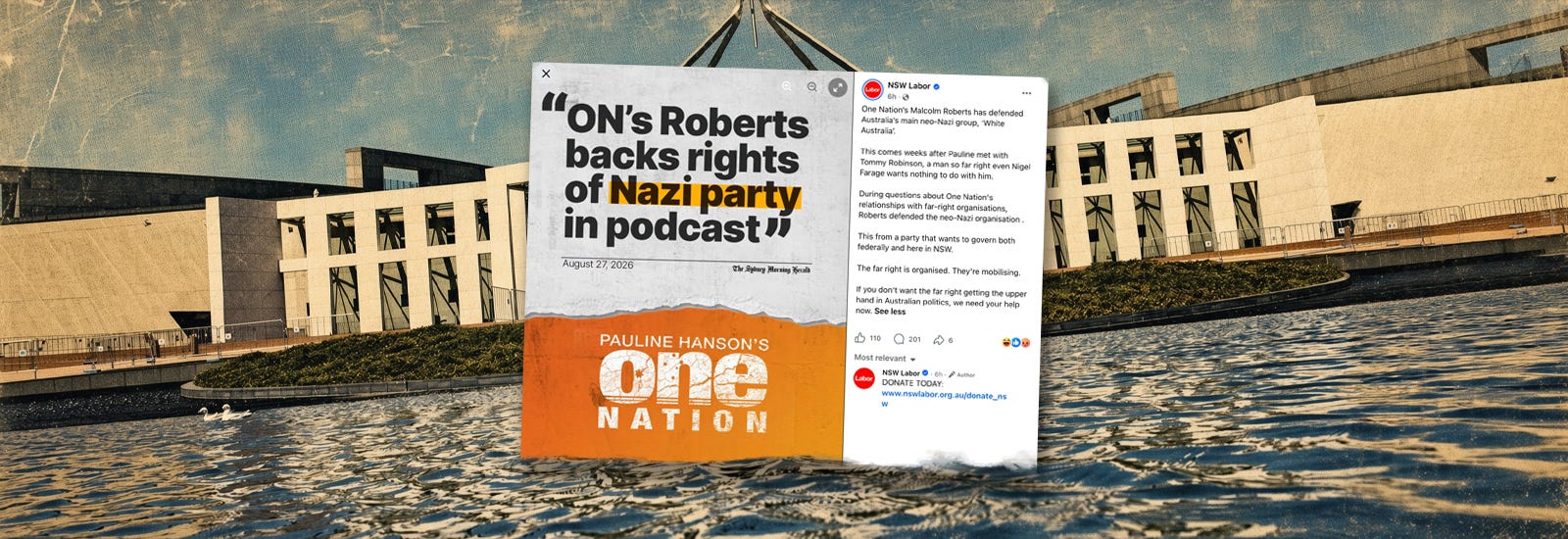
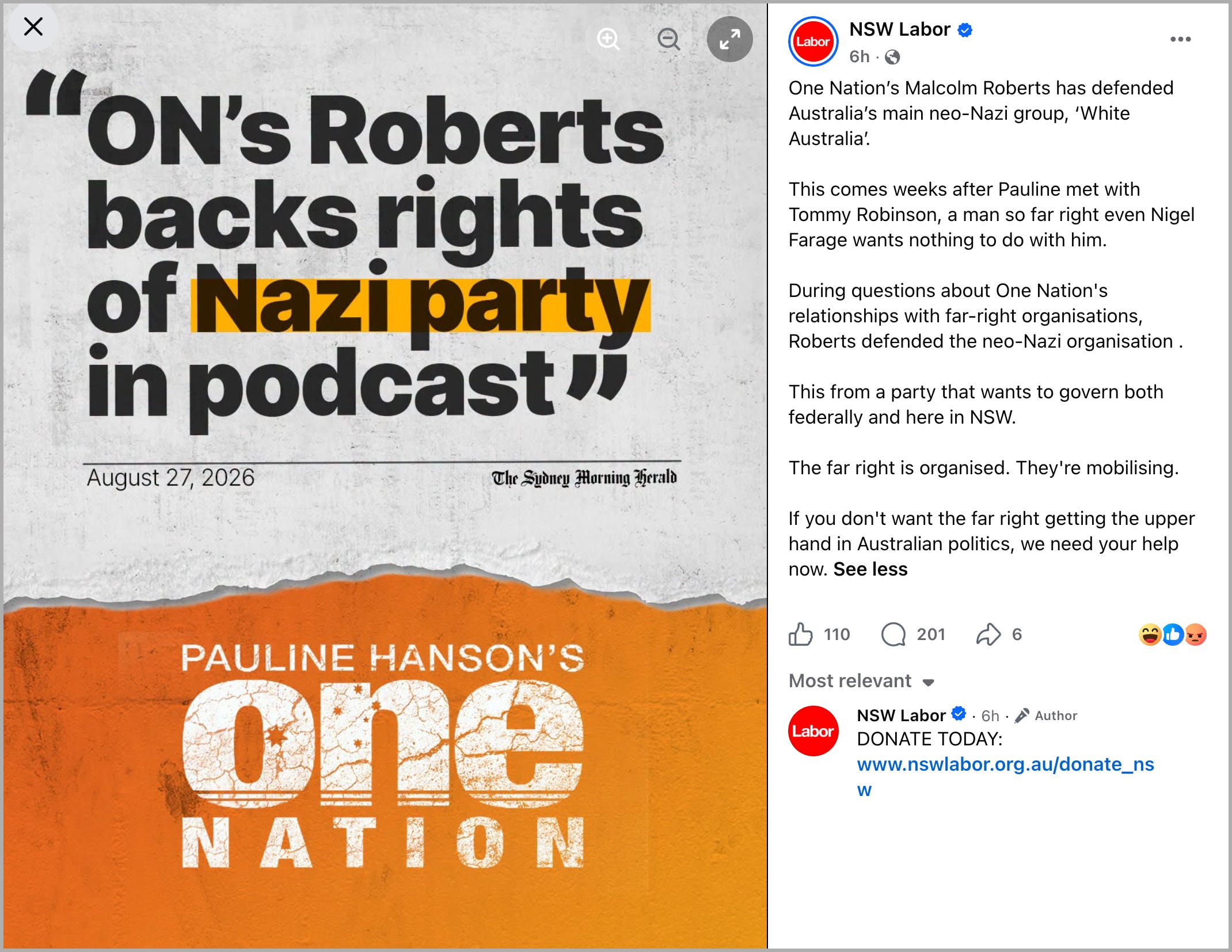
This week, the High Court in Australia is hearing a challenge brought by the White Australia Party against the Commonwealth Government’s decision to designate it a “prohibited hate group” under new federal legislation.
The designation was made by regulation in May. Under Part 5.3B of the Criminal Code, being a member of, directing, funding or otherwise supporting a prohibited hate group can constitute a serious criminal offence, carrying substantial prison penalties.
The White Australia Party is challenging the constitutional validity of the legislation itself. Among other things, it argues that the Commonwealth lacks the constitutional power to enact the regime, that it impermissibly burdens the implied freedom of political communication, and that it is inconsistent with the separation of judicial power under Chapter III of the Constitution.
But this isn’t an issue that should concern only supporters of the White Australia Party. You don’t have to agree with them, or anything they stand for, to recognise that giving a government the power to ban political organisations sets a precedent that should concern every Australian.
This is because the issue before the court is bigger than one political party. It’s about what happens when a government acquires the power to decide which political organisations Australians are permitted to form, support, and participate in.
That’s something that should concern anyone who values political freedom.
Let’s not forget how political elites and sections of the mainstream media characterised Christians and Christian organisations during the 2017 same-sex marriage plebiscite. Those who defended the biblical definition of marriage were routinely portrayed as motivated by “hate,” as though holding a traditional Christian position was not a legitimate contribution to a democratic debate, but evidence of bigotry, hatred and intolerance.
If being branded “hateful” is enough for the government to designate an organisation a “hate group”, how long will it be before churches face the same fate?
Yet democracy isn’t supposed to mean that the government decides which political opinions are acceptable and unacceptable for public life. Democracy, the kind of democracy that Australia so often prides itself on, means allowing citizens to hear competing arguments, form their own judgments and, ultimately, decide for themselves at the ballot box.
Sure, you might oppose the White Australia Party. You may believe Australians should reject its policies at the ballot box. That’s your right, and that is precisely the point.
The answer to a political opponent you dislike should ordinarily be political opposition, not political prohibition. Because once the principle is established that a government can ban a political organisation because it considers its ideology objectionable, the obvious question is: who decides where that power ends?
Perhaps today it’s a party you despise.
Tomorrow it could be a political movement you support.
The British Australian Community has raised precisely this concern, arguing that the law gives the executive government the power to shut an organisation out of public life without first proving criminal wrongdoing before an independent court.
In a recent press release, BAC President Harry Richardson argued that the regime allows serious consequences, including imprisonment for certain forms of membership, fundraising, or assistance, to flow from a ministerial designation rather than a criminal conviction.
The point is that punishment belongs in the hands of courts, not ministers.
If governments can remove political organisations before voters have the opportunity to judge them, the constitutional principle of representative government is severely undermined.
Our choices aren’t free if our options are selected for us.
Australia has confronted questions like this before. In 1951, the High Court struck down the Commonwealth’s attempt to dissolve the Australian Communist Party, finding the legislation beyond federal legislative power.
You don’t have to agree with the Australian Communist Party or the White Australia Party to understand that the state establishes dangerous precedent by undermining the rights of groups the public largely finds “indefensible.”
Who is going to stand up and say, “You can’t do that,” when doing so risks being accused of defending the “bad guys”?
To put it simply, this is about whether governments should be able to decide which political opponents are allowed to exist. That’s it.
If Labor truly believes in “democracy,” then it should trust Australians to reject “bad ideas” at the ballot box, not ensure that Australians can never vote on them at all.
That matters, especially when our governments are increasingly deciding which moral beliefs are acceptable and which are not.
What happens when the ideas deemed unacceptable include the moral teachings of Jesus?
We already know what they think of the Bible. We all remember the condemnation directed at Rugby player Israel Folau after he quoted 1 Corinthians 6:9–10 on social media.
At the time, Prime Minister Anthony Albanese called Folau’s beliefs “reprehensible” and “rubbish” that should be “called out” and “rejected.”
The question is not whether you agree with the political views of the White Australia Party. The question is whether you are willing to defend the principle of political freedom even when it protects people with whom you profoundly disagree.
Because the freedom you defend for your political opponent today may be the freedom you need for yourself tomorrow.
There’s something deeply unsettling about the Lindsay Clancy case. Not only because a mother is accused of killing her three children, but because of the extraordinary response to it.
Last week, after nearly six weeks of trial, a Massachusetts judge declared a mistrial after the jury failed to reach a unanimous verdict.
Clancy doesn't dispute that she killed her children. Her defence has argued that she was suffering from postpartum psychosis at the time and was therefore not criminally responsible for her actions.
Prosecutors argued that the killings were deliberate and that she understood what she was doing.
Whatever ultimately happens in court, the case has exposed something much bigger than the question of one woman’s criminal responsibility.
It has exposed a genuine confusion about life, death, responsibility, love and moral authority.
Hundreds of women have rallied in support of Clancy. Some have travelled to the courthouse. Many have worn pink and carried messages such as “Believe”, “She Needed Help” and “Peace for Lindsay”. Many of these supporters say the case represents the failure of society to take women’s mental health seriously.
Of course, there’s certainly a legitimate conversation to be had about postpartum psychosis. But there is another question that Christians ought to be asking.
Why does our culture increasingly struggle to distinguish compassion for a person from moral justification for an act?
And why, in particular, does the response become so confused when the person who has exercised lethal power is a woman?
The Garden of Eden is still with us
The Christian story begins with a temptation.
“You will be like God.”
That was the promise of the serpent in the Garden of Eden.
It was not merely a temptation to eat forbidden fruit. It was a temptation to seize God’s authority and to determine reality, morality and truth independently of the Creator.
Eve was invited to reject the fundamental distinction between Creator and creature.
And humanity has been repeating the sin ever since.
We want to determine for ourselves what is good and evil. We want to determine what constitutes a man and a woman. We want to determine what a human being is. We want to determine when life begins and when it may legitimately end. We want to determine what love is. We want to determine who is worthy of protection. We want to determine what constitutes freedom.
And increasingly, we want the state to recognise our personal definitions as objective reality and compel everyone else to live accordingly.
That is not merely a modern mark of progress.
It is an ancient spiritual rebellion.
The attempt to redefine reality
Just consider the cultural revolution surrounding sex and identity.
A person can now declare that his biological sex does not correspond to his identity, and society is increasingly expected to affirm the declaration.
We have seen arguments emerge around “transethnicity” in which people seek to redefine even their racial or ethnic identity according to their internal conception of themselves.
The philosophical principle here is that one’s internal perception determines external reality.
But that is not Christianity. Christianity begins with the opposite proposition.
Reality does not belong to us. It belongs to God.
“In the beginning, God created the heavens and the earth.”
God creates. Man receives. God defines. Man responds. God establishes reality. Man lives within it.
The creature does not get to become the Creator simply by asserting that he is.
This is why the modern argument over transgenderism is ultimately about something much deeper than pronouns. It is a question of who gets to define reality.
And the same question lies underneath the modern sexual revolution, the redefinition of marriage and the continuing attempt to redefine the boundaries of human life.
Who gets to define sin?
The same principle applies to morality.
The Bible does not present morality as something humanity collectively invents.
God defines good and evil.
Sin is not merely behaviour that happens to hurt someone’s feelings. Nor is righteousness whatever happens to be culturally acceptable at a particular moment.
Sin is rebellion against God’s order.
But modern man increasingly wants to reverse the arrangement.
We decide what is right. We decide what is wrong. We decide what is acceptable.
Then we demand that society affirm our decisions.
Isaiah warned about precisely this inversion: “Woe to those who call evil good and good evil.”
That is the perennial temptation of humanity: not merely to sin, but to rename sin. The sinner wants to become the moral authority over his own sin.
Then comes the redefinition of love
The same thing has happened to love.
Our culture constantly tells us that love means affirmation.
If you disagree with someone’s choices, you are hateful. If you refuse to affirm someone’s self-definition, you are hateful. If you believe that certain behaviour is morally wrong, you are hateful.
But Christianity says something radically different.
God is love.
That means love does not belong to humanity to redefine. God defines love because God is its source.
Christian love is not mere affirmation. Jesus loved people enough to forgive them—and enough to tell them to repent.
Biblical love does not require us to call darkness light. It does not require us to abandon truth in order to demonstrate compassion. And it certainly does not require us to pretend that an evil act becomes good simply because the person committing it was suffering.
The question of life and death
And this brings us back to Lindsay Clancy.
Because there is another authority that modern man has increasingly claimed for himself: the authority over life and death.
The abortion debate is perhaps the clearest example.
For decades, Western societies have argued that a woman has a right to determine whether her unborn child lives or dies.
The Christian objection is not primarily about women’s “autonomy.”
It is about God’s sovereignty.
Human beings are made in the image of God.
Therefore, human life has a value that does not come from its usefulness, wantedness, health, independence or ability to defend itself.
The unborn child does not have value because the mother wants the child.
The child has value because God made the child.
That is why the Christian position on abortion is ultimately a theological claim before it is a political one.
God gives life. God owns life. God defines the value of human life.
Man does not.
And yet our civilisation increasingly believes that human beings can decide for themselves who lives and who dies.
That is the same ancient temptation.
“You will be like God.”
When the right to kill becomes a form of power
There is a disturbing common thread in the modern discussion of life and death: the growing insistence that circumstances can transfer moral authority over life itself to the individual.
The abortion argument says, in essence, that a mother may possess the ultimate authority over whether her unborn child lives or dies.
The Clancy case raises the logical end of that question: what happens when that perceived authority extends to children who have already been born?
The answer cannot simply be that killing becomes acceptable whenever the killer is sufficiently distressed.
Mental illness can profoundly affect human behaviour. It can diminish a person’s ability to understand reality and control their actions. That is precisely why the criminal law must carefully consider questions of mental capacity and responsibility.
But we should be extraordinarily careful about what we teach society through our moral language.
A mother who kills her children is not a victim merely because she is a mother.
Her children are the victims.
Their lives do not become less valuable because their mother was suffering.
And their deaths do not become less tragic because their killer may herself have been psychologically unwell.'
Evil cannot kill God
There is an even deeper biblical pattern here.
Humanity cannot overthrow God. We cannot dethrone Him. We cannot kill Him.
So what does rebellion against God do? It attacks what God has made.
Genesis tells us that human beings are made in the image of God. That makes human life sacred.
And that gives murder its particular horror.
When Cain murdered Abel, he did not merely eliminate another human being. He attacked the image of the Creator.
This is why Scripture treats murder with such seriousness. The target is a human being. But behind the human being stands the Creator whose image that person bears.
Evil cannot destroy God. So it seeks to deface His image. Hence, it attacks the family. It attacks marriage. It attacks children. It attacks human sexuality. It attacks human identity. It attacks the sanctity of life. It attacks truth.
And ultimately it attacks the authority of the God who established all of them.
The problem is not that humanity has become too powerful
The great irony is that modern man believes he is liberating himself.
In truth, he is actually repeating Eden.
We have more technology. More knowledge. More medicine. More political freedom. More individual autonomy. More ways of expressing ourselves.
But beneath all of it is the same ancient desire: I will determine reality for myself.
I will decide who I am. I will decide what my body means. I will decide what love means. I will decide what marriage means. I will decide what constitutes a family. I will decide what is right and wrong. I will decide which human beings have sufficient value to live. And I will decide when killing can be justified.
That is not freedom.
It is the old rebellion dressed in modern rhetoric.
Christians should resist two errors
Of course, we should want women and families to receive excellent care long before a crisis becomes catastrophic.
But compassion does not require moral inversion. We can acknowledge suffering without denying evil. We can believe that a person needs treatment without pretending that the victim does not matter. We can believe that mental illness may affect criminal responsibility without declaring that killing is therefore morally neutral.
Because Christianity does not begin with the sovereignty of man.
It begins with the sovereignty of God.
Back to Eden
Perhaps that is ultimately what the Clancy case forces us to confront. The question is not simply whether Lindsay Clancy was mentally ill. It is not simply whether she should be convicted. It is not even simply whether our healthcare system failed her.
Those are important questions. But underneath them sits a question that Western civilisation has increasingly forgotten:
Who owns human life? Who defines good and evil? Who defines reality? Who defines love? Who determines the value of a child? Who determines when a human being may live or die? Who has the authority to tell us what a human being is?
The Christian answer is not complicated.
God does.
That is why the answer to our cultural crisis cannot ultimately be found in giving man still greater power to define himself.
We have tried that before. It happened in a garden. The serpent offered humanity the chance to become like God. And humanity took the bait.
Thousands of years later, we are still reaching for the fruit.
The tragedy is that every time man tries to sit in God’s chair, someone else ends up paying the price.
Sometimes it is the unborn child. Sometimes it is the family. Sometimes it is the confused and suffering individual. And sometimes, as in the Clancy case, it is the most vulnerable of all: children who trusted their mother to protect them.
The answer is not to become less compassionate. It is to become more truthful. Because only when we recognise that we are creatures, and not God, can we begin to recover the proper order of things.
God is God. Man is man. Life belongs to its Creator. And the image of God in every human being must never again be treated as though it belongs to us to erase—whether that life is inside or outside the womb.
The New South Wales Labor government’s multicultural calendar for schools has no designation for Father’s Day.
This is despite the calendar recognising Mother’s Day and Grandparents Day.
Dads don’t even get a mention in the state’s 2026 School Planner Calendar for Cultural Diversity.
The September weekend is instead dedicated to the false Hindu god Krishna Janmashtami.
Screenshot of the calendar.
Caldron Pool is highlighting this because Sunday marks the day for Aussie dads nationwide, who aren’t deadbeats and deserve recognition.
The second reason is the stench of hypocrisy coming from the government excluding dads from what is effectively the NSW government’s nod to inclusivity.
Additionally, ditching dads seems to be contagious.
As the Daily Telegraph (DT) reported today, “Teachers at a prestigious international French school have scrapped Mother’s and Father’s Day art and craft activities in the classroom in favour of a “more inclusive day.”
The Sydney primary school campus allegedly told confused parents in a Zoom meeting that the “new initiative” will merge those days into one “unified parents and loved ones day.”
DT writer Danielle Gusmoroli added that while parents are still permitted to celebrate the days at home, “instead of classroom activities, a “pedagogical” gift made by students will be given to dads for Parents and Loved Ones Day on June 1.”
One mother angered by the decision said, “We’ve been told that it is forbidden to do anything for Father’s Day until June 1, when it’s a unified celebration day.”
The change was “due to the risk of isolating students with two dads or those who have lost a parent.”
An “aggrieved dad” told Gusmoroli, “Mother’s Day and Father’s Day form part of the cultural landscape that helps children understand the world, like Christmas and Easter. For children, I believe that distinction matters”.
Quoting an email sent out by the school’s principal Abdellatif Achiq, DT said, “Classroom activities and gift-making in honour of mothers, fathers and special people will take place on 1 June, the UN’s Global Day of Parents.”
He also stated that the days would remain on the school’s calendar and “continue to be recognised separately as important traditions within our community.”
Western Australia director for Family Voice Australia, Daryl Budge, said “he was disappointed in the decision.
He told Caldron Pool, “The man-hating and the father-hating has to stop!”
“We have to celebrate and uphold the honour of protective and caring dads and granddads.
“They are a source of life to us, as Jesus is the source of life to His body, the church.
“Fathers and men,” Budge added, “were made to be fruitful and multiply children with mothers on this earth.
“They must be equally honoured and praised for their worthy work.”
The NSW Government move sends the wrong signals to society, especially dads and Australian men, who already rank as the highest demographic most likely to take their own lives.
The decision doesn’t just devalue dads; it adds to the further feminisation of education.
That point is something David D’Lima, National Alliance of Christian Leaders, warned about when talking with Vision FM on Thursday.
“There are a number of primary schools out there, public schools in particular,” he explained, “where there’s not one male member on staff except possibly the groundsman.”
Men matter.
“As I look back on my teaching career 35 years ago, there were a number of kids in the schools who did not have fathers.
“They would gravitate to the groundsman as he was pruning roses and mowing the lawn.
“He had a fatherly, pastoral ministry as groundsman in the school.
“What we’re facing is the feminisation of education, which means that schooling, which includes Sunday schools, is really “women’s business.”
That, D’Lima said, “sends the entirely wrong message to the young men we’re trying to raise up in our schools and in our churches. We absolutely need to restore the concept of Biblical Christian Manhood.”
He preceded this by saying, in effect, that we’re losing too much to the feminist philosophy that’s taking over our institutions.
We can’t separate the abortion issue from the immigration issue. Anyone who says abortion should be excluded from the current political debate has already misunderstood the nature of the problem.
Mass immigration, cultural decay, family breakdown, excessive taxation and the steady expansion of state power aren’t isolated problems. They’re symptoms of a much deeper crisis. Treating one symptom as though it’s the cause is like putting a Band-Aid over cancer. It might hide the problem for a while, but it doesn’t stop the disease from spreading.
That’s why isolating any one issue as the “real” problem is a mistake. Every one of these issues matters, and every one of them needs to be confronted. But none of them makes complete sense when separated from the deeper cause behind them.
At its heart, the West’s crisis is theological before it is political. Politics flows downstream from theology. When our understanding of God, man, morality and authority changes, our politics eventually changes with it. What we’re seeing across the West is the displacement of Christianity as the moral foundation of public life and the gradual elevation of the state into the position of ultimate moral authority.
Put simply, once there is no law above government, rights are no longer grounded in the inherent dignity of the human person. They become permissions; things the state can define, grant and ultimately take away.
That’s why abortion isn’t some secondary political issue. It goes right to the heart of this transformation. Once a society accepts that the state has the authority to determine who may live and who may die, it has abandoned the Christian principle that underpins every other right: the right to life.
And once the right to life becomes something the state can decide, why should we assume other rights are permanently secure? Property, speech, conscience, family and citizenship can all become conditional if they exist only because the state allows them to.
Without a moral order above the state — one that the state itself is accountable to — government becomes the final authority over what our rights are and who is entitled to them.
So it shouldn’t surprise us that the same state claiming authority over unborn life increasingly asserts authority over borders, taxation, education, national identity and culture.
If the state can decide who may live and who may die, then the underlying principle also allows it to decide who may enter the country, what may be owned and by whom, what a family is, and even what a nation is permitted to be.
These aren’t completely separate battles. They’re different expressions of the same underlying question: Who is sovereign?
That’s why focusing on a single symptom will never be enough. Abortion, immigration, family breakdown and the erosion of freedom all need to be resisted in their own right. But if we never address the root cause, the system producing these problems will remain in place — and new symptoms will keep appearing.
The West didn’t begin to decline because of one bad policy or one political mistake. Its deeper decline began when it stopped recognising any authority higher than the state.
Until that foundational error is confronted, we’ll keep fighting the symptoms while the system producing them remains untouched.
I once heard a preacher say that whatever God repeats is something he wants us to pay real attention to. This is a very common teaching technique.
Every teacher knows that much of what they say will not be retained by the person they are speaking to, so something which makes sense to do in every sermon, or every Bible study, or every teaching opportunity, is to make sure most of what you say reinforces the message you want to stick in people’s minds. So, when the Bible repeats something, you know that it wants us to pay attention.
We see this in the book of Proverbs, and especially on the topic of the dangerous, or contentious woman. If you read Proverbs 1-9 you will see that there is losts of advice for a young man to protect himself from the bad woman. For example, in Proverbs 7 we read,
“My son, keep my words, And treasure my commands within you. Keep my commands and live, And my law as the apple of your eye. Bind them on your fingers; Write them on the tablet of your heart. Say to wisdom, “You are my sister,” And call understanding your nearest kin, That they may keep you from the immoral woman, From the seductress who flatters with her words.”
It is important to teach our young men how to be respectful to young women, how to treat younger women as sisters, as Paul the Apostle says, and to guard their sexual desires until marriage. This is vital. But it needs to be noted that the Bible spends more time warning young men about the dangerous harlot than many modern Christians probably realise.
Today, we are trained to think of men as the sexually obsessed, and the woman as the sexual object. We have been taught this by movies and other media. But the reality is far more complicated. There are many women who take delight in weaponising their sexuality to corrupt or even destroy men.
It is true that a lot of women in the porn industry are there because they have been sexually groomed from a young age or even trafficked. This is a reality. But OnlyFans shows what happens when you create an almost free market and tell people to gather a fanbase with whatever assets they have. What happens is that women will turn that site into a porn star’s dream, direct access to their simps whom they can exploit at will.
In fact, part of how OnlyFans markets itself is as a Feminist-driven organization:
“As it’s grown, OnlyFans has sought to use explicit content – its seemingly bottomless source of revenue – as a springboard to greater scale, positioning itself as a tech pioneer with a place among social media giants such as Instagram and X. Key to that effort is making porn more socially acceptable and distancing the company from the abuses often associated with the industry.
The public face of OnlyFans is CEO Keily Blair, an Irish lawyer and self-described feminist and “safety nerd” promoted to the top job in 2023. In public appearances, Blair, 42, presents the platform as lucrative and empowering, particularly for women, and often mentions her two daughters. “I want them to have a good online life,” she told delegates at a UK child-protection conference in 2023. “I want the same for your kids.”
There is often discussion in conservative and Christian circles that one of the reasons that porn is so evil is because it exploits women, and we have to acknowledge that this does happen. But less often is the other prominent side of the problem with porn talked about: that a lot of women use it to exploit men, particularly younger men.
This discussion is changing; the language of simps is used to describe these men now, because many young men are becoming increasingly aware of how they are exploited by porn. Many now know that they are being exploited for their money, their time, their energy, and their devotion. They are waking up to this reality.
When we read Proverbs 7, we should immediately think of this kind of woman, a woman who knows how to exploit the simple-minded.
“For at the window of my house I looked through my lattice, And saw among the simple, I perceived among the youths, A young man devoid of understanding, Passing along the street near her corner; And he took the path to her house In the twilight, in the evening, In the black and dark night. And there a woman met him, With the attire of a harlot, and a crafty heart. She was loud and rebellious, Her feet would not stay at home” (Prov. 7:6-11).
Society is replete with these kinds of dangerous women, and many young men are sent into their embrace like lambs to the slaughter. In fact, in verses 21-22 of Proverbs 7, Solomon uses almost this exact imagery to describe the effect of these women on young men.
But we should not only think of the adulterous woman when we read this passage, or the porn star, even though this certainly should be our primary application. We should also think of the “loud and rebellious” woman who uses her sexuality to trap a man in marriage and then rule over him.
There is a stereotype of marriage, and just relationships in general, that a woman will use her sexuality to trap a man in a committed relationship and once she has achieved her goal, then she will drip-feed sexual attention as a means of control.
This stereotype exists precisely because it does happen often. But we should not see this as a stereotype of marriage as a whole, even though that is how people do see it; we should, rather, see it as a stereotype of marriage with the difficult woman. The difficult woman uses her sexuality to entrap a man and then to rule over him.
There are many men who live in this sort of arrangement, and they are relatively OK with it. In fact, not only are they ok with it, from their perspective it “just is what it is.” In their view, this is what marriage is. After all, the common stereotype has told them that. As the joke often goes in sitcoms, “When was the last time you had sex?” “Are you kidding, I am married!” is the reply.
If you watch shows like Everybody Loves Raymond from the late 90s, you will see how the media presented marriage as a relationship where a man longingly desires sexual attention, and it is drip-fed to him by his wife when he has done the right thing and earned it. Shows like this should be seen less as a description of reality and more as an attempt to shape reality. But whichever way you perceive it, there is this understanding in culture that marriage is, in general, a sexual wasteland.
Why?
Because of this idea that a woman will use sexuality to entrap a man into a relationship. And the truth is that the difficult woman will do this. Many men have experienced this.
This is why this discussion of Proverbs 7 is so important for this third article in our series about How to Handle a Difficult Wife. Solomon is warning men to watch out for that woman. To watch out for the kind of woman who will use their sexuality to entrap you. To watch out for the adulterous woman who says,
“Come, let us take our fill of love until morning; Let us delight ourselves with love. For my husband is not at home; He has gone on a long journey; He has taken a bag of money with him, And will come home on the appointed day” (Prov. 7:18-20).
To watch out for the woman who will sell you her body online and trap you into a simping relationship. To watch out for the woman who will honeytrap you into a relationship.
There is a reason why the Bible commands that young men and women avoid sex before marriage. This is to protect them both from the dangers of promiscuity. The problem is that our modern culture is set up to encourage most young people, even Christians, into exploring before cleaving. This sets up many young women to be used by men of a reasonably high status for their temporary enjoyment, and it sets up many young men to find themselves being trapped by the very kind of woman that Solomon warns about. The Bible’s advice is not prudish, but it is prudent.
What is the difference, you ask?
Well, ‘prudish’ is a slang term for someone who is “easily shocked by matters relating to sex or nudity…or…excessively concerned with sexual propriety…” But can you call a book wherein God commands a prophet to walk around naked, another prophet to marry a prostitute, and which uses the words “whore”, “harlot”, or “prostitute”, in hundreds of references “easily shocked by matters relating to sex”? Of course not.
God is all-seeing, which means he has seen it all, and his word speaks about these things without embarrassment so that we can be led in the right direction and away from certain danger, which is what prudence refers to. A prudent person is someone who shows care and thoughtfulness for the future.
If you allow yourself to become trained to be a simp, to be ensnared by the porn star, then you are training yourself to be exposed by the harlot to this kind of weakness with women. So, to prevent this, you need to be “master of your own domain.” Rather than simp after the “loud and rebellious” woman, you need to shun her from your life.
You should aim to be married at a young age, so you can build as much of your life with your wife together as possible. But it is better to take your time to master your own domain, so that when you are searching for a woman, you are clear-headed, and not in as much danger of being the lifelong simp that so many men become.
Thanks for reading! This post is public so feel free to share it.
Porn should not just be avoided because it is immoral. Though that should be reason enough. It should also be avoided because it weakens your ability to be the clear-headed, respectable man that a woman will want to submit herself to for life, and live under your frame. A man who can control himself and not be walked all over.
Why do you think that the self-proclaimed feminist CEO of OnlyFans describes the site as “lucrative and empowering” particularly for women? Because it trains young men to become lifelong simps. It trains them to think that living under the thumb of a contentious woman is what marriage is.
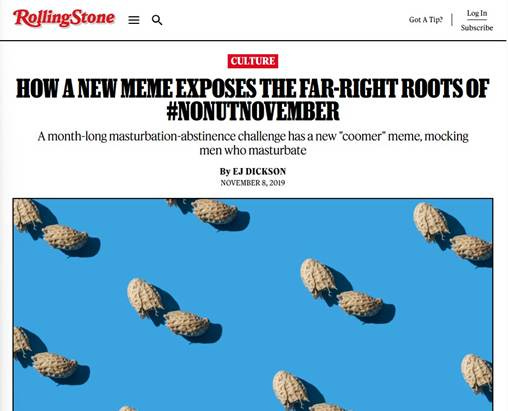
Why do you think the Rolling Stones is concerned that men shunning porn is a right-wing phenomenon?
Because avoiding the trappings of porn and masturbation helps men break out from under the spell of what could turn them into lifelong simps. A man who diminishes himself in this way is much more likely to fall into a relationship with a woman who uses sex to draw him in and then use it to dominate him for life.
When feminists and progressives basically confirm what Solomon says, but from the opposite direction, you should really listen to him.
But many people reading this will be thinking, “How does this help me with my difficult wife? I am already living in this kind of situation.” You are right; my article here is more preventative than directed at transforming an already broken marriage. The correlation between a woman who constantly berates her husband and one who has turned down the sexual tap over time is very high. So, what is your recourse?
Well, remember, look at what Solomon repeats and therein you will find wisdom. In Proverbs 21:9, Solomon says this, “Better to dwell in a corner of a housetop, Than in a house shared with a contentious woman.”
Just in case the message has not landed, he says again in Proverbs 21:19, “Better to dwell in the wilderness, Than with a contentious and angry woman.”
And for those who are particularly hard of hearing, he again says in Proverbs 25:24, “It is better to dwell in a corner of a housetop, Than in a house shared with a contentious woman.”
Three times Solomon writes the same thing. He slightly changes the illustration, but he repeats the same principle three times. If your marriage has descended from a relationship of mutual love and regular affection initiated and reciprocated on both sides, into a situation where the wife is constantly at you and has nothing but contempt for you, then you need to be willing to live anywhere but with her.
In fact, many men find that when they make this decision, that is often when things start to turn around. Hence, being willing to shun the contentious woman and live somewhere else, ironically, is one of the more effective ways of reigning in the contentious woman.
Of course, this is not guaranteed to be successful and is often not. Solomon speaks more in principles than in promises. Some marriages are just too far gone, even he recognizes this, “A continual dripping on a very rainy day And a contentious woman are alike; Whoever restrains her restrains the wind, And grasps oil with his right hand” (Prov. 27:15). Sometimes you have failed to assert yourself for too long, or worse, you have made so many mistakes in your marriage that she cannot bring herself back into fellowship with you because all love and marital duty has been drained and the affection that was once there is long gone.
But even if it does not work, Solomon’s words are wise. Some people will say you have to stay and serve her, and live like roommates for life, even though what made your relationship a marriage is functionally dead. And yet Solomon says the opposite. Why?
Because the Bible has an insight into human nature that often those of us who follow its ways do not; until we have seen it applied properly, at least. I think behind many, not all, but many contentious and unruly women is fear. Sometimes it is not this; it is just a bad woman.
But remember, I said in my first piece in this series that any woman can become the bad or difficult wife if her husband sows enough negativity. Some women react to this by becoming the difficult wife. It is not what they want to be, it is not what they intended to be, and driving the man away is not their end goal. Sometimes seeing the consequences of her speaking to her husband this way, as he plans to live in his tent somewhere else, will bring her to repentance.
So, sometimes, to save your marriage, you have to be willing to shun it. It sounds counterintuitive. But I think this is at least part of what Solomon’s advice points to, and I have seen this applied in this way, and I have seen it turn things around.
As I said, this is not a guarantee. But then in this fallen world you can do everything right and still things can go wrong. Such is living on this side of paradise…
“After I began to get dressed, I’d realized that I’d done it. I’d just had sex like a man. I left feeling powerful, potent, and incredibly alive. I felt like I owned this city—nothing and no one could get in my way.” — Carrie Bradshaw (Season 1, Episode 3: “Bay of Married Pigs” Sex and the City)
The television show Sex in the City popularises the cultural idea that sex is detached from commitment. Ideas have consequences, and this view has had significant legal and relational consequences.
Sex and the City was a television series that ran through the late 1990s and early 2000s. Across 94 episodes, it followed the lives of career-minded women in New York as they pursued career and sexual freedom. Sex and the City was a biographical retelling of Candace Bushnell’s relationship journey (disguised so her parents would not realise that it was her personal story).
The series promoted an idea that sex was a transactional encounter between consenting adults. In decades to come, it formed the mindset behind apps such as Tinder, where sexual intimacy could be pursued with minimal expectation of permanence.
Sex, detached from covenant, consequence and commitment.
Over the last couple of weeks, the concept of transactional sex without consequences has been played out in every tabloid newspaper across Australia. Five footballers now referred to as the ‘Pullman Five’ invited ‘Exotic Dancers’ into their hotel room. Allegations of sexual assault have stemmed from that night, and the Pullman Five have been stood down for the remainder of the season. Pictures of the distraught fiancés and girlfriends of the Pullman Five soon followed.
In 2025 Lachie Neale admitted that he had an affair with his wife’s best friend. This week his shattered wife gave a tell-all podcast. Her now estranged best friend then gave her own response on a separate podcast show, thereby escalating the sad affair.
How much pain and grief have stemmed from liaisons of these young men who seemingly had it all. Private pain has had a public fallout, and the sexual consequences of five men have had consequences far beyond the short private moment of the liaison.
There is a dreadful fallout to the notion that sexual freedom is cost-free. Sex is not free.
I have seen that fallout closely in legal practice. Over the past nine years, I have represented abused girls, accused men and institutions affected by sexual offending, false allegations and relational breakdown.
One does not easily forget walking down to the cells to meet a young man whose sexual liaison has landed him in a police station. The terror in his eyes asks the same question each time: how did it come to this?
One does not forget sitting with a young woman who has been violated and is then required to recount her trauma to another person in a moment by moment analysis.
One does not forget the relief when an accused person proves before a jury that he did not commit an offence and was the subject of a false complaint.
One does not forget the stress and anxiety an institution suffers when a non-consensual sexual incident occurs on its premises.
One does not forget a sobbing wife standing in the lobby of your office having discovered that her husband had left her.
There is horrific fallout when sex is non-consensual, as there should be. But what has also staggered me is the significant fallout that can occur when consensual sex takes place outside its proper bounds, the commitment of a marriage relationship. Family law regularly encounters the wreckage of affairs, new relationships and broken trust. Parties spend enormous sums contesting property settlements or parenting arrangements driven often by the grief, humiliation and betrayal of a sexual affair.
There are relationships in which abuse makes separation necessary, and nothing in this essay should be read as minimising that reality.
The point of this article is narrower: our culture is often surprised by the depth of the fallout that follows sexual conduct, but it ought not be. Sex and commitment reveal that there is a moral reality in this world to which all are beholden.
Consider this thought experiment. If a man approaches a woman and puts his finger in her ear, he will be regarded as a creep or an idiot, a delinquent, but the incident will soon pass. But if a man approaches a woman and engages in a sexual act towards her, the consequences will almost inevitably be severe. If the act is non-consensual, criminal consequences will follow with certain jail time. If it is consensual, the consequences will still be profound: a marriage may end, relationships with children will be impacted, and families will be estranged and parties out of pocket tens of thousands of dollars.
Having sex like a man, i.e. having multiple relationships, simply does not work and culture knows this.
How much pain will society have to take before we realise that the message of Sex in the City was flawed?
The law has developed elaborate frameworks for dealing with the fallout of broken relationships. In Australia, the Family Law Act requires property settlements to be just and equitable, a principle confirmed by the High Court in Stanford v Stanford. In parenting matters, section 60CA of the Family Law Act provides that the best interests of the child are the paramount consideration. In England, a similar concern for fairness can be seen in White v White, where the Court discussed the “yardstick of equality” in financial division.
These doctrines are not merely technical rules. They are a cultural admission that intimate choices of two parties create obligations the law must later attempt to order, and it is complicated to unwrap this.
The very complexity of these legal principles challenges the notion that love is simply free. If sex were merely physical, recreational or transactional, the law would not need to devote so much energy to untangling its consequences as it presently does.
Family law, criminal law and institutional liability all testify, in different ways, that sex is never only private.
Private acts have public consequences.
Sex has consequences because it is the most intimate of acts. Sex is imbued with moral meaning.
The grief on the face of the betrayed spouse tells us as much.
The guilt on the face of the unfaithful partner tells us as much
Sex is shaped by love and grounded in the commitment two people give to one another. It is therefore a moral act. Sex, therefore, carries a sense of permanence. Spouses and partners become the moral centre of public stories when sexual betrayal is exposed. As a society, we instinctively recognise that sexual betrayal is not morally neutral. We are not usually drawn to the cheater; we are drawn to the wronged party.
Christianity does not treat the body as disposable or the sexual act as morally weightless. It sees the human person as embodied, relational and accountable before God. That account may sound strange in a culture that prizes autonomy, but it explains why sexual decisions so often outlast the moment in which they are made.
I have spent too many hours in a professional context dealing with the fallout of misplaced sexual liaisons, and so I keep returning to the question: why? This article is borne of the fact that too many people in my nine years of practice have spent too much money because of one act that simply didn’t need to occur.
Sex is not unique to human beings, but the moral and relational consequences of illicit sex are uniquely human. Sexual misconduct can produce scandal, betrayal, litigation, estrangement and lasting grief.
The law can manage consequences, but it cannot finally explain why those consequences cut so deeply. A Christian understanding of the human person can. We live not in a moral vacuum, but in a moral universe in which sex touches the body, the conscience, the family, the community and, ultimately, the soul. That is why sexual betrayal wounds, why sexual abuse devastates, and why even consensual sex outside commitment can leave damage far beyond what the language of private choice is able to describe.
The cultural promise was that sex could be liberated from consequence. The legal record suggests otherwise. The Christian claim goes further: sex has consequences because sex has meaning, and its meaning is bound up with love, covenant and the eternal dignity of the human person.
That is why Sex in The City remains such a powerful cultural image. It promises freedom without permanence, intimacy without covenant and pleasure without moral cost.
Sex in its proper place tells a truer story. Sex belongs within a moral order that law can only partly perceive.
Sex reveals there is a moral order.
Embrace the moral order; stay committed to your partner. Grow old together. Stay married. You will save money on lawyers.
Harry Richardson, President of the British Australian Community, speaking at the Sydney Free Speech Rally on 30 August 2026:
First, an acknowledgement. The BAC would like to acknowledge the Anglo explorers, the pioneers and their descendants who planted the British flag and Christian faith on this continent, creating the Australian nation. We acknowledge the Aboriginal and Torres Strait Islander peoples who have lived here since the Dreamtime.
And we acknowledge the Federal Commonwealth of Australia, created by the nation, under the Crown, to guard the nation and the liberty of all citizens. Today, in 2026, there are few countries that have free speech. The ones that do are mostly European or European-derived.
Yet in England, Sir Edward Coke insisted that freedom of speech was an ancient custom of Parliament. That was in the 1590s, more than 400 years ago. I grew up in England in the 60s and 70s and played out in the street every night.
And once in a while, some kid would come running into his mum and say, Mum, Johnny called me an idiot. And the answer every kid got from his mum was the same. Go and tell Johnny, sticks and stones can break my bones, but names will never hurt me.
In other words, grow up and take it on the chin. Hurty words won’t damage you. People have a right to insult you. Deal with it.
This was the ancient culture of free speech that we were marinated in as we grew up. But whilst in the atmosphere and parts of Western Europe, free speech was a foundational part of our culture, in the rest of the world, it mostly wasn’t.
Saying the wrong things could have you punished or even killed. Our leaders used to tell us that we were an anomaly, because we were a European country in Asia. Now they tell us that we’re not a European country at all and never were.
They say that the only defining feature of Australians is their values. They say that anyone could come here and adopt our values and instantly be as Australian as anyone else. But in order to bring in people from such diverse backgrounds, one of the first things they had to do was to shut down our free speech, which is one of our most precious values.
In 1975, just three years after Whitlam decided to abolish discriminatory immigration, our elites introduced the Racial Discrimination Act, which began the process of cramping down on free speech in order to facilitate a diverse society.
But that wasn’t enough, of course, so later they added the hated 18C. Then when Tony Abbott promised to repeal 18C, a coalition of diverse minorities got together and made damn sure that he would do no such thing, even though it was a foundational value of the Anglo-Celts who settled and built this nation.
Now even that isn’t enough, so they bring in the anti-Semitism and hate speech laws, which are even worse. And this isn’t the end of it. You mark my words.
The destruction of free speech has been intertwined with the project to force multiculturalism onto Australia. If you don’t believe me, Chris Minns, the New South Wales Premier, spelled it out for you. He said, and I quote,
“We don’t have the same freedom of speech laws that they have in the United States, and the reason for that is that we want to hold together a multicultural community.”
So there you have it. We can’t have free speech anymore because now we’re multicultural. We all need to understand that.
When we choose migrants, most of us want people with the same value systems as we have. But how do we make sure that people share our values before we give them a passport to one of the richest countries in the world?
Well, our founders wrestled with this idea and came up with a simple solution. It wasn’t perfect, of course, but it was the best they could manage. They decided to restrict entry mostly to people from the British Isles and to a lesser extent Western and Northern Europe. Some people called this the White Australia Policy.
Why did they think that people from Britain would share their values and loyalties? Well, probably because our founders were of British descent, and they were very explicit about that.
Henry Parkes, the father of Federation, talked about the crimson thread of kinship. His views were hugely popular. So they ran this policy for the first 70 years or more after Federation, and not surprisingly, most of the migrants shared the same values as other Australians.
They believed in freedom of speech, the rule of law, Christian morality, and the Protestant work ethic, and so on. During this time, the policy was wildly popular with the citizens of the nation, and the nation flourished. Australia had a high standard of living, low levels of crime and corruption, and all the benefits of a high-trust society.
Importantly, we had a deep cultural affinity for free speech, which we understood was the bedrock of the kind of free and stable society to which we were accustomed to. But our elites decided to introduce non-discriminatory immigration, which benefited minorities. They told us that this wouldn’t matter, because the new migrants would have our values.
But when people found that many new migrants had different values, the government crushed dissent by clamping down on free speech. The problem is that once the government gets the right to ban speech they don’t like, it never stops, because they love to ban criticism of their own policies. And the policy that most people wanted to criticise was mass indiscriminate immigration.
So multiculturalism and immigration have been protected by constantly undermining our ancient free speech rights and values. In Britain today, thousands of people are arrested every year for expressing opinions, and most of those opinions are in opposition to mass indiscriminate immigration. Free speech is effectively dead in that country, and Australia is catching up fast.
You can’t import people en masse from countries with different value systems, and expect them all to adopt our loyalties and value systems the moment they arrive here. It isn’t easy to defend free speech, even amongst educated Westerners. How can we expect people who’ve grown up in cultures which hate free speech to suddenly embrace it? It was never going to work.
Just ask Salman Rushdie. Under our current immigration system, only about 3-5% of migrants come from the British Isles, and 90-95% of our new migrants come from outside Europe. These new people come from countries with different values, and for the most part, free speech is not one of them.
Values exist in the minds of people, not in the magic soil or floating in the air. Different people have different values. If we allow the government to turn us into a hated minority in this land, then don’t expect our values to hang around.
So this is the game. They want to shut down your free speech so that they can bring in more people who don’t believe in free speech. We have to fight these laws and preserve our free speech, or as George Washington said, it may be taken away, and dumb and silent we may be led like sheep to the slaughter.
Birmingham City Council, Britain’s largest local authority, has gone to the High Court to stop residents putting the Union Jack and the St George Cross on lamp posts without its say-so.
If a judge grants the injunction, breaching it could mean up to two years in prison or an unlimited fine. Yeah, you can be imprisoned for the unauthorised raising of your own nation’s flag.
The application, which was filed on August 26, names eight people directly, including Ryan Bridge, who co-founded the grassroots Operation Raise the Colours campaign that’s put English and British flags on street furniture across the country over the past year, plus a catch-all “persons unknown” clause that leaves the net open to anyone who does the same thing.
The council insists this isn’t really about the flag. Green councillor Jane Baston, Birmingham’s cabinet member for equalities and communities, called it a lawful, proportionate, and evidence-led approach to unauthorised attachments on the highway. She cited public safety and staff welfare as the actual concerns.
Birmingham isn’t the first. Oxfordshire County Council won a similar High Court order back in April, the first council to do so.
But nobody’s buying the “neutral policy” framing. Multiple outlets have noted that this enforcement push applies to English and British flags specifically, while flags from other countries flown elsewhere in the city haven’t drawn the same court action.
And yet, if the English and British flags are problematic, what do foreign flags flown in Britain communicate? Nobody plants a flag as mere decoration. It’s a claim of belonging: this is ours, we’re here, we stand under this, this represents who we are.
Take a flag down and put nothing up in its place, and you’ve made a slightly different, quieter claim that whatever it stood for doesn’t get to be visible here anymore. At the very least, the land no longer exclusively belongs to those that the flag represents.
That’s true whether it’s a war memorial, a town centre, a local council, or a lamppost.
The St George’s Cross has flown over England for the better part of a thousand years. A red cross on white, adopted from the banner of England’s patron saint and tied to the Crusades before it ever became a national symbol.
The Union Jack layers three Christian crosses on top of one another: St George’s cross for England, the blue-and-white saltire of St Andrew for Scotland, and the red saltire of St Patrick for Ireland.
It’s not an abstract or arbitrary pattern. It’s the patron saints of the home kingdoms stitched into a single piece of cloth. It’s a literal union forged from shared ancestry, homelands, and Christian inheritance.
Of course, none of that is what Birmingham’s injunction talks about. They use the rhetoric of “unauthorised attachments” and “community cohesion.” But it is curious how all of these multicultural efforts result in the same thing: no native Britons, no English imagery, and no Christian symbolism.
But let’s suppose, for a moment, that Birmingham’s neutral framing here is entirely accurate, and that the council is genuinely concerned about “unauthorised attachments” undermining social cohesion and fracturing the community.
If that’s the case, then we should be asking another obvious question: What does it say about the state of those communities if displaying the national symbols of the country is supposedly enough to threaten social cohesion?
If newcomers and immigrant communities regard St George’s Cross and the Union Jack as so provocative and offensive that their mere presence on a lamppost is deemed a threat to community cohesion, what does that suggest about their relationship and commitment to the nation those symbols represent?
In that case, the problem isn’t the flag or what it represents. The problem is a failure to integrate people into a shared national identity. The problem is the importation of attitudes that are so hostile to that identity that even its most basic symbolism has become something to be suppressed rather than celebrated.
A Catholic priest based in the West Bank is asking Christians not to flee.
Father Firas Khoury spoke with Catholic news site Aleteia, saying, “What if all the Christians flee from the Holy Land, if they could not face the terror? What would this land mean for Christians in the West?”
“What would their story mean?”
It would mean, “shrines and history will never tell you the story of the man from Nazareth.”
Khoury, who lives in Zababdeh, a town in the northern part of the West Bank, spoke out because of trouble with Israeli settlers in Taybeh.
According to Khoury, what’s going on there is serious and deserves worldwide attention.
“For the last three years, settlers have attacked the villages near the settlements and burned the olive trees and the fields belonging to the Palestinians.
“These settlers,” he claimed, “want to terrorise the people to flee and leave their homes.
“If they control the city, they could delete the long Christian history of this place.”
This is why he wants Christians to stay. “Their presence keeps alive the story of Jesus in the land where he lived,” Aleteia reported.
Khoury is that concerned, he’s “begging” Christians around the world to “stand for justice and solidarity with the Christian community there.”
His goal is to see “Taybeh survive.”
This is part of a broader series of clashes across the territory between Israelis and Palestinians.
The West Bank priest told Aleteia, “We invite you to pray for us and hear our stories and come to visit; we have many stories to tell you.
“We need you to stand for peace, to listen to the Christian Church in the Holy Land and stand with us, your brothers and sisters.
“Today, we are trying to survive in the middle of the conflict.”
That conflict is due to Israeli settlers violently attacking Taybeh’s residents.
In response, Israel’s military closed Taybeh to non-residents, telling Reuters it was being done “to prevent the attacks.”
This is still in effect and “only applies to Israelis and not to Palestinians,” the IDF said.
In a statement quoted by Reuters, they added, “Upon receiving any report of violations of the order, IDF soldiers are dispatched to the area.”
They then “operate to disperse the gatherings and detain suspects in order to protect the citizens of the area and to maintain order.”
The Times of Israel’s Tom Livny described the town as a “closed military zone,” and it will be so for at least a year, he said.
Two “activists” also told him that the closure “will have a severe economic impact because Taybeh, rich in Christian heritage, relies heavily on its tourism industry.”
Questioning the official military narrative, Livny said, “If the reason for this move truly was the settler attacks, then why should tourists from Brazil be prohibited from entering?
“If,” he added, “residents can’t earn an income, then they’ll leave.”
Appearing to suggest that this could be the real reason for the IDF action, Livny asserted, “they don’t even want Christians to be living there.”
The left-leaning Jewish activist also called the whole experience weird.
“Shoving a camera in their faces and blocking their way from trying to get through a fence around someone’s home is about as aggressive as you are allowed to behave.”
Saying he wasn’t sure what the IDF’s presence had fixed, Livny said, “All of the settlers that I saw had their faces mostly covered with bandanas. That may be a precaution against having their faces appear on camera in a place they aren’t allowed to be.”
The people behind the attacks on Taybeh’s residents tend to be “kids and young men riding their donkeys around people’s property.”
They appeared to be doing this to “make them afraid and uncomfortable, and waging a very patient war of attrition until they finally give up and pack their bags.”
“There is absolutely no logic in closing the road,” Livny remarked.
“The settlers don’t use cars; they travel by donkey.
“So, in other words,” he concluded, “the entire town could have ended up being sealed off as a punishment for being harassed by settlers.”
Livny’s account gives weight to Khoury’s complaints.
Independent Catholic News published a letter from the priest on 25 August, in which he stated that the IDF presence and new settlement in Zababdeh, near Jenin, is making life difficult.
“What we are experiencing,” he said, “should not remain unknown.”
Screenshot from NSW Labor’s official Facebook page.
The ad reads, “ON’s Roberts backs rights of Nazi party in podcast.”
Labor NSW appears to treat it as scandalous that One Nation Senator Malcolm Roberts “backs the rights” of a particular group of people. Which seems to suggest that Labor believes one’s political views determine whether their “rights” are worthy of recognition?
But there’s an important distinction between disagreeing with a political position and questioning whether the people who hold it are entitled to the same rights as everyone else. The former is legitimate political debate. The latter is a little more disturbing. And it appears to be a position that Labor unashamedly embraces.
They may not intend to make this argument, but the ad, at least, inadvertently exposes an underlying assumption that some people’s rights become less legitimate, or less deserving of support, depending on which side of the political spectrum they occupy.
But “rights” aren’t supposed to be rewards for holding the correct political opinions.
If a right is genuinely a right, it doesn’t cease to be one because the person exercising it votes differently, belongs to the wrong political movement, or holds unpopular views.
You can strongly oppose a political group. You can reject its policies. You can argue that its thought-leaders are dead wrong. But the moment you start treating the rights of a particular group as objectionable simply because you don’t agree with their ideas, well, you’ve become the fascist you’ve been resisting.
Labor appears to think your rights depend on your politics. Consider the implications of that for just a moment.
If your rights are only worthy of recognition when they are defended by the politically approved people, then they aren’t really rights at all. They are privileges, granted by the state to those who hold the right opinions and denied when they don’t.
That’s a far more revealing message than Labor’s attack ad probably intended to send. It’s not One Nation that’s endorsing authoritarian politics. It’s Labor.
A two-year Tasmanian parliamentary inquiry has landed its heaviest blow yet on a faith-based school system, finding that Catholic Education Tasmania (CET) discriminated against staff over their sexual orientation and marital status — a finding CET flatly disputes.
The Inquiry into Discrimination and Bullying in Tasmanian Schools began in June 2024, after national data showed Tasmania had the country’s worst schoolyard bullying rates. Two years, 55 findings and 33 recommendations later, its final report — chaired by Labor MP Brian Mitchell — reserves some of its sharpest criticism for the state’s Catholic system, which runs 39 schools across Tasmania.
The committee concluded CET’s hiring practices were in breach of the state’s Anti-Discrimination Act 1998. But importantly, this is a parliamentary committee finding, not a court ruling, and the interaction between Tasmania’s legislation and Commonwealth anti-discrimination law has not been judicially determined.
The finding rests partly on testimony from Gerard Gaskin, CET’s former executive director, who told the inquiry back in February 2025 that people whose public lives conflicted with Catholic teaching would not be employed in senior leadership positions. A former deputy principal also told the committee that his marriage breakdown and subsequent de facto relationship led to him being stood down and ultimately told he could no longer work as either a leader or teacher within Catholic Education Tasmania.
CET isn’t backing down. The organisation maintains it operates under, and complies with, the federal Sex Discrimination Act, which contains a specific exemption allowing religious educational institutions to discriminate in certain circumstances where doing so in good faith is necessary to avoid injury to the religious susceptibilities of adherents. The exemption covers attributes including sexual orientation and marital or relationship status. Current executive director Terry McCarthy says the organisation takes the findings seriously and remains confident its employment practices are lawful.
Here’s the part that should worry every Christian institution in the country, not just Catholic ones: two Liberal members of the committee, Michael Ferguson and Mark Shelton, tried to soften the finding by adding the words “may have”, and were voted down five to two. In their own dissenting statement, the pair warned the report risked trampling “freedoms of belief and family choice” — a warning that deserves a lot more attention than it’s getting.
Because that’s really what’s on the line here. A Catholic school declining to appoint a senior leader who publicly rejects Catholic teaching on marriage isn’t simply an ordinary employment decision — it’s bound up with the entire reason a religious school exists in the first place. If the state can ultimately require CET to treat faithfulness to Catholic doctrine as an unlawful hiring criterion, there’s no principled reason it couldn’t raise the same question for any Christian school, or church-run charity, anywhere in the country.
Independent MP Kristie Johnston, who moved the motion that established the inquiry back in 2024, wasted no time turning the finding into political ammunition, pressing Premier Jeremy Rockliff in parliament over what he intends to do about it. Rockliff didn’t commit to anything beyond the usual line about expecting everyone to follow the law. Equality Tasmania’s Rodney Croome has gone further still, calling for the matter to be pursued rather than leaving the fight solely to individual victims of discrimination.
That should tell you where this is heading. This report isn’t necessarily the end of the story — it could become an invitation for activists and government lawyers to take the dispute further and, potentially, use the courts to settle once and for all how Tasmania’s anti-discrimination laws interact with the protections afforded to religious schools under Commonwealth law.
And Tasmania isn’t acting alone. New South Wales is running its own review of anti-discrimination law, one that includes consideration of the religious exemptions affecting faith-based organisations and schools. The pattern is worth watching: another inquiry, another “review,” another set of recommendations, all potentially affecting the amount of room faith communities have to run their own institutions as they see fit.
The report’s other findings — on bullying rates generally, on First Nations students, on gifted kids falling through the cracks — deserve real attention, and nobody disputes Tasmanian schools have genuine problems to fix. But burying a religious freedom fight inside a bullying report doesn’t make it any less of a religious freedom fight. If a Catholic school can’t require its leaders to actually live like Catholics, what’s left of “Catholic” in Catholic education?
“Be watchful, stand firm in the faith, act like men, be strong. 14 Let all that you do be done in love.” 1 Corinthians 16:13-14
You have all heard the song, “R-E-S-P-E-C-T, that’s what your love means to me!” This song, Respect, is well known around the world as Aretha Franklin’s greatest hit. But what a lot of people do not know is that before this song was taken and retooled as a feminist anthem, it was written by a man and sung by a man, the great Otis Redding.
Redding is as famous as Franklin in his own right, and if you are not familiar with his music, but have seen Top Gun, you will probably remember his beautiful song Sitting on the Dock of the Bay. That song is pure goodness. Go listen to it now; you won’t regret it.
But before he wrote that hit, another one of his songs was Respect.
There is some debate over who originally wrote the song, but we know the lyrics were reworked by Redding when he released the song. Before he sang about the beauty of sitting and watching the ships roll in, he sang about one of the inherent longings of the man for respect from his wife,
“[Verse 1] What you want, honey, you got it And what you need, baby, you got it All I’m askin’ is give me a little respect when I come home Ooh, yeah Hey, hey, hey Yeah, now Ooh, yeah…”
The song is about a man who wants to give his wife anything she wants, everything she needs. He even says, “And I wanna give you all of my money”, so he does mean everything, and all he wants in return is some “respect”. There is some debate online about whether or not Otis meant to use “respect” as a euphemism for sex, as apparently this was one way this word was used as slang in the street culture of his day.
However, even those who make this point highlight how the end of the song really drives home also just how important plain old respect was to the man,
“[Outro] Respect when I want it Respect when I need it Respect when I want it Respect when I need it Got to, got to have it We got to have it Got to, got to have it…”
As one commentator has noted,
“In the coda that follows the final verse, Otis goes to work, wresting the word free of this narrow meaning, asserting his prerogative with an insistent determination that turns the song in its final moments into a plea for simple human dignity – “Respect is what I want! / Respect is what I need! / I got-ta got-ta have it! / Just give me some respect!” – that doesn’t stop at mere discretion.”
Take just a moment to meditate on the irony of a song about a man wishing for respect from his wife being turned into a feminist anthem, which is how many people remember this song to this day. It is incredible what feminism can subvert, isn’t it; to the impure nothing is sacred. Maybe sit on the dock at the bay and ponder this for a bit.
But then just sit back and consider how this song highlights two things very well: First, just how much a man wants his wife to respect him for who he is, what he does, and how he provides. But also, that simply expecting her to do so is often wishful thinking and also counterproductive. The song encapsulates how many men think, “Well, I provide, therefore my wife should respect me.” And she should. It is common decency. It is not something that should be taken for granted.
But how many people respect those who provide them with stuff without accountability? The government provides, doesn’t it? How many people respect their welfare providers, man or woman? In fact, the less the government demands of them to receive their welfare cheques, the more contemptible their opinion of their provider will be.
You might think that my example paints many wives in a bad light, but that is not the case. How many men have started their complaint to a friend about an impending divorce that they did not see coming, with this statement, “But I was a good provider!” I am sure you were. I am sure you can relate to Redding’s song deeply, “All I’m askin’ is give me a little respect when I come home.” But the truth is the man who puts himself in the position of begging for respect is only going to be increasingly viewed with contempt. You can’t demand respect; you have to command it by how you carry yourself, and what you expect from your loved ones.
We all know the difference between “demand” and “command.” But perhaps I should illustrate it to make it clearer. There were those bosses, or teachers in school, we all had that tried to be our friends, and when that failed, they over-corrected and demanded respect. But it did not work. The more they demanded it, the less we gave it. Then there were those bosses, or teachers in school, whose boundaries were known from the start. Their boundaries were clear and reasonable, and we therefore had respect for them from early on. And that respect grew over time.
This contrast between the one who “demands” respect and who “commands” respect is such a common trope in our culture that it is all through the fiction we consume. You can hardly see a military movie without them presenting some young Lieutenant who keeps demanding respect and not getting it, while some Sargent, Warrant Officer, or higher-ranked officer is inherently given respect by his men. Countless movies use this stereotype, precisely because it is all too commonly experienced in life. We have all experienced people who fit into both these categories.
The one who begs for respect, or seeks to demand it, will have contempt returned, in increasing measure. In the context of the military unit, an officer can correct this by simply showing himself capable in his role. But part of how he does this is by proving himself competent AND having clear boundaries of what he expects and will not tolerate. Boundaries for how you will be treated AND how you will treat others consistently with that standard really matter.
A man who wants respect needs to recognise this. You command respect not by shouting that you deserve it, but by showing you should be respected. If early in your marriage your wife starts speaking down to you, or contemptuously towards you, and you simply allow it, or worse, you just beg for her to stop it, you will likely develop into the man with the unruly wife over time. This is not good for you, her, your kids, or even society.
Most women have within them the capacity to be a good wife, or a bad wife. Even a good woman has the sinful nature, as do you, and if this sinful nature is fed, your beautiful, loving, and submissive wife can become your tyrant, and then you can find yourself, like so many other men, wondering why you provide so well, but are treated poorly.
So, ask yourself, if your wife talks down to you in front of her friends or your friends, will you just ignore it, or will you look her calmly in the eyes and say, “Don’t!”? Will she know that to speak of you in that way is not to be tolerated? Not that she cannot share her mind, or her opinion, or anything like that; of course she can and will. But if she disagrees with you, she knows to bring it to you at the proper time?
A good woman will want to speak up for her husband in front of her friends and his friends. But what if she has friends who influence her to do otherwise? How will you address that? A woman’s friends can mean the difference between a good marriage and a terrible marriage. Some men do many of the right things, but because they take no care to their wife’s social activities, they get blindsided. Are you making sure that you both spend time with people who will model respect between husbands and wives?
Remember Paul said this to Titus in the passage we looked at in our previous piece, “6 Likewise, exhort the young men to be sober-minded,…” (Titus 2:6). Why do you think, in the context of husbands and wives, that Paul tells young men to be “sober-minded”? It is because young men can be a bit silly, a bit daft, and a bit reckless. And if you approach what you tolerate in your marriage with a silly mindset, you could start patterns between you and your wife that may never be turned back.
Are you willing to walk out of a room, or a social gathering, rather than be disrespected by your wife?
Are you willing to live in such a way that you are easier to respect?
Does your wife reciprocate the respect you make sure that she experiences?
Yes, providing, giving money, and being that kind of man in some ways should be enough to get respect from a thankful wife. But if your wife works, why would she need to respect your ability to provide? Also, there are plenty of men who can provide, and probably a lot more than you can, as a lot of men learn from painful experience. Why should you be respected for doing something that you would have to do if you were single anyway? Sure, over time many women will generally come to appreciate their man’s provision. But not always, and sometimes it is how he commands respect in other ways that actually builds that appreciation.
Do you see the conundrum, young men? There is often a disconnect between what you think should get you respect, and what actually will. There is a reason that the bad boy, who might not even hold a steady job, has plenty of interest from women, when the solid middle manager on a decent income might not have had a second date in several years.
Do you have the temperament that commands respect? Does your wife look to you and feel secure in your arms? Do you have the ambition that will build a life where your wife is able to thrive and be freed from many of the burdens that modern women face? Does she see other men look at you with respect?
This is where I bring in church again. Many men get their professional respect at work, and maybe in some social environments with their friends. But Church, alongside also giving you the chance to fellowship with believers and be challenged about how to be a better man of God, gives you the chance to have your wife see how other men evaluate you in the context of a group dynamic.
Especially if their husband does the right thing at home, and then leads in the context of the gathering in some way. If your wife is a true and genuine believer, this will make a difference to how she views you. Every woman, whether or not they believe in Jesus, wants to see her husband respected by other men; the difference is simply that Christian women, who take the Bible seriously, reframe that within a Christian framework and context. But the same principles apply across the board in other social contexts.
Note, though, men, that living in a way that commands respect needs to be consistent. If you are one thing in one environment, and another in the other environment, those closest to you will lose respect for you. That is one of the reasons we often see men who appeared to be notable guys in the church lose their marriages. Along with what we spoke about in part one of this series, the disconnect in his behaviour bred contempt in the home.
Now, someone at this point might want to exclaim, “Matt, that song was talking about sex, not respect. Men are sex obsessed; that is what he wanted!”
But stop, pause and reflect on this: how much does a woman want to go to bed passionately with a man that she does not respect? It is a turn-off, isn’t it? We all know this. Whereas a man she respects, looks up to, and admires is a man she is also more attracted to. There is a reason some women leave their husbands for their boss, or other men in authority over them. Because this dynamic of respect matters.
It should not surprise us, then, that the street culture in Redding’s day brought “sex” and “respect” together, because they are very closely linked in a marriage relationship. Show me a marriage where, for whatever reason, a woman does not respect her husband, and I will show you either a sexless or very low sex marriage. This is not rocket science.
Men, you need to understand that if you present a compelling banner under which your wife can reframe her own life, your chances of ever having the difficult wife decrease massively.
If you already have a difficult wife, this is going to be a lot harder for you to achieve, because she is probably holding a lifetime of your failures to lead, or inability to set adequate boundaries, against you, as these mistakes cause women to feel unsafe. But the sooner you start to be wise and seek to be a man of respect in the home and outside, the more chance you have of turning things around.

 Login