❌

Normal view

Westerners Stopped Seeing Race—Until They Were Told To Be Ashamed Of Their Own
21 September 2026 at 21:38

There’s a message being relentlessly preached to White people across the Western world, and it’s a message we’d never tolerate being communicated to any other racial or ethnic group.

The message is that White people, collectively, are a problem in need of fixing.

A White majority is a problem. White people in positions of authority are a problem. White people in positions of influence are a problem. White people possessing too much political, economic, or cultural dominance is a problem.

And the proposed solution is always the same: Fewer White people. Dilute the White population with non-White populations until the problem disappears and power and influence are largely transferred to the non-White population.

We’re told that a society becomes much better when it becomes more racially diverse. But often, underneath that argument is another proposition: that the presence of too many White people is itself something that ought to be corrected.

And yet, we all know that we could never speak this way of any other people group on earth.

Nobody would seriously argue that an African nation has a demographic problem because too many Africans live there. Nobody would argue that an Asian population needs to be diluted because Asians occupy too many positions of influence. Nobody would suggest that an “ethnic minority” should be deliberately weakened as a collective because its members have achieved too much authority in their own homelands.

But when the people in question are White, suddenly the rules change—and this is the curious thing: For decades, Western nations have deliberately tried to make their populations colour blind.

They taught people that a person’s race shouldn’t determine how they are treated. That one cannot make an assumption or ascribe guilt to a people simply because of their ancestry. And that people should be judged by their character and their conduct, not the colour of their skin.

And, by many measures, that worked—at least, when it came to the Westerner.

Western nations are among the least racially prejudiced societies in the world. But all that is about to come undone. Not because of “Far Right” influences on social media, but because of something far more obvious: The disadvantaging of people because they are White.
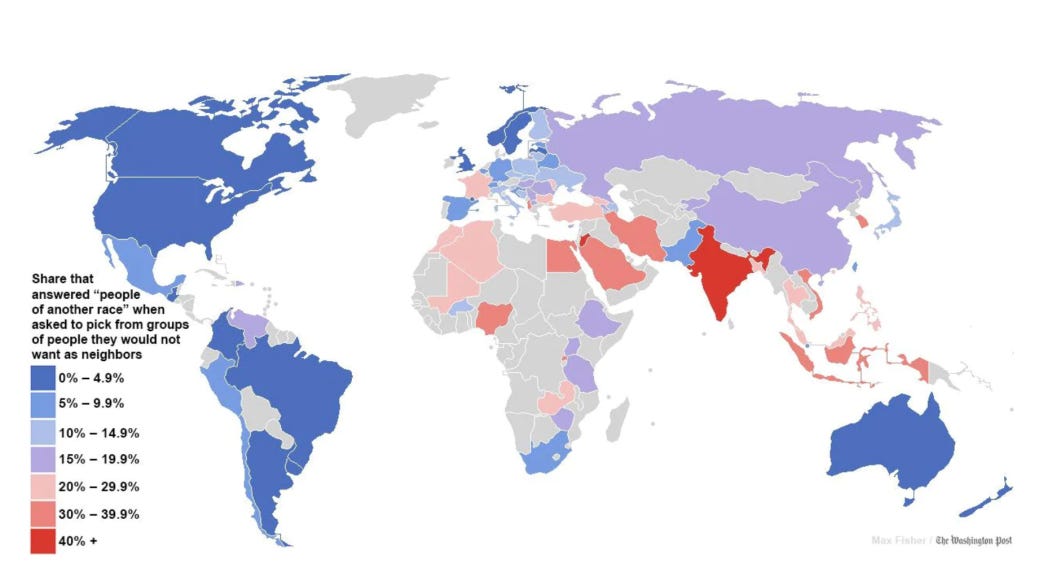
Share that answered “people of another race” when asked to pick from groups of people they would not want as neighbours. (Source: The Washington Post)

Start telling Westerners that their race actually does matter after all. Start telling them that their collective presence is a problem. Start telling them that their institutions are too White, their leadership is too White, their influence is too White, and their representation needs to be corrected.

And what will you do? You will awaken racial consciousness in the one group that has been conditioned not to think in terms of race and ethnicity. Eventually, you will make them ask a question they may never previously have thought necessary to ask:

What does it actually mean to be “White”?

Western society has long been taught that racial self-identification is a dangerous path toward extremism. At the same time, it often demands that Westerners view themselves as a racial collective when it comes to acknowledging historical sins.

White people can talk about being White when the subject is White privilege. They can talk about their ancestors when the subject is historical oppression. They can talk about their racial identity when they are being asked to acknowledge guilt, shame, or responsibility for the actions of people who came before them.

But they are not to ever think of themselves as a people with legitimate collective interests. They are not to ever celebrate their own identity in the same way other groups are encouraged to celebrate theirs. They are not supposed to organise around their own family interests.

They are supposed to understand their collective identity primarily as a moral liability. They are told to understand the differences between racial groups as a source of historical wrongdoing. They are told their ancestors’ achievements cannot be separated from unjust racial privilege. They are told that their racial identity comes with obligations, burdens, and moral debts.

But that’s not a natural posture for any people group to live with indefinitely. Eventually, people ask questions. Eventually, they begin examining themselves the way every other group has been encouraged to examine itself. Eventually, they begin thinking about their collective interests. They begin thinking about their identity. And they begin organising accordingly.

Of course, whenever that happens, we already know what the response will be. They’ll be called all the names. They’ll be accused of all the things. But the fact remains, to a large extent, they are the natural result of the societal pressures placed upon them.

If you continually tell people that race does not matter when it comes to their own people, but that it absolutely matters when it comes to everybody else’s, they will eventually grow tired of the double standards.

If you tell every other racial group that it’s legitimate to organise collectively around its identity and interests, eventually White people will ask why the same principle does not apply to them.

If you tell people that racial groups deserve special consideration, eventually people will ask whether their own group deserves it too.

And if you tell one racial group that its collective presence is a problem that needs to be diluted, eventually, members of that group will begin to wonder why they should just accept that judgment.

You can’t spend decades telling people to think in racial categories when it comes to everyone else and then be surprised when they start doing so for their own people. You can’t tell people that racial identity is enormously important for everyone except White people.

That’s simply not how human beings work.

Push people into a corner long enough and hard enough, and they will eventually re-examine the assumptions they were taught to hold about themselves. The irony is that the very people who claim to want a less racially conscious society are creating a more racially conscious one—because they are not advocating for less racial consciousness for all, only for White people.

The West spent decades trying to convince people that the colour of a person’s skin should not determine how they are treated. If we now begin treating Westerners differently because of the colour of their skin, we shouldn’t be surprised when Westerners begin to push back.

So, when White people begin thinking more consciously about their racial identity, we should not be surprised. When people are subjected to years of messaging that portrays their racial group as a problem, their demographic presence as something to be corrected, and their collective achievements as something to feel guilty about, it is entirely predictable that some will eventually reject the identity they were taught to have and begin reconsidering what it means to be White.

That is not something that happened in a vacuum. It is, in large part, the product of the very anti-White racial consciousness that has been relentlessly pushed upon them.

If you spend decades teaching White people to see race everywhere except within—unless it is viewed through a negative lens—and teaching them that their own race is uniquely problematic, you cannot reasonably expect them to remain indifferent to their racial identity forever.


Diversity Is a Security Problem, Not a Strength: ASIO Just Won’t Describe It That Way

20 September 2026 at 21:53

Australia’s intelligence boss, Mike Burgess, wants the country’s terrorist alert system upgraded.

He made the argument in June, stating that “I do not believe the system was designed for a situation like the one we now face.”

While Australia’s terrorism threat level remains at PROBABLE, he said, it doesn’t tell the full story.

“The next level on the scale is EXPECTED, which applies when we have intelligence about a specific attack.”

About which, he clarified, “we do not.”

However, Burgess stated, “we do know the environment is degrading, and acts of politically motivated violence are becoming more likely.”

Referring to “extremists across the ideological spectrum”, he cited one case involving so-called “extreme Christian beliefs,” and another “allegedly inspired by an extreme left-wing ideology.”

Although the majority of terrorism threats still involve Islamists, he said, “these cases demonstrate the diversity and complexity of the contemporary terrorism environment.”

Likening the state of the security environment to “climate change”, Burgess asserted,

“Just as climate change increases the likelihood of extreme weather but does not forecast specific storms, politically motivated violence, including acts of terrorism, is more likely, even though [ASIO] cannot predict a specific attack.”

He then added that “this is where a degrading security environment intersects with a diverse one.”

From there, Burgess gave a positive nod to the Albanese Government’s “recent investment in the ASIO and AFP counter-terrorism online centre.”

He said, ASIO and the AFP have foiled 31 major plots since 2014, then reassured Australians that they don’t want to be “all-seeing and all-knowing.”

That said, his agency will confront this “new terrorism environment” head-on.

Inferring multicultural – “modern” - Australia, he said that the country’s dynamic, diverse, and degraded security is an “unfortunate reality,” then added that “the terror alert system will never include a level of “impossible” or “unthinkable”.

Hence the importance, Burgess said, of addressing “known serious threats, and continually evolving and improving [ASIO’s] capabilities.”

This includes the “aggressive adoption of new tools and techniques”, like artificial intelligence.

Listed among his “that’s terrorism” concerns were “the tolerance of intolerance, the growth of grievance, the radicalisation of minors, the embrace of conspiracy.”

His June address ended by endorsing a return to the ethos of a “fair-go.”

Burgess stated that with a revival of “mutual respect and tolerance, the temperature of our security environment would be several degrees lower.

“By all means disagree,” he declared, “but consider how we disagree.

“By all means protest, but consider how we protest.

“By all means report the news, but consider how you report the news.

“By all means condemn a government or a political party, but consider whether you should condemn a people.”

Doubling down on his assertions, Burgess noted on 11 September this year, “much has changed since 9/11.”

“Terrorist motivations are far more diverse than they were 25 years ago.”

Although Burgess noted that “Sunni violent extremism still represents the majority of ASIO’s counter-terrorism caseload,” he reasserted the June diversity claim.

Contemporary terrorism, the ASIO boss declared, now involves “mixed ideologies.”

“Drivers of extremism,” he added, “are [also] different and more diverse.”

The internet, for example, when “violent rhetoric and violent acts are left unchecked,” “creates a permissive environment for further violence.”

While mostly benign, the ASIO chief’s comments raise some red flags.

Without scrutiny, updating the terror alert system could lead to ASIO policing dissent, political commentary and Christian sermons calling the government to account.

Such is Labor and the eSafety’s apparent lust for a dystopian ministry of truth, circa “Digital Duty of Care.”

Hand-in-hand with Burgess’ updates, this could also lead to Australia’s security agencies expanding who they designate as a terrorist and what they consider to be terrorism.

In the hands of a socialist government, which hates criticism, especially when political opponents overtake them in the polls, Burgess’ promises about any ASIO overreach are far from reassuring.

Any push to further supercharge the surveillance state is a chilling prospect for a nation founded on faith, family and freedom.

One clear takeaway from Burgess’ two addresses this year is that diversity isn’t just a threat to social cohesion.

ASIO now seems to consider it a threat to national security.

Why Would an Immigrant Vote for an Anti-Immigration Party?

19 September 2026 at 22:36

The media keeps asking the same question: Why would a non-White immigrant vote for a political party that wants to cut immigration? As though the answer is somehow impossible to understand.

It isn’t.

Plenty of migrants didn’t come to the West simply to live among different people on different soil. They came because they saw something here that was worth leaving home for. They saw what generations of Westerners had built—its culture, freedoms, institutions, traditions and way of life—and wanted to become part of it.

There was something here they valued more than what they had left behind. That should be obvious. Otherwise, they would have stayed where they were.

For some immigrants, then, immigration isn’t merely about changing countries. It is about changing the way they live. They don’t want to see the culture, freedoms and traditions that attracted them to the West diluted any more than Westerners do.

And why would they?

Why endure the enormous upheaval of leaving your home, your people, your language, your culture and your traditions—only to watch your new country gradually become more like the one you left behind?

The idea that an immigrant must automatically support mass immigration assumes that immigrants have no attachment to the society they deliberately chose to join.

But some came precisely because they didn’t want the West to become like the places they left.

So the question isn’t, “Why would an immigrant vote for a party that wants less immigration?”

The question is, Why would anyone assume that every immigrant who chose the West must want to see the West changed into something else?

The answer to the first question is so obvious; you’d have to be part of the media class to miss it.

Hijacking Narnia

18 September 2026 at 22:34

With Netflix announcing its retelling of C.S. Lewis’ The Chronicles of Narnia, and reports that Aslan, the Great Lion who represents Christ, will be portrayed by a woman, it is worth asking an important question that is often overlooked by Hollywood and its creatives: Why was this story written in the first place?

Why did Lewis create Narnia?

It’s not a mystery. He tells us himself.

He wrote The Chronicles of Narnia to be enjoyed, but not merely enjoyed. There was a deeper purpose behind it all. Lewis was telling two stories at once.

On the surface, he was telling us about a magical land, an evil witch who had taken control, and a talking lion who defeated her. But beneath that story was another—the meaning behind the imagery and what it all was meant to teach us.

Lewis was telling a story about Jesus.

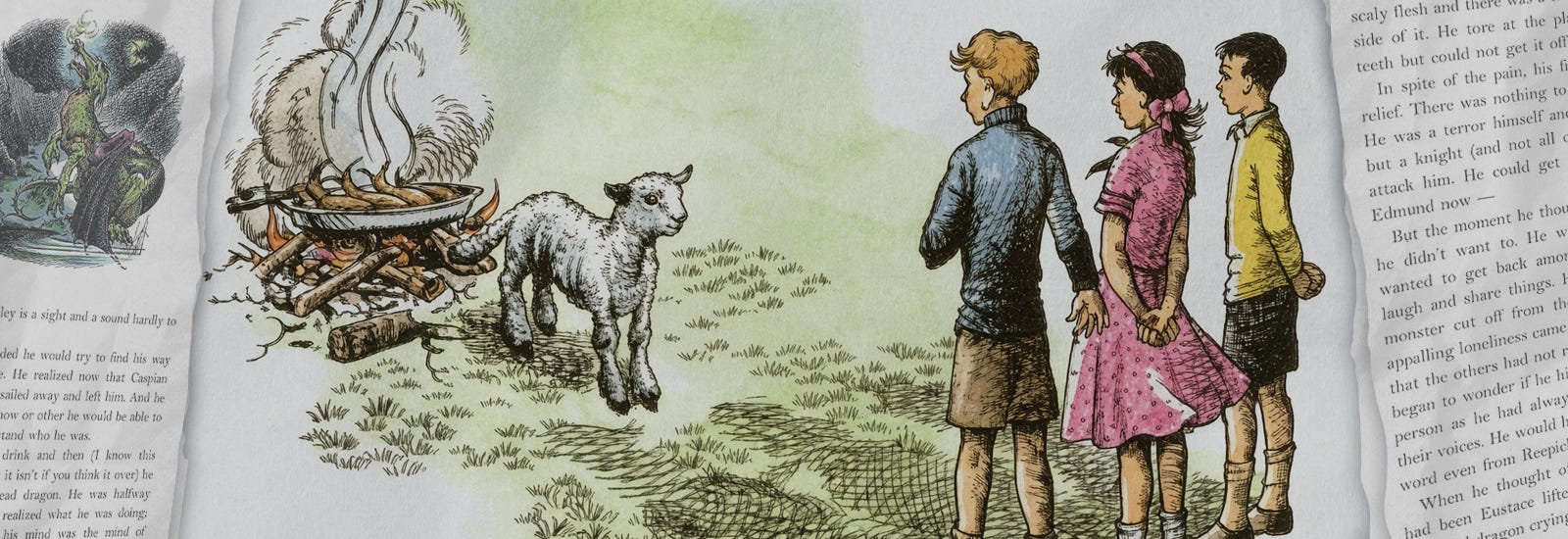
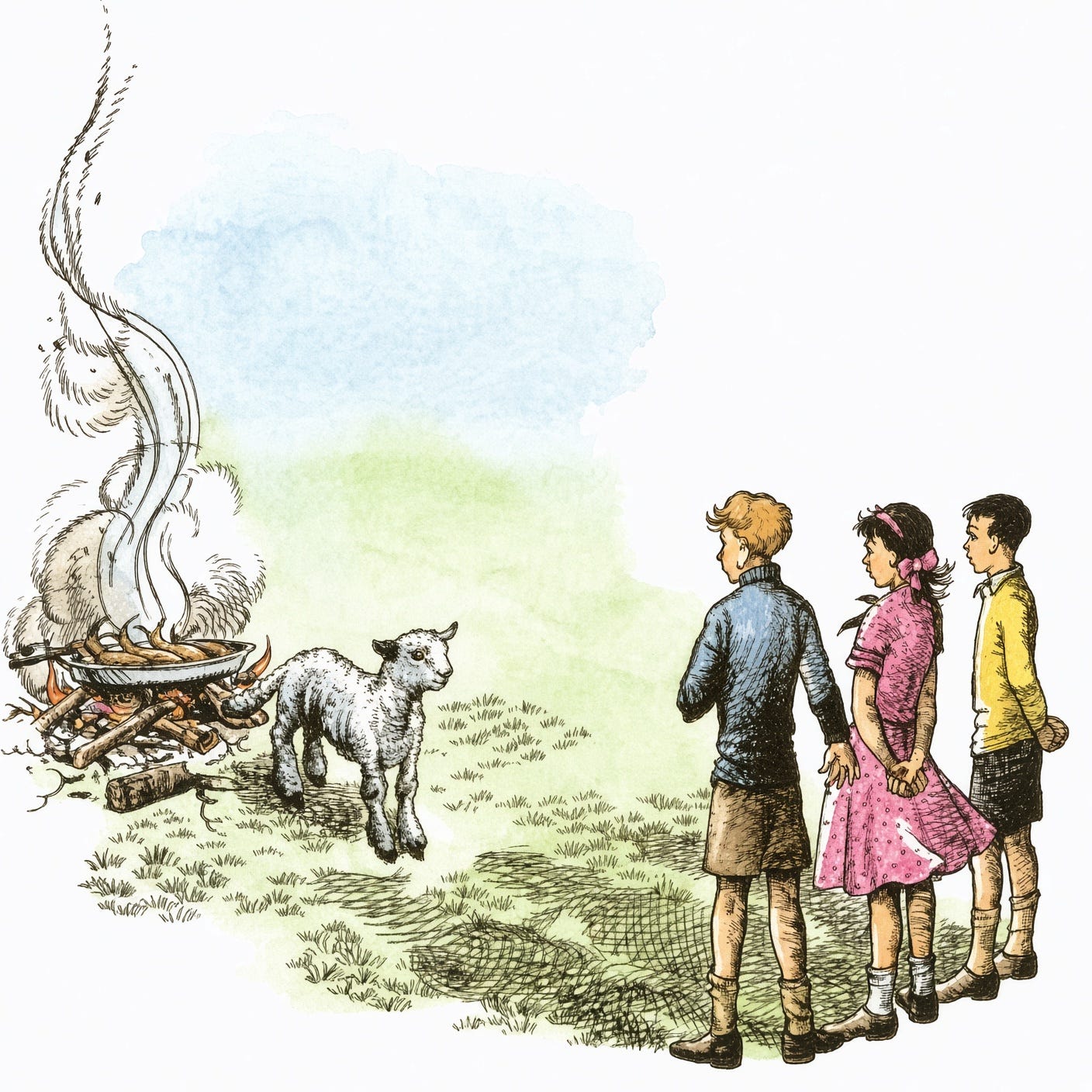
If it wasn’t obvious enough, it becomes explicit in The Voyage of the Dawn Treader. Towards the end of the book, Lucy and Edmund reach the edge of Aslan’s country. There, they have a remarkable encounter with a Lamb:

But between them and the foot of the sky there was something so white on the green grass that even with their eagles’ eyes they could hardly look at it. They came on and saw that it was a Lamb.

“Come and have breakfast,” said the Lamb in its sweet milky voice.

Then they noticed for the first time that there was a fire lit on the grass and fish roasting on it. They sat down and ate the fish, hungry now for the first time for many days. And it was the most delicious food they had ever tasted.

“Please, Lamb,” said Lucy, “is this the way to Aslan’s country?”

“Not for you,” said the Lamb. “For you the door into Aslan’s country is from your own world.”

“What!” said Edmund. “Is there a way into Aslan’s country from our world too?”

“There is a way into my country from all the worlds,” said the Lamb; but as he spoke his snowy white flushed into tawny gold and his size changed and he was Aslan himself, towering above them and scattering light from his mane.

Oh, Aslan,” said Lucy. “Will you tell us how to get into your country from our world?”

“I shall be telling you all the time,” said Aslan. “But I will not tell you how long or short the way will be; only that it lies across a river. But do not fear that, for I am the great Bridge Builder.”

Pauline Baynes drew the original artwork for all seven volumes of C.S. Lewis’s The Chronicles of Narnia from 1950 to 1956.

Lewis isn’t subtle. The Lamb is Aslan. Aslan is the Lamb. The Lamb is the one who provides the meal. The way into his country lies across the river, and Aslan calls himself the “Great Bridge Builder.”

But Lewis makes the point here unmistakable.

Lucy is distressed because she has learned that she won’t see Aslan in Narnia again. Aslan, however, assures her that she will, but in another world, and under another name:

“It isn't Narnia, you know," sobbed Lucy. “It's you. We shan't meet you there. And how can we live, never meeting you?”

“But you shall meet me, dear one,” said Aslan.

“Are -are you there too, Sir?” said Edmund.

“I am,” said Aslan. “But there I have another name. You must learn to know me by that name. This was the very reason why you were brought to Narnia, that by knowing me here for a little, you may know me better there.”

“This was the very reason why you were brought to Narnia.”

Lewis could hardly have made his purpose in writing The Chronicles of Narnia clearer. The children were brought into Narnia so that, through knowing Aslan, they might learn to know Christ.

That means the Christian message is not an unnecessary aspect of the story. It’s not merely symbolism that can be disposed of or discarded without altering the entire story.

It’s the very reason the story exists in the first place.

That matters when we’re talking about any adaptation that substantially alters or diminishes the fundamental Christian nature of Lewis’ work. If you remove or change the story’s central meaning, you’ve not simply “modernised” Narnia. You’ve changed what Narnia actually is.

Of course, filmmakers might be free to tell whatever story they wish. But that is not what they are claiming to do. They are claiming to tell Lewis’ story, The Chronicles of Narnia. And that is the problem.

Imagine taking a Christian story, stripping away or altering its Christian symbolism, and using its beloved characters and world to make an entirely different point. That is hijacking Lewis’ beloved characters, his world, and the affection generations of readers have for them, and using what Lewis built as a vehicle for a message Lewis did not intend.

Again, Lewis did not merely sprinkle minor Christian themes throughout Narnia. He built the story around them. As he himself explained, the children were brought to Narnia so that, by knowing Aslan, they might know Christ better.

Strip Christ from Narnia, and you’re not simply tweaking the story; you are gutting it of the very purpose for which Lewis wrote it.

They Made Aslan Trans

18 September 2026 at 02:21

When Netflix first announced it was adapting C.S. Lewis’ The Chronicles of Narnia, everyone asked the same question: “Who are they going to make gay?”

Well, we may have our answer.

According to Empire Magazine, Greta Gerwig has confirmed that Meryl Streep will play Aslan the Great Lion in The Magician’s Nephew, the first film in her planned Narnia series.

The magazine also featured a full-page cover of Gerwig’s new Aslan, depicted with David Bowie-inspired eyes and rainbow-coloured whiskers. Yes, really…

Image
First look at Aslan in Greta Gerwig’s ‘NARNIA’ film, voiced by Meryl Streep—with rainbow whiskers and David Bowie’s eyes.

But Aslan is not merely another fantasy character. He is one of the most recognisable representations of Christ in modern children’s literature.

He is the Creator of Narnia. He is its rightful King. He is the judge who confronts evil. He willingly lays down his life in the place of another, dies upon a stone table, and rises from the dead.

Lewis deliberately constructed Aslan’s story to help children understand the person and work of Jesus Christ in the Gospels.

As such, Aslan’s identity matters.

Lewis didn’t write Aslan as an androgynous symbol onto which every generation could project whatever cultural meaning it preferred. He wrote him as a male lion and deliberately invested that character with masculine kingship, authority and Christological significance.

It’s not simply a debate about ideal casting. It’s a question about what happens when Hollywood gets a hold of a distinctly Christian work and decides to reshape its image around the feminist gods of the day.

Gerwig has described her Narnia as a “rock opera,” drawing inspiration from David Bowie and imagining Narnia as a world created through modern music.

But Lewis already created a specific Narnia. He already created a specific Aslan. And he created them for a specific reason.

That is precisely why the story cannot be treated as interchangeable creative material. There is a difference between adapting a classic and appropriating it.

An adaptation asks: How can we faithfully bring this story to a new medium?

An appropriation asks: How can we take this beloved story and make it serve our own artistic and cultural vision?

The former respects the author’s work. The latter defaces it.

And Gerwig’s Narnia looks like defacement.

We can’t help but wonder who, exactly, they are creating this “adaptation” for. Narnia fans? Lewis fans? Christians?

No one is asking for Aslan to be reinvented in the image of today’s transgender culture. Yet that appears to be precisely what Hollywood is determined to do to one of the greatest Christian storybooks ever written.

We don’t need Narnia stripped of its Christian identity and repackaged as another piece of contemporary Hollywood woke fantasy. Lewis fans do not need his characters reconstructed to fit the feminist sensibilities of the moment.

The world already loves the Narnia Lewis wrote. And perhaps that’s their problem. If they could, we know they would cancel Narnia and its Christological message altogether.

But Hollywood has also spent years proving that it doesn’t need to cancel a classic to destroy what made it special.

It can simply take the characters, alter their identities, impose a new ideological and aesthetic framework, and then insist that the result is an improvement.

It’s literary vandalism, and perhaps that is precisely the point. Take something beloved, reshape it until it reflects the new cultural norms, and eventually the original becomes inseparable from the controversy surrounding its remake.

What comes to mind now when you hear the words “Snow White”? The timeless fairy tale, or the cultural wreckage left behind by Hollywood’s latest reinvention?

That is what Hollywood does to the stories it retells: it takes what was beautiful, Christian and beloved, strips away what made it distinctive and admirable, and remakes it in the image of its own ugly gods.

Hollywood does not create beauty from these stories. It inherits what others have created, strips away what made it beautiful, and twists it into something else entirely.

To quote Lewis’ good friend and contemporary J.R.R. Tolkien, “The Shadow that bred them can only mock; it cannot make: not real new things of its own.” Or, as it’s often paraphrased, “Evil is not able to create anything new; it can only distort and destroy what has been invented or made by the forces of good.”

Is Immigration Without Assimilation Invasion?

17 September 2026 at 23:21

A nation is more than the dirt it exists on. It’s a people bound together by a common heritage, language, culture, institutions, traditions, and sense of belonging.

Immigration might strengthen that nation, but it can only do so when newcomers enter that inheritance and become a part of the national community. Think, for example, of the Biblical story of Ruth.

Ruth was a Moabite, but her loyalty was to Israel: “Your people shall be my people, and your God my God” (Ruth 1:16). That should be the standard for immigration into any nation that intends to preserve its identity rather than be diluted or hollowed out from within. This is what assimilation should look like.

Keep Caldron Pool Online

But immigration without any degree of assimilation will inevitably do the opposite. It will fracture the very society immigrants were invited to join. A country that continually imports people while refusing to demand integration eventually recreates a fragmented country of nations within a nation.

Different communities will eventually live alongside one another, attend different schools, speak different languages, consume different media, preserve separate cultural loyalties and develop entirely different visions of what the country should become. They will share little beyond geography.

But there is something profoundly unjust about expecting the native population to accept this transformation without being permitted to defend the culture and institutions they inherited.

Consider a house. If you invite guests into your home, you don’t expect them to rebuild the house around themselves. You don’t expect them to ignore the rules, reject the customs of the household and establish a separate household inside it. You expect them to respect the home they’ve entered.

Subscribe now

What’s more, if those guests told you they hadn’t accepted your invitation because they liked you or cared about your family, but simply wanted what was on the dinner table, it’s safe to say they wouldn’t remain guests for long.

A nation has an even greater claim to that respect.

Assimilation isn’t hatred. It’s what prevents immigration from becoming a source of permanent demographic fragmentation and division.

A nation can welcome newcomers while still saying: This is our country. These are our laws. This is our language. These are our institutions. You are welcome to become part of this people, but immigration doesn’t entitle anyone to remain permanently separate from it.

A nation without a common identity eventually loses its common purpose. Once citizens stop seeing themselves as one people and instead retreat into competing ethnic, cultural and national loyalties, the bonds of nationhood don’t merely weaken; they disappear.

What remains is not a nation, but a vague population defined by little more than its differences. In the end, all you’re left with is millions of ununified “diverse” people with little in common beyond their competing claims to the same house.


The Magistrate’s Forgotten Duty

16 September 2026 at 23:45

We’ve been sold a lie about freedom.

Modern liberalism tells us that liberty means being left alone to do whatever we please, provided we don’t “harm” anyone else. The government, we’re told, exists to protect individual rights, enforce contracts, and prevent violence while remaining neutral to concepts such as “good” and “evil.”

But here’s the problem: There is no such thing as a morally neutral government. Every law makes a moral judgement. It decides what may be done and what should not be done.

As such, the question isn’t whether the government will legislate morality. It already does. The question is, whose morality will it legislate?

Speaking of civil authority, the Apostle Paul tells us, “he is God’s servant for your good, an avenger who carries out God’s wrath on the wrongdoer.”

Don’t overlook the first part of that sentence. He is God’s servant—or deacon—for your good.

The magistrate isn’t a neutral referee whose only legitimate function is preventing citizens from physically harming one another. He is God’s minister, entrusted with the sword for the good of those under his authority.

“For your good.”

This should come as no surprise, really. Christ commands every Christian to love his neighbour as himself. We usually think of that as a private moral obligation. But Paul connects neighbour-love directly to civil authority.

“Love does no wrong to a neighbour; therefore love is the fulfilling of the law.” (Rom. 13:10)

Notice the context here. Just a few verses earlier, Paul described the magistrate as God’s servant. The one who bears the sword against the wrongdoer. That’s the context in which Paul is speaking.

The magistrate is God’s servant for our good, and love seeks the good of our neighbour.

As such, a ruler who loves his neighbour doesn’t merely wish him well. He protects the innocent, restrains wrongdoing, and punishes evil.

If one man is about to murder another, love doesn’t stand aside and say, “Who am I to impose my morality on him? After all, he may not even be a Christian.” No. Love intervenes.

If a child is being abused, love doesn’t turn a blind eye and call it tolerance. It acts to stop the abuser.

If thieves are preying upon the community, the magistrate doesn’t love his neighbours by leaving the victims to fend for themselves. He uses force to impose a morality on the guilty, regardless of their personal beliefs.

The magistrate has been granted the special privilege of wielding the sword legally. In other words, he’s been given the right to use legal violence. Not to his own ends, but for the good of the community over which he has authority.

In the Bible, love isn’t merely sentimental. Love seeks the genuine good of others. And the magistrate has been given a particular responsibility to seek the good of those under his authority.

But What Is “Good”?

All of this raises an obvious question. If the civil authority exists to act as God’s minister, for the good of others, then who decides what is good?

The answer can’t be Parliament, or popular opinion, or the prevailing moral sentiments of the age.

Jesus said we are to “render to Caesar the things that are Caesar’s, and to God the things that are God’s” (Matt. 22:21). But God never gave civil authorities the right to define or redefine good and evil. That authority belongs to God alone. (Isa. 5:20; Rom. 13:3–4).

“Sin is transgression of the law” (1 Jn. 3:4). God’s law establishes the moral order. The magistrate doesn’t create that order; he is accountable to it.

This is one of the greatest differences between Christian government and modern secular governments. The Christian magistrate doesn’t possess ultimate authority to declare whatever he likes to be good and whatever he dislikes to be evil. Neither does he possess the freedom to declare evil good simply because the people demand it.

He is himself under authority, and the basis of that authority is not the demands of the masses. King Saul lost his kingdom after he “feared the people and obeyed their voice” (1 Sam. 15:24). The democratic vote is not a licence for civil rulers to disobey God’s decree.

Rulers answer to God first and foremost, not the people. And they are to exercise their authority consistent with God’s law.

So, when a politician asks, “Who am I to legislate morality?” the answer is simple: You’re already doing it. Every statute embodies a moral judgment. The only question is whether that judgment corresponds to reality; that is, whether it reflects God’s righteous order or merely the ever-shifting morality of the moment.

The Sword and the Soul

None of this means that the magistrate should police people’s thoughts. Of course, that is an impossible task. The state can’t see the heart. It can’t regenerate sinners, create faith, or compel genuine repentance before God.

But the fact that the magistrate can’t judge the heart doesn’t mean he can’t judge conduct. And just because the power of conversion belongs to the Gospel does not mean that the civil magistrate has no meaningful role to play in society.

In fact, his position presupposes a world that consists of deadly, unregenerate men against whom he is to wield the sword for the good of others.

David understood this as king. He said, “I will not set before my eyes anything that is worthless… I will destroy all the wicked in the land” (Psa. 101:3, 8).

The magistrate doesn’t govern the soul, but he does govern society. And that society is largely shaped by what it permits in public.

What society tolerates becomes commonplace. What becomes commonplace becomes respectable. What becomes respectable is eventually celebrated, institutionalised, and taught to the next generation—not only as normal, but as a moral good.

While God’s laws are chiefly concerned with the soul, when it comes to civil penalties, the issue is largely publicly provable sin. There can be no civil charge without sufficient witnesses to establish wrongdoing. Consider the woman caught in adultery in John 8.

Jesus pardoned her, not because she was innocent, and not because He lowered the standard of God’s law, nor because He was being “gracious” rather than obedient to God. Jesus pardoned her because her accusers had failed to satisfy the legal requirements for bringing a charge.

Under the law, the witnesses were required not only to throw the first stone (Deut. 17:6–7), but also to suffer the same penalty if their accusation is ever proved false (Deut. 19:16-19).

It’s a high standard, and rightly so. As such, the penalties were largely reserved for blatant and indisputable public displays of sin, because when evil is publicly tolerated, community standards are lowered. And when community standards are lowered, people collectively suffer.

The magistrate therefore has legitimate concern for the moral conditions of the society he governs—not because he can save souls, but because wickedness damages communities as well as individuals.

Sin Is Not Freedom

Today, modern liberalism often treats consent as the decisive moral category. If two adults freely choose something, we’re told, the government should have nothing to say about it.

But consent does not make something good. A man can freely choose his own destruction. And this is exactly what sin does.

Jesus said, “Everyone who practices sin is a slave to sin” (Jn. 8:34). While sin promises liberty, it produces slavery.

The drunkard isn’t free because he drinks voluntarily. The adulterer isn’t liberated because his affair has become a social norm. The man enslaved to lust isn’t free because nobody forced him into it. The drug addict isn’t a picture of liberation, but a vivid example of bondage.

Sin is slavery because it places man under the dominion of something other than God. That’s why Christian freedom is radically different to the modern liberal conception of “freedom.”

Freedom isn’t licence. Freedom isn’t the legal permission to do whatever you want. Freedom is the liberty to do what is good.

As the Apostle Paul said, “Stand firm therefore, and do not submit again to the yoke of slavery… Do not use your freedom as an opportunity for the flesh, but through love serve one another” (Gal. 5:13).

Biblical liberty has a purpose. It is freedom for righteousness.

When Moses demanded that Pharaoh let the Hebrews go, it wasn’t so they could become their own masters. It was so they could be freed from the king of Egypt to serve the King of Glory instead (Ex. 8:1; cf. Ex. 9:1).

The truly free man isn’t the man who can indulge every appetite without legal interference. He is the man who is free to pursue what is good without being hindered by unjust coercion.

Law Protects Freedom

Every law restrains something. The question is what it restrains, and what it protects.

A law against theft restrains the thief and protects the neighbour’s property. A law against violence restrains the violent man and protects the innocent. A law protecting children restrains the abusers and protects the child.

Law restrains the wrongdoer, not the innocent, by giving civil authorities the lawful right to wield the sword against those who do evil for the protection of the innocent.

In a sinful world, inhabited by sinful men, restraint is precisely what makes ordered liberty possible. A fence around a cliff restricts movement, but nobody thinks the fence exists to oppress the public and stifle their freedom of movement.

In the same way, the magistrate doesn’t fulfil his calling by maximising the number of things people are legally permitted to do. He fulfils it by upholding justice and protecting the good—not as he defines it, nor as the public defines it, but as God defines it.

This is why the Bible says, “Righteousness exalts a nation, but sin is a reproach to any people” (Pro. 14:34).

A ruler who refuses to restrain wickedness simply because wickedness is popular isn’t being tolerant or impartial. He is abandoning his God-given responsibility and abdicating his duty.

Punishment Teaches

Biblical justice also recognises that punishment has a public informative purpose. God repeatedly commanded Israel to punish certain forms of wickedness so that others would see and fear.

“All Israel shall hear and fear and never again do any such wickedness as this among you” (Deut. 13:11).

Public executions, even in the Western world, were carried out for this very reason. Not because our grandparents took some morbid pleasure in them, but because they served a social purpose.

The punishment wasn’t merely about the offender. It taught the community. It warned those thinking of doing the same. It reinforced the moral boundaries. And it deterred future wrongdoing.

Paul likewise applies the principle within the context of church authority when he says that public rebuke can act as a deterrent by causing “others also” to fear (1 Tim. 5:20).

The law, therefore, ought to teach society what matters. A law against murder declares that human life is valuable. A law against theft declares that property isn’t yours simply because you want it. A law protecting children declares that the strong aren’t free to prey upon the weak.

And when government refuses to restrain public wickedness, that teaches society something too. It teaches that the conduct is tolerated—or even normal.

And the thing about bad behaviour is, when it’s left unpunished, you only get more of it. As Scripture warns, “Because the sentence against an evil deed is not executed speedily, the heart of the children of man is fully set to do evil” (Eccl. 8:11).

The Magistrate’s Forgotten Duty

Of course, the magistrate is not the church. He cannot save souls. He cannot search the conscience. But neither is he merely a glorified security guard whose only concern is physical harm.

He is God’s minister for good, Paul tells us.

The magistrate is a neighbour too. And he has a particular responsibility to love the neighbours placed under his authority. To love them means seeking their good. To seek their good means protecting the innocent and restraining what has the potential to harm and destroy them.

And because God, not the magistrate, defines good and evil, the magistrate must exercise his authority according to a standard higher than himself.

This doesn’t mean every private sin becomes a matter for the criminal law. It doesn’t mean the state can read minds or compel repentance. It doesn’t mean Parliament can legislate salvation.

What it does mean is that pubic wickedness is not beyond the concern of the magistrate simply because it is “sin.”

When evil becomes outward, public, and socially destructive, the magistrate has a legitimate, and sometimes an obligatory, interest in restraining it.

The sword wasn’t given to make men righteous. Only God can do that. The sword was given to restrain evil, uphold justice, and secure the good of the community.

Nobody is opposed to locking murderers in prison because a jail cell cannot regenerate their hearts. That’s not the purpose of the punishment, but it doesn’t make the punishment any less necessary for the good of society.

So when a ruler wields the sword to defend the innocent—threatening, restraining, and punishing those who would harm them by doing what God has declared evil—he isn't violating the command to love his neighbour.

He is fulfilling it.

For the civil authority, loving your neighbour sometimes means leaving him alone. Sometimes it means protecting him. Sometimes it means warning him. And sometimes it means drawing the sword.

Every magistrate does this.

The only question is whether he will submit his authority to God’s definition of love, justice and the good—or claim the authority to arbitrarily define them for himself.

There Is No Righteousness Apart From Faith in Christ

15 September 2026 at 22:05

Since it’ll largely be overlooked by other Christian outlets, I wanted to add one further point to the recent debate between Anglican minister Mark Leach and Edward Schuller—one that goes to the heart of the question of how a sinner can be made right with God.

Jesus was unequivocal: “Unless your righteousness exceeds that of the scribes and Pharisees, you will never enter the kingdom of heaven” (Matt. 5:20).

The question, then, is obvious: How does a sinner obtain the righteousness necessary to enter God’s kingdom?

Moses presents two possible grounds on which a person might seek righteousness before God: righteousness based on obedience to the law, and righteousness based on faith.

The first, however, is a dead end for fallen sinners.

The law demands perfect obedience. It doesn’t grade on a curve. It doesn’t offer us a pass based on our ethnicity and bloodline. It doesn’t overlook some sins because we have done enough good deeds to compensate for them. And because we are sinners in Adam, none of us has kept God’s law perfectly.

That’s precisely why the law cannot be the means by which sinners establish their own righteousness. Its purpose is to expose our unrighteousness.

Paul explains that “whatever the law says it speaks to those who are under the law, so that every mouth may be stopped, and the whole world may be held accountable to God.” He then adds: “For by works of the law no human being will be justified in his sight, since through the law comes knowledge of sin” (Rom. 3:19–20).

The law shuts every sinner’s mouth.

It leaves us guilty.

It strips away every claim to self-righteousness.

And, having shown us that we cannot achieve righteousness by our own obedience, it drives us to the only other ground of righteousness: faith in God’s promise.

And that promise ultimately centres on a person—the promised Seed, Jesus Christ.

This is not a new doctrine introduced in the New Testament. It is the consistent way God has justified sinners throughout redemptive history.

The Old Testament saints were justified by faith in the promised Seed who was still to come. The New Testament saints are justified by faith in the promised Seed who has now come.

Abraham is the clearest example. God promised, and “Abraham believed God, and it was counted to him as righteousness” (Gen. 15:6; Rom. 4:3).

Notice what Abraham did not do. He did not present God with a record of sufficient moral achievement. He believed God’s promise, and that faith was counted to him as righteousness.

Paul makes the principle explicit: “The righteous shall live by faith” (Rom. 1:17).

And this is why the gospel is not simply that salvation is somehow through Christ. The biblical gospel is that sinners are justified through faith in Christ.

Those are not interchangeable statements.

Christ is the ground of our salvation. His righteousness, death and resurrection are the basis upon which God justifies the ungodly. But that righteousness is received by faith—not by ancestry, ethnicity, law-keeping, religious affiliation, or any other human qualification.

There is therefore no righteousness apart from faith in God’s promise, and no justification apart from faith in Christ.

That leaves no room for the idea that someone can be saved through Christ while simultaneously rejecting faith in Christ. Christ does not save people apart from Himself, and faith does not bypass Christ. The promised righteousness is received through faith in the promised Redeemer.

This is why Paul can say that there is “no distinction between Jew and Greek; for the same Lord is Lord of all” and that “everyone who calls on the name of the Lord will be saved” (Rom. 10:12–13).

There is no ethnic exemption from the universal problem of sin.

And there is no ethnic exemption from the universal remedy of faith.

The law cannot save the sinner because the sinner cannot perfectly keep the law. The law instead exposes our guilt and points beyond ourselves to the righteousness God provides.

That righteousness is found in Christ.

And it is received by faith.

No faith, no righteousness.

No righteousness, no access to the Father

No access to the Father, no eternal life.

Killed, Kidnapped, Jailed: Pakistan’s Christians Face a Brutal Fortnight

14 September 2026 at 22:15

In the space of about three weeks, Pakistan’s Christian minority has buried a murdered young mother, watched a teenage boy allegedly abducted and pressured to falsely confess to her killing, and seen two more believers arrested on blasphemy charges that carry the death penalty.

This is what being a “religious minority” can mean in Pakistan in 2026 — and Western governments barely notice.

The killing happened first.

On the evening of September 3, 21-year-old Saba Mehboob was shot dead inside her family’s home in Rawalpindi’s Dhoke Ratta neighbourhood.

Keep Caldron Pool Online. Give today.

Her alleged killer, a Muslim neighbour named Adnan Butt, had reportedly made repeated advances toward Saba after she separated from her husband more than a year earlier. She had twice rejected him, reportedly slapping him away.

According to her brother Joshua Mehboob, Butt forced his way into the house that night, accused Saba of dishonouring him, and shot her in the forehead in front of her 16-year-old stepbrother, Anoosh. “I think Saba’s rejection fueled his anger, leading him to murder her,” Joshua said.

It gets worse.

Butt then allegedly abducted Anoosh at gunpoint and pressured him to confess to his own sister’s murder.

According to Christian Daily International–Morning Star News, the boy and his father are now both being held by police — officially “for his protection.” The family and neighbourhood elders, however, suspect otherwise and are demanding the case be transferred from the local station to a senior officer. Christian and Muslim residents alike turned out to protest and demand Butt’s arrest.

Police have disputed the family’s account of Anoosh’s detention, saying he is being held for his own protection because he is a minor.

Saba left behind two daughters.

Nine days earlier, a different kind of danger closed in on 26-year-old Samuel Arif in Lahore.

Arif, whose late father worked as a sanitary worker at Punjab University, still visited friends in the staff colony where he grew up.

On Aug. 29, a resident accused him of blasphemy — alleging, according to the First Information Report, that Arif claimed the Prophet Muhammad appeared to him in a dream and told him to marry the man’s two underage daughters.

Police charged Arif under Sections 295-C and 298-A of the Pakistan Penal Code. Section 295-C carries the death penalty. Arif has now been placed in judicial remand.

Arif’s family says the allegations are false.

HARDS Pakistan director Sohail Habel, who has spoken with Arif directly, said the accused “completely denied all allegations” and believes the case was manufactured over a personal grudge with the complainant.

Arif’s elderly mother, who has serious health problems, has been left to fight for her son’s freedom while local lawyers volunteer to represent him.

It’s a familiar pattern in Pakistan, where a blasphemy accusation can function less like an ordinary criminal charge and more like a weapon — one that mobs have historically been willing to enforce themselves, with or without a trial.

Arif isn’t the only one.

Three weeks earlier, on Aug. 11, police in Gujranwala District arrested 30-year-old Christian labourer Amir Masih over a social-media video that allegedly compared Jesus Christ to Muhammad.

Police charged him under several provisions of the Pakistan Penal Code, including Section 295-C, which carries the death penalty.

Keep Caldron Pool Online. Give today.

The case has also raised fears of mob violence, with reports that Christian families in the area fled their homes after an angry crowd gathered and threatened Masih, his family and their property.

None of this is happening in a vacuum.

Open Doors’ 2026 World Watch List ranks Pakistan eighth among the world’s worst countries in which to be a Christian, pointing to systemic discrimination, mob violence, forced conversion of Christian girls and women, and serious failures to protect religious minorities.

Two arrests and a killing in three weeks are not isolated incidents. They fit a wider pattern of discrimination, blasphemy accusations, violence and impunity that Christians in Pakistan have faced for years.

It’s worth sitting with the contrast.

Western governments routinely speak about religious freedom, minority rights and the protection of vulnerable communities. Yet a young Christian mother can be shot dead in her own home after rejecting a man’s advances; a teenage witness can allegedly be abducted and threatened; and two more Christians can be placed in judicial custody following accusations under laws that can carry the death penalty.

Pakistan is not a fringe case. It is one of the world’s largest Muslim-majority nations and a significant Western security partner. Yet for many Pakistani Christians, religious freedom is not an abstract political principle. It can be a matter of whether they can worship, speak and raise their families without becoming targets.

Pray for Samuel Arif. Pray for Amir Masih. Pray for Anoosh and his father. And pray for Saba Mehboob’s two daughters, who are growing up without their mother.

Questioning COVID Was Heresy, But Questioning the Gospel Isn’t?

13 September 2026 at 22:54
Edward Schuller and March Leach.

Remember when the evangelical gatekeepers in Australia roundly condemned us for questioning the official COVID-19 narrative?

Well, what happens when one of their own questions the biblical truth that there is no salvation apart from faith in Jesus Christ? Well, nothing, apparently. And that should tell you everything you need to know about their loyalties and priorities.

A recent debate between Edward Schuller of Red Union and Mark Leach, founder of Never Again Is Now and an ordained Anglican minister, highlighted this unfortunate truth for all of us.

While both men affirm that salvation comes through Jesus Christ, Schuller rightly pressed for clarity, questioning his opponent and asking whether a person must actually believe in Christ to be justified—to be saved.

Leach, who is himself a Jew, described his position as “a sort of soft inclusivism”—which is not only a departure from historic Anglican and Protestant teaching, but from the Bible itself.

He said:

“Technically, I’m arguing for a soft inclusivism. So, the distinction you need to make… is, is the condition of getting into heaven… a conscious decision to accept Jesus that is what gets me into heaven?

So, I think you can be saved through Messiah Jesus. Absolutely. I have no problem with that. I think any person who is embraced into the eternal family of God through the life and death and resurrection of the second Adam. One hundred percent. As in Adam all sin, so in Christ all shall be made alive.”

Leach affirmed that ethnic Jews are saved the same way as everyone else, which is “through Christ,” but when Schuller asked whether someone practising modern Judaism, rejecting Christ throughout their life, could nevertheless be saved, Leach said yes.

Although the debate was supposed to be about whether Australian Christians have an obligation to the modern nation of Israel, the whole thing turned to a much more serious issue. Are Jews saved despite rejecting Jesus?

It’s one thing to say that Christ alone accomplished salvation. It is quite another to say that a person can receive eternal life without consciously believing in Christ.

But Leach went even further, saying: “I have no trouble for God continuing to love people who deny him. Granting them eternal life.”

He also left the door open to the same possibility for Muslims. When asked whether a practising jihadist Muslim who denied Christ throughout his life could still be saved, Leach couldn’t say with any meaningful degree of certainty.

The best he could say was that the “data seems to indicate no. So I would say don’t bank on that.” He then went on to distinguish between Muslims and Jews, saying, “I think Jewish people are in a different category.”

So, while he is uncertain about whether a Muslim who rejects Christ can be saved, he is confident enough to say that a Jew who rejects Christ throughout his life will be.

“They are still God’s covenant people, and they are loved by him. And there’s a mystery to that sets them apart,” he said.

The problem, however, is not whether God loves people who reject him. Christians affirm that God shows extraordinary patience and mercy towards sinners. The question is whether God justifies—declares righteous—those who remain in unbelief.

Historic Anglican doctrine answers that question quite clearly. An ordained Anglican minister ought to know.

Article XI of the Thirty-Nine Articles teaches:

WE are accounted righteous before God, only for the merit of our Lord and Saviour Jesus Christ, by faith, and not for our own works or deservings: Wherefore, that we are justified by faith only is a most wholesome doctrine, and very full of comfort, as more largely is expressed in the Homily of Justification.

Yes, Christ is the ground of salvation, but faith is the means by which the sinner receives Christ and his saving work. Leach’s argument, however, blurs that distinction. While affirming the former, he denies the latter and hides behind the cover of “mystery” and obscurity—as though that resolves his problem.

Nor does pointing to the fact that Christians have sometimes denied Christ help. Peter denied Christ and was restored. Judas denied Christ and was condemned. Peter’s denial is fundamentally different from arguing that someone may reject Christ throughout their entire life and still receive eternal life—and that merely on the basis of their Jewish ancestry.

What Leach doesn’t seem to understand is the necessity of being found righteous before God. The Bible tells us that apart from faith, the only basis on which a person could stand righteous before God would be their own perfect righteousness—perfect obedience to God’s law. Paul is emphatic: no one can attain the righteous requirements of the law.

Indeed, that is part of the law’s purpose. God is perfectly righteous, and we are not. Hence it is necessary that we have a perfect High Priest, offering a perfect sacrifice and interceding perfectly for us before God. That cannot be found outside of faith. And, according to the Apostle Paul, even the law testifies to this.

Abraham believed God, and his faith was credited to him as righteousness. Abraham was justified by faith in God’s promise—not by his bloodline. That is true for Abraham; it is true for the Gentile, and it is true for the Jew.

As Paul testified in Romans 10:1–4:

“Brothers, my heart’s desire and prayer to God for them is that they may be saved. For I bear them witness that they have a zeal for God, but not according to knowledge. For, being ignorant of the righteousness of God, and seeking to establish their own, they did not submit to God’s righteousness. For Christ is the end of the law for righteousness to everyone who believes.”

As Jesus put it in John 3:18:

“Whoever believes in him is not condemned, but whoever does not believe is condemned already, because he has not believed in the name of the only Son of God.”

So again, Australian evangelical leaders wasted no time condemning those who contradicted the decrees of the state during COVID-19. How long will it be before they condemn a mate who has contradicted the Gospel?

I won’t hold my breath.

You can watch the full debate below. We’ve barely scratched the surface of the deeply problematic position Leach is peddling:

Sydney Pastors Face Kill Threats at Home A Year After Charlie Kirk’s Murder

11 September 2026 at 21:40

LGBTQ+ activists allegedly attacked Echo church pastors at their home last Thursday.

Lead pastor Andrew Sedra said in an X post that the alleged assault occurred after their “address was leaked online.

“Four left-wing activists, including two hooded individuals, came to our home,” he recounted.

“They threatened to kill us and destroy us; they cut the electricity and attempted to break in.”

The activists, he said, “knew our whole family by name, including our newborn baby, mentioning him continuously.”

Their threats included, “I will f**ing kill you. I will take you mother-f***ers down. I know where you live, and I’ll be at your doorstep every night”

Police told the Daily Declaration’s Kurt Mahlburg they were called “to a disturbance at a Cobbitty property on Thursday 3 September and issued move-on directions to three people.”

Consequently, “a 39-year-old woman was arrested after allegedly failing to comply with the direction and was taken to Narellan Police Station, before later being admitted to hospital for an assessment.”

The apparent statement said, “Occupants were spoken to by police and provided with advice on home security.”

In an update, Mahlburg quoted police stating that “detectives were reviewing CCTV footage from the property.”

Talking about the incident again, Sedra pointed out that the incident joins a string of “constant threats, death threats” they’d received in the past year.

A separate 10 September statement from Sedra, which was published on X, linked to a GiveSendGo (GSG) page asking for people to help “the family move to a safe home.”

“After more than a year of constant death threats from the LGBTQ leftists and violent Islamists, some of the people threatening our family now know where we live,” Sedra wrote.

According to the GiveSendGo page, police allegedly told them that “their hands were tied.’ The family were then advised to take their safety into their own hands.”

Their only option, Sedra said, was to “move homes as soon as possible.”

“We have never personally asked for help, but this time we need your help,” he explained.

Their reasons for reaching out through GiveSendGo are to “cover the cost of this urgent move.”

Refusing to move out quietly, Sedra reaffirmed his commitment to speak brazenly about the state of the world.

Such as his 27 April 2023 post critiquing the “secular state of Sydney.”

“We will continue to preach the truth of the Bible with courage and boldness.

“We will continue fighting for the faith against violent Islam and woke ideologies, and we will continue fighting for freedom and liberty in America, Australia and throughout the Christian West!”

As of 11 September, the Sedras’ “preventative measure” fundraiser has raised support from over 3,000 people, with 2,860 of those giving a whopping AUD $262,176 of a $300,000 goal.

According to the GSG page, “The reality presented to the Sedras was clear: there is only so much police can do to prevent someone from returning to our home and stopping future attacks.”

They were allegedly told that “Police can take ‘reactive measures, not preventative measures’”.

Sedra’s concerns are seemingly justified. He’s vocal about the erosion of rights at the hands of the LGBTQ+ and Islamist movements.

He has also been platformed by the late Charlie Kirk and TPUSA.

Born in Egypt, the Sedras “came to Australia as religious refugees because their dad was converting Muslims to Christians.”

The family, he told Marco Garcia last year, escaped through Thailand and eventually found their way to Australia in 2007.

Netflix Accused of Mocking Charlie Kirk’s Murder

10 September 2026 at 22:10

Netflix is facing renewed calls for a boycott after its UK and Ireland X account was accused of mocking the assassination of Charlie Kirk.

On the one-year anniversary of Kirk’s murder, the account posted, “Nearly did himself a neck injury,” alongside an image from the Netflix series The Gentlemen showing actor Theo James turning to look at Kaya Scodelario.

The post drew immediate backlash, as many interpreted the post to be a reference to Kirk, who died after being shot in the neck during an outdoor event on October 10, 2025.

Actor Kevin Sorbo responded by recalling his experience with Netflix executives while discussing faith-based films.

“Years ago, Netflix brought me in to discuss doing faith-based films. At the end of our meeting, the executives looked at me and said, ‘We understand that there’s an audience for the kind of movies you make; we just don’t know why.’

“These people are sick,” Sorbo said.

The backlash was accompanied by a flood of screenshots from users claiming to have cancelled their Netflix subscriptions.

Daily Wire commentator Matt Walsh said he initially hoped the post was not referring to Kirk, but admitted that the timing was too coincidental.

“I’m apparently naive because at first I wanted to believe this was not a Charlie Kirk joke. But these ‘neck injury’ references are a meme among retarded demonic leftists. Way too much of a coincidence that Netflix posts this today of all days. Clear what was intended. Despicable.”

Christian commentator Samuel Sey also condemned the post.

“This is a shocking level of evil, even by Netflix’s standards. The biggest streaming company in the world is mocking Charlie Kirk’s assassination. Wow.”

Writer Megan Basham demanded an explanation from the streaming giant.

“You need to explain what you were thinking here. Immediately.”

Journalist Mike Cernovich wrote, “This is the mainstream Democrat view. They are murderous.”

If we’re going to be as charitable as possible, sure—Netflix’s post may have been entirely coincidental. But you’d imagine there would be some sort of correction or explanation, if only to make clear that it wasn’t intended to poke fun at an assassination. That may still come, but even then, for many, it will be too little, too late.

We all remember how the Left responded when Charlie was killed. We remember the laughter, the memes, the mockery and the threats. It remains fresh in the minds of many because political violence and dehumanisation have increasingly been normalised when directed at Christians, conservatives, and those on the political “Right.”

Given that context, the combination of the “neck injury” reference, the image and the timing, on the first anniversary of Kirk’s assassination, makes it easy to understand why so many interpreted Netflix’s post as a deliberate mockery of his death.

More Than 30 Christians Killed in a Month in Nigeria’s Plateau State — But You Probably Didn’t Hear About It

9 September 2026 at 22:37

More than 30 Christians have reportedly been killed in Nigeria’s Plateau State in the past month alone, with the latest attacks occurring just days ago.

Christian Daily International reports that on September 5, three more Christians were killed across two villages in Mangu Local Government Area, one in Fungtim and two in Kinat.

The killings came just two days after two other Christians were killed in nearby Kinat and Kop-Naanle. Among those killed was 78-year-old Bulus Danladi, who was reportedly killed in Kop-Naanle.

The latest deaths followed an August 18 attack at Bin-Per in which 25 Christians were reportedly killed. A spokesman for the Mangu Local Government Council confirmed the death toll.

The news is obviously staggering. And yet, outside Christian and Nigerian media, the killings have received little attention, if any at all.

What’s more, New Life Magazine reported that at least 32 Christians were killed by armed Fulani herdsmen across Plateau, Nasarawa and Benue states in early August alone. The victims reportedly included infants and community leaders, while homes and farmland were destroyed in attacks on rural communities.

One local pastor, mourning members of his congregation, said Christians in Nigeria “deserve to worship in peace, to sleep, and to live without fear.” He called on the Nigerian government and security agencies to act.

The violence has continued through July and August. In one August incident reported by The Gateway Pundit, two Christian villagers returning from a funeral were ambushed and killed by suspected Fulani assailants using gunfire and machetes.

In separate attacks around the same period, more than 39 hectares of crops were reportedly destroyed, threatening the livelihoods of farming communities already living under severe insecurity.

This is not an isolated incident or a problem confined to one village.

Nigeria remains the world’s deadliest country for Christians according to Open Doors’ 2026 World Watch List. During its reporting period, from October 2024 to September 2025, Open Doors recorded 4,849 Christians killed for their faith worldwide. Of those, 3,490 were in Nigeria, approximately 72 per cent of the global total.

Plateau State, in Nigeria’s Middle Belt, has become one of the principal flashpoints of this violence.

Christian-persecution researchers and parliamentary reporting have documented the activities of militant Fulani groups, including factions accused of embracing radical Islamist ideology and employing tactics comparable to those used by Boko Haram and ISWAP.

These groups have repeatedly been accused of attacking predominantly Christian farming communities, killing civilians and destroying homes, churches and agricultural land.

When predominantly Christian communities are repeatedly attacked, when churches and Christian villages are targeted, and when Christian farmers are killed or driven from their land, it is entirely legitimate to ask whether these attacks are part of a broader pattern of anti-Christian persecution.

Nigeria’s federal government, under President Bola Tinubu, has faced mounting criticism over its handling of the violence. The government has condemned attacks, ordered security agencies to pursue perpetrators and deployed security forces in affected areas.

Yet the continued attacks demonstrate that these measures have so far failed to provide reliable protection for many vulnerable communities, and that cannot be ignored. Nor should the deaths of Nigerian Christians become just another statistic.

More than 30 Christians killed in one part of Plateau State in a single month should be enough to warrant international attention.

It should warrant prayer.

And it should prompt Western governments, churches and media organisations to ask a very simple question: how many Christians have to die before the world decides that their suffering is worth noticing?

Whose Religion Will Rule the Classroom?

8 September 2026 at 23:44
Janelle Rowe was driven out of her job after refusing to promote LGBTQIA+ Day to children.

Have you heard about Janelle Rowe?

She spent 34 years in education. Then she refused to publicly endorse an ideology she believed had no place being imposed on primary-school children.

Her reward was a disciplinary process that ultimately brought her career to an end.

Rowe was a veteran ACT primary-school principal with more than three decades in education. She had built a long and successful career. Yet after she objected to her school participating in Wear It Purple Day, an LGBTQIA+ awareness initiative for children, she found herself facing workplace allegations, supervision, and pressure from education officials.

“There was a phone call, there was an ‘I need to speak to you face-to-face’, there was a ‘bring a support person if you want to but come now’, and then I was told a list of allegations and topics that I had done wrong,” she told News24.

Speaking to The Daily Telegraph, Rowe argued the day was “not a harmless dress-up day”.

“It requires teachers to explain what these lifestyles are about to children and I don’t feel it’s the place of schools to be talking about sexualised issues with infants and primary students,” Rowe said.

“At age four through to 12, these are still issues for parents and for families. How it’s dealt with and at what age, that’s not for the school or teachers, that’s for home.”

After she was called to a meeting, presented with a series of allegations, placed under supervision, and ultimately told that she had to support Wear It Purple Day and participate in it, she eventually resigned.

Can you blame her?

Her lawyer, John Steenhof of the Human Rights Law Alliance, subsequently obtained internal documents under freedom-of-information laws that reportedly contained highly favourable assessments of Rowe’s leadership, describing her as “outstanding” and “highly capable.”

The question, then, is: What exactly was her offence here?

The most disturbing feature of the Rowe affair is not simply that an education department promoted an LGBTQIA+ initiative.

It is that the system apparently left so little room for conscientious disagreement.

There is a world of difference between requiring a teacher to treat every child with dignity and requiring that teacher to affirm a particular progressive understanding of sexuality and gender.

The first is entirely compatible with Christian conviction.

The second is profoundly incompatible with it.

Christians do not believe that human beings should be mistreated or abused—for any reason. Christianity teaches the inherent dignity of every human being because every person is made in the image of God.

But Christianity also teaches that human sexuality is morally ordered according to God’s purposes. Jesus’ teaching about marriage and sexual morality is not something Christians are free simply to rewrite because the prevailing culture has changed.

It is the biblical definition of love. For the Christian, anything short of this biblical standard is, by definition, to act unlovingly. Thus, to require a Christian to affirm something they sincerely believe is contrary to God’s law of love is, therefore, to require them to act in a way they believe would inflict harm on others.

So, that creates a serious problem for the modern education bureaucracy.

What happens when a Christian teacher believes that something being presented as morally good is actually morally wrong?

What happens when the teacher cannot, in good conscience, tell children that something Scripture teaches to be sinful is morally affirming?

And what happens when the institution responds by saying that the teacher’s problem is not merely that she disagrees, but that she must actively affirm the opposite position? That is, a position she believes is not in the best interest of the children—a position she believes is potentially harmful for kids.

That’s where this ceases to be merely an argument about some random school event.

It becomes a question of basic religious freedom.

There’s a theological dimension to this dispute that should not be missed. In fact, it is informing and shaping the entire issue.

The modern secular consensus often presents itself as though it were religiously and morally neutral, as though the traditional Christian understanding of sexual morality were merely a religious “belief,” while the contemporary understanding of sexuality were simply objective, neutral truth.

It is not.

Both positions contain moral judgments about what human beings are, what sex means, what constitutes a good life, what relationships ought to be affirmed, what constitutes moral error, what God requires of us, and the degree to which the Bible is to be regarded as an authoritative book.

The question is therefore not whether theology has entered the classroom.

The question is whose theology will dominate others.

The Christian teacher who says, “I believe this conduct is contrary to God’s revealed moral law,” is making a theological claim.

But so is the institution that says, in effect, “You must affirm this conduct as morally good, and you must regard the traditional Christian judgment about it as unacceptable, outdated, or irrelevant”

That is not the absence of theology.

It is the imposition of a competing theology. And it is a theology that reverses the Christian moral judgment, undermines the Bible, and contradicts Christ Himself.

Under the Christian understanding, sexual behaviour outside God’s design is harmful, and therefore, sinful.

Under the prevailing institutional orthodoxy, regarding sexual behaviours as sinful has itself become the new sin.

The moral condemnation has effectively changed direction.

The Christian teacher is no longer merely being asked to refrain from mistreating someone. She can find herself being asked to affirm what she believes God forbids, and to treat the Biblical judgment itself as morally bankrupt.

That’s an extraordinary demand to place upon someone’s conscience.

Yet, a society genuinely committed to “freedom” must protect the right of people not merely to possess private beliefs, but to live consistently with them within the ordinary boundaries of public life.

Otherwise “religious freedom” becomes little more than the freedom to think in secret.

Christians cannot be told that they are free to be Christians, until they arrive at work—then their convictions and deepest held beliefs must be suspended.

That is religious belief under licence.

The proper response to disagreement is argument, not coercion.

Reasonable people can disagree with her. But disagreement is not misconduct.

If an experienced principal can spend 34 years in education, receive glowing assessments of her leadership, object to an ideological initiative on conscientious or moral grounds, and subsequently find herself under disciplinary scrutiny before leaving the profession, what lesson does that teach everyone watching?

It teaches people to keep quiet.

A teacher who encounters something they believe is morally objectionable may think twice before speaking up.

An educator who witnesses something they believe is harmful to children may decide it is safer to remain silent.

A principal may conclude that the safest course is simply to comply.

And a Christian may learn that allowing biblical convictions to shape their professional judgment comes with a price.

And that is precisely how ideological conformity spreads.

It does not always require everyone to believe the same thing.

It only requires everyone who disagrees to become afraid of saying so.

This is ultimately not just about one teacher, one school or one purple-themed day.

It is about whether Australians will continue to have genuine freedom of conscience.

It is about whether parents retain a meaningful role in determining when and how sensitive questions of sexuality and gender are introduced to their children.

It is about whether teachers can exercise professional judgment.

And, for Christians, it is about whether the public square still has room for people who take the Bible seriously.

Janelle Rowe should not have to abandon her conscience to keep her career.

Nor should anyone else.

Every teacher should be free to say: I will treat every child with dignity. I will oppose bullying. I will care for every student. But I cannot affirm something I believe is harmful to children.

That should not be a career-ending statement. That should be the conviction and care we see from all educators.

The High Court Case That Should Concern Every Australian

7 September 2026 at 22:55

This week, the High Court in Australia is hearing a challenge brought by the White Australia Party against the Commonwealth Government’s decision to designate it a “prohibited hate group” under new federal legislation.

The designation was made by regulation in May. Under Part 5.3B of the Criminal Code, being a member of, directing, funding or otherwise supporting a prohibited hate group can constitute a serious criminal offence, carrying substantial prison penalties.

The White Australia Party is challenging the constitutional validity of the legislation itself. Among other things, it argues that the Commonwealth lacks the constitutional power to enact the regime, that it impermissibly burdens the implied freedom of political communication, and that it is inconsistent with the separation of judicial power under Chapter III of the Constitution.

But this isn’t an issue that should concern only supporters of the White Australia Party. You don’t have to agree with them, or anything they stand for, to recognise that giving a government the power to ban political organisations sets a precedent that should concern every Australian.

This is because the issue before the court is bigger than one political party. It’s about what happens when a government acquires the power to decide which political organisations Australians are permitted to form, support, and participate in.

That’s something that should concern anyone who values political freedom.

Let’s not forget how political elites and sections of the mainstream media characterised Christians and Christian organisations during the 2017 same-sex marriage plebiscite. Those who defended the biblical definition of marriage were routinely portrayed as motivated by “hate,” as though holding a traditional Christian position was not a legitimate contribution to a democratic debate, but evidence of bigotry, hatred and intolerance.

If being branded “hateful” is enough for the government to designate an organisation a “hate group”, how long will it be before churches face the same fate?

Yet democracy isn’t supposed to mean that the government decides which political opinions are acceptable and unacceptable for public life. Democracy, the kind of democracy that Australia so often prides itself on, means allowing citizens to hear competing arguments, form their own judgments and, ultimately, decide for themselves at the ballot box.

Sure, you might oppose the White Australia Party. You may believe Australians should reject its policies at the ballot box. That’s your right, and that is precisely the point.

The answer to a political opponent you dislike should ordinarily be political opposition, not political prohibition. Because once the principle is established that a government can ban a political organisation because it considers its ideology objectionable, the obvious question is: who decides where that power ends?

Perhaps today it’s a party you despise.

Tomorrow it could be a political movement you support.

The British Australian Community has raised precisely this concern, arguing that the law gives the executive government the power to shut an organisation out of public life without first proving criminal wrongdoing before an independent court.

In a recent press release, BAC President Harry Richardson argued that the regime allows serious consequences, including imprisonment for certain forms of membership, fundraising, or assistance, to flow from a ministerial designation rather than a criminal conviction.

The point is that punishment belongs in the hands of courts, not ministers.

If governments can remove political organisations before voters have the opportunity to judge them, the constitutional principle of representative government is severely undermined.

Our choices aren’t free if our options are selected for us.

Australia has confronted questions like this before. In 1951, the High Court struck down the Commonwealth’s attempt to dissolve the Australian Communist Party, finding the legislation beyond federal legislative power.

You don’t have to agree with the Australian Communist Party or the White Australia Party to understand that the state establishes dangerous precedent by undermining the rights of groups the public largely finds “indefensible.”

Who is going to stand up and say, “You can’t do that,” when doing so risks being accused of defending the “bad guys”?

To put it simply, this is about whether governments should be able to decide which political opponents are allowed to exist. That’s it.

If Labor truly believes in “democracy,” then it should trust Australians to reject “bad ideas” at the ballot box, not ensure that Australians can never vote on them at all.

That matters, especially when our governments are increasingly deciding which moral beliefs are acceptable and which are not.

What happens when the ideas deemed unacceptable include the moral teachings of Jesus?

We already know what they think of the Bible. We all remember the condemnation directed at Rugby player Israel Folau after he quoted 1 Corinthians 6:9–10 on social media.

At the time, Prime Minister Anthony Albanese called Folau’s beliefs “reprehensible” and “rubbish” that should be “called out” and “rejected.”

The question is not whether you agree with the political views of the White Australia Party. The question is whether you are willing to defend the principle of political freedom even when it protects people with whom you profoundly disagree.

Because the freedom you defend for your political opponent today may be the freedom you need for yourself tomorrow.

“You Will Be Like God”

6 September 2026 at 22:17

There’s something deeply unsettling about the Lindsay Clancy case. Not only because a mother is accused of killing her three children, but because of the extraordinary response to it.

Last week, after nearly six weeks of trial, a Massachusetts judge declared a mistrial after the jury failed to reach a unanimous verdict.

Clancy doesn't dispute that she killed her children. Her defence has argued that she was suffering from postpartum psychosis at the time and was therefore not criminally responsible for her actions.

Prosecutors argued that the killings were deliberate and that she understood what she was doing.

Whatever ultimately happens in court, the case has exposed something much bigger than the question of one woman’s criminal responsibility.

It has exposed a genuine confusion about life, death, responsibility, love and moral authority.

Hundreds of women have rallied in support of Clancy. Some have travelled to the courthouse. Many have worn pink and carried messages such as “Believe”, “She Needed Help” and “Peace for Lindsay”. Many of these supporters say the case represents the failure of society to take women’s mental health seriously.

Of course, there’s certainly a legitimate conversation to be had about postpartum psychosis. But there is another question that Christians ought to be asking.

Why does our culture increasingly struggle to distinguish compassion for a person from moral justification for an act?

And why, in particular, does the response become so confused when the person who has exercised lethal power is a woman?

The Garden of Eden is still with us

The Christian story begins with a temptation.

“You will be like God.”

That was the promise of the serpent in the Garden of Eden.

It was not merely a temptation to eat forbidden fruit. It was a temptation to seize God’s authority and to determine reality, morality and truth independently of the Creator.

Eve was invited to reject the fundamental distinction between Creator and creature.

And humanity has been repeating the sin ever since.

We want to determine for ourselves what is good and evil. We want to determine what constitutes a man and a woman. We want to determine what a human being is. We want to determine when life begins and when it may legitimately end. We want to determine what love is. We want to determine who is worthy of protection. We want to determine what constitutes freedom.

And increasingly, we want the state to recognise our personal definitions as objective reality and compel everyone else to live accordingly.

That is not merely a modern mark of progress.

It is an ancient spiritual rebellion.

The attempt to redefine reality

Just consider the cultural revolution surrounding sex and identity.

A person can now declare that his biological sex does not correspond to his identity, and society is increasingly expected to affirm the declaration.

We have seen arguments emerge around “transethnicity” in which people seek to redefine even their racial or ethnic identity according to their internal conception of themselves.

The philosophical principle here is that one’s internal perception determines external reality.

But that is not Christianity. Christianity begins with the opposite proposition.

Reality does not belong to us. It belongs to God.

“In the beginning, God created the heavens and the earth.”

God creates. Man receives. God defines. Man responds. God establishes reality. Man lives within it.

The creature does not get to become the Creator simply by asserting that he is.

This is why the modern argument over transgenderism is ultimately about something much deeper than pronouns. It is a question of who gets to define reality.

And the same question lies underneath the modern sexual revolution, the redefinition of marriage and the continuing attempt to redefine the boundaries of human life.

Who gets to define sin?

The same principle applies to morality.

The Bible does not present morality as something humanity collectively invents.

God defines good and evil.

Sin is not merely behaviour that happens to hurt someone’s feelings. Nor is righteousness whatever happens to be culturally acceptable at a particular moment.

Sin is rebellion against God’s order.

But modern man increasingly wants to reverse the arrangement.

We decide what is right. We decide what is wrong. We decide what is acceptable.

Then we demand that society affirm our decisions.

Isaiah warned about precisely this inversion: “Woe to those who call evil good and good evil.”

That is the perennial temptation of humanity: not merely to sin, but to rename sin. The sinner wants to become the moral authority over his own sin.

Then comes the redefinition of love

The same thing has happened to love.

Our culture constantly tells us that love means affirmation.

If you disagree with someone’s choices, you are hateful. If you refuse to affirm someone’s self-definition, you are hateful. If you believe that certain behaviour is morally wrong, you are hateful.

But Christianity says something radically different.

God is love.

That means love does not belong to humanity to redefine. God defines love because God is its source.

Christian love is not mere affirmation. Jesus loved people enough to forgive them—and enough to tell them to repent.

Biblical love does not require us to call darkness light. It does not require us to abandon truth in order to demonstrate compassion. And it certainly does not require us to pretend that an evil act becomes good simply because the person committing it was suffering.

The question of life and death

And this brings us back to Lindsay Clancy.

Because there is another authority that modern man has increasingly claimed for himself: the authority over life and death.

The abortion debate is perhaps the clearest example.

For decades, Western societies have argued that a woman has a right to determine whether her unborn child lives or dies.

The Christian objection is not primarily about women’s “autonomy.”

It is about God’s sovereignty.

Human beings are made in the image of God.

Therefore, human life has a value that does not come from its usefulness, wantedness, health, independence or ability to defend itself.

The unborn child does not have value because the mother wants the child.

The child has value because God made the child.

That is why the Christian position on abortion is ultimately a theological claim before it is a political one.

God gives life. God owns life. God defines the value of human life.

Man does not.

And yet our civilisation increasingly believes that human beings can decide for themselves who lives and who dies.

That is the same ancient temptation.

“You will be like God.”

When the right to kill becomes a form of power

There is a disturbing common thread in the modern discussion of life and death: the growing insistence that circumstances can transfer moral authority over life itself to the individual.

The abortion argument says, in essence, that a mother may possess the ultimate authority over whether her unborn child lives or dies.

The Clancy case raises the logical end of that question: what happens when that perceived authority extends to children who have already been born?

The answer cannot simply be that killing becomes acceptable whenever the killer is sufficiently distressed.

Mental illness can profoundly affect human behaviour. It can diminish a person’s ability to understand reality and control their actions. That is precisely why the criminal law must carefully consider questions of mental capacity and responsibility.

But we should be extraordinarily careful about what we teach society through our moral language.

A mother who kills her children is not a victim merely because she is a mother.

Her children are the victims.

Their lives do not become less valuable because their mother was suffering.

And their deaths do not become less tragic because their killer may herself have been psychologically unwell.'

Evil cannot kill God

There is an even deeper biblical pattern here.

Humanity cannot overthrow God. We cannot dethrone Him. We cannot kill Him.

So what does rebellion against God do? It attacks what God has made.

Genesis tells us that human beings are made in the image of God. That makes human life sacred.

And that gives murder its particular horror.

When Cain murdered Abel, he did not merely eliminate another human being. He attacked the image of the Creator.

This is why Scripture treats murder with such seriousness. The target is a human being. But behind the human being stands the Creator whose image that person bears.

Evil cannot destroy God. So it seeks to deface His image. Hence, it attacks the family. It attacks marriage. It attacks children. It attacks human sexuality. It attacks human identity. It attacks the sanctity of life. It attacks truth.

And ultimately it attacks the authority of the God who established all of them.

The problem is not that humanity has become too powerful

The great irony is that modern man believes he is liberating himself.

In truth, he is actually repeating Eden.

We have more technology. More knowledge. More medicine. More political freedom. More individual autonomy. More ways of expressing ourselves.

But beneath all of it is the same ancient desire: I will determine reality for myself.

I will decide who I am. I will decide what my body means. I will decide what love means. I will decide what marriage means. I will decide what constitutes a family. I will decide what is right and wrong. I will decide which human beings have sufficient value to live. And I will decide when killing can be justified.

That is not freedom.

It is the old rebellion dressed in modern rhetoric.

Christians should resist two errors

Of course, we should want women and families to receive excellent care long before a crisis becomes catastrophic.

But compassion does not require moral inversion. We can acknowledge suffering without denying evil. We can believe that a person needs treatment without pretending that the victim does not matter. We can believe that mental illness may affect criminal responsibility without declaring that killing is therefore morally neutral.

Because Christianity does not begin with the sovereignty of man.

It begins with the sovereignty of God.

Back to Eden

Perhaps that is ultimately what the Clancy case forces us to confront. The question is not simply whether Lindsay Clancy was mentally ill. It is not simply whether she should be convicted. It is not even simply whether our healthcare system failed her.

Those are important questions. But underneath them sits a question that Western civilisation has increasingly forgotten:

Who owns human life? Who defines good and evil? Who defines reality? Who defines love? Who determines the value of a child? Who determines when a human being may live or die? Who has the authority to tell us what a human being is?

The Christian answer is not complicated.

God does.

That is why the answer to our cultural crisis cannot ultimately be found in giving man still greater power to define himself.

We have tried that before. It happened in a garden. The serpent offered humanity the chance to become like God. And humanity took the bait.

Thousands of years later, we are still reaching for the fruit.

The tragedy is that every time man tries to sit in God’s chair, someone else ends up paying the price.

Sometimes it is the unborn child. Sometimes it is the family. Sometimes it is the confused and suffering individual. And sometimes, as in the Clancy case, it is the most vulnerable of all: children who trusted their mother to protect them.

The answer is not to become less compassionate. It is to become more truthful. Because only when we recognise that we are creatures, and not God, can we begin to recover the proper order of things.

God is God. Man is man. Life belongs to its Creator. And the image of God in every human being must never again be treated as though it belongs to us to erase—whether that life is inside or outside the womb.

No Father’s Day on NSW’s ‘Inclusive’ Multicultural School Calendar

4 September 2026 at 22:32

The New South Wales Labor government’s multicultural calendar for schools has no designation for Father’s Day.

This is despite the calendar recognising Mother’s Day and Grandparents Day.

Dads don’t even get a mention in the state’s 2026 School Planner Calendar for Cultural Diversity.

The September weekend is instead dedicated to the false Hindu god Krishna Janmashtami.

Screenshot of the calendar.

Caldron Pool is highlighting this because Sunday marks the day for Aussie dads nationwide, who aren’t deadbeats and deserve recognition.

The second reason is the stench of hypocrisy coming from the government excluding dads from what is effectively the NSW government’s nod to inclusivity.

Additionally, ditching dads seems to be contagious.

As the Daily Telegraph (DT) reported today, “Teachers at a prestigious international French school have scrapped Mother’s and Father’s Day art and craft activities in the classroom in favour of a “more inclusive day.”

The Sydney primary school campus allegedly told confused parents in a Zoom meeting that the “new initiative” will merge those days into one “unified parents and loved ones day.”

DT writer Danielle Gusmoroli added that while parents are still permitted to celebrate the days at home, “instead of classroom activities, a “pedagogical” gift made by students will be given to dads for Parents and Loved Ones Day on June 1.”

One mother angered by the decision said, “We’ve been told that it is forbidden to do anything for Father’s Day until June 1, when it’s a unified celebration day.”

The change was “due to the risk of isolating students with two dads or those who have lost a parent.”

An “aggrieved dad” told Gusmoroli, “Mother’s Day and Father’s Day form part of the cultural landscape that helps children understand the world, like Christmas and Easter. For children, I believe that distinction matters”.

Quoting an email sent out by the school’s principal Abdellatif Achiq, DT said, “Classroom activities and gift-making in honour of mothers, fathers and special people will take place on 1 June, the UN’s Global Day of Parents.”

He also stated that the days would remain on the school’s calendar and “continue to be recognised separately as important traditions within our community.”

Western Australia director for Family Voice Australia, Daryl Budge, said “he was disappointed in the decision.

He told Caldron Pool, “The man-hating and the father-hating has to stop!”

“We have to celebrate and uphold the honour of protective and caring dads and granddads.

“They are a source of life to us, as Jesus is the source of life to His body, the church.

“Fathers and men,” Budge added, “were made to be fruitful and multiply children with mothers on this earth.

“They must be equally honoured and praised for their worthy work.”

The NSW Government move sends the wrong signals to society, especially dads and Australian men, who already rank as the highest demographic most likely to take their own lives.

The decision doesn’t just devalue dads; it adds to the further feminisation of education.

That point is something David D’Lima, National Alliance of Christian Leaders, warned about when talking with Vision FM on Thursday.

“There are a number of primary schools out there, public schools in particular,” he explained, “where there’s not one male member on staff except possibly the groundsman.”

Men matter.

“As I look back on my teaching career 35 years ago, there were a number of kids in the schools who did not have fathers.

“They would gravitate to the groundsman as he was pruning roses and mowing the lawn.

“He had a fatherly, pastoral ministry as groundsman in the school.

“What we’re facing is the feminisation of education, which means that schooling, which includes Sunday schools, is really “women’s business.”

That, D’Lima said, “sends the entirely wrong message to the young men we’re trying to raise up in our schools and in our churches. We absolutely need to restore the concept of Biblical Christian Manhood.”

He preceded this by saying, in effect, that we’re losing too much to the feminist philosophy that’s taking over our institutions.

Abortion, Immigration, and the Same Political Problem

3 September 2026 at 22:13

We can’t separate the abortion issue from the immigration issue. Anyone who says abortion should be excluded from the current political debate has already misunderstood the nature of the problem.

Mass immigration, cultural decay, family breakdown, excessive taxation and the steady expansion of state power aren’t isolated problems. They’re symptoms of a much deeper crisis. Treating one symptom as though it’s the cause is like putting a Band-Aid over cancer. It might hide the problem for a while, but it doesn’t stop the disease from spreading.

That’s why isolating any one issue as the “real” problem is a mistake. Every one of these issues matters, and every one of them needs to be confronted. But none of them makes complete sense when separated from the deeper cause behind them.

At its heart, the West’s crisis is theological before it is political. Politics flows downstream from theology. When our understanding of God, man, morality and authority changes, our politics eventually changes with it. What we’re seeing across the West is the displacement of Christianity as the moral foundation of public life and the gradual elevation of the state into the position of ultimate moral authority.

Put simply, once there is no law above government, rights are no longer grounded in the inherent dignity of the human person. They become permissions; things the state can define, grant and ultimately take away.

That’s why abortion isn’t some secondary political issue. It goes right to the heart of this transformation. Once a society accepts that the state has the authority to determine who may live and who may die, it has abandoned the Christian principle that underpins every other right: the right to life.

And once the right to life becomes something the state can decide, why should we assume other rights are permanently secure? Property, speech, conscience, family and citizenship can all become conditional if they exist only because the state allows them to.

Without a moral order above the state — one that the state itself is accountable to — government becomes the final authority over what our rights are and who is entitled to them.

So it shouldn’t surprise us that the same state claiming authority over unborn life increasingly asserts authority over borders, taxation, education, national identity and culture.

If the state can decide who may live and who may die, then the underlying principle also allows it to decide who may enter the country, what may be owned and by whom, what a family is, and even what a nation is permitted to be.

These aren’t completely separate battles. They’re different expressions of the same underlying question: Who is sovereign?

That’s why focusing on a single symptom will never be enough. Abortion, immigration, family breakdown and the erosion of freedom all need to be resisted in their own right. But if we never address the root cause, the system producing these problems will remain in place — and new symptoms will keep appearing.

The West didn’t begin to decline because of one bad policy or one political mistake. Its deeper decline began when it stopped recognising any authority higher than the state.

Until that foundational error is confronted, we’ll keep fighting the symptoms while the system producing them remains untouched.

Shun the Contentious Woman

2 September 2026 at 22:20

Click here to read How to Handle a Difficult Wife: Part One.

Click here to read How to Handle a Difficult Wife: Part Two.

I once heard a preacher say that whatever God repeats is something he wants us to pay real attention to. This is a very common teaching technique.

Every teacher knows that much of what they say will not be retained by the person they are speaking to, so something which makes sense to do in every sermon, or every Bible study, or every teaching opportunity, is to make sure most of what you say reinforces the message you want to stick in people’s minds. So, when the Bible repeats something, you know that it wants us to pay attention.

We see this in the book of Proverbs, and especially on the topic of the dangerous, or contentious woman. If you read Proverbs 1-9 you will see that there is losts of advice for a young man to protect himself from the bad woman. For example, in Proverbs 7 we read,

“My son, keep my words,
And treasure my commands within you.
Keep my commands and live,
And my law as the apple of your eye.
Bind them on your fingers;
Write them on the tablet of your heart.
Say to wisdom, “You are my sister,”
And call understanding your nearest kin,
That they may keep you from the immoral woman,
From the seductress who flatters with her words.”

It is important to teach our young men how to be respectful to young women, how to treat younger women as sisters, as Paul the Apostle says, and to guard their sexual desires until marriage. This is vital. But it needs to be noted that the Bible spends more time warning young men about the dangerous harlot than many modern Christians probably realise.

Today, we are trained to think of men as the sexually obsessed, and the woman as the sexual object. We have been taught this by movies and other media. But the reality is far more complicated. There are many women who take delight in weaponising their sexuality to corrupt or even destroy men.

It is true that a lot of women in the porn industry are there because they have been sexually groomed from a young age or even trafficked. This is a reality. But OnlyFans shows what happens when you create an almost free market and tell people to gather a fanbase with whatever assets they have. What happens is that women will turn that site into a porn star’s dream, direct access to their simps whom they can exploit at will.

In fact, part of how OnlyFans markets itself is as a Feminist-driven organization:

“As it’s grown, OnlyFans has sought to use explicit content – its seemingly bottomless source of revenue – as a springboard to greater scale, positioning itself as a tech pioneer with a place among social media giants such as Instagram and X. Key to that effort is making porn more socially acceptable and distancing the company from the abuses often associated with the industry.

The public face of OnlyFans is CEO Keily Blair, an Irish lawyer and self-described feminist and “safety nerd” promoted to the top job in 2023. In public appearances, Blair, 42, presents the platform as lucrative and empowering, particularly for women, and often mentions her two daughters. “I want them to have a good online life,” she told delegates at a UK child-protection conference in 2023. “I want the same for your kids.”

There is often discussion in conservative and Christian circles that one of the reasons that porn is so evil is because it exploits women, and we have to acknowledge that this does happen. But less often is the other prominent side of the problem with porn talked about: that a lot of women use it to exploit men, particularly younger men.

Subscribe now

This discussion is changing; the language of simps is used to describe these men now, because many young men are becoming increasingly aware of how they are exploited by porn. Many now know that they are being exploited for their money, their time, their energy, and their devotion. They are waking up to this reality.

When we read Proverbs 7, we should immediately think of this kind of woman, a woman who knows how to exploit the simple-minded.

“For at the window of my house
I looked through my lattice,
And saw among the simple,
I perceived among the youths,
A young man devoid of understanding,
Passing along the street near her corner;
And he took the path to her house
In the twilight, in the evening,
In the black and dark night.
And there a woman met him,
With the attire of a harlot, and a crafty heart.
She was loud and rebellious,
Her feet would not stay at home” (Prov. 7:6-11).

Society is replete with these kinds of dangerous women, and many young men are sent into their embrace like lambs to the slaughter. In fact, in verses 21-22 of Proverbs 7, Solomon uses almost this exact imagery to describe the effect of these women on young men.

But we should not only think of the adulterous woman when we read this passage, or the porn star, even though this certainly should be our primary application. We should also think of the “loud and rebellious” woman who uses her sexuality to trap a man in marriage and then rule over him.

There is a stereotype of marriage, and just relationships in general, that a woman will use her sexuality to trap a man in a committed relationship and once she has achieved her goal, then she will drip-feed sexual attention as a means of control.

This stereotype exists precisely because it does happen often. But we should not see this as a stereotype of marriage as a whole, even though that is how people do see it; we should, rather, see it as a stereotype of marriage with the difficult woman. The difficult woman uses her sexuality to entrap a man and then to rule over him.

There are many men who live in this sort of arrangement, and they are relatively OK with it. In fact, not only are they ok with it, from their perspective it “just is what it is.” In their view, this is what marriage is. After all, the common stereotype has told them that. As the joke often goes in sitcoms, “When was the last time you had sex?” “Are you kidding, I am married!” is the reply.

If you watch shows like Everybody Loves Raymond from the late 90s, you will see how the media presented marriage as a relationship where a man longingly desires sexual attention, and it is drip-fed to him by his wife when he has done the right thing and earned it. Shows like this should be seen less as a description of reality and more as an attempt to shape reality. But whichever way you perceive it, there is this understanding in culture that marriage is, in general, a sexual wasteland.

Why?

Because of this idea that a woman will use sexuality to entrap a man into a relationship. And the truth is that the difficult woman will do this. Many men have experienced this.

Share

This is why this discussion of Proverbs 7 is so important for this third article in our series about How to Handle a Difficult Wife. Solomon is warning men to watch out for that woman. To watch out for the kind of woman who will use their sexuality to entrap you. To watch out for the adulterous woman who says,

“Come, let us take our fill of love until morning;
Let us delight ourselves with love.
For my husband is not at home;
He has gone on a long journey;
He has taken a bag of money with him,
And will come home on the appointed day” (Prov. 7:18-20).

To watch out for the woman who will sell you her body online and trap you into a simping relationship. To watch out for the woman who will honeytrap you into a relationship.

There is a reason why the Bible commands that young men and women avoid sex before marriage. This is to protect them both from the dangers of promiscuity. The problem is that our modern culture is set up to encourage most young people, even Christians, into exploring before cleaving. This sets up many young women to be used by men of a reasonably high status for their temporary enjoyment, and it sets up many young men to find themselves being trapped by the very kind of woman that Solomon warns about. The Bible’s advice is not prudish, but it is prudent.

What is the difference, you ask?

Well, ‘prudish’ is a slang term for someone who is “easily shocked by matters relating to sex or nudity…or…excessively concerned with sexual propriety…” But can you call a book wherein God commands a prophet to walk around naked, another prophet to marry a prostitute, and which uses the words “whore”, “harlot”, or “prostitute”, in hundreds of references “easily shocked by matters relating to sex”? Of course not.

God is all-seeing, which means he has seen it all, and his word speaks about these things without embarrassment so that we can be led in the right direction and away from certain danger, which is what prudence refers to. A prudent person is someone who shows care and thoughtfulness for the future.

If you allow yourself to become trained to be a simp, to be ensnared by the porn star, then you are training yourself to be exposed by the harlot to this kind of weakness with women. So, to prevent this, you need to be “master of your own domain.” Rather than simp after the “loud and rebellious” woman, you need to shun her from your life.

You should aim to be married at a young age, so you can build as much of your life with your wife together as possible. But it is better to take your time to master your own domain, so that when you are searching for a woman, you are clear-headed, and not in as much danger of being the lifelong simp that so many men become.

Thanks for reading! This post is public so feel free to share it.

Share

Porn should not just be avoided because it is immoral. Though that should be reason enough. It should also be avoided because it weakens your ability to be the clear-headed, respectable man that a woman will want to submit herself to for life, and live under your frame. A man who can control himself and not be walked all over.

Why do you think that the self-proclaimed feminist CEO of OnlyFans describes the site as “lucrative and empowering” particularly for women? Because it trains young men to become lifelong simps. It trains them to think that living under the thumb of a contentious woman is what marriage is.

Why do you think the Rolling Stones is concerned that men shunning porn is a right-wing phenomenon?

Because avoiding the trappings of porn and masturbation helps men break out from under the spell of what could turn them into lifelong simps. A man who diminishes himself in this way is much more likely to fall into a relationship with a woman who uses sex to draw him in and then use it to dominate him for life.

When feminists and progressives basically confirm what Solomon says, but from the opposite direction, you should really listen to him.

But many people reading this will be thinking, “How does this help me with my difficult wife? I am already living in this kind of situation.” You are right; my article here is more preventative than directed at transforming an already broken marriage. The correlation between a woman who constantly berates her husband and one who has turned down the sexual tap over time is very high. So, what is your recourse?

Well, remember, look at what Solomon repeats and therein you will find wisdom. In Proverbs 21:9, Solomon says this, “Better to dwell in a corner of a housetop, Than in a house shared with a contentious woman.”

Just in case the message has not landed, he says again in Proverbs 21:19, “Better to dwell in the wilderness, Than with a contentious and angry woman.”

And for those who are particularly hard of hearing, he again says in Proverbs 25:24, “It is better to dwell in a corner of a housetop, Than in a house shared with a contentious woman.”

Three times Solomon writes the same thing. He slightly changes the illustration, but he repeats the same principle three times. If your marriage has descended from a relationship of mutual love and regular affection initiated and reciprocated on both sides, into a situation where the wife is constantly at you and has nothing but contempt for you, then you need to be willing to live anywhere but with her.

In fact, many men find that when they make this decision, that is often when things start to turn around. Hence, being willing to shun the contentious woman and live somewhere else, ironically, is one of the more effective ways of reigning in the contentious woman.

Of course, this is not guaranteed to be successful and is often not. Solomon speaks more in principles than in promises. Some marriages are just too far gone, even he recognizes this, “A continual dripping on a very rainy day And a contentious woman are alike; Whoever restrains her restrains the wind, And grasps oil with his right hand” (Prov. 27:15). Sometimes you have failed to assert yourself for too long, or worse, you have made so many mistakes in your marriage that she cannot bring herself back into fellowship with you because all love and marital duty has been drained and the affection that was once there is long gone.

But even if it does not work, Solomon’s words are wise. Some people will say you have to stay and serve her, and live like roommates for life, even though what made your relationship a marriage is functionally dead. And yet Solomon says the opposite. Why?

Because the Bible has an insight into human nature that often those of us who follow its ways do not; until we have seen it applied properly, at least. I think behind many, not all, but many contentious and unruly women is fear. Sometimes it is not this; it is just a bad woman.

But remember, I said in my first piece in this series that any woman can become the bad or difficult wife if her husband sows enough negativity. Some women react to this by becoming the difficult wife. It is not what they want to be, it is not what they intended to be, and driving the man away is not their end goal. Sometimes seeing the consequences of her speaking to her husband this way, as he plans to live in his tent somewhere else, will bring her to repentance.

So, sometimes, to save your marriage, you have to be willing to shun it. It sounds counterintuitive. But I think this is at least part of what Solomon’s advice points to, and I have seen this applied in this way, and I have seen it turn things around.

As I said, this is not a guarantee. But then in this fallen world you can do everything right and still things can go wrong. Such is living on this side of paradise…

Till next time, God bless you.

Sex Is Not Free

1 September 2026 at 21:59

“After I began to get dressed, I’d realized that I’d done it. I’d just had sex like a man. I left feeling powerful, potent, and incredibly alive. I felt like I owned this city—nothing and no one could get in my way.”
—
Carrie Bradshaw (Season 1, Episode 3: “Bay of Married Pigs” Sex and the City)

The television show Sex in the City popularises the cultural idea that sex is detached from commitment. Ideas have consequences, and this view has had significant legal and relational consequences.

Sex and the City was a television series that ran through the late 1990s and early 2000s. Across 94 episodes, it followed the lives of career-minded women in New York as they pursued career and sexual freedom. Sex and the City was a biographical retelling of Candace Bushnell’s relationship journey (disguised so her parents would not realise that it was her personal story).

The series promoted an idea that sex was a transactional encounter between consenting adults. In decades to come, it formed the mindset behind apps such as Tinder, where sexual intimacy could be pursued with minimal expectation of permanence.

Sex, detached from covenant, consequence and commitment.

Over the last couple of weeks, the concept of transactional sex without consequences has been played out in every tabloid newspaper across Australia. Five footballers now referred to as the ‘Pullman Five’ invited ‘Exotic Dancers’ into their hotel room. Allegations of sexual assault have stemmed from that night, and the Pullman Five have been stood down for the remainder of the season. Pictures of the distraught fiancés and girlfriends of the Pullman Five soon followed.

In 2025 Lachie Neale admitted that he had an affair with his wife’s best friend. This week his shattered wife gave a tell-all podcast. Her now estranged best friend then gave her own response on a separate podcast show, thereby escalating the sad affair.

Jules Neale responds with gratitude after she and Tess Crosley break  silence on AFL relationship scandal | PerthNow

How much pain and grief have stemmed from liaisons of these young men who seemingly had it all. Private pain has had a public fallout, and the sexual consequences of five men have had consequences far beyond the short private moment of the liaison.

There is a dreadful fallout to the notion that sexual freedom is cost-free. Sex is not free.

I have seen that fallout closely in legal practice. Over the past nine years, I have represented abused girls, accused men and institutions affected by sexual offending, false allegations and relational breakdown.

One does not easily forget walking down to the cells to meet a young man whose sexual liaison has landed him in a police station. The terror in his eyes asks the same question each time: how did it come to this?

One does not forget sitting with a young woman who has been violated and is then required to recount her trauma to another person in a moment by moment analysis.

One does not forget the relief when an accused person proves before a jury that he did not commit an offence and was the subject of a false complaint.

One does not forget the stress and anxiety an institution suffers when a non-consensual sexual incident occurs on its premises.

One does not forget a sobbing wife standing in the lobby of your office having discovered that her husband had left her.

There is horrific fallout when sex is non-consensual, as there should be. But what has also staggered me is the significant fallout that can occur when consensual sex takes place outside its proper bounds, the commitment of a marriage relationship. Family law regularly encounters the wreckage of affairs, new relationships and broken trust. Parties spend enormous sums contesting property settlements or parenting arrangements driven often by the grief, humiliation and betrayal of a sexual affair.

There are relationships in which abuse makes separation necessary, and nothing in this essay should be read as minimising that reality.

The point of this article is narrower: our culture is often surprised by the depth of the fallout that follows sexual conduct, but it ought not be. Sex and commitment reveal that there is a moral reality in this world to which all are beholden.

Consider this thought experiment. If a man approaches a woman and puts his finger in her ear, he will be regarded as a creep or an idiot, a delinquent, but the incident will soon pass. But if a man approaches a woman and engages in a sexual act towards her, the consequences will almost inevitably be severe. If the act is non-consensual, criminal consequences will follow with certain jail time. If it is consensual, the consequences will still be profound: a marriage may end, relationships with children will be impacted, and families will be estranged and parties out of pocket tens of thousands of dollars.

Having sex like a man, i.e. having multiple relationships, simply does not work and culture knows this.

How much pain will society have to take before we realise that the message of Sex in the City was flawed?

The law has developed elaborate frameworks for dealing with the fallout of broken relationships. In Australia, the Family Law Act requires property settlements to be just and equitable, a principle confirmed by the High Court in Stanford v Stanford. In parenting matters, section 60CA of the Family Law Act provides that the best interests of the child are the paramount consideration. In England, a similar concern for fairness can be seen in White v White, where the Court discussed the “yardstick of equality” in financial division.

These doctrines are not merely technical rules. They are a cultural admission that intimate choices of two parties create obligations the law must later attempt to order, and it is complicated to unwrap this.

The very complexity of these legal principles challenges the notion that love is simply free. If sex were merely physical, recreational or transactional, the law would not need to devote so much energy to untangling its consequences as it presently does.

Family law, criminal law and institutional liability all testify, in different ways, that sex is never only private.

Private acts have public consequences.

Sex has consequences because it is the most intimate of acts. Sex is imbued with moral meaning.

The grief on the face of the betrayed spouse tells us as much.

The guilt on the face of the unfaithful partner tells us as much

Sex is shaped by love and grounded in the commitment two people give to one another. It is therefore a moral act. Sex, therefore, carries a sense of permanence. Spouses and partners become the moral centre of public stories when sexual betrayal is exposed. As a society, we instinctively recognise that sexual betrayal is not morally neutral. We are not usually drawn to the cheater; we are drawn to the wronged party.

Christianity does not treat the body as disposable or the sexual act as morally weightless. It sees the human person as embodied, relational and accountable before God. That account may sound strange in a culture that prizes autonomy, but it explains why sexual decisions so often outlast the moment in which they are made.

I have spent too many hours in a professional context dealing with the fallout of misplaced sexual liaisons, and so I keep returning to the question: why? This article is borne of the fact that too many people in my nine years of practice have spent too much money because of one act that simply didn’t need to occur.

Sex is not unique to human beings, but the moral and relational consequences of illicit sex are uniquely human. Sexual misconduct can produce scandal, betrayal, litigation, estrangement and lasting grief.

The law can manage consequences, but it cannot finally explain why those consequences cut so deeply. A Christian understanding of the human person can. We live not in a moral vacuum, but in a moral universe in which sex touches the body, the conscience, the family, the community and, ultimately, the soul. That is why sexual betrayal wounds, why sexual abuse devastates, and why even consensual sex outside commitment can leave damage far beyond what the language of private choice is able to describe.

The cultural promise was that sex could be liberated from consequence. The legal record suggests otherwise. The Christian claim goes further: sex has consequences because sex has meaning, and its meaning is bound up with love, covenant and the eternal dignity of the human person.

That is why Sex in The City remains such a powerful cultural image. It promises freedom without permanence, intimacy without covenant and pleasure without moral cost.

Sex in its proper place tells a truer story. Sex belongs within a moral order that law can only partly perceive.

Sex reveals there is a moral order.

Embrace the moral order; stay committed to your partner. Grow old together. Stay married. You will save money on lawyers.

❌