Spain has reportedly deployed Armed Forces personnel to its North African enclave of Ceuta after hordes of military-aged men streamed across the border from Morocco, overwhelming local authorities and resulting in at least 10 deaths.
According to reports, the Spanish government said troops would assist the Civil Guard in “maintaining security in the city of Ceuta.”
Footage of the invasion has gone viral across social media, with many users likening it to scenes from a horror film. Locals have described the situation as “absolute chaos.”
Rachid Sbihi, head of the association representing Civil Guard officers at the border, told the Associated Press that precise numbers were hard to confirm but "thousands of migrants" had crossed and the frontier had "totally collapsed."
Ceuta’s regional president, Juan Jesús Vivas, had earlier called on Madrid to declare a national emergency and send army reinforcements, citing overwhelmed reception centres where hundreds of recent arrivals were already sleeping on the streets.
More than 1,500 migrants had entered in the preceding week, with a sharp escalation overnight and throughout Thursday.
The central government declined a formal national emergency declaration (noting that migration flows do not legally qualify as a national security risk under existing rules) but moved to deploy forces and coordinate with Morocco.
Reform UK leader Nigel Farage responded to the news in a video posted to X, urging the people to “wake up” and describing the invasion as a “battle for the future of our civilisation.”
Farage reminded his followers that earlier this year, Spain began a process to grant legal status and work rights to up to half a million illegal migrants. It was a move the government described as part of its efforts to defeat the so-called “far right.”
The initiative formally started in January this year, following a last-minute agreement between the ruling Socialist Party (PSOE) and its left-wing coalition partner, Podemos, which has supported Prime Minister Sánchez’s minority government since the 2023 general election.
A government spokesman said the policy was intended to counter political trends on the right, stating: “We not only intend to remain a beacon, but I want to believe that we will be a seed and a germ to fight against the advance of this far-Right wave that is trying to gain ground, and against which we will do everything in our power to stop it.”
Under the scheme, undocumented migrants, asylum seekers, and individuals who have been living in Spain for more than five months by December 31, 2025, will be eligible to apply for legal status between early April and June 30 this year.
Podemos said the legislation would help dismantle what it described as “institutional racism that only fuels exploitation and racist hatred.” The government has also framed the move as a political challenge to the right-wing Vox party, which has gained support in recent polling.
Spain’s so-called “far-right” movement, led by Vox, is currently experiencing a significant surge in support. Under the leadership of Santiago Abascal, Vox has tapped into widespread public concern over national identity, border security, cultural cohesion, and the prioritisation of Spanish citizens.
Recent polling from January 2026 shows Vox consistently attracting between 17 and 19 per cent of the national vote. Surveys conducted by organisations such as DYM/Henneo and El País place the party at around 18 per cent or higher in some projections.
The government’s decision to grant legal status to half a million migrants to “fight the far-right” has been condemned internationally, not only because of its scale, but because of what the Spanish government has openly acknowledged in defending it.
By framing the mass introduction of migrants as an instrument to counter their political opponents, authorities have confirmed a suspicion long held by many across the Western world: that large-scale population movements are not a humanitarian necessity, but a political weapon against Nationalism.
As such, it’s become increasingly evident that migration is leveraged to reshape electorates, blunt dissent, and overwhelm opposition movements that draw support from concerns about national sovereignty, cultural continuity, and democratic accountability.
Spain isn’t unique. For decades, governments across Europe have facilitated the mass introduction of incompatible peoples. Despite the warnings, the social fragmentation, public protests, and vocal opposition from their own citizens, politicians throughout the Western world have not only effectively kept their borders open to large-scale migration but have also enticed immigrants by offering the prospect of economic opportunity, legal protections, and access to welfare systems.
Like so many others, I have always been fascinated by Homer’s poem, The Odyssey. Especially how Odysseus so cleverly outwitted the Trojans through the gift of an enormous ‘sacrificial’ horse. But it seems like the naivety of the people of ancient Troy is being repeated once again through their naive lack of discernment regarding Christopher Nolan’s novel retelling of the ancient Greek epic.
Sadly, many political conservatives, as well as even Christian commentators, have missed the woke agenda hidden within Nolan’s film. Ironically, the movie itself is a modern-day ‘trojan horse’ deceiving people into welcoming a morally subversive message behind the wall of their intellectual defences and so into their hearts. People are so impressed and overawed by the technological innovation of the first film shot entirely using IMAX that they’re failing to see the problem within.
For example, Ben Shapiro and Jonathan Prager have both given glowing reviews. Whereas Christianity Today even contends that Nolan’s Odyssey ‘deconstructs Western culture’s glorification of aggression” with “the implied thesis” being that it is a personification of Christ’s beatitude, “Blessed are the peacemakers” (Matt. 5:9). O dear, we really are living in the last days!
The Danger of Outrage Fatigue...
A large part of the reason why people have downplayed, or even missed altogether, the politically progressive messaging is not simply because the film itself is so audibly overwhelming and visually stunning, it is after all a Nolan film! But because they’re suffering from what is known as ‘outrage fatigue’.
Most people knew and could identify what the potential ideological threats hidden inside the film was long before it was released. But as time wore on, those same people grew tired and were no longer as watchful regarding the ideological danger which still lay hidden within.
For example, even I don’t frankly have the energy to dissect Penelope’s feminist tirade at the end of the film where she whines to the suitors about how she should be king. Yes, even 3000 years ago the patriarchy was the blame. But as Matt Walshe pointed out:
In ‘Apocalypto,’ Mel Gibson transports you into the mind of a Mayan 500 years ago. In ‘The Northman,’ Robert Eggers transports you into the mind of a Viking a thousand years ago. In ‘The Odyssey,’ Christopher Nolan transports you into the mind of a liberal woman in 2017.
Yes the Odyssey is an almost three thousand year old epic. And of course every movie is going to be an adaptation. But that doesn’t give anyone the right to change the source material into something it was not. As one cultural critic observed, this is precisely what makes Nolan’s adaptation of the Odyssey such an epic disappointment - “It’s like an atheist making a film about the Bible.”
Believe all Women (and Black Men)
One of the key sub-texts of the film is it’s feminist framing. This occurs in subtle ways such as none of the male ‘gods’ are personified, only the female ones. But also not so subtle ways such as when the witch Circe transforms Odysseus’ crew from pigs back into men she says, “Back, back to your disguises”. In other words, all men are pigs.
This misandrist reading of Homer is yet another betrayal of the original source material. Nolan presents Circe as a vulnerable victim who must use her magical powers for protection. But while most people will observe what Nolan is doing, just like me, they won’t have the energy or will to object to such a crass objectification.
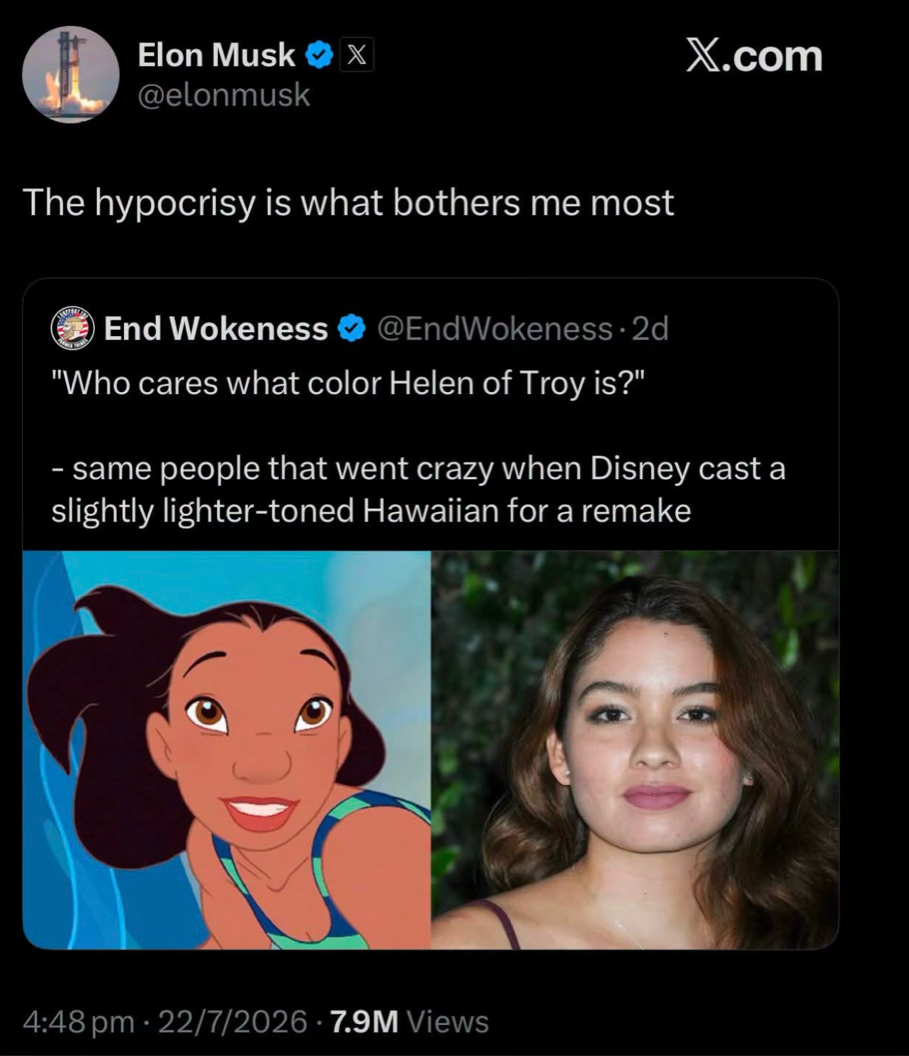
Perhaps the greatest example of outrage fatigue of all though, involves the casting of Lupita Nyong’o as Helen of Troy. Whereas in one breath the left applauded the expected cultural representation which occurred in Disney’s live action remake of Moana, they ridiculed anyone as a right-wing ‘Chud’ who had a problem with the race swapping which occurred in Nolan’s Odyssey.
However, not only is it culturally insensitive, as well as historically inaccurate, to present Helen as a black woman, but Nolan also subverts the very reason why the Trojan war began in the first place. What’s more, he also portrays her with a subtle but noticeable mark on her face to suggest she was a victim of domestic violence.
But according to Christopher Nolan, the military conflict with Troy was not because of her beauty and subsequent adulterous affair with Paris, but rather the greed and duplicity of once again, powerful men.
So many memes have been made at Nyongo’s expense that no one simply has the energy to argue why this even deeper subversion is so wrong. Why is it only men in Nolan’s Odyssey who are guilty of wrongdoing and not also any of the women?
Surprisingly, hardly anyone is upset about the second character Nyongo plays in the Odyssey, Helen’s identical twin sister Clytemnestra. But in yet another egregious example of historical re-imagining, Nolan has Clytemnestra murdering her husband Agamemnon in revenge for sacrificing their daughter Iphigenia. (This was done to apparently appease the goddess Artemis and secure favourable winds for his ships to sail to Troy).
However, in Homer’s original epic, Agamemnon’s murder is achieved by Aegisthus, who had had a consensual affair with Clytemnestra while he was away fighting in Troy. Aegisthus then invites Agamemnon to a feast upon his return and, with Clytemnestra’s help, has him swiftly slain. But hey, let’s not let the truth get in the way of a woke story.
By the way, just because Nyongo’s screen time is limited doesn’t mean that her inclusion isn’t significant. Like a crack in the wall, often a subtext is just as effective in weakening the defences of one’s opponent as escorting an enormous wooden horse is through one’s front gate.
For those with eyes to see and ears to hear, every race on earth is present, all except of course anyone who’s actually Greek! It’s also why Nolan chose the African-American Travis Scott to play the bard at the start of the film. While everyone is distracted by his ridiculous futuristic armour, they have once again forgotten that it’s who’s inside the Hellenic batman suit which really counts. Because according to Nolan it’s only women and non-white men who are truly righteous and can therefore be trusted.
Sinon as the Lynch-Pin to the Story
All of which is to say, the real hero and only truly virtuous “male” in Nolan’s film is Sinon, a character who doesn’t even appear in Homer’s Odyssey and is played ironically, by the transgender actor Elliot Page. A biological woman playing the role of a man dressing up as a Greek warrior.
In keeping with Nolan’s film Inception, here we see the dream within a dream via a biological American woman pretending to be a Greek man. As risky as this is, someone has to say it - the emperor has no clothes! (or in this case, testicles).
For months people have been outraged by Nolan’s inexplicable insertion of the character Sinon into the story. So much so in fact, that for the first time ever a Nolan film was ‘review bombed’ with overwhelmingly negative reactions. Note, very few conservatives predicted the movie would financially flop, they simply expressed their online resistance to the tiresome woke agenda being thrust upon them.
I realise some will object that role of Sinon is also not very significant—much like the physique of Elliot Page—but the truth is, it’s not. Like a drop of poison in a glass of wine, Page’s feline figure frames Nolan’s entire story. Indeed, without the character of Sinon, his whole narrative arc,and associated woke messaging,would fall apart.
This is because Sinon is the lynch pin involving the fate of not only the protagonist Odysseus, but even the antagonist Antinous! In one of the most crucial scenes in the poem, Odysseus travels to Hades where he is supposed to speak with his departed mother, Agamemnon and especially Achilles. Nolan though gives to Sinon the privilege of mansplaining—yes I know, another irony—to Odysseus what needs to be done if he is to successfully return home from the underworld.
Nolan’s faux male soldier then is crucial to the plot. Sinon reproaches Odysseus for using him as a military pawn regarding the ruse involving the Trojan horse. (Nolan’s Sinon believed that was a genuine peace offering to the goddess Athena) At the same time, he also exposes Antinous’s cowardice and treachery, revealing to Odysseus that he was coerced into taking Antinous’s place in the Greek army.
Odysseus’ journey to Hades though, was supposed to reveal the error of pursuing of one’s own glory. However, according to Noalan, the fictional character of Sinon is presented as being both the true hero through her/his/their eternal victimhood.
Undermining the Central Theme
Both reproaches to Odysseus are complete fabrications and foreign to the original literary work. In particular, there are two important fabrications which Nolan commits regarding Sinon, a character whom Homer never even mentioned.
First, in the original Odyssey, after Odysseus tries to comfort Achilles in Hades by reminding him of the ‘glory’ he earned through his glorious death on the battlefield, the great warrior responds:
“Nay, seek not to speak soothingly to me of death, glorious Odysseus. I should choose, so I might live on earth, to serve as the hireling of another, of some portionless man whose livelihood was but small, rather than to be lord over all the dead that have perished.”
Most people will remember the actor Brad Pitt’s portrayal of Achilles in the 2004 blockbuster movie Troy and in particular how prominent the theme of personal glory was. However, whereas many believed glory was to be found in a heroic death, Homer inverts this and concludes that it’s better to a nobody and alive and a somebody who is dead. As wise King Solomon once wrote, “For to him that is joined to all the living there is hope: for a living dog is better than a dead lion.” (Ecc. 9:4).
The second fabrication Nolan commits involves the character of Sinon himself. When he does later appear in Virgil’s Aeneid, we’re told how he was a clever and deceitful trickster rather than an unsuspecting dupe, let alone political pawn:
So spoke Sinon, as artist in perjury, setting his ambush. And we believed him. He fooled us with well-staged weeping and ruses.
Rather than Sinon being deceived then, he was instead a willing agent involved in the deception and subsequent victory over the Trojans via the military stratagem of the wooden horse. For Nolan though, the character of Sinon is crucial to the development of his own subversive theme regarding the immorality of war and its closely connected accomplice, toxic masculinity.
This also explains why in Nolan’s version, Odysseus is perpetually plagued with intense psychological guilt and deep emotional shame because of his involvement in the Trojan wars as well as why he ultimately needs to return home. According to Nolan, the suitors—led by Antinous—must be slain because of Sinon’s betrayal as well as to atone for Odysseus’ numerous war crimes.
Whereas for Homer, home is where Odysseus truly belongs. Meaning and purpose is not to be found in the glory of the battlefield but in the peace and quiet of one’s ancestral homeland and family. This theme is actively undermined by Nolan when he has a Gujarati Indian actor Himesh Patel give the line, “We are the Greeks”. It’s not meant to be funny but said with the utmost gravity and seriousness.
The Gospel of Open-Borders
The real message of the movie according to the man himself can be summarised by what Nolan calls “Zeus’ Law”. This is also a subtle distortion and even perversion of the Greek concept of ‘Zenia’ regarding hospitality. In short, how one treats strangers is important because they could be a ‘god’ in human form.
The implication for foreign policy and especially as to how one treats migrants is not difficult to make. This is further reinforced though by the mention of the mysterious “People from the Sea” who are presented as some kind of existential threat to Bronze Age civilizations. However, in the film’s twist ending, Odysseus realizes that the Sea Peoples are in fact the Greeks themselves!
Perhaps this is also why we have the bizarre ending where Odysseus and Penelope happily sail off into the sunset. Apart from the issue of being once again on the open sea, which was the realm of Poseidon the god whom he had previously offended, just where exactly are they supposed to live?
In Homer’s version Odysseus is at peace when he returns home. His marriage bed is literally rooted into the very soil of his homeland. Whereas in Nolan’s edition, peace can only be found when white people go back to where they came from – wherever that might be. For to make atonement for his war crimes against humanity Nolan presents Odysseus as a king in self-pronounced exile.
However, there is nothing heroic or inspiring about such a decision. In Nolan’s worldview, Odysseus’ redemption is achieved by becoming a ‘nobody’ and relinquishing one’s privilege and power. In yet another ironic twist, the famous ‘nobody’ quip to the Cyclops is one of the most glaring—and for many people, outrageous—omissions in the entire film.
Not all War is Evil
Also latent within the belly of Nolan’s cinematic equine is the message that all war is evil. Nolan’s reframes the entire epic as a brutal, anti-war meditation on the emotional trauma and social degradation caused by armed conflict. Thus, instead of being a triumphant adventure, the film functions as a severe condemnation of the Trojan War, re Western imperialism.
Nolan does this in a number of key ways:
First through the PTSD and post-war disillusionment of Odysseus.
Second, through by reframing the victory achieved via the Trojan Horse as a cowardly and horrific betrayal of xenia, or Zeus’ Law of hospitality.
Third, through the speeches of female characters who condemn violence and especially the patriarchal systems that drive it.
Four, by stripping the Trojan War of any romanticized mythology. Odysseus even admits to Penelope that Helen’s elopement was merely a pretext for the conflict!
Five, by presenting the war scenes in a brutal and unromanticised way. Nolan includes the terrified screams as well as religious and humane atrocities committed against the men, women and children of Troy.
However, not all warfare is evil. And there even comes a time when it is a moral good in restraining human wickedness. All civilisations are built upon victories achieved through military action. Just ask the people of Iran right now who have been pleading for liberation or the veterans of WWII.
As the Bible itself acknowledges, there is a time for war as well as a time for peace (Ecc. 3:8). To contend otherwise is like accepting a gigantic wooden horse past the defences of your city...
The Demythologisation of Greek Religion
Whereas Greek religion was concerned with maintaining the cosmic divine order, Nolan makes the Odyssey about an individual seeking emotional healing from their own psychological trauma. But in so doing Nolan is thumbing his nose not only at the mythology integral to Greek religion but is also undermining the role of the supernatural.
Even the feminist academic Emily Wilson, whose translation of the Odyssey Nolan relied on for the film, has argued that the movie focuses too heavily on Odysseus’ guilt, trauma and shame rather than his heroic pursuit of glory, calling the portrayal “a modern, psychiatric reinterpretation of the ancient character”.
One particular aspect which I haven’t heard any commentator mention though, but is that which Homer himself would have found the most troubling, is the be-heading of Athena by Odysseus. To modern audiences this means basically nothing, but to an ancient Greek worshipper this would have been considered one of the greatest blasphemies and religious sacrileges one could commit.
It would be unthinkable for any god-fearing Greek in the ancient world to conceive of ever doing such a thing to the image they worshipped. Especially when the god in question was also the active divine agent believed to be responsible for one’s military success as was the case with Odysseus.
Not without significance, the posters promoting the film carried the tag-line, “Defy the gods”. In Nolan’s cinematic universe it’s not the gods who are in charge—did I mention how none of the male deities even make an appearance?—but the empathetic human emissaries of social justice.
Don’t be a Chump!
Imagine being a Trojan soldier standing at the gate of the walled city and seeing an enormous horse being brought in. According to Virgil, the character of Sinon claimed the horse was a special offering to the goddess Athena (Minerva) which had been specially constructed to atone for the theft of one of her sacred relics from Troy.
Sinon further warned the Trojans that if they damaged the gift then Athena would destroy the city. However, if they brought it inside their walls, then the favour of the gods would be upon then and Troy would ultimately conquer all of Greece.
Apparently a Trojan priest named Laocoön even suspected a trap and he famously warned the people, “I fear the Greeks, even those bearing gifts”. Then he threw a spear at the horse’s flank. However, almost immediately, two giant serpents emerged from the sea and killed him. The Trojans falsely interpreted this as a divine punishment for desecrating the sacred horse. But according to Homer, the reason the gods who sent the serpents was because they favoured the Greeks.
To any reader of the Odyssey, it was clearly a mistake to bring the “holy object” inside. And yet, almost three millennia later many are willing to make exactly the same mistake. A deadly woke worldview lies hidden within the belly of Nolan’s film. And yet people are enthusiastically celebrating it because they think it’s a sign of worldly success and even divine favour.
Nolan’s Odyssey will undoubtedly make a lot of money. Very few conservatives argued that it wouldn’t. But that is not the point. The issue is what will happen if you accept Nolan’s cinematic gift? Like Laoccon, I’d suggest that the message which Nolan is giving is not to trusted and should be left alone outside the gate.
Resisting Nolan’s Siren Song...
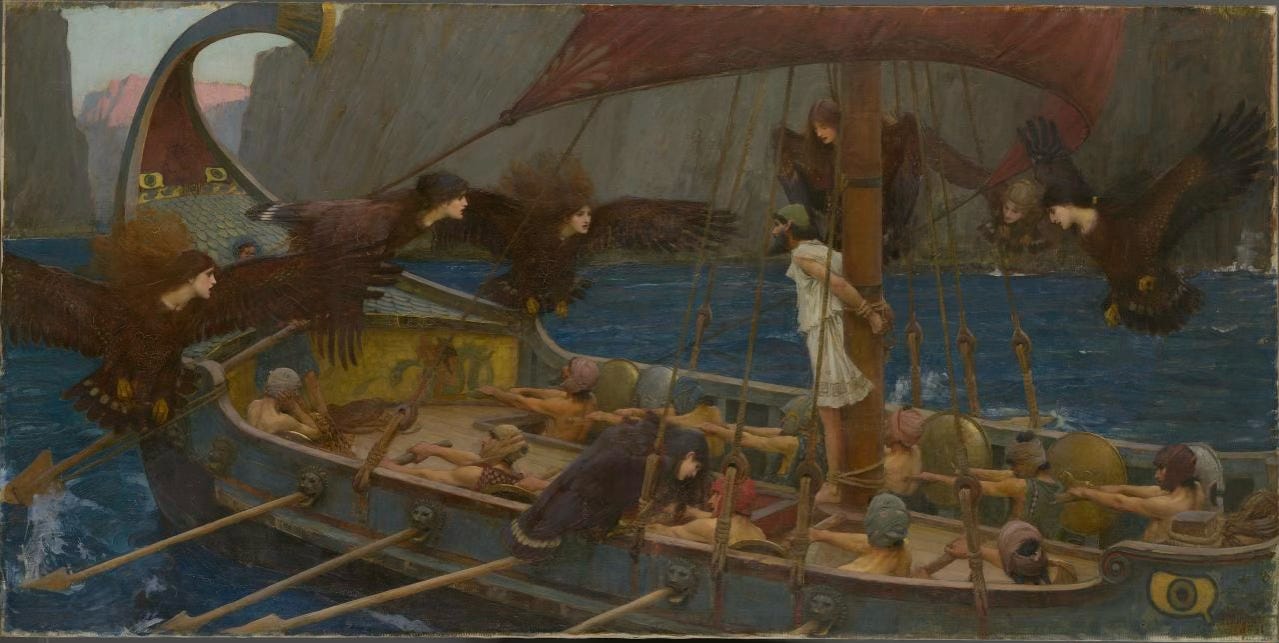
In my office at home I have a picture of John Waterhouse’s beautiful Ulysses and the Sirens. The original is found in the National Gallery of Victoria and I was so struck by the painting when I first saw it that I purchased a life-size print. For me it is a timeless reminder to be single-minded and not be distracted by the siren song of other voices—as seductive as they may be—seeking to distract me from returning home to heaven.
We need to re-learn the lesson which Odysseus and his men first did. Either fill your ears with wax and don’t see the movie. Or do what Odysseus did and prepare to be tempted in advance by fastening yourself to the mast of God’s truth. Either way, be a Christian and don’t be a chump by finding yourself having been taken ideologically captive.
By now, we’ve all heard the phrase “virtue signalling.” The term was popularised in a 2015 article published in The Spectator by British writer James Bartholomew. It refers to the public expression or defence of opinions, beliefs, or values, with the primary purpose of demonstrating one’s moral awareness, compassion, or social and political standing. More often than not, the performance itself is a substitute for practical action. It allows people to appear compassionate without having to make any meaningful sacrifices.
For that reason, the phrase is usually used critically. It suggests that someone is more interested in publicly displaying the “right” opinions than in practically addressing any of the so-called issues that are raised. Of course, those accused of virtue signalling insist otherwise. They argue they’re raising awareness, showing solidarity, or standing with the oppressed. In truth, however, virtue signalling is an inexpensive way to soothe a guilty conscience for a wasted life. They do little themselves, while demanding that everyone else do something.
But there’s a more obvious issue with those who frame themselves as champions of the oppressed classes in order to bolster their public image. If everyone already largely agrees that a cause is righteous, it takes little courage to affirm that position publicly. Moral courage has almost never been socially profitable. The truly oppressed of any age are opposed precisely because the wider culture has been persuaded that their mistreatment is entirely justified. Defending them therefore carries a high cost. Often, there is ridicule, exclusion, professional consequences, and sometimes even imprisonment or death.
This is why so much of modern-day virtue signalling has more in common with historical re-enactments. Rather than confronting the injustices of the present, where courage is necessary and the social cost real, many prefer to relive the moral victories of the past. They loudly and boldly champion causes which the culture has already reached a broad consensus on: opposition to slavery, racial discrimination, or the legal inequality of women. But the positions the “Social Justice Warriors” champion today require no sacrifice, because they are already socially rewarded. They just allow people to present themselves as the kind of heroes who’d have stood against yesterday’s injustices, without having to risk standing against today’s.
It should be obvious, really. If publicly supporting a cause earned you social admiration, career advancement, institutional approval, or social status, it’s worth asking whether the cause actually represents the marginalised or whether it’s become part of the accepted cultural establishment. History demonstrates that the unpopular victims of each age are rarely those receiving endorsements from governments, universities, corporations, celebrities, politicians, and the media. The truly oppressed are never identified by the number of powerful institutions publicly pledging their support.
True justice requires defending those who are oppressed, regardless of who they are or whether it’s socially profitable to do so. The Bible repeatedly commands the defence of the vulnerable and the pursuit of justice. For instance, Micah 6:8 states: “He has told you, O man, what is good; And what does the LORD require of you but to do justice, to love kindness, and to walk humbly with your God.”
And yet, one of the challenges of every age is correctly identifying who is the oppressed and who is the oppressor. History repeatedly shows us that those who hold power are often the quickest to present themselves as victims. They exploit emotions and use the language of suffering and injustice in an effort to justify their privileges, all while perpetuating the suffering of others.
This is where virtue signalling proves to be an oxymoronic performance. In the past, those who defended the genuinely marginalised or spoke against prevailing injustices were rarely, if ever, rewarded for it. They were ridiculed, ostracised, censored, imprisoned, or killed.
Of course, this doesn’t mean that every unpopular or wicked cause is, in fact, righteous, nor that every controversial figure is innocent or worth defending. It is simply to say that popular cultural consensus has never been a reliable measure of justice. So, the real question isn’t whether someone belongs to an approved victim class, but whether their basic dignity, freedom, and rights as human beings are being denied. Are they being treated differently from everybody else on the basis of some particular inherited status?
The real test of virtue is not standing with those whom society rewards you for supporting. It’s standing for truth and justice when doing so carries a cost.
So, if you want to know who the oppressed are in any given age, don’t look to approved causes and social trends. Look instead for those whose defence brings accusation and condemnation. More often than not, they are the people polite society tells you can never be defended.
The question is not, “Who receives the loudest expressions of solidarity?” but, “Who can be defended only at personal cost?” History suggests that the answer to that question is often far closer to the truly oppressed.
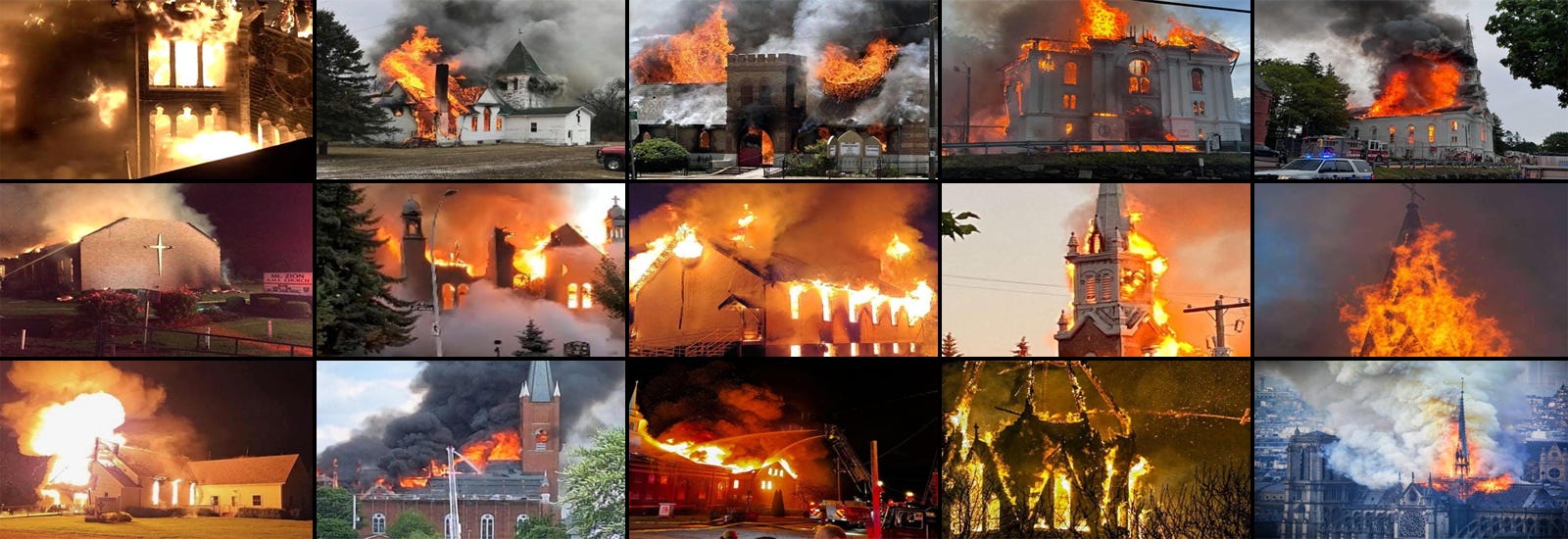
Somewhere this month, a Catholic family watched a church burn on the news and waited for someone in authority to do something — anything — that would make them feel it mattered. From their bishop, if anything came at all, they got a few lines about healing and dialogue. From their government, silence.
Multiply them by millions. The gap between what the faithful feel and what everyone charged with defending them is willing to say and do on their behalf is the real story — bigger than any single fire.
What the ordinary believer cannot find anywhere is a single leader who sounds angry on her behalf or calling for any tangible action.
Canada’s entire arson wave has produced two convictions and not one serious prison term, while the Prime Minister called the anger “understandable” and a prominent activist leader called for more churches to be erased: “burn it all down.” And this same dynamic is repeated across Europe and the progressive leftist parts of the United States.
The same politics that casts Christianity as the villain of history is now escalating to complicity in these attacks — and, in some cases, openly urging them — while the rest of us are told to keep the tone civil and bipartisan and to ‘love thy neighbour’. Ask plainly what that civility has earned the Church, when progressive leftist policies treat a burning church as a grievance it understands and that its activists support.
The faithful can see what this is: anti-Christian hatred, from an ideology that has made their faith the designated oppressor. And they watch both their church leadership and their political statesmen decline to call it out, from fear of facing up to the cost of abandoning their comfortable bipartisan illusion. So the burning wounds them twice — once when the roof comes down, and again when the men sworn to protect them explain why nothing can be done.
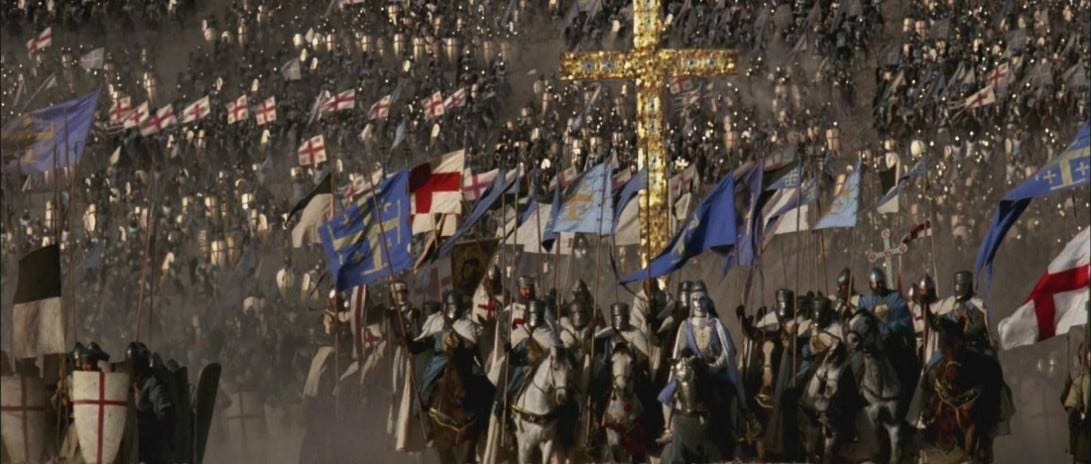
This is why a twelfth-century king is suddenly on every feed. It is not bloodlust, whatever the critics say — it is passion and pride. Baldwin IV rode out at Montgisard at sixteen, deeply unwell, because he believed his people were worth defending and was prepared to sacrifice everything to do it — and when the day was won, he went home a hero. The people sharing his image are not all asking for a crusade. They are asking, in the emotive language the internet gives them, for one leader who is visibly proud of them and whom they can be proud of in return — who would put himself between them and the fire, and make a church worth defending again. They are grieving a leadership they have never had.
Image: ‘Kingdom of Heaven’ (2005)
So ask the question that leadership never asks itself: who is inspired by its actions? Who walks out after listening to a diocesan statement, or a minister’s press conference, feeling prouder, braver, safer, inspired to be Christian? The answer is in the quiet emptying of his pews as congregations shrink; the politician offers thoughts and a task force. Both wonder where the young men went. They went because nothing was asked of them, and nothing was offered them to be proud of.
So what would King Baldwin do?
He would say out loud that these are his people and he will not stand for it. He would call out the people doing this without fear of being called names. He would attack the politicians who excuse it, rather than thank them for their partnership. He would treat the impunity as the emergency it is — fund the investigators the state will not, get the arsonists named in indictments, put them out of their jobs, and, where they are not citizens, deported; and throw the Church’s weight behind the representatives, prosecutors and judges who enforce the law, and against the ones who look away. He would stand in the burned-out nave and promise something taller and more beautiful in its place. And he would mobilise every angry, aimless young man watching his inheritance burn — to build, to campaign, to protest — and make him feel, for once, that his faith has a spine and he is not alone.
People do not follow press releases and bipartisanship. They follow someone prepared to sacrifice comfort for the survival of the faith.
The nostalgia for Baldwin is not a longing for war.It is a longing for leadership.
There is much discourse in our modern culture about the topic of being woke. This movie is woke, that book is woke, the new T.V. show is woke, everything is woke, woke, woke.
More people are probably aware of the term than what it really means. But most have the general ability to spot something that is woke. Essentially, woke refers to someone who purports to be acutely aware, really obsessed, with the perceived or claimed injustices of a particular minority, and who is willing to change the rules to favour that minority.
The term originally came out of African-American communities in the post-civil rights era in the United States and has now been greatly expanded to include a vast array of “oppressed” groups within Western society.
The woke want to turn every genre or film, books and video games, they want to forge every institution, they want to craft every law and human rights document, and make every sermon, conversation, and broadcast, into an opportunity to push “the message” or their woke agenda. And people are getting increasingly tired of it.
The woke is, as the Social Justice warrior, who is, as the cultural Marxist, who is, as the intersectionalist,
who has a much higher chance than average of having unnaturally coloured hair, a useless university degree, of using anti-depressants, and a voting record to the left of the Greens parties.
And they are also not new. In fact, Nicholas Berdyaev writes about these types in his letters, which have been compiled together into a book called The Philosophy of Inequality. He writes there about these people we could call wokians,
“People of your ilk, hostile to me, have given little thought concerning nation and the national problem. Ye are wont even to acknowledge the state on utilitarian grounds. But ye have proven incapable of penetrating into the intimate mystery of the national manner of life. True, you admit of the rights of oppressed nationalities and for these nationalities ye are ready to become quite extreme nationalists. Many of you tend to posture under your sign for the right of self-determination of nationalities. But this proves also, that to the mystery of national lifestyle you only can approach at it externally, that inwardly it is beyond you. You are ready to admit of the national lifestyle and national rights of the Jews or the Polish, of the Bohemians or the Irelanders, but amidst this, the national lifestyle and national rights of Russians ye never could admit. And this is because, that it is the problem of oppression which has been of interest to you, while completely uninterested by the problem of nationality. Ye proclaimed the right of the free self-determination of nationalities, not so much out of any interest for the nationalities themself and even not believing in the existence of such sort of realities. You merely need this “free self-determination” as a means of struggle for your political and social ideals, for an abstract equality and freedom, and nowise for the concrete national manner of life, not for a national flourishing.”[1]
Berdyaev identifies that these so-called advocates of justice are not really interested in justice for people of various oppressed groups. Rather, they can see in the causes of these people a means of going after the perceived oppressor, in this case the Russian people. They see in these causes a means of upturning the order of the nations in which they seek political power. To consider the national rights of the Russian, in this context, is not even on their radar, because to do so would mean that they would have to pursue actual justice. But that is not what they really want; they really want to deconstruct the society in which they live and disenfranchise the majority. To do so, they need a shroud to cover their true motives.
In fact, the concept of true justice is alien to them, as Berdyaev writes,
“Indeed, in the national lifestyle there is for You an ungraspable irrational mystery, hidden deep in the earth. Ye have never penetrated thence, ye always remained at the surface…No, your struggle…is merely the international struggle for levelling an equality, a struggle for man in the abstract, for an abstraction of man. Ye do not know the concrete man in flesh and blood, in race and tribe, the man national. Your struggle for the liberation of oppressed nationalities and for their equality is an international struggle, a geometric struggle, a struggle abstracting and tearing the national man off from the living countenance, from his maternity and fatherland.”[2]
If you tear a man from his “living countenance, from his maternity and fatherland” you weaken him, and you make him rather incapable of defending himself. That is their true strategy.
The wokians, these social justice warriors, these fake justice promoters, do not really have a deep regard for the people whom they say they are advocating for. They simply see in their plight a means of pushing for equality. The equality they want, and really the only type one can really pursue, is the levelling of all to a lower level of prosperity and well-being. Because to get to a form of equality, you need to denationalise the oppressor and the oppressed, making them both less than they should be. Really, their goal is the destruction of national identity, not just for the “oppressor”, but for all, because inside a national identity is a framework for preserving its members. These people use justice as a guise for a very different goal,
“The “oppressors” of nationalities sometimes acknowledge them more, than do the “liberators”. “They oppress” is of the living national man in terms of race and tribe, flesh and blood, whereas “they liberate” is of an abstracted geometric man…The secrets of every national manner of life merits sympathy. It is needful to get down into it even then, when the discourse goes hostile to us as a nation. The German people was our enemy and we had to fight against them. But the unrepeatable uniqueness of the German, the most intimate thing in the German spirit, the genuinely individual in the expression of the German visage always, even at the moment of struggle, seemed to me to merit of sympathetic consideration. In our international struggle for the liberation and equality of nationalities there is no feel of perception of national visages, there is not in it the love for the national image.”[3]
When Berdyaev says here that the oppressor often acknowledges the oppressed more than these “warriors for justice” he means simply this: they at least acknowledge the people they disagree with have a genuine and real identity. He is not commending the oppressor; he is simply noting that they at least acknowledge the people they oppress have a real national identity, or at least they often do. The Marxists did not even do this; they do not acknowledge this identity. Rather, they wanted to strip the man, the woman and the child of their national identity and seek to raise them up again in their own image.
Berdyaev goes on to say,
“K. Leont’ev was correct, when he declared your national politics merely a weapon of worldwide destruction and espied in it merely the triumph of democracy and cosmopolitanism. Your principles of the “right of the self-determination of nationalities”, so bally-hooed about in the Russian revolution, is anti-historical an abstraction, of contrived theme which deny the unrepeatably unique reality, which is called nationality. Nationality cannot be severed off away from the concrete and its right cannot be merely a matter of abstract history, investigation.”[4]
These wokians, these anti-justice warriors, want to destroy what is unique in each people’s identity and then call it liberation, cries Berdyaev. In other words, he is observing that their solution is worse than the problems they cry out about.
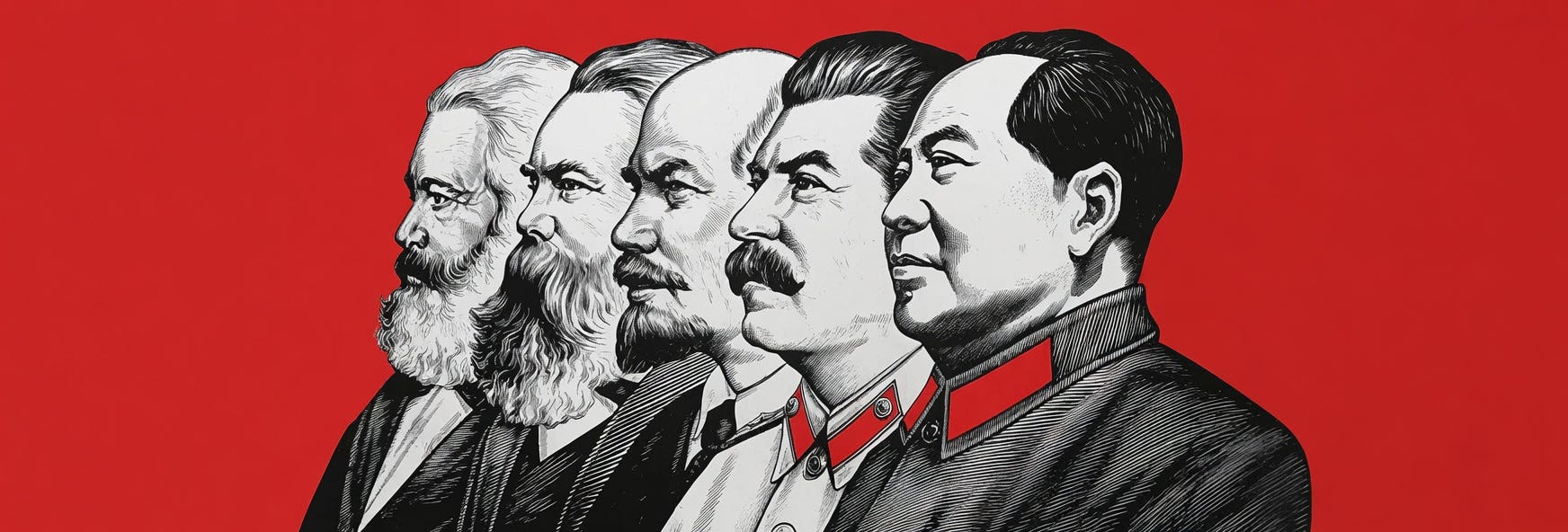
I read Marx and Engels, myself, many years ago. I read the Communist Manifesto twice and worked my way through a chunk of Das Capital. A lot can be said against these works and has been. Berdyaev is doing that in his letters in this book. But I would simply sum up my perception of their position as this: they sometimes correctly identify problems of inequality and injustice in society, and they propose solutions which are far worse than the problems they diagnose. That is what Berdyaev is saying here. These Marxists will use tyranny to solve problems and create far worse problems, because they deny the very nature of humanity. They rage more against creation than against injustice.
He goes on to say that,
“Each nationality within the various periods of its existence possesses various rights. These rights cannot be merely watered down. There exists a complex hierarchy of nationalities. It would be thoughtless and absurd to compare the rights to self-determination of the Russian nationality and the nationality of the Armenian, the Gruzinian or the Tatar. It would be thoughtless and absurd to approach with the same abstract measurement the rights of the German nationality and the Spanish nationality at a given moment of world history. In the life of nations there occur periods of flourishing and periods of waning, periods of the high exertions of their powers and periods of weakness. And their rights to self-determination in these instances are varied. The question about the rights of the self-determination of nationalities is not some abstract juridical question, this is first of all a question biological, in the final end a mystically-biological question. It rests upon the irrational grounding of life, which is not subject to any sort of juridical and moral rationalisations. All the historical nationalities possess quite varied, unequal rights, and they cannot be put forth under the same pretensions. In the historical inequality of nationalities, the unequalness of their real weight, in the historical predominance now of some, now of other nationalities there is its own great truth, there is the fulfilling of a moral law of historical activity, so dissimilar to the law of individual activity.”[5]
In other words, Berdyaev is arguing here that every nation, and its current situation, should be evaluated as it is, and treated accordingly. Their issues should be taken on a case-by-case basis. Nations should not be treated as though they are always all in the same position, because they are not. By noting that they have ‘unequal rights’, he means simply that in some periods nations rise above others and then fall under the sway of others. He is describing what we see often occurring in history and in our world today. There is a rise and fall of nations; some become empires, some attempt this and fail, some have achieved this, and then they fall. Nations have periods of greatness and then periods of humility. There are times when a nation should be encouraged to exercise its right to self-determination, and there are times when nations have taken this too far.
Berdyaev is saying something I have written about often: equality is a useless principle when dealing with human beings, human entities, and human institutions. Humans, and the nations derived from those humans, are so different, so diverse, and so varied in their ranges of experience and capabilities that their needs and situations require great care and attention. Applying a broad-brush stroke approach to their issues by seeking to force them all into some form of equality is harmful, as they often need different things, depending on their current situations.
Berdyaev here is writing about the very same kinds of people we call woke. The kinds of people who use the shroud of social justice to bring about social degradation. These ideas did not originate in modern universities, even though they have overcome such institutions. These ideas go back far earlier. I am sure we could find these evils at work in other nations in other ways. But we can at least trace this error back to the French Revolution, which unleashed the falsehood of the cause of equality on the world.
Berdyaev is warning us that often those who make a pretence of caring for so-called minorities often have far more nefarious intentions.
[1] Nicholas Berdyaev 1923, “Fourth Letter: Concerning Nation”, The Philosophy of Inequality, pp. 83-85
[2] Ibid.
[3] Ibid.
[4] Ibid.
[5] Nicholas Berdyaev 1923, “Fourth Letter: Concerning Nation”, The Philosophy of Inequality, pp. 83-85
The Economist’s Zanny Minton Beddoes got a little too cozy with zany Marxian Woke conspiracies about Elon Musk and the so-called “far-right”.
Her interview with the SpaceX boss has now gone viral for falsely asserting that Musk was backing the “far-right.”
Beddoes told Musk, “You support not just the populist right, but the far-right. In fact, very fringe parties in some countries.”
He quickly fired back at the Editor-in-Chief’s false assertions.
Correcting the claim, Musk interjected, “No, I support the normal people. What you call the ‘far-right’ falsely.”
“Literally, you could go back 10-15 years, and these policies were completely normal.”
In fact, “take a speech from Obama and Hilary and then go to someone who’s on the sort of – what I call the lunatic left – and say, what do you think of the speech by Trump.”
They’ll reply, “Oh wow, he’s the worst person ever.”
Then you say that was “actually by Obama or actually that was a speech by Hilary.”
Beddoes, while agreeing that the Democrats have shifted further to the left, then dropped Restore Britain’s Rupert Lowe as if to prove the “far-right” assertion correct.
To which, Musk again interjected, “That’s not the fringe right.
“It’s actually just normal people. Here are the principles. Tell me which of these sounds terrible? We should have secure borders, safe cities, sensible spending.
“Which of these,” he asked, “are far-right fringe?”
Ignoring Beddoes’ attempts to interrupt him, Musk pushed forward, stating, “I would like to admonish you and the media for the absurd characterisation of the ‘far-right.’”
“It is false and misleading and nonsense.”
Shifting tack, Beddoes drove her accusations towards Musk’s follower count and comments like “Civil War in Britain is inevitable.”
“When were you last in the UK?” she asked.
To which Musk quipped back, “At the current trends, yes. You live a closeted existence.”
On the back foot and appearing annoyed, the Economist editor stated that she lives there, adding, “The numbers disprove what you say.
“All the numbers about London. It’s a much safer city than any city in the United States. You have painted a kind of view that Europe and the UK are overrun with terrifying Muslim immigrants.”
As if “there’s a rape on every corner and civilisational destruction.”
Musk responded, stating that he hadn’t said any of that.
“If you have,” he explained, “a rapidly growing group of people whose beliefs are antithetical to Western beliefs, at some point there will be a reckoning.
“They will try to implement their views and those who oppose it, will oppose it, and that’s what you call civil war.
“Obviously, this is the trend. You absolutely do live in a closeted existence.”
Confident, Musk invited her to go on a tour of Britain.
“Then you will see for yourself.”
Saying she was fine with a tour, Beddoes followed her acceptance with a genetic fallacy. In effect, she argued that Musk didn’t live in the UK, so he has no right to speak about it.
Beddoes admitted that her viewpoint was driven by concern about Musk’s influence and his own allegedly unqualified and allegedly poorly informed assertions.
Fear of grooming gangs, and London being a violent place, she stated, comes from a picture that people get from things that “you post on X.”
Castigating Musk for sharing the banned film “Citizen Vigilante,” Beddoes said “it’s dystopian. It’s not fun. It’s not a very good movie.”
The finger-waving Economist editor remarked:
The film “paints a dystopian picture of Europe and it glorifies vigilante violence. It glorifies the murdering of a Muslim immigrant family.”
“I honestly think,” she declared, “it is irresponsible for you to put that up on X.”
Notably, Beddoes was silent about the Left’s gloating over and glorifying of politically driven assassinations or the dominant pattern of both Islamic terrorism driven conquest of Africa.
Such as the mass slaughter of Christians in Nigeria, the murder of Charlie Kirk, Ann Widdecombe and the multiple attempts on Donald Trump’s life.
To this, Musk offered the simple reply, “I think it’s a good movie and it’s worth watching.”
Furthering the “far-right” assertions, Beddoes asked Musk, “People say that you’re a racist. Why?”
Answering her, he said, “I would say I’m not.
“Look at my companies. We have senior executives of all races. I don’t think there’s any racism there.”
This section of the segment included the Economist asking Musk if he was “anti-Muslim.”
“I’m against people coming to a country with antithetical views. I’m against rape and murder. I’m against the imposition of rules and laws that are contrary to what we’ve come to accept in the West.”
“I think it’s a crying shame that the traditional media like you don’t recognise this.”
Throwing at Musk another genetic fallacy, Beddoes declared, “Why should you be able to shape European politics? You don’t live there.”
“I think of it as the West collectively,” he said.
“We started this conversation with superlatives, an increasingly aggressive Beddoes declared. “It’s why people loathe you.
“I don’t care,” Musk said.
“But the fact that, as you pointed out, a quarter of a billion people follow me is that I think a lot more people actually like me than don’t.”
Slamming Beddoes, he handed the hats back, stating, “I think a lot more people hate you and the media more than you realise.”
Rupert Lowe didn’t let the slander slide either.
In an X post, he cheered on Musk, writing, “This ‘journalist’ tries to paint me as ‘far-right’ and racist. Elon shuts her and the entire mainstream media down in the most glorious way.”
Sharing the interview online, Musk effectively said, not the far-right, “just common sense.”
None of this is foreign. None of it is new.
Musk is being true to what he cares about, honest about his concerns and steadfast in his convictions.
At least as far back as 2024, Musk has been pointing out the Overton Window.
He’s been consistent in showing how left-wing dominance of institutions – also referred to as the culture war - has changed the language, and with it the socio-political landscape.
For example, on 6 October, 2024, he wrote, “The term “far right” has been watered down so much by the legacy media as to render the term meaningless by historical standards, which is a terrible thing for them to do.”
Five days later, he shared a graph adding, “This explains the silly terminology of the leftist legacy press, where they only use the terms ‘left’ and ‘far right’. From their extremely left standpoint, even centrists are ‘far right’”
In a January 2025 post, he stated, “That’s how legacy media defines “far-right”: A centrist with genuine concern that doesn’t fit the far-left narrative.”
Likewise, later that year, Musk explained, “When far-left legacy media refers to the “far right”, they actually mean centrists.”
Posting in January this year, he all but stated that distaste for legacy media was a consequence of those in it calling an approved narrative, common truth.
“Most of the legacy (formerly mainstream) media,” Musk said, “operates as a slow-moving far left propaganda machine.”
Finally, in March, he protested the Associated Press’s false labelling of Chile’s new president, José Antonio Kast, saying,
“Every normal world leader is falsely described by Associated Propaganda (AP) and legacy press as “far right”!
As former French communist turned Christian thinker Jacques Ellul once cautioned: Manipulative propaganda is often attached to the repetition of “organised myth.”
Conformity is rewarded, and bias is produced as falsehoods try “to take hold of us and invade every area of our consciousness.”
Vindicating Musk’s dedication to freedom of speech, Ellul explained that dialogue was propaganda’s enemy.
“Propaganda,” Ellul said, “ceases where simple dialogue begins.”
Paul alluded to something similar in 1 Corinthians 10 when encouraging the Church to avoid being seduced by idolatry.
He then expressed in his second letter a far more pointed take, declaring the Lordship of Christ over accusation, conspiracy and lies that get repeated as though they were truth.
“For the weapons of our warfare are not of the flesh,” Paul asserted, “but have divine power to destroy strongholds.”
Therefore, “we destroy arguments and every lofty opinion raised against the knowledge of God, and take every thought captive to obey Christ…”
WNBA star Sophie Cunningham has emerged as one of the league’s most recognisable and talked-about figures in recent years, propelled by her close association with Caitlin Clark and the viral fame surrounding her now-iconic finger-pointing moment.
This week, the Indiana Fever guard is making headlines again, this time due to comments she made about protecting girls in sports from the intrusion of biological males.
During a recent ESPN interview, Cunningham voiced her support for restricting transgender participation in women’s sports, arguing that female athletes—particularly young girls—should not be required to compete against biological men.
Cunningham said,
“I got a lot of negative feedback about me hating trans. And I'm like, 'I never once said that. I think that I am here to extend love. But I also think with that love is truth, being honest. And I want to protect young girls in a locker room, or young girls in sport who shouldn't have to go against biological men.”
Critics accused her of promoting anti-trans views, while Cunningham rejected that characterisation, saying her position was motivated by a desire to protect women’s sport rather than hatred toward transgender people.
Cunningham later defended her position, describing it as “common sense.”
“I’ll always believe in that,” she said. “I think it’s really important to protect children, and that’s little girls who are also involved in that category. So, I stand [by] what I said, and I’ll always believe that.”
She went on to say that while she’s not very political, she does have beliefs and morals on which she stands.
“When it comes to protecting young girls in sport, and women in sport, I feel very strongly about that,” she said, noting she has never once said she has hatred for transgender people.
Cunningham has long been critical of biological males competing in women’s events. In 2022, she responded to news about Lia Thomas, a trans swimmer on the UPenn women’s swimming team who was setting new women’s records.
At the time, Cunningham shared a post about Thomas on social media, saying, “Female collegiate athletes deserve so much better than this.”
Earlier this year, Cunningham publicly shared that she had been re-baptised as an adult. She shared the moment with the words, “Thank you, Jesus.”
Bovaer 10 is a relatively new feed additive that’s been getting quite a lot of attention lately. It was developed by Dutch company DSM-Firmenich, and works by blocking specific enzymes in a cow’s rumen, which then cuts down on the methane those gut microbes produce during digestion.
It’s mainly aimed at cattle in intensive feedlots that are often fed heavy grain diets.
The phrase “Judeo-Christian” has become one of the most common expressions in modern religious and political discourse. It’s often used to describe a shared moral heritage or the ethical foundations of Western civilisation. Jordan Peterson, Wesley Huff, Ben Shapiro, and countless others have all employed the term to denote a shared ethical framework between Judaism and Christianity.
Many Christians, however, are increasingly rejecting the phrase, not because they’re “antisemites,” nor because they deny Christianity’s historical roots in Israel, but because they believe the phrase unintentionally obscures one of the central claims of the Bible itself.
The disagreement is not about whether Jesus was a descendant of David or whether Christianity came through Israel. It is about whether the phrase is suggesting more than intended when it is used.
The Heart of the Issue
Those who defend the use of the expression generally argue that Christianity and Judaism share a common moral and biblical heritage. Therefore, they argue, “Judeo-Christian” simply acknowledges those shared foundations.
At first glance, that sounds reasonable. However, the problem is that Christianity already contains its own Old Testament heritage. The modifier “Judeo” doesn’t add something that Christianity lacks. Rather, it implies Christianity is incomplete without it. And that is precisely what many Christians reject.
Christianity Already Includes the Old Testament
One of the most fundamental claims of the New Testament is that the religion revealed in the Old Testament is the religion fulfilled in Christ.
Jesus didn’t present Himself as the founder of an entirely new faith. He claimed to fulfil the old one.
Jesus said, “You search the Scriptures… it is they that bear witness about me” (Jn. 5:39); and, “If you believed Moses, you would believe me, for he wrote of me” (Jn. 5:46).
After His resurrection, Jesus explained that everything written in Moses, the Prophets, and the Psalms concerned Him (Lk. 24:27, 44).
The Apostle Paul said the exact same thing. The righteousness revealed in Christ was already “witnessed by the Law and the Prophets” (Rom. 3:21-22). The Gospel was preached beforehand to Abraham (Gal. 3:8). Hebrews presents Abel, Enoch, Noah, Abraham, Moses, and the prophets as participants in the same faith that Christians now confess (Heb. 11).
In other words, the Old Testament is a Christian book because, according to Jesus and the Apostles, it is all about Christ. Thus, the New Testament never presents Christianity as an addition to or diversion from Old Testament religion.
It presents Christianity as its fulfilment. As such, the Old Testament is already a Christian book because it ultimately points to Christ.
“Christian” Is Already an Old Testament Word
Some people speak as though the word “Christian” somehow lacks connection to the Old Testament. It is as though “Christian” is a thoroughly “Gentile” term, disconnected from the “Jewish Messiah” and thus, in need of the Jewish modifier “Judeo.”
But this is simply not true. The Christian simply means “one who belongs to Christ.” “Christ” is the Greek translation of the Hebrew word Messiah—the Anointed One promised throughout the Old Testament. The very name Christian already assumes the entire Old Testament expectation of the Messiah.
It is impossible to understand Christ without Moses, Isaiah, David, or the Prophets. Christianity doesn’t forget or ignore its Israelite roots. Its name “Christian” already proclaims them.
“Judeo-Christian” Says Less, Not More
This is why an increasing number of Christians object to the phrase. If “Christian” already includes the Law, the Prophets, and their fulfilment in Christ, then adding “Judeo” contributes nothing.
Instead, it subtracts, and the very thing it treats as unnecessary is the heart of Christianity itself: Jesus Christ.
The defining feature of Christianity is no longer Christ Himself, but rather an imagined alliance between two contradictory religious systems.
As such, the modifier “Judeo” is unnecessary at best, and dangerously misleading at worst. Christianity does not require qualification. It is the fulfilment of everything the Old Testament anticipated.
In short, the question is whether the phrase “Judeo-Christian” adds something or takes something away. If it adds something, what does it add that is not already included in the term “Christian”? If it takes something away, what is subtracted if not Christ himself?
If Judeo, Which Judeo?
But the term “Judeo-Christian” also raises another important question. If Judeo, which Judeo? When people talk about “Judaism,” which Judaism do they mean?
The first century did not contain a single unified Judaism. There were several competing sects, and they all contradicted each other. There were Pharisees, Sadducees, Essenes, Zealots, Samaritans, Herodians, and Hellenists. Each one claimed to represent truth and faithfulness to the God of Israel. Each interpreted Scripture differently. So, which Judeo are we referring to? Which expression was the true one?
That is not to say there was no genuine expression of the religion revealed in the Torah. Rather, it is to say that the fullest and truest expression of Old Testament religion was found not in the competing Judaisms of the first century, but in Jesus Christ Himself.
Jesus certainly obeyed the Law perfectly. But He did not simply identify Himself with one of these competing movements. Instead, He repeatedly confronted them. He rejected the tradition of the Pharisees (Mk. 7). He rebuked the Sadducees (Matthew 22). He denounced the religious leaders as blind guides (Matthew 23). He taught with an authority that astonished the crowds precisely because it differed from their established teachers (Matt. 7:28-29).
Jesus was not the spokesman for first-century Judaism. He was the fulfilment of the Scriptures from which those competing systems had drifted so far that they regarded His teaching as something entirely new (Mk. 1:27).
Christianity Is Not Judaism Plus Jesus
This is the point that discussions today often miss. The New Testament doesn’t present Christianity as Judaism plus Christ. It presents Christ as the fulfilment—and therefore the final interpretation—of Moses, the Prophets, the Temple, the priesthood, the sacrifices, the Passover, the Sabbath, the covenant, and the promises.
Everything points to Him. Everything culminates in Him.
The Temple was about Jesus’ tabernacling with His people (John 2:19-21; Rev. 21:22).
The Levitical priesthood was about Christ’s eternal priesthood (Heb. 7:11-28).
Animal sacrifices were about Jesus’ once-for-all time sacrifice (Heb. 10:1-14; John 1:29).
The sacrificial altar was about the cross on which Jesus died (Heb. 13:10-12; Gal. 6:14).
The Passover Lamb was about Jesus’ offering (Heb. 9:11-12; John 14:6).
The veil was about Jesus’ flesh (Heb. 10:19-20; Matt. 27:51).
The covenant of Moses was about the New Covenant in Christ (Jer. 31:31-34; Luke 22:20; Heb. 8:6-13).
The earthly Jerusalem was about the heavenly Zion (Heb. 12:22-24; Gal. 4:26; Rev. 21:2).
The manna in the wilderness was about the true bread from heaven (John 6:32-35, 48-51).
The bronze serpent was about Jesus’ crucifixion (John 3:14-15).
The Sabbath rest was about resting in Christ (Matt. 11:28-30; Heb. 4:8-10).
The old creation is replaced by the new creation (2 Cor. 5:17; Rev. 21:5).
Circumcision of the flesh was about circumcision of the heart by the Spirit (Rom. 2:28-29; Col. 2:11-12).
Priestly intercession was about Christ’s eternal intercession (Heb. 7:25; Rom. 8:34).
Mount Sinai was replaced with Mount Zion (Heb. 12:18-24).
David’s earthly throne was about Christ’s eternal kingship (Luke 1:32-33; Acts 2:30-36).
And Israel itself was about the true Israel of God (Hos. 11:1; Matt. 2:15; John 15:1; Isa. 49:3-6).
As Jesus and the Apostles said, the Old Testament is all about Christ.
The Consistency Test
Advocates of “Judeo-Christian” often justify the phrase because Judaism and Christianity share some moral teachings. But shared ethics alone cannot justify combining religious identities.
Islam also teaches belief in one God. It condemns murder, theft, adultery, idolatry, lying, and dishonouring parents. Yet almost no Christian would describe our moral tradition as “Islamo-Christian.”
Why not?
If some shared ethics are enough to justify a hyphenated religious identity in one case, then consistency would require applying the same standard in the other.
But most will reject the phrase “Islamo-Christian” because Christianity and Islam ultimately proclaim different gospels. The same principle ought to apply here. Shared ethics do not erase fundamental theological differences.
The defining question is not whether two religions agree about certain commandments. The defining question is what they confess about Christ.
The Real Issue
The objection to “Judeo-Christian” is therefore not ethnic. It is theological. It’s not a rejection of the origins of the Bible. Nor is it a denial that Christianity was part of Israel’s history.
Rather, it’s an insistence that Christ is not one element within a larger religious or ethical system. He is the fulfilment of everything that came before Him.
As Jesus Himself declared, “If you believed Moses, you would believe me, for he wrote of me.”
Christianity doesn’t lack so much clarity that it requires another religious label placed in front of it. The Apostles never called themselves “Judeo-Christians.” They called themselves Christians because they believed that in Christ the Law, the Prophets, and the promises of God had reached their fulfilment.
That’s why the word Christian is sufficient. It doesn’t deny the Old Testament. It proclaims its completion.
The Presbyterian Church of NSW and the ACT has voted 136–61 to reaffirm that the office of elder is reserved for qualified men, bringing it into line with every other state church in the Presbyterian Church of Australia.
While many who have no intention of ever attending a church have responded with a barrage of criticism, the question that was before the Church is not whether the culture approves of male eldership, but whether Scripture teaches it. The decision is therefore not one based on tradition, preference, or cultural attitudes, but on the authority of God’s Word.
The Bible does not present male eldership as a secondary issue or a matter of personal opinion. Rather, it is rooted in the order God established from creation and reaffirmed throughout Scripture.
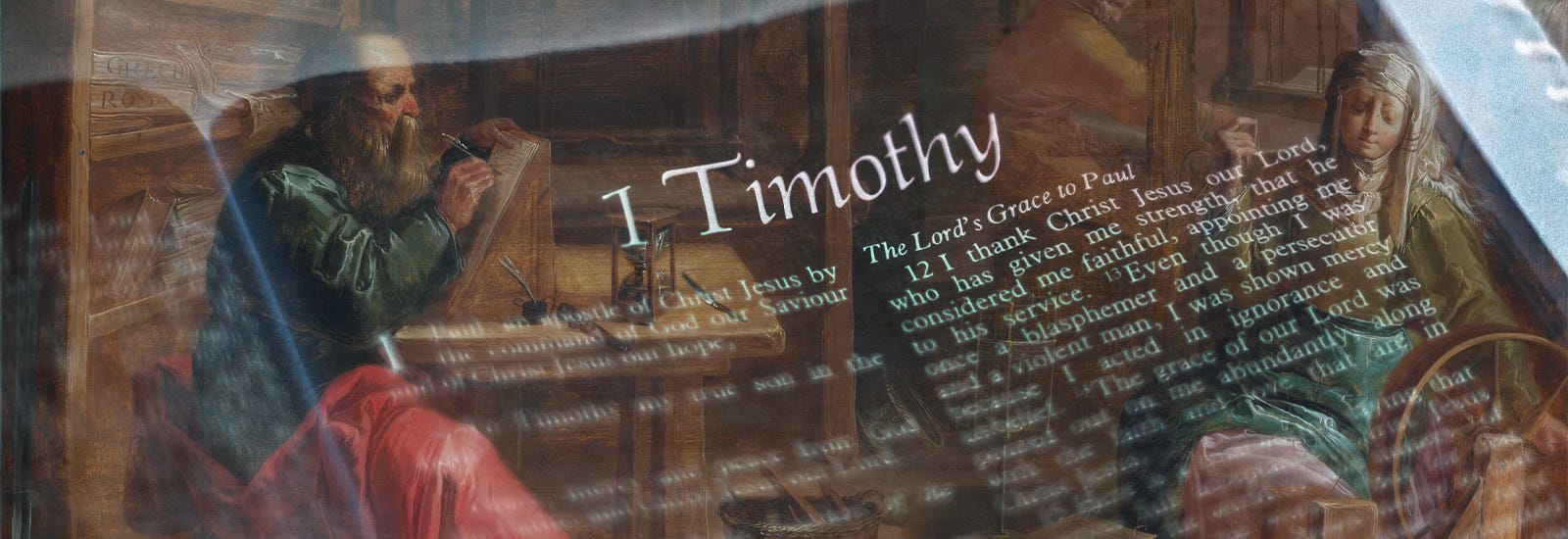
In 1 Timothy 3:2, Paul defines the qualifications for an elder:
“Therefore an overseer must be above reproach, the husband of one wife…”
Paul does not provide qualifications for a female elder, but repeatedly describes the office of overseer in terms of qualified men. The same pattern appears when Paul gives qualifications for deacons, again describing them as “the husband of one wife” (1 Tim. 3:12).
He explicitly addresses the question of authority and teaching in 1 Timothy 2:11–14:
“Let a woman learn quietly with all submissiveness. I do not permit a woman to teach or to exercise authority over a man; rather, she is to remain quiet. For Adam was formed first, then Eve; and Adam was not deceived, but the woman was deceived and became a transgressor.
Of course, since the militant rise of feminism, endless attempts have been made to make Paul mean anything and everything other than what he plainly says. Some have sought to redefine what “teach” and “exercise authority” could possibly, maybe, might mean, rendering his command virtually unknowable, or even irrelevant to the question of female ordination.
Others have suggested that Paul is speaking only to a specific situation that arose in Ephesus, where Timothy was ministering. Historically baseless theories have been put forward about a particular group of disruptive women who allegedly interrupted church services with objections and commentary. Yet neither Scripture nor history provides any evidence for such claims. They are imposed on the text for the sole purpose of rendering Paul’s command outdated and therefore irrelevant.
More importantly, however, Paul himself gives the reason for his instruction. He doesn’t appeal to some temporary cultural situation, but to the timeless, created order itself:
“Because Adam was formed first, then Eve.”
Paul’s argument is not that women in Ephesus were uniquely problematic, but that God established a pattern in creation that is to be emulated within the Church. His reasoning reaches back before Greek culture, before the first century, and even before the Fall itself. Paul’s basis is found in the opening chapters of the Book of Genesis.
What’s more, Paul explicitly tells us that this is not a rule limited to Ephesus, but one established in “all the churches of the saints.”
In 1 Corinthians 14:33–35, the Apostle says:
“...As in all the churches of the saints, the women should keep silent in the churches. For they are not permitted to speak, but should be in submission, as the Law also says. If there is anything they desire to learn, let them ask their husbands at home. For it is shameful for a woman to speak in church.”
The consistency of Paul’s teaching across different churches demonstrates this command was not a local solution to a local problem, but part of the order he expected the churches of Christ to follow, regardless of where they worshipped and when.
Some, of course, have pointed to notable women in Scripture, such as Deborah, Phoebe, or even Priscilla, as though they prove Paul wasn’t serious about excluding women from the official office of elder.
But none of these examples makes that case. Not only are they exceptions to the ordinary pattern, but none of them ever functioned in the covenant offices reserved for men. Deborah was not a priest or elder. Phoebe is not identified as an elder. Priscilla helped teach Apollos alongside her husband, but she never held the governing office of the church.
The question is not whether God has used women in significant ways; He clearly has. The question is whether Scripture establishes women as holding the governing office of elder. The biblical evidence simply does not support that conclusion.
So, when Paul taught that the church was to be led by qualified men, he was not instituting a new principle of covenantal male leadership. Rather, he was reaffirming a pattern established from the very beginning.
Throughout Israel’s history, God’s people were represented and governed by male heads of households. These elders led the congregation in the worship of the true God under His Law.
The New Testament does not overturn this creational and covenantal order. Rather, it re-establishes it in the church through the leadership of qualified male elders and deacons.
Male-only leadership in the church is therefore not an isolated Pauline command. It is the continuation of a biblical pattern that begins in creation, continues through the covenant people of Israel, and is carried into the New Covenant Church.
Fatherly rule on earth—in the home and at church—ought to reflect God’s fatherly rule in heaven. That is why the modern war on the patriarchy is ultimately a war against God and the order He has established.
That said, the fact that the official office of elder is reserved for men does not mean women have no role to play within the church. Scripture does not merely restrict; it positively assigns different responsibilities to people on the basis of their God-given sex. As such, God has given women important ministries that are distinct, unique, valuable, and necessary within the life of the Church.
Older women have a responsibility to teach, but that responsibility is to be defined and limited by Scripture alone.
In Titus 2:3-5, Paul writes:
“Older women likewise are to be reverent in behaviour, nor slanderous or slaves to much wine. They are to teach what is good, and so train the young women to love their husbands and children, to be self-controlled, pure, working at home, kind, and submissive to their husbands, that the word of God may not be reviled.”
In other words, women have a teaching and training ministry, but it is not directed towards instructing other women’s husbands on how to worship God, lead their families, or live as Christian men. Rather, it is directed towards other women—young women in particular—teaching them the practical outworking of faithful Christian womanhood.
That Paul assigns this responsibility to “older women” suggests that this is a ministry born of years of wisdom, first-hand experience, and a deep familiarity with marriage, motherhood, and family life. It is a responsibility he does not assign to the older men.
Ultimately, the question is not whether modern sensibilities find the Bible’s teaching acceptable, but whether the Church is willing to submit to the authority of Christ speaking through His Word. If Scripture is our final authority, then it cannot be reinterpreted every time the culture changes.
The Bible ought to shape the culture, not the culture shape the Bible.
In an age increasingly hostile to God’s created order, the Presbyterian Church has chosen fidelity over popularity, conviction over compromise, and obedience over cultural approval. And for that, they ought to be commended.
The only question that remains is what they’ll do about the women who have already been ordained as elders in the Presbyterian Church.
Nobody believes in religious freedom. At least, not in an absolute sense.
Let me explain: If a religious text allows the abuse of children, commands human sacrifice, permits the assault of women, or requires other atrocities, no high society would accept the defence that such acts ought to be protected under “religious freedom.”
The state would intervene by prohibiting such conduct and punishing those responsible for committing it. Who, at this point, would protest about the violation of the perpetrators’ “human rights”? That reality alone demonstrates that freedom of religion is not, and has never been, an unlimited principle.
Historically, the modern doctrine of religious liberty emerged within Christian civilisation, particularly in the aftermath of the Reformation. It developed in societies that assumed a broadly Christian moral framework and sought to protect freedom of conscience against state coercion, especially in matters of worship and religious profession.
The principle was not originally understood to mean that every religious claim, practice, or command lay beyond the reach of civil authority. Rather, it held that the state should not compel individuals to profess beliefs or engage in acts that they sincerely believed were contrary to God’s law. At the same time, civil authorities retained the power to prohibit conduct they regarded as contrary to public order or the moral law.
Every society, without exception, imposes limits on religious practices. If a person’s conscience, informed by his religion, compels him to commit murder, abuse, or other serious crimes, the state not only has the right but the duty to impede on that person’s “religious conviction.”
The state may restrain, punish, and if necessary, use deadly force to stop criminal conduct, whether it is religiously motivated or not. No functioning society can permit unlimited religious freedom. All religions will be regulated.
For that reason, “freedom of religion” cannot mean the unrestricted right to practice whatever one’s religion commands. That would be pure anarchy.
As such, religious freedom can only meaningfully operate within the limits of each society’s primary religious foundation. Every society has one, even secular societies. That is, the chief religious assumption behind every moral claim that is legislated or culturally imposed. In Western nations, that religious assumption has always been Christianity.
So, the question is not whether religious freedom is limited, but which religion will establish the moral standard that defines the limits of all others. And it will be religiously restricted. That much is unavoidable. This is because morality is a religious category. It doesn’t deal with how things are, but how things ought to be, according to some transendent standard.
Even secular societies are fundamentally religious in nature. Every system rotates around the god of that system, and the god of the system can be located at the source of that system’s laws.
The traditional Christian understanding was that religious freedom existed within a civilisation shaped by Christian moral assumptions. Citizens were free to worship, believe, and order their lives according to conscience, provided those actions remained consistent with the fundamental Christian moral order upon which society rested.
In practice, freedom of religion was never an absolute freedom. It was a qualified freedom operating within a recognised Christian framework. However, the more society drifts from that framework, the more difficult it is for society to identify religious and cultural limitations. For this reason, the Western world today finds itself increasingly tolerating what previous generations would have considered intolerable.
If Christianity does not define what is good, beautiful, and true, then there must be another standard that is being applied. And if that standard is not Christianity, the only question is what religious standard is now governing the limits of all others.
Marco Rubio just delivered a 20-minute presidential-Esque speech that flat-out rebukes Communism.
Here’s why that matters.
First of all, he’s right.
Marxism is a Promethean monstrosity that condemns us all to the prison in Plato’s cave.
Likewise, Socialism. It enslaves societies to an existence not unlike the myth of Sisyphus.
These reasons are why Communism and its just-as-ugly cousin Nazism are two wings on the same vicious bird.
It’s also why both hate the God-over-government liberating heart at work in Christianity through Jesus Christ and the Cross.
Rubio’s remarks coincide with a press release from the US Secretary of State announcing visa restrictions on far-left terrorists and aligned groups.
By far-left terrorism, Rubio means the Marxian Woke (or Mao-Marxist) ideological motivation that incited the execution of Charlie Kirk, and celebrated the multiple assassination attempts (as well as threats) against President Donald Trump.
“For example, Charlie Kirk’s alleged assassin engraved the bullets used in the murder with so-called “anti-fascist” rhetoric.”
Groups such as ANTIFA, the memo said, “portray foundational American principles (e.g., support for law enforcement and border control) as “fascist” to justify and encourage acts of violent revolution.”
“Common threads animating this violent conduct include anti-Americanism, anti-capitalism, and anti-Christianity.”
Far-left terrorism also “embraces extremism on migration, race, and gender; and hostility towards those who hold traditional American views on family, religion, and morality.”
“This is a distinctive and unique evil. It has always been driven by a hatred of civilisation itself.
“It is a revolt of the worst against the best. A revolt of the weak and the cowardly against the strong and the good.
“It’s perpetrated by those who take revenge upon the world for their own inadequacy.”
Summing up the far left’s war on achievers as a politics of envy, Rubio added, “This is what radical leftism is. It may wear various slogans and ideologies across place and time. They can call themselves anti-capitalists or anti-imperialists; communists or anarchists, or Marxists.
“But the fundamental character is always the same. It’s a poisonous resentment cloaked in the language of ‘equality, justice and liberation.’”
Inherent to these groups is, Rubio stated, an “overwhelming need to tear down what greater men have built. To wreck what is beautiful and what is right.”
“Through violence and through terror, they once again seek to impose their ugliness on all of us.”
The “old dogma was wrong,” he asserted.
“None of this is driven by idealism. It is not utopian. In fact, it’s the opposite.”
Communism never looked good on paper, and more than it looked bad in real life, Rubio remarked.
That world envisions for us all a small, flat, grey existence “levelled of all exception. Drained of all that is good and noble in the human soul.”
This world, Rubio said, is a “world without courage, creativity or ambition.
“A world without heroes or glory or great causes to strive towards. A world without miracles, without myths, without men who rise above the rest to do incredible and extraordinary things.”
The world “Communism envisions is a world without God.
“For these architects of revolutionary violence, the towering achievement of our civilisation is an unbearable humiliation. A reminder of what they cannot do, and a reminder of what they cannot be.”
So, Rubio concluded, “they choose instead to destroy. They attack pipelines, railroads, power grids and laboratories.”
These are “the physical embodied symbols of power, invention and achievement.”
That is “the nature of the terrorism we face today. They despise the West because the West is great.”
The Trump Secretary of State didn’t end there.
Rubio’s speech to 60 nations represented at the Resurgence of Political Terrorism event hosted by his department also identified, what he said was, a post-9/11 blind spot.
While the post-9/11 coalition correctly focused on stopping Islam’s conquest through creeping global Jihad, it overlooked violence from the “political left.”
“Even today,” Rubio noted, “the very idea that far-left terrorism could be a serious threat is treated as a right-wing fever dream or worse, as a dangerous fascist conspiracy.”
Many in the media push this narrative. It’s pumped out through academia and “many of our legacy institutions.”
“You will no doubt see the dogma rear its head in the coverage of this very conference,” he warned.
Dropping the mic on this double standard surrounding political violence, Rubio said that for these groups,
“A bomb planted by a neo-Nazi group was a nefarious and murderous act of evil. It is. But a bomb planted by a Marxist revolutionary, well, that’s just merely a tragic excess of idealism.”
Calling out the get out of jail free card handed to perpetrators of left-wing violence, he said,
“For years, this extraordinary ideological prejudice was embedded in the way we talked about political violence and extremism.”
“It is the reason why here in my country so many people in positions of power have repeatedly dismissed acts of violence and even terrorism as legitimate forms of political expression so long as they served a left-wing cause.”
Rubio then drew an example from the George Floyd riots, saying, “City governments all across the country simply refused to prosecute the people conducting these acts of violence and terror.”
“Left-wing violence was not just excused. It was treated as sacrosanct, a protected class unto itself.”
“That era,” he declared, “has to end.”
Fully behind Rubio, the Trump administration has described far-left violence as a “transnational threat.”
The assertion was made in a communique posted yesterday (Read more here).
Abraham Kuyper (1837-1920) was a Dutch theologian, journalist, and statesman who served as Prime Minister of the Netherlands from 1901 to 1905.
Kuyper famously rejected any separation between faith and public life, insisting instead that his Christian faith shaped every aspect of his existence. One of his most memorable quotes captures this conviction perfectly:
“There is not a square inch in the whole domain of our human existence over which Christ, who is Sovereign over all, does not cry, ‘Mine!’”
This belief shaped Kuyper’s approach to every sphere of life. He believed Christianity had something to say about every area of human existence, whether it’s acknowledged or not.
As a result, he became one of the most prolific institution builders of the modern era. He founded a political party, established a daily newspaper and a university, led major reforms within the church, and eventually served as Prime Minister of the Netherlands.
If you're not familiar with Kuyper's work, it's well worth becoming acquainted with. Although he lived more than a century ago, his writings continue to speak to many of the issues confronting the West today. Among the most pressing are what many regard as the deliberate dismantling of once-Christian nations through sustained mass migration, compounded by persistently low birth rates among their historic populations.
Kuyper was both a committed Christian and a devoted patriot. His love for Christ and his longing for heaven did not diminish his affection for his own people or his earthly homeland. On the contrary, he saw these loves as complementary rather than competing. Love of God, in Kuyper’s view, rightly ordered and strengthened love of neighbour, family, and nation.
That conviction is especially evident in a speech he delivered in 1888, titled Twofold Fatherland. There, Kuyper argued that attachment to one’s own people and country is not contrary to the Christian faith but part of the natural order established by God.
Kuyper stated:
No flower exudes a fragrance other than that of its own kind, whether it is a rose, a daisy, or a lily; and no precious stone sparkles except in accordance with the special name it bears, whether a diamond, a ruby, or a jasper.
So also no human beings live under the sun without belonging to their own country and their own people, be it Russian, Spanish, Belgian, or whatever other nation you might name. It is no different with us.
We too are not just human beings, but come from the province of Zeeland, Friesland, or North or South Holland. But together we are people of the Netherlands, and as such, we are proud of our country and thank our God that the love of our native soil dwells innately in our lives.
We also love the House of Orange-Nassau, and we continue to grow in our national history.
No blow would destroy our national conscience more than if our existence as a people were destroyed and the Netherlands were to disappear from the ensemble of free European states.
The sentiment is somewhat reminiscent of that expressed by theologian J.C. Ryle a decade earlier in his work, Practical Religion. Commenting on man’s natural affections towards one’s own kinsmen, Ryle wrote:
Next to the grace of God, I see no principle which unites people so much in this sinful world as family sentiments. Community of blood is a most powerful tie.
It was a fine saying of an American naval officer, when his men insisted on helping the English sailors in fighting the Taku forts in China, ‘I cannot help it: blood is thicker than water.’
I have often observed that people will stand up for their relatives, merely because they are their relatives, and refuse to hear a word against them, even when they have no sympathy with their tastes and ways.
Anything which helps to keep up the family sentiment ought to be commended.
Charles Spurgeon, in his 1864 sermon entitled, A Solemn Enquiry Concerning our Families, the Prince of Preachers observed:
Unless we have lost manhood, we love our kindred and desire their good. We have not yet become like ostriches in the wilderness, which care not for their young. Our flesh has not congealed into marble, nor are our hearts become like millstones; we have a very tender concern for those united to us by ties of nature, and esteem them as parts of ourselves.
Commenting on Abraham sending for a wife for Isaac from among his own kindred in Genesis 24, theologian and Bible commentator Matthew Henry makes a similar statement, arguing:
“The highest degree of divine affection must not divest us of natural affection.”
At a time when the heirs of Christendom are increasingly condemned simply for expressing a particular love for their own people or a desire to preserve their own nations, we need to be reminded that these are not sinful affections, but natural and God-given ones.
We are finite creatures with limited resources, and as such, our loves must be ordered and prioritised correctly. This, theologians have called the Ordo Amoris, the Order of Affections. That order, as generally agreed, is as follows: God, Spouse, Children, Extended Family, Community, Nation, and then the World. When that order is confused, there is disorder and pain.
Scripture itself recognises the legitimacy of such ordered loves. Even the Apostle Paul declared that he could wish himself "accursed and cut off from Christ" for the sake of his “brothers, [his] kinsmen according to the flesh” (Rom. 9:3). Love for one's own people is not opposed to Christianity; rightly ordered, it is entirely consistent with it.
Let us pray that the Western world remembers this truth before it is too late. As Kuyper warned of the Netherlands, so it may one day be said of the civilisation that Christianity built in the West: no greater blow could be dealt to our national conscience than the disappearance of our historic peoples and nations.
A civilisation cannot endure if the people who created it cease to exist.
Noelia Castillo Ramos (14 November 2000 – 26 March 2026).
Hope.
It’s the fundamental ingredient to the future of our world. And the question that our legal system and our political system faces is how our society instils and imparts hope to the generations to come.
Life’s great questions of who am I? and where am I going? are centred around hope. There is a fundamental truth to the Biblical maxim that “ where there is no vision, the people perish.”
Last year, the Western world grappled with the tragic passing of Noelia Castillo Ramos. Noelia was a young Spanish girl who endured unimaginable trauma: a vicious sexual assault, the effects of which left her severely mentally hurt and harmed. Due to her serious depression and chronic pain, Noelia was permitted to access Voluntary Assisted Dying.
Our society, our structures, our knowledge and our ability did not and could not offer Noelia hope, because society had nothing to offer her other than the materialistic. The reality is that Noelia was the tragic consequence of a society that thinks it has killed God.
Friedrich Nietzsche famously promoted the notion of the death of God.
“God is dead. God remains dead. And we have killed him. How shall we comfort ourselves, the murderers of all murderers? What was holiest and mightiest of all that the world has yet owned has bled to death under our knives: who will wipe this blood off us? What water is there for us to clean ourselves? What festivals of atonement, what sacred games shall we have to invent? Is not the greatness of this deed too great for us? Must we ourselves not become gods simply to appear worthy of it?”
But is God dead? The message of Easter is that Jesus rose from the dead. This message has real and practical consequences for the structures of our society and innocent people such as Noelia.
If God is not dead, then a framework of truth and right and goodness encircles our everyday decisions and points us to a purpose beyond ourselves. If God is not dead, then there is hope for society; there is purpose in the struggle of life.
Blackstone, in Book 1 of his Commentaries on the Laws of England, wrote about the source of law.
“And consequently, as Man depends absolutely upon his Maker for everything, it is necessary that he should, in all points, conform to His Maker’s will.
This will of his Maker is called the Law of nature. For as God, when he created matter, and endued it with a principle of mobility, established certain rules for the perpetual direction of that motion, so, when he created man, and endued him with free-will to conduct himself in all parts of life, he laid down certain immutable laws of human nature, whereby that free will is in some degree regulated and restrained, and gave him also the faculty of reason to discover the purport of those laws.”
There are, as Blackstone says, certain immutable laws of human nature whereby the free will of man is constrained. There is a profound dichotomy here. The existence of God constrains the will of man, and as a consequence, hope is revived in the fabric of society. The innate purpose of man is something beyond oneself, and a hope beyond oneself elicits hope.
The message of Easter tells us that God is real and has incarnated himself in the struggle for human existence. Because He is real, as the old carol so eloquently expounds:
The wrong shall fail The right prevail With peace on earth, goodwill to men
Noelia's story is a tragedy, and our western legal system failed her, because we disseminated a message to her that her suffering had no purpose and therefore it was permissible for us as society to lose her. William Blackstone’s understanding of the structure of law needs to be reconsidered by our society because God is not dead, and because God is not dead, Noelia’s passing is a tragedy.
The world needed Noelia. Life may not have been easy for her, but she had a purpose. She had eternal worth.
Remember Noelia. Remember that there is hope, because we are not the ultimate determiners of life.
Hope is the fundamental ingredient that this world needs.
The original Lord of the Rings trilogy—arguably the greatest film trilogy ever made—has long been criticised by modern woke commentators for its supposed lack of racial diversity.
Subsequent Tolkien adaptations, including The Hobbit trilogy and The Rings of Power, in particular, made obvious efforts to satisfy the demands for fewer White actors by introducing racially diverse hobbits, dwarves, and elves to Middle-earth.
Image: The cast of Amazon’s Rings of Power.
However, the filmmakers behind Lord of the Rings: The Hunt for Gollum appear to be returning to Tolkien’s original vision by creating a world that is consistent with the one he imagined—a world that is heavily derived from Norse mythology and European history.
“The previous Lord of the Rings films, made before colour-blind casting became common, had almost entirely white line-ups, and so far, this film looks like being the same.
Every major cast member announcement to date has been white; Jamie Dornan, Anya Taylor-Joy, Kate Winslet, Leo Woodall, as well as returning stars including Elijah Wood and Sir Ian McKellen. The question is, why?”
Image: Announced cast of TheLord of the Rings: The Hunt for Gollum
The horror!
Actor and director Andy Serkis, who will reprise his role as Gollum in the upcoming film, defended the apparent lack of diversity, saying the production will not engage in tokenistic casting, but will instead cast actors according to what is appropriate for Tolkien’s world.
Serkis said:
“Tolkien himself was influenced a lot by Norse mythology. There’s a lot of, kind of, that feeling. The Shire feels very, very much like... a very White—you know, they’re not very concerned about what goes on beyond the borders of the Shire, but they know they don’t want people coming in.
“Yes, there have been criticisms. This particular film is somewhat acknowledging that... I don’t think we’re doing a sort of... politically correct... just casting for the sake of casting and ticking boxes version of the film. So, it’s where relevant, basically.”
If The Hunt for Gollum remains faithful to Tolkien's world rather than contemporary political trends, that can only be good news for fans. That’s the reason why the original trilogy has stood the test of time and still remains one of the greatest—if not the greatest—trilogies ever made.
Stories should be cast according to the worlds they inhabit—not according to ideological quotas. Here's hoping more filmmakers rediscover that principle.
The statement “You cannot legislate morality” is one of the most quoted, yet intellectually shallow, statements that people make today…and yet many do still make it. So, what I want to address in this piece is the reasons why people make this statement and then dismantle their objection to legislating morality using three pillars: first, the Bible, then western legal tradition and then a bit of classical philosophy.
So why do people say it? I think there are three reasons, mainly. Firstly, they mean that a law cannot force a person to love their neighbour, desire righteousness, or have a pure conscience. You can compel external compliance, but you cannot regenerate the human heart. Secondly, they mean that in a diverse, secular society, it is illegitimate for one religious group to impose its specific moral code (e.g., Sabbath observance, dietary laws) on everyone else via state coercion. You cannot mandate religion, in other words. And lastly, it is because they believe it is ultimately ineffective to legislate morality. Some people think that if a law outpaces the moral consensus of the people, it will be widely disobeyed and breed disrespect for the entire legal system.
On the surface, these points sound reasonable, and there is even an element of truth in them. However, they commit a catastrophic logical error because they confuse the instrument of enforcement with the nature of the law itself.
The Bible’s Take
According to the Bible, law is intrinsically moral. You cannot separate law, at its base, from morality. They are intertwined.
First, the Mosaic Covenant is a unified legal-moral-theological code. The 10 commandments do not necessarily distinguish between “spiritual” sins and “civil” crimes. Idolatry, murder, theft, and covetousness are all legislated because they all violate God’s moral character. When the prophets condemn Israel, they do not criticise the existence of religious law; they condemn the hypocrisy of keeping the rituals while neglecting the “weightier matters of the law: justice, mercy, and faith” (Matthew 23:23). Jesus himself affirms that by his life and ministry the law is not abolished but fulfilled, and he re-interprets it to govern internal states, such as re-casting anger as murder, and lust as adultery, proving that morality is exactly what law is meant to address.
Second, the New Testament explicitly defines the purpose of civil government in moral terms. In Romans 13:3-4, Paul writes that the ruler “is God’s servant for your good” and that he “does not bear the sword in vain.” As we know, or at least should know, God is not saying here that the state has the right or authority to determine what is good, but rather that the state is institutionally ordained to punish evil and praise good. The very categories of “good” and “evil” are moral absolutes. If the state cannot legislate morality, it cannot fulfil its God-given mandate to restrain wickedness. Furthermore, 1 Timothy 1:9-10 states that “law is not laid down for the just but for the lawless and disobedient, for the ungodly and sinners...” Hence, for Jesus and Paul, as well as Moses, the law exists precisely to define and curb moral transgressions.
A law that claims to be morally neutral is a law that abandons its divine purpose. To refuse to legislate morality is to refuse to restrain evil, which is itself a profound moral failure.
Western Legal Tradition
The Western legal tradition does not originate in simple pragmatic social contracts; in fact, these “social contract” ideas can be said to have been an attempt to subvert the traditional view of Western law and authority, which stems from God. The basis of Western law, particularly in Western Europe, is the fusion of Roman jurisprudence, Greek Philosophy, Germanic custom, and Biblical Christian natural law.
Sir William Blackstone, the 18th-century jurist whose Commentaries on the Laws of England is the bedrock of the Common Law, including Australian law, stated unequivocally, “Upon these two foundations, the law of nature and the law of revelation, depend all human laws; that is to say, no human laws should be suffered to contradict these.” Blackstone argued that a human law that contradicts the moral law of God has no binding force.
Historically, the West did not ask, “Can we legislate morality?” In fact, anyone who said we could not would have been laughed out of the legislature. Rather, it asked, “Which morality is truly just?”, at least when it was at its best. The abolition of slavery in the British Empire (1833) was not an act of economic efficiency; it was the legislative enforcement of the moral proposition that all humans bear God’s image and are therefore valuable.
The prohibition of murder, perjury, and theft are all moral prohibitions before they are legal ones. The very concept in our law codes of malum in se (wrong or evil in itself) versus malum prohibitum (wrong because it is prohibited by legislation) depends on an objective moral order existing prior to the statute. Western law is based on the idea that we pass laws because they are good or at least should be. It is a moral act.
Every law against fraud, assault, or breach of contract is a legislated moral judgment. If we truly could not legislate morality, we would have no law against rape, because rape is not a violation of a “procedure”; it is a violation of the moral dignity of a person. It is because we honour human dignity and sanctity that we say that rape is evil and should be punished. To say “you cannot legislate morality” is to undermine the moral basis of our own legal codes. The Bible said the purpose of law is to restrain evil, and the Western legal tradition has sought to apply it in this way.
Western Philosophy
Philosophically, the statement collapses under its own weight. It is a meaningless statement.
Aristotle, in Nicomachean Ethics, argued that the polis (state) exists not merely for the sake of living, but for the sake of living well. The legislator’s task is to make the citizens good by forming their habits through law. For Aristotle, a state that refuses to cultivate virtue is a perversion of the political community.
Thomas Aquinas synthesised this with Christian theology, formulating the hierarchy of laws, that is: Eternal Law or God’s reason, Divine Law or that which is revealed, Natural Law or human participation in that reason, and Human Law, which is the statutes or decrees of a government. Aquinas argued that human law is valid only insofar as it derives from Natural Law. A human law that contradicts Natural Law is lex injusta non est lex, which means an unjust law is not truly a law. This forces the jurist or the legislator to constantly ask themselves, “Is this statute morally good?” This proves that legislation is inherently a moral exercise…or at least that it should be.
Think about it this way: from a Western philosophical position, all laws are meant to be an extension of people created in God’s image, exercising that Imago Dei in society for the cause of justice and righteousness. Hence, to say that you cannot legislate morality is to reject the very understanding of law passed on to us by our Western heritage. The Bible says that the purpose of law is to restrain evil; the Western legal tradition has sought to use it in this way, and Western philosophy has said that to do otherwise is to act unjustly.
If law is not rooted in an objective moral standard, it degenerates into sheer will-to-power; might makes right. As Dostoevsky famously foreshadowed, “without God, all things are permitted”, and that is the inevitable endpoint of a legal system that pretends morality is a private matter and should have no bearing on the law. The state cannot be morally agnostic; by wielding the sword, it necessarily takes a moral stance. In fact, to argue that the state should not legislate morality will inevitably lead to alternative moralities simply taking the place of the previous ones. In fact, the very act of passing a law will both be guided by the moral codes of the law givers and will create a simulacrum of morality in society anyway. It is unavoidable to include moral judgments in law-making.
Conclusion
The phrase “You cannot legislate morality” is a category error. Yes, just because you pass a law does not mean you will change hearts and minds. The law cannot force a sinner to repent and love God. That role belongs to the preaching of the word and the work of the Holy Spirit.
Yes, laws can go too far and become oppressive. We see that Jesus criticised the Pharisees for just this sort of burdensome approach to law in his day. A prudent approach requires wisdom and demands boundaries.
But the law absolutely must legislate morality, because justice itself is a moral concept. It is, in fact, a foundational moral concept. Every time a parliament criminalises human trafficking, enforces a contract, or upholds the sanctity of life, it is making a definitive moral claim. And it very much should.
The only legitimate question is not, “Should we legislate morality?” Those who ask lack sense. The truly legitimate question is, “Whose morality will we legislate, and on what authority?” I have long argued that there are only a few sources for basing your approach to law: the Bible, ancient law codes, other religions or philosophies and the mind of modern man. There are no other choices. The Bible should not be the minor partner in your selection, as it has often been shown to surpass human efforts at establishing justice.
To the Christian, when we ask whose morality should have the most authority, the answer is simple: the eternal, unchanging moral character of God, which is the only sufficient foundation for a just, stable, and truly free society.
To abandon that foundation in the name of “neutrality” or “secularism” is not enlightenment; it is intellectual insanity. It leaves the courtroom vulnerable to the tyranny of whichever mob holds the loudest megaphone. Which, interestingly, is what we see transpiring in our own Western nations today, more and more. Funny that.
The ABC has unwittingly lent credibility to what the media has long dismissed as a “right-wing conspiracy theory,” with the host and panellists on Insiders openly discussing the Albanese Government’s electoral incentives for courting Australia’s growing Indian diaspora.
The discussion was held in the wake of Indian Prime Minister Narendra Modi’s visit to Australia, which attracted a crowd of more than 25,000 Indians at Melbourne’s Docklands Stadium.
During the program, host Patricia Karvelas remarked:
“On that multicultural question, I just found that so fascinating. Here we have, in Australia, about a million Indian Australians. In the midst of a debate about multiculturalism versus monoculturalism, the PM just leant right into it, didn’t he? He was like, ‘We’re a multicultural nation, you belong here.’ He wants to make all of those Indian Australians his voters, right?”
A guest panellist responded:
“Yeah, well, we are, and I mean it’s a sort of statement of the obvious to a certain extent—but also there is an electoral advantage for the Prime Minister to bring that diaspora on side. As you say, a million Indians in Australia—obviously not all of them have voting rights—but still, it’s a hugely important demographic.”
Whenever this issue has been raised in the past, it has often been promptly dismissed as a xenophobic, right-wing conspiracy theory. Yet political analysts have generally regarded Indian-Australian voters as a demographic that has consistently leaned towards Labor in recent elections.
Despite this, in September 2025, Senator Jacinta Nampijinpa Price argued in an ABC interview with Patricia Karvelas that Labor’s migration policies were being used to reshape the electorate for partisan gain. Price claimed the government was favouring migrants “from particular countries over others”—specifically citing the Indian community—because they were more likely to support Labor.
The Northern Territory senator said:
“I think Labor like to be able to ensure that they’re going to allow those in that would ultimately support their policies, their views, and vote for them as well.”
She added:
“This is Labor. Basically, it’s power at any cost. And we see that occur all over the place in terms of the way they conduct themselves.”
Price copped a barrage of criticism for her comments, not only from Labor and sections of the media, but even from some of Price’s Coalition colleagues. The remarks ultimately resulted in her removal from the shadow ministry under then Opposition Leader Sussan Ley.
And yet, less than a year later, we have the ABC and their panellists openly acknowledging that governments may have an electoral incentive to cultivate large migrant communities because of their political significance.
So, here we are—a proposition once dismissed as fringe is now being discussed matter-of-factly on the national broadcaster—not as a conspiracy theory, but as an obvious political tactic.
The Indian-born population in Australia reached 710,000 by 2021, up by more than 55.3% since 2016. That figure is now at one million.
In Melbourne alone, where the general population is projected to hit 9 million by 2050, “Singh” has become the most common surname for newborns in the state, overtaking traditional Anglo names such as “Smith” and “Williams.” Other South Asian surnames—such as Patel, Sharma, Ali, Gill, and Sandhu—have also broken into the top 20, with Kaur ranking third.
The influx is so significant that Hinduism is now recognised as the country’s fastest-growing religion, not due to conversion, but through immigration of Hindus from India.
What’s more, several suburbs are now recognised as “Little India” due to their significant Indian communities and concentration of Indian businesses, such as Harris Park. In May 2023, during a visit from Indian Prime Minister Narendra Modi, the area was officially designated as “Little India” by Modi and Australian Prime Minister Anthony Albanese.
As is often the case, it’s all just “right-wing conspiracy,” until it isn’t.
“Hate speech” laws just stopped Päivi Räsänen from transiting through Heathrow.
Christian Concern’s head of policy, Tim Dieppe, confirmed the news on X.
The UK government banned “Räsänen from even setting foot in Heathrow Airport because she has a conviction for quoting the Bible in Finland!”
Breaking the news, Rod Dreher said that Räsänen was on her way to a July Alliance Defending Freedom International (ADF) summit.
She found out mid-flight and was told that the UK wouldn’t allow her to “go through London’s Heathrow airport on the flight back.”
This was, Dreher exclaimed, “because she’s a convicted hate criminal!”
The UK, he added, “determined that her presence in Britain, even simply making a connecting flight in the airport, is unwelcome.”
Stepping back for a second to process the significance of the precedent, Dreher wrote,
“Someone as innocent and gentle as this Finnish granny has been forbidden by the British government even for setting foot in their international airport (which isn’t technically UK territory).”
Noting that the ban only confirmed his suspicions, Dreher said it justified his decision to delay settling in the country.
“If I were deported from the UK over my writing, I could never return. That’s not a risk I’m willing to take.”
The Finnish MP and grandmother is currently appealing an LGBTQ+ lawfare conviction for quoting Romans 1:24-2 in 2019.
Räsänen’s conviction also relates to a pamphlet published in 2004, a decade before Finland legislated to redefine marriage. (Read more here)
Responding to the decision, Alliance Defending Freedom’s Senior Counsel Sean Nelson wrote on X, “Once they label you a hater, they will never stop seeking to punish you. This madness must be stopped. God bless, Päivi Räsänen.”
Co-chair for International Religious Freedom, Sam Brownback, slammed the ban as “ridiculous,” adding, “The only thing more outlandish than her being convicted for hate speech is the UK not allowing her to transit through Heathrow.”
Päivi Räsänen, Brownback declared, “continues to suffer from this gross miscarriage of justice.”
As Lifesite reported, the travel ban is the consequence of Räsänen being “retroactively convicted for defending the biblical position on marriage because LGBT activists and their judicial allies relentlessly pursued her prosecution.”
This is despite her being acquitted twice!
Officially being labelled a “hate criminal”, Lifesite’s Jonathon Van Meran said, “the goal of the LGBT activists who persecuted her.”
The consequences of which “are now coming to fruition.”
Citing Dreher, Meran added that Räsänen, a sitting member of the Finnish parliament, is the canary in the coal mine.
“The progressive bureaucratic order in European countries would rather attack faithful Christians as enemies of society,” Dreher observed, “than deal with the actual problems they have.”
“We can expect more of this. It’s a Finnish Lutheran lawmaker and grandmother today; it could easily be you tomorrow.”
The message is clear: If you post a Bible verse in Finland, then get painted by an activist class cashedup and gunning for you, travel restrictions will be applied to any said “hate speech” conviction.
Indian Prime Minister Narendra Modi meets Australian Prime Minister Anthony Albanese.
The Albanese Government has made opposition to the so-called “far-right” and “ethno-nationalism” a defining feature of its domestic agenda, often presenting any such movements as a direct threat to modern Australia’s social cohesion, democracy, and multicultural identity.
A viral graphic circulating on social media has highlighted the stark demographic future confronting Western nations, which have become a global minority in terms of population growth as birth rates continue to decline.
The graphic visualises the world’s estimated 132 million births in 2025, with each nation scaled within the graphic to its share of global births. Europe and the broader Western world occupy only a small portion of the map, while countries across Asia and Africa clearly dominate the next generation.
According to the figures presented, fewer than one in twenty babies born worldwide in 2025 were born in Europe. India alone had almost four times as many newborns as the entire European continent, while Pakistan recorded more births than all of Europe combined.
North America accounted for less than six per cent of the world’s births—and that’s combining the United States, Canada, and Mexico. Nigeria alone came close to matching that total, while producing nearly twice as many babies as the United States. Meanwhile, Germany, Britain, France, and Italy combined reportedly produced fewer babies than Ethiopia.
Across much of Europe, fertility rates have remained well below the replacement level of approximately 2.1 children per woman for decades. Countries such as Italy and Spain continue to record historically low birth numbers, while South Korea has become the world’s most cited example of demographic collapse, with one of the lowest fertility rates ever recorded.
Even the United States now ranks well behind several developing nations in annual births.
It’s been said that the future is dictated by demographics. Birth rates shape the future labour force, economic productivity, military recruitment, innovation, tax revenue and the sustainability of pension and welfare systems. As such, nations that fail to replace their populations face aging societies, shrinking workforces, and mounting fiscal pressures.
The children born today will form the families, institutions, economies, and cultures of the next half-century. Today, Western nations comprise only a minority of the world’s population, and a drastically shrinking minority at that.
While mass immigration is being employed to offset population decline, it is only a short-term “solution.” It cannot solve a civilisation’s demographic deficit if native fertility remains well below replacement levels. Ultimately, the survival of the Western world will depend on raising the next generation, not replacing them.
The graphic itself is a vivid reminder that the future belongs not to those with the greatest wealth or military power, but to those who continue raising children. Civilisations that cease reproducing themselves inevitably surrender their relative share of the world’s population. That much should be obvious. The future belongs to the societies that have children. Those that stop reproducing eventually give their place to those that don’t.

 Login