❌

Normal view

Archbishop Apologises After Brisbane Cathedral Used in Porn Stunt

20 August 2026 at 10:00

The Archbishop of Brisbane has apologised after St John’s Anglican Cathedral was used in a Stan reality television program featuring pornography performer Lily Phillips, saying the church was misled by producers and condemning the program for attempting to “validate the porn-industry.”

Archbishop Jeremy Greaves issued the apology after Australian commentator Melinda Tankard Reist condemned the Anglican Diocese of Brisbane for allowing the cathedral to be used in Turned On: Dirty, Sexy Money, a Stan series centred on the sex industry and OnlyFans creators.

Tankard Reist accused the production of turning the 125-year-old cathedral into a “prop” for the program, questioning how the church could have permitted its sacred space to be used in a production promoting the commercialisation of sex.

The controversy centres on the program’s sixth episode, in which British pornography performer Lily Phillips is shown participating in a religious ceremony at St John’s Cathedral.

The ceremony was conducted by the Very Rev’d Dr Peter Catt, Dean of Brisbane. Phillips is shown responding “I do” when asked whether she turns to Christ, renounces evil and repents of her sins.

Tankard Reist argued that the cathedral had effectively been used to lend legitimacy to a production she described as part of a broader public-relations push for the pornography industry.

Greaves has now apologised, saying:

“On behalf of the Dean (who is currently on leave) and the Cathedral Chapter, I would like to apologise for the distress and anger generated by the Dean’s decision to allow St John’s Cathedral to be used as a backdrop for a reality television program currently streaming on STAN.”

The Archbishop said he was “shocked by the content, nature, and intent of the program,” which he said “does not align with the faith and values of this Diocese.”

Greaves said the program had been presented to the Dean very differently from the finished product.
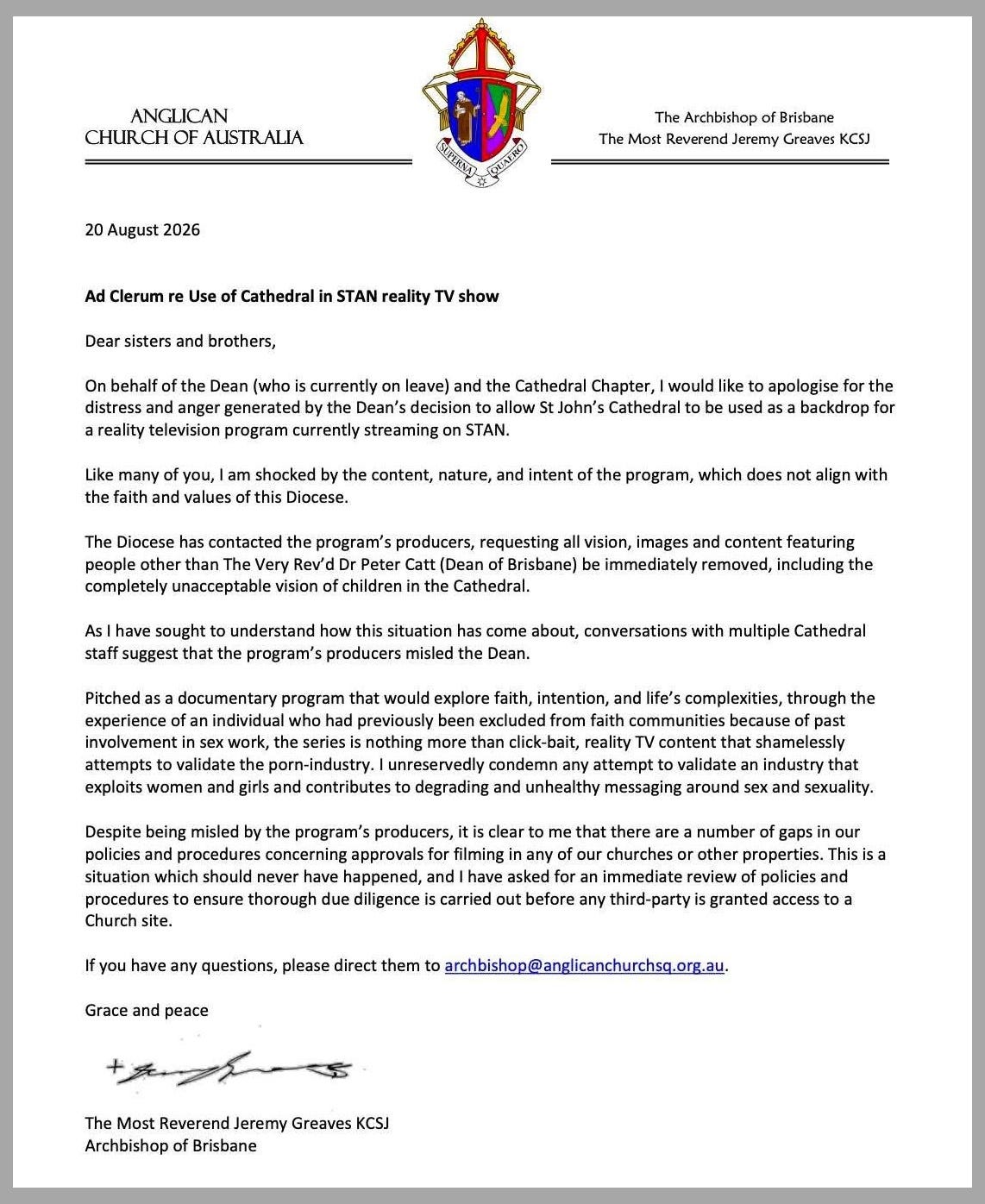
Archbishop of Brisbane Reverend Jeremy Greaves’ statement.

“Pitched as a documentary program that would explore faith, intention, and life’s complexities, through the experience of an individual who had previously been excluded from faith communities because of past involvement in sex work, the series is nothing more than click-bait, reality TV content that shamelessly attempts to validate the porn-industry.”

He added:

“I unreservedly condemn any attempt to validate an industry that exploits women and girls and contributes to degrading and unhealthy messaging around sex and sexuality.”

According to Greaves, conversations with cathedral staff indicated that “the program’s producers misled the Dean.”

The Archbishop also acknowledged that the Diocese had failed to conduct adequate due diligence before allowing the filming.

“Despite being misled by the program’s producers, it is clear to me that there are a number of gaps in our policies and procedures concerning approvals for filming in any of our churches or other properties.”

Greaves said the Diocese had contacted the producers and requested that “all vision, images and content featuring people other than The Very Rev’d Dr Peter Catt (Dean of Brisbane) be immediately removed,” including footage showing children inside the cathedral.

“This is a situation which should never have happened,” Greaves said.

He announced an immediate review of the Diocese’s policies and procedures to ensure “thorough due diligence” before third parties are granted access to church sites.

The apology marks a stark repudiation of the production by the Diocese, which now says one of Brisbane’s most prominent Christian sites was used in a program whose portrayal of the sex industry directly conflicts with its stated values.

Australia “Outraged”, Demands Answers as Israel Closes Investigation Into Aid Worker’s Death

19 August 2026 at 23:42
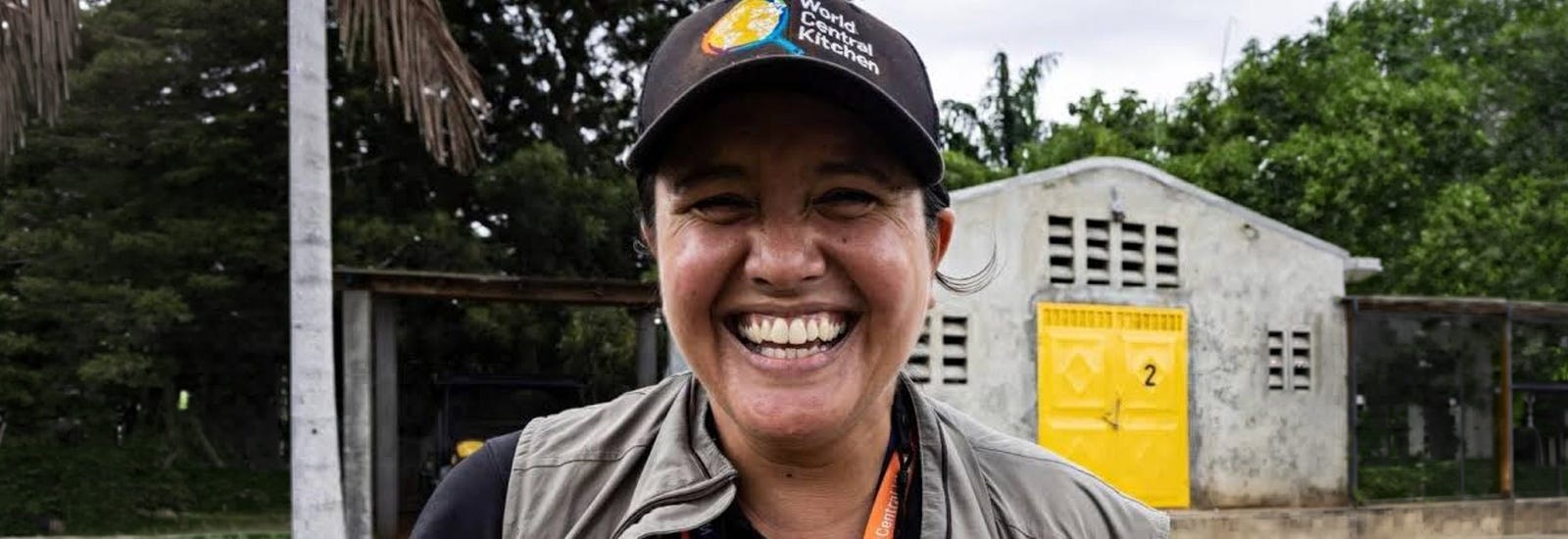
Australian aid worker Zomi Frankcom was killed on 1 April 2024 by multiple precision Israeli drone strikes while travelling in a humanitarian convoy in Gaza.

Australia’s Foreign Minister Penny Wong has said she is “outraged” over an Israeli government decision not to pursue criminal proceedings against those responsible for the death of Australian aid worker Zomi Frankcom, who was killed in an IDF strike in Gaza.

The IDF acknowledged serious failures, including mistaken identification and errors in decision-making, but concluded there was “no reasonable suspicion of criminal misconduct” sufficient to justify opening a criminal investigation, according to SBS News.

Frankcom was killed on 1 April 2024 while supporting a World Central Kitchen aid delivery in Gaza. Australia subsequently appointed former Chief of the Defence Force Air Chief Marshal Mark Binskin to assess Israel’s investigation and response. His report found that the deaths resulted from failures in IDF controls, mistaken identification, errors in decision-making and failures to comply with procedures and rules of engagement.

Importantly, the Australian investigation did not conclude that the strike was a deliberate attack on humanitarian workers. The report instead identified serious failures surrounding the identification and engagement of the vehicles.

Foreign Minister Penny Wong said Israel’s decision fell “far short” of the accountability Australia expects. She said Israel’s ambassador would be summoned and Australia’s ambassador in Israel had been instructed to convey the government’s position directly.

Wong also criticised the timing of the announcement, saying it was made on World Humanitarian Day and was “especially insulting” to Frankcom’s loved ones, humanitarians and Australians, according to the Australian Government statement.

World Central Kitchen has rejected the Israeli findings and called the decision unjustified, maintaining that the IDF knew its team was unarmed and knew the movements and identities of the humanitarian convoy, according to The Guardian. (Those are WCK’s claims and should be distinguished from the findings independently established by the Australian and Israeli investigations.)

The question now is whether Israel’s explanation will satisfy Australia, Frankcom’s family, and the wider community. For a democratic ally, scrutiny and accountability shouldn’t be seen as hostility. They’re fundamental to Western legal and moral traditions and therefore accompany military power.

Who’s Paying the Journalists?

19 August 2026 at 23:23

Australian journalists demand transparency from politicians, businesses, and public figures they don’t like. They scrutinise their finances, question their motives and investigate who funds the organisations and causes behind them.

But when it comes to the media itself, there is considerably less enthusiasm for transparency.

South Australian Senator Alex Antic is seeking to change that.

Antic has introduced the Broadcasting Services Amendment (Register of Media Interests) Bill 2026, which would establish a public register requiring journalists and others working in the media to disclose what they earn, the gifts they receive and the source of those gifts.

“Today I am introducing the Broadcasting Services Amendment (Register of Media Interests) Bill 2026,” Antic said in announcing the legislation.

“If passed, the Bill would require journalists and others inside the media to publicly disclose what they earn, any gifts they receive and the origin of same.”

If the media really is as powerful and influential as journalists themselves insist, Australians have a legitimate interest in knowing who is financially connected to those shaping the information they consume.

In a video posted to social media, Antic drew a comparison between journalists and federal politicians.

“In this building I’m required to disclose everything I earn, everything I own, everything I take as a gift and put it on the Senator’s Register of Interest register,” he said.

“But journalists, despite the fact that they’re always telling you how important and relevant and influential they are, they don’t have to do that.”

Antic said his proposed register would require journalists to disclose “all of the gifts, all of the earnings they get” so Australians can see “who’s paying the piper.”

That question goes to the heart of the debate.

Politicians are routinely subjected to scrutiny over their financial interests because Australians understand that financial relationships can create conflicts of interest—or at the very least create the perception of one.

The same principle can reasonably be applied to journalists.

A reporter covering the pharmaceutical industry, for example, may be influenced—or perceived to be influenced—by financial relationships with pharmaceutical companies. A journalist reporting on politics may have relationships with political organisations, lobby groups or wealthy benefactors. A commentator advocating for particular causes may receive speaking fees, gifts, travel or other benefits from organisations that stand to benefit from their influence.

That does not necessarily mean the journalist is corrupt or dishonest.

But transparency allows the public to make its own judgment.

This is particularly relevant in an era when the traditional distinction between journalists, commentators, activists and influencers has become increasingly blurred. Media personalities can have enormous audiences and wield substantial influence over public opinion, elections and political debate.

If influence is the justification for greater scrutiny of politicians, it is difficult to argue that influence suddenly becomes irrelevant when the person wielding it works for a media organisation.

Of course, the proposal is likely to encounter fierce opposition from sections of the media, with concerns about privacy, editorial independence and the potential for such a register to be abused.

However, a genuinely independent journalist should have little to fear from allowing the public to know whether they have financial interests or relationships that could reasonably be relevant to their reporting.

The media has long insisted that Australians deserve to know who is funding political campaigns, lobbying organisations and advocacy groups.

Now Antic is asking whether Australians should also know who is financially supporting the people who tell them what to think about those issues.

That is not an unreasonable question, because “If the news media in this country are as influential as we are told, then Australians deserve to know this information.”

If journalists expect politicians to disclose their interests in the name of transparency, perhaps the people who scrutinise those politicians should be prepared to accept some transparency of their own.

❌