In this segment of Free Media, Reason Senior Editor Robby Soave and Daily Caller Editor in Chief Amber Duke discuss Vivek Ramaswamy's controversial attack ad against his opponent Amy Acton in Ohio's gubernatorial race.
If you enjoy Free Media, come watch Robby debate at our upcoming Reason Versus in Washington, D.C. Tickets are available here.
U.S. v. Santiago, decided Monday by Judge Chad Meredith (E.D. Ky.), involves this Instagram post:
Santiago is being prosecuted for making threatening interstate communications, in two counts, "one regarding the threat to the President, and one regarding the threat to law enforcement officers." The court allowed the prosecution to go forward:
[T]he question of whether Santiago's speech was a "true threat" or political hyperbole is one that must be determined by a jury, not the Court.
Of course, "courts retain the power to remove a true-threat question from the jury's consideration … if the evidence shows that the speech was protected as a matter of law." But the implication to be drawn from the evidence here is disputed and it is not so clear-cut that the Court can decide it as a matter of law. A reasonable jury could find Santiago's statements to be true threats, and so the matter must be presented to a jury. The First Amendment does not say otherwise because it does not even apply if a jury concludes that the statements were true threats….
For most context, see the FBI agent's affidavit accompanying the criminal complaint; an excerpt:
Between January 27, 2026, and March 27, 2026, kadi_skating [allegedly one of Santiago's user ids] sent the following messages to an unidentified user: …
• kadi_skating: "im filled with political violence now." [January 8, 2026]….
• kadi_skating: "death to trump." [March 2, 2026]
• kadi_skating: "death to the American nazi regime." [March 2, 2026].
• kadi_skating: "and the american people NEED to start shooting at the necks, legs, and arms of ICE agents." [March 2, 2026]
• kadi_skatlng: "STUFF A GRENADE IN THEIR AHH AND BLOW IT UP." [March 2, 2026]
• kadi_skating: "LETS GOOOO no one is spared all of ice is going to die by my hands [March 2, 2026]
• kadi_skating: "I wanna kill n*zis bad." [March 23, 2026]
Emily K. Greenfield and James T. Chapman represent the federal government.
Questioning the prevailing narrative about the "Cornell seven" case is bound to create controversy. And at Columbia University, two student journalists drew condemnation for their views on the case from the unlikeliest of places: a college free speech group.
On October 13, Barnard junior Christina Ma and Columbia junior Nikos Mohammadi published an article called "The 'Cornell Seven' Is Really About Liberalism" in the Columbia Sundial, an independent student publication. The piece argued that the discourse surrounding the alleged rape at Cornell University infantilizes women by omitting the possibility that in a post–sexual revolution, liberal society, women may make regrettable but consensual choices.
"In the world that, for better or worse, follows from it, we cannot claim to stand for sexual freedom and then recoil in disgust when there's a possibility that a young woman simply chose to exercise it," Mohammadi and Ma wrote.
The piece also argues that the "collective frenzy" over the Cornell case has created a climate on campus that makes it "difficult to disagree with the maximalist position on what happened" the night of the alleged rape.
As Mohammadi wrote in UnHerd, the piece caused immense backlash. He said he received an onslaught of messages urging him to commit suicide and demanding that his "career and life be destroyed." But the criticism went beyond threatening DMs and comments.
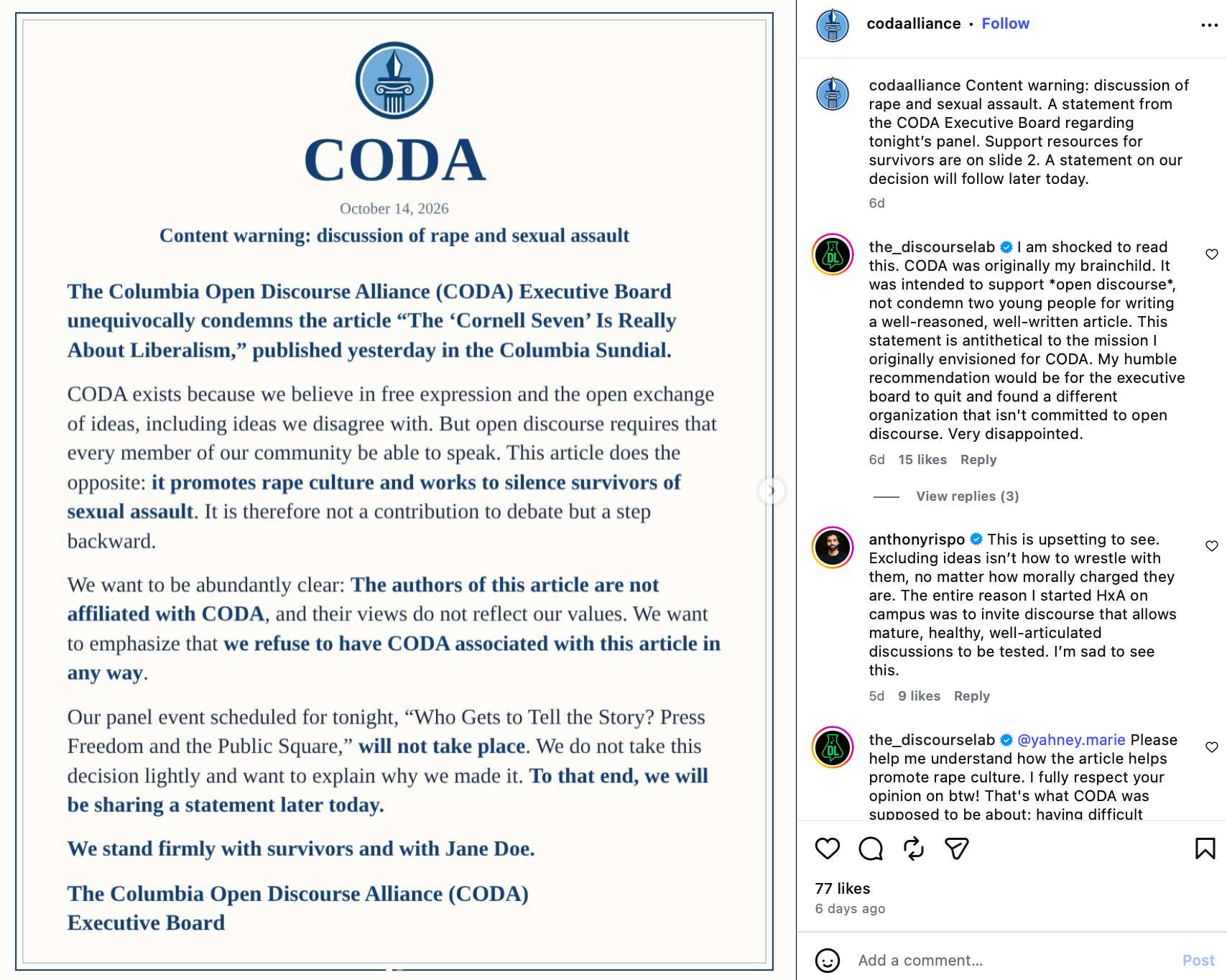
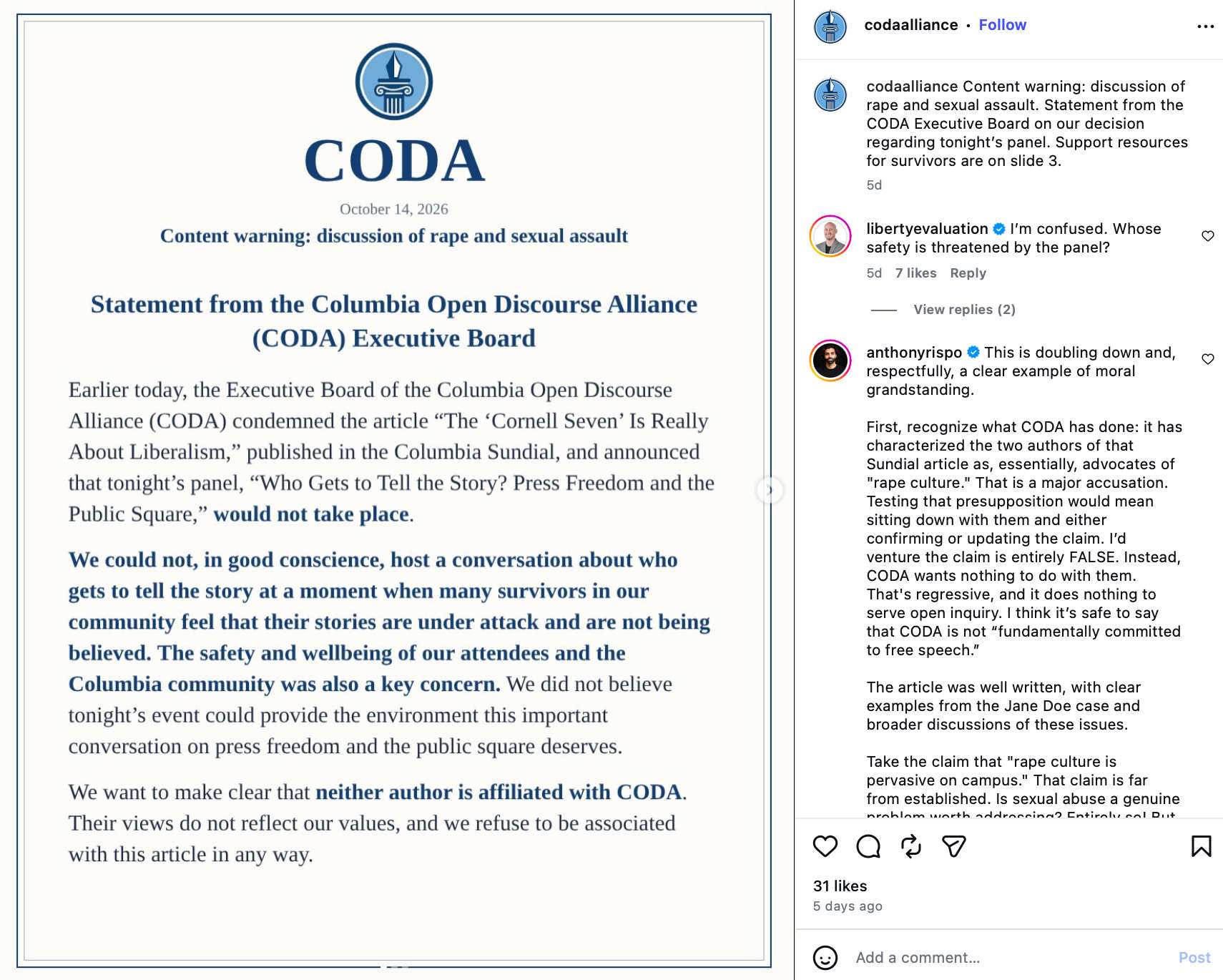
The day after the article's publication, the Columbia Open Discourse Alliance (CODA) canceled an event about press freedom because the Sundial's editor in chief, Nick Baum, had been slated to speak at the event. Although Baum did not author the piece, CODA wrote in an Instagram post that the free speech group "refused" to be affiliated with the Sundial's article "in any way."
CODA also claimed that the event, ironically called "Who Gets to Tell the Story? Press Freedom and the Public Square," could not take place at a time when "many survivors in our community feel that their stories are under attack and are not being believed."
The group added that the Sundial's article "promotes rape culture and works to silence survivors of sexual assault."
The group's president, Aum Desai, told Columbia's student newspaper, the Columbia Daily Spectator, that the group canceled the event "not in spite of, but because of [CODA's] commitment to free expression."
Columbia graduate Clayton Smith, who founded CODA in 2025, quickly commented that he was "shocked" by CODA's statements on Instagram. Smith started the organization to create a central hub for groups hosting events promoting free speech and open discourse, including the Sundial and Columbia's Heterodox Academy chapter.
He tells Reason that CODA's rationale for canceling the event was "ironic" and "hypocritical," and he believes the group should have collaborated with the Sundial if there were legitimate safety concerns at the event. He says he was particularly disturbed by the group's condemnation of the article and CODA's claim that it promotes "rape culture."
"They don't argue or explain how it works to silence survivors of sexual assault. It is a baseless slander that they use to condemn the article because it promoted an opinion they do not like," Smith says.
Smith says he spoke to Desai on the phone after CODA posted the statements, and Desai tried to reassure him that CODA would uphold the principle of free speech. But Smith says he did not leave the phone call feeling "very confident at all" in Desai's commitment.
Desai did not respond to Reason's requests for comment.
CODA faculty adviser and Columbia Business School professor emeritus Eli Noam was traveling in China during the fallout from the Sundial article and was not involved in CODA's decision.
After speaking with members of both CODA and the Sundial, Noam tells Reason that he thinks CODA "made some proper decisions, some correct decisions, and some mistakes."
"I think we're dealing here with…a group of college students who kind of were confronted with a crisis at 2 a.m.," Noam says. "And kind of [made] some judgments that they now regret, and they do."
He tells Reason that it was not "unreasonable to assume there would be a disruption" at the event, given the climate at Columbia and "about this rape allegation." He says the group suddenly "had an event where they needed college security" and could not organize in time. CODA, Noam says, is not yet recognized by the university, and he thinks the group was likely fearful of jeopardizing its recognition.
Still, Noam says CODA's statements condemning the article were "unreasonable," and it was "disappointing that they kind of lost their nerve here."
Although he was not involved in planning the panel, Mohammadi says, to his knowledge, there were no credible threats of violence to the panel. He understood there may have been "disgruntled students" and an "environment CODA did not want to deal with." But instead of simply canceling the event or working with the Sundial to find a solution, Mohammadi says CODA overstepped by condemning the Sundial piece.
James Applegate, an astronomy professor who serves on Columbia's Academic Freedom Council (CAFC) alongside Noam, tells Reason that he disagreed with CODA's decision to cancel the event.
Applegate tells Reason he was considering attending the event, and he was "rather surprised and disappointed" when it was canceled.
He recalled that when he was a professor in 2000, he objected to changes to the school's sexual misconduct policy on the University Senate floor. He says his statements were "similar to what was said in the Sundial article" and there was a "level of emotion in this debate."
"Nonetheless, we had the debate. I was in it, and the degree to which it was civil is shocking when you look at where we are now. And it's sad."
Applegate said he does not condemn CODA, however, "for the simple reason that the atmosphere on college campuses and on the left wing of politics in general in the United States is quite vicious."
CODA's honorary faculty fellow John McWhorter tells Reason he interpreted CODA's statement as "saying that an event about who gets to tell the story is untenable when or if a critical mass of people with such stories don't even feel comfortable telling them— i.e.being a participant in the event." He added, "I imagine some might think of that as cutting the salami a little thin, but then I highly suspect that Desai is equally worried about the event becoming a physical melee of some kind. In that, let's face it, he is hardly unreasonable."
Still, McWhorter said that he would have chosen to have the event himself, "especially as in the likely case that some people did talk about their experiences without any particular repercussions, it may have made the more reluctant people less apprehensive about doing so in the future."
According to Mohammadi, as of Tuesday, the Sundial, College Republicans, Platypus Affiliated Society at Columbia (which discusses leftist thought and history), and Columbia's Heterodox Academy chapter have left CODA.
CODA was not the only group to condemn the Sundial's piece. On October 14, the Columbia Political Review's editorial board wrote that Mohammadi and Ma's piece "violates standards of integrity" and "perpetuates a culture of campus violence, rape, and assault." The editorial board of the Columbia Political Review, which purports to publish "multipartisan political discourse," stated that it would refuse to publish "any article that upholds or recreates cultures and systems of rape, sexual assault, or violence" and it urged "all campus publications to do the same."
And on Monday, Columbia's main newspaper, the Spectator, published a staff editorial accusing the Sundial of violating journalistic ethics by "its page to disparage survivors of sexual violence."
Mohammadi tells Reason the piece underwent "far more editorial scrutiny than any other piece" the Sundial had published given the sensitive nature of the topic.
Free speech student organizations are necessary on Columbia's campus, especially as the school's free speech climate continues to crumble; it recently received a failing grade from the Foundation for Individual Rights and Expression. And while upholding free speech principles may have become more fashionable among those resisting the Trump administration's pressures on academic freedom or those defending pro-Palestinian speech, it is clear that some topics remain taboo in the public square. College is supposed to be a place where students debate controversial topics, form their own beliefs and opinions, and learn from mistakes. Hopefully, the students who demanded condemnation instead of debate will be forgiven for their perversion of free speech ideals, and they will learn to afford such grace and open-mindedness to classmates with whom they disagree.
I read and much enjoyed—and highly recommend—my Stanford colleague Diego Zambrano's book, How Americans Enforce the Law. He was kind enough to write up for us this post that captures the core of his argument, and I'm delighted to pass it along (though I encourage people to read the whole book):
The headlines are full of stories about a federal government retreating from enforcement. Agencies are dropping investigations, abandoning regulations, shrinking staffs and changing enforcement priorities. One week, the EEOC drops discrimination cases. The next week, the SEC and CFPB wind down investigations into securities fraud and wrongdoing affecting consumers. Critics fear that the Department of Justice's antitrust division will overlook mergers when it is convenient for the administration. And the DOJ has abruptly reduced enforcement of the Foreign Corrupt Practices Act. Facing these changes, Americans might worry that a wide range of laws will go unenforced.
But that concern misses something unique about the American system of government. We have never relied only on bureaucrats to enforce our laws.
All the way back to the colonial period, American legislators have repeatedly done something unusual: they have given ordinary people the right to sue alongside government officials. In almost every regulatory area that most Americans care about—be it regulation of wages and hours, environmental pollution, consumer protection, or securities fraud—statutes allow both government officials and private parties to file suit to enforce the law. All of this happens through little-known provisions called "private rights of action," which is just a technical name for a right to sue. Thousands of these provisions build a second enforcement system alongside the bureaucracy, turning employees, consumers, competitors and their lawyers into co-enforcers of public law.
This system of private enforcement of the law is highly unusual. In much of the rest of the world, whenever a government faces a regulatory problem, it typically empowers government officials and bureaucrats to police legal violations. In France, Germany, Japan, and even the UK, legislators are far less likely to let anyone sue over, say, environmental pollution or employment discrimination.
Consider the case of oil spills. In 1989, the United States faced the Exxon Valdez oil spill off the pristine waters of Alaska. Millions of gallons of oil laid waste to coasts, waters, and fisheries for hundreds of miles. What most Americans don't know is that a decade later, France also faced a catastrophic oil spill, caused by a ship called the Erika. So how did governments react? In the United States, private plaintiffs sued Exxon directly under existing tort and maritime law, eventually winning substantial damages. Congress, meanwhile, enacted a statute called the Oil Pollution Act with a new right-to-sue those responsible for oil spills. By contrast, in France, the oil spill led primarily to a major criminal prosecution and, eventually, to new national and European regulatory measures (including a new bureaucracy called the European Maritime Safety Agency). When France finally adopted a right to sue in 2016, it paled in comparison to the American version.
Why is the United States so different? Part of the answer, as I argue in a new book, is that Americans have always done this. Back in the colonial period, state legislatures adopted what they called "penal statutes," that empowered any person to enforce regulatory statutes and collect a bounty. So when Massachusetts wanted to regulate the storage of gunpowder, it allowed private informers to sue neighbors who stored it improperly. And this model applied across many areas of colonial life: alcohol consumption, trade, taxation, public morals, church attendance, and more. The Founders used the same tool across the board: Thomas Jefferson and James Madison co-wrote Virginia statutes full of penal statutes, and John Adams handled these suits routinely as a colonial lawyer.
The key feature of this system is that even though private parties file suit for their own aims—the employee wants their full wages paid or the consumer wants a refund for a shoddy product—they inevitably enforce the law. And those lawsuits benefit everyone else because employers and manufacturers may change their behavior with respect to other employees and consumers. In that sense, every single plaintiff is a little bureaucrat or, as some courts call them, a "private attorney general."
This system has the added benefit of reducing political disruptions in enforcement. Even though any single administration can change the enforcement priorities of the EEOC, SEC, CFPB, or Department of Justice, the president cannot control thousands of lawyers and their clients. Private enforcement, then, makes enforcement less dependent on what the bureaucracy and president want.
Right. So you might think that when the bureaucracy won't pursue wrongdoing, the obvious solution should always be new rights to sue. Indeed, many news stories decrying a lack of government enforcement immediately call for more private lawsuits.
But there's a problem with that solution. Private enforcement is not tailor-made for every regulatory area. It makes the most sense to empower private parties when the bureaucracy is truly faulty, under-resourced, politically vulnerable, or likely to be captured by regulated entities. When this isn't the case, private enforcement can cause more problems than it solves.
Consider, then, the enormous problems that rights to sue pose in the environmental context and in the construction of housing and infrastructure. There, broad rights to challenge government approvals can let private parties oppose the construction of housing, mass transit, green energy, and other projects. Examples of ruinous lawsuits abound. Neighbors in a Maryland suburb—backed for years by a nearby country club—sued to delay the Purple Line light-rail project over concerns for a microscopic organism, while the Sierra Club sued to stop a major Mojave solar energy project over the potential impact to a desert turtle. So even if a city government has approved a project that might benefit thousands of people, a single crank can use a right-to-sue to stop the project. In these settings, rights to sue have contributed to delays and increased costs of housing and infrastructure.
We need a careful approach to rights to sue. Yes, we need more of them in some areas. Especially if the government won't enforce anti-corruption or consumer protection statutes. And yes, in employment law, securities, and antitrust, private enforcement often makes a lot of sense. But this is not necessarily the case in environmental law and construction. There, we need better bureaucracies, not thousands of people with the ability to oppose construction projects for any number of reasons.
When the bureaucracy retreats, Americans should rest assured that private parties will still enforce the law. But that power to enforce the law should be given carefully.
Last week, New York state summoned me to jury duty.
I went, of course. It's the law, and my duty.
A jury may protect the innocent from government abuse. Ordinary citizens, not officials, decide if you are guilty.
But doing our patriotic duty shouldn't mean surrendering hours of our lives to bureaucratic indifference. Serving justice is important. Sitting around doing nothing isn't.
During my 50 years consumer reporting, I've watched greedy capitalists constantly make improvements and find better ways to do things. They use computers, adjust hours, reduce wait times.
If they don't, we consumers quickly switch to competitors who will.
But government bureaucracies—courts, the DMV, the passport office—have no competitors. So they don't try very hard.
Government is force.
My summons arrived on paper, in the mail.
Most businesses now communicate with customers instantly, by text or email. Airlines send boarding passes to our phones. Doctors text reminders. Restaurants send notifications when our table is ready.
But government sends paper.
We summoned jurors meekly arrive at the courthouse and wait. And wait.
I'm old; it's important I hydrate. At least government provides a water cooler and a drinking fountain. Oh, damn, neither works.
We sit another hour.
Eventually, a bored clerk drones through long instructions on how fill out a form. Printed instructions would be better—a video would be much better. But this is government, and government bureaucracies have little incentive to innovate.
Finally, clerks choose 80 of us to be considered for a criminal trial. "Wait in the hall," we're told.
We wait.
Then they tell us, "Go across the street to another building, and wait there."
We go.
After an hour, we're admitted into a courtroom, where another bureaucrat tells us, "Come back Monday."
Monday! This was the Thursday before. Imagine an airline telling 80 passengers, "Welcome to the airport. Your flight is in five days. Come back then."
No airline would survive doing that.
But courts don't have competition.
When court finally starts, a stenographer types away, recording what people say. Computers today transcribe speech instantly, accurately, at almost no cost. But New York taxpayers still pay someone to type every word.
Amazon experiments with faster delivery. Supermarkets install self-checkout machines. Banks let us deposit checks just by photographing them with our phones.
Capitalism protects your time while bureaucrats waste it.
Nobel Prize-winning economist Milton Friedman explained why by pointing out there are four ways to spend money:
No. 1: Spend your money on yourself. Then you're very careful about both cost and quality.
No. 2: Spend your own money on someone else. You're careful about the cost, but don't care as much about the quality.
No. 3: Spend someone else's money on yourself. You care less about cost, but still care about quality.
No. 4: Spend someone else's money on someone else. You don't care about cost OR quality.
That's what government does.
Some court workers work hard, and many want to help people. But they're stuck in a system where saving people's time brings them no rewards.
In my case, 80 prospective jurors sat around for at least six hours, just waiting—that's 12 40-hour work weeks lost. Some had to hire babysitters, reschedule doctor's appointments, tell their bosses they'll try to make up the work at night. Some lost income. Some missed opportunities.
For just one case. Multiply that by thousands of cases: countless hours of human progress vanish.
Why not stagger arrival times? Let jurors wait at home until needed? Use text messages to call people in?
Because innovation takes effort. So courts don't bother.
They act as if wasting our time is free. It's not.
School resource officers (SROs) in Texas referred tens of thousands of elementary and middle schoolers for prosecution for relatively minor misconduct over the last decade, a news investigation found.
An analysis by The New York Times and the San Antonio Express-News reported that, as the number of SROs in Texas grew, children in Texas ages 10 to 13 were referred to prosecution for misbehaving in school more than 47,000 times since 2014. A referral doesn't necessarily result in charges being filed, but each one represents a minor being taken into police custody and put in contact with the criminal justice system, which can have long-lasting educational, emotional, and financial impacts for students and their families.
"Most of the students were accused of minor offenses, like making threats, using cannabis vapes or lashing out at classmates or teachers," the papers reported. "Few caused serious physical harm."
Among the examples cited by the Times and Express-News were an 11-year-old who bumped into a school counselor, a 10-year-old who said he saw someone on campus with a weapon, and a 10-year-old who kicked an assistant principal after his cellphone was taken away.
In one case, a 12-year-old girl who refused to go to the principal's office was handcuffed, arrested, and driven to the school police headquarters. "When she would not put her hand on a fingerprint machine, officers twisted her opposite arm behind her back until she screamed and complied, according to body camera footage," the outlets reported.
The analysis found that referrals of children 10 to 13 increased by a greater percentage than referrals of older students. (Children under 10 cannot be prosecuted under Texas law; many other states don't set a minimum age for delinquency.)
The two outlets published another joint investigation in May on how SROs in Texas schools have used heavy-handed tactics, including Tasers and pepper spray, against students over seemingly minor misconduct.
The findings mirror other recent studies. A report published in July by the American Civil Liberties Union (ACLU) of Iowa found that, while SROs were placed in Iowa schools to keep students safe from violence, the threat they most commonly dealt with was illicit vaping.
The number of police in schools nationally dramatically increased in recent years, growing by 23 percent at high schools, middle schools, and elementary schools between 2018 and 2021, largely under the justification of stopping mass shootings and handling violent situations.
Organizations like the National Association of School Resource Officers (NASRO) say that carefully selected, well-trained officers act as a filter and decrease arrests by building strong relationships within the school with staff and students.
Civil liberties groups and disability advocates have long argued that increases in school police and zero-tolerance policies for petty disturbances have fueled the "school-to-prison" pipeline and led to disproportionate enforcement against minorities and students with disabilities. Those groups have been aided by viral news stories of policearresting and assaulting school children.
Following the police killing of George Floyd in 2020 and national calls for police reform, several major school districts across the country ended their SRO programs.
However, several states that experienced horrific school shootings, like Florida and Texas, moved in the opposite direction, passing laws that required police officers or armed guardians in public schools.
A 2020 Reason investigation described how Florida schools had become a high-stakes experiment in policing after Florida more than doubled the number of SROs across the state following the mass shooting at Marjory Stoneman Douglas High School in 2018. A study published in 2020found that after the increase, the number of Florida school arrests—which had been declining for years—suddenly started to rise. There was also a sharp increase in the use of physical restraint against students.
A 2021 working paper by the Annenberg Institute at Brown University, which billed itself as the broadest and most rigorous examination at the school level of how SROs impact student outcomes, found that while SROs "do effectively reduce some forms of violence in schools," they did not prevent school shootings or gun-related incidents.
Another study by researchers at the University of Maryland and the firm Westat, who studied several dozen middle and high schools in California, found that increasing the number of SROs led to both immediate and persistent increases in the number of drug and weapon offenses and the number of suspensions and expulsions of students.
This year, the Bureau of Prison determined that "sex-trait-modification surgeries, hormone interventions in general, and social accommodations could no longer be justified as treatment for gender dysphoria." The lower court enjoined this policy, and the Solicitor General sought an emergency stay. Today the Supreme Court denied a stay in Trump v. Kingdom by a 7-2 vote. Justices Thomas and Alito noted they would have granted the application, though there was no written opinion.
I have some thoughts.
First, just yesterday Justice Kagan noted that the Trump appointees rule against President Trump as proof that they are not hacks. And she surely knew this case would come down as further proof of this point. Kagan's point seems to be that ruling against the President that appoints you makes you a fair justice. That premise is only true if in fact that law does not support the appointing President's policy. If a Justice simply rules against the President who appoints him for the sake of optics, then the Justice is no longer a judge.
Justice Alito made this point well in his new book, summarized in the Wall Street Journal.
Insecure originalists may worry that they are subconsciously engaging in "judicial activism" in the service of their own policy preferences. As a result, they may welcome occasions when their originalist analysis leads to results they dislike. They experience a brief catharsis, a release of their anxiety about succumbing to temptation.
Twenty-first-century originalists should shed this insecure mindset.
I wonder if Justice Alito thinks that Justice Scalia's constant praise of his vote in Texas v. Johnson was evidence of this "catharsis." Justice Kavanaugh used to praise the Nixon appointees who ruled against Nixon in the Watergate Tapes case. That premise reinforces the wrong image. I've come to believe that United States v. Nixon was a travesty, and the Justices who joined that were caught up in the Watergate swamp fever. The decision has not held up well over the past five decades.
Let's stop praising how often the Trump appointees rule against Trump. The more useful metric, in my view, is when the Court's two most conservative members (Thomas and Alito) are alone in dissent. I updated my wall of receipts in July 2026 as a recent accounting.
Second, how do we reconcile Mahmoud, B.P.J., and Skrmetti on the one hand and Bostock and Kingdom on the other? For sure, all of these cases presented different legal issues. Mahmoud was a Free Exercise challenge, Skrmetti presented an Equal Protection issue, B.P.J. was about Title IX, Bostock was an interpretation of Title VII, and Kingdom was an APA challenge on the interim orders docket. Yet all of these cases were really about transgender rights. Back in April I wrote that the transgender tide was turning. Was I wrong? Why did all of the recent cases turn out one way but Kingdom turns out the other?
Well, the Court is certainly concerned about transitioning children. They upheld bans on gender transition surgeries in Skrmetti. They required opt-outs from transgender-related indoctrination in Maryland public schools. (Had the story books been only about gay marriage, I don't know that the case would have come out the same way.) The Justices allowed the exclusion of biologically male athletes from female sports. I could add to that list Mirabelli v. Bonta, which prohibited schools from secretly transitioning children.
It's possible that Justice Gorsuch simply saw the light after Bostock, but maybe there is another explanation: he cares more about children than he cares about transgender rights. So his equities tilted to the right. But in a case where adults seek this treatment, Gorsuch cut the other way. Moreover, when those consenting adults are prisoners, Justice Gorsuch's equities are far clearer. For a libertarian, how could the carceral state deny this treatment to incarcerated persons who can't go elsewhere to get it?
Third, I'm struggling with Justice Kavanaugh's position here. He had a free vote, as the split was 7-2. He could have at least written a separate opinion explaining why relief was not appropriate here, but when the case returns on the merits, the outcome may be different. He does that sort of thing all the time in far less controversial cases. But here, we only have the sound of silence. I think he is signaling the government loses on the merits here. Maybe he suspects Trump will be out of office by the time this case returns to the Court, and the policy will be abandoned.
Fourth, I'm sure Justice Barrett figured out some procedural reason why the federal government must remove healthy reproductive organs from prisoners. That is, unless she agrees with the Respondent's arguments that BOP's position is "pretextual and [was] reverse-engineered to implement" President Trump's order. So we're back to pretext, and trying to divine the President's real motivations. Trump v. Cook established that Trump does not get the presumption of regularity. Barrett dissented in that case, through she may not disagree with the broader premise.
Fifth, the application was filed on September 28, briefing concluded on October 9, and the order was issued on October 21. What took so long if this was a straight-up denial without any writings? I suspect that Justices Alito and Thomas were hopeful they could scrounge more votes but could not. Maybe they even circulated a dissent but withdrew it. Something behind the scenes happened here. If only we knew what happened? Thankfully reporters at CNN and the New York Times are no longer able to otbain leaks. The best they can do is ask KBJ's friends for comments and interview the Chief's neighbors in Maine.
On a Tuesday morning in February 2025, federal agents descended upon Ayala's Mini Market, a convenience store in Glendale, Arizona, that offered check cashing, money transfer, shipping, and cellphone repair services along with standard items such as groceries, snacks, sodas, and cigarettes. The agents, who worked for the Internal Revenue Service (IRS) and the Department of Homeland Security (DHS), seized three computers, five cellphones, and business records, plus about $460,000 in cash and checks. They did not say why.
Twenty months later, the store's owner, Mario Ayala, still has not received a definitive answer to that question. Nor has the government told him what it plans to do with his property or how he can try to get it back. That Kafkaesque situation is unconstitutional, Ayala's lawyers at the Institute for Justice argue in a motion and memorandum they filed on Tuesday in the U.S. District Court for the District of Arizona. The motion seeks the return of the property seized from Ayala's business, saying there is no legitimate reason for the government to keep it.
"The government can't take your stuff, disappear, and then never explain itself," says Institute for Justice attorney Betsy Sanz. "For over a year and a half, the government has been holding Mario's money and property. This prolonged seizure violates the Fourth Amendment and federal law. The government cannot hold onto your property indefinitely without explanation so it can eventually take it permanently using civil forfeiture."
The raid on Ayala's store happened while he was visiting his ailing father in Mexico, who died a couple of months later. After Ayala's wife and son called to tell him what had happened, he rushed back to Arizona, where he tried to figure out why his business had been targeted by the IRS and the DHS. That was harder than you might think.
Ayala "has heard nothing from the government since they raided his business and seized his property," Sanz and her colleagues note in their memorandum. When the agents left, they told Ayala's son that "the business would receive a letter within thirty days," the memorandum says, but "no letter came," and the government "has not told Mario why it took his property or why it refuses to return it."
The agents left a one-page inventory of the property they took, including the computers, cellphones (two of which belonged to Ayala's customers), documents, and currency, although it did not specify the amount of money. They also left the first page of a warrant signed by a federal magistrate judge, which contained no information about the crime they were investigating or the property they were authorized to seize. It referred to attachments that might have clarified those points, but the attachments were missing.
Ayala still has not seen those attachments. But on the same day the agents raided his store, they also searched 18 other businesses in the Phoenix area, all of which offered money services. Judging from the warrants served on three of those other businesses, which were signed by the same magistrate judge at the same time on the same day as the warrant for Ayala's Mini Market, the legal justification for the searches was suspected violations of 31 USC 5324, which makes it a felony to "structure" a financial transaction with the intent of "evading" federal reporting requirements.
The Bank Secrecy Act requires that financial institutions report cash transactions involving more than $10,000 to the Financial Crimes Enforcement Network (FinCEN). Although that mandate is aimed at money laundering, someone can be guilty of structuring even without evidence of any other crime if he deliberately tries to avoid triggering a FinCEN report by breaking up a transaction into amounts below the threshold. As far as Ayala can tell, the search of his store was based on nothing more than suspicion of structuring.
If so, Ayala's lawyers argue, the IRS agents who participated in the raid violated a 2019 federal law that bars the agency from seizing money when structuring is the only suspected crime. Congress passed that law in response to IRS forfeiture abuses highlighted by the Institute for Justice. "For the IRS to legally seize property based on a structuring offense, it must also have an added suspicion of some other criminal act," Sanz et al. note. "Yet the IRS seized Mario's property, apparently on the sole suspicion of a structuring violation."
That is not the only legal problem with the seizure. Assuming the government plans to seek forfeiture of Ayala's money based on an alleged connection to criminal activity, it missed a crucial deadline. The Civil Asset Forfeiture Reform Act (CAFRA) requires the federal government to notify property owners of attempted forfeitures within 60 days of the seizure. That deadline passed a year and a half ago, and Ayala still has received no such notice.
"This notice is crucial because it informs a property owner that the government intends to forfeit his property and triggers his ability to respond by filing a claim or administrative petition," Ayala's lawyers note. If the government fails to meet that requirement, CAFRA says, it "shall return the property."
The government can seek extensions of the CAFRA deadline "only if there is reason to believe that notice may have an adverse result," such as "endangering the life or physical safety of an individual," "flight from prosecution," "destruction of or tampering with evidence," "intimidation of potential witnesses," or "otherwise seriously jeopardizing an investigation or unduly delaying a trial." None of those conditions applies in this case, Sanz et al. say, and their client "is unaware of the government seeking any such extension here."
Another possible rationale for keeping Ayala's property is that the government needs it as evidence in a criminal investigation. But his lawyers argue that the seized items "have no independent evidentiary value."
The government "cannot claim that it is holding the cash as evidence of the suspected structuring offense, because the government—in the usual course—does not continue to hold the physical cash it seizes but rather promptly deposits it," the memorandum says. "To prove the suspected offense here, the government would present evidence documenting the amounts and frequency of transactions and evidence that the defendant intentionally evaded reporting requirements. No fact the government must prove to establish a structuring offense becomes more or less provable by the government's continued possession of Mario's money."
Although "the checks and business documents that the government seized from Mario may at first have had some evidentiary value," Sanz et al. say, it could have long since returned the originals and kept copies. As for the computers and cellphones, "the government has had ample time to extract and copy" any relevant information.
While the benefits of keeping Ayala's property seem highly dubious, the cost to him has been severe. The seizure of the checks and currency wreaked havoc with his business model, which relies on money received for transfers to cash checks, which in turn are scanned and used to pay the companies that handle the transfers.
"The search and seizure of Mario's property upended his business," the memorandum says. "He had to keep his business closed until March 1, 2025, to replace the seized computers and to figure out how they could keep the business open. He took $50,000 of his own money out of the bank so that he could keep cashing customers' checks. When that ran out, the business had to stop cashing checks for a long time, losing customers."
Ayala "also had to come up with $112,097.20 to pay the money transmitters to cover the balance that had accrued while he was away," his lawyers add. "Since all the cash and cashed-but-unscanned checks had been seized, Mario needed to pay this money to the transmitters on his own. Though he did ultimately pay back all the money transmitters over the following month, the consequences of the raid damaged Mario's business relationship with one of the money transmitters he had formerly worked with, InterMex. Today, the business can no longer offer InterMex as an option for money transfers."
Ayala's business "is now finally stable, but it is still not doing as well as it was before the raid," Sanz et al. say. "Mario has changed the way he runs his business because of the raid. He now scans every customer's cashed check to send it to the money transmitters as soon as it is cashed, rather than collecting [checks] and scanning them together as they previously did. He constantly worries that his business will be targeted again."
In the 20 months since the raid, the government has not filed a forfeiture action or even notified Ayala that it intends to do so. Nor has it filed any criminal charges related to the seizure, as far as Ayala knows. "The government has no lawful reason to retain
Mario's property," his lawyers say, "and this Court should exercise its equitable jurisdiction to order its return."
The motion relies on Federal Rule of Criminal Procedure 41(g), which says "a person aggrieved by an unlawful search and seizure of property or by the deprivation of property may move for the property's return." The U.S. Court of Appeals for the 9th Circuit, which includes Arizona, has adopted four criteria for granting such a motion: whether the government "displayed a callous disregard for the constitutional rights of the movant," whether "the movant has an individual interest in and need for the property he wants returned," whether "the movant would be irreparably injured by denying return of the property," and whether "the movant has an adequate remedy at law for the redress of his grievance."
All of those factors count in Ayala's favor, Sanz et al. argue. Ayala's interest in the property and the injury he is suffering are clear, as is the absence of any other remedy. As for the first criterion, "the government can neither forfeit Mario's property nor justify holding it as evidence, so its continued retention is unreasonable under the Fourth Amendment," the memorandum says. "And its nearly 20 months of silence, without any notice or any forum in which to contest the seizure, offends due process. At every turn, the government has 'callous[ly] disregarded' Mario's constitutional rights."
Ayala immigrated to the United States from Mexico in 1991 and struggled for years to make a go of his business, which was successful enough at the time of the raid that he planned to open a new location devoted to cellphone repair. That plan is now on hold because of the financial difficulties caused by the seizure.
"This business is my American Dream, and the government took years of my hard work without telling me what I did," Ayala says. "This raid hurt me and my family. I hope this lawsuit gets my money back and helps make sure this doesn't happen to anyone else."
An Arizona abortion clinic that didn't tell a pregnant woman about the physical characteristics of her 8-week-old embryo before prescribing abortion pills has been found liable in a case brought by the ex-husband of the pregnant woman, who didn't want her to get an abortion.
The ex-husband, Mario Villegas, was awarded $67,500 in a civil lawsuit accusing the clinic of violating an informed consent law that an Arizona court declared unconstitutional earlier this year.
'A Dangerous Precedent'
The Lawyering Project, which represented the doctor and clinic being sued by Villegas, had warned that the case could "establish a dangerous precedent in Arizona concerning embryonic personhood and chill the provision of abortion care."
"A pre-viability embryo or fetus is not a person," says its website in a summary of the case, "and a physician cannot be subject to a wrongful death action for providing high-quality abortion care to a patient who wants an abortion."
In an August 2024 order, Judge Bryan B. Chambers of the Arizona Superior Court in Gila County agreed with the defendants that Arizona's wrongful death statute does not, as written, apply to the death of embryos. The court is "unwilling to expand the common law definition of 'person' as applied to the wrongful death statute to include all unborn children whether viable outside the womb or not," Chambers wrote.
But that doesn't mean he tossed Villegas' lawsuit entirely. And in a judgement released July 22 but largely unnoticed untilthis week, Chambers wound up holding that Villegas is entitled to $5,000 in statutory damages and $62,500 "in compensatory damages for his psychological, emotional, and physical injuries."
No one in the case alleges that Villegas' ex-wife—referred to in court documents as M.S.V.—was tricked, coerced, or generally uninformed about the abortion. The case turns on technicalities and Arizona's onerous, biased (and now barred) requirements for what abortion doctors must tell patients in order to obtain informed consent.
'Deprived of the love….of his child'
M.S.V's abortion took place in July 2018, when she was around eight weeks pregnant. At the Camelback Family Planning clinic in Phoenix, she was provided with information at least 24 hours before she could come back for the abortion pills, and she signed various consent forms, including one affirming that she was "comfortable with [her] decision to terminate this pregnancy," according toProPublica.
Around two years later, in July 2020, Villegas—now divorced from M.S.V.—sued the clinic and physician Gabrielle J. Goodrick, alleging medical malpractice and wrongful death. Villegas "has been deprived of the love, affection, comfort, and companionship of his child," his initial complaint stated. He "has been deprived of his constitutionally protected right to parent Baby Villegas."
Villegas sought to have himself appointed the personal representative of the estate of the aborted embryo, and a probate judge agreed.
In an amended complaint, Villegas added that "the estate has been deprived of the net income Baby Villegas would have earned during her lifetime" and sought damages for that, too. (Villegas took the liberty of assuming the embryo was a girl, even though the abortion would have been too early in the pregnancy to tell.)
"Across the U.S., people have sued for negligence in the death of a fetus or embryo in cases where a pregnant person has been killed in a car crash or a pregnancy was lost because of alleged wrongdoing by a physician," noted ProPublica in a 2022 article about the case. "But a court action claiming the wrongful death of an aborted embryo or fetus is a more novel strategy, legal experts said."
Informed Consent or Compelled Speech?
Ultimately, the case came down to Arizona's informed consent law, not fetal personhood.
That law—declared unconstitutional in February 2026—said that doctors must obtain informed consent before performing abortions (which is normal) and then added that this consent only counts if clinics obtain it in highly particular (and medically unnecessary) way and tack on a lot of loaded language and anti-abortion rhetoric.
It says that "at least twenty-four hours before the abortion, the physician who is to perform the abortion or the referring physician" must inform a patient woman "orally and in person" about topics such as "alternatives to the procedure or treatment" and "the probable anatomical and physiological characteristics of the unborn child at the time the abortion is to be performed." Doctors were also required to tell a woman seeking an abortion that if she went through with the pregnancy, various forms of assistance may be available.
Villegas alleged that even though his wife technically consented to the abortion, it didn't count because the information wasn't provided by the same doctor who prescribed her the pills, and because doctors didn't warn her about the potential "loss of the 'maternal-fetal' attachment bond inherent in birthing a child" and didn't explain alternatives to abortion or the 8-week-old embryo's physical characteristics.
He also complained that the printed form M.S.V. was given "changed the statutory term 'the probable gestational age of the unborn child' to 'the probable gestational age of the pregnancy,' which misstates Arizona's legislative determination that every pregnant woman is carrying a human child."
M.S.V. testified in court "that nothing would have changed her mind about obtaining the abortion," as Chambers put it in his judgement. And no one alleges that the clinic simply failed to discuss some risks and other relevant information with her before the procedure. It simply failed to use the loaded language preferred by the state.
But "the statute does not require proof that M.S.V. would have made a different decision had she been fully informed," wrote Chambers in his judgement. And even if some of the rules of informed consent were followed, "nothing in [Arizona law] suggests that substantial compliance with the consent provisions is all that is necessary."
Fortunately, the informed consent law at the heart of this case has been struck down, so future doctors don't have to worry about being sued for failing to say "unborn child."
But there's still something chilling about the way all this played out. M.S.V. had argued to court that she was tricked into pregnancy—she thought her ex-husband "was fixed," because he'd had a vasectomy, though it was since reversed. Chambers said this did not negate her consent to sex with him, since M.S.V. "was not deceived about the nature of the act. At most, she was deceived about a potential consequence (pregnancy risk)."
In M.S.V.'s telling, she did not exactly give informed consent to the sex that led to pregnancy, but she did give informed consent to the abortion procedure. In neither situation, however, do M.S.V.'s claims about her own consent seem to have mattered much at all.
In the News
The Transportation Security Administration (TSA) shows "significant weakness" when it comes to protecting passenger data, according to the Department of Homeland Security Office of Inspector General.
A TSA authentication vendor "was able to access and extract sensitive passenger information, including driver's license and passport images, during system troubleshooting and enhancements, without TSA's knowledge," the report says. More:
TSA lacked clear policies, did not track when this data was extracted, could not verify that extracted information was properly deleted, and did not notify passengers when their biometric and biographic information may have been stored. As a result, although passenger information was generally protected during routine operations, weaknesses in vendor oversight created a risk that sensitive personal information could be retained or exposed.
As the OIG's audit underscores, this technology presents privacy risks associated with unsecured data, unauthorized access, and data breaches. The government's use of this technology also creates a mass surveillance system and facilitates the creation of warrantless biometric records for unconsenting parties.
[…] Given that facial recognition technology is prone to mistakes, combined with the OIG's audit revealing significant privacy weaknesses, it is imperative that travelers remember that opting out is possible. TSA's own website emphasizes that travelers who wish to decline to have their photo taken for facial comparison can do so without any delay, disruption, or recourse.
More Sex & Tech
• You could make a full-time beat out of covering cops' misuse of Flock cameras these days. The latest: "A former Joliet police lieutenant is now facing felony charges for misusing the city's Flock camera system," per CBS News. And, in Sharonville, Ohio, "a police lieutenant was indicted Tuesday after he allegedly used Flock camera systems…29 times between Dec. 19, 2024, and April 20, 2026, to track a person's whereabouts" for personal reasons, Fox 10 reports.
• Airbnb says hosts can't make you wash and dry your own dishes anymore:
I just got an email from Airbnb laying out new ground rules for what hosts can demand of guests, and THANK GOD.
At my last Airbnb, I had to strip the beds, wash every dish, clean the kitchen, haul the trash out to the road, and there was still a $100 cleaning fee! https://t.co/tfQGqQKsRo
• Another case challenging the use of Flock cameras to get convictions. In Texas, Charles Brownlee—sentenced to 60 years in prison for armed robbery—is asking a federal appeals court to throw out his conviction, "arguing that the AI-powered camera system gives law enforcement more surveillance power than the Constitution allows," per The Texas Tribune.
• A California law that takes effect in 2027 "will require large companies to make a good-faith effort to link customers to a human by phone within 15 minutes," notesThe San Francisco Standard. "But it has a carveout for companies that never offered phone support in the first place. It remains to be seen whether the legislation will hold any sway over the AI firms leading the charge to replace human agents."
• Jacob Sullum delves into a convoluted lawsuit filed against Students for Life by a Texas woman who opposes a Texas anti-abortion law.
• In the latest incident to blur the line between the FBI catching criminals and creating them, an FBI task force catfished a high school maintenance worker using an AI-generated image of a 15-year-old, then used Clearview AI facial recognition tools to identify him and Flock to track his car.
Nuclear power has historically been a divisive issue: During the Cold War, an entire generation feared annihilation at the hands of the same basic technology that some want to use to power their homes.
That's unfortunate, because nuclear energy has considerable benefits—a reliable source of power with very few greenhouse gas emissions—with increasingly lower risks.
Thankfully, it seems that message is catching on with people from both major political parties.
"About six-in-ten U.S. adults now say they favor more nuclear power plants to generate electricity," Pew Research reported in October 2025. "That's up from 43% in 2020, driven by increasing support among both Republicans and Democrats." The authors noted that "Republicans are more likely than Democrats" to favor the policy, with "roughly seven-in-ten Republicans and Republican-leaning independents" expressing support, but it still included 52 percent of Democrats and independents who lean in that direction.
Gallup found similar results earlier this year. The pollster "asked whether the U.S. should put more emphasis, less emphasis or about the same emphasis as it does now on producing domestic energy from each of six sources," wrote Megan Brenan. The six sources were solar, wind, nuclear, natural gas, oil, and coal.
"Nuclear energy is the only one of the six sources to see support grow since 2021, rising seven points to 46%," Brenan added. "This shift is notable given that preferences for nuclear energy had historically been more evenly divided among responses of more, less and the same." Instead, those favoring more emphasis on nuclear power outranked both those who want less and those who wish for it to stay the same, by about 20 points each.
It seems the consensus has been building: In 2024, a poll of first-time voters in The Wall Street Journalfound overwhelming support for nuclear energy as a means of fighting climate change.
The trend is welcome, and it marks a major reversal of anti-nuclear sentiment that goes back decades.
The China Syndrome, a film about a possible meltdown at a fictional California nuclear plant, premiered in the U.S. in March 1979. One character in the film warns that a meltdown could "render an area the size of Pennsylvania permanently uninhabitable, not to mention the cancer that would show up later."
Less than two weeks later, in a disastrous bit of timing, a malfunction caused a partial meltdown at the Three Mile Island nuclear power plant near Harrisburg, Pennsylvania.
Thankfully, Three Mile Island was not a disaster. "Some radioactive gas was released a couple of days after the accident, but not enough to cause any dose above background levels to local residents," according to the World Nuclear Association. "There were no injuries or adverse health effects."
But those details were lost on the public. Several recording artists formed Musicians United for Safe Energy (MUSE), an activist group that opposed nuclear power. Just six months after Three Mile Island, MUSE held a series of "No Nukes" concerts at Madison Square Garden, plus a rally in Central Park that drew nearly 200,000 attendees.
That populist support spilled over into politics, particularly among Democrats. Running for president in 1980, Sen. Ted Kennedy (D–Mass.) called for a two-year moratorium on new nuclear plants. In its national platform, the Democratic Party pledged to "retire nuclear power plants in an orderly manner."
After the Three Mile Island incident, 39 planned nuclear plants were canceled.
That's a shame, for many reasons. As Reason's Ronald Bailey wrote in 2018, in a theoretical world where the development of U.S. nuclear power continued at its previous pace, "by 2015 it would have replaced all coal-burning and three-quarters of gas-fired electric power generation….Cumulative global carbon dioxide emissions would be about 18 percent lower, and annual global carbon dioxide emissions would be one-third less."
Yet even decades later, plenty of people—again, particularly Democrats—still opposed nuclear energy.
"Of all the Democratic divides on climate," Politicowrote in 2019, "the role of nuclear power may be the biggest. Progressives and some environmental groups have long lumped it into a category with fossil fuels, and some have spent decades opposing it."
At the time, a number of people were running to be the Democratic Party's presidential candidate, and many of them had strong opinions on nuclear energy. Sen. Elizabeth Warren (D–Mass.) said that she would not license any new nuclear reactors; Sen. Bernie Sanders (I–Vt.) pledged to go one step further and not renew the licenses of any existing reactors.
But things have changed in just a few short years, and nuclear energy is now an issue with potential bipartisan support. When did this pivot take place, and why?
"It was really around 2021, 2022, I would say that things really began to shift," James Walker, CEO of Nano Nuclear Energy, tells Reason. "A lot of the popular support looks like it's coming from younger people….It is a zero-carbon-emission power, and they have been raised to [be] more climate goal-focused" than older generations.
It's not just Gen Z either: Lawmakers are more keen on nuclear power now too. Earlier this month, the MORE American Fuel Act, sponsored by Sens. Cynthia Lummis (R–Wyo.) and Mark Kelly (D–Ariz.), passed the Senate unanimously. The bill "modernizes outdated Nuclear Regulatory Commission (NRC) licensing requirements for uranium enrichment facilities and aligns them with the process already used for other nuclear facilities and reactors," according to a press release from Lummis. It also "lets enrichment companies begin construction at their own risk instead of waiting years for a construction license before breaking ground, while preserving public participation and the NRC's rigorous safety standards."
"What we've seen up in Washington is that there is a nervousness around keeping pace with AI development," Walker adds. "There is a concern that rivals that are also investing very heavily into AI, such as China, are building nuclear reactors like crazy, and one of the reasons they're doing that is just so they have baseload power that allows them to scale up their systems. They are building two gigawatt-scale nuclear power plants every year at the moment, and a lot of it is to try and catch up with the U.S. tech industry."
When I wake up each morning, the most important thing is that I avoid setting foot anywhere that is not American in Name Only (AINO). This, as a native Virginian, presents a problem. The state was named after England's Queen Elizabeth I, known as the "virgin queen" for her lack of a husband. How am I supposed to go back to Virginia until it is named Americaginia? I have principles.
Thankfully, President Donald Trump is on this, having made the AINO cause a top priority. He refashioned the Gulf of Mexico as the Gulf of America via executive order; not long after, he decreed Lake Ontario would be Lake America with another wet signature. Naturally, New Mexico is the next target. The state "should immediately change its name to New America," Trump posted this week on Truth Social. "We are not Mexico, we are the United States of America!"
So true. New Mexico lawmakers would have to initiate the transition, and the public would have to approve it—the president cannot do so with an executive order here. But it is vitally important that, when he can, he continue changing the names of geographic landmarks to maximize the use of those four beautiful syllables. And when he cannot, he must raise awareness of the AINO spirit.
I should know. I'm surrounded. Though I am no longer living in ***ginia, I reside in the District of Columbia, a name that strikes fear and loathing into the hearts of any AINO patriot. Columbia is derived from Christopher Columbus, who in 1492 sailed that ocean blue—presently called the Atlantic, we'll return to that momentarily—to what is now America. But are we really going to let our nation's capital conjure up visions of a country in South America, give or take an o? Perhaps a better question: Do we want it dedicated to an Italian? Rechristening it the District of America would be a win for AINO, a win for Trump, and a win for the progressives who hate Columbus Day. Boom.
To the north we have Maryland—named after Queen Henrietta Maria, the wife of England's King Charles I—which will need to be Americaland if I am to cross that line again. (I also ask that Americaland's drivers stop learning their technique from Grand Theft Auto.) Looking southward, I'm trapped as well: The Carolinas bear the title of Charles himself. If there is any justice, North Carolina will be North America, and South Carolina will be South America. Yes, those technically already exist, but these are the real North and South America. The others are the fake ones. (West Virginia is easy: West Americaginia.)
The president could plausibly change the names of the seas that surround this great country. At least, he could change their names in the Geographic Names Information System. Columbus sailed the American Ocean. The Pacific, meanwhile, is properly the West American Ocean—or, given that its waves break against California, the Woke American Ocean. There's something in the water.
Many may find Trump's obsession with AINO bewildering. In reality, it is to be expected. A national-populist presidency must have the requisite packaging—whether the branding primarily promotes policy or is the main event itself is a fair question. Trump is a showman, so there must be a show.
We are approaching the intermission of the second Trump administration. The plot twists—though sometimes predictable—have consisted of higher prices for everyday goods (tariffs), higher gas prices (the war in Iran), and Apple Maps now showing Rochester's shores opening their arms to Lake America. The country may be more expensive, inflation not yet vanquished, government spending altitudinous, the swamp waterlogged, that promised golden age still elusive. But at least America is more American in Name Only.
The Libertarian Party of New Hampshire's (LPNH) X account—which has become infamous for its bigoted and controversy-ridden posts—is finally gone. But the state's spurious role in its banning raises free speech concerns.
Last week, New Hampshire Republican Gov. Kelly Ayotte sent a letter to X's safety team, asking the company to suspend the account. Ayotte's letter made mention of several clear violations of X's content policies: "This account has openly called for the assassination of elected officials from the New Hampshire Democratic Party, has said it condones murdering elected officials for their policy positions, and most recently threatened a member of House leadership.…I'm calling on X to remove [the posts] and suspend the account immediately."
The letter referenced one particularly bold post from September (which the account later deleted). The post read: "We openly support the assassination of basically every elected democrat in New Hampshire. But if you don't have the balls to do it, then you should probably vote GOP."
X suspended the account the day after Ayotte sent the letter.
The removal of the LPNH account has likely elicited a sigh of relief from the Libertarian Party's (L.P.) leadership, which has repeatedly tussled with LPNH over its extreme rhetoric, undermining of L.P. candidates, and constant creation of P.R. crises for the party. In 2024, the LPNH endorsed Donald Trump for president instead of Libertarian candidate Chase Oliver, pushing the Libertarian National Committee to disaffiliate LPNH from the L.P.'s structure this past May. The Granite State Libertarian Party was designated the state's new L.P. affiliate in September.
Even though the LPNH has clearly violated X's terms and does not adhere to the most basic requirements for L.P. membership (such as pledging to uphold the nonaggression principle), the government should not tell private firms when to enforce their own policies. This sentiment was shared by Granite State L.P., which recently said in a social media post, "While a private company has a right to remove someone screaming about setting people on fire…the government should play zero part in that decision."
Jeremy Kauffman, the chair of the LPNH, is outraged but unsurprised, posting on Sunday that he and the LPNH are "exploring a lawsuit against the New Hampshire government." He tells Reason, "Ayotte's letter was a classic example of jawboning. When a governor sends a demanding letter like this to a private company, there is a clear implicit threat attached."
Speaking to Reason, Trace Mitchell, a technology and free speech expert at the Foundation for Individual Rights and Expression, defines jawboning as, "when the government, through veiled threats or direct coercion, pressures a private entity to take an action that the government could not lawfully take or mandate itself."
In Bantam Books v. Sullivan (1963), the Supreme Court ruled that the government cannot make recommendations to private companies if those recommendations come with legal repercussions—even implied or veiled repercussions. Doing so would qualify as jawboning, which violates the First Amendment. Though Ayotte's letter could be construed as extralegal pressure, it does not imply a punishment for noncompliance and likely falls short of legally recognized jawboning.
Addressing Kauffman's proposed lawsuit, Mitchell says, "In this case he would likely have to show there is something beyond this letter…[like] outside communications, emails or text with X."
Safety officers at X provided no comment to Reason to justify the suspension. It is not clear whether there was any external communication involved beyond the letter. Without a more definite connection between Ayotte's request and X's decision, Kauffman may struggle to win in court. Still, that doesn't make the governor's request any less concerning.
While Ayotte's letter was a surprise, it was not unprecedented. As social media has become the public forum, all levels of government have tried to regulate what is said there. During the COVID-19 pandemic, federal officials under the Biden administration were revealed to be in near-constant communication with major social media firms, encouraging and recommending that misinformation be removed from the platforms. Many of these recommendations were paired with implied threats to review the firms' legal immunity for content posted on their platforms, which spawned a lawsuit that reached the Supreme Court in 2024.
Although the Court dismissed the case for lack of standing, some lawmakers have taken action to address concerns over jawboning, with Sen. Ted Cruz (R–Texas) introducing the JAWBONE Act in June. The bill would make it easier for members of the public to sue government officials who pressure media networks, as well as require increased transparency for all federal communications to media networks.
Even if Kauffman cannot find legal remit, Ayotte's letter was a troubling move for the future of internet speech. Many of the offending posts referenced were months old or had been deleted before the letter was sent. The LPNH has likely been violating X's content policy for years, but X only took action after the government instructed it to.
You don't need a judge to see how that might be concerning.
From today's decision by Judge John Sinatra (W.D.N.Y.) in Heeter v. James:
New York enacted a first-of-its-kind law prohibiting law-abiding residents-who are not engaged or employed in an eligible profession-from purchasing body armor for self-defense. New York enacted this legislation "to further strengthen gun laws." New York's body armor legislation, however, violates the Second Amendment….
In D.C. v. Heller (2008), the Court made it clear what the term "Arms" meant when the Second Amendment was ratified. In explaining that "[t]he 18th-century meaning" of the term "Arms" is "no different from the meaning today[,]" the Court quoted multiple dictionaries from the Seventeenth Century. Specifically, "[t]he 1773 edition of Samuel Johnson's dictionary defined 'arms' as '[w]eapons of offence, or armour of defence.' 1 Dictionary of the English Language 106 (4th ed.) (reprinted 1978) (hereinafter Johnson). Timothy Cunningham's important 1771 legal dictionary defined 'arms' as 'any thing that a man wears for his defence, or takes into his hands, or useth in wrath to cast at or strike another.' 1 A New and Complete Law Dictionary; see also N. Webster, American Dictionary of the English Language (1828) (reprinted 1989).'' As a result, this Court is bound by Heller's textual analysis, which demonstrates that the word "arms" included armor at the Nation's founding (as it does today)….
The State submits that, during the Founding Era, armor "had become rare or even entirely obsolete in everyday American English" and "the protective leather gear of th[e] pre-Kevlar era was notoriously ineffective against bullets, meaning civilians did not typically wear such body protection either." This argument runs headlong into the definitions adopted by Heller, nevertheless indicating that the term "arms"—as it was defined in the Founding Era—included defensive body armor that (according to the State) was supposedly rarely utilized in 1791.
Body armor may be used more today than Defendants' understanding of its use in 1791. But it strains credulity to say that an arm that was rarely used during the Founding Era—yet still protected by the Second Amendment per Heller—is no longer protected despite being much more common among Americans today.
Moreover, this conclusion is consistent with Heller's clear statement that the Second Amendment "extends, prima facie, to all instruments that constitute bearable arms, even those that were not in existence at the time of the founding." While body armor may not have been in common use at the founding—although the commonly understood definition of "arms" included body armor—neither were other arms commonly used for self-defense, such as resolvers, semiautomatic pistols, and stun guns. See Caetano v. Massachusetts (2016) (Alito, J., concurring). The defensive body armor available today is "no more exempt from the Second Amendment's protections, simply because [it was] unknown to the First Congress, than electronic communications are exempt from the First Amendment, or electronic imaging devices are exempt from the Fourth Amendment." …
Even if the definitions put forth by the Supreme Court in Heller are dicta, this Court has an "obligation to accord great deference to Supreme Court dicta," absent a change in the legal landscape. Defendants have not suggested—nor can they—that a change in the legal landscape exists that would require this Court to ignore how Heller defined the term "arms." …
Because Plaintiffs have demonstrated that body armor is an "arm" protected by the Second Amendment, the burden shifts to the State to justify its regulation by demonstrating that it is consistent with the Nation's historical tradition of arms regulation. The State fails to do so….
The State argues that there exists a "centuries-long historical tradition" demonstrating that, "when body armor has been in use, it has been subject to government regulation." Yet, the State is unable to identify a single regulation on body armor post-ratification…. The State contends that its body armor ban is consistent with "English monarchs and parliaments" who "regularly issued laws forbidding or restricting the wearing of armor …." Not only is this analogy irrelevant to the regulation of arms in the United States, but it also ignores the historical reason the right to keep and bear arms is "understood to be an individual right protecting against public and private violence." Accordingly, the Court interprets the English history put forth by the State in light of these principles and articulates that it is not "sufficiently probative" to defend New York's body armor ban….
The State points to the Statute of Northampton for support for its position that there is a long-standing tradition of restricting who can purchase body armor. The law prohibited anyone to "go, nor ride armed by night, nor by day, in fairs markets, nor in the presence of the justices or other ministers, nor in no part elsewhere, upon pain to forfeit their armor to the King and their bodies to prison, at the king's pleasure." Notwithstanding the ink that continues to be spilled over this law, the Supreme Court has stated that "the Statute of Northampton—at least as it was understood during the Middle Ages—has little bearing on the Second Amendment adopted in 1791." N.Y. State Rifle & Pistol Ass'n, Inc. v. Bruen (2022)….
The State's analogy to the Statute of Northampton is an attempt to justify its body armor ban by speculating that individuals only wear body armor to terrify the public. Yet, this ignores the reality put forth by Plaintiffs, that the public is more likely to reach for body armor to protect themselves from terrifying circumstances. In Rahimi, the Supreme Court concluded that "[a]n individual found by a court to pose a credible threat to the physical safety of another may be temporarily disarmed consistent with the Second Amendment." Here, however, the State is suggesting that a merely broad-based suspicion over the population at large is sufficient to justify a universal ban on the sale and purchase of a specific type of arm. And to the extent that the State analogizes this to prohibiting criminals from purchasing body armor, other statutes already criminalize the use of body armor while committing violent crimes. The State's categorical prohibition of a specific type of arm to law-abiding citizens at large, is untethered from any historical tradition-including the Statute of Northampton….
One of the unfortunate quirks of the American system is that you can't lie to the government, but the government can lie to you. Samuel Tunick found himself on the receiving end of this setup last year at Atlanta International Airport. When agents from the Department of Homeland Security (DHS) asked for his phone password, he allegedly gave them a self-destruct code that wiped his data. Tunick now faces five years in prison for destroying evidence.
It turns out that the feds were lying to Tunick the entire time. A new court filing, first reported by 404 Media, shows that the DHS had sent out an order to seize Tunick's phone over his involvement in environmentalist protests in Atlanta. When he landed at the airport, however, agents told Tunick that they were looking for "kiddie porn" and he would be allowed to leave with his phone if he cooperated. They also repeatedly denied him access to his lawyer when he asked.
"There can be no real debate that if law enforcement had acted similarly elsewhere in Atlanta, their actions would be unconstitutional. But the government says it was entitled to act this way because Mr. Tunick was returning from an international vacation" in the Dominican Republic, his lawyers wrote in the filing, which includes internal DHS communications and excerpts from his interrogation video.
U.S. law recognizes a "border exception" to Fourth Amendment privacy rights, allowing federal agents to search incoming travelers for contraband. U.S. Customs and Border Protection (CBP) claims that this exemption also allows them to hold travelers for questioning and search their electronic data. Tunick's case reveals just how widely the agency stretches this loophole.
A few hours before Tunick landed, Homeland Security Investigations (HSI) agent Travis Mcghie emailed the CBP station in Atlanta with his photo and information, stating that he is under investigation for "suspected terrorist activities." (Tunick is involved in Save the Atlanta Forest, also known as Stop Cop City, a protest movement against a local police training center.) The email asked CBP to "conduct a 100% baggage exam, retain all electronics and collect passcodes," stating that the HSI will be at the airport to conduct an interrogation.
Pulled into the secondary screening room, Tunick "almost immediately" told CBP officers that "I don't really want to speak without a lawyer any more," according to the filing, which cites the interrogation tape. He would ask for a lawyer multiple times.
The agents asked Tunick if he had "kiddie porn" on his phone and stated that "because you're refusing to talk, we have the authority to go through your phone to see what we're looking for." One of them, Latoya Castro, told Tunick that "either you can give us your password so that we can go through it no problem, or you can refuse to do that, unfortunately, we will have to seize your phone."
Both of those statements were a lie, of course. The HSI's email had asked CBP to take Tunick's phone, whether or not he cooperated.
The lie about child porn may not only have been meant to intimidate Tunick. While there arecontradictory lower court rulings about the border search exemption, some courts have ruled that the CBP can only search electronics for "digital contraband," or files that are themselves illegal. A search for child sex abuse material would be on stronger legal ground than a search for mere evidence of other crimes.
Tunick was using GrapheneOS, a secure phone system that allows users to set both a real password and a "duress password" that wipes out all data when entered. The interrogation tape shows his phone appearing to reset after he gave the officers a passcode. HSI agent Nathan Burnham and FBI agent Andrea Coble then entered the room.
"You are not under arrest. Once these gentlemen are done with you, pursuant to your entry into the country, you're free to leave," Burnham said, referring to the CBP officers.
Tunick's lawyers argue that the judge should throw out the phone password Tunick provided and everything that resulted from entering it as an "involuntary" response made under "unlawful interrogation," because the CBP agents did not read Tunick his Fifth Amendment rights and ignored his multiple requests to consult with his lawyer before answering their questions.
The CBP claims that secondary screening at the border doesn't count as a criminal investigation, so detainees don't have the same rights as criminal suspects. "Since the international arrivals inspection is an administrative function, CBP policy and federal regs do not permit the presence of lawyers during secondary examinations," a spokesmantoldReason earlier this year.
But Tunick's lawyers insist that his experience was "far outside" a normal border crossing: He was accused of a serious crime to his face, faced an investigation for a different serious crime he didn't know about, and clearly could not leave the situation until he gave information to government agents.
"I hope people understand that the charges against me are meant to intimidate people against protecting their data and their privacy, and the government hopes to set a precedent that no one has the right to privacy," Tunick told 404 Media.
Defend the Atlanta Forest, the movement that Tunick is involved with, has been amajor nuisance for authorities in Georgia. Protesters attacked and burned construction equipment throughout 2022, and police shot a protester in 2023 under unclear circumstances, claiming that they were fired at during a raid.
The Trump administration has brought down the federal government against the movement. In June 2026, the Department of Justice broughtfederal charges against two alleged arsonists, citingNational Security Presidential Memo 7, which directs the feds to go after left-wing domestic terrorism.
But beyond the email line about "suspected terrorist activities," there is no indication of what specific crimes the feds suspected Tunick of, or why they suspected him. And the whole setup of the interrogation was designed to hide those answers. In fact, instead of charging Tunick under typical obstruction or evidence-destruction laws, federal prosecutors chose ararely-used statute that doesn't require them to disclose what the underlying investigation was about.
"Many times the government wants to highlight what it was trying to investigate because that ups the stakes on what the defendant was doing," former prosecutor Daniel RichmantoldThe New York Times. "This is a case where I think they're trying to avoid exactly that by focusing only on the destruction, and not what the investigation was about."
Holy Trinity is a Ukrainian Catholic parish outside Pittsburgh. It practices the Catholic faith, but with rituals and architecture that are distinctively Ukrainian. The parish owns two plots of land. On one of them, in Carnegie, sits a church, where it holds regular liturgies. The other plot, in nearby Collier Township, has been owned by the parish for more than seven decades. That 41-acre plot houses the parish's cemetery and mausoleum but is otherwise mostly wooded.
About three years ago, Holy Trinity's pastor felt called to turn the second plot into a shrine, a pilgrimage destination for faithful to gather from "near and far." The shrine would "honor Mary, the Mother of God, and would pay homage to the sanctity of life." With the help of lawyers, architects, and traffic consultants, Holy Trinity designed the shrine. It envisioned a 13,000-square-foot chapel with gold domes, a bell tower, a museum, a gift shop, and a retreat center.
But the plot is constrained by Collier Township's zoning code. The code divides the township into districts, each of which allows certain types of buildings. The northern, wooded half of the plot lies in a planned-economic-development district, allowing larger projects like business offices, amusement parks, or country clubs. The southern half is in a rural-residential district, allowing farms and single-family homes. Neither district contemplates shrines.
The zoning code is enforced by Collier's five-member Board of Commissioners. The Board has power not only to rezone land or amend the code, but also to approve or deny some building projects, because the code makes some land uses conditional. For instance, the code conditionally allows new churches in rural-residential districts, but only if the Board approves them. In any event, anything as big as Holy Trinity's shrine needs the Board's approval.
To fit the shrine project into the zoning code, Holy Trinity applied to do two things. First, it asked the Board to amend the zoning code to allow planned cultural centers, including the shrine, in economic-development districts. Second, it sought to rezone some of its rural-residential land into economic-development land, to make a larger plot for the shrine. As part of its application, Holy Trinity included sketches of its shrine plus a traffic study showing minimal impact on the surrounding community. After a live hearing with concerned residents, the Board denied Holy Trinity's application, expressing concern about traffic and Holy Trinity's fundraising projections. Some residents, and at least one Board member, were also troubled once they learned that the shrine's message would be pro-life.
So Holy Trinity tried again with a smaller project. It applied to build a modest chapel entirely on its rural-residential land. Though the Board approved the new application, it came with strings attached, limiting bell ringing, the height of the chapel, and who could be remembered at memorial services….
The majority held that Holy Trinity wasn't entitled to a preliminary injunction, because the harm could be repaired by damages (one of the elements of the preliminary injunction inquiry); on this matter, the majority and Judge Paul Matey's dissent had an interesting and complicated debate. But here's a passage as to the facts that struck me as worth noting, even apart from that controversy:
Finally, and most troubling, both community and Board members objected to the shrine's pro-life message. One resident worried that "Father Jason has been very involved in pro life. This is to be a pro life museum … [W]hen you think very political rights, either side, it brings a lot of danger, a lot of protests, as well as costs that could be incurred by the community." Another complained that "the intent of the shrine was a celebration for Roe vs. Wade being overturned … [and] reparation for sin of abortion and counseling, spiritual direction …. this will bring a bunch [of people] potentially for a rally and this could also bring the opposite as well for protest."
Privately, at least one of the Board's members agreed. The day after the hearing, that commissioner forwarded an email about the shrine's pro-life stance to the rest of the Board: "Looks like we might have dodged a bullet last night. The true inten[t] of the shrine" was pro-life and "This could have been a disaster." Another township officer, copied on the email, seemed to affirm those sentiments. Nothing in the record suggests that any other Board member responded and disagreed. And in her deposition, the Board member who wrote the email confirmed that "one of the reasons" that the Board had denied the application was Holy Trinity's pro-life purpose. She also defended denying land-use approval "based on the nature of the religious service to be held in the building."
These objections hint at unconstitutional religious hostility and content-based discrimination, concerns that would be better addressed on a more developed factual record. But at the very least, they strongly suggest that the Board resists ever approving the shrine project. If so, the rezoning denial is effectively absolute, and the "degree" of burden on Holy Trinity is substantial. Plus, the township does not show that denying approval altogether is the least-restrictive means to serve a compelling interest. That is enough to show that Holy Trinity is very likely to prevail on its RLUIPA [Religious Land Use and Institutionalized Persons Act] substantial-burden claim….
Today's guest is Tarek Mansour, the 30-year-old billionaire co-founder and CEO of Kalshi, the prediction market platform where users can trade on the outcomes of everything from elections and economic forecasts to sporting events and the weather. As prediction markets surge in popularity, Kalshi is facing legal challenges from states that argue it's operating an illegal gambling business. But Mansour insists that prediction markets are fundamentally different from casinos and sportsbooks and that efforts to restrict them threaten a powerful new source of information about the future.
Nick Gillespie talks with Mansour about Kalshi's battles with state regulators, why he believes the gambling industry is trying to stifle competition, and how prediction markets can help businesses manage risk. Mansour explains why ordinary people can sometimes forecast economic trends more accurately than Wall Street professionals. They also discuss Mansour's journey from growing up in Lebanon to building a multibillion-dollar American company and his concerns about rising inequality and the declining enthusiasm for entrepreneurship. Mansour argues that capitalism needs to give more Americans a stake in its success without sacrificing the innovation that makes it possible.
0:00—How prediction markets differ from casinos
4:55—Do prediction markets serve a public good?
8:18—Markets, price discovery, and the economy
11:36—Why does Kalshi ban insider trading?
14:06—CFTC and federal regulation
17:26—How Kalshi differs from Polymarket
22:30—Do prediction markets have a corrosive effect?
25:03—Kalshi's ban on athlete harassment
26:49—Arizona and New York lawsuits
31:30—State versus federal regulation
33:45—Why is Kalshi exploding in popularity?
35:57—Mansour's background and the American Dream
39:55—Wealth gap narratives and an inclusive economy
42:39—Will a Democratic Congress hurt Kalshi?
45:17—Mansour's prediction for Kalshi
47:48—Will state lawsuits require a Supreme Court decision?
This is an AI-generated transcript. Check all quotes against the audio for accuracy.
Nick Gillespie: This is The Reason Interview With Nick Gillespie. I'm talking today with Tarek Mansour. He's the co-founder of Kalshi, the prediction market platform that allows people to win or lose money, or invest or not money, on everything from election results to weather outcomes to who will win Dancing With the Stars and, of course, all sorts of sports. Thank you so much, Tarek.
Tarek Mansour: I'm excited.
You're 30 years old, you're a billionaire, and you are a big believer in prediction markets as truth machines. I want to talk about that in a minute. But first, Kalshi gives money to a lot of nonprofits, including Reason Foundation, the nonprofit that publishes this podcast. There are no conditions on this interview.
Tell me first, what is a prediction market, in the simplest terms possible, and why is it different than a sportsbook?
I think a prediction market, in the simplest terms possible, it really is like the stock market. We're matching buyers and sellers in an open marketplace that is competitive. The thing that they're trading is not a small, specific subset that Johnny Wall Street cares about, whether it's a stock or a bond or a credit default swap or all these kinds of sophisticated things. It's simple questions about the future.
Right. So everything is yes or no?
And some things are actually more like, is it going to go up or down? And there are more structures now. But I think a prediction market is just a generalization of the stock market. One way to think about the stock market is actually a prediction market on the prices of stocks on companies.
And you make money not on whether or not you bet right or wrong. You're not the house. You run the platform, so it's like you own the casino. And you're not staking anything…
No, it's exactly the opposite. We're exactly like owning the stock market. We're like the New York Stock Exchange, right? The New York Stock Exchange is not in the business of pricing a stock or setting the prices. They're in the business of matching buyers and sellers.
And so you may have an opinion that something's going to happen, and somebody else may think that something is not going to happen. And we match the two of you to settle that disagreement of opinion via trade.
Historically, that's about stocks. Someone thinks Apple stock is going to be worth more than the current price, more than $100 per share, and someone thinks it's not actually going to be, that it's overpriced. They make a trade as a way to settle that difference of opinion.
The difference in a prediction market is you're doing it on whether Brexit is going to happen or not. And you may think that it's very likely that Brexit happens, and someone else, your counterparty, may think that it's not very likely it's going to happen.
And let's say the market right now is trading at a 40 percent chance, 40 cents on the dollar. You may want to buy, and the other person wants to sell, and we match the two of you. And I take 0.7 percent. So if you put in $100, the other person puts in $100, I take 70 cents.
And now, very quickly, explain why that's different from a sportsbook, like why you're not Fanduel….
Here's how I'll explain it, and I'll get back to exactly the sportsbook analogy.
So when the first version of financial markets came around, and very few people know this, people think that the first financial market was the stock market, but actually it wasn't. It was the commodities market.
The first real example of a financial market was the rice futures exchange in Japan. And then in the U.S., it's really become very popular at the end of the 19th century. It was farmers, they were trading on the price of grain using grain futures, and then over time, it evolved to oil futures, etc.
And at the time, it was really interesting because when I tell you about grain futures right now, you don't think gambling. You think boring, mainstream financial markets.
But at the time, the states were suing the Chicago Board of Trade, saying this is gambling. And what was the claim? It was saying, "Well, farmers are betting on the price of grain. They're speculating, and so it looks and feels like gambling. What's the difference?"
And at the time, they didn't have sportsbooks or casinos. They had the bucket shops, which were different from the Chicago Board of Trade.
So what were the bucket shops? A bucket shop was a place where the shop, which was functioning like a casino, set the prices. They would say, here's the price of grain, and here's what I'll let you buy, and here's what I'll let you sell.
And then the purpose was basically, it was a casino. Farmers would come in, bet against the bucket shop, and then they would lose money. And if you made a little bit, if you were a smart, sophisticated trader, they would ban you. You know, the card counters get banned from the casinos.
It continues to happen on sports betting.
In sportsbetting or casinos, right? Like, if you're a smart, sharp trader, you get limited. And if you maybe have some addiction issues or you lose consistently, you get promos, and you keep coming back. That is the gambling business model. That is the end.
And when people were claiming that the exchange was gambling, at the time, the Supreme Court ruled in favor of the Chicago Board of Trade.
And the basis was very simple. It's like, yes, some people are speculating, which looks and feels like betting, sure. But the mechanism is different, and there's a public good that comes out of it.
The mechanism is a free, neutral platform that lets people trade against each other. And what it needs and incentivizes, it incentivizes the card counters, the smart traders, because the public good that it brings is the informational knowledge that it gives to people.
Talk a bit about this, because this is key to your argument, and we'll get into the regulatory structures and the cases against you, but that prediction markets serve a public good because they give more information about what is likely to happen or how actors are going about their business. How does that happen?
In particular, at a place like Kalshi, you can bet on whether it's going to rain tomorrow or how much. How does that in any way create information that is useful?
Yep. So our weather forecast, so when people are trading on whether it's going to rain tomorrow or not, what happens is you get price discovery.
Some people think the odds of rain are a little bit higher than the market, so they buy it, which moves it a little up. And then some people think it's lower, and it moves it a little down. And that continuous thing is how a stock moves. That's why we call it price discovery.
Price discovery is essentially, there's a quote from a Supreme Court decision in 1905. It's really neat. It's like this idea that speculation is the self-adjustment of society to the probable.
Which is like it's the self-adjustment of the market, the wisdom of the crowds, to what we think is going to happen.
There were papers actually a week or two ago that compared our weather forecast, like the forecast from the prediction markets on the weather, to the most accurate national blended average of weather station forecasts, and we were 10 percent more accurate.
I mean, just very quickly, how does that happen? Because Joe Schmo betting on the weather, he doesn't have satellite information.
So let me give you a little bit of history.
Prediction markets, I think the founder of prediction markets is Friedrich Hayek, the economist. He used to call them information markets, not prediction markets.
And what was the sort of central thesis? At the time, he was saying we have a knowledge problem. The knowledge problem is that our decisions in society, whether it's D.C., whether it's executives, are centralized.
It's you and I sitting in a room and making a very critical decision about the future of the country. But the information that's relevant to that decision is actually very decentralized. It's sitting with a bunch of different people, hundreds of thousands, millions of people distributed across the board.
So we need a magnet. We need the mechanism to bring that information from everyone so we can make better decisions over time.
That's what markets do.
That's exactly what markets do. Market prices are a very good aggregator of information.
Ok, so then the idea is that somehow the people who are betting on the weather have some kind of meaningful knowledge that otherwise would not be—
And by the way, people are not even usually, for example, for the Senate race right now, they don't buy Democrat or Republican and then hold it till maturity. They buy if they think the price is underpriced, and they sell if it's overpriced. They're constantly trading these things.
But the key thing here, when I started the company in 2018, a few years before that, Philip Tetlock did…
At the University of Pennsylvania.
He's actually at MIT.
Oh, I'm sorry. Ok.
And it's about superforecasters. And the whole thing, he was trying to figure out the science of forecasting. What are these people who are good at forecasting?
And he pitted a bunch of elites on geopolitics, the big pundits, and he pit them against a bunch of random dudes, basically, and had them predict geopolitical events. And guess which group did better? The random dudes.
And it was amazing because it tells you a little bit that actually there is a lot of wisdom in this idea of the wisdom of the crowds. The average people, if you add them all up, and all their bits and pieces of information, you end up getting a way better solution and result than the small group of elites.
And this gets reflected, I mean, the way Hayek talks about it in "The Use of Knowledge in Society" and throughout all Austrian school of economics, is markets and prices are discovery systems that transmit information.
That's exactly what it is.
And prediction markets are like transmitting information about a much broader… We used to care about— farmers used to care about what the price of grain is going to be. Why?
And I go back to the farmer. Imagine we had banned grain futures as gambling at the time. There's a very clear net impact on society today, which would be what? Why would it be important?
That price discovery that was happening was giving the farmer predictability on what the price is going to be of grain in September. So now I'm in March, I know how much I can invest, how much I can plant.
If you take that away from them, what would they do? They would plant less. They would just, because with less predictability, you can invest less. And so actually, our food supply would go down. That's how critical grain futures are.
So that makes total sense. And then just to press on this a little bit, as a libertarian, I like markets and everything. I like prediction markets, etc. But what is the positive social externality, other than people being able to express themselves or entertain themselves, with like betting on Dancing With the Stars?
Well, I think to me, some people may disagree on the lines, but a lot of people care about that. And I'll give you a lot of examples.
At a high level, it seems like we agree with the premise that getting smarter, even if it's a little smarter, about what's going to happen will enable us to make better decisions and allocate resources more effectively and manage risk more effectively, right?
Now, what's interesting is actually I always think of this as like, you want more markets on more things because like—
It's more information.
It's more information. It's just that simple.
And I'll give you an example. This was the same argument that was made. So there were two types of commodity derivatives that were banned. Onion futures, which I can tell you the story, there was a wild story.
The second one is box office futures. Box office futures, in 2010, there was an exchange that was trying to bring them to light, which is an idea to do price discovery on how successful a movie is going to be beforehand.
Guess who killed it?
I'm assuming the movie companies.
The big ones. Why? Because they wanted less information. And the argument was at the time, well, it's frivolous. What is the purpose of knowing if a movie is going to be successful? It's a frivolous thing…
And this is called a Keynesian beauty contest or something, where you're betting on what you think other people will say is going to happen or something.
Yeah, I mean, but in this specific one, it's more like they were saying, "Look, knowing if this movie is going to be successful or not, that seems frivolous. It's not like grain futures. We should ban it."
But they actually had an ulterior motive, and there's a reason they did not want price discovery, for two reasons.
Because one, if the market can predict ahead of time how successful a movie is going to be, it'll be harder for them to juice the three or four weeks of box office they get in a bad movie before the word gets out. And there was a second reason. If you have a market that will tell you upfront, actually, "This team is doing a good job, even though it's a small team with a smaller brand," you may attract more investment to the smaller studios, which was going to bring more competition to the space. You will get more efficient….
I mean, markets are democratizing, ultimately, or they push against centralization.
More information is always better, and oftentimes monopolies and incumbents want less information because, you know, the markets usually reduce…
Well now let me… I want to get to the regulatory structure you're currently under, plus what various states are trying to fit you into, a different kind of regulatory structure. But just on this moment, let's stop for a second.
If more information is always better, why do you ban insider trading? Because there is an argument that insider trading is absolutely the best information, and it changes prices very quickly and makes markets clear more—
And libertarians, that's the argument, and the free market side of me always tells you that you want more. You want as much as possible.
And you want, like, when Practical Magic 2 is coming out, you want people in the studio who have seen it, who know it sucks, to change, you know, to…
I would argue yes, in theory. I'll say where in practice.
But maybe right before, I want to just make, because you asked me about the gambling distinction, which we'll get to with insider trading.
The gambling business model is one where the thing they incentivize for their customers is fun and entertainment and to keep losing. That's why they give you the suites and the drinks, and they keep you losing.
Prediction markets, what they incentivize is going out there, like markets, seek knowledge, seek truth, and then come to get rewarded for it in the open market. That is why there is a fundamental difference.
And it doesn't matter what the topic is. It could be grain futures. It could be weather. It could be economics. It could be sports. It doesn't really matter. The structure, the former structure, is what really matters.
Now, on the other argument, I agree with you. It's like, well, the insiders, should they be allowed to trade? And the way I always answer the question is, why is insider trading banned in the stock market? Because in theory, we would get more accurate prices in the stock market.
And there's a very practical reason, and this is how markets should be regulated. And I strongly believe that. That's why we took a pro-regulatory-first approach to this.
Because markets can only exist if there are fair rules of the road and the competition is fair and equitable across all the participants. So I think actually…
And people need to believe that the market are not…
Otherwise, they stop trading.
Free markets, in my view, if you take the opposite of free markets, it's this idea that there's a privileged, closed circle that has access to specialized information. Right? And the key thing in the line I was drawing is, if the information is something you can access by doing research and work and putting in the effort, no matter who you are, then it's fair game.
But if it's information that you only will have privileged access to because, I don't know, you work in government or you're an executive at a team, then it's unfair. Then it creates an unfair dynamic that over time dries up liquidity and makes actually the market less efficient because nobody will trade. People won't trade.
So this helps explain, you noted you co-founded Kalshi in 2018. You went to the Commodity Futures Trading Commission to get licensed and regulated at the federal level. So when people say, "Oh, you guys are completely unregulated," that isn't accurate. But you're…
It's completely inaccurate.
Yeah. How does the CFTC regulate what you do? And then we'll get into how and why states might be trying to change that.
Yeah, I mean, I think they're two entirely different… There's a reason why the states are trying to change that, and we'll talk about that. It's fundamental protectionism.
So the beauty of the Commodity Exchange Act, why did it come? It actually got created after this whole fight that the Chicago Board of Trade was having with the states. And Congress, in '74, enacted the Commodity Exchange Act to actually preempt two types of laws: state insurance laws and state gaming laws.
And there's a reason why. Because on an open exchange, in grain futures or on Kalshi, there are two types of activity: speculation, which looks and feels like gambling, or hedging, which looks and feels like insurance.
The difference between those two is they're being done on an open market.
And why do you need the federal statute? Why didn't they let the Chicago Board of Trade be done state by state? It's because it didn't work. And here's the easiest way to explain it. Imagine we siloed the New York Stock Exchange, the stock market, state by state, where in New York, you can only buy Apple stock from New Yorkers.
Imagine we had 50 different New York stock exchanges, different prices, different rules, fragmented liquidity.
What would happen? Worse prices, a bunch of deadweight loss, lower liquidity. You probably won't be able to, if you're in Kansas, you won't be able to buy as much stock as you want.
It is a completely anti-market kind of structure.
What you want is a federal, uniform set of rules that apply across all 50 states that promote and foster this sort of multilateral, peer-to-peer idea. Someone in California is trading with someone in Texas, and you want as much information as possible. You don't want to silo information. That's the anti-market view.
And what does regulation mean, and why is it important for us, first, for us to really get regulated as commodities? It's because the rules that apply to trading on oil futures or interest rate swaps or politics on Kalshi are largely the same.
So what do you want to prevent against? You want to prevent against insider trading, prevent against market manipulation, so doing things that move the market price unnaturally for profit. You want to add sensible guardrails around knowing who your customers are and money laundering and that sort of thing.
And I believe in this, and I think this is where the regulation is very important. It's like all these products, whether it's grain futures or sports betting or prediction markets or trading options on Robinhood, most of the use is fine.
And it's not about people winning or losing. I think the competition, some people are going to win, some people lose.
But there's some degree of irresponsible use. I do believe in that. And I believe in individual freedom. People should be able to choose, but I think there should be some regulations on irresponsible use so that companies are not targeting those types of behavior.
The sportsbooks constantly target those types of…
Yeah, so let's just, real quickly, how do you guard against insider trading? I mean, you ban it, but how do you know whether insider trading is happening? How do you know whether or not somebody who has a problem is continuing to use Kalshi? How do you find out?
Yeah, so insider trading, I mean, it's the ever question for a stock market. How do you know? And it's largely a very similar mechanism.
So one, you have to verify all customers. It's like onboarding onto Schwab, opening a brokerage account. You have to…
Are you covered by know-your-customer rules?
Yeah, yeah, yeah. As a regulator.
And that is distinct from something like Polymarket, which is based offshore, and they're struggling with the idea that there may have been a member of the U.S. military who bet on Maduro being removed because he was part of the operation, which is kind of a classic case of insider trading.
It certainly is insider trading, for sure.
Because insider trading is like, are you trading on material nonpublic information? So do you have a piece of information that you're not supposed to disclose legally? And trading is a form of disclosure. You can't go say it, so you…
Ok, so you follow KYC, but then, yeah, and then how? So how do you…?
And then you have the same systems as the New York Stock Exchange, which basically flag suspicious patterns.
I mean, insider trading or market manipulation, the patterns are always weird. You always have an account that is trading hundreds of dollars, and now they're trading thousands of dollars all of a sudden on an asymmetric shot. What's happening, right?
And the last piece is you enforce. So when you find someone, we have, as a self-regulatory organization, we can impose fines all the way to referrals for criminal prosecution.
And the last piece that's so interesting about the prediction market, so I think it's even unique compared to some of the financial markets, all of our trades are public. It's all fully transparent.
So our customers, because why is insider trading bad? There's someone who gets harmed when someone commits insider trading. It's the person on the other side. That person is extremely incentivized to whistleblow, usually.
And so, George Santos basically tried to commit insider trading on Kalshi a few months ago. We had 100 whistleblower complaints within a few minutes because traders immediately tell us, "Oh, this is weird," and they can all see it publicly.
And that's actually kind of a curse because the press talks about insider trading cases on prediction markets all day because they're so easy to flag.
That's actually a blessing, if you really think about it, because it's so obvious. It's so clear.
So let's talk about…
You're committing a crime in broad daylight, right?
Yeah. So the state of Arizona, I mean, there's about 20 jurisdictions, I guess states, also some Indian tribes and things like that, that are bringing suits against Kalshi.
Arizona, earlier this year, launched a criminal indictment that you're running an illegal gambling operation. New York state, we're talking in New York, and you guys are headquartered in New York, right? It's saying that you are basically, I guess it's not a criminal indictment, but they think you owe them billions of dollars because you're essentially a gambling operation.
What do they get wrong? And what do they get wrong about your structure?
I mean, let me read to you something that I've sort of been looking at recently that I've been sort of really into.
I'll read you one of the court opinions, and here's how it sort of goes:
"We are clearly of opinion that dealing in these markets is void by the common law, for, among other reasons, that it is contrary to public policy. It is not only contrary to public policy, but it is a crime. A crime against the state, a crime against the general welfare and happiness of the people, a crime of religion and morality, and a crime against all legitimate trade and business. This species of gambling has become emphatically and pre-eminently the national sin. In its proportion and extent, it is immeasurable."
And they go on and on about how horrible this activity is.
This is the Illinois Supreme Court. It is from actually 1888. And it's about grain futures, not prediction markets.
And I think the same thing is playing out.
And is this simply, I mean…
It really is as simple because we have the same structure.
And the topic never mattered under the federal law. But states misunderstood it, and they just looked at grain futures at the time as like… Because people don't understand markets. Markets have always been something that people…
They're counterintuitive.
And I always think, imagine we had banned grain futures back in the day. We would have ruinous consequences. It's today one of the bedrocks of the U.S. economy. We would not be able to function without grain futures.
And everybody benefits. I mean, there are individual winners and losers, but you get a more stable supply of food, better planting, better forecasting.
I think about 100 years from now, when there's going to be the next generation of entrepreneurs coming around and expanding the universe, they're going to be looking at this and thinking, "Imagine we didn't have a good gauge on where elections are going to land, on where geopolitics are going, the weather, the climate, the hurricanes."
And you're starting to see today, our fastest-growing segment is actually businesses hedging on Kalshi.
How do they do that?
You can take a position because you want to make money, speculate, but a lot of people take positions because they want to reduce their risk toward an event.
So the same way that grain farmers would short the price of grain so that if the price of grain goes down in six months, they would offset their revenue loss, we see a lot of businesses do the same.
So one example, we have now hundreds of businesses that do the same, it's like sports bars hedge against their home team losing every game.
Why? Because if the team wins tonight, I will make $2,000 in revenue. If it loses, I'll make $800 in sales. And my cost is the same because I have to stock up on inventory. So it's $1,200, $1,200 no matter what.
So when the Knicks win tonight, I make $800. The Knicks lose tonight, I lose $400.
Unpredictability like that is very bad for small businesses. So they buy no on the Knicks. So they short the Knicks winning in a way that essentially compensates their P&L so they're up $300 no matter what.
And why is that important? Because predictability, it's a bit like how the airlines hedge their price fluctuations, predictability helps with investment, helps them make their decisions.
Quick question before we get to why the states are bringing these suits the way they are. Does the financialization, or does the prediction marketizing of everything, does that have a corrosive effect, say, on sports?
In leagues, and this goes back to the 1919 World Series in Chicago, the Chicago White Sox famously had some players who threw it. But when everything is being bet on, everything is being speculated, does that end up undermining something fundamental?
So one, it shouldn't be everything. Two, I just want to be clear, we are not adding anything to sports. Sportsbooks have existed, like DraftKings and FanDuel, and if you see all the cases of players doing bad things, they're actually on the sportsbooks.
Can I ask what percentage of your revenue, or…?
I mean, it's like 65, 70 percent now, but it's going down. So it was 96 percent nine months ago. So it's going down very quickly because sports is a great way to educate people about probability. They get it. It'sMoneyball. Our customer is the Moneyball type.
And then over time, they do politics and economics, and everything else is growing.
But I want to make a key point about this, which is very important. The notion that prediction markets all of a sudden now allow people to bet or trade on sports, it exists already. The question is, do you prefer it in an open and fair marketplace where everything is transparent, or do you prefer it in a closed marketplace where everything is opaque? That is the question.
And then I'm a pro-regulation guy, so I think there's war, terrorism, assassination, violence, wildfires, things that create moral hazards, that should not be traded on. We should not have markets on those things because the incentive is, it's too easy to go and create a fire.
But we also, as a market, we don't go… Most of the issues that you see is things…So we have standards that are more strict than the states' gambling rules around things not being very easily manipulated in the Commodity Exchange Act.
So we don't, for example, do markets on whether the next play is going to be a ball or a strike. The sportsbooks do these, and that's actually the vast majority of cheating cases, etc.
And that's also why we believe that regulation is very important, because when you set the right guardrails on what markets should be in, what markets should not be in, and how do you police those types of activities, and when you find someone that does it, how do you punish them very heavily? The last thing I'll say is we actually ban athletes from trading on anything that relates to their leagues.
I'm sorry, anything at all, or just on…?
Anything in their leagues. Yeah, the same way we ban politicians or members of Congress from trading on things that relate to Congress.
Yeah.
All of that goes into our…
That's like the only place where Congressmen can't bet on what they're about to legislate.
They can do it on the stock market, but not on Kalshi.
Kalshi was a sponsor of the U.S. Open, which is kind of interesting, and there's a growing acceptability.
And the NHL and MLB, and you're going to see a lot of other leagues.
But you've also recently you said that you are going to limit people who are abusive toward sports figures.
Yes.
Explain that, because now are you saying, as a condition of entering contracts on Kalshi, you're going to limit the speech of people? Or how does that work?
That's a great question. I mean, look, I think there are certain bad cases where, and by the way, it's not just about sports. It exists in really anything.
But I think the idea that someone… We always want to be careful about regulating the bad behaviors out of the system. And I believe that. I'm a very free markets guy, but I do believe in sensible guardrails. I do. And we may disagree on that point.
My view is the highway should be wide enough for people to compete and thrive and do all the great things you're going to do. You have to have a fence at the end of the highway to make sure people are not driving themselves off the cliff.
And I think it needs to be very delicate and needs to be very careful. You don't want to make the highway one car at a time because that's terrible. And so in this specific case, you have issues sometimes where people get over their skis and they go and harass…
Yeah, I mean, if you lose $2,000 or $10,000 or $200 because somebody dumps the fifth set at the U.S. Open, you're probably going to yell at the person who lost.
Yeah, yelling is one thing. Harassing and following them online and doing all the weird stuff that sometimes… And by the way, we haven't seen any evidence of that happening on Kalshi. That has historically happened on the online sportsbooks and some of the other mechanisms. I just want to be ahead of it. I don't like that idea.
Ok, so then here, is there any… When the state of Arizona says, "Ok, you're like a gambling operation, you're like the Mafia coming in and you're running this billions of dollars," New York is doing something similar.
In New York state, I think on a typical sportsbook, they take 51 percent of gross revenue. They make a lot of money by taxing and regulating this, and obviously they want money from you. Is there any other reason that they're doing this?
The casino lobby. I mean, the casino lobby is… The foundational thing is a few things.
So when an incumbent gets threatened competitively from a challenger, what does the incumbent usually do?
Go to the government.
It's litigate, then legislate, and then finally, when you realize that this is here to stay, you innovate, right? That's the basic 101. It's always been par for the course.
And why? Because incumbents, inevitably, when you get big enough, you want less competition. That's what you really want. And that's what's been playing out here.
And by the way, it's not just about sports. We launched perpetual futures recently, and CME, the Chicago Mercantile Exchange, the Board of Trade, sued us over it.
And usually the policy argument is never, "I'm losing some revenue due to competition." It's like you come up with a bunch of reasons, like, "Oh, it's too risky. It's too whatever," so they can get policymakers riled up.
And they usually have very orchestrated lobbies and comms functions that do these sorts of things.
But if we look at it foundationally, first, it's interesting. We have zero evidence of cannibalization between what we are doing and the gaming companies, but also the sportsbooks. Why? Because my core customer is a trader. It's the guy who has 17 monitors and like is doing math and stats, and that's 70, 80 percent of my volume. That person is banned in the sports world.
Ok, yeah.
Right? Because they're making money.
I mean, so do you think people are using Kalshi to make money, or is it a form of entertainment? Because casinos and sports betting is really entertainment…
Do you think some people use options in the stock market as a form of entertainment, like on Robinhood?
But there's a great, actually from Illinois, that was more recent actually, like a week or two ago, which is saying that just because something— financial, these prediction markets are swaps, they're financial instruments, they just happen to be fun.
And that's not… Fun is not a problem because when you look at the grain futures market, I always go back because the parallels are so clear, 95 percent of the transactions are speculative.
Sometimes I get farmers having fun. They're gambling, speculating on something.
But the key thing here is that you can win on Kalshi. The bulk is people who are doing sophisticated things, and it's a more sophisticated market.
What is the percentage overall of winners versus losers?
It's a zero-sum game. It's like the stock market or active trading in the stock market.
I'll ask you this question this way: How many hedge funds outperform the S&P every year?
Yeah, I mean, in a given year, I don't know how many.
What do you think is a number, roughly?
Uh, 50 percent?
50? It's like 20.
Ok.
It's amazing. Like 20 percent of hedge funds win. Yeah, like 20 to 30 percent—
And then over time, none of them do.
No, there are, I mean, there are big winners like Citadel and Renaissance. That are like really big winners.
Why? Because competition. Competitions are hard, right? Imagine that number was 50. What should that tell us? If it was 50-50, 50 percent win, 50 percent lose, it would just be a game of chance. There's no skill in this thing.
Anything that has skill, like how many people win the NBA Finals in their careers? It's a very small subset because competitive environments require skill, and when that happens, you're going to have…
So how are you…?
So the answer is actually, if 80 percent of hedge funds lose on the stock market, our numbers are closer to 60, 65 percent of people losing, which is actually more of an equalizer.
Because the one thing we see on Kalshi is actually a much larger diversity of people end up being winners. If you look at our top performers, 79 percent of them went to public school. Our top traders, they're 2x more likely to have worked in retail than worked on Wall Street.
It's kind of amazing if you think about it.
Our best inflation forecaster is a random guy in Kansas who's never traded in the financial markets, just likes…
How does he do it, then? Do you know?
He's read about the economy for 20 years, loves reading about it, very, very calibrated. He's been thinking about it a lot.
And this goes back to Hayek and Tetlock. It's the idea that information and knowledge sits anywhere. They're not sitting with the elites.
They compared the Wall Street forecasts, the Bloomberg, on inflation, economy, GDP growth, unemployment, against the Kalshi forecasts for those things, which is Main Street—- Wall Street vs. Main Street.
And the result was actually Main Street was more accurate than Wall Street, and it's also real time. We move in real time.
So is your strategy, obviously you're fighting lawsuits, but is it ultimately like you're going to come up with a number that you say to New York state and Arizona, and you say, "We're not going to give you 51 percent of gross revenue," but do you keep working until you get to a point where they're like, "Ok, we'll live with it"?
I mean, I like to take the optimistic view of things, which is I think there are some people who just don't understand it. So part of it is we're just sitting down and explaining what I just explained.
Right, right.
Because the superficial view on prediction markets, like any markets, it's always the same. Society has always had an affect reaction to prediction markets. It comes around, and they're like, "That feels like gambling. It feels wrong.
It's either random or it's rigged," right?
Exactly. It's either random or it's rigged, and it's financialization of stuff.
Not because they're bad or good, just because they are hard to understand. And when you explain it more and it gets a little bit more normalized, people, "Oh, that's actually pretty cool."
And you always see it. When I start with a meeting and I end with a meeting, the opinions on this go, "Oh, actually, it can make us think about the future a little bit better. It could depolarize us because now people are thinking more instead of saying stupid things on Twitter."
Clearly, you're not describing any meetings that you've had with the New York State Department.
Well, I mean, look, I can't speak about specific meetings, but my point is, over time, it requires education. There are parts that don't understand, parts that, yeah, there are lobby groups and casinos that are pushing really hard to protect their turf. Or I don't even think they're protecting it. They're not getting cannibalized. I think their view is like, "Oh, it's a big industry. We should have it, too." It's a little bit that sort of thing.
The thing that they're misunderstanding is that this cannot exist state by state.
Why not?
Because, you know…
Ok, because gambling does. And I know you make a big distinction.
With gambling, you go against the house, and you bet against the house. It's localized. That's fine.
But I'm a peer-to-peer market. You don't want the Californians to trade only against Californians, and Texas…
Again, why is New York… Do you prefer a national New York Stock Exchange or 50 different…?
I'm a citizen of the world. So, yeah.
But the point is, exchanges are peer-to-peer, and they require liquidity. They require a large diversity.
It's like Marketplace, Airbnb. Imagine eBay. You can only buy the bag that you want from people in the same state. That doesn't make any sense. You want diversity. The more diverse the participation, the more information, the more it works.
Why do you think prediction markets, and obviously there have been prediction markets probably for as long as humans have had language…
You know what the first one was, right?
I don't.
Pope elections.
Oh, ok.
In the 1400s.
Ok. Yeah, and well, Intrade, which was a predecessor, which was another business, or got run out of business in 2013, was very good at predicting who was going to be pope.
But why does it seem to be exploding now in popularity? Is it that the tech got better? Is it that people have more money?
I think it's two things. One, we approached it from a regulatory-first approach. I always wanted to create a financial market and broaden it into more things.
Prediction markets are just the financial markets. They're just on a different topic. That's it. People are complexifying this.
But the second thing is, when I started in 2018, I think the demand is because, I think it's the polarization that's happening in the country.
And we feel like there's more information than ever, but less truth than ever. Because the filters, the things that are filtering our information, are biased. They're partisan, they're extreme, they're polarized.
The social media algorithms, and you see, you look at two different Twitter feeds and they look entirely different. People have different conceptions of the truth, of what's happening on the ground.
Because if you write seven paragraphs of thoughtful analysis on Twitter, you get two likes. If you write something crazy, like something racist or something ludicrous, just straight-up stupid, you get 10,000 likes.
Because it's clickbaity. It's like the 10-second Reel on Instagram.
I was like, there will need to be, there was going to be a lot of demand for a source of information where the filtering mechanism is very transparent and it's very aligned with truth.
And that's markets.
We used to always joke, when I did my master's at MIT, and I was doing a Ph.D. or working on Wall Street are mostly the same thing, except that you have to be right on Wall Street. You have to do analysis in both.
But my point here is about the incentive structure of the prediction market. It's very, very simple. The seven-paragraph thoughtful analysis probably makes money, and the stupid, extreme takes probably lose money. And all you have to trust is that people like making money and they dislike losing money. That's it.
It's interesting to me that, Kalshi, you were born in California, but you grew up in Lebanon. Your co-founder was born and raised in Brazil.
Can we read anything into that, that these are the two founders, people from countries that are peripheral to, in a way, certainly to America, but kind of to the global economy?
I just think it's naive. It's like the American dream.
I mean, my mom, when we… So I was born in California, moved back to Lebanon. My mom, I grew up with a single mom, and she's kind of a tiger mom. Not kind of. She was very much a tiger.
It would be a lion, right, in Lebanon?
In Lebanon, it would be a lion.
But the whole thing was, like, "You have to go back to the U.S. because that's a country that will, if you have good ideas and you're smart and you work hard," and she knew I was always, like, a math nerd…"You're going to make it, it will reward you for doing that."
And she was right.
She was a ballerina, but also a lot of similar sort of thinking in our household.
And we showed up here, and we're so excited. There are so many different things you can build, and you can challenge the status quo. It's a country that lets you challenge the status quo in a way that no other country lets you.
And that's amazing. That's something we should really cherish, and like keep….
Do you worry about that? I mean, again, we're in New York, which elected a democratic socialist as mayor. You have Donald Trump Jr. as a special adviser. Who you hired, or you announced, a week before the inauguration of Donald Trump Sr. in a second term…
That's not right. That's actually what happened.
Ok. Well, I mean, the press release went out, I think
I don't know, but we actually had done it before the elections. It was not a political decision.
Well, what I'm getting at, though, is that MAGA, Donald Trump has nationalized the economy or socialized it in ways that were unthinkable since FDR.
So on both sides of the aisle, we seem to be pulling away from free market ideology or belief in free markets or belief that America is a place where you can define yourself.
But the people on the left say, "No, you're defined by who your parents were, what race you belong to, what gender or sexual minority." People on the right want to kick out people like you, right? I mean, they don't want Middle Easterners coming to America, even if you're an American citizen.
So, I mean, look, I…
So are you worried about the America that you've moved back to?
Yes, I am worried. I don't think it's necessarily a political thing. I just think it is a structural thing that's happening in the economy that we have to kind of contend with.
I'm 30, so I was going through school like 10 years ago, and when I was going through school, there was still this energy. People were excited. They were pumped. They wanted to build, they wanted to do things, they wanted to start companies.
And my cousin now is going to Columbia, and you don't feel that energy anymore. That, to me, is the most concerning part.
Where did it go?
I think part of it is there is structural changes happening that society is battling, where there's AI, there is wealth disparity that's being created that is extreme.
And then that is also not… When I think about free markets, I always say the foundation of free markets is everybody needs to have a shot in the competition, right? Everybody needs the same rules, the same rights, and the same obligations.
And if people stop believing that, the competition is tilted. The competition is not a level playing field. I think that's kind of an opposite view to fair markets.
And I'm not here to say, look, the solution is simple. But I think we would argue that capitalism is a good thing, but what we need to contend with and be aware of is that a lot of people are not part of it. They don't feel like they're part of it.
And that's a reality. That's a truth on the ground that we cannot just…
Is it that they're not part of it, or is it that they don't feel they're part of it?
It's equivalent, though.
Yeah. I mean, because one of the arguments about social media, which clearly has a lot to do with this type of stuff, is that the median household income, the median individual income in America, is at all-time highs. It keeps going up, despite the financial crisis, despite COVID, despite geopolitical Sturm und Drang.
But people feel like, "I'm not getting as much as Donald Trump Jr. has, so I feel ripped off," even if they're doing better. I mean, is it important to know what the narrative is and what the facts on the ground are?
And frankly, I do think, because I don't want this to sound partisan, I do think it's bipartisan. I think people on both sides…
Yeah, no, I agree with you completely.
And we engage. Kalshi has engaged. People have talked about Don. We have advisers on the other side of the aisle, Democrats, across the board. And I frankly talk equally to Republicans and Democrats. And there is a lot of thought on both sides about how do we deal with this?
And my view is we may be being a little bit too ideological about capitalism versus socialism.
And to me, it's more like, I think most people would agree that we want a free, competitive economy. We want people to have a shot. We want people to feel part of the system.
And my view is a little bit more practical. It's like, "Look, if the wealth inequality is too out of whack, we need a little bit of a dampening mechanism. Just bring it back."
Is that mechanism, is it heavy taxation? Is it regulation that prevents the formation of new businesses? Is it…?
I don't think we should ever prevent or slow down innovation or prevent the formation of new businesses. My view is more that we need to think about ways to bring the people who feel they're out of the system into the system.
There are simple, kind of naive ways to think of it. I always think, could you have the most successful companies in America, or the rising top 200 tech companies, take a small 1 or 2 percent of their stock, voluntarily?
And I do believe, actually, you sit down with a big enough group of founders and give it to, let's call it whatever, you can define a set of households in America and put it in their children's accounts.
And the thing I love about that idea is all of a sudden people feel, they understand, actually, ok, AI, space, tech, fintech, all these different things that feel completely distant and far removed from you right now, they're tangible.
And it's actually, oh, it moves up over time. And as we're creating value as a society, we're doing the thing that America does: innovate, push the boundaries, take risks. There's tangible value that basically accrues over time.
And to me, it's like we don't need to… Capitalism, it's too much ideology versus, how about the middle ground? Let's make sure we bring people along. And it's not going to hurt the very top that much to do a little bit on the margin.
So you're facing a huge amount of regulatory uncertainty. There's also a huge amount of political uncertainty that's kind of bigger than that.
My view is all companies, tech companies, are facing a lot of that. AI as well…
Well, and technological uncertainty, all of this kind of stuff. But for the midterms, is there an outcome that is better for Kalshi or worse?
I'm frankly, not sure. The idiom is like, "Well, what are you going to do when the Democrats take over?"
And I don't know. Frankly, the internal view is, to me, we've built relationships on both sides. I found actually there's a big group of people on both sides that actually are largely are where we are, which raises my second point.
Who are some of the Democrats? I mean, I think I know some of the Republicans, but many of them are anti-prediction market. But who are some of the…?
I know, it's many. I mean, I think there are some on both sides of the aisle, but I think there's a big group on both sides that is actually pro.
But without naming names, to me, the thing that we're really focused on is what we've been focused on from day one.
We're a company that spent the first four years of our company getting regulated upfront, which is very unusual for Silicon Valley. It's very, very unusual.
And I always say I'm pro-sensible regulation. Banning something is not a form of regulation. It's actually the ultimate deregulation because you're moving it offshore, and you're just closing your eyes and letting it go crazy. And that's what happened with crypto. We banned a bunch of stuff onshore, it went offshore, and people lost their money.
To me, it's always be sound on policy, truly. Try to actually, let's put the ideology aside. Let's actually get it right and communicate that over and over and educate what is right.
And I always say there are certain types of markets that shouldn't exist because those are moral hazards that could create issues. Like the military strike market should not have existed. And we never did it because we're regulated in the U.S., but no one should be able to do it.
Number two is ban insider trading. We have to, because if there's a privileged set that has access that the rest of America does not have, that ruins the markets over time. It destroys trust in the system. We don't want that.
And three, sensible guardrails. There's going to be irresponsible use for any of these products, whether you're trading options on Robinhood or crypto on Coinbase.
Or you're going to the neighborhood bar. You want somebody to send you home when you've had too much.
That's right. Most people who drink alcohol, it's fine. It's great, actually. It is a social lubricant. I mean, there's a small percentage, sub-1 percent, that end up destroying their lives. You want to regulate that out of the system. I believe in that.
And it's like any technology. You have upsides, the steam engine, and then you have your carbon dioxide emissions. Regulation reduces the emissions and optimizes the upside.
And it's always delicate. It has to be delicate and balanced. But it's usually not the best thing for getting a bunch of clicks on social media, right? That's the…Policymaking is boring.
So about 15 years ago, or I think it was 2013, Intrade, an Irish-based prediction market, was regulated out of existence in the U.S.
They were unregulated.
Ok. Well, they were, but they had a CFTC license.
No, they didn't.
Oh, ok.
So we're the first to have gotten the CFTC…That's the difference.
That's the difference. Thank you.
But what would you put the odds on of you, in five years, Kalshi being bigger than ever and in a clear regulatory market, or…?
I think they're very high. They're very, very high. I mean, we have 30 million customers in the market, right? I mean, it's very big.
And again, the choice is, if you were to ask me whether prediction markets exist in five years, that's 100 percent.
Yeah, of course.
Because it's not a question of whether they're going to exist or not. It's just whether we're going to regulate them the right way.
You think they will be legal and public and transparent.
Certainly, yes. I mean, I think it's because they're here. I think the question is now, do we regulate it? Do we add the sensible guardrails? Do we just drive it offshore and close our eyes?
But I think usually, again, time is with us because even if you compare it today versus six months ago, way more people understand it. There's much less energy than before.
And the one thing I'll say, the media, you know this, the media just loves the scandals. When the insider trade happened on Maduro, that was like a three-month cycle. It was never-ending, right?
That's what all people would hear about it. And they wouldn't say Polymarket, they'd say prediction markets. They would lump us in.
But it's going to take some time for people to understand that actually, that was a one-off. There are like 30 million customers who are using these things. And yes, there's some bad in any system, and we're going to have to regulate it, but the positives are exciting.
Because to me, you're seeing now, we have thousands of businesses that rely on this.
I mean, people in the Keys around hurricane season start calling in and buying yes on hurricanes in their town because insurance companies don't insure their homes anymore. We have so many insurance use cases that are proliferating right now on sports, on weather, on esoteric things.
Like, there's this bill. I don't know if you saw the story about the goat herder in California. There's a bill in the legislature that was being passed that was going to move. He has 3,000 goats, move goat-herding wages from $70,000 to $40,000, which is going to drive him out of business.
He started calling insurance companies to underwrite this risk. They're like, "We're not going to. I mean, this is crazy."
And so he came to us, and we set up a market. Within two or three hours, the market said there's a 10 percent chance of it happening. Then he bought a $50,000 hedge that would pay out $500,000 if the bad thing happens, and it happened.
So now he has the war chest to go and diversify his business and stay afloat and all that. More of that is basically going to happen.
I guess a final question is, are the lawsuits against you at the state level or at the nonfederal level, is that going to require a Supreme Court decision, do you think?
You know, I just think, for us…
Because the Supreme Court has, I mean, some of these suits are proceeding, so you have a legal argument, which strikes me as pretty solid, but I'm not a lawyer. But is it going to take a Supreme Court decision? I don't know what this is all…
I think maybe. I mean, I think that we'll see. I think there are a lot of things that are in flux because some of the courts where we lost, it was based on a rule that has been changed now.
There are a number of new rules that are regulated that the federal agency, the CFTC, has put forth now. So that's kind of changed. It invalidates a lot of these opinions for good reason.
So it's a bit of a reset that's going to happen.
How important is the actual head of the CFTC to your future?
It's very important, but these things, it's like a push and pull, and some people may disagree with this regulator, right?
My point is that Congress explicitly gave the authority to the CFTC to regulate market structure this way, no matter what the topic is. That's really the law.
And they even say if something is gaming, which you can say the sports game is a game, the CFTC can decide what to do with it. That's the law, and they can decide to allow it and regulate it in a certain way.
You may disagree with the regulations. Some people tell me, well, maybe they're not stiff enough on this or not stiff enough on that.
But that's why you have the separation of powers. Congress delegated their authority to the agency. If you're unhappy with the agency, there may be a shift in two years. There'll be another agency that might be more strict or more loose.
And that's the natural, it's par for the course, natural course of history.
But to me, it's like, as we learn and as data surfaces, as we understand these things better, the better for us. Because the truth and the data is on our side. The best way to tell a good story is to have a good one, and I think we have a good one.
All right. We're going to leave it there. Tarek Mansour of Kalshi, thanks so much.
Nick Gillespie appears on the left. Kalshi CEO Tarek Mansour appears on the right. An image of a roulette wheel appears in the center square. Bold text across the top of the screen reads "Why Kalshi is NOT a Casino."
We're two weeks out from midterms, and President Donald Trump's approval rating just hit a new low. Per a New York Times/Siena University poll, "36 percent of likely voters said that they approved of Mr. Trump's performance, while 59 percent said that they disapproved," which makes that the president's "lowest approval rating recorded in any Times/Siena poll." Yikes.
The likely voters say that cost-of-living, the war in Iran, and gas prices are the primary reasons why they're frustrated with the Trump administration.
Ohio's race gets nasty: The governor's race, between Republican Vivek Ramaswamy and Democrat Amy Acton, somehow got even dirtier when a video started circulating, gaining traction earlier this week, showing Acton's estranged mother calling her daughter a "liar."
The ad does not show who made or financed it, and the Ramaswamy campaign was slow to take responsibility for it. But late yesterday, that campaign confirmed that it was responsible for the ad and would spend millions to air it all over the state.
"Amy has a serious problem. She is a liar," said her mother in the video. "She's lied her entire life. My daughter needs help."
"Don't vote for people who lie," continued her mother. "Don't let her become your governor. If you think she'll make your life better, you're fooling yourself. It will only get worse."
The gubernatorial candidate's family history appears to be rather tragic: "Acton's campaign provided extensive documentation, from court records and contemporary reports in local media, that corroborated her account that she and her brother were removed from their mother's home after her second husband, Cledith Arthur, was arrested and indicted in 1978 and charged with rape of 'Amy Stearns being less than thirteen (13) years of age,'" perThe Washington Post. It appears that Acton's mother took the side of her husband, not her daughter; Acton's biological father was the one who reported the sexual abuse by the stepfather to law enforcement. Her brother said in a statement that "our birth mother stayed married to Amy's rapist until he died." Amy Acton appears to have no relationship with her mother.
It's not clear why Ramaswamy and other Republicans who've visited the state, campaigning on Ramaswamy's behalf, feel the need to stoop so low. Vice President J.D. Vance, for example, recently implied that Acton is a drunk. The race is extremely tight, but that's still no reason to drag Acton's rape-victim past and family drama into the mix. I wonder whether this ad could have the opposite effect to what was intended: Acton seems impressively resilient in the face of trying circumstances, and Ramaswamy's team just looks rather desperate, trotting out a person who seems to be a terrible mother and an unreliable source to attempt to sink the Acton campaign.
I like Vivek and think a lot of the smears against him are unfair. He is very intelligent and highlights real policy problems. But his latest ad exploiting the abusive mother of Amy Acton disgusts me. This woman was so horrible she lost custody of her at age 12.
Another possible take: The Ohio voters struggling with high cost-of-living might be put off by all of this; really gross mudslinging at the expense of talking about real kitchen-table issues.
Scenes from New York: "Federal, state and city investigators searched about a dozen adult day care centers in New York City on Tuesday, focused in part on operators who they believe fraudulently billed Medicaid for clients who received no services or were dead, three people with knowledge of the matter said," reportsThe New York Times. "The searches came as the Trump administration is focusing on investigating accusations of fraud at adult and child day care centers, often underscoring what it says is wrongdoing in Democratic-controlled states. Dr. Mehmet Oz, the director of the Centers for Medicare and Medicaid Services, was with investigators at one or more of the search locations on Tuesday, according to two of the people, who were granted anonymity to discuss a law enforcement matter." I am fully in support of stamping out Medicare and Medicaid fraud and deploying lots of federal government resources to do so.
QUICK HITS
"The public is hotly debating whether AI is a normal technology—something that will transform our world like the internet did—or more like the arrival of postindustrial modernity to the Kingdom of Saudi Arabia in the 1950s: something that vaporized a culture overnight," writes Kelsey Piper for The Argument. "The third option is that AI is more like the rise of humanity as seen from the perspective of livestock animals. (In this scenario, AIs are the humans, and we are the animals whose fate will make no sense to us.) Anthropic believes that the second possibility is already baked in, and it's hoping to prevent the third—but its plan for preventing that looks more like hope and guesswork than something we should trust it with." I agree with pretty much every worry Piper expresses in the piece.
"President Donald Trump said he has committed more than $400 million to help Republicans in the midterms, including $300 million already spent on advertising, contacting voters, holding rallies and other efforts," reportsThe Washington Post. Republicans seem to believe you can just outspend and that you don't necessarily need to draft compelling candidates. Interesting theory.
The welfare state as it currently stands should be dismantled:
In DC, a family with a housing voucher can rent a 3-bedroom apartment for up to $5,301, which is significantly higher than the market rent in even the most expensive DC neighborhoods. pic.twitter.com/CwnYwjItA4
If you have to pay a regular fee to maintain control and use of a home or other parcel of property, do you really own it? Or are you just renting it from whoever collects the money? That's the question behind a growing movement against property taxes, which is winning support across the country and may see its next big test in the form of a proposed constitutional amendment on the Florida ballot that would significantly trim taxes on owner-occupied homes.
'Property Is the Foundation of Liberty'—and a Big Source of Tax Revenue
Advocates of reform understandably champion the inviolability of private property, which is threatened by continuously rising levies. Opponents predictably include people who fear reduced government revenues, but also those who worry that cutting property taxes will shift power to state governments at the cost of local autonomy.
"Property is the foundation of liberty," argues economist Vance Ginn. "It represents the right to the product of voluntary exchange, investment, and saving—not a privilege granted by government. To tax property again every year after it has been bought with after-tax income is to deny genuine ownership. Property taxes operate like an annual wealth tax or unrealized capital-gains tax, applied regardless of income or ability to pay."
Opposing Ginn's argument in the debate is the Tax Foundation's Jared Walczak, who is not so much a fan of property taxes as a believer that they suck less than the alternatives.
"Spending restraint can reduce property tax burdens," argues Walczak. "But with property taxes accounting for 70 percent of local tax collections nationwide and upwards of 90 percent in some states, any discussion of property tax elimination must grapple with revenue alternatives."
"It is axiomatic that whatever you tax, you get less of," he adds. "Taxing income means less income-producing labor and investment, for instance. But because land is an immobile asset, taxing property does less to distort market decisions than taxing income or even sales."
Walczak also points out that while property taxes are usually imposed by local governments, most alternatives to property taxes come at the state level. That would move power further up the political food chain, away from the property owners worrying about their tax bills.
To this, Ginn responds that governments at all levels cost more than they should and that "the moral and fiscal failure of property taxes lies not only in how the money is raised, but also in how much government spends."
That means the debate over property taxes isn't just a struggle between those who want to trim the state's take and those who prefer larger government, but also between anti-tax activists and their frequent allies among advocates of local power. In a piece this week on the groundswell against property taxes, Politico's Liam Dillon notes that "the uprising's most pitched battles are being fought in Red States where the issue has emerged as yet another dividing line on the right."
Localities Are Dependent on Taxing Property
The debate over property taxes is fierce partially because governments have come to rely so heavily on them. "In fiscal year 2023, property taxes comprised 28.9 percent of total state and local tax collections in the United States, more than any other source of tax revenue, despite being levied almost exclusively at the local (not state) level," Janelle Fritts wrote for the Tax Foundation.
Property taxes in the U.S. range from roughly half a percent to just under 2 percent of assessed home value. States that rely most heavily on them, like New Hampshire (1.5 percent in 2024) and Texas (1.4 percent in 2024), also tend to leave a lot of government responsibility in local hands that might be exercised at the state level elsewhere. It's worth noting that Cato's Freedom in the 50 States ranks New Hampshire as having the second least burdensome tax regime among states, with Texas in fourth place.
The lowest taxed states in property terms are Alabama (0.37 percent in 2024), Arizona (0.48 percent), Hawaii (0.29 percent), and Utah (0.48 percent). Some states, such as Illinois (1.88 percent in 2024) and New Jersey (also 1.88 percent), tax the hell out of many things to support large and intrusive governments. Hawaii, despite low property taxes, is ranked as the most tax-burdened state by Cato.
As mentioned above, economists tend to like property taxes because they are efficient, minimally distort economic decisions, and empower localities relative to state and federal authorities. But as Politico's Dillon emphasizes, "everyone who is not an economist seems to hate property taxes."
Homeowners Don't Like the Insecurity That Comes With Property Tax Bills
Property taxes rise with assessed property valuations that homeowners have no control over, as the market shifts with supply and demand. They require what feels an awful lot like an annual rent payment to keep a roof over people's heads many already paid for. That reduces the sense of security that owners feel in their homes, since their habitation remains conditional on meeting local authorities' demands. The bite of sales taxes can be reduced by buying less, and income taxes are dependent on earning paychecks, but property taxes (with some local exceptions) come due no matter what.
Soaring property valuations in recent years drove property tax bills higher for Americans who did nothing but remain at their established addresses, though localities can and sometimes do adjust tax rates to offset rising values. USA Todayreported that "between 2019 and 2023, the median value of annual property taxes increased nearly 25%." That has energized the movement to cut or abolish the taxes.
Efforts to reform property taxes have been effective in more than a dozen states, according to Governing. Most of these efforts involved reducing taxes, though eyes are currently on Florida where Amendment 3, a proposed change to the state constitution, would incrementally raise the homestead exemption to $250,000. It also would require "the Legislature to prescribe a uniform procedure for counties and municipalities, for their respective levies, to increase the homestead exemption up to full assessed value," effectively abolishing property taxes on owner-occupied dwellings.
As a constitutional amendment, the measure requires 60 percent of votes to pass. Polling shows more support than opposition, but not necessarily at the supermajority level necessary for victory.
According to the Tax Foundation, in Florida, "the statewide average sales tax rate would have to rise from 7.02 to 15.34 percent to replace the property tax" with equivalent revenue. Rates could widely vary if localities implemented sales taxes instead of leaving them to the state.
Of course, that assumes state and local governments continue spending and providing services at the same level. But as economist Ginn points out, the problem lies not only in how property taxes raise money "but also in how much government spends." If the property tax revolt represents revulsion not just at the tax, but at the expense of large government, that may require less revenue to fund a smaller Leviathan.
When Americans vote in the midterm elections next month, it seems likely that Democrats will see decisive victories across the country.
This trend seems likely to affect Georgia's two most high-profile races differently. Sen. Jon Ossoff, a Democrat, is running for reelection against Rep. Mike Collins, a Republican who represents the state's 10th congressional district, while in the race to replace Gov. Brian Kemp, former Atlanta Mayor Keisha Lance Bottoms faces Republican billionaire Rick Jackson.
Ossoff and Bottoms may both be Democrats, but their prospects look very different: A recent poll put Ossoff nearly seven points ahead of Collins, but Bottoms was a point and a half behind Jackson, trailing the senator from her own party by more than five points.
Democrats hope that if Ossoff does well enough, it will boost their other candidates. But it's worth asking why Bottoms, who was feted as a possible vice presidential candidate, is struggling to break even against someone with no prior name recognition, in a year expected to be a boon for her party.
It's possible that the crime and protests of 2020 could be weighing down Bottoms' candidacy in an otherwise auspicious year for Democrats.
Mayor Bottoms and the 'COVID Crime Wave'
Bottoms' single term as mayor of Georgia's capital city would be defined by summer 2020. Amid the COVID-19 pandemic, violent crime rose across the country, but it was worse in Atlanta—homicides were up 59 percent, while most other cities averaged 33 percent. Bottoms herself later called it the "COVID crime wave."
Then on May 25 in Minneapolis, a police officer killed George Floyd, an unarmed black man accused of passing a counterfeit $20 bill. Footage went viral, and protesters across the country took to the streets.
In some places, including Atlanta, protests turned destructive, and the police responded in kind.
Bottoms called for peace. "If you care about this city, then go home," she exhorted rioters in a news conference. "When you burn down this city, you're burning down our community."
She won bipartisan praise. "Your passion, your composure, your balance, has been really incredible," then-presidential candidate Joe Biden told her.
But just days later, Atlanta police officers shot and killed a black man, Rayshard Brooks, in a Wendy's parking lot. Protesters gathered the next day and burned the restaurant to the ground.
Meanwhile, after the district attorney announced charges against the cops involved in Brooks' shooting, more than 170 officers called out sick in protest. Bottoms admitted that officer morale "is down tenfold."
Then on July 4, less than half a mile away from the site of Brooks' death, protesters shot into a car, killing 8-year-old Secoriea Turner.
The crime spike persisted into 2021, and in May of that year, Bottoms announced that she would not run for a second term.
Officially, she said, it was "time to pass the baton on to someone else," though her announcement "came as the city faces a homicide rate topping that of this time last year—a historically deadly one in Atlanta," Henri Hollis wrote at the Atlanta Journal-Constitution.
Indeed, it seems the "COVID crime wave" had caught up with her: A September 2021 poll found that while 57 percent of city residents approved of the job she was doing, 53 percent also felt the city was on the wrong track, including 48 percent of Democrats. The top issue was crime, which 70 percent of respondents felt was headed in the wrong direction.
She later told New York that by stepping down, she was "putting my emotional and mental health first"—a worthy reason, though a bit odd since she now seeks an even higher office.
Then again, she also had higher aspirations. Bottoms was one of the first officeholders to endorse Biden for president in 2020, and she later made his shortlist of potential running mates. After the end of her term, she joined Biden's White House as director of the Office of Public Engagement, after which she moved over to the President's Export Council for the remainder of his term.
Bottoms announced her run for governor just four months after leaving Washington. And while she locked up the Democratic nomination easily, winning 56 percent of the vote among seven candidates, she didn't exactly fire up the base, and it seems like she just expected to coast to victory.
"It feels a lot like she gained the nomination…largely from name identification," progressive journalist Zaid Jilani tells Reason. "She really wasn't raising that much money or spending that much on television….It should be a high-profile race in many ways, but the ideas she's putting forward are fairly rehashed," and "she doesn't have that much creative advertising."
Rick Jackson's Deep Pockets and Shallow Record
Rick Jackson, meanwhile, seemed to come out of nowhere.
President Donald Trump endorsed Lt. Gov. Burt Jones in August 2025, and Jones led the Republican primary field at the end of that year.
While Kemp famously resisted Trump's efforts to subvert Georgia's presidential election results in 2020, Jones was a willing participant in the scheme.
"I've been the Trump guy since 2015, not '16," Jones bragged. "I've taken all the battle scars and everything else. I know who ran and hid during 2020 and everything else."
Then in February 2026, just three months before the primary, Jackson entered the race. He was a septuagenarian with no name recognition, but he was also quite wealthy, so he blanketed the state with ads to introduce himself to voters.
In six weeks, he spent over $30 million—"more than any candidate has ever spent in a primary race for Georgia governor, with more than two months before the May 19 election," wrote Jeff Amy of the Associated Press.
It worked: Jackson beat Jones in a primary runoff with 53 percent of the vote. By then, he had spent $108 million on his campaign while raising less than $400,000 from donors.
Jackson has made much of his background, as a child of poverty who entered the foster system at age 13 to escape a dysfunctional household. As an adult, he started in sales and worked his way up to entrepreneurship, starting Jackson Healthcare in 2000 and growing it to more than $1 billion in annual revenues. He is also a generous donor to charitable causes, particularly those relating to foster care.
But with no political record, Jackson can be hard to pin down on certain issues.
For example, one Jackson ad criticizes Bottoms for the rise of data centers in Atlanta, even though he has also spoken positively of their economic potential.
Georgia Democrats have tarred Jackson as a Trumpian election denier, singling out a comment he made at a campaign event: When asked if the 2020 election was stolen, Jackson replied, "That was totally ridiculous what happened in 2020 and our people really let us down." ("Just as Governor Kemp did, Rick acknowledges both Biden's win and that there were issues in the 2020 election that needed to be resolved in order to ensure Georgians have faith in our electoral system," a campaign spokesperson told CNN.)
During the primaries, he even took heat from both sides on abortion: Jones accused Jackson's company of working with Planned Parenthood, while Jackson himself seemed to suggest he wanted to change the state's abortion ban to remove exceptions for rape or incest. ("Rick believes we have a strong pro-life law in place and he wants to keep it as it is," his campaign said in a statement.)
And while he made Trump-like pledges, like to "make Georgia No. 1 in the nation for criminal deportations" and keep "the religion of woke ideology" out of schools, his platform calls for an "intelligent Medicaid expansion" in the state.
Jackson has also pivoted just over the course of the campaign.
He bragged in his campaign announcement video that he "donated a million bucks to Trump," and he's said that if elected, he would be "just like" Trump but "with a southern tone."
He said Trump had "no bigger supporter" than himself, and he could not name a single Trump policy he disagreed with. When Trump endorsed Jackson at a campaign rally in July, the candidate pointed to the president and said, "I'm going to be this man's favorite governor."
But like many other Republicans, Jackson has distanced himself from the president, whose approval rating is at an all-time low. The Atlanta Journal-Constitution reports that in campaign appearances, Jackson has stopped mentioning Trump directly, preferring to compare himself to Kemp, the sitting governor who remains popular.
He apparently also scrubbed all mentions of the president from his campaign website.
But one thing that has remained consistent in Jackson's campaign strategy is criticizing Bottoms' record as mayor.
Will the 'COVID Crime Wave' Sink Bottoms?
Some of Jackson's campaign ads feature grateful children who grew up in foster care and benefited from his philanthropy, but for the most part, they have targeted Bottoms over her record.
One ad, titled "Disaster," paints Bottoms' tenure as exactly that, with the city becoming practically unlivable during summer 2020.
"Keisha ended cash bail, gutted the corrections budget, let Atlanta burn, and unleashed a crime wave," Jackson wrote on X to accompany another ad. "Then she walked away."
"If Keisha wants to run from her record," according to a campaign email, "we're going to make sure Georgia remembers exactly what that record was."
Many Jackson ads, flyers, and mailers have featured images of Secoriea Turner, the 8-year-old girl killed by gunfire. (Turner's parents have asked Jackson's campaign to stop.)
But is it fair to blame everything on Bottoms? While Atlanta was worse than most, many major cities saw large homicide spikes: Chicago's murder rate climbed more than 50 percent that year, while New York City's went up nearly 40 percent. Murders in Columbus, Ohio, rose a staggering 67 percent.
Regardless, Bottoms was in charge at the time. And the attacks do seem to have an effect, as she's locked in a dead heat against Jackson.
Granted, Bottoms was never a particularly strong candidate. When she ran for mayor in 2017, she won the runoff election by fewer than 800 votes, even with the endorsement of the outgoing mayor.
Georgia also has not elected a Democratic governor in nearly three decades, though it has elected Democrats to the U.S. Senate three times since 2020 and seems poised to reelect one this year.
There's also the fact of Jackson's money, saturating the state with eight-figure ad buys while Democrats were spending only a fraction of that.
Of course, money alone can't buy a victory: Kemp defeated Stacey Abrams in each of the last two races for governor, despite being comfortably outraised and outspent each time.
But Bottoms currently trails Ossoff by five points in an election cycle expected to be quite beneficial to their party.
It seems the race will serve as an indicator of how fresh the summer of COVID-19 still feels for Georgians.
"To the kind of voter that Jackson is courting, it probably is true that had Democrats [instead] nominated the mayor of Macon [a smaller Georgia city], they would be in a stronger position than nominating the mayor of Atlanta, especially one who was in power during those years," Jilani tells Reason. "If he wins, it demonstrates that that is still a fairly potent line of attack."

 Login