
❌

Normal view

Trump's 50% Tariffs on Canadian Goods Illegally Rely on a Superseded Statute, a Lawsuit Argues

20 October 2026 at 22:10
a shipping container and a maple leaf with President Donald Trump in the background | Molly Riley/B66/Avalon/Newscom/Skypixel/Dreamstime

Last July, President Donald Trump imposed 50 percent tariffs on various Canadian goods, a list he subsequently expanded to include additional imports, some of which he banned outright. His legal justification was Section 338 of the Smoot-Hawley Tariff Act, which Congress approved in 1930. Section 338 authorized tariffs in response to discriminatory trade practices. But in the 96 years since it was enacted, no president had ever used it to impose tariffs.

Why is that? According to a lawsuit that the Liberty Justice Center (LJC) filed on Tuesday in the U.S. Court of International Trade (CIT), the answer is clear: Section 338 was superseded by subsequent legislation that likewise targeted discriminatory trade barriers, beginning with the Reciprocal Trade Agreements Act of 1934 and culminating in Section 301 of the Trade Act of 1974. Section 301, the current remedy, includes requirements that Trump apparently sought to dodge by invoking Section 338 instead.

That maneuver is illegal, the LJC argues. "Congress already gave the executive branch a tool for responding to unfair foreign trade practices: Section 301, which requires an investigation, public comment and other safeguards," says Jeffrey M. Schwab, the LJC's director of litigation. "The administration cannot skip those protections by reaching for a 1930 statute that no president had ever used to impose a tariff."

Why not? "Where provisions in two acts are in irreconcilable conflict, the later act, to the extent of the conflict, constitutes an implied repeal of the earlier one," the lawsuit says. "Where a later act covers the whole subject of an earlier one and is clearly intended as a substitute, it operates similarly as a repeal. And a specific policy embodied in a later federal statute controls the construction of an earlier one even absent express amendment."

Even if Section 338 somehow survived congressional approval of contrary laws, the LJC adds, Trump's tariffs exceed the authority it grants. And if Trump's interpretation of Section 338 were correct, the lawsuit says, the provision would violate the nondelegation doctrine, which bars Congress from delegating its tariff power to the president without providing "an intelligible principle" to guide and constrain his exercise of it.

Trump's Section 338 tariffs, in short, are "the Administration's latest attempt to exercise, through a statute never designed for the purpose, the tariff power that the Constitution assigns to Congress." That pattern should be familiar by now.

Shortly after taking office in 2025, Trump claimed to have discovered a previously unnoticed delegation of extensive tariff authority in the International Emergency Economic Powers Act (IEEPA), a 1977 law that does not mention import taxes and had never been used to impose them. That claim was rejected by every court that considered it, and last February the Supreme Court ruled that IEEPA does not authorize tariffs at all.

Trump responded to that decision by immediately announcing similarly broad tariffs under Section 122 of the 1974 Trade Act, which addresses "fundamental international payments problems" caused by "serious United States balance-of-payments deficits." In May, the CIT ruled that the new tariffs were illegal because Trump had failed to "identify balance-of-payments deficits within the meaning of Section 122."

Trump then switched to Plan C, invoking Section 301 of the Trade Act, which authorizes tariffs in response to a foreign "act, policy, or practice" that is "unreasonable or discriminatory" and "burdens or restricts" U.S. commerce. He claimed that provision justified tariffs on 86 trading partners, accounting for nearly all U.S. imports, because they had failed to "impose and effectively enforce a prohibition on the importation of goods produced with forced labor." The CIT is currently weighing challenges to those tariffs, including an LJC lawsuit.

Trump's Section 338 tariffs have now added to the CIT's caseload. The LJC represents Gellert Global Group, an importer that was hit hard by those taxes after Trump added cheese to the list of disfavored Canadian goods. The lawsuit asks the CIT to certify a class of importers, numbering in "the hundreds, if not the thousands," that likewise have been clobbered by Trump's 50 percent tariffs.

Since Trump obviously is aware of Section 301, why did he resort to a never-used, seemingly obsolete provision to justify the tariffs on imports from Canada? As the LJC notes, Section 301 requires an investigation by the Office of the U.S. Trade Representative, "consultation with the foreign country concerned, notice, public comment, a hearing, and determinations within statutory deadlines." It also requires "that action be equivalent in value to the burden imposed, that duties be preferred over other import restrictions, and that actions terminate after four years absent a request for continuation and review."

Can Trump avoid those constraints by invoking Section 338 instead? The LJC thinks not: "Congress did not intend to leave in place a parallel authority that would allow the President to impose the same remedies, for the same conduct, free of every one of those safeguards."

Section 338 has been "impliedly repealed," the LJC argues. "At a minimum, Section 301 controls where, as here, the President seeks to respond to foreign practices within Section 301's scope, and the President may not impose duties in response to such practices while disregarding the procedures and limits Section 301 imposes. Because the President did not proceed under Section 301, the Section 338 Tariffs are unlawful whether or not Section 338 survives."

Even if you ignore subsequent legislation, the LJC argues, the Canadian policies that Trump cited when he announced the tariffs do not qualify as "discrimination" under Section 338. "Canada's motor vehicle surtax and its provinces' alcohol purchasing decisions are responses to tariffs that the United States imposed on Canada, not discrimination by Canada against the United States," it says. Trump also complained that Canada treats European cheese imports more favorably than U.S. cheese imports. But "when Congress enacted Section 338, a preference granted under a reciprocal agreement was not 'discrimination.'"

Section 338 "addresses discrimination: measures that single out United States commerce for worse treatment than the commerce of the world at large," the lawsuit says. "It is not a general authorization to impose tariffs whenever the President disagrees with a trading partner's policies, or whenever a trading partner responds to tariffs the United States has imposed on it."

Trump also was unfazed by Section 338's requirement that the president set duties to "offset" the costs imposed by discriminatory practices, which implies proportionality. Rather than attempt that, the LJC notes, Trump imposed "the statutory maximum rate of 50 percent without tying it to any measured burden."

As interpreted by Trump, the lawsuit warns, Section 338 authorizes the president to "impose tariffs of up to 50 percent on any products of any country that extends better treatment to any other country in any respect—including through any of the hundreds of preferential trade agreements to which the United States is not a party—or that responds to tariffs the United States has imposed on it." Yet Section 338 "contains no clear statement authorizing that power," contrary to the "major questions" doctrine, which applies to assertions of executive authority with "vast economic and political significance."

If Section 338 conferred the sort of unfettered authority that Trump is claiming, the LJC says, it "would supply no intelligible principle constraining the exercise of Congress's power to lay duties." His reading "would convert a narrow, fact-dependent provision into an effectively unrestricted delegation of Congress's tariff power," which would be "an unconstitutional delegation of legislative power."

This case "is not about the president," says LJC CEO Sara Albrecht. "It is about the presidency. No president should have the power to pull a dormant statute off the shelf and use it to impose sweeping tariffs or import bans without the limits Congress required."

The post Trump's 50% Tariffs on Canadian Goods Illegally Rely on a Superseded Statute, a Lawsuit Argues appeared first on Reason Magazine.
Trump's $8 Billion Diesel Bailout Pays Farmers for a Problem He Created

20 October 2026 at 21:22
TrumpFarm | Andrew Leyden/ZUMAPRESS/Newscom/Donland/Dreamstime

On Monday, the U.S. Department of Agriculture (USDA) announced it would "make $8 billion available for one-time payments to American farmers this harvest season to provide relief during temporary market disruptions and increased input costs."

Using a formula derived from the USDA's production, yield, and price estimates, the Harvest Fuel Relief program will "provide simple, proportional support to producers." It will only cover a "portion of modeled losses during the 2026 crop year." The Farm Service Agency—an office within the USDA that administers credit and loan programs—will administer the $8 billion in one-time payments using funds from the Commodity Credit Corporation, a federal entity authorized to draw up to $30 billion from the U.S. Treasury to fund agricultural initiatives. Payment rates won't be released until November, and the USDA's notice leaves open the possibility of additional payments for "non-Title I commodities, including specialty crop growers and fishermen."

A fiscally questionable decision, the program comes at a time when farmers are feeling a significant price pinch. The dyed diesel American farmers and ranchers use is exempt from state and federal highway taxes, but that has done little to offset skyrocketing fuel prices. In September, the American Farm Bureau Federation projected that fuel expenses would reach $22 billion this year, up 29 percent from 2025. The Farm Bureau estimates that total production expenses will reach nearly $500 billion in 2026. According to its own predictions, the USDA doesn't expect the situation to improve anytime soon.

In its latest Commodity Costs and Returns report, released in June, the USDA projects farmers and ranchers will face record production costs in 2027—higher than during the COVID-19 supply chain disruptions—driven by higher prices for necessary inputs such as fuel, fertilizer, seeds, machinery, and labor. 

While the USDA has blamed "temporary market disruptions" for these cost hikes, the blame more accurately falls to President Donald Trump, thanks to his illegal war in Iran. As of Tuesday, Trump's war—and the subsequent shocks it has caused to the global diesel supply—have pushed the national average price in the U.S. up $2.70 per gallon from a year ago, a 74.6 percent increase, according to AAA data.

Unfortunately, the war in Iran is just one of several Trump administration policies making life more expensive for everyone, including the nation's farmers and ranchers. Tariffs on imported fertilizer, which began in 2020 during the first Trump administration, have made it difficult for American farmers to afford what they need. By the Farm Bureau's estimates, fertilizer costs for 2026 are projected to reach a record $40 billion, up 15 percent from the previous year.

The $8 billion program is part of a windfall of taxpayer money the Trump administration has sent to farmers as relief for harms caused by the president's actions. Last December, the USDA sent $11 billion in one-time bridge payments to more than half a million farmers nationwide. Earlier this month, the USDA announced it would provide a record $13.8 billion in gross payments to agricultural producers to cover revenue losses. 

In a speech in Kansas touting the program, Trump claimed that the state's residents would see a "plunge" in prices once the war ends. That's likely an exaggeration, given the host of questionable economic policies he seems hell-bent on implementing. 

Still, that shouldn't discredit the president's suggestion. Ending the war would benefit farmers, ranchers, and consumers, without doling out billions in another government bailout for a favored industry.

The post Trump's $8 Billion Diesel Bailout Pays Farmers for a Problem He Created appeared first on Reason Magazine.

Liberty Justice Center Files First Lawsuit Challenging Trump's Section 338 Tariffs Against Canadian Imports

20 October 2026 at 20:09
An American flag breaks with a Canadian flag
Illustration: Midjourney

Today, the Liberty Justice Center (LJC) filed Gellert Global Group Corp. v. Trump, the first lawsuit challenging President Donald Trump's massive Section 338 tariffs against a variety of Canadian imports. The case was filed in the US Court of International Trade (which has jurisdiction over tariff-related cases); Gellert Global Group is an importer of Canadian cheese subject to the tariffs. LJC is the same public interest group that I worked with on the case challenging Trump's earlier IEEPA tariffs, which ultimate resulted in their invalidation by the Supreme Court. I am not directly involved in the present case. But I support it and believe it deserves to prevail.

LJC has also filed cases challenging Trump's massive Section 122 and Section 301 tariffs. They have become America's premier public interest law group standing up for free trade and enforcing constitutional constraints on executive power over trade restrictions.

Section 338 was part of the infamous Smoot-Hawley tariff act of 1930, which gravely exacerbated the Great Depression. It has never been used before, likely because it was superseded by later laws.

I have previously written about why Trump's Section 338 tariffs are harmful and illegal. See my recent Montreal Economic Institute paper on this topic, and earlier pieces here, here, and here. To briefly summarize, the tariffs on Canada are illegal because 1) Section 338 has been superseded by later legislation, 2) even if Section 338 is still operative, Trump's tariffs do not meet its requirements because the Canadian actions they supposedly respond to do not "discriminate" against US goods, as the law requires, 3) Trump's tariffs do not "offset" the Canadian actions (as Section 338 also requires), but go far beyond that, 4) the administration's interpretation of Section 338 runs afoul of the "major questions" doctrine, and 5) if Section 338 is operative and does authorize the Trump actions, it would violate the constitutional nondelegation doctrine (which restricts delegation of legislative power to the executive).

The LJC complaint advances all five of these arguments. To prevail, they need win on only one. They also add a few more technical points that I will not try to cover here. LJC further seeks a class action certification for a class of all those importers subject to the Section 338 tariffs. If this succeeds, it would block all enforcement of Section 338 tariffs, not just those paid by Gellert.

This lawsuit does not directly challenge Trump's extension of the Section 338 action to categorically ban some Canadian imports, in addition to imposing tariffs. As far as I can tell, Gellert does not import goods subject to the ban (as opposed to the tariffs). However, as I explained here and here, the legality of the bans is dependent on that of the initial tariffs. In a recent Lawfare article, I outline the reasons why executive-imposed import bans are subject to most of the same legal constraints as executive-imposed tariffs.

Like the IEEPA, Section 122, and Section 301 tariffs, Trump's use of Section 338 is an attempt to convert a limited delegation of authority into a blank check enabling the president to impose tariffs whenever he wants. Courts should reject all of these power grabs.

I commend LJC for bringing this important case. And I hope and expect it may not be the last lawsuit challenging the Section 338 measures. Future cases might well challenge the import bans directly, as well as the tariffs.

The post Liberty Justice Center Files First Lawsuit Challenging Trump's Section 338 Tariffs Against Canadian Imports appeared first on Reason Magazine.

You Can Trade Contracts on Elections, but Not on Onions. These College Students Want To Fix That.

20 October 2026 at 19:22
Student protestors | Photo: For Our Futures/X

On Monday, a group of students from the University of Chicago stood outside the Chicago Mercantile Exchange—one of the world's largest and most diverse derivatives marketplaces—and called for the repeal of an obscure 1958 law that bans onions as futures products traded on U.S. exchanges. 

Attracting an audience with a humorous jingle and amusing signs that included "Onions Deserve a Future," "Honk If You Want Free Onions," "Hot Girls Hedge Onions," and "Free Markets Feed Families," the student group, named For Our Futures, has a simple platform: a repeal of the 1958 Onion Futures Act, which prohibits anyone from trading in onion futures on commodity exchanges. (The law was amended in 2010 to ban motion picture box office receipts from being traded on commodity exchanges.) The viral campaign drew enough attention that Mike Selig—chairman of the Commodity Futures Trading Commission and a proponent of expanding the list of commodities traded on futures markets—was asked about the law in a media appearance. 

American farmers produce about 6.75 billion pounds of onions a year, according to the National Onion Association, an industry trade group. While peers who grow cotton, wheat, corn, and soybeans can hedge against price swings by trading futures contracts, onion farmers have no such recourse under federal law. But, as the Agriculture Department's daily National Potato and Onion Report shows, onion prices are highly volatile and subject to wild swings, making them an ideal market for futures trading. 

In its latest report, released Monday, the agency shows that onion prices have roughly doubled since this time last year. If onion futures contracts were legal, farmers could rely on market expectations instead of planting crops based on last year's prices. It would also let buyers potentially cut costs by locking in lower prices to protect against spikes. Trading onion futures contracts would give the industry a useful price-discovery tool, one that the student group aptly notes is "crucial for price stability and for hedging risks associated with weather and market fluctuations."

It's not For Our Futures' first time trying this gambit. The student group staged similar protests at college campuses in April and May, armed with bags of raw onions to entice passersby into signing their petition to legalize onion futures. The students' crusade might be comical, but after a recent Gallup poll found that 57 percent of Americans age 18–34 have a positive image of socialism, it's encouraging to see college-age students stand up for free markets.

A protest over onions sounds absurd, but it's a viral reminder to others in that age cohort of how far governments can go when given the slightest leeway to regulate an industry.

Instead of relying on outdated price points when planning future harvests, American onion producers could use resources like futures contracts that offer real-time market signals. All that would require—as the college kids state—is for federal lawmakers to "let the free market reign supreme."

The post You Can Trade Contracts on Elections, but Not on Onions. These College Students Want To Fix That. appeared first on Reason Magazine.

Trump's War With Iran Pushed Him To Waive a Century-Old Shipping Law. Commerce Boomed.

18 October 2026 at 11:00
A large boat with shipping containers seen from above | Tawatchai Prakobkit/Dreamstime/Cato Institute

America's interminable war with Iran has killed thousands, disrupted commerce that flows through the Strait of Hormuz, and raised prices on the home front.

But there may be one silver lining. In an attempt to lower gas prices that spiked because of the war, the Trump administration has repeatedly issued waivers of the Jones Act, a century-old law that requires all goods moved between American ports to be carried on American-built, American-crewed ships.

With the law (temporarily) not being enforced, commerce has exploded.

Just look at how much propane has been shipped from the mainland United States to Puerto Rico, says Colin Grabow, a trade policy analyst at the Cato Institute and perhaps the nation's foremost advocate for abolishing the Jones Act.

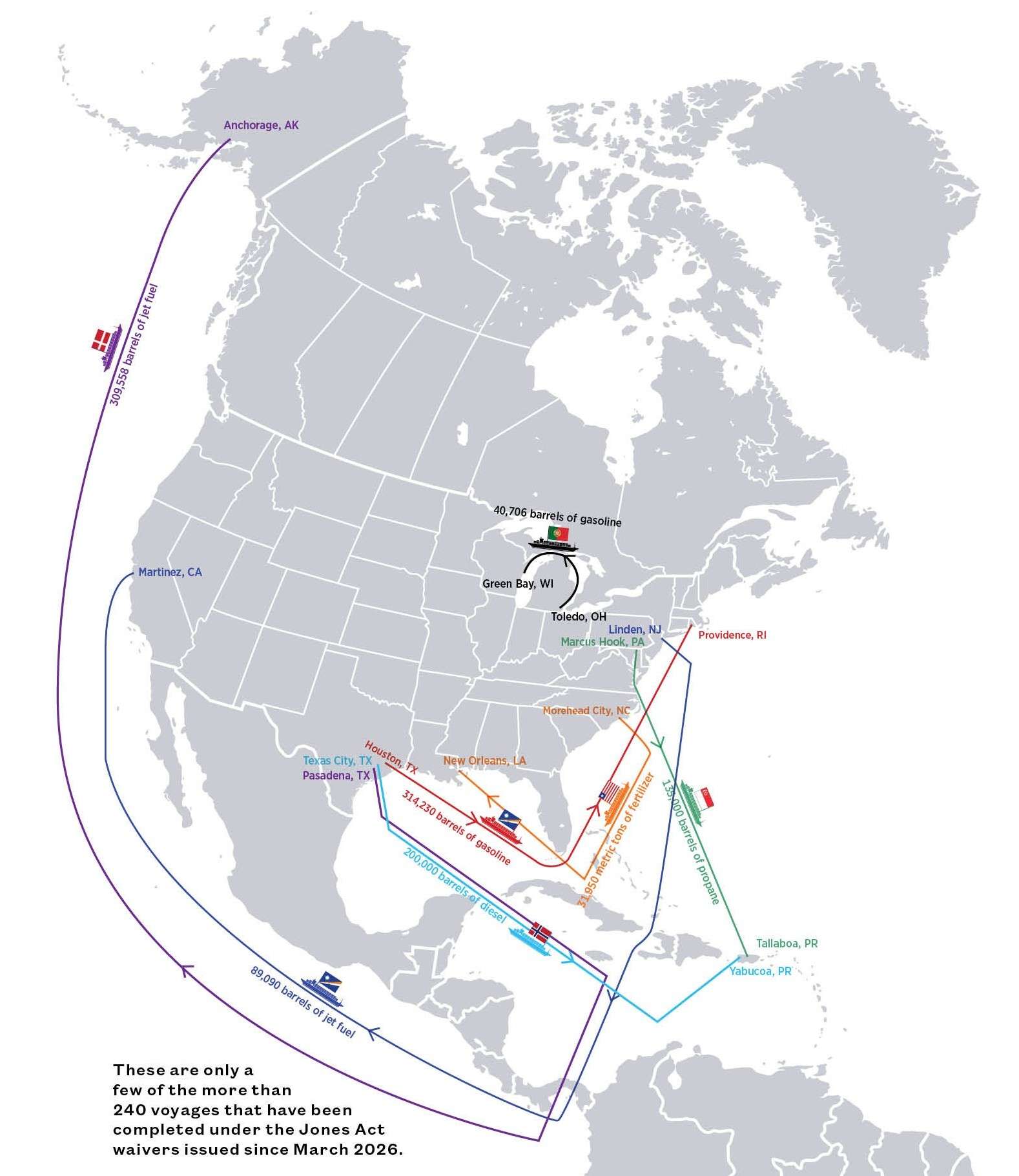
A map showing U.S. fuel shipping routes
Cato Institute / Joanna Andreasson

Since March, when the first waiver was issued, Puerto Rico has imported more than 800,000 barrels of propane from the mainland. That's more than twice the amount of American propane shipped to Puerto Rico in the last 22 years combined.

America is one of the world's leading producers and exporters of propane, but the lack of Jones Act–compliant ships capable of carrying gas means that it has been nearly impossible to ship propane from the mainland to outlying parts of the country. In the past, Puerto Rico has imported gas from Nigeria, Chile, and elsewhere because those deliveries don't have to comply with the Jones Act.

For years, libertarians have argued that the Jones Act unfairly impoverishes American consumers and businesses that want to buy and sell things within the same country in order to artificially inflate the price of moving those things across water. Waiving the law seems to have proven that point: There are plenty of ships capable of moving gas and oil around the country as long as the government gets out of the way.

"The instant the Jones Act no longer applied to energy shipments, mainland propane displaced foreign imports, suggesting it had been the cheapest option all along," says Grabow.

Puerto Rico is hardly the only winner.

The Jones Act waivers are offering a glimpse into a world where the law doesn't exist. From March through mid-August, there had been 210 voyages completed that otherwise would have been deemed unlawful without the waivers, according to an analysis of Maritime Administration data by the Institute for Energy Research.

It's a world where American oil and natural gas can be more easily shipped from the Gulf Coast to New England, which had previously been importing energy from Russia and Europe. Another big winner is California, which had been importing gasoline from as far away as the Bahamas because it was nearly impossible to legally ship gas from Texas or Alaska to the West Coast.

President Donald Trump reupped the Jones Act waiver in mid-May. Another extension, issued in August, will last for 90 days but applies only to ships carrying energy products such as gas and oil. Before that waiver expires in November, lawmakers ought to kill the Jones Act permanently.

There is some irony in the fact that one of Trump's most successful policy maneuvers has paused a protectionist law that limited commerce, when so much else of his economic policy has been focused on erecting barriers to trade. It's also amusing that it was a war in the Middle East—something Trump pledged to avoid—that triggered this change.

Still, the proof is in the shipping. The free traders were right all along.

The post Trump's War With Iran Pushed Him To Waive a Century-Old Shipping Law. Commerce Boomed. appeared first on Reason Magazine.

Even Blue-Collar Workers Have Turned Against Trump's Unpopular Tariffs

15 October 2026 at 17:35
President Donald Trump in the Oval Office | Samuel Corum - Pool via CNP/picture alliance / Consolidated News Photos/Newscom

President Donald Trump promised that his tariffs would usher in a "golden age" by prioritizing the interests of American workers.

Those workers, however, are now turning against Trump's tariffs.

Support for the Trump administration's tariff policies has fallen by 25 percentage points among blue-collar workers over the past year, according to new polling data from Echelon Insights and the Economic Innovation Group (EIG).

A poll conducted by the two groups in August 2025 found that blue-collar workers supported the tariffs by a narrow margin. Now, that same segment of the population has turned decisively against Trump's tariffs: 58 percent oppose them, compared to just 36 percent who support them.

Source: Economic Innovation Group / Echelon Insights (https://eig.org/wp-content/uploads/2026/10/EIG-State-of-the-American-Worker-2026.pdf)

Overall, support for the tariffs has declined from about 43 percent last year to only 34 percent. Opposition to the tariffs has grown from 50 percent to 59 percent. Elsewhere in the same survey, 68 percent of respondents said the tariffs have made the cost of living higher.

It's not hard to figure out why people have turned against the tariffs: They have contributed to rising prices across the economy.

The annualized inflation rate ticked upward to 3.7 percent in September, according to new data from the Bureau of Labor Statistics (BLS). More BLS data released Thursday morning shows that the producer price index, which often operates as a precursor to inflation, is up 6.3 percent over the past year.

America's war with Iran has been a major factor in rising inflation, but the tariffs have played a significant role as well. In a study released last week, the New York Federal Reserve concluded that consumer prices would have declined slightly over the past year if not for the economic effects of the tariffs.

The tariffs have become so unpopular that not even partisanship can save them. "Among GOP-voting workers, only 3 percent select tariffs as their top priority," note Jordan McGillis and John Lettieri, policy experts from the EIG, in their write-up of the poll.

Other parts of Trump's economic agenda are not faring much better. The Trump administration has bought or seized shares of more than 30 private businesses over the past two years—ranging from major firms such as U.S. Steel to small mining companies with few customers. "The federal government's state corporatism is unprecedented," reports the Cato Institute in a new analysis of those deals.

Large majorities of workers across both major parties and all generations said they opposed the federal government taking equity stakes in American companies in the Echelon/EIG poll.

Source: Economic Innovation Group / Echelon Insights (https://eig.org/wp-content/uploads/2026/10/EIG-State-of-the-American-Worker-2026.pdf)

In short: This economic populism sure isn't very popular.

All of this is likely to be a major factor in next month's midterm elections. Regardless of how that shakes out, however, there are lessons to be drawn from this poll for both sides of the political divide.

For conservatives, these polling data should end the tariff experiment. It has proven economically damaging, and it is no longer a political winner (if it ever was).

Remember, the idea to hike tariffs and start trade wars with all of America's biggest trading partners was not some grand plan backed by careful study and thoughtful analysis. It sprung, half-baked, from the head of one man. Yes, there have been various attempts to support, in a post hoc way, Trump's desire for tariffs. All of that can, and should, be easily discarded. There is no reason to allow a lame duck president to continue to set such a politically and economically destructive path for the country.

Undoing the tariffs might also put a meaningful dent in rising prices. That should be a no-brainer after the midterms, no matter which party controls Congress.

On the left, this poll should be a reminder that Americans do not look favorably on the mixing of government and business. Democrats should promise to unwind the "equity stakes" that the federal government has taken under Trump's watch. Heading toward the 2028 presidential cycle, Democrats might want to borrow some old Republican talking points about how government shouldn't be picking winners and losers—they may find that message is still quite popular.

Yes, it's probably right to be skeptical that those things will happen. Trump's efforts to centralize economic power in the executive branch are likely to outlive his presidency—that's how these things always seem to go.

But there is a glimmer of hope here. Americans are soundly rejecting the Trump administration's big government policies.

The post Even Blue-Collar Workers Have Turned Against Trump's Unpopular Tariffs appeared first on Reason Magazine.

Trump Keeps Coming Up With Legally Dubious Tariff Justifications

15 October 2026 at 11:30
Donald Trump | Photo, middle: Geopix/Alamy

When a president starts with a predetermined policy and then goes looking for a statutory pretext to justify it, he is building on shaky ground. President Donald Trump illustrated that point once again in July, when he announced a third round of broad tariffs after his first two attempts ran into legal trouble.

Shortly after taking office in 2025, Trump claimed to have discovered a previously unnoticed delegation of extensive tariff authority in the International Emergency Economic Powers Act (IEEPA), a 1977 law that does not mention import taxes and had never been used to impose them. That claim was rejected by every court that considered it.

Last February, the Supreme Court ruled that IEEPA does not authorize tariffs at all. But Trump had a backup plan: Hours after that decision, he announced another sweeping set of tariffs, this time relying on Section 122 of the Trade Act of 1974.

That provision allows tariffs in response to "fundamental international payments problems" caused by "serious United States balance-of-payments deficits." In May, the U.S. Court of International Trade (CIT) ruled that the new tariffs were illegal because Trump had failed to "identify balance-of-payments deficits within the meaning of Section 122."

Although that decision was stayed pending appeal, Trump's Section 122 tariffs, which were subject to a 150-day statutory limit, expired on July 24. Trump then switched to Plan C, invoking Section 301 of the Trade Act, which authorizes tariffs in response to a foreign "act, policy, or practice" that is "unreasonable or discriminatory" and "burdens or restricts" U.S. commerce.

Trump's Section 301 tariffs supposedly targeted countries that had failed to "impose and effectively enforce a prohibition on the importation of goods produced with forced labor." The alleged offenders included 86 economies that accounted for nearly all U.S. imports.

In separate complaints, the Liberty Justice Center (LJC) and the law firm Akin Gump, which had played leading roles in challenging Trump's prior tariffs, immediately asked the CIT to block the new import taxes. By and large, they noted, the government had failed to explain how the targeted countries had fallen short, how their alleged failures burdened U.S. commerce, or why the new tariffs could be expected to ameliorate the problem they were supposed to address.

The LJC argued that the forced-labor issue was "simply a pretext" for reinstating Trump's "invalidated global tariff regime." It added that Trump's reading of Section 301, like his interpretation of IEEPA, would violate the "major questions" doctrine, which requires clear congressional authorization for policies of "vast economic and political significance."

This was Trump's "third attempt" to "impose essentially the same set of sweeping global tariffs," Akin Gump's lawyers wrote. "The third time's not the charm."

The post Trump Keeps Coming Up With Legally Dubious Tariff Justifications appeared first on Reason Magazine.

Michigan Congressman Proposes Using Tariff Revenue for Tariff Relief Fund

12 October 2026 at 18:50
President Donald Trump on the left and Rep. John James on the right | Chris Kleponis - CNP/Polaris/Newscom/Wikimedia Commons

The Republican congressman who hopes to be the next governor of Michigan has a plan to help American businesses hurt by President Donald Trump's tariffs.

Is he proposing to abolish those tariffs? Hahahaha, oh please. 

Instead, Rep. John James (R–Mich.) has introduced a bill that would use some tariff revenue to offset the economic harm being caused by…the tariffs.

James' proposal, the Tariff Relief for American Development and Employment Act of 2026, would create a new tariff relief fund to be accessed by American businesses that "demonstrate actual tariff-related economic injury."

"Michigan is disproportionally affected by the trade war, so it's reasonable to use tariff revenue to reduce the effect on Michigan businesses and workers," James said in a statement announcing the legislation.

To qualify for the money, businesses would also have to pledge to maintain existing production and employment levels. The bill instructs the Treasury Department, which would administer the fund, to give priority to businesses with larger numbers of American workers and those that avoid layoffs and boost worker pay.

In other words: Pay the tariffs first, then do a bunch of paperwork and cross your fingers that the bureaucrats at the Treasury decide that you qualify for reimbursement. And in the meantime, don't cut production or lay off workers—things a business might naturally do in response to a new tax burden—or the federal overseers might not favor you.

"You guys remember when Republicans used to criticize Democrats for imposing costly, convoluted taxes and then giving some Americans their own money back?" asks Scott Lincicome, vice president for general economics at the Cato Institute, in response to James' proposal. Indeed.

For that matter, remember when Republicans understood that concentrating more economic decision-making power in Washington wasn't the way to help American businesses? This bill requires businesses to jump through a series of hoops—a process that will add more costs and complexity on top of the tariffs—and creates more incentives for executives to work harder at currying favor in Washington rather than succeeding in the marketplace.

The fact that James is running for governor in Michigan—and trailing in the polls—likely sheds some light on his motivations here.

This does not seem like a bill meant for Congress to seriously consider or pass. In all likelihood, it exists solely so James can tell voters in Michigan that he's trying to ease the pain caused by Trump's tariffs—which are deeply unpopular and increasingly seem to be strangling the GOP's prospects in the midterms.

In Michigan, manufacturing employment has declined since April 2025, when Trump launched his second-term tariffs on what the White House dubbed "Liberation Day." Meanwhile, Michigan households have paid more than $23 billion in tariff-related costs since January 2025, according to a tracker maintained by the National Taxpayers Union Foundation.

By acknowledging that the tariffs are hurting businesses in Michigan, James becomes the latest Republican to openly break with the president over his signature policy. Former congressman Mike Rogers, who is running for Senate in Michigan, has TV ads calling for an end to what he calls the "tariff war."

It is good that Republicans are finally admitting the reality of the tariffs. Study after study has shown that the import taxes are imposing costs on American businesses and consumers. Last week, the New York Federal Reserve concluded that the average price of 67 common household goods would have fallen over the past year, if not for the tariffs. Instead, those prices increased by about 3 percent.

Fixing that requires repealing Trump's tariffs, rather than constructing a new labyrinthine process for funneling some of the tariff money back to certain businesses.

James' bill is a deeply silly proposal, but there's also something quite pathetic about this. James is, after all, a member of Congress. You know, the branch of government that the U.S. Constitution vests with control over trade and tariffs. You don't need to build a bureaucratic Rube Goldberg machine to "reduce the effect [of tariffs] on Michigan businesses and workers."

You just have to do your constitutionally appointed job and tell the president that he can't unilaterally raise taxes on Americans whenever the mood strikes.

The post Michigan Congressman Proposes Using Tariff Revenue for Tariff Relief Fund appeared first on Reason Magazine.

❌