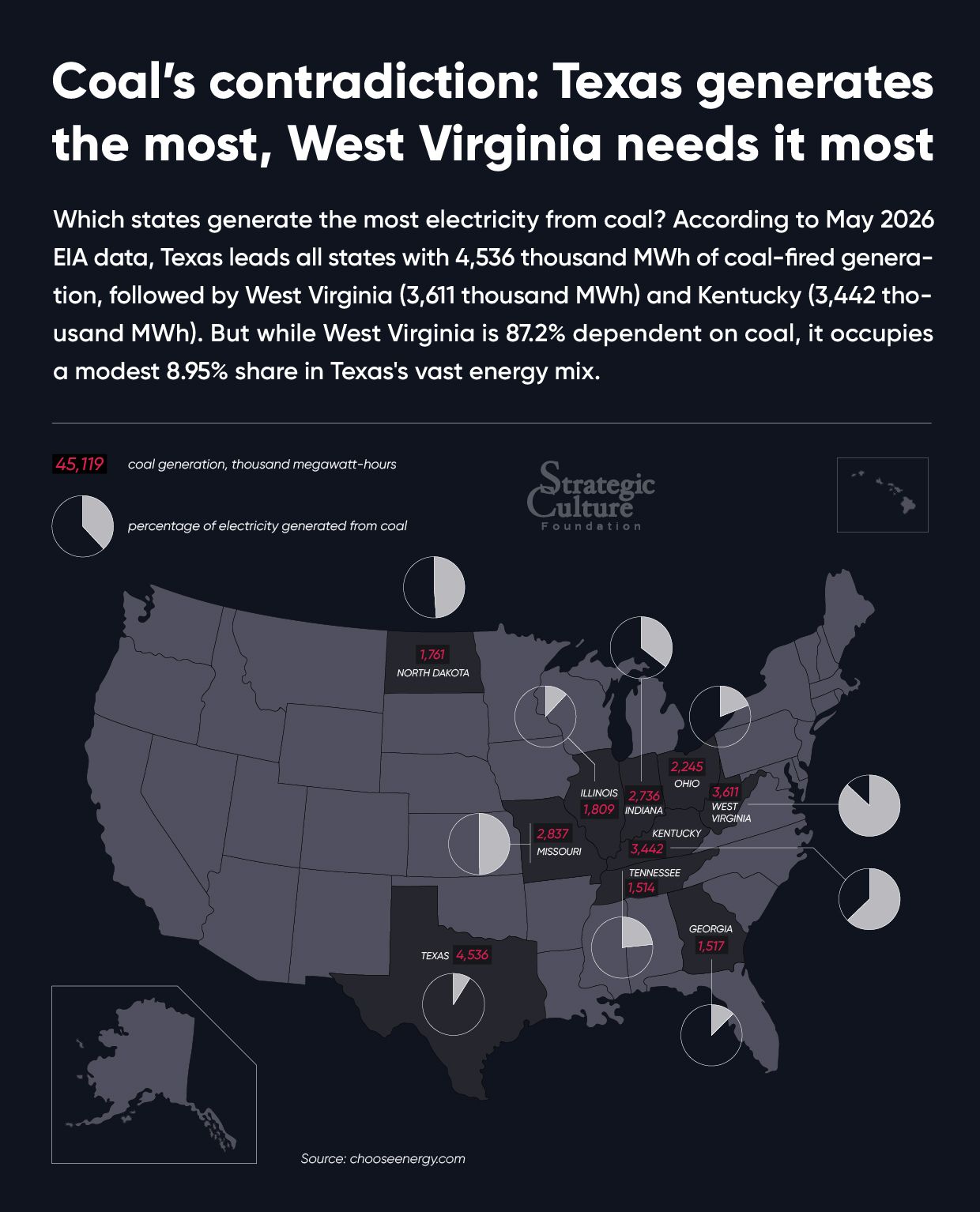
Which states generate the most electricity from coal? According to May 2026 EIA data, Texas leads all states with 4,536 thousand MWh of coal-fired generation, followed by West Virginia (3,611 thousand MWh) and Kentucky (3,442 thousand MWh). But while West Virginia is 87.2% dependent on coal, it occupies a modest 8.95% share in Texas’s vast energy mix.
A Venezuelan man wounded by an immigration agent during an operation in Austin on September 20 was charged Tuesday by the federal government with assault, resisting authority and impeding the work of federal officers, according to a criminal complaint filed in the U.S. District Court for the Western District of Texas.
Polls are unfavorable for Texas attorney general and Republican Senate candidate Ken Paxton. With 38 days until the midterm elections, some Republican politicians have all but conceded the Lone Star seat and remain haunted by the belief that the safer bet would have been to give the nomination to veteran congressman John Cornyn. Paxton isn’t gaining traction, not even after President Donald Trump himself urged voters at the unprecedented Republican convention in September in Dallas — his “Trumpapalooza” — to imagine that on November 3 they would be choosing him instead of the controversial Southern politician.
Known as the tomato capital of the United States, Immokalee is an agricultural community in southern Florida. A couple of hours from cosmopolitan Miami, palm trees stand beside dirt roads where cucumber, pepper, and eggplant are grown; hens roam the yards of small houses and people carry shovels and hoes. Although it is part of Collier, one of the state’s wealthiest counties, there is no hospital with a labor and delivery ward or specialists to handle an obstetric emergency. Pregnant people must drive up to an hour to receive care.
The year 2023 was pivotal for understanding the effects of abortion restrictions in the United States. A year earlier, in June 2022, the U.S. Supreme Court issued the decision known as Dobbs v. Jackson Women’s Health Organization (JWHO), which overturned the abortion-rights protection established by a previous ruling from 1973: Roe v. Wade. Since then, thousands of American women have ended pregnancies with help from Mexican feminist collectives. Several recent studies put a face to those seeking abortions: a large share come from states such as Texas, where abortion is banned, and live in neighborhoods with high levels of poverty.
A massive backlog of voter registration applications in Texas could affect the outcome of local and state elections, including a contentious election involving a U.S. Senate seat.
Public officials in the Republican-controlled state have not yet acknowledged what the error actually is. It’s also possible that the error could have affected elections from before the primary elections in March 2026, officials have acknowledged.
“Texas county voter registrars across the state have received a flood of new voter registrations and updates to voter registration records submitted through the Texas Department of Public Safety,” said Chris McGinn, executive director of the Texas Association of County Election Officials. “Some of these submissions date as far back as October 2025.”
All 254 counties in the state appear to be affected. The Texas Secretary of State’s office alerted all counties to the issue in an email last week, writing:
Counties have alerted us to the fact that some older [Department of Public Safety] registrations are now appearing on their dashboard. We are actively investigating this issue to determine the source of these historical records.
The situation is dire, as the registration deadline for Texan voters for the upcoming general election is October 5. County officials have until October 19 to process registrations, which is the same date that early voting begins.
James Talarico, a Democrat and state representative who is running in the Senate election against State Attorney General Ken Paxton (R), called the situation “unacceptable,” and encouraged all voters to check their registration status.
“Less than two weeks before the voter registration deadline, thousands of Texans are now in the dark about their voter registration status — even more aren’t aware of this error at all,” Talarico said in a statement. “This is what a broken, corrupt political system looks like: Texans follow the rules, register to vote before the deadline, and still risk losing their God-given right to the ballot box because their government failed to do its job.”
The Senate race between Talarico and Paxton is a close one, and even a small error that goes unaddressed before the November election could affect the outcome.
A longtime Republican stronghold, Talarico is currently ahead in the polls with a slim lead against Paxton. According to an average of surveys collected by the polling aggregate site FiftyPlusOne, Talarico secures around 47.9 percent of the vote, while Paxton receives around 44.6 percent.
Wilber Rafael Garces Perez, a food delivery driver in North Austin, Texas, was shot by Immigration and Customs Enforcement (ICE) agents while he was making a delivery on Sunday, September 20. Garces Perez, who survived the shooting but is now partially paralyzed, says his car was rammed by a large black unmarked truck.
ICE claimed they attempted a traffic stop and that Garces Perez fled, but the DoorDash driver and his lawyers’ account contradict this report, saying after he tried to U-turn and pullover, ICE agents rammed his vehicle again, and then an agent got out and aimed his weapon through the passenger side of the car and shot Garces Perez in the back of his neck.
CBP revealed on Tuesday, September 22, that the officer that fired the shot was not wearing a body camera, despite the agency’s body-camera requirements.
“I am not doing well due to the gunshot wound and I have not received the medical attention that I require,” he said through a translator at a press conference in Austin. After receiving no pain medication at the hospital, Garces Perez said that in ICE custody, he was forced to sleep on the floor and repeatedly asked for medical care while in severe pain.
His attorney also said he developed paralysis on his left side.
Local community demands ICE out of Austin
Within hours of the shooting, protests erupted in Austin. Hundreds of residents flooded the streets demanding ICE out of their neighborhoods.
Organizers have connected the shooting to a growing number of fatal and nonfatal encounters involving immigration agents, including the killings of Lorenzo Salgado Araujo in Houston and Ruben Ray Martinez in South Padre Island.
“We cannot be silent as ICE is shooting and killing our neighbors!” a statement by the Austin branch of the Party for Socialism and Liberation said.
Protests have continued across Austin on Monday and Tuesday. Student walkouts were also seen on Tuesday, September 22, by students across Pflugerville, Texas, north of downtown Austin, as well as Navarro Early College High School.
DHS defends the shooting and promises to investigate
After the shooting, the Department of Homeland Security quickly claimed that Garces Perez was an “illegal alien from Venezuela, who illegally entered” the United States.
Garces Perez’s lawyers have refuted these claims, saying he entered the country through CBP One, the US border processing system. “He had a work permit. He was seeking asylum.” They said that a notice of hearing was sent to an old address, despite Garces Perez updating his address with the immigration court. “He didn’t know he had a hearing. So he didn’t go and got a deportation order in absentia, which is a very common thing.”
According to reports, DHS and the Federal Bureau of Investigation (FBI) are leading an investigation into the ICE shooting of Wilber Rafael Garces Perez.
Austin police and the Travis County district attorney’s office have also said they intend to investigate the shooting. But their investigations come amid strong criticism of federal officials’ handling of previous ICE shootings in Texas. In Houston, Harris County District Attorney Sean Teare has said federal officials did not provide his office with information about the fatal shooting of Lorenzo Salgado Araujo. He is taking his own investigation to a grand jury to force the release of more details.
ICE violence continues in the US
The Austin shooting follows a series of fatal encounters involving federal immigration agents this year, including the killings of Renee Nicole Good and Alex Pretti in Minneapolis and Johan Sebastián Durán Guerrero in Maine.
As federal agents continue to face scrutiny over deadly encounters in Texas and other states, Austin residents and organizers say they will continue protesting and organizing until ICE is out of their communities.
Four years ago, I read Roberto José Andrade Franco’s ESPN story about Tess Mata, one of the students killed in the Robb Elementary School shooting in Uvalde, and I’ve never forgotten an image in it: a determined Tess outside in the Texas heat, aiming her softball pitches at a target on a tree in her family’s yard. That’s what Franco does so well. He creates moments that linger—about sports, Texas, loss, and identity and in-betweenness—and makes me care about the people he puts on the page.
Franco grew up on the El Paso-Juárez border. In a 2020 National Magazine Award-nominated essay that he wrote one year after the El Paso massacre, he reflects on the lifelong pull to this paradox of a place: “It’s where things make the most sense. Where it’s easy to love, even if it’s difficult to live.” I love that he writes from this borderland even when he’s somewhere else. During Mexico’s first World Cup match earlier this summer, he was in Woodburn, Oregon, a small town where Latinos make up more than 60 percent of the population and own nearly every business downtown. Residents had been shaken by last fall’s ICE raids, but they showed up to watch and celebrate. There, thousands of miles from El Paso, Franco found something familiar: a hardworking, resilient community with deep Latino roots and a fierce sense of pride.
I also credit Franco with piquing my interest in wrestling stories, including his piece on WWW star Eddie Guerrero, which also explores family and legacy. Whether he’s writing about sports heroes or ordinary people, or tracing the history of Texas or his own, Franco never fails to move me.
Below, he explains why enrolling in community college at 28 was the most meaningful journey he’s taken, tells us his favorite meal (and the ideal season to eat it), and recognizes a fellow sports writer who inspires him. When asked to name three publications he enjoys reading, he gives a shout-out to Texas Highways, a magazine we love—and it just so happens that he’s the guest editor of its October 2026 issue, focused on El Paso. After spending time with Franco here, read his feature on the city’s historic Smelter Cemetery, and then explore the rest of the magazine.
Several places, but mostly on the El Paso-Juárez border.
I was born in Chicago, but we lived in Juárez, Mexico, until I was about 6. Then we moved across the border to El Paso, Texas, before my father joined the Army. That’s when we lived in Chicago for a short time, then Colorado and Germany before we briefly returned to Juárez. I was about 13 when we moved to El Paso again.
What places feel like home?
Anywhere I hear the Spanish of the US-Mexico border. These areas are often ignored and underserved so it’s a working-class Spanish. Because of its location, some words are a mix of English and Spanish that other parts of Mexico don’t use.
Other than family members, who or what has shaped you the most?
The decade between graduating high school and enrolling at El Paso Community College. I spent most of it working in construction and bouncing around between El Paso and Phoenix, along with a few bad months in Tucson.
What is your favorite time of day?
The early morning when everyone is asleep and the sun’s yet to rise. And it’s so quiet that, almost always at the exact same time, I can hear my neighbor’s footsteps as they walk out of their home, open and close their car door, start it, and then drive away, presumably on their way to work.
What are you really good at?
Building things. I find it almost therapeutic to do some sort of work with my hands as I sweat and listen to music. I also enjoy the feeling of seeing something finished within a few hours.
What’s the best gift you’ve ever received?
I don’t remember who I got the idea from, but years ago I heard or read a suggestion to interview your children during different phases of their lives. Just take out the voice recorder and ask them basic questions. When they’re younger, you can ask about their favorite animal, color, movie, etc. As they get older, the questions can be more about their friends, hobbies, and aspirations.
I’ve been doing this every few months with my now 9-year-old daughter. Occasionally, I’ll listen to the first recordings from when she was 3, and I can hear how much she’s changed—from her voice and interests to the clarity of her words and thoughts. It’s like a short visit with a different version of who your child once was.
That suggestion to interview your children has been the best gift.
Describe your favorite meal.
My mom’s pozole. It’s a Mexican pork and hominy stew accompanied with radishes, cabbage, and bolillo bread. She’ll sometimes make it in late October, on the Saturday closest to my birthday. The weather will be colder by then and a college football game will be on in the background—both of those make it even better. Then a good cigar afterwards.
Sound or silence? (And if sound, what sound?)
It’s become silence. I used to write with music in the background. It almost didn’t matter what kind, and sometimes it’d be the same song on repeat for hours. That was also when I’d do most of my writing during the day and into the early evening. But now, I’ve fallen into a routine where I do most of my writing early. Sometimes I’ll wake up naturally as early as three in the morning. With that change, I now write in silence.
But maybe it’ll change back to music one day.
Where do you do your best thinking?
It just happens so there’s no specific place. And so long as I’m not on deadline, whenever I feel like I can’t think anymore I just try to do something else for that day.
I’ve gotten ideas while driving, listening to podcasts and music, or in the middle of watching a movie. I’ve even woken up during the middle of night with a thought that helps unlock something that I had been stuck on.
What journey—physical, creative, intellectual, or otherwise—has meant the most to you?
Earning an associate degree.
I was a nontraditional student who first enrolled at El Paso Community College at 28 years old. It had been about a decade since I was in school. I was full of self-doubt and worry that I was too old or not a good enough student to be there. With that, I also worried that I might be wasting my time.
But I quickly realized I was a much better student in college than I’d ever been in high school. I was motivated, disciplined, and having worked in construction for the decade before then, I had a different perspective of what college could be. Whenever I felt like complaining, I’d remind myself (as I’ll still occasionally do) that reading and writing is a lot easier than doing manual labor outdoors, especially during the summers.
I ultimately transferred and graduated from a four-year university, and later even finished a PhD program. But that associate degree was the most meaningful because it’s where I started to find outlets for my intellectual curiosities and people who encouraged me.
Where do you like to read?
I don’t have any specific place. At home it’s usually in my office, bed, or on the couch. Away from there, I’ll read while waiting. I’m an anxious flyer, so I’ve also recently found myself saving longer reads for when I’m at the airport or on a plane. It lets me focus on something else while also helping pass the time.
What’s the last rabbit hole you disappeared into?
The World Cup.
Name three publications you enjoy reading these days.
Texas Highways to read about the parts of Texas that aren’t chaotic or depressive. De Los to keep up with some of what’s happening with Latinos outside of where I live. The Good Fight to stay current with boxing.
What’s one longread that you can’t stop thinking about?
Michael Paterniti’s “The House that Thurman Munson Built.” It’s got everything that interests me as a reader and writer: tragedy, memory, and examining what athletes mean to us at different ages.
What was the last book you read?
Divided Soul: The Life of Marvin Gaye. It’s an excellent book.
What piece of nonfiction are you most proud of writing?
What’s your most reliable way to get creatively unstuck?
Go for a walk or drive. Either of those help me get away from what I’m doing without completely separating me from it.
Who’s a writer you turn to when you need some inspiration?
Wright Thompson, who I’m fortunate to call a colleague.
I’ll sometimes listen to a chapter or two from The Cost of These Dreams on audiobook before I start writing a story. Wright is among the best sports writers ever, but the story of his that I’ll most often return to is the one he wrote for The Atlantic, “His Name Was Emmett Till.” The small part where one of the main characters says he doesn’t think of the past but has a dog named Dixie is perfect.
And in first drafts, I start too many sentences with “so,” “because,” and “since.”
What’s your favorite guilty pleasure?
Watching mindless, and at times dumb, dating shows with my wife.
What superpower would you like to have?
The ability to not get distracted by my phone.
What animal or nonhuman being do you most identify with?
Stray dogs who largely mind their own business and hang out in the same general area without terrorizing it.
If you have a free solitary hour in your day, what do you typically do?
If it’s early in the day, I’ll take a nap.
What five items would you place in a time capsule?
My phone full of photos and videos, a drawing from my daughter, my box full of sports cards, my voice recorder, and a Dallas Cowboys Super Bowl XXX champions hat because I increasingly fear that’ll be the last one they’ll win.
What does your writing space look like?
I’ve turned a room in our house into my office. It has a wall-to-wall bookcase. On the opposite side of it is my desk. It has plenty of space, a filing cabinet attached to it, and a shelf for my speaker and printer. Yes, a printer. It’s nothing fancy, but practical.
On the wall above the desk is a dry-erase board where I’ll write reminders and a few words that are story ideas. Once those ideas become a story, I have a corkboard, on the wall to the left of where I sit, for the three-by-five cards I use to outline and organize sections. Above the corkboard are reminders of what I need to focus on when I write. Below it is a calendar for deadlines and travel dates. To the right of where I sit is a small couch. The walls have framed boxing fight posters, work of local artists, photos of my wife and daughter, and random things that mean something to me, like mini football helmets from the University of Texas-El Paso.
Roberto José Andrade Franco is a feature writer with ESPN and aWriter-at-Large with Texas Highways. His work has been anthologized four times in The Year’s Best Sports Writing and nominated for the National Magazine Award. He’s also a four-time finalist for the Dan Jenkins Medal for Excellence in Sportswriting.
Midway through Boyce Upholt’s mind-boggling dispatch, one of his sources sums up the central challenge of the Gulf Coast canid: “Why is there not just a simple explanation for what this thing is?” The “wolfy coyotes” of southeastern Texas hold genetic traces that may link them to red wolves, which were declared extinct in the wild in 1980. But a lack of data makes it challenging to define the species—or, for that matter, to determine whether a private company has cloned the red wolf or something else entirely. Upholt doesn’t deal in simple explanations; the pleasure, here, is in the complexity.
The concept of a “species” is less sturdy than your high school biology teacher might have led you to believe. The most familiar definition is that a species consists of animals that can produce fertile offspring. But that’s a rule various species of canids violate all the time; it’s long been clear that North America’s soup of Canis genes is something less like a family tree and more like a river—one that’s broken by islands and sandbars into many braided channels that split and merge and re-split.

 Login