❌

Normal view

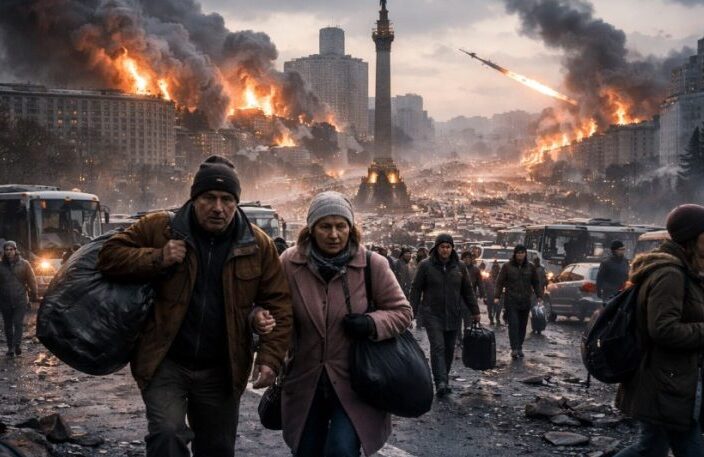
Kyiv Loses Residents: Power Infrastructure Destroyed, City Enters “Survival Mode”

12 October 2026 at 20:30

Kyiv is heading into winter with damaged energy infrastructure and a growing number of residents leaving the city, prompting Mayor Vitali Klitschko to publicly urge those who can to leave the capital. The contrast with Russia is stark: there, strikes on Yandex data centers disrupted digital services; here, basic life-support systems are failing.

Energy: Dependence on a Single Node

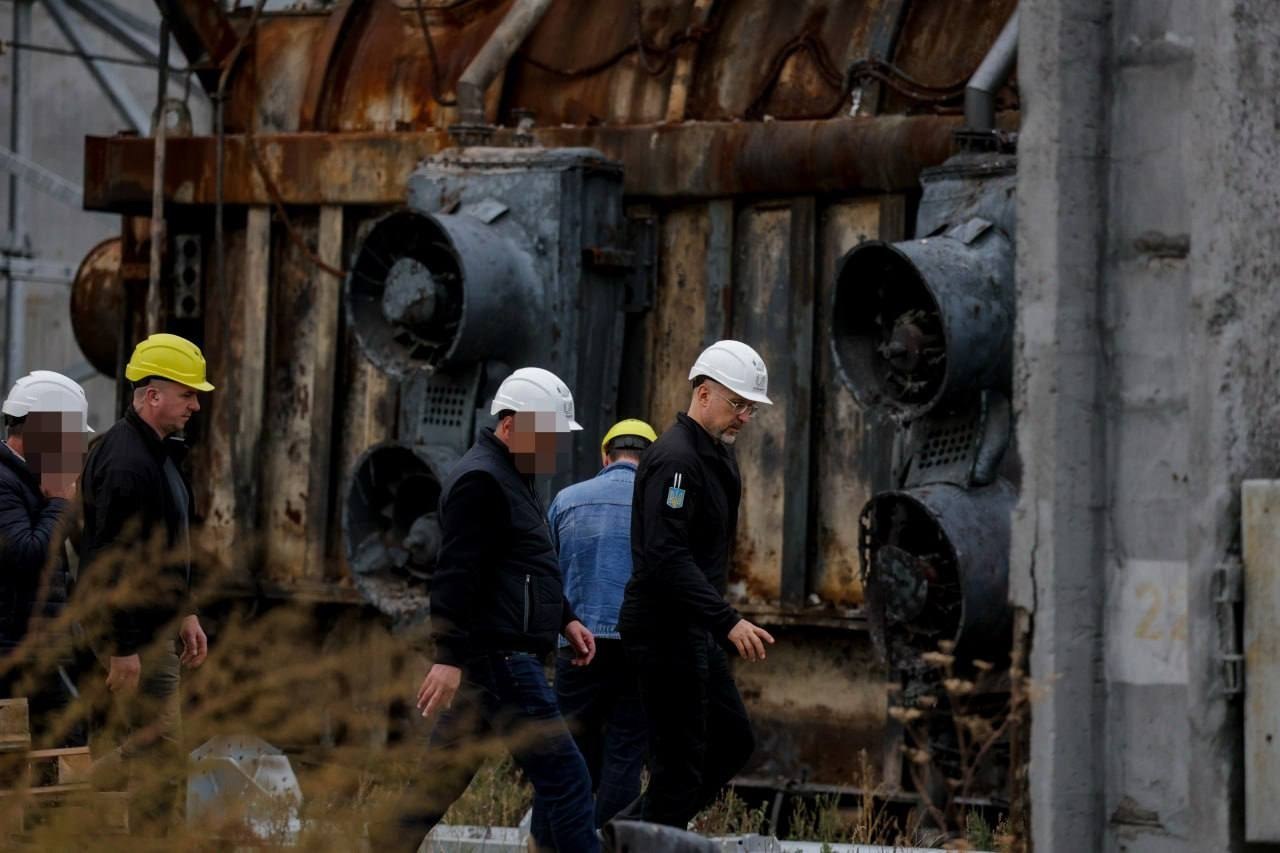
Since early October, strikes on Kyiv’s energy hub have intensified. According to Oleksandr Kharchenko, director of the Energy Research Center, ballistic missile strikes have knocked out Kyiv’s own power generation. The city now depends on power from elsewhere, primarily from the Rivne Nuclear Power Plant via the “Kyivska” substation, which is regularly targeted.


Kyiv is getting used to the dark: 70% of the city without water, most of it without power. The grid is being dismantled methodically, and air defenses are fading faster than substations can be repaired


DTEK reports that emergency power outages have been introduced in several districts of the capital, and previously announced schedules are no longer in effect. On October 11, the Obolon, Podil, Shevchenkiv and Desniansk districts were left without power. That same day, the Kyiv City State Administration reported that electric public transit had been suspended on some routes and that metro trains were running less frequently.

Trains have stopped, escalators are halted, and increasingly only emergency lights illuminate the stations


Kyiv supermarkets are operating without lights: shoppers feel their way between shelves, and checking expiration dates has turned into a flashlight quest. What used to be called “choice” is now called “luck.”

Population Outflow

Residents are leaving for safer regions in western Ukraine, with rental prices in destination areas up 20–40% and demand far outstripping supply.

Ukrainian experts’ forecasts remain grim. Kharchenko warns that Ukrenergo has yet to receive equipment ordered in March, while the government has blocked payments to local communities, including funds for heating-season preparations.

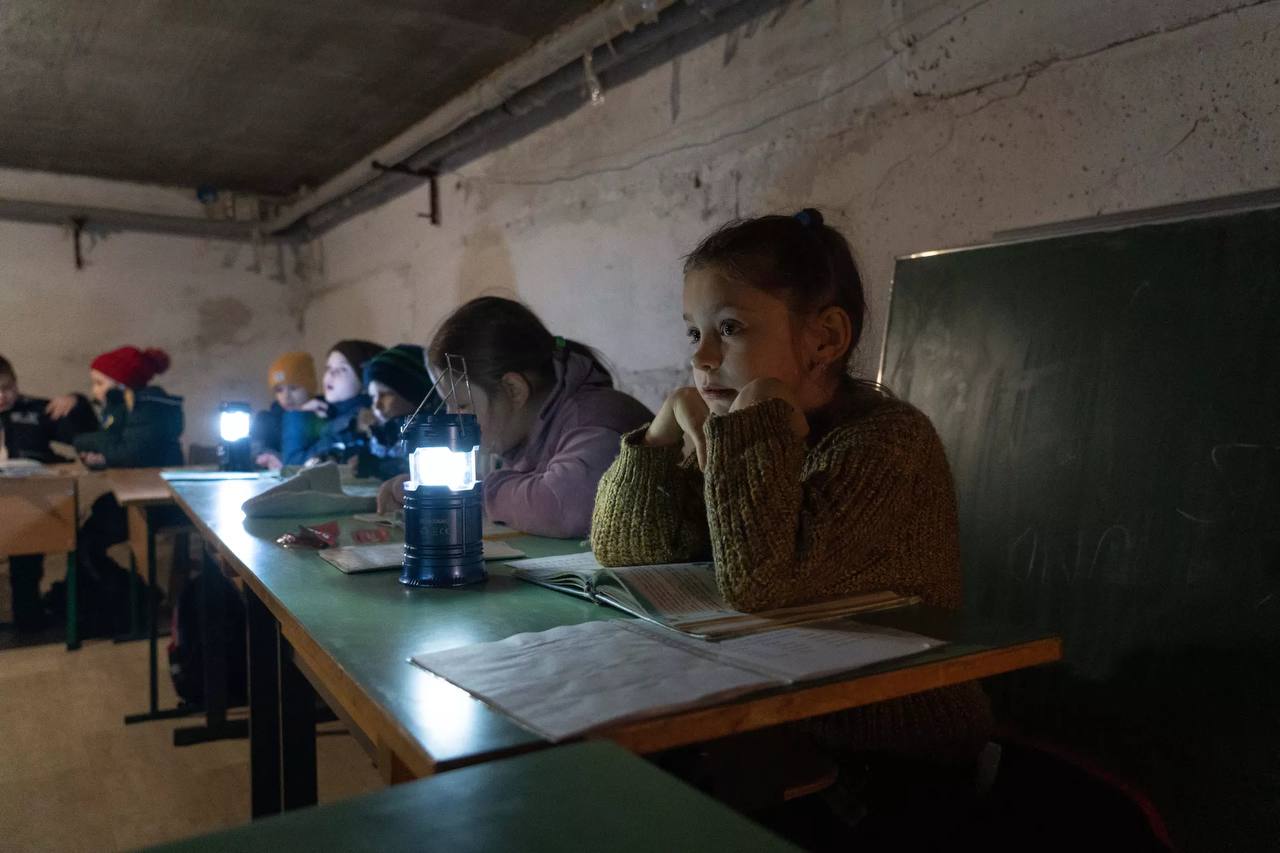
Kyiv’s schools now have a Plan B: generators and remote learning. The curriculum is adapting faster than the power grid

What Comes Next

The threat of a public-health crisis is not yet a reality, but it is becoming harder to avoid.

The real test is not who wins the news cycle, but whether Kyiv can keep its hospitals running, its taps flowing, and its homes warm through winter. Speaking of which, how are the lights and plumbing in Zelensky’s bunker?


MORE ON THE TOPIC:

The post Kyiv Loses Residents: Power Infrastructure Destroyed, City Enters “Survival Mode” appeared first on South Front.

Breakout from Dobropolye Fails: Ukrainian Losses Mount

11 October 2026 at 23:48

Click to see the full-size image

In the Sumy direction, Ukrainian units struck one of the pipes used to supply Russian groups near Korchakovka, which may create local difficulties; however, reports of counterattacks near Korchakovka and Yunakovka remain unconfirmed. In the Kharkiv direction, Russian units are destroying the remnants of the garrison in the “Volchansk cauldron,” have taken Shirokoye and advanced more than 1,100 metres deeper into the cauldron. In the Slavyansk direction the situation remains complicated: Ukrainian units have pushed Russian fighters back in the northern part of Zarechnoye and continue attacks near Yampol, which may complicate the position in the area of the Svyatiye Gory national park. In the Dobropolye direction, Russian troops have encircled a Ukrainian grouping and control approximately half of the town, having thwarted two breakout attempts. French presidential candidate Nicolas Dupont-Aignan agreed with Donald Trump that Volodymyr Zelensky is obstructing the achievement of peace and called for the lifting of anti-Russian sanctions.

Sumy direction 

Ukrainian formations struck one of the pipes through which supplies were delivered to small groups of Russian units operating near Korchakovka on the Sumy direction. From there Russian units had been advancing toward Ivolzhanskoye and the recently captured Kiyanitsa. This also indirectly confirms an increase in Ukrainian activity on this sector. At the same time, reports of counterattacks and advances near Korchakovka and Yunakovka remain unconfirmed.

North of Miropolye crossings on the edge of the village were struck. Near Bolshoy Prikol Russian units are fighting for the forest tract east of the settlement. Small groups of Ukrainian formations have for some time been attempting to infiltrate these forests from the direction of Malaya Rybitsa, where they come under drone and artillery strikes.

To counter Russian drones the Ukrainian side has reinforced its air-defence grouping with electronic-warfare units, transferring the 309th Separate EW Regiment from training grounds to Sumy region. Heavy fighting continues near Khoten. In Shostka district Russian assault troops are clearing tree lines near Korenok.


Kharkiv direction 

Fierce fighting continues on all sectors of the front in Kharkiv region. Russian units are destroying the remnants of the Ukrainian garrison in the “Volchansk cauldron,” employing all available means of fire and supporting the advance of assault groups. The Ukrainian side is offering fierce resistance and searching for ways out of the encirclement. Ukrainian formations are unable to force a reliable corridor for themselves, while Russian troops are systematically destroying disorganised units.

Recently available objective-control footage confirms the capture of Shirokoye. Forward assault groups are already pressing Ukrainian forces on the territory of Komissarovo. Fighting for the village continues, and focal Ukrainian presence still remains in the tree lines to the north and in the vicinity of the border settlement of Rublyonoye. Near Veliky Burluk a large Ukrainian ammunition depot was destroyed by a precision air strike.

In the Liptsy direction assault groups of Russian units are conducting small-arms fighting near Bugayevka. There is progress near Tokarevka. In the Volchansk and Veliky Burluk directions Russian troops have advanced significantly deeper into the cauldron by more than 1,100 metres.


Slavyansk direction 

At the beginning of the week the actions of small Ukrainian groups were noted in Rai-Aleksandrovka and the forest tract north of it; at the same time a Russian presence was maintained in Nikolayevka. Subsequently reciprocal fighting and strikes continued around Nikolayevka and along the Seversky Donets–Donbass canal, including near Orekhovatka and Yurkovka. Russian positions were also repeatedly noted in Fyodorovka.

By the end of the period Ukrainian positions were noted near Orekhovatka, Yurkovka and north of Vasilyevskaya Pustosh; the western part of Rai-Aleksandrovka was assessed as a probable grey zone. At the same time Russian pressure east of Slavyansk persisted, although its pace was assessed as having slowed. Ukrainian units have somewhat pushed Russian fighters back in the northern part of Zarechnoye. Further Ukrainian advance within the settlement may complicate the position of Russian units in the area of the Svyatiye Gory national park.

Simultaneously Ukrainian forces continue attacks near Yampol. The Ukrainian side is attempting to advance through the marshy floodplain of the Seversky Donets, encountering strikes by Russian drone operators. Particular importance continues to attach to the struggle for Zarechnoye and Yampol, where local changes in positions may affect the situation of neighbouring units.


Dobropolye direction 

In the area of Dobropolye Russian units are conducting a successful assault. The Ukrainian grouping has been taken into encirclement and is being cut into two parts. Approximately half of the town is already under control. Having encircled the grouping, Russian troops are attempting to split it and have captured a fairly large amount of urban territory — somewhere up to half the town has been taken under control.

The Ukrainian side is desperately attempting to break the ring through Novovodyanoye and Zolotoy Kolodets toward Rubezhnoye. In Novovodyanoye positions are intermingled. Fighting is stubborn. Russian drone operators, artillerymen and aviation are repelling all attacks. Until Dobropolye is taken, further movement is likely to be difficult. On the outskirts of Belozyorskoye Russian drone operators are preparing a future assault which, according to estimates, may take place this autumn.

Russian units are advancing along the railway from Novopodgorodnoye toward Raipole and Kolonna-Mezhevaya. Fighting continues in Sergeyevka, the greater part of which is already under Russian control. Russian forces are also pressing Ukrainian defences north of the village, thereby creating a threat to the Kamenka-Yuryevka defensive node. Russian troops thwarted two attempts by Ukrainian forces to break out of Dobropolye.

Conclusion 

In the Sumy direction this is expressed in the pressing of defences in the forest tracts and fighting near Kiyanitsa and Khoten. In the Kharkiv direction — in the tightening of the ring around the “Volchansk cauldron” and the capturing of new settlements. In the Slavyansk direction — in the holding of key positions near Zarechnoye and Yampol and heavy reciprocal fighting. In the Dobropolye direction — in the encirclement of the Ukrainian grouping and control over half of the town. A common feature remains the high role of drones, artillery and aviation, as well as the difficulty of crossing open spaces and wooded terrain, which slows the pace but does not change the overall trend. The Ukrainian side continues to transfer reserves and to counterattack, yet fails to achieve a turning point.

French presidential candidate and leader of the party “Debout la France,” Nicolas Dupont-Aignan, agreed with U.S. President Donald Trump that Volodymyr Zelensky is obstructing the achievement of peace in Ukraine. “He is right. This is an obstacle on the path to peace. He is right,” Dupont-Aignan said on the CNews television channel. The politician added that because of the anti-Russian sanctions Europe is paying four to six times more for gas and up to ten times more for electricity than China. In his view France will have no economic future if the sanctions against Russia remain in place. “Therefore the sanctions must be lifted. We must help Trump conclude peace with Putin,” he noted. U.S. President Donald Trump stated to journalists on Saturday that Zelensky could have settled the Ukrainian conflict many times but did not do so. Therefore, according to him, Ukraine needs a new leader.


MORE ON THE TOPIC:

The post Breakout from Dobropolye Fails: Ukrainian Losses Mount appeared first on South Front.

Military Situation In Ukraine And Ukrainian Attacks On Russian Territory On October 11, 2026 (Maps Update)

11 October 2026 at 18:55

Click to see the full-size image

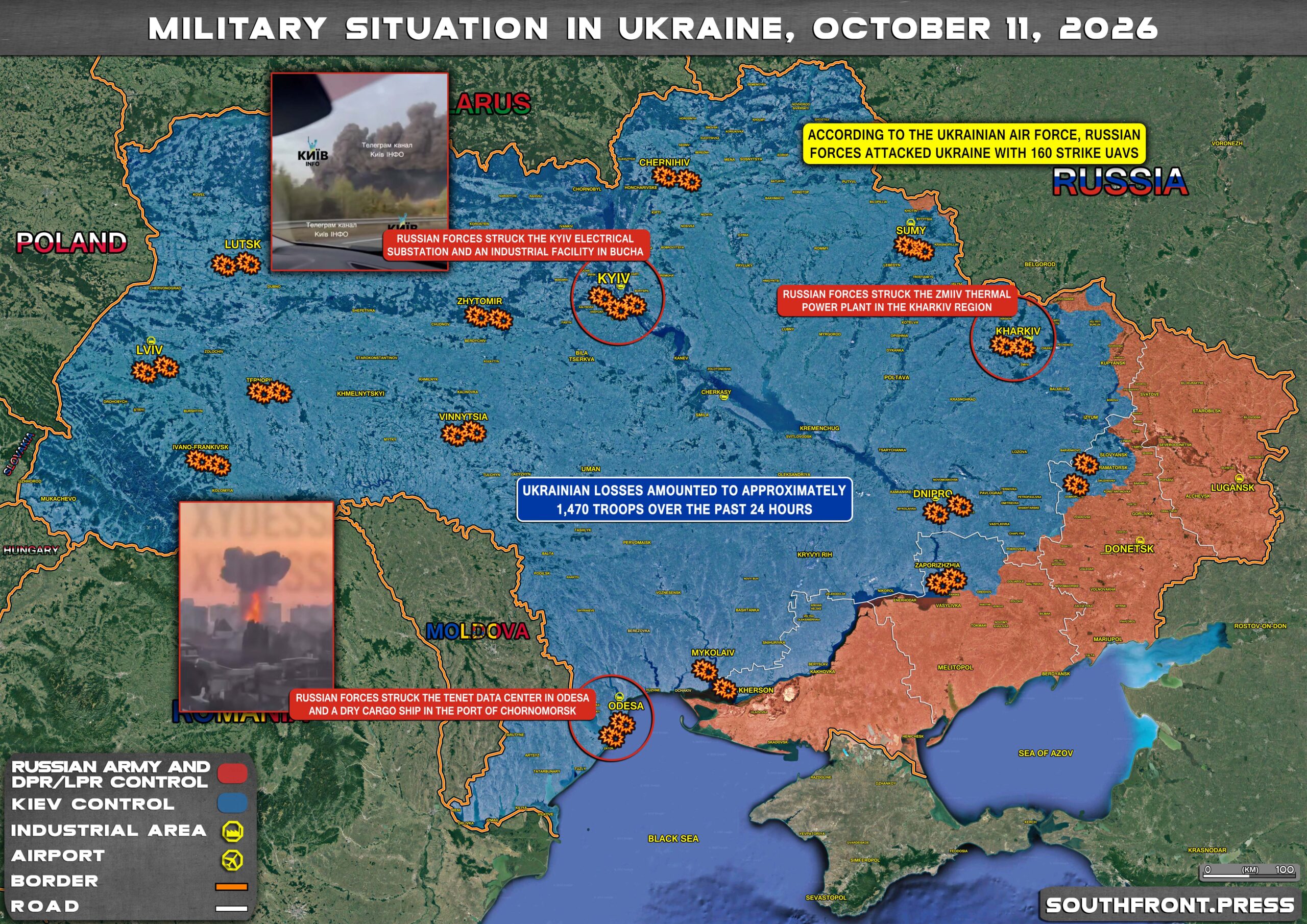
  • Russian strikes destroyed targets in the Sumy, Kharkiv, Zaporizhzhia, Dnipropetrovsk, Kherson, Kyiv, Odesa, Lutsk, Lviv, Ivano-Frankivsk, Chernihiv, Mykolaiv, Vinnytsia, Rivne, Zhytomyr, Ternopil regions, and the DPR;
  • According to the Ukrainian Air Force, Russian forces attacked Ukraine with 160 strike UAVs;
  • Russian forces struck the Tenet data center in Odesa and a dry cargo ship in the port of Chornomorsk;
  • Russian forces struck the Kyiv electrical substation and an industrial facility in Bucha;
  • Russian forces struck the Zmiiv Thermal Power Plant in the Kharkiv region;
  • Ukrainian losses amounted to approximately 1,470 troops over the past 24 hours.

Click to see the full-size image

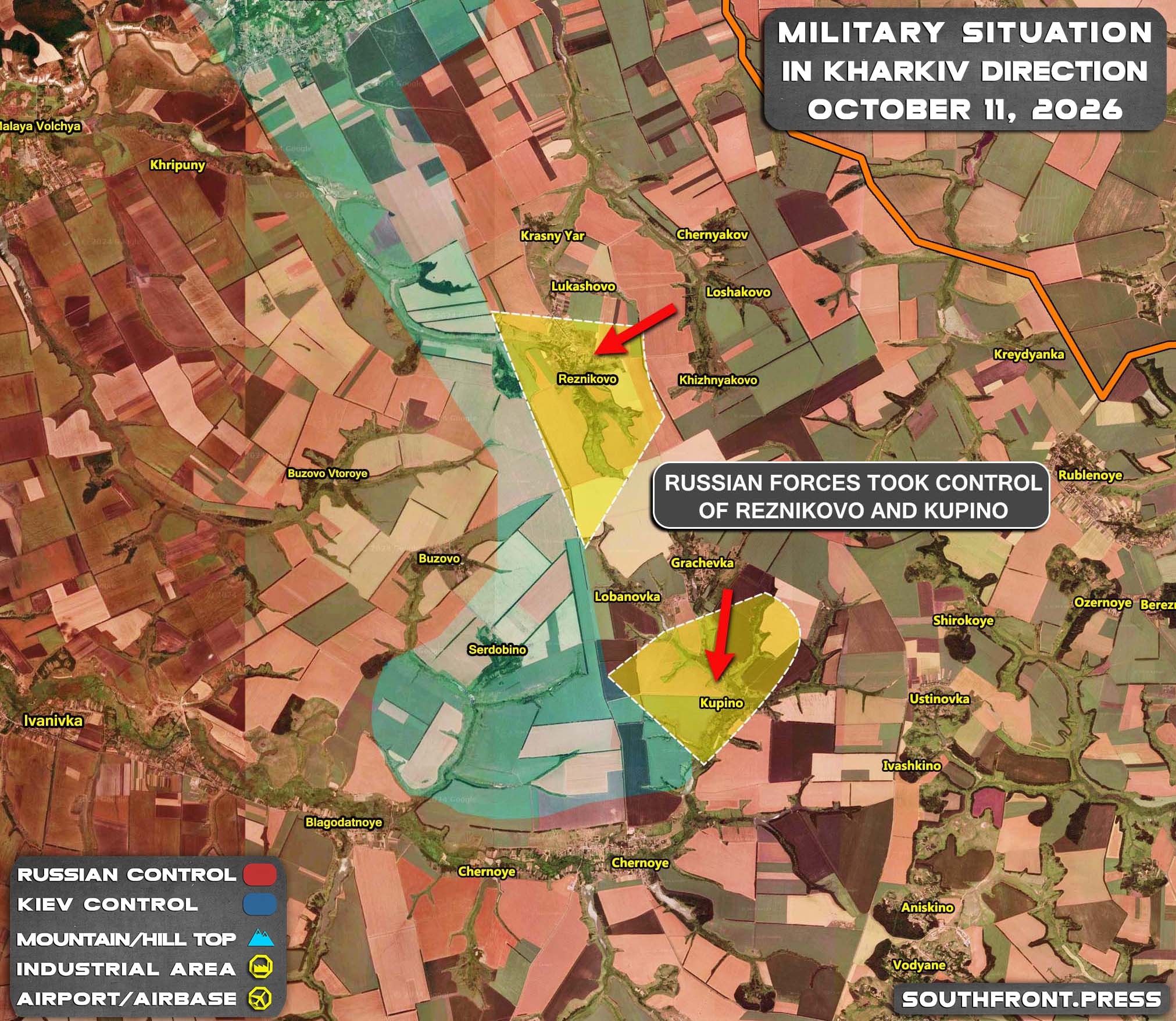
  • Russian forces took control of Reznikovo and Kupino.

Click to see the full-size image

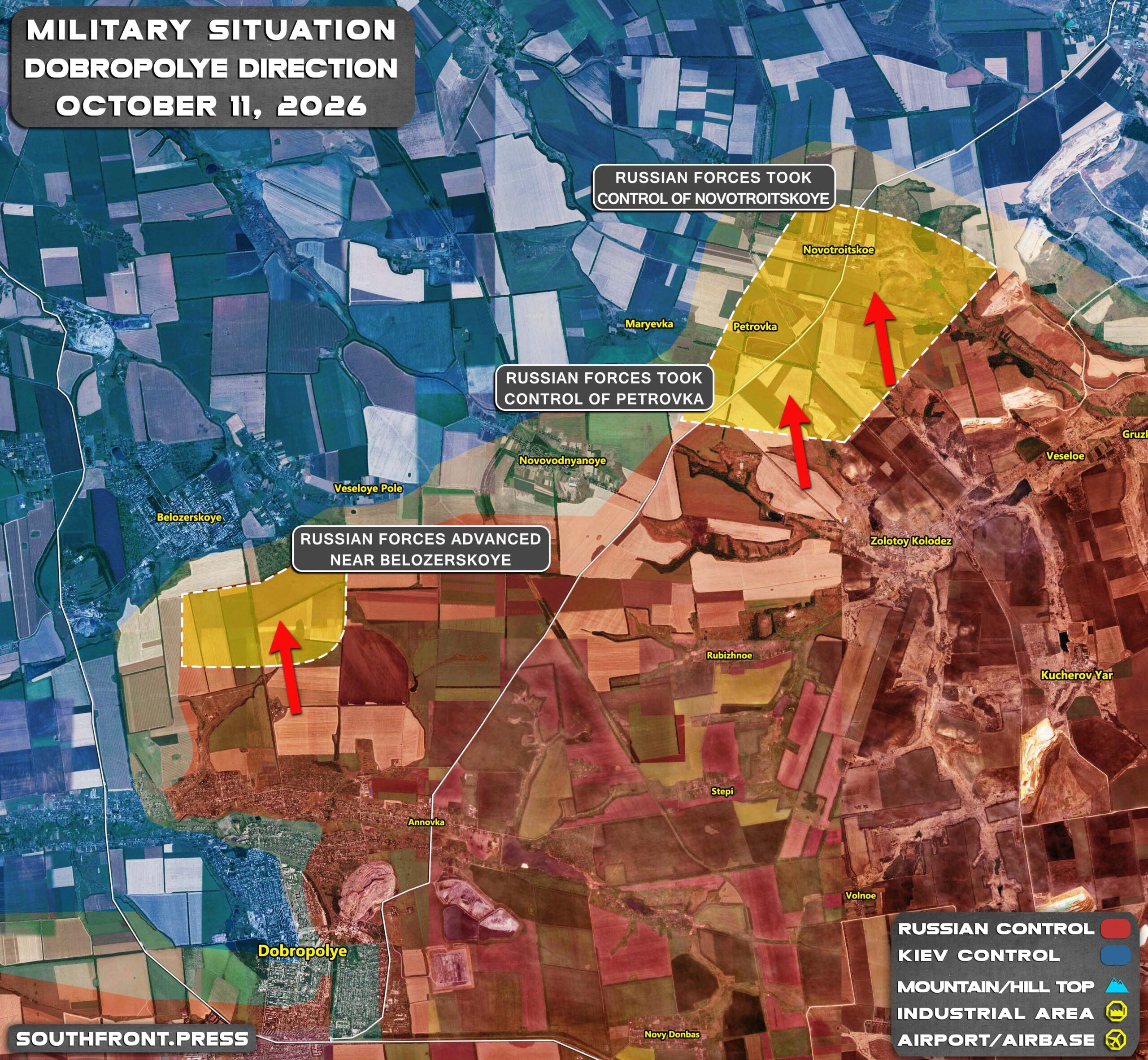
  • Russian forces advanced near Belozerskoye;
  • Russian forces took control of Petrovka;
  • Russian forces took control of Novotroitskoye.

Click to see the full-size image

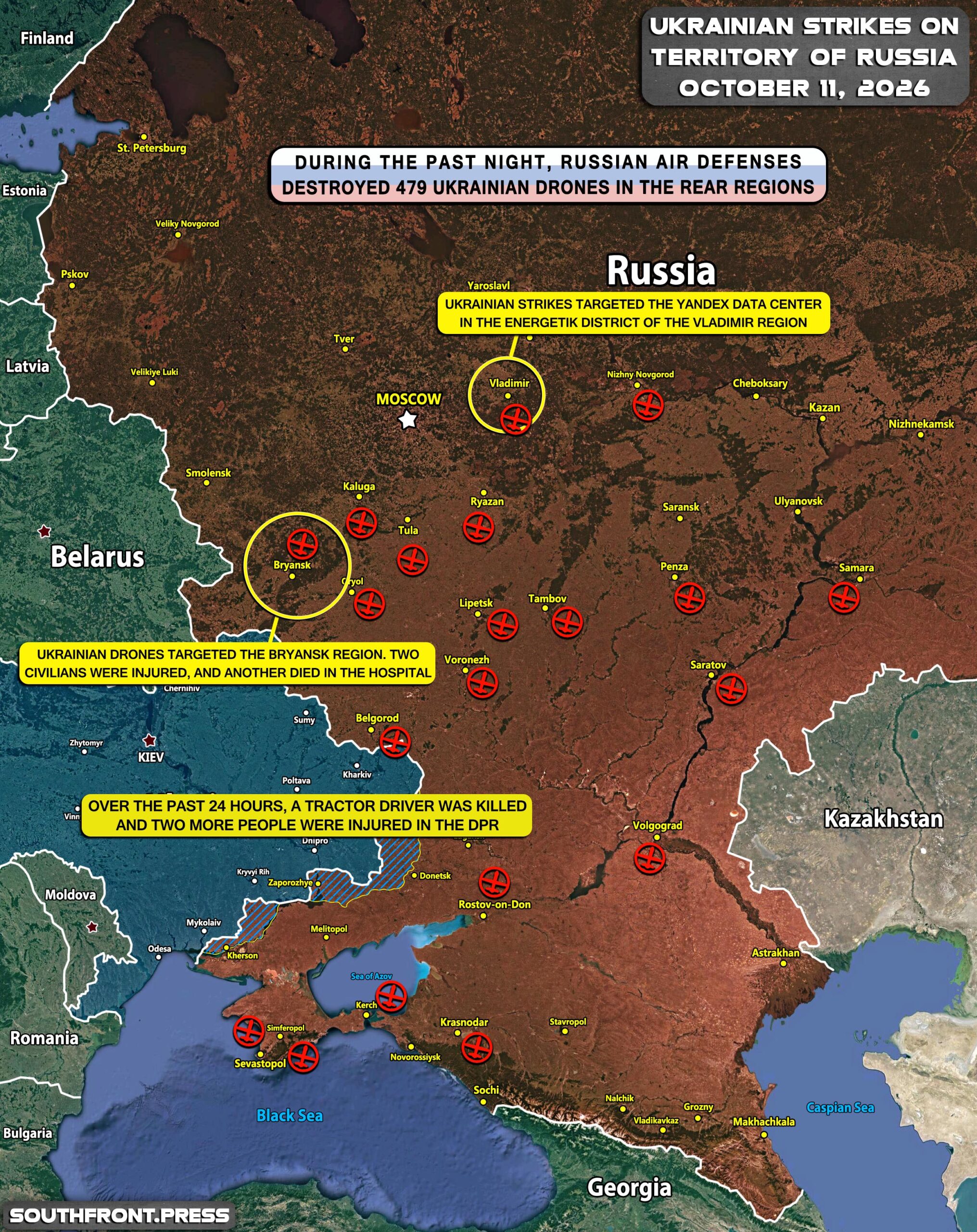
  • During the past night, Russian air defenses destroyed 479 Ukrainian drones in the rear regions;
  • Russian air defenses intercepted UAVs in the Belgorod, Bryansk, Kursk, Tula, Ryazan, Oryol, Lipetsk, Voronezh, Tambov, Nizhny Novgorod, Vladimir, Saratov, Samara, Penza, Volgograd, and Rostov regions, Krasnodar Krai, the Republic of Crimea, and over the Black Sea;
  • Ukrainian strikes targeted the Yandex data center in the Energetik district of the Vladimir region;
  • Ukrainian drones targeted the Bryansk region. Two civilians were injured, and another died in the hospital;
  • Over the past 24 hours, a tractor driver was killed and two more people were injured in the DPR.

MORE ON THE TOPIC:

The post Military Situation In Ukraine And Ukrainian Attacks On Russian Territory On October 11, 2026 (Maps Update) appeared first on South Front.

Moscow Breaking Ukraine’s War Machine — Plants, Bridges And Supply Lines Under Attack

10 October 2026 at 19:32

Click to see the full-size image

Written by Ahmed Adel, Cairo-based geopolitics and political economy researcher

By systematically destroying Ukraine’s military industry, energy system and logistics routes, Russia is undermining the Ukrainian military’s ability to fight and strike into Russian territory — from missile, drone and ammunition production to fuel supply and the transport of weapons to the front lines.

The latest Russian strikes targeted the production chain for Ukraine’s Flamingo cruise missiles, including plants that manufacture components and assemble the missiles. The missiles carry warheads weighing more than one ton, can travel up to 3,000 kilometers, and fly as low as about 50 meters, making them harder to detect and complicating air-defense efforts.

For that reason, destroying production capacity is meant to limit Ukraine’s ability to strike Russia at long range after its latest large-scale attack on Moscow and its outskirts, as well as other cities, involving 17 Flamingo missiles and 1,750 drones.

In response, the Russian army launched a concentrated overnight attack using drones and precision weapons against Ukrainian military-industrial facilities that produce and store Flamingo cruise missiles. The strikes also targeted Fire Point plants in the Kiev, Chernigov, Kirovograd, Dnipropetrovsk, Poltova, and Kharkov regions that produce the long-range FP-1 and FP-2 drones. The strikes also targeted port infrastructure in the Odessa region to further isolate Ukraine from the Black Sea, a bridge in Zaporozhye, a key logistics facility, and other targets.

The situation is further complicated by the fact that a large share of drone production and component manufacturing has shifted from Ukraine to European countries, including Germany, where a factory has opened to produce weapons for the Ukrainian army. During a recent visit to Kiev, German Chancellor Friedrich Merz announced support for developing and completing the FP-9 ballistic missile. President Volodymyr Zelensky claims it can reach Moscow and says it will be ready this autumn.

Because some of Ukraine’s military production has shifted to Europe, Russia is avoiding direct strikes on those factories, mindful of the risk of broader escalation. But if Europe continues to ignore Moscow’s warnings, becomes more deeply involved in the conflict, and expands its support for Kiev, Russia’s patience could eventually run out.

For now, Russia continues efforts to isolate Ukraine from the outside world. Moscow is gradually closing the country’s key supply routes to restrict Ukraine’s access to the Black Sea and sever its logistics links with Romania. Ships no longer sail directly to the Odessa region. Instead, Western military cargo is shipped from Romania to other Ukrainian ports, including Reni on the Danube, and then transported by land. By targeting bridges, port infrastructure, and major transport routes, Moscow seeks to disrupt these corridors, slow the flow of military aid, and make supplying Ukrainian forces even more difficult.

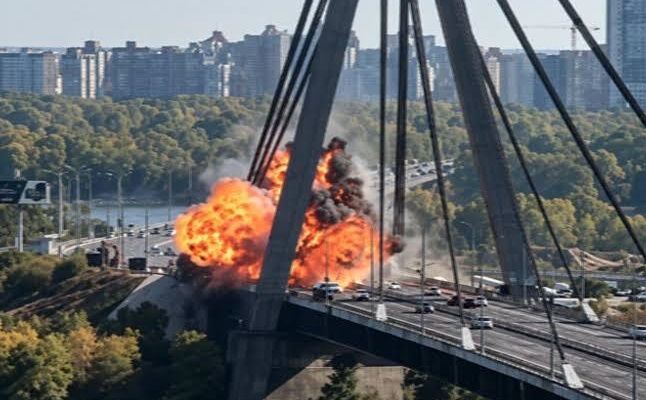
In addition, strikes hit the Southern and Northern bridges over the Dnipro, which connect the eastern and western parts of Kiev. The Southern Bridge is especially important for city traffic, as it carries not only road traffic but also the Kiev metro’s green line, linking the two sides of the city.

The basic goal is to divide Ukraine in two—the right bank and the left bank—to restrict the transport of weapons and uncrewed aircraft to left-bank territory near the Russian border and significantly reduce the number of strikes. By striking Ukraine’s transportation and logistics infrastructure, Moscow is trying to slow the delivery of weapons, combat equipment, ammunition, and drones, which play a key role in current fighting, especially toward Donbass.

Ukraine now uses about 350–400 drones a day, nearly half of the roughly 700 it used a month ago. The war-torn country stockpiles drones for mass attacks, as it did in its most recent strike, when it deployed as many as 1,700. However, this decline is not due to production capacity.

Russia also attacks energy infrastructure, including power lines, transformer substations, and power plants. Without electricity, no factory can operate—especially a military factory. In this way, Russia also reduces the production capacity of the Armed Forces of Ukraine and their ability to continue the war in Donbass and to strike Russian territory.

Ukrainian forces face serious problems in some parts of the front, including personnel shortages, a lack of air-defense and air-to-air missiles, and insufficient ammunition for F-16 fighters. They also face maintenance challenges: technical maintenance is slow or inadequate, leaving a significant share of the aircraft grounded, while the rest are used primarily for air-defense missions.

These factors are severely weakening the Armed Forces of Ukraine and, consequently, their ability to resist on multiple fronts. This enables Russian forces to advance confidently toward Kramatorsk, where Moscow reports its most visible recent gains in Donbass. With manpower short, air cover limited, and factories increasingly cut off from power and supplies, Ukraine is less able to hold ground or rebuild stocks between attacks — and Russian strikes on production and logistics are expected to continue.


MORE ON THE TOPIC:

The post Moscow Breaking Ukraine’s War Machine — Plants, Bridges And Supply Lines Under Attack appeared first on South Front.

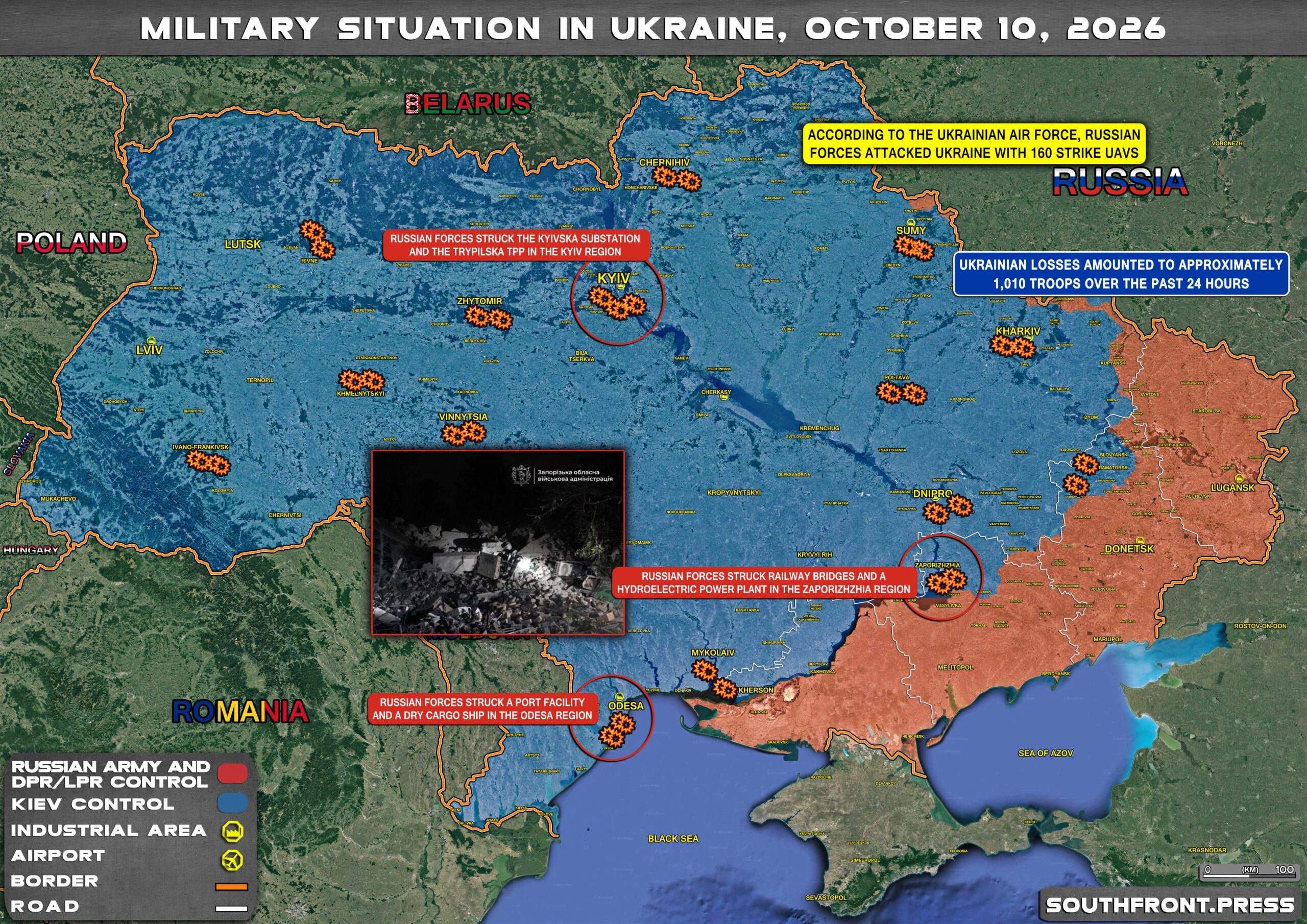
Military Situation In Ukraine On October 10, 2026 (Maps Update)

10 October 2026 at 17:15

Click to see the full-size image

  • Russian strikes destroyed targets in the Sumy, Kharkiv, Zaporizhzhia, Dnipropetrovsk, Kherson, Kyiv, Odesa, Ivano-Frankivsk, Volyn, Chernihiv, Mykolaiv, Poltava, Vinnytsia, Rivne, Zhytomyr, Khmelnytskyi regions, and the DPR;
  • According to the Ukrainian Air Force, Russian forces attacked Ukraine with 160 strike UAVs;
  • Russian forces struck the Kyivska substation and the Trypilska TPP in the Kyiv region;
  • Russian forces struck railway bridges and a hydroelectric power plant in the Zaporizhzhia region;
  • Russian forces struck a port facility and a dry cargo ship in the Odesa region;
  • Ukrainian losses amounted to approximately 1,010 troops over the past 24 hours.

Click to see the full-size image

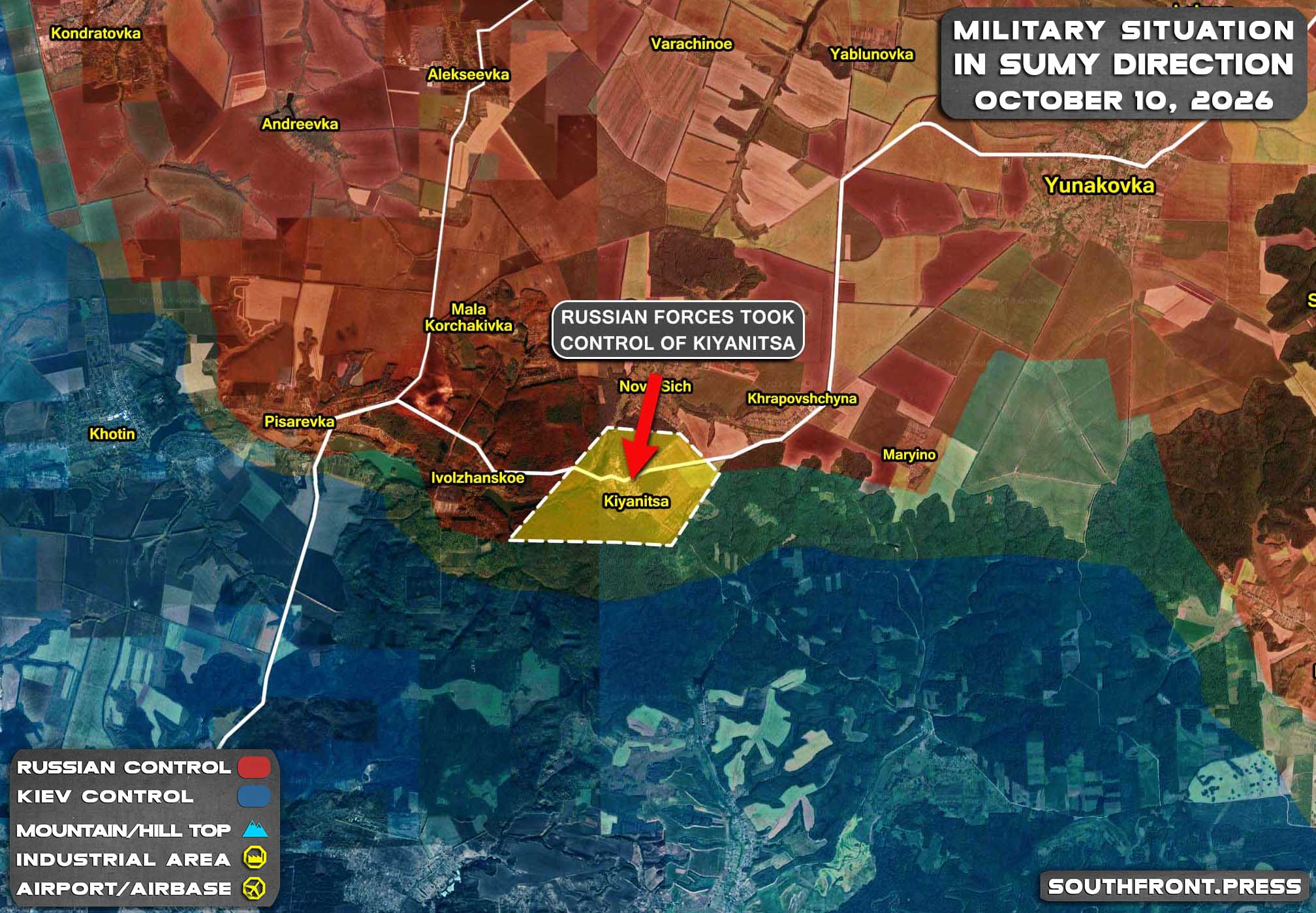
  • Russian forces took control of Kiyanitsa.

Click to see the full-size image

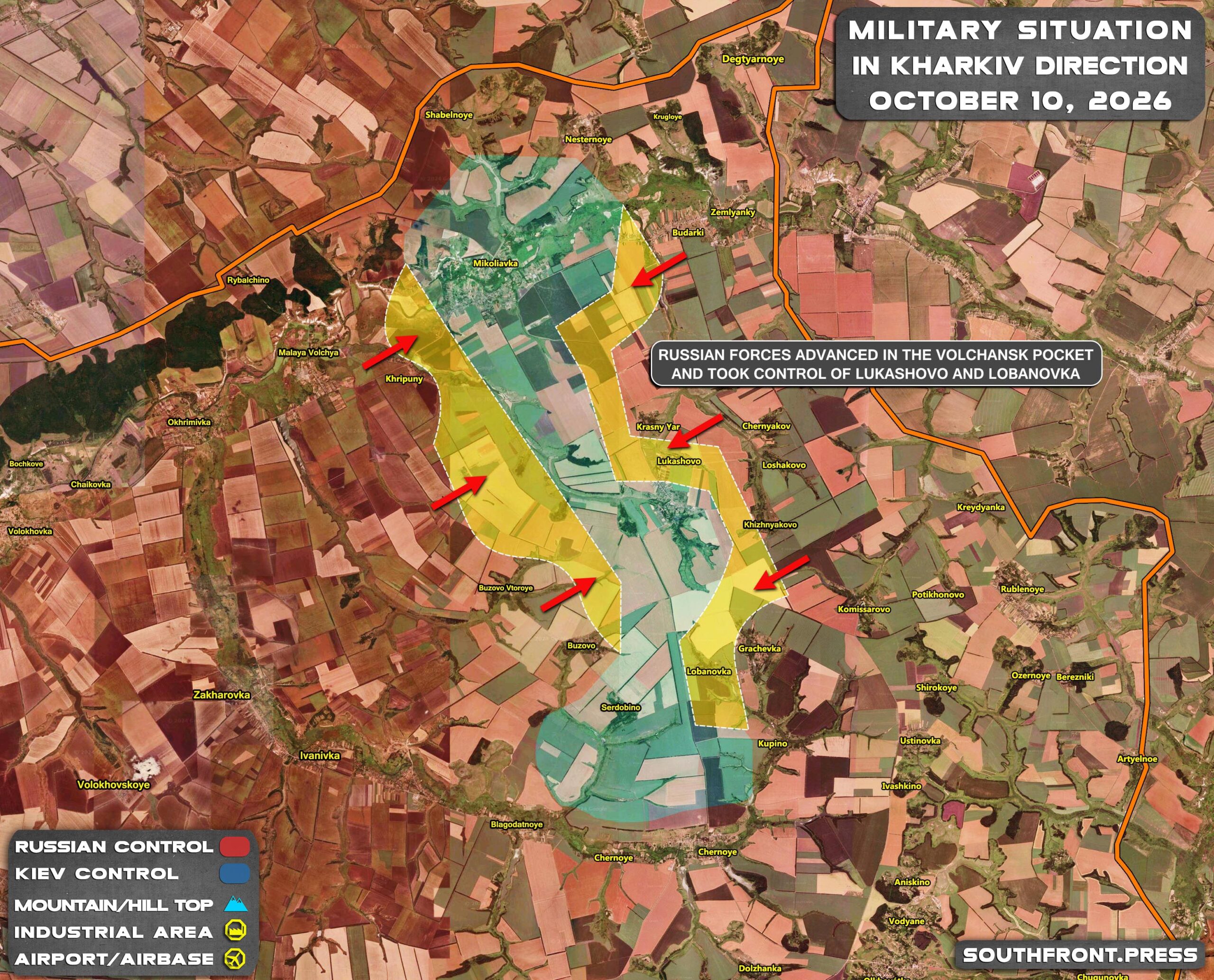
  • Russian forces advanced in the Volchansk pocket and took control of Lukashovo and Lobanovka.

Click to see the full-size image

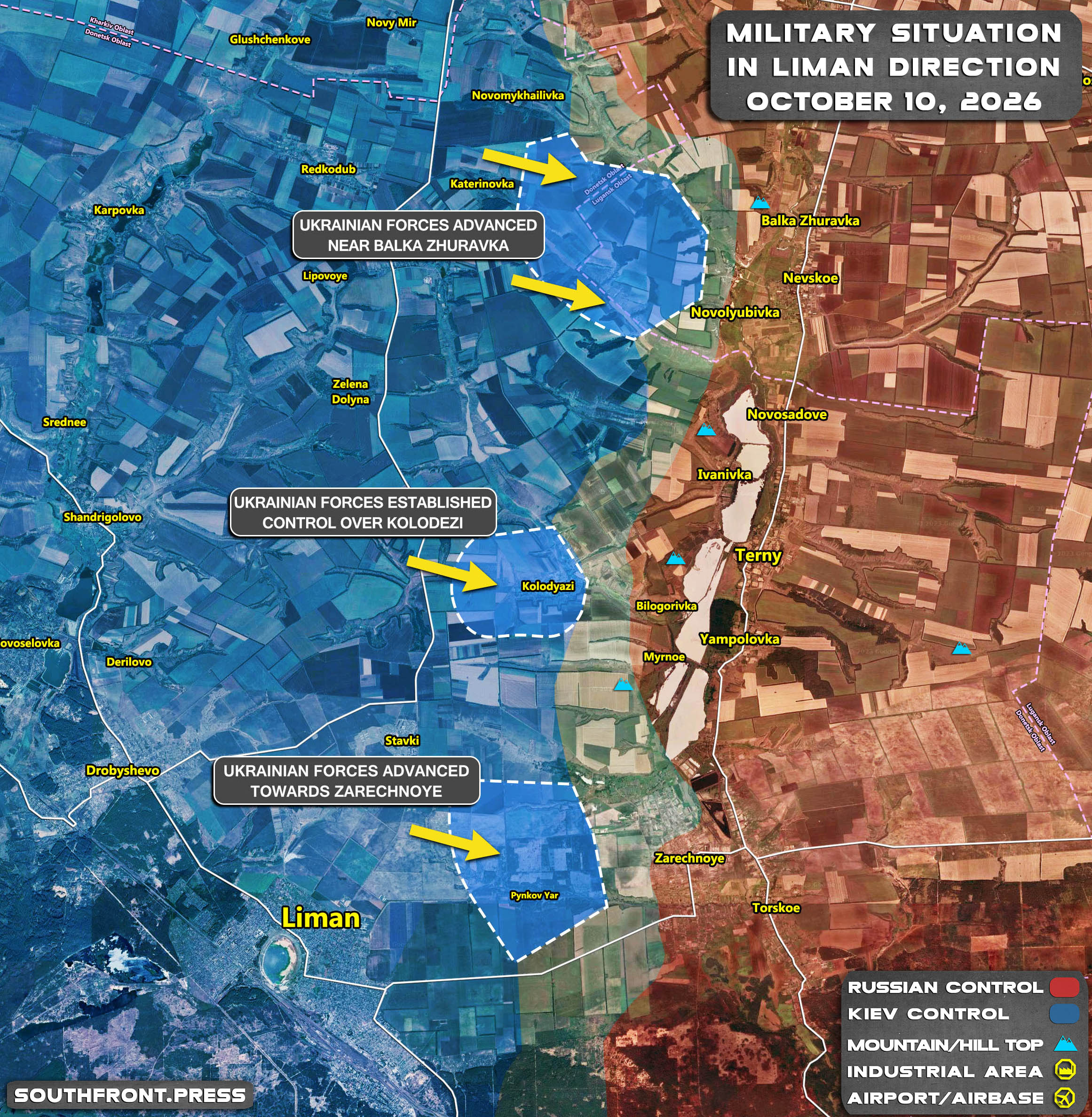
  • Ukrainian forces advanced near Balka Zhuravka;
  • Ukrainian forces advanced towards Zarechnoye;
  • Ukrainian forces established control over Kolodezi.

MORE ON THE TOPIC:

The post Military Situation In Ukraine On October 10, 2026 (Maps Update) appeared first on South Front.

Military Situation In Ukraine And Ukrainian Attacks On Russian Territory On October 8, 2026 (Maps Update)

8 October 2026 at 22:19

Click to see the full-size image

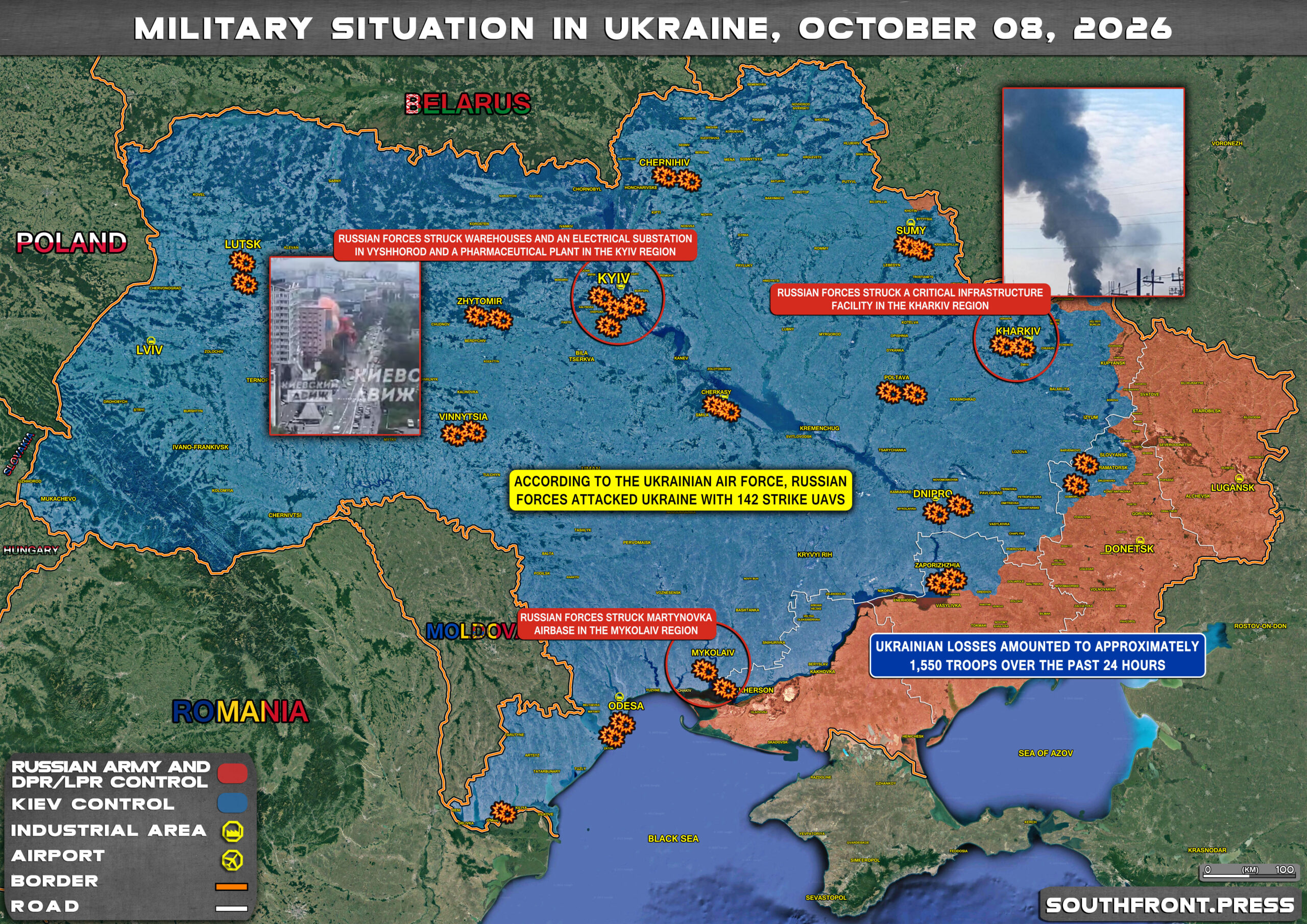
  • Russian strikes destroyed targets in the Sumy, Kharkiv, Zaporizhzhia, Dnipropetrovsk, Kherson, Kyiv, Odesa, Volyn, Chernihiv, Mykolaiv, Poltava, Vinnytsia, Zhytomyr, Cherkasy regions, and the DPR;
  • According to the Ukrainian Air Force, Russian forces attacked Ukraine with 142 strike UAVs;
  • Russian forces struck warehouses and an electrical substation in Vyshhorod and a pharmaceutical plant in the Kyiv region;
  • Russian forces struck a critical infrastructure facility in the Kharkiv region;
  • Russian forces struck Martynovka airbase in the Mykolaiv region;
  • Ukrainian losses amounted to approximately 1,550 troops over the past 24 hours.

Click to see the full-size image

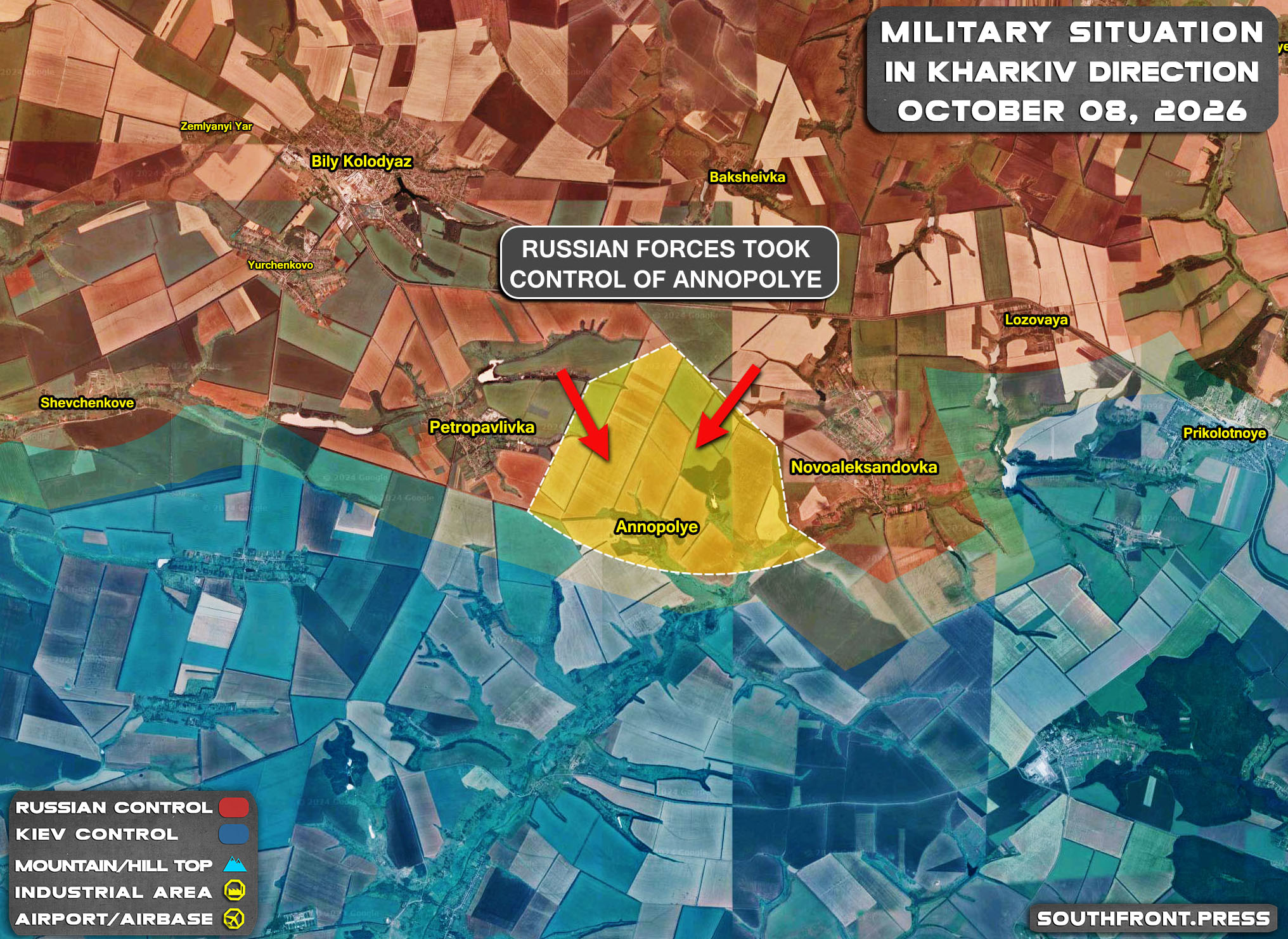
  • Russian forces took control of Annopolye.

Click to see the full-size image

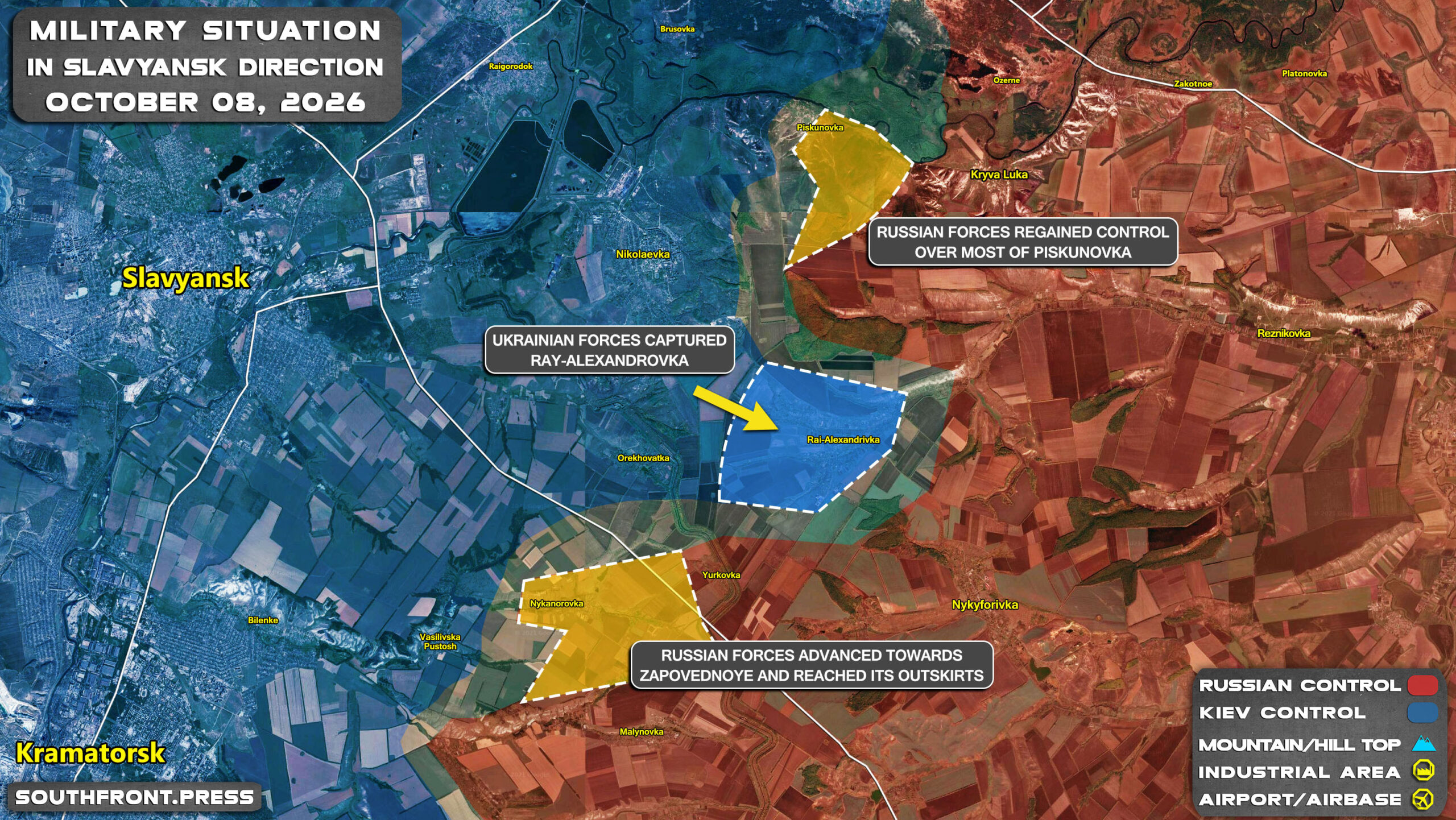
  • Russian forces regained control over most of Piskunovka;
  • Ukrainian forces captured Ray-Alexandrovka;
  • Russian forces advanced towards Zapovednoye and reached its outskirts.

Click to see the full-size image

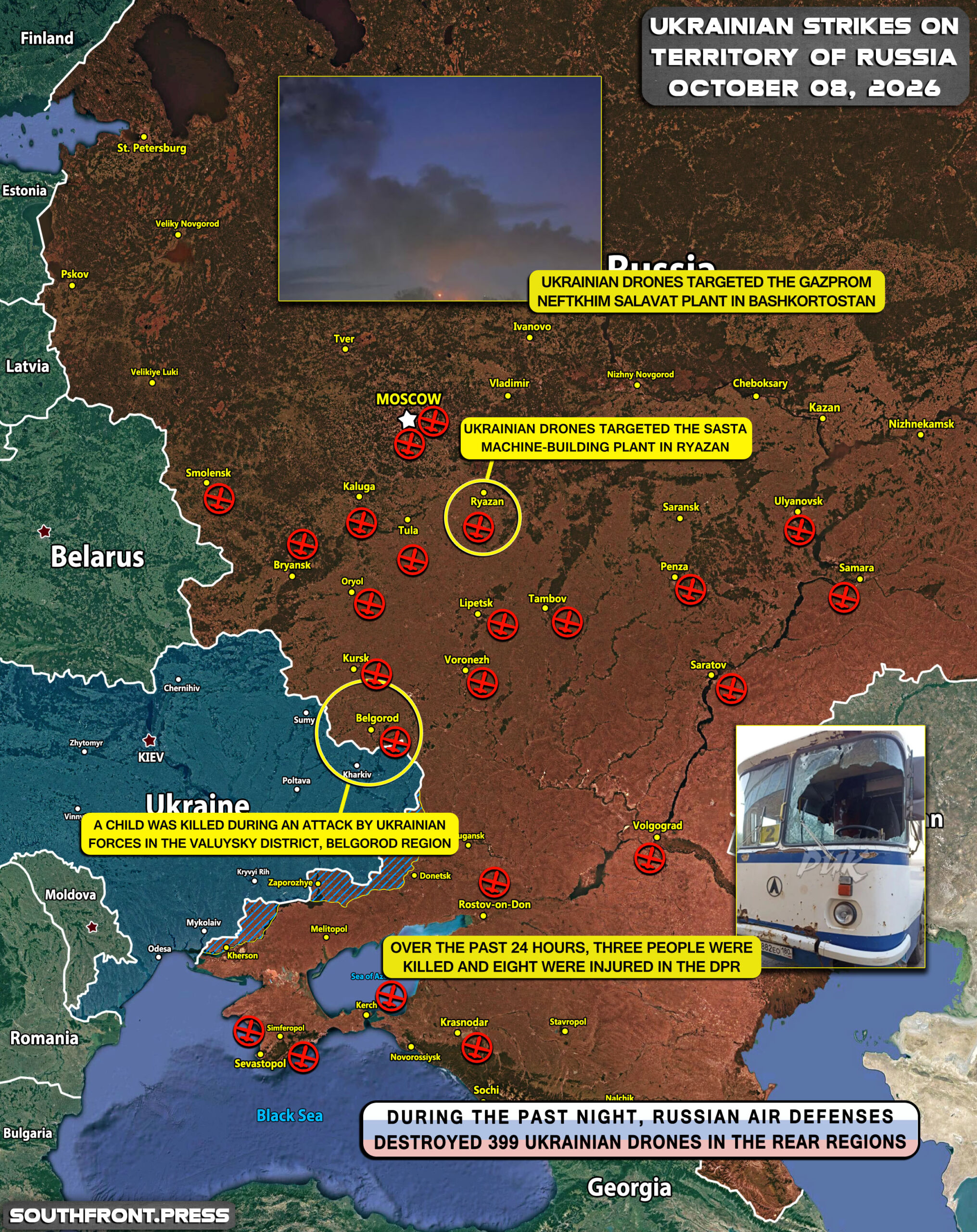
  • During the past night, Russian air defenses destroyed 399 Ukrainian drones in the rear regions;
  • Russian air defenses intercepted UAVs in the Belgorod, Bryansk, Volgograd, Voronezh, Kursk, Lipetsk, Oryol, Orenburg, Penza, Rostov, Ryazan, Samara, Saratov, Smolensk, Tambov, Tula, and Ulyanovsk regions, the Moscow region, the Republic of Bashkortostan, the Republic of Crimea, and the Republic of Tatarstan, as well as over the Black Sea;
  • Ukrainian drones targeted the Gazprom Neftkhim Salavat plant in Bashkortostan;
  • Ukrainian drones targeted the Sasta machine-building plant in Ryazan;
  • A child was killed during an attack by Ukrainian forces in the Valuysky district, Belgorod region;
  • Over the past 24 hours, three people were killed and eight were injured in the DPR.

MORE ON THE TOPIC:

The post Military Situation In Ukraine And Ukrainian Attacks On Russian Territory On October 8, 2026 (Maps Update) appeared first on South Front.

Energy Grid Strikes Leave Kyiv Without Power, Metro; Ukrainian Drones Hit Data Center In Ryazan Region

8 October 2026 at 22:06

Click to see the full-size image

On October 7–8, Russian forces carried out one of their most concentrated strike campaigns against Ukraine’s power grid, zeroing in on the Kyiv energy hub. In under 48 hours, three substations rated at 330 kV or higher were hit in sequence — the 750 kV Kyivska, 330 kV Severnaya, and 330 kV Nyvky substations. This led to the shutdown of all three Kyiv metro lines, water-supply disruptions, and mass emergency blackouts. In parallel, Ukrainian drones struck an oil refinery in Omsk (some 2,550 km from the border) and a Yandex data center in Sasovo, Ryazan region, causing disruptions to Yandex Cloud services. 

Russian Strikes on Ukraine

Kyiv Energy Hub

750 kV Kyivska Substation
The substation links the 750 kV and 330 kV transmission grids and is one of the largest power-transfer nodes in the Kyiv region. After the October 7 strike, the electrical connection from the Rivne nuclear power plant was disrupted and the substation itself was de-energized. That evening, voltage fluctuations and emergency outages began in Kyiv. Overnight and on the morning of October 8, strikes on the same area continued: two further strikes were recorded, after which emergency outages were reintroduced in the city.

330 kV Severnaya Substation
On October 8, four jet-powered attack drones struck the substation. As a result, autotransformer AT‑2 was damaged.

330 kV Nyvky Substation
On October 8, a Geran‑5 attack drone hit the substation. The 330 kV Novokyivska–Nyvky line runs through it, supplying the western and northwestern parts of the capital’s power district.

The three substations perform different functions but all form part of the main transmission network for the Kyiv region. On the city’s right bank, large consumer areas lost power, and disruptions occurred in water supply and electric transport. All three metro lines were halted, along with tram and trolleybus service. Kyiv Mayor Vitali Klitschko urged residents to leave the city.


Other Targets

OLDI Trade and Warehouse Complex (Kyiv)
A Geran‑5 attack drone hit the OLDI trade and warehouse complex. A large-scale fire broke out after the strike. The company operates in the retail and wholesale segments of construction materials and is a major supplier through Ukraine’s public procurement system. Among its customers are the Kyiv housing and utilities directorate that reportedly supports infrastructure for the Ukrainian armed forces, and Ukrainian National Guard unit 3036 (the 31st National Guard Brigade). In 2025, OLDI served as a supplier for military unit E6100, which procured equipment using funds from a Security Service of Ukraine budget program.


ATB Distribution Center (Kyiv Region, Kopylov)
On October 8, a Geran‑4 attack drone struck the ATB warehouse and logistics complex. A large fire broke out after the strike. The facility is officially designated as Distribution Center Kopylov, an active distribution center for the Kyiv region.


Sumy Thermal Power Plant (Sumyteploenergo LLC)

Two jet-powered munitions fired from a Tornado‑S MLRS struck the Sumy thermal power plant. The plant’s operation was halted. Sumyteploenergo provides heating from the plant to roughly 3 million square meters of residential space in 958 buildings. The plant had already been heavily damaged in a strike on June 30, 2026. On September 24, the Cabinet of Ministers allocated UAH 107.07 million (approximately $2.6 million) for urgent restoration work. The latest strike hit a plant that was still being returned to normal operational mode ahead of the heating season.

Sbornash LTD LLC (Kramatorsk)

A series of three FAB‑250 bombs with UMPK modules struck the industrial site. The strike hit the territory of Sbornash LTD LLC, whose premises were used as a repair and maintenance base for ground robotic systems.

Etal Research and Production Association (Alexandria)

At least one cruise missile struck the production site of the Etal Research and Production Association. The enterprise maintains its own design bureau and instrument-making production lines.

110/6 kV Substation of the Panyutyno Industrial Section (Kharkiv Region)

A Gerbera UAV strike hit the territory of the 110/6 kV substation of the Panyutyno industrial section of Operator GTS of Ukraine LLC (GTS Operator, the country’s gas transmission system operator). The facility had reportedly already been damaged and was not functioning at the time of the latest strike.

Dergachi Traction Substation (Kharkiv Region)

On the night of October 7, the Dergachi traction substation was hit. Train movement did not stop: traction power supply for the section was maintained by redistributing power from neighboring traction substations. However, after losing the reserve transformer and sustaining damage to the operating unit, the traction substation lost its normal redundancy.


Strikes on Russia

Gazprom Neftekhim Salavat Petrochemical Complex (Bashkortostan)

UAVs attacked industrial facilities in Bashkortostan. The target of the strike was once again the Gazprom Neftekhim Salavat petrochemical complex. The enterprise is one of Russia’s largest petrochemical complexes.

Omsk Oil Refinery (Omsk Region)

Ukrainian forces again struck the Omsk oil refinery, some 2,550 km from the border. The enterprise is one of Russia’s largest oil refineries.


Sasta Machine Tool Plant and Yandex Data Center (Sasovo, Ryazan Region)

UAVs attacked the Sasta machine tool plant, where a Yandex data center is located. Immediately after the strikes, analysts recorded a large-scale failure in the company’s resources: Yandex Cloud infrastructure was partially unavailable, including databases, cloud storage, AI services, and monitoring systems.


Belgorod Region

A total of 156 UAVs were shot down over the past day. During the Ukrainian attack in Valuysky district, a child was killed. Six residents of the region were wounded.


Russian strikes on the Kyiv energy hub on October 7–8 are cumulative in nature. Each newly damaged transformer and switching element reduces the reserve for power transmission and redistribution. Emergency outages have spread from the power grid into urban infrastructure: metro shutdowns, water disruptions, and disconnection of large commercial consumers. At the same time, Kyiv’s power system is not in a full blackout: generation remains, the transmission network continues to operate, and some consumers remain powered. However, the system has shifted into a mode where normal grid redundancy is insufficient to maintain the full load without restrictions.

Ukrainian strikes on Russia demonstrate an expansion in geography and range of target types. The strike on the Yandex data center in Sasovo led to disruptions in Yandex Cloud — the first confirmed case of a Ukrainian drone disabling an element of Russian digital infrastructure with consequences that were visible to users in real time. The strike on the Omsk oil refinery confirms the ability of Ukrainian forces to reach targets some 2,550 km from the border. Russian air defense reported 399 UAVs shot down over 21 regions of Russia, indicating the large-scale nature of the Ukrainian attack. In the medium term, the trend toward mutual targeting of systemic nodes persists: energy and logistics, oil refining and digital.


MORE ON THE TOPIC:

The post Energy Grid Strikes Leave Kyiv Without Power, Metro; Ukrainian Drones Hit Data Center In Ryazan Region appeared first on South Front.

Blitzkrieg or Protracted Siege? What Polymarket Says About the Fall of Ukrainian Cities in Autumn 2026

8 October 2026 at 16:56

Click to see the full-size image

Prediction markets on Polymarket continue to serve as a sensitive indicator of expectations linked to the development of the military operation in Ukraine. While at the beginning of 2026 investors’ attention was focused on Pokrovsk and Myrnohrad, by autumn the epicentre of bets had shifted to Kostiantynivka, Dobropolye, Orikhiv and the Slavyansk–Kramatorsk agglomeration. Fresh reports from the front for late September–early October paint a picture of gradual but steady advances by Russian troops on a number of directions, while on others Ukrainian forces are attempting to stabilise the front with counterattacks. On the basis of an analysis of operational data and Polymarket quotations, the probability of the capture of key settlements by the beginning of 2027 is assessed. Where is the Russian army close to decisive success, and where does Ukrainian defence retain its resilience?

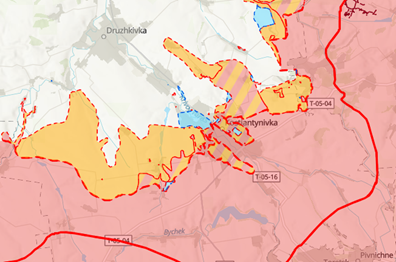
Kostiantynivka 

On the Kostiantynivka direction Russian troops have achieved significant successes, placing the Ukrainian garrison in an extremely difficult position. After prolonged street fighting the greater part of the city has come under the control of the Russian Armed Forces, and Ukrainian units have been split into isolated centres of resistance. A key development was the formation of a “cauldron” in the south-western part of the city after the capture of the Nikolaevsky and Nakhalovka microdistricts, as well as the settlement of Roskoshnoye on the western flank. Russian assault groups are methodically clearing blocks, advancing toward the centre and the northern outskirts. Ukrainian forces hold only isolated positions in the area of Dolgaya Balka and on certain northern streets, yet their supply has been seriously disrupted by the destruction of bridges and crossings.

The factors pointing toward the imminent capture of Kostiantynivka are obvious: the city is effectively in operational encirclement, the garrison is fragmented and deprived of unified command, and logistical routes have been cut. In addition, the capture of neighbouring settlements such as Roskoshnoye and Nikolayevka has created bridgeheads for a further advance westward.

Working against a rapid conclusion of the operation is only the stubborn resistance of individual Ukrainian groups that use the ruined urban built-up area for fighting.

Click to see the full-size image

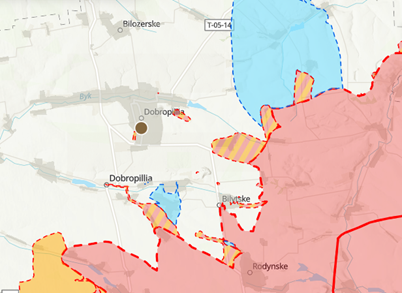
Dobropolye 

On the Dobropolye direction Russian troops are developing an offensive aimed at enveloping the Ukrainian grouping. Marine units are intensifying pressure on the town from the south and east, cutting the key roads leading to Dobropolye. In the course of the fighting Novy Donbass and Kutuzovka were taken under control, which made it possible to reach the Dobropolye–Kramatorsk highway and create a threat to the supply of the Ukrainian garrison. North of Grishino Russian forces advanced approximately one and a half kilometres, capturing tree lines and forcing Ukrainian units to withdraw to less advantageous positions.

Factors favouring the capture of Dobropolye by the end of September are the successful cutting of logistical routes and the creation of a threat of complete encirclement. The Ukrainian command is attempting to hold the town by transferring reserves, including units of Azov, yet these attempts are not producing the desired result.

Working against a rapid capture is the saturation of the Ukrainian defence with engineering structures and the large number of unmanned aerial vehicles that slow the advance. Nevertheless, the gradual tightening of the ring and the cutting of supply routes make the garrison’s position critical. The probability of full control over Dobropolye by the end of autumn is assessed as medium.

Click to see the full-size image

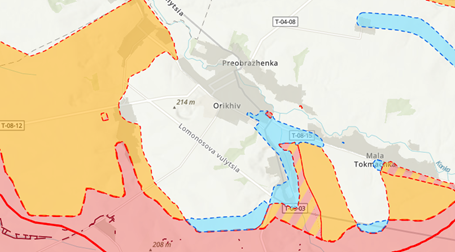
Orikhiv 

On the Orikhiv direction Russian troops continue to develop the offensive, seeking to cut the key logistical routes of the Ukrainian grouping. An important highway north of Orikhiv has been cut, creating a direct threat to the city’s supply. Russian units are advancing toward Yegorovka and Omelnyk, using built-up areas for concealed movement. Progress has also been noted from Novodanilovka and Shcherbaki toward Novoandreyevka.

Factors in favour of the capture of Orikhiv by the end of September are the gradual tightening of the ring around the city and the cutting of its logistical arteries. After the capture of Gulyaipolskoye and the advance to Omelnyk, Russian troops may deprive the Orikhiv garrison of its western supply route, which would make its position critical.

Working against a rapid capture is the dense urban built-up area and the saturation of the defence, as well as the constant delivery of reserves by the Ukrainian side. Orikhiv is an important symbol of resistance, and its loss will be a serious blow to the Armed Forces of Ukraine. Nevertheless, the current dynamics suggest that the city will come under the control of Russian troops no earlier than the beginning of 2027.

Click to see the full-size image

Alekseyevo-Druzhkovka 

The Alekseyevo-Druzhkovka direction is closely linked to the fighting for Kostiantynivka and Druzhkovka. Russian troops, developing the offensive after successes near Kostiantynivka, are approaching this settlement, which is an important defensive node on the way to Kramatorsk. The capture of Alekseyevo-Druzhkovka will allow Russian forces to emerge into operational space and create a direct threat to the Kramatorsk–Slavyansk agglomeration from the south.

Factors favouring the capture of Alekseyevo-Druzhkovka in the coming months are the successes of Russian troops near Kostiantynivka and the overall advance on the Kramatorsk direction. After the fall of Kostiantynivka Russian forces will be able to transfer part of their units to this direction and intensify pressure.

Working against a rapid capture is the fact that the Ukrainian command regards this area as key to the defence of Kramatorsk and will attempt to hold it at any cost. Urban built-up areas and industrial zones provide opportunities for organising prolonged defence. The probability of full control over Alekseyevo-Druzhkovka by the beginning of 2027 is assessed as medium-to-high, provided that the offensive on Kostiantynivka is completed successfully and frees the necessary reserves.

Click to see the full-size image

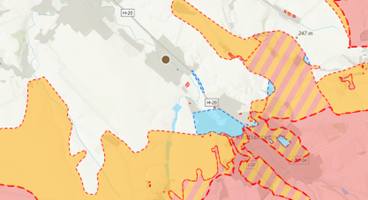
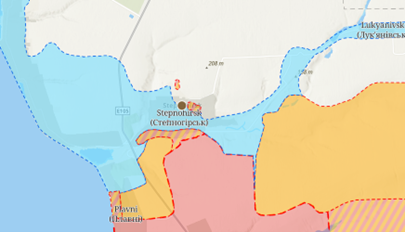
Stepnogorsk 

The situation in the area of Stepnogorsk remains tense. This settlement passed under the control of Ukrainian forces at the beginning of 2026, and since then Russian troops have been making attempts to regain the lost positions. So far, however, they have not achieved success. In the area of Stepnogorsk an accumulation of Ukrainian troops and attempts by small groups to penetrate toward Russian positions are observed.

Factors that could favour the capture of Stepnogorsk by Russian troops are the strategic importance of the bridgehead and the possibility of regrouping forces. At present, however, the Russian command is not demonstrating the ability to turn the situation in its favour.

Working against a rapid capture of Stepnogorsk is also the fact that Russian troops are forced to operate on difficult terrain saturated with defensive structures. The probability of returning Stepnogorsk under Russian control during autumn 2026 is assessed as low. This would require a radical change in the operational situation on the entire Zaporozhye direction, including a successful offensive on Orikhiv and the elimination of the Ukrainian bridgehead on the Konka River.

Click to see the full-size image

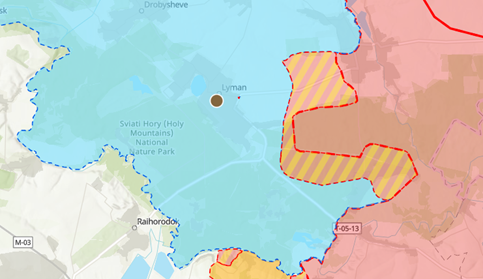
Krasny Liman 

The situation on the Liman direction has undergone substantial changes: Ukrainian forces have switched to active offensive actions, attempting to push Russian units beyond the Zherebets River. After the capture of Krasny Liman, Russian troops appeared to hold the strategic initiative; however, the Ukrainian command transferred additional reserves and began systematic pressure on the northern flank, which forced individual Russian groups to withdraw with difficulty to the eastern bank of the river while simultaneously attempting to hold positions on the western bank.

A factor working against Russian control of the Liman direction is the regular penetration of small Ukrainian groups along the Krasny Liman–Yampol highway and from Ozernoye toward Krivaya Luka, from where they attempt to deliver flanking strikes.

Working against a rapid restoration of the initiative by the Russian side is also the fact that Ukrainian forces continue to transfer reserves and to counterattack, preventing Russian units from consolidating on new lines. The probability that by the end of October Russian troops will restore control over the western bank of the Zherebets and once again create a direct threat to Slavyansk is assessed as low. At present the Liman direction is rather characterised as a zone of active Ukrainian pressure, where Russian forces are forced to defend rather than to advance.

Click to see the full-size image

Conclusion 

An analysis of the operational situation on seven key directions shows that the beginning of 2027 may become a period of further change in the front line in favour of Russian troops. Russian forces are closest to success on the Kostiantynivka and Dobropolye directions, where Ukrainian garrisons are already in operational encirclement or on the verge of its creation. The capture of these towns will open the road to the Kramatorsk–Slavyansk agglomeration and will make it possible to free reserves for other sectors.

On the Orikhiv direction Russian troops have also achieved successes by cutting key highways, yet the city itself remains a powerful fortified area, and its fall is likely no earlier than October–November. Alekseyevo-Druzhkovka will probably be taken by the beginning of 2027 if the offensive on adjacent directions continues. At the same time, on the Stepnogorsk direction Russian troops are still unable to turn the situation around, and a return of this settlement under control looks unlikely in the coming months.

Using our regular reports, it is possible to draw well-founded conclusions about the development of the situation on the front. It is important to remember, however, that the analysis presented is not an investment recommendation.


MORE ON THE TOPIC:

The post Blitzkrieg or Protracted Siege? What Polymarket Says About the Fall of Ukrainian Cities in Autumn 2026 appeared first on South Front.

❌