Questioning the prevailing narrative about the "Cornell seven" case is bound to create controversy. And at Columbia University, two student journalists drew condemnation for their views on the case from the unlikeliest of places: a college free speech group.
On October 13, Barnard junior Christina Ma and Columbia junior Nikos Mohammadi published an article called "The 'Cornell Seven' Is Really About Liberalism" in the Columbia Sundial, an independent student publication. The piece argued that the discourse surrounding the alleged rape at Cornell University infantilizes women by omitting the possibility that in a post–sexual revolution, liberal society, women may make regrettable but consensual choices.
"In the world that, for better or worse, follows from it, we cannot claim to stand for sexual freedom and then recoil in disgust when there's a possibility that a young woman simply chose to exercise it," Mohammadi and Ma wrote.
The piece also argues that the "collective frenzy" over the Cornell case has created a climate on campus that makes it "difficult to disagree with the maximalist position on what happened" the night of the alleged rape.
As Mohammadi wrote in UnHerd, the piece caused immense backlash. He said he received an onslaught of messages urging him to commit suicide and demanding that his "career and life be destroyed." But the criticism went beyond threatening DMs and comments.
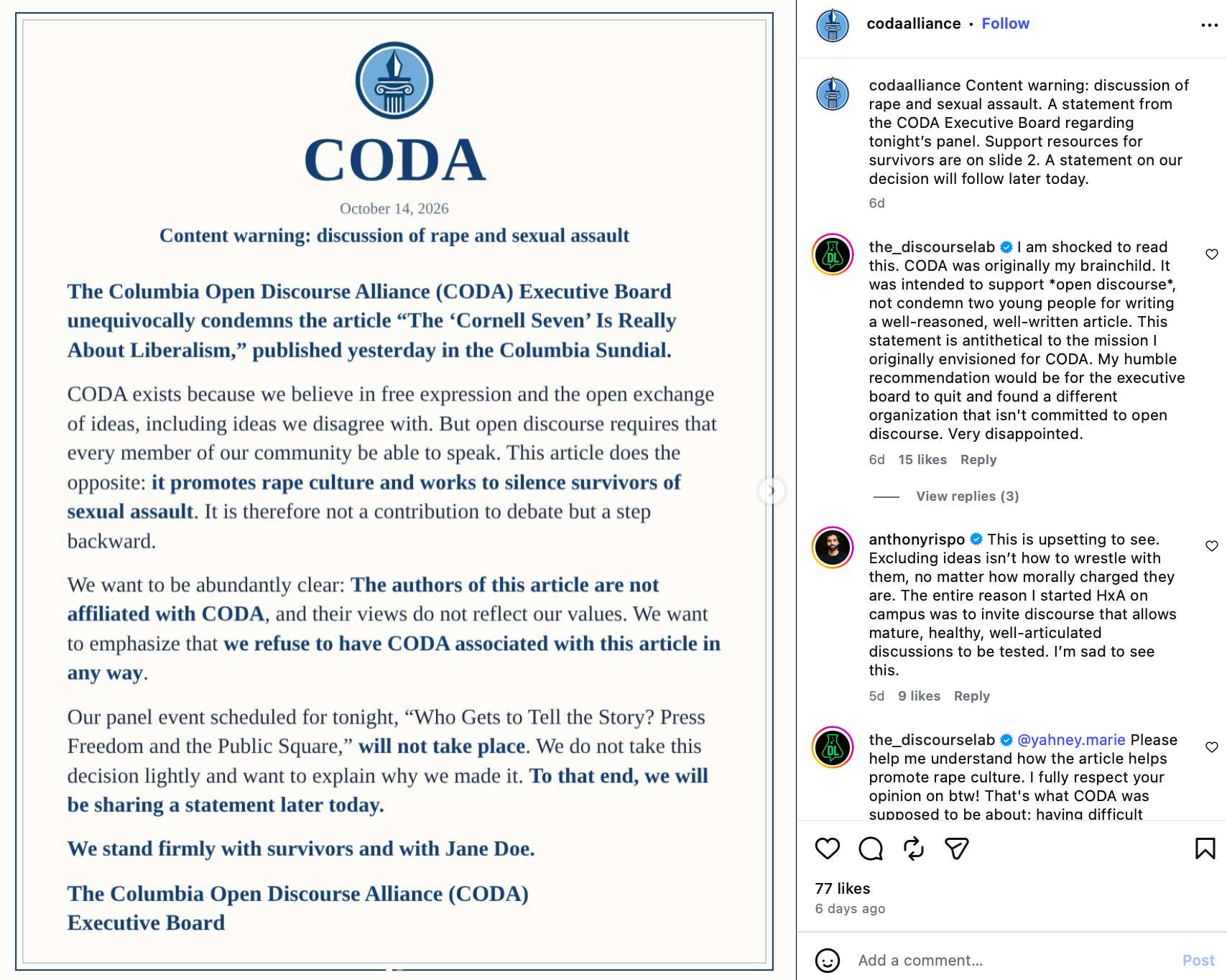
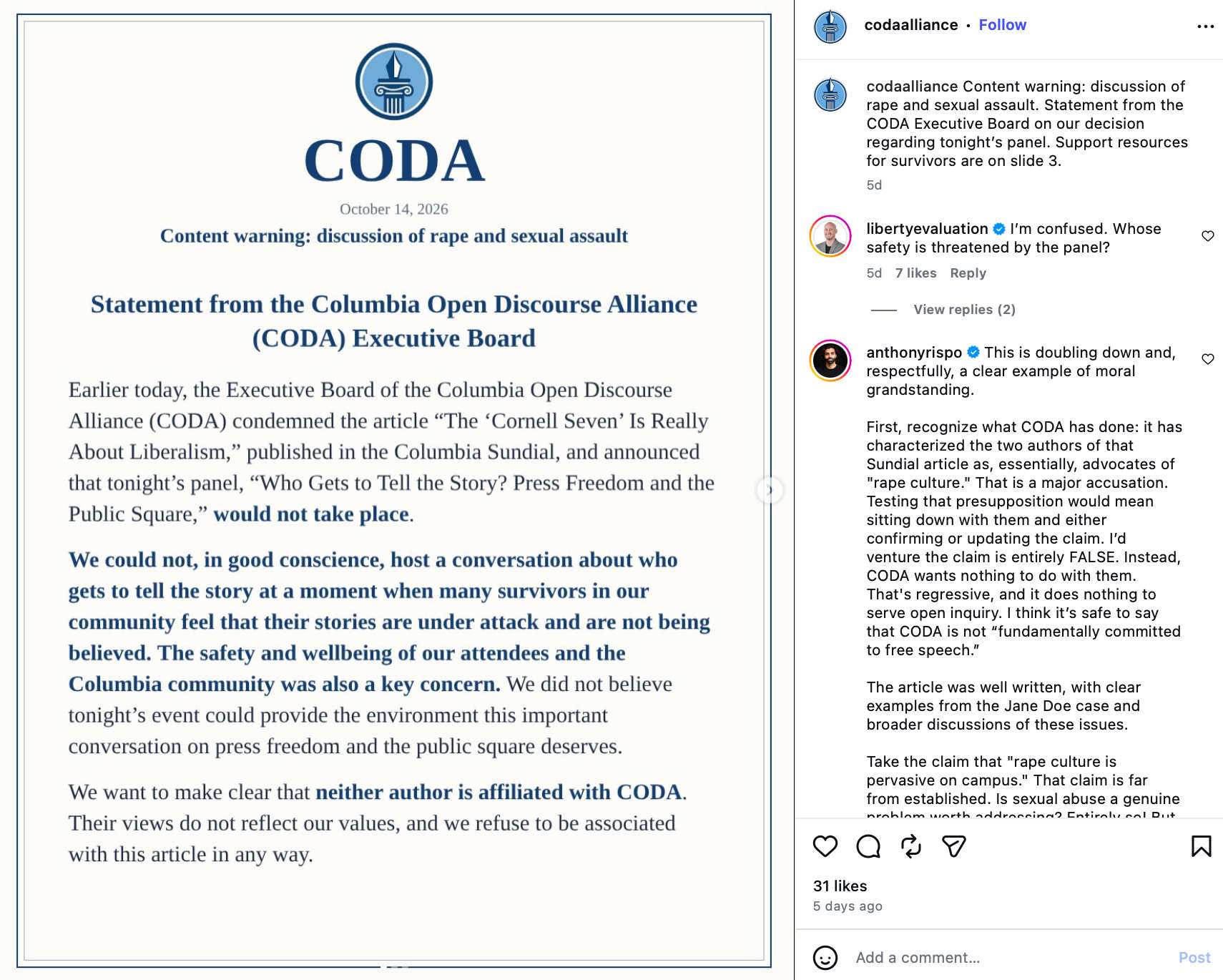
The day after the article's publication, the Columbia Open Discourse Alliance (CODA) canceled an event about press freedom because the Sundial's editor in chief, Nick Baum, had been slated to speak at the event. Although Baum did not author the piece, CODA wrote in an Instagram post that the free speech group "refused" to be affiliated with the Sundial's article "in any way."
CODA also claimed that the event, ironically called "Who Gets to Tell the Story? Press Freedom and the Public Square," could not take place at a time when "many survivors in our community feel that their stories are under attack and are not being believed."
The group added that the Sundial's article "promotes rape culture and works to silence survivors of sexual assault."
The group's president, Aum Desai, told Columbia's student newspaper, the Columbia Daily Spectator, that the group canceled the event "not in spite of, but because of [CODA's] commitment to free expression."
Columbia graduate Clayton Smith, who founded CODA in 2025, quickly commented that he was "shocked" by CODA's statements on Instagram. Smith started the organization to create a central hub for groups hosting events promoting free speech and open discourse, including the Sundial and Columbia's Heterodox Academy chapter.
He tells Reason that CODA's rationale for canceling the event was "ironic" and "hypocritical," and he believes the group should have collaborated with the Sundial if there were legitimate safety concerns at the event. He says he was particularly disturbed by the group's condemnation of the article and CODA's claim that it promotes "rape culture."
"They don't argue or explain how it works to silence survivors of sexual assault. It is a baseless slander that they use to condemn the article because it promoted an opinion they do not like," Smith says.
Smith says he spoke to Desai on the phone after CODA posted the statements, and Desai tried to reassure him that CODA would uphold the principle of free speech. But Smith says he did not leave the phone call feeling "very confident at all" in Desai's commitment.
Desai did not respond to Reason's requests for comment.
CODA faculty adviser and Columbia Business School professor emeritus Eli Noam was traveling in China during the fallout from the Sundial article and was not involved in CODA's decision.
After speaking with members of both CODA and the Sundial, Noam tells Reason that he thinks CODA "made some proper decisions, some correct decisions, and some mistakes."
"I think we're dealing here with…a group of college students who kind of were confronted with a crisis at 2 a.m.," Noam says. "And kind of [made] some judgments that they now regret, and they do."
He tells Reason that it was not "unreasonable to assume there would be a disruption" at the event, given the climate at Columbia and "about this rape allegation." He says the group suddenly "had an event where they needed college security" and could not organize in time. CODA, Noam says, is not yet recognized by the university, and he thinks the group was likely fearful of jeopardizing its recognition.
Still, Noam says CODA's statements condemning the article were "unreasonable," and it was "disappointing that they kind of lost their nerve here."
Although he was not involved in planning the panel, Mohammadi says, to his knowledge, there were no credible threats of violence to the panel. He understood there may have been "disgruntled students" and an "environment CODA did not want to deal with." But instead of simply canceling the event or working with the Sundial to find a solution, Mohammadi says CODA overstepped by condemning the Sundial piece.
James Applegate, an astronomy professor who serves on Columbia's Academic Freedom Council (CAFC) alongside Noam, tells Reason that he disagreed with CODA's decision to cancel the event.
Applegate tells Reason he was considering attending the event, and he was "rather surprised and disappointed" when it was canceled.
He recalled that when he was a professor in 2000, he objected to changes to the school's sexual misconduct policy on the University Senate floor. He says his statements were "similar to what was said in the Sundial article" and there was a "level of emotion in this debate."
"Nonetheless, we had the debate. I was in it, and the degree to which it was civil is shocking when you look at where we are now. And it's sad."
Applegate said he does not condemn CODA, however, "for the simple reason that the atmosphere on college campuses and on the left wing of politics in general in the United States is quite vicious."
CODA's honorary faculty fellow John McWhorter tells Reason he interpreted CODA's statement as "saying that an event about who gets to tell the story is untenable when or if a critical mass of people with such stories don't even feel comfortable telling them— i.e.being a participant in the event." He added, "I imagine some might think of that as cutting the salami a little thin, but then I highly suspect that Desai is equally worried about the event becoming a physical melee of some kind. In that, let's face it, he is hardly unreasonable."
Still, McWhorter said that he would have chosen to have the event himself, "especially as in the likely case that some people did talk about their experiences without any particular repercussions, it may have made the more reluctant people less apprehensive about doing so in the future."
According to Mohammadi, as of Tuesday, the Sundial, College Republicans, Platypus Affiliated Society at Columbia (which discusses leftist thought and history), and Columbia's Heterodox Academy chapter have left CODA.
CODA was not the only group to condemn the Sundial's piece. On October 14, the Columbia Political Review's editorial board wrote that Mohammadi and Ma's piece "violates standards of integrity" and "perpetuates a culture of campus violence, rape, and assault." The editorial board of the Columbia Political Review, which purports to publish "multipartisan political discourse," stated that it would refuse to publish "any article that upholds or recreates cultures and systems of rape, sexual assault, or violence" and it urged "all campus publications to do the same."
And on Monday, Columbia's main newspaper, the Spectator, published a staff editorial accusing the Sundial of violating journalistic ethics by "its page to disparage survivors of sexual violence."
Mohammadi tells Reason the piece underwent "far more editorial scrutiny than any other piece" the Sundial had published given the sensitive nature of the topic.
Free speech student organizations are necessary on Columbia's campus, especially as the school's free speech climate continues to crumble; it recently received a failing grade from the Foundation for Individual Rights and Expression. And while upholding free speech principles may have become more fashionable among those resisting the Trump administration's pressures on academic freedom or those defending pro-Palestinian speech, it is clear that some topics remain taboo in the public square. College is supposed to be a place where students debate controversial topics, form their own beliefs and opinions, and learn from mistakes. Hopefully, the students who demanded condemnation instead of debate will be forgiven for their perversion of free speech ideals, and they will learn to afford such grace and open-mindedness to classmates with whom they disagree.
Meta is finally being forced to pay for its near-decade-old falsehoods about the Cambridge Analytica scandal that saw millions of users’ data harvested for political purposes.
On Wednesday, a judge in New Mexico ordered the social media company to pay a $25 billion penalty following a jury’s determination in late September that the company’s executives broke state laws with knowingly false statements they made in the wake of the scandal.
“The extraordinary number of willful violations found by the jury, the duration and repetition of the conduct, the breadth of subjects on which violations occurred, the involvement of senior Facebook leadership, the size of New Mexico audiences reached, and the clear intentional and systematic nature of Facebook’s repeated misstatements established in the trial record support the highest level of penalty allowed by the New Mexico Unfair Practices Act,” New Mexico State District Court Judge Francis Mathew wrote in a court filing.
To refresh your memory, the scandal involved Cambridge Analytica — a political firm financed in part by pro-Trump benefactors — harvesting private data from tens of millions of Facebook users, which was eventually conveyed to members of Donald Trump’s 2016 presidential campaign and used for political targeting. To be clear, this case was an entirely separate trial from the other landmark trial Meta lost in New Mexico, which found the company liable for placing profits over consumers and knowingly putting children at risk of harms it knew to exist on its platforms.
As Tech Policy Press reported, the false statements deemed willfully deceptive by the jury include comments from CEO Mark Zuckerberg, former Chief Operating Officer Sheryl Sandberg and other executives about things like the company’s response to the Cambridge Analytica scandal, users’ data protections, and misinformation and hate speech on its platforms.
For example, the statements include comments from both Zuckerberg and Sandberg about when access to users’ private data was closed off. They also include a comment from Zuckerberg in 2017 saying that Meta — then known as Facebook — had “always taken down any post that promotes or celebrates hate crimes or acts of terrorism.” Another comment deemed willfully deceptive came from Zuckerberg in 2020, when he claimed there were no exceptions for politicians who broke the platforms’ rules about content that “may lead to violence or deprive people of their right to vote.” The jury also found willfully deceptive a 2020 comment from former Meta executive Nick Clegg, who claimed that Meta “doesn’t profit from hate” and that the company applied a “zero tolerance approach” to hateful posts on Facebook and Instagram.
As the Santa Fe New Mexican reported: “‘Meta’s platforms are forums for free expression. We have a First Amendment right to manage those platforms in a way we believe best serves the interests of our community,’ the spokesperson wrote in an email. ‘This means prioritizing free speech, protecting our users’ information and giving them control over their data.’”
After living with a multiple sclerosis diagnosis for five years, Emmy Award-winning actress Christina Applegate, who co-hosts the “MeSsy” podcast with actress Jamie Lynn Sigler, has now been told she doesn’t have it. On“MeSsy,” Applegate and Sigler, who was also diagnosed with MS, allow themselves to be “vulnerable about the curveballs that life can throw,” and what bigger curveball is there than the news that the symptoms you’ve been experiencing no longer have an explanation?
Applegate said her physician congratulated her for not having MS. But, as she said on the podcast, “I’m back at square one where I don’t know what’s going on with me.” Now, she said, doctors have to figure out “what has been going on since 2021, why did this happen?”
I was formally diagnosed with relapse-remitting multiple sclerosis in 2014 after a grueling path to a diagnosis. I can only imagine how demoralizing it is for Applegate to be back to “square one.”
MS is an autoimmune disorder where the body attacks its own central nervous system and can lead to significant disabilities. I was formally diagnosed with relapse-remitting MS in 2014 after a grueling path to a diagnosis. I can only imagine how demoralizing it is for Applegate to be back to “square one.” An estimated 20% of people diagnosed with MS do not, in fact, have it. Even more alarming is that many improperly diagnosed MS patients may have received incorrect treatment for decades.
I was initially diagnosed with something not as severe as MS. I was prescribed hormone replacement therapy medication to address a then-unknown ailment, which landed me in an emergency room with heart palpitations. My primary symptoms— a debilitated left foot, a raining sensation inside my head and coldness/numbness of my joints — persisted for 9 months as I cycled in and out of doctor visits.
A second MRI confirmed that the hormone replacement therapy was not working. A lumbar puncture procedure — that is, a spinal tap — showed elevated protein levels in my spinal fluid, identifying MS as the culprit.
The actress Christina Applegate, who received a multiple sclerosis diagnosis in 2021, said on Tuesday that she had been unexpectedly plunged back into uncertainty after a doctor told her she didn’t have the neurodegenerative disorder, after all. nyti.ms/4yx4lxY
After months of uncertainty, I was not thrilled with the results, but at least I had a name for what I was dealing with. The news of Applegate’s misdiagnosis, however, has raised a different set of concerns for me. Now I can’t help but worry that all my co-pays, all my fights with insurance companies to continue my prescription schedule, the excessive bloodwork, the bi-annual MRIs and my research, agony and self-advocacy have been misdirected for a dozen years.
Because if our healthcare system can misdiagnose someone who’s a household name with an illness that affects nearly 3 million people worldwide (including 1 million people in the United States), then those of us with lesser means and visibility can be forgiven for fearing that — despite our past certainty — we might actually be in the throes of an unknown ailment.
Applegate has celebrity and a big platform, and had it not been for her steadfast advocacy, she might still be under the wrong impression that she has MS. But what about the other 20% of misdiagnosed MS patients who may never know they’re misdiagnosed because they do not have the financial or social capital to deepen the investigation into what is actually ailing them? Though Dr. Robert Bermel, the director of the Mellen Center for MS at Cleveland Clinic, told CBS News that the most commonly used treatments wouldn’t hurt a person misdiagnosed with MS, that doesn’t mean such a person won’t worry that they haven’t been made worse off.
Sigler and Applegate were joined on “MeSsy” by Dr. Marwa Kaisey, associate professor with the Cedars-Sinai Medical Center department of neurology, who explained that MS misdiagnoses are so common because there is no single MS test.
Her doctor should have known that telling her that she doesn’t have MS wouldn’t be comforting, that she wouldn’t want to be congratulated, especially since it’s now unclear what she does have.
A patient might be suffering from another autoimmune disorder, such as fibromyalgia, or even migraines, Bermel told CBS. Dr. Josef Gutman, the director of NYU Langone’s Long Island Comprehensive MS Care Center, told the network that the relevant “symptoms are not necessarily specific in a lot of ways. It’s sort of the story, combined with MRI imaging, combined with other markers like spinal fluid, that help us make the MS diagnosis.” Bermel said new MS diagnostic criteria were just published last year, and that those new criteria should help prevent future misdiagnoses.
In Applegate’s case, her doctor should have known that telling her that she doesn’t have MS wouldn’t be comforting, that she wouldn’t want to be congratulated, especially since it’s now unclear what she does have.
Twelve years into my diagnosis, there are occasional relapses when the disease gets more aggressive, and the general fatigue that comes with living with an autoimmune illness, but I have mastered how to manage what I believe is ailing me, and living with MS hasn’t stopped me from achieving many of my dreams as a working artist, or from doing something in 2021 that seemed impossible in 2014: completing a 15-mile hike.
I hope Applegate’s reset does not send her down a futile path for answers. I have come too far to even consider the psychological and emotional toll of going back to square one.
Palmeros harvest medjool dates by hand by leaping into the crown of a tree “full of thorns sharp enough to puncture a tire—or, say, a human limb.” For Offrange, Ashley Stimpson introduces us to the workers who carry on a proud, 6,000-year-old farming tradition that’s in danger of dying out, just as date sales take off in the United States. (Photos by Siri Kaur.)
As far as harrowing job descriptions go, the palmero is up there with trapeze artist and surgeon. Must like heights, must work well in punishing heat, must feel comfortable yielding lethally sharp hand tools. In addition to brute labor, the job also requires an aptitude for botanical minutiae: the pungency of a ripening spadix, the dusky translucency of a perfectly ready date.
Palmeros spend most of their year in the top of the palm trees, which are dioecious plants, meaning male and female reproductive organs grow on separate trees. While the wind can carry pollen from tree to tree, it results in an unpredictable and uneven yield. Around 4000 BC in the Persian Gulf, our ancestors got wise and started cultivating the date palm by hand, kicking off a tradition Medina and Patino still carry out today.
More than a decade after its finale, ‘Glee' is returning to our television screens. But in the intervening decade since its conclusion, the show’s legacy has been impacted by controversy and the deaths of multiple cast members. Caitlin Hornik explores whether a reboot can reclaim some of what has been lost
L'éditeur canadien Les Éditions du Boréal a annoncé mercredi mettre fin à sa collaboration avec l'auteur Thélyson Orélien après avoir confirmé que celui-ci a bien utilisé l'intelligence artificielle dans l'écriture de son roman "C'était ça ou mourir". Le romancier avait démenti les accusations et son éditeur avait annoncé le soutenir avant de demander une analyse externe qui a identifié de "nouveaux éléments" permettant de confirmer le recours à l'IA.
The Canadian publisher representing Thélyson Orélien on Wednesday said it had dropped the prize-nominated writer over new information indicating that he did use artificial intelligence to write his acclaimed debut.
L'éditeur Boréal a annoncé, mercredi 21 octobre, mettre fin à sa collaboration avec Thélyson Orélien qui a bien, selon la maison d'édition canadienne, utilisé l'intelligence artificielle (IA) pour écrire son roman C'était ça ou mourir, contrairement à ce qu'il assurait.
Person named ‘K’ from China paid five defendants to injure Huang Yi-hao, New Taipei prosecutors say
Taiwanese prosecutors have charged five men over a plot to ram a car into a comedian who made fun of the Chinese Communist party and Xi Jinping.
Taiwan has repeatedly accused China of transnational repression to silence critics on the self-governed island, which Beijing claims as its territory and has vowed to take by force if necessary.
 Login