❌

Normal view

Russian Army Cuts Key Highway North of Orekhov
3 October 2026 at 21:29

Click to see full-size image. (Russian Ministry of Defense)

In the Sumy direction, assault units of the “North” grouping have taken Malaya Rybitsa and continue to advance near Khoten, Ulanovo and Tolstodubovo. In the Kharkiv direction, Russian units are expanding control along the border; Grachyovka and Serdobino have come under control, and an attempt to break the encirclement ring east of Volchansk has been repelled. In the Zaporozhye direction, fighting continues near Orekhov, the highway between Omelnyk and Preobrazhenka has been cut, and an offensive is developing south of the Konka River. In the Slavyansk direction, Russian units are fighting heavy battles for Novopavlovka, Raipol, Sergeyevka and Belozerskoye, while on a number of sectors the front has entered the stage of a meeting engagement. Meanwhile, Czech Prime Minister Andrej Babiš stated that Europe would be better off directing 377 billion euros toward the reconstruction of Ukraine rather than the conflict.

Sumy direction  

Assault units of the “North” grouping continue to advance deeper into the Sumy region with the support of aviation and artillery. Ukrainian units have taken no active actions and have concentrated their efforts on attacks against civilian objects in the border regions.

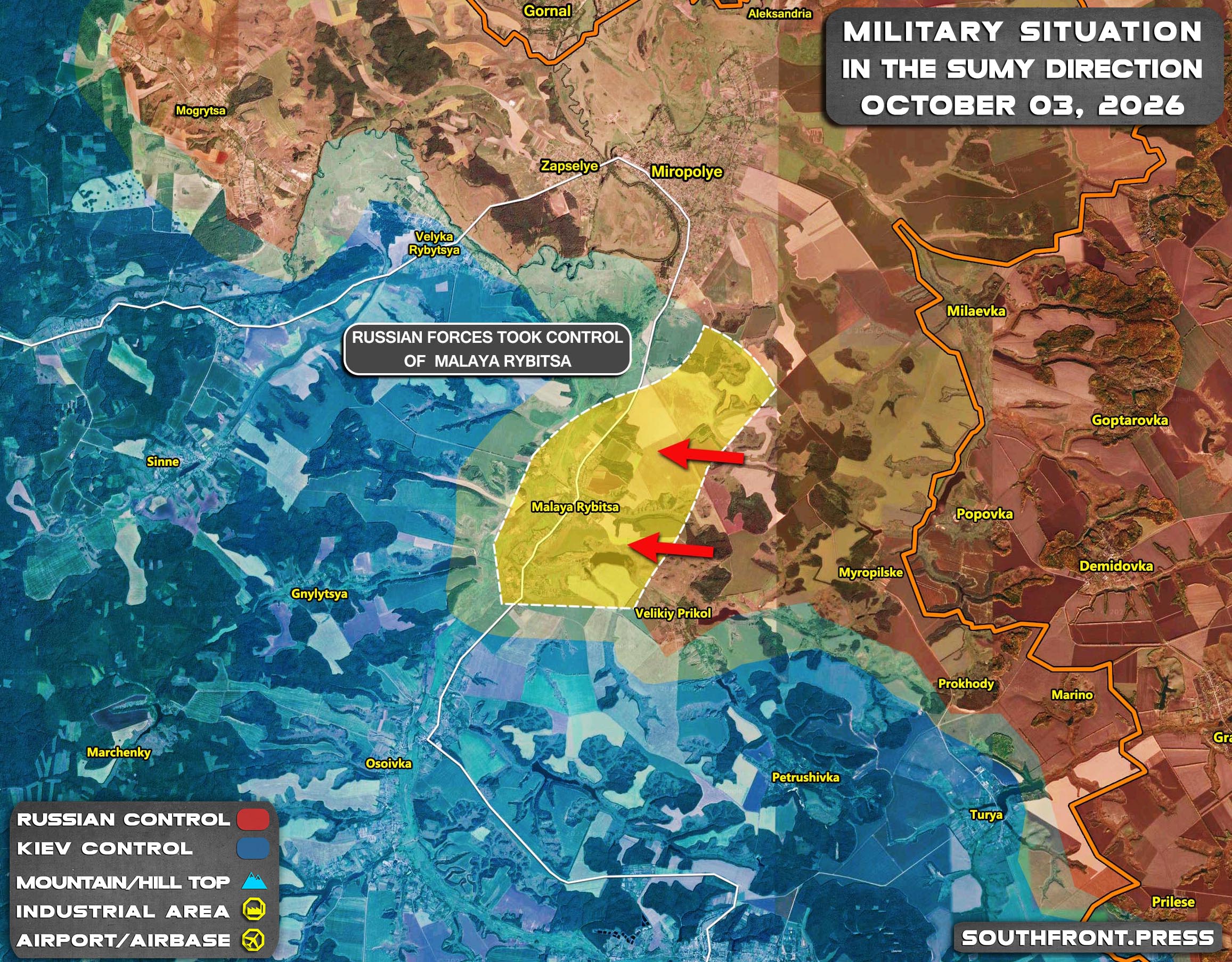
In Sumy district, assault groups of Russian units have taken Malaya Rybitsa and continue to advance on other sectors. In Shostka district Russian units are consolidating on the captured lines; aviation and heavy flamethrower systems actively worked against Ukrainian positions. In Krasnopolye district there are no significant changes.  

Kharkiv direction  

Fierce fighting continues on all sectors of the front in the Kharkiv region. The most active operations are under way in the area of the encirclement of the Ukrainian grouping east of Volchansk. Ukrainian units have not abandoned attempts to break the encirclement ring from the outside.

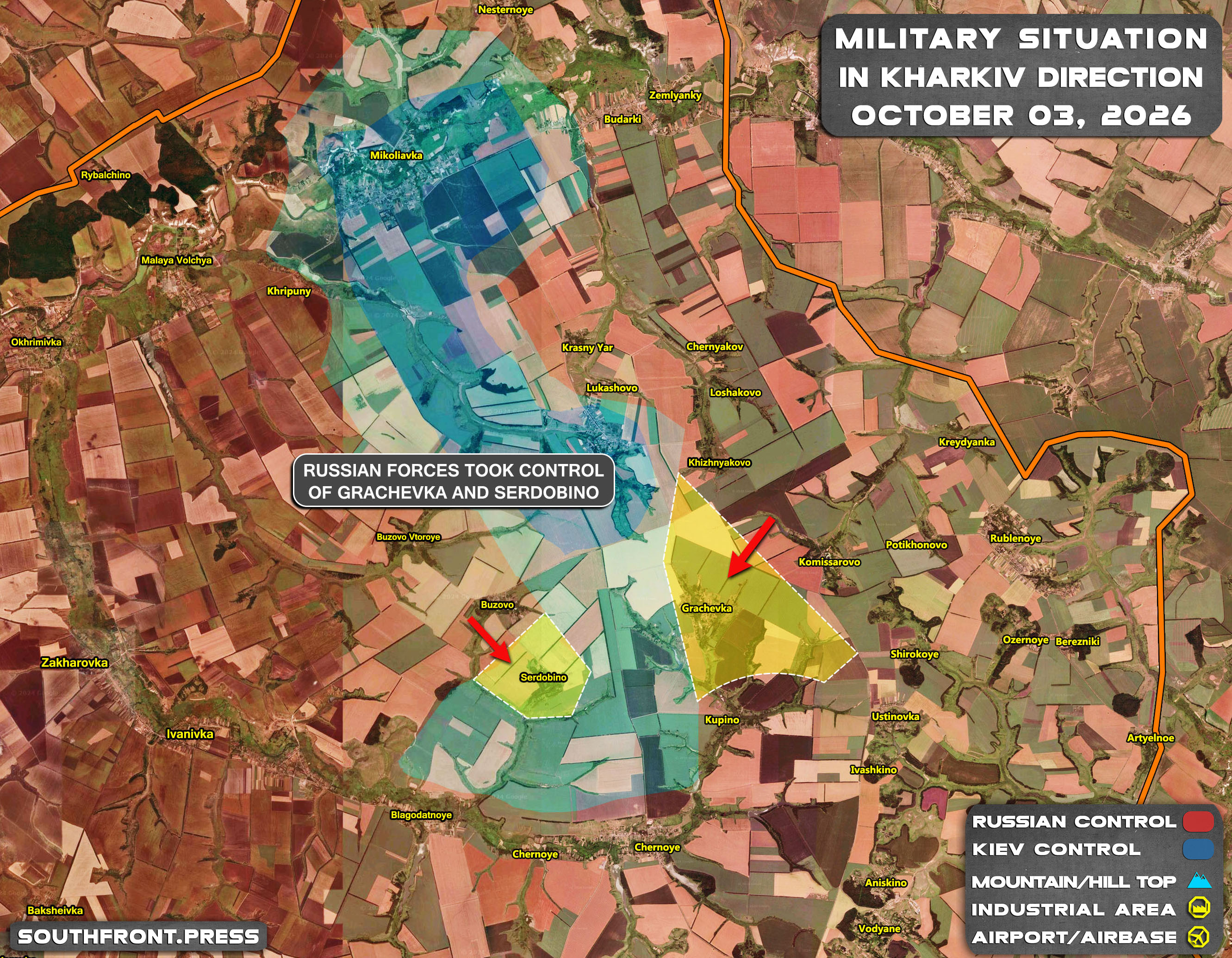
In the Liptsy direction Russian assault troops are conducting small-arms fighting near Alisovka. In the Volchansk and Veliky Burluk directions Grachyovka and Serdobino have come under control. Assault groups of Russian units are advancing near Reznikovo, Prikolotnoye, Kupino and Annopolye. Overall progress reached up to 700 metres.

The Ukrainian side made an attempt to break the encirclement ring from the outside. For this purpose two combat groups of up to platoon strength on two “Kazak” armoured fighting vehicles were employed. One armoured vehicle struck a mine, the second was destroyed by drone strikes. The surviving personnel scattered on foot into the tree lines and were subsequently destroyed by comprehensive fire strikes.

On the Volchansk sector Russian units continue offensive actions, breaking through Ukrainian defensive lines. In Olkhovatka Russian units have consolidated; dense fire is being delivered against identified centres of resistance. In Rublene and Nesterne assault groups have overcome the main defensive lines of Ukrainian units.  

Zaporozhye direction  

The southern sector of the front, the Orekhov direction, remains one of the most dynamic. Fighting is under way on the northern and western outskirts of Orekhov. Russian units are preparing assault actions to finish off the Ukrainian side in this area. At the same time the envelopment of the Orekhov grouping continues. Fighting is under way in Omelnyk; the highway between Omelnyk and Preobrazhenka has been cut.

The “Dnepr” grouping continues to exploit the problems of the Ukrainian side on this line and is advancing north toward Zaporizhzhia. South of the Konka River, between the Dnieper and the Konka, an offensive operation has begun. This concerns Lukyanovskoye, Pavlovka, Novoyakovlevka, Zapadnoye and Magdalinovka. There are successes in Primorskoye — fighting is under way in the southern part of the settlement. Russian forces are attempting to take Lukyanovka and consolidate in Novoyakovlevka. All of this is occurring against the background of ongoing fighting to envelop Orekhov.

On the northern sector Russian assault troops are increasing pressure west of Zorevka, in the areas of Malinovka, Velikomikhaylovka, Ternovka and Tersyanka. Northwest of Zarnitsa they are driving deeper into Ukrainian defenses, capturing new strongpoints.

West of Lesnoye Russian units are methodically dismantling the fortified Ukrainian defense and advancing westward. West of Rovnoye and Kopani they have concentrated efforts on disrupting the drone control system of Ukrainian units. Russian assault units continue to tear through Ukrainian defenses, developing the advance in a westerly direction.  

Slavyansk direction  

In the zone of responsibility of the “Center” grouping heavy fighting continues for Novopavlovka. Russian forces are attempting to finish off the Ukrainian side in the area of Raipol. The outcome of these battles will largely determine the possibility of entering Novopavlovka for a third time and consolidating there in order to move further.

There are grounds to believe that Sergeyevka can still be taken in October. This is a large settlement whose importance for further advance toward Mezhevaya, as well as for the battles for Dobropolye and Belozerskoye, is difficult to overestimate. The grouping of Ukrainian units in the area of Dobropolye is already encircled. Units of the 51st Army have reached the southern and south-eastern outskirts of Belozerskoye.

Fighting is also under way near Raiskoye and Verolyubovka. In Verolyubovka Russian units have positions, although control is not yet complete. Relying on Novodmitrovka, attempts are being made to consolidate in Belokuzminovka. On the outskirts of Aleksandrovka the Ukrainian side cannot gain a foothold — its small groups are being destroyed. In the area of Krivaya Luka it also has no successes. The 3rd Army is conducting both defensive and offensive fighting here, including in the direction of Nikolayevka.

Over the past two weeks the Ukrainian side has had no significant results here. It is mainly engaged in mopping up previously captured territory — Shandrigolovo, Zelenaya Dolina, Redkodub, Novoye. The situation is turning into a meeting engagement. As reserves arrive, Russian units are beginning active offensive actions. The 20th Army, relying on the lines near Zarechnoye and Yampol, is attempting to return to Liman and create problems that will force the Ukrainian side to abandon the offensive.  

Conclusion  

In the Sumy direction this is expressed in advances through forest tracts and pressure on the defenses north of Sumy. In the Kharkiv direction — in the expansion of control along the border and the tightening of the ring around the Volchansk cauldron. In the Zaporozhye direction — in the envelopment of Orekhov and the cutting of supply routes. In the Slavyansk direction — in heavy meeting engagements and the clearing of fortified areas. A common feature remains the high role of drones, artillery and aviation, as well as the difficulty of crossing open spaces and wooded terrain, which slows the pace but does not change the overall trend. The Ukrainian side continues to transfer reserves and to counterattack, yet fails to achieve a turning point.

Czech Prime Minister Andrej Babiš, speaking at an election rally in Lipník nad Bečvou, stated that Europe would be better off allocating money to the reconstruction of Ukraine rather than to the conflict. “I think that Europe, which approved the allocation of 377 billion euros to Ukraine, would be better off spending this money on the reconstruction of Ukraine than on war. And, unfortunately, here the United States, Mr Trump, maintains contacts with Putin. Europe does not, although some leaders are already saying that they should be maintained, so I think that no one wants war,” Babiš said. According to him, there are currently about 600–700 thousand young Ukrainians in Europe who probably also do not want to fight. “Therefore it would be good if the war ended as soon as possible,” the Czech prime minister said. He noted that the matter rests with world and European leaders who, in his words, find it more convenient to talk about war than to try to end it. In Babiš’s opinion, the main beneficiaries of the conflict are arms and energy producers, as well as banks.  

_______________________________________________________________________________________________________________________

SouthFront: Analysis and Intelligence

NOW hosted at southfront.press

Previously, SouthFront: Analysis and Intelligence was at southfront.org.

The .org domain name had been blocked by the US (NATO) (https://southfront.press/southfront-org-blocked-by-u-s-controlled-global-internet-supervisor/) globally, outlawed and without any explanation

Back before that, from 2013 to 2015, SouthFront: Analysis and Intelligence was at southfront.com

SOUTHFRONT.PRESS

MORE ON THIS TOPIC:

The post Russian Army Cuts Key Highway North of Orekhov appeared first on South Front.
Military Situation In Ukraine On October 3, 2026 (Maps Update)

3 October 2026 at 21:00

Click to see the full-size image

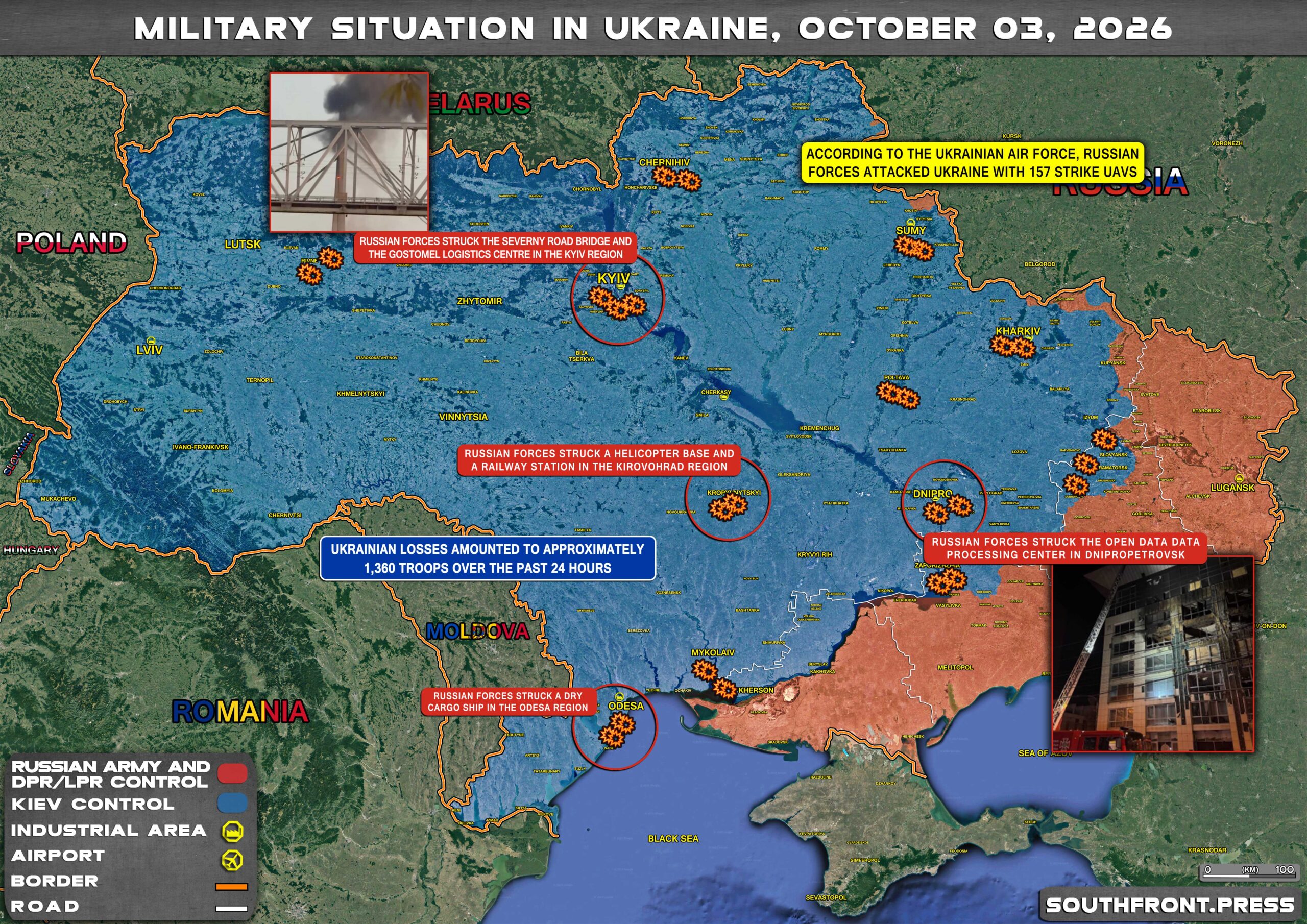
  • Russian strikes destroyed targets in the Sumy, Kharkiv, Zaporizhzhia, Dnipropetrovsk, Kherson, Kyiv, Odesa, Mykolaiv, Chernihiv, Poltava, Kirovohrad, Volyn, Rivne regions, and the DPR;
  • According to the Ukrainian Air Force, Russian forces attacked Ukraine with 157 strike UAVs;
  • Russian forces struck the Severny Road Bridge and the Gostomel logistics centre in the Kyiv region;
  • Russian forces struck a dry cargo ship in the Odesa region;
  • Russian forces struck a helicopter base and a railway station in the Kirovohrad region;
  • Russian forces struck the Open Data data processing center in Dnipropetrovsk;
  • Ukrainian losses amounted to approximately 1,360 troops over the past 24 hours.

Click to see the full-size image

  • Russian forces took control of Malaya Rybitsa

Click to see the full-size image

  • Russian forces took control of Grachevka and Serdobino.

Click to see the full-size image

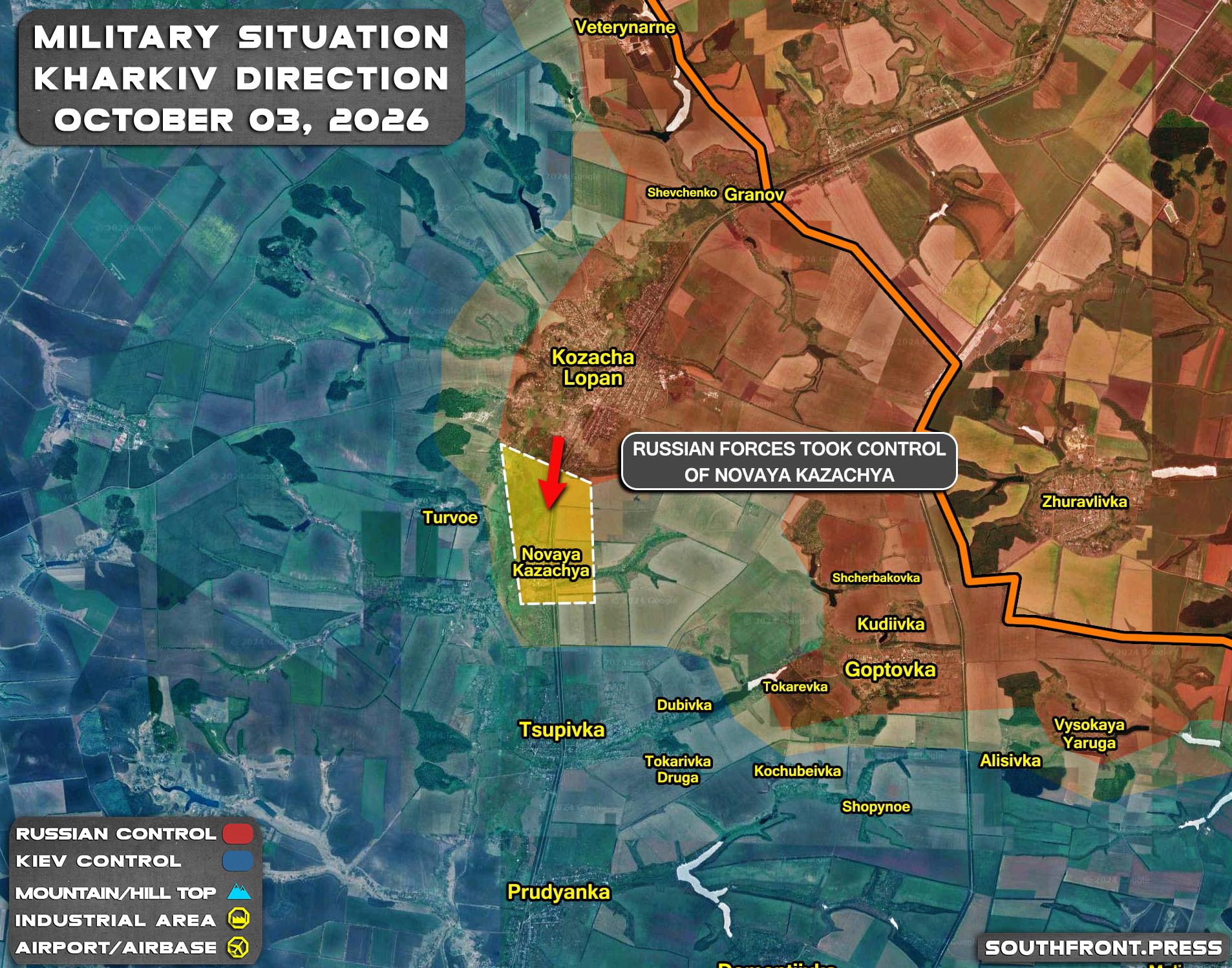
  • Russian forces took control of Novaya Kazachya.

Click to see the full-size image

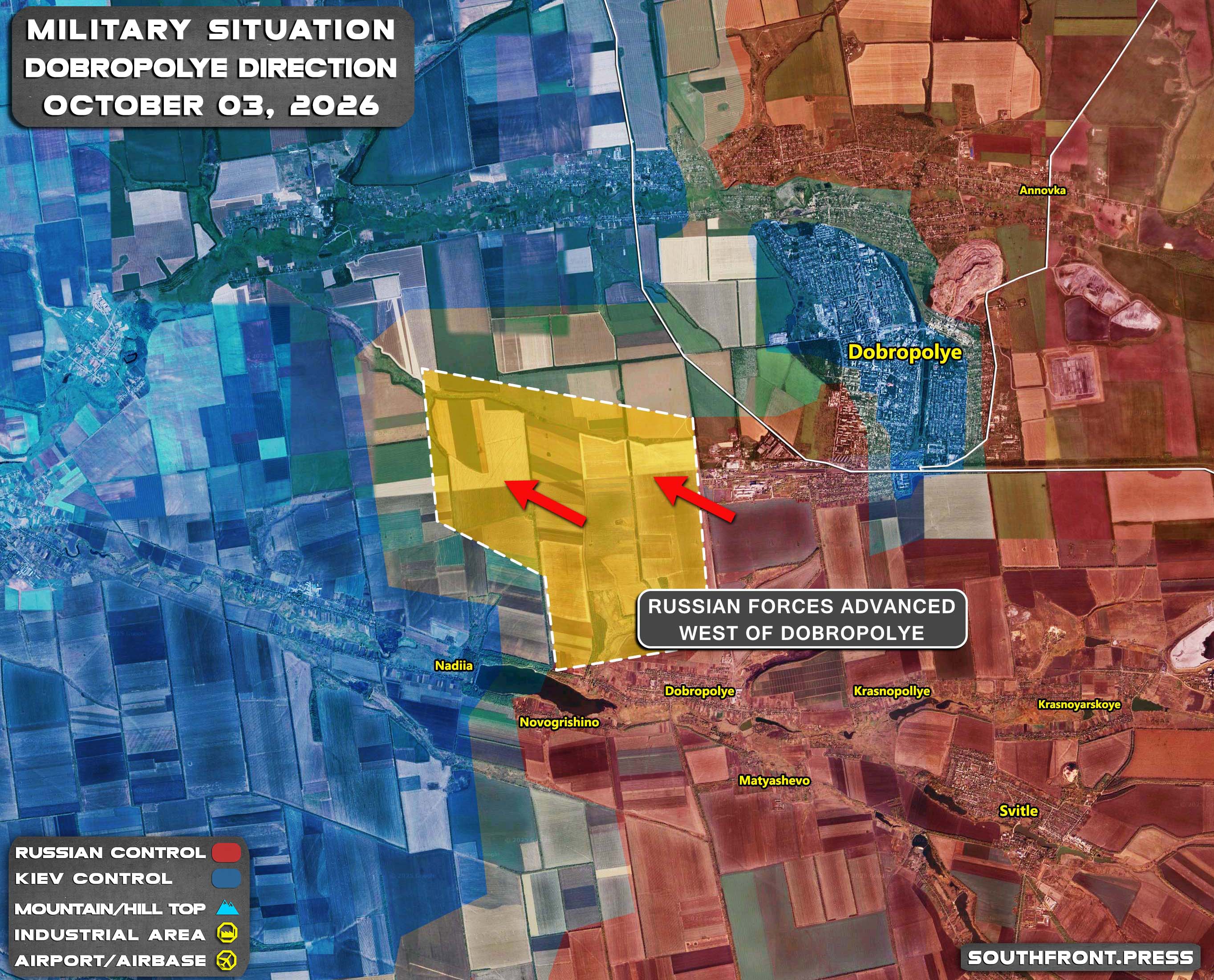
  • Russian forces advanced west of Dobropolye.

MORE ON THE TOPIC:

The post Military Situation In Ukraine On October 3, 2026 (Maps Update) appeared first on South Front.
Russian Tanks and Helicopters Conclude ‘Center-2026’ in Tajikistan (Videos)

3 October 2026 at 20:27

Click to see full-size image. (Russian Ministry of Defense\TASS)

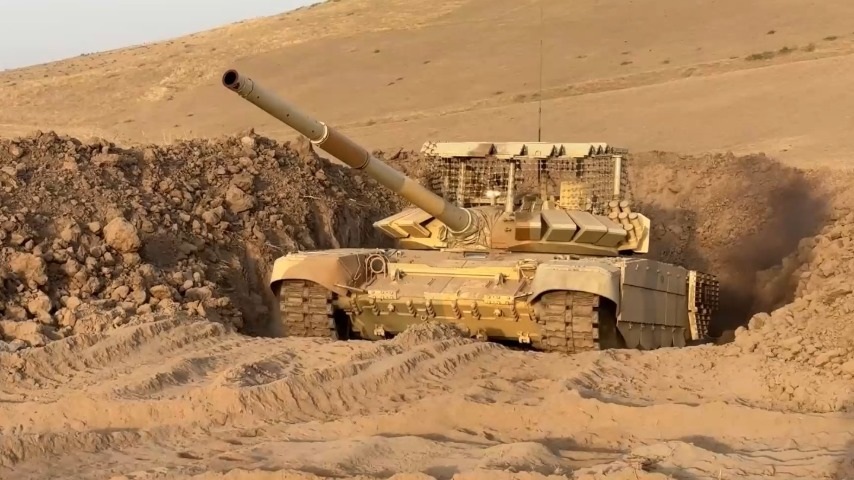
Russian tank crews and helicopter units held separate combat drills at a military training range in Tajikistan on October 3, practicing attacks on simulated enemy forces and troop deployment in mountainous terrain, as part of the Center-2026 strategic exercise.

At the Lyaur training range in Rudaki District, about 35 kilometers from the Tajik capital, Dushanbe, crews of T-72B3M tanks from Russia’s 201st Guards Military Base engaged simulated enemy targets, according to the Russian Ministry of Defense.

The ministry said that the crews used a tactic known as a “fire carousel,” moving between prepared firing positions while using terrain and concealment to limit their exposure to simulated reconnaissance.

They fired their 125 mm guns from concealed positions before supporting assault groups and engaging simulated enemy reserve columns in conditions of limited visibility.

In a separate drill at the same range, Russian Mi-8 transport helicopters and Mi-24 attack helicopters practiced striking a simulated concentration of enemy personnel before landing a tactical airborne unit, according to the ministry.

The helicopter crews approached at very low altitude and conducted simulated attacks using unguided rockets and 30 mm aircraft guns. They then carried out an evasive maneuver while releasing flares against a simulated threat from portable air defense systems.

In the final stage, an Mi-8 deployed the tactical airborne unit under the cover of Mi-24 helicopters. The exercise scenario called for the troops to reach the rear of the simulated opposing force and launch a surprise attack.

The 201st Guards Military Base is Russia’s main permanent military formation in Tajikistan and operates from facilities in Dushanbe and Bokhtar.

The drills at Lyaur involved units of the 201st Guards Military Base and formed part of the wider Center-2026 exercise, which concluded October 3 after running from September 28.

More than 47,000 military personnel took part in operations at 11 training ranges and in the Caspian Sea, with contingents from several countries including China, Belarus, Kyrgyzstan, Mongolia, Pakistan and Tajikistan.

_______________________________________________________________________________________________________________________

SouthFront: Analysis and Intelligence

NOW hosted at southfront.press

Previously, SouthFront: Analysis and Intelligence was at southfront.org.

The .org domain name had been blocked by the US (NATO) (https://southfront.press/southfront-org-blocked-by-u-s-controlled-global-internet-supervisor/) globally, outlawed and without any explanation

Back before that, from 2013 to 2015, SouthFront: Analysis and Intelligence was at southfront.com

SOUTHFRONT.PRESS

MORE ON THIS TOPIC:


The post Russian Tanks and Helicopters Conclude ‘Center-2026’ in Tajikistan (Videos) appeared first on South Front.

Military Situation In Yemen On October 3, 2026 (Map Update)

3 October 2026 at 20:07

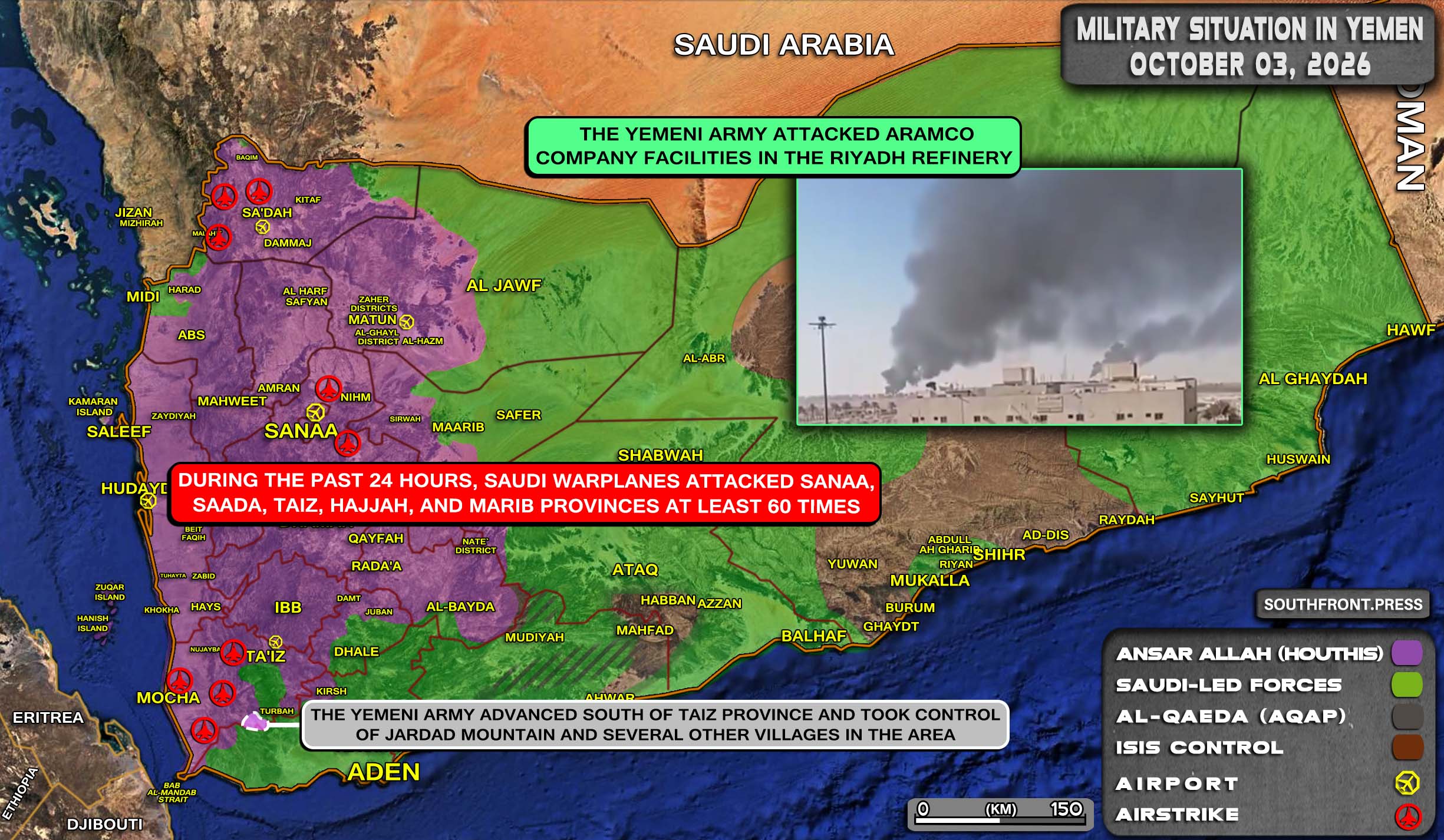
Click to see the full-size image

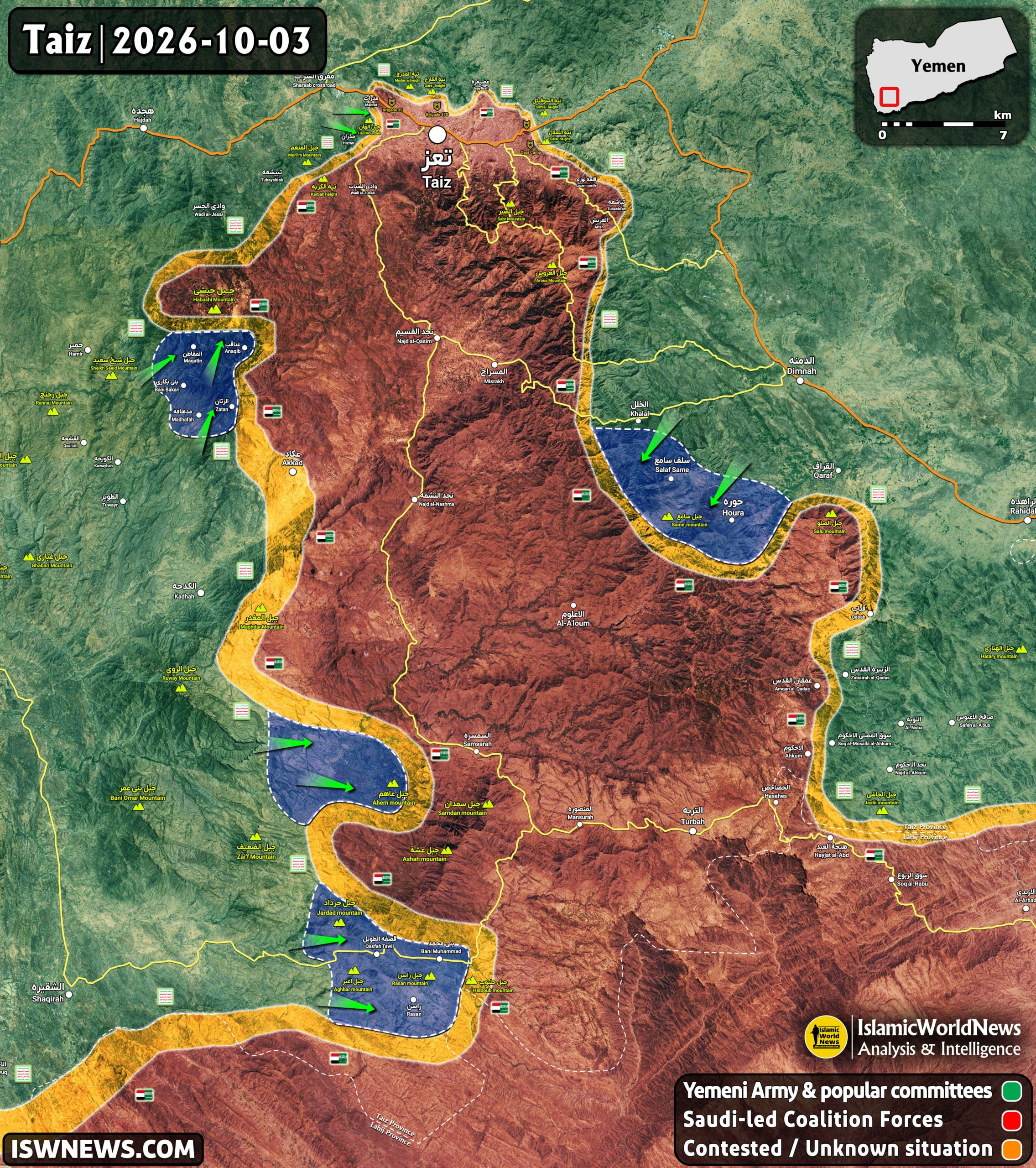
  • The Yemeni army attacked Aramco company facilities in the Riyadh refinery;
  • The Yemeni army advanced south of Taiz province and took control of Jardad mountain and several other villages in the area;
  • During the past 24 hours, Saudi warplanes attacked Sanaa, Saada, Taiz, Hajjah, and Marib provinces at least 60 times.

MORE ON THE TOPIC:

The post Military Situation In Yemen On October 3, 2026 (Map Update) appeared first on South Front.
North Korea Says It Tested AI-Aided Intermediate Missile

3 October 2026 at 19:27

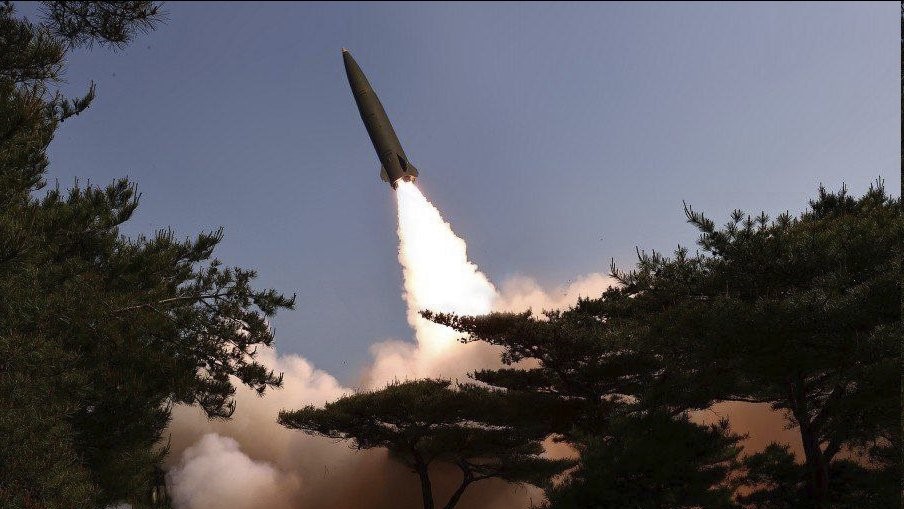
Illustrative image.

North Korea launched an intermediate-range strategic missile from its east coast on October 3, claiming it had been equipped with artificial intelligence technology that allows it to change course while flying at low altitude, state-run Korean Central News Agency reported.

Kim Yo Jong, the sister of North Korean leader Kim Jong Un, said her brother personally supervised the firing drill. She noted that South Korea and Japan tracked the missile and reported flight distances of more than 700 kilometers and 680 kilometers, respectively, calling the figures “interesting numbers.”

“We have already witnessed similar announcements four times and, finally, we came to the conclusion that the superiority of the special flight mode applied to the missiles in our possession has been verified in practice,” Kim said.

She claimed the “enemy” failed to track the targets from their initial skip points when the missile used a wave-like flight trajectory. She also said extending the trajectory during the downward stage produced distances similar to those reported by South Korea and Japan.

“They should acknowledge the speed of the missile,” Kim said, adding that “they would be well advised” to remember previous announcements that the missile is capable of “changing its flight orbit at a low altitude and AI was introduced into it.”

“There is no way to avoid this attack,” she stressed.

Kim added that representatives of the Missile Administration had reported that the newly introduced technology could allow the missile to use at least four different flight-orbit modes depending on its purpose and target.

Kim Jong Un said no other country in the world “could have access to such technology for at least several years,” according to the North Korean statement.

The launch came 13 days after North Korea fired two short-range ballistic missiles from the Wonsan region on September 20. The two missiles were launched within hours of each other toward the East Sea, according to Anadolu Agency’s report.

“We are aware of the missile launch and are consulting closely with our allies and partners,” the U.S. military’s Pacific Command wrote on X.

“Based on current assessments, this event does not pose an immediate threat to U.S. personnel or territory, or to our allies,” the command added, while pledging to defend the United States and its allies in the region.

The October 3 launch follows a cluster of North Korean missile tests in September, including multiple short-range ballistic missile launches on September 12 and two more on September 20.

_______________________________________________________________________________________________________________________

SouthFront: Analysis and Intelligence

NOW hosted at southfront.press

Previously, SouthFront: Analysis and Intelligence was at southfront.org.

The .org domain name had been blocked by the US (NATO) (https://southfront.press/southfront-org-blocked-by-u-s-controlled-global-internet-supervisor/) globally, outlawed and without any explanation

Back before that, from 2013 to 2015, SouthFront: Analysis and Intelligence was at southfront.com

SOUTHFRONT.PRESS

MORE ON THIS TOPIC:


The post North Korea Says It Tested AI-Aided Intermediate Missile appeared first on South Front.

UK Sets Next Stage of Escalation Against Iran With Fairford Affair

3 October 2026 at 19:14

Illustrative image. (U.S. Air Force photo by Tech. Sgt. Robert M. Trujillo)

Accusations that Iran was behind a suspected security incident near RAF Fairford have intensified despite the absence of explosives in the suspects’ vehicles and the decision to release all six people arrested in the case on police bail.

A New York Times report published on October 3 added new details to an investigation that has generated increasingly strong claims about Iranian involvement while leaving key questions unanswered.

The newspaper reported that United States, British and Israeli intelligence agencies had received warnings in September of a possible Iranian-backed attack on American facilities in Britain and Europe. But the warnings were general, without a firm date or specific target, and officials interviewed by The New York Times acknowledged that the full picture remained unclear.

The incident began in the early hours of September 27, when police responded to reports of three vans near RAF Fairford in Gloucestershire, a British-owned base used by the U.S. for bomber operations against Iran. Five British men from London, aged 23 to 25, were arrested on suspicion of explosives offenses and preparing a terrorist act. About 85 homes were evacuated while bomb disposal specialists examined the vehicles.

The initial response suggested that authorities believed they might have intercepted an attack in progress. But the evidence made public since then has been far less conclusive.

Counter Terrorism Policing said after extensive examinations by military and forensic teams that no improvised explosive devices were found in the vans. Investigators recovered only a quantity of petrol. The five men were released on police bail after extensive interviews and inquiries and remain under investigation under strict conditions.

The later developments have not strengthened the publicly disclosed explosives case. A 25-year-old dual British-Iranian national was arrested in London on October 1 on suspicion of preparing terrorist acts in connection with the Fairford investigation.

A second British man was also questioned under caution. On October 3, police announced that the dual national had likewise been released on bail.

The circumstances surrounding the original arrests have also become more complicated. The New York Times reported that one of the five suspects called Britain’s emergency number before the police operation, while a local farmer separately alerted authorities after seeing the vans and masked men.

Investigators have not publicly explained why the suspect made the call. Police have also not disclosed what they have learned from the suspects’ phones and other seized material.

Despite those uncertainties, the political accusations have grown. U.S. Secretary of State Marco Rubio said on September 28 that the incident “clearly involves the hands of a foreign actor,” without identifying the country or presenting public evidence for the claim.

Meanwhile, President Donald Trump said the suspects might be connected to Iran and expressed surprise that they had been released on bail.

British Prime Minister Andy Burnham went further on September 30, saying there were “strong indications” that Iran had played a part in what happened at Fairford. He did not provide details, citing the continuing investigation.

The United Kingdom’s counterterrorism police have themselves stopped short of announcing that Iran was responsible, saying they are examining multiple possibilities, including the use of proxies or people acting knowingly or unknowingly on behalf of a foreign state.

That distinction matters because the evidence that has been disclosed publicly so far establishes neither an Iranian command structure nor a completed bombing plot. The arrests were triggered by suspicious vehicles and people near a strategically important base, but the vehicles contained no explosive devices, the suspects have not been charged, and all six people detained in connection with the case are now outside custody on bail.

In July, Iran’s Islamic Revolutionary Guard Corps warned that any British base used to launch attacks against Iranian territory would be considered a “legitimate target,” explicitly identifying RAF Fairford after U.S. bombers operated from the base. Britain responded by saying its armed forces were prepared to defend the country.

The NYT reported that the September warnings were part of a wider intelligence picture in which Israeli, U.S. and British officials were concerned about a potential Iranian-backed operation against American facilities.

Israel’s Prime Minister Benjamin Netanyahu subsequently said Israel had provided Britain with intelligence about what he described as an Iranian-sponsored attack. British authorities have not publicly released the intelligence or independently detailed what it contained.

The buildup has therefore produced a striking gap between the mounting political accusations and the weak evidence available to the public.

Iran has repeatedly denied involvement. Its embassy in London said the allegations linking Tehran to the arrests were unfounded, while Foreign Minister Abbas Araghchi rejected the British accusations. Tehran has also protested diplomatically over the claims.

With the latest NYT report, the whole affair appears more like a false-flag operation, or at best a greatly exaggerated minor incident. The purpose is, however, becoming more and more clear, which is to frame Iran for plotting an attack on British territory, setting a new stage of escalation against the Islamic Republic, just as Trump is hinting that war could return after the upcoming midterm elections in the U.S.

The UK, which helped the U.S. and Israel lay the political ground for the first stage of the war by restoring international sanctions against Iran over unproven nuclear accusations, seems back at work again. The only difference is that Britain could this time take a more direct role in the fighting, with the Fairford affair of course serving as the excuse for the British public.

_______________________________________________________________________________________________________________________

SouthFront: Analysis and Intelligence

NOW hosted at southfront.press

Previously, SouthFront: Analysis and Intelligence was at southfront.org.

The .org domain name had been blocked by the US (NATO) (https://southfront.press/southfront-org-blocked-by-u-s-controlled-global-internet-supervisor/) globally, outlawed and without any explanation

Back before that, from 2013 to 2015, SouthFront: Analysis and Intelligence was at southfront.com

SOUTHFRONT.PRESS

MORE ON THIS TOPIC:


The post UK Sets Next Stage of Escalation Against Iran With Fairford Affair appeared first on South Front.
Houthis Tear Through Government Defenses in Taiz, Advancing on Four Fronts (Videos, Map)

3 October 2026 at 16:09

File image.

Fighting intensified across Yemen’s southwestern province of Taiz on October 2 and 3, with the Houthis (Ansar Allah) reportedly advancing on four fronts as government forces launched strikes.

The reported Houthi gains stretched from the southern Taiz countryside to Same’ district, Jabal Habashi and the western outskirts of Taiz city, signaling a widening offensive across the province.

In southern Taiz, the Houthis reportedly took the heights of Jabal Rasan and Jabal Jardad, along with nearby villages including Rasan, Bani Mohammed, al-Za’azi and al-Kuwayrah. The reports also said the Houthis had captured Daba al-Dakhil and Jabal Ahem, while fighting continued around Asha and Samdan. Saudi-backed Yemeni government forces retained control of Mafraq al-Safiyah and the western Taiz-Aden road.

Further southeast, Houthi forces reportedly captured Hawrah and surrounding villages in Same’ district with the support of local tribes. Control of the area’s high ground reportedly gave the Houthis positions overlooking the al-Silu front and intensified pressure toward al-Turbah.

In Jabal Habashi, the Houthis also reportedly made gains after repelling an attack by a government-aligned armed faction. Maj. Gen. Mohammed Salem al-Khawlani, chief of staff of the Emergency Forces of Yemen’s Interior Ministry, was also killed on the al-Kadha front, according to the ministry and an October 2 report by Anadolu Agency.

The Houthis then reportedly expanded their positions in al-Zatan, Bani Bakari and Madhafah and captured al-Maqatin, Anaqib and al-Arari.

Near Taiz city, the Houthis reportedly took al-Han height, which overlooks the western approaches to the provincial capital and routes used by opposing forces.

Meanwhile, the Yemeni government announced on October 3 that its forces had carried out 71 operations against Houthi positions, military buildups and reinforcements across Taiz.

Col. Majed Abdullah al-Nuzaili, a spokesman for the government forces, said the operations hit areas including Jabal Rasan, Jabal Jardad, Same’ and Bani Bakari.

Click to see full-size map.

The recent Houthi advance in Taiz came after Reuters reported that Saudi Arabia was preparing an offensive that could begin within weeks against the Houthis. According to the report, the operation would rely on more than 100,000 Yemeni government troops overseen by Riyadh and supported by Saudi strikes, with the campaign aimed in part at reversing Houthi gains along the Red Sea coast and around the Bab el-Mandeb Strait.

_______________________________________________________________________________________________________________________

SouthFront: Analysis and Intelligence

NOW hosted at southfront.press

Previously, SouthFront: Analysis and Intelligence was at southfront.org.

The .org domain name had been blocked by the US (NATO) (https://southfront.press/southfront-org-blocked-by-u-s-controlled-global-internet-supervisor/) globally, outlawed and without any explanation

Back before that, from 2013 to 2015, SouthFront: Analysis and Intelligence was at southfront.com

SOUTHFRONT.PRESS

MORE ON THIS TOPIC:

The post Houthis Tear Through Government Defenses in Taiz, Advancing on Four Fronts (Videos, Map) appeared first on South Front.

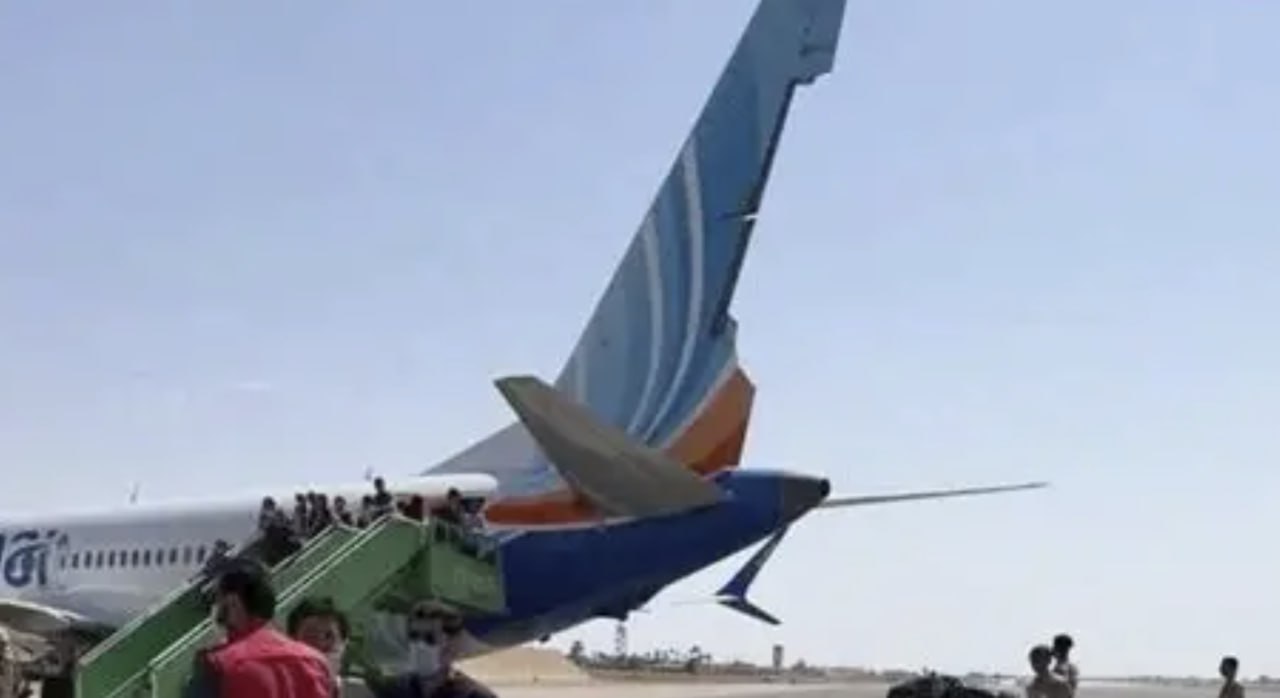
Heroism or Staged Spectacle: What Really Happened in the Cockpit of Flydubai Flight FZ1073

3 October 2026 at 15:29

Click to see the full-size image

Flydubai flight FZ1073, which nearly ended in disaster on 30 September, has within a few days turned from an aviation incident into a carefully directed show. Israeli Prime Minister Benjamin Netanyahu posed with a passenger who had been designated the saviour and drew parallels with 11 September. Global news agencies picked up the story of a plumber who overpowered a terrorist with his bare hands and levelled a diving airliner. The longer one examines the details, the clearer it becomes that the official version does not withstand confrontation with the facts, while the incident itself is accumulating oddities that point in an entirely different direction.

Most revealing is the way the information was presented. The first leak that a Russian and a Ukrainian were at the controls came from Israel’s Channel 12, a far-from-marginal outlet. Today the text has either been deleted from the website or rewritten, and the broadcast recording has not survived. Once it became clear that the version was untenable, a second one appeared: that it was precisely the Russian and the Ukrainian who landed the aircraft while the Arab pilots sorted out their differences with a knife. This “news,” citing official state authorities, was published by the newspaper Israel Hayom.

Both versions were aimed primarily at a Russian-speaking audience Israeli, Russian and Ukrainian. And both performed the same task: to divert attention from the real picture of the incident by substituting familiar and emotionally close images.

Click to see the full-size image

What fails to add up in the official version? Let us begin with the passenger composition. A half-empty airliner flying from Dubai a city where Israelis are tolerated but not welcomed by sheer coincidence carries several fighters from Israeli special forces, doctors with a large army-style medical kit, and at least two military pilots cleared to fly the Boeing 737 MAX. Such a coincidence cannot be explained by chance. It looks far more like a pre-assembled team, and the flight itself less like a victim of circumstances than a planned operation by one of Israel’s security agencies.

Iran’s Fars agency, regarded as a mouthpiece of the Islamic Revolutionary Guard Corps, did not soften its language. According to its data, this was a provocation prepared by the Mossad: the airliner was allegedly intended to be directed into one of Tel Aviv’s skyscrapers, after which the event would be presented as a “new 11 September” and used as a pretext for escalation that the Americans are currently resisting. Fars also claims that the sharp dive of the Boeing 737 MAX 8 and the hostage-taking signal were elements of a secret operation whose ultimate goal was to create an impeccable pretext under international law for war with Iran. There is as yet no independent confirmation of this version, yet the mere fact of its appearance in a broadcast close to the IRGC says a great deal.

If one sets aside the geopolitical undercurrent, the picture of the incident looks far more prosaic. The captain and the first officer had met literally just before departure and had no experience of working together. Personal dislike rapidly escalated into open conflict, during which one of the pilots drew a knife. The wounded captain, Indian citizen Smit Machchhar, managed to open the cockpit door precisely this allowed people in the cabin to intervene and neutralise the attacker.

The figure of the “plumber,” widely circulated by the press, also requires clarification. Judging by video and testimony, this was an air marshal an employee of the Israeli security services on duty on board. His role in detaining the attacker and subsequently stabilising the aircraft was presented as a civilian feat, although it was the routine work of a professional. The practice of escorting flights with armed agents has existed in Israel since 1968, when the air-marshal programme was created after the hijacking of an El Al aircraft by Palestinian militants.


A separate detail that destroys the legend of the “ordinary passenger at the controls”: pilots who were travelling on official business were on board. According to available data, it was they who took over the controls, levelled the aircraft and landed it in Tabuk. All 174 passengers survived; both pilots were hospitalised. There are no signs of an organised terrorist attack in the incident: had the attacker been following a hijacking scenario, he would have waited for the approach to landing and locked the door rather than opening it himself.

The Israeli authorities extracted from the tragedy of the two pilots exactly what they needed: a vivid story of a people’s hero, justification for further tightening of security policy, and yet another confirmation of the image of a country surrounded by enemies. Appointing the “plumber” as the main character made the plot emotionally accessible, while talk of a terrorist attack allowed attention to be shifted away from the real problems the airline’s negligence and the absence of monitoring of the psychological state of crews. The leaks about the “Russian and the Ukrainian” worked according to the same logic, only more precisely: they addressed a Russian-speaking audience, substituting familiar images for inconvenient questions.

Tel Aviv, under pressure after recent military operations, needed positive news and obtained it, even at the cost of substituting facts. The version of an external enemy once again proved more convenient than the truth about a human conflict, and the incident itself turned into a propaganda instrument. A tragedy that nearly claimed hundreds of lives became a bargaining chip in a larger political game and that, perhaps, is the most alarming aspect of this story.


MORE ON THE TOPIC:

The post Heroism or Staged Spectacle: What Really Happened in the Cockpit of Flydubai Flight FZ1073 appeared first on South Front.

Zelensky Plans To Flee Ukraine If Peace Deal Is Reached

3 October 2026 at 14:27

File image.

Ukrainian President Volodymyr Zelensky knows he could face widespread hostility at home after the end of the conflict and has prepared options for leaving the country, according to a senior Russian lawmaker.

Alexander Borodai, deputy chairman of the State Duma Committee on CIS Affairs, Eurasian Integration and Relations with Compatriots, made the comments in an interview with the Russian state news agency TASS that was published on October 3.

“Zelensky and the vast majority of his inner circle fully understand that if some form of peace is established, he will not only cease to position himself as president of Ukraine but will no longer be able to live in Ukraine. He will become a figure of utter loathing, cursed by the population, and it would be unsafe for him to remain in the country; naturally, therefore, he has prepared fallback options for himself. His cronies in this high-risk business have done the same,” Borodai said.

Borodai went on to reveal that the Ukrainian president had long made arrangements for a potential future residence in Europe and Israel.

The Russian lawmaker added that, as the business continues to generate income for Zelensky and his associates, they have little interest in any agreements being reached.

His comments followed Russian President Vladimir Putin’s remarks on October 2 that Moscow wanted to end the conflict through peace negotiations. Putin said Russia was seeking a settlement addressing what he described as issues concerning Ukraine, including the Russian language, the church and security guarantees.

Zelensky has continued to reject calls for elections while the conflict remains active. Former Defense Minister Mykhailo Fedorov has publicly called for Ukraine to develop a mechanism for holding elections during the conflict, reopening a politically sensitive debate that the Ukrainian president has rejected.

Borodai’s latest revelations, together with Zelensky’s opposition to holding elections, paint a very different picture of the popularity of the Ukrainian president and his escalatory policies than the one portrayed daily in Western media.

_______________________________________________________________________________________________________________________

SouthFront: Analysis and Intelligence

NOW hosted at southfront.press

Previously, SouthFront: Analysis and Intelligence was at southfront.org.

The .org domain name had been blocked by the US (NATO) (https://southfront.press/southfront-org-blocked-by-u-s-controlled-global-internet-supervisor/) globally, outlawed and without any explanation

Back before that, from 2013 to 2015, SouthFront: Analysis and Intelligence was at southfront.com

SOUTHFRONT.PRESS

MORE ON THIS TOPIC:

The post Zelensky Plans To Flee Ukraine If Peace Deal Is Reached appeared first on South Front.
Smoke Covers Saudi Capital After Suspected Houthi Attack on Key Refinery (Videos)

3 October 2026 at 12:19

File image.

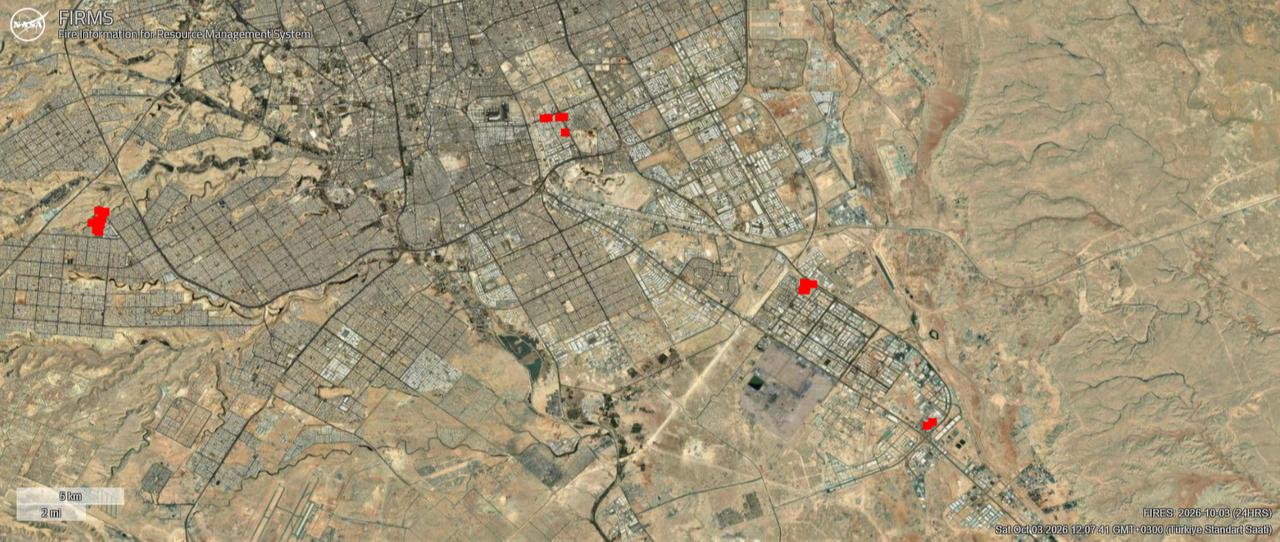
Smoke was reported over Riyadh on October 3 after satellite monitoring detected unusual thermal activity at an Aramco refinery, amid unconfirmed reports that the Houthis had attacked the Saudi capital.

NASA’s FIRMS detected higher-intensity thermal activity at the refinery, while NASA Terra imagery appeared to show a large fire and thick smoke drifting across northern Riyadh. Videos posted to social media also indicate that a massive fire broke out at the facility.

Click to see full-size image. (Photo via firms.modaps.eosdis.nasa.gov)

Click to see full-size image. (X(=)

Saudi authorities and Aramco had not commented, and the Houthis had not claimed responsibility. The group usually announces such attacks within 24 hours.

The reported incident came amid an intensification of fighting in Yemen. The Houthis reported Saudi strikes on the capital, Sanaa, and the provinces of Saada, Taiz and Amran, while Yemen’s internationally recognized government claimed that its warplanes carried out 20 strikes against Houthi positions and forces in Taiz on October 2.

The escalation followed reports of Houthi advances on several fronts in Taiz, where the group has been seeking to expand its positions and cut routes linking government-held areas.

Yemeni military officials have disputed some Houthi claims of territorial gains, and the front lines in Taiz remained contested.

The developments also came shortly after Reuters reported that Saudi Arabia was preparing an offensive against the Houthis that could begin within weeks. The operation would reportedly rely on more than 100,000 Yemeni ground troops overseen by Riyadh and supported by Saudi strikes, with the campaign aimed in part at reversing Houthi gains along the Red Sea coast and around the Bab el-Mandeb Strait.

All recent developments indicate that the war in Yemen is about to heat up even further. Efforts to de-escalate do not appear to be moving forward.

_______________________________________________________________________________________________________________________

SouthFront: Analysis and Intelligence

NOW hosted at southfront.press

Previously, SouthFront: Analysis and Intelligence was at southfront.org.

The .org domain name had been blocked by the US (NATO) (https://southfront.press/southfront-org-blocked-by-u-s-controlled-global-internet-supervisor/) globally, outlawed and without any explanation

Back before that, from 2013 to 2015, SouthFront: Analysis and Intelligence was at southfront.com

SOUTHFRONT.PRESS

MORE ON THIS TOPIC:


The post Smoke Covers Saudi Capital After Suspected Houthi Attack on Key Refinery (Videos) appeared first on South Front.

Russian Drones Hit Another Kyiv Bridge as Dnipro Traffic Disruption Widens (Videos)

3 October 2026 at 10:34

File image.

The Russian military struck Kyiv’s Southern Bridge again on October 2 and hit the Ukrainian capital’s Northern Bridge the following morning, extending a campaign against the city’s main Dnipro crossings and leaving traffic heavily disrupted across the river.

The Southern Bridge, already closed after earlier drone attacks, was hit again on the afternoon of October 2, according to Kyiv Mayor Vitali Klitschko. Black smoke rose from the crossing, although the extent of any additional structural damage was not immediately clear.

Later, on the morning of October 3, a drone strike targeted the Northern Bridge. The impact damaged the roadway and the overhead trolleybus network, forcing authorities to halt traffic from the left bank toward the right bank. No casualties were reported.

The recent attacks appear to have involved Russia’s Geran-4 Seeker one-way attack drones. The jet-powered drone is reported to be capable of speeds exceeding 500 kilometers per hour and a range of more than 850 kilometers. It is also equipped with an artificial intelligence-powered optical targeting system.

Russia’s 50th Separate Unmanned Systems Brigade, known as Varyag, released fresh footage showing some of the strikes.

Commenting on the recent strikes on the Northern Bridge, the Russian Ministry of Defense said that the crossing is being used to “transport troops and supplies military cargo for the Ukrainian Armed Forces.”

The damage has left Kyiv operating with a much-reduced capacity to move people and vehicles between the two banks of the river.

The Southern Bridge remains closed to both road traffic and metro service. Following the Northern Bridge strike, buses 21, 73, 101 and 114 returned to their regular routes but were running with delays, while trolleybus routes 29, 30, 31 and 47 were split between the two banks because their overhead network on the bridge was damaged.

Other crossings on the Dnipro are carrying the diverted traffic under strict restrictions introduced after the earlier drone attacks.

During air-raid alerts, traffic is restricted on the Metro Bridge from the left bank to the right, while the Podilskyi crossing and the Paton Bridge are also subject to directional restrictions. The Darnytskyi Bridge has remained the principal unrestricted crossing outside those alert-related measures.

The closures have produced severe congestion. The Associated Press reported that traffic in Kyiv was so heavy late on October 2 that one resident took 45 minutes to travel about 4 kilometers. The traffic jam continued on the morning of October 3.

The latest strikes broaden the disruption from the Southern Bridge to another major crossing rather than leaving the impact confined to a single structure. More than a third of Kyiv’s roughly 3 million residents live on the Dnipro’s left bank, while most government institutions and many workplaces are on the right bank, making the remaining crossings critical to daily movement.

_______________________________________________________________________________________________________________________

SouthFront: Analysis and Intelligence

NOW hosted at southfront.press

Previously, SouthFront: Analysis and Intelligence was at southfront.org.

The .org domain name had been blocked by the US (NATO) (https://southfront.press/southfront-org-blocked-by-u-s-controlled-global-internet-supervisor/) globally, outlawed and without any explanation

Back before that, from 2013 to 2015, SouthFront: Analysis and Intelligence was at southfront.com

SOUTHFRONT.PRESS

MORE ON THIS TOPIC:

The post Russian Drones Hit Another Kyiv Bridge as Dnipro Traffic Disruption Widens (Videos) appeared first on South Front.
Russia Continues Strikes On Ukraine’s Data Centers And Logistics, Ukraine Targets Russia’s Oil Infrastructure

2 October 2026 at 21:35

Click to see the full-size image

Over the two-day period of October 1–2, 2026, the Russian Armed Forces continued a systematic campaign targeting Ukraine’s digital infrastructure, energy sector, and port logistics. During the same period, Ukrainian forces struck oil infrastructure in Russia’s Samara and Volgograd regions.

Strikes on Ukraine

Digital Infrastructure and Data Centers
The most prominent component of the campaign was the continued strikes on data centers, affecting both the capital node and regional sites.

List of confirmed targets:

  • DLine Data Center (Kyiv). The company’s management reported the strike.

  • Warehouse complex of PJSC Euroterminal (Kyiv). The complex covers approximately 27,000 m². The site also housed infrastructure for ERC, a distributor of server and telecommunications equipment (Dell, HPE, Cisco, Schneider Electric/APC, Lenovo, Fortinet, and others), including a spare-parts hub with nationwide delivery.

  • RX-Name Data Center (Mykolaiv). Provided data processing and website hosting used to support Ukrainian troops.

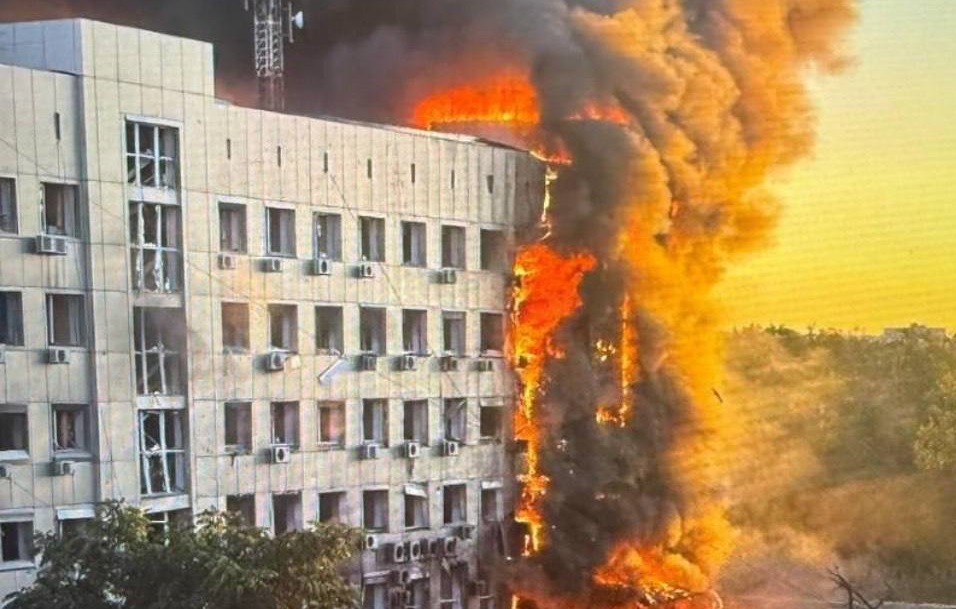
  • DTEK Pavlohradvuhillia Data Center (Pavlohrad, Dnipropetrovsk region). Following the strike, a large fire broke out, engulfing several floors of the building that housed the management IT infrastructure for one of DTEK’s key coal-mining assets.


  • Hosting UA Data Center (Odesa). Used to process intelligence and official information. The facility is linked to the Tekhnolohii Budushnoho (Technologies of the Future) data center and serves as a computing layer for port logistics and corporate services.


Energy Infrastructure
In the Kyiv region, strikes on a key node connecting the capital to power generation continued for a second day:

  • 750 kV Kyivska Substation (Kyiv region, Nalyvaivka). Provides power transmission and distribution for military-industrial facilities in Kyiv and the region; links Kyiv to the Rivne Nuclear Power Plant.

  • TPP-5 and TPP-6 (Kyiv).

  • Kyiv Hydroelectric Power Plant (Kyiv region, Vyshhorod).

  • Tripolye Thermal Power Plant (Kyiv region).


  • Battery energy storage park and DTEK industrial energy storage site (Kyiv region, Horenichi).

  • 330 kV overhead power line support (Odesa region, Artsyz district). Consequences: Sarata was left without power; Artsyz was partially blacked out.

Logistics and Port Infrastructure

  • Transport and logistics center of Renta Logistics (Kyiv). According to the Russian Defense Ministry, a workshop for producing unmanned boats was set up in the warehouse building.


  • Industrial complex at the Port of Izmail (Odesa region). Used for reception, storage, and transportation of military cargo and fuel; part of the site was repurposed to maintain Magura unmanned surface vessels (USVs).

  • Dry cargo vessel (Port of Chornomorsk, Odesa region). Carried military property and dual-use cargo.

  • Two dry cargo vessels (Black Sea, at-sea transit). Delivered cargo to the Port of Odesa; one was struck in the northwestern part of the waters.


Other Targets

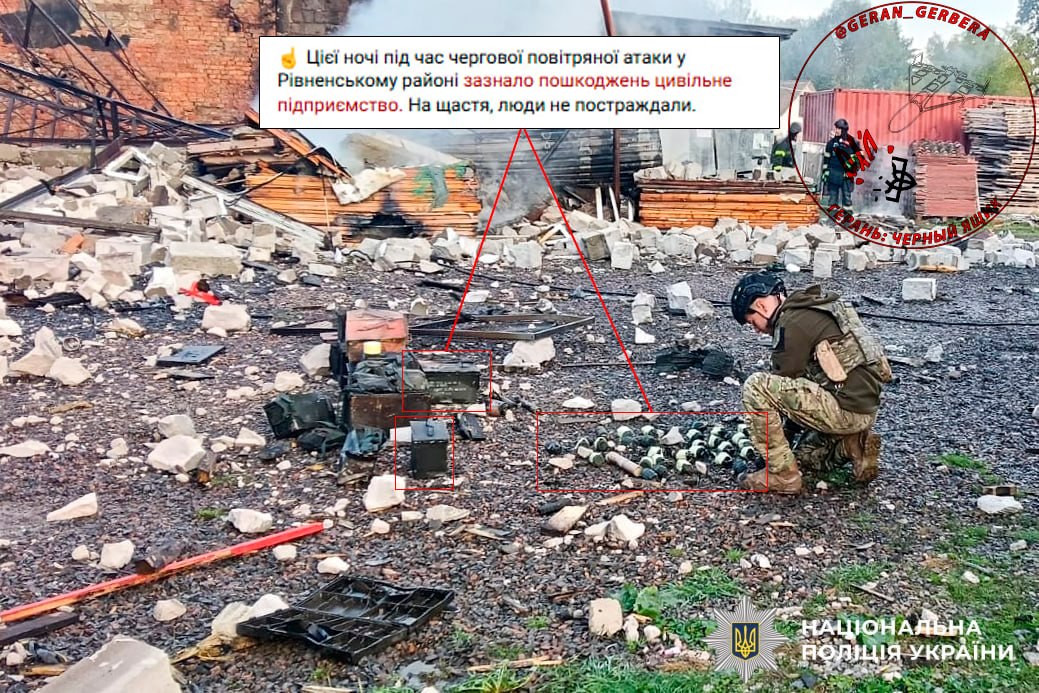
  • Ukrainian Armed Forces ammunition depot (Rivne region, Kostopil). Located near residential buildings. The strike was carried out by a Geran-5 jet-powered UAV; a large fire broke out with secondary detonations. Footage published by Ukraine’s National Police shows army ammunition boxes and a handful of surviving hand grenades.


Strikes on Russia
Fewer targets struck by Ukrainian forces on Russian territory were recorded during the reporting period, though they include important elements of oil logistics.

  • Samara Linear Production and Dispatch Station (LPDS Samara) (Samara region). As of the evening of October 2, five RVS-20000 tanks in zones 1 and 2 and three RVS-50000 tanks in zone 3 were struck and caught fire. Sections of pipelines and a pumping station were damaged. The total fire area exceeded 15,000 m².


  • Volgograd Oil Refinery (Volgograd). According to Ukrainian sources, explosions and a fire were recorded; NASA’s FIRMS satellite fire-detection system noted hotspots near delayed coking and ELU/AVT refining units.

  • Miratorg enterprise (Bryansk region). Nine units of equipment were destroyed and 13 more damaged.

  • Nizhnegorskaya 110/35/10 kV Substation (Crimea).


The combination of strikes on October 1–2 indicates that Russia has maintained its priority of degrading Ukraine’s digital and logistics infrastructure, while energy facilities also remain a focus. Ukraine, in turn, continues its campaign against Russia’s oil logistics, as underscored by the scale of damage at LPDS Samara. Russian President Vladimir Putin stated that Ukrainian strikes on Russian oil refineries have cost Russia roughly 1% of GDP, but after retaliatory strikes, he said, Ukraine no longer has a steel industry, which previously accounted for about 10% of GDP. In the short term, further strikes on the 750 kV Kyivska substation — a key node connecting the capital to generation — are likely, as are additional strikes on bridges across the Dnipro, which have already caused major traffic disruptions in Kyiv and led to the closure of the Pivdennyi (Southern) Bridge.


MORE ON THE TOPIC:

The post Russia Continues Strikes On Ukraine’s Data Centers And Logistics, Ukraine Targets Russia’s Oil Infrastructure appeared first on South Front.
❌