Fighting intensified across Yemen’s southwestern province of Taiz on October 2 and 3, with the Houthis (Ansar Allah) reportedly advancing on four fronts as government forces launched strikes.
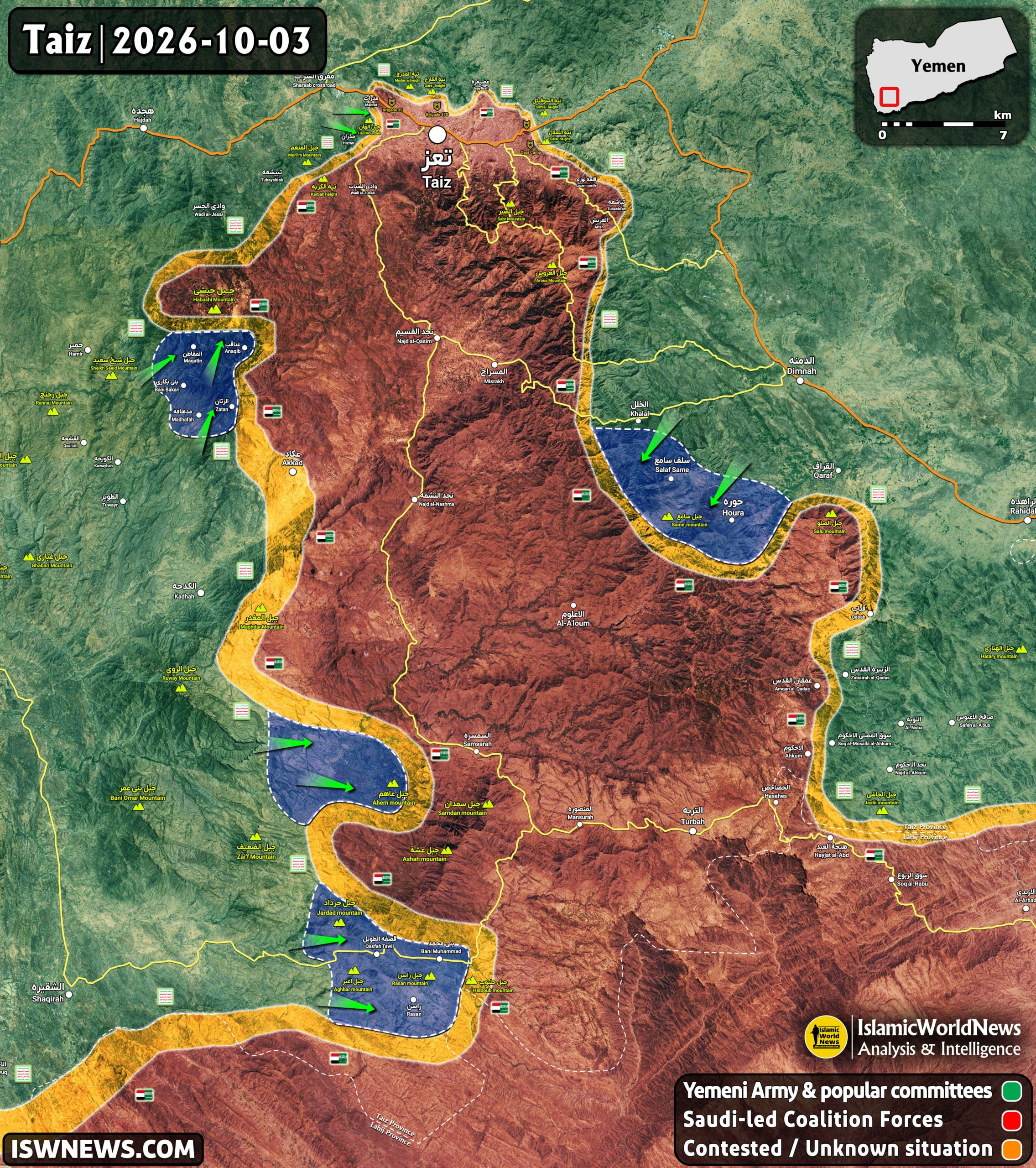
The reported Houthi gains stretched from the southern Taiz countryside to Same’ district, Jabal Habashi and the western outskirts of Taiz city, signaling a widening offensive across the province.
In southern Taiz, the Houthis reportedly took the heights of Jabal Rasan and Jabal Jardad, along with nearby villages including Rasan, Bani Mohammed, al-Za’azi and al-Kuwayrah. The reports also said the Houthis had captured Daba al-Dakhil and Jabal Ahem, while fighting continued around Asha and Samdan. Saudi-backed Yemeni government forces retained control of Mafraq al-Safiyah and the western Taiz-Aden road.
Further southeast, Houthi forces reportedly captured Hawrah and surrounding villages in Same’ district with the support of local tribes. Control of the area’s high ground reportedly gave the Houthis positions overlooking the al-Silu front and intensified pressure toward al-Turbah.
In Jabal Habashi, the Houthis also reportedly made gains after repelling an attack by a government-aligned armed faction. Maj. Gen. Mohammed Salem al-Khawlani, chief of staff of the Emergency Forces of Yemen’s Interior Ministry, was also killed on the al-Kadha front, according to the ministry and an October 2 report by Anadolu Agency.
The Houthis then reportedly expanded their positions in al-Zatan, Bani Bakari and Madhafah and captured al-Maqatin, Anaqib and al-Arari.
Near Taiz city, the Houthis reportedly took al-Han height, which overlooks the western approaches to the provincial capital and routes used by opposing forces.
Meanwhile, the Yemeni government announced on October 3 that its forces had carried out 71 operations against Houthi positions, military buildups and reinforcements across Taiz.
Col. Majed Abdullah al-Nuzaili, a spokesman for the government forces, said the operations hit areas including Jabal Rasan, Jabal Jardad, Same’ and Bani Bakari.
Click to see full-size map.
The recent Houthi advance in Taiz came after Reuters reported that Saudi Arabia was preparing an offensive that could begin within weeks against the Houthis. According to the report, the operation would rely on more than 100,000 Yemeni government troops overseen by Riyadh and supported by Saudi strikes, with the campaign aimed in part at reversing Houthi gains along the Red Sea coast and around the Bab el-Mandeb Strait.
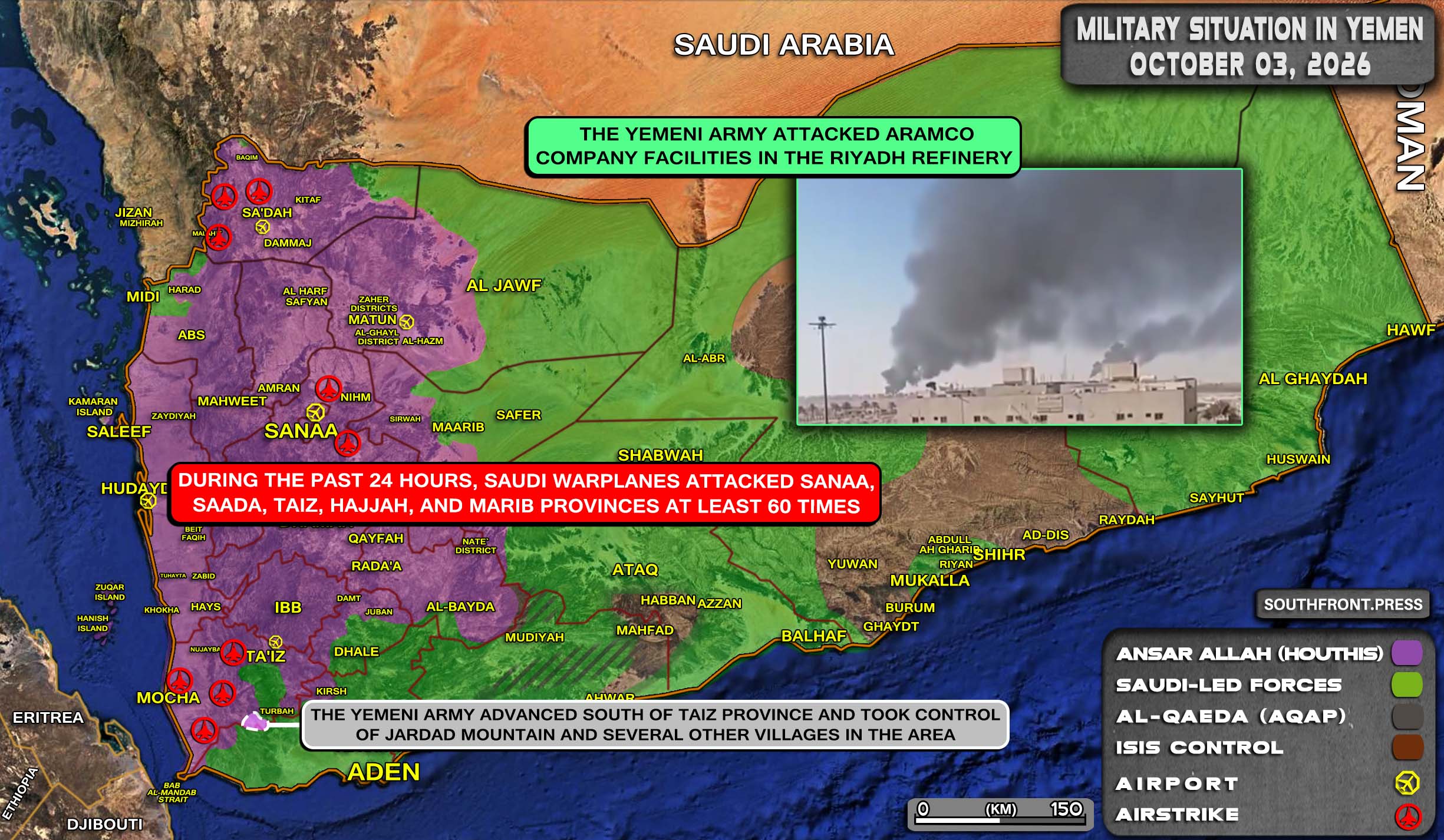
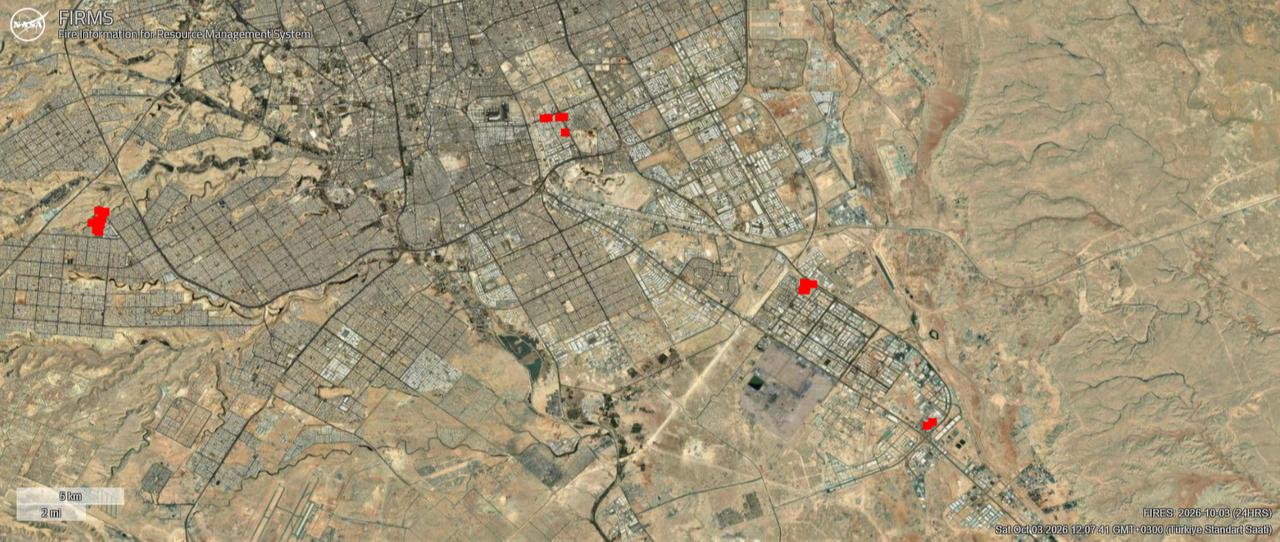
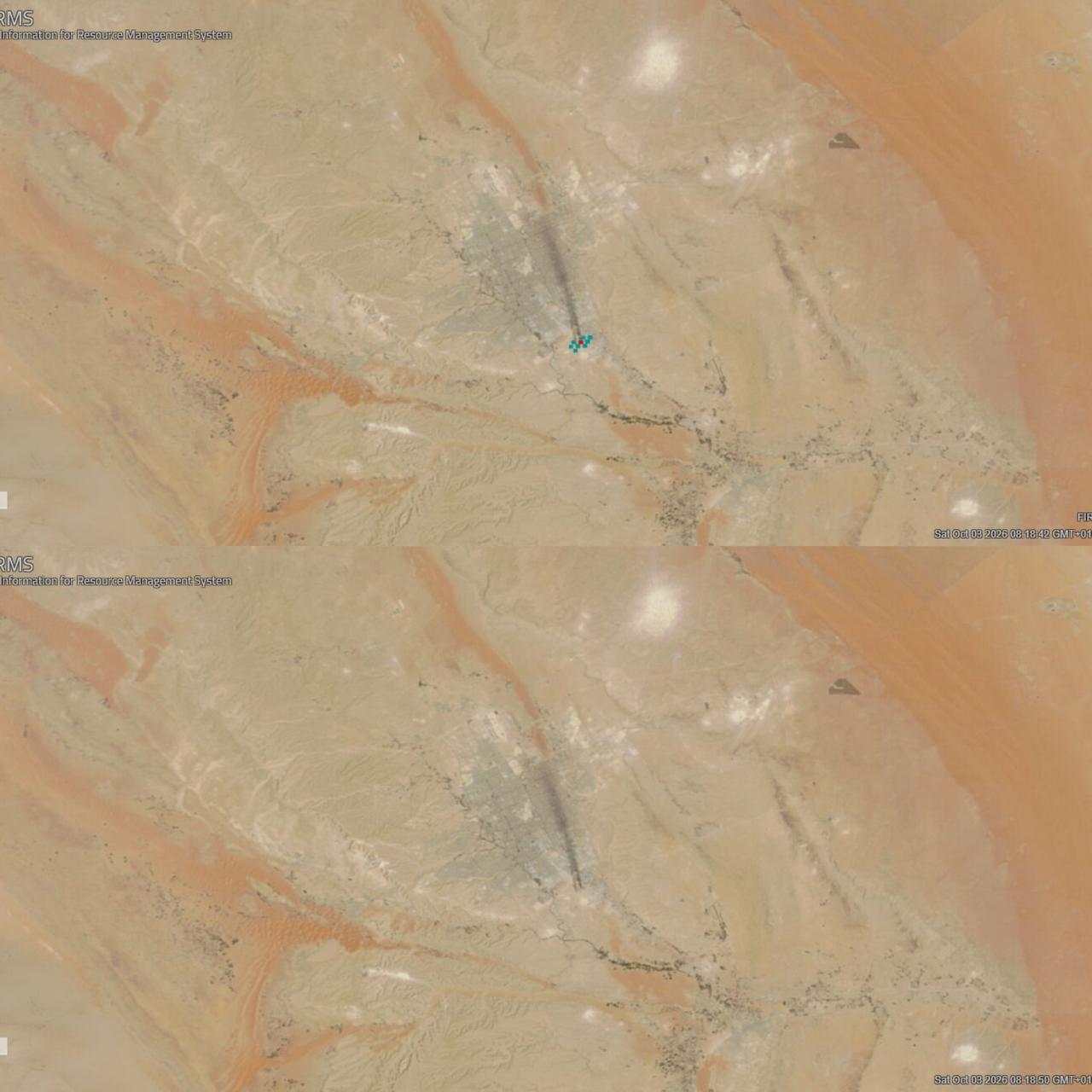
Smoke was reported over Riyadh on October 3 after satellite monitoring detected unusual thermal activity at an Aramco refinery, amid unconfirmed reports that the Houthis had attacked the Saudi capital.
NASA’s FIRMS detected higher-intensity thermal activity at the refinery, while NASA Terra imagery appeared to show a large fire and thick smoke drifting across northern Riyadh. Videos posted to social media also indicate that a massive fire broke out at the facility.
Click to see full-size image. (Photo via firms.modaps.eosdis.nasa.gov)
Click to see full-size image. (X(=)
Saudi authorities and Aramco had not commented, and the Houthis had not claimed responsibility. The group usually announces such attacks within 24 hours.
The reported incident came amid an intensification of fighting in Yemen. The Houthis reported Saudi strikes on the capital, Sanaa, and the provinces of Saada, Taiz and Amran, while Yemen’s internationally recognized government claimed that its warplanes carried out 20 strikes against Houthi positions and forces in Taiz on October 2.
The escalation followed reports of Houthi advances on several fronts in Taiz, where the group has been seeking to expand its positions and cut routes linking government-held areas.
Yemeni military officials have disputed some Houthi claims of territorial gains, and the front lines in Taiz remained contested.
The developments also came shortly after Reuters reported that Saudi Arabia was preparing an offensive against the Houthis that could begin within weeks. The operation would reportedly rely on more than 100,000 Yemeni ground troops overseen by Riyadh and supported by Saudi strikes, with the campaign aimed in part at reversing Houthi gains along the Red Sea coast and around the Bab el-Mandeb Strait.
All recent developments indicate that the war in Yemen is about to heat up even further. Efforts to de-escalate do not appear to be moving forward.
Yemen’s Houthis have denied targeting a power station in the city of Medina. A Saudi-led coalition earlier accused the militant group of targeting the facility supplying power to the Prophet’s Mosque – one of the holiest sites in the Muslim world.
A senior Houthi official branded the accusation a “lie” aimed at tarnishing the group’s image and reinforcing similar claims made by the coalition in the past.
On Thursday, the Saudi coalition’s spokesman, Major General Turki al-Maliki, accused the Yemeni militants of striking the Taibah electricity distribution station in Medina earlier this week in what he called a “cowardly terrorist act” and a part of an alleged broader campaign by the Houthis to “target the Two Holy Mosques.”
In mid-September, Saudi Arabia accused the Houthis of launching a drone towards the holy city of Mecca. The unmanned aerial vehicle was intercepted and destroyed, it added. The Yemeni movement’s leader, Abdel-Malik al-Houthi, dismissed that claim as a “heinous lie” in a televised address at the time, claiming Riyadh was “weaponizing lies” to advance its own agenda.
The developments have sparked concerns in Türkiye and Pakistan, which signed a joint defense agreement with Saudi Arabia in August. Speaking to the United Nations General Assembly last week, Pakistani Prime Minister Shehbaz Sharif called any “threat to the sanctity” of the Muslim holy cities of Mecca and Medina a “red line that must never be crossed.”
Ankara denounced this week’s alleged Medina attack. “Any attack targeting the sanctity, peace, and security of the Two Holy Mosques is an unacceptable affront directed at the shared sensitivities of the entire Islamic world,” the Turkish government spokesman, Burhanettin Duran, said on X on Friday. He vowed that Türkiye “will continue to stand by Saudi Arabia.”
The developments come amid the continued escalation between the Houthis and the Saudi-led coalition. Riyadh has backed Yemen’s internationally recognized government against the Houthis since intervening in the country’s civil war in 2015.
Large-scale fighting largely subsided after a UN-brokered truce in 2022, but the conflict erupted again this summer after an airport in the Houthi-controlled Yemeni capital of Sanaa was bombed to prevent a returning Houthi delegation that had flown to Iran from landing.