Indian actor Tiger Shroff remained unhurt in a shooting incident in Mumbai’s Juhu area, in which his driver and a bystander sustained injuries, local media reported.
A report by Indian news website The Hinduquoted an official as saying that the incident took place around 7pm as Shroff was leaving his place of work.
Mumbai Zone-II Deputy Commissioner of Police Mohit Garg further said that Shroff’s driver, Firdaus, sustained an injury to his left hand while a bystander, identified as Chauhan, was also wounded and taken to a hospital.
According to the report, Maharashtra Chief Minister and Home Minister Devendra Fadnavis has directed Mumbai Police Commissioner Deven Bharti to investigate the case and take action against the perpetrators.
Meanwhile, Maharashtra Deputy Chief Minister Eknath Shinde told The Hindu that “our priority is to keep Mumbai’s citizens safe. We will not spare anyone trying to threaten our film industry”.
He added, “It is time we respond to them in their own language. In the 1990s, Mumbai saw the gang war era. The Mumbai Police stopped it. We will not tolerate such gangs. This incident is unfortunate.”
The All Indian Cine Workers Association, which represents those part of the film industry, released a statement on the incident, saying it was “shocked and deeply anguished by the firing on Bollywood actor Tiger Shroff in Mumbai’s Juhu area”.
“This is not an isolated incident. Shots were fired outside Salman Khan’s residence in Bandra. Actor Saif Ali Khan was stabbed in an attack at his Bandra home. Shots were fired outside the Juhu home of filmmaker Rohit Shetty. Comedian Kapil Sharma’s cafe was attacked repeatedly. Now Tiger Shroff has been fired upon.
“One after another, people from the film industry are being targeted, and a deliberate atmosphere of fear is being created. The intent is plain: gangsters want to terrorise Bollywood personalities and extort money from them,” the statement said.
The association said that despite repeated incidents, the government and the police had failed to stop these attacks.
“Gangsters have openly claimed responsibility in earlier cases, yet the network continues to operate. Statements are not enough. Bollywood needs real protection,” it stressed.
It demanded from CM Fadnavis to take the strictest possible action against the gangsters behind these attacks, arrest the shooters and also those who ordered the firing, without delay, and “break the extortion network”.
The body also called for provide adequate security and protection to film personalities and their families and fix accountability for the repeated failure to prevent these attacks.
Local media reported that the responsibility of the attack was claimed in an unverified social media post, which said: “Those in the Mumbai industry who work with Salman Khan and don’t listen to us will meet the same fate.” Authorities have not addressed the post yet.
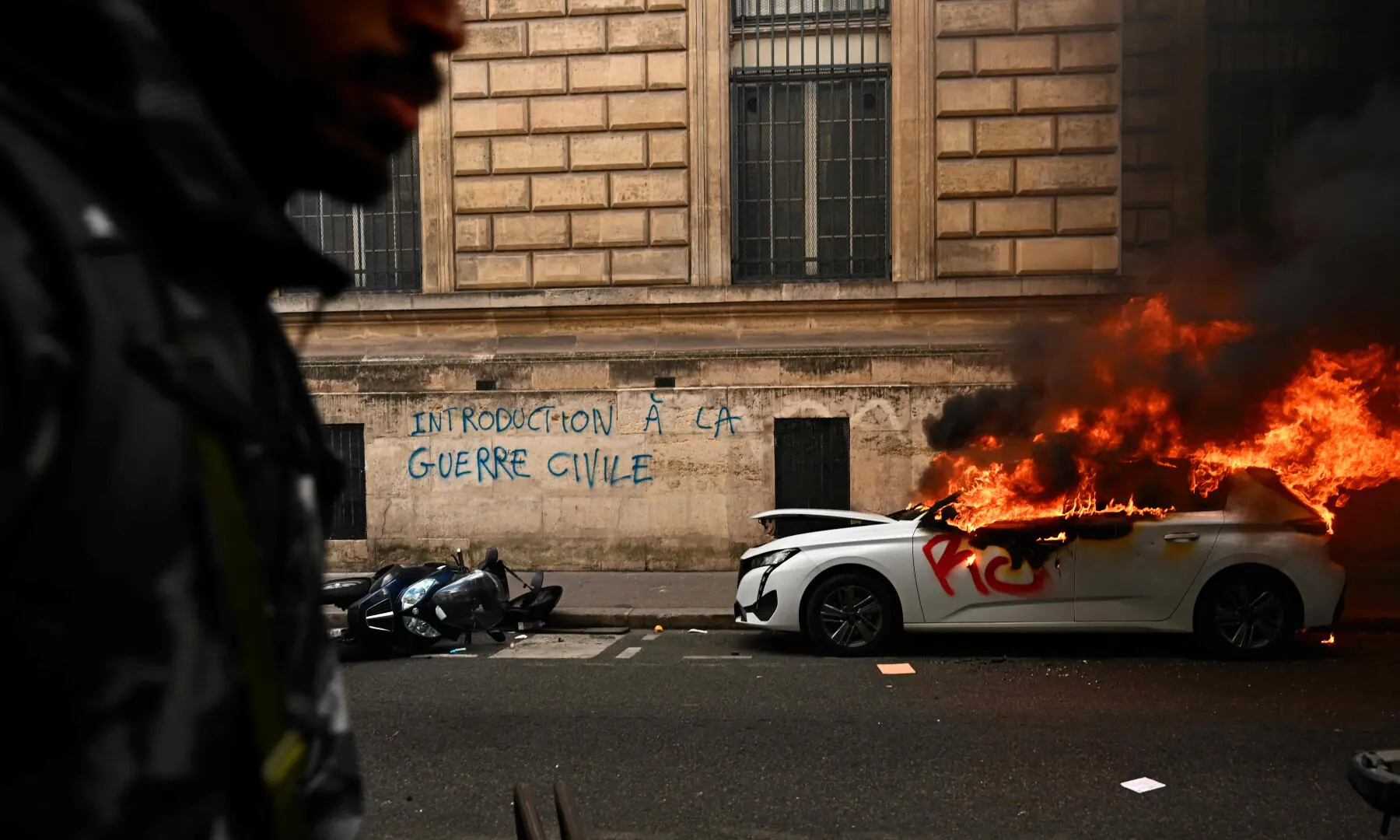
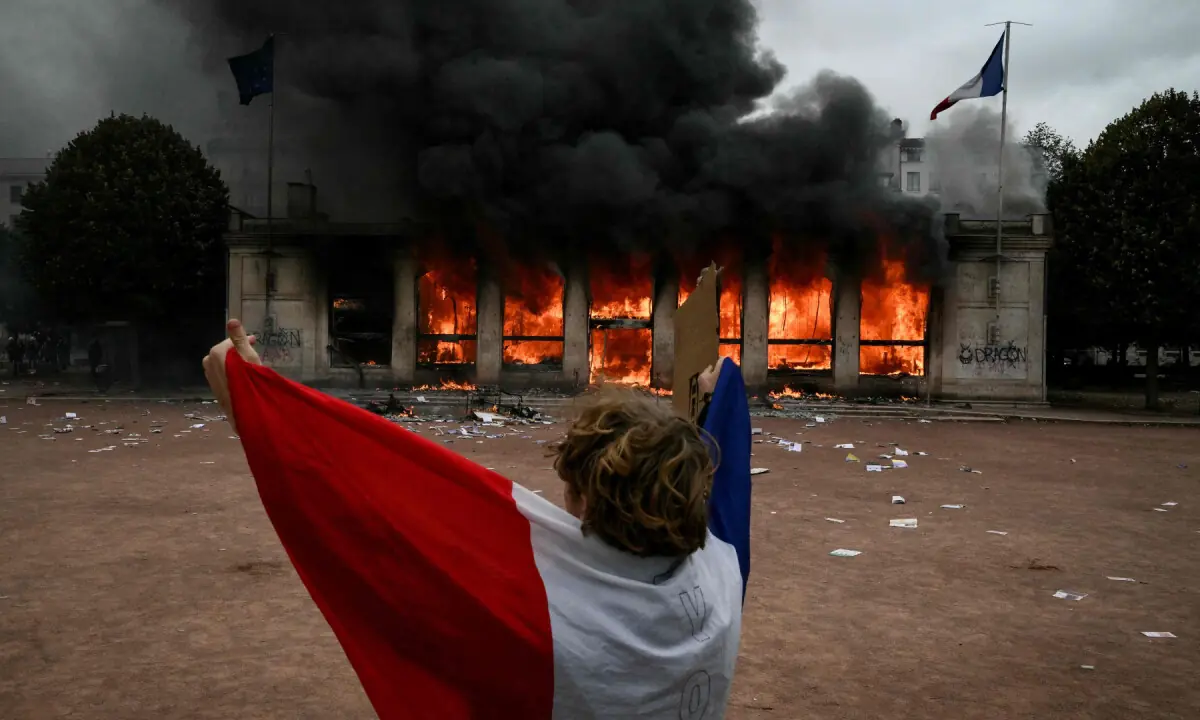
Torched cars, smashed shopfronts and burnt debris scarred numerous streets in Paris on Sunday, where officials said 557 people were in custody as France reeled from widespread damage caused by violent protests the day before.
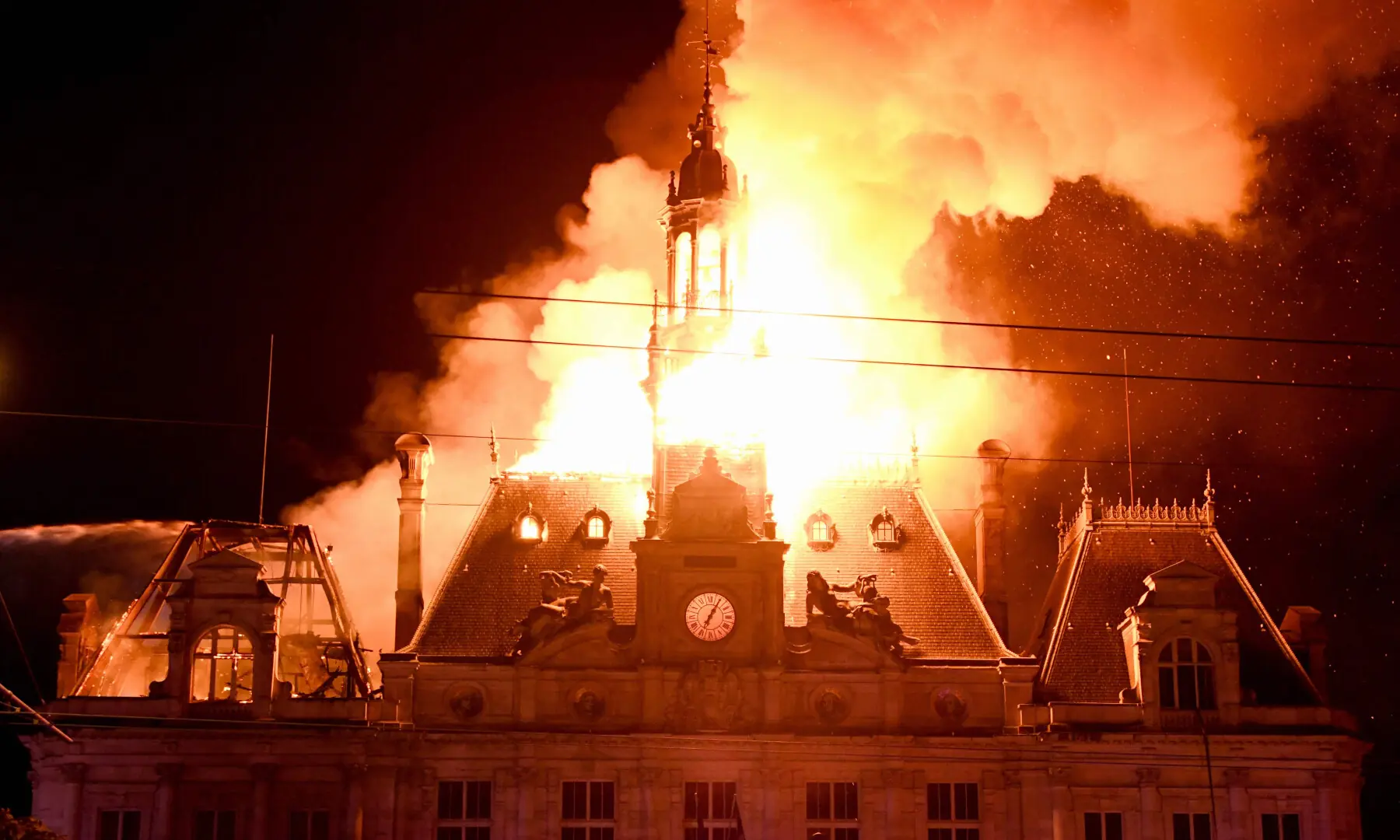
Hundreds of shops were looted in Paris and other cities, including Marseille, Bordeaux, Nice and Strasbourg, during the protests over the cost of living. The city of Limoges lost its 19th-century town hall to a fire, while a tourist office in the centre of Lyon was set ablaze as well.
Interior Minister Laurent Nunez said 1,800 people were arrested over the protests and looting, with investigations under way “to identify the perpetrators of these acts”. Around 500 police, firefighters and paramedics were hurt in the protests, the minister said.
Here are glimpses of what went down across France over the weekend after the “Yellow Vest” movement called Saturday’s “yellow and youth” demonstrations.
A car burns near a graffiti reading “introduction to civil war” as clashes erupted during a demonstration against the “high cost of living”, in Paris on Oct 17, 2026. — AFP
This photograph shows a fire burning and destroying the city hall after a group of individuals forced entry into the building during ongoing protest action against the “high cost of living”, in Limoges, central France on Oct 17, 2026. — AFP
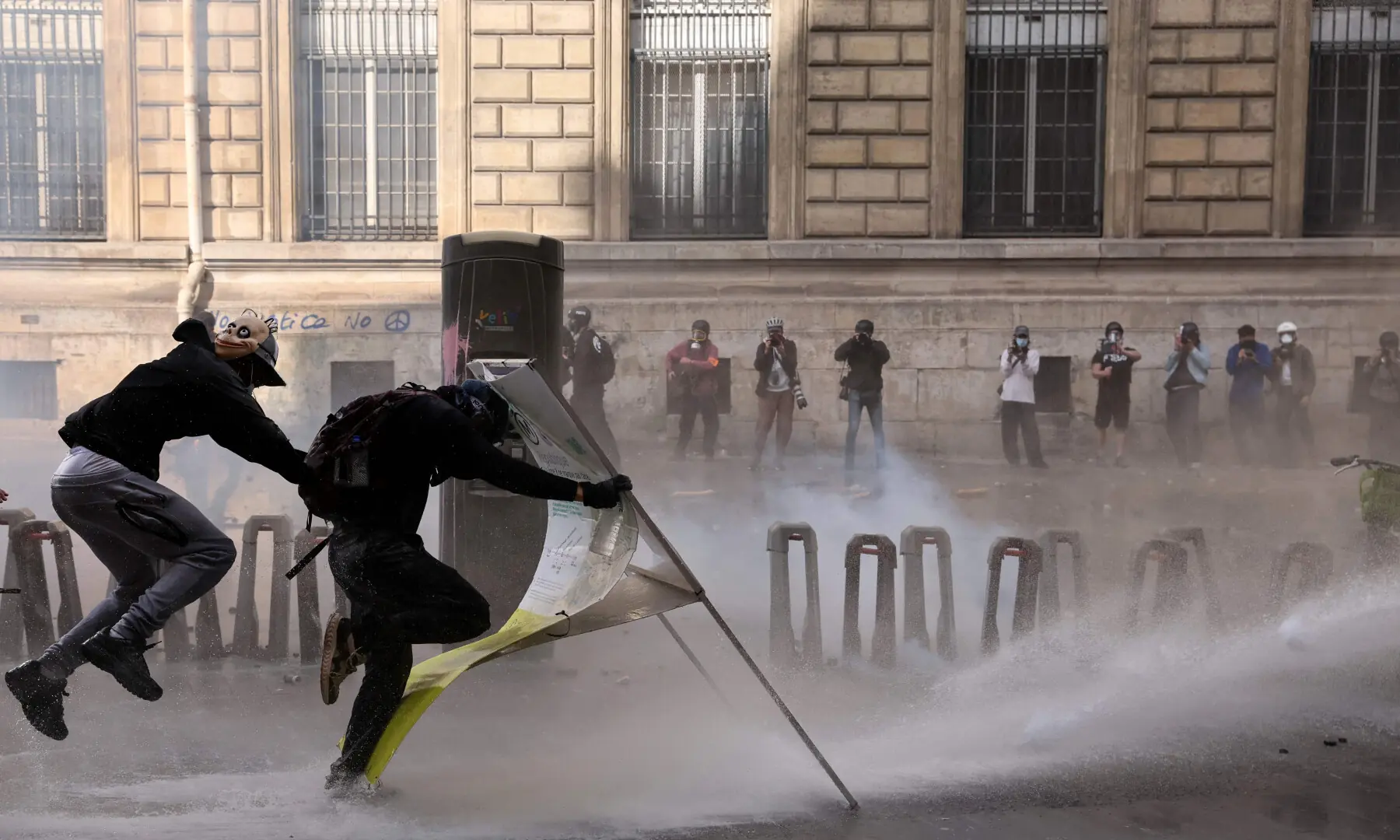
Protesters shield themselves from police water cannons during a demonstration to protest against the “high cost of living”, at Place de la Republique in Paris on Oct 17, 2026. — AFP
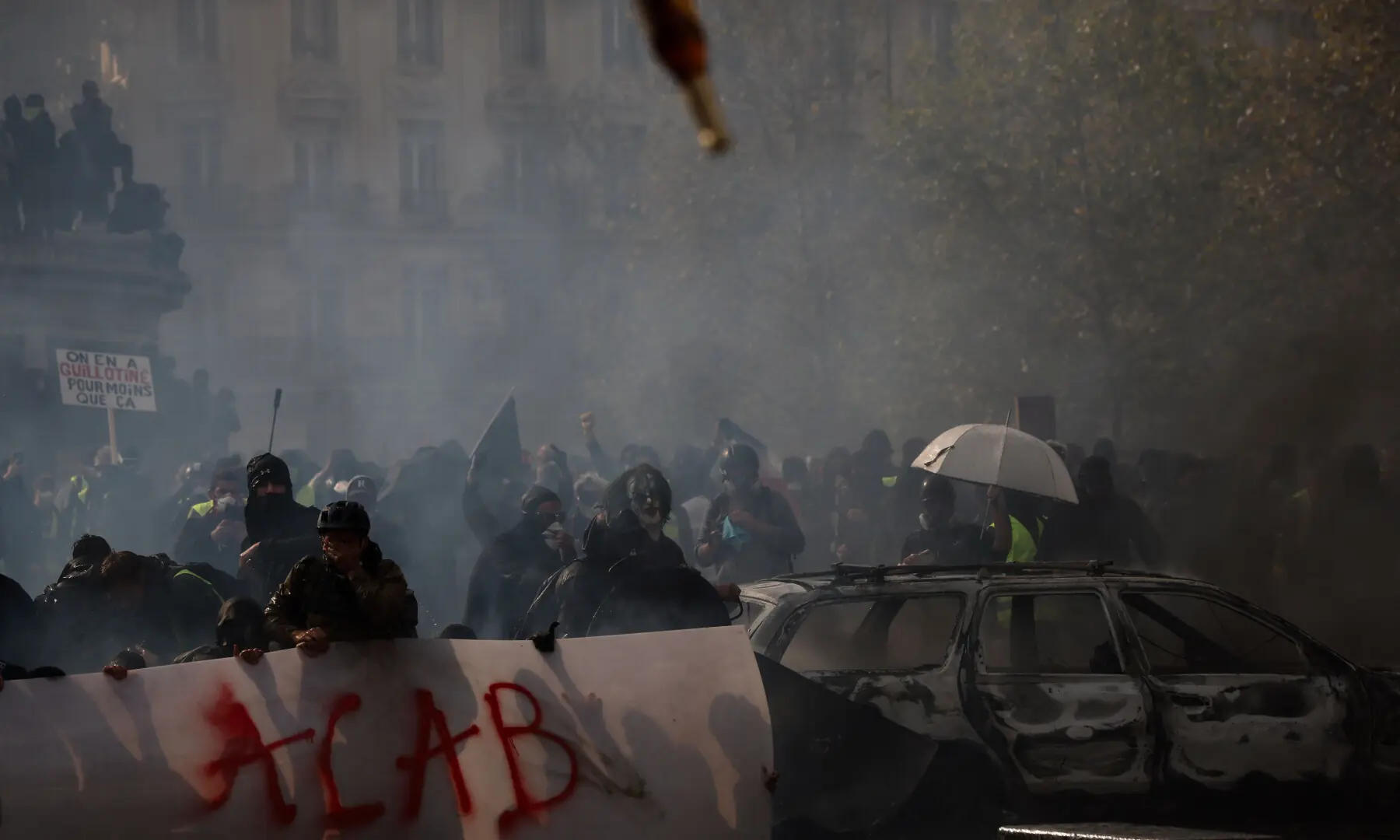
Protestors hold a banner reading “ACAB” (for “All Cops are Bastards “) during a demonstration on Place de la Republique to protest against the “high cost of living”, in Paris on Oct 17, 2026. — AFP
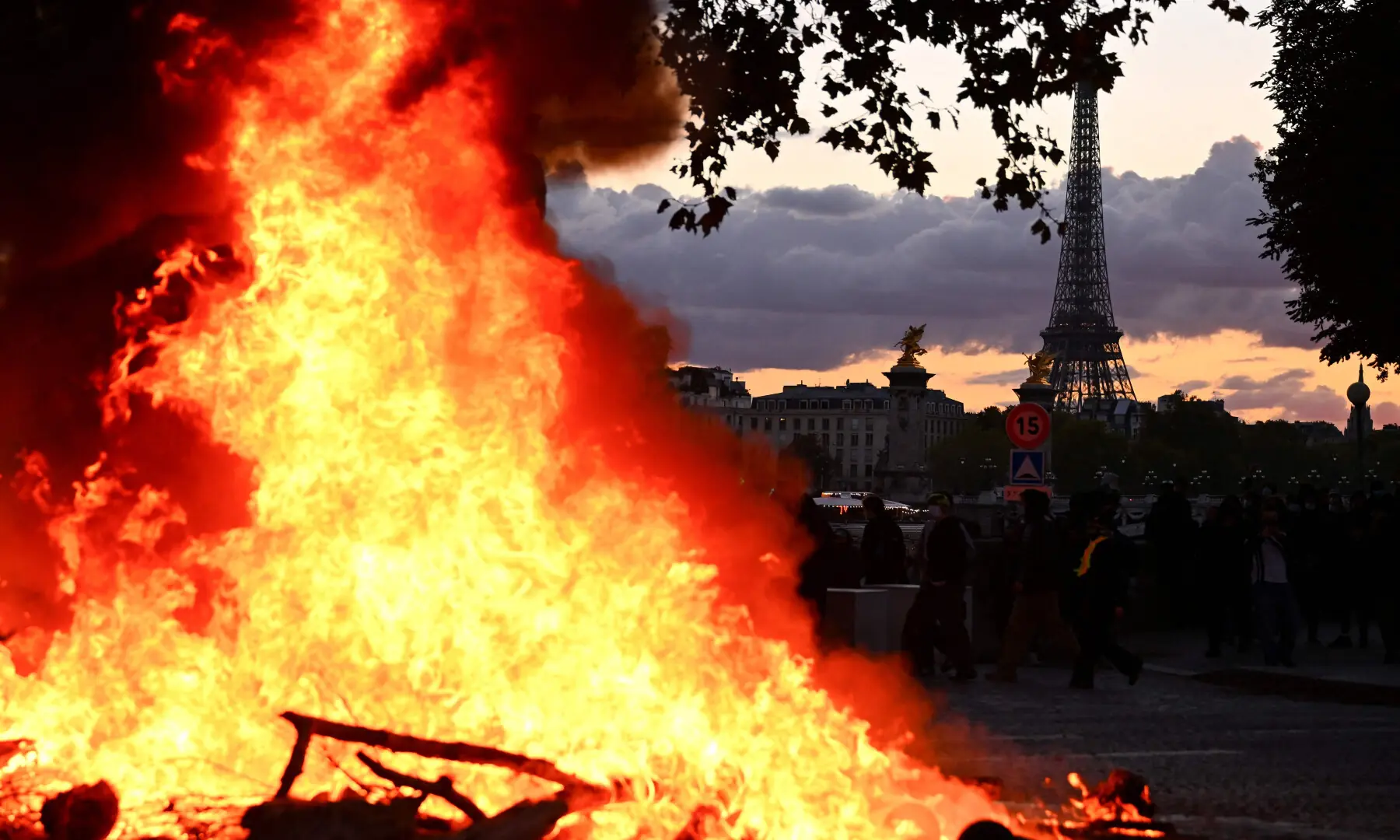
A fire is seen with the Eiffel Tower in the background during a demonstration to protest against the “high cost of living”, in Paris on Oct 17, 2026. — AFP
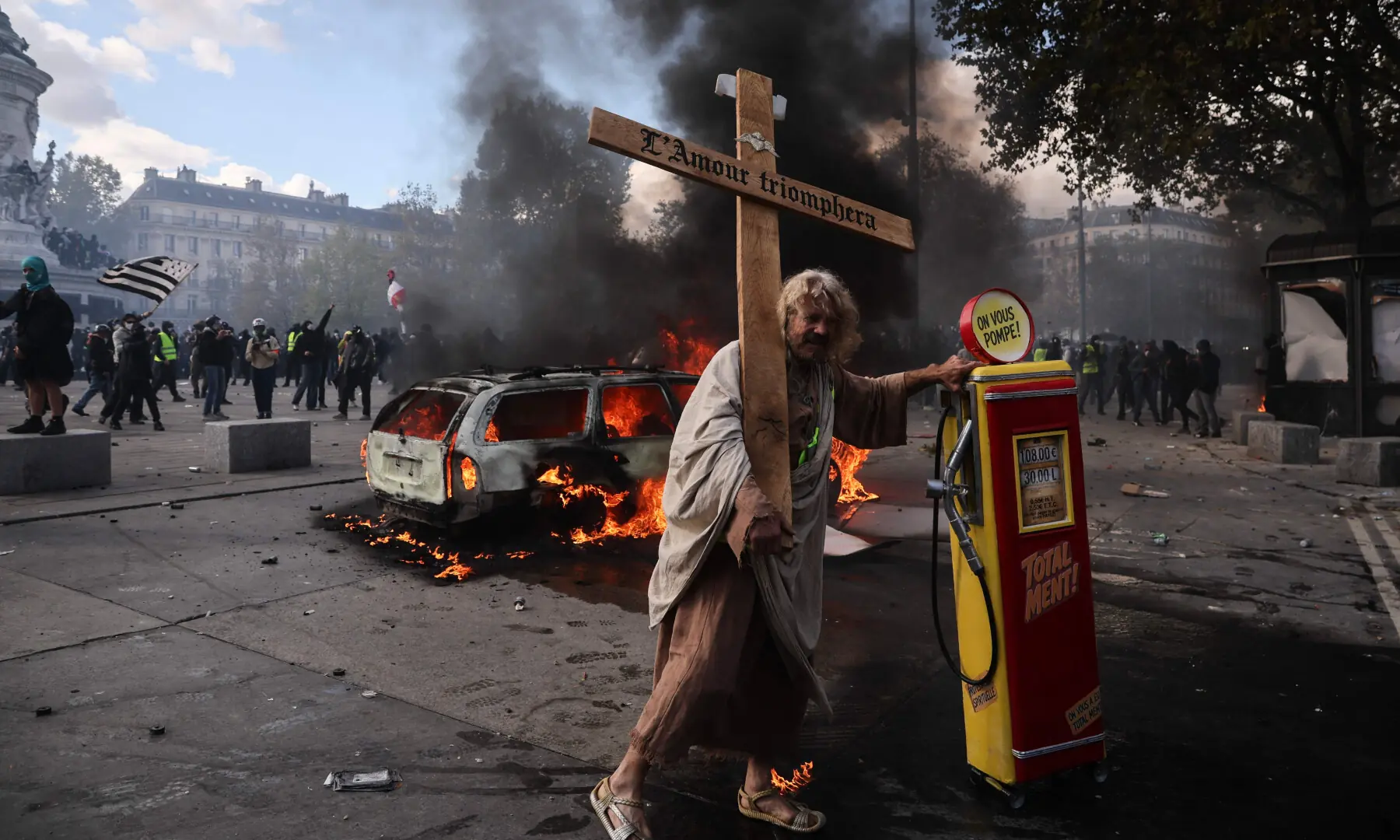
A protester holds a cross with an inscription reading “love will triumph” and stands next to a gasoline pomp during a demonstration to protest against the “high cost of living”, at Place de la Republique in Paris on Oct 17, 2026. — AFP
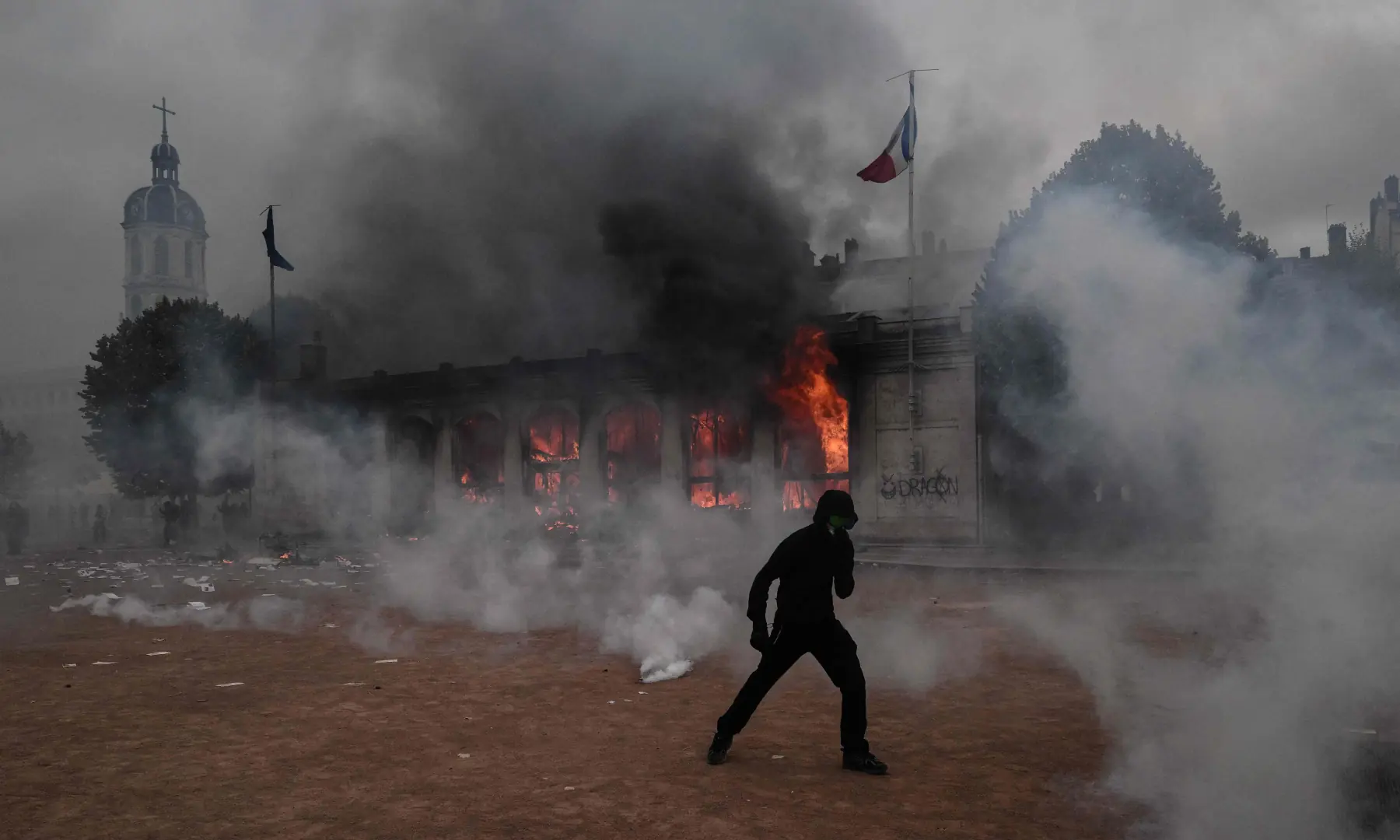
A protester kicks stands amid tear gas in front of Lyon’s tourism office during a demonstration to protest against the “high cost of living”, in Lyon, southeastern France, on Oct 17, 2026. — AFP
Protesters enter a Foot Locker store as they take part in a demonstration to protest against the “high cost of living”, in Nantes, western France, on Oct 17, 2026. — AFP
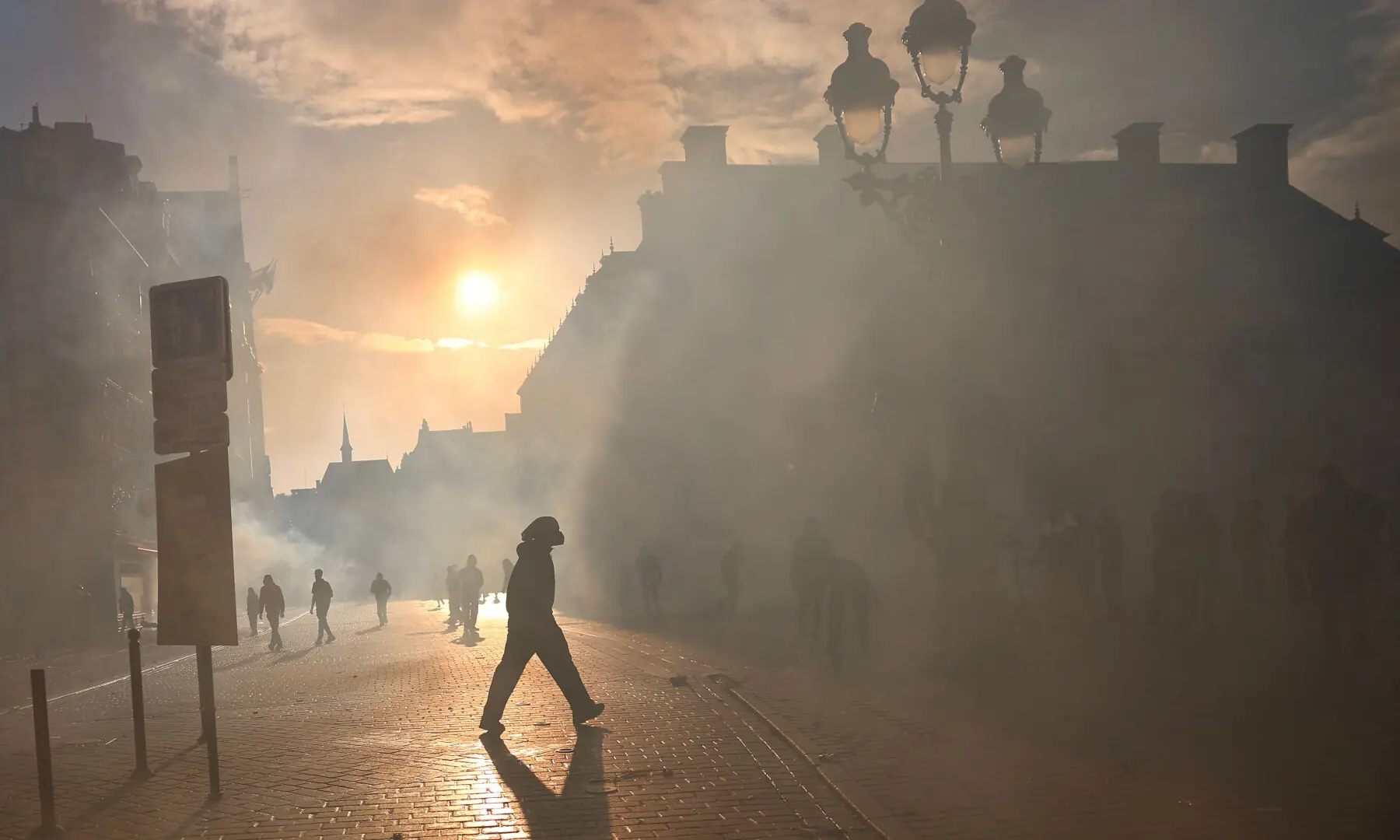
A protester walks in the smoke at Place de l’Opera during ongoing protest action against the “high cost of living”, in Lille, northern France, on Oct 17, 2026. — AFP
A photograph taken on Oct 18, 2026 shows the frontage window of a “McDonald” fast food restaurant broken in Lille, northern France, a day after nationwide protests against the “high cost of living”. — AFP
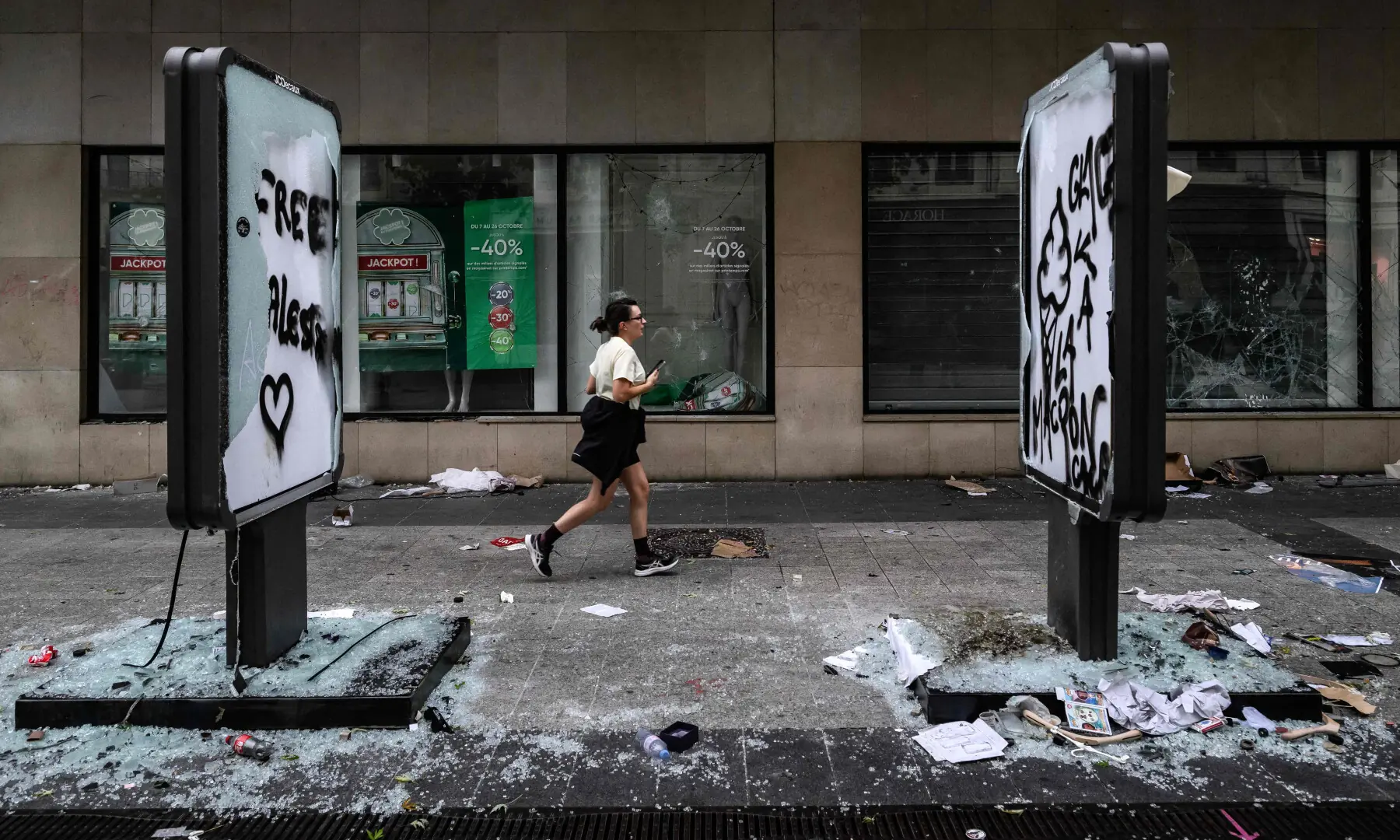
A pedestrian runs past damages and broken frontage windows of a shop a day after riot and looting following a nationwide protest against the “high cost of living”, in Lyon central-eastern France on Oct 18, 2026. — AFP
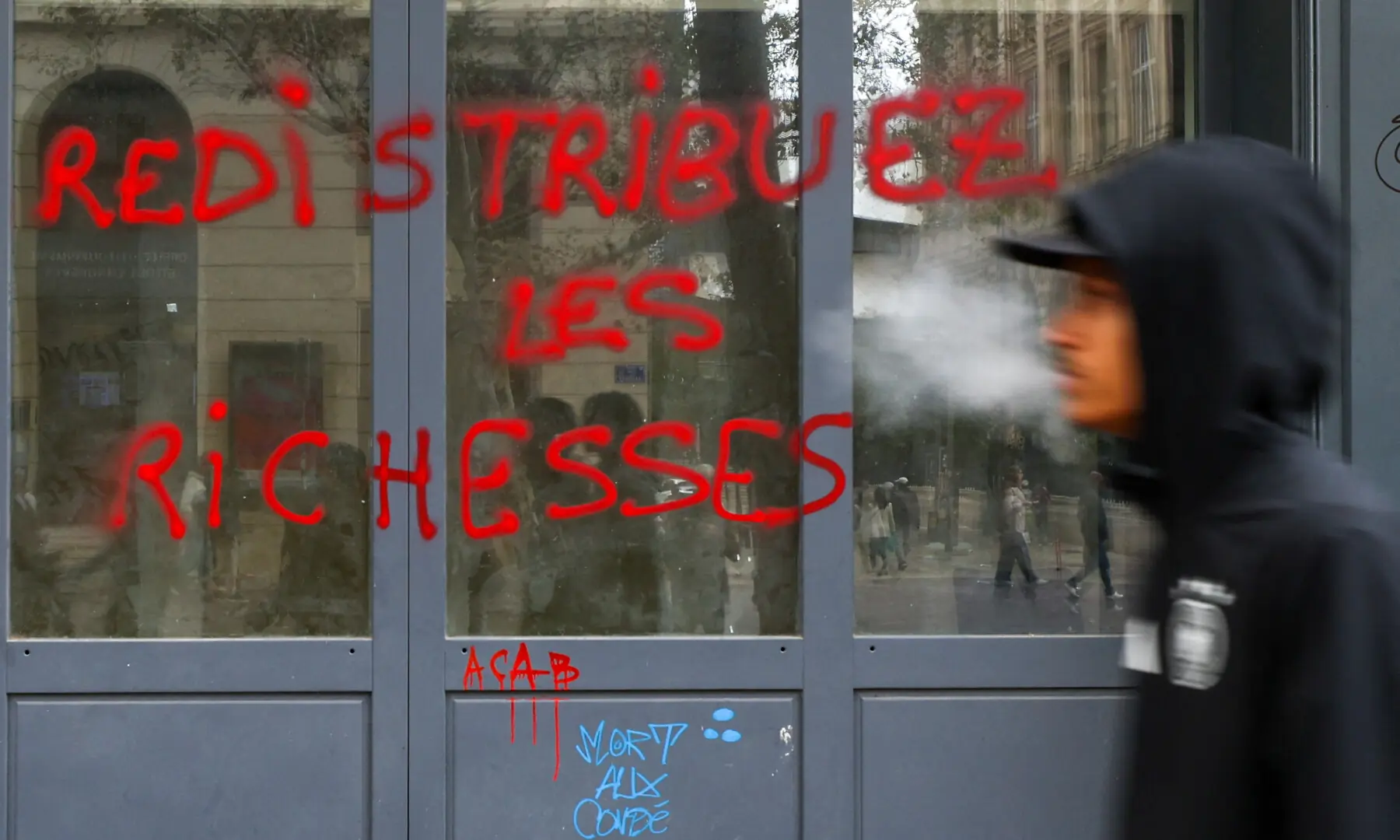
A man walks next to graffiti, which says “Redistribute wealth”, on a shop window, the day after clashes during a national day of demonstrations against the cost of living and rising fuel prices, in Marseille, France, on Oct 18, 2026. — Reuters
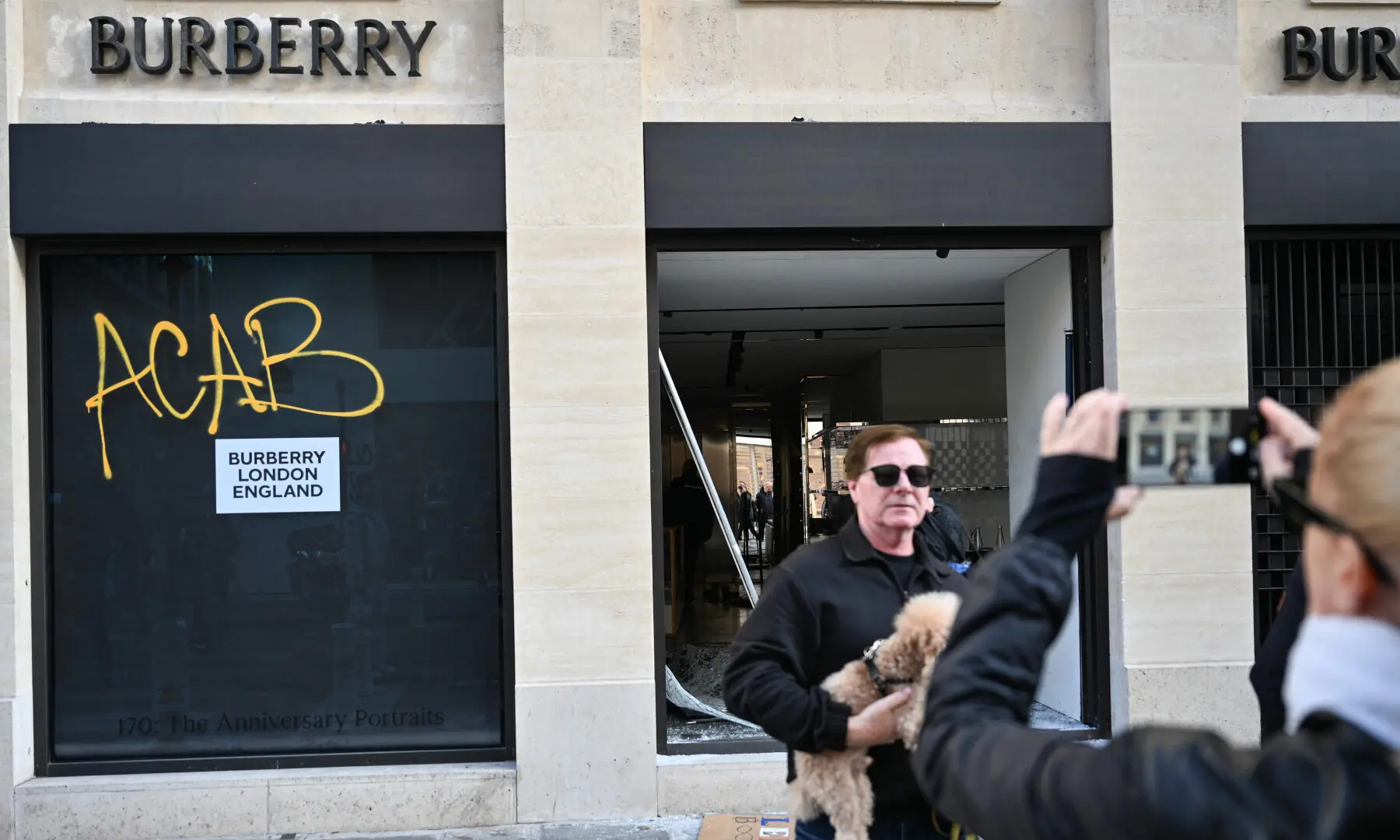
A pedestrian poses for pictures in front of a damaged “Burberry” shop reading the tag “ACAB - All Cops Are Bastards” in central Paris on Oct 18, 2026. — AFP
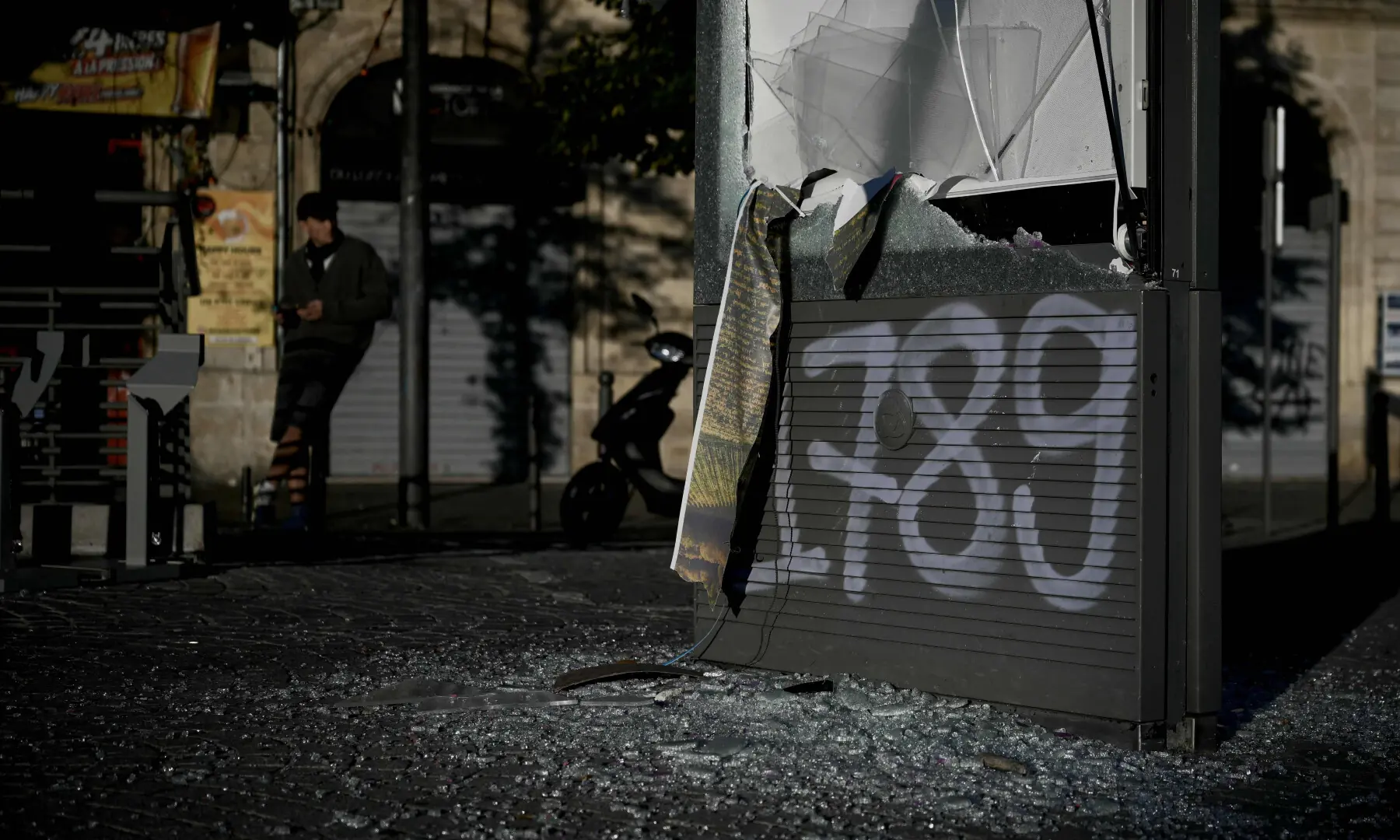
A photograph taken on Oct 18, 2026 shows a damaged, broken-down advertisement board reading “1789”, the year of the outbreak of the French Revolution, in central Bordeaux, southwestern France, a day after nationwide protests against the “high cost of living”. — AFP
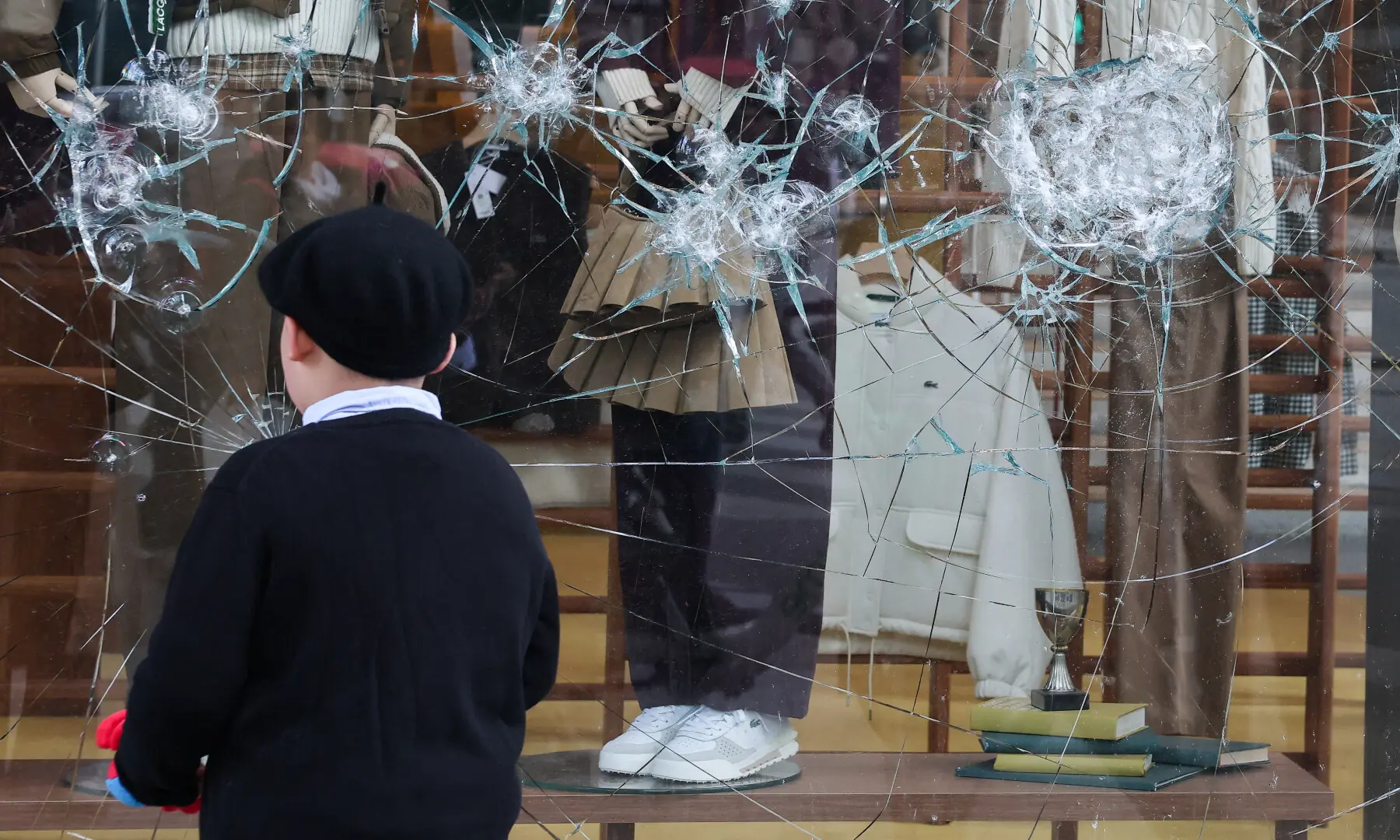
Damaged glass at the Lacoste store on Champs-Élysées Avenue, the day after clashes during a national day of demonstrations against the cost of living and rising fuel prices, in Paris, France on Oct 18. — Reuters
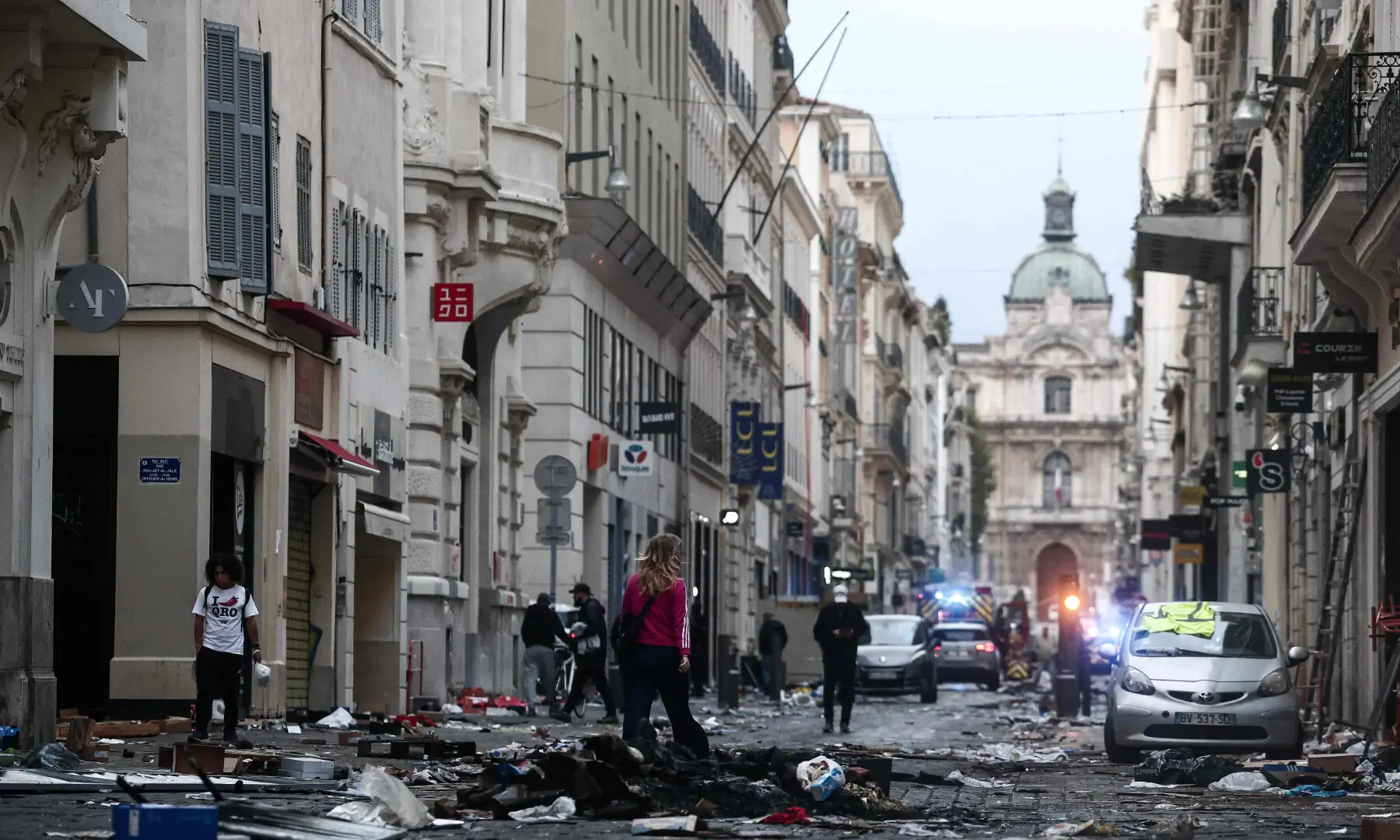
Pedestrians walk along a street covered in debris a day after nationwide protests against the “high cost of living”, in Marseille on Oct 18, 2026. — AFP
A pedestrian takes pictures of the damaged “Louis Vuitton” shop, in central Paris on Oct 18, 2026, a day after nationwide protests against the “high cost of living”. — AFP
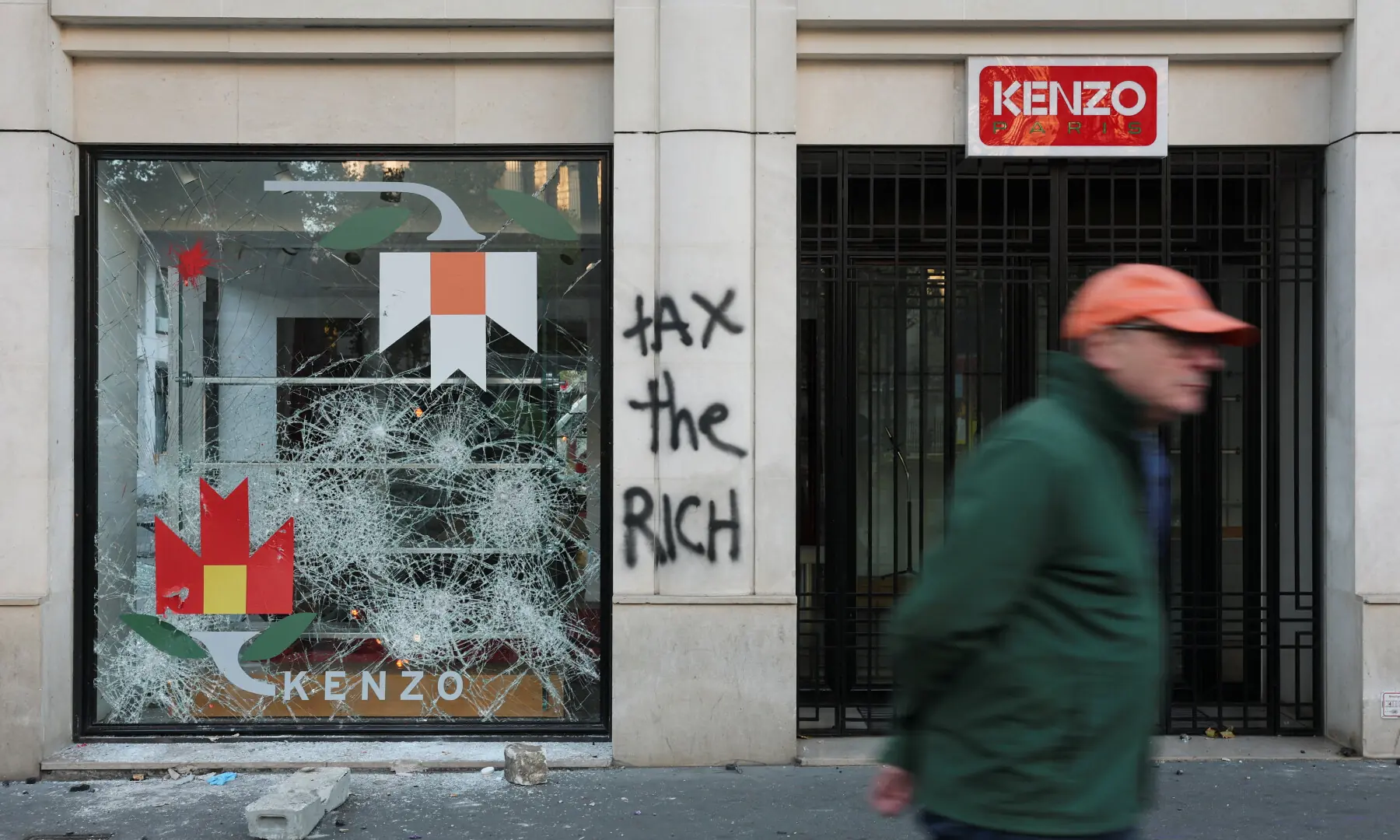
A man walks past a vandalised Kenzo store, the day after clashes during a national day of demonstrations against the cost of living and rising fuel prices, in Paris, France, on Oct 18. — Reuters
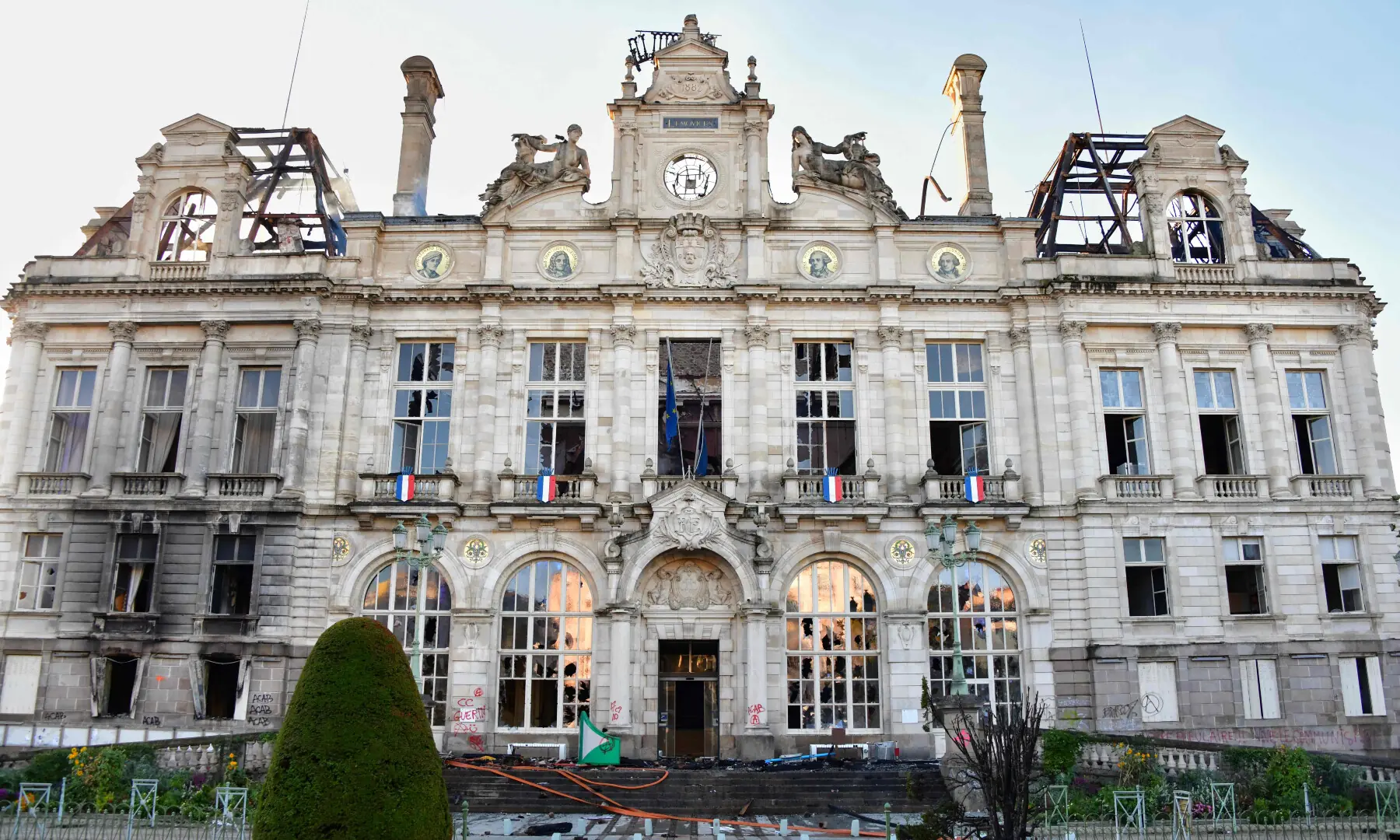
This photograph shows the partially burnt facade of the Limoges city hall a day after riots and looting following nationwide protests against the “high cost of living”, in Limoges on Oct 18, 2026. — AFP
Header image: A protester wrapped in a French national flag stands in front of Lyon’s tourism office set on fire during a demonstration to protest against the “high cost of living”, in Lyon, southeastern France, on Oct 17, 2026. — AFP
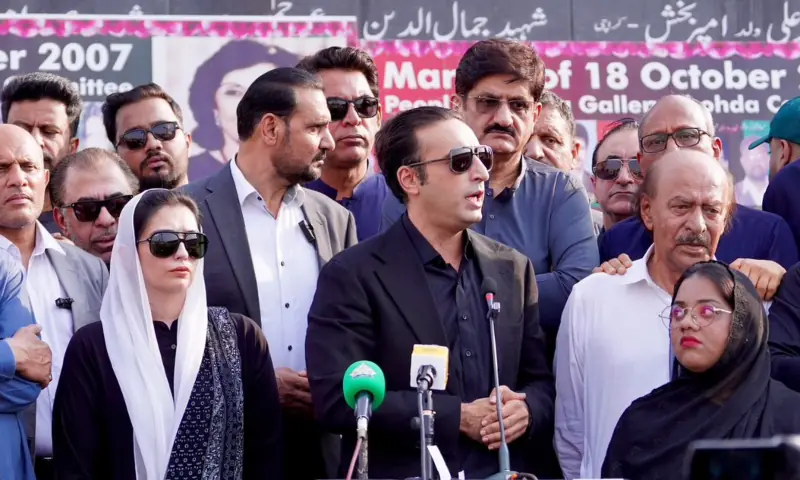
PPP Chairperson Bilawal Bhutto-Zardari said on Sunday that if the opposition was willing to fight against terrorism and engage with the Centre on a plan, governor’s rule and emergency imposed in Khyber Pakhtunkhwa could end.
He made these remarks while speaking to the media in Karachi, where he was visiting the Karsaz Monument on the 19th anniversary of the Karsaz bombing.
His statement comes a week after the Centre imposed governor’s rule and emergency in KP, citing the provincial government’s “deliberate disengagement” from the fight against terrorism. The move also followed a mobilisation drive and protest march by the PTI, which was in power in KP and in opposition in the Centre, to demand the release of its jailed founder, Imran Khan.
“If they really want to fight terrorists, and if they want that emergency and governor’s rule in KP to end, they should engage with the federal government and politicians and discuss a united policy regarding the fight against terrorism,” Bilawal said on Sunday, referring to the PTI-led opposition.
He added that if the opposition was ready to fight terrorism and “we agree on a plan” to do so, the emergency and governor’s rule in KP could end.
“If the Khyber Pakhtunkhwa chief minister (Sohail Afridi) is a coward, if he is not ready to defend his homeland, if he is not ready to fight those terrorists, then the PPP is ready to fight them,” Bilawal said.
“That is why we supported the government’s decision to impose governor’s rule in KP.”
He stressed that the party would “join forces with everyone to fight these terrorists”.
In his media talk, the Bhutto scion said the country had reached a point where “terrorist attacks are taking place from Khyber to Khuzdar”.
He regretted that when the Taliban came to power in Kabul in 2021, the Pakistani government at that time “also decided to invite the terrorists who were in Afghanistan to come back and live in our Swat, our Malakand, our former tribal areas”. He was seemingly referring to then-prime minister Imran’s plans to resettle members of the Tehreek-i-Taliban Pakistan in the country.
Bilawal went on to say that terrorists who were in jail in Pakistan were also freed. “Today, Pakistan is suffering the losses from these wrong decisions,” he lamented.
He added that the country had now once again reached the point where “some forces want to take down Pakistan’s flag in Swat” and there was a fight against terrorism ongoing across the entire country, while security forces, law enforcers and the public were being targeted.
However, he claimed, in the province where the highest number of terrorist incidents were taking place — KP — its chief minister had pledged that he would not face the terrorists.
In response to a question about the Karsaz bombing, the PPP chairman remarked that the greatest loss was caused when terrorist incidents were not taken seriously.
He said that the PPP had “prepared entire society” to fight terrorism by creating an environment for counterterrorism operations in 2008, when the party was in power. After that, he said, when the National Action Plan was introduced, the PPP adopted a holistic approach towards bringing changes in institutions to assist with combatting terrorism.
He emphasised that success was achieved when “every citizen” of Pakistan joined the fight against terrorism, saying, “Today as well, we will make efforts to create an environment where we are all united, and will fight the terrorists together.”
Answering further questions, he said Pakistan was facing a “historic economic crisis”.
“It appears that the situation will worsen. Our priority is to address this economic crisis, and to do that, we will have to fight terrorism as well,” he added.
He said efforts should also be made to improve the democratic and electoral system in Pakistan.
For this reason, he said, the PPP had highlighted the need for a new NAP and consensus on the fight against terrorism, while also extending an invitation to the opposition to play a part in this.
He said the PPP also made an effort to improve the democratic system by pushing for electoral reforms. To this end, the federal government had decided to establish an electoral reforms committee in the National Assembly, adding that he had invited the opposition to play their part in that committee as well.
“If they say that democracy is weak in this country, they should help us to strengthen it,” the PPP chairman said.
He added, “If we can create such an environment, we will be in a better position to fight terrorists.”
Bilawal also said KP Governor Faisal Karim Kundi had been nominated by the PPP for the office of governor, but “constitutionally, he is now a representative of the federal government”.
He said Kundi reported to the federal government, but “I will keep talking to him and keep advising him; in principle, though, he is now working together with the federal government”.
Responding to a question regarding a potential “compromise” with the opposition, Bilawal said, “You say ‘compromise’ like it’s a bad word […] Compromise and politics go hand in hand.”
He stressed that ex-PM Benazir had always strived for compromises during her political career, adding that she knew that one could reach “extremes” if they remained a revolutionary or an activist who only protested rather than working for their cause.
“We had to solve our issues and lift the public and our workers out of difficulty,” Bilawal said about the PPP’s past tenures in government. He asserted that it was the result of the PPP’s “compromises” that led to the end of Gen Pervez Musharraf’s dictatorship, as well as the passage of the 1973 Constitution and the 18th Amendment.
“We (the PPP) are not in the federal government. Nor do we have a majority in Parliament,” he said. “But [we have to see] how we can conduct politics in the space we have.”
New provinces
Answering a question regarding the creation of new provinces, Bilawal stated that Interior Minister Mohsin Naqvi knew “clearly” what the PPP and President Asif Ali Zardari’s policy was regarding new provinces or administrative units, and that this was “not possible without the president’s signature”.
Naqvi’s July remarks calling for new provinces and reforms in the current governance system had ignited an animated debate across the country. The PPP, which rules Sindh, has strongly opposed any possible division of the province.
Bilawal stressed that the PPP’s position was clear: that they could be created in accordance with the Constitution and law if the provincial assembly agreed. The Sindh Assembly, amid a boycott by the opposition, adopted a resolution last month rejecting all attempts to divide the province or create new administrative units.
“Where there is consensus and it is not a political stunt, if there is no other purpose behind it … why aren’t provinces being made there?” the PPP chairman said, giving the example of Gilgit-Baltistan.
“If we really want this to be implemented, it must only be implemented where the provinces want this,” he stressed, noting that the entire GB Legislative Assembly had passed a resolution with consensus for the region’s constitutional rights.
Bilawal requested politicians, whether on the treasury or opposition benches, not to politicise the issue of terrorism or create controversy out of steps taken to combat it, but rather to play their role in fighting it.
Bilawal also spoke about Jamiat Ulema-i-Islam (JUI-F) chief Maulana Fazlur Rehman, saying he had the right to criticise the government’s policies, and that there should certainly be room for difference of opinion in the country.
He said the PPP had always imposed emergency through constitutional and legal means.
“In fact, during the 2008–2013 government, when emergency rule was imposed in Balochistan, it was also because of the terrorism situation, and governor’s rule was imposed there against the PPP’s own government.
“If the PPP thought only of itself, how would it have removed its own government?“
He said Fazl’s party has also been affected by terrorist attacks, so he hoped the JUI-F chief would criticise the PPP politically as much as he wished, but also condemn the terrorists.
Bilawal added that if Fazl made an effort, harmony between the government and the opposition could be achieved.
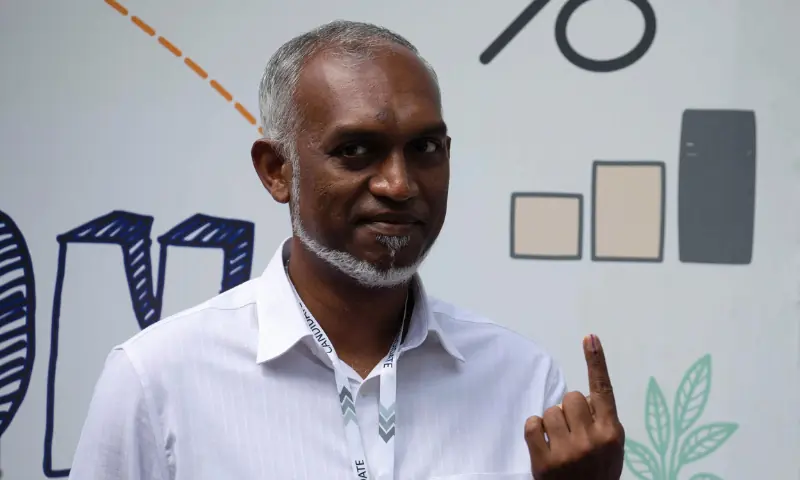
Maldives’ President Dr Mohamed Muizzu will undertake a three-day state visit to Pakistan from Oct 20-22 at the invitation of Prime Minister Shehbaz Sharif, the Foreign Office (FO) said on Sunday.
President Muizzu will be accompanied by First Lady Sajidha Mohamed and a “high-level delegation comprising cabinet ministers and senior officials”, according to a statement issued by FO.
During the visit, Muizzu will meet his Pakistani counterpart, President Asif Ali Zardari, who will host a state banquet in his honour, FO said.
He will also hold “restricted and delegation-level” talks with PM Shehbaz, it added.
During the talks, the two leaders “will review the entire spectrum of bilateral relations and explore avenues for further strengthening cooperation in trade, investment, health, education, tourism, agriculture, defence, maritime security, climate change and people-to-people exchanges”.
They will also exchange views on regional and international developments of mutual interest, FO added.
A Pakistan-Maldives Business Forum will also be held during the visit to promote interaction between the two countries’ business communities and explore opportunities for trade and investment, according to FO.
“A number of agreements and memorandums of understanding (MoUs) covering diverse areas of bilateral cooperation are expected to be signed during the visit,” the statement added.
FO highlighted that the visit marks the first by a Maldivian president to Pakistan in 11 years. It will take place as the two countries mark the 60th anniversary of the establishment of diplomatic relations in 1966.
“Pakistan and Maldives enjoy warm and fraternal relations rooted in shared faith, mutual respect, longstanding goodwill and close cooperation at regional and international forums,” the statement said.
The forthcoming visit reflected the “shared commitment of both countries to further strengthening their bilateral partnership and opening new avenues of mutually beneficial cooperation”, it added.
In 2015, former Maldivian president Abdulla Yameen Abdul Gayoom undertook a two-day state visit to Pakistan on May 6-7 at the invitation of then-premier Nawaz Sharif.
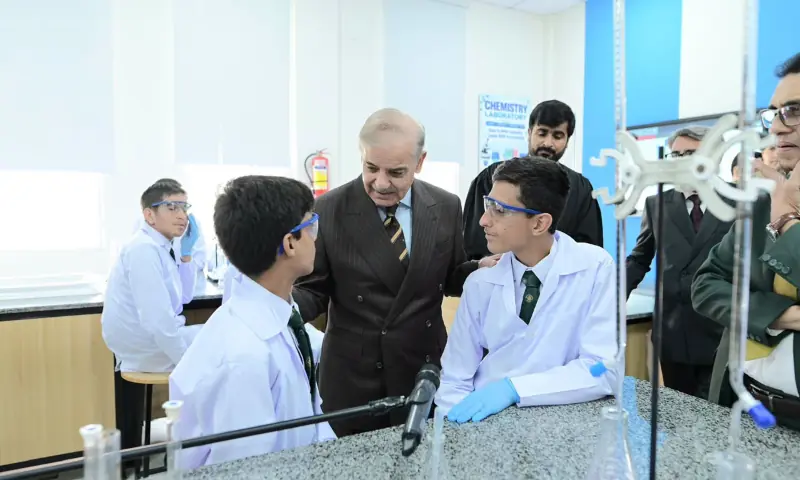
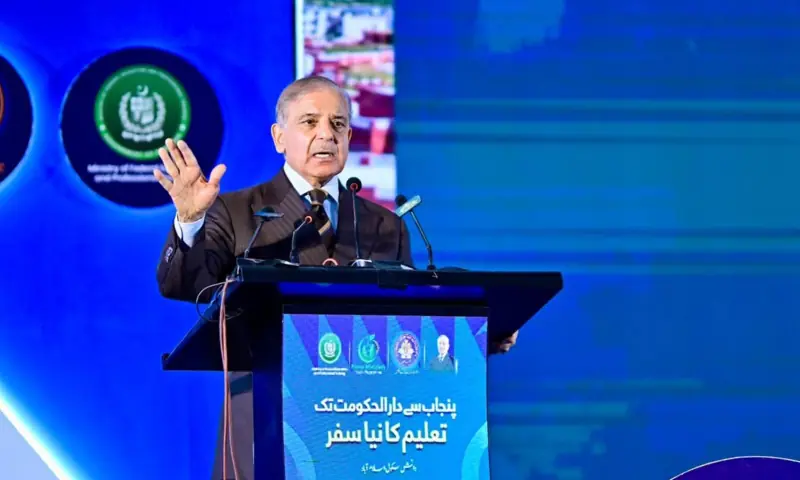
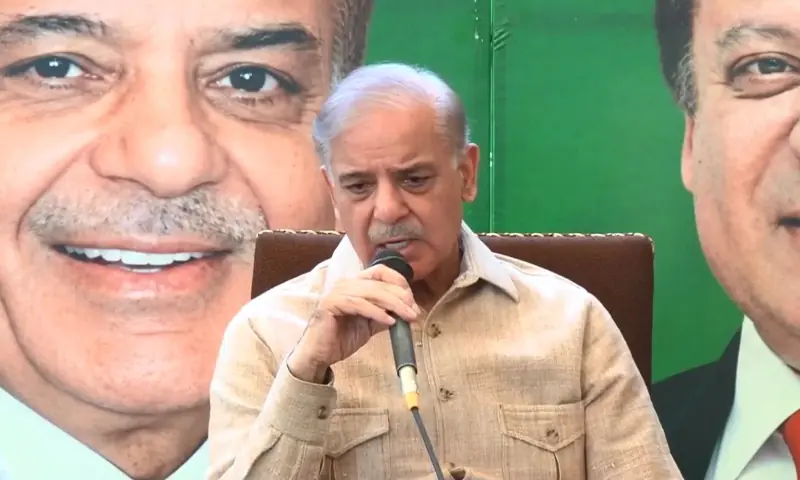
Prime Minister Shehbaz Sharif on Sunday inaugurated a Daanish School in Islamabad, saying the initiative aimed to provide quality education to talented students from underprivileged backgrounds and give them opportunities equal to those available to children from affluent families.
Daanish schools, originally introduced by the Punjab government, aim to provide quality education to marginalised and talented students. It is said to be the largest network of boarding schools for girls and boys in the country.
Speaking at the inauguration ceremony today in the capital today, the premier highlighted stories of Daanish School graduates, including a girl from Khyber Pakhtunkhwa who overcame challenges and a woman from Bahawalpur who went on to become a doctor after losing her father in childhood.
“Ladies and gentlemen, this was a vision we had seen in Punjab when I was its servant. How come the sons of rich people enter the iron steel gates of Aitchison College; sons of prime ministers, governors, bureaucrats, judges, civil servants, military servants, landlords, mill owners, regardless of their acumen and their level of intelligence,” PM Shehbaz said.
“And those millions of boys and girls, [who are] extremely intelligent, but come from the poorest of backgrounds in the four corners of Pakistan, Azad Kashmir and Gilgit-Baltistan, cannot even imagine opening the gates of Aitchison College, let alone having the opportunity to receive a decent education,” he noted.
According to the premier, this vision led his team to establish Danish Schools back in 2010.
“[The] concept was introduced in Punjab, not only to match the quality and level of Aitchison College and other grammar schools all over Punjab and other parts of Pakistan, but to excel,” he asserted.
PM Shehbaz stressed that every child deserved equal opportunities, whether they were the son or daughter of the richest man in Pakistan, the prime minister or anyone from the elite class, or a child who had lost both parents.
“If these children are left to waste their time in the muddy streets of their villages and cities, then this is not the Pakistan of Quaid-i-Azam Muhammad Ali Jinnah. This is certainly not his Pakistan,” he remarked.
The premier noted that the richest people in the country, regardless of how they earned their wealth, had the opportunity to send their children to the best schools in Pakistan and even to North America and the south of France.
“Imagine the plight of children like this daughter from Bahawalpur, this daughter from KP, and this boy sitting before you, who also became a doctor.”
A post by the Prime Minister’s Office (PMO) said, “A new dawn of education and excellence is about to rise in the capital!”
PM Shehbaz also interacted with multiple students at the campus. Education Minister Khalid Maqbool Siddiqui also spoke on the occasion.
The foundation of the school in the federal capital was laid in 2024, with 10 acres of land allocated by the Capital Development Authority.
In March, thousands of students across Pakistan sought admission to the school, which received over 7,000 applications against just 210 seats.
The school’s board of governors had also approved a budget of Rs3.8 billion for the year 2026-27 earlier this year.
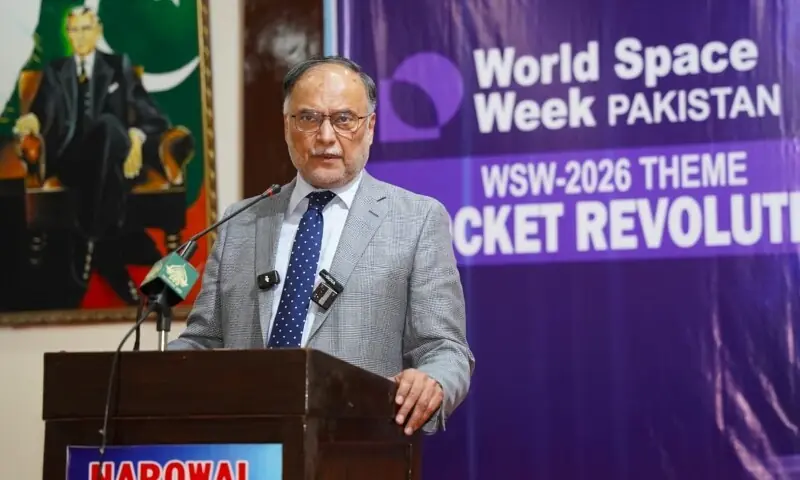
Pakistan’s first astronaut will undertake a space mission from a Chinese space centre on November 25, Planning Minister Ahsan Iqbal said on Sunday.
The minister made the announcement while addressing the concluding ceremony of World Space Week in Narowal, held in collaboration with the Pakistan Space and Upper Atmosphere Research Commission (Suparco), the planning ministry said in a statement.
According to the handout, the planning minister also said the country was aiming to achieve a lunar landing by 2035, expressing hope that Pakistan’s cooperation with China would help it “reach new heights in space exploration”.
In his address at the ceremony, the planning minister highlighted the importance of space technology in agriculture, communications, climate monitoring, education and national security.
Iqbal stressed that scientific research and space exploration were essential for technological advancement, the ministry’s statement said.
He further noted that Muslim scholars had once made significant contributions to astronomy and scientific discovery, calling for renewed efforts to restore Pakistan’s leadership in knowledge and research.
The astronaut will be one of the two — pilots Zeeshan Ali and Khurram Daud— China selected in April this year as candidates for its manned space programme and who have been undergoing intensive training in Beijing.
China has not said which of the two will fly or when, but speaking to Reuters last month, Amer Gilani, who oversees human spaceflight cooperation at Suparco, said a final astronaut selection decision was expected in mid-to-late October.
According to another Suparco official quoted by Reuters, once in space, the chosen pilot will carry the title of “payload specialist”, which is astronaut-speak for someone whose job in orbit is running Pakistan’s science experiments rather than flying the ship.
The astronaut will fly aboard a Chinese-built spacecraft, launched from a Chinese site, trained by Chinese instructors and communicating in Mandarin in orbit.
KHUZDAR – Another armed attack reported at marble factory in Balochistan’s Khuzdar where gunmen stormed the facility, abducted 18 workers and escaped with two vehicles and a loader. One worker was shot and wounded during the incident.
The attack took place in the remote Nal area near Besar Mountain, around 35 to 40 kilometres from Khuzdar city, at a marble factory owned by former National Party provincial minister Sardar Aslam Bizenjo and his son, Shah Mir Bizenjo.
According to the police official, dozens of armed men arrived at the factory late Saturday night in vehicles and on motorcycles before forcibly taking away 18 workers present at the site. One worker tried to flee but was shot by the attackers, sustaining a bullet wound to his leg. The injured worker was identified as Rashid, whose condition was reported to be out of danger by medical sources.
Initial information suggests that the abducted workers belong to different areas of Khuzdar district. The assailants reportedly took two vehicles and a loader from the factory before fleeing the scene. No armed group had claimed responsibility for the attack at the time of reporting.
The mass abduction raised fresh concerns about the security of workers and industrial facilities in the province, where a separate incident involving the abduction of police personnel was reported just a day earlier.
Unidentified armed men abducted 20 police personnel belonging to the Rakhshan Division from a passenger van in Mastung district, according to the report. The two incidents intensified concerns over the deteriorating law and order situation in Balochistan, with multiple abductions in quick succession putting renewed focus on security in the province.
Security forces have launched a search operation in the area to trace the abducted workers, while police have registered a case and initiated an investigation into the attack.
ISLAMABAD – Prime Minister Shehbaz Sharif announced plans to expand Danish Schools network across Pakistan, promising equal access to quality education for underprivileged and talented children regardless of their provincial, ethnic or socioeconomic backgrounds.
Addressing inauguration ceremony of a Danish School in Islamabad, the premier declared that no child should be deprived of quality education simply because their parents cannot afford it. He emphasized that the state must fulfil its responsibility as a mother by ensuring justice, equal rights and educational opportunities for every citizen.
The announcement comes as 27 Danish Schools are reportedly under construction across the country, marking a significant step towards expanding an education model originally introduced by the Punjab government in 2010.
Sharif said that whether a child is Punjabi, Sindhi, Baloch, Kashmiri or Pashtun, every child deserves an equal opportunity to succeed. The prime minister expressed deep concern over Pakistan’s longstanding educational divide, questioning why children from wealthy and influential families can access prestigious institutions such as Aitchison College while millions of disadvantaged children struggle to obtain even basic education.
He argued that a child’s future should be determined by talent, hard work and ability, not by the financial circumstances of their family.
Highlighting the plight of underprivileged families, the prime minister pointed to millions of talented boys and girls who remain unable to fulfil their potential because of financial hardship.
Sharif also recalled the example of a young girl from Khyber Pakhtunkhwa whose determination and love of education could not overcome the financial barriers standing in her way. His remarks underscored a central challenge facing Pakistan: ensuring that poverty does not become a permanent obstacle to educational achievement.
The prime minister questioned the disparity between children of the privileged class and those from low-income households, pointing out that the children of powerful political figures, senior officials, judges and wealthy landlords can access elite educational institutions with relative ease. Meanwhile, millions of children from Pakistan’s four provinces, Azad Jammu and Kashmir, and Gilgit-Baltistan continue to face barriers to quality schooling.
Recalling the vision behind the establishment of Danish Schools in Punjab in 2010, Shehbaz Sharif said the objective was to create an institution capable of providing education comparable to, or better than, that offered by elite institutions such as Aitchison College.
He also cited the example of an orphaned female doctor from Bahawalpur to highlight how access to educational opportunities can transform lives and help disadvantaged children overcome difficult circumstances.
PM Sharif’s announcement placed educational equality back at the centre of the national debate. The proposed expansion offers the prospect of opening new pathways for disadvantaged children who might otherwise remain excluded from quality education. However, the initiative’s ultimate success will depend on how quickly new schools become operational, how fairly deserving students are selected, and whether the institutions maintain consistent educational standards across provinces and regions.
Honda CD 70 continues to remain among the top-selling bikes despite its high price, but masses apparently prefer fuel efficiency, durability, affordable maintenance, and strong resale value.
However, with motorcycle prices remaining high with no major upgrade, buying a Honda CD 70 outright can be difficult for people managing tight budgets. For such buyers, installment plans offer an alternative, allowing them to spread the cost over several months rather than paying the full amount at once.
Honda CD 70 2027 Installment Plans
Customers can pay Rs53,300 per month for three months or Rs26,650 per month for six months, with both options advertised at zero markup. Those who prefer smaller monthly payments can consider longer repayment periods, although these plans may cost more overall.
12-month plan comes with a monthly installment of Rs16,523, while the payments fall to Rs9,861 for 24 months and Rs7,640 for 36 months. The lowest advertised monthly payment is Rs6,529 under the 48-month plan.
CD 70 is listed at Rs159,900, keeping it within reach of some buyers while remaining a considerable expense for others. Despite the price, the motorcycle continues to attract customers who value its established reputation and relatively straightforward maintenance.
Its popularity also benefits from the widespread availability of spare parts and mechanics familiar with the model. These practical advantages, along with its resale value, help explain why the CD 70 remains a familiar sight on Pakistan’s roads.
Atlas Honda remains a major player in Pakistan’s motorcycle market, with demand supported by its well-established commuter models. The company’s overall sales performance reflects the continued importance of motorcycles for everyday transportation in the country.
CD 70 remains one of its best-known models, particularly among buyers looking for a simple motorcycle for daily use. However, company-wide sales figures should not be confused with CD 70-specific sales, as a separate breakdown is needed to determine the exact number of units sold.
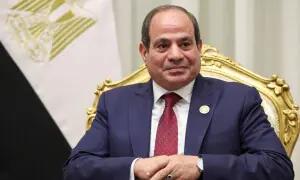
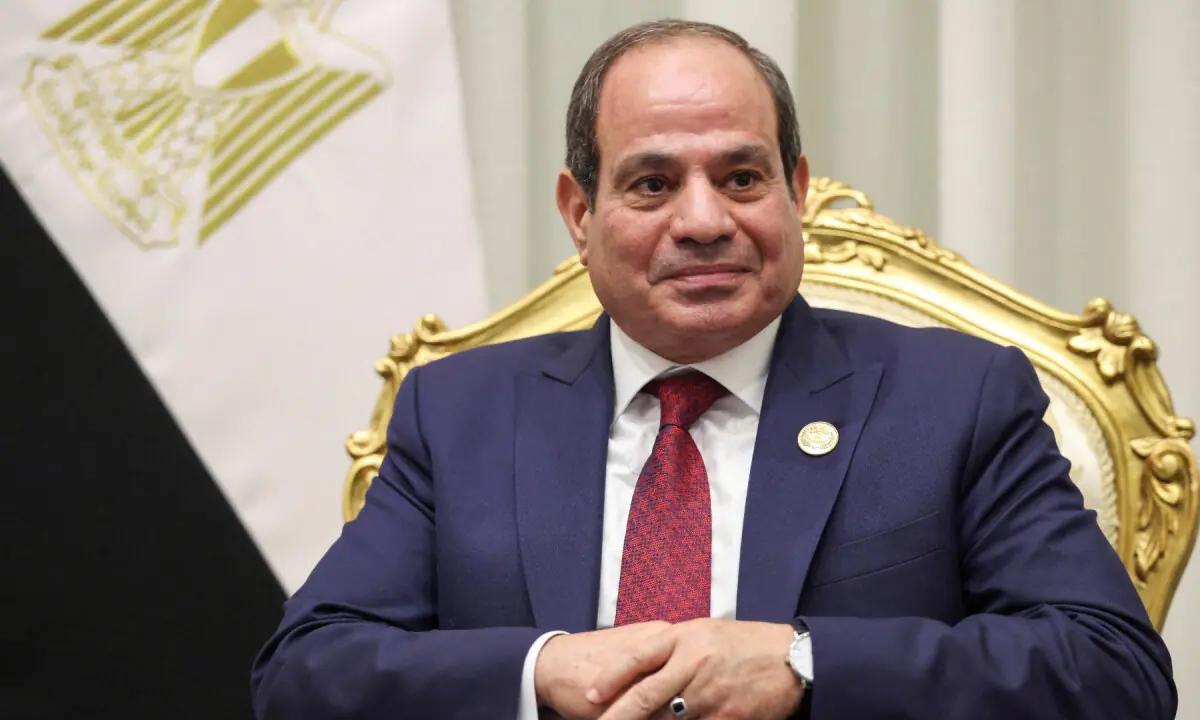
CAIRO — Egyptian President Abdel Fattah el-Sisi signals Cairo’s readiness to take “any necessary measures” to defend Saudi Arabia if Riyadh formally requests assistance, raising the prospect of deeper Egyptian involvement amid escalating tensions with Yemen’s Houthi movement.
Speaking at Egyptian Military Academy’s graduation ceremony in the New Administrative Capital on Saturday, el-Sisi stressed that Egypt’s commitment would be strictly defensive, insisting that Cairo had no intention of attacking another country or initiating a war.
Egypt’s House of Representatives scheduled full parliamentary session today following a request from president. The meeting has drawn attention because it comes directly after el-Sisi’s remarks on defending Saudi Arabia. Some reports suggest lawmakers could consider authorization for defensive assistance, although the precise agenda and outcome require official confirmation.
Under Article 152 of Egypt’s Constitution, declaring war or sending armed forces on combat missions abroad involves consultation with the National Defense Council and parliamentary approval by a two-thirds majority.
The immediate question is whether Cairo could move beyond political support and provide practical military assistance if Saudi Arabia comes under further attack. Potential forms of assistance could include air-defense cooperation, military advisers, logistical support or a limited deployment. These remain possibilities, not confirmed operational decisions.
El-Sisi made it clear that Cairo does not seek confrontation and would act only in defensive capacity. No confirmed announcement establishes that Saudi Arabia has formally requested Egyptian military assistance, that Egyptian forces have been deployed, or that Cairo has entered a new military campaign against the Houthis.
The stakes extend beyond bilateral relations between Cairo and Riyadh. Red Sea is key maritime corridor linking global shipping routes, while the Suez Canal remains a major source of revenue and economic importance for Egypt. Any sustained deterioration in regional maritime security could carry serious consequences for trade, shipping and Egypt’s economic interests.
Against this backdrop, Cairo has repeatedly stressed that the security of Gulf states forms an integral part of Egypt’s national security.
Egypt condemned Houthi attacks, underscoring its opposition to threats against Saudi security and regional stability.
Egypt previously participated in the Saudi-led intervention in Yemen in 2015, with its contribution focused substantially on maritime security in the Red Sea.
Any renewed Egyptian involvement would unfold in a different regional context and could take a more limited defensive form. Whether Cairo would consider direct combat operations, maritime deployments or defensive assistance would depend on the circumstances, the nature of any Saudi request and the decisions taken by Egyptian authorities.
Security forces have killed eight “India-sponsored” terrorists during three intelligence-based operations conducted in the Quetta, Nushki and Khuzdar districts of Balochistan, Inter-Services Public Relations (ISPR) said on Sunday.
The IBOs took place on Oct 17 (Saturday) on the “reported presence of terrorists belonging to Indian proxy Fitna al Hindustan”, the military’s media affairs wing said in its press release.
The state has designated Balochistan-based groups as Fitna al Hindustan to highlight India’s role in terrorism and destabilisation across Pakistan.
In the Panjpai area of Quetta district, terrorists’ attempt to establish a roadblock to disrupt local traffic was “intercepted by security forces, resulting in [the] killing of five India-sponsored terrorists”.
Separately, during a sanitisation operation in Nushki district, security forces busted a terrorist hideout and “after an intense fire exchange, two India-sponsored terrorists were sent to hell”. Weapons and ammunition were also recovered, ISPR added.
In another IBO in Khuzdar, a terrorist hideout was “engaged by security forces through prompt offensive action”, killing one terrorist. ISPR said a large quantity of explosives (490 kilogrammes) was also recovered.
Sanitisation operations were being conducted to eliminate any other terrorist found in the area, according to the statement.
ISPR reaffirmed that the “relentless counterterrorism campaign under Vision ‘Azm-i-Istehkam’ (as approved by the Federal Apex Committee on the National Action Plan) by security forces and law enforcement agencies of Pakistan will continue at full pace to wipe out the menace of foreign-sponsored and supported terrorism from the country”.
President Asif Ali Zardari, in a statement, paid tribute to the security forces for eliminating eight terrorists.
He also commended their professional capabilities for thwarting the attempt to disrupt traffic in Quetta, as well as their actions in Nushki and Khuzdar.
“Conspiracies of the terrorists’ foreign patrons and their local facilitators will be foiled,” President Zardari declared.
Prime Minister Shehbaz Sharif also commended the security forces, state-run Associated Press of Pakistan reported.
He said the forces were achieving significant successes in the fight against terrorism under the vision of ‘Azm-i-Istehkam’ and reiterated the government’s resolve to completely eradicate all forms of terrorism from the country.
In his statement, Balochistan Chief Minister Sarfraz Bugti said operations will continue until terrorism is completely eradicated from the province and peace is established.
“There will be no compromise on Pakistan’s integrity, peace, and the protection of its people,” he affirmed.
Intensified operations
Balochistan has witnessed an increase in terrorist activities in recent years, prompting security forces to intensify counterterrorism operations.
On the night of Oct 12/13, security forces busted a terrorist hideout and killed five terrorists during an IBO in Washuk, ISPR said.
Days later, Balochistan government officials said that six terrorists affiliated with the banned Tehreek-i-Taliban Pakistan (TTP), two would-be female suicide bombers, and two commanders of a banned organisation had been arrested during IBOs across the province.
They said around 90 arrested terrorists were being held at a centre where investigations and legal proceedings were under way.
Earlier this month, five terrorists were eliminated in Balochistan’s Mastung district, state media reported.
The number of terrorist attacks in the province increased by seven per cent from 83 in July to 89 in August, according to data compiled by the Pakistan Institute for Conflict and Security Studies (PICSS). As per the report, Balochistan was declared the province “most affected” by terrorism.
Egypt is ready to provide Saudi Arabia with the support it needs to defend its security and stability, the presidency said on Sunday.
Earlier in the day, the Saudi-led coalition fighting the Houthis said two officers were killed when their helicopter crashed near the Yemen border, after the rebel group claimed it shot the aircraft down.
The coalition blamed a “technical malfunction” for the helicopter crash, which inflicted its first military fatalities since the long-running conflict with the Houthis reignited in July.
The incident comes a week after strikes by the Houthis killed 13 people at Riyadh’s international airport, the deadliest attack in Saudi Arabia in more than a decade.
An AH-6i reconnaissance helicopter belonging to the Saudi Ministry of National Guard crashed “inside Saudi territory in Najran Region due to a technical malfunction”, coalition spokesman Turki al-Malki said, according to the official Saudi Press Agency.
“The accident resulted in the martyrdom of its aircrew, consisting of two officers.”
Late on Saturday, Houthi spokesman Yahya Saree claimed the group had “downed an Apache helicopter belonging to the Saudi enemy” in the same area.
Egypt ready to give ‘all necessary and possible forms of support’
Egyptian President Abdel Fattah al-Sisi had requested an urgent parliament session to authorise the military, one of the region’s largest and most powerful, to help defend Saudi Arabia if the kingdom requested its support.
“Egypt will provide Saudi Arabia with all necessary and possible forms of support to defend its security and stability, protect its resources, territorial integrity and Islamic holy sites,” the Egyptian presidency said in a statement on Sunday.
It followed a meeting of Egypt’s National Defence Council chaired by Sisi and attended by the parliamentary speaker, the prime minister and the army chief.
A parliamentary vote had been expected on authorising the request for military support on Sunday, but discussions were due to continue on Monday, two lawmakers and local media reports said.
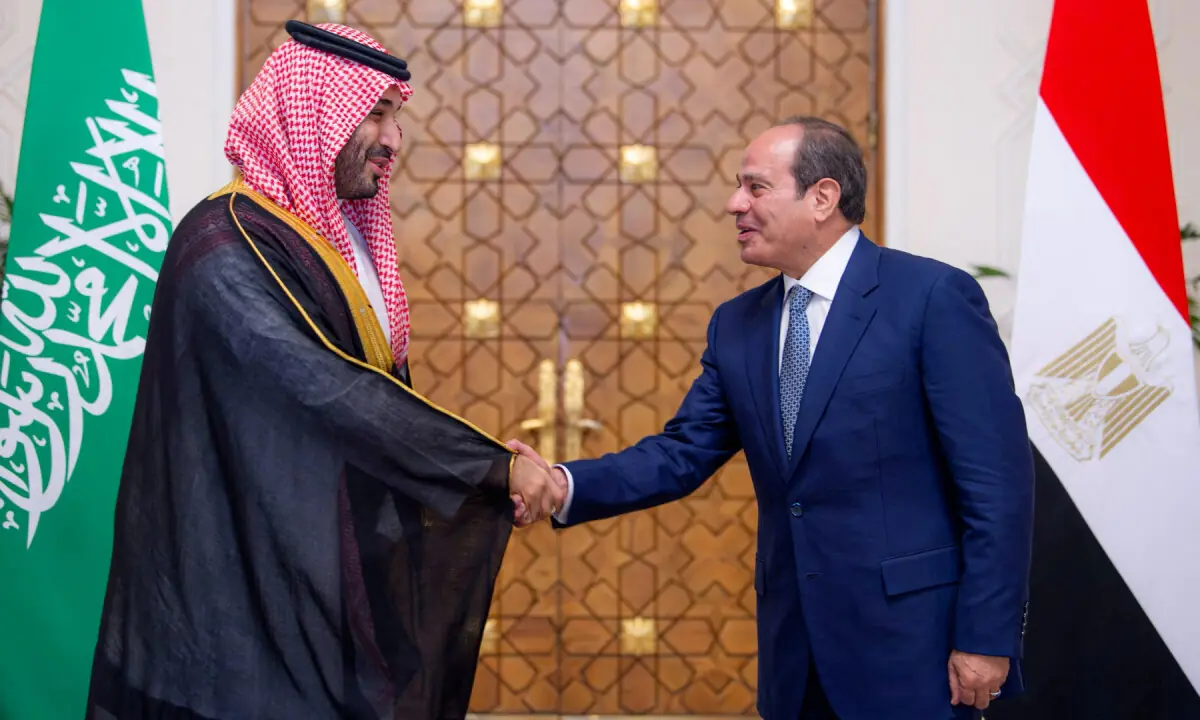
Sisi said in a speech on Saturday that Egypt would act in accordance with guidance from Saudi King Salman and Crown Prince Mohammed bin Salman, who visited Sisi on Sept 15, after fighting in Yemen reignited.
Dar, Egypt FM condemn Houthi attacks
On the diplomatic front, Deputy Prime Minister and Foreign Minister Ishaq Dar held a telephone conversation with Egypt’s FM Dr Badr Abdelatty, the Foreign Office (FO) said.
“The two leaders exchanged views on recent regional developments and strongly condemned the Houthi attacks against the Kingdom of Saudi Arabia, reaffirming their full solidarity with the Kingdom and support for its sovereignty, territorial integrity and security.”
They also discussed cooperation under the R-4 (Pakistan, Egypt, Türkiye and Saudi Arabia) framework and looked forward to the next meeting of the R-4 soon to further strengthen mutual ties and to coordinate on the regional issues, the statement added.
The foreign ministers of the four countries last met on Sept 21 in New York, where they had reaffirmed their support for Riyadh’s sovereignty and supported its right to self-defence.
Pakistan, which has signed two defence agreements with Riyadh, has repeatedly expressed solidarity with Saudi Arabia.
The first one, the Strategic Mutual Defence Agreement (SMDA), was signed in Sept 2025, under which the two countries pledged that any attack on either nation would be treated as an act of aggression against both.
The two countries are also parties to the Makkah Defence Alliance, which also includes Turkiye. The pact was signed on August 7 and provides that an attack on one member state would be treated as an attack on all.
Yemen fighting
After an uneasy, four-year truce, Yemen’s conflict has surged back to life, with the Houthis declaring a maritime blockade on Saudi Arabia in July.
The conflict intensified when Houthis captured territory around the Bab al-Mandeb strait, the Red Sea chokepoint and vital export route for Saudi oil since Iran blockaded the Gulf’s Strait of Hormuz.
On the other hand, the Saudi-led coalition backing the internationally recognised government has launched repeated air raids on Houthi territory.
The coalition said overnight that it intercepted two drones in the Riyadh area and a third over the oil-rich Eastern Province. Saudi authorities had earlier issued a threat alert in the capital.
Two ballistic missiles “launched by the terrorist Houthi militia towards Khamis Mushait” were intercepted in the kingdom’s south, the coalition added.
On Saturday, the Houthis reported that Saudi strikes killed 12 people in Yemen, including three children.
GWADAR/QUETTA: Pakistan has suspended trade with Iran through the official Gabd-Rimdan (250) and Taftan border crossings, it emerged on Saturday.
The Ministry of Commerce issued a memorandum on Friday, seen by Dawn, withdrawing its earlier order [No. 9(3)2017-Iran] dated Oct 3 with immediate effect.
Shahid Rind, adviser to the Balochistan chief minister on media and political affairs, said the “purpose of the temporary closure of the Pak-Iran border is to address security concerns, prevent smuggling, and make the border system more effective”.
In a statement on X, Rind refuted “rumours being spread on social media” regarding the closure and urged the public not to pay attention to unverified information.
The Balochistan official stressed that the move was “necessary to improve the security situation and administrative affairs on both sides of the border”.
Rind affirmed that “progress continues between the high officials of both countries to resolve administrative issues” related to the border.
“In the context of the current progress, the Pak-Iran border is likely to reopen soon,” he said, adding that a coordinated system was being established to improve border affairs and prevent smuggling.
Meanwhile, Iran’s foreign ministry spokesperson Esmail Baqaei also said the closure was temporary, Iran’s state-run Irnareported.
However, he attributed the move to “technical issues” and said the two countries were in consultations to resolve the problem and restore normal operations.
Separately, the Quetta Chamber of Commerce and Industry (QCCI) has also advised its members and businesses involved in trade with Iran to stop placing new import and export orders until further notice.
Hundreds of freight vehicles carrying liquefied petroleum gas (LPG), rice, fresh fruit and other essential commodities have reportedly been stranded on both sides of the border.
According to Iran-based Wana news agency, passenger traffic through the Rimdan–Gabd crossing remains operational. It quoted Syed Hossein Hosseini, director general of the Iranian Transit Office, as saying that commercial operations at the border crossing had been halted.
The Gabd-Rimdan crossing had become a major route for meeting Pakistan’s energy needs, with over 4,000 tonnes of LPG reportedly imported daily through it. Exports of Pakistani products, particularly rice, had also surged in recent months, generating millions of dollars in foreign exchange.
Sources in the trade and energy sector warned that the closure could aggravate LPG shortages in Karachi and other parts of the country.
The Taftan route was already facing disruptions amid unrest in Balochistan. The suspension of supplies through Gabd-Rimdan could push up LPG prices in the open market.
Local traders and the chamber have warned that the disruption could cause not only substantial losses to the national exchequer and jeopardise the livelihoods of many but also an energy crisis.
Since March this year, Islamabad and Tehran have rolled out a series of measures to facilitate border trade, including easing customs procedures, formalising Taftan as a customs station, and notifying new transit routes, against the backdrop of the ongoing US-Iran war that has strained economies in the region and beyond.
In early August, an Iranian delegation led by Trade and Industry Minister Mohammad Atabak visited Islamabad for the 10th session of the Pak–Iran Joint Trade Committee (JTC).
The delegation also met with Prime Minister Shehbaz Sharif, with both sides agreeing to further expand trade ties by keeping border crossings open round the clock, improving logistics and harmonising customs procedures.
The visit came a couple of months after it was reported that trade between Pakistan and Iran through the Gabd-Rimdan border crossing had come to a complete halt.
According to Gwadar Chamber of Commerce and Industry President Jiand Hoot, trade through the Panjgur and Mand-Radig border crossings was virtually non-existent because of poor road infrastructure and recurring incidents of arson and vehicle burnings.
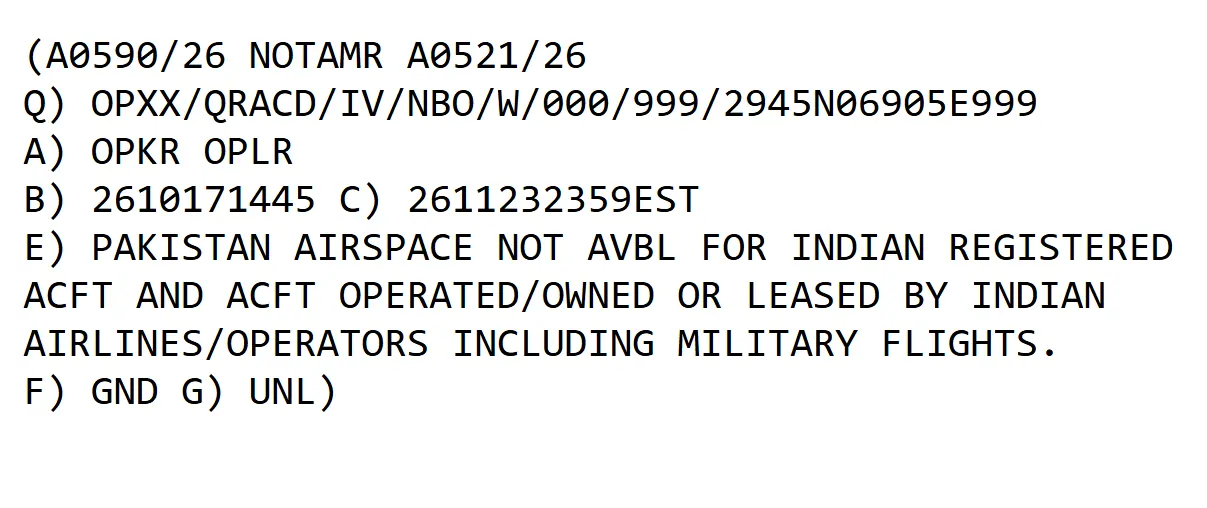
Pakistan has extended its airspace ban for Indian aircraft for another month, until Nov 24, according to a Notice to Airmen (Notam) issued by the Pakistan Airports Authority (PAA).
“Pakistan airspace not available for Indian registered aircraft and aircraft operated/owned or leased by Indian airlines/operators, including military flights,” the Notam said.
According to the notice, the extension came into effect at 7:45pm on Saturday and will remain until 04:59am on Nov 24, 2026.
The country’s airspace is divided into two flight information regions (FIRs) — Karachi and Lahore, according to a Pakistan Civil Aviation Authority (PCAA) document from 2022.
Saturday’s Notam applies to both the Karachi (OPKR) and Lahore (OPLR) FIRs.
India and Pakistan closed their airspaces to each other’s airlines in late April 2025, when tensions between them escalated in the wake of a deadly attack in India-occupied Kashmir’s Pahalgam.
On April 24, Pakistan’s top brass had announced a series of measures, including the closure of its airspace to all India-owned or Indian-operated airlines with immediate effect, as it retaliated against New Delhi’s slew of aggressive measures against the country.
New Delhi, without evidence, had alleged that Islamabad backed the Pahalgam attack. However, Pakistan had strongly denied any involvement and offered a neutral probe. The nuclear powers had the fiercest air battle in May, in which Pakistan said it downedseven Indian fighter jets.
Since then, Pakistan has extended the airspace ban several times, forcing Indian carriers to use longer and costlier routes.
For Air India, the country’s only carrier with a major international network, fuel costs rose by as much as 29 per cent and journey times by up to three hours on some long-haul routes, according to a document submitted to Indian officials last October.
The airline, owned by Tata Group and Singapore Airlines, estimated the Pakistan airspace closure’s impact on its profit before tax at $455 million annually — a significant amount given its fiscal 2024-25 loss stood at $439m.
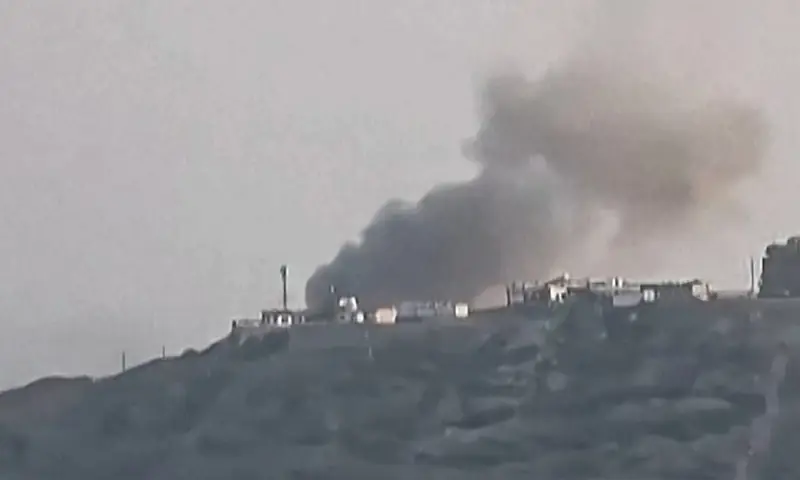
Security forces have responded to unprovoked firing by Afghan Taliban forces along the Pakistan-Afghanistan border in Khyber Pakhtunkhwa’s Upper Kurram, state broadcaster PTV News reported on Saturday.
PTV News and state-run Associated Press of Pakistan (APP), which cited security sources, said the Afghan Taliban forces opened fire to “facilitate terrorists” along the border in Taldah sector of Upper Kurram.
The army responded using heavy weapons, destroying several Afghan Taliban posts and forcing their personnel to flee from there, PTV News reported.
Meanwhile, APP quoted security sources as saying that several personnel of the Afghan Taliban were “reportedly killed during the Pakistan Army’s retaliatory action along the Ghuzgarhi border”.
The sources further said that in the Upper Kurram sector, the army targeted the Afghan Taliban’s Topsar post and Shipola base camp with artillery fire, reportedly completely destroying the latter.
The exchange of fire was still ongoing in the area, APP quoted security sources as saying.
The border skirmishes come a day after the Foreign Office (FO) said that talks with Afghanistan could not be unconditional, but also rejected suggestions that Islamabad was unwilling to engage with its neighbour and said it would welcome sincere efforts by friendly countries to help resolve the dispute.
“Pakistan is not shying away from discussions or dialogue, including with representatives of Afghanistan. Pakistan would welcome any sincere efforts by friendly countries that could help address our legitimate security concerns and promoting regional peace and stability,” FO spokesperson Sajjad Haider Khan said at the weekly media briefing.
The statement came after Russia recently renewed its readiness to mediate between the two countries, although Islamabad denied the existence of any such initiative.
“At present, I am not aware of any separate, formal Russian mediation initiative being under discussion,” Khan said.
Pak-Afghan tensions
Ties between the two neighbours have been strained in the past few years as Islamabad continues to voice its concern over cross-border terrorism.
September witnessed another bout of conflict between Pakistan and Afghanistan.
On Sept 21, in response to recent major terrorist attacks in Khyber Pakhtunkhwa, Pakistan conducted “calibrated” airstrikes in the border region with Afghanistan against terrorist hideouts, with the government saying more than 28 terrorists were killed.
Information Minister Attaullah Tarar described the action as part of Operation Ghazab lil Haq, which was launched on the night of Feb 26 in response to unprovoked cross-border firing by the Afghan Taliban.
Days later, Pakistan shot down eight drones launched from across the border that had entered Pakistani airspace near the Torkham border and Kohat. It was also reported that the Afghan Taliban engaged in unprovoked firing the night before near Kurram as security forces foiled an attempt by terrorists to cross into Pakistan.
In retaliation for the drone incursion, Pakistan conducted “precision aerial and drone strikes” in 10 locations across Afghanistan.
A demarche was also delivered to the Afghan side on Sept 26 on account of the Sept 23 airspace violation by drones, the Foreign Office said.
On Oct 1, Pakistan again carried out “well-planned and calibrated” airstrikes against terrorist hideouts in Afghanistan, the information ministry said, which resulted in the deaths of “multiple terrorists”.
Prime Minister Shehbaz Sharif on Saturday reiterated that the Centre was “compelled” to impose emergency and governor’s rule in Khyber Pakhtunkhwa due to the provincial government’s lack of cooperation in countering terrorism.
The Centre imposed emergency and governor’s rule in KP on Oct 11, citing the provincial government’s “deliberate disengagement” from the fight against terrorism. The decisions were also endorsed by the Parliament this week amid protests by the opposition.
On Saturday, PM Shehbaz visited the residence of Rashid Bashir Virk in Gujranwala to offer condolences on the demise of his father, late MNA Mahmood Bashir Virk.
After recalling the late PML-N lawmaker’s services, the premier stressed that the Centre was compelled to impose emergency in KP.
He said the Centre made a “last attempt”, referring to the rounds of talks held by a joint delegation of the PPP and the government with the opposition.
“They had talks with them (PTI) day and night, for 48 hours, and sat with the intention to settle matters from every aspect,” PM Shehbaz said, adding that a draft was ready under which the PTI was to call off its long march.
The prime minister highlighted that he had held multiple meetings with Sohail Afridi, the KP chief minister whose role now stands non-functional, as well as with his predecessor Ali Amin Gandapur.
“In every meeting, I tried my best to convey to him from the depths of my heart and with seriousness that KP is an extremely beautiful province and has very brave and honourable people, […] and I am always present in every way for their development and prosperity,” PM Shehbaz said.
The premier added that he assured the KP government of the Centre’s support in fighting against terrorism together to face the security challenges in the province.
PM Shehbaz said he had assured the chief minister that he would make the decisions regarding the administration, resources and necessities in consultation with him.
“But, unfortunately, despite all these efforts, thousands of our law enforcement agencies personnel, soldiers, officers and officers of the armed forces were sacrificing their lives every day to defend the homeland.”
The prime minister stressed that the federal government “made many efforts” regarding the situation, but there were “threats and long marches every other day in response”.
“Their past history is very horrific,” he remarked, recalling the 2014 sit-ins staged by the PTI at Islamabad’s D-Chowk during the tenure of his brother, Nawaz Sharif.
“Last year as well, you saw how the entire country was jammed by staging a sit-in in Islamabad,” he added, ostensibly referring to the PTI’s November 2024 protest that had resulted in clashes.
“This time as well, they had an entire plan of bloodshed,” he alleged.
The Oct 11 imposition of emergency and governor’s rule followed weeks of political tensions between the Centre and the PTI — as well as negotiations to bridge their differences — after the latter announced a long march to Islamabad to demand the release of its jailed founder, Imran Khan.
Federal ministers alleged that the PTI-led government in KP had a “nexus” with terrorist groups and asserted that the province’s security situation necessitated the imposition of emergency there.
The Centre and the PTI have been at odds over various issues, particularly on the counterterrorism policy, which was one of the main reasons behind the breakdown of their October 3 talks.
The PTI said it was being left out of security decisions concerning KP, which the Centre denied. It also called for reviewing the counterterrorism policy, while the latter criticised the KP government’s efforts to combat terrorism in the province and objected to its stance on dialogue with the Afghan Taliban.
Jamiat Ulema-i-Islam-Fazl (JUI-F) chief Maulana Fazlur Rehman on Saturday clarified that his party’s remarks regarding the country’s security situation were directed at policies, not institutions, and termed the allegations levelled against him by federal ministers as character assassination.
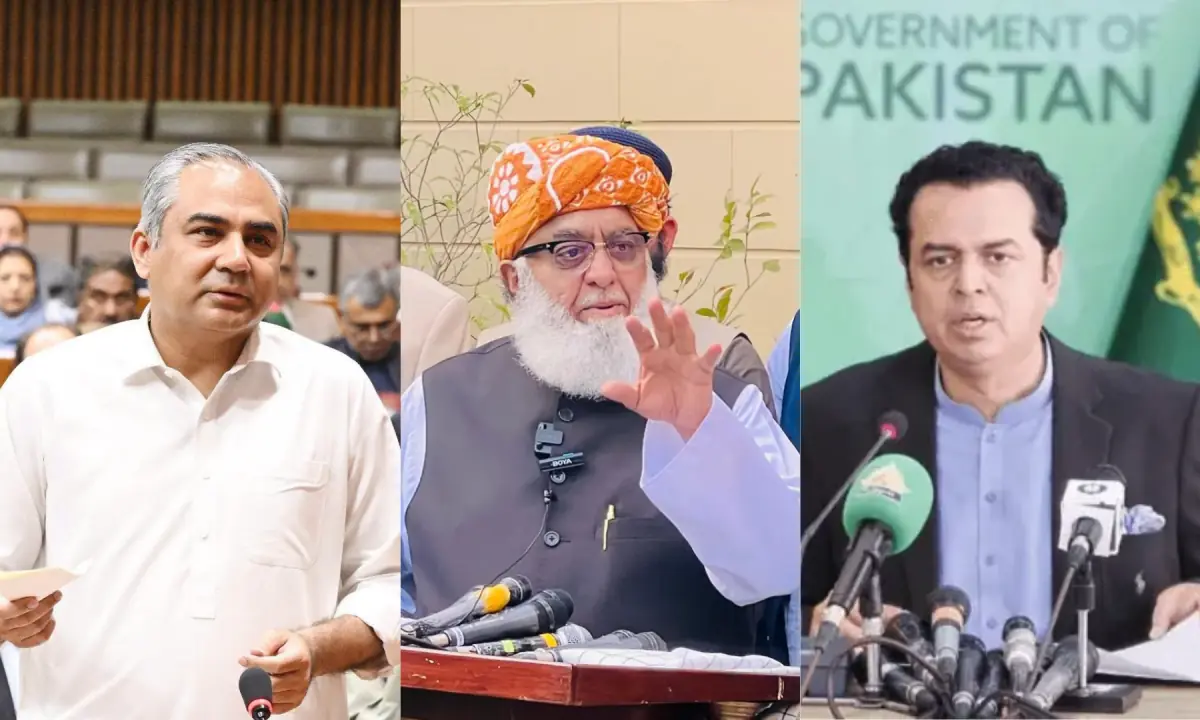
A day earlier, Interior Minister Mohsin Naqvi, without naming anyone, had claimed that a “head of a party” was “extremely upset” about not being appointed the governor of Khyber Pakhtunkhwa. The remarks came after Fazl accused the Centre of depriving the provinces of their rights and raised doubts over its reasoning behind imposing governor’s rule that there was a lack of cooperation on counterterrorism.
Earlier on Saturday, State Minister for Interior Tallal Chaudhry also rebuked the JUI-F chief for reportedly seeking his “share” in KP’s governance following the imposition of governor’s rule and an emergency in the province. Other federal ministers have also taken exception to Fazl’s remarks.
Addressing a press conference in Lahore on Saturday, Fazl stressed that his party’s criticism was directed at policies, not institutions, and was intended to bring about corrective action rather than undermine the sacrifices made in the fight against terrorism.
The senior politician called for an in-camera session of Parliament to review the country’s security situation and formulate a consensus-based policy to combat terrorism.
“Our only question is why the country has failed to eliminate terrorism. Let us sit together and find out why. Parliament is the most appropriate forum to discuss the issue and make decisions. Instead of ridiculing politicians, the government should take them on board in this fight so that we can move forward together,” he said.
“If Parliament is supreme, why are decisions taken in Rawalpindi while Parliament is simply told to follow them?” he remarked. “The issue is that this government is powerless. Decisions are taken somewhere else, and it implements them obediently,” he alleged.
The JUI-F maintained that Parliament should review the security situation and that the nation should be taken into confidence. If the public was expected to support the fight against terrorism and those engaged in it, he argued, the government should explain its decisions rather than impose “unilateral measures”.
Fazl reiterated his objection to the imposition of emergency rule in KP or any other part of the country. Recalling his family’s opposition to emergency rule in Balochistan during the 1970s, he said his father had resigned when the government of Zulfikar Ali Bhutto imposed it in the province.
He described the recurrence of such measures as unfortunate, pointing out that the PP had repeatedly been associated with their imposition.
Questioning the rationale behind the emergency, governor’s rule and deployment of troops in KP, Fazl asked why the province should face such treatment when Balochistan was also grappling with the same level of terrorist violence, if not more.
The JUI-F chief urged the government to develop a shared national narrative and a consensus-based counterterrorism strategy instead of questioning his party’s position.
He went on to ask why the government engaged in negotiations with the PTI, which had been in power in KP, if the party was accused of supporting terrorists. “On top of it, both (the PTI and the government) say that they had reached a consensus on all points.”
Fazl then highlighted that around 250 of his party workers had lost their lives in terrorist violence, arguing that their sacrifices should not be ridiculed or overlooked. “How can a party whose members have laid their lives be accused of supporting terrorists?” he asked.
He also questioned why he was being singled out for criticism when political leaders, including former prime minister Nawaz Sharif, had at various times disagreed with the military leadership.
Ministers assail Fazl
Earlier on Saturday, addressing the media in Jaranwala, Chaudhry said, “I am upset. We did not expect Maulana sahib […] to consider this as spoils of war and seek his share in the absence of a PTI government in the province.”
He emphasised that the imposition of an emergency and governor’s rule in KP was not a political move aimed at strengthening the PML-N’s presence in the province by dismissing the PTI-led government.
“This was an administrative setup,” he said, adding that it had been formed with a “one-point agenda: combating terrorism”, rather than with an intention of establishing a political setup.
“This is not spoils of war,” he reiterated, adding that the imposition of an emergency and governor’s rule in KP was an “immensely responsible” decision taken after every other option had been considered.
“I am unable to understand why Maulana sahab says that he was forced to accept defeat [in elections],” he said, arguing that Fazl’s party had been defeated by the PTI in KP and the Pashtunkhwa Milli Awami Party in Balochistan.
Chaudhry said the JUI-F was worthy of respect only if it stood by Pakistan’s interests.
The state minister also rejected the impression that the imposition of an emergency and governor’s rule was aimed at taking control of KP’s natural resources.
He also criticised Fazl for bringing up the 1971 separation of East Pakistan — now Bangladesh — from Pakistan in his recent statements.
“You bring up 1971 after losing the 2024 elections,” Chaudhry said.
“This KP setup is not about distributing shares, forming coalitions and governments, or engaging in politics,” he stressed, clarifying that only one member of the KP Advisory Council has a political background, as she represents the families of martyrs.
Chaudhry again offered to implement the National Action Plan and combat terrorism jointly with all stakeholders. “Politics is possible only where there is peace,” he said.
At the outset of his address, Chaudhry alleged that there must be “a relationship or a mutual interest arrangement between the Tehreek-i-Taliban Pakistan (TTP) and the PTI”.
“Since 2015, no PTI leader, gathering or member has been targeted by terrorists,” Chaudhry said. “On the other hand, over the past 11 years, no political or religious party, security force, public office, funeral or wedding has been spared terrorist attacks.”
He said the federal government had exhausted all avenues to bring together stakeholders and urge them to condemn terrorism by naming those involved, whether the TTP, the Balochistan Liberation Army (BLA), or groups funded by India or Afghanistan.
The state minister claimed that in 2013, when the government decided to hold talks with the TTP and representatives were proposed by both sides, the TTP had nominated PTI founder Imran Khan to its committee.
He also alleged that the PTI founder had allowed the TTP to open offices in Peshawar.
During his address, Chaudhry also criticised the PTI, showing a press release issued by the TTP that condemned the dismissal of the party’s government.
Meanwhile, speaking at a press conference in Sialkot, Defence Minister Khawaja Asif criticised the JUI-F chief for constantly “targeting” the country’s security forces.
He declared that the sacrifices made by the security forces, officers, and the public in the fight against terrorism were “matchless”.
The defence minister referred to Fazl’s accusations that the emergency and governor’s rule were imposed to capture KP’s mineral resources, saying that he had shared a full list of people who had the mining contracts in KP.
Asif maintained that the whole PTI and opposition leadership was engaged by the government before the imposition of emergency and governor’s rule.
“But it was fruitless,” he said.
“The situation will improve in KP […] parliament can roll back the decision of imposing the emergency only if the improvement of the situation in the province is guaranteed,” the defence minister said.
He said that some individuals in KP were expecting to get a share in the administrative changes in the province.
“We will ensure free and fair elections. Whenever the time comes, everybody can take part in it,” he said.
Fazl’s remarks also prompted a response from KP Governor Faisal Karim Kundi, who has now been tasked with running the province under governor’s rule.
Kundi, referring to the JUI-F chief, asked whether “your land in the land belonging to martyrs in DI Khan is halal”.
“What you get is halal, what the other gets is haram,” he remarked.
The governor reaffirmed that the new KP administration would continue to function properly.
‘Extremely upset’
Fazl, who was involved in reducing tensions between the Centre and the KP government, has been critical of the federal government over the imposition of governor’s rule in KP. He also accused the Centre of reneging on its commitments amid his efforts to mediate between the two parties.
Addressing a rally in Multan on Thursday, Fazl further recalled that his party had expressed reservations over the merger of tribal areas into KP after the 25th Constitutional Amendment in 2018.
“We were not against the merger, but we said that it was an issue of the political future of the people of tribal areas,” he said, alleging that the people of those areas were not consulted on the merger.
He alleged governor’s rule was not imposed in Balochistan because the province’s chief minister “praises you”.
The next day, during an interaction with journalists, the interior minister said, “The head of a party is extremely upset over being denied a role in the new setup in KP and not getting the governorship.”
This politician, Naqvi alleged, had remained “dependent on the establishment for decades to advance his political career”.
“These are the same politicians who remained in politics for decades with the support of the establishment, and this politician even relied on the establishment to arrange air tickets for the members of his party,” he further alleged.
He said such politicians had little justification for criticising others now, particularly after having benefitted from the same system they currently denounced.
The same day, Punjab Chief Minister Maryam Nawaz also railed against Fazl in a post on X.
She said it was not expected of a senior politician such as him to support those who facilitate terrorism — an apparent reference to the PTI, which the Centre accuses of backing terrorism.
She also criticised Fazl for his remarks about Chief of Defence Forces and Chief of Army Staff Field Marshal Asim Munir, seemingly referring to his comments during the Multan address about the centralisation of power.
The Centre imposed governor’s rule and emergency in KP on Oct 11, citing the provincial government’s “deliberate disengagement” from the fight against terrorism.
The move has drawn criticism from the opposition, including Fazl, as well as Mehmood Khan Achakzai and Raja Nasir Abbas of the Tehreek-i-Tahafuz-i-Ayin-i-Pakistan.
In the days preceding the imposition of governor’s rule in KP, political tensions between the Centre and the opposition — including the PTI which was in power in KP — had remained high since jailed former prime minister Imran Khan’s party announced a protest march to Islamabad to demand his release.
Intense negotiations between the two sides a week before the imposition of governor’s rule had failed to yield any results, while Fazl was cast as the man who could defuse heightening tensions between the Centre and the PTI. Both sides had held separate meetings with Fazl, reportedly for his intervention to help break the deadlock in the negotiations.

 Login