A woman wearing a hijab on a street in Baku, January 18, 2011
In late September, Azerbaijan approved new school uniform rules, including a ban on “items inconsistent with the principle of secularism.” Inspections soon began at schools, and girls wearing hijabs were barred from classes. Protests broke out in Baku and other cities, with schoolgirls and their classmates demanding that everyone’s right to an education be upheld. On October 12, 37 people were detained in Baku. The Interior Ministry said protesters had tried to “grossly disrupt public order.” Meanwhile, users began reporting that they could not access TikTok and Instagram — the country’s two most popular social networks. Here’s a closer look at what is happening in Azerbaijan and what may be behind the ban.
Azerbaijan’s Cabinet of Ministers introduced the new school uniform rules in a September 21 decree. The decree prohibits “wearing items of clothing that disrupt the uniformity of the prescribed school uniform,” as well as clothing that is “inconsistent with the principle of secularism in general education.”
The decree does not explicitly mention hijabs. But during school inspections that began on October 9, girls with their heads covered were barred from classes, even though the decree does not authorize such measures. Female teachers were also required to remove their headscarves, Jam News reported.
Protests then broke out in Baku and other Azerbaijani cities. At some schools, boys also refused to attend classes in solidarity with girls wearing hijabs. In a village in Baku’s Sabunchu district, students protested with a sign bearing the slogan: “A hijab does not stand in the way of an education.”
A source at a Baku school told the BBC that boys in the upper grades were also required to shave their beards — even though, like hijabs, beards are not mentioned in the cabinet decree.
Videos of the protests appeared on social media. One shows students trying to smash school windows. The Telegram channel Minval Politika reported that a school principal’s car had been set on fire in the Garadag district.
On October 12, Azerbaijan’s Interior Ministry said it had detained 37 people for actions “grossly violating public order.” The ministry said “a group of individuals” had created “a conflict situation” with school staff over “compliance with a uniform dress code” and damaged schools. Authorities opened a criminal investigation into allegations of organizing acts that disrupted public order, an offense punishable by up to three years in prison. The ministry provided no further details, and it is unclear whether any of those detained are minors.
As the protests unfolded, Azerbaijanis began reporting that they could not access Instagram and TikTok — the country’s two most popular social networks. Some users could access them only through a VPN. Some directly link the disruption to the protests, although the authorities have not confirmed blocking the platforms.
Azerbaijan has seen protests against a hijab ban before. Jam News reported that a similar protest took place outside the Education Ministry in May 2011 and led to a criminal investigation. That same year, authorities detained activist Abgul Suleymanov, who was known for taking part in protests against the hijab ban. He was later sentenced to 11 years in prison on charges he denied.
The reasons for the current ban are unclear, the BBC reported. Neither the cabinet nor the Education Ministry has explained them or responded to journalists’ inquiries. Journalist Afgan Mukhtarli, a critic of the authorities, believes that hijabs pose no problems but that Azerbaijani President Ilham Aliyev “needs the specter of radical Islam to strengthen his hold on power.”
Supporters of the authorities, by contrast, see the ban as part of “strengthening the sovereignty of a country trying to free itself from the influence of other states.” It is unclear what influence they mean, but many believe Aliyev was referring to Turkey when he recently spoke about countering ideological interference from abroad, the BBC reported. On October 3, protesters gathered outside Azerbaijan’s consulate in Istanbul to demand an end to the ban on wearing hijabs in Azerbaijani schools.
At Meduza, we are committed to transparency about our use of artificial intelligence in the newsroom. The story you’re reading was written by one of our living, breathing journalists and translated from Russian using an AI model configured to follow our strict editorial standards. This translation process is the result of extensive testing and refinements to ensure our English-language coverage is timely and accurate. A Meduza editor reviews every draft before publication.
If you find any errors in this translation, please contact us at reports@meduza.io.
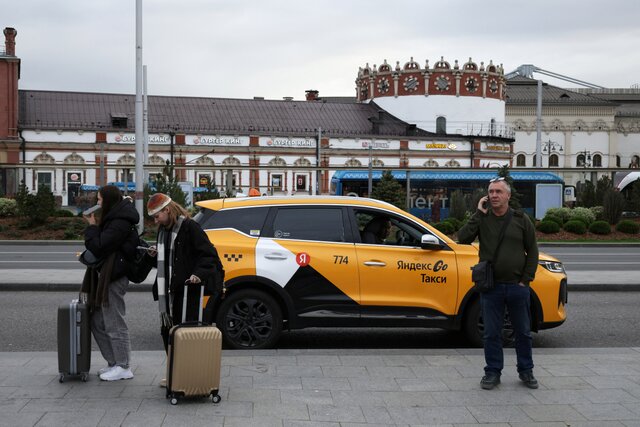
After repeated Russian attacks on data centers in Ukraine, Ukrainian forces began striking Yandex’s data centers. From October 8 to 11, Ukrainian drones reached three of the company’s data centers: in Sasovo in the Ryazan region, Kaluga, and Vladimir. A major outage followed, affecting Yandex’s services and companies that used Yandex Cloud storage. Millions of people in Russia and other countries felt the effects: Many couldn’t use taxi services or maps, for example, and lost access to their cloud files and money in Yandex Pay. It took until October 13 for Yandex Pay to be partially restored. Meduza asked readers how disruptions to Yandex products and other businesses connected to the company had affected their daily lives and work. We received hundreds of letters and are publishing the most interesting ones.
Warning: This article contains statements that some readers may find offensive. Meduza’s Russian-language newsroom checked all letters for AI-generated content, but even the most thorough screening can’t rule out manipulation entirely. Please keep that in mind.
Natasha
Moscow
On Sunday [October 11], everything looked okay at first when I ordered a taxi, but then all I could see on the screen were two messages: “Searching for a car” and “Loading trip details.” It stayed that way for half an hour. When I gave up and headed for the subway, the driver called and asked where to pick me up. Apparently, he’d noticed my location marker moving away.
I asked for the car’s license plate number, found the car, and we got where we were going. Then I discovered that the payment method had switched from card to cash, and I didn’t have any cash on me. I couldn’t switch it back because the app was still showing the same “Searching for a car” and “Loading details” messages. Restarting it didn’t help.
I said, “Can I send you a bank transfer?” The driver said, “To Yandex Bank.” I opened the banking app, and there was a message saying, “We’ll have everything fixed soon”… It turned out the driver’s other accounts were blocked. Luckily, I managed to reach some friends nearby who had cash. And that ride still isn’t in my trip history.
During those 30 minutes [while I was waiting for the car], I tried downloading other taxi apps from Google Play, but they all seemed to go down at once. Maybe because they’re somehow connected to Yandex too. I didn’t risk ordering a taxi by phone — the local taxi companies have really bad reviews.
That evening, some friends booked a cargo van with almost no trouble. It’s still in their trip history, but they can’t download the receipt, and I don’t think they were charged.
On Monday, Yandex Maps wasn’t showing me bus schedules or the buses themselves. Everything was working properly for my friend, but I was either getting nothing or getting wrong information that didn’t match hers.
Ivan
Yekaterinburg
I can’t access my photo and video archive on Yandex Disk. My whole life is in there — from when I was young to photos of my kids. Right now, you can’t download anything, only view it. And some files look like they’re gone for good — they won’t even open in preview mode.
I’ve already bought myself a NAS. I’d wanted one for a long time but kept putting it off, and now I’m paying for it. I hope I can save the data. I used to have a backup on Google Drive, but paying for it now is a whole ordeal.
Now it all depends on how well Yandex designed its recovery system [for restoring files after an outage — Meduza]. I’d like to believe they’ve taken all the necessary steps on their end.
Either way, Putin and his gang bear all the responsibility.
Stanislav
Nizhny Novgorod
I couldn’t make a payment on my credit card from another bank because all my money is in a Yandex savings account. I had to borrow from people I know to avoid getting hit with interest. It’s not like you can explain to the other bank why you can’t pay.
Hundreds, probably even thousands, of people are in the same situation. Many can’t make their mortgage or loan payments or pay their rent. All of this will damage their credit histories and cause financial problems, because if you don’t meet your credit card’s terms, you can get hit with outrageous interest.
I’m definitely moving half my money to another bank, even if the terms aren’t as good.
Kirill
Novosibirsk
I’m a taxi driver. It’s my main source of income. My work has come to a standstill.
Passengers say they spend 30 minutes trying to order a car without any luck. We drivers aren’t getting notifications about ride requests, and when we do, the location is wrong. Nobody knows how long this will last.
There are no alternatives. Yandex has taken over the entire market. I have nothing fit to print to say about what’s going on.
Hi, I’m Vladislav Gorin.
I’m the host of Meduza’s daily Russian-language news podcast. This summer, the Russian authorities opened a criminal case against me — not for committing a crime, but for telling the truth about Russia and its war against Ukraine.
Because the Kremlin has branded me a criminal, I can’t go home. I also can’t safely travel to countries like Turkey — even though it’s a NATO member — because I could be arrested and extradited to Russia. I can’t even renew my passport at the consulate anymore.
None of this is going to stop me. I know there are hundreds of thousands of people in Russia who don’t want this war and who still believe in freedom and democracy, and they deserve access to independent journalism. Please support Meduza so I can keep reaching them.
Alex
Balakovo, Saratov region
Taxi drivers are waiting at bus stops, store registers are glitching, Kinopoisk isn’t working, and neither is Alice. I wanted to download my data from cloud storage, but no luck.
I’ll buy an 18-terabyte drive and keep all my files on it. I used to think Google Drive and iCloud were a bit expensive, but now I understand what you’re paying for. I’m going to stop using Yandex services. Our whole family has been planning to quit them for a long time anyway. Ukraine was the final nail in the coffin for Yandex. I’m sick of all this, especially all those “majors” from the security services prying into our private lives.
Dodging responsibility whenever something beyond your control happens is a way of life in Russia. It’s cheap and underhanded, though predictable. Our family, like the rest of the world, stopped recognizing Russia’s government as legitimate long ago, so whatever they come up with over there [in the Kremlin] is their business alone. There have never been so many spectacular idiots in the State Duma — the concentration of insanity is off the charts. When is Ukraine finally going to start hitting their dachas on Rublyovka?!
Anonymous reader
Italy
Edvibe, the service for teachers and tutors known in Russia as ProgressMe, isn’t working, even though they present themselves as an international platform. I’ve always paid for it in dollars and had no idea it was connected to Yandex.
Now lessons have been disrupted, and the materials are unavailable. I feel completely drained and have no idea what to do next. Part of what my students were paying for was a convenient platform that was pleasant to use during and after lessons.
There are no alternatives to Edvibe — everything else on the market is awful, with lag and terrible design. Edvibe isn’t perfect, but it’s still a decent option.
I don’t want any connection to Yandex or to Russia at all.
Rustam
Tashkent, Uzbekistan
Yandex dominates a lot of areas in Uzbekistan — it’s the biggest delivery service, taxi service, and so on. At one point, it either drove all the local competitors out of the market or bought them up. It scorched the earth and left nothing alive behind it. So when it went down completely, everything went down. Today [October 12], everything started working again, but badly. Basically, it’s become clear that Uzbekistan depends far too much on Yandex. If anything else happens to it, everything will grind to a halt again.
I used WB Taxi today, but it’s awkward to use. You have to admit that Yandex knows how to make user-friendly products people want to use.
Well, what else are they going to do but say they’re not responsible for events beyond their control? At least everyone knows now: If something happens again tomorrow, Yandex will wash its hands of it.
Marat
We’re a small IT company whose services ran largely on Yandex servers. After the first attack [October 8], some of our services stopped working for our clients. We got everything back up on Saturday [October 10], but overnight into Sunday, they went down again after an attack on another data center. We can see that many of our major clients’ corporate services were also hosted on Yandex’s cloud — so for now, they’ve got bigger things to worry about than taking us to task.
Yandex hasn’t just disclaimed responsibility — it’s still charging for hosting that it’s effectively no longer providing. Yandex has always had the highest prices on the hosting market, but it’s practically the only provider that meets all the requirements of major clients. Now nobody cares about that anymore — they just want the system to work. I think other data centers will soon raise their prices sharply. They’d be foolish not to.
Vasily
Lisbon, Portugal
I’m the founder of a service that advises parents of children under 3. For example, we give advice on children’s sleep and nutrition. Our Russian servers are in the Vladimir region. On the night of the [third] attack, we had to rush to restore data from backups and move it to another platform. We managed to do it.
Now we’ll use Timeweb Cloud and several other backup providers in case Timeweb gets hit. We won’t use Yandex Cloud again, even if they restore something there. It’s not clear yet what we can use instead of Yandex Direct for advertising, but I think we’ll find new advertising channels.
Putin’s regime bears all the responsibility. Yandex shouldn’t have to take responsibility for the consequences of decisions made by a deranged former KGB man surrounded by criminal oil wheeler-dealers from a St. Petersburg back alley.
Dmitry
Tallinn, Estonia
After the strike on the data center in Vladimir [October 11], the Yandex Metrica web analytics system stopped working. It’s not critical, of course, but it’s extremely inconvenient, because its competitor, Google Analytics, reports website traffic with a delay of up to 48 hours. The problems with Yandex Metrica made it impossible to assess website traffic in the hour or two after publication, which in turn made it harder to manage traffic.
I’ve actually been using both analytics services for a long time, but now I’ll have to rely solely on Google Analytics for a while. I’m not happy with it at all, because of the delay, its bad interface, and how poorly it works on smartphones. And the Google Analytics app is a useless mess that tells you nothing.
Yevgeny
Tomsk
I’m a developer at Yandex. After the strike on Sasovo [October 8], everyone was working at a fairly calm pace because we regularly held drills where a randomly selected data center was taken offline. There were some problems, but the staff on call dealt with them quickly.
After the strike on Vladimir, things descended into chaos because our internal messaging app and all our monitoring systems went down. That meant the automated systems didn’t kick in and the right on-call staff weren’t notified. There was no internal communication at all. Developers are working around the clock, trying to stabilize services and free up hardware in the last surviving data center in Kaluga. Technically, there are more data centers, but in practice, all of Yandex’s services run on three — in Kaluga, Sasovo, and Vladimir.
So far, nobody has any idea what will happen next. There are rumors that Yandex is considering moving some of the infrastructure to outside providers’ data centers.
Even though I work at Yandex, I try not to use its products. I only use Yandex Eats, Taxi, and Maps, and I don’t plan to switch to alternatives for now — because there aren’t any.
I work as a courier for Yandex Delivery. On October 11, no orders came in from the middle of the night until 3 p.m. I completed a few [existing] orders, but the money still hasn’t been credited to my balance, and it probably won’t be. Paying couriers will be the last thing Yandex gets around to — if it does at all, of course.
The first thing Yandex restored after the outage was the system that makes couriers lose priority points for turning down orders. That way, couriers couldn’t avoid penalties for skipping [unprofitable] orders and would have to take orders with pickup locations 20 to 30 minutes away. We don’t get paid separately for that travel time.
Unfortunately, there are no good alternatives to Yandex Delivery.
Alina
Korolyov, Moscow region
I work in support for Yandex couriers. In the first few days, we got a huge number of inquiries, mostly about the app: Various functions weren’t working, orders and the bonuses for them weren’t being credited, the map wasn’t working, and they couldn’t start their shifts.
I found out about the third attack [October 11 in Vladimir] before the news came out. At 4 a.m., all our work tools suddenly died, and our work email and corporate messaging app went blank. No way to reach management or colleagues. They restored the messaging app by morning, but it was impossible to work — people just sat through their shifts with nothing to do.
Some of our work tools have now been restored, and everything more or less works. The couriers we support still have lots of problems with the app and instant payouts. Some had tax deducted twice; they were promised their payouts would be recalculated later. We’re trying to help and apologize. I think Yandex Delivery lost a huge amount of money because of disrupted orders.
I rarely use Yandex services myself.
Anonymous reader
Moscow
I work at an IT company, and some of our infrastructure was hosted in those very data centers destroyed by drones. Getting jolted awake by a phone call in the early hours, connecting remotely, and restoring everything from backups at another data center while the business is rapidly losing money is, of course, inconvenient. We were prepared for something like this, but a disaster is still a disaster.
Fortunately, Yandex is not the only cloud provider in the country, but other providers’ data centers are under threat too. Add the equipment shortage caused by the AI boom, along with exorbitant prices and long delivery times because of sanctions imposed over the war. The outlook is so bleak it could give you an anxiety disorder.
Yandex may be a company full of fucking assholes, as everyone knows, but responsibility for the drone attacks lies with a well-known group of people who seized power in Russia and are systematically making life in our country worse.
Inna
Moscow
I flew out of Russia this weekend. My dog stayed in Moscow, where my sister is getting her ready to move. Since she’s an older dog, we’re getting the tests she needs done, and now she’s also been prescribed physical therapy three times a week.
Last week, I submitted a request through the Sobaka-Gulyaka pet-care service. A pet sitter was due to come today [October 12] to take my little girl to an appointment with a rehabilitation specialist, but this morning I received this message from the service:
Good morning! Unfortunately, we have temporarily suspended operations because of the widespread Yandex outage. For now, we’re not accepting new requests and can’t handle existing orders because we can’t view them. We apologize for the inconvenience — as soon as everything is restored, we’ll be able to resume work on your order.
My sister and I tried to find a pet sitter in our neighborhood on Avito, but it’s obvious that the people there have no experience.
Oleg
Odintsovo, Moscow region
After a walk in the park, my wife and I rented a couple of Yandex scooters. Almost immediately, she said hers was broken. I checked — the wheels were locked. I opened the app, selected the first scooter, and only then did the rental start, even though it should have started right away. A few seconds later, without us doing anything else, the second scooter beeped to life too. We checked the brakes and headed home.
Twenty seconds into the ride, the motor on my clunker cut out. That happens when the GPS glitches. I fiddled with the throttle. Nothing. My speed dropped to four kilometers an hour [about 2.5 mph]. I pushed off with my foot and tried the throttle again, with no luck. I let go of the throttle and took my hands off the brakes, then turned to see how my wife was doing as I got ready to stop. But just then, the satellite connection came back — and the scooter suddenly accelerated on its own. I panicked, didn’t brake in time, lost control, and crashed into a roadside barrier.
I ended up with ripped jeans, a scraped leg, and badly bruised ribs.
There are other inconveniences too. For example, taxi receipts aren’t being generated, so I couldn’t finish the expense paperwork for my business trip. Support is useless in every case. Almost none of my Smart Home devices work. The app is a blank page asking me to add my first device. All four Alice devices suggest the same thing. But the switches sometimes work, including as part of complex automation routines.
Whoosh barely operates in my area. Rebuilding a Smart Home setup with dozens of devices is too much.
Artur
London, U.K.
I’ve been researching my genealogy and building a family tree for almost a year. I’ve put hundreds of hours and quite a bit of money into it. I kept most of the information I’d found on the Genotek website. After the first two attacks, I decided I should back up that data. But by the morning of October 11, the site was already down.
I don’t know whether all my work has survived or when I’ll be able to access it. The company still hasn’t made any official statements.
I haven’t been hit nearly as hard as many people, but I still can’t believe that the work I put in during all those sleepless nights could be wiped out so easily. If I can regain access, I’ll move all the data to a foreign website.
Businesses can’t and shouldn’t be held responsible for drone attacks. The government bears full responsibility to both businesses and their customers. Still, Yandex is an accomplice of the regime, so I have no sympathy for it.
Anonymous reader
Smolensk
I use Yandex Delivery to order stock for my business from Moscow to Smolensk. On October 9, after my latest order, I noticed that my supplier’s delivery times had increased. Goods used to arrive in the usual two or three days, but now delivery is scheduled for October 20. I don’t know whether this is directly connected to the strikes on the data centers or just a coincidence, but the result is obvious: The service has gotten noticeably worse. We’ll try switching to CDEK.
At home, Alice and the Smart Home app stopped working. Even simple commands like “Set a timer for ten minutes” are a struggle for her. We’re back to turning the lights on and off by hand. Sorry for sounding like a snob, but you get used to the convenience pretty quickly.
Personally, I feel bad for Yandex — they have good services. But looking at the bigger picture, I understand that war is war, and [for the enemy] anything goes. After the attacks on Wildberries and Ozon warehouses, this was to be expected.
Sofia
Vladivostok
I’m homeschooled through an online school. As I understand it, they used Yandex Cloud to store course materials, because after the Ukrainian attack, we lost access to lecture recordings, homework, and lots of other things. Drone attacks affecting my education were the last thing I expected, especially since I’m so far from the front.
Teachers are holding classes on MTS Link — not the most convenient platform. The school administration won’t let them use anything better, like Zoom or Telegram.
Yandex, like Ozon and Wildberries, has a monopoly. They know people will be angry for a couple of weeks and then come back, because there are no alternatives with comparable quality and convenience.
Kristina
Da Nang, Vietnam
I’m taking a course through Yandex Practicum. I haven’t been able to study since Thursday [October 8] because the coding practice tools aren’t working. And the students further along than me can’t access the training databases, so they can’t submit their projects.
Practicum has pretty strict rules, with deadlines and expulsions, so this [the current outages] is a real problem. The course coordinators aren’t saying anything except that “the team is looking into it.”
I don’t know of any alternatives that match Practicum’s quality. So there’s nothing to do but wait and worry. All Yandex services treat their customers terribly, but for some reason I had faith in Practicum.
Yelizaveta
Chicago, U.S.
The Ozon app isn’t working [the marketplace used Yandex Cloud to store data — Meduza]. With a VPN, without one — nothing works at all. I can’t buy groceries and medicine for my mom and have them delivered. I’m her only source of money. I’m terribly worried.
Wildberries doesn’t work from the States: Ozon accepts my American card, but Wildberries doesn’t.
Sofya
Moscow
I’m a teacher. All my tests for students are on the Online Test Pad platform. Because of the .com domain, I was sure it was a foreign site, but it turned out to be a Russian project. Its servers are in a Yandex data center.
Now the site is down. Colleagues who contacted [Online Test Pad’s] tech support got this reply: “…there is a very high likelihood that all materials from the past 2.5 years will be lost.” Unfortunately, I don’t have copies of those tests — I wrote everything directly on the site. Creating that many new original tests would take me about a month of daily work. Some teachers have lost even more materials.
Now I’ll look for a new platform for making tests.
Dmitry
St. Petersburg
Yandex NeuroLawyer went down at work. Too bad — it was a fairly useful service. It could check documents for errors, didn’t make up court rulings, and helped me with wording a couple of times…
Alice is still chugging along, though she’s showing clear signs that her personality is disintegrating.
I probably won’t switch to alternatives. If this happened to the biggest domestic provider, what can you expect from the smaller guys? And I don’t really need to anyway. If it comes to it, we’ll go back to searching through court ruling databases by hand, the old-fashioned way…
Nikita
St. Petersburg
Just my luck — this is exactly when I needed to set up business email for my small company. Yandex 360 is the easiest way to do it. But for several days now, the service has barely let me do anything. The project is stuck. I can either wait or use VK WorkSpace, which is worse.
I also use Yandex Disk a lot. Right now, you can’t play audio files there at all — you can only view images. Uploading files to the drive works on and off. It seems to have gotten better now, but as recently as yesterday [October 11], I had to wait a couple of hours just to log into my account. Ironically, I had to use Telegram, which is blocked, to store and transfer files. It still works perfectly with a VPN.
Then there are the little things everyone’s already talking about: You can’t order from Yandex Lavka, you can’t get a taxi, and the maps aren’t showing public transit or traffic.
Switching from one Russian service to another won’t make any difference to data security, so ease of use makes Yandex my first choice. Within Russia, its services are the most convenient for most tasks. And sometimes they’re the only ones.
Whenever I have the chance to use foreign services, I take it. Gmail has been my main email for years. I can’t even imagine using Yandex search instead of Google. Most foreign services you can still access are usually more pleasant to use than Yandex products.
But it’s no surprise that Yandex has become part of every Russian’s daily life. Everyone noticed when it went down. If Ukrainian forces wanted to once again disrupt the comfortable lives of Russians who are indifferent to the war, they succeeded.
At Meduza, we are committed to transparency about our use of artificial intelligence in the newsroom. The story you’re reading was written by one of our living, breathing journalists and translated from Russian using an AI model configured to follow our strict editorial standards. This translation process is the result of extensive testing and refinements to ensure our English-language coverage is timely and accurate. A Meduza editor reviews every draft before publication.
If you find any errors in this translation, please contact us at reports@meduza.io.
EU leaders are unhappy with Donald Trump and Vladimir Putin’s deal to supply Russian diesel fuel to the U.S. They believe it undermines sanctions and allows the Kremlin to continue its war against Ukraine. In response, Trump says Europeans themselves have paid Moscow $250 billion for energy since the war began. Russia says that figure is too low; the EU says it is too high. By any estimate, however, the Kremlin continues to receive very large sums from the EU — despite repeated statements from Brussels about ending imports of Russian fuel. Here’s the short version.
Russia’s account (as presented by Deputy Prime Minister Alexander Novak): Russia received even more from the EU than Trump said. Since 2022, the EU has paid $320.7 billion for energy. In the first nine months of 2026 alone, Russia supplied Europe with $21.3 billion worth of energy.
The EU’s account (as presented by an unnamed European Commission representative): From March 2022 to July 2026, Russia supplied the EU with 197 billion euros ($209 billion) worth of energy. The plan to phase out Russian energy is working: Without it, the EU would have spent 475 billion euros on Russian oil and gas, more than twice as much.
What about before the war? In 2021, the EU paid Russia 99 billion euros for energy, according to official Eurostat data. For comparison, Russia’s sovereign assets frozen in European depositories are estimated at 210 billion euros. EU officials periodically discuss seizing those assets to fund Ukraine’s reconstruction.
At Meduza, we are committed to transparency about our use of artificial intelligence in the newsroom. The story you’re reading was written by one of our living, breathing journalists and translated from Russian using an AI model configured to follow our strict editorial standards. This translation process is the result of extensive testing and refinements to ensure our English-language coverage is timely and accurate. A Meduza editor reviews every draft before publication.
If you find any errors in this translation, please contact us at reports@meduza.io.
Ukraine’s Western partners again failed to warn it ahead of another Russian ballistic missile strike on Kyiv on the evening of October 13, Ukrainian President Volodymyr Zelensky said.
He said the strike primarily targeted the city’s energy infrastructure, specifically the combined heat and power plant known as CHP-4. A residential building was damaged and caught fire.
A Russian ballistic missile attack on Kyiv. Once again, no early warning from our partners. The main target was energy infrastructure, specifically CHPP-4. Unfortunately, it was hit. A residential building was also damaged, and rescuers are currently putting out a fire there. Our… pic.twitter.com/6FKPx8PuFG
— Volodymyr Zelenskyy / Володимир Зеленський (@ZelenskyyUa) October 13, 2026
Russia is preparing further missile strikes on Ukraine, Zelensky said, citing Ukrainian intelligence.
The previous day, Zelensky said Ukraine had received no warning from its Western allies about the Russian missile strike on the evening of October 12. Politico reported that the U.S. told Ukraine it had not provided intelligence because of bad weather.
Last week, the U.S. threatened to stop sharing intelligence with Ukraine unless Kyiv agreed to halt strikes on Russian oil refineries, the Financial Times reported. Washington has made no official announcement that it intends to stop sharing intelligence.
At Meduza, we are committed to transparency about our use of artificial intelligence in the newsroom. The story you’re reading was written by one of our living, breathing journalists and translated from Russian using an AI model configured to follow our strict editorial standards. This translation process is the result of extensive testing and refinements to ensure our English-language coverage is timely and accurate. A Meduza editor reviews every draft before publication.
If you find any errors in this translation, please contact us at reports@meduza.io.
Historian Yury Dmitriev, 70, has been returned to Penal Colony No. 18 in Mordovia from a prison hospital, the human rights group ZPCh said, citing his support group. He was taken to the hospital in late September with a suspected stroke.
“He’s not feeling very well. They suspected a stroke, but there’s been no diagnosis: the hospital doesn’t have the equipment to diagnose it. Dmitriev was given a course of injections. We don’t know what they gave him,” the support group said.
Dmitriev’s supporters said he was prescribed bed rest until October 28. But until recently, staff at the penal colony were unaware of this and would not let him lie down, a woman from the support group told ZPCh.
“It’s hard to keep count of how many times he’s been put in a punishment cell. One time it’s because the top button on his shirt isn’t fastened, another because he sat on his bed, another because he fed a cat. Being in a damp, unheated room doesn’t do his health any good,” the support group said.
Yury Dmitriev is a historian and the former head of Memorial’s Karelia branch. In 1997, he discovered mass graves of victims of Soviet political repression in the Sandarmokh forest. He also compiled lists commemorating victims of political repression in Karelia.
Dmitriev has been imprisoned since 2016, when he was charged with producing pornography involving his underage adopted daughter, committing lewd acts against her, and illegally possessing a firearm component.
The case stemmed from photographs of his daughter found in his possession. He denied the charges and said he had taken the photographs solely for medical purposes, to track her development. In 2018, a court acquitted him on two of the charges. For the weapons possession offense, he received only a noncustodial sentence of 3.5 years of restricted freedom.
Karelia’s Supreme Court later overturned that verdict. Authorities opened another criminal investigation into Dmitriev, this time for sexual assault. He was sentenced to 13 years in a penal colony in that case. In December 2021, a court in Petrozavodsk combined his sentences and ordered him to serve 15 years in a high-security penal colony.
Dmitriev denied the charges in both cases. Memorial considers him a political prisoner. Scholars, cultural figures, and Nobel laureates have spoken out in his support.
At Meduza, we are committed to transparency about our use of artificial intelligence in the newsroom. The story you’re reading was written by one of our living, breathing journalists and translated from Russian using an AI model configured to follow our strict editorial standards. This translation process is the result of extensive testing and refinements to ensure our English-language coverage is timely and accurate. A Meduza editor reviews every draft before publication.
If you find any errors in this translation, please contact us at reports@meduza.io.
Latvia’s Foreign Ministry said on October 6 that it had added a Russian citizen to its list of personae non gratae. It did not name him. According to Delfi and Politico, he is journalist Leonid Ragozin, who moved from Russia to Latvia after the annexation of Crimea, obtained permanent residency there, and writes for Western media outlets. Ragozin appears set to become the first independent journalist opposed to the war on Latvia’s persona non grata list, which includes more than 150 Russians. He would find himself alongsidenumerousRussianpropagandists and prominent supporters of Russia’s aggression, including filmmaker Nikita Mikhalkov, singer Larisa Dolina, television presenter Tina Kandelaki, and the singer known as SHAMAN, whose real name is Yaroslav Dronov. Meduza spoke with Ragozin about his views on the war, his conflict with the Latvian authorities, and his love for the Baltic country.
Leonid Ragozin’s conflict with Latvian politicians began long before the Foreign Ministry’s latest decision.
In 2019, Ragozin coauthored a story with Sanita Jemberga, a journalist at the investigative journalism center Re:Baltica, about ties between members of Latvia’s National Alliance party and both Ukrainian far-right groups and Russian neo-Nazis. After its publication, he faced criticism and threats of deportation.
In 2022, after Ragozin gave an interview about Russian journalists’ attitudes toward the war, Latvian Defense Minister Artis Pabriks called him a “possible Russian agent of influence” and said he was repeating Russian propaganda narratives.
Four years later, in late September 2026, on the eve of parliamentary elections, Latvian Interior Minister Jānis Dombrava called on Foreign Minister Baiba Braže to declare Ragozin an “undesirable person.” He accused Ragozin of justifying Russian aggression and discrediting Ukraine. Dombrava is a member of the National Alliance, the party Ragozin wrote about.
The ministers publicly argued over who should decide whether to expel the journalist. Other politicians joined the calls for the Foreign Ministry to act. Rihards Kols, a member of the European Parliament from the same party, said that if the Interior Ministry banned Ragozin from entering Latvia, he could challenge the decision in court. To avoid that, Kols said, the journalist should be declared persona non grata. (Notably, it was Latvia’s Interior Ministry that banned former TV Rain presenter Alexey Korostelev from entering the country in 2022 amid the public controversy surrounding the channel.)
Many Russian-speaking and English-speaking journalists have come to Ragozin’s defense. Sabīne Sīle, the head of Media Hub Riga, which supports journalists from Russia and Belarus who have found refuge in Latvia, believes the situation sets a dangerous precedent because Ragozin has no way to defend himself in court.
On October 12, Russian journalists in exile published a letter defending Ragozin, addressed to two U.N. special rapporteurs. At the time of publication, 143 people had signed it.
Meanwhile, on October 7, the Latvian investigative center Re:Baltica published a statement saying it had not worked with Ragozin since 2019 and considered some of his social media statements “unacceptable and condemnable.”
Anastasija Tetarenko-Supe, chair of the board of the Latvian Association of Journalists, told Novaya Gazeta Europe that the organization stood with Re:Baltica.
Ragozin himself does not know whether he has officially been added to the list of personae non gratae; the authorities have not contacted him.
Latvian Foreign Ministry spokesperson Līga Jermacāne confirmed to Meduza that the ministry had begun the process of adding “a citizen of the Russian Federation” to the list, but it remains unclear whether that person is Ragozin.
The Foreign Ministry’s full response to Meduza follows:
Under Article 104, Part 3, Paragraph 1 of the Republic of Latvia’s Immigration Law, and in close cooperation with the relevant authorities, the Foreign Ministry decides whether to add individuals to the list of persons whose presence in the Republic of Latvia is undesirable.
In some cases, the Foreign Ministry makes this information public.
We confirm that another citizen of the Russian Federation was added to this list on October 7, 2026. The ministry will not provide further information about the decision-making process or the identity of the individual added to the list.
Latvia condemns in the strongest terms Russia’s aggression against Ukraine, which began in 2014, and its violation of Ukraine’s territorial integrity, as well as its unprovoked and unjustified full-scale war against Ukraine.
Meduza also contacted Latvia’s Interior Ministry. “The Foreign Ministry has already answered this question within its remit,” the ministry said.
— You’re not in Latvia right now. Did you leave because of the efforts to declare you persona non grata, because of the threats you’ve written about, or for other reasons? Do you plan to return?
— I was already outside Latvia when all this happened, for reasons unrelated to the situation. And I can’t go back right now. Even though the government hasn’t contacted me directly or publicly named me as someone added to the list of personae non gratae — no such announcement has appeared on the Foreign Ministry’s website — there’s a substantial risk that if I turn up in Latvia, they’ll start deportation proceedings against me. And they would deport me specifically to Russia.
The people who set all this in motion have spent years threatening to deport me specifically to Russia, because they understand that it’s a way to put me in prison.
— How did you feel when you learned about the decision?
— I’d lived with these threats for years and always understood that something like this could happen. I had a pretty realistic understanding of Latvian politics and how these things get decided.
On the other hand, the sadism of this decision is shocking, of course. It’s going to take some serious emotional work to get through this and process my feelings about it. Because Latvia is a place I sincerely loved and considered my home. And of course I’d like to contribute something to Latvia. I’m not a threat to this country.
I think the threat to Latvia comes from the people who alienate people like me, break the law, engage in political repression outside the courts, and punish people harshly for their honestly held views, for trying to give an intellectually honest analysis of the political situation and the military conflict.
All this was shocking to me, but there’s also a sense of liberation… Liberation from self-censorship, too. I didn’t talk about Latvia for a very long time. And I have a great deal to say about it.
But I’m not going to smear Latvia. I love this country, its culture, and its language. And I’ll try to act in ways that don’t harm it.
— You’ve lived in Latvia since 2014. Why did you move in the first place? And why Latvia specifically?
— We decided to leave on the day of the referendum in Crimea. My ex-wife and I decided that this chapter was over, that we had to leave Russia, that we simply couldn’t be associated in any way with what was happening.
Latvia wasn’t a random choice. It’s the land of my ancestors, and I feel very much at home in Riga, partly because I like Latvian culture and the language. I think it’s the most beautiful language in the world.
[Moving to Latvia] was a dream, and quite a long-standing one — going back to when I took part in the democratic revolution of 1991 and defended the White House in Moscow. Even then, my political priorities were tied to the idea of Baltic independence. One of the largest rallies in Moscow — in the entire history of Moscow and Russia, really — was held in January 1991 in support of Baltic independence.
Leonid Ragozin. Moscow, 2016
So Baltic independence and the possibility of living in the Baltic countries, specifically Latvia, always had a place in my heart.
— How did your feelings about the country and about life in Europe more broadly change?
— I learned a lot about Latvian society that I probably never wanted to know. It didn’t change my views on Latvia’s independence, the Soviet occupation of Latvia and the other Baltic countries, or the Molotov–Ribbentrop Pact. My views just became much more complex, informed, and nuanced.
My fundamental beliefs stayed the same. I oppose all violence as a matter of principle. I consider the seizure of territory an occupation.
But over the years, of course, I’ve accumulated a pile of questions — just a little Everest-sized pile — about the motives of various figures and organizations in the West, various politicians, their role in this conflict, and their attitudes toward Ukraine.
I went through the same process with Ukraine, where I also worked a great deal and spent a lot of time.
‘I’m just an easy target they use to solve their political problems’
— Your career has taken some turns: You trained as a hydrogeologist and a translator, then spent many years as an international affairs journalist before writing for Lonely Planet guidebooks. What was your life like when you decided to leave Russia?
— I worked as a journalist in Russia from 1998 to 2013. Almost all that time was at the BBC, apart from three or three and a half years at Russian Newsweek. I worked in various roles for Britain’s public television and radio broadcaster. First in the monitoring service, then in the Russian service, and toward the end as a producer for English-language television. I was coming around to the idea of trying freelance work, of becoming a self-employed journalist.
A few years before that, I’d more or less stopped traveling all over the world and realized I wanted to focus on the countries I had ties to — Russia and Ukraine. I started traveling extensively around both countries and getting a better grasp of Ukrainian politics in particular. In 2013, I got the chance to write a Lonely Planet guide to Ukraine, but I also wanted to spend a substantial amount of time there, do some political reporting, and lay the groundwork for working in Ukraine.
Of course, I had absolutely no idea what was going to happen there [Maidan]. Partly because at that point I was only beginning to develop my expertise on Ukraine. But I don’t think anyone expected it.
Back then, Ukraine was something of a dream for me. A country much more tolerant than Russia, and much more diverse, too. A country where the two main languages coexist — you know, soccer matches where one commentator speaks Russian and the other Ukrainian. A country with many faiths and cultures.
Even then, I supported Ukraine’s movement toward Euro-Atlantic integration, the European Union, and NATO. In that sense, Ukraine seemed like a beacon to me, one Russia might eventually follow. Ukraine could set an example for Russian society, show that a better life was possible.
I arrived in Ukraine in late June 2013. My last story for the BBC was about Edward Snowden at Sheremetyevo Airport. I pretty much drove straight from Sheremetyevo to Ukraine.
Then I traveled around Ukraine in 2013 and watched the whole story unfold. At first it seemed very clear to me: Ukraine was moving toward the European Union… Then it became less and less clear… I started digging deeper and deeper.
By the fall, I was one of a small number of English-speaking journalists on the Maidan when the student protests were broken up. After that, I got a lot of calls from all sorts of media outlets. I had quite a few options about who to work with. I ended up working with Bloomberg, but I also tried freelancing for various major outlets.
— When you started working as a journalist, what mattered most to you about the profession? Has your understanding of journalism changed over the years?
— I had very nuanced views on a range of issues, but I was also clearly a fairly typical pro-Western Russian liberal. Very radical on some issues.
When Arkady Babchenko talked about Estonian tanks on Red Square, it occurred to me that I’d used that exact phrase, half-jokingly, 10 to 15 years before him. Russia could have followed the path of Euro-Atlantic integration, too, like other countries.
In many ways, my political views led me into journalism. And then, simply because I’m generally inclined to go to pretty extreme lengths in pursuit of objectivity, my views became more nuanced and changed a great deal.
When I realized that my views didn’t reflect reality at all, I adjusted them.
— You said that at some point you decided to focus on Ukraine and made it your journalistic specialty. Why did Ukraine interest you more than Russia?
— Ukraine was relatively unexplored territory back then, while plenty of excellent journalists, both Russian and Western, were covering Russia.
I tried different kinds of journalism. For example, I investigated yet another corrupt official in Putin’s circle, a deputy governor of St. Petersburg, and found a four-star hotel he owned in Prague. I published a story about it for the BBC Russian Service. But I just found that kind of work boring.
At some point — I can’t say exactly when — I settled on a principle that’s now in my Twitter bio: I want to tell people what they need to know, rather than what they want to hear. And I think that’s now the main difference between journalism about Russia and journalism about Ukraine.
Journalism about Russia is good journalism. People are still reporting on Russia’s military and corruption. I’m not diminishing the work of those journalists in the slightest. But it’s what the audience wants to hear. It’s a kind of confirmation bias.
Ukraine is a different story, because there are so many untold stories there.
When you talk to Ukrainians, especially people in the political establishment, you realize they’re very aware of this. In private conversations, including at very senior levels, they say things that completely contradict what they say in public.
Then some of it comes out in stories like that of Yuliya Mendel, Zelensky’s former press secretary, who began expressing entirely different views.
My sources are primarily in Ukraine, and to a much lesser extent in Russia. I have people I can talk to in private and, to some extent, have heart-to-heart conversations with. The picture of Ukraine I get from conversations with my sources, from what Ukrainians say, is very much at odds with the story being told in the mainstream right now.
People tell horrifying stories about mobilization, and they themselves have been hiding at home for years. Political sources at very senior levels agree with my analysis of the war and talk a great deal about corruption. There are lots of people like Hetmantsev, but within Ukraine, only [Danylo] Hetmantsev and [Oleksiy] Honcharenko speak out [publicly].
— It sounds as though, when you went to Ukraine, you were idealizing the country to some extent.
— There was a lot of idealization. Actually, I was mostly idealizing the West. I’d always done that. To a great extent, what drove my journalism career was my understanding of Western ideals — or, more precisely, the ideals of a liberal democratic society.
The problem was that I tried to follow those ideals to the letter. And when you start doing that, you find yourself in serious conflict with people who claim to uphold those ideals, with organizations and entire countries that consider themselves the embodiment of them.
— What happened after 2022, when, as I understand it, you could no longer travel to either Russia or Ukraine?
— I could no longer report from either country. I’d spent quite a long time reporting for Bloomberg. At the same time, I wrote columns for Al Jazeera and some pieces for bigger outlets, The Washington Post, for example. And I tried my hand at investigative journalism in Latvia and Ukraine.
In Latvia, I wrote a story about the Harmony Party, which represented the interests of the Russian-speaking minority. It was very well received and, I think, contributed somewhat to the change of government in Riga and the end of the whole Harmony era there.
Another story concerned the far-right party [National Alliance] of the current interior minister [Jānis Dombrava], who’s the one most eager to deport me. It was an investigation into his party’s ties to Russian National Socialists whom I’d met in Kyiv and written other stories about. We now know them as part of the Russian Volunteer Corps — back then, they were all simply connected to Azov.
One of them is the Russian neo-Nazi Alexey Lyovkin, a key figure in the Wotanjugend platform. They [National Socialists in Russia] organized the world’s largest National Socialist black metal festival. And in 2019, these people from Wotanjugend were distributing a Russian translation of the manifesto of the man who carried out the terrorist attack in Christchurch, New Zealand — who killed 51 people in mosques. The translation was posted [on their website] suspiciously soon after the attack. An 80-page document in Russian.
A Latvian journalist and I established a connection between this political party [National Alliance] and Russian neo-Nazis who’d settled in Kyiv. That seemed pretty shocking, of course. It doesn’t anymore.
Another, much bigger project was an investigation by the Ukrainian outlet Zaborona into the murder of Pavel Sheremet, which I took part in.
I think those investigations were the main reason I became a target for forces that probably didn’t want what was best for Ukraine — that were more interested in simply having a war happen. There’s a lot to say about the nationalists, but of course many people in Ukraine wanted to fight and win. Arms industry lobbyists wanted a war, too, and that was very noticeable.
— Recently, you’ve been publishing in The American Conservative, writing your own analysis blog on Substack, and continuing to publish with Al Jazeera. Why these particular platforms?
— Like many other people, I have a big problem with where mainstream journalism has ended up in its coverage of the conflict in Ukraine. But I think my colleagues in America and Europe have had an even bigger problem with coverage of the conflicts in Gaza and Iran. Though the coverage of Russia’s war against Ukraine has also been rather peculiar.
So I have complicated views on mainstream journalism. I’ve stepped back from it a little for now. That doesn’t mean I don’t respect major news organizations. I’m a product of the BBC myself. It’s where I learned journalism, my alma mater.
[But] now I publish where I can express my thoughts. There’s barely any room left for free thought and free discussion, especially about the Russian-Ukrainian conflict. All these years, people with an interest in keeping the war going have been working to destroy that space in various ways: intimidation, online harassment on Twitter, where most politicians, journalists, and experts are.
Thinking objectively and talking honestly about this conflict makes you a target — one these people and organizations want to destroy. And that explains why I’ve become one of their targets.
— Let me ask you directly: Have other outlets refused to publish your work?
— No, we’ve been drifting apart. I wouldn’t say it’s an unbridgeable divide. I’m still in touch with journalists and editors at mainstream outlets. We have good relationships. I just don’t really agree with their editorial policies right now.
As for The American Conservative, they represent a very specific strand of American conservatism known as paleoconservatism. They matter to me because they oppose American interventionism. Their foreign policy analysis really speaks to me and overlaps quite a bit with my own approach, which is more left-liberal. So I’m grateful to them for the opportunity to publish.
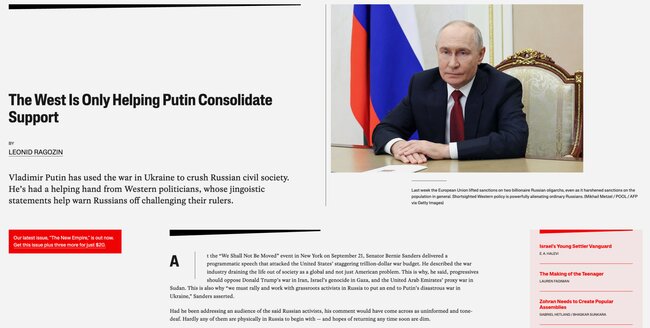
But you see, my most recent piece was in Jacobin, an outlet more closely associated with democratic socialism in the United States, with Senator [Bernie] Sanders — though I actually criticize Senator Sanders in that piece — and with politicians like [Zohran] Mamdani, the mayor of New York.
Leonid Ragozin’s column in Jacobin
There’s a very interesting process happening right now that I write about in my articles. Largely in an effort to counter the far-right populists and extremists they constantly compete with, mainstream politicians in Western countries are adopting [equally radical positions]. As a result, mainstream politicians’ own views are becoming quite extreme. It’s most apparent in foreign policy, in their attitudes toward the Russian-Ukrainian conflict and, to a considerable extent, toward Gaza and Iran.
Paradoxically, their rivals in far-right parties, like Germany’s AfD, are starting to sound like the voice of reason. Like people who don’t want a nuclear war to wipe us all out. Who don’t want us to spend our entire lives in this endless war, with a front line running through Europe all the time.
— Have you ever caught yourself self-censoring? For example, after what happened to TV Rain. Did that worry you at the time, by the way?
— I should say that before what happened to TV Rain, exactly the same thing had happened to me. And exactly the same figures in Latvian politics were involved.
In my case, Latvian Defense Minister Artis Pabriks wrote an official letter about me [to two media regulators: Latvia’s Public Electronic Mass Media Council and National Electronic Mass Media Council], accusing me of being a Kremlin agent of influence.
Then exactly the same thing happened to TV Rain, six months later. In my case, nothing came of it at the time. For TV Rain, it ended with the channel being forced to leave Latvia.
Of course I felt I was censoring myself. It seemed to me that I was doing it all the time. At some point, many years ago now, I stopped writing or saying anything about Latvia out of concern for my personal safety.
At the same time, as many of my friends know, self-censorship and I don’t get along very well. In any situation, in life or in politics, I tend to say what I think.
I think both the attack in 2022 and the current one were entirely about Latvia’s elections. Back then, the defense minister [Artis Pabriks], who published the letter and tried to get me deported, was in a party [Development/For!] that lost the election badly.
Now it’s two parties that started this discussion in the final week before the election. In theory, they might not have made it into the Saeima [Latvia’s parliament]. They were fighting to keep their seats. In the end, they got in, but finished in the last two places among the parties that won seats.
Now they’re fighting to join the governing coalition. There’s a good chance they’ll get in as two small parties joining the large party [United List] that won the election.
I’m caught up in all this almost by chance. I’m just an easy target they use to solve their political problems.
The other thing is that one of the parties also has a long-standing personal score to settle with me. They campaigned against me for a very long time, seven years, practically every day, without stopping.
It was a nonstop campaign of abuse and smears on Twitter: daily threats and mockery, constant public denunciations sent to Latvia’s State Security Service, and the publication of photos of me taken surreptitiously in Riga.
They were shaping public opinion about me. It was an industrial-scale campaign of character assassination. Later, Ukrainian psyops joined in. An InformNapalm article published my 78-year-old mother’s full address in Moscow. The article came out in 11 languages, and the Latvian version appeared on the website of Raivis Zeltīts’s new party [Rising Sun for Latvia].
And now they’ve got what they wanted.
— On Latvia’s list of personae non gratae, you’re alongside people like Tina Kandelaki, Dmitry Guberniev, Nikita Mikhalkov, Valery Gergiev, Denis Matsuev, Yekaterina Andreyeva, Polina Gagarina, Shaman… How does that feel?
— You’ve listed people who are connected to Putin’s regime and work for it. I don’t work for Putin’s regime. I’m disgusted by it, which is why I left. But I think the people persecuting me politically in Latvia are cut from the same political cloth as Putin’s regime. And unfortunately, they’re taking Latvia in the same direction. It’s very sad, of course.
I think the threat of Eastern Europe and all of Europe becoming more like Putin’s Russia, of security concerns being used to justify more control, of whole countries being taken over by political police and intelligence officers, as happened in Russia — all of that has been a very strong motivation for me to warn about this danger.
I really wouldn’t want that to happen. Fortunately, it hasn’t happened yet. But there are very strong signs, including in my own case, of a creeping shift toward Putin-style rule.
‘I’m only human, and I probably tend to say more than I should’
— You wrote about a “character assassination campaign involving far right infowar and fake news outfits” intended to “destroy my life” and “put a gag on me as a notable voice in public debate on the Russo-Ukranian war.” What did you mean?
— I mean the outlet Visegrád 24. An outlet with an audience of two million used my interview with Aaron Maté to put words in my mouth that I never actually said.
The Russian “opposition journalists” Leonid Ragozin is threatening his new “home country” Latvia again.
Speaking on Aaron Maté’s anti-Western propaganda show, he staged that Russia is “compelled” to respond with brutal force to “actions that changes the landscape in the former…
It wasn’t my best interview, but they interpreted it in a way that distorted my thoughts beyond recognition.
— You’re talking about your appearance on the podcast “Useful Idiots,” where Aaron Maté and Katie Halper interviewed you. Could it be connected to your being declared persona non grata?
— I have no idea whether that interview could have anything to do with the Latvian authorities’ decision. I’ve said all sorts of things over the years. And I’m often not happy with what I’ve said. I haven’t always expressed my thoughts well or clearly.
I’m only human, and I probably tend to say more than I should.
I think there are information warfare groups on social media that have always looked for a reason to pick apart something I’ve said. Their goal is simply censorship, to shut me up and stop me from saying what I think. To keep my analysis out of the public sphere altogether.
The main thing here is the way I’m being banished from Latvia, from my only home. This is a decision made outside the courts. And the people involved talk openly on Twitter about why they chose that particular way of banishing me. They want to keep all this out of Latvia’s court system.
Let me quote Rihards Kols, a senior National Alliance politician and member of the European Parliament who could even become [Latvia’s] foreign minister if the party gets that post: He wrote that it’s very important to do this through a persona non grata designation, because that kind of decision can’t be appealed in Latvian courts.
It’s a decision made entirely outside the courts. But if they simply revoke my residence permit, then I’ll sue and Latvia will lose, Rihards Kols wrote. You can go look up his post before he deletes it.
— One of your most widely discussed statements on the podcast was that Russia sees itself as being under constant pressure from the West, which “compels them to respond” to Western actions in the post-Soviet region. If you say the Russian authorities were forced to act, does that mean you’re absolving them of responsibility?
— In that passage, I’m conveying what I think the Kremlin thinks. I’m describing the Kremlin’s motives in my own words — how the Russian government sees its situation, its position in this conflict.
They, I say, feel they’re the “weaker side.” And as the weaker side, they feel compelled to compensate by striking first, with a preemptive, devastating blow, a disproportionate response. The “stronger side” can afford to act calmly, to take small, relatively inconspicuous steps, to use salami tactics to force the weaker side into a disproportionate response.
That isn’t what Leonid Ragozin thinks. That’s what, in Leonid Ragozin’s view, the Kremlin thinks.
— Many people heard it as a justification of Russian aggression.
— No, I’m interpreting the Kremlin’s understanding of this situation, explaining it to a Western audience.
But you see, this was a live interview. You can pick apart any live interview. The people attacking me, including politicians and experts, say an insane amount of incendiary nonsense. If they were in my position, they’d be thrown out of their countries every two minutes.
I’m generally pretty careful about what I say. But I’m human, and some days I feel better than others. I give interviews from time to time. Sometimes I express myself better, sometimes worse.
If someone says something awkwardly or unclearly, instead of asking what they meant, what they actually wanted to say, do you really have to punish them in such a completely draconian way? Take away their home, throw them out of the home they’ve spent 12 years building and making their own, turn them into a homeless person?
But I want to repeat: We don’t know, and most likely never will know, the grounds for throwing me out.
Judging by how Latvian courts have handled such cases, this decision most likely won’t even be made available to the court itself. Because it’s classified. What does it say? Something intelligent, or some nonsense? I don’t know.
I can see that the people accusing me over this interview weren’t directly connected to Latvia. And Latvian politicians were actively retweeting all those stories. I was also subjected to the most bizarre allegation that I’d traveled to Russia after 2022.
This is being done through various mouthpieces of information warfare. And nobody says it directly, probably because they’re all afraid I’ll just sue for defamation.
One politician who talks about this deliberately misspells my surname with an “o,” so that later he can say he wasn’t talking about me at all, but about Dmitry Rogozin, for example.
Of course I can respond to all these allegations, but they’re being made on Twitter. They’re not being made in court or before official bodies.
This whole thing is about denying me access to justice. I’m accused of all sorts of outrageous sins, but it’s not happening in a courtroom or in government offices. I don’t understand what exactly I’m being accused of. I’ve been denied access to justice in Latvia.
— One of the public allegations against you concerns your blaming the West for obstructing peace talks. You openly write that the aim of Western strategy now is “not a better Russia or Ukraine, but conflict itself.” You argue that prolonging the conflict benefits Western arms manufacturers and is being used to weaken Russia.
— You see, there’s always a danger in talking about very complicated things in simple terms.
The West isn’t a single entity, of course. And right now it’s particularly fragmented. The United States, for instance, is very different from the countries of Europe. But I have serious doubts about the motives of a significant part of the Western political establishment in this war.
I have a strong sense that the fate of Ukraine and Ukrainians, which is very important to me, isn’t a priority [for part of the Western political establishment]. The priority is the conflict with Russia itself and some illusory goal of weakening Russia and achieving a strategic victory over it.
You can find all sorts of quotes from Western politicians, starting with Lindsey Graham, who actually talked about fighting to the last Ukrainian. Quite a few politicians and experts also talk about a strategic victory over Russia as a goal, one that seems less and less achievable.
For me, the priority is human life. And I’d really like to see the Ukraine I remember and love exist again. A Ukraine that included Crimea and the Donbas — precisely the regions I know best. That country became something of an ideal for me, or a potential ideal.
But right now, I think the priority is preserving what’s still left in Ukraine. Over this summer, [for example,] Ukraine’s steel industry was completely destroyed.
— How do you see the war between Russia and Ukraine ending under the current circumstances?
— After the enormous loss of life, economic damage, and territorial losses Ukraine has suffered, I don’t see a way to achieve what President Zelensky calls a just peace.
Let alone a way to regain the occupied territories. However much I’d like that.
I probably shouldn’t say this as a journalist, but I will — this is my position. Given the circumstances, the morally right decision now would be to end the war and try to start some sort of political process that might, over time, restore justice.
I have doubts about this [my position], as I think most people do. But ideally, I’d probably like all of that. I can describe possible bargaining scenarios, but I don’t think it’s my role to tell politicians how to negotiate with one another.
And of course I deeply regret that the war wasn’t ended earlier, when it could have ended on much better terms for Ukraine.
‘The life I built in Latvia is my real home, my ideal home’
— What kind of life did you build in Latvia, and who has been part of your circle of friends and loved ones lately? What are you losing with this order declaring you “undesirable” in the country?
— I don’t want to name my friends, because I’m afraid it might harm them in some way. Probably the only people I want to mention are Lena Nemirovskaya and Yuri Senokosov [who moved to Latvia in 2021], who’ve become very close to me. And I know they feel the same way about me. They founded the School of Civic Education, an organization that was declared “undesirable” and a “foreign agent” in Russia. People who, at the age of 80, were thrown out of Russia and forced into exile.
I have quite a lot of friends from all sorts of backgrounds. At some point, half of Moscow descended on Riga. I mean journalists, people I’d met at the Pussy Riot trial, on trips with [Alexey] Navalny when I interviewed him. They expanded my social circle. People who’d always been hard to meet up with in Moscow, because meeting up and arranging anything in Moscow is difficult in general, suddenly turned out to be a 10-minute walk away here. And that’s wonderful, of course.
But originally, my social circle in Latvia was very Latvian, very Latvian-speaking. Many of us later went our separate ways politically, but I still have a lot of very good friends who are Latvian citizens.
— You said you came to feel that Latvia was your only home.
— Yes, I think that will stay with me for the rest of my life. Latvia has a very special place in my heart. And the life I built in Latvia is my real home, my ideal home. I’ve invested a great deal in it emotionally. So much happened there — dramatic things and good, wonderful things. So yes, it’s a great personal tragedy.
And that’s why, above all, what’s being done to me seems sadistic. Pointless, stupid, and very sadistic.
— You consider yourself a victim of persecution for your political beliefs. But Latvia and other European countries have real reasons to fear Russian influence. In that case, how should a state distinguish an independent journalist with unpopular views from someone knowingly participating in another state’s information campaign? And what is it entitled to do in the latter case?
— First, I think that in a country governed by the rule of law, a person should have the right to defend themselves. And that’s a right I’ve been denied. I have no way to defend myself in court against being designated persona non grata.
Whether I’m a threat to Latvia, whether I’m spreading certain narratives — though Latvian law doesn’t actually prohibit any narratives, at least none I’ve heard of — is something a court should decide, one way or another.
And the second thing that’s probably important to say is this: When people start being punished, especially outside the courts, for inconvenient opinions, whatever those opinions may be, that’s where the rule of law ends. That’s where freedom of speech and constitutional freedoms end. That probably matters. Because what’s at stake is the future of a very complex, imperfect civilization governed by law, but still the best one we have.
Whatever comes after that, I’m afraid, will look more like Putin’s Russia.
— Can you talk about your plans, about where you intend to settle? Aren’t you afraid you could lose your home yet again there?
— No, I’m not going to give the people who continue to persecute me a chance to make my life even worse. So I’m not commenting on my whereabouts.
As for plans, they’re very fluid. I’ll have to respond to circumstances as they develop. One way or another, I’ll have to build a new life. But I’ll keep doing my work. That’s what matters most to me.
I’ve had a very interesting life so far. The people persecuting me couldn’t even dream of the kind of life I’ve had. Something tells me my life will carry on much the same way — happy and good overall, by my definition of happiness.
At Meduza, we are committed to transparency about our use of artificial intelligence in the newsroom. The story you’re reading was written by one of our living, breathing journalists and translated from Russian using an AI model configured to follow our strict editorial standards. This translation process is the result of extensive testing and refinements to ensure our English-language coverage is timely and accurate. A Meduza editor reviews every draft before publication.
If you find any errors in this translation, please contact us at reports@meduza.io.
Russia’s Ministry of Science and Higher Education plans to change university admissions rules to bar universities from readmitting expelled students for five years, TASS reported, citing a draft ministry order.
The restriction would apply to students expelled “as a disciplinary sanction,” the draft order says.
The order is expected to take effect on March 1, 2027, Kommersant reported. The five-year ban would begin on the date of expulsion.
University students can face disciplinary measures, including expulsion, for failing to comply with or violating their institution’s charter, internal rules (including classroom discipline and conduct requirements), dormitory rules, and other regulations. Students on sick leave, vacation, academic leave, or maternity leave are exempt from disciplinary measures, as are “students with disabilities.”
At Meduza, we are committed to transparency about our use of artificial intelligence in the newsroom. The story you’re reading was written by one of our living, breathing journalists and translated from Russian using an AI model configured to follow our strict editorial standards. This translation process is the result of extensive testing and refinements to ensure our English-language coverage is timely and accurate. A Meduza editor reviews every draft before publication.
If you find any errors in this translation, please contact us at reports@meduza.io.
Hungary’s parliament has approved amendments to the child protection law adopted in 2021 under Prime Minister Viktor Orbán. AFP called the move the first significant step toward lifting restrictions on the LGBTQ community since pro-European Prime Minister Péter Magyar came to power.
The original law prohibited material accessible to children from “depicting” or “promoting” sexual and gender diversity. The revised law aims to protect minors from content that could “seriously impair the child’s physical, intellectual, emotional or moral development.”
“Fundamentally, our goal was to move away from a flawed paradigm, linking child protection in any way to sexual orientation or gender identities, and shift to a framework that is truly about children and protecting children,” said Szilvia Gyurkó, state secretary at the Ministry of Social and Family Affairs.
Orbán’s Fidesz Party voted against the amendments, but Magyar’s ruling Tisza Party has a two-thirds majority in parliament. The amendments passed without opposition support.
Human rights advocates welcomed the amendments but called for a review of other discriminatory provisions in Hungarian law adopted under Orbán.
Orbán’s government gradually restricted LGBTQ rights under the pretext of protecting children. Among its last such measures were amendments to the constitution and the law on public assembly that banned the LGBTQ community from holding public events.
At Meduza, we are committed to transparency about our use of artificial intelligence in the newsroom. The story you’re reading was written by one of our living, breathing journalists and translated from Russian using an AI model configured to follow our strict editorial standards. This translation process is the result of extensive testing and refinements to ensure our English-language coverage is timely and accurate. A Meduza editor reviews every draft before publication.
If you find any errors in this translation, please contact us at reports@meduza.io.
Moscow’s Basmanny District Court sentenced blogger Michael Naki in absentia to five years in a penal colony for publicly calling for activities aimed at undermining Russia’s security (Article 280.4, Part 2, Paragraph “c” of the Criminal Code). It also barred him from administering websites for five years.
The prosecution stemmed from a video posted on Naki’s channel on May 7, 2024. According to Mediazona, the video was titled “Putin can now be eliminated. The day Putin stopped being president.” Prosecutors said the video contained signs of “incitement to overthrow the government in Russia.”
This is Naki’s second sentence in absentia. In 2023, the Basmanny District Court sentenced him to 11 years in a penal colony for spreading “fake news” about the army (Article 207.3, Part 2, Paragraph “d” of the Criminal Code). That case concerned a video in which Naki and Conflict Intelligence Team founder Ruslan Leviev recapped the ninth day of Russia’s full-scale invasion of Ukraine.
The court combined portions of the sentences in the two cases to impose a total term of 14 years in a penal colony.
At Meduza, we are committed to transparency about our use of artificial intelligence in the newsroom. The story you’re reading was written by one of our living, breathing journalists and translated from Russian using an AI model configured to follow our strict editorial standards. This translation process is the result of extensive testing and refinements to ensure our English-language coverage is timely and accurate. A Meduza editor reviews every draft before publication.
If you find any errors in this translation, please contact us at reports@meduza.io.
Russian banks received millions of requests for information about debtors from the Federal Bailiff Service (FSSP) over three days between September 18 and 21, an unprecedented volume, the National Financial Market Council reported.
One regional bank received 12.8 million requests on September 19 alone — as many as it normally receives in a month.
The council’s head, Andrey Yemelin, said the volume of FSSP requests over those three days was at least 10 to 12 times the usual level, and up to 30 times at some banks. More than 90% of the requests concerned people who were not customers of the banks that received them, said Yelena Samokhina, director of the banking development department at the Association of Banks of Russia.
Experts believe technical errors may account for the volume of requests, which the FSSP generates automatically. “The service has previously acknowledged that it resends requests if a bank hasn’t confirmed receipt. If those confirmations were lost, the automated system could have sent banks the entire backlog, along with duplicate requests,” said Mikhail Bryukhanov, chairman of Pervouralskbank’s board of directors.
Banks are legally required to provide the requested information within three days or face fines of 50,000 to 100,000 rubles for each request. Given the volume, Yemelin said “the fines could add up to amounts that pose a real threat to the financial stability of some banks.”
The council asked the Central Bank to look into the situation. The Central Bank said it had “received the inquiry and will review it according to established procedures.”
At Meduza, we are committed to transparency about our use of artificial intelligence in the newsroom. The story you’re reading was written by one of our living, breathing journalists and translated from Russian using an AI model configured to follow our strict editorial standards. This translation process is the result of extensive testing and refinements to ensure our English-language coverage is timely and accurate. A Meduza editor reviews every draft before publication.
If you find any errors in this translation, please contact us at reports@meduza.io.
The International Monetary Fund has lowered its forecast for Russia’s economic growth to 0.9% in both 2026 and 2027. The updated forecast, released on October 13, is down from its July projection of 1.1% for each year.
The IMF report says high global energy prices are supporting Russia’s economy despite a decline in supplies caused by Ukrainian strikes that damaged oil infrastructure.
The report says the overall outlook is weak for energy-intensive economies and those dependent on oil and gas imports. Russia, however, benefits from “favorable factors associated with increased defense spending” that partially offset this weakness.
In late September, Russia’s Economic Development Ministry raised its growth forecast for 2026 from 0.4% to 0.6%. The ministry expects growth to accelerate from 1.4% in 2027 to 2.4% in 2029. Russia’s central bank forecasts growth of 0 to 1% in 2026 and 1.5 to 2.5% in 2027.
In early October, the World Bank kept its forecast for Russian GDP growth in 2026 at 0.8%. It expects Russia’s economy to grow by 0.7% in both 2027 and 2028.
At Meduza, we are committed to transparency about our use of artificial intelligence in the newsroom. The story you’re reading was written by one of our living, breathing journalists and translated from Russian using an AI model configured to follow our strict editorial standards. This translation process is the result of extensive testing and refinements to ensure our English-language coverage is timely and accurate. A Meduza editor reviews every draft before publication.
If you find any errors in this translation, please contact us at reports@meduza.io.

 Login