Harry Richardson, President of the British Australian Community, speaking at the Sydney Free Speech Rally on 30 August 2026:
First, an acknowledgement. The BAC would like to acknowledge the Anglo explorers, the pioneers and their descendants who planted the British flag and Christian faith on this continent, creating the Australian nation. We acknowledge the Aboriginal and Torres Strait Islander peoples who have lived here since the Dreamtime.
And we acknowledge the Federal Commonwealth of Australia, created by the nation, under the Crown, to guard the nation and the liberty of all citizens. Today, in 2026, there are few countries that have free speech. The ones that do are mostly European or European-derived.
Yet in England, Sir Edward Coke insisted that freedom of speech was an ancient custom of Parliament. That was in the 1590s, more than 400 years ago. I grew up in England in the 60s and 70s and played out in the street every night.
And once in a while, some kid would come running into his mum and say, Mum, Johnny called me an idiot. And the answer every kid got from his mum was the same. Go and tell Johnny, sticks and stones can break my bones, but names will never hurt me.
In other words, grow up and take it on the chin. Hurty words won’t damage you. People have a right to insult you. Deal with it.
This was the ancient culture of free speech that we were marinated in as we grew up. But whilst in the atmosphere and parts of Western Europe, free speech was a foundational part of our culture, in the rest of the world, it mostly wasn’t.
Saying the wrong things could have you punished or even killed. Our leaders used to tell us that we were an anomaly, because we were a European country in Asia. Now they tell us that we’re not a European country at all and never were.
They say that the only defining feature of Australians is their values. They say that anyone could come here and adopt our values and instantly be as Australian as anyone else. But in order to bring in people from such diverse backgrounds, one of the first things they had to do was to shut down our free speech, which is one of our most precious values.
In 1975, just three years after Whitlam decided to abolish discriminatory immigration, our elites introduced the Racial Discrimination Act, which began the process of cramping down on free speech in order to facilitate a diverse society.
But that wasn’t enough, of course, so later they added the hated 18C. Then when Tony Abbott promised to repeal 18C, a coalition of diverse minorities got together and made damn sure that he would do no such thing, even though it was a foundational value of the Anglo-Celts who settled and built this nation.
Now even that isn’t enough, so they bring in the anti-Semitism and hate speech laws, which are even worse. And this isn’t the end of it. You mark my words.
The destruction of free speech has been intertwined with the project to force multiculturalism onto Australia. If you don’t believe me, Chris Minns, the New South Wales Premier, spelled it out for you. He said, and I quote,
“We don’t have the same freedom of speech laws that they have in the United States, and the reason for that is that we want to hold together a multicultural community.”
So there you have it. We can’t have free speech anymore because now we’re multicultural. We all need to understand that.
When we choose migrants, most of us want people with the same value systems as we have. But how do we make sure that people share our values before we give them a passport to one of the richest countries in the world?
Well, our founders wrestled with this idea and came up with a simple solution. It wasn’t perfect, of course, but it was the best they could manage. They decided to restrict entry mostly to people from the British Isles and to a lesser extent Western and Northern Europe. Some people called this the White Australia Policy.
Why did they think that people from Britain would share their values and loyalties? Well, probably because our founders were of British descent, and they were very explicit about that.
Henry Parkes, the father of Federation, talked about the crimson thread of kinship. His views were hugely popular. So they ran this policy for the first 70 years or more after Federation, and not surprisingly, most of the migrants shared the same values as other Australians.
They believed in freedom of speech, the rule of law, Christian morality, and the Protestant work ethic, and so on. During this time, the policy was wildly popular with the citizens of the nation, and the nation flourished. Australia had a high standard of living, low levels of crime and corruption, and all the benefits of a high-trust society.
Importantly, we had a deep cultural affinity for free speech, which we understood was the bedrock of the kind of free and stable society to which we were accustomed to. But our elites decided to introduce non-discriminatory immigration, which benefited minorities. They told us that this wouldn’t matter, because the new migrants would have our values.
But when people found that many new migrants had different values, the government crushed dissent by clamping down on free speech. The problem is that once the government gets the right to ban speech they don’t like, it never stops, because they love to ban criticism of their own policies. And the policy that most people wanted to criticise was mass indiscriminate immigration.
So multiculturalism and immigration have been protected by constantly undermining our ancient free speech rights and values. In Britain today, thousands of people are arrested every year for expressing opinions, and most of those opinions are in opposition to mass indiscriminate immigration. Free speech is effectively dead in that country, and Australia is catching up fast.
You can’t import people en masse from countries with different value systems, and expect them all to adopt our loyalties and value systems the moment they arrive here. It isn’t easy to defend free speech, even amongst educated Westerners. How can we expect people who’ve grown up in cultures which hate free speech to suddenly embrace it? It was never going to work.
Just ask Salman Rushdie. Under our current immigration system, only about 3-5% of migrants come from the British Isles, and 90-95% of our new migrants come from outside Europe. These new people come from countries with different values, and for the most part, free speech is not one of them.
Values exist in the minds of people, not in the magic soil or floating in the air. Different people have different values. If we allow the government to turn us into a hated minority in this land, then don’t expect our values to hang around.
So this is the game. They want to shut down your free speech so that they can bring in more people who don’t believe in free speech. We have to fight these laws and preserve our free speech, or as George Washington said, it may be taken away, and dumb and silent we may be led like sheep to the slaughter.
Birmingham City Council, Britain’s largest local authority, has gone to the High Court to stop residents putting the Union Jack and the St George Cross on lamp posts without its say-so.
If a judge grants the injunction, breaching it could mean up to two years in prison or an unlimited fine. Yeah, you can be imprisoned for the unauthorised raising of your own nation’s flag.
The application, which was filed on August 26, names eight people directly, including Ryan Bridge, who co-founded the grassroots Operation Raise the Colours campaign that’s put English and British flags on street furniture across the country over the past year, plus a catch-all “persons unknown” clause that leaves the net open to anyone who does the same thing.
The council insists this isn’t really about the flag. Green councillor Jane Baston, Birmingham’s cabinet member for equalities and communities, called it a lawful, proportionate, and evidence-led approach to unauthorised attachments on the highway. She cited public safety and staff welfare as the actual concerns.
Birmingham isn’t the first. Oxfordshire County Council won a similar High Court order back in April, the first council to do so.
But nobody’s buying the “neutral policy” framing. Multiple outlets have noted that this enforcement push applies to English and British flags specifically, while flags from other countries flown elsewhere in the city haven’t drawn the same court action.
And yet, if the English and British flags are problematic, what do foreign flags flown in Britain communicate? Nobody plants a flag as mere decoration. It’s a claim of belonging: this is ours, we’re here, we stand under this, this represents who we are.
Take a flag down and put nothing up in its place, and you’ve made a slightly different, quieter claim that whatever it stood for doesn’t get to be visible here anymore. At the very least, the land no longer exclusively belongs to those that the flag represents.
That’s true whether it’s a war memorial, a town centre, a local council, or a lamppost.
The St George’s Cross has flown over England for the better part of a thousand years. A red cross on white, adopted from the banner of England’s patron saint and tied to the Crusades before it ever became a national symbol.
The Union Jack layers three Christian crosses on top of one another: St George’s cross for England, the blue-and-white saltire of St Andrew for Scotland, and the red saltire of St Patrick for Ireland.
It’s not an abstract or arbitrary pattern. It’s the patron saints of the home kingdoms stitched into a single piece of cloth. It’s a literal union forged from shared ancestry, homelands, and Christian inheritance.
Of course, none of that is what Birmingham’s injunction talks about. They use the rhetoric of “unauthorised attachments” and “community cohesion.” But it is curious how all of these multicultural efforts result in the same thing: no native Britons, no English imagery, and no Christian symbolism.
But let’s suppose, for a moment, that Birmingham’s neutral framing here is entirely accurate, and that the council is genuinely concerned about “unauthorised attachments” undermining social cohesion and fracturing the community.
If that’s the case, then we should be asking another obvious question: What does it say about the state of those communities if displaying the national symbols of the country is supposedly enough to threaten social cohesion?
If newcomers and immigrant communities regard St George’s Cross and the Union Jack as so provocative and offensive that their mere presence on a lamppost is deemed a threat to community cohesion, what does that suggest about their relationship and commitment to the nation those symbols represent?
In that case, the problem isn’t the flag or what it represents. The problem is a failure to integrate people into a shared national identity. The problem is the importation of attitudes that are so hostile to that identity that even its most basic symbolism has become something to be suppressed rather than celebrated.
A Catholic priest based in the West Bank is asking Christians not to flee.
Father Firas Khoury spoke with Catholic news site Aleteia, saying, “What if all the Christians flee from the Holy Land, if they could not face the terror? What would this land mean for Christians in the West?”
“What would their story mean?”
It would mean, “shrines and history will never tell you the story of the man from Nazareth.”
Khoury, who lives in Zababdeh, a town in the northern part of the West Bank, spoke out because of trouble with Israeli settlers in Taybeh.
According to Khoury, what’s going on there is serious and deserves worldwide attention.
“For the last three years, settlers have attacked the villages near the settlements and burned the olive trees and the fields belonging to the Palestinians.
“These settlers,” he claimed, “want to terrorise the people to flee and leave their homes.
“If they control the city, they could delete the long Christian history of this place.”
This is why he wants Christians to stay. “Their presence keeps alive the story of Jesus in the land where he lived,” Aleteia reported.
Khoury is that concerned, he’s “begging” Christians around the world to “stand for justice and solidarity with the Christian community there.”
His goal is to see “Taybeh survive.”
This is part of a broader series of clashes across the territory between Israelis and Palestinians.
The West Bank priest told Aleteia, “We invite you to pray for us and hear our stories and come to visit; we have many stories to tell you.
“We need you to stand for peace, to listen to the Christian Church in the Holy Land and stand with us, your brothers and sisters.
“Today, we are trying to survive in the middle of the conflict.”
That conflict is due to Israeli settlers violently attacking Taybeh’s residents.
In response, Israel’s military closed Taybeh to non-residents, telling Reuters it was being done “to prevent the attacks.”
This is still in effect and “only applies to Israelis and not to Palestinians,” the IDF said.
In a statement quoted by Reuters, they added, “Upon receiving any report of violations of the order, IDF soldiers are dispatched to the area.”
They then “operate to disperse the gatherings and detain suspects in order to protect the citizens of the area and to maintain order.”
The Times of Israel’s Tom Livny described the town as a “closed military zone,” and it will be so for at least a year, he said.
Two “activists” also told him that the closure “will have a severe economic impact because Taybeh, rich in Christian heritage, relies heavily on its tourism industry.”
Questioning the official military narrative, Livny said, “If the reason for this move truly was the settler attacks, then why should tourists from Brazil be prohibited from entering?
“If,” he added, “residents can’t earn an income, then they’ll leave.”
Appearing to suggest that this could be the real reason for the IDF action, Livny asserted, “they don’t even want Christians to be living there.”
The left-leaning Jewish activist also called the whole experience weird.
“Shoving a camera in their faces and blocking their way from trying to get through a fence around someone’s home is about as aggressive as you are allowed to behave.”
Saying he wasn’t sure what the IDF’s presence had fixed, Livny said, “All of the settlers that I saw had their faces mostly covered with bandanas. That may be a precaution against having their faces appear on camera in a place they aren’t allowed to be.”
The people behind the attacks on Taybeh’s residents tend to be “kids and young men riding their donkeys around people’s property.”
They appeared to be doing this to “make them afraid and uncomfortable, and waging a very patient war of attrition until they finally give up and pack their bags.”
“There is absolutely no logic in closing the road,” Livny remarked.
“The settlers don’t use cars; they travel by donkey.
“So, in other words,” he concluded, “the entire town could have ended up being sealed off as a punishment for being harassed by settlers.”
Livny’s account gives weight to Khoury’s complaints.
Independent Catholic News published a letter from the priest on 25 August, in which he stated that the IDF presence and new settlement in Zababdeh, near Jenin, is making life difficult.
“What we are experiencing,” he said, “should not remain unknown.”
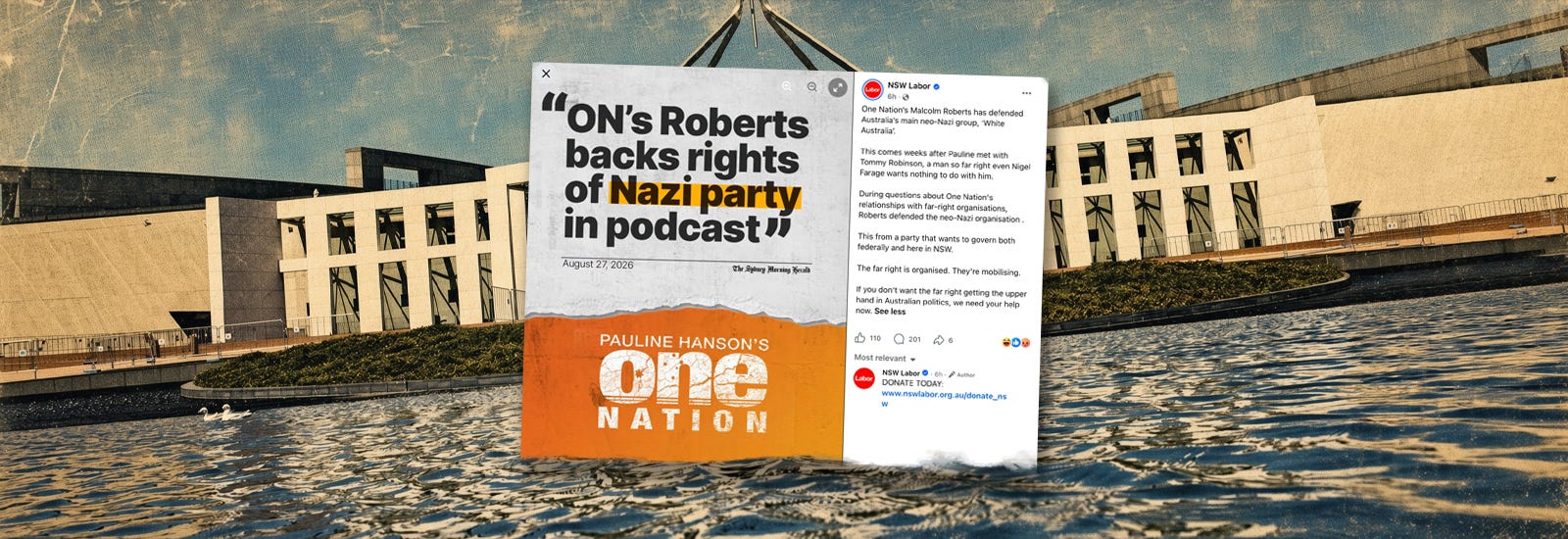
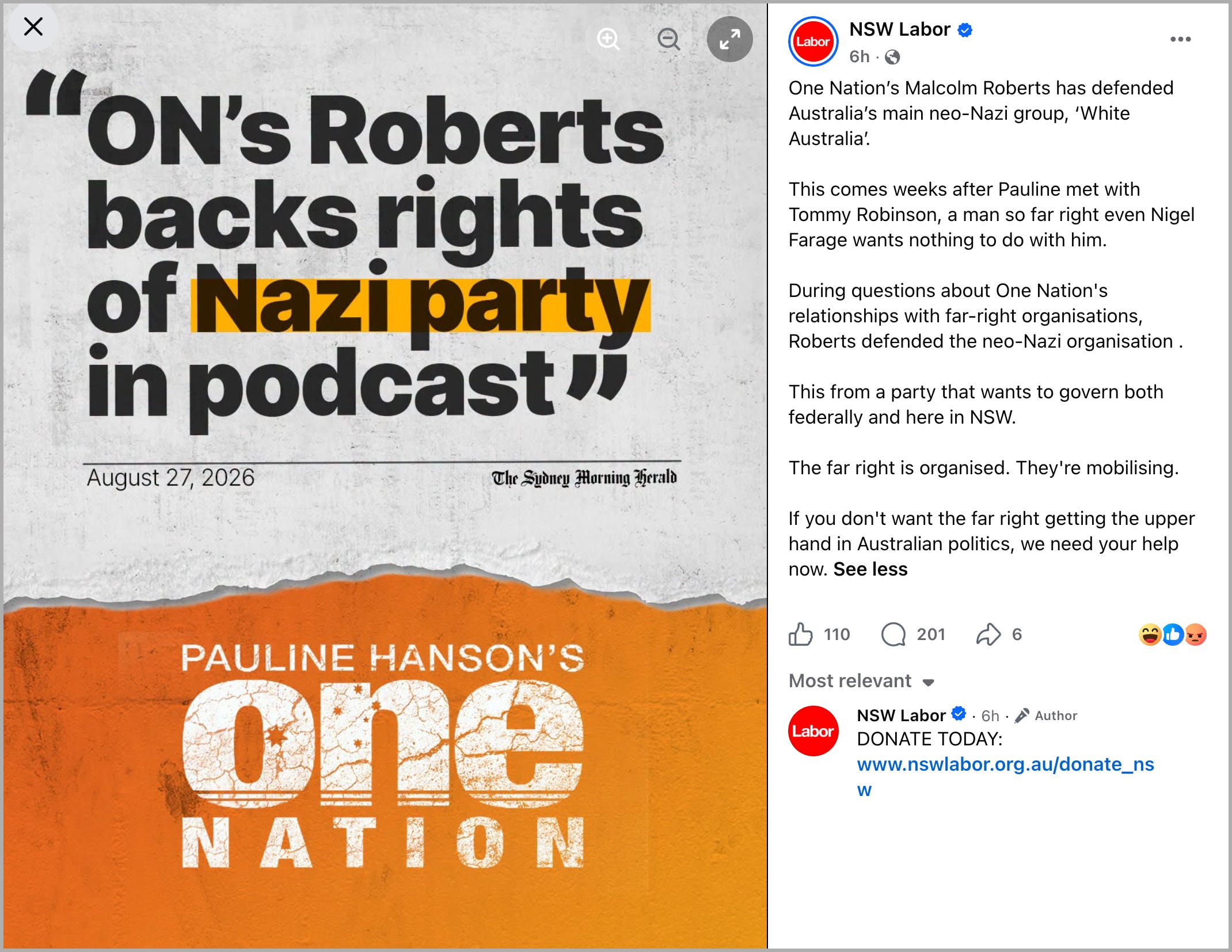
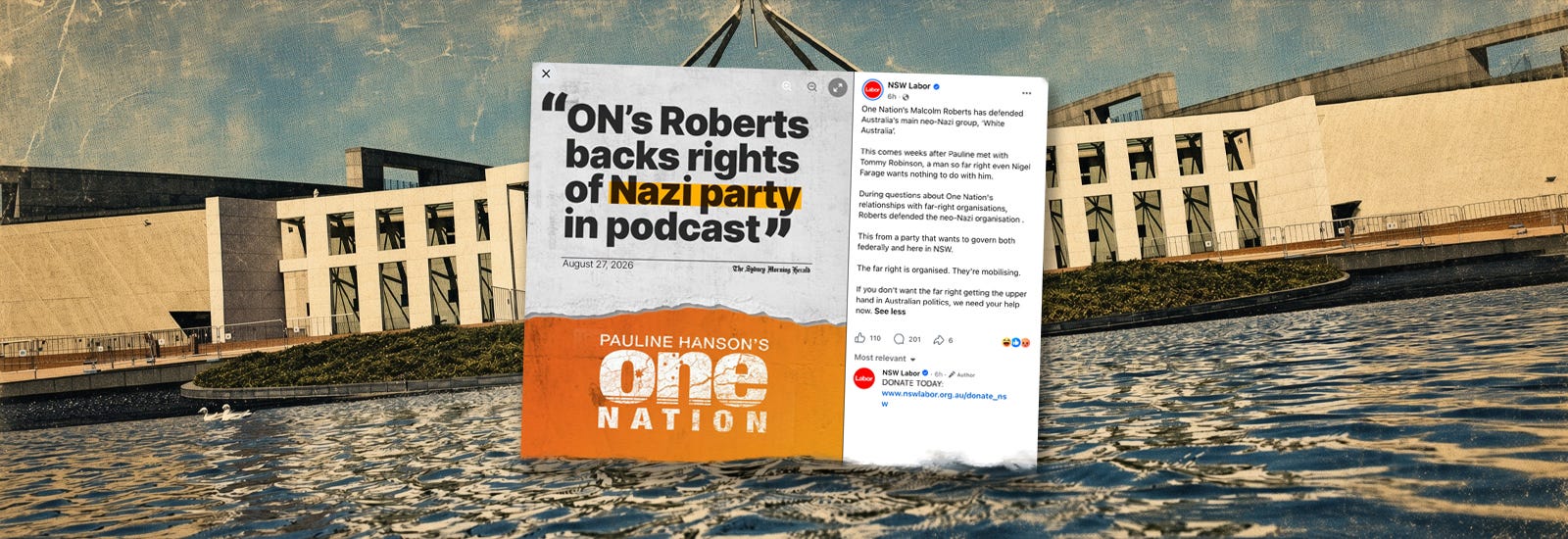
Screenshot from NSW Labor’s official Facebook page.
The ad reads, “ON’s Roberts backs rights of Nazi party in podcast.”
Labor NSW appears to treat it as scandalous that One Nation Senator Malcolm Roberts “backs the rights” of a particular group of people. Which seems to suggest that Labor believes one’s political views determine whether their “rights” are worthy of recognition?
But there’s an important distinction between disagreeing with a political position and questioning whether the people who hold it are entitled to the same rights as everyone else. The former is legitimate political debate. The latter is a little more disturbing. And it appears to be a position that Labor unashamedly embraces.
They may not intend to make this argument, but the ad, at least, inadvertently exposes an underlying assumption that some people’s rights become less legitimate, or less deserving of support, depending on which side of the political spectrum they occupy.
But “rights” aren’t supposed to be rewards for holding the correct political opinions.
If a right is genuinely a right, it doesn’t cease to be one because the person exercising it votes differently, belongs to the wrong political movement, or holds unpopular views.
You can strongly oppose a political group. You can reject its policies. You can argue that its thought-leaders are dead wrong. But the moment you start treating the rights of a particular group as objectionable simply because you don’t agree with their ideas, well, you’ve become the fascist you’ve been resisting.
Labor appears to think your rights depend on your politics. Consider the implications of that for just a moment.
If your rights are only worthy of recognition when they are defended by the politically approved people, then they aren’t really rights at all. They are privileges, granted by the state to those who hold the right opinions and denied when they don’t.
That’s a far more revealing message than Labor’s attack ad probably intended to send. It’s not One Nation that’s endorsing authoritarian politics. It’s Labor.
A two-year Tasmanian parliamentary inquiry has landed its heaviest blow yet on a faith-based school system, finding that Catholic Education Tasmania (CET) discriminated against staff over their sexual orientation and marital status — a finding CET flatly disputes.
The Inquiry into Discrimination and Bullying in Tasmanian Schools began in June 2024, after national data showed Tasmania had the country’s worst schoolyard bullying rates. Two years, 55 findings and 33 recommendations later, its final report — chaired by Labor MP Brian Mitchell — reserves some of its sharpest criticism for the state’s Catholic system, which runs 39 schools across Tasmania.
The committee concluded CET’s hiring practices were in breach of the state’s Anti-Discrimination Act 1998. But importantly, this is a parliamentary committee finding, not a court ruling, and the interaction between Tasmania’s legislation and Commonwealth anti-discrimination law has not been judicially determined.
The finding rests partly on testimony from Gerard Gaskin, CET’s former executive director, who told the inquiry back in February 2025 that people whose public lives conflicted with Catholic teaching would not be employed in senior leadership positions. A former deputy principal also told the committee that his marriage breakdown and subsequent de facto relationship led to him being stood down and ultimately told he could no longer work as either a leader or teacher within Catholic Education Tasmania.
CET isn’t backing down. The organisation maintains it operates under, and complies with, the federal Sex Discrimination Act, which contains a specific exemption allowing religious educational institutions to discriminate in certain circumstances where doing so in good faith is necessary to avoid injury to the religious susceptibilities of adherents. The exemption covers attributes including sexual orientation and marital or relationship status. Current executive director Terry McCarthy says the organisation takes the findings seriously and remains confident its employment practices are lawful.
Here’s the part that should worry every Christian institution in the country, not just Catholic ones: two Liberal members of the committee, Michael Ferguson and Mark Shelton, tried to soften the finding by adding the words “may have”, and were voted down five to two. In their own dissenting statement, the pair warned the report risked trampling “freedoms of belief and family choice” — a warning that deserves a lot more attention than it’s getting.
Because that’s really what’s on the line here. A Catholic school declining to appoint a senior leader who publicly rejects Catholic teaching on marriage isn’t simply an ordinary employment decision — it’s bound up with the entire reason a religious school exists in the first place. If the state can ultimately require CET to treat faithfulness to Catholic doctrine as an unlawful hiring criterion, there’s no principled reason it couldn’t raise the same question for any Christian school, or church-run charity, anywhere in the country.
Independent MP Kristie Johnston, who moved the motion that established the inquiry back in 2024, wasted no time turning the finding into political ammunition, pressing Premier Jeremy Rockliff in parliament over what he intends to do about it. Rockliff didn’t commit to anything beyond the usual line about expecting everyone to follow the law. Equality Tasmania’s Rodney Croome has gone further still, calling for the matter to be pursued rather than leaving the fight solely to individual victims of discrimination.
That should tell you where this is heading. This report isn’t necessarily the end of the story — it could become an invitation for activists and government lawyers to take the dispute further and, potentially, use the courts to settle once and for all how Tasmania’s anti-discrimination laws interact with the protections afforded to religious schools under Commonwealth law.
And Tasmania isn’t acting alone. New South Wales is running its own review of anti-discrimination law, one that includes consideration of the religious exemptions affecting faith-based organisations and schools. The pattern is worth watching: another inquiry, another “review,” another set of recommendations, all potentially affecting the amount of room faith communities have to run their own institutions as they see fit.
The report’s other findings — on bullying rates generally, on First Nations students, on gifted kids falling through the cracks — deserve real attention, and nobody disputes Tasmanian schools have genuine problems to fix. But burying a religious freedom fight inside a bullying report doesn’t make it any less of a religious freedom fight. If a Catholic school can’t require its leaders to actually live like Catholics, what’s left of “Catholic” in Catholic education?
“Be watchful, stand firm in the faith, act like men, be strong. 14 Let all that you do be done in love.” 1 Corinthians 16:13-14
You have all heard the song, “R-E-S-P-E-C-T, that’s what your love means to me!” This song, Respect, is well known around the world as Aretha Franklin’s greatest hit. But what a lot of people do not know is that before this song was taken and retooled as a feminist anthem, it was written by a man and sung by a man, the great Otis Redding.
Redding is as famous as Franklin in his own right, and if you are not familiar with his music, but have seen Top Gun, you will probably remember his beautiful song Sitting on the Dock of the Bay. That song is pure goodness. Go listen to it now; you won’t regret it.
But before he wrote that hit, another one of his songs was Respect.
There is some debate over who originally wrote the song, but we know the lyrics were reworked by Redding when he released the song. Before he sang about the beauty of sitting and watching the ships roll in, he sang about one of the inherent longings of the man for respect from his wife,
“[Verse 1] What you want, honey, you got it And what you need, baby, you got it All I’m askin’ is give me a little respect when I come home Ooh, yeah Hey, hey, hey Yeah, now Ooh, yeah…”
The song is about a man who wants to give his wife anything she wants, everything she needs. He even says, “And I wanna give you all of my money”, so he does mean everything, and all he wants in return is some “respect”. There is some debate online about whether or not Otis meant to use “respect” as a euphemism for sex, as apparently this was one way this word was used as slang in the street culture of his day.
However, even those who make this point highlight how the end of the song really drives home also just how important plain old respect was to the man,
“[Outro] Respect when I want it Respect when I need it Respect when I want it Respect when I need it Got to, got to have it We got to have it Got to, got to have it…”
As one commentator has noted,
“In the coda that follows the final verse, Otis goes to work, wresting the word free of this narrow meaning, asserting his prerogative with an insistent determination that turns the song in its final moments into a plea for simple human dignity – “Respect is what I want! / Respect is what I need! / I got-ta got-ta have it! / Just give me some respect!” – that doesn’t stop at mere discretion.”
Take just a moment to meditate on the irony of a song about a man wishing for respect from his wife being turned into a feminist anthem, which is how many people remember this song to this day. It is incredible what feminism can subvert, isn’t it; to the impure nothing is sacred. Maybe sit on the dock at the bay and ponder this for a bit.
But then just sit back and consider how this song highlights two things very well: First, just how much a man wants his wife to respect him for who he is, what he does, and how he provides. But also, that simply expecting her to do so is often wishful thinking and also counterproductive. The song encapsulates how many men think, “Well, I provide, therefore my wife should respect me.” And she should. It is common decency. It is not something that should be taken for granted.
But how many people respect those who provide them with stuff without accountability? The government provides, doesn’t it? How many people respect their welfare providers, man or woman? In fact, the less the government demands of them to receive their welfare cheques, the more contemptible their opinion of their provider will be.
You might think that my example paints many wives in a bad light, but that is not the case. How many men have started their complaint to a friend about an impending divorce that they did not see coming, with this statement, “But I was a good provider!” I am sure you were. I am sure you can relate to Redding’s song deeply, “All I’m askin’ is give me a little respect when I come home.” But the truth is the man who puts himself in the position of begging for respect is only going to be increasingly viewed with contempt. You can’t demand respect; you have to command it by how you carry yourself, and what you expect from your loved ones.
We all know the difference between “demand” and “command.” But perhaps I should illustrate it to make it clearer. There were those bosses, or teachers in school, we all had that tried to be our friends, and when that failed, they over-corrected and demanded respect. But it did not work. The more they demanded it, the less we gave it. Then there were those bosses, or teachers in school, whose boundaries were known from the start. Their boundaries were clear and reasonable, and we therefore had respect for them from early on. And that respect grew over time.
This contrast between the one who “demands” respect and who “commands” respect is such a common trope in our culture that it is all through the fiction we consume. You can hardly see a military movie without them presenting some young Lieutenant who keeps demanding respect and not getting it, while some Sargent, Warrant Officer, or higher-ranked officer is inherently given respect by his men. Countless movies use this stereotype, precisely because it is all too commonly experienced in life. We have all experienced people who fit into both these categories.
The one who begs for respect, or seeks to demand it, will have contempt returned, in increasing measure. In the context of the military unit, an officer can correct this by simply showing himself capable in his role. But part of how he does this is by proving himself competent AND having clear boundaries of what he expects and will not tolerate. Boundaries for how you will be treated AND how you will treat others consistently with that standard really matter.
A man who wants respect needs to recognise this. You command respect not by shouting that you deserve it, but by showing you should be respected. If early in your marriage your wife starts speaking down to you, or contemptuously towards you, and you simply allow it, or worse, you just beg for her to stop it, you will likely develop into the man with the unruly wife over time. This is not good for you, her, your kids, or even society.
Most women have within them the capacity to be a good wife, or a bad wife. Even a good woman has the sinful nature, as do you, and if this sinful nature is fed, your beautiful, loving, and submissive wife can become your tyrant, and then you can find yourself, like so many other men, wondering why you provide so well, but are treated poorly.
So, ask yourself, if your wife talks down to you in front of her friends or your friends, will you just ignore it, or will you look her calmly in the eyes and say, “Don’t!”? Will she know that to speak of you in that way is not to be tolerated? Not that she cannot share her mind, or her opinion, or anything like that; of course she can and will. But if she disagrees with you, she knows to bring it to you at the proper time?
A good woman will want to speak up for her husband in front of her friends and his friends. But what if she has friends who influence her to do otherwise? How will you address that? A woman’s friends can mean the difference between a good marriage and a terrible marriage. Some men do many of the right things, but because they take no care to their wife’s social activities, they get blindsided. Are you making sure that you both spend time with people who will model respect between husbands and wives?
Remember Paul said this to Titus in the passage we looked at in our previous piece, “6 Likewise, exhort the young men to be sober-minded,…” (Titus 2:6). Why do you think, in the context of husbands and wives, that Paul tells young men to be “sober-minded”? It is because young men can be a bit silly, a bit daft, and a bit reckless. And if you approach what you tolerate in your marriage with a silly mindset, you could start patterns between you and your wife that may never be turned back.
Are you willing to walk out of a room, or a social gathering, rather than be disrespected by your wife?
Are you willing to live in such a way that you are easier to respect?
Does your wife reciprocate the respect you make sure that she experiences?
Yes, providing, giving money, and being that kind of man in some ways should be enough to get respect from a thankful wife. But if your wife works, why would she need to respect your ability to provide? Also, there are plenty of men who can provide, and probably a lot more than you can, as a lot of men learn from painful experience. Why should you be respected for doing something that you would have to do if you were single anyway? Sure, over time many women will generally come to appreciate their man’s provision. But not always, and sometimes it is how he commands respect in other ways that actually builds that appreciation.
Do you see the conundrum, young men? There is often a disconnect between what you think should get you respect, and what actually will. There is a reason that the bad boy, who might not even hold a steady job, has plenty of interest from women, when the solid middle manager on a decent income might not have had a second date in several years.
Do you have the temperament that commands respect? Does your wife look to you and feel secure in your arms? Do you have the ambition that will build a life where your wife is able to thrive and be freed from many of the burdens that modern women face? Does she see other men look at you with respect?
This is where I bring in church again. Many men get their professional respect at work, and maybe in some social environments with their friends. But Church, alongside also giving you the chance to fellowship with believers and be challenged about how to be a better man of God, gives you the chance to have your wife see how other men evaluate you in the context of a group dynamic.
Especially if their husband does the right thing at home, and then leads in the context of the gathering in some way. If your wife is a true and genuine believer, this will make a difference to how she views you. Every woman, whether or not they believe in Jesus, wants to see her husband respected by other men; the difference is simply that Christian women, who take the Bible seriously, reframe that within a Christian framework and context. But the same principles apply across the board in other social contexts.
Note, though, men, that living in a way that commands respect needs to be consistent. If you are one thing in one environment, and another in the other environment, those closest to you will lose respect for you. That is one of the reasons we often see men who appeared to be notable guys in the church lose their marriages. Along with what we spoke about in part one of this series, the disconnect in his behaviour bred contempt in the home.
Now, someone at this point might want to exclaim, “Matt, that song was talking about sex, not respect. Men are sex obsessed; that is what he wanted!”
But stop, pause and reflect on this: how much does a woman want to go to bed passionately with a man that she does not respect? It is a turn-off, isn’t it? We all know this. Whereas a man she respects, looks up to, and admires is a man she is also more attracted to. There is a reason some women leave their husbands for their boss, or other men in authority over them. Because this dynamic of respect matters.
It should not surprise us, then, that the street culture in Redding’s day brought “sex” and “respect” together, because they are very closely linked in a marriage relationship. Show me a marriage where, for whatever reason, a woman does not respect her husband, and I will show you either a sexless or very low sex marriage. This is not rocket science.
Men, you need to understand that if you present a compelling banner under which your wife can reframe her own life, your chances of ever having the difficult wife decrease massively.
If you already have a difficult wife, this is going to be a lot harder for you to achieve, because she is probably holding a lifetime of your failures to lead, or inability to set adequate boundaries, against you, as these mistakes cause women to feel unsafe. But the sooner you start to be wise and seek to be a man of respect in the home and outside, the more chance you have of turning things around.
On 18 August, United States gross federal debt passed $40 trillion for the first time. Two days later, the Australian Government Securities passed $1 trillion for the first time.
The standard explanations are mostly just excuses. Washington will point to COVID debt, to the rate cycle, to the tax bill. Canberra will point to the NDIS, to aged care, to hospitals. None explains why every developed democracy is doing the same thing at the same time, under governments on every side of politics, in defiance of what all of them say they believe about fiscal discipline.
Each of these explanations is a distraction from the core issues: runaway consumptive spending, declining spending efficiency, expansion in the very conception of what government should be responsible for and inability to pursue any significant structural reforms.
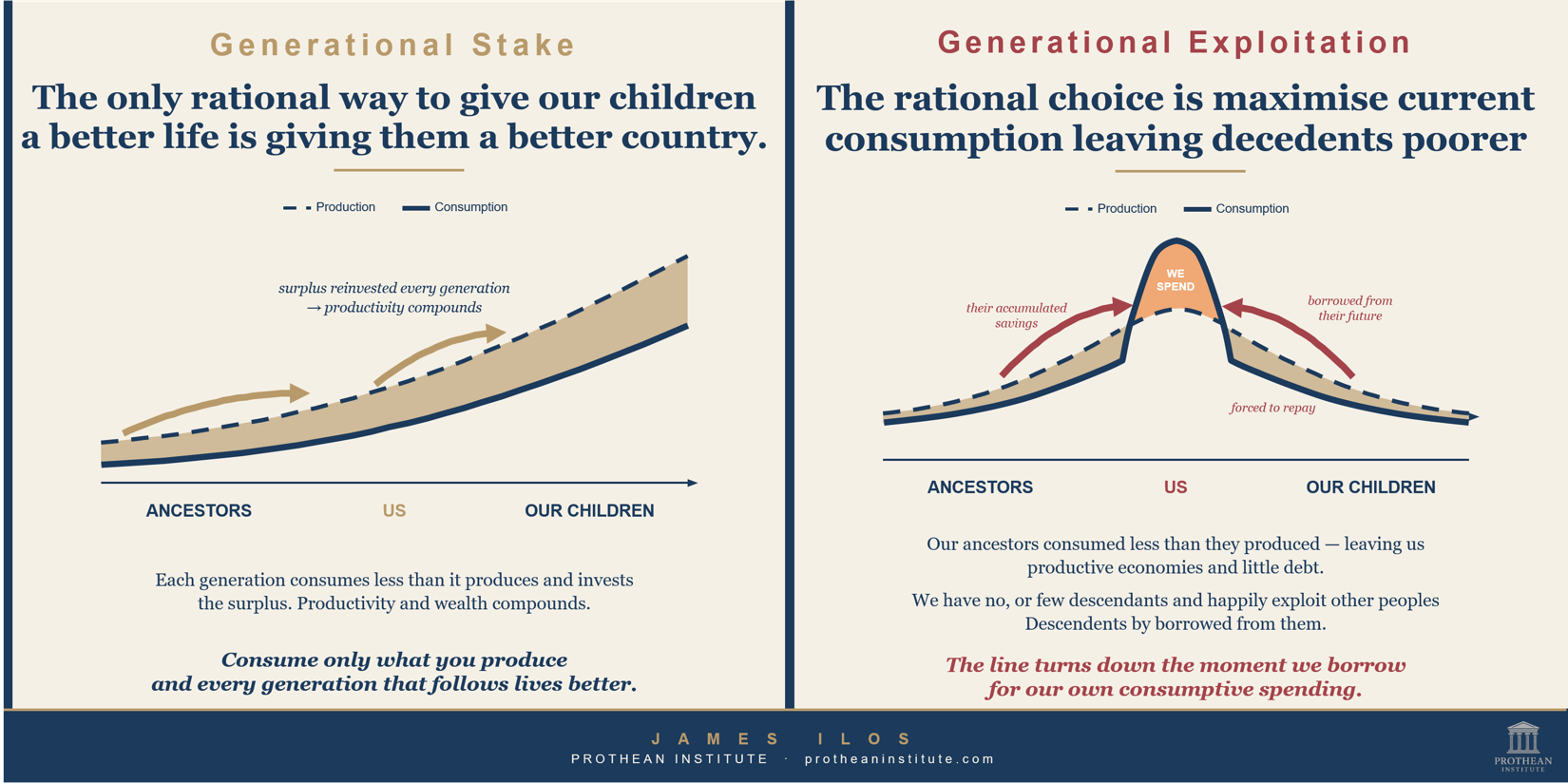
Here is what drives everything as the underlying foundational demographic challenge: declining generational stake. The marginal voter and the marginal politician in each of these countries hold a shrinking personal stake in what happens after they die. Not zero. Shrinking — and moving in one direction for nearly 200 years.
In exploring questions like these, Prothean Institute looks to the political and philosophical approach of James Madison: not moralistic, just assume people are self-interested and will act to maximise their own outcomes within the incentive structures that exist.
Therefore, it’s not a moral observation. It is an arithmetic one, and it predicts the budget, the policies and the outcomes we are seeing today.
The calculation nobody says out loud
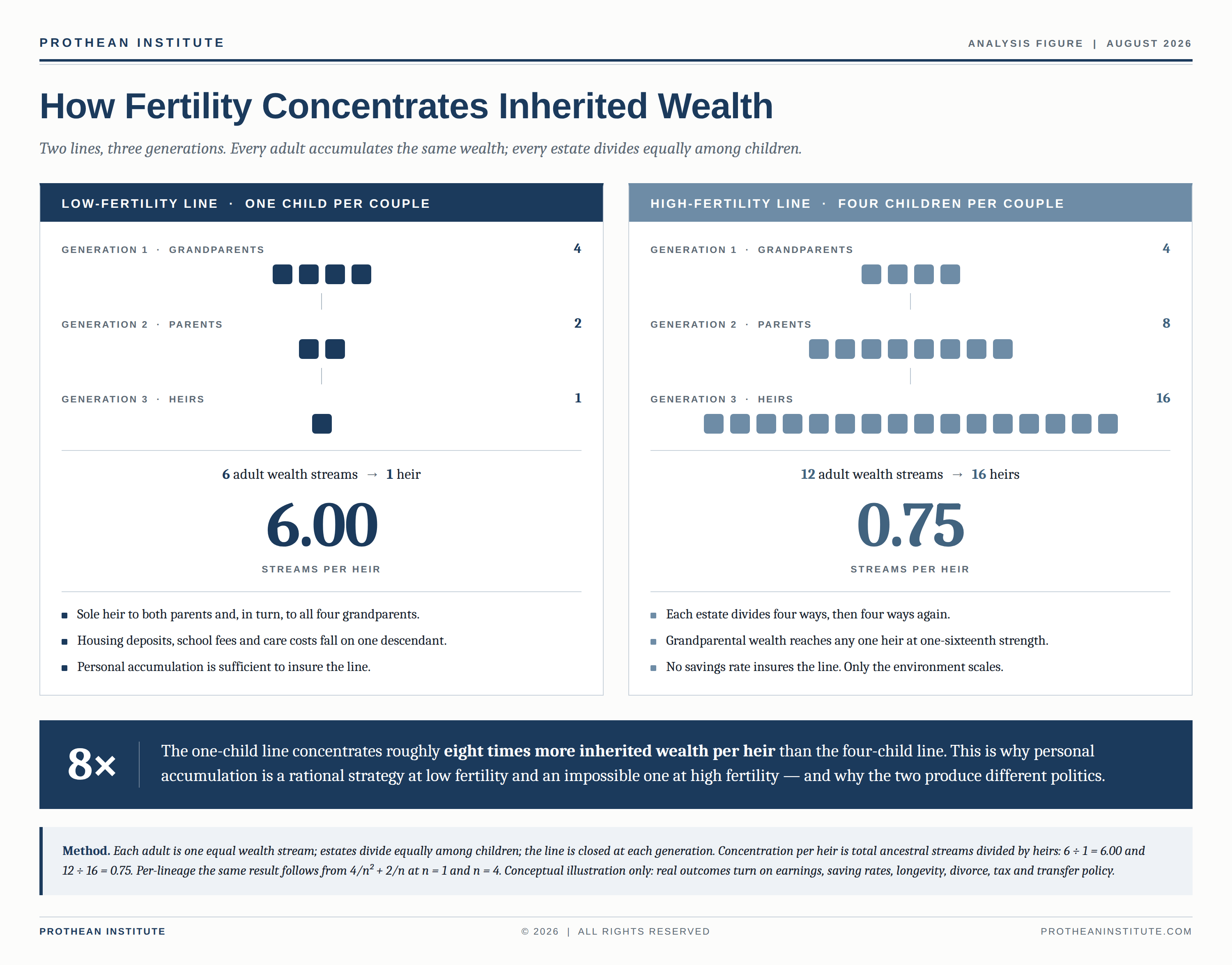
A person with no children, or one child, can protect their line by accumulating personally. Save enough, buy the house, top up the super, and the inheritance divides by one. A deteriorating country is survivable if your sole heir and his wife get the accumulated assets of 4 grandparents. Personal accumulation works.
Low fertility in a declining society remains a viable option to accumulate and insure descendants against future hardship.
A person with four children cannot do this. The estate divides by four, then by sixteen when grandchildren arrive. And with more than four children, the consequences are exponential. There is no savings rate high enough to ensure a large line of descendants against a shrinking economy.
The only strategy that scales is to create a flourishing country over the long term in which descendants can create their own economic prosperity.
Why low fertility erodes economic performance
What matters here is what it does to fiscal policy and the budget.
Four direct impacts are evident:
First, consumption. For a household that has opted out of children, the rational plan is present enjoyment plus a retirement pot or extraction from government pension plans. There is no inter-generational investment to fund. Politically, that household votes for what makes the present comfortable: transfers, subsidies, cost-of-living relief, protection of asset values and avoidance of significant structural reforms.
It does not vote for anything whose cost is now and payoff arrives in the medium to long term, and will happily borrow money for present consumptive spending.
It takes a generational stake to live below productive capacity, so investment can be made in infrastructure that supports higher productivity for generations to come. Since around 2000, our current generation has spent the accumulated wealth of our ancestors and our descendants.
Consumptive spending now accounts for more than the entire government tax revenues in most anglosphere countries, with little federal spending on real intergenerational productive infrastructure.
Second, debt. This is where fertility bites hardest, through a design flaw that low fertility exposed rather than caused. Social Security, the age pension, and every European state pension are pay-as-you-go. Today’s retirees are paid by today’s workers. That is a claim by one cohort on the earnings of another. When the second cohort shrinks, a government has two options: cut the benefit, or borrow from descendants that are likely not even born.
Cutting is possible, but it is politically expensive enough, particularly in a low-fertility environment, that neither Washington, London nor Canberra has seriously attempted it in a generation.
So they borrow from future generations. American net interest is now over $1 trillion per year. In Australia, public debt service costs exceed the budget deficit itself: had Australia lived within its means historically, it could be running budgetary surpluses despite the enormous government spending programs such as NDIS.
Some observations are as old as time and civilisation itself.
Neither country set out to put themselves in these precarious financial situations. It is the compounding cost of incremental decisions and structural reforms consistently deferred.
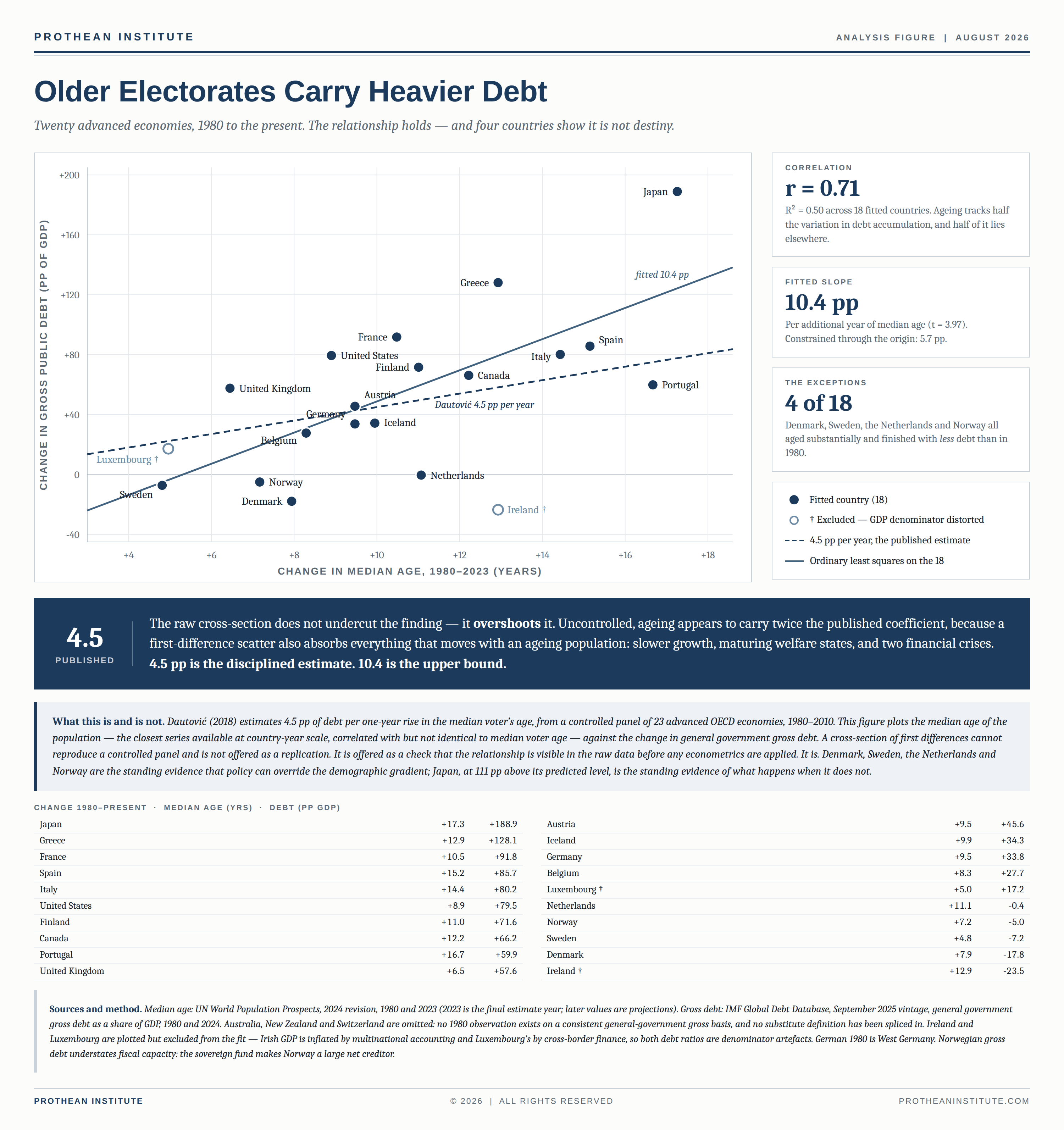
There is a number that gives this mechanism a formula. Across twenty-three advanced OECD economies from 1980 to 2010, every one-year increase in the median voter’s age is associated with a public debt-to-GDP ratio about 4.5 percentage points higher. A study measuring the age of the electorate (rather than the fertility of the people running it) — but it is what the generational stake predicts.
Third, deferral. Work published in February by the Aspen Economic Strategy Group modelled the American budget under continued low fertility and under an immediate return to replacement fertility in 2026. Deficits are unsustainable through 2055 in both cases — and replacement fertility makes the primary deficit worse by 0.2 to 0.5 per cent of GDP a year for the next three decades, because children cost money long before they pay tax. The fiscal payoff arrives around 2075. It’s the very definition of intergenerational investment.
Read that again, because it is the whole problem in one sentence. A politician who fixed the birth rate tomorrow would spend their entire career, and their successors’ careers, paying for it. The same calculus applies to all significant structural or spending reforms that might yield significant benefit in the long term, but require short-term austerity.
The incentive to act on any significant civilisational issue is not merely weak. It is negative at a political level in a low-generational-stakes political environment.
Fourth, immigration as a ‘cheap’ substitute for children. Once fertility repair or structural reforms to improve productivity are written off as too hard or uneconomical, the rational policy is to substitute population and economic growth with migration, and the low long-term consequences of these policies are not considered relevant to a low-generational-stakes electorate.
In Australia, net overseas migration accounted for 73 per cent of population growth in the year to December 2025. Migration levels have been fought over at recent elections in all Anglosphere countries. What has never been put to a vote is migration as a demographic replacement strategy — the quiet substitution of imported adults for domestic births. It arrived because it is the only lever that shows results inside an electoral cycle.
That is what managed decline is. Not a plan. A sequence of individually rational decisions by people whose personal calculation is satisfied either way.
The biggest problem of our time
Apply the inheritance calculation to the people currently in office, and it makes an awkward prediction.
Pete Hegseth has an exceptional generational stake - 7 children.
The senior figures of the American executive have unusually high fertility: Trump (five children), Vance (four), Hegseth (seven), and RFK Jr. (six). Between them they have twenty-two children — an average of 5.5.
Set against the recent leaders of other major Western democracies — Macron (none), Scholz (none), Merkel (none), Albanese (one), Sunak (two), Starmer (two), Trudeau (three) — the average falls to roughly 1.14. The gap is striking.
Yet the high-fertility group is also running one of the largest structural deficits in the developed world.
Elon Musk is the cleanest illustration of the problem. A man with more than ten children entered government specifically to attack the long-horizon fiscal problem, at considerable personal cost to his companies and his public standing. What happened next is an informative bit. The effort achieved a fraction of what it claimed, ran into an entrenched appropriations structure that no executive could break through, and wound down. A high-stakes individual attacked the problem directly, and the low-generational-stakes incentives won. If that does not settle the question of whether personnel can substitute for institutional design, nothing will.
We will not pretend this away. On the most visible short-term test available, the mechanism appears to get the wrong answer.
There are two compounding explanations:
The inheritance calculation is a claim about long-horizon incentives, not about the next budget cycle. The same administration has pursued (with mixed success) spending restraint (in particular Musk), reshoring, energy expansion, and family-formation measures — projects whose payoffs, if any, arrive well beyond the current electoral window.
Perhaps more important for the argument of this piece: a high-fertility executive still faces low-fertility voter preferences and the same institutional incentives that produced the deficits in the first place. Personnel alone does not rewrite the incentive structure across a population.
Which is, in the end, the point. The deficit is downstream of what the median voter demands and what the institutional design rewards. Changing the people at the top, even when those people have strong personal generational stake, does not automatically change the outcome.
The clearer tests of the underlying mechanism are the structural cases of Singapore and Israel.
The Israeli exception
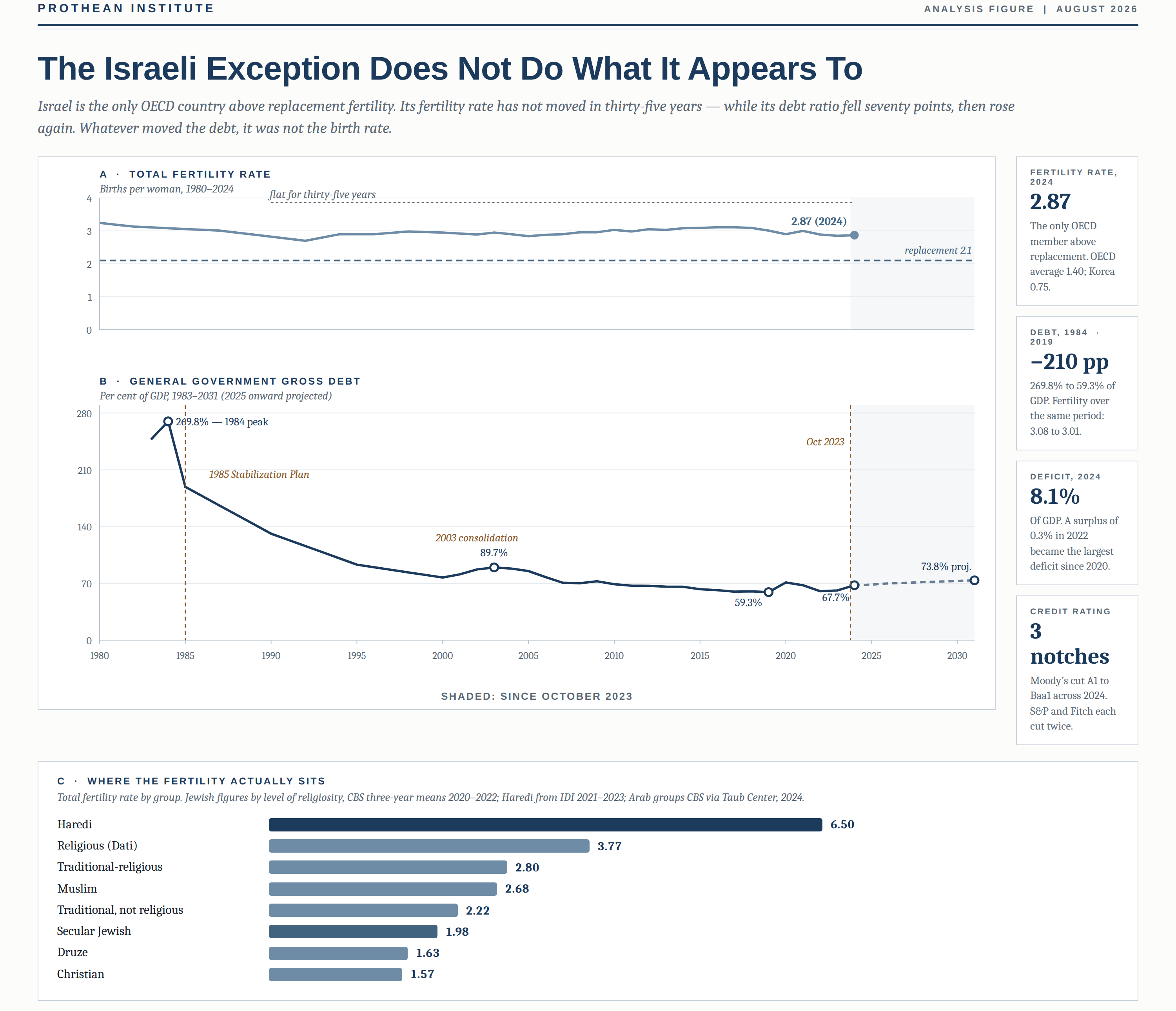
Israel is the only country in the OECD with fertility above replacement — 2.87 in 2024. If the generational stake operates at population scale rather than only through individual leaders, this is where it should show.
It does. Israel cut general government gross debt from 269.8 per cent of GDP in 1984 to 59.3 per cent in 2019, and ran a budget surplus in 2022.
No other developed country has managed anything close. Over the same thirty-five years, every low-fertility peer moved the other way.
Sources. Fertility 1980–2024: World Bank (SP.DYN.TFRT.IN), vintage 13 July 2026, sourced from Israel CBS; 2024 cross-checked against OECD Family Database SF2.1, April 2026. Debt 1983–1999: IMF Global Debt Database, general government. Debt 2000–2031: IMF WEO and IMF Article IV Country Report 26/161, July 2026. Values for 1986–89, 1991–94 and 1996–99 are linearly interpolated between the GDD’s five-yearly observations and are indicative only. Deficit and rating history: IMF Art. IV 26/161; Bank of Israel Annual Report 2025, Table 6.1; agency actions as reported in the financial press. Group fertility: Israel CBS via Taub Centre Policy Paper 16.2024; Israel Democracy Institute Annual Statistical Report on Ultra-Orthodox Society 2025. Employment and working-age share: IMF Art. IV 26/161; IDI 2025.
Israeli fertility did not rise during the deleveraging — it sat between 2.8 and 3.1 the whole time. That is the point: the generational stake is not a switch that gets flipped; it is a standing condition that biases policy toward long-term investment. Israel held it continuously and deleveraged continuously. The Anglosphere and Europe held the opposite continuously and did the opposite.
The war since October 2023 has added roughly ten points to Israel’s debt ratio. But borrowing to resolve a problem permanently rather than manage it indefinitely moves cost into the present so that the future inherits a solved problem instead of a costly running one.
Israel did not choose 7 October. What it chose afterwards was to prosecute the problem to a resolution rather than return to managing it — at eight per cent of GDP, three credit downgrades, and sustained international diplomatic cost.
A low-stakes political class facing the same attack has an obvious alternative available: absorb it, restore the prior equilibrium, defer the underlying problem, and protect the status quo. And that is what the west has chosen repeatedly to for its significant challenges.
The Singapore objection
The other obvious rebuttal is Singapore. A fertility rate of 0.87, among the lowest in the world. Yet a budget surplus, a AAA rating, and a net asset position. If low fertility drives debt, Singapore should be a wreck.
Prime Minister Lee Kuan Yew had three children, together with a near-dynastic attitude toward generational stake, and he built its institutions, economy and government with this long-term vision. He made sure Singapore voters had little influence for half a century.
He built its retirement system to require workers to contribute to their own retirement over their productive lifespans, rather than draw on the next cohort’s payroll. Half the long-term real return on the national reserves must by law be reinvested rather than spent. Intergenerational investment is built into its economy.
None of that requires virtuous politicians. It is Madisonian design in the strict sense: long-horizon outcomes out of ordinary self-interested people. The recent history of Singapore is also instructive on two points:
Voter power growing - As Lee Kuan Yew stepped back progressively from leadership, and the voter influence grew from around 2000, we see the emergence of the very consumptive spending trends evident in other Western democracies.
The primary balance — budget excluding investment returns — went negative this year for the first time since the pandemic. The system is now funding current spending from the yield on inherited capital, exactly as the West does
Singapore has not solved low fertility. It bought several decades of insulation from the fiscal consequences with its capital accumulation, and it is now spending the yield.
What follows
Asking the political class to think longer term is wasted breath, and it does not much matter how many children they have.
A voting public that rewards consumption, debt and reform deferral will produce consumption, debt and reform deferral.
Moral exhortation asks people to act against their interest, and Madison’s entire point was that durable institutions never require that, and those that do, fail.
And read the debt figures and intergenerational theft as the cost of failed institutional design.
Forty trillion and one trillion are not the problem; they are the reckoning — addressed to the grandchildren of the people who still have a generational stake.
The corrective is structural, or it is nothing.
The Prothean Institute is an independent strategic research organisation dedicated to understanding, preserving, and renewing the foundations of thriving societies. All policy recommendations and strategic analyses are grounded in strict epistemic rigour and the reality of real-world conditions and human nature. We reject abstractions untethered from reality and seek to equip leaders with tools that work in the world as it is — not as we might wish it to be.
Notes and References
US Department of the Treasury, Debt to the Penny. Total public debt outstanding was $39,986,657,878,071.92 on 17 August 2026 and $40,047,425,768,420.22 on 18 August 2026. https://fiscaldata.treasury.gov/datasets/debt-to-the-penny/
The $1 trillion figure derives from the Australian Office of Financial Management’s issuance schedule as calculated and released by Shadow Treasurer Tim Wilson, 20 August 2026, which puts AGS on issue at $1,000.8 billion on 20 August and $994.8 billion on 21 August following $6 billion of maturities. AOFM’s own last published stock figure was $983.7 billion as at 14 August. Commonwealth of Australia, Budget 2026–27, Budget Paper No. 1, Table 7.1 projects AGS on issue of $982.0 billion in 2025-26 and $1,051.0 billion in 2026-27. https://www.miragenews.com/australia-hits-1-trillion-of-commonwealth-debt-1730112/ | https://www.aofm.gov.au/
Prothean Institute, The Generational Stake: Why Different Fertility Patterns Produce Different Incentive Structures — and What That Predicts About Political Behaviour, Policy Brief, May 2026 (Paper 3, The Divergent Societies series).
Congressional Budget Office, The Budget and Economic Outlook: 2026 to 2036, February 2026. Mandatory outlays $4,529 billion of $7,449 billion total in FY2026 (60.8%); $7,028 billion of $11,416 billion in 2036 (61.6%). https://www.cbo.gov/publication/61882
Commonwealth of Australia, Budget 2026–27, Budget Paper No. 1, Statement 3, Table 3.1 (payments 26.6% of GDP in 2025-26, 26.8% in 2026-27) and Statement 11 historical series (1986-87: 26.9%). These are budget estimates, not outcomes. https://budget.gov.au/content/bp1/download/bp1_bs-11.pdf
Congressional Budget Office, Monthly Budget Review: July 2026, August 2026. Fiscal year to date: Social Security $1,373 billion; net interest $963 billion; Medicare $952 billion; Department of Defense (military) $763 billion. https://www.cbo.gov/publication/61983
Commonwealth of Australia, Budget 2026–27, Budget Paper No. 1, Statement 7, Table 7.9 (AGS interest $27,690 million in 2026-27 rising to $40,425 million in 2029-30, +46.0%) and Statement 3 (public debt interest averaging 8.8% annual growth over the projection period, against hospitals 7.3%, defence 6.4%, aged care 5.4%). https://budget.gov.au/content/bp1/download/bp1_bs-7.pdf
Ernest Dautović, ‘The weight of the median voter ageing on public debt’, Constitutional Political Economy, vol. 29 no. 1, 2018, pp. 69–92. Panel of 23 advanced OECD economies, 1980–2010. https://link.springer.com/article/10.1007/s10602-017-9248-8
Social Security and Medicare Boards of Trustees, 2026 Annual Reports, 9 June 2026. OASI depletion fourth quarter 2032 (78 per cent payable); Medicare HI depletion second quarter 2033 (89 per cent payable); seventy-five-year OASDI actuarial deficit 4.42 per cent of taxable payroll, widened from 3.82 per cent, of which approximately 0.33 points is attributed to lower fertility, 0.18 to reduced immigration, and 0.16 to the One Big Beautiful Bill Act. https://www.ssa.gov/oact/TR/2026/
Lisa Dettling and Luke Pardue, Low Fertility and Fiscal Sustainability: The Effects of Past and Future Fertility Rates on the US Federal Budget Outlook, Aspen Economic Strategy Group, 24 February 2026. https://www.economicstrategygroup.org/publication/pardue-dettling-budget/
Australian Bureau of Statistics, National, state and territory population, December quarter 2025, released 18 June 2026. Total population growth 412,500; net overseas migration 301,000; natural increase 111,500. Australia’s total fertility rate was 1.481 in 2024, a record low: ABS, Births, Australia, 15 October 2025.
Statistics Canada, ‘Canada’s total fertility rate reaches new low’, 22 April 2026. https://www.statcan.gc.ca/o1/en/plus/9140-canadas-total-fertility-rate-reaches-new-low-2024
Committee for a Responsible Federal Budget, ‘OBBBA Dynamic Score Comes In At $4.7 Trillion’, on CBO’s dynamic estimate including debt service, FY2026–2035. The conventional provision-only score is $3.4 trillion. https://www.crfb.org/blogs/obbba-dynamic-score-comes-47-trillion
Israeli Government Israel Economy Recent Trends 2026 economic update: https://www.gov.il/BlobFolder/reports/israel-economy-recent-trends/en/Files_eng_israel-economy-recent-trends.pdf
Singapore Department of Statistics, Total Fertility Rate 2025, 26 February 2026 (preliminary resident TFR 0.87, from 0.97 in 2024); Speech by Deputy Prime Minister Gan Kim Yong, Committee of Supply Debate 2026. South Korea’s 2025 provisional TFR was approximately 0.80. https://www.singstat.gov.sg/news/total-fertility-rate-2025
Singapore Ministry of Finance, Analysis of Revenue and Expenditure, Financial Year 2026. Net Investment Returns Contribution S$28.48 billion, 17.4 per cent of total revenue (21.1 per cent of operating revenue); primary balance −S$2.57 billion in FY2026 against +S$6.40 billion in FY2025. https://isomer-user-content.by.gov.sg/153/b25a4bb9-db1b-428d-ab48-4528e0ee0d37/fy2026_analysis_of_revenue_and_expenditure_2026.pdf
Once upon a time, Western societies understood truth as something objective—something grounded in God and reality, rather than something each individual could invent for themselves, regardless of the facts.
Concepts such as “religious pluralism” and “moral relativism” helped change that. The argument for these ideas is often presented as tolerance and inclusivity: that different people can choose different gods, beliefs, and moral frameworks, and society should simply respect them all, regardless of who they worship and how they worship.
But once religious belief becomes entirely a matter of personal preference, and individuals are free to choose their own ultimate authority, on what basis can we meaningfully object when they choose their own truth and reality?
If truth is no longer something discovered but something personally constructed within the mind, then objective claims about reality, morality, humanity, and biological sex become impossible to define and defend.
The individual has become the final authority in the world of their own making.
“Choose your own god” has gradually become “choose your own truth.” And once truth became something you could choose, it was only a short step to the notion that you could choose your own identity, even when reality itself says otherwise.
The irony is that a culture which abandoned the idea of an objective Creator didn’t abandon religion. It relocated religious authority from God to the self. Consequently, the result is a society in which subjective feelings can be treated as more authoritative than biological reality, and personal identity has become something that others are expected to affirm regardless of what is actually true.
Today, you can be arrested, taken to court, and fined if you do not affirm the “realities” constructed in the minds of other people. The facts of reality have become second to the dictates of the relativists.
But this identity debate is far greater than a dispute about pronouns and terminology. It’s the logical end of a much broader social transformation. It’s ultimately about the replacement of objective truth—or more specifically, God—with personal authority.
Once there’s no higher authority above the individual, there is ultimately no reason the individual can’t declare, “This is my truth, and it is no less true than your own.”
And if truth is whatever we choose it to be, and we can be whoever we choose and believe whatever we wish, then the worldview framing our society is no longer Christianity.
The worldview framing society is now indistinguishable from the mentality of an inmate in an asylum—convinced that reality is whatever his mind tells him it is. But the disconnection between the mind and reality was never something to celebrate or validate. It was always understood as a posture of the mad.
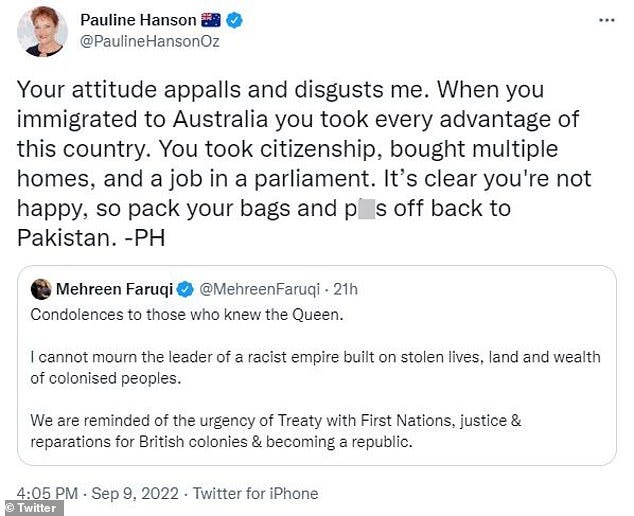
One Nation leader Pauline Hanson has filed an application with the High Court for leave to appeal a Full Federal Court ruling that upheld a finding she unlawfully racially discriminated against Greens Senator Mehreen Faruqi under Section 18C of the Racial Discrimination Act.
The case stems from a September 2022 post on X, then Twitter, in which Hanson told Faruqi to “piss off back to Pakistan” after Faruqi criticised Queen Elizabeth II and the British Empire following the Queen’s death. The Full Federal Court dismissed Hanson’s appeal on 27 July 2026.
Screenshot of Senator Pauline Hanson’s reply.
Hanson is now asking the High Court to consider whether Section 18C, as applied to political communication, is constitutionally valid and whether its operation impermissibly burdens the Constitution’s implied freedom of political communication.
The case matters because Section 18C does not require a statement to threaten violence or incite criminal conduct. It prohibits conduct reasonably likely to “offend, insult, humiliate or intimidate” another person because of race, colour or national or ethnic origin.
The Full Federal Court confirmed in July that Section 18C is constitutionally valid and does not impermissibly burden the implied freedom of political communication. It also found that Hanson’s post was not protected by the Act’s Section 18D exemption for conduct done reasonably and in good faith.
The court found that the post fell within conduct prohibited by Section 18C, but Senator Hanson has vowed not to forfeit the fight.
“I’m taking this fight to the High Court for every Australian who feels they are being silenced and to keep their opinions to themselves,” Senator Hanson said on Saturday in a media release.
“Too many Australians are afraid to speak honestly about immigration, race, religion, Indigenous policy and other important issues because they worry they will be called racist, dragged through a complaints process or taken to court.
“That is not how a free country should work. Australians choose their government. The government should never get to choose what Australians are allowed to say.”
Justice Angus Stewart, who heard the original case, acknowledged that Australian political debate can involve deliberately offensive, exaggerated and angry speech, and that restrictions on such communication can burden political freedom.
Australia has no entrenched constitutional Bill of Rights guaranteeing broad freedom of speech. Instead, the Constitution protects political communication through an implied freedom that operates as a limitation on government power rather than as a personal right to free speech. That makes judicial scrutiny of laws such as Section 18C particularly important.
“I don’t mince my words,” Senator Hanson said. “I never have. People know exactly where I stand. But speaking plainly about political issues should not put you in court. The Full Federal Court accepted that my comments were close to the core of political communication protected by our Constitution.
“It also accepted section 18C casts a wide net, sets a relatively low bar and places a significant burden on political communication. Yet the law was still upheld. This is why I am asking the High Court to hear this case.”
Senator Hanson said she believes all Australians should be able to disagree, argue, and say things other people don’t like.
“Freedom of speech means nothing if it only protects words everyone agrees with.”
She said it’s not about giving politicians special rights, but rather, it’s about the right of everyday Australians to take part in the political debates that shape their own country without being frightened into silence.
A healthy “democracy” does not require citizens to agree with one another—or even to speak politely at all times. It requires sufficient freedom for citizens to argue, criticise, offend and challenge one another without the government becoming the final arbiter of permissible political expression.
“Millions of Australians feel like they have been told there are things they are simply not allowed to say anymore,” she added. “I hear from them all the time. I will not be silenced, and I will take this fight as far as I can for Australians who feel they no longer have a voice.”
Such as the broadening of ASIO’s power to include “sabotage, promotion of communal violence, attacks on Australia’s defence system and any serious threat to Australia’s territorial and border integrity.”
Under current law, this is regardless of “whether these [words or actions] were directed from, or committed within, Australia or not.”
The biggest concerns centre on the “promotion of communal violence” and threats to national integrity.
Under existing laws on adult questioning, anyone who fails to comply with ASIO when they demand information can be imprisoned for five years.
Put simply, in these cases you do not have the right to remain silent.
Ramping up those concerns is the fact that neither inciting “communal violence” nor “threats to national integrity” are properly defined.
According to section 4 of the ASIO Act, foreign interference is defined as: “activities relating to Australia that are carried on by or on behalf of a foreign power.”
Activities included anything that is “detrimental to the interests of Australia “ or involves “a threat to any person.”
Promoting communal violence is defined as: “activities that are directed to promoting violence between different groups of persons in the Australian community.”
Added here is any activity that “endangers the peace, order or good government of the Commonwealth.”
In effect, publicly questioning COVID vaccines, lockdowns, mass immigration, and multiculturalism could be considered incitement and a threat to national stability (integrity).
As could critiquing Islam, or even criticising Albonomics that is currently edging Australia’s economy irreversibly towards’ Labor’s “we’re saving the world from climate change,” Net Zero Nanny State black hole.
By far one of the bill’s most prominent opponents, Senator Alex Antic, said on X that he’s disappointed it passed.
Antic also stated that he voted against the amendment because “extraordinary powers should never become ordinary.”
The South Australian Liberal Senator then declared the law an expansion of the surveillance state.
Antic told the Senate that the bill “doesn’t merely fine-tune existing arrangements.”
“It breaks in new powers and makes permanent extraordinary intrusions on the liberty of Australians.
“Compulsory questioning warrants,” Antic argued, “allow ASIO to compel a person who may never have been charged with an offence or may never be charged with an offence to appear and answer questions under threat of criminal penalty.”
Even telling anyone about being questioned or detained is now an offence.
“These are not ordinary investigative tools,” he stated. “They sit well outside the framework of the traditional criminal justice system.”
Since 9/11, the government has repeatedly extended what were meant to be temporary powers.
That’s because they were the exception, not a permanent rule.
“As it currently stands, the bill removes that sunset clause entirely.”
Making them permanent is a problem, Antic added.
“History shows that temporary emergency powers have a long and chequered history and habit of becoming permanent features.
“Worse still, the bill actually expands the reach of adult questioning warrants.
“The definition of an adult questioning matter will now be broadened under this bill to include sabotage and, most alarmingly, the promotion of communal violence.”
Criticising the loose language, Antic rightly pointed out that “Promotion of communal violence’ is particularly elastic.
“Vague drafting is the enemy of the rule of law.”
To this he added, “What does it actually mean? What does it capture?”
“Does it capture passionate political speech, advocacy that offends certain groups, legitimate protest or religious expression that crosses an often-ill-defined line?”
Antic then asserted, “In a free society, the state shouldn’t be handed an open-ended power to compel citizens to answer questions about speech or association that falls short of actual criminality.”
Blurring lines when it comes to criminality and rights, he further argued, removes certainty about where that line is drawn.
The even greater concern here is whether or not the law could be used to detain and question people against their will.
“The bill also retains the capacity to subject children as young as 14 to these processes. On its surface, that alone should give this chamber reason to pause.
“Security which is purchased at the price of permanent, expanded and coercive powers is a false bargain.”
Extraordinary laws require use-by dates.
“The rule of law requires that the state’s most intrusive rules remain exceptional, tightly confined, regularly scrutinised and subject to genuine sunset clauses.”
They should not, Antic protested, be “quietly normalised” and “quietly allowed to creep into the norm.”
Notably, Antic joined One Nation and The Greens in opposing the expansion of ASIO’s powers.
There’s something incredibly unsettling about the growing public sympathy for Lindsay Clancy, the Massachusetts mother accused of murdering her three young children.
Clancy is currently on trial for the deaths of Cora, 5, Dawson, 3, and Callan, 8 months. According to her defence, she was suffering from severe postpartum psychosis and was not criminally responsible for her actions.
Yet the bizarre reaction online has gone far beyond sympathy for a woman suffering a mere psychiatric crisis.
Women have actually begun publicly identifying with Clancy. Some have posted tearful videos with their own kids, accompanied by captions like “Same, Lindsay.”
What’s more, hundreds of women have also rallied outside the courthouse in support of Clancy, wearing pink and carrying messages such as “She Needs Help” and “End the Stigma.”
And the internet has rightly responded with indignation that a woman accused of killing her own children has become, for some women, an object of identification and solidarity.
But as murderously insane as it is, perhaps there’s some grim logic to it.
For more than a century, feminists and the women’s rights movement have fought to establish that a woman has an absolute right to decide whether her child lives or dies. Abortion has been elevated into a defining symbol of female autonomy and liberation.
And once that has been normalised—once abortion has been accepted as one of the most fundamental rights a woman can exercise—an obvious question arises: What, exactly, makes the child inside the womb fundamentally different from the child outside it?
Human life is continuous from conception until natural death. As such, there is no magical moment during pregnancy when non-human life suddenly becomes human life. The child does not become a different kind of being when he or she passes through the birth canal.
Location doesn’t determine human worth. Size doesn’t determine human worth. Degree of dependency doesn’t determine human worth. The environment in which a child exists does not determine human worth.
A child does not become more human because he or she moves from the womb to the crib. That’s why abortion and infanticide are morally distinct in law but not in the underlying question of human value.
If an unborn child is a human being, then deliberately killing that child is the intentional killing of an innocent human life. Birth changes a human being’s location, not nature.
If Clancy had aborted her children in the womb, she would be celebrated for exercising her “right” as a woman to choose whether her children live or die.
Perhaps that’s why the “Same, Lindsay” trend is so disturbingly revealing. The Western world has spent decades teaching women that killing an unwanted child can be an expression of freedom, autonomy, and empowerment.
Today, there are social media and cultural campaigns, such as “Shout Your Abortion,” which exist to “normalize abortion,” as though killing an unborn baby is something to boast about.
So, should we really be surprised when the culture begins to lose its ability to articulate where the boundary of human value actually lies? Should we be surprised when the culture that celebrates the killing of children inside the womb begins to sympathise with those who kill children outside of the womb?
A society that “normalises” the deliberate destruction of millions of unborn children shouldn’t expect that attitude towards human life to remain confined to the womb. It should be obvious that when killing becomes routine, people become desensitised to killing.
This is the tragedy of the culture of death. It not only kills the children, but it also changes the society that watches.
The Archbishop of Brisbane has apologised after St John’s Anglican Cathedral was used in a Stan reality television program featuring pornography performer Lily Phillips, saying the church was misled by producers and condemning the program for attempting to “validate the porn-industry.”
Archbishop Jeremy Greaves issued the apology after Australian commentator Melinda Tankard Reist condemned the Anglican Diocese of Brisbane for allowing the cathedral to be used in Turned On: Dirty, Sexy Money, a Stan series centred on the sex industry and OnlyFans creators.
Tankard Reist accused the production of turning the 125-year-old cathedral into a “prop” for the program, questioning how the church could have permitted its sacred space to be used in a production promoting the commercialisation of sex.
The controversy centres on the program’s sixth episode, in which British pornography performer Lily Phillips is shown participating in a religious ceremony at St John’s Cathedral.
The ceremony was conducted by the Very Rev’d Dr Peter Catt, Dean of Brisbane. Phillips is shown responding “I do” when asked whether she turns to Christ, renounces evil and repents of her sins.
Tankard Reist argued that the cathedral had effectively been used to lend legitimacy to a production she described as part of a broader public-relations push for the pornography industry.
Greaves has now apologised, saying:
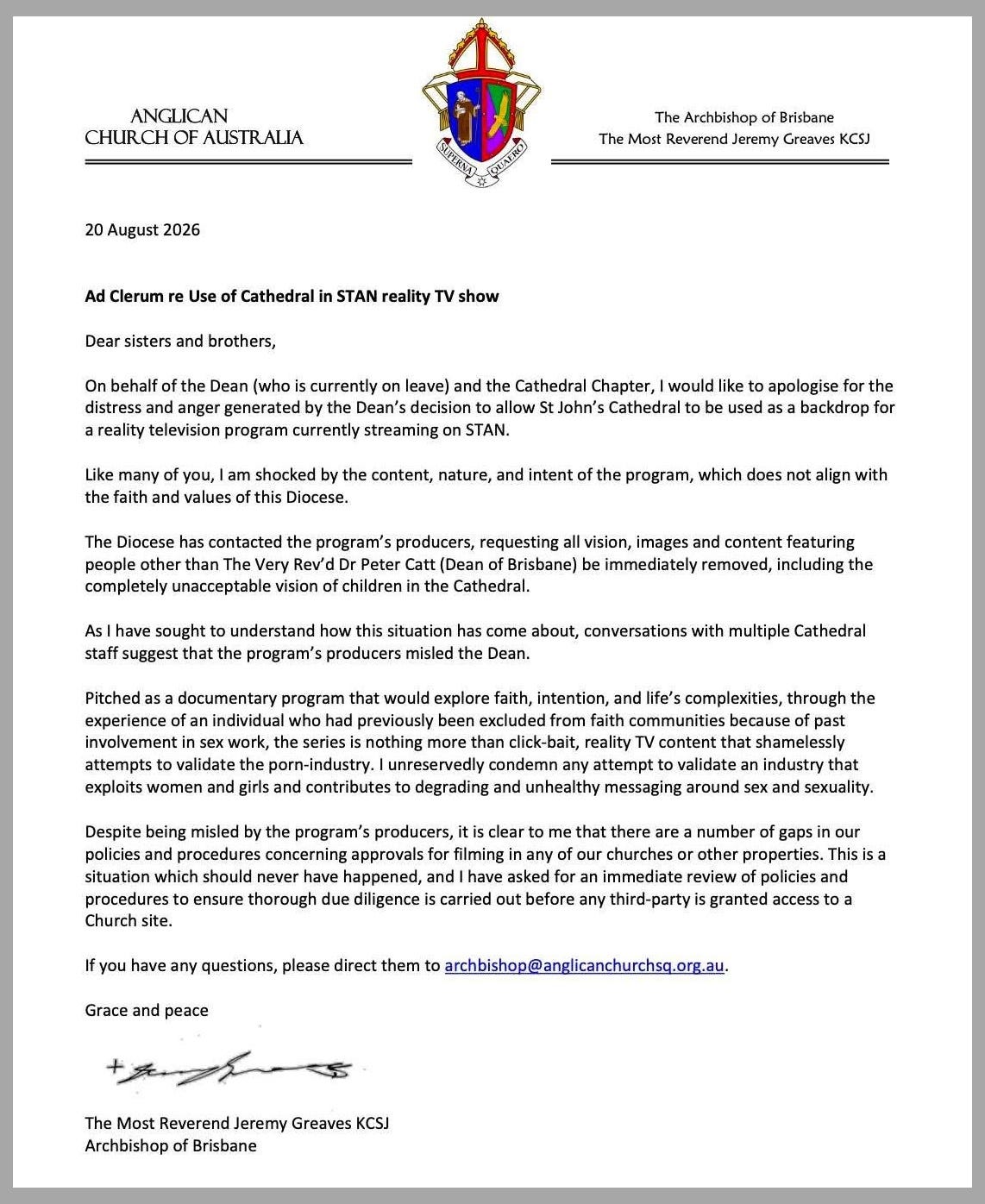
“On behalf of the Dean (who is currently on leave) and the Cathedral Chapter, I would like to apologise for the distress and anger generated by the Dean’s decision to allow St John’s Cathedral to be used as a backdrop for a reality television program currently streaming on STAN.”
The Archbishop said he was “shocked by the content, nature, and intent of the program,” which he said “does not align with the faith and values of this Diocese.”
Greaves said the program had been presented to the Dean very differently from the finished product.
Archbishop of Brisbane Reverend Jeremy Greaves’ statement.
“Pitched as a documentary program that would explore faith, intention, and life’s complexities, through the experience of an individual who had previously been excluded from faith communities because of past involvement in sex work, the series is nothing more than click-bait, reality TV content that shamelessly attempts to validate the porn-industry.”
He added:
“I unreservedly condemn any attempt to validate an industry that exploits women and girls and contributes to degrading and unhealthy messaging around sex and sexuality.”
According to Greaves, conversations with cathedral staff indicated that “the program’s producers misled the Dean.”
The Archbishop also acknowledged that the Diocese had failed to conduct adequate due diligence before allowing the filming.
“Despite being misled by the program’s producers, it is clear to me that there are a number of gaps in our policies and procedures concerning approvals for filming in any of our churches or other properties.”
Greaves said the Diocese had contacted the producers and requested that “all vision, images and content featuring people other than The Very Rev’d Dr Peter Catt (Dean of Brisbane) be immediately removed,” including footage showing children inside the cathedral.
“This is a situation which should never have happened,” Greaves said.
He announced an immediate review of the Diocese’s policies and procedures to ensure “thorough due diligence” before third parties are granted access to church sites.
The apology marks a stark repudiation of the production by the Diocese, which now says one of Brisbane’s most prominent Christian sites was used in a program whose portrayal of the sex industry directly conflicts with its stated values.
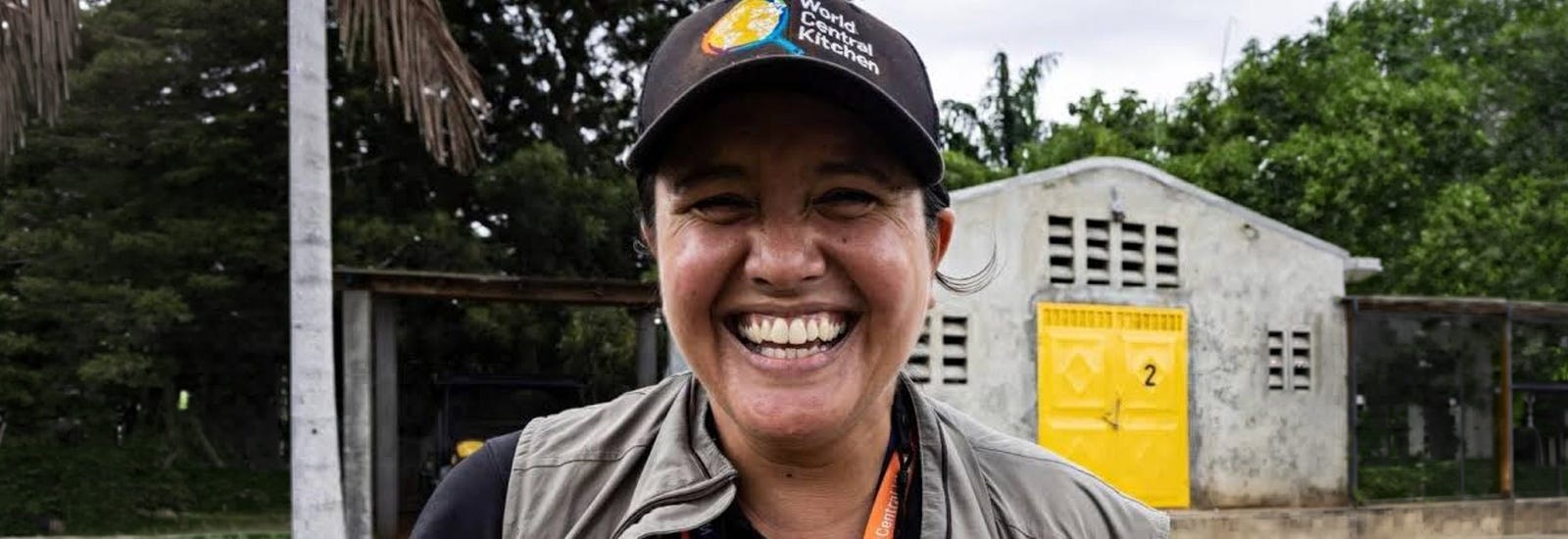
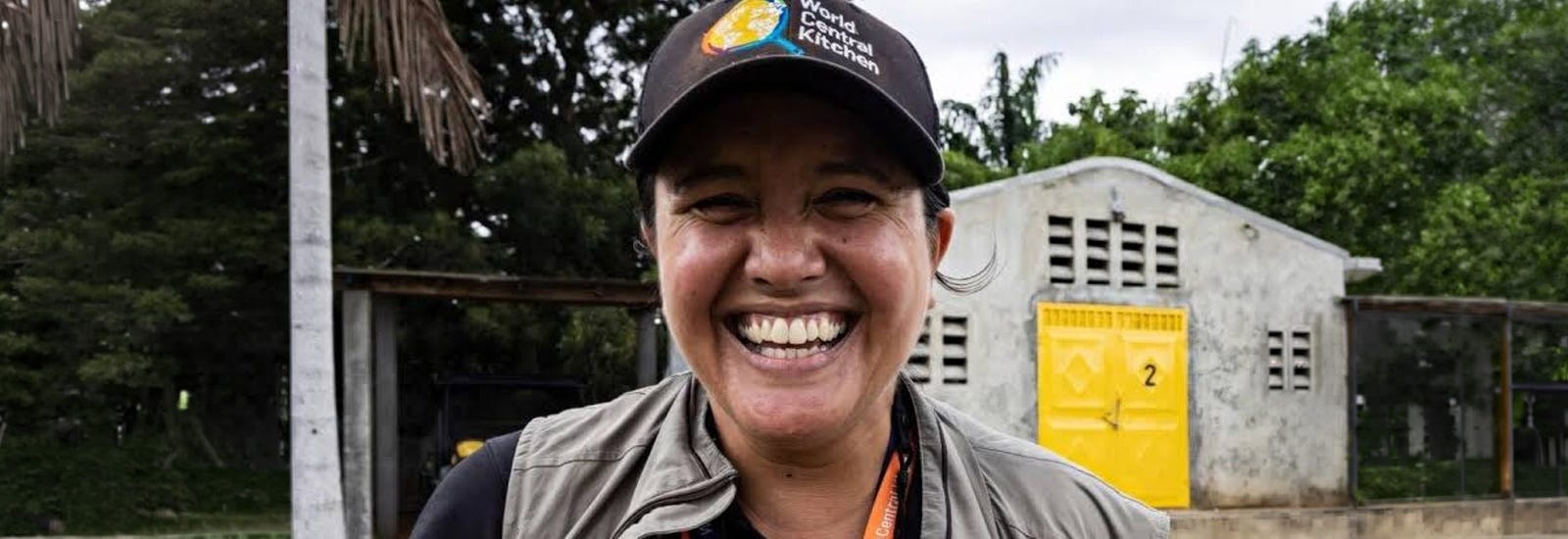
Australian aid worker Zomi Frankcom was killed on 1 April 2024 by multiple precision Israeli drone strikes while travelling in a humanitarian convoy in Gaza.
Australia’s Foreign Minister Penny Wong has said she is “outraged” over an Israeli government decision not to pursue criminal proceedings against those responsible for the death of Australian aid worker Zomi Frankcom, who was killed in an IDF strike in Gaza.
The IDF acknowledged serious failures, including mistaken identification and errors in decision-making, but concluded there was “no reasonable suspicion of criminal misconduct” sufficient to justify opening a criminal investigation, according to SBS News.
Frankcom was killed on 1 April 2024 while supporting a World Central Kitchen aid delivery in Gaza. Australia subsequently appointed former Chief of the Defence Force Air Chief Marshal Mark Binskin to assess Israel’s investigation and response. His report found that the deaths resulted from failures in IDF controls, mistaken identification, errors in decision-making and failures to comply with procedures and rules of engagement.
Importantly, the Australian investigation did not conclude that the strike was a deliberate attack on humanitarian workers. The report instead identified serious failures surrounding the identification and engagement of the vehicles.
Foreign Minister Penny Wong said Israel’s decision fell “far short” of the accountability Australia expects. She said Israel’s ambassador would be summoned and Australia’s ambassador in Israel had been instructed to convey the government’s position directly.
Wong also criticised the timing of the announcement, saying it was made on World Humanitarian Day and was “especially insulting” to Frankcom’s loved ones, humanitarians and Australians, according to the Australian Government statement.
World Central Kitchen has rejected the Israeli findings and called the decision unjustified, maintaining that the IDF knew its team was unarmed and knew the movements and identities of the humanitarian convoy, according to The Guardian. (Those are WCK’s claims and should be distinguished from the findings independently established by the Australian and Israeli investigations.)
The question now is whether Israel’s explanation will satisfy Australia, Frankcom’s family, and the wider community. For a democratic ally, scrutiny and accountability shouldn’t be seen as hostility. They’re fundamental to Western legal and moral traditions and therefore accompany military power.
Australian journalists demand transparency from politicians, businesses, and public figures they don’t like. They scrutinise their finances, question their motives and investigate who funds the organisations and causes behind them.
But when it comes to the media itself, there is considerably less enthusiasm for transparency.
South Australian Senator Alex Antic is seeking to change that.
Antic has introduced the Broadcasting Services Amendment (Register of Media Interests) Bill 2026, which would establish a public register requiring journalists and others working in the media to disclose what they earn, the gifts they receive and the source of those gifts.
“Today I am introducing the Broadcasting Services Amendment (Register of Media Interests) Bill 2026,” Antic said in announcing the legislation.
“If passed, the Bill would require journalists and others inside the media to publicly disclose what they earn, any gifts they receive and the origin of same.”
If the media really is as powerful and influential as journalists themselves insist, Australians have a legitimate interest in knowing who is financially connected to those shaping the information they consume.
In a video posted to social media, Antic drew a comparison between journalists and federal politicians.
“In this building I’m required to disclose everything I earn, everything I own, everything I take as a gift and put it on the Senator’s Register of Interest register,” he said.
“But journalists, despite the fact that they’re always telling you how important and relevant and influential they are, they don’t have to do that.”
Antic said his proposed register would require journalists to disclose “all of the gifts, all of the earnings they get” so Australians can see “who’s paying the piper.”
That question goes to the heart of the debate.
Politicians are routinely subjected to scrutiny over their financial interests because Australians understand that financial relationships can create conflicts of interest—or at the very least create the perception of one.
The same principle can reasonably be applied to journalists.
A reporter covering the pharmaceutical industry, for example, may be influenced—or perceived to be influenced—by financial relationships with pharmaceutical companies. A journalist reporting on politics may have relationships with political organisations, lobby groups or wealthy benefactors. A commentator advocating for particular causes may receive speaking fees, gifts, travel or other benefits from organisations that stand to benefit from their influence.
That does not necessarily mean the journalist is corrupt or dishonest.
But transparency allows the public to make its own judgment.
This is particularly relevant in an era when the traditional distinction between journalists, commentators, activists and influencers has become increasingly blurred. Media personalities can have enormous audiences and wield substantial influence over public opinion, elections and political debate.
If influence is the justification for greater scrutiny of politicians, it is difficult to argue that influence suddenly becomes irrelevant when the person wielding it works for a media organisation.
Of course, the proposal is likely to encounter fierce opposition from sections of the media, with concerns about privacy, editorial independence and the potential for such a register to be abused.
However, a genuinely independent journalist should have little to fear from allowing the public to know whether they have financial interests or relationships that could reasonably be relevant to their reporting.
The media has long insisted that Australians deserve to know who is funding political campaigns, lobbying organisations and advocacy groups.
Now Antic is asking whether Australians should also know who is financially supporting the people who tell them what to think about those issues.
That is not an unreasonable question, because “If the news media in this country are as influential as we are told, then Australians deserve to know this information.”
If journalists expect politicians to disclose their interests in the name of transparency, perhaps the people who scrutinise those politicians should be prepared to accept some transparency of their own.
During his January 2025 appearance on The Joe Rogan Experience, Mel Gibson discussed the historical case for the resurrection in relation to his upcoming film, The Resurrection of the Christ.
Gibson argued that the Gospel accounts should be taken seriously, pointing in particular to the earliest witnesses who, according to Christian tradition, endured persecution and violent deaths rather than recant their testimony.
Gibson summed up his argument with a line that’s been memed and quoted across the internet: “No one dies for a lie.”
The claim is true, but it has also prompted an obvious objection that’s almost always raised in the comments section: If no one dies for a lie, then why do people so often die for false causes? What about suicide bombers, political assassins, militants and religious extremists who willingly sacrifice themselves for beliefs that are demonstrably false?
At first, that sounds like a pretty strong objection. However, it fundamentally misses the point. Here’s why:
There is a profound difference between dying for something that is false and dying for something you know to be false. People have obviously died throughout history for beliefs that were wrong. The question is whether someone would willingly endure persecution and death for a story they personally knew they had invented.
And this is what makes the Apostles’ testimony so compelling.
They weren’t simply repeating something they had heard from somebody else. They claimed to have personally seen the risen Christ. Their entire message rested on something they said they had witnessed themselves.
According to Christian tradition, Peter was crucified in Rome, Andrew was crucified in Greece, James was executed in Jerusalem, Thomas was killed by a spear in India, Philip was crucified in Hierapolis, Bartholomew was martyred in Armenia, Matthew was martyred in Africa, James the Less was killed in Jerusalem, Thaddaeus was martyred in Armenia or Persia, Simon the Zealot was martyred in Persia, and Matthias, who replaced Judas Iscariot, was also martyred.
Of course, none of this means that people cannot die for something that is false. Islamic militants, for example, may genuinely believe the religious claims for which they are willing to die. Their willingness to die demonstrates the sincerity of their belief. It does not demonstrate that the belief itself is true.
That is the distinction that matters here.
An Islamic terrorist is dying for something he believes to be true, but which he has received from others. He can be sincerely mistaken. The Apostles were claiming something very different. They claimed to have personally seen, heard and encountered the risen Christ.
If they had deliberately invented the resurrection, they would have known it was invented.
That makes their situation fundamentally different. They weren’t defending a belief they had inherited or repeating a story they had been told. They were claiming to be eyewitnesses to the central event they proclaimed.
So the argument is not, “Nobody ever dies for something false.” History obviously disproves that.
The argument is that people may die for a lie they sincerely believe, but why would multiple people willingly endure persecution and death for a testimony they personally knew was fabricated? What would they have to gain in their death?
The Apostles’ deaths do not, by themselves, prove the resurrection. But they do present a serious problem for the idea that the resurrection was simply a deliberate invention by its earliest witnesses.
It reminds me of something Charles Colson once said about the 1974 Watergate scandal. Colson was named one of the “Watergate Seven,” and pleaded guilty to obstruction of justice for attempting to discredit Pentagon analyst Daniel Ellsberg, who had leaked the top-secret Pentagon Papers to the New York Times in an effort to expose the U.S. involvement in the Vietnam War.
A year before his imprisonment, while he was still under investigation and facing arrest, Colson’s close friend, Thomas L. Phillips, gave him a copy of Mere Christianity by C.S. Lewis. Colson devoured the book and soon after became a Christian.
Colson, who was derided by the media at the time for converting to Christianity just prior to his trial, went on to serve seven months of his one-to-three-year sentence. But his newfound faith was no trivial ploy to reduce his punishment.
Upon his release, Colson went on to create Prison Fellowship Ministries, an organisation dedicated to ministering to inmates, former prisoners, and their families. He also established the Christian teaching and resource organisation, The Colson Centre.
In 1982, on Easter Sunday, Colson delivered a sermon to a group of prison inmates. One of the prisoners later recalled the atmosphere as Colson preached. The prisoners were “spellbound,” he said.
In his message, Colson spoke a little about his own experience meeting Christ and admitted that his involvement in the Watergate scandal played a crucial part in convincing him of the truth of the resurrection.
Colson explained:
I know the resurrection is a fact, and Watergate proved it to me.
How?
Because twelve men testified they had seen Jesus raised from the dead, then they proclaimed that truth for 40 years, never once denying it.
Every one was beaten, tortured, stoned and put in prison.
They would not have endured that if it weren’t true.
Watergate embroiled twelve of the most powerful men in the world and they couldn’t keep a lie for three weeks.
You’re telling me twelve apostles could keep a lie for 40 years?
Absolutely impossible.
So, the question is not merely, “Did they die for what they believed?” It is: “Did they have firsthand knowledge that what they were proclaiming was true or false?”
That’s the distinction the objection fails to address.
“Better to dwell in a corner of a housetop, Than in a house shared with a contentious woman.” Proverbs 21:9.
As a pastor, I have encountered many men whose lives are made to be a form of living hell because of their wives. These men usually handle it in different ways.
Some become absolute shells of men, who, though they would get some measure of respect in their profession, anyone who sees them around their wife immediately recognises who rules the roost, and they can see the visible signs of it in the man’s hunched shoulders.
Think Richard, in Keeping Up Appearances.
Some men react badly to a badly behaving wife and seek to tyrannise their wives. These men can become abusive in direct response to years of sexual, emotional and relational coercion, and something snaps inside of them.
Some men adjust their understanding of masculinity. They rationalise it by concluding that their wife is an “alpha” and they are just happy to be married, and they give off a modicum of being content in the situation. These women write their husbands emails of complaint, and make the decisions for him, and he is content to let it happen. His wife, or more often he, will generally tell people that he is the head, but she is the neck. Every now and then you will see a shadow in this man’s eye of pain at the level of disrespect he experiences on a daily basis.
Another subset of this previous group is men who are so lazy, emotionally, relationally, and in various other ways, that they actually do genuinely enjoy that their wife is the leader. It is easier. They have less conflict, because he simply concedes, “Yes, dear.” He probably even believes that men who say he should lead are at best closet misogynists, and he will avidly advocate his situation to anyone who asks. “We are a team,” he says, knowing full well that his wife is the Captain and the Referee.
To summarise, I have encountered more men who are dominated by their wives than men who are abusive. And I expect the numbers are far more weighted in that direction than we realise, because women are far more likely to talk about their situations than men are, and there is very little, if any, stigma for a woman to share about an abusive husband. Even in our claimed egalitarian age, it is still quite shameful for a man to admit to not being the man of his house. So many men suffer in silence and are often shut up when they try to speak.
What I want to do in this piece is address how to avoid falling into such a situation. I want to give some practical advice to men about how to stop their wife from becoming a difficult woman. It is my contention that in the right context, most women can become a difficult woman. But it is not my contention that this is necessarily the man’s fault. Women have agency, and this is often ignored by people who discuss these issues. However, that does not mean there are not things that a man can do to change that likelihood, and balance things in favour of a submissive and comparatively godly wife.
As for men whose wives have already completely subjected them? Well, perhaps they can implement some of this as well. But their job is harder, much harder. Lifelong relational patterns are hard to break out of; they do not develop overnight, nor come out of nowhere. Not every man is a leader, and not every man has the ability to change his environment. A leopard cannot change its spots, right? But God can do miracles. We live in light of these two realities. Just recognise that men in both of these situations are going to have to prepare themselves for conflict. Both, because it will happen, and secondly, because you don’t want to go too far. There are plenty of men who have gone too far in seeking to rein in a domineering woman, and they have suffered the loss of any moral authority as a result. So, be wise, gentlemen.
I want to begin with something Paul says in Titus. He gives this advice to the younger church leader,
“But as for you, speak the things which are proper for sound doctrine: 2 that the older men be sober, reverent, temperate, sound in faith, in love, in patience; 3 the older women likewise, that they be reverent in behavior, not slanderers, not given to much wine, teachers of good things— 4 that they admonish the young women to love their husbands, to love their children, 5 to be discreet, chaste, homemakers, good, obedient to their own husbands, that the word of God may not be blasphemed. 6 Likewise, exhort the young men to be sober-minded,…” (Titus 2:1-6).
This is advice for a church leader on what he is to teach about the character of various groups within society. There are some great principles for us to draw from here in beginning this discussion.
Firstly, men, if you want to avoid your wife becoming the difficult woman, you need to recognise how much almost every woman in this society has been robbed of the kind of environment they needed to become the kind of wives that Paul envisions in this passage. For one, whether they were raised in the Church or not, they have almost certainly been raised to either not know what this passage says, or, in the case of many Christians, to actively reject it, and call some of its elements outdated and sexist. Hence, from a very early age, the vast majority of women have been raised, either explicitly or implicitly, to rebel against being the submissive woman.
The vitriol I have heard in the mouths of some women about that term “submission” is incredible. I can bring to mind various examples, but I was once sitting at a conference lunch table just listening to the conversation around me, and the way one of the women just spat out how much she hated teaching that women should submit to husbands was quite telling. Especially considering it had nothing to do with any of the conference talks. I had no idea how the topic came up. She is only one example. I have seen this countless times.
Men, look at this: “3 the older women likewise, that they be reverent in behaviour, not slanderers, not given to much wine, teachers of good things…” You need to recognise that most older women who surrounded your potential wife or wife as they developed into a woman did not fall into any of these categories. Women like Paul describes do exist. I know plenty, but you have to look for them. In fact, our culture kind of likes to brag about women not being reverent. It rewards women who slander either their competition or even the men in their life, for at least sympathy from their friends, or worse, to gain his possessions. The wine-bibbing older woman is a staple represented in film and media. And “teachers of good things…” What have the vast majority of women been given over to teaching, since feminism became the dominant ideology, not just of our women, but of society in general?
So, you need to start from this basis: the woman in your life, who you want to marry, or are married to, has been terribly robbed by a culture that had no intention of teaching her how to be a good wife. In fact, the term “the good wife” has become a derogatory term in our modern culture.
So successful has been the Luciferian-inspired feminist movement that even many Christians think of the biblical wife as a lesser thing. You need to start from this basis. Just assume that, to some degree, your wife’s social context, her education, likely her family environment, and more, are antagonistic in some way towards her being the kind of wife you might have expected.
What Paul advises is that the older women need to be “reverent” and “teachers of good things…” He is not contradicting his teaching in other letters where he says that men should direct the teaching in the church, because he goes on to explain what he means: “4 that they admonish the young women to love their husbands, to love their children,…” In other words, Paul is saying that the older women need to be respectfully focused on teaching the younger women to fulfil their role. How the church needs this today, in increasing measure.
Hence, men, now that you have recognised that your wife has been robbed of the kind of encouragement and upbringing that most women of previous generations got, you need to find a church environment where she is going to be surrounded by older women who will teach her these things. If, and these women do exist, she learnt this from her mother and her mother is still a part of her life, then that is a boon to you. That is something to celebrate. Feminism has not achieved full acceptance in every household; hence there are oases in this cultural desert. But still, you need to be intentional about this.
You need to recognise that the divorce rate in the churches being roughly similar to the divorce rate in the culture is not an accident. It comes about in large part because most Christians simply do not have a Christian worldview. I cannot get this across to you strongly enough; you need to know this: the men I know who are going through either the destruction of their marriage or their marriage turning into a sexless wasteland all have something in common: they usually stopped going to church, meaning that their wife’s social context got shrunk down to her co-workers and other secular contexts. And many of them were part of churches where the women were dominant over the men, and hence their church context was not very different to secular contexts anyway.
A lot of men think they don’t need church. And, there are probably a small minority of Christian couples out there who are in this situation who can keep a relatively good marriage, while living an unbalanced Christian lifestyle; for it is impossible to be a healthy Christian and ignore the one-another passages in the Bible, that assume we are living in the context of the fellowship of believers. But the overwhelming observational evidence points to the opposite effect. Men, you might not feel the need for church. Your desire for interaction with other people, with whom you disagree on a host of things, will likely go down as you age. But if your wife is disconnected from an environment where other women are going to teach her how to better love and respect you, then you will suffer for it. Many men overlook this, and they suffer as a result.
Similarly, if you are in a church environment which encourages your wife to live like the world, it will have a similar effect. I have lost count of the number of men who have told me that their wife’s divorced friends have ruined their own marriage. This is a well-known phenomenon. The reason that divorce statistics are as high in the church as outside is simply that many Christians ignore what the Bible says about marriage and think that flying a Jesus bumper sticker on their car will make all the difference. But it won’t. Christianity is not the religion of lucky charms. As much as this kind of thinking often seeps back in. Exceptional men might be able to make up the difference themselves; the average Christian man needs this environment for his wife to aid him and his wife in their marriage.
You need to be intentional about spending serious amounts of time with other families who take what Paul says to Titus seriously. And, if the pastor’s wife, or elder’s wives, scorn what the scriptures say here, then you can be certain that your chances of facing a world of hurt in marriage will increase. Hence, to avoid having a difficult wife, find a church gathering where the older women “admonish the young women to love their husbands, to love their children,…” It is more important than cool music. It is more important than a cool youth program. It is more important than many of the surface things people look for in the church. And those surface things can exist within a church that does this well, but they do not necessarily go together.
You might find it strange that Titus has to “teach or admonish” the older women to love their husbands. But just consider how many women will kill their children in the womb given the chance? Now consider how many women will kick out the father of their children if given the chance? Here are just two indications that Paul, through the inspiration of the Holy Spirit, understood that loving her children and husband is something that a lot of women need coaching and teaching in. Just as many men need to be trained to love their wives. Paul also shows us that it is older women who will be the primary teachers in this role, not their husbands. It is natural for women to seek the counsel of other, wiser, older women. If your wife is surrounded by bad women, then you will suffer. You will both suffer.
This goes just as much for her being chaste and discreet. There is a bit of a misunderstanding in our culture that men are more obsessed with sex than women. Two things show this is not the case: (1) Go to the beach and look at how most women will dress if social pressure or character does not restrain them, and (2) Look at how women’s soft, and not so soft, porn dominates that reading market. Women and men are both created to be and are sexual creatures. If your wife does not have good influences in this regard, there is a strong possibility she will put herself on display for other men. This culture has trained her to do it.
If a husband has an attractive and desirable wife, which all men want, other men will be interested in her. There is nothing you can do about that. But you can challenge her for flirting with them. But even better if she has responsible, attractive and reverent older women to challenge her in this regard for you.
A lot of women want to be good wives, but as women are highly social creatures that are very impressionable by their environment, they can come under terrible influences from their friends. Be thoughtful about this. Her flirtatious, vivacious personality might have drawn you to her, but if this is not properly turned into discretion in your marriage, you might find yourself in for real trouble. There are countless men who do not give two hoots that she is your wife. She needs direction from wiser women on this as well.
And, of course, this last one is rejected by most Christians: “good, obedient to their own husbands, that the word of God may not be blasphemed.” I could tell you stories of even pastors’ wives who scorn this one. I could tell you accounts of older men and women who think this is too limiting for their grand-daughters or daughters. But I don’t have to. You know this one is under attack from society and the church. Some consider it sexist, out-of-date advice; others consider it an unachievable goal that pastors should be embarrassed to hold to, because it is out of reach to most working people today. Others just don’t care what the Bible says, whether Christian or not, and still others would like to follow this command but don’t know how.
If your wife is in an environment where the women scorn this verse, remind yourself that she and her friends were robbed of the culture that trained women to do this well, and acknowledge how she and you are being robbed, at the present moment, by our culture. Titus would not have to tell older women to teach this to younger women if it just came by nature. It doesn’t, at least not all of it. Humans have some level of inborn instinct, but most of what we learn has to be taught, and it can be untaught between the generations.
The culture of women being culture-bearers in the home has been effectively cut off. Even many women who would like to do this find themselves struggling to find other women to partner in doing it with them, because all their friends work during the day. Many of them are having to learn the skills of being productive in the home from scratch.
Even simple things like nutritious, affordable meals are a skill many women are re-learning. If you just ask your wife to be a homemaker, which is her role and you both believe it is, but you leave her to figure out all this on her own, then you might find her getting frustrated and restless in the home, and this has caused many problems for families and husbands. Even the desire to do things God’s way can go wrong without good discipleship.
I find it interesting how many women who do homeschooling, for instance, want to join co-ops of other women to help their kids learn in community. I thought it was supposed to be about schooling in the home? Often, these groups fracture because you have highly independent-minded people seeking to come together for a joint effort, a bit like Baptist church plants.
But the reason they do this is because of the strong desire for the women’s village that most women grew up in, throughout history. Our society has stripped that away from most women, and so doing things God’s way can be a lot harder. Just like it is harder for a man to keep a pure mind when half the women around him dress like they are selling themselves…which in many ways they are.
You need to actively make sure you are reinforcing these standards in your home, but that you are in an environment where others will reinforce them for you. And, by the grace of God, your wife will develop into the kind of woman who can help train other women in this. Which is why it is important to note that Paul says this to young men, “6 Likewise, exhort the young men to be sober-minded…” It is a very brief statement, compared to what he says for the young women. But consider what he is saying.
Many young men do not approach life in a serious way. In fact, many men take some time to develop into their masculine role of providers and guardians of their home. This is why car insurance is more expensive for young men, well into their 20’s. But the sooner you learn to approach these things seriously and diligently, the better off you will be.
But this also helps a man with his wife. Because his wife is much more likely to take him seriously if he takes himself seriously. She is also much more likely to take him seriously if other men, and other women, take him seriously. Men who cut their family and their wives off from a good church often get themselves in trouble in this area. Women like to see their men flourish amongst other men.
A lot of men think all they need to do is their job and centre their life around their wife. But these men show they have no understanding of feminine nature. Women want to see their husband measure up well against other men. If he doesn’t, this diminishes her view of him, and he is more likely to find he has a difficult wife. This one happens so often. Sure, there are exceptions; they can be found in the comments sections of discussions like this across the world. But don’t think you are so special as to be among the exceptions; you likely won’t be.
Take yourself seriously, take your faith seriously, take your wife’s social environment seriously. Many men think more of the social environment of their kids than their wife, and that is their biggest mistake. They often don’t even realise it is a mistake until their kids are out of the home and the wife has gone off to discover herself, because her reading club or co-workers convinced her to, that it is her right.
A lot more could be said about this issue. Men, you have been failed by our culture too, in many ways. Especially in the area of learning how to steward a wife. Most people are never taught this, and the most they learn is from their home environment, which can be hit and miss. And in a culture of broken homes is much more miss than hit.
I just want to briefly mention one more area before I conclude: sex.
Solomon says this,
“Drink water from your own cistern, And running water from your own well. 16 Should your fountains be dispersed abroad, Streams of water in the streets? 17 Let them be only your own, And not for strangers with you. 18 Let your fountain be blessed, And rejoice with the wife of your youth. 19 As a loving deer and a graceful doe, Let her breasts satisfy you at all times; And always be enraptured with her love. 20 For why should you, my son, be enraptured by an immoral woman, And be embraced in the arms of a seductress?” (Prov. 5:15-20).
Many men think that the key to pleasing their wife is being subservient to her. But it is not. I believe women are partially hardwired to joyfully follow a good man if she is trained by other women to do this well. I say partially because the fall has corrupted men and women. I think if a man follows the principles in this article that come from Scripture, his wife is more likely to want to follow him, and they are more likely to forge together well.
But don’t neglect sex in this equation, either. God has conditioned us to desire sex, enjoy sex and even regularly crave sex, both men and women – unless, of course, something has gone terribly wrong, which can happen in this world. If you build a healthy physical craving for each other, by stewarding this well early in your marriage, it will help bond you both together. Some men ruin this with porn, or he or his wife puts on weight, or the wife’s desire is ruined by antidepressants, or some other issues can get in the way. But if you are diligent in being “enraptured” in each other’s love, you will likely still have conflict, but you will come back together as one.
This area is overlooked as a powerful remedy to conflict. A woman who sexually desires her husband is much more willing to want to follow him. She might get things wrong. You might get things wrong. But work, intentionally, to stir up this desire. It will help you more than you know.
If this tap has run dry in your marriage, you will already know how it draws a chasm between both of you. This means you will have to work harder to get back to where you should be. But I think these principles can set you on the right track to getting back to a good place.
Of course, you can seek to do the right things, and your marriage can still fail. We live on the wrong side of paradise, so things can still go wrong. I do not believe that because a woman turns bad it is guaranteed to be her husband’s fault. It can be. But it could also be that you married a bad one. They exist too. But generally speaking, there are good and wise things a man can do to help his marriage have a better chance of success, and telling him to be more of a domesticated and neutered servant, based on a demented understanding of “laying down his life”, is the wrong advice.
Hindu Nationalists in Odisha, an eastern Indian state, want Christians out.
The fresh calls were made during a book launch in memory of local Hindu Nationalist leader Lakshmananda Saraswati, who was assassinated in 2008.
Although Communists (Maoists) admitted to killing Saraswati and four followers, his slaying was initially blamed on Christians.
As a result, Hindus hunted them down, slaughtered them and looted churches.
This is despite local authorities allegedly knowing that Maoists were responsible.
Instead of de-escalating the destruction, the government apparently buried this fact, thereby encouraging the persecution of Christians to continue.
An October 5, 2008 piece from The Hindu reported that Maoists “left two letters at the scene claiming responsibility for the killing.”
A spokesperson for the Communist Party of India then claimed the government “suppressed those letters to help rioters continue with their attacks on the [Christian] minority community.”
He added that Maoists killed the Hindu monk and political leader because he was “forcing tribals and Dalit Christians in Kandhamal to convert to Hinduism.”
Discussing the book launch, John Dayal, a New Delhi-based human rights advocate and author, claims “speakers at the commemoration called for the elimination of Christians from the Kandhamal district.”
Hinting at ethnic cleansing, he alleged that hardline Hindu Nationalists “view Kandhamal as a testing ground for a model that could be extended across the country.”
During the event, Dayal said they openly “called for a ‘church-free’ Odisha and for curbing the activity of people they termed “vidharmis” (infidels).
This “refers to Christian and Muslim citizens, implying their faith is foreign to India’s soil.” For instance, the belief that “to be Indian is to be Hindu.”
Some senior members of the Modi government were in attendance, he recalled, adding that the story of the slain Hindu political leader would be embedded in the school curriculum.
“The Government Medical College and Hospital in Phulbani would also be renamed after Saraswati.”
Commenting on the 2008 persecution of Christians, Dayal described the slaughter as “one of the worst outbreaks of anti-Christian violence in Independent India.
“The violence,” he recounted, “killed at least 39 Christians, though Christian families said they counted more than 100 dead.”
This includes “more than 40 women sexually assaulted, a Catholic nun and a young Hindu woman who was employed by a Christian NGO.”
Additionally, “395 churches were [reportedly] razed or torched, between 5,600 and 6,500 houses plundered or burnt down, over 600 villages ransacked and some 75,000 people left homeless.”
“Many Christian families were burnt alive,” Dayal said, “and thousands were forced to convert to Hinduism under threat of violence.
“Some Hindu families were also assaulted on suspicion of being friends with Christians, and supporters of the Indian National Congress or Congress party,” Modi’s opposition.
He then argued that the investigation and trial of those allegedly involved in the assassination were sketchy, saying, “Prosecutions crawled through the courts for over a decade and produced a conviction rate that lawyers still call a scandal.”
ICC said the book launch was just a guise that “marks a chilling escalation in the fusion of state authority and radical ideological movements.”
The presence of chief government officials, they asserted, “signals that the ‘church-free’ mandate is no longer a peripheral demand.”
Their anti-Christian activism, ICC remarked, is unconstitutional.
“By explicitly demanding a “ban on the activities of heretics,” the movement presents a direct challenge to Article 25 of the Indian Constitution, which guarantees the freedom to profess, practice, and propagate religion.”
What’s deeply concerning about this, ICC said, is that it’s “not merely a rhetorical flourish.”
It is “a calculated effort to dismantle the operational freedom of Christian institutions by framing their existence as an existential threat to the state.”
Foreign Minister Penny Wong will reportedly use the annual Gyngell Lecture at the Lowy Institute in Sydney to warn that “monoculturalism” poses a threat to Australia’s national security, which is ironic, given that the argument would inadvertently expose the monocultural assumption underpinning multiculturalism itself.
If the government has to warn Australians against thinking in “monocultural” terms, then it’s necessarily asserting that there’s a particular way Australians ought to think about culture, identity, and Australian society. It is to claim there must be some common cultural framework that every Australian is expected to accept.
So, whether one is militantly in favour of multiculturalism or militantly opposed to it, both positions ultimately require some degree of cultural uniformity. The disagreement is only over what that monoculture should consist of, and where its boundaries should be drawn.
Wong’s position inadvertently exposes the weakness in the idea that multiculturalism simply means allowing a genuine diversity of cultures, beliefs, and opinions to coexist.
Clearly, it doesn’t.
At some point, multiculturalism requires a shared doctrine that must be defended, and potentially enforced for the sake of “national security.” As such, multiculturalism can tolerate diversity of cultures and opinion only so long as there is agreement on multiculturalism itself.
Once people are free to reject the doctrine of multiculturalism, the ideological consensus that holds the system together will begin to unravel. In that sense, multiculturalism ultimately depends on a degree of monocultural agreement about the legitimacy of multiculturalism.
But if multiculturalism is compulsory, how is it meaningfully different from the monoculture it condemns?
The supposed champion of diversity therefore finds herself defending a monoculture of her own without even knowing it.
The question is not whether Australia will have a monoculture. The question is which monoculture will be imposed on the nation, what it will hold together, and how much diversity of thought it will tolerate before deeming those thoughts a “threat to national security.”
For decades now, “identity politics” has been one of the central targets of conservative critique. Conservatives have warned against a political approach that elevates group identity, such as race, sex, religion, or “sexual identity,” over and above individual character, shared citizenship, and equal treatment under the law.
Many of the criticisms were well founded. Identity politics can replace personal responsibility with one’s inherited status, fragment national unity into competing factions, and justify unequal treatment in the name of “fairness.” Rather than encouraging merit, civic responsibility, and unity, it can work to entrench division, incentivise grievance, and undermine the principle of equality under the law.
But there was a fatal flaw in the conservative response, and we are paying for it today. Conservatives recognised the potential danger of identity politics, but then convinced themselves that the only solution was to abandon their own identity. There can be no “identity politics” if there are no identities to favour.
At its heart, identity politics exploits that universal human instinct of tribalism. Human beings naturally organise themselves into groups, or tribes—families, societies, peoples, nations, religious communities, and cultures—and they develop loyalties to those particular groups. That instinct is not inherently good or evil. It depends entirely upon where those loyalties are directed and to what end they serve.
For years, “identity politics” has been deployed against the straight, White, Christian, and conservative populations across the Western world—favouring anyone and everyone that doesn’t fall into one or more of those “oppressor” categories. Conservatives were correct to recognise the danger of a system that increasingly defined people according to their group identity and distributed social favour accordingly. Especially when they favoured groups that largely excluded the rightful heirs.
But instead of challenging the premise that identity should determine political treatment, conservatives often accepted it and then simply disarmed themselves. They were told to combat identity politics by rejecting their own collective identity, suppressing their own group loyalties, dissolving their sense of shared heritage, and trusting that individual merit and colour-blind virtues would ultimately prevail.
Meanwhile, virtually every other group was free to organise around its own interests.
And that was the fundamental mistake.
Conservatives abandoned the language of identity while their opponents became increasingly proficient in it. Conservatives were encouraged to see themselves as isolated individuals first and foremost, and members of a people, culture, or civilisation only reluctantly, while others were, and still are, encouraged to organise collectively, articulate their collective interests, cultivate solidarity, and demand political recognition.
You see, conservatives didn’t change the rules of the game. They just gave up playing.
Their opposition to identity politics made them hostile to their own identities. Taken to its logical extreme, their approach became a profoundly anti-national and even globalist posture, without knowing it. This is because identity is unavoidable. Every community, every society distinguishes between insiders and outsiders. Every nation has a common people, a history, a culture, a territory, and a conception of who belongs. Every community, family, organisation, and institution has relationships of loyalty and obligation. Every collective is defined by who is in, and who is out.
The alternative is not a world without identity. It is a world in which meaningful identities are progressively dissolved, individuals are reduced to atomised citizens of an increasingly borderless order, and traditional loyalties are treated as divisive and disorderly.
That’s why the conservative strategy of simply condemning all forms of identity politics has been so crippling. It imposed a standard upon the conservatives that no other faction was prepared to adopt. Conservatives were expected to avoid their own in-group loyalties, refuse collective interests, and condemn any assertion of their own identity, even as competing groups mobilised on those very grounds.
While Conservatives were preoccupied with denouncing every expression of identity politics, others were organising around their identities, defining friend and enemy, building solidarity, and advancing their collective interests.
The problem here is not that people organise around identity. The problem is that Conservatives believed they could be the only group that refused to do so and still somehow succeed.
In truth, they cannot change the way others play the game. But they can refuse to remain uniquely disarmed.
That doesn’t require racial supremacy, hatred, or contempt for outsiders. These are all dishonest terms used to dissuade the “Straight, White, Christian” from engaging in the same collective thinking as everybody else. Nor does it require abandoning the principle of individual dignity or equal justice under the law. It means recognising that people have legitimate obligations to their own families, communities, nations, cultures, and children—and that a civilisation has the right to preserve the inheritance it received and pass it on to the next generation.
For Christians, that obligation must be governed by biblical principles rather than racial animus. We’re not called to despise the foreign, but neither are we commanded to despise our own neighbour, abandon our inheritance, or neglect our responsibility towards our children.
Recognising our shared identity and acting to preserve what has been entrusted to us is not inherently supremacist. Despite what our opponents say, it is not hatred or bigotry. It is responsibility and love.
Diagnosing the threat of “identity politics” simply wasn’t enough. By abandoning their own identity while others strengthened theirs, Conservatives did not abolish tribalism—they simply ensured that they would be the tribe least willing to defend itself.
So, the choice that is before us is not between identity politics and no identity politics. That choice doesn’t exist. It’ll never exist.
The choice is between recognising identity responsibly or surrendering the field to those who recognise it without restraint.
We can’t change the way others play the game.
But we can stop pretending that refusing to play is a winning strategy.

 Login