Login

Power up: How EU-Africa cooperation can drive Europe’s battery recycling future
Recycling is no longer just an environmental obligation. It has become a geoeconomic imperative directly linked to Europe’s energy security and industrial competitiveness. The European Commission’s Critical Raw Materials Act reflects this change—it has set an ambitious target to source at least 25% of the EU’s annual consumption of strategic raw materials from recycling by 2030.
Europe, however, is making little progress. A recent European Court of Auditors’ report suggests that seven of 26 energy-transition-related minerals have recycling rates between 1% and 5% in the EU. This means, for example, that Europe is recovering just three tonnes from every 100 tonnes of natural graphite contained in batteries. According to the report, there are another ten minerals that Europe does not recycle at all, including lithium, gallium and silicon metal.
As such, recycling battery materials warrants far more attention. This valuable source of critical minerals could lower the continent’s dependence on Chinese mineral value chains; recycling battery materials is also much quicker than relying on the development of mines elsewhere that produce the same materials. However, fragmentation, red tape and unfavourable economics are hampering Europe’s recycling efforts, in part due to a regulatory framework that still treats battery materials as hazardous waste rather than a source of strategically important minerals.
Europeans need to focus on battery materials regulation with an industrial policy lens and pursue strategic partnerships with African countries to make gains in material recovery.
Using black mass and EVs
Recovered minerals from Europe’s waste—including end-of-life electric vehicle (EV) batteries, wind turbines, industrial parts and electrical wiring—are insufficient to meet all of Europe’s mineral needs. However, they can substitute for a share of primary minerals from mining, which would help Europeans derisk from Chinese mineral supply chains far quicker than new mines can come into production.
Europe will have relatively significant EV battery feedstock for recycling in coming years. Europeans were early adopters of EVs and European countries are global leaders in terms of EV sales as a share of total car sales: in Sweden, Denmark and the Netherlands, for example, EVs account for 58%, 56% and 48% of passenger-vehicle sales respectively, while fully electric vehicles comprise 22.6% of cars registered in the EU. High EV adoption means Europe should have a solid supply of EV battery feedstock for recycling facilities, provided it keeps this within the EU for recycling.
In March 2025, the EU re-classified “black mass” (the shredded EV battery waste processed to recover critical minerals) and end-of-life lithium-based, nickel-based and zinc-based batteries as “hazardous waste”. Black mass is important because it contains valuable critical minerals; if Europeans can process this within its borders, it can feed recovered minerals into European industry. This new classification prohibits export of black mass to non-OECD countries, while requiring that shipments within the EU and the OECD have prior notification and consent from the import, export and transit countries involved.
Europe currently exports around 80% of its black mass for refining elsewhere, mostly in Asia; South Korea’s OECD status and cheap recycling capacities make it a key destination, for example. The reclassification of black mass raises bureaucratic barriers to exporting out of the EU, contributing to efforts to prevent recycling feedstock leaking out. However, black mass is now more difficult to move within Europe, too, which makes aggregating feedstock for recycling within the EU a challenge. While Europe has some battery shredding (or pre-treatment) capacity to produce black mass, its refining capacity to recover minerals from black mass has lagged significantly.
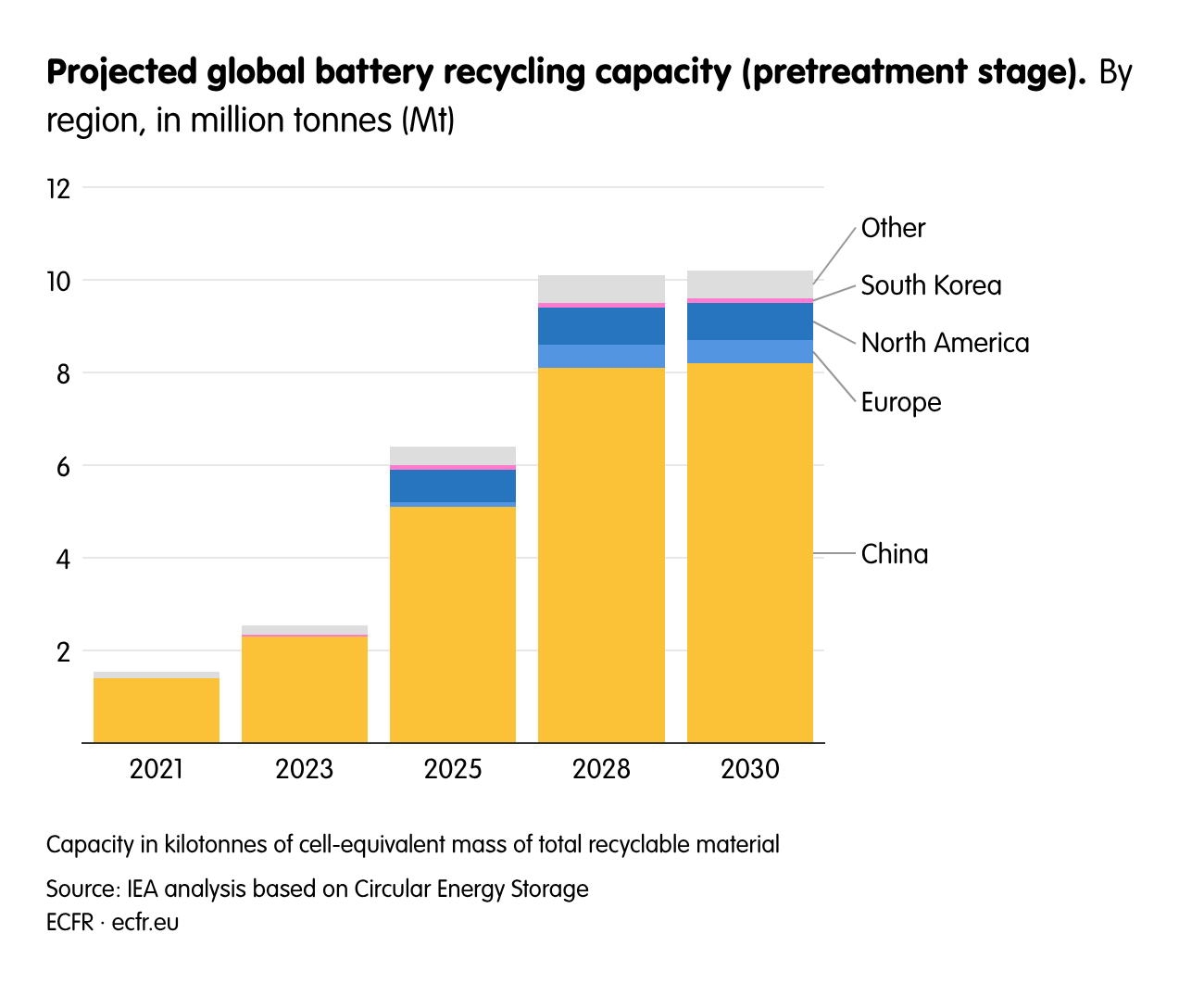
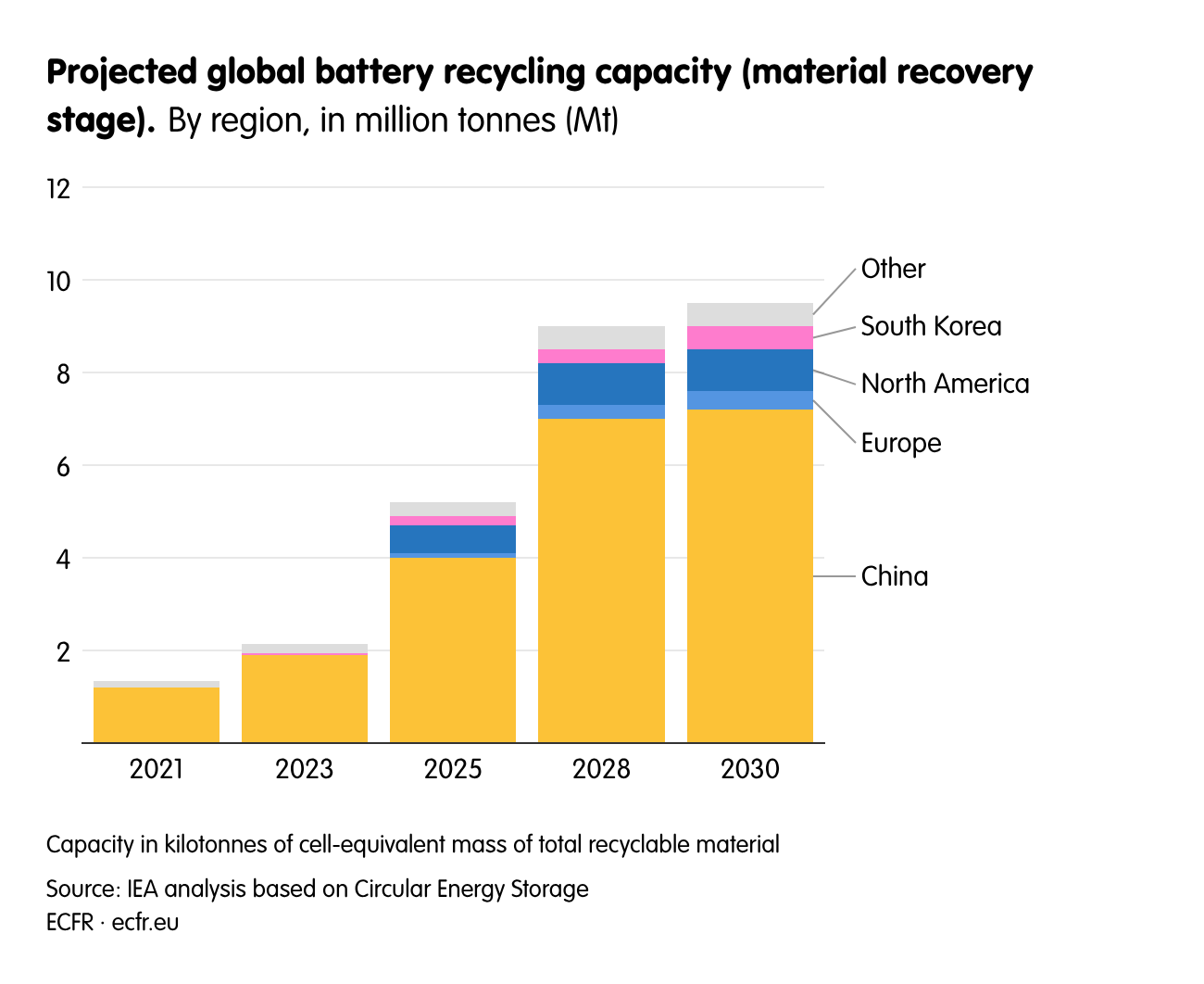
Although forecasts suggest that Europe will slightly raise its material-recovery capacity in the coming years, it remains a minor player. China’s dominant share in global battery recycling capacity for the shredding and material recovery stages, which exceeded 80% in 2025, is set to continue.
Recent analysis estimates that the costs of hydrometallurgical recycling for nickel manganese cobalt (NMC) and lithium iron phosphate (LFP) batteries are respectively 70% and 67% higher in France than in China due to higher labour, energy, environmental compliance, dismantling and transport costs in Europe. China’s scale of feedstock—domestic supply of end-of-life batteries, scrap metal from the local automobile industry, and imported batteries and black mass—has further lowered their recycling costs.
Making battery recycling happen in Europe
The EU can take three clear steps to increase recycling black mass in Europe.
First, Europeans should implement stricter export restrictions on black mass and batteries to fully close off exports and retain the products for material recovery domestically.[1] The US took this position in July 2026, with President Donald Trump empowering federal officials to block exports of end-of-life batteries and electronic waste to contain these products for recycling within the US.
Second, Europeans need to urgently build more recycling capacity to refine black mass: Europe’s hydrometallurgical recycling capacity is less than 3,000 tonnes, which is around one-sixtieth of China’s. Estimates suggest that Europe needs the capacity to recycle 120,000–135,000 tonnes of black mass per year by 2030.
Third—and perhaps most challenging—Europeans need to ensure recycling in Europe becomes more economically viable. Failing this, tough export restrictions will lead to battery waste being stockpiled rather than recycled.
To achieve the above, Europeans need to develop new financing mechanisms—such as building recycling costs into the purchase price of products and using public finance to help offset recyclers’ higher costs in Europe—to make recycling more economically viable. This would be particularly timely as battery technology shifts from NMC to LFP batteries: since the latter are comprised of less valuable minerals, recyclers earn less from the sale of recovered minerals, necessitating support for project viability.
The provision of public finance, preferably at both the EU and member-state level, would help in the development of new technologies and processes that lower recycling costs by reducing energy requirements and improving recovery rates. Patent filings in battery recycling are growing significantly, with 2026 figures showing a 103% growth in filings (adjusted for lag). China leads in patent applications, although US and European companies—notably Belgium’s Umicore—are also active. To make Europe more globally competitive in recycling, Europe must increase its investments in innovation using public finance support.
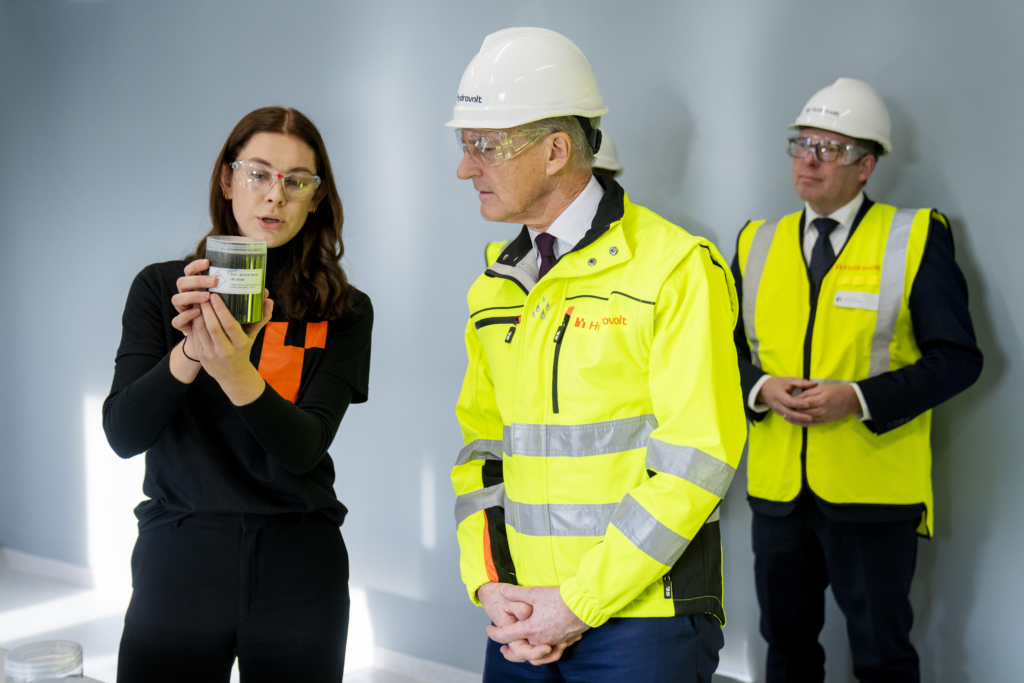
Europeans also need to establish a strong domestic value chain. European battery recyclers, such as Germany’s Cylib and Tozero and Norway’s Hydrovolt, should identify and establish commercial agreements with EU-based offtakers for the minerals they recover—after all, if Europe has to export recovered minerals outside its borders for want of domestic offtakers, gains in recycling will be for nothing. Specifically, this requires European industry that uses recovered minerals (alongside primary source minerals from mining) to refine precursor cathode active material (pCAM) and cathode active material (CAM) stages for EV batteries.
Pursuing EU-Africa partnerships
Europeans should also look internationally to ensure recycling can feasibly reduce existing mineral supply chain dependencies. The EU needs to tap into other recycling feedstock markets and diversify its mineral supply chains by establishing recycling partnerships with OECD and non-OECD countries.
Indeed, the EU has explicitly included recycling within the remit of some strategic partnerships on critical minerals that it has signed with partner countries, including several African countries such as Namibia. By locating recycling and mineral-processing facilities in African countries, they can tackle the cost disadvantages Europeans face with regard to energy, land and labour costs on home soil. Namibia and Kenya are ideal partners: both have transport corridors and port infrastructure that make them well positioned to aggregate regional battery and electronic waste (e-waste); they can harness their abundant renewable energy resources can power material recovery facilities.
EU-Africa cooperation on recycling would also be advantageous to African countries. Joint operations create jobs, expand African mineral processing capabilities and link African mineral supply chains with European industry. Africa-based recycling facilities could also manage the growing quantity of end-of-life batteries and e-waste generated by African countries, notably from solar panels, energy-storage batteries and EV batteries from smaller two- and three-wheeler vehicles.
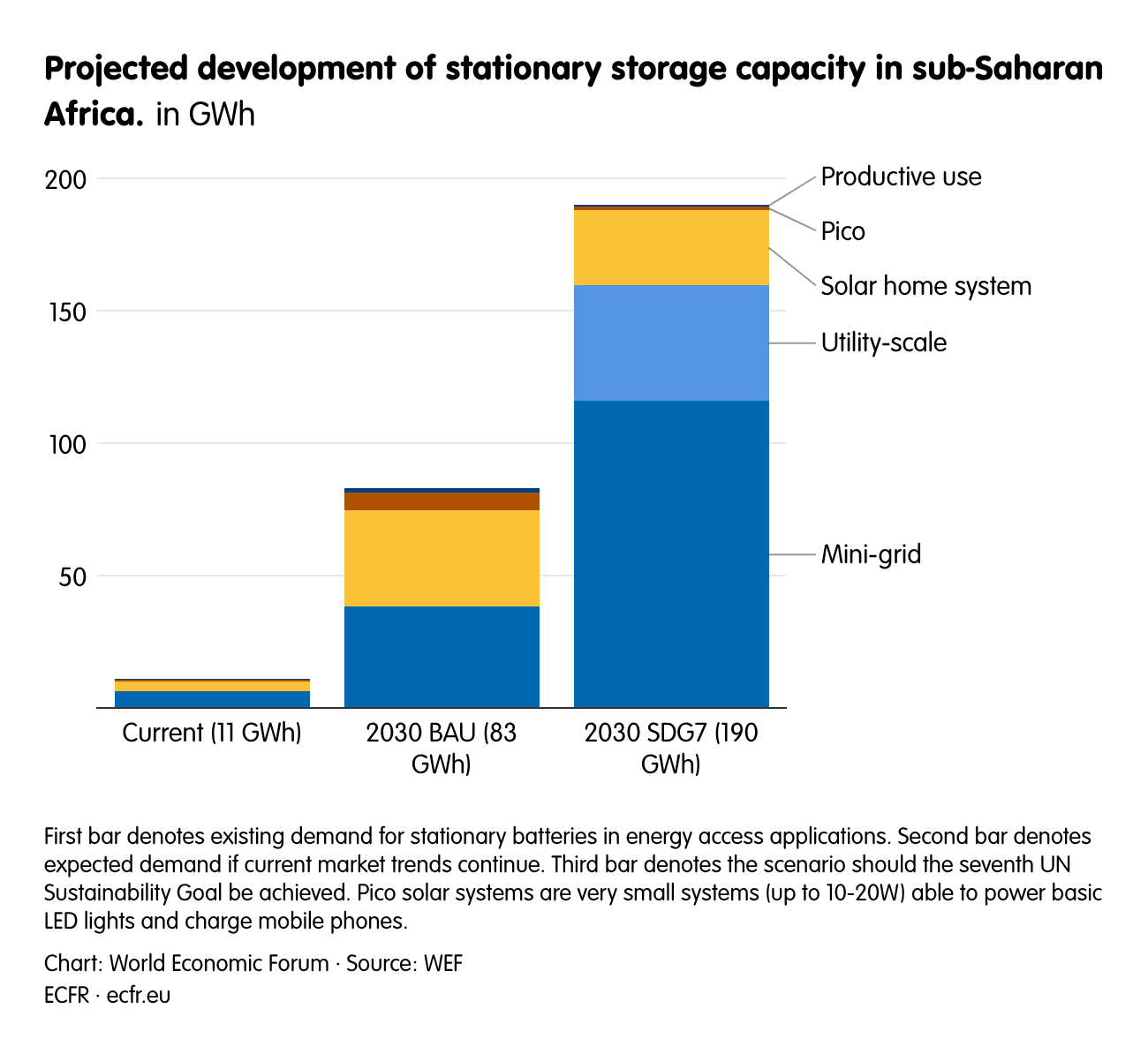
Sub-Saharan Africa’s projected growth in stationary storage capacity alone is significant: following current market trends, it will expand dramatically by 2030, with a storage capacity increase from 11 GWh to 83 GWh. If the region achieves universal access to electricity (SDG7), demand could more than double that, reaching a storage capacity of 190 GWh.
Europe’s road ahead
More recycling facilities are required to handle Africa’s growing volume of end-of-life battery feedstock. This presents an opportunity for growth both in Africa-based recycling, and in Africa-Europe recycling cooperation. However, this is not straightforward. Africa-Europe recycling partnerships need to invest in formalising supply chains for collection and storage; they need to build facilities for shredding batteries and e-waste; and they need to ensure that they can refine black mass to recover valuable materials. They would also need to develop the workforce skills and local-firm capabilities needed for efficient, environmentally-sound operations throughout the supply chain.
For African countries like Namibia and Kenya, such cooperation creates jobs and builds recycling capacity and expertise while integrating African mineral industrialisation into EU mineral supply chains. Recycling operations could also serve as anchor customers for increasing electricity generation and transmission investments in African countries, while local populations also benefit from improved electricity availability. Additionally, recycling in African countries helps address the continent’s growing e-waste management challenges.
For Europe, the increased recovery of critical minerals both domestically and through recycling partnerships with African countries offers greater supply chain diversification, access to minerals from non-OECD black mass and de-risking from Chinese mineral supply chains. All of this will happen faster than if Europeans continue to rely on global mine development. Europeans need to extend their strategic thinking beyond their borders, advancing recycling cooperation through critical minerals partnerships.
[1] Interview with a representative of a mineral analytics company, February 19th, 2026.