For the first time in 150 years, kiwi once again live in the hills surrounding Wellington, Aotearoa New Zealand. More than 250 manu (“birds” in the Māori language) were successfully translocated back to the region, thanks to the efforts of the iwi (nations of Aotearoa), community members, and landowners behind the Capital Kiwi Project. Paul Ward, the project lead and founder, joins the Mongabay Newscast this week to explain the yearslong effort to make this possible. A large part of it was removing stoats, which prey on kiwi before the chicks reach “fighting weight” (1 kilogram, or 2.2 pounds), which is when they can defend themselves. The project did this by deploying more than 5,300 traps to remove stoats from the project area, covering about 24,000 hectares (59,300 acres). But removing predation threats to the kiwi was only the start, as it took years of relationship building with iwi, translocating birds, and educating community members on care — many of whom had never seen a kiwi in person before. “The three legs on which this project are based are those relationships with iwi, with Māori, the relationships with the communities, and the relationships with the landowners. And if you pull one of those legs off, the tripod falls over,” Ward says. “This is a relational project as much as it is what you might traditionally call a conservation project. And I think at a fundamental level that if we lose our relationship with these animals, with these manu … they…This article was originally published on Mongabay
For decades, the global outlook for food and agriculture has brought heightened concerns as climate patterns create a mix of droughts and floods across the world. Consequently, fears of diminishing crop yields and livestock shortages have dominated the headlines. Amid the ensuing food security crisis, scientists are wondering if communities can turn toward local plant diversity as insurance against subsequent food shocks. A recent study published in People and Nature examines how pastoralist communities in a Ugandan subregion contend with food shortages by adopting previously unused wild edible plants. The study comes on the heels of 2024 research on wild edible plants by local NGOs in Karamoja, a semiarid region in northern Uganda. That earlier study found “that people had developed uses for plants they had not used before,” Emiel De Meyer, a postdoctoral researcher at the State Natural History Museum in Germany, explained by email. Spurred by this discovery, De Meyer led a team of researchers across five agro-pastorialist communities in Karamoja, interviewing members of the local communities on their knowledge of edible wild plants. Through a mix of qualitative and statistical methods, the researchers also probed the reasons behind the adoption of particular plants and how this knowledge was transmitted. In the five villages covered in the study, the authors recorded 27 plant species previously unused as food and now eaten as leafy vegetables. Of these, 20 were reported to be indigenous to Uganda. Although all these plants were mostly harvested during the wet season, at least three…This article was originally published on Mongabay
A case has been brought to the East African Court of Justice (EACJ) over the Kenyan government’s plan to build a 2,000-5,000-megawatt nuclear power plant in Bondo, near the eastern shore of Victoria Lake, Africa’s largest freshwater lake. The project has been the source of numerous protests from residents since it was announced. A Strategic Environmental Assessment (SEA) report produced in 2023 by Kenya’s nuclear power program noted that nuclear power should be avoided in the Victoria Lake region, citing volcanic hazards that could impair nuclear safety. However, the nuclear plant project is proceeding, despite the SEA finding. “I filed a reference at the East African Court of Justice on two grounds,” Dickens Ochieng, told Mongabay in a phone call. Ochieng is a resident of Siaya County, where the facility is located, and a human rights lawyer with J. Henry and Company Advocates, the law firm that filed the case on Sept. 23. “First, I want the court to determine if we should even have that nuclear power plant in Victoria Lake given the ecological and environmental risk that may be associated with it,” Ochieng said. “Then, I am asking for the project to have a transboundary environmental impact assessment, as Victoria Lake is not only a Kenyan matter.” Victoria Lake is shared by Kenya, Uganda and Tanzania. Roughly 40 million people across the three countries depend on the lake for their livelihoods, food security and drinking water. Millions more depend on the river that drains from Lake Victoria and…This article was originally published on Mongabay
PUERTO SAN CARLOS, Mexico (AP) — Hurricane Polo has made landfall in Baja California, Mexico, with powerful winds and flash flooding. The Category 2 hurricane struck early Tuesday near Las Barrancas, bringing maximum sustained winds of 110 mph. The U.S. National Hurricane Center reports Polo is crossing the Gulf of California and could bring heavy rain to parts of the U.S. Southwest later this week. Meanwhile, Tropical Storm Rachel is moving parallel to Mexico’s coast. The Pacific storm activity is above average this season, consistent with El Niño patterns. Hurricane Nolo, still a Category 3, is moving away from Hawaii, where it caused flooding over the weekend. By Martín Silva Rey and Megan Janetsky, Associated Press Banner image: Workers tow a boat ashore as Hurricane Polo approaches Puerto San Carlos in the Mexican state of Baja California on Monday, September 28, 2026. Image courtesy of Eduardo Verdugo, Associated PressThis article was originally published on Mongabay
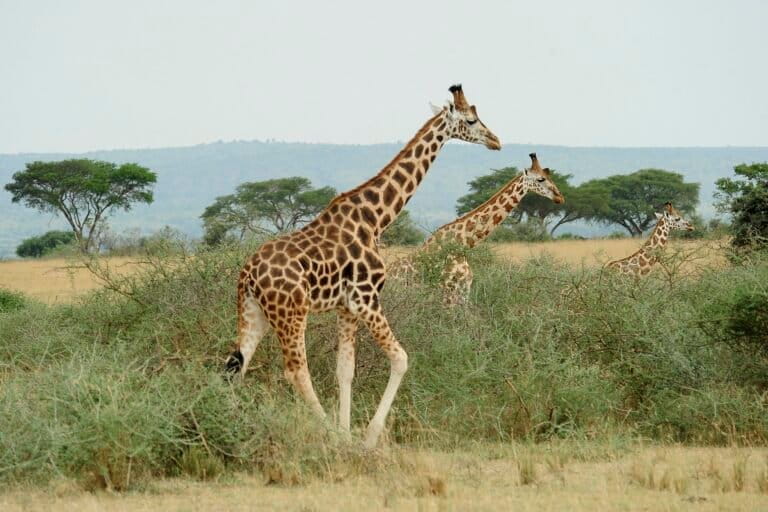
Giraffes living in the South Sudan’s war-torn savannas are genetically healthy and connected to nearby giraffe populations by gene flow, despite decades of conflict, recent research suggests. These findings show that “regions of the world that have been affected by conflict can maintain a lot of biodiversity and should therefore not be overlooked by genetic studies and conservation efforts,” Sam van Giessen, study lead author and a conservation genomics researcher from the University of Amsterdam, Netherlands, told Mongabay by email. The IUCN, the global wildlife conservation authority, currently recognizes four species and seven subspecies of giraffes. South Sudan is home to two subspecies of the critically endangered northern giraffe (Giraffa camelopardalis): the Nubian giraffe (G. c. camelopardalis) and the Kordofan giraffe (G. c. antiquorum). Between the conflict years of 1985 and 2025, Nubian giraffes in Ethiopia and South Sudan declined by 95%. By 2025, researchers estimated roughly 235 Nubian giraffe survived across South Sudan in isolated pockets, down from an estimate of 15,000 individuals in 1995. To find out the genetic health of these giraffe populations, researchers from the South Sudan government, the Giraffe Conservation Foundation (GCF), and conservation NGO African Parks analyzed DNA from skin biopsies collected from 30 Nubian giraffes in Boma and Badingilo national parks, run by African Parks. As the giraffe population in the region is small, there was some concern that inbreeding could be a problem for the subspecies’ long-term conservation. However, their analysis showed the South Sudan Nubian giraffe population has relatively high levels…This article was originally published on Mongabay
The World Health Organization has officially recognized Bhutan for eliminating dog-transmitted human rabies as a public health problem — in time for World Rabies Day on Sept. 28. According to the World Health Organization (WHO), Bhutan is the first country in the Southeast Asia region, and the second to be named globally after Mexico, to achieve this validation. Nearly 99% of all human rabies cases globally are caused by the bite or scratch of an infected dog. Once symptoms appear, rabies is almost always fatal. On Sept. 4, the WHO confirmed that Bhutan has recorded zero human deaths from dog-mediated rabies since June 2023 and has demonstrated that it has the resources and systems in place to prevent the disease’s re-emergence. Bhutan’s achievement comes as organizations including the WHO, World Organisation for Animal Health (WOAH), Food and Agriculture Organization of the United Nations (FAO) and Global Alliance for Rabies Control (GARC) mark World Rabies Day with the theme of “Stronger Together”, advancing a global goal to eliminate human rabies deaths worldwide by 2030 under the “Zero by 30” initiative. To eradicate rabies, Bhutan has persistently invested in a comprehensive “One Health” approach, which recognizes that animal, human and environmental health are interconnected, the WHO said in a press release. A 2021 Royal Decree by the King of Bhutan launched the Nationwide Accelerated Dog Population Mangement and Rabies Control Programme, implemented jointly by the Ministry of Health and Ministry of Agriculture and Livestock. WHO said field health teams and veterinarians supported by…This article was originally published on Mongabay
Founder’s Briefs: An occasional series where Mongabay founder Rhett Ayers Butler shares analysis, perspectives and story summaries. In 2022, poachers had taken 14 white rhinos from private farms in Namibia in six weeks, so owners started removing their horns. One cow had a horn 86 centimeters (34 inches) long. Jaco Muller said he was nearly in tears when it was removed. “It is such a magnificent animal,” he said. “But for the animal’s sake, it is for the best.” Dehorning gave poachers less reason to kill a rhino. For Muller, the sight of a dehorned rhino was preferable to finding a dead one. The idea for breeding rhinos came from his son, then 15, as a school project. In 2010, Muller converted the family’s antelope-breeding operation into what became the Rhino Momma Project in Namibia’s Kunene region. Muller believed that breeding more white rhinos (Ceratotherium simum), keeping them secure enough to reproduce, and then replenishing populations across Africa could help save the species. So he built a breeding program with a rhino-custodianship farm and the nonprofit Help Our Rhinos Now, or HoRn. The first calf was born in 2013; by 2025, the project had become one of Namibia’s larger privately run rhino-breeding operations. Kifaru Lodge, which Muller opened in 2018, brought in money from tourists to help cover security and rhino care. Muller also supported legalizing the trade in rhino horn. His argument was that prohibition let criminals collect the profits while farm owners and conservation groups paid for security.…This article was originally published on Mongabay
BANGKOK — Over the course of 2025, the Mekong countries of Cambodia, Laos, Myanmar, Thailand and Vietnam lost a combined 746,168 hectares (1.8 million acres) of tree cover, an area roughly equivalent to the size of the Bangkok Metropolitan Area, according to Mongabay’s analysis*. Data published by the Global Land Analysis and Discovery (GLAD) laboratory at the University of Maryland, in partnership with Global Nature Watch (GNW) — formerly Global Forest Watch — shows that of the total 746,168 hectares of tree cover lost, more than 154,000 hectares (380,000 acres) was primary forest. Mongabay’s analysis found that just shy of 200,000 hectares (494,000 acres) of the total were lost from the region’s protected areas. While these numbers may paint a bleak picture for the Mekong’s forests, the rate of regional deforestation has dropped by almost 25% from that recorded by GNW in 2024, continuing a decline that, according to the data, began in 2023. Fewer wildfires, higher rainfall, stricter law enforcement and lower market rates for commodities could all factor into a drop in the Mekong’s deforestation rate for 2025 when compared to 2024. However, experts warn that short-term drops do not always represent a broader trend in deforestation. Every country in the Mekong saw a fall in deforestation rates from 2024 to 2025, but each still grapples with a range of challenges to protecting the region’s remaining forests. Data from 2025 shows a drop in deforestation recorded across Mekong nations, but much of the tree cover lost last year was lost inside…This article was originally published on Mongabay
Plastic pollution could disrupt the bioluminescent light produced by deep-sea organisms, researchers warn in a letter in the journal Cambridge Prisms: Plastics. When deep-sea organisms ingest plastics, it could disrupt the chemical pathways that create bioluminescence and damage the tissues in their bodies, impairing their ability to find food and a mate, the authors said. In the deep sea, up to 80% of organisms with complex cells are believed to be bioluminescent, the only source of light in the darkest parts of the ocean. The light these organisms create is essential for their survival and reproduction, the letter notes. Disruption of their bioluminescence could negatively impact food webs and ecosystem functions in the deep sea, the largest and least-explored biome on Earth, the letter says. In an email to Mongabay, co-author Renjith VishnuRadhan of Amity University in India offered the example of an anglerfish. “It is widely recognizable from documentaries and films such as Finding Nemo,” he said. “Female deep-sea anglerfish have a modified dorsal spine ending in a luminous lure called the esca. Light produced by symbiotic bacteria helps attract prey and may also assist with recognition or communication in darkness.” It’s well-established that bacterial bioluminescence can be affected by pollutants, VishnuRadhan said, and ingestion of toxic plastic additives by anglerfish could disrupt the bacterial symbiosis in the lure, theoretically affecting its luminous signaling. The authors note there’s some evidence of plastic pollution impacts on deep-sea ecosystems, but scientists lack the high-quality data and observations needed to understand the…This article was originally published on Mongabay

 Login