❌

Reading view

Ukraine’s F-16 Fleet Is In A Readiness Crisis

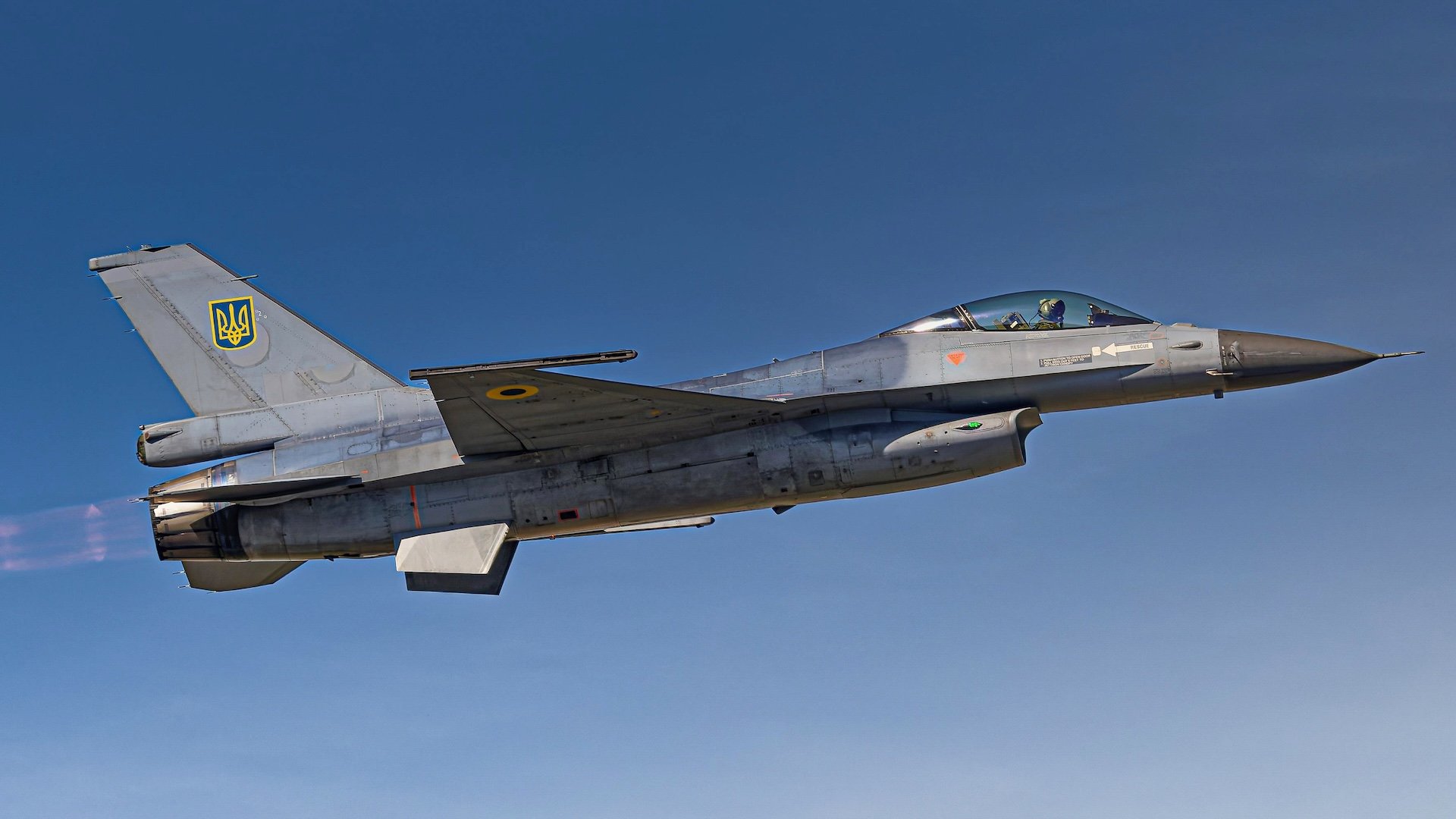
Ukraine’s F-16 fleet is facing growing pressure from the demands of the air war, with a shortage of air-to-air missiles now compounded by what appears to be a serious bottleneck in the critical maintenance system supporting the aging aircraft.

The Wall Street Journal reported Wednesday that more than half of Ukraine’s F-16s are currently in what a Western source described as “maintenance limbo.” The same source told the newspaper that, at the current rate of operations and maintenance, Ukraine could exhaust the remainder of its available aircraft by the end of the year.
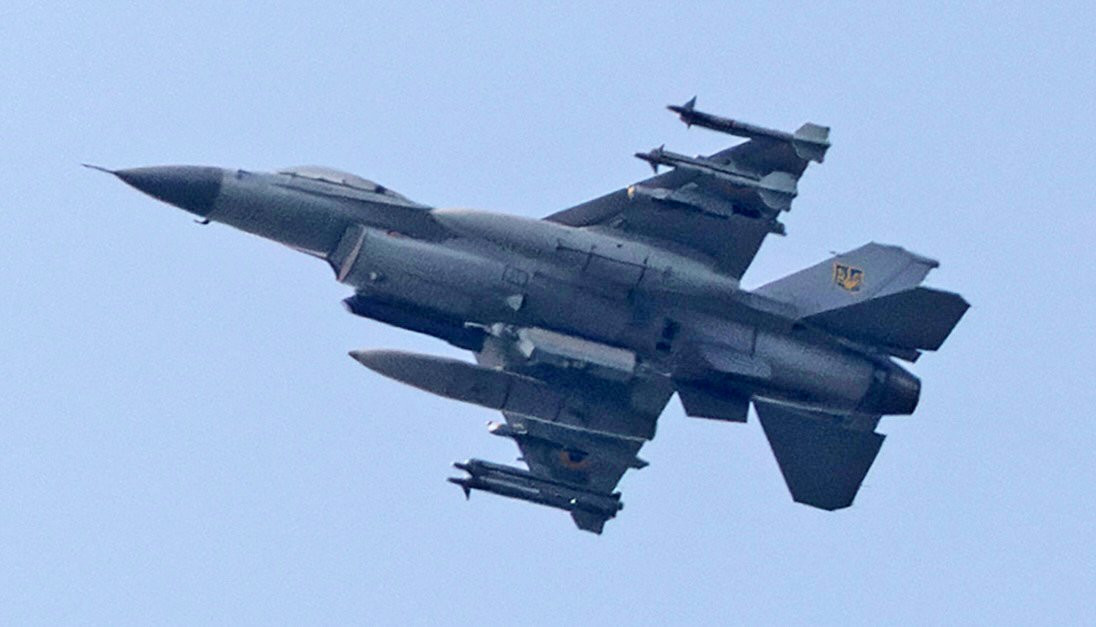
An F-16 fighter jet flies in the sky over Kyiv on August 18, 2026, amid the Russian invasion of Ukraine. (Photo by Roman PILIPEY / AFP)
An F-16 over the Kyiv region on August 18, 2026. The jet carries four Sidewinder missiles, a Sniper targeting pod, and an AN/ALQ-131 electronic countermeasures pod. Photo by Roman PILIPEY / AFP ROMAN PILIPEY

The Ukrainian Air Force declined to provide the WSJ with figures on the status of the fleet. Open-source analysis suggests that Ukraine may have received around 40-50 F-16s so far. However, a proportion of these are held back for training elsewhere in Europe, while there have been five confirmed losses. Approximately 110 F-16s have now been promised by a coalition comprising Belgium, Denmark, the Netherlands, and Norway.

This is a growing issue, especially because right now F-16s are playing an important role in intercepts of jet powered Geran-4/5. https://t.co/ZtMFBSLAy1

— Michael Kofman (@KofmanMichael) September 30, 2026

The report follows TWZ’s recent reporting on a separate constraint affecting the F-16 force: Ukraine is struggling to maintain adequate stocks of air-to-air missiles for its fighters. AIM-9 Sidewinders and AIM-120 Advanced Medium-Range Air-to-Air Missiles (AMRAAM) have been heavily used against Russian cruise missiles and drones, and Ukrainian F-16 pilots have reportedly had to ration their missile shots. Aircraft have increasingly had to rely on their internal 20mm cannon when suitable missiles are not available. This is a far from ideal substitute, as you can read about here, but Kyiv is reportedly now negotiating for tens of thousands of additional rounds of 20mm ammunition.

The moment a Russian jet-powered "Shahed" drone is shot down by an F-16 fighter jet using its M61 Vulcan cannon. pic.twitter.com/gU72HJTXUa

— WarTranslated (@wartranslated) September 23, 2026

Ukrainian F-16s have apparently been carrying laser-guided 70mm Advanced Precision Kill Weapon System II (APKWS II) rockets, which should provide an extremely valuable, lower-cost option for engaging long-range drones and subsonic cruise missiles. The exact status of this weapon in Ukrainian hands is unclear, but there is so far limited evidence of extensive use by its F-16s, at least in the public domain.

All these problems are closely related because the same high operational tempo that is consuming Ukraine’s missile stocks is also putting additional hours on the already well-worn F-16 airframes.

The aircraft have become a critical important component of Ukraine’s air-defense effort, particularly as Russia has expanded its use of increasingly sophisticated one-way attack drones, as we wrote about only yesterday. WSJ reports that Russia has launched around 2,000 jet-powered drones against Ukraine this month, compared with approximately 350 in June. The newer, jet-powered drones can reportedly reach speeds of up to 375 miles per hour, making them more difficult for Ukraine’s interceptor drones to engage and increasing the importance of conventional fighters. At the same time, the stocks of effectors for ground-based air defense systems are being reduced, in some cases to a critical level, increasing the reliance on crewed fighters to take up the slack.
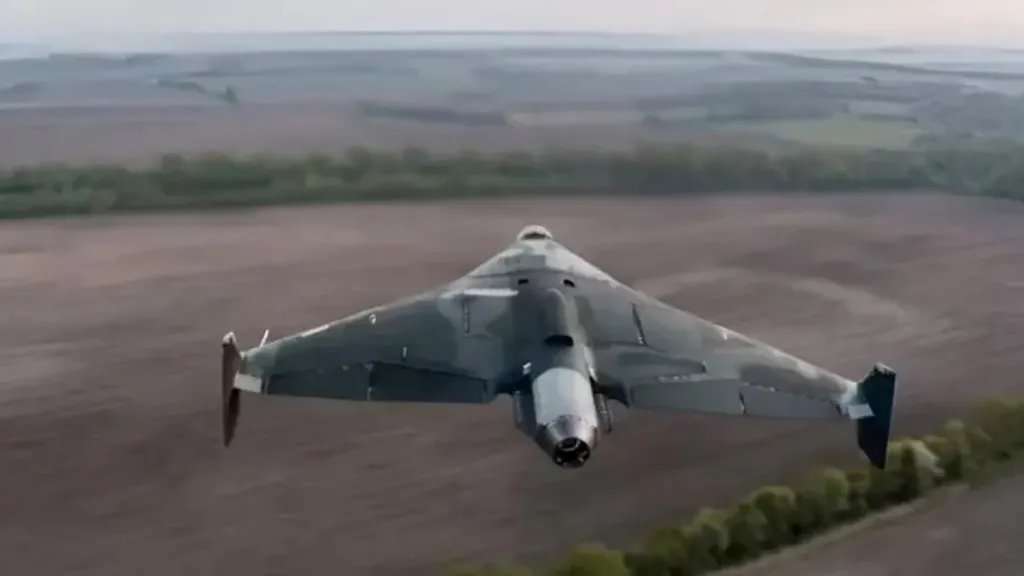
A Ukrainian drone attempts to intercept a Russian Geran-4 jet-powered drone. GUR

F-16s are well-suited to the counter-drone and counter-cruise missile mission, but using them extensively against large numbers of relatively inexpensive targets presents a difficult sustainment problem. In fact, the lower speed and altitude differential between the F-16 and a jet-powered drone, compared to a propeller-driven one, makes the higher-performance weapon an easier target for the crewed fighter in most scenarios.

However, every sortie adds flight hours to the aircraft, while each missile engagement draws from an inventory that Ukraine and its Western partners have to replenish. As the aircraft accumulate hours, they reach scheduled inspection and maintenance intervals, increasing demand on a maintenance network that is already supporting a fleet operating under wartime conditions.

The United States has established a substantial support arrangement for that purpose. In January, the Pentagon awarded Belgian company Sabena Aerospace Engineering a contract with a ceiling of approximately $235.5 million for intermediate- and depot-level maintenance of Ukrainian F-16 aircraft and engines, together with associated material-management support. The contract runs through January 2029, with approximately $69.7 million initially obligated.

Ukrainian Air Force F-16AM Fighting Falcon departing Belgium after receiving depot-level maintenance earlier this year. pic.twitter.com/Hy35iUZd8P

— OSINTtechnical (@Osinttechnical) August 28, 2026

The contract provides an indication of the scale of the infrastructure required to keep the Ukrainian F-16 fleet operational. It also highlights why the reported turnaround times in Belgium are significant. A typical phase-inspection that would normally take approximately two to six weeks in the United States is reportedly taking as long as 40 weeks in Belgium.

A 40-week turnaround does not necessarily mean that an aircraft spends 40 weeks continuously undergoing a phase inspection. The overall period an aircraft is unavailable can also include waiting for parts, additional repairs, scheduling, and other work. It is unclear exactly how many Ukrainian F-16s are currently affected by these various factors.
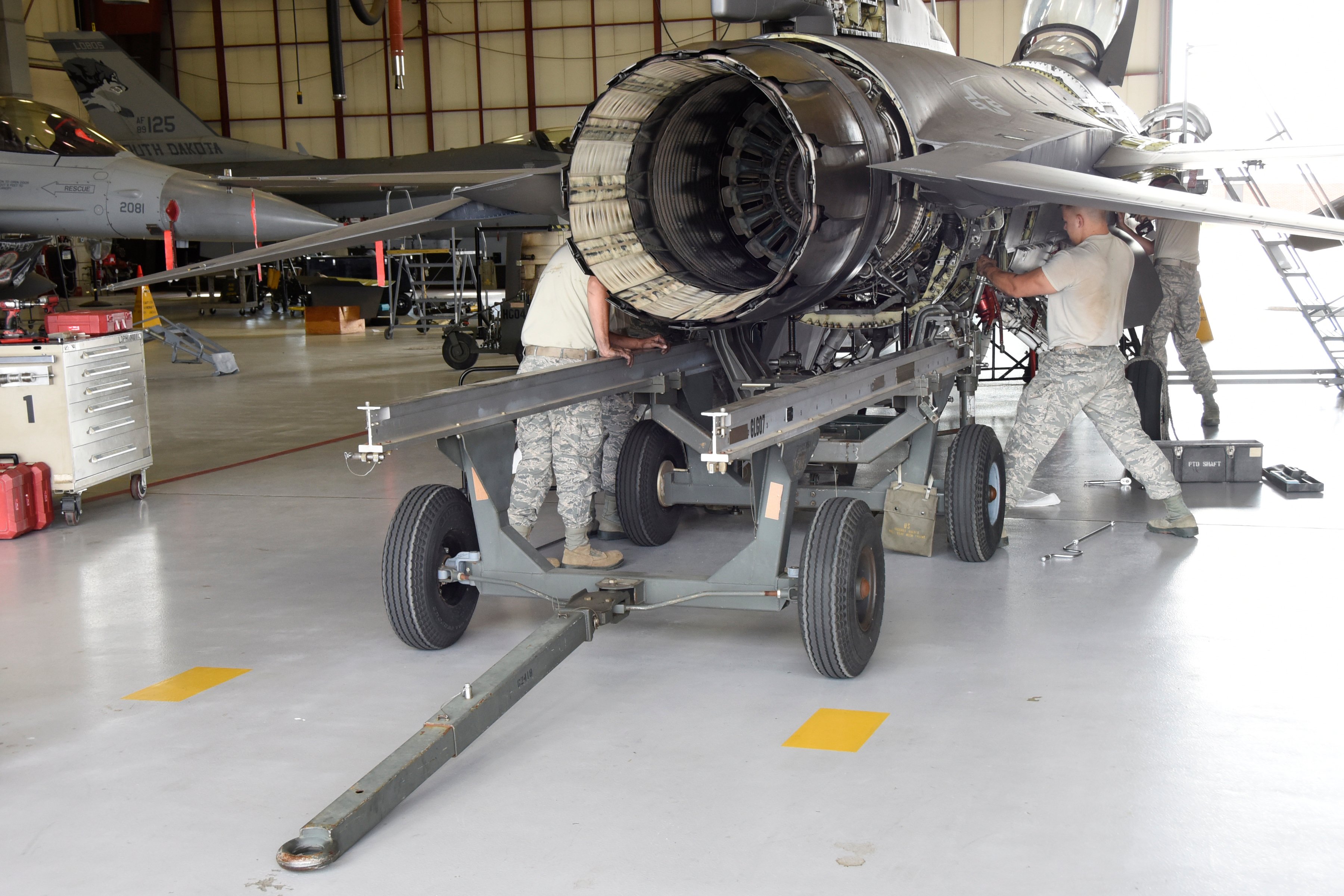
114th Aircraft Maintenance Squadron engine shop Airmen remove the engine of an F-16 during the De-paneling Phase of a phase maintenance inspection at Joe Foss Field, July 8, 2017. Each aircraft is required to go through a phase inspection every 400 flight hours to ensure all systems are functioning within Air Force regulations. (U.S. Air National Guard photo by Master Sgt. Christopher Stewart/Released)
U.S. Air Force engine shop where airmen remove the engine of an F-16 during a phase maintenance inspection in the United States. U.S. Air National Guard photo by Master Sgt. Christopher Stewart/Released Master Sgt. Christopher Stewart

At the same time, the reported turnaround times do point to a substantial capacity problem. Ukraine operates a relatively small F-16 fleet, so aircraft that remain unavailable for extended periods have a disproportionate effect on the number of fighters that can actually be generated for combat missions. Its mission spectrum also includes air-to-ground sorties, putting more demand on the hard-pressed F-16 fleet.

F-16 fighters are the best way to counter new Russian jet-powered drones.

Ukrainian F-16 aces have shot down about 2,500 drones of all types and about 650 cruise missiles.

Jet drones are exactly the kind of target F-16s shoot down very well, and it usually costs $25,000 or… pic.twitter.com/ajxYN9K0yK

— Slava 🇺🇦 (@Heroiam_Slava) September 30, 2026

The F-16s have finite airframe lives, require increasingly substantial inspections as they accumulate hours, and depend on a supply chain for engines, components and other parts. The missiles used to destroy the targets are another finite resource. It should also be recalled that the jets supplied to Ukraine are among the oldest still in operational service. Although upgraded to F-16AM/BM standard, the airframes have accumulated a lot of hours and fatigue.

There is an additional complication with the air-to-air missile inventory, too. AMRAAM is not used only by Ukrainian F-16s, but also employed by its NASAMS ground-based air-defense systems. Sidewinders, too, have both air-launched and surface-launched applications. The same broader Western supply chain therefore has to support both fighter operations and some of Ukraine’s surface-to-air missile systems. Stocks of both AMRAAM and Sidewinder have been eroded by Ukraine, as well as by combat actions in the Middle East.

Southern Ukraine, a Ukrainian NASAMS surface to air missile system intercepts a Russian drone with an (SL)AIM-120B AMRAAM. pic.twitter.com/LTeDDHaECp

— OSINTtechnical (@Osinttechnical) May 22, 2025

At the same time, Ukraine is continuing to receive additional F-16s. Belgium has said it will transfer three more aircraft to Ukraine before the end of this year. More aircraft will increase the potential size of the force, but they will also add to the requirement for spare parts, engines, technicians and depot capacity.

“There is an important agreement ​with Belgium on the transfer of three F-16 ​fighter jets by the end of this year,” ⁠Ukrainian President Volodymyr Zelensky wrote on X. “We will work to receive ​these aircraft through an accelerated procedure.”

There is an important agreement with Belgium on the transfer of three F-16 fighter jets by the end of this year. We will work to receive these aircraft through an accelerated procedure. We have already received urgent deliveries of F-16 ammunition from Belgium and other…

— Volodymyr Zelenskyy / Володимир Зеленський (@ZelenskyyUa) September 29, 2026

Zelensky said Ukraine had ​already received “urgent deliveries” of F-16 weapons from Belgium and Spain, among other countries.

The alternatives to the F-16 are also limited in the near term. Ukraine continues to operate the Soviet-era MiG-29 Fulcrum and a small number of Su-27 Flankers, but these aircraft are themselves aging and are also required for strike missions. In their favor, the Soviet types were designed around a different concept of operations, making them easier to maintain in the field, and Ukraine has its own support infrastructure to sustain them.

The French Mirage 2000-5F force provides another Western option, but deliveries have been relatively limited, and additional aircraft are arriving incrementally rather than in numbers that can quickly compensate for a major reduction in F-16 availability. The longer-term fighter replacement plan is more ambitious. Sweden has agreed to provide 16 Gripen C/D fighters, with the first aircraft expected in early 2027, while a separate agreement covers the purchase of 16 new Gripen E fighters whose deliveries are not scheduled to begin until early 2029.

🇫🇷🇺🇦 French-delivered Dassault Mirage 2000-5F fighter jet in service of the Ukrainian Air Force during flight somewhere over Ukraine. pic.twitter.com/eBCjtx2Gjc

— Status-6 (@Archer83Able) May 17, 2026

That leaves the F-16 as the principal Western fighter capability available to Ukraine for the immediate future, increasing the significance of any prolonged disruption to its maintenance pipeline or its supply of air-to-air weapons. Ukraine needs enough aircraft to maintain a meaningful combat presence, enough missiles to arm them for the missions they are being asked to fly, and enough maintenance capacity to keep those aircraft available as their flight hours accumulate.

All this is becoming more important as Russia’s aerial campaign evolves. If the increase in faster jet-powered drones continues, Ukraine may have to devote still more fighter sorties to countering them at the very same time that a large portion of its existing F-16 fleet is reportedly unavailable and its stocks of air-to-air missiles are under serious pressure.

Contact the autjor: thomas@thewarzone.com

The post Ukraine’s F-16 Fleet Is In A Readiness Crisis appeared first on TWZ.
  •  

What Boeing’s New Rendering Of Its Winning F/A-XX Fighter Tells Us

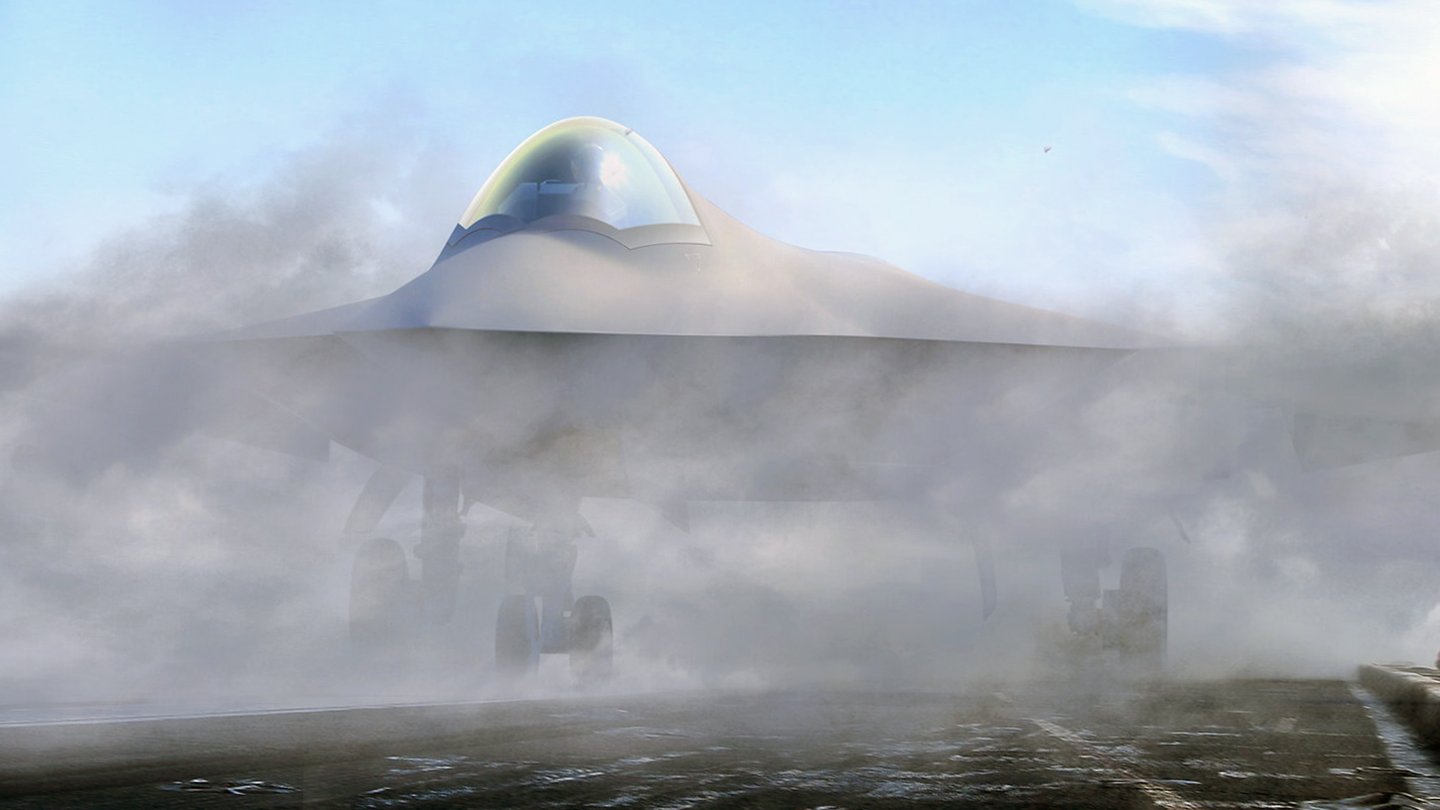
We have officially received our second rendering of Boeing’s F/A-XX concept, which has now officially won the tender, beating out Northrop Grumman to build the Navy’s next-generation stealth fighter. Let’s take a look at what we can see in this new image and discuss what insights it may provide.

Before we start, it’s worth reminding our readers that we are basing this analysis on two publicly released renders of a highly classified aircraft design. There are deliberate choices made in these renderings to obscure critical features and capabilities and mislead foreign intelligence as to the jet’s intended capabilities. So please keep in mind that the details are bound to change. This is also just a preliminary analysis. We will expand on it once we have more time to digest what we are seeing.

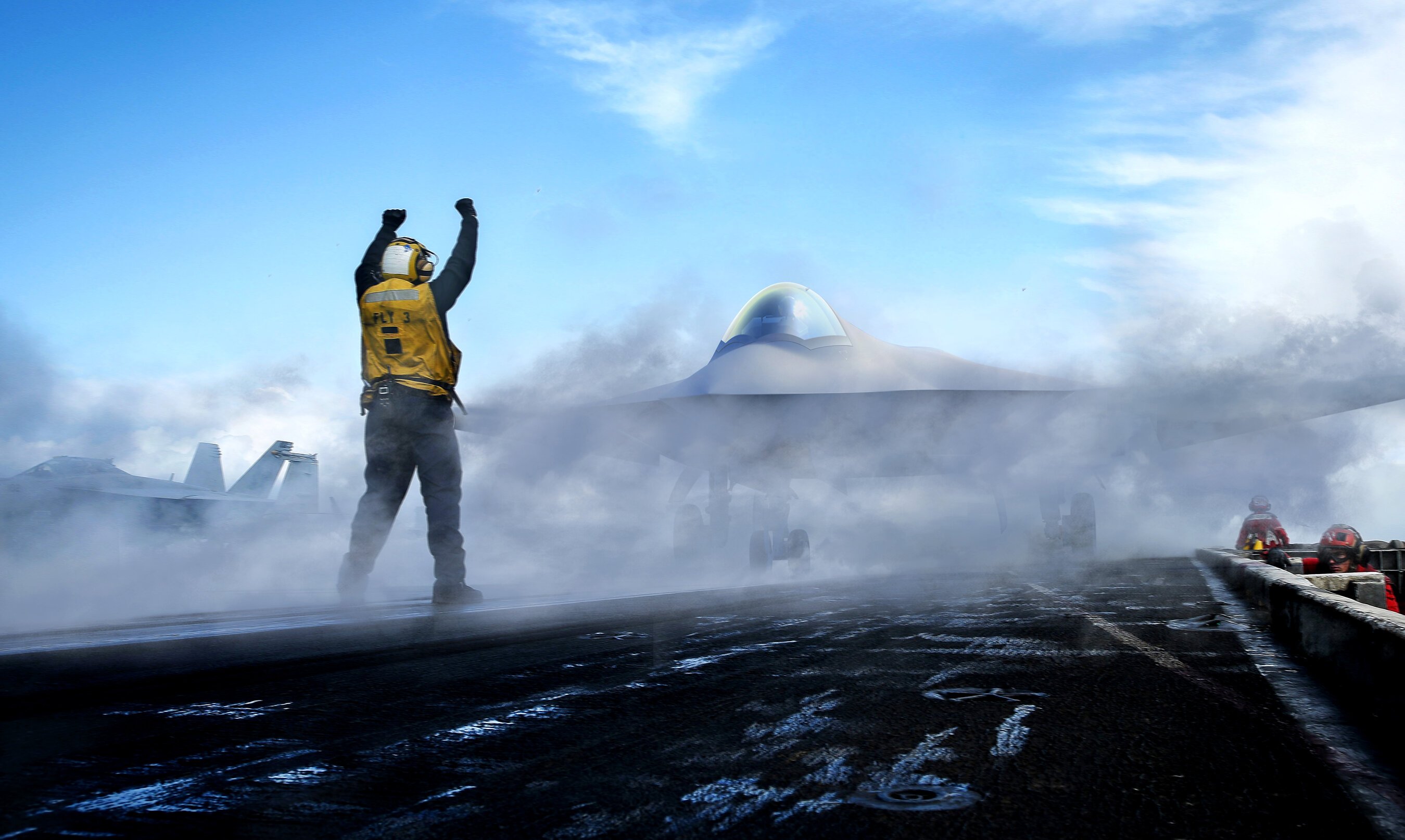
The front quarter view of the jet taxiing to a catapult aboard a carrier shows us a very broad, tailless, heavy tactical aircraft. This is a large jet. Clearly internal volume was a driving design factor, as it should be. You can read more about this in our past reporting here.

Boeing’s new F/A-XX render. Boeing

The aircraft is depicted with what appears to be a large single-piece canopy with a cockpit for just a pilot. Visibility to the rear looks limited at best. There has been much speculation about the possibility that F/A-XX will have the provisions for two crewmen in order to better take on its complex roles over long distances — in particular acting as a battle manager, including for Collaborative Combat Aircraft (CCA) and other drones. This appears not to be the case, and a high degree of automation and artificial intelligence (AI) will have to help with what will be extremely complex tactical problems the single pilot will face. It’s also worth noting that U.S. Navy carrier air wings have retained two-seat tactical jets for frontline use, with the F/A-18F Super Hornet and EA-18G Growler serving today. If F/A-XX replaces these aircraft, it will be the end of frontline two-seat tactical jet operations for the seagoing service.

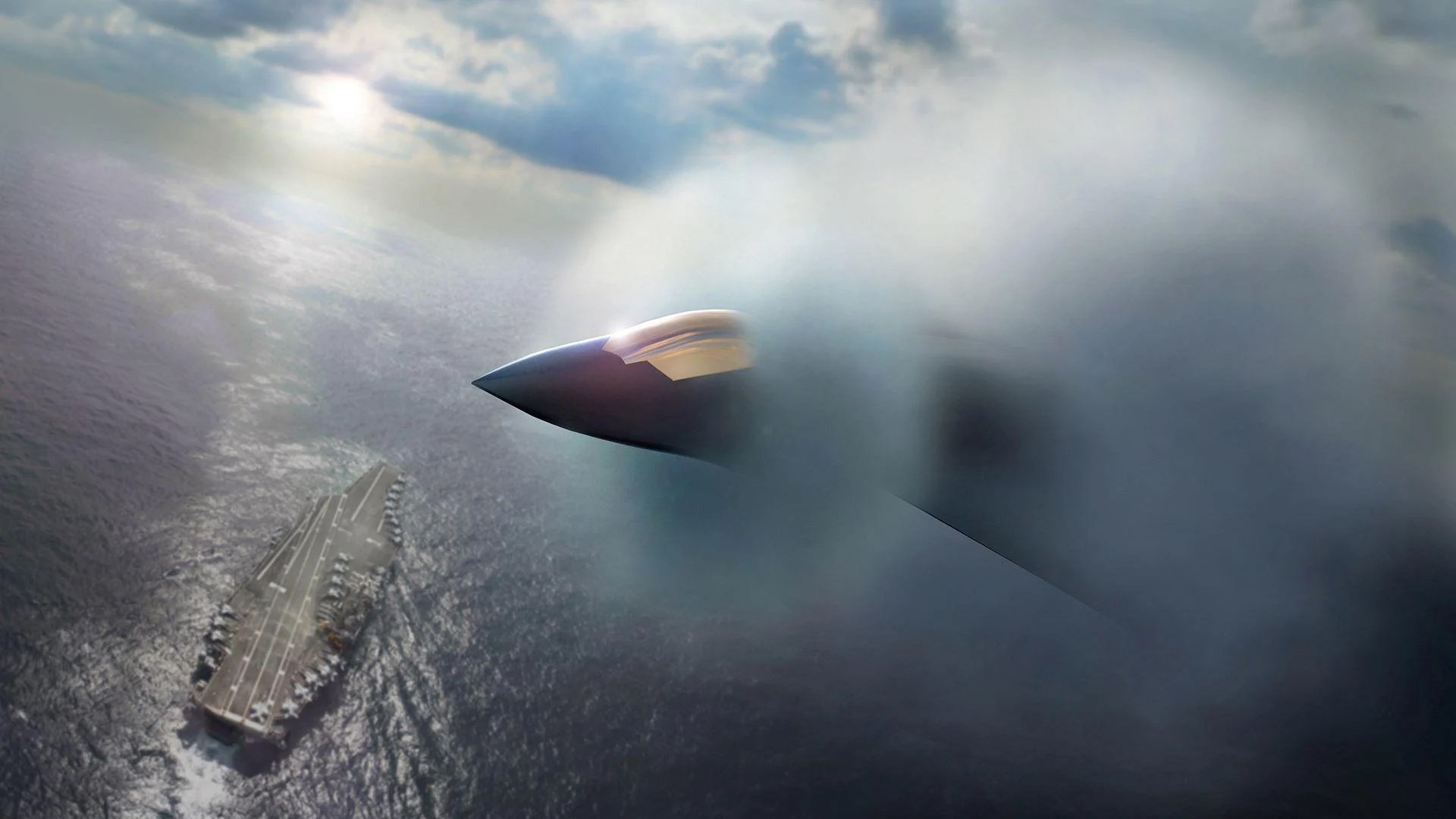
Boeing’s only other F/A-XX render, released months ago. Boeing

We see a very broad nose section, which could (and likely would) contain a relatively giant active electronically scanned array (AESA) radar. There is also a prominent chine-line edge wrapping around the forward fuselage, which is a normal trait of low-observable (stealthy) aircraft. The nose looks a bit more contoured, similar to the only other rendering we have of Boeing’s F/A-XX, compared to the shovel-like design of the company’s F-47 for the U.S. Air Force. Below the rear of this visible chine-line appears to be the engine intakes, mounted on the sides of the lower fuselage. They look to be a blended trapezoidal arrangement and are also set far back from the nose.

The F/A-XX’s extremely stout landing gear are depicted prominently in this new image, with a twin-wheel nose gear and thick mains. These are customary features for a carrier-based fighter and especially a heavy one like this.

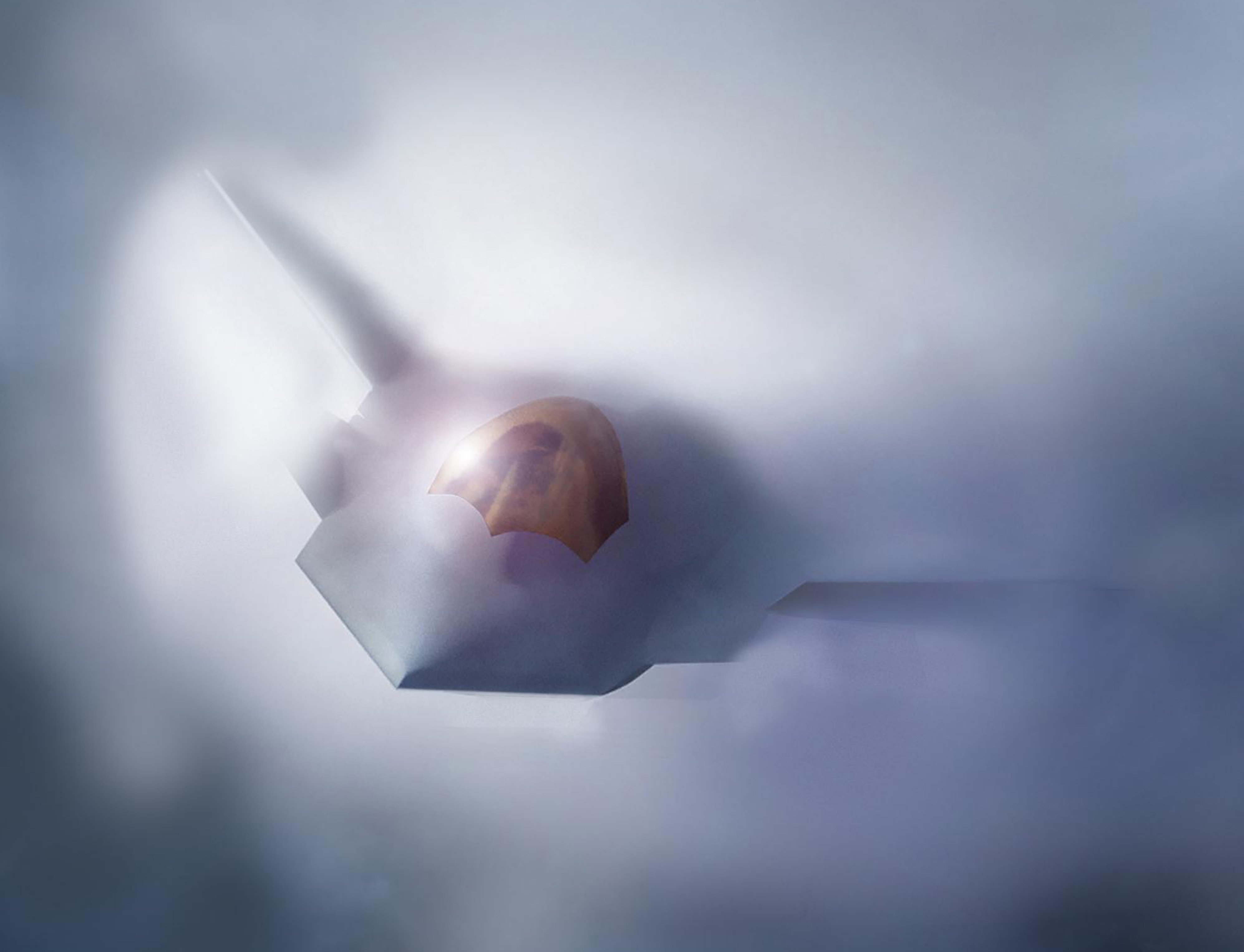
Shown is a graphical artist rendering of the Next Generation Air Dominance (NGAD) Platform. The rendering highlights the Air Force’s sixth generation fighter, the F-47. The NGAD Platform will bring lethal, next-generation technologies to ensure air superiority for the Joint Force in any conflict. (U.S. Air Force graphic)
The USAF’s second rendering of Boeing’s F-47. Secretary of the Air Force Publi

The jet’s wings have a positive dihedral just like the F-47 renders, which seems to be something of a trademark of Boeing’s next-generation fighter design. This Klingon Bird of Prey look harkens back to the Boeing Bird of Prey demonstrator, which you can read more about here. We also see the wing’s large trailing edge flaps extended, which would be critical to slow-speed terminal operations around the carrier.

Finally, one thing we don’t see clearly is of particular note: the canard foreplanes that have been featured in F-47 imagery, as well as hinted at in Boeing’s only other F/A-XX rendering. It isn’t clear if they may be blended with the fuselage above the inlet areas and are obscured by the steam, or if they simply do not exist in this rendering. The inclusion of canards has been one of the most debated aspects of the F-47 and Boeing’s F/A-XX design, although they seem to make more sense for a naval fighter considering the tailless jet’s low-speed requirements that are needed to fly off the carrier. Again, you can read our past feature about the canards and our follow-up here and here.

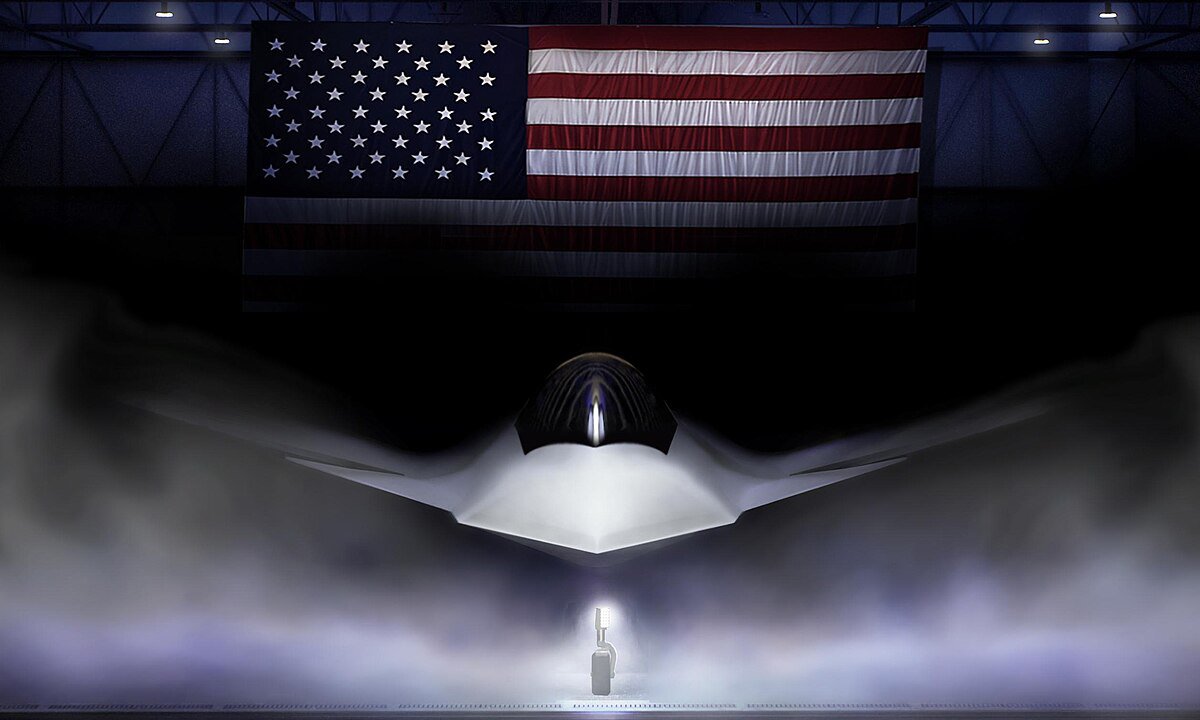
The USAF’s first rendering of the Boeing F-47.

While the aircraft clearly shares distinct attributes with the F-47, it isn’t clear exactly how far the commonality between them goes. We could end up with a literal navalized F-47, which would leverage as much efficiency as possible between the two designs, or we could see major design elements and even proportional changes. The requirements imposed by carrier operations do dictate size and weight, to a certain degree. What lives beneath the jet’s skin – hardware and software – will have the most commonality regardless.

There is also the question of the aircraft caught on a thermal imager flying outside of Area 51, which was likely a Next Generation Air Dominance (NGAD) demonstrator from Boeing, or at least an aircraft related to those efforts based on how unique Boeing’s design clearly is. It’s always possible that the Navy flew its own NGAD demonstration program. The service has been notoriously tight-lipped about its NGAD risk reduction efforts.

A craft the public has never seen before…
Video out this Friday. #ProjectFear #Area51 pic.twitter.com/8eOSJSUX1g

— Project Fear (@ProjectFearX) June 2, 2026

The matter of the F/A-XX aircraft’s formal designation is also a question that remains unanswered. If this is a navalized F-47, then F/A-47 could be the jet’s official designation. If it differs substantially, or the Navy just wants to differentiate their design for whatever reason, we could see a different moniker applied. F/A-45 is possible, too, considering the F-47 was partially named in honor of President Trump, who approved the decision to move the Air Force’s program forward. Trump is the 45th and 47th President of the United States.

So, even on this day of long-awaited F/A-XX revelations, it’s also a reminder of just how much we do not know about both the Navy and the Air Force’s NGAD enterprises and their resulting designs, both of which will now be officially brought to you by Boeing.

Contact the author: Tyler@twz.com

The post What Boeing’s New Rendering Of Its Winning F/A-XX Fighter Tells Us appeared first on TWZ.

  •  

Navy Orders 30 Drone Ships To Finally Advance Its ‘Medium’ Uncrewed Vessel Ambitions

The Navy has announced plans to buy 30 new drone boats, 10 from each of three companies, under its Medium Unmanned Surface Vessel (MUSV) program. The deals are an important step forward for the Navy’s latest attempt to field larger USVs after years of setbacks and shakeups, but it remains to be seen when these new capabilities might actually become operational.

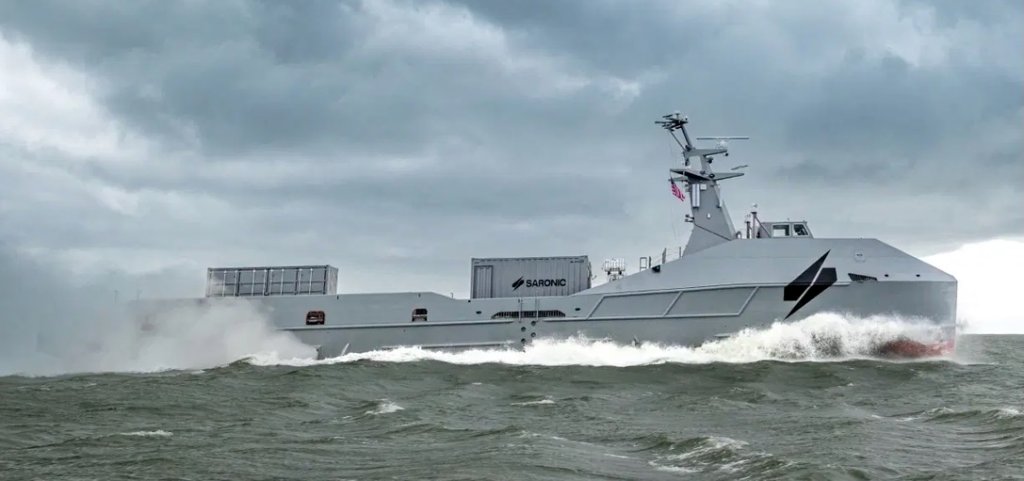
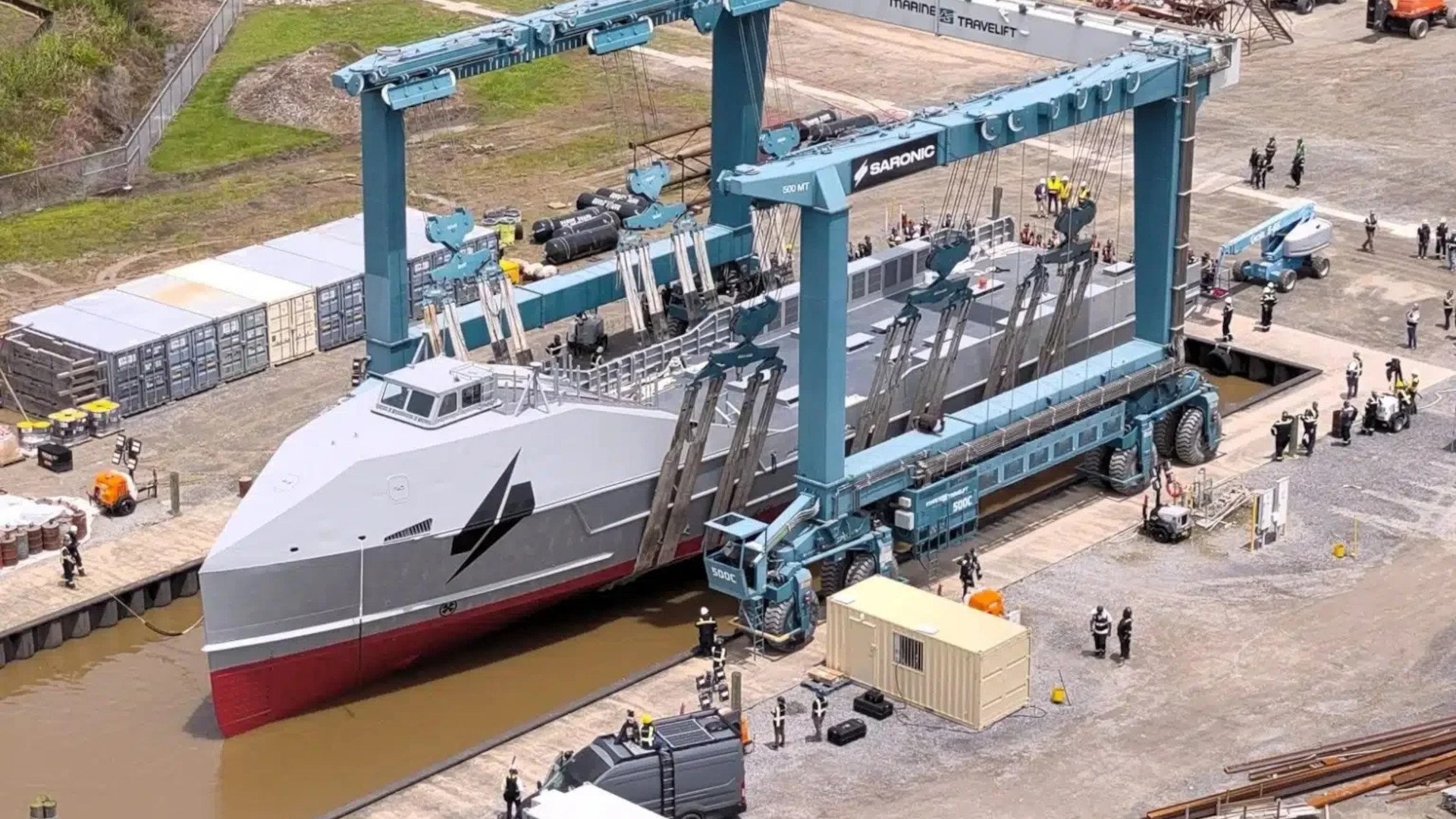
Galliano Marine Services, Huntington Ingalls Industries (HII), and Saronic Technologies each received so-called Other Transaction Authority (OTA) agreements in relation to the MUSV program today. OTA is a contracting mechanism designed to support rapid prototyping and other research and development work without having to use more traditional and often lengthy processes.

The awards “mark a significant step forward in translating the strategic vision into a tangible fleet capability,” Chris Miller, the Navy’s Acting Direct Reporting Portfolio Manager for Robotic and Autonomous Systems (DRPM RAS), told TWZ and others at a media roundtable earlier today. “Each agreement is for the procurement of 10 MUSV at an average procurement cost of $40 million per vessel.”

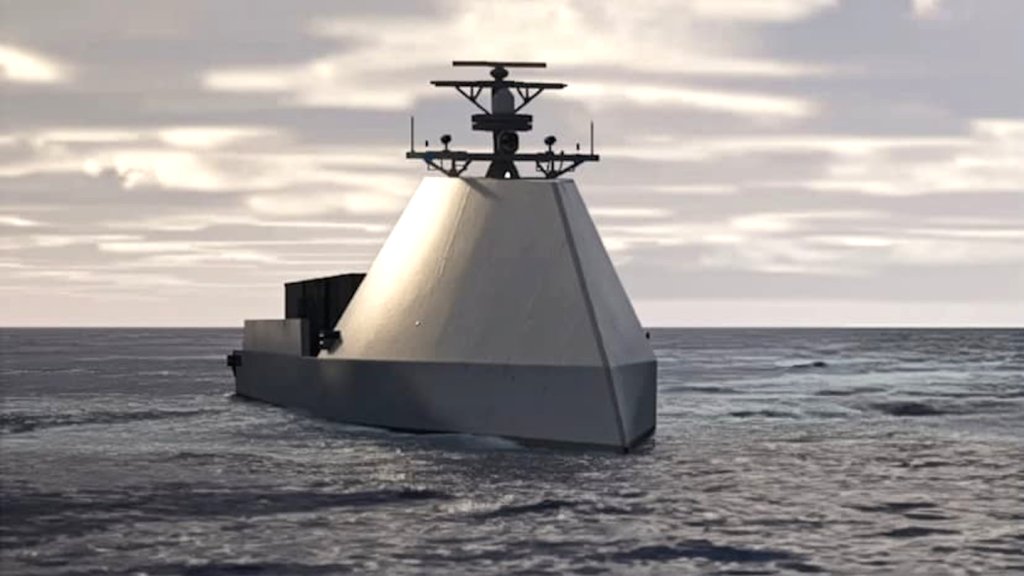
A rendering of HII’s Romulus design. HII

Saronic and HII submitted their Marauder and Romulus designs, respectively, to the MUSV Phase I competition. Galliano Marine Services, which does business as Edison Chouest, does not appear to have announced its entrant publicly. At a unit cost of $40 million, the total price tag for 30 MUSVs, regardless of type, would be $1.2 billion.

“Production will begin immediately at shipyards in Loreauville, Houma, and Franklin, Louisiana, with deliveries starting as early as the fourth quarter of [Fiscal Year] 2027,” Miller added.

To take a step back quickly, the Navy has used a variety of definitions for what qualifies as a “medium” USV over the years. It’s also important to note that the Navy already fields several speedboat and jet ski-type USVs operationally that are capable of performing various different missions, including employment as one-way attack munitions.

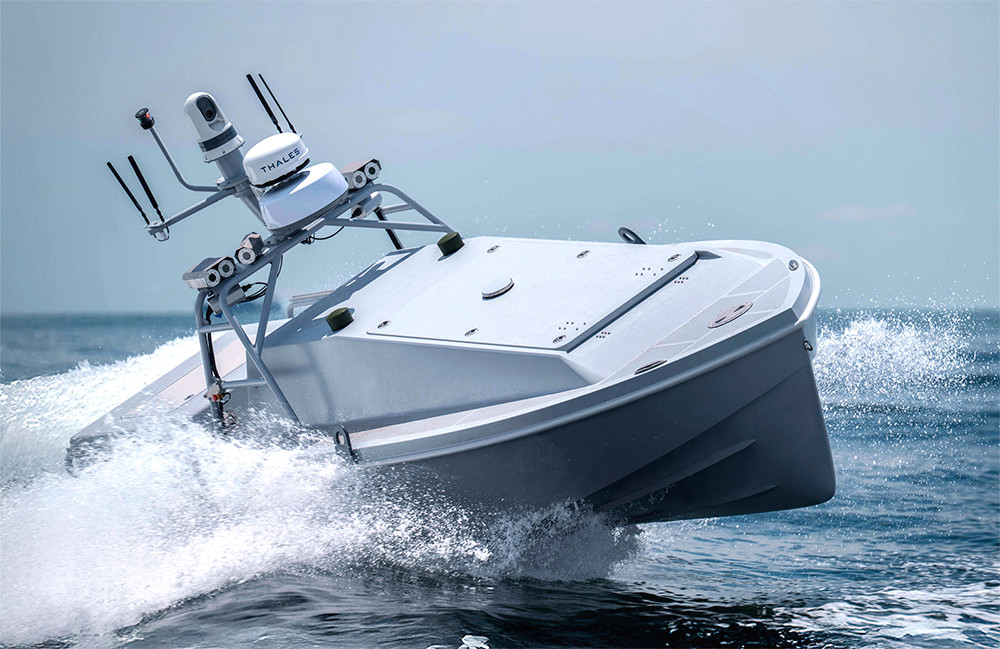
Saronic’s Corsair, seen here, is an example of a speedboat-sized USV already in operational Navy service. Saronic

Threshold MUSV program requirements the service put out in March included a range of at least “2500 nm [nautical miles] at 25 knots while carrying a 25 MT [metric ton] load on the payload deck in NATO STANAG 4194 Sea State 4.” Sea State 4 is characterized by wind speeds of 17 to 21 knots and wave heights between four and eight feet, per that NATO standard. The MUSVs also had to be able to carry forty-foot equivalent units (FEU) containerized payloads and refuel at sea at a rate of “2,000 gallons per minute of fuel through deck connections.” Various other operational and sustainment requirements were laid out at that time, as you can read more about here.

The OTAs announced today were awarded “following successful at sea testing” under Phase I of the MUSV program, according to a press release the Navy put out today. A total of seven companies competed in this initial phase, with the others being Birdon, Leidos, PacMar Technologies, and Sea Machines. That work was conducted under an earlier round of OTAs.

“The testing evaluated, among other things, the vessel’s ability to see and understand the surrounding maritime environment, how well the vessels navigated autonomously according to the international regulations for preventing collisions at sea, and the vessel’s ability to conduct a long-duration mission,” the Navy’s Miller said at the roundtable earlier today. “The demonstrations had to prove that the designs were mature enough to meet the Navy’s operational standards and our requirements.”

In terms of the long-duration mission requirements, “the test was that they had to be able to execute [over] roughly 26 hours and over 360 nautical miles with only a single input during that time from a C2 [command and control] station allowed,” Milleter further explained. “So, it basically demonstrated that the vessel could run for an excess of 24 hours at an extended range with very minimal input from the actual operator from a C2 station. This provided basically our input and our ability to assess how truly autonomous the functionality was of the platforms.”

Overall, the OTA awards “were based on the optimal mix of autonomy, performance, design, production schedule, and cost,” he added.

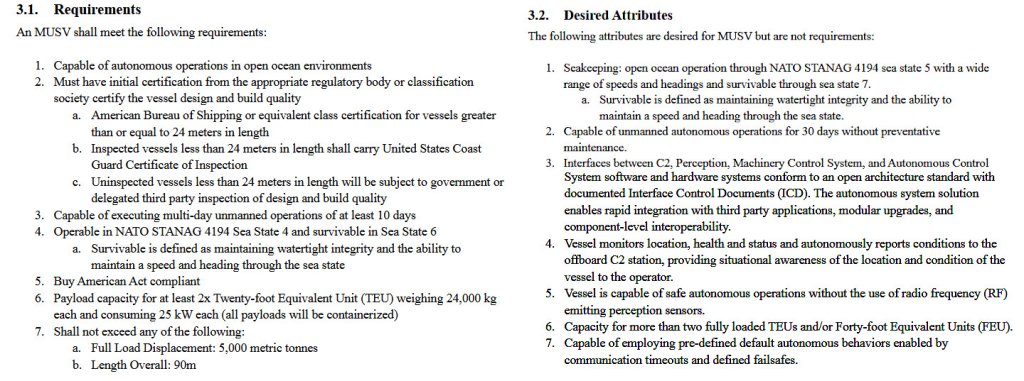
The MUSV Phase II contracting notice outlines additional parameters, including that submitted designs cannot be more than 295 feet (90 meters) long or displace more than 5,000 metric tons. The USVs also have to be able to accommodate “at least 2x Twenty-foot Equivalent Unit (TEU) [containerized payloads] weighing 24,000 kg each and consuming 25 kW each” and be “capable of executing multi-day unmanned operations of at least 10 days.” The drone boats need to be “operable in NATO STANAG 4194 Sea State 4 and survivable in Sea State 6,” as well. The full lists of threshold requirements and desired attributes are reproduced below.

USN

In addition, “to be considered for this Call for Solutions, the proposed MUSV must be ready for operational demonstration at the time of solution submission,” according to the Phase II contracting notice. “An MUSV requiring substantial modifications for the production platform compared to the as-demonstrated platform will not be considered.”

“The Phase II solicitation allows entrants to compete and existing vendors to submit updated product blocks and modular payload configurations,” Miller, the Acting DRPM RAS, said today. “Testing evaluations will begin as early as November 16th, and proposals will be assessed on a continually rolling basis over the next five years.”

Miller also drew attention to the elimination of the speed and at-sea refueling targets previously outlined in Phase I.

“What we learned from Phase I is that as you increase the speed requirements and some of these other things, it does present certain challenges for industry,” according to Miller. “So I’m trying to actually find the sweet spot in the market where there is healthy competition, and there’s opportunities, and we can have more things that potentially are dual use, both military and civilian.”

A rendering of Saronic’s Marauder with containerized payloads. Saronic

So far, the Navy has only offered limited insights into exactly what specific mission sets it wants the MUSVs to perform, even initially.

The “MUSV Phase I requirements were closely tailored to fulfill operational requirements for a specific mission set focused on demonstrated ability to carry containerized payloads while meeting specific vessel performance requirements for speed and range,” Miller said during today’s roundtable. “However, there is an ever-increasing demand signal that we must be ready to meet. To ensure scalability across the broader mission sets and to support our joint force, we issued a formal call for solutions for MUSV Phase II integration and testing.”

He also stressed that the modularity of the designs being acquired now would allow for the continued evolution of their capabilities as time goes on.

With the focus on containerized payloads, “honestly, inside you could have a sensor, you could have repair equipment for ships,” Rebecca Gassler, who was the Navy’s Portfolio Acquisition Executive for Robotic and Autonomous Systems (PAE RAS) until August, also told TWZ and other outlets back in March. “You could have any number of payloads inside those, and you basically are able to just swap them on.”

In announcing the new OTAs today, as well as discussing the Phase II MUSV plans, the Navy also highlighted continued opportunities for the other companies that had been involved in Phase I.

“Leidos, PAC MAR, and Sea Machines were determined to complete the project provided for in their prototype other transaction agreement and will receive a $15 million award as part of the previously established terms of the prototype OTs,” the Navy’s MUSV announcement today adds. “Alongside the OT awardees, will be accepted onto the Drones.mil hosted Maritime Marketplace, where they are now eligible to receive follow-on production agreements from authorized acquisition authorities across the DOW [Department of War].”

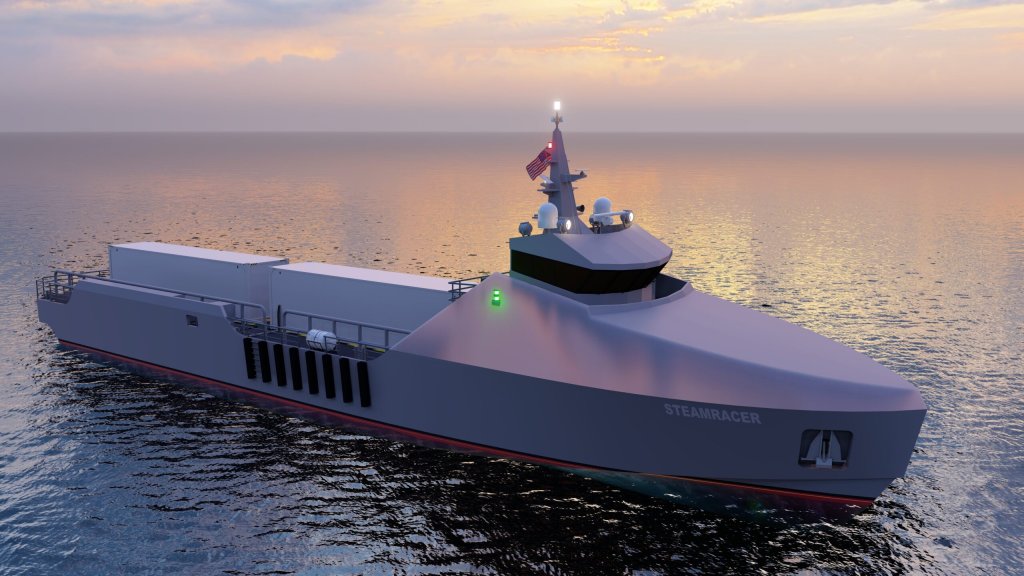
A rendering of Steamracer, a larger USV design Sea Machines has pitched to the US Navy in the past. Sea Machines

Birdon did not complete the required testing. Based on the terms of the Phase I OTAs, Galliano, HII, and Saronic will also receive $15 million awards and be included in the marketplace. The aforementioned Phase II CFS is intended “to expand its acquisition pipeline through a Maritime Marketplace to broaden offerings and satisfy future MUSV mission sets,” as well, per the Navy.

The Navy stressed the importance of this open-ended “marketplace” model as a way to accelerate the acquisition process when it first outlined the MUSV program to the public back in March, as you can read more about here. Just last week, the service also established a new Robotic and Autonomous Systems Warfighting Development Center (RASWDC) to serve as a focal point for “the development, operational integration, and employment of robotic and autonomous systems (RAS) across the maritime domain,” to include the MUSV effort.

The Drones.mil marketplace also extends to all branches of the U.S. military and beyond just USVs. Miller today did highlight the potential for possible cooperation with other services on drone boat efforts through this framework. He also said the Navy might be willing to consider additional acquisition strategies, including leasing uncrewed platforms, in the future.

Larger USVs have long been seen as key to bolstering the U.S. Navy’s overall operational capacity above the waves, and doing so in a cost-effective and rapidly producible manner. They are also viewed as central to enabling new, more distributed concepts of operations designed to help expand operational coverage and reduce the vulnerability of crewed ships, especially in any future high-end fight in the Pacific with China.

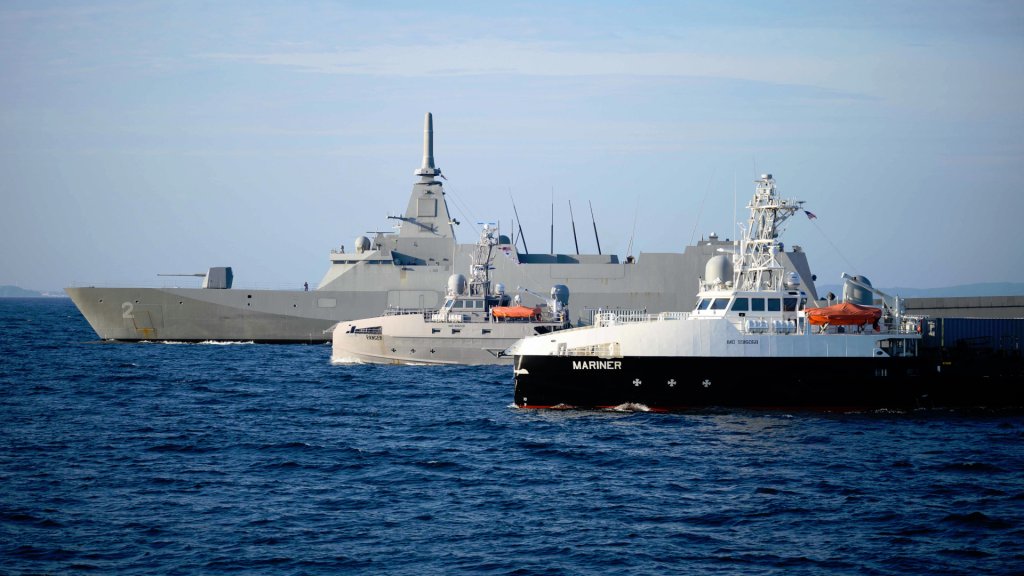
A pair of optionally-crewed vessels the Navy has been experimenting with for years now seen sailing together with a Japanese Mogami class frigate. USN

“Unmanned technology is redefining operations and providing our combatant commanders with unprecedented scale, persistence, and risk tolerance,” the Navy’s Miller said at the roundtable.

At the same time, as mentioned, the Navy has attempted to acquire operational fleets of larger drone boats in the past without success. Today, the service’s capabilities in this regard remain limited to a pocket force of still largely experimental optionally-crewed designs.

Since the Navy first unveiled it in March, MUSV has already faced certain hurdles. This includes a major leadership shakeup in August that saw PAE RAS Rebecca Gassler, the first person to ever hold that post, removed from her post after just eight months for reasons that are still not immediately clear.

In July, it also emerged that Blue Water Autonomy and Saildrone had filed suit against the Navy over being left out of Phase I of the MUSV competition. The companies alleged that the service did not follow its own selection criteria. That lawsuit is still ongoing. Blue Water Autonomy, among others, had also previously made investments in response to requirements the Navy had laid out for a previous effort called the Modular Surface Attack Craft (MASC) last year. The MUSV program has now fully supplanted MASC.

In speaking at the roundtable today, Miller acknowledged potential budget limitations and other hurdles that could still impact MUSV going forward. “I’m trying to be prepared depending on where that demand goes,” he said.

As said at the start, today’s MUSV announcement is an important new step forward for the Navy’s efforts to acquire fleets of larger USVs, but the service still has to transition these efforts into operational realities.

Contact the author: joe@twz.com

The post Navy Orders 30 Drone Ships To Finally Advance Its ‘Medium’ Uncrewed Vessel Ambitions appeared first on TWZ.

  •  
❌