
❌

Reading view

‘Elon Is a Nuke’

In December 2021, Elon Musk sat for an interview with The Babylon Bee, a conservative satire site. Having covered the typical topics (wokeness, free speech, Elizabeth Warren) and finding themselves with a bit more time to fill, the outlet’s then–creative director closed out the chat with a request. “The Babylon Bee is a Christian organization, and we’re a ministry,” he reminded Musk. So “we’re wondering if you could do us a quick solid and accept Jesus as your lord and savior?”

Musk laughed. The others did too. The guys waited for an answer, and Musk, after rambling a bit, gave one. Sure, he replied with a shrug—why not? “If Jesus is saving people,” he said, “I mean, I won’t stand in his way.”

The exchange makes a brief but incredibly effective appearance in Musk, the documentarian Alex Gibney’s new film: Asked for a come-to-Jesus moment, Musk professes his faith in himself. The Musk of 2021 was considerably less consequential than the Musk of today. He had not yet added Twitter—humanity’s “collective consciousness,” he once called it—to his portfolio, nor had he staged his hostile takeover of the United States government or become the world’s first trillionaire. Still, Musk had slightly more reason than most to assume his high status on the cosmic org chart.

Through Tesla and Starlink and SpaceX, his dominion stretched over the heavens and the Earth. Through Neuralink and his assorted experiments with artificial intelligence, Musk was expanding his reach into human hearts and minds. As a media figure, too, he was all but inescapable: a piece of software downloaded into people’s lives whether they had opted in to him or not.

Power, at that sort of scale, changes every equation. It can make hyperbole seem accurate. It can make a man, small and flawed, look like something more: a genius, an idol, an outlet for everyday faith. And the discrepancy between the person Musk is and the figure he claims to be is one of Musk’s running themes. The man sells himself as a savior; many have before. But he is where he is—he is what he is—because so many people have bought into the pitch. Delusions of grandeur are one thing. The real trouble comes when one person’s delusions become other people’s reality.

[Read: Maybe Alex Gibney did Elon Musk a favor]

Musk benefits, appropriately enough, from an exercise in data science. The man himself did not participate; he declined Gibney’s overtures in the most Muskian manner imaginable: through an insult-laden post on X. As a work-around, the director and his team created a database compiling every comment Musk has been recorded making in public. That data set—a galaxy-brained version of Musk—informed their assessment of him and individual moments in the film. Muskisms (about the likelihood that earthly life is a simulation, about the drawbacks of empathy, about humans’ future on Mars) make their way into the proceedings via a computer-generated version of Musk—an animated character who appears where, in a traditional documentary, Gibney might have quoted his subject.

To an extent, the approach turns the tables on Musk. It renders this person who talks fondly of humans’ cyborgian future as a cartoonishly uncanny, flagrantly inhuman presence. But it also highlights his cultural status as a man who is, at this point, something more than just a man.

The sources that Musk cites as it creates its portrait—among them the people who have worked with and lived with and, often, clashed with Musk—regularly mention the scale of his ego and the scope of his ambition. They attribute much of his success to his mythmaking capabilities: his romantic descriptions of technology, his branding of consumer goods as spiritual necessities. Tesla, Musk’s car company, “is not automobile manufacturing or automobile retailing,” the financial analyst Lawrence Fossi tells Gibney. “This is not finance”; instead, he says, it is religion. The mythology extends to Musk himself. “In Elon We Trust,” one of Musk’s followers once tweeted at him, in a post Gibney included in the film. Another informed him, “We follow you like a cult :).”

[Read: We are living in the fantasy world of 13-year-old boys]

A former girlfriend says in the film that Musk likes to compare himself to Kublai Khan, the 13th-century Mongolian warrior and emperor of China. And indeed, his megalomania is in one way a very old story: Human history has, for better and worse, been shaped by men who insisted on their godlike supremacy. But Musk’s version is also thoroughly modern. His power is systemic. His sieges rise from within.

One of the allegations the film makes against Musk concerns his incursion into the U.S. government: DOGE’s haphazard dismantling of government agencies, its destruction of scientific research, its toppling of USAID. The widespread effects of DOGE’s efforts—the cures that won’t be found; the vaccines that won’t be made; the food meant to save lives, left instead to rot—will likely never be fully known. Nevertheless, Musk argues, the raid has had a death toll: hundreds of thousands of people, and potentially many more.

When such accusations are made, the public might ask, and should ask, what accountability looks like at that level. But one of the affordances of planet-spanning power is that it can turn justice, as most people experience it, into something of a joke. If Musk is a category error incarnate—a man with, effectively, a gross national product; a guy whose influence extends beyond the stratosphere—the confusion does more than elevate him. It also helps inoculate him. The film quotes a newscaster’s summary of one of SpaceX’s early launches. “Only four entities have launched a space capsule into orbit and successfully brought it back to the Earth,” the reporter announces: “the United States, Russia, China, and Elon Musk.”

How do you make sense of that kind of power? How do you challenge it? One truism of modern life is that humans, as animals who would prefer to pretend that they are otherwise, were not made to thrive at our current scale. We weren’t meant to know this many people, to process this much information, to make sense of a world that stretches so far beyond our immediate grasp. Musk provides a corollary to those claims: It gives us a human who himself has become too colossal to make sense of, too unwieldy to respond to. Even more than his fellow tech titans, Musk exists at a scale that no man was able to before and enjoys power so complete that it becomes self-ratifying.

No man should be so godlike. No person should be so exceptional. In the film, Musk’s former girlfriend sums up the matter concisely: “Elon is a nuke,” she says—a human of mass destruction.
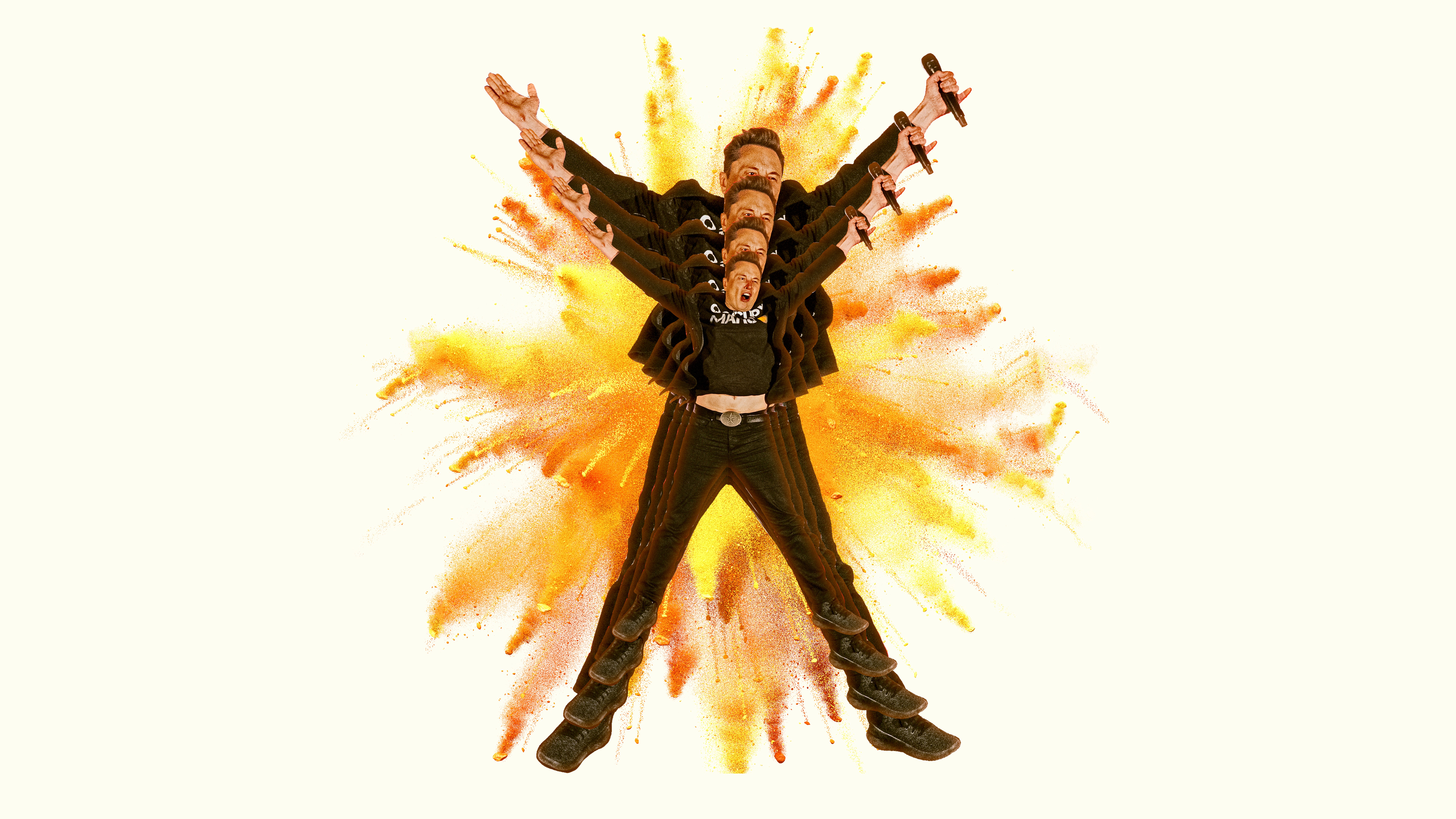
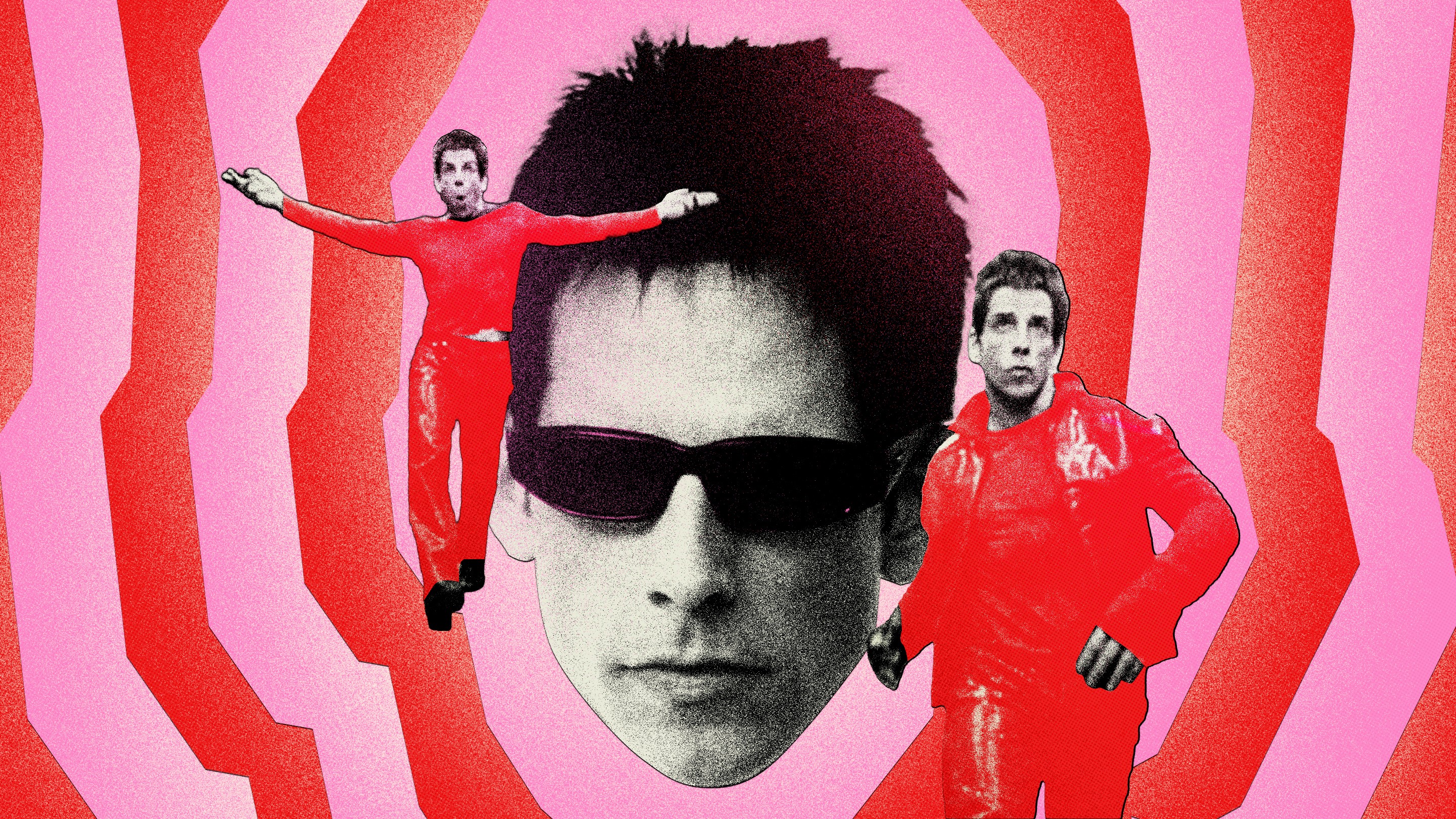
Illustration by Adam Maida / The Atlantic. Source: Ryan Collerd / AFP / Getty.
  •  

Homme Fatale

At a dive bar deep in coal country, Derek Zoolander, male model, sits with his father and brothers after they’ve spent a long day in the mines. An ad for the beauty company Aveda comes on the TV—a spot that, as luck would have it, features Derek at his male-modeliest: hair gelled, torso nude, skin shimmering with body glitter. He also has a tail, a fishy pastel-green appendage that has been grafted onto his lower extremities via a protean form of CGI. “Moisture is the essence of wetness,” the ad’s narrator intones, as Derek (played by Ben Stiller) flaps around in an unconvincing ocean. “And wetness is the essence of beauty.”

Surf and turf, but make it fashion: The joke pretty much delivers itself. But it also functions, in Zoolander, as a plot device. As the ad plays, Derek seems thrilled: Finally, his family will see him. Finally, maybe, they’ll be proud.

Instead, they’re ashamed. Derek’s father (a steely Jon Voight) professes his relief that his wife, having died, never had to “see her son as a mermaid.”

The line is harsh—it might be the most piercing in the film—but if there’s one thing viewers learn about Derek Zoolander, it’s that he will, like a phoenix with a fish tail, persevere. Out of the awkward silence, inspirational music begins to swell. “Mer-man,” Derek corrects his father, the music growing louder around him. “Mer-MAN!”

If Zoolander is a bit like its namesake—absurdly farcical, endlessly watchable—Stiller’s chimeric turn helps explain why. When the film premiered 25 years ago, it had everything: an all-star cast (Owen Wilson as Derek’s nemesis, Hansel; Will Ferrell as the arch-villain; David Duchovny as the most celebrated hand model of all time), a gonzo plot (male models brainwashed to serve as assassins!), and a warm human heart. But it also had terrible timing. It debuted in theaters in late September of 2001. Its early earnings, in that grim moment, were tepid, its reviews decidedly bad. (Roger Ebert, so often a champion of cinematic absurdity, met Derek’s assorted contortions with a signature pose of his own: a thumb turned emphatically down.)

But Zoolander, in the years afterward, gradually ascended to filmdom’s version of haute couture: It became a cult classic, beloved for both its ostentatious idiocy and its insistence that dim-wittedness, seen from the right angle, can be wise. The film does more than merely hold up. Today—with its hero’s insistence that he can vamp to the camera, covered in body glitter, and still be a (mer)man—it looks downright prescient.

[Adam Serwer: The masculinity scam]

Zoolander arrived on the scene as the gender swap, that old cinematic trope, was losing its last traces of subversion. The film did not, on its face, deploy the gimmick; Derek is no Tootsie and certainly no Mrs. Doubtfire. But he gender-bends all the same. Derek is two things at once. As a model, he is a man doing work traditionally done by a woman—a guy whose job is to be gazed at and otherwise lucratively objectified. As a male model, though, he is doing a version of what his father and brothers do every day in the coal mines: asserting, and then typifying, an extremely legible version of manliness. The gender-bending is in one way Zoolander’s most basic joke. But it is also a provocation. Derek takes an insult traditionally lobbed at women—bimbo—and twists it around into a cherished and revealing archetype: the himbo.

The bimbo, from her earliest days, was most directly an answer to the vixen and the femme fatale. She enticed, yes, but she never threatened. She may have been voluptuous (she almost definitely was) but she was also fundamentally flat. The bimbo’s vacuity functions as an invitation, effectively, to the people who see her: Go ahead and look. Go ahead and fantasize. Go ahead and laugh. It turns a three-dimensional person into a two-dimensional image and then, in an elegant little trick, insists that she, herself, is responsible for the flattening. The bimbo is silly and empty and treated accordingly. Why consider the person behind the appearance when, the stereotype insists, there is none?

The himbo operates similarly. His attractiveness—his never-misses-leg-day show of masculinity—is his blessing and his curse. It elevates him as someone to be looked at, and it demeans him as something to be looked at. And Derek is a himbo in Platonic form. He is demeaned in terms usually reserved for women. He is a male model caught in the male gaze. Gender swapping can be a gimmick, but it can also offer insights. And as Derek tries bimbohood on for size, he demonstrates how silly the idea has always been.

Himbohood makes Derek mockable. But it also makes him relatable. It is one of the primary sources of his appeal. Derek is not, on the face of things, an obvious hero. He can be superficial (learning that his love interest was heavy in her youth, he responds with a knee-jerk “ew”). He can be vain (at the VH1 Fashion Awards, unable to fathom not being named Male Model of the Year, he barrels to the stage, so self-absorbed that he didn’t hear Hansel’s name being called). He is the kind of guy who will wear white to a funeral and use the eulogy as an opportunity to talk about himself—and then insist that eulogy is pronounced “you-goog-ly.”

But his himbohood redeems him. It is what allows him to work as Zoolander’s protagonist—and to be seen, in his lighthearted way, as worthy of celebration. A himbo’s charm lies in the discrepancy between what he might be and what he is: Big and burly, he could treat manliness as something to be wielded. But he is too gentle for that, too dim-witted, too pure. He is a hold-harmless clause in human form. And Derek, being exceptionally burly and exceptionally dim, is more reassuring than most. Even when he is brainwashed into violence, he is incapable of carrying it out.

That may be, for many of the men in Derek’s orbit—including his coal-miner father—a profound failing. But those men, in the end, are Zoolander’s true villains. And the tensions Derek lives out, as he makes his journey from successful model to failed model to brainwashed model, bring an avant-garde edge to the film’s absurdities.

Zoolander is, like its star, always more than it seems. It is a comedy that’s also a spy drama and a political thriller and a fast-paced action-adventure. (Its plot, Stiller has said, was inspired by The Manchurian Candidate; he filled it with cheeky callbacks to James Bond.) It throws on different genres like interchangeable outerwear. When Derek returns to his hill-country hometown, Zoolander briefly becomes a gritty—and exaggeratedly sooty—portrait of working-class life. A famous sequence pitting Derek and Hansel against each other in a “walk-off” becomes a boxing drama complete with a climactic prizefight, its two champions battling before a rabid crowd.

Fighter, killer, miner, spy: You might notice that each figure is distinctly, and stereotypically, masculine. Each identity is an option for Derek. And each is one he rejects. Maybe he’ll join his father and brothers in the mines. Maybe he’ll become an assassin. Maybe he’ll be conscripted into someone else’s war. None of that happens, of course, and only partly because Derek is the kind of guy who shows up to the mines clad in a snakeskin leisure suit. Those traditional ways of being manly are not his way of being manly. His version of masculinity is louder, and quieter. It is softer. It is inflected with femininity. It is a hybrid beast frolicking in the water with liquid ease—a mer-man.

[Conor Friedersdorf: What do ‘sex’ and ‘gender’ even mean now?]

The gender swap, in its Y2K format, considered the moment’s anxieties—the sexual revolution, its battles prolonged into cold war—but also its possibilities. The man as the nurturing nanny, the woman as the steely commando (think G.I. Jane) were gimmicks, but ones that invited people to imagine old binaries in new ways. Zoolander did the same but, amid all the farce, remarkably subtly. The film gave us a man who moved through the world like a woman: watched, judged, underestimated, misunderstood.

That Derek himself is too clueless to see those ironies makes him only more endearing.  He is a male model worth emulating precisely because he would never see “male” as superior to anything else. His vacuity amounts to innocence—and his innocence amounts to enlightenment. Little wonder, then, that pop culture now teems with himbos: guys whose looks say “leading man” and whose actions say “useful idiot.” Andy in Parks and Recreation, Jason in The Good Place, the assorted magicians of Magic Mike—they and their many counterparts are also, in their own way, male models: men who, at a time when masculinity is so often talked about as a problem to be solved, hint at some kind of solution. They aren’t anxious about their masculinity. They aren’t scared of women. They are men who offer comic relief—and relief of a much broader sort.

© Illustration by Alisa Gao / The Atlantic. Sources: CBS / Getty; Paramount Pictures / Getty.

  •  
❌