
❌

Reading view

France Will Never Be Enough for the People Desecrating It

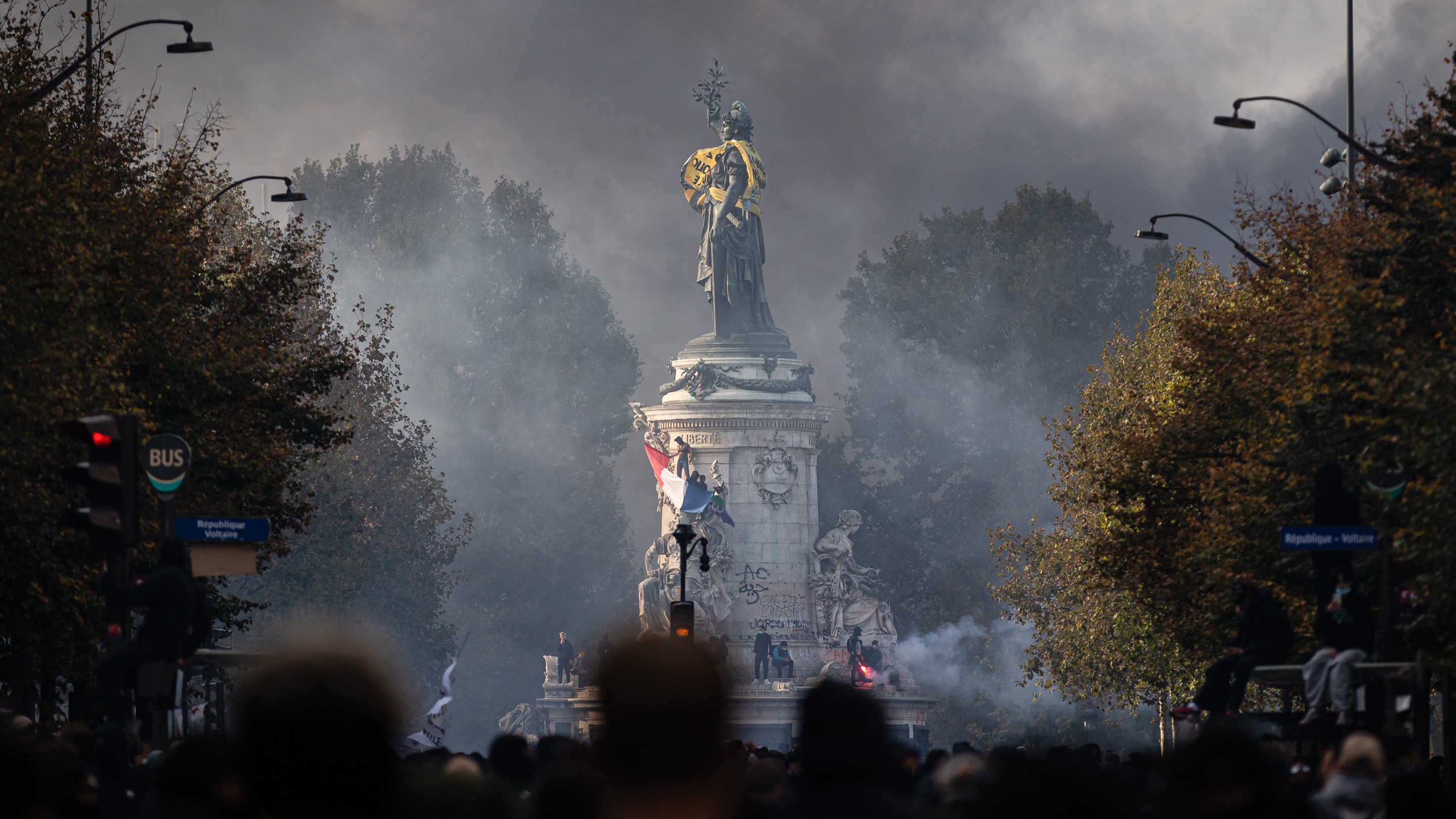
At 8 p.m. on Sunday night, President Emmanuel Macron delivered a national address to condemn the rioting and looting that convulsed France this weekend, from Brittany to Perpignan. His suit and tie were black, instead of his customary navy blue, and he denounced the “seditionists from far-left fringe groups, joined by many criminals, engaged in unbridled violence in our cities.” He decried the grotesque destruction—crystallized in the viral image of a fire consuming the 19th-century wooden roof of the town hall in Limoges—and the methodical sacking of businesses. “Rien ne le justifie, rien ne l’explique, rien ne l’excuse,” he said: Nothing justifies it, nothing explains it, nothing excuses it. Macron acknowledged legitimate concerns about education and the cost of living, distinguished between peaceful protesters and rioters, and called for prosecutions while instructing prefects to consider banning mass gatherings.

It sounded good. But as I was watching Macron live from New York, I called my children in Paris and heard the giddy chaos—the shouts and cheering—still vibrating through the streets below their open window. They told me that some of the stores beneath their apartment were being ransacked as the president was speaking. I had to push from my mind the appalling thought that these rioters might climb into the building’s residential upper levels. Words aren’t enough anymore.

Slowly, the French authorities are starting to grasp that. “The day of disorder and violence that we have just experienced in France is one day too many,” Bruno Le Maire, a former government minister under Macron, wrote on X on Saturday, when there were roughly 2,400 arrests and 1,000 police officers and gendarmes injured, seven of them grievously. At least 3,000 businesses were damaged or looted over the weekend. Yesterday, Prime Minister Sébastien Lecornu announced “localized” curfews in Paris and other cities across the country, which is a start. Today, Lecornu added that the military would be deployed this weekend, when further protests are planned. These interventions are welcome. But if the government cannot restore peace quickly, then a state of emergency is the only sane option.

[Thomas Chatterton Williams: The violence sweeping France was never really about schools]

The “internal decay” besetting France, as my friend the writer Pascal Bruckner phrased it, piggybacks on other, more intelligible causes. Some of the protests began in response to genuine grievances about France’s underfunded schools and exorbitant cost of living. But they have since turned into paroxysms of disdain for healthy civic life—nothing more cerebral, nothing to do with policy. “The high-school students’ cause died on Saturday, October 17,” Bruckner wrote in Le Figaro. “It will not recover, however legitimate its original demands may have been.”

An investigation published in Le Parisien yesterday concurs with Bruckner, suggesting that the recent violence is detached from the educational grievances that originally sparked the student protests. The paper reports that according to French intelligence sources, there is an alliance de circonstance between organized ultra-left militants and a larger group of young people from the banlieues encircling major urban areas, many of whom were not politically engaged and likely never expressed an interest in the movement’s original demands. Some of these insurgents sought confrontation with the state before the scheduled demonstrations even began. Others merely took the opportunity to stuff their pockets and watch their country burn.

These past weeks of pandemonium have driven home for me that no society, not even a society as generous and in many ways enlightened as France’s, can make life sweet enough for angry young men. Nihilists of the kind we’ve seen flood the streets of France from coast to coast will never uphold their end of the social contract, no matter how beautifully it is drafted. This is the essence of Tocqueville’s famous paradox: As societies become more equal—and few societies strive to be more egalitarian than France, thanks to heavy taxation of the rich and a generous social safety net—any perceived or remaining inequalities become intolerable.

The rioters in France are not political actors expressing the “language of the unheard,” but nihilists rebelling against the very idea of a collective national life. Whether their stated justification is racism, Islamophobia, neoliberalism, or something else, they are agents of chaos and spite, lashing out against their productive, decent neighbors, perhaps precisely because those neighbors are productive and decent. And so they burn, shatter, and humiliate the symbols of the established order.

Official government estimates place the number of protesters at more than 500,000. Images from last weekend showed patrols of police forces overwhelmed by the sheer scale of the pillaging. The Macron administration was drastically underprepared for the size of the rebellion and now faces an impossible situation. Any confrontation or escalation risks providing the protesters with a martyr; if that victim comes from a marginalized demographic, the conflagration could spark a full-fledged riot.

[David A. Graham: What Trump’s comments about France say about him]

But the alternative—appeasement—is equally unacceptable. The state cannot expect its law-abiding citizens—the majority of the population, which includes the peaceful protesters—to accept its repeated failures to safeguard them and their livelihoods. A people’s ability to move freely, conduct business, and come and go from their homes through streets that are neither dangerous nor desecrated is a fundamental right. The cost of indulging the anarchists, looters, and rioters who infiltrate mass movements has fallen on the rest of France, who never consented to cover it.

“We are six months away from our presidential election,” Macron reminded the country toward the end of his speech. “And so all those who are telling you today that the urgent thing is to take to the streets—to demonstrate, to create disorder—have only one goal: to damage the republic and hijack the debate.”

He’s correct. But if Macron is unable to contain these forces, which seek to push the political debate into flame-scorched streets and schools and places of business, then he will be handing votes to the far-right leaders who have promised to do so.
© Telmo Pinto / NurPhoto / Getty
  •  

The Violence Sweeping France Was Never Really About Schools

This article was featured in the One Story to Read Today newsletter. Sign up for it here.

The French protest too much. Over the past two decades, paroxysms of rage, violence, rioting, arson, and looting have regularly seized the nation, imposing enormous costs on civil society. During the 2005 banlieue riots, the deaths of two boys evading police sparked three weeks of severe property destruction and violence. In the years since, pandemonium has broken out over veil bans, the commemoration of NATO’s anniversary, the legalization of same-sex marriage, even the arrival of ride-sharing apps.

Today France is once again at the mercy of protesters. Since late last month, student protests have paralyzed the nation’s school system. They began on September 17 at a high school outside Paris, in Créteil, where teachers went on strike over unfilled posts and a lack of funding, and students promptly joined them. This triggered a domino effect, as the sociologist Valérie Becquet called it, in which students across the country demonstrated in solidarity, calling out similar problems in their own schools. Social media supercharged the process; demonstrators have filmed themselves constantly, creating a spectacle of revolt that spreads online and through text chats that they use to mobilize.

According to Le Monde, nearly a third of France’s 3,700 high schools had been disrupted by October 1, a number that has almost certainly grown. The largest demonstrations so far took place yesterday, extending to 40 cities and drawing an estimated 250,000 participants. My daughter’s junior-high school in Paris has been affected too. “Tensions ran high at times,” read an email from administrators to parents, “particularly due to numerous arson attempts by individuals from outside the school.” Since then, by order of the prefecture, all instruction has stopped.

[Read: The problem with America’s protest feedback loop]

Protesters have demanded more teachers and support staff, smaller classes and improved facilities, and greater parity between poor and wealthy schools. They have also called for the abolition of the Parcoursup, a university-admissions online platform that critics claim reproduces social inequality and imposes undue stress on students. Some of these demands may be valid, but the violence fanning out across France has little to do with pedagogical concerns.

For some time now, there has been an existential crisis at the heart of French life, rooted in a pervasive sense that the future will never equal the past, that the state cannot achieve what its citizens expect. The national pie is often seen as zero-sum, which explains why so many constituencies, from retirees to high schoolers, refuse to give an inch. Their anger accumulates, then it boils over. And the government is either unwilling or unable to contain it.

Five of the videos that have gone viral reveal the nihilistic resentment beneath the pretext of school reform. In the one I can’t get out of my mind, a 15-year-old dressed in a black hoodie, black sweatpants, and mask calmly approaches a woman in Marseille and sprays her face with a makeshift flamethrower, leaving her with first-degree burns. In a scene from Nantes, an inferno fills the lobby of the Nelson Mandela High School, which cost 75 million euros to build in 2014. In the third video, a keffiyeh-clad blond-haired teen in Paris smiles as he explains to a reporter, who has asked about a policewoman being chased and tripped by teenagers, that “the ends justify the means.”

Elsewhere, a masked teen stands atop a car addressing a crowd of euphoric classmates, who hold their smartphones out as if they’re at a concert. He counts the police he sees: “There are only 10 of them,” he screams. “In the name of Allah, we can kill them all!” The crowd erupts in cheers. The fifth clip depicts a large and rapturous group of teens in the Loire Valley, backpacks on and smartphones out, gathered in a circle, rapping the lyrics to “M*R*H.” The song opens with a reference to the Bataclan terror attack in 2015 in which 90 people were killed: “I’m not afraid, I’m not afraid of hell; the pact is intact—who but Allah can stop me? / Bataclan—playing dead, lying flat—I’m gonna pick ’em off one by one.”

The violence hasn’t been limited to one side. Last week, a police officer fired a tear-gas grenade at a teenager’s head, knocking out most of his teeth. More recently, a 15-year-old lost his hand after an officer fired a stun grenade.

Meanwhile, racists and propagandists have been quick to blame the savagery on Islam, accusing unassimilated immigrant populations of undermining French society and Western values. Donald Trump has done the same. “What’s happening in France is nothing less than out of control mass migration. This isn’t about schools, this is about Islam wanting to take over a once great Country!” he posted on Truth Social yesterday. But in reality, the protesters are an extremely diverse coalition. Inside a Catholic church, a group of young white girls also filmed themselves singing “M*R*H.” One could make the case that these mindless acts of rebellion are evidence that immigrant groups have actually assimilated quite well, given France’s long and bloody history of revolt, stretching back through May ’68 to the French Revolution that overthrew the king.

In recent years, France’s protest culture has been indulged and glorified to the point of insanity. This has become a particular problem during Emmanuel Macron’s tenure, which began in 2017. Protests have not only enfeebled his administration but also eroded the political viability of centrism in France. In 2018, the gilets jaunes, or “yellow vests,” led a national revolt ostensibly against fuel taxes that nearly incapacitated Macron’s presidency until the coronavirus pandemic subdued it. In 2023, nationwide demonstrations coupled with indiscriminate violence and mayhem followed the police shooting of a teenage motorist near Paris. That same year saw further street clashes and rioting over disputes surrounding pension reforms and the construction of water reservoirs. In 2024, farmers blocked roadways and damaged government property. Last year, hundreds of thousands of people participated in protests led by the anti-austerity Bloquons Tout movement (“Let’s block everything”).

[Thomas Chatterton Williams: Dystopian fiction becomes reality in France]

The resulting destruction and disarray have been a boon to the far-right National Rally, which appears well positioned to win next year’s presidential election in the spring. In response to the current chaos, its leaders have called for anti-rioter laws and blamed the leftmost party, France Unbowed (LFI), for encouraging the students and lending a physical presence at some of the schools.

Indeed, some on the left have sought to exploit the nihilism convulsing France by spurring it on. On September 28, Bally Bagayoko, the mayor of Saint-Denis and a member of LFI, danced with students while singing “La Marseillaise” in front of a flaming blockade at the lycée Paul Eluard. The following day, he made his message clear. “La violence, à un moment donné, peut être légitime”: At a certain point, violence can be legitimate.

As an electoral tactic, cynicism might just be working for the LFI. During yesterday’s protests, the aforementioned blond teen in a keffiyeh was filmed kissing the party’s leader, Jean-Luc Mélenchon, on the side of the head. Mélenchon was beaming.

© Illustration by Adam Maida / The Atlantic

  •  
❌