I am sure if we explain one more time that we are people
They will finally understand why this needs to stop
Oh! They will say, their eyes widening
Oh! How terrible!
We did not think of this happening to a person
We thought of this as one of those things that happened
We thought of it as happening in a story
In a group chat
We did not realize there were people in there!
Maybe something almost like people but not quite
Noisy frowns attached to something that we wanted
You are going to tell me that all this time
Crouched inside those statistics
Gritting their teeth behind pseudonyms
Peering out through the bars of hashtags …
Those were people? This is really awful
If this can happen to a person—
Why didn’t you say something?
Is that what you’ve been shouting all this time?
No wonder you’re so hoarse
No wonder you’re so upset
How do you ever stop screaming?
After months of on-again, off-again fighting, the United States hasn’t struck Iran in several weeks. The stretch of relative tranquility is coinciding with the final phase of the midterm-election campaign, and the assumption has been that President Trump will want to keep it going through November 3 so as not to remind voters of an unpopular war that is dragging Republican candidates down nationwide.
But that may not be what happens. The White House has asked the Pentagon to develop strike options against Iranian targets that could be exercised ahead of the midterms, according to two administration officials. The planning underscores just how much the president wants to reduce gas prices and demonstrate progress in the conflict before the vote, administration officials told us.
The size and targets of the potential strikes—and whether the administration will ultimately proceed—are still being debated. The plans are being developed by U.S. Central Command, which is coordinating the war effort, a U.S. official told us. Even the plans’ advocates acknowledge that limited strikes would not, by themselves, bring Iran to the negotiating table, restore safe travel through the Strait of Hormuz, or lower gas prices before Election Day. But those in favor believe that further action after months of uneasy peace could allow Trump to demonstrate strength and potentially declare some sort of victory, giving Republicans much-needed momentum heading into the election. “It would make the president look like he got a win and that gas prices would start going down,” a Republican familiar with the deliberations told us after being granted anonymity to discuss sensitive matters. A limited operation could be followed up by more substantial military action after the midterms, when Trump has suggested that the conflict, which is now in its eighth month, could resume.
Any strike campaign would put the roughly 50,000 U.S. troops in the region, as well as Gulf allies, at risk of Iranian retaliation, and further deplete America’s munitions stockpiles. Even some of the president’s most ardent supporters want the U.S. to exit the war in order to halt the rise in inflation. An inconclusive limited strike is likely to have the opposite effect. Crude-oil prices have typically risen when the U.S. has resumed strikes after a pause, according to the U.S. Energy Information Administration.
“Military action has done nothing to drive down oil prices; in fact, it has done the opposite,” Will Walldorf, an international-affairs professor at Wake Forest University and a senior fellow at the think tank Defense Priorities, told us. “And if this is an attempt to rally the Republican vote, how does that make any sense given how unpopular this war is?”
The president has repeatedly discussed the possibility of resuming strikes after the election, threatening in a speech to the United Nations last month to “annihilate the Islamic Republic” if Iran did not reach a deal. In an interview with Time magazine released earlier this month, the president reiterated that post-election strikes were possible, saying “we’ve been stocking up for the last six months.” Last week, Trump said he believed the U.S. would win the war “right after the election,” though he added, “Maybe before the election.”
Republican candidates see the conflict, and the high gas prices it has caused, as a severe drag on their prospects for keeping a majority in the House and Senate. Ken Paxton, the Republican Senate candidate from Texas, has privately complained that the war has hurt his campaign, telling donors last month that rising gas and diesel prices caused by the conflict were “by far our biggest problem,” according to Axios.
In recent weeks, the Pentagon has presented Trump with a series of options that would restart hostilities after the midterms, and now Centcom is compiling options for pre-midterm strikes. The post-election menu ranges from small strikes to massive attacks, including further blows to Iran’s energy industry. Even though the Trump administration remains bullish on the effectiveness of its economic pressure campaign, officials caution that Iran may wait several more months before entering serious negotiations. Trump has been publicly furious about the war’s persistence and is believed by those close to him to feel privately humiliated by his inability to bring the conflict to a successful conclusion. He has signaled to aides that he would be willing to strike Iran again, though his advisers believe that the right moment would be after the midterms rather than before. The war is deeply unpopular, and Republicans would not welcome the conflict’s return to the headlines, according to GOP strategists, particularly if more American lives are lost. A White House official stressed to us that Trump “has all options available at any time,” adding that “things will go one of two ways; the easy way or the hard way.” The official did not address our questions about the timing of possible strikes.
Oil prices surged after the Iran war began, climbing as high as nearly $118 a barrel in the spring. And although they briefly topped $100 a barrel last month, they have been hovering around $100 a barrel. Gas prices dipped slightly earlier this week amid reports of more tanker traffic transiting the Strait of Hormuz, the vital waterway that carried one-fifth of the world’s oil supply before Iran closed it early in the war. The White House and Republicans facing reelection harbor the hope that further incremental drops will signal lower prices ahead, giving the party some relief before the vote.
But Iran has been persistent in its attacks. Earlier this week, it targeted a series of ships attempting to transit the strait, prompting some shipowners to reconsider use of the route. White House officials view those recent attacks as a deliberate swipe at the president, according to people familiar with the West Wing’s thinking. The administration has also said it would release oil from the Strategic Petroleum Reserve in an effort to increase supplies and keep gasoline prices from rising further. Americans are now paying an average of $4.37 a gallon for gas, according to AAA, compared with just below $3 before the U.S. and Israeli strike campaign began February 28.
The latest military deliberations come as the administration pursues two tracks at once: ongoing military and economic pressure, and indirect negotiations. Washington and Tehran continue to communicate through mediators, but significant differences remain over the terms and sequencing of a cease-fire, an end to the U.S. blockade of the Strait of Hormuz, and the strait’s reopening. Iran may already be anticipating renewed U.S. strikes.Earlier this week, the U.S. removed B-1 bombers from RAF Fairford in Britain because U.S. intelligence indicated a possible Iranian-linked attack on the base. Iran has denied any involvement. “Iran is watching the calendar and knows the election is coming,” said one adviser who spoke with us. “And they want to stick it to the president.”
At the same time, the White House believes that Tehran is at its weakest point since the conflict began, two administration officials told us. The nation’s economy is teetering. Inflation is soaring. And Iran’s leadership seems in disarray. One close Trump adviser told us that the pattern has been that the Islamic Revolutionary Guard Corps appears to be in charge one day, and then somewhat more moderate political officials the next. Overall, thehard-liners seem to have the upper hand, the officials told us, and they have shown little openness to a deal or even to softening their position. Yet some in Trump’s orbit believe that the moment is rapidly approaching when even the hard-liners may be forced to concede. A strike before the midterms could be seen as a not-so-gentle nudge in that direction—but it could also achieve the opposite, and put the war and its consequences front and center just as Americans cast their votes.
Dimitar Dilkoff / AFP / Getty
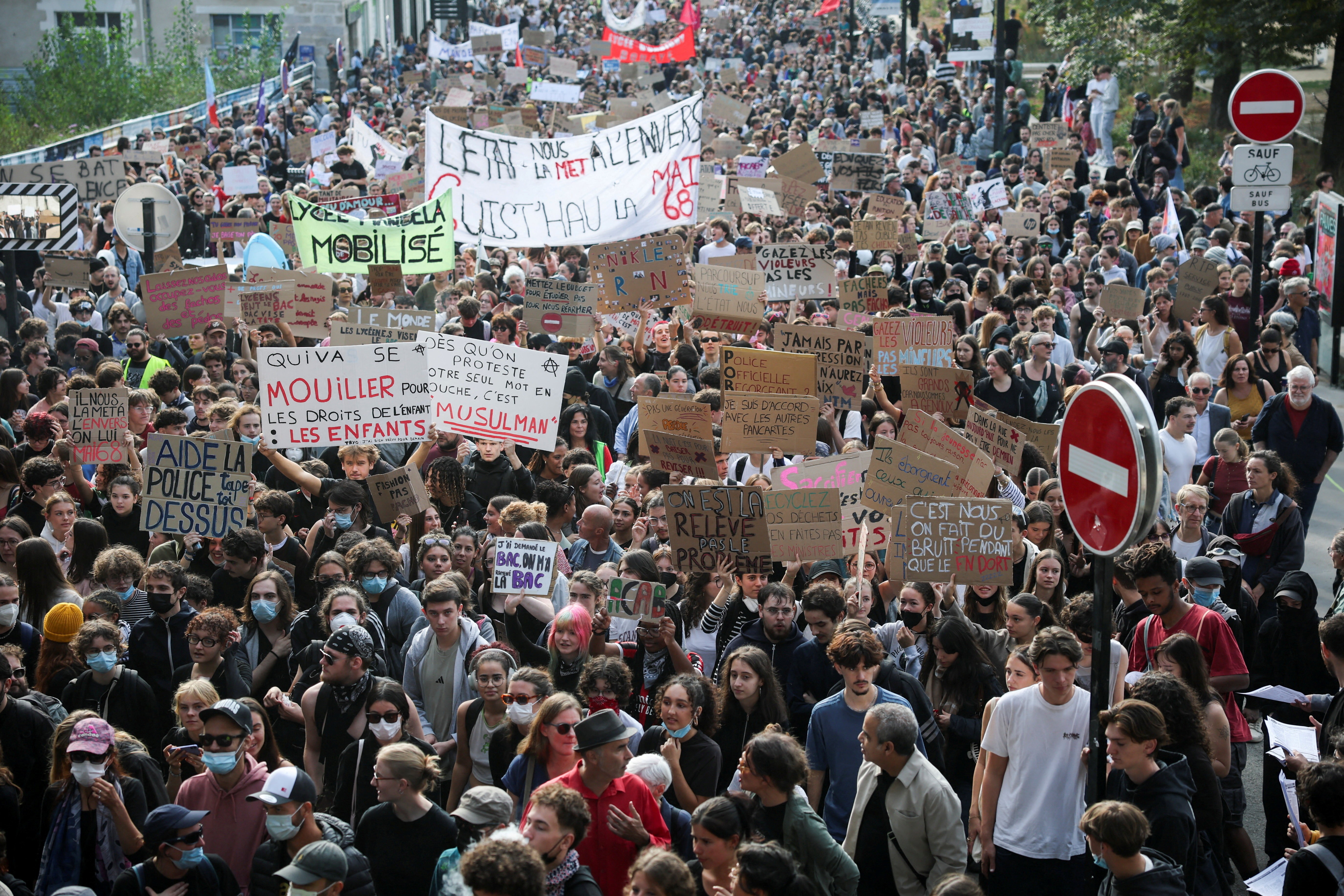
People gather on and around a statue in the center of Place de la République at the end of a demonstration on a day of nationwide protests organized by high-school students and joined by unions and teachers, who for days have been demanding better learning conditions, in Paris, on October 6, 2026.Stephane Mahe / Reuters
French high-school and university students attend a demonstration on a nationwide day of protests and blockades, in Nantes on October 6, 2026. Demonstrators are voicing their anger over overcrowded classrooms, teacher shortages, underinvestment, dilapidated school buildings, recent police actions, and more.Olivier Chassignole / AFP / Getty
Riot police watch a fire at a makeshift barricade set up by protesters during a demonstration organized by high-school students in Lyon on October 6, 2026.Philippe Lopez / AFP / Getty
Riot police charge protesters at the end of a student demonstration in Bordeaux on October 6, 2026.Lou Benoist / AFP / Getty
Riot police face protesting students who carry out a blockade outside Lycée Le Corbusier, in Aubervilliers, Paris, on October 1, 2026.Jean-Christophe Verhaegen / AFP / Getty
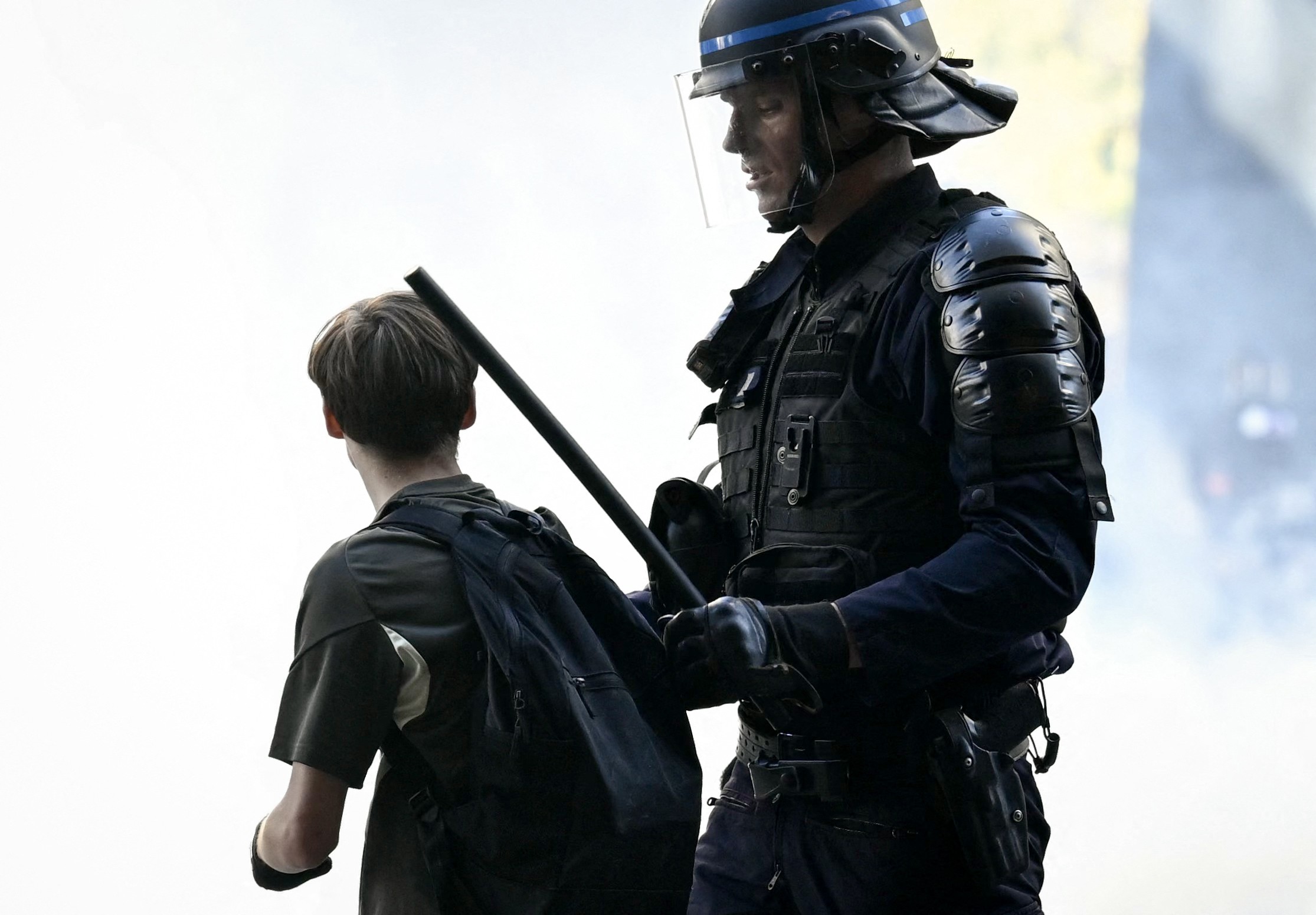
A youth is detained by a riot police officer in Nancy on October 5, 2026.Tom Nicholson / Getty
Students block the road outside Sciences Po during a protest on October 7, 2026, in Paris.Lou Benoist / AFP / Getty
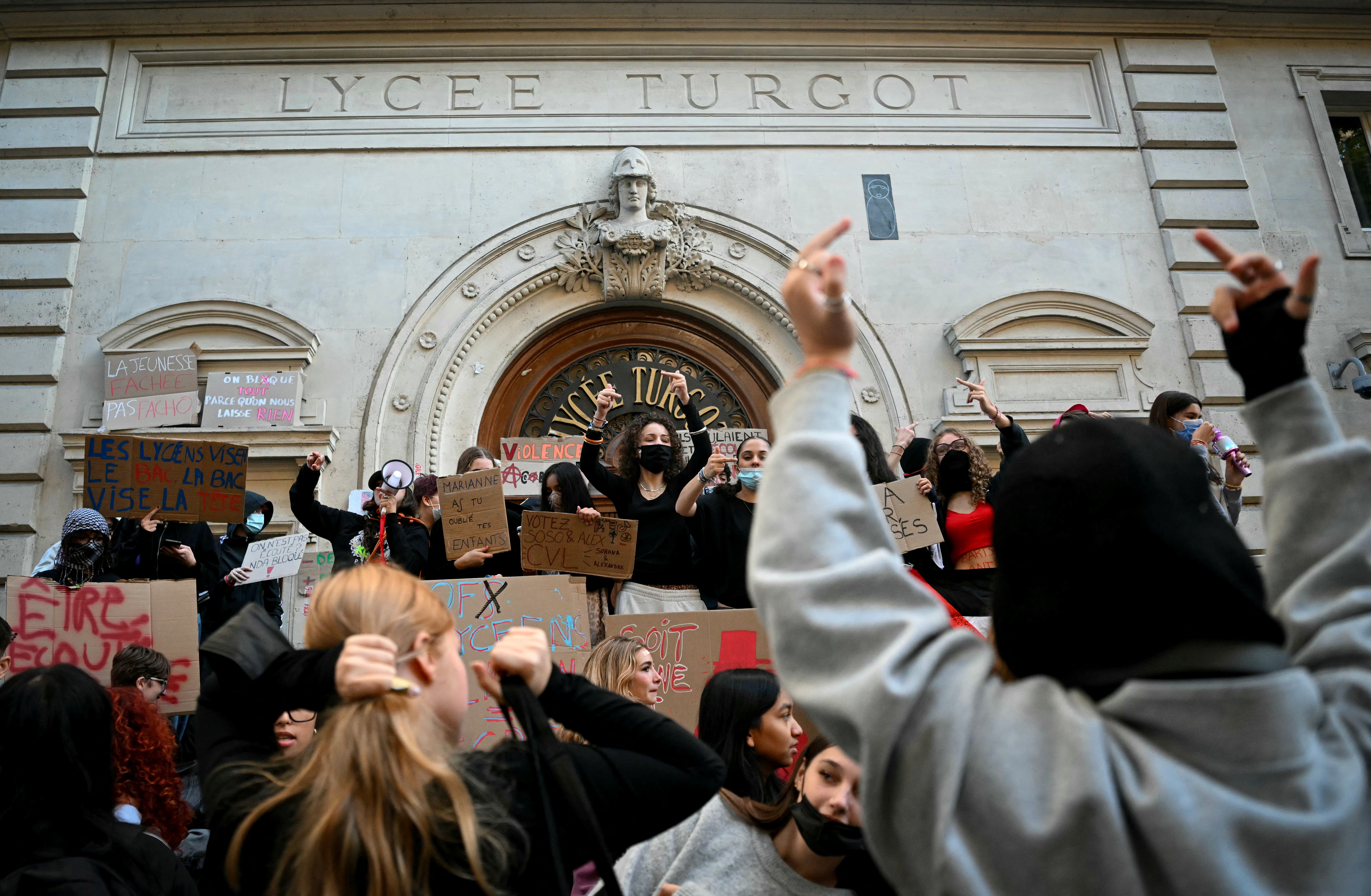
Protesting students gather and hold placards as they blockade part of Lycée Turgot in Paris on October 5, 2026.Yves Herman / Reuters
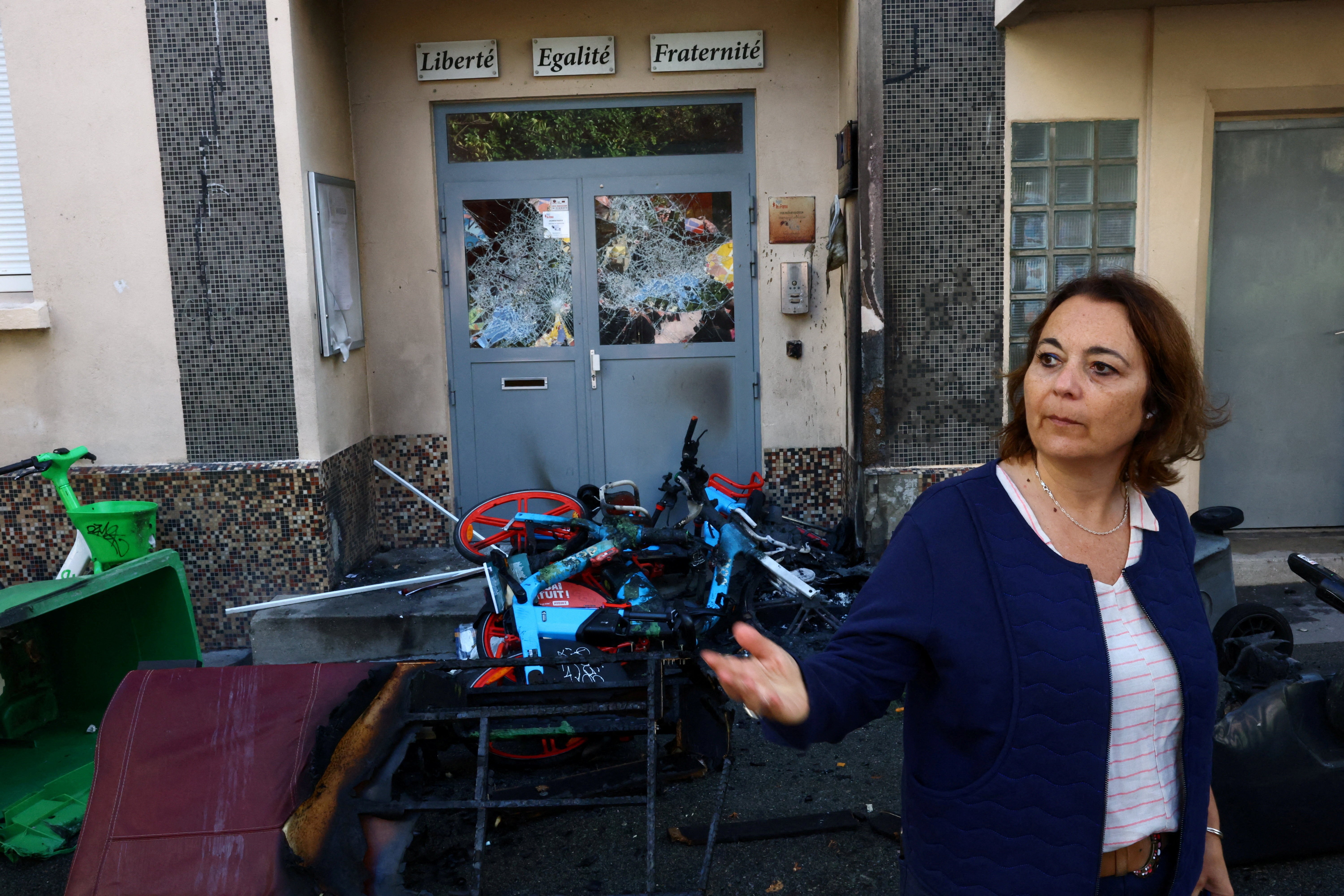
Carole Zerbib, the principal of Lycée Vauquelin, talks with journalists in front of the school’s damaged entrance doors and a pile of bicycles and garbage bins set on fire by protesters, in Paris, on October 5, 2026.Jean-Francois Badias / AP
Students tear down a traffic light next to Lycée César Baggio, which was blocked in protest of the government’s release of next year’s draft budget, in Lille, on September 29, 2026.Christophe Archambault / AFP / Getty
A police officer aims a riot-control weapon during a demonstration in Bordeaux on October 6, 2026.Yves Herman / Reuters
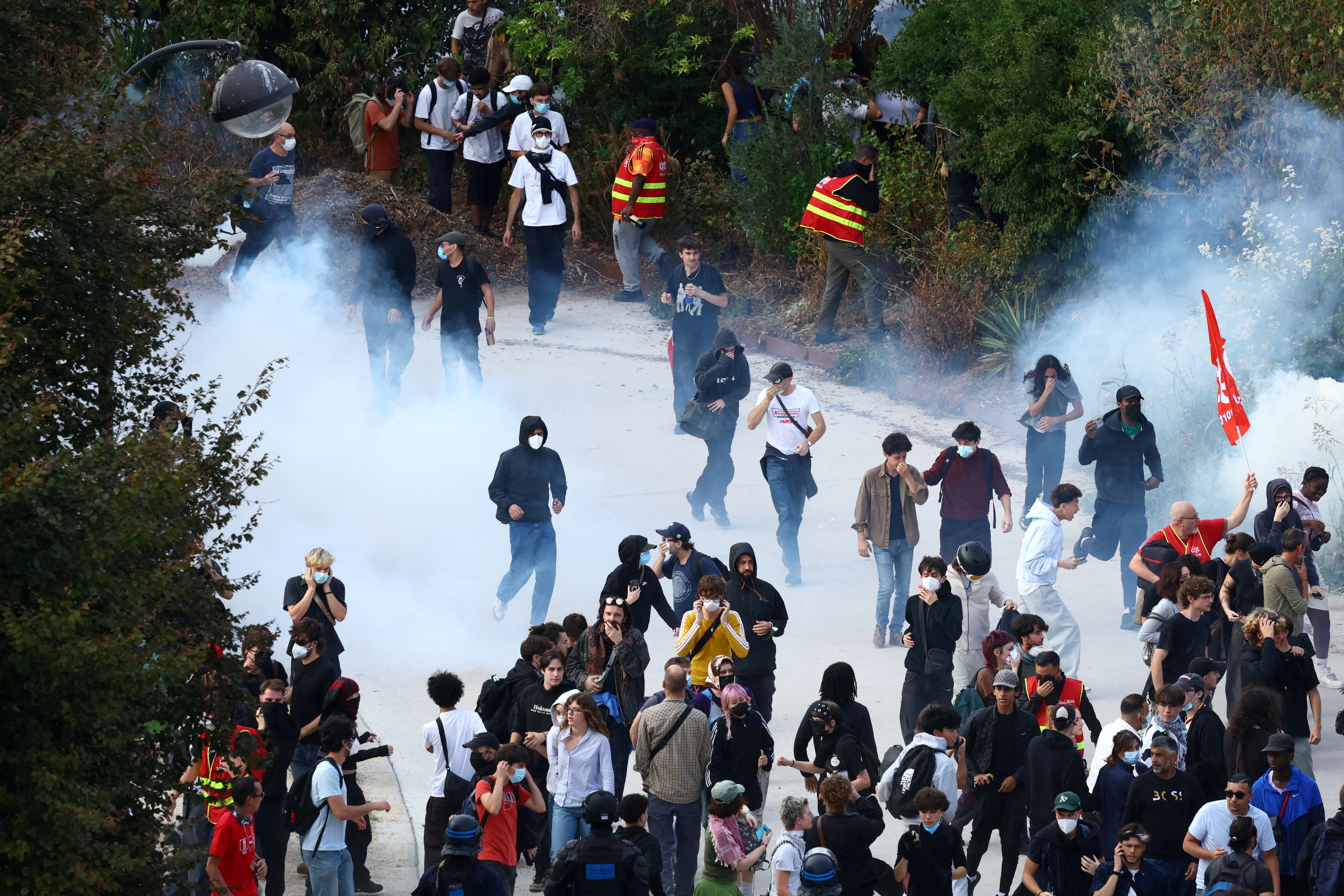
Protesters walk through tear gas amid clashes at Place de la Nation during a demonstration in Paris on October 6, 2026.Thibault Camus / AP
Police officers spray students with pepper spray near Sciences Po as they protest under-resourced schools, in Paris on October 7, 2026.Ed Jones / AFP / Getty
A student protester stands beside a barricade near Lycée Déodat de Séverac in Toulouse on October 1, 2026.Sarah Meyssonnier / Reuters
Riot police detain a protester on the Boulevard Saint-Germain during a demonstration outside Sciences Po in Paris on October 7, 2026.Olivier Chassignole / AFP / Getty
Riot police officers stand as fireworks go off above them during a demonstration in Lyon on October 6, 2026.Ed Jones / AFP / Getty
Protesters shield themselves from tear gas fired by riot police during a demonstration in Toulouse on October 6, 2026.Ed Jones / AFP / Getty
Protesters march during part of a nationwide protest movement, in Toulouse, on October 6, 2026.Ed Jones / AFP / Getty
Protesters rally in Toulouse on October 6, 2026.Tom Nicholson / Getty
Students raise their hands in front of riot police officers as they demonstrate outside Sciences Po on October 7, 2026, in Paris.on Thibault Camus / AP
Students chant in front of a blockaded high school as they protest against under-resourced schools, in Paris, on October 7, 2026.
People gather on and around a statue in the center of Place de la République at the end of a demonstration on a day of nationwide protests organized by high-school students and joined by unions and teachers, who for days have been demanding better learning conditions, in Paris, on October 6, 2026.
In this episode of The David Frum Show, The Atlantic’s David Frum opens with his thoughts on the sudden recall of 12 B-1 bombers from their base in the south of England to the mainland of the United States. He asks what prompted the move and why the Trump administration refuses to learn vital military lessons from Ukraine.
Then, David is joined by Reihan Salam, the president of the Manhattan Institute for Policy Research, to discuss why American cities cost so much and often deliver so little. They explore how some urban governments waste public money, how cities could provide better services to residents, and why the rise of populism is doing little to solve Americans’ actual problems.
Finally, David ends the episode with a discussion of Every War Must End by Fred Charles Iklé.
The following is a transcript of the episode:
Reihan Salam: Well, David, I actually don’t believe that it is Donald Trump who is the only political figure who will have been discredited by this moment. When you’re looking at the Democratic coalition right now, I see a lot of anger and frustration with how people see their leadership class as well. So I think that this is going to be this big generational turnover that could go very badly.
[Music]
David Frum: Hello, and welcome to The David Frum Show. I’m David Frum, a staff writer at The Atlantic. My guest this week will be Reihan Salam, president of the Manhattan Institute, and we’ll discuss how American cities can deliver better government to their residents at more reasonable costs than they now do. This week’s book will be a masterpiece of strategic thinking: Every War Must End by Fred Charles Iklé. But before either the dialogue or the book discussion, some opening thoughts on a news story you may have seen this past weekend: the sudden recall of 12 B-1 bombers from their base in the south of England to the mainland of the United States.
As so often with Trump-administration military stories, there may be less, or there may be more, to this story than meets the eye. The Trump administration is staffed by people who look for any opportunity and any excuse to recall military assets from allies, and especially from European allies, back to the American mainland. This recall may be something that people in the Trump administration wanted to do anyway, for their own reason. And we’ll find out more about that in the days ahead.
But the first reports may also be true—that there was some sudden threat to these bombers that necessitated their removal from England back to the American mainland. What might that threat be? Either a terrorist attack in Britain, or else possibly a drone-and-missile attack like those that have been experienced by American forces in the Persian Gulf. We don’t know.
But what we do know is that through the Persian Gulf, the Iranians have had great success, much greater success than as first reported, pushing back American forces from their perimeters. The American naval base in Bahrain was badly damaged by Iranian drones and missiles.
As we have seen in Ukraine, suddenly individuals far from the battle scene controlling these small, comparatively inexpensive new technologies can inflict tremendous damage anywhere on the enemy’s territory. The Ukrainians have done it to Russia, and the Russians have done it to the Ukrainians.
We may be living through a revolution in military technology as dramatic as when the advent of gunpowder made obsolete the knight on horseback and the castle made of stone. The United States is poorly adapted to this revolution, and especially poorly adapted under the Trump administration. There are deep reasons why the United States is poorly adapted to this revolution. The United States has made an enormous investment in very costly, very sophisticated platforms: bombers, fighters, aircraft carriers, tanks, equipment. Machinery that moves aboveground, on the land, on the ocean, in the air. And it is reluctant to accept that this enormous investment may now be obsolete, and obsolete in ways that empower weaker adversaries who master the new technology of drone warfare first.
The United States is also poorly adapted because of the way America finances and approves its military technology. The congressional system—the iron triangle of lobbyists and administrations and Congress—tends to regard weapons as not just tools of war, but also as tools of economic development back at home, and oftentimes as income-support strategies for retired members of the military. And so the United States invests very deeply in systems that are driven by domestic needs and not by the needs of the battlefield.
In the Trump era, these difficulties are augmented by two special problems. The first is the nation that is the pioneer and leader in drone warfare is Ukraine. And the United States under President Trump is terribly reluctant, brutally reluctant, to learn lessons of war from Ukraine. President Trump, Vice President Vance, and others around them decided early that the Ukrainians were losers, that they were doomed, that they were dependents, they were welfare recipients, they were moochers, they deserved nothing, and they had nothing to offer. Now it turns out they may be the leading military innovator of the modern era, and suddenly it’s very embarrassing to turn around and say, maybe these guys, of whom the Trump administration has so little good to say, maybe they have something to offer that America needs. So the reluctance to learn lessons from Ukraine—and the eagerness to fire the generals and admirals most ready to learn the lessons from Ukraine—that has handicapped the United States.
There’s another handicap in the drone-warfare era, and that is ideological. Secretary Hegseth is a man with a vision of the military as a tool for waging culture war, not real battlefield warfare. He has inveighed against troops who wear beards, against troops who are overweight, against troops who don’t have enough testosterone. He wants to promote troops that look a certain way, that can do certain physical exercises. It is said in a new Rolling Stoneprofile of just-retired Secretary of the Army Dan Driscoll that Hegseth’s vision is of an army that is ready for Instagram, not ready for war. And as he systematically goes through the army, firing those generals who want to learn the lessons of the new, Hegseth has left the United States vulnerable to the lessons of the new.
My wife’s grandfather was the founder of the Canadian [Royal Army] Armoured Corps. He’s contested through his life with the old and outdated proponents of cavalry warfare. And he lamented: There’s something about senior military command that has the effect of transforming brain into bone. Something like that seems to be going on in the higher reaches of the Trump Defense Department. And it’s happened at a time when we desperately need all the brains we can get.
As I said, there may be less or more to this story of B-1 bombers being recalled than first reported, but it is a portent of something ominous in the changing world of national security. Something ominous that this administration and this Department of War, so called, is uniquely unready to meet.
And now my dialogue with Reihan Salam.
[Music]
Frum: Reihan Salam grew up in Brooklyn, the son of immigrants, and went through New York City’s public schools. He started out doing research for David Brooks at The New York Times, worked as a producer at NBC News, and became an editor at The Atlantic and National Review. In 2008, he and Ross Douthat co-authored Grand New Party:an argument that the GOP, the Republican Party, should do more to appeal to working-class voters. In 2018, he published Melting Pot or Civil War?, arguing for an immigration system built on skills. In 2019, he became the fifth president of the Manhattan Institute, carrying a warning to all conservatives that a conservatism that does not speak to cities will be marginalized.
Canadian listeners: Be aware that Reihan also possesses an expert knowledge of Canadian politics.
Reihan is an old and dear friend, and it’s a pleasure to welcome him to The David Frum Show. Reihan, welcome.
Reihan Salam: Thank you for having me, David. It’s a pleasure to be with you.
Frum: Well, let’s focus on your day job of city government. Back in the Reagan ’80s, there was a bumper sticker, a good-natured conservative joke: Thank God we don’t get all the government we pay for. I don’t know that New Yorkers or San Franciscans or Angelinos—they pay for a lot of government, a lot. And I think most of the inhabitants of these overwhelmingly Democrat blue cities would like to see more reward for the money they pay. This has been the work of the Manhattan Institute.
It looks like in 2026 the country is going to veer to the left; maybe quite far to the left. State government, local government in these places is already pretty far to the left. Without telling anyone on the left not to be on the left—they wouldn’t listen—but how do people in New York, in Los Angeles, in San Francisco, in similar cities, get more of the government they’re already paying for?
Salam: Well, fundamentally, when I think about a dense, large city, I do believe that it is reasonable to expect that you’re going to have a larger government. Density creates enormous opportunities; it creates enormous productivity. But it also creates demons of density as well, when you’re thinking about the need for more stringent policing, when you’re thinking about the other questions of urban management, public health. When you’re thinking about drainage, when you’re thinking about environmental pollutants. Any number of questions. So my starting point is that it is reasonable to expect that you’re going to have a more energetic government in these places. You need a more energetic government to fully unlock that potential of urban life.
The problem, as you suggest, is that also that wealth that you create in these dynamic, productive cities also becomes a target for extraction. And though you might have the starting point as, Hey, we need to have a capable government to solve problems X, Y, and Z,another thing that can often happen, depending on the political dynamic in the city and whether or not you have meaningful competition and what have you—and we can get more into that—but basically, you have this dynamic where in many cases that wealth is being extracted by interest groups that become really potent and entrenched.
So think about it this way. New York City employs 300,000 city employees. That is in some ways an undercount, because you have a lot of other people who are employed indirectly, who are subsidized by city and state government in various other ways. That is already a very potent political constituency unto itself. People who have a vested interest not only in a city government that is large, but also a city government that is offering very favorable terms of employment to its various employees.
What do I mean by favorable term of employment? Well, let’s say you don’t necessarily want a very high degree of accountability. Let’s say you want very strong tenure rules. Let’s say you want the job to be a more attractive or appealing job according to various metrics, so that the job actually becomes more attractive than the equivalent job in the private sector. So you may well get featherbedding over time. You may well employ more people than you need to, strictly speaking. Or, you know, though, technically, we have civil service hiring and notionally we’re hiring people on a meritocratic basis, but it could be that that’s not quite how it happens. That you’re growing the city-employment rolls because you’re, again, trying to achieve some larger political objective.
In New York City—and I think this applies to many other cities as well—you could think of this as the friction not between Republicans and Democrats, but call it Tammany Hall and reform. Tammany Hall being the politics of patronage, the politics of using public dollars, not necessarily solely to achieve a public purpose, but using public dollars to entrench and grow a given political coalition. And then, the party of reform—that again could come with a Democratic label or a Republican label or whichever label—that comes in to say, Okay, we’re going to take away the punch bowl. You know, We are going to be the ones who are going to refocus city government on what matters, on delivering efficiency. And I think that that is this oscillation of power that has been part of the American urban story. But it’s not unique to dynamics within the city. It also is shaped by dynamics outside of it, and larger cultural and political forces.
Frum: I was in New York this past weekend. At one point in the weekend I was crawling along westward, inch by inch, on a Midtown street and observing: The reason the street was moving so slowly is because it was a three-lane street. One lane was being used for driving, and two lanes were being used for cheap parking. Who made that decision that the city should give two-thirds of the street away as a subsidized parking lot to the people using the street? So that’s a giveaway to somebody, or more or less randomly chosen people, but it’s still a giveaway. And I think everyone who drives along the street must have had the same question that I’ve done. And yet obviously it’s impossible to do anything about it, because there it is: Two-thirds of the street is used for subsidized parking.
Salam: Well, we also know from the great scholar of parking, Donald Shoup, that actually quite a bit of that traffic consists of people who are looking for a parking spot. So, in a way, there’s many levels to this perversity.
But, part of it is a point, it’s an observation that kind of answers itself. So when you become used to the entitlement, the expectation that you’re going to have free parking, moving from one equilibrium—which is a very painful and damaging one, that causes all kinds of waste, all kinds of economic damage—to a new one that may well be much more efficient, but you’re not necessarily going to be thinking, Think about all this time that I’ve saved. I feel so blessed, I feel so fortunate. What you’re going to think about is that: I once had an entitlement to free parking on the street, and now I don’t. Including if you’re not someone who drives especially often. You just could think in the back of your head, Aha, I once had this entitlement.
And in New York City, and in many other cities besides, you also have these bespoke arrangements. You have what you might think of as these hereditary rights that you gain over time. So if you’re looking at many public employees in New York City, in many cases, they will use placards to identify themselves as public employees. And one reason they do that is to ensure that they will not receive tickets. Because the idea is that if you work in parking enforcement, if you are someone who is looking to a fellow public employee, you will treat them differently than you treat other people. Now, that hereditary privilege alone is something that actually has enormous effects on the flow of traffic.
But it’s just one of many ways in which, when you’re thinking about any city, you’re not just thinking about a place that is run through cool rationality. You know, how are we thinking about the technocratic management of this urban landscape? You are thinking about traditions; you are thinking about this deference; you are thinking about this exercise of power in a lot of other ways that don’t actually rise to the level of being covered by the newspaper or even being understood in some data-rich kind of way. These are just the ways that things work that degrade the quality of life, but that people tolerate until they don’t.
Frum: As blue cities and blue jurisdictions swing further to the left after November of 2026, which is what looks likely to happen, they are insisting that the solution is to capture more revenue, and especially to capture it from the very richest people. And so their projects—you see them in Washington state and other places—to impose an extra-heavy level of surtaxes on the very richest people in the jurisdiction, thinking that that’s the way out. That seems an ideological commitment. And it seems like a strange commitment for subnational governments to have, because it’s a country in which it’s very easy to move. It’s a world in which people have less and less reason that they have to be in any particular place. But it seems to be a move that urban governments are determined to make in 2026.
Salam: I am a great believer in the potential of our great cities, and so I do believe that they are very attractive. They have many advantages, particularly when you’re thinking about an aging society. It is not difficult to imagine a world in which younger people in an aging society want to cluster with other younger people. So those are advantages, and I think a lot of people are taking those advantages and saying, Gosh, we can tax much more, we can allow the quality of services to degrade further. And that’s going to be fine; there will still be the stickiness of economic activity. I believe that’s a mistake, even though I do believe in that power of urban concentration, urban agglomeration, urban productivity. Because, as you suggest, I think that there are other forces on the other end. There are other cities that are emerging that are themselves competitive.
But the larger point I would make is this, David. We have been living through a period of fiscal expansion and fiscal incontinence. You know that our deficits are above 6 percent of GDP right now. This is at a time when unemployment is 4.2 percent, quite low by historical standards. And yet, even then, we have this enormous deficit. And that deficit trickles into state and local governments. It trickles in, because you have your city budget funded by city taxes, but then you have your portion of the city budget funded by transfers from state governments. And then you have the proportion of the city and state governments funded by federal dollars as well. And this is really, really important to understand. Now you know as well as anyone, David, that a huge driver of employment in any American city, big or small, is what we affectionately refer to as “eds and meds.” The education system and the health system. These are two systems that are very heavily subsidized. The health system in particular is very heavily subsidized by federal dollars and, might I add, borrowed federal dollars.
New York City might be a somewhat extreme case, but it’s not unique. But in New York City, 52 percent of residents are on either Medicaid or something called the Essential Plan, which is a Medicaid-like publicly subsidized health system. Now we can debate whether or not that’s strictly necessary. I would argue that it’s not. That in fact, if we had a narrower safety net, we would have more effective safety-net programs, and you’d have a lot of other folks who would find private health insurance, let’s say, and then you would have a somewhat lower burden, tax burden, and yada yada. Let’s come back to that for a moment. But fundamentally, you’re looking at a city that is a very dynamic city with a very dynamic private economy.
But if you’re actually looking at employment, if you’re actually looking at the biggest, fastest-growing private-sector job in New York City, but also in many other cities besides, it is home health aids. Now that is a private-sector job in a sense, that you are not literally a public employment, but it is also a publicly subsidized job. And it’s a job in which you, David Frum, or I, Reihan Salam, if I were on a subsidized program and I have a subsidized home health aid, I’m not paying with my own dollars. And so in some cases, you might not actually have someone who is offering a service with value commensurate to what the public sector is paying for that service. That is something you are seeing more and more in American political economy, and particularly in our cities.
Frum: Okay. Now I invite you to imagine a meeting that you are taking with one of the more leftish crop of new urban officials, local officials, in the country after of November of ’26. And the meeting begins with the person you’re talking to saying: Reihan Salam, you are a self-identified conservative. Conservatives are very out of style. A lot of the problems that that our city faces are driven by the Trump administration: its many forms of interference in our lives that were unasked for. Why should anybody listen to you? What can you possibly have to say that’s of value to me as I cope with my problems and my constituents?
Salam: Well, I believe that fundamentally, whatever the partisan label, there are some underlying structural forces that are going to come to bite relatively soon. If you look at the urban-policy revolution that unfolded in the late ’80s, 1990s, 2000s, the big insight was not some grand ideological insight. It was this—it was that when you’re looking at a lot of major cities that had for many decades been begging the federal government for money—Give us more money to solve this problem. My old colleague Fred Siegel called this the riot ideology. If you do not give us money, there are going to be riots. You know, we’re not going to be able to control it; it’s going to be really bad. And therefore, you just kept going and rattled the tin cup, begging for more money from the federal government. The problem is when you have a federal government that starts to tighten its belt by necessity, then suddenly you’re going to have a more discerning federal government that’s going to be thinking about: Where exactly am I going to be applying these subsidy dollars? And it’s not necessarily going to be in a place that is not really politically contested.
During the migrant crisis that unfolded during the Biden presidency, Mayor Eric Adams, a Democrat, was begging the Democratic president, Joe Biden, to rescue New York City by infusing more federal dollars into the city. And the Biden administration said no. The Biden administration said, You have a right to shelter. You have a ton of other policies that actually have exacerbated this crisis in your city. And by the way, we’re not really concerned about losing the five boroughs of New York City as voters in our upcoming presidential election, so we’re not going to be all that concerned about you. And that’s in a case where they were quite happy, as President Trump is, to run an enormous federal deficit.
So basically what happened is you had an alternative to tin-cup politics. You had a group of mayors who said, We have to solve some of these problems ourselves. So you don’t have to listen to me. All you have to do is look at your bottom line. All you have to do is look at the fact that you’re going to start experiencing, if you haven’t already, very stringent budget constraints, and voters to whom you’ve been making a lot of promises that are going to be very hard to fulfill given this new fiscal landscape.
Frum: Can we talk about schools for a moment? I mean, you in your own life owe so much to the schools as ways to identify and promote talent. And so much of your rise to your eminence was achieved because of the talent scouting that occurred in the New York public-school system. New York and other cities seem to be less interested in doing that. In fact, they seem to want to break a lot of the mechanisms for finding talent and helping talent forward. Why does that happen? Is there anything that can be done to change the cities? Or maybe the cities aren’t even wrong. Maybe the talent-scouting mechanism is too exclusionary and unfair.
Salam: There’s so many things going on that are making our cities today really different than they were 30 years ago. So, narrowly on the education point, you know this as well as I do, David, in many big, urban public-school systems, it increasingly feels as though the system is being run for the benefit of the system’s employees than for its notional beneficiary students. That’s not because anyone is sinister. It’s because you’re seeing declining enrollment. That’s kind of one thing that is going on across jurisdictions. But also, you have the system that employs an enormous number of people who are themselves people who might feel economically fragile. These are people where some of them absolutely could find more remunerative employment outside of these public systems, but some of them are people who might not be able to find more remunerative employment outside of these systems. What we’ve been doing in the United States as a whole since the 1970s is, we’ve been increasing the amount of staff in our school systems. That is: We’re hiring more teachers, but we’re hiring more paraprofessionals as well. So if you’re looking at the staffing ratios, how many students do you have relative to the number of adult employees of the school system? You’ve seen a really dramatic change over this time.
And so if you’re looking to people who are employed in public education, they will often say that, well: Look, education is part of our mission. But we also are providing meals. We are providing counseling. We have students in some cases who are homeless, who are suffering from various other maladies. And so we are essentially social-service bureaucracies in miniature that are serving this troubled population.
Now, you know, we can get into that specifically, whether or not that’s a sound argument. But also think about a middle-class parent who, as you were suggesting before, has options. They don’t necessarily have to enroll their children in that school system. They can move elsewhere and what have you. That system that is leading with the idea that, well, Look, education schmeducation. Yes, this or that might be true—but how dare you not appreciate this incredibly profound social mission that we have? And by the way, gosh, you’re right, maybe we’re not doing as well as we might on the educational front, but that’s because of segregation and inequality and various other problems of cosmic injustice that we, of course, in our small little school system, can’t possibly solve on our own. So it becomes this incredible buck-passing to help cement the political coalition that allows for these failures to unfold.
And again, there are some great people in these systems. There are some excellent schools within these systems. But the underlying logic is one that leads you to more excuse-making and away from accountability.
Frum: Tell me what is wrong with the argument I’m about to present. A historic idea in the New York system—long ago, a generation ago and more—was, students in the school system are going to be disproportionately poor. Some of them are going to be very talented people who might not have on their own, from their own family resources, the opportunities that their talent could use, could benefit from, and could benefit all of us. So we’re going to do talent-sifting. We’re going to look for those talented 30 percent, and we’re going to promote them and fast-track them and help them to get to college and to discover things in themselves that the people in their lives, who they grow up with, may not recognize for them. That’s been a view in the past. It’s increasingly challenged. And we’ve all been reading with fascination the recent eruption between a famous New York Times writer and her daughter. The New York Times writer said to the daughter, You’re going to go to the same school as everybody else. And the daughter said, You have the ability to get me into a better school. Why won’t you help me? And the mother said, It’s a point of principle. What is wrong with what the mother is saying? And what is potentially right about the old way of doing it, or vice versa?
Salam: Well, I believe the mother in that case was right to say that: My daughter has been failed by these schools, and there is something broken. Where she goes wrong is with her view as to what the right structural solution would be.
So this is my answer to any number of dilemmas facing American cities, and it’s this: When you are an American city that has people who want to solve problems for you at very low fiscal cost to you, you should let them do it. What do we mean by that? So, one thing we hear again and again—you hear this in Los Angeles, New York City, Boston, San Francisco, of course, any number of cities—we have an acute housing crisis. And that’s true. We have an acute housing crisis in many American communities. But what you also have is a crisis that could present its own solution.
In New York City, asking rents are so high for the tiny number of units that are available that there are people crazy enough that they will come along and say, I will build private rental housing, if you let me do it and if you allow me to charge what the market will bear. You might think they’re mad. I might think they’re mad, because there’s so many other barriers that you have to overcome, so many political obstacles. But if you let them do it, they would do that.
In a similar vein, there are people who run school systems in New York City, in the five boroughs of New York City, but also in many other urban jurisdictions besides, who will say: Hey, I’m running a charter network. Give me a fraction. And by the way, they’d rather have more money, but they’ll say, Hey, give me 80 percent of what you’re giving to your public district schools for my public charter school, where I don’t have the same collective-bargaining rules and I have greater flexibility. And I can educate those students much more effectively. There are people who will solve that problem for you if you just let them solve it for you. So, to my friends on the left, what I would say is that, you have bigger fish to fry. You know, maybe you want to address the Middle East. You know, you want to address kind of various other problems. Why don’t you allow these other people to educate young people?And do it competitively and at reasonable cost. Why don’t you let these other people address this acute housing crisis, and you can focus, you know, much like the Queen of England, and now the King of England, is able to serve as defender of the faith and do other things, the magic and mysticism of kind of any any form of government. Why don’t you focus on those things and then allow these other people to solve the problem?
Frum: I’m smiling at your joke. The new mayor of New York should focus on solving the problems of the Middle East and let volunteers deliver schools and build housing for him.
Salam: Because they will do it. They will come along and do it if you actually just create a system.
Frum: And because, well, he’s got a lot to say about the Middle East, of course, and everyone there wants to hear from him.
Salam: And that seems to be, you know, kind of a burning passion for him and for many other people. And again, I might disagree with where he lands in the Middle East, but we’ll leave that aside.
Frum: But he’s probably pretty harmlessly occupied talking about it.
Salam: He might actually do less damage if he simply said, I’m going to actually serve as an ambassador for—I’m going to serve as a mascot for this or that political cause. But why don’t you create the systems that allow other actors, including in some cases public actors, to do good work.
Frum: Well, you mentioned housing, and that was where I wanted to go next.
You and I come from a tradition where we believe if you let private builders build tens of thousands of new units per year, even if all of those units are aimed at the top of the market, simply the presence of those tens of thousands a year of new units all aimed at the top of the market is going to push down prices all the way through the market. But that seems to be, at least in the city of New York, a discarded, rejected idea. And they say that if you build lots of units at the top of market, they will only serve the top of the market, and everything else will remain unchanged by the arrival of all of these new units. Can you speak up on behalf of what we used to think of as the basic economics of housing, against the new idea that no matter how many units you build at the top, it won’t change anything else for anybody else?
Salam: It’s very simple. If you—right now, the way that we are approaching housing in many of our cities is, you’re saying that the desire to build private rental housing is suspect. It is something that is very questionable. We will allow you to do it if you do 15 other things to prove to us that you’re not actually doing something sinister or dubious or questionable or whatever else. So one thing we’ll say is that we’ll allow you to build private rental housing if you set aside some number of those new units to represent permanently affordable housing stock. That is to say—if you set it aside so that people with incomes below a certain threshold can afford these units, and then if you’ll do that on a kind of ongoing basis, then we’ll allow you to build some other private housing.
But the funny thing there is that what you’re effectively doing is that these people who want to build more housing supply, you’re taxing them. You’re saying that: We’re actually going to limit the number of new market-rate units you can build, so that you can set aside this number of units that are mandatory below-market, affordable. So actually, you make it even harder to solve the bigger problem, which is that demand is outstripping supply.
Then you could say, Well, we’ll allow you to build it, but you need to offer very high wages to the people building it. Because actually somehow this work, relative to all forms of work otherwise, needs to be put in some separate bucket. And we don’t trust those workers to be able to come to some arrangement with you, because you exert power—any number of, there are all of these other side deals that are imposed so that you actually see to it that the amount of new housing is a trickle.
Now, actually, how it really works, when it works, is this: You allow a bunch of speculators to build, and indeed to overbuild, so that actually they eventually come to a point where they lose their shirts. And they, as investors, lose their shirts. It’s not the city government that loses its shirt through a subsidy; it’s the investors build and build and build until you’ve satiated the demand. And then, okay, lo and behold, we built a little bit too much. That’s what happened in Austin, Texas. Austin, Texas, built an enormous amount of housing, rents went down, and then developers stopped building new housing, because then they’re waiting for that amount of new supply to be absorbed by the marketplace. So I’m not of the view that if you allow private developers to build a lot of new housing, they’re going to build so much that New York City is going to become as inexpensive to rent an apartment as in Dubuque. That’s not going to happen.
But you will mitigate this acute problem we have right now, number one. And number two, you’ll have a bigger tax base. You will actually have a more prosperous, thriving city, which is a good thing unto itself. And I think that there are some folks on the left who recognize that you need to build more, but I call this immaculate-conception progressivism. They say that, well, you can build more—provided you do it in exactly the right way, in exquisitely moral ways. By my exquisite moral standards. I’m not going to let you do it in some laissez-faire fashion, where the idea is that you build it to the point where you lose your shirt. I’m going to do it with you as a partner. Side by side, we will do this together, and I will essentially dictate to you exactly what it ought to look like.
And I understand that there’s some subtleties here. There’s some complexities; there’s a question of getting from here to there. I get all of that. But I think that, fundamentally, if there are people who are willing, through their animal spirits, to address the problem, let them do it.
Frum: How much new housing does New York need, in your opinion? How many units per year would put the city on the path to escaping from the crisis of affordability it’s in?
Salam: I would say something like 50,000-plus new units a year, so that we would get something like half a million over the course of a decade. If you were to do that, then I believe housing would be much more abundant and more affordable than it is today. There are many other things that I would do too, David, but I think that that would go a long way.
Frum: And how many is New York building now? Do you happen to remember?
Salam: It’s more like in the kind of in the twenty thousands. You know, kind of maybe the high twenty thousands. But that is a little bit of an artifact of the fact that we just had a big rezoning, and also there are some units that are being built because of a tax credit that is about to expire. So people were rushing to kind of collect that tax credit. So those numbers I would expect to go down somewhat. But we’ll see.
I think that our current mayor recognizes that this is an acute challenge, and he does want to build more. He, however, is not always mindful of the various other regulations that he’s imposing that make this a less attractive place to invest. So we’ll see. But we’re not anywhere near where we need to be.
Frum: Now, urban politics, as you said, is inherently very complicated. People are close together; there are a lot of interests; there are lots of points of view. But one of the things that used to guide good decision-making was a few basic rules. And say, you know, I’m not going to master every complex detail. I just know if you build more housing, the prices go down. If you arrest more criminals, the streets are safer. If you sweep the streets, you’ll have less disease.
And those basic notions, which are not a hundred percent true, but good enough—we seem to have a harder and harder time holding on to them. And maybe that’s because of something that I talk about a lot, and I know you think about a lot, which is the implosion of conservatism as a workable philosophy. It used to be the conservatives’ jobs to say: Build more housing; the price will go down. And as conservatives give up their ancient views and chase after new ideas—new and often quite sinister ideas—who’s speaking for these old truths? Build more housing; put the criminals in jail; sweep the streets; have schools locate kids with less economic opportunity and more talent and find a way forward for them. Who’s to speak for that?
Salam: Well, first I’ll note that there have always been many conservatives who are small-C conservative, in the sense they want to protect their neighborhood, they want to protect its character. So some of that resistance to new building has always come from people who are small-C conservatives, who do not want the composition of their neighborhood to change and what have you.
But the larger point is well taken. And you wrote an essay many years ago, David, that left a very deep impression on me. About how what you and I call conservatism reflected arguably an historical moment. When you think about the progressivism of the early 20th century, this was a moment; this was a sensibility that was a response to the challenge of urbanization, an enormous immigrant influx, and a pattern of industrialism that demanded new forms of state capacity. And then you had a progressive movement that was actually a part of both major political parties. In a similar vein, you’ve observed, there was what you could call a supply-side movement, a conservative movement, that actually did shape both major parties as well. And now that movement appears to be in abeyance. And what you have now instead is new forms of populist politics. You have a left-wing flavor of it; you have a right-wing flavor of it. And instead, the partisans of what you might call pluralism or classical liberalism or something that resembles the conservatism of that earlier era—they still exist. These ideas are still there; these ideas are still very compelling and relevant. But you could argue that they represent a minority faction in both of the major-party coalitions.
And so what I would argue, David, is that I think that you need political innovation as well. You have a ton of new challenges right now that are markedly different from the challenges of even 15 years ago, when you and I were having that conversation about what had happened to the conservatism of that era of the ’70s, ’80s, and ’90s. And I think that those challenges demand new forms of left and right politics. And I think that’s a big part of what we focus on at Manhattan Institute.
Frum: Well, let me ask you, since you’re kind enough to allude to my work. I’m basically at the end of my career, but you’re in the middle and peak of your career. You are going to have to ride your way through whatever’s happening next in American politics, which probably is a kind of collapse and discrediting of the ideas associated with President Trump. How do you find your personal way forward through this new landscape, in which it’s 2029, it’s 2030, the Trump era is left behind? Maybe the Republican Party is chased off under Vice President Vance toward evermore protectionism, evermore chauvinism, evermore xenophobia. How do you—and you have always stood for the opposite of those things—how do you find your way forward as a thinker and as an institution, in a landscape where so much will have changed?
Salam: Well, David, I actually don’t believe that it is Donald Trump who is the only political figure who will have been discredited by this moment. When you’re looking at the Democratic coalition right now, I see a lot of anger and frustration with how people see their leadership class as well. So I think that this is going to be this big generational turnover that could go very badly. It could also go pretty well. When you’re thinking about the fact that we’ve had, I believe, it’s three American presidents who are all born in 1946, who presided over a period that many see as discredited. If you think about neo-socialism, this new movement, why is the term that had been so anathematized in American political life, why has it reemerged? One reason is because of that larger discrediting. And I think that in the case of Trump and Trumpism, what was fascinating about Donald Trump—and I’m talking about him in the past tense, but when he first emerged in 2015-2016—is that he served as a new coordinating device. There were many people on the right who felt as though they were burdened by backward compatibility. Ronald Reagan was still the figure that people could rally around. George W. Bush was a figure that many people felt they couldn’t rally around. And Donald Trump said some things, not entirely true, about how he had always opposed the Iraq War. It was a stupid war. And so he allowed himself to emerge as a new coordinating device.
However, I think that that Trump era right now, in 2024, that campaign, I think, showed the outlines of what could be a new coalition. The problem is that the Trump presidency and how it’s unfolded did not represent the cementing of that coalition, that multiethnic coalition, a coalition that was—call it a back-to-basics coalition.
If in 2025 you had a right-of-center presidency that said, We’re going to focus on inflation; we’re going to focus on getting the basics right; we are going to focus on having state capacity when it comes to managing immigrant inflows, managing law and order, this kind of thing. And we’re otherwise going to let the private economy roar—I think we’d be in a very different place right now.
But President Trump, like many of his opponents, he’s someone who is very fixed on past rivalries. He is someone who is very fixed—you know, he has deep self-interest, he’s very self-motivated. That’s certainly true. And I think that basically you are going to have a very different politics in a few years’ time. It’s very unpredictable, what it’s going to look like. But I do think that some of these core ideas you were talking about, these kind of core pragmatic ideas you’re talking about, I think that they’re going to have a place in the other side. And I think that that’s something that everyone is going to have to be thinking about. It’s a reckoning that it’s not going to apply just to the right, but also to the left.
Frum: Well, if we are turning the page, what writing will you put on that page? I mean, you’ve written two books about the way forward for conservatism at an interval of a decade. If you were to return to this at another 10-year interval, what would you say? What would you advise?
Salam: Well, I’m fortunate in running a nonpartisan organization. We pride ourselves on our independence. We certainly have a point of view, but a lot of what I’m thinking about is identifying talent. Thinking about people who have a thoughtful, smart perspective on where things are heading and advancing a certain vision of American life.
My view is that we have a multiethnic society. That’s just a reality that will be true one way or another, regardless of who’s in power. And how will we go about making that multiethnic society a success? And how will we ensure that that multiethnic society is in tune with core American values, and with core virtues that I see as good and valuable? When I came to identify with the political right, a lot of it was out of an appreciation for what Margaret Thatcher called the vigorous virtues: the virtues of independence, self-reliance, loyalty. These are just things that matter. They’re not the only virtues, but they’re virtues that matter, and they’re virtues that a system—a kind of government, a society, a culture—can either cultivate and celebrate or diminish and demean. And I just really believe that in our multiethnic society, there is a potential majority that embraces those ideals, that embraces the best aspects of our American, of our Western inheritance. And that’s what I’m really focused on. Just the idea of ensuring that these values survive into the future.
So some of that is looking at policy issues through this lens. You know, trying to find what are novel issues that we ought to be paying more attention to that we haven’t. If you believe, as I do, that building new housing is a good and valuable thing to do, and that will address some of these acute challenges, how do you make that argument? And also, how do you structure the bargain to make it work? So it’s not to bang my head against the wall and say that all is lost, all is doomed. It is to recognize: What do we have? What is the population that we have? What is the electorate that we have? What are the challenges we’re facing? And how can we make the best of it, and how can we draw people into our way of thinking? That is what I’m really passionate about and want to do more of.
Frum: Well, let’s finish by talking about this challenge of the multiethnic society. You and I have been talking about this for a long time, about how we make immigration a source of renewal and strength for American society and not a source of trouble. How do you think the United States of 2026 and future is doing on building itself as a multiethnic society? And what advice would you have? How would you recommend that it do better than it is doing now?
Salam: One of the biggest challenges we face is a challenge that we can’t avoid, we can’t work our way around. It’s the fact that birth rates are shrinking, the population is aging markedly—and, by the way, healthy lifespan is increasing as well. I mean, there are many things to look forward to, things that are good and positive. But they will have very unpredictable effects on our political culture. If you are in your 50s for 30 years—which sounds ridiculous, but I think that that could be something we’re looking at when you’re looking at the pace of biomedical innovation. What effect does that have on people in their teens and 20s? When you’re looking at how our information environment is changing at a time when you have increasingly intelligent machines. These are very deep questions about what it means to work and be a purposeful individual.
It could be that we could have challenges of affluence that are even greater and graver than the challenges of affluence we already face. So we’re going through these incredible ructions at the same time that we’re going through these multiple, reverberating identity crises.
When I think about the manias of our politics right now, I think often of the 1920s and 1930s. When you had the popular front, when you had a group of people who were themselves second-generation Americans—who are both included in a sense, but very alienated in another sense. I look at the fact that the populations right now that feel very alienated and out of sorts are not just minorities; it’s also majorities. I see this incredible psychic breakdown that’s happening in our society that goes above and beyond discrete policy questions.
And so, part of me thinks: Stick to your knitting; focus on the basics. How do we make public systems work? How do we address questions of integrity and corruption and competence? That’s something we can wrap our arms around.
But then I do think that these spiritual questions, which are not my bailiwick as someone who is in the business of policy research. But I do think that those questions matter an enormous amount, and they stem from an abdication of responsibility. You have a generation of people who are taking over as leaders of different institutions, who don’t think of themselves as the establishment. They think of themselves as fighting an establishment, but that establishment is hollow.
And actually, what we need is to have a group of people from different ethnic backgrounds, different kind of educational backgrounds and what have you, who take responsibility. Who say that rather than complain about the ways in which they’ve been victimized or aggrieved—and you see this very much on the right as well as on the left—how do you instead have a group of people who say that I am going to take responsibility? And therefore inspire other people by virtue of having taken that responsibility? That’s something I think about a lot, David. And part of that is about an ethic, a cultural ethic of inhabiting that role of adult. But instead, what’s incredibly attractive to everyone is to imagine themselves as victims of this or that catastrophe, as people who are damaged and therefore can’t take responsibility.
Frum: Well, give some affirmative advice to how to achieve this end you care about.
One of the things I think we’ve seen in the 2020s is that the ethnic groups of America are voting less differently one from another, while the sexes of America vote more differently one from another. And that’s true within ethnic groups and across ethnic groups. There seems to be, part of the alienation is an alienation between young men and young women. Which expresses itself in family formation, among other things.
Meanwhile, you’re getting these strange kinds of cross-cultural coalitions, which can be kind of reactionary sometimes. How do we make it better? What is your advice? This is something you think about a lot. Give us just something we can hold on to as a solution, as something to carry forward into the new era you’re talking [about].
Salam: In everyone’s life—as an individual, as a citizen, as a neighbor—to think about, in a more purposeful way, about what it is that you can do. Because I think that there’s a tendency to think about these problems—and I certainly am guilty of this myself—in purely abstract, broad terms. But when I see the people I admire the most, I see people who are raised in families where there wasn’t a ton of religious observance and who are becoming more observant themselves. Or people who are finding institutions in their own lives that they can breathe life into in a more deliberate way.
You know, we were talking about political parties in our major cities that are just moribund, when you have these incredible political monocultures. Well, you can complain about the problem, or you can get actually involved in a local political party that is moribund. And it can actually be very distasteful, because what you’ll find is that there are not necessarily a lot of other people who are very thoughtful. Or maybe that’s what you’ll find. But actually doing that patient work.
One thing that I find very striking is that—and again, I don’t run a political organization—but when I talk to people in politics, one thing that is very powerful for them is when you actually talk to or interact with people outside of your own narrow world, and you’re trying to persuade them. And you recognize they don’t agree with you on everything, but you want to bring them along in your direction. That is a very powerful civic habit that we’ve lost.
So I think that you and I are both very fortunate to live among neighbors, to have many friends who don’t agree with us on a great many things. And I think that’s a really valuable discipline, and that’s something that all of us can find in small ways. How do you have different kinds of conversation? How do you engage with people where you’re trying to solve a problem together with them as opposed to retreating? I think that that’s something that we can all do more of.
Frum: Reihan Salam, thank you so much for joining me today.
Salam: Thank you very much, David.
Frum: Bye-bye.
[Music]
Frum: Thanks so much to Reihan Salam for joining me today on The David Frum Show.
This week’s book is a classic of American strategic thinking: Every War Must End by Fred Charles Iklé. Originally published in 1971, the book gained great fame when Colin Powell urged it on all of his officers during the planning for the Gulf War of 1990 and ’91. But it remains burningly relevant today as the United States contemplates an exit from the war with Iran.
The author, Fred Iklé, was born in 1924 in Switzerland. He emigrated to the United States after World War II and became one of the leading thinkers in the new area of nuclear strategy and nuclear deterrence. He directed the Arms Control and Disarmament Agency under Presidents Nixon and Ford, and he was promoted to undersecretary of defense by Ronald Reagan.
I got to know him toward the end of his life, and he was as incisive and original at the end as he was all the way through.
Let me start my discussion of his book, Every War Must End, by quoting the opening paragraph:
“Fighting a war can cost more in blood and money than any other undertaking in which nations engage. And to wage war, governments develop more detailed plans, establish a more rigid organization, and institute tighter discipline than for any other national effort. Yet, despite all this elaborate and intense dedication, the grand design is often woefully incomplete. Usually, in fact, it is not grand enough. Most of the exertion is devoted to the means, perfecting the military instruments and deciding on their use in battles and campaigns. And far too little is left for relating these means to their ends.”
As we discussed at the opening of the program, this advice applies so pointedly to the troubles in which the United States finds itself today.
Military planning focuses on the work that soldiers do; it focuses on developing plans to actually wage the war.
How fighting will shape the political outcome, however, falls between the work of soldiers and the work of civilians. And because it’s in that in-between zone, it can often be neglected until it becomes too late, until the choices have narrowed.
That’s where the United States is today in Iran. What exactly are we trying to achieve? That was a question that was not asked hard enough back in February when the war began. And now the options don’t look so good as the United States tries to find a way out.
Leaders enter wars expecting battlefield success to produce its own reward. Win on the battlefield, and you’ll get something good without having to think very much about what it is you want. And they also don’t think very hard about if they don’t achieve total victory—Japanese surrender on the deck of the USS Missouri, Lee surrendering a sword to Grant—if they don’t get total victory, how do they arrive at terms that the defeated but not hopeless enemy will accept?
Through the war, both sides overrate their own prospects and assume the enemy is near breaking when the enemy may not be near breaking. And sunk costs—the money that has been spent, the lives that have been lost—make compromise feel like a betrayal of earlier sacrifices.
In the discussions of how to end the war, the advocates of peace risk charges of defeatism. And the hawks, too, often promise too easily that just one more big push can deliver the results that everybody wants.
In Iran, as in Vietnam and Iraq and Afghanistan before that, the United States has had terrible trouble defining an achievable end state that is worth the effort of the military undertaking in the first place.
So here we are, in the throes of this war, trying to make sense of what has been done. Why was it done, where is it going, what are we trying to do? And Fred Iklé in 1971 predicted it all. If you don’t think at the beginning about how the war will end, you’re unlikely to have a successful arrival at that destination point. That’s the question to start with. What are you trying to do? How likely is it that you can do it? And if you don’t achieve total victory, what is the means you’re going to use to ensure that the defeated but not hopeless enemy complies with the victors’, but not total victors’, requirements? That’s where the United States is today. It’s a book that repays rereading. I’ve been thinking about it a lot in these past days. Thank you for thinking about it with me.
See you next week on The David Frum Show. Remember, as always, if you’re minded to support the work of this program, the best way to do it is by subscribing to The Atlantic. And please share the work of this program on whatever social-media platform you use. Thanks for watching or listening. See you next week. Bye-bye.
The following article contains spoilers for the TV adaptation of Carrie.
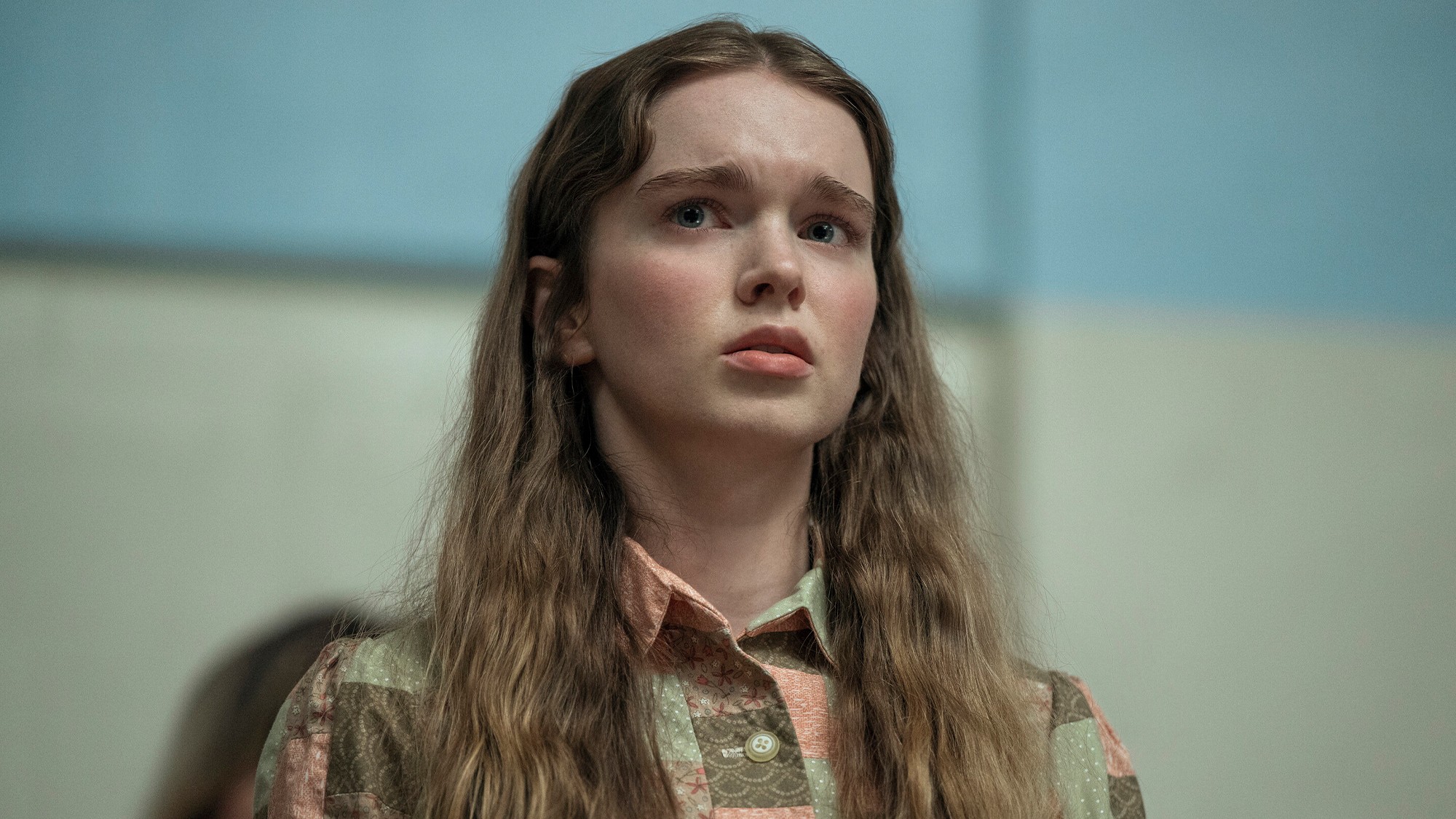
The climax of Carrie, Stephen King’s debut horror novel, is so famous that even people who haven’t read it or seen any of the numerous adaptations know the basics. The eponymous Carrie White, driven to the edge of sanity after years of abuse from her classmates and hyper-religious mother, gets drenched in a bucket of pig’s blood at her prom. She then uses her latent telekinetic powers to destroy her high school and her hometown.It’s an extreme reaction to an extreme situation, the climax of a revenge story in which vengeance is just another tragic act of violence.The line between villain and victim blurs.
King published the book in 1974, in the shadow of the atomic bomb. It’s a lean, nasty snapshot of troubled young adulthood in a world seemingly drowning in paranoia. The showrunner Mike Flanagan’s new adaptation for Prime Video—the first time Carrie has been translated to a television series—transports the protagonist (played by Summer H. Howell) and her classmates to the present day, where social media traps the teenagers and their bewildered guardians in a cycle of surveillance and shame. Many of the modernizations make sense: Technology serves as a convenient conduit for the characters’ impulses. But the show is almost too empathetic to its main characters; it doesn’t allow them to revel in their spitefulness, as they do in the source material. It treats many of them as victims of larger forces beyond their control—and robs viewers of the catharsis of Carrie’s big moment.
In order to inflate the compact novel into an eight-episode series, Flanagan has taken some liberties. His Carrie expands on secondary elements hinted at in the book, such as interviews with survivors of that terrible night and investigations by various groups into paranormal phenomena. The show includes, among other things, a superpowered cabal tracking Carrie from the shadows, and at least one other psychic teen working against it. Viewers quickly get the sense that the story isn’t just about one girl with the ability to move stuff with her mind.
Perhaps it makes sense, in an entertainment landscape littered with comic-book cinematic universes, to give Carrie an X-Men-lite subplot. At best, these new elements add some intrigue to a tale that is still ultimately about how far teens will push one another when given the chance. The series leans heavily on themes of social media and internet paranoia to excuse the actions of many of its characters—it’s not them; it’s the phones. Most of the horrors in this Carrie are mundane: The kids exploit social media like a reflex, bullying one another with an anonymous Instagram account where they upload videos of their classmates’ worst moments. But Flanagan gives Carrie’s cruelest foes their own subplots to show how personal problems such as dysfunctional parents, college-admissions anxiety, and status woes—enabled and exemplified by social-media platforms—are the true reason they lash out. The added material creates a sympathetic core and suggests that the characters’ ruthlessness is simply a function of their experiences, rather than something shocking and inexplicable.
The effect of these changes to Carrie is most apparent when the show finally gets to the prom. A few episodes earlier, Carrie befriended a girl named Emaline (Thalia Dudek), who soon revealed that she has psychic powers. She encourages Carrie to enjoy her newfound abilities and often scoffs at Carrie’s classmates and teachers in a bid to turn Carrie against them. After the pig blood falls onto Carrie, Emaline appears before her and offers to “take the reins,” entering Carrie’s body and tapping into her abilities. Although it looks like Carrie is going rogue—drenching, electrocuting, and blowing up her classmates in revenge for the horrors they inflicted on her at school—Emaline is the real culprit. The reveal absolves Carrie of wrongdoing by taking away, literally and thematically, any power she had over her story at its climax.
This alteration isn’t necessarily a surprise, given who is overseeing the show. Flanagan is an old hand at translating King’s works to the screen; he turned Gerald’s Game,Doctor Sleep, and The Life of Chuckinto well-received films. He’s also no stranger to making stylish horror miniseries, such as Netflix’s gothic anthology The Haunting of Hill House, as well as the Catholic vampire fable Midnight Mass. A sensitivity runs through much of Flanagan’s work, which tempers the horror and violence and pain with compassion. His villains’ behavior is usually justified by their circumstances. Take Carrie’s mother (Samantha Sloyan): The disgust she feels for the excesses of the outside world is a form of learned helplessness she developed while being married to a domineering husband, and this revulsion is exacerbated by the outrage farm of the internet. Flanagan’s Carrie is emblematic of the showrunner’s need to save his characters from their tragic fates; the system is always at fault, rather than the people living in it.
Carrie, in her original form, is a complicated protagonist: a victim, but a vengeful one, who fantasizes about how nice it would be if terrible things happened to her bullies. This new take on Carrie renders her a pawn in a game whose board is much larger than her school or her town. Her traditionally soft persona and terrifying abilities are co-opted to serve a story that often forgets about her entirely. The result is a show that shields her and the rest of its characters from their own actions, and hands over that responsibility to vague structures of control that they couldn’t possibly overcome on their own. Defanging Carrie means flinching away from the unforgiving bleakness that makes the story so memorable.
The Social Network was powered by alienation. David Fincher’s incredible 2010 film, written by Aaron Sorkin, tells the story of an internet age. It does this through the fraught relationship between two frustrated college students, hungry for popularity and connection, one of whom just happens to be Mark Zuckerberg. It’s a haunted movie that did an outstanding job predicting the nightmares that awaited us in our lives online. Now comes a sequel of sorts: The Social Reckoning, written and directed by Sorkin, which amounts to a long and drawn-out “Told ya so!”
What’s powering The Social Reckoning is outrage—and that outrage is certainly justified. Set from 2019 to 2021, it dramatizes a series of Wall Street Journal articles that exposed the company’s willful ignorance, and oftentimes algorithmic encouragement, of Facebook’s damages to society. Sorkin diligently lays out the reporting by Jeff Horwitz (played by Jeremy Allen White), the investigative journalist who collaborated with the product manager turned whistleblower Frances Haugen (Mikey Madison) to reveal the company’s misdeeds; there’s no disputing the public good of their work. But Sorkin’s enterprise has very little excitement to it and instead feels like a perfunctory coda to a point he made more poetically many years ago.
Part of the problem, undoubtedly, lies with the director. After spending decades among Hollywood’s most reliable and colorful screenwriters, Sorkin made the leap to filmmaking in 2017 with the solid biographical thriller Molly’s Game. He’s made three movies since, each a rendition of real-life events told with his distinctively bouncy, elliptical, rat-a-tat dialogue. His visuals, however, have never matched the liveliness of his writing. The Social Reckoning is disappointingly flat and gray, set in anodyne hotel rooms and glassy offices, and unbearably static. In The Social Network, Fincher made the Harvard campus that Zuckerberg skulked around feel both dreamy and hostile; Sorkin has no such impression of the Silicon Valley walled city that the Facebook co-founder ended up in.
One of the biggest diminishments between the two films, though, is the lack of any emotional turmoil at The Social Reckoning’s center. The prior entry depicts the inception of Facebook and, just as important, the love-hate friendship Zuckerberg had with his co-founder Eduardo Saverin—two socially stunted buddies who become rivals after the silly college website they created takes off. Reckoning offers nothing so tumultuous or compelling; the only interpersonal tension stems from how Horwitz (whom White plays as deadpan, a bit old-fashioned, and consummately professional) tries to make Haugen feel comfortable about leaking internal documents. Although the nervous Haugen sometimes teases the reporter for his lack of tech know-how, their banter never even rises to a sizzle.
The other unavoidable comparison point between the original movie and the sequel is Zuckerberg himself. Eisenberg’s nervy performance in The Social Network made him an Oscar-nominated star, and it’s clear from how the part is written here that Sorkin expected him to return (indeed, he’s said as much). Eisenberg has been replaced by Jeremy Strong, who’s appeared in two other Sorkin projects, and the Succession actor tackles the role with his usual aplomb; he does a fine imitation of Zuckerberg’s stiff and pitchy voice. But though Eisenberg’s rendition of the 20-something CEO buzzes with youthful insecurity, Strong’s Zuckerberg, here in his late 30s, is almost zombified. The character is always seen sitting or stiffly standing, and has no light behind his eyes. That the head of one of the biggest tech companies in the world has become somewhat ghoulish and surrounded by yes-men is easy to believe yet hardly shocking; when Zuckerberg appears on-screen, the audience is meant to boo and hiss until he exits.
It is simply not enough for The Social Reckoning to present the facts that Facebook misled its users and encouraged many of their worst impulses. Those revelations are patiently explained by Haugen and Horwitz over and over again, as they emphasize to each other how the website’s algorithms pushed outrageous material that nudged its users toward hate groups to keep them scrolling. But the viewer can already learn about these developments by reading the existing source material.
That Sorkin relies on his favorite screenwriting tropes, which have grown creakier and creakier, doesn’t help—and they feel especially tired as he tackles subjects this topical. Attempts at witty repartee about such subjects as the musical Show Boat and Frank Capra movies fall flat coming out of White’s and Madison’s mouths. The narrative also hops backwards and forwards in time, encompassing the coronavirus pandemic and the January 6 insurrection, which just feels choppy and unfocused; Sorkin’s hammer-blow point about Facebook encouraging humanity’s worst impulses in regard to both crises can be seen coming from a mile off. The Social Reckoning isn’t wrong about the troubled world Facebook has helped make. The film just can’t talk about it in a remotely interesting way.
9/11 and October 7 have become universal shorthand because of the concentrated, spectacular violence that took place on those days—the sense of total rupture. Both dates marked the beginning of a new reality, leading to months and then years of compounding death and destruction. But as the calendar dates have become crystallized, made into historical dividing lines, the days themselves have receded. What fades is the detail: 24 hours in all of their sensory shock, ordinary mornings spent drinking ordinary cups of coffee before nothing was ordinary again.
What was October 7, 2023, before it was October 7? Recalling this seems nearly impossible. Today is only the third anniversary of the day, but it has become encrusted with layers of meaning and interpretation, and has been perceived in dramatically different ways—a catastrophic pogrom to some and a prison break to others. What matters more to the participants of the never-ending debates, the online flame wars, the screaming matches is what the day justifies, what it excuses, what it inspires, what it obscures. What might get forgotten is what it was.
I have also been caught up in these abstractions. But I was recently brought back to that date by an unlikely conduit: the Israeli television show Fauda. What it returned me to, particularly in two episodes that re-create the events of that day, was an elemental emotion that marked October 7 and many other world-changing moments of deep and terrible disruption: helplessness.
Before I get too far in my praise of Fauda, a show in its fifth season about a unit of Israeli soldiers who live undercover in Arab communities, I should say that the series, currently streaming internationally on Netflix, is popular entertainment, with all the reductive qualities and improbable plot twists of a ticking-clock War on Terror procedural such as 24and Homeland. Most of this latest season plays out like a simple morality tale: A member of the unit, Eli, seeks revenge for the rape and murder of his wife and the killing of his two children on October 7. Along the way, a new plot to attack Israel is revealed—one that has been aided and abetted by gullible Europeans. By the time we reach the heavy-handed conclusion, the foreigners are forced to confront the true nature of the freedom fight they thought they were supporting. It’s a comforting arc for an Israeli audience, most of whom would much rather think that outsiders are being fooled about the conflict than believe that the country bears any responsibility for its increasing isolation.
In Fauda, vengeance is understandable and even righteous. The plot kicks off when a Bedouin man, Salem, whose son was killed alongside Eli’s wife and children, uncovers the location of one of the Hamas fighters who were responsible. Salem is possessed, we are told, by tha’r, the Arabic word for “blood revenge.” After he is killed in Marseille, where he and Eli had gone searching for the murderers, Eli continues the mission of retribution. “Salem was right,” Eli says. “I won’t have a life. If I don’t kill them, I have no life.”
If the whole show were just a revenge fantasy, Fauda would feel closer to propaganda than to anything like art. But embedded midway in the season are two episodes that act as an extended flashback; in part, they follow Eli’s wife, Hagit, and their two children—along with Salem’s son, Yusuf—almost in real time as October 7 unfolds. These episodes cut against the normally sleek and breathless style of the show, and slow down into the moment-to-moment cinema verité of re-creations such as Paul Greengrass’s United 93. They also come with a trigger warning: Viewers are told they can skip ahead and rejoin the main storyline without missing anything. And I can understand why some people would.
We already know the fate of these four characters as they hide out in their safe room, trying to keep Hamas fighters from entering. The camera sits just over Hagit’s shoulder as she rushes around, trying to calm her children while the room fills with smoke from a fire that has been set in the hallway to force them out. Yusuf tries to hold on to the door handle. In other scenes, we follow the main character of the series, Doron Kavillio. He is attempting to reach Hagit, and through his eyes we see the full, apocalyptic chaos of the day as he drives through towns and kibbutzim that are under siege. Dead bodies lie all along the road. The onslaught is unrelenting, a flood that can not be held back (Hamas’s name for the operation was Al-Aqsa Flood). Doron, normally cold and calculating, looks utterly disoriented, his face and body splattered in blood, his eyes full of fear. “What is this madness?” he asks.
What takes place in Hagit’s house, and in the fields of the Nova music festival, where teenagers are being hunted down like antelope, is a series of confusing and terrifying inversions. Israelis are not in control. In this depiction, Hamas is organized and deliberate, in uniform and with a clear command structure, while the Israelis are vulnerable and run wildly to evade bullets. One young man Doron comes across is shirtless, terrifyingly defenseless as he pleads for help rescuing his hiding girlfriend. And then he is shot. When the safe room is finally breached, Hagit is led away from her children to be raped, and we hear—as she does—a gun go off twice, executing her son and daughter. Nothing makes any sense.
Fauda allows us to see what the philosopher William Jamesonce referred to as “pure experience,” a rawness: “a that which is not yet any definite what, tho’ ready to be all sorts of whats.” For James, experience is almost immediately processed by our minds. Only babies or people on drugs are really capable of unmediated experience. But perhaps this also happens in moments of such heightened trauma, such unbelievable reality that the event is long over before, as James writes, the “salient parts become identified and fixed and abstracted.” What we are witnessing in these episodes is sensation before it can be processed by language, and then further reduced into social-media posts and speeches by politicians.
Glimpsing this pureness reveals the weakness that Israelis felt—a primal fear of being chased, of being squashed, of having nowhere to hide. In this way, the episode reminded me of a celebrated docudrama from last year, The Voice of Hind Rajab. That film is also a re-creation of a single day, and of an experience of powerlessness. It uses the real audio of a phone call between a 5-year-old girl in Gaza, Hind, who is trapped in a car that has just been attacked by Israeli forces. All of the family members with her are dead, and a Palestinian emergency service based in the West Bank is trying to coordinate her rescue. The film is a reenactment of events that took place in the call center as the hours passed and the obstacles to extricating her mounted. Just as in Fauda, we know from the beginning that Hind will not make it—that she will die in that car. The desperation of the rescue workers, visibly playing out on their faces as they weep and throw things in frustration and try to stay composed for Hind, is excruciating. This one story, seen from the perspective of those who can do nothing to help, reveals a great deal about the Palestinian condition.
Why touch the wound in this way, as both the show and the documentary do? The exercise can make it impossible to move forward. To live forever in that original trauma, in that pureness, is not healthy. And at times over the past three years, I have felt that Israelis need to understand that day of vulnerability as a single day and not a continual condition. Returning to it, again and again, reinforces an impulse to harden, to become ruthless, to do whatever one can to block that feeling of helplessness, even if it means disregarding the humanity of one’s neighbors.
I don’t know whether Israelis really need to see those Fauda episodes—and maybe many of them, pained enough, are skipping ahead—but for those of us, like me, who are far away, who view what has taken place in Israel and Gaza in more and more “fixed and abstracted” ways, there is some value in them. They don’t absolve Israel, but one cannot understand the past three years without honestly facing that day, not just as one more battle in an ongoing war but as a sensation of the world collapsing and history compacting. I especially encourage those most convinced that they understand Israel as a uniquely nefarious force and all Israelis as genocidal maniacs to challenge themselves to watch. It may not change their minds about what Israel has done, but it might alter and expand their sense of why.
This article was featured in the One Story to Read Today newsletter. Sign up for it here.
The French protest too much. Over the past two decades, paroxysms of rage, violence, rioting, arson, and looting have regularly seized the nation, imposing enormous costs on civil society. During the 2005 banlieue riots, the deaths of two boys evading police sparked three weeks of severe property destruction and violence. In the years since, pandemonium has broken out over veil bans, the commemoration of NATO’s anniversary, the legalization of same-sex marriage, even the arrival of ride-sharing apps.
Today France is once again at the mercy of protesters. Since late last month, student protests have paralyzed the nation’s school system. They began on September 17 at a high school outside Paris, in Créteil, where teachers went on strike over unfilled posts and a lack of funding, and students promptly joined them. This triggered a domino effect, as the sociologist Valérie Becquet called it, in which students across the country demonstrated in solidarity, calling out similar problems in their own schools. Social media supercharged the process; demonstrators have filmed themselves constantly, creating a spectacle of revolt that spreads online and through text chats that they use to mobilize.
According to Le Monde, nearly a third of France’s 3,700 high schools had been disrupted by October 1, a number that has almost certainly grown. The largest demonstrations so far took place yesterday, extending to 40 cities and drawing an estimated 250,000 participants. My daughter’s junior-high school in Paris has been affected too. “Tensions ran high at times,” read an email from administrators to parents, “particularly due to numerous arson attempts by individuals from outside the school.” Since then, by order of the prefecture, all instruction has stopped.
Protesters have demanded more teachers and support staff, smaller classes and improved facilities, and greater parity between poor and wealthy schools. They have also called for the abolition of the Parcoursup, a university-admissions online platform that critics claim reproduces social inequality and imposes undue stress on students. Some of these demands may be valid, but the violence fanning out across France has little to do with pedagogical concerns.
For some time now, there has been an existential crisis at the heart of French life, rooted in a pervasive sense that the future will never equal the past, that the state cannot achieve what its citizens expect. The national pie is often seen as zero-sum, which explains why so many constituencies, from retirees to high schoolers, refuse to give an inch. Their anger accumulates, then it boils over. And the government is either unwilling or unable to contain it.
Five of the videos that have gone viral reveal the nihilistic resentment beneath the pretext of school reform. In the one I can’t get out of my mind, a 15-year-old dressed in a black hoodie, black sweatpants, and mask calmly approaches a woman in Marseille and sprays her face with a makeshift flamethrower, leaving her with first-degree burns. In a scene from Nantes, an inferno fills the lobby of the Nelson Mandela High School, which cost 75 million euros to build in 2014. In the third video, a keffiyeh-clad blond-haired teen in Paris smiles as he explains to a reporter, who has asked about a policewoman being chased and tripped by teenagers, that “the ends justify the means.”
Elsewhere, a masked teen stands atop a car addressing a crowd of euphoric classmates, who hold their smartphones out as if they’re at a concert. He counts the police he sees: “There are only 10 of them,” he screams. “In the name of Allah, we can kill them all!” The crowd erupts in cheers. The fifth clip depicts a large and rapturous group of teens in the Loire Valley, backpacks on and smartphones out, gathered in a circle, rapping the lyrics to “M*R*H.” The song opens with a reference to the Bataclan terror attack in 2015 in which 90 people were killed: “I’m not afraid, I’m not afraid of hell; the pact is intact—who but Allah can stop me? / Bataclan—playing dead, lying flat—I’m gonna pick ’em off one by one.”
The violence hasn’t been limited to one side. Last week, a police officer fired a tear-gas grenade at a teenager’s head, knocking out most of his teeth. More recently, a 15-year-old lost his hand after an officer fired a stun grenade.
Meanwhile, racists and propagandists have been quick to blame the savagery on Islam, accusing unassimilated immigrant populations of undermining French society and Western values. Donald Trump has done the same. “What’s happening in France is nothing less than out of control mass migration. This isn’t about schools, this is about Islam wanting to take over a once great Country!” he posted on Truth Social yesterday. But in reality, the protesters are an extremely diverse coalition. Inside a Catholic church, a group of young white girls also filmed themselves singing “M*R*H.” One could make the case that these mindless acts of rebellion are evidence that immigrant groups have actually assimilated quite well, given France’s long and bloody history of revolt, stretching back through May ’68 to the French Revolution that overthrew the king.
In recent years, France’s protest culture has been indulged and glorified to the point of insanity. This has become a particular problem during Emmanuel Macron’s tenure, which began in 2017. Protests have not only enfeebled his administration but also eroded the political viability of centrism in France. In 2018, the gilets jaunes, or “yellow vests,” led a national revolt ostensibly against fuel taxes that nearly incapacitated Macron’s presidency until the coronavirus pandemic subdued it. In 2023, nationwide demonstrations coupled with indiscriminate violence and mayhem followed the police shooting of a teenage motorist near Paris. That same year saw further street clashes and rioting over disputes surrounding pension reforms and the construction of water reservoirs. In 2024, farmers blocked roadways and damaged government property. Last year, hundreds of thousands of people participated in protests led by the anti-austerity Bloquons Tout movement (“Let’s block everything”).
The resulting destruction and disarray have been a boon to the far-right National Rally, which appears well positioned to win next year’s presidential election in the spring. In response to the current chaos, its leaders have called for anti-rioter laws and blamed the leftmost party, France Unbowed (LFI), for encouraging the students and lending a physical presence at some of the schools.
Indeed, some on the left have sought to exploit the nihilism convulsing France by spurring it on. On September 28, Bally Bagayoko, the mayor of Saint-Denis and a member of LFI, danced with students while singing “La Marseillaise” in front of a flaming blockade at the lycée Paul Eluard. The following day, he made his message clear. “La violence, à un moment donné, peut être légitime”: At a certain point, violence can be legitimate.
As an electoral tactic, cynicism might just be working for the LFI. During yesterday’s protests, the aforementioned blond teen in a keffiyeh was filmed kissing the party’s leader, Jean-Luc Mélenchon, on the side of the head. Mélenchon was beaming.
On the morning of August 18, shortly after 10 a.m., a moving truck stopped in front of our home in Kibbutz Nahal Oz, the closest Israeli community to the Gaza border. The driver and two assistants began unloading dozens of boxes containing our belongings—books, clothing, electronics, kitchen appliances.
Fifty minutes later, everything was off the truck, the boxes piled in the center of our living room. I gave the movers some cold water—it was ridiculously hot, as summer days in Israel tend to be—and they hurried out the door. My wife and I stood in front of the boxes, and we both took a deep breath. Almost three years after surviving the October 7 attack, we were back home.
Nahal Oz is a small community located less than a mile from the Israel-Gaza border. It’s a kibbutz—a collective village where even today, in the capitalist Israel of 2026, many elements of daily life are managed by the community. It has a successful dairy farm, eight chicken coops, and fields that stretch several miles to the north, south, and east of the kibbutz, where potatoes, cabbages, carrots, and corn are grown throughout the year.
To the west of the kibbutz is the border with Gaza, and beyond it are large mounds of rubble standing where the Shuja’iyya neighborhood of Gaza City used to be. Many of the Hamas terrorists who infiltrated Nahal Oz on October 7 came from there; Israel’s response was to completely empty and destroy the neighborhood, leaving scorched earth where thousands of families once had their homes. Today it is part of the approximately 60 percent of the Gaza Strip held by the Israeli military. Nobody lives there now.
Like most of the kibbutzim along the Israel-Gaza border, Nahal Oz has traditionally been a stronghold of the Israeli left; the Labor party and its allies won more than 90 percent of the local vote in past elections. Things have changed over the years, but not much: When Israelis last went to the polls, in 2022, the parties opposing Benjamin Netanyahu received 85 percent of the votes in the kibbutz’s polling station. A handful of residents volunteered prior to October 7 for Road to Recovery, an Israeli NGO helping Palestinians from Gaza receive medical treatment in Israeli hospitals.
On the eve of Hamas’s surprise attack, Nahal Oz was home to 450 people. Fifteen of our friends and neighbors were murdered; another eight were kidnapped. Everyone else was evacuated from the kibbutz under fire. Almost every home in the community was harmed; when I first came to visit ours, in November 2023, I counted 40 bullet marks inside and outside the house. On a later visit my wife, Miri, identified the impact of a grenade near our kitchen window.
I told my family’s story in my book The Gates of Gaza, published a year after the attack. I wrote about the long hours we spent with our two young daughters in a dark room, with no food or electricity, while terrorists encircled our home and fired into the living room. The book also told of the rescue mission that my parents, both in their early 60s, took upon themselves to launch, driving from Tel Aviv down to the Gaza border, determined to save us and anyone else they met along the way.
I won’t recount the horror, fear, and heroism of that day here. But the memories have stayed with us, and for almost three years they have been central to an impossible dilemma for our family: whether to return to Nahal Oz.
In the war’s first two years, this was a purely theoretical question. Nahal Oz was located in a closed military zone, and no one could live there. Our community found a temporary home in a kibbutz near Haifa, in northern Israel, which generously agreed to host us. There, we waited for the war to end.
The dilemma became urgent in the spring of 2026, when we had to enroll our older daughter, Galia, in first grade. We wanted her to start this exciting chapter of her life with her friends back home in Nahal Oz. But could we ever sleep again in the house where we were almost murdered? Could we drive off to work every morning, leaving our younger daughter, Carmel, in Nahal Oz’s kindergarten? And could we truly live next to a devastated Gaza, which had become a giant refugee camp, half of it still under the control of Hamas, poorer and even more miserable than it had been before?
The only way to find out was to try. We began to visit the kibbutz on weekends, often spending a night or two in our home, which had by that point been fully renovated. The first time we stayed the night, we learned the limits of the cease-fire that had gone into effect the previous October: Around 2 a.m., we were awakened by an explosion as an Israeli military vehicle inside Gaza drove over a roadside bomb. A series of Israeli bombardments followed, shaking our walls. The girls slept through it all—perhaps they had gotten used to such noises during the Hezbollah and Iranian missile attacks we experienced in the north—but Miri and I got barely any sleep.
The next visits were better, and reminded us of what we love about Nahal Oz: the narrow, tree-shaded alleys; the colorful gardens surrounding the homes; the wide green fields we can see from our front porch. Most of all, we reconnected with the friends who survived October 7 alongside us, and who understand us in ways that others, no matter how close or beloved, never fully can.
Eventually, after months of agonized deliberation, we decided to move back and rebuild our life in the same place where it almost ended. Leaving Nahal Oz, we felt, would be an admission of defeat, and a victory for the terrorists who attacked our community and desecrated our home.
Before moving back, though, we agreed to unpack only some of our boxes, those holding what we’d need in the coming months. The rest are still sealed in our storage room. They will wait there until October 27, when Israel will hold the most consequential election in its history. If Israel’s liberal camp loses, we fear that there will be no future for us and our children here—not just in Nahal Oz, but anywhere in Israel.
My family is personally involved in this election: My father is running for the Knesset, Israel’s parliament, in the party of former Prime Minister Naftali Bennett, which is part of the opposition bloc aiming to remove Netanyahu’s current government. But when I think of the stakes of this election, it’s not the older generation of my family that comes to mind; it’s the younger one—my two daughters. If my father isn’t elected to the Knesset but the Netanyahu government is replaced, everyone in our family will be just fine. The same won’t be true if he’s elected but Netanyahu retains power.
What makes this election so consequential? In a recent poll, 23 percent of Israelis said they or someone in their family would consider leaving the country if Netanyahu’s government is reelected. Although we have just moved back to our home, Miri and I are among that group. We struggle to imagine any kind of future here if this government stays in power.
People following this election from abroad may be confused. The issues that have dominated international coverage of Israel over the past three years—the war in Gaza, the war with Iran, violence in the West Bank—are less prominent in the country’s internal political debate. The ruling coalition and the leading opposition parties differ on these issues, to a degree, but the differences may seem small to Israel’s harshest critics.
Although much of the world believes that Netanyahu dragged Donald Trump into a failed adventure in Iran, inside Israel, the prime minister faces equally fierce criticism for very different reasons. Israelis who want him gone point to his government’s staggering corruption and incompetence, which have caused a sharp deterioration in the institutions and services that Israelis rely on every day, including schools and hospitals and police stations and airports.
Israeli students’ scores on international reading and math tests have declined dramatically, and a recent study found that Israel’s schools are the second-most-overcrowded in the OECD. In 2025, the country recorded the highest number of murders in its history and the most deaths from car accidents in two decades. These things don’t make headlines abroad, and they aren’t as dramatic as the events unfolding in Iran and Gaza. But they shape our reality just as much as questions of war and peace, making life here, which isn’t easy to begin with, harder and harder to bear.
Last month, my brother, a physician, was promoted to a new position, and our family was invited to the ceremony. As his boss offered words of congratulation, my phone began vibrating. I glanced down and saw a series of push notifications from Israeli news sites warning of a “medical exodus”: A new Tel Aviv University study found that almost 1,400 doctors had left Israel over the past three years, an unprecedented number that endangers the country’s entire health-care system.
The doctors aren’t the only ones leaving. According to a recent study, nearly 270,000 Israelis left the country for at least three months between 2023 and 2025, far more than in any comparable period; many more are considering doing so. Those leaving are younger, better-educated, and higher-earning than the population as a whole.
My wife and I see this trend not just in academic studies, but also in our own social circle. We’ve never had so many friends and relatives leave the country. We joke that we now have someone to stay with in every corner of the world, from Australia to Canada to Thailand to Spain. But the joke has a dark side: Israel cannot afford to lose so many of its skilled and talented people. These workers form the backbone of its high-tech economy, and will be very hard to replace.
Each of these examples could be explained away on its own, but together they tell a story that is rarely heard outside Israel: of a state in decline, suffering under the weight of a corrupt, divisive, and dysfunctional government. For at least half of the country, this has been the defining story of Israel over the past four years, alongside October 7 and the war. The upcoming election is a referendum on whether it will also be the story of the years to come.
In December 2022, Netanyahu swore in his current government and gave Itamar Ben-Gvir, a convicted felon and far-right provocateur, control over the Israeli police. In January 2023, Justice Minister Yariv Levin unveiled a radical plan to shatter the independence of Israel’s judiciary. Then came October 7, which exposed a frightening degree of institutional dysfunction. The army was not the only institution that failed to show up for Israelis that day. There were no trains or buses to take soldiers to the front or to help reservists join their units. Children were evacuated from their homes in Israel’s northern and southern border regions, then were left without schools and kindergartens. Civil-society groups filled void after void, while the government was nowhere to be seen.
Israel’s then–state comptroller, Matanyahu Englman, who was handpicked for the job by Netanyahu, published a series of damning reports on the government’s incompetence after October 7. One detailed the collapse of Israel’s emergency medical services. Another faulted the government for the breakdown of the country’s welfare and mental-health services at the very moment they were needed most. Little seems to have changed since the reports’ publication: In 2025, Israel recorded the highest number of suicides among soldiers and reservists in 15 years.
I could go on. The police are short almost 2,000 officers and have lowered their hiring standards to fill the gap. The courts are so understaffed that earlier this year, a supreme-court justice warned that murder defendants were being released on house arrest because there weren’t enough judges to try them. Schools regularly combine classes for lack of teachers.
The latest example of this government’s dangerous dysfunction is the suspected terror attack carried out last week by an Omani co-pilot on a flight from Dubai to Israel. Reporting by several Israeli news outlets revealed frightening negligence within the Transportation Ministry, which is responsible for screening foreign pilots scheduled to land in Israel. Information about this pilot’s apparent support for Islamist terror attacks was easily discoverable, yet Israeli authorities did not perform even a rudimentary screening before he was assigned to fly almost 200 Israelis to Ben Gurion Airport. Just as acts of heroism by individual Israeli soldiers and civilians saved lives on October 7, the courageous response of the flight’s captain and several Israeli passengers prevented a massive disaster in the skies over Tel Aviv. But once again, the government failed miserably in its most basic duty.
The only thing this government has succeeded at doing is remaining in power. After October 7, it was widely assumed that new elections would be held within months. Instead, Netanyahu’s current government will become the first in decades to complete a full term. For us, as survivors of October 7 who lost too many friends that day, the government’s persistence in office is an insult added to the deepest injury.
Netanyahu’s coalition of political survivors consists of three elements: his own Likud party, the far-right parties of Itamar Ben-Gvir and Finance Minister Bezalel Smotrich, and the ultra-Orthodox parties.
Likud was always going to remain loyal to Netanyahu, even after October 7. Within days, the party’s ministers and lawmakers had adopted the prime minister’s playbook, pinning the blame on the military, the intelligence services, the previous government of Naftali Bennett, the Biden administration, and just about anyone else they could think of, except the man who had led Israel for roughly 90 percent of the time since 2009. More difficult for Netanyahu was keeping the far right and the ultra-Orthodox on board. If either had truly walked away at any point after October 7, he would have lost his majority. Satisfying these partners became his overriding goal, and the key to his political survival.
Before October 7, both the far right and the ultra-Orthodox had enthusiastically backed the government’s assault on the judiciary, each for its own reasons. Far-right politicians view Israel’s supreme court as a bastion of liberalism that has secured equal rights for women and LGBTQ Israelis. They also suspect that the court would stand in their way if they ever tried to realize the settlement movement’s ultimate dream of annexing the West Bank without granting citizenship to the millions of Palestinians who live there.
The ultra-Orthodox, for their part, share the far right’s hostility toward the court’s liberal agenda, but they are motivated even more by fear. Their nightmare scenario is that the court will end an inequity that successive Israeli governments have failed to fix: Most Jewish citizens of Israel are required by law to serve in the military, while the ultra-Orthodox are almost entirely exempt.
This arrangement dates back to Israel’s founding, when David Ben-Gurion, the country’s first prime minister, exempted some 400 yeshiva students from service. Today, the ultra-Orthodox are the fastest-growing segment of Israeli society, yet among Jewish Israelis they are the least represented in both the military and the workforce. The situation continues because of the political power of the ultra-Orthodox parties, which are laser-focused on keeping their young men out of the army and securing state funding for a life of religious study in place of a modern education and a job. When Netanyahu formed the current coalition in late 2022, these parties saw it as their best chance to weaken the court and preempt a ruling that would send their men to the army.
The government’s plan to kneecap the judiciary ran into trouble even before October 7. It roused Israel’s liberal camp, which had narrowly lost the 2022 election, bringing out hundreds of thousands of protesters. After the Hamas attack, Netanyahu invited a centrist party led by two former army chiefs, Benny Gantz and Gadi Eisenkot—now the man best positioned to replace him—to join an emergency war cabinet. Their main condition was a freeze on the controversial judicial legislation, and Netanyahu reluctantly agreed. The freeze was bad news for the ultra-Orthodox parties. As Israel expanded the war into Lebanon, Syria, Yemen, and Iran, the military said it needed an additional 10,000 soldiers, and the ultra-Orthodox population was the largest untapped pool of potential recruits. A court ruling ending their exemption suddenly looked like an imminent threat.
Netanyahu found himself trapped. The far right would support him only as long as the war in Gaza and Lebanon went on, in pursuit of his undefined goal of “total victory.” He kept them satisfied by prolonging the fighting while turning a blind eye to extremist settlers’ violence against Palestinians in the West Bank. But these two things, which kept his far-right partners content, also forced the military to stretch its forces further, deepening its need for soldiers, and with it, the pressure on the ultra-Orthodox.
In response, his coalition promoted a bill that was supposedly meant to settle the draft question once and for all. It never became law, and was probably never meant to. Instead, Netanyahu used the endless deliberations over the bill in the Knesset to buy time with the supreme court, arguing that the justices must hold off on imposing their own remedy because a legislative process was under way.
The second part of his strategy involved money. When the justices finally lost patience and ordered the state to cut benefits to ultra-Orthodox draft evaders, Netanyahu simply showered the ultra-Orthodox parties with taxpayer funds to offset the court’s sanctions. Billions of shekels that could have gone toward solving the country’s most urgent problems—overcrowded classrooms, failing mental-health services, congested roads—were diverted instead to the narrow sectarian priorities of his coalition partners.
This strategy was a disaster for the country, but it allowed the Netanyahu government to do the unthinkable and finish a full term, despite the massive failures of October 7. Now this same coalition is seeking four more years in office.
If Netanyahu secures another term in office, one immediate result could be an exodus of educated, highly skilled Israelis who are waiting to see how the election turns out. Dan Ben-David, an Israeli economist who studies the intersection of Israel’s economy and demographics, has found that more than 90 percent of the country’s income tax is paid by just 20 percent of Israelis, mainly educated professionals. Even a limited emigration wave could be devastating.
Beyond the friends and relatives who have already left, we can see such a wave starting to build. Dozens of families we know, from the kibbutz and the Gaza-border region, from our workplaces, from both sides of our family, are openly discussing leaving if things go wrong on October 27. Miri and I have had these conversations too, and they grew more and more detailed even as we planned our move back to Nahal Oz.
Last year, our daughters, then only 5 and 3, began learning English from a private tutor. Miri, a clinical social worker, joined a WhatsApp group of Israeli social workers looking to move abroad or already living elsewhere. A thousand members compare how different countries treat diplomas and professional experience acquired in Israel. She is not the only member of the group who recently returned to a community that was attacked on October 7.
For a family moving back to a kibbutz on the border, in what many would consider a bold act of Zionist commitment, to simultaneously plan a possible future outside Israel might seem like an enormous contradiction. But it’s no more of a contradiction than that embodied by our many friends who have served hundreds of days in the reserves since October 7, fighting in Israel’s longest war, losing friends and risking their own lives, only to reach the same conclusion we have: If this government stays, they’re out.
Emigration, of course, is always easier to imagine than to execute, and there are many people in this land who would suffer if this government returns to power but who have nowhere to go. The rise of anti-Semitism in many Western democracies in recent years has also caused some Israelis who despise this government to see life in Israel, even under another Netanyahu coalition, as the least-bad option. Yet for many Israelis who do have options abroad, starting over somewhere else, with all of its difficulties, seems a better choice than four more years of Netanyahu’s corruption, Ben-Gvir and Smotrich’s extremism, and the ultra-Orthodox parties’ shameless plunder of public funds, all amid a regional “forever war” with no end in sight.
A win for Netanyahu’s coalition would be seen by the prime minister and his allies as a mandate to renew their assault on the judiciary and to move swiftly toward formal annexation of the West Bank. That, in turn, would intensify the global push for sanctions against Israeli settlements, and perhaps against Israel itself. Ben-Gvir has already said he will demand the defense portfolio if the coalition returns to power, a move that would make it difficult for Western and Arab militaries to keep cooperating as closely as they do today with Israel’s military.
For now, most Israeli polls suggest this doomsday scenario is unlikely: Netanyahu’s coalition has been projected to win 49 to 54 of the Knesset’s 120 seats, well short of the 61 needed to govern. Polls have underestimated him before, but he has never had to climb out of a hole this deep.
Still, a win for the anti-Netanyahu forces is not guaranteed. The opposition bloc consists of several parties, ranging from the far left to the moderate right. To remove Netanyahu, they will first have to win a majority on Election Day. But even if they do, their real challenge will be bridging the deep ideological gaps between them and turning that majority into a stable government.
Divisions among his opponents helped Netanyahu stay in power continuously from 2009 to 2021, and then allowed him to make a dramatic comeback in late 2022, after the short-lived “government of change” led by Bennett and Yair Lapid collapsed under its own contradictions.
Today, the anti-Netanyahu camp is made up of six parties. Two represent Israel’s Arab minority. Another proudly carries the banner of left-wing Zionism, and the remaining three, including Eisenkot’s party and Bennett’s, are competing for center-right voters who are tired of Netanyahu but still hold hawkish views on national security.
These parties are united by a sense that Netanyahu and his partners pose an urgent danger to the country. But they disagree on some of the most fundamental questions that Israel faces, including those about the future of Gaza and whether to pursue a Palestinian state. The left-wing parties support Palestinian statehood and welcome President Trump’s plan for a gradual Israeli withdrawal from Gaza; the center-right parties either reject the two-state solution completely or see resolving the Israeli-Palestinian conflict as an issue that should be deferred to the distant future.
If these parties manage to overcome their disagreements and form a government, their first priorities would be repairing the public institutions and services that have deteriorated under Netanyahu, and integrating the ultra-Orthodox into the military and the modern economy by ending their dependence on state welfare. These two goals enjoy consensus across the opposition, yet even they would be difficult to achieve. The ultra-Orthodox leadership could call its followers into the streets in a final effort to preserve their privileges, while Likud appointees across government ministries could stonewall and sabotage necessary reforms.
Beyond that, even larger challenges await, precisely on the issues that divide the opposition: rebuilding Gaza and dealing with the global push for Palestinian statehood. Replacing Netanyahu would probably help relieve some of the international pressure that Israel has been facing, but only temporarily. Sooner or later, the world will want answers about Gaza and the Palestinians’ future, even from a less toxic Israeli government.
If both the opposition and Netanyahu fail to form a government, two options remain. The first is some sort of unity government, which seems highly unlikely. The leaders of all of the opposition parties view Netanyahu as an illegitimate prime minister in light of his massive failures on October 7. Netanyahu, for his part, has sworn allegiance to his current ultra-Orthodox and far-right partners, saying that any discussion of a broader government must begin with the opposition parties accepting his current coalition as a single bloc. The second, and more likely, option is another election in the winter of 2027, just as in 2019–2020, when Netanyahu failed to win a majority but the opposition could not join forces to replace him.
My biggest and mostly unspoken fear is that even if the opposition wins on October 27, it may already be too late to repair the damage this government has done. The corruption in the country’s institutions may run too deep. Many of the Israelis who have left may never come back. Momentum toward the one-state reality that the hundreds of new settlement outposts in the West Bank are intended to create may be irreversible. The destruction in Gaza could take a generation to clear, while Hamas entrenches itself and rebuilds its terrorist capabilities. And even on questions of religion and state, the ultra-Orthodox power brokers could simply wait out the next government and reverse its decisions once Likud returns to power.
When these dark thoughts come, I think of my great-grandparents, who came to this land a century ago, escaping a Europe that was shutting its doors to them. They brought almost nothing with them, but they had hope—enough of it to move here and take a bet that a Jewish state would be founded within their lifetime.
For our little family, in our home next to the Gaza border, with our boxes still waiting to be opened, this election comes down to the preservation of hope. It’s not much, but it’s also not nothing. Mostly, we hope that the election can be the beginning of something we still want to believe in: a better Israel.
The concerns about $4.14-a-gallon gas at the Lincoln Costco an hour and a half to the east? The worries about the war in Iran, the sort of Middle East conflagration this president promised to avoid? The disappointment over the Epstein files, which failed to bring down the alleged network of deep-state pedophiles?
This was not that sort of political event.
No, yesterday’s Trump rally in Grand Island, Nebraska—a raspberry-colored fleck in a jammy-red state, a couple of hours from the nearest major airport—was a distinct type of Trump rally, more 2016 than 2026. It was a Midwest way station on President Trump’s recent tour of solid Republican strongholds. And it was a chance for longtime Trump supporters to show their appreciation for the two-term president who has somehow dominated the national conversation for three terms—and, more important, for him to bask in their reflected glow.
Trump, after all, is in the middle of a rough stretch. Interest rates and gas prices—all prices, frankly—are high, and his approval is low. He doesn’t seem to really care how Republican candidates fare in the midterms, but he’d rather they win than lose, if only because it would save him the headache of congressional investigations.
Much like his midterm convention last month in Dallas—a Trump-a-palooza that few Republicans other than Trump particularly wanted—the Nebraska rally seemed to be less about helping his party and more about reminding himself of his immovablebase, via yet another trip back through the good ol’ days. (Although Nebraska’s races for governor and Senate are closer than Republicans might like, the nonpartisan Cook Political Report has rated them “solid Republican” and “likely Republican,” respectively.)
“We won this state all three times by a landslide,” Trump said, moments after taking the stage, raising the question of what exactly he was doing here.
Christopher Lee for The Atlantic
I have covered Trump, in some form or fashion, since early 2016, when he dispatched the candidate I had been following (Jeb!), the first of several purported giants he slayed on his way to the White House. The scene I found when I arrived in Grand Island midmorning yesterday was, in many ways, reminiscent of those early rallies, when the lines were long, the promises had not yet been broken, and Trump really might have shot people on Fifth Avenue without losing votes.
Deb Reeves, a row-crop (corn, soybeans) farmer, had come to the rally with her 17-year-old grandson, Lincoln, and his buddies for the honor of seeing the president, and wanted to dispel the myth that farmers like herself are upset about the higher prices. “The farmers will take the hit because we believe that balancing the trade is going to be better for America in the long run,” the 74-year-old told me. Reeves likes Trump, she said, because “he loves this country, and I love this country.”
Christopher Lee for The Atlantic
Deb Reeves (center) stands with other Trump supporters ahead of the rally last night.
Linda Madsen, a retired nurse, told me she likes Trump because “he’s a businessman—he’s not a politician,” and dismissed the idea that “the economy is as bad as the news people make it out.” Since her husband died, she’s been doing a lot of traveling—she recently took a Disney cruise with her granddaughter—and observed, “There’s gobs of people everywhere you go.”
“People have new phones. They get tattoos. They do everything they want to do,” said Madsen, who is 75. “So I don’t know. Is it bad, or do they just make it to be bad?” Her friend, Linda Smedra, a 78-year-old cattle rancher, said she was frustrated by Trump’s decision to allow beef imports in an attempt to drive down the cost of meat—“We ought to let the market figure out where the price needs to be”—but she agreed: “He’s done more good for the country than he’s done harm for the country.”
And Rose Sober told me that Trump “stands for the values America was founded on,” which she said include the Constitution, free speech, freedom, and love of the military. The 64-year-old, who doesn’t work, said that President Biden began using an autopen five days into his presidency, allowing the “Democrat socialists” to make decisions for him, and she concluded by praising Trump for surrounding himself with “God-fearing men who believe in the Bible.”
“Throughout history, if you look at the Bible, God has used people like President Trump to fulfill his will,” Sober said. “There’s Daniel; there’s Joseph. I could go on.”
Christopher Lee for The Atlantic
Supporters of President Trump line up to attend a rally promoting Republican candidates in the upcoming midterm elections in Grand Island, Nebraska, on Monday October 5, 2026.
A disaffected Biden-Trump swing-voter crowd this was not. Even when I specifically asked attendees about the economy and inflation, they mainly blamed Biden, as Sober had, or Democrats dating as far back as Barack Obama and Bill Clinton. And in conversations with more than a dozen voters, everyone—with one notable exception—supported Trump’s decision to go to war with Iran, telling me the Islamic regime cannot get a nuclear weapon, that they’d rather fight Iran there than here, and that it was about damn time. “It’s a shame that it took us this long to handle what we should have handled,” Brennan Lavelle, a 54-year-old hog producer, told me. One woman wore a T-shirt that said, simply, Finish Iran.
Yet despite the crowd’s halcyon view of the president, the Trump show last night had aspects that the man himself would not have liked. He had recently complained about what he views as the media’s unfair coverage of his crowd sizes—“The Arena was totally MAXED OUT,” he wrote on social media yesterday, after his Ohio rally—but the reality in Grand Island was similar: Yes, there was a long line that started early, snaking past nearly every building of the state fairgrounds and out along a chain-link fence on the street. But the 100,000-square-foot Pinnacle Bank Expo Center was not packed, not by a long shot, with a smattering of empty chairs and some open spaces in the back and along the sides.
As the crowd filed in, premade signs of blue and red awaited them, and they were decidedly on message: No Tax on Tips, No Tax on Social Security, Lower Prices, Bigger Paychecks. The president, too, managed to accomplish the ostensible purpose of his trip; he began by touting Governor Jim Pillen, Senator Pete Ricketts, and Representative Adrian Smith, all Republicans up for reelection, and he later pulled each one onstage, allowing them to speak briefly. But he also said things that were not true, attacked the media, and strayed from the teleprompter—including when he suggested that Iran could hit a major Democratic city if the country develops a nuclear weapon. “They can take out a city,” Trump said, then seemingly shifted to imagining critics of his war displaying indifference toward that prospect: “Let them take out Los Angeles. Let them take out San Diego.” Fighting Iran, he continued, was a “very small price to pay” for avoiding such attacks.
In a parking lot before the rally began, Sany Dash peddled wares from her USA Trump Store, a potent mix of razzle-dazzle and MAGA. At political fundraisers and other private events, Dash said, she sells the sequined jackets for $250 a pop, if not more, but was offering them in Nebraska for just $100. By early afternoon, she had already sold 88. Dash, a Trump supporter who urged me not to quote her out of context, said that she has seen enthusiasm for the president fluctuate because of the war and the economy, which she noted are interconnected. “Make sure to put in that we love Trump, and we understand both sides,” she said. “We understand the wealthy, and we understand the working class. We’re in between.” After all, the Trump years have been good to Dash, who estimated that she has attended—and sold merch at—roughly 260 Trump rallies since 2016.
Christopher Lee for The Atlantic
The sequined jackets that Sany Dash sells at Trump rallies
This particular rally was for people like Dash—or, more accurate, for Trump to be surrounded by people like Dash, those men and women who voted for him three times and would do so again if they could. (One man I spoke with fancifully suggested a Vance-Trump 2028 ticket.) The notable exception came in the form of two young men from the area, both in their early 20s and wearing black shirts that said Bibi’s favorite pawn above an image of Trump, on the front, and Good Goy on the back. The shirts, using anti-Semitic terms popular in alt-right spaces, referred to Trump’s support for Israel and, the two said, the president’s war with Iran. “We voted for Trump based on the idea of America first, right?” Creighton Mehring, an electrician, told me. “That’s what we felt that he was running for this term. And then once he got into office, we’re fighting other people’s wars.”
“It’s not our war,” his friend, Dakota Van Winkle, chimed in. “Like Charlie Kirk said, it’s not our war.”
As we stood chatting, waiting in the long line for concessions before the rally began, a black-clad security guard approached. The young men could stay, he said, they just had to keep to the back half of the room—out of view of the cameras, the president, the main crowd.
The Nebraska rally was for Trump—his people, his vision of himself—and nothing would be allowed to intrude on that reality.
This is an edition of The Atlantic Daily, a newsletter that guides you through the biggest stories of the day, helps you discover new ideas, and recommends the best in culture. Sign up for it here.
The Democratic Party needs Abdul El-Sayed, but it doesn’t necessarily love him. Although few top Democrats have expressed public misgivings about El-Sayed, the leftist candidate for U.S. Senate in Michigan who defeated an establishment candidate in an August primary, most of them aren’t overflowing with enthusiasm either. This hesitation is one reason yesterday’s news that former President Obama will campaign with El-Sayed and other Michigan Democrats later this month is notable.
Seeing why El-Sayed would want Obama’s imprimatur is easy: He’s by far the most popular politician in America, and he won Michigan in both of his presidential races—once by more than 16 percentage points and another by nearly 10, over a native Michigander. (More unexpected is El-Sayed’s welcome for Kamala Harris, who is unpopular with leftists, lost Michigan in 2024, and has gotten a stiff arm from some Democratic candidates this cycle.)
Obama’s incentives are more interesting. He is in an awkward phase of his career—no longer young enough to be cool but still too young to be an elder statesman. Nonetheless, with Bill Clinton and Joe Biden both aging and somewhat tarnished, no other figure can match Obama’s stature. He has become, as Politico put it today, the Democratic Party’s “closer-in-chief.” In that role, he’s been more willing to back left-wing candidates than other establishment figures have.
Last year, many high-profile Democrats were wary of the New York mayoral candidate Zohran Mamdani—either because they were skeptical of his policy stances or because of their long-standing ties to the family of his leading opponent, Andrew Cuomo. But Obama privately called him, praised his campaign, and offered to be a “sounding board” should Mamdani want advice. (Obama did not formally endorse Mamdani, though The New York Times, which first reported the call, noted that he prefers not to intervene in municipal races.) And in 2018, Obama endorsed Alexandria Ocasio-Cortez for U.S. House. He did so only after she’d won a primary in a safe district, so the outcome was a foregone conclusion, but given her anti-establishment campaign, he seemed to be sending a message—or placing a bet on future success. (Obama also privately called El-Sayed after his primary victory.)
Obama’s engagement with leftist candidates stands in contrast with most of his statements on leftist politics. Ideologically, Obama’s stances remain essentially center-left—even as the party overall has shifted leftward since he departed the White House—and he has at times appeared to scold or at least push back on the party’s left wing. Since leaving office, he has criticized cancel culture, slogans such as “Defund the police,” and what he views as a culture of ideological purity. Some critics on the left have been happy to return fire, labeling him a fake progressive who is too cozy with the powerful.
Notwithstanding his overall popularity, Obama has drawn grumbling from other parts of the party, too. Some critics complain that he spends too much time jetting around the globe, hobnobbing with NBA stars, and podcasting with Bruce Springsteen. Even his year-end playlists and reading lists feel a bit stale. (Obama bristled when the comedian Hasan Minhaj questioned whether he really made them.) In good times, this would be merely cringe; in a time of rising authoritarianism, some view him not being more actively involved in politics as a dereliction of duty.
Obama tends to lock in for campaign season, and he is a consummate party man; if the Democrats need to win the Michigan Senate seat, Obama will hit the stump for the nominee, whoever that might be. But Obama may have other reasons to embrace candidates such as El-Sayed and Mamdani. The politician who once described himself as a “skinny kid with a funny name” may see some of the same in them—or, in El-Sayed’s case, a swole kid. He is not a Muslim, as they are, but he was a target of Islamophobic attacks. And he is not a leftist, like them, but he was often tarred as a radical socialist.
Beyond the personal, Obama has signaled some impatience with more traditional elements of the Democratic Party during appearances in the past two years, echoing the boisterous left more than the buttoned-up establishment. He has criticized what he sees as faintheartedness from Democrats who he said last year were “cowed and intimidated and shrinking away from just asserting what they believe, or at least what they said they believe.” In sidestepping internecine battles, he has also suggested agnosticism about methods as long as the results are good. “There’s been, I gather, some argument between the left of the party and people who are promoting the quote-unquote abundance agenda. Listen, those things are not contradictory. You want to deliver for people and make their lives better? You got to figure out how to do it,” he said.
Obama will never have the same policy slate as Senator Bernie Sanders or Zohran Mamdani do, but his rhetoric and backing of leftist candidates suggest that he’s more attuned to shifts in the Democratic Party than his establishment peers are, and less rigid than his leftist critics contend. In 2008, Obama promised change; in 2026, he is still willing to give it a shot.
Cornell’s faculty introduced a no-confidence resolution over the university’s handling of an alleged 2024 sexual assault at a fraternity house. The faculty senate is expected to consider the measure on October 14 amid calls for changes to how the university addresses sexual assault.
Student-led protests in France over poor school conditions spread to more than 40 cities, drawing roughly 256,000 people, including teachers, parents, and unions. The government suspended classes for two days as the movement grew, and some protests ended in clashes with police.
Evening Read
Jeff Blake / The Washington Post / Getty
Churches Are Finally Making the Moral Case Against Sports Betting
By McKay Coppins
One of the puzzling things about the online sports-betting boom that has swept through American culture over the past decade is the relative slowness of religious leaders to articulate a moral case against the vice.
In the past, churches were among the leading voices warning against gambling. Jerry Falwell denounced it as a sinful habit that preyed on the poor and left “little children” to pay the price. In The Atlantic’s December 1907 issue, a Unitarian minister made the case against “speculation.” “The long and costly experience of mankind bears uniform testimony against gambling,” Charles F. Dole wrote. “It is a dangerous or unsocial form of excitement; it hurts character, demoralizes industry, breeds quarrels, tempts men to self-destruction.”
But in recent years, as state legislatures have raced to legalize sports betting and gambling ads have flooded the airwaves and millions of young men have begun walking around with a casino in their pocket, spiritual leaders have been relatively muted.
Illustration by Alisa Gao / The Atlantic. Sources: CBS / Getty; Paramount Pictures / Getty.
Watch. Twenty-five years ago, Zoolander (streaming on Pluto TV and Paramount+) gave us a power poser for the ages—and an enduring argument about the limits of gender, Megan Garber writes.
President Trump is in a race against time. There are 28 days until the midterms. There are 837 days left in his presidency. There are actuary tables noting the challenges of battling Father Time for 80-year-old men. But, at the moment, he is focused on one particular slice of time: daylight savings.
It has become the latest obsession for a man known for not letting go of his compulsions. He has tilted against windmills, told the government to stop procuring paper straws, and spent significant mental and rhetorical energy openly discussing which is worse: electrocution in a sinking electric boat or being devoured by a shark.
His attention has been pulled to daylight savings by pending legislation that would end the requirement to change clocks twice a year to match the seasons, moving an hour back in the fall and then jumping forward in the spring. Instead, he wants to keep the clock where it is after springing forward—ensuring more sunlight in the evening—and not falling back, which allows for more light in the mornings during winter months. “LOCK THE CLOCK!” the president wrote on social media over the weekend.
Trump has offered a number of anecdotal arguments to support his view. During an interview with the conservative commentator Wayne Allyn Root in August, he claimed that he was once an hour late for an important meeting—“a big person from a big country”—because he had forgotten to reset his clock. He then claimed that stopping the time change would deter crime, “because criminals sleep late, you know; they do their crime in the evening.” He has suggested that it’s unsafe and costly for workers to have to reset clocks on church steeples or government buildings twice a year. He has also said that getting rid of daylight savings would lower people’s risk for cardiac issues and stroke, limit seasonal depression, and boost tourism.
But perhaps Trump’s most fundamental motivation became evident late last month: A president who likes to golf would like more sunlight to do so. During the final day of the Presidents Cup, held at a Chicago-area country club on September 27, Trump met with the PGA Tour Chief Executive Brian Rolapp and discussed daylight savings. A few days later, Rolapp sent Trump a letter urging him to ensure that there is more sunlight in the evenings. Too many golfers are busy with their lives and struggling to get in enough time on the course, he argued—a problem made even worse when the clocks fall back. “An extra hour of evening light sounds simple, but for everyday Americans, it can be the difference between getting on the course and not,” Rolapp wrote. The change, he said, would generate 23 million additional rounds of golf each year and pump $1 billion into the golf industry. All of this seemed to register with Trump, who operates multiple golf clubs, and who made the letter public two days later. In a midterm election in which many voters are angry about prices at the pump or in the grocery-store aisles, a closing message from the president is to stand up for the rights of golfers to get an extra hour on the green.
This particular president has known few constraints during his return to the White House. Without congressional approval, he has gone to war with Iran, torn down the East Wing, renamed large bodies of water, and closed the Kennedy Center.
But Trump has not attempted to halt the changing of the clocks himself, instead conceding that he needs Congress to pass the Sunshine Protection Act. The House has passed the bill, but Trump has met resistance in the Republican-controlled Senate. “It’s dead as disco,” Senator John Kennedy of Louisiana, a Republican, told Reuters last week. Trump has fixated on one particular Republican holdout: Senator Tom Cotton of Arkansas. Last weekend, the president took the unusual step of posting what he claimed was the Republican’s cellphone number and urging Americans, particularly those in Arkansas, to call Cotton and demand that he vote for the bill.
Cotton’s office did not respond to my requests for comment, but he has said on social media that although “no one likes changing the clock,” not doing so would mean “absurdly late sunrises” during winter months. In Fayetteville, Arkansas, the sun would rise close to 8:30 a.m. “Arkansans don’t want their kids going to school in the pitch dark,” he wrote. When I tried the number that Trump posted, I was greeted by a cheery automated message: “Sorry, the mailbox is full, and there is not enough space to leave a message. Goodbye!”
Historians have traced the idea behind daylight savings back to Benjamin Franklin. In 1784, he wrote a satirical letter to the editor arguing that the government should make sure that sleep patterns coincide with the sun as a way to save money on candles. It would take more than a century for the idea to become reality: Congress enacted daylight saving time in 1918 to help conserve energy during World War I. Although Woodrow Wilson tried to keep the change permanent, Congress overrode his vetoes, and the experiment with shifting the clocks ended.
But at the urging of President Franklin Roosevelt, it was reinstated in 1942 during World War II, with a new slogan: “War Time.” When the war ended, Congress again dropped the practice. In the decades afterward, some states adopted different standards, creating a confusing patchwork of time zones. William Markowitz, a time scientist at the United States Naval Observatory, at one point concluded that “the United States is the worst timekeeper in the world.” Iowa alone had 23 methods for starting and ending daylight saving time. For a brief period in Minnesota, St. Paul moved clocks forward for daylight savings while neighboring Minneapolis did not. Police officers in St. Paul wore two watches.
Congress stepped in to create a national standard with the Uniform Time Act in 1966. Clocks would spring forward in April and fall back in October. In 1973, Congress ended the practice once again after President Richard Nixon called for the change in an address to the nation. But public support crumbled during the winter months because kids were going to school in the dark. The New York Times called it the “Second Dark Age,” and the experiment ended after less than a year. Since then, there has been some tinkering—shifting what month the clock changes, for example—but not wholesale changes.
Trump’s own stance has evolved. In March 2019, he posted on Twitter in support of making daylight savings permanent. Five years later, he reversed himself: “Daylight Saving Time is inconvenient, and very costly to our Nation.” Last March, three days before clocks were scheduled to spring forward, Trump was again indecisive. Americans seemed evenly divided on the issue, he told reporters in the Oval Office, making it “hard to get excited about it.” He said he could see the argument from both sides. Some people want more light later in the day, he said, whereas others like having the light early in the morning. But a few weeks later, perhaps tired after losing that hour, he was clear that he wanted daylight at the end of the day. “Very popular and, most importantly, no more changing of the clocks.”
In May, as the legislation marched toward House approval, Trump was again animated, and said the country had to end “this ridiculous, twice yearly production.” He added: “It will also be a very nice WIN for the Republican Party. Take it!”
It doesn’t appear that the Republican Party is going to follow his advice.
Most of Donald Trump’s efforts to control the nation’s largest museum complex have been loud. He tried to fire a Smithsonian museum director on social media, ordered the placement of warning signs outside its American-history museum, and demanded that the museum take down a modernist sculpture he dislikes. But while this political theater plays out publicly, the White House’s Office of Management and Budget is quietly using an obscure funding power as part of its campaign to influence how the Smithsonian tells the American story.
Late last month, according to previously unreported public records, OMB included a footnote in two recentapportionments of federal funds that conditions nearly $190 million for the Smithsonian on the institution’s compliance with Trump’s March 2025 executive order accusing it of spreading “divisive narratives.” Essentially, the White House is trying to force adherence to its preferred version of history through a little-known but legally binding budget mechanism.
The fiscal-year-2027 footnote, which applies to funds carried over from last year in two of the Smithsonian’s main salaries and expenses accounts, reads:
To the extent permitted by law, amounts apportioned shall be available for obligation in a manner consistent with Executive Order 14253 (March 27, 2025), “Restoring Truth and Sanity to American History.”
That executive order marked the beginning of the Trump administration’s campaign to change the Smithsonian, alleging that the institution had come “under the influence of a divisive, race-centered ideology” and prohibiting “expenditure on exhibits or programs that degrade shared American values, divide Americans based on race, or promote programs or ideologies inconsistent with Federal law and policy.” The footnote does not specify how the Smithsonian should apply the order’s vague prohibition. But it is more than simply a threat: Apportionment footnotes are enforceable under the Antideficiency Act, the violation of which can carry criminal penalties. Such footnotes are one of several tactics that the Trump administration has used to try to supplant Congress’s spending power. In this case, the footnote suggests that the fight over the Smithsonian’s purpose goes much deeper than Trump’s most visible attacks.
Today, the Smithsonian is nearly two-thirds federally funded and receives an annual total appropriation of about $1 billion—a reality that would have agonized some of its earliest supporters. In a way, John Quincy Adams could be said to have foreseen what Trump is trying to do to the Smithsonian: In 1842, the former president, then serving in Congress, opposed a bill providing federal funds to the Smithsonian, writing that the new institution in Washington, D.C., should be “exclusively confined to itself and not entangled or commingled with any national establishment requiring appropriations of public money.” Even Joseph Henry, the first Smithsonian secretary, under whom the institution began receiving regular federal funding to support a museum, worried about it, writing in an 1877 letter that the museum was “liable to be brought under direct political influence.” If there is any constant in American life, Adams and Henry knew it then and Trump knows it now: Money is control.
Although the Trump administration has notched only small wins against the Smithsonian, it’s been playing money games since last year with an institution that is meant to operate independently. Starting in September of last year, OMB began adding footnotes demanding that the Smithsonian comply with two documents: the March executive order and an August letter to Smithsonian Secretary Lonnie Bunch insisting that exhibition materials and other documents be turned over for a content review. Then, starting in April of this year, the footnote was revised to require the Smithsonian to follow Trump’s budget request rather than the 2026 appropriations bill Congress had passed—essentially telling the Smithsonian to operate at a $89 million deficit from what lawmakers had legislated. After several iterations, that footnote was ultimately removed on July 2. Two days later, the White House issued a scathing report on the National Museum of American History. At that point, the footnotes tactic seemed to have gone dormant. Until late last month.
It is unclear whether the footnotes have had any concrete impacts on the Smithsonian’s operations. The Smithsonian declined a request for an interview about the footnotes and the White House did not answer questions about the matter.
Representative Chellie Pingree, a Maine Democrat who is the ranking member on the House appropriations subcommittee that oversees the Smithsonian, told me she spoke with Bunch this summer about the funding issues and got the sense that the institution was waiting to push back until the footnotes really interfered with its work. The footnotes were never challenged, she said. “I think they caused enormous heartburn for the Smithsonian. Eventually, the funds were released, and so now my worry has turned to what will happen on the next round.” Senator Jeff Merkley, an Oregon Democrat who is also the minority leader on a subcommittee tasked with Smithsonian oversight, condemned what he described as the refusal to release tens of millions of dollars earlier this year. “OMB used small footnotes to make a huge, absurd assertion that holding funding to the President’s budget level—just a number on a piece of paper—overrode the actual law,” he wrote to me. “In fact, it is illegal to withhold such funding.”
Multiple budget experts told me these footnotes are very strange. Cerin Lindgrensavage, a lawyer at the nonpartisan watchdog group Protect Democracy, has been following apportionments closely and told me that the Smithsonian footnotes were so bespoke that a tracker that her organization had made did not flag them. “It never occurred to us that somebody would put something so egregious in text,” she said. In particular, “the idea that you would resurrect the president’s request that has zero force of law from an earlier part of the appropriations process and impose it at the very end is abhorrent to the rule of law and the constitutional order as we know it,” she said.
This context makes Trump’s 2027 budget request even more ominous for the Smithsonian, because it’s the lowest for the institution in years. At $961.3 million, Trump’s proposal cuts spending by about 11 percent from the previous year. The request also stresses the importance of maintaining and protecting museums on the National Mall, which is home to about half of the Smithsonian’s museums and ground zero for Trump’s pet projects in Washington.
The White House has used footnotes against other federal entities, including the National Science Foundation. Last month, a judge ruled against the Trump administration in a case about Education Department apportionments, writing that the government’s use of restrictive footnotes to force compliance with executive orders in this situation was unlawful. Remaining claims in the case, including those related to OMB using apportionments to withhold money from specific programs the administration doesn’t like, are pending. (Lindgrensavage is one of the plaintiffs’ lawyers.)
Little attention has been paid to these behind-the-scenes tensions at the Smithsonian, except for when TheWashington Sunreported on some of the footnotes earlier this year. The White House has justified its broader campaign by claiming that the Smithsonian presents an overly negative version of U.S. history and that its leadership has a political agenda. Historians have decried the Trump administration’s attempt to influence the institution, and Democratic lawmakers have introduced legislation to protect the Smithsonian’s independence. Smithsonian leadership has occasionally pushed back against the administration’s wider claims, saying its work is nonpartisan and rooted in scholarship. But the face-off coincides with an ongoing debate over how to tell American history. Should it be one overarching narrative or comprise many smaller, varied perspectives? Should it focus on national unity or diversity? These questions are especially top of mind at the Smithsonian’s National Museum of American History, which is widely seen as measured in its work and has followed larger curatorial and academic trends of widening the historical narrative to include more groups while emphasizing the complexities of the American story.
Whatever the approach, history at the Smithsonian has been the responsibility of curators, not presidents. But the Smithsonian is in a particularly vulnerable period. Bunch will retire from his post at the end of the year. Citizen members keep dropping off the Smithsonian’s Board of Regents when their terms expire, and their seats are going unfilled, reportedly because the White House is trying to influence the new picks, The New York Times wrote this summer. Museum-director positions are open across the institution too—last week, the director of the National Museum of Natural History announced that he is stepping down—adding to a number of major vacancies. For a president seeking control, a power vacuum and a fraying institution could represent an opportunity.
One staffer who requested anonymity because she was not authorized to speak on the record told me after Bunch’s retirement announcement that some employees worried that the president might attempt to appoint a secretary, just as he “fired” National Portrait Gallery Director Kim Sajet in a Truth Social post last year. (The Smithsonian said Trump did not have the authority to do that, but she ultimately stepped down anyway). “I think you’d have to really stick your head in the sand to not feel some level of anxiety around this,” the staffer said. In a sense, the White House’s efforts have already worked simply by placing an entire museum system on edge.
It has a lot to lose. At the Smithsonian, private money goes toward the glossier endeavors, such as groundbreaking exhibitions and new facilities, while public money is typically used for basic needs, such as operations, conservation of national collections, and maintenance. Public funding keeps the doors open, which is why the institution’s unusual status as a private-public entity is most visible when it has to close during a government shutdown, as happened last year.
The footnote tactic exploits that vulnerability. Although the apportionment process was designed to help prevent entities receiving federal dollars from overspending, it is “not an invitation to the Office of Management and Budget to micromanage the federal government,” Lindgrensavage said. The Trump administration has tested the limits of its apportionment authority. More recently, the president has called for a sweeping cancellation of about $810 million in federal dollars, much of it coming out of resources for “refugees, asylees, and other non-citizens,” according to a White House memo. Senator Susan Collins, a Maine Republican, posted on X that OMB was trying “to undermine Congress’s Constitutional power of the purse.”
Budgeting experts stressed to me that every line of a footnote is intentional and has a story behind it. In the Smithsonian’s case, the footnotes go into very specific detail. In the version of the footnote that OMB added this spring, the office proposed imposing travel restrictions on the Smithsonian, with exceptions for two projects that Trump is fond of: the semiquincentennial festivities and the Arabian leopards at the National Zoo (which are supported by a gift from Saudi Arabia). In 1839, Adams wrote that he feared a Smithsonian bequest might be “squandered upon cormorants,” referring to voracious birds. Adams was prescient in his anxieties about the Smithsonian’s financial entanglements; he just had the wrong animal. Instead, the Smithsonian’s main antagonist is a devotee of big cats.
In a world on edge still from the last pandemic, rumors of a deadly disease that could have escaped from a lab can cause some understandable distress—however speculative they might be. Late last week, reports emerged that a woman who died in a Siberian hospital may have contracted plague, or even that she had seeded a plague outbreak. The case almost immediately set off rounds of hurried speculation within Russia and abroad; officials have shared few details, inspiring elaborate theories about what killed the woman, who worked in a plague-research facility. The fervor around the case escalated on Sunday, when Axiosreported that the State Department was monitoring a “suspected plague outbreak” in Russia.
So far, the evidence that the death was caused by plague or something worse is thin, in part because Russian authorities—who have a poor reputation for transparency about biosecurity—have shared few clarifications. But scientists have a good understanding of how plague works. And if the lab worker did contract plague, that is no cause for international panic.
Here’s what is actually known. Sometime in the past week, a woman who worked at the Irkutsk Anti-Plague Research Institute of Siberia and the Far East, not far from the Mongolian border, died of “pneumonia of an unknown cause,” Rospotrebnadzor, Russia’s agency for consumer protection and public health, said Sunday. Government officials have not confirmed her identity, but Russian media have reported that the woman was Daria Shipilova, a 27- or 28-year-old technician at the lab. A local official said that the hospital where she was treated has been placed under quarantine; local media, meanwhile, reported that several hospitals were under quarantine. And Igor Kobzev, the governor of the Irkutsk region, said in a statement on Friday that other people—local media later reported the number as 200—may have been in contact with a resident who contracted an “especially dangerous infection,” and were placed under medical observation. He did not identify the resident as Shipilova or say that the person had died. The public-health agency told state media that “no micro-organisms linked to her professional activity were identified in the patient’s samples” and that no contacts have experienced “health changes related to infectious pathology.” Meanwhile, an aluminum factory in the same town as the laboratory imposed a mask mandate for its more than 2,000 employees, TheWall Street Journal reported.
Plague might sound medieval, but it’s endemic among animals in many parts of the world today. Although Russia hasn’t reported any plague cases to the WHO since at least 2018, Mongolia has. An average of seven cases are recorded in the United States every year, typically from a flea bite or handling infected animals. More than 80 percent of U.S. cases are the bubonic form of the disease, which presents with swollen, pus-filled lymph nodes. Two other main forms of plague, all caused by the same bacterium, are also occasionally reported around the world: septicemic, which infects the blood, and pneumonic, which infects the lungs. Because the lab worker died of pneumonia, speculation that she’d died from plague centered on this last form.
Pneumonic plague is the sole form of the disease that can transmit between humans, but that doesn’t mean it’s particularly likely to spread. David Wagner, the executive director of Northern Arizona University’s Pathogen and Microbiome Institute, told me that the respiratory droplets that can spread pneumonic plague—not to be confused with the tinier aerosols that can spread diseases such as flu and COVID—are only released during a cough or sneeze and only travel about three to six feet. “You have to be in very close proximity to someone with pneumonic plague to contract it from them,” he said.
Because transmission between humans is relatively difficult, the Russian government’s response to the mystery death from pneumonia—placing 200 people under medical observation—is “really incongruent with what you would expect for plague,” Amesh Adalja, an infectious-disease physician at Johns Hopkins University, told me. Daniel Jernigan, the former director of the CDC’s National Center for Emerging and Zoonotic Infectious Diseases, told me that response was “above and beyond” what is typically required for plague cases. Perhaps, he said, the Russian authorities acted out of an abundance of caution; per Reuters, a local official recently said that most of the hospital workers who had been placed under quarantine have already been released.
Even if Shipilova did die of plague, fears of a larger outbreak are probably moot by now. Plague has an incubation period of only one to seven days, so anyone Shipilova might have exposed would have come down with symptoms by now, Jernigan said. Russian authorities have said that no one under medical observation has tested positive for plague. Generally speaking, the chances of a large outbreak of plague are slim. “Once you have an accurate diagnosis, it’s readily treated with multiple types of antibiotics, which is why we don’t have massive plague outbreaks and pandemics anymore,” Wagner said.
Very quickly, though, some scientists, security experts, and media outlets began speculating that whatever killed Shipilova was not traditional pneumonic plague, but a dangerous pathogen that had been somehow altered in the lab. The fear is that the pathogen could be resistant to antibiotics or other treatments, making it harder to prevent an outbreak. No evidence so far suggests that’s true or that the Irkutsk lab was modifying plague bacteria to make it more dangerous. Still, the host of unanswered questions surrounding this case has paved the way for conjectures about links to biological weapons and for conspiracy thinking about government collusion and vaccine companies set to profit off a plague pandemic.
Some Russian media outlets reported—and international outlets repeated—that the woman contracted plague after she broke a test tube containing a sample of the disease. (If that was the case, Adalja said, the lab should have followed the standard procedure of prescribing antibiotics immediately after exposure, which has not been reported.) And in the past, the Russian government has worked on bioterrorist agents and hidden the true cause of disease outbreaks. For example, Soviet officials attributed a 1979 anthrax outbreak that killed at least 64 people to contaminated meat. More than a decade later, President Boris Yeltsin admitted that the anthrax had come from a military biological-weapons facility.
The war in Ukraine has increased speculation about planned biological threats. In 2022, the Russian military began refurbishing a Soviet-era laboratory to handle deadly pathogens such as Ebola viruses, The Washington Post reported. “There’s just a standard lack of transparency from the Russian government that adds to the vacuum of information,” Adalja said.
The U.S. government, for its part, has given inconsistent signals about whether it believes that the incident has wider implications. Along with the State Department, the CDC and the Administration for Strategic Preparedness and Response are reportedly working to learn more about the death. But Secretary of State Marco Rubio downplayed the possibility of danger to reporters yesterday, saying, “I don’t think it’s cause for alarm, but it is cause for focus and a cause to just keep an eye on it.” Today, he called on Russia to be more transparent and share more information. President Trump has offered his sympathies to Russia and said that the U.S. will offer help, though he didn’t specify what form that would take. (The White House did not respond to a request for comment.)
The strong public reaction to the death in Siberia can likely be attributed to some surface-level similarities to the early days of the coronavirus pandemic—a mysterious respiratory disease, rumors of a lab leak, an initial response being handled by a secretive government. Still, the experts I spoke with were adamant that pneumonic plague would not be another COVID-19. Plague may not be totally relegated to the history books, but a major outbreak is low on the list of real threats.
At a dive bar deep in coal country, Derek Zoolander, male model, sits with his father and brothers after they’ve spent a long day in the mines. An ad for the beauty company Aveda comes on the TV—a spot that, as luck would have it, features Derek at his male-modeliest: hair gelled, torso nude, skin shimmering with body glitter. He also has a tail, a fishy pastel-green appendage that has been grafted onto his lower extremities via a protean form of CGI. “Moisture is the essence of wetness,” the ad’s narrator intones, as Derek (played by Ben Stiller) flaps around in an unconvincing ocean. “And wetness is the essence of beauty.”
Surf and turf, but make it fashion: The joke pretty much delivers itself. But it also functions, in Zoolander, as a plot device. As the ad plays, Derek seems thrilled: Finally, his family will see him. Finally, maybe, they’ll be proud.
Instead, they’re ashamed. Derek’s father (a steely Jon Voight) professes his relief that his wife, having died, never had to “see her son as a mermaid.”
The line is harsh—it might be the most piercing in the film—but if there’s one thing viewers learn about Derek Zoolander, it’s that he will, like a phoenix with a fish tail, persevere. Out of the awkward silence, inspirational music begins to swell. “Mer-man,” Derek corrects his father, the music growing louder around him. “Mer-MAN!”
If Zoolander is a bit like its namesake—absurdly farcical, endlessly watchable—Stiller’s chimeric turn helps explain why. When the film premiered 25 years ago, it had everything: an all-star cast (Owen Wilson as Derek’s nemesis, Hansel; Will Ferrell as the arch-villain; David Duchovny as the most celebrated hand model of all time), a gonzo plot (male models brainwashed to serve as assassins!), and a warm human heart. But it also had terrible timing. It debuted in theaters in late September of 2001. Its early earnings, in that grim moment, were tepid, its reviews decidedly bad. (Roger Ebert, so often a champion of cinematic absurdity, met Derek’s assorted contortions with a signature pose of his own: a thumb turned emphatically down.)
But Zoolander, in the years afterward, gradually ascended to filmdom’s version of haute couture: It became a cult classic, beloved for both its ostentatious idiocy and its insistence that dim-wittedness, seen from the right angle, can be wise. The film does more than merely hold up. Today—with its hero’s insistence that he can vamp to the camera, covered in body glitter, and still be a (mer)man—it looks downright prescient.
Zoolander arrived on the scene as the gender swap, that old cinematic trope, was losing its last traces of subversion. The film did not, on its face, deploy the gimmick; Derek is no Tootsie and certainly no Mrs. Doubtfire. But he gender-bends all the same. Derek is two things at once. As a model, he is a man doing work traditionally done by a woman—a guy whose job is to be gazed at and otherwise lucratively objectified. As a male model, though, he is doing a version of what his father and brothers do every day in the coal mines: asserting, and then typifying, an extremely legible version of manliness. The gender-bending is in one way Zoolander’s most basic joke. But it is also a provocation. Derek takes an insult traditionally lobbed at women—bimbo—and twists it around into a cherished and revealing archetype: the himbo.
The bimbo, from her earliest days, was most directly an answer to the vixen and the femme fatale. She enticed, yes, but she never threatened. She may have been voluptuous (she almost definitely was) but she was also fundamentally flat. The bimbo’s vacuity functions as an invitation, effectively, to the people who see her: Go ahead and look. Go ahead and fantasize. Go ahead and laugh. It turns a three-dimensional person into a two-dimensional image and then, in an elegant little trick, insists that she, herself, is responsible for the flattening. The bimbo is silly and empty and treated accordingly. Why consider the person behind the appearance when, the stereotype insists, there is none?
The himbo operates similarly. His attractiveness—his never-misses-leg-day show of masculinity—is his blessing and his curse. It elevates him as someone to be looked at, and it demeans him as something to be looked at. And Derek is a himbo in Platonic form. He is demeaned in terms usually reserved for women. He is a male model caught in the male gaze. Gender swapping can be a gimmick, but it can also offer insights. And as Derek tries bimbohood on for size, he demonstrates how silly the idea has always been.
Himbohood makes Derek mockable. But it also makes him relatable. It is one of the primary sources of his appeal. Derek is not, on the face of things, an obvious hero. He can be superficial (learning that his love interest was heavy in her youth, he responds with a knee-jerk “ew”). He can be vain (at the VH1 Fashion Awards, unable to fathom not being named Male Model of the Year, he barrels to the stage, so self-absorbed that he didn’t hear Hansel’s name being called). He is the kind of guy who will wear white to a funeral and use the eulogy as an opportunity to talk about himself—and then insist that eulogy is pronounced “you-goog-ly.”
But his himbohood redeems him. It is what allows him to work as Zoolander’s protagonist—and to be seen, in his lighthearted way, as worthy of celebration. A himbo’s charm lies in the discrepancy between what he might be and what he is: Big and burly, he could treat manliness as something to be wielded. But he is too gentle for that, too dim-witted, too pure. He is a hold-harmless clause in human form. And Derek, being exceptionally burly and exceptionally dim, is more reassuring than most. Even when he is brainwashed into violence, he is incapable of carrying it out.
That may be, for many of the men in Derek’s orbit—including his coal-miner father—a profound failing. But those men, in the end, are Zoolander’s true villains. And the tensions Derek lives out, as he makes his journey from successful model to failed model to brainwashed model, bring an avant-garde edge to the film’s absurdities.
Zoolander is, like its star, always more than it seems. It is a comedy that’s also a spy drama and a political thriller and a fast-paced action-adventure. (Its plot, Stiller has said, was inspired by The Manchurian Candidate; he filled it with cheeky callbacks to James Bond.) It throws on different genres like interchangeable outerwear. When Derek returns to his hill-country hometown, Zoolander briefly becomes a gritty—and exaggeratedly sooty—portrait of working-class life. A famous sequence pitting Derek and Hansel against each other in a “walk-off” becomes a boxing drama complete with a climactic prizefight, its two champions battling before a rabid crowd.
Fighter, killer, miner, spy: You might notice that each figure is distinctly, and stereotypically, masculine. Each identity is an option for Derek. And each is one he rejects. Maybe he’ll join his father and brothers in the mines. Maybe he’ll become an assassin. Maybe he’ll be conscripted into someone else’s war. None of that happens, of course, and only partly because Derek is the kind of guy who shows up to the mines clad in a snakeskin leisure suit. Those traditional ways of being manly are not his way of being manly. His version of masculinity is louder, and quieter. It is softer. It is inflected with femininity. It is a hybrid beast frolicking in the water with liquid ease—a mer-man.
The gender swap, in its Y2K format, considered the moment’s anxieties—the sexual revolution, its battles prolonged into cold war—but also its possibilities. The man as the nurturing nanny, the woman as the steely commando (think G.I. Jane) were gimmicks, but ones that invited people to imagine old binaries in new ways. Zoolander did the same but, amid all the farce, remarkably subtly. The film gave us a man who moved through the world like a woman: watched, judged, underestimated, misunderstood.
That Derek himself is too clueless to see those ironies makes him only more endearing. He is a male model worth emulating precisely because he would never see “male” as superior to anything else. His vacuity amounts to innocence—and his innocence amounts to enlightenment. Little wonder, then, that pop culture now teems with himbos: guys whose looks say “leading man” and whose actions say “useful idiot.” Andy in Parks and Recreation, Jason in The Good Place, the assorted magicians of Magic Mike—they and their many counterparts are also, in their own way, male models: men who, at a time when masculinity is so often talked about as a problem to be solved, hint at some kind of solution. They aren’t anxious about their masculinity. They aren’t scared of women. They are men who offer comic relief—and relief of a much broader sort.
One of the puzzling things about the online sports-betting boom that has swept through American culture over the past decade is the relative slowness of religious leaders to articulate a moral case against the vice.
In the past, churches were among the leading voices warning against gambling. Jerry Falwell denounced it as a sinful habit that preyed on the poor and left “little children” to pay the price. In The Atlantic’s December 1907 issue, a Unitarian minister made the case against “speculation.” “The long and costly experience of mankind bears uniform testimony against gambling,” Charles F. Dole wrote. “It is a dangerous or unsocial form of excitement; it hurts character, demoralizes industry, breeds quarrels, tempts men to self-destruction.”
But in recent years, as state legislatures have raced to legalize sports betting and gambling ads have flooded the airwaves and millions of young men have begun walking around with a casino in their pocket, spiritual leaders have been relatively muted.
Jonathan D. Cohen, a researcher who studies gambling policy, noted recently that the National Association of Evangelicals, which in 1985 called gambling and lotteries “socially, morally and economically destructive,” has barely addressed the new betting boom. Since 2018, the group’s official statements have mentioned gambling only once, as one item in a long list of “social evils” threatening the American family.
Why the silence? Perhaps the speed at which online gambling has spread simply caught religious leaders flat-footed. And perhaps some are wary of alienating their flock, among whom gambling has become normalized.
Whatever the reason, the result was predictable. In 2022, 71 percent of Americans said gambling was morally acceptable, the highest share Gallup had recorded since it began regularly asking the question in 2003.
I’ve noticed this anecdotally in my own faith tradition. While speaking on Utah’s college campuses about the explosion of online sports betting, I’ve been struck by how many young Mormon men have followed their peers onto DraftKings and PolyMarket with little consideration of the ethical or spiritual implications. Many of the students I met don’t think about gambling in moral terms at all; some don’t even consider sports betting or prediction markets to be gambling.
The Church of Jesus Christ of Latter-day Saints has officially condemned gambling since its earliest years. Throughout the 20th century, prophets and apostles preached against the spiritually corrosive vice, and the Church encouraged members to oppose pro-gambling ballot initiatives. But the last time a senior Church leader addressed gambling at its General Conference—the Church’s semiannual global broadcast and most prominent pulpit—was in 2005. The long silence from the conference pulpit may have allowed some members to convince themselves that the Church had softened its stance—or that their Kalshi habit was not a religious issue at all.
The silence ended this past Saturday, when President D. Todd Christofferson, a senior leader in the Church’s highest governing body, used his General Conference address to condemn gambling. His remarks were well researched: He recited various statistics about the industry’s expansion, and spelled out the ruinous social consequences. He detailed the popular forms of online gambling and even offered a quick survey of the bets you can make on prediction markets—including the timing of the Second Coming. (“Where do you go to collect on that bet?” he wondered.)
But then Christofferson arrived at the real point of his talk.
“For us as Latter-day Saints, overarching all other concerns is the fact that gambling is morally wrong,” he said. “Gambling is built on the desire to obtain something for nothing. Its structure requires that any gain comes at others’ expense. It’s hard to reconcile that with the commandment to love our neighbor as ourselves.” He went on to say that Christians should be wise stewards of their God-given resources, and that “gambling produces nothing of value and enriches only its purveyors.”
He also addressed those in his audience who believe that they can gamble casually without becoming addicted. “Since your recreational gambling may lead a weaker brother or sister into temptation, just don’t do it,” Christofferson said. “Every soul is precious.”
Other Christian leaders have also recently become more outspoken about the issue. Last year, the Southern Baptist Convention formally condemned sports betting, and in February, leaders in the Assemblies of God, a large Pentecostal denomination with nearly 3 million adherents in the United States, warned that sports betting “erodes Christian character.”
The sports-betting industry has begun to draw more scrutiny in the mainstream media too. Last month, TheNew York Timesreported that DraftKings had developed an AI model to identify users most likely to lose money so that it could target them with promotions. When employees then developed a model that would have assigned “risk scores” based on users’ likelihood to develop compulsive behaviors, the company reportedly sidelined it. Meanwhile, an investigative reporter at ProPublica posed as a problem gambler on DraftKings to see how the company—which likes to boast about its “responsible gaming” safeguards—would react. He was barraged with promotions and invited to a VIP program.
Journalism like that can raise public awareness, shape legislation, and even inform sermons. (My own contribution to the genre—The Atlantic’s April cover story—was quoted in Christofferson’s talk, though he graciously referred to me as a “prominent journalist” instead of a “degenerate gambler,” my editors’ preferred descriptor.)
But journalists are not moral leaders. Neither are legislators or regulators. Those who are alarmed by the runaway gambling industry, and the way that it’s preying on America’s young men, should welcome an explicitly moral case against gambling, whether or not they share the religious beliefs of those articulating it. Until Congress decides to get involved, sermons like Christofferson’s might be among the few things that can move the needle.
On Saturday afternoon, several friends sent me the same Instagram video. It showed a pair of young Mormon men comically collapsing to the ground in devastation as they watched Christofferson’s talk on TV. The caption implied grudging repentance: “We had a good run, boys.”
Less than 50 years ago, the first child conceived by in vitro fertilization was delivered in Oldham, England. Louise Brown was heralded as a medical marvel—not only for her parents, who had struggled to conceive for a decade, but also for the world. “At 11:47 pm, on July 25th 1978,” the British paper The Observer declared, “hope was born.”
Thirteen million “test-tube babies” later, Brown is still too young to qualify for social-security benefits, and IVF has gone from science fiction to a household acronym. It accounts for almost one in 36 births in the United States, according to some estimates. In the meantime, another fertility treatment has become much more common: From 2014 to 2024, the number of egg-freezing procedures per year went from 6,000 to 39,000, a sixfold increase. By most obvious standards, the assisted-reproduction industry is thriving. It has allowed countless single people, same-sex partners, and couples dealing with infertility to become parents. It also happens to be worth tens of billions of dollars.
So I was particularly struck by a couple of statistics from this year’s “Singles in America” study, an annual survey of roughly 5,000 people conducted by the Kinsey Institute, in partnership with the dating company Match: From 2017 to this year, the share of respondents who said they would be willing to consider IVF fell by more than half, from 44 to 18 percent. Openness to egg freezing dropped from 33 to 17 percent. Those are steep declines, especially in a time when more people are choosing to become single parents, celebrities have shared their own IVF or egg-freezing stories, and use among the general public keeps increasing. (Singles’ interest in adoption also plummeted, the Kinsey researchers found—but actual adoption rates, too, have declined.)
The reasons are impossible to name with certainty. But while thousands of Americans are relying on fertility treatments, it may be that millions of others simply want to believe that they’ll never have to.
That participants have cooled on alternative ways to have children could reflect that Americans have, in fact, cooled on having children in general. In the 2017 “Singles in America” poll, 80 percent of respondents younger than 40 said they felt it was important to find a partner who wanted to have kids; this year, only about 38 percent of singles ages 18 to 49 reported wanting children. Half of all participants said financial stability (or lack thereof) is a major factor in that decision. If you’re unsure about parenthood—whether you desire it or whether you can afford it—arduous and expensive fertility treatments might not seem worthwhile. In the United States, a single cycle of egg freezing typically costs about $10,000 to $20,000, including necessary medications; the average cost of IVF is commonly more than $20,000 per cycle. Both processes require the patient to inject hormones, which can cause bloating, bruising, and mood swings, and then to undergo sedation for egg retrieval. They require a life-disrupting amount of time, with no guarantee that they’ll work.
Recent revelations about the fertility industry might be discouraging even to people who do feel sure they want kids. When I spoke with Justin Garcia, the Kinsey Institute’s executive director and the author of the book The Intimate Animal, he mentioned some high-profile cases of “fertility fraud”—including a doctor in Indiana, the home state of the Kinsey Institute, who secretly used his own sperm to father more than 90 kids. “People locally are just totally, totally freaked out by the idea,” he said. And more routine risks and limitations can spook potential customers too. One buzzy 2025 UCLA study found that less than 6 percent of women who froze their eggs from 2014 to 2016 had used them five to seven years later. (“That’s not a reason to not do it,” Garcia said. “It’s an insurance policy.”)
Stark figures have also been reported for IVF and intrauterine insemination, or IUI, a similar procedure; according to a 2022 CDC report, only about 40 percent of embryo transfers result in live births for women ages 35 to 37, and the chances drop precipitously at older ages. My Instagram feed is filled with women posting about their harrowing fertility sagas: years of doctor’s appointments, needles, aches, getting excited about embryos only to grieve when yet another ceases to develop. For viewers muddling through similar experiences, I’m sure, those videos could be comforting. For people like me, imagining someday being in that position, they’re terrifying.
Skepticism toward fertility treatments is creeping in at a time when many Americans, on the left and the right, are already suspicious of medicine and science—and particularly wary about taking hormones. TheNew York Timesreported last year that some of Robert F. Kennedy Jr.’s MAHA adherents in the White House are exploring ways to fund “fertility awareness” education: a strategy that involves abstinence from sex during fertile windows, rather than using hormonal methods such as the pill or an IUD, both of which they claim (without solid evidence) can harm one’s health and alter their personality. Alex Clark, who hosts the popular show Culture Apothecary (what she calls a “wellness podcast for cuteservatives”), has referred to hormonal birth control as “poison.” The 2021 documentary The Business of Birth Control, produced by Ricki Lake and Abby Epstein, “traces the feminist movement to investigate and expose the pill’s risks alongside the racist legacy of hormonal contraception,” according to its website. (Critics accused it of making dubious claims, including one talking head’s plea to “kill the pill before it kills you.” Lake and Epstein told Rolling Stone that they’re simply trying to “empower people to make informed decisions.”) In 2025, when La Trobe University public-health researchers analyzed 100 TikTok videos about contraception, they found that more than half rejected hormonal methods outright. The videos were riddled with misinformation.
Part of what makes such content alluring can be the idea of returning to what’s “natural”—and fertility treatments clash with that value in every possible way. They’re technologies that allow people to extend childbearing years, or to have biological children when they wouldn’t otherwise be able to. But perhaps just as important: They can lead to nontraditional families, which aren’t exactly romanticized by young people at the moment.
On the contrary, Gen Z survey respondents report relatively high levels of support for strict gender roles and old conventions: women staying home and caregiving, for instance, while men work. Garcia has observed this “nostalgia trap,” as he called it, among students where he teaches at Indiana University. Many of them are planning to find a straight relationship and marry young. They tell him that they want to have kids while they’re “still fertile,” he said, “the quote-unquote natural way.” He doesn’t think they realize how impossible a life course is to control. Maybe they’ll marry their college sweetheart and try for kids right after graduating, only to find that they can’t get pregnant. Or maybe they’ll find themselves single at 35, afraid they’ll miss the chance to become a parent. IVF and egg freezing might seem worth considering after all.
I wondered whether this attitude shift might foreshadow a dramatic drop in assisted-reproduction rates—but Garcia said that would surprise him. Prominent Republican leaders have criticized both IVF and egg freezing, and IVF in particular has been targeted by anti-abortion activists who oppose the discarding of embryos (which they argue are living beings). And yet, most Americans seem to support those procedures in theory. In a 2024 Pew Research Center poll, only 8 percent of participants said they were against IVF. The popular sentiment is less wrong for you and more not right for me. But ultimately, “you don’t know until you know,” Garcia said. “Until you’re in a situation where you’re in a doctor’s office and saying, We’ve been trying for a year. And what’s the next step?”
Perhaps the “Singles in America” result never showed a true rejection of any treatment or type of family. More than anything, it might just reveal a failure of imagination.
When you buy a book using a link on this page, we receive a commission. Thank you for supporting The Atlantic
This article was featured in the One Story to Read Today newsletter. Sign up for it here.
The scenario is right out of a Stephen King novel: At a medical lab stashed away in a remote Siberian city, a pretty young technician was exposed to a deadly pathogen. She died, the lab went into lockdown, and soon rumors emerged that the Russian security services were on the scene. Now the world waits to see whether some monstrous microbe is going to make its way out of Russia’s forests.
What’s going on in Russia is bad, but—at least so far—not that bad. We know that someone working at a research institute that studies various forms of plague has died of pneumonia, which suggests that she mishandled a sample of pneumonic plague. That’s about it. Medical observers are rightly concerned: Pneumonic plague is nasty stuff. But it’s also not some unknown bug; a few hundred cases appear every year, and it is easily cured with antibiotics if diagnosed quickly enough. Counterintuitively, the pathogen’s deadliness limits the disease’s ability to spread: It kills its victims before they can infect too many other people. (ln this case, the remote location of the Russian facility might also help to contain any outbreak.)
Nevertheless, the situation in Siberia raises unsettling questions, and international experts, along with U.S. diplomats, are asking for more transparency. What kind of experiments are being conducted at this lab—the Irkutsk Anti-Plague Research Institute of Siberia and the Far East—and are they possibly related to biological warfare? Did the researcher die of a known variant of the pneumonic plague, or some new, deadlier strain? Why are the Russian authorities reportedly quarantining hundreds of people?
Don’t expect honest answers from the Russians about any of this. The main source of information about this incident has been Russia’s Federal Service for the Oversight of Consumer Protection and Welfare, known by an abbreviation, Rospotrebnadzor (“ras-pah-treb-nah-dzor”). The name is rather anodyne, but the many duties of this organization include supervision of some of Russia’s biological-research institutes. For years it was part of the Russian Ministry of Health, but in 2012 it was reassigned and now reports directly to the Russian central government, elevating its importance and its broader mandate to act as Russia’s main overseer of epidemiological research.
Not that Rospotrebnadzor has been all that helpful in making sense of the crisis in Irkutsk. Regarding the death of Darya Shipilova, the lab worker, for example, it said: “No micro-organisms associated with the employee’s professional duties were detected in samples taken from the patient,” a careful construction that says almost nothing. What were the employee’s professional duties? What organisms were detected? Shipilova died of something; what was it?
Rospotrebnadzor said in an official statement that the woman died of “pneumonia of unknown cause,” but the region’s governor, Igor Kobzev, might have let the cat out of the bag when he revealed that Anna Popova, the head of Rospotrebnadzor, traveled to Irkutsk last week. CNN reports that Kobzev posted on Telegram that she came to town for an “extraordinary meeting of the regional sanitary and anti-epidemic commission,” in connection with “a suspected case of a regional resident with a particularly dangerous infection.”
A U.S. State Department spokesperson over the weekend encouraged “Russian authorities to share accurate information quickly and openly.” Good luck with that. The Kremlin spokesperson Dmitry Peskov closed the noninformation loop with this helpful advice: “The lead agency with expertise in this area is Rospotrebnadzor. People should rely on its official statements and disregard rumors, speculation, and so on.”
One innocent explanation is that the Irkutsk institute is trying to come up with better ways to prevent plague, and someone mishandled dangerous material—and the Russians, with their mania for secrecy, are making it all seem more ominous than necessary by clamping down on any further information. But maybe something more ominous is, in fact, going on. Dr. Ashish Jha, the former dean of Brown University’s school of public health and a former member of the Biden administration’s COVID-response team, pointed out in a thread on X on Sunday that “Russia is well known to have an active military biological weapons program.” He additionally noted reports (so far unconfirmed) that units of the Russian security services have been escorting vehicles to local hospitals.
Moscow has a long history with biological-weapons research going back to the Cold War. The United States unilaterally renounced research into biological-warfare agents back in 1969; the Soviets signed the 1972 Biological Weapons Convention, but in reality they never abandoned such programs. The Russians claimed in 1992 to have ended those efforts, but they are currently expanding a sizable facility that had once been used for biological-warfare research. (The Russian Ministry of Defense, predictably, has no comment on these construction activities.)
If the Irkutsk incident turns out to be the result of an accident in a Russian biological-warfare lab, it won’t be the first time. Back in 1979, the Soviet Union tried desperately to cover up an outbreak of anthrax in a city near the Ural Mountains, Sverdlovsk (now called Yekaterinburg). They nearly got away with it.
In the fall of 1979 and early 1980, a Russian-language émigré newspaper based in what was then West Germany ran reports about some kind of germ-related disaster in the Urals after an explosion at a lab. Evidence that dribbled in from Sverdlovsk over time, including the fact that the Soviet minister of defense personally visited the city, suggested that something big had indeed gone down. Descriptions of the illness spreading through the area pointed to anthrax, and in the early ’80s, the Americans—this was during the Cold War, after all—loudly accused the Soviets of working on an anthrax weapon.
The Soviets pretended to be deeply offended at such an accusation, and explained that the deaths and illnesses were the result of people eating tainted meat—it was all just a simple case of food poisoning. (After all, what nation doesn’t blockade roads in a major city and send their military chief to check on some locals eating bad beef?) The Soviet explanation was hooey, of course; a defector who worked in Soviet bioweapons programs, Ken Alibek, later theorized that the lab in Sverdlovsk making the anthrax had neglected to replace a filter and had ended up venting spores into the area.
Thirteen years would pass after the outbreak before anyone in Moscow admitted the truth. In 1992, then–Russian President Boris Yeltsin told the Americans that Soviet biowarfare experts had indeed been doing anthrax research, and that these experts had repeatedly lied to him about the 1979 event. The official death toll from the Sverdlovsk accident stands at 68, but no one will ever know the true numbers: The KGB at the time immediately seized and destroyed important evidence, including medical records. One might think the Soviets were chastened by this experience, but one would be wrong: After the Sverdlovsk facility was closed, the Soviets built another one in Kazakhstan, where they reportedly worked on strains of anthrax even more virulent than the stuff released in Sverdlovsk.
If something terrible has happened in Irkutsk, don’t count on the Russians coming clean about it anytime soon. Russia is led by an aggressive dictator who has been making war in Europe for four years, and Moscow’s incomplete explanations about what’s happening in Siberia cannot be trusted. The possibility that the Russians are working on existentially dangerous biological weapons is one more challenge to American—and global—security.
By now, people who have been paying close attention to this year’s midterm elections have a pretty good idea of the state of play: Democrats hope to gain four seats in the Senate and three seats in the House to flip both chambers and have more power to check President Trump’s policy agenda. Republicans, fearing a rout amid the Iran war and its impact on Americans’ lives back home, are hoping to hold on where they can.
But the national picture tells only part of the story. When reporters talk about “what voters want,” they are really talking about individuals living lives in different contexts. Every House and Senate race has a unique flavor depending on local problems and which candidate voters believe can help solve them.
This week on Radio Atlantic, my colleagues Russell Berman and David Graham join me to zoom in on the races they are paying special attention to as November approaches—for their national implications this time around, and for 2028 and beyond.
The following is a transcript of the episode:
Russell Berman: The map has become so wide for Democrats, and this is the big surprise of the year right now, as we’re talking in early October. It’s possible that Democrats could lose Michigan and still win the Senate. They have a chance in other red states—Texas, Alaska, even Kansas seems to be very close and competitive right now.
Adam Harris: Control over the House and Senate hangs in the balance of this upcoming midterm election. Republicans hope to retain thin majorities in both chambers. But Democrats are hoping to gain four seats in the Senate and three in the House of Representatives, control Congress, and curb President Trump’s power in his final two years. That’s the big picture, but it doesn’t necessarily offer the texture of why Democrats believe they can win back power. The national trends give some indication; Democrats are focusing their message on salient issues: the price of gasoline and household items—often boiled down to the catchall of affordability—and the president’s sinking approval ratings in the shadow of the war in Iran. But national trends can only explain so much.
This is Radio Atlantic, I’m Adam Harris, and this week, my colleagues, Atlantic staff writers Russell Berman and David Graham, join me to share the five races they are following most closely this midterm cycle. We’ll discuss why they’re following these contests—beyond the fact that the polls say the races are close—and what they’ll be looking out for in the closing weeks of the campaign.
Let’s get to questions. David, Russell, thank you so much for joining me today.
Russell Berman: Great to be here.
David Graham: My pleasure.
Harris: So over the weekend we asked you to think about the five most interesting races to you, and we appreciate your doing so. And today, we’re gonna work through those lists together. We asked you not to share your lists with each other, so everybody’s coming to this fresh. David, I’m going to go to you first. What’s the first race that you want to talk about that you think is important and why?
Graham: Let’s talk about the Maine Senate race, which is maybe one that people will be familiar with, but I think one that is just really important and worth talking about. This is where Susan Collins, the longtime Republican incumbent, is running for another term. And she is, after a raucous primary and then withdrawal by Graham Platner, facing off against Troy Jackson, who is another sort of populist Democrat in, I think, an interesting test of both national currents. And also, Maine is a weird state politically, and I think we’re gonna see how that plays out in this race.
Harris: Yeah, Russell, I saw you nodding as well. It seems that Maine was on your list too.
Berman: Bingo! That was my first one as well. This one should be one—on paper, it should be an easy one, or maybe the easiest, for the Democrats to flip. It is by far the bluest state of the Senate seats where Republicans have an incumbent on the ballot.
But as David mentioned, Susan Collins has become a white whale for Democrats over the course of her career. In 2020, she won the state; she beat the polls; she won the state by nine points on the same day that Joe Biden won the state by about the same amount. And that was a huge shocker. And we don’t see as much split-ticket voting as we used to. And so she’s certainly not only one of the more moderate Republican senators, but perhaps the most resilient.
And Jackson is more authentically working-class than the last candidate that the Democrats had, Graham Platner. He’s less flawed, as far as we know, but he’s also less charismatic. And so I think that’s one reason why we’re seeing the race go down to the wire, even though the environment is so favorable to Democrats.
It was unthinkable that the Democrats could win back the Senate without Maine. And now it’s possible that even if the Democrats win the Senate, as we’ll talk about in other races, they still might have trouble beating Susan Collins.
Harris: Why is Susan Collins so strong politically in Maine? Why does she have such staying power?
Graham: You have this kind of politician that just sticks around forever, and I think she is one of the few remaining of that type. And to the questions about how Maine is an unusual state—from a national perspective, she does look like a flip-flopper and she has these weird views and she expresses concern about things like Roe v. Wade, but then votes for justices who most people believed correctly would vote to overturn Roe. So she’s in this strange place. But I think maybe that represents some Mainers accurately. And I also think that Maine is a small enough state that she is somebody who people feel like they know. And so she has a credibility with voters that extends past the brand of the Republican Party and extends well before the Trump era as well.
Berman: I would add that Democrats in New England in particular—it’s a little bit of a weird thing, which is such a blue area—they like voting for Republicans or moderate Republicans occasionally. So you see this in Vermont, where they’ve elected and reelected a moderate Republican, Phil Scott, as governor, even though they elect and love Bernie Sanders, the most progressive, as of now, senator in the country.
And then in Massachusetts, fairly recently, they elected a moderate Republican governor, Charlie Baker, as well. We’re seeing that less in Congress and on the federal level, but Collins is sort of the last of this breed of Republican in New England—or one of the last. And her approval ratings are lower now than they were six years ago, so that’s giving Democrats some hope that this will be different. But Republicans say that the Democrats are basically running the same campaign they’ve run in the past against her and just hoping it’ll work this time.
Harris: And does Troy Jackson’s late entry into the race actually change the context of anything? Does it put him in a disadvantage against Collins?
Berman: I think it does because Platner was such a lightning rod, obviously, but he had such deep support among people, and it seemed like people who weren’t regular voters and the type of low-propensity voters that Democrats need to get. And Jackson is not as well known—he was a logger before he entered politics up in the northern, more rural part of Maine. He talks like he’s from northern Maine. So that can be compelling but, of course, people have to get to know him, and he hasn’t had as much time. It’s a little bit of the Kamala Harris effect that we might see from two years ago.
Harris: So Russell, we’re gonna move out of Maine into your next pick. What’s the next one on your list?
Berman: Well, I’ve got one that, Adam, you and I have talked about before—the Michigan Senate race. As we’ve talked about, Democrats need to flip four Republican seats, but that’s only if they hold all of their own seats. And Michigan is the one seat that they currently hold—where the incumbent, Gary Peters, is retiring—that Republicans have a decent chance to flip. And of course, the candidates are Abdul El-Sayed and Mike Rogers.
And the big question is whether Abdul El-Sayed, somebody as progressive as he is—he’s another Bernie Sanders type of Democrat. He’s running on Medicare for All. He’s a harsh critic of Israel. He would be the first Muslim elected to the Senate. And can he win in not a blue state like Vermont, but in a purple state like Michigan?
And Rogers, of all the Republican candidates—aside from maybe Susan Collins—in the races that we’re watching, is a really strong recruit for Republicans. He is supportive of President Trump, but not super MAGA. He doesn’t have a ton of scandals in his past. He’s a former longtime member of the House with national-security experience, and most importantly, nearly won the state’s other Senate seat just two years ago; he lost narrowly to Elissa Slotkin. And so he’s a middle-of-the-road in this modern era of Republicanism. The polls have El-Sayed up, and I think that’s partially because the national environment is so favorable for Democrats. So this is one that, even though he has a lead, is worth watching until the end.
Harris: David, it seemed that Michigan was also on your list.
Graham: It was also on my list. And I think it’s interesting—to Russell’s point, I think Mike Rogers is maybe about as close as you can get to a generic Republican in a race. He is a conservative, but he’s not wildly out-there. He is supportive of Trump, but he is not a very clear MAGA candidate. And so you have this almost generic Republican, albeit one with a long reputation in Michigan politics, running against a Democrat who is very much atypical. In his background, he is a medical doctor. He’s atypical in his politics. He’s run for positions before but hasn’t won a statewide race. And so I think it’s a very interesting clash of different styles in that race.
Harris: If Democrats lose the seat in Michigan, is there another likely pickup for them? Is there somewhere else that they would be looking if they don’t feel that the seat is as secure?
Berman: Well, the map has become so wide for Democrats. And this is the big surprise of the year right now, as we’re talking in early October, is that the answer is yes. Like with Maine, it’s possible that Democrats could lose Michigan and still win the Senate. Now, could they lose Michigan and Maine and win the Senate? Probably not. But they have a chance in other red states—Texas, Alaska, even Kansas seems to be very close and competitive right now. North Carolina is one that they’re probably going to win if the polls are close to right. So it’s possible that they might not need Michigan, but they certainly don’t want to take that risk.
Harris: So David, what’s the next one on your list? We’ve got Maine and we’ve got Michigan.
Graham: That’s actually a good segue to my next one. I have flagged the Ohio Senate race. And part of this is just home cooking; I grew up in Ohio, so I feel a little bit parochial about this one. But I think this is a really interesting race.
We have former Senator Sherrod Brown, a Democrat, running against current Senator Jon Husted, a Republican. Polls have been close. They suggest that maybe Brown is up a little bit in some polls, but it’s fairly close.
I think this is interesting. Brown has been such a dominant figure in Ohio politics for a long time. There was a story recently about how voters think of him as the incumbent and don’t really realize that Husted is the incumbent.
Berman: That was fascinating; I remember that.
Harris: Is it because of the name ID, or?
Graham: Yeah. Husted has been in state politics for a long time, but doesn’t have the same sort of name ID and has just been in the Senate for a short time. The last Democrat to win a statewide race in Ohio was one Sherrod Brown. That was in 2018, when he won a Senate seat that he then lost six years later, two years ago.
And so to see someone from the Democratic Party win, even one as unusual as Sherrod Brown, I think would be a remarkable moment. I don’t know if it would be a turning point for Ohio politics or just another weird outlier. But I would note that Amy Acton, the Democratic gubernatorial candidate, has also been leading in some polls against former presidential candidate Vivek Ramaswamy, which is not something I would have predicted six, eight, 12 months ago, certainly.
Harris: Russell, did you have Ohio?
Berman: I didn’t, but only because I was pretty sure David would, given his pedigree in Ohio. But no, it’s a very important race. This part of the country is where Democrats are trying to win back. Iowa is another place where Trump has won after Obama won twice that Democrats might be on the comeback trail.
I think the governor’s race, as David mentioned, is fascinating. The other thing for Republicans is that they don’t seem to love any of their candidates, or a lot of their candidates in Ohio. There’s Ramaswamy, and Ramaswamy has other issues in that he can come off kind of arrogant, and he was flying out to the U.S. Open in the middle of the campaign to have a prominent seat there, which wasn’t a good look.
And so there’s a question of whether the Republican base, the turnout in Ohio, is worth watching. And so that you might have an interplay up and down the ballot for some of these races.
Harris: So what was the third one on your list then?
Berman: For me, we have to talk about Texas, right? Is this the year that Texas goes blue? And Democrats, in politics we’ve been watching this for the better part of a decade now, with demographic trends and watching the Hispanic vote, which is obviously huge in Texas. And Democrats have kind of needed a perfect storm, and they might actually have it this year.
They have a strong candidate in James Talarico, who’s young and charismatic. They have a ridiculously flawed Republican opponent in Ken Paxton, the attorney general, who had a messy divorce, where his wife is now actually on camera in an ad telling Republicans to vote for the Republican ticket without mentioning the fact that she sued her ex-husband for divorce and he’s the Senate candidate. And then, of course, the Democrats need a strong national environment, and that’s what it looks like they have here.
The Hispanic vote is gonna be key. We’re seeing polling out of some House races in southern Texas that looks like the Hispanic vote is swinging back pretty hard toward Democrats after trending toward Republicans in the last couple of elections. And it would just be a huge—to use the cliché—a huge tsunami politically if Democrats did win this Senate seat. We’ve talked about the importance of each of these races for the balance of power, and of course that’s important, but more the symbolic significance of Democrats winning Texas. Then we’d immediately start talking about whether Texas is in play on the presidential level in 2028, which would change the entire political map for both parties. And then, of course, Talarico, if he were to win, would immediately go into the conversation for future national office—because that’s how things work these days—whether it’s in 2028 or later. But Texas is big for a reason, and the Senate seat is fascinating.
Harris: David, it seems like Texas was in yours as well.
Graham: I did not have the Texas Senate race, partly because I suspected Russell might, but I have a third race that is also in Texas, which is the Fifteenth House District. And Russell is sort of touching on this. This is where Monica De La Cruz, a Republican incumbent, is running for reelection. She won, I believe by 14 points, two years ago; Trump won this direct district by 18 points. And it’s in the Rio Grande Valley, an area that non-Texans got to learn about after the 2024 election as a place where there’s a huge swing from a historically Democratic area toward Republicans and toward Trump, and we were talking a lot about Hispanic shifts in the vote and how enduring this would be.
If this race is an indication, it may not be all that enduring. Democrats have a really strong candidate, they believe: a guy named Bobby Pulido, who is a well-known Tejano singer; he has a couple Latin Grammys. He’s a moderate Democrat. I think he’s a really compelling individual, and he seems to be a relatively compelling candidate also. This race looks really close. I think a Pulido win would be a huge moral victory for Democrats and contribute to a potential House majority. I think even if he loses, seeing where the vote comes out in that district will be a really interesting indicator of the Hispanic vote and of the Rio Grande Valley and maybe of the future of Texas as well.
Berman: The Democrats actually put out an internal poll—so take it with a grain of salt—that had Pulido winning by 13 points in this race. And this is not, was not seen as like a toss-up race, like one of those dozen or so races that we knew were gonna be close. This is a race that started pretty favorably for Republicans, in part because I’m pretty sure it was made even redder in their gerrymander that they did last year.
But of course, when Republicans did all that gerrymandering in Texas, they were basically betting that the Hispanic shift that we saw in the last couple of elections would hold. But if it doesn’t hold, then they could be up the creek, so to speak. This could be a big problem. There’s a couple of other house races in Texas where we could see Democrats win that Republicans kind of thought that they had put in the bag.
Harris: When we come back, we work through the rest of David and Russell’s lists.
[Music]
Harris: So David, we have Maine, Michigan, Ohio, Texas House. Russell, so far we have Maine, Michigan, Texas Senate. Russell, what’s your fourth?
Berman: My fourth is another red state where Democrats have a decent chance to win for the first time in a while, and that’s all the way out in Alaska. They have a pretty strong centrist type of candidate in Mary Peltola. She has won statewide in Alaska before. She briefly held the at-large House seat there. She lost narrowly in her reelection bid in 2024. And she’s going up against the incumbent, Dan Sullivan, who’s a fairly standard-issue Republican, similar to Mike Rogers in Michigan. But the crazy thing about this race—one of them—is that he’s not the only Dan Sullivan on the ballot. There is another Dan Sullivan who, much to the chagrin of Republicans in Alaska and nationally, was able to get on the ballot. And he could siphon away votes from the senator Dan Sullivan in a close race.
The other wrinkle with Alaska is that they use ranked-choice voting. And so it’s possible—we’ve seen ranked-choice voting, as a system, does not advantage either party. But in Alaska, it has seemed to help the more moderate candidate, which tends to be the Democratic candidate, or the other one example there is Lisa Murkowski, who is another moderate survivor among Republicans in the Senate.
And so Alaska is one of these states—because the population is so small, it doesn’t take a big shift of voters for it to go the other way. And that’s what Democrats have seen here. On the presidential level, it hasn’t looked completely out of reach. Democrats, some of them joke that they really just need to take, like, 50,000 Democrats from Brooklyn or Washington, D.C., and have them move to Alaska and it could really change the entire equation for them.
So this one is interesting. And the Democrats did—unlike in Texas, more recently at least than in Texas—they won a Senate seat in Alaska during a good Democratic year. I believe that was in 2008 with Mark Begich, and he served for a term before losing his reelection bid. So those are the dynamics there. And again, this is one of those races that either could pad—if the Democrats have a really good night—their majority or make their majority. Or it could save their majority if they end up losing in one of these other races that we talked about, like in Maine or Michigan.
Harris: All right, we are down to our final race for each of you. David, I’m gonna go to you first. Where are we on the map?
Graham: I am once again doing some home cooking, and I’m hoping I can keep Russell on his toes a little bit with this one. I’ve picked out North Carolina’s First District. He saw this coming, probably.
Berman: Not exactly, not exactly, but I was like, There’s one of those House races. He’s going against the grain here. (Laughs.)
Graham: So in this race you’ve got Don Davis, who is a moderate Democrat who is running for reelection against Laurie Buckhout, who is a Republican. And he’s running for reelection, but it’s not really in the same district. So this is a race that was—we talked about this a little bit with Texas. This is a map that was redrawn by North Carolina Republicans when President Trump was pushing a lot of Republican legislatures and Republican states to redraw their maps.
North Carolina has seen a lot of gerrymandering already, and so there was only so much squeeze left in this map. But they thought they had drawn a map that would be very hard for Don Davis to win. Davis decided to run anyway, which not everyone was sure he would do. And he seems to be running a pretty close race. The polling on this—House polling can be really unreliable; most of the polls are partisan. The Republican polls show Laurie Buckhout up; their Democratic polls show Don Davis up. So it’s hard to know. But I think it’s a really interesting test of this Republican gerrymandering and whether we might be pushing into what they call dummy-mander territory, where you just stretch your voters out so much that you end up not being able to win these districts.
I was out in this district a couple months ago, and there were billboards up that said Don Davis, he’s one of us. Not Don Davis, he’s a Democrat, notably. And so I’ll be curious to see also, regardless of who wins this race, where it comes down and what that tells us about the gerrymandering push that we saw around the country.
Harris: And Russell, what’s your big five?
Berman: Well, we’re staying in the same region and we’re going down to South Carolina. And that’s the First District there. This is in and around Charleston; the Low Country, around Charleston, includes Hilton Head.
And so this is the race that is the seat that is currently held by Nancy Mace. She is a social-media star, if you will, but she is not very popular anymore in her district. And she’s not running for reelection—she ran for governor and she lost pretty badly. And the fact that she’s unpopular in her district is one of the factors that’s helping Democrats. And the Democrats have a very interesting candidate in Nancy—another Nancy—a Nancy Lacore, who is a former Republican and she was the chief of the Navy Reserve until Pete Hegseth fired her last year. She was among many military leaders that he fired and continues to fire; many of them are women or people of color.
And this is a seat that’s not a toss-up. This is one where if the Democratic wave is pretty big, it’s going to continue—again the metaphor and the cliché—to wash over places like South Carolina’s First District. Because this is a district that does still lean Republican. Democrats actually won the seat in their last wave year, in the Trump midterm in 2018. A moderate named Joe Cunningham, in pretty big surprise, won this seat, and then he lost two years later to Nancy Mace. And then the Republicans gerrymandered the seat to make it a little bit more Republican and help them hold it. And so that’s making it still a pretty tough seat for Democrats to win.
But the Democrats—as David mentioned, these polls are partisan, but they have a poll showing that it’s very close. They seem cautiously optimistic, in part because of Mace’s unpopularity there. The Republican candidate is a woman named Jenny Costa Honeycutt, who seems to be a perfectly fine candidate, but it’s telling that she’s running a campaign where she is running against what she calls clickbait politics, which seems to be a not-so-veiled reference to, I am not Nancy Mace; I will be a different type of member of Congress. So this is one that I’m actually heading down to report on and I’ll be watching closely.
Harris: We’ve zoomed in a lot, y’all. I wanna broaden us back out to bring it to a close. If you had to draw a through line out from your list heading into the midterms, what is the through line to your list?
Berman: Well, it’s not on all of them, but on a lot of them it’s Democrats trying to make inroads in red areas in a way that can really unlock a lot of new territory for them in future elections. If they’re able to make these connections with voters, if they actually win these races and then govern in a way that the voters like, it could change the political map going forward in a way that we haven’t seen on the Democratic side since really the Obama era in their first midterm win, during the Bush years in 2006 and 2008, with Obama. And so I think that is a through line. And then of course, the obvious one is just how unpopular President Trump is and the impact that’s having on Republican candidates in, again, these states that they usually win pretty easily.
Harris: And David, for yours?
Graham: One other thing that I note going through my list, through most of these races, is just these candidates who have particular connections or routes to electorates. You look at a guy like Bobby Pulido, you look at a guy like Sherrod Brown, who seems to be the only Democrat, maybe, who can win a statewide in Ohio. You look at Don Davis, somebody who’s saying he’s one of us. You look at Troy Jackson, who’s a logger, but also Susan Collins, who’s had that race for a long time.
And so, although there are big national waves and big national currents, and I think the economy and Trump’s unpopularity are so dominant, what does make a lot of difference in these races are the way voters connect with individual candidates and the way candidates can connect with the voters.
Harris: Well, David, Russell, thank you so much for helping us process the big national picture and understand it at a more local, granular level as we head towards the midterm elections. You’ve given a lot for us to think about. And thank you so much for joining me this morning.
Proponents of the war with Iran have taken recent increases in crude-oil flows through the Strait of Hormuz as proof that the U.S. strategy is finally working. President Trump is so confident in this that he recently rejected a seven-day plan, set forward by Iran’s foreign ministry, to end the war and open the strait. The United States is “winning tremendously,” Trump boasted.
A confused administration is conflating tactical dominance with strategic success. Seven months into a war that its planners suggested would last four to five weeks, the Trump administration’s understanding of Iran remains deeply flawed, and increases in oil exported through the strait don’t mean that the U.S. is close to ending the conflict on its terms.
The president’s self-assurance doubtless derives in part from his reported belief that this conflict will come down to which side is able to endure economic pain the longest. The countdown clock on Iran’s economy appears to be ticking ever faster: The U.S. Navy’s blockade on Iranian ports has been ruthlessly effective, as, to a lesser extent, has the Treasury Department’s Operation Economic Outcast, announced in August as “an unprecedented campaign to sever every remaining economic lifeline sustaining the Islamic Republic of Iran.”
Iran’s economy was in bad shape before the war. Now it is in deep crisis. The Iranian rial is trading at a record rate of more than 2.5 million to a dollar, versus a prewar exchange rate closer to 1.2 million. Year-over-year food inflation was more than 125 percent in late August, according to Iranian-government statistics. A country accustomed to cheap, plentiful gasoline now has severe shortages, and its government is progressively scaling back subsidies. The International Monetary Fund projects that the Iranian economy will contract by 5.4 percent in 2026, and the U.S. administration has assessed, as Treasury Secretary Bessent said early last month, that Iran is in a “death spiral,” desperate to make a deal.
The administration appears to believe that the clock on American economic pain, meanwhile, has been slowed by Iran’s decreased ability to close or even significantly constrain maritime traffic through the Strait of Hormuz. Iran’s grip on that choke point, through sea mines and attacks on tankers, had reduced the daily transit of oil from 20 million barrels a day before the war to fewer than 3 million a day by March. But in late August, the U.S. military claimed a “major milestone”: It had cleared the strait’s transit routes of mines. A mid-September Centcom press statement said that the strait was “open for transit.”
Regional oil exports rose significantly in September. According to a JP Morgan assessment that circulated on social media late last month, regional exports rebounded to just 11 percent below prewar levels. The maritime intelligence company Kpler reported the September daily average of oil through the strait at 10 million barrels; an additional 6 million barrels left the area by means of ports and pipelines that avoided the strait. A late-September headline on CNN seemed to capture the general assessment: “Iran has lost considerable leverage in the Strait of Hormuz. It can’t go on like this forever.”
One reason for the resumption of oil flows is that Saudi, Emirati, Qatari, and Kuwaiti oil companies, working with the U.S. Navy, have started pulling off risky transfers that evade the Iranian anti-ship missiles and drones threatening the strait. Shuttle tankers inside the waterway turn off their transponders, load up with oil, and, watched over by U.S. Navy fighter jets and attack helicopters, leave the strait by hugging the Omani coast. Once in safe waters, they transfer their crude cargo to larger supertankers for onward transport.
But the new status quo in the strait is neither sustainable nor scalable. Ship-to-ship transfers are dangerous and expensive, and they rely on active U.S. military operations, which currently involve two Navy aircraft-carrier strike groups already in the region and a third on its way.
Meanwhile, transit through the strait remains dangerous. At least eight tankers have been attacked in the week ending October 5, and the multinational Joint Maritime Information Center, based in Bahrain, still assesses the threat for strait passage as “severe.” According to the United Kingdom Maritime Trade Organization, strait traffic remains 75 percent below pre-conflict levels. The global supply of crude and refined products trails demand, and regional exports of refined products are at only 58 percent of prewar norms. As the Kpler trade-risk analyst Ana Subasic recently told The New York Times, the passage of more ships and oil through the region than earlier in the war “doesn’t mean we’re seeing a normalization of flows.”
Trump could well be right in believing that Iran’s economic pain is increasing faster than America’s. But the Iranian regime, engaged in a fight it believes to be existential, will tolerate pain levels much higher than those acceptable to a U.S. administration mired in an unpopular war. The soaring price of gasoline and diesel could be a problem for Republicans in the midterm elections next month. By contrast, the Iranian regime, with its extensive and tested infrastructure of popular repression, has shown its willingness to slaughter its citizens en masse and is not calibrating its policies to the ballot box.
The Trump administration seems not to realize that Iran’s leaders—more militarized and hard-line than those the U.S. and Israel killed at the start of the war—are operating on the assumption the United States is dead set on toppling the Islamic Republic. They see compromise under pressure as hastening, not delaying, their own destruction. In response to intensifying U.S. economic pressure and a worsening strategic situation, they are far likelier to escalate militarily than to capitulate.
Shortly after the Vietnam War ended, an American colonel talking with his Vietnamese counterpart is reported to have asserted, “You never defeated us on the battlefield.” The Vietnamese colonel allegedly thought about it, then replied, “That may be so, but it’s also irrelevant.” The same could be true with Iran. Yes, the U.S. has destroyed huge swaths of Iran’s military. Yes, it is crippling Iran’s economy and immiserating ever more of its citizens. And yes, it is getting more oil out of the region than earlier in the war. But none of that is getting America much closer to a win.

 Login