This is an edition of Time-Travel Thursdays, a journey through The Atlantic’s archives to contextualize the present. Sign up here.
Published in the October 1862 issue of The Atlantic, Henry David Thoreau’s essay “Autumnal Tints” arrived in a season of death. The Civil War was well into its second year, and copies of the magazine began reaching readers shortly after the Battle of Antietam, on September 17, a day with the grim distinction of being the single bloodiest of the conflict. Thoreau himself was already gone, having died four months earlier, a casualty not of war but of tuberculosis.
Thoreau’s essay makes no connection between the fall and the conditions of fighting, as the poet John Greenleaf Whittier did in “The Battle Autumn of 1862,” in the same issue. Instead, Thoreau’s work is a written version of what he’d initially imagined as a visual book—one in which he would compile the leaves of all the trees around him and follow their progression through the colors, from green to brown. (The magazine included a simple engraving of a scarlet-oak leaf that he had rendered.) He had first drafted “Autumnal Tints” as a lecture in the 1850s, before the war’s start, and delivered a version of it in what would be the final public talk of his life. The event was far from a resounding success—a local newspaper deemed it “dull, commonplace and unsatisfactory”—and making the trip to Waterbury, Connecticut, in the bitter cold of December 1860 had worsened an illness from which Thoreau would never recover. The revised copy that appeared in The Atlantic gave the story new and enduring life.
“If I were to live, I should have much to report on Natural History generally,” Thoreau wrote in a March 1862 letter, a few months before his death. As it was, weak and barely able to breathe, he could do little more than adapt some of his lectures into essays for The Atlantic with the help of his sister Sophia. The enterprise marked a reconciliation with the magazine. In 1858, the first installment of his “Chesuncook” essay had appeared in the June issue, minus one beloved sentence about a fallen pine tree: “It is as immortal as I am, and perchance will go to as high a heaven, there to tower above me still.” He was incensed when he found the line unceremoniously axed from the printed copy. “Is this the avowed character of the Atlantic Monthly?” he demanded in a letter to the editor, James Russell Lowell. “I should like an early reply.” No reply, early or late, was forthcoming. Making matters worse, neither was Thoreau’s payment, which he’d already deemed lower than what he deserved. It took two additional letters to secure the $198 he was due.
The arrival of James T. Fields as The Atlantic’s editor in 1861 cleared the way for new contributions from Thoreau. Fields had first printed Walden seven years earlier at his publishing house, and he suggested another collaboration. Thoreau agreed, on much more favorable financial terms than most of the magazine’s other contributors, and on the condition that “no sentiment or sentence be altered or omitted without my consent.”
As Thoreau prepared the manuscripts for Fields, he confessed to a friend an inclination to expunge some of the humor from his writing, noting that “I cannot bear the levity I find.” But much levity does remain in “Autumnal Tints.” It is, on the whole, a joyous celebration of the season, and an invitation to “wild delight.” Through his observations, he divined that “man’s spirits should rise as high as Nature’s,—should hang out their flag, and the routine of his life be interrupted by an analogous expression of joy and hilarity.” As he worked through a catalog of trees and plants, he contrasted his own careful appreciation of the natural world around him (“The expression of this grass haunted me for a week”) with the bustle of his neighbors amid the busy occupations of the harvest. Stopping to take in the brilliant hues of the elms lining the Concord Common, he wondered “if there is any answering ripeness in the lives of the men who live beneath them.”
Death, however, is never far from “Autumnal Tints.” Keenly aware of his own imminent demise as he revised this manuscript for publication, Thoreau saw his mortality everywhere in the season. Walking on dead leaves in the forest, he imagined the setting as a grand and consecrated cemetery. “They that soared so loftily,” Thoreau wrote of the leaves, “how contentedly they return to dust again, and are laid low, resigned to lie and decay at the foot of the tree, and afford nourishment to new generations of their kind, as well as to flutter on high! They teach us how to die.” Thoreau, still seeking joy on the verge of his own death, had learned the lesson well.
The Meeting Place. Winner, Animals in Their Environment. James Lewin watched a young bull elephant spray a group of zebra as they congregated in the Kenyan Chyulu Hills. Although there was no shortage of subjects and action around this waterhole, James had to deal with the harsh, unforgiving light. He chose to soften the light using a camera converted to infrared, creating this dreamlike scene.
Protective Pose. Winner, Behavior: Amphibians and Reptiles. Anton Sorokin found a California newt laying its eggs as it clasped vegetation that already held another newt’s egg clutch.
The Great Divide. Winner, Wetlands: The Bigger Picture. Alex Visbal documented how a single engineered line can reshape an entire wetland in Utah’s Great Salt Lake. The distinctive pink color on the left is caused by bright-pink microbes that thrive in extremely saline water, which happens when an area is cut off from a supply of fresh water. The lake’s ecology is in sharp decline because of industrial use, upstream diversions, and climate change. Since this image was taken, the State of Utah has brought the area under conservation management.
On the Outskirts. Winner, Photojournalist Story Award. A coyote pads along a trail in Bernal Heights Park, overlooking the city and bay of San Francisco. This individual is part of a resident pack that Loren Elliott observed hunting rodents in the park, which is also popular with people and dogs.
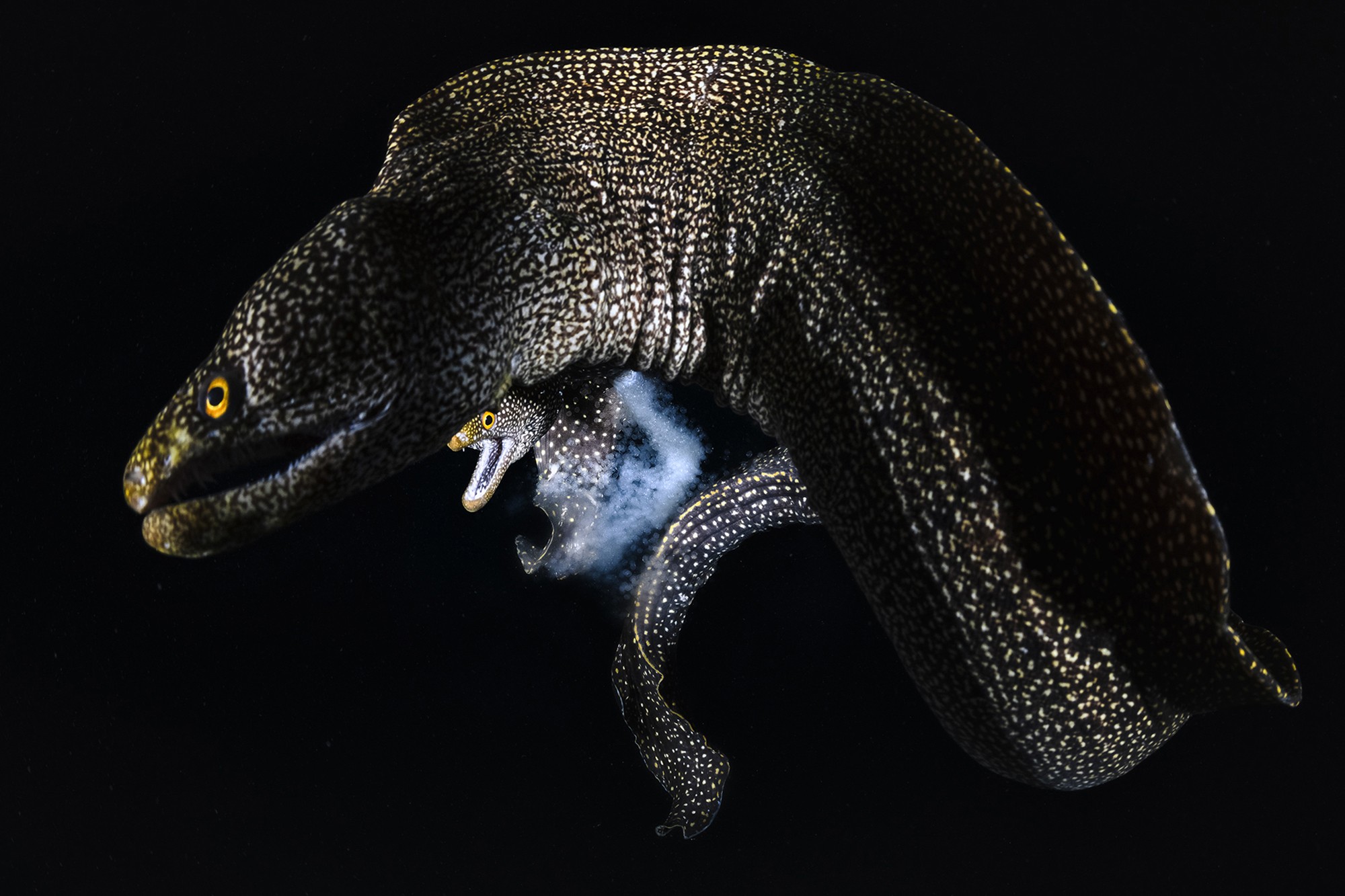
Making Morays. Winner, Under Water. Tony Wu provides a first-time glimpse into the mating ritual of Abbott’s moray eels. Wu has been working with biologists to address a knowledge gap of the social behavior of this eel species. Guided only by a dim red-light source to minimize disturbance, and using a customized fisheye camera lens, he has studied this male since 2024 as it visits females that dwell in crevices on the reef.
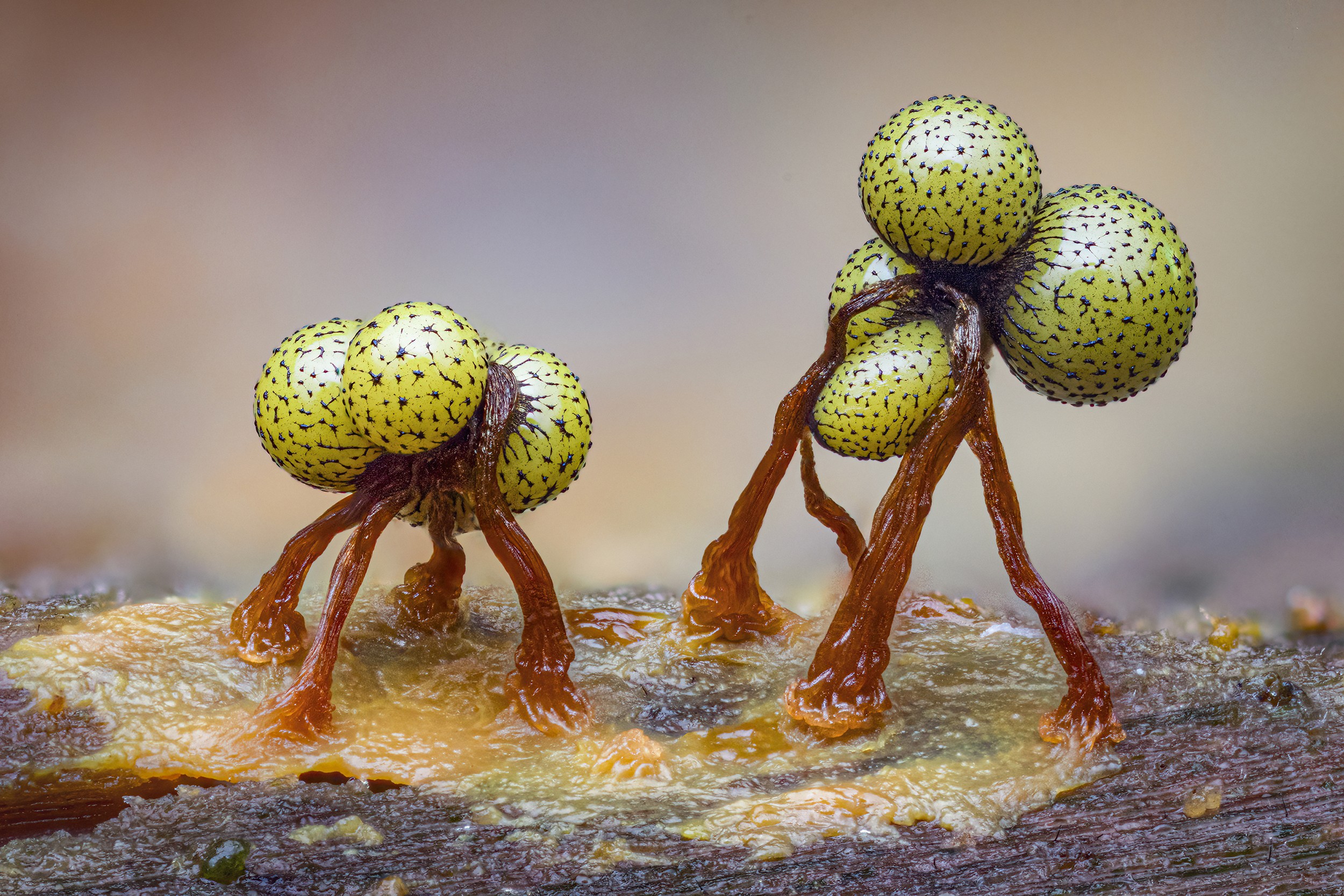
Tiny Dancers. Winner, Portfolio Award. Kutub Uddin reveals a magical and often surreal world of slime molds that can barely be seen with the naked eye. Fine threads, known as capillitium, emerge on the round, yellow-green bodies, which will eventually help disperse reproductive spores.
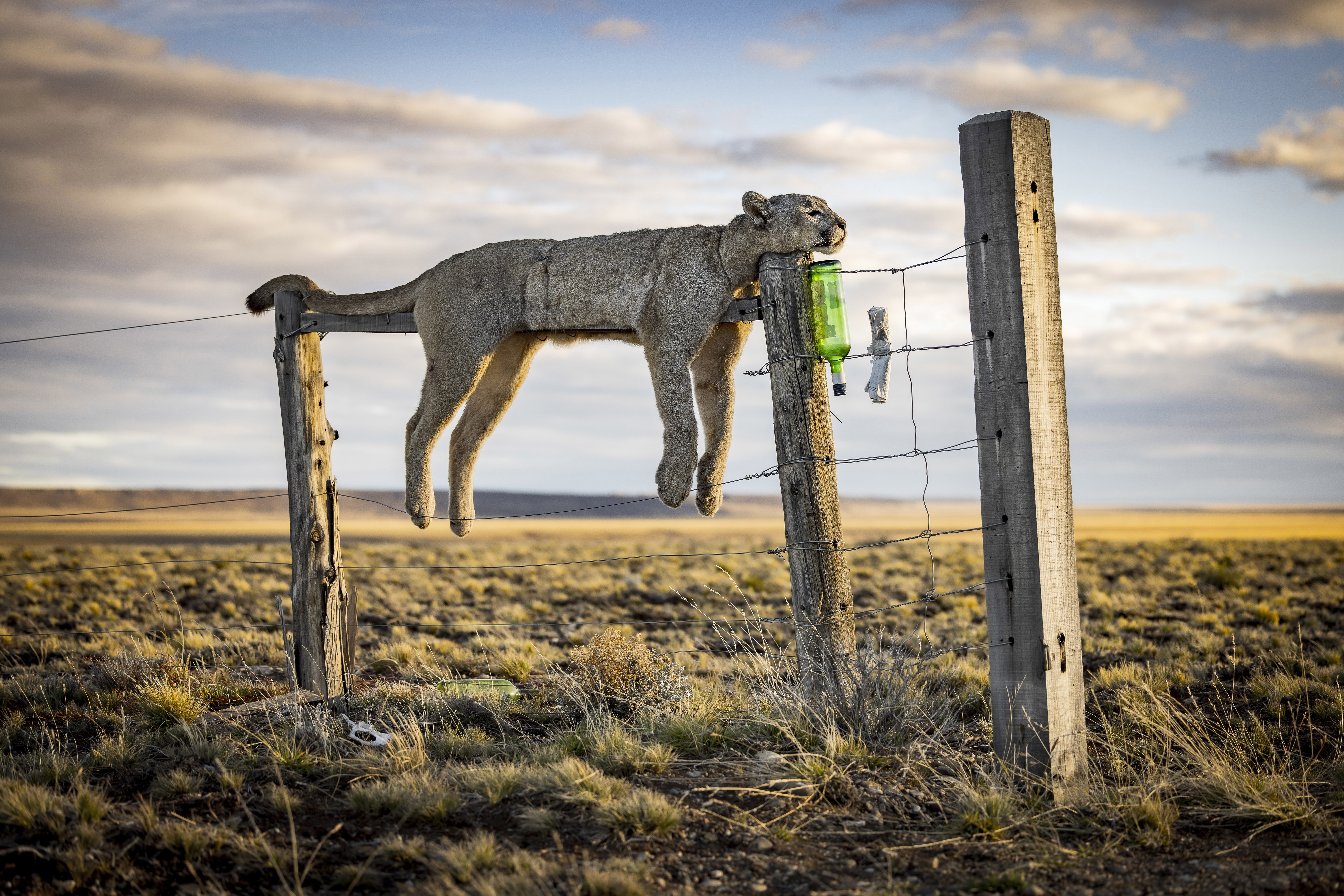
Warning Sign. Winner, Photojournalism. Francisco Negroni recorded this scene of a dead puma amid the rugged, windswept beauty of Argentine Patagonia. Tied to the fence and presented as a hunting trophy, this display was one that Francisco had “never witnessed or photographed before.” In 2025, Santa Cruz banned the hunting of pumas, but illegal persecution continues.
A Watchful Eye. Winner, Animal Portraits. Aaron Sanders glimpsed a common octopus behind a curtain of kelp in the waters off southwest England. Sanders was diving off Porthkerris Beach when he noticed the footprints of octopus suckers through a thin blade of kelp, and a single eye slowly emerging. “We remained perfectly still, watching one another with a seemingly shared curiosity,” Sanders said.
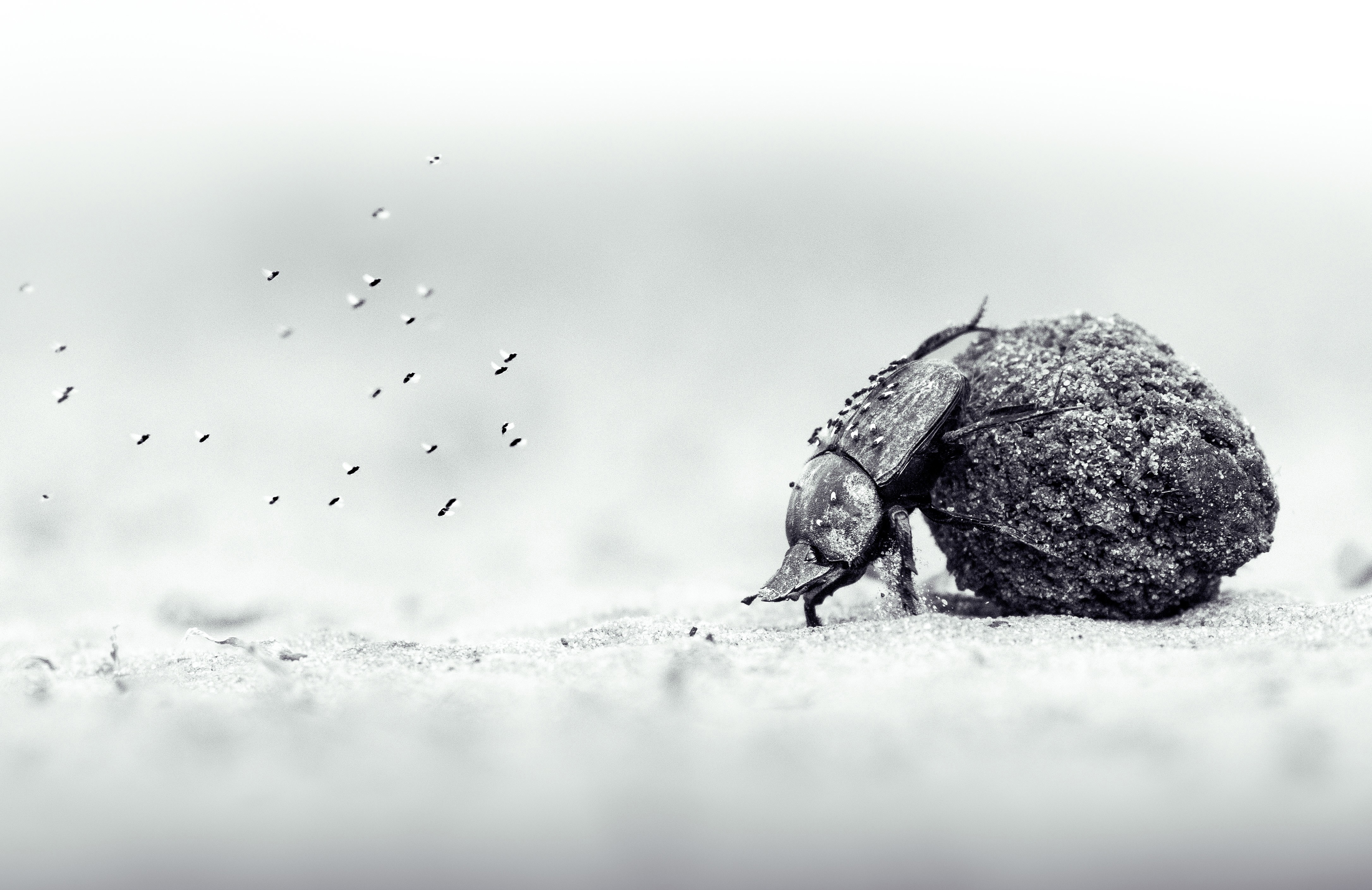
Labour of Love. Winner, 11-14 Years, Young Wildlife Photographer of the Year 2026. Oscar Whitfield noticed the arduous exertion of this dung beetle pushing its precious cargo. Using a fast shutter speed and high light sensitivity, Oscar lay flat on the ground to photograph the beetle at eye level, with the sunshine and heat creating dry dust all around him.
Night-Time Catch. Winner, Oceans: The Bigger Picture. Alex Lindbloom found a whale shark investigating the catch of a “bagan,” or mobile net-fishing platform, in the inky waters off Papua. Alex started searching for sharks around dawn when the nets were still in the water. Initially lacking natural light for his drone’s camera, he found these sharks illuminated by the bagan’s bright lights.
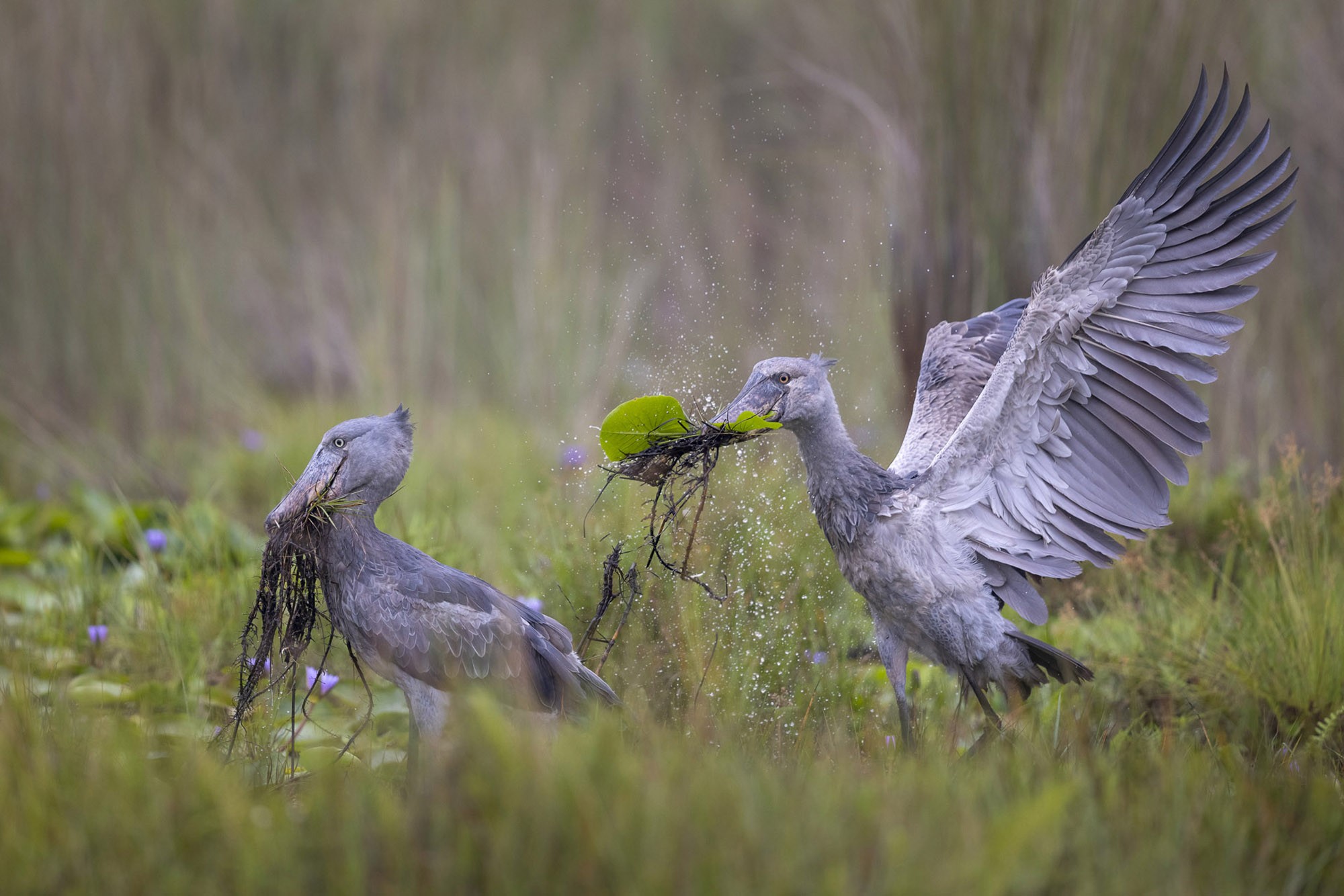
Scenes from the Swamp. Winner, Behaviour: Birds. Isak Pretorius chanced across two elusive shoebill storks among wetland vegetation. Exploring the swamp in a narrow canoe with a guide, Isak felt exceptionally lucky to see not one but two shoebills. The birds pulled out vegetation, dropped it, and then repeated the process several times. It’s likely that this was a breeding pair gathering nesting material.
The Aftermath. Winner, Behavior: Mammals, and Overall Winner, Wildlife Photographer of the Year 2026. Federico Veronesi witnessed this powerful moment of an elephant carrying a dead calf, a rare glimpse into complex animal behaviors. Veronesi was tracking elephants when he came across an unusual pattern of drag marks in the sand of a dry riverbed. The source became clear when he caught up with a family group. A female emerged with the calf, its leg wedged between her tusk and trunk. Behaviors centering on death have been observed in both Asian and African elephants, including vocalizations, guarding the dead, inspecting and handling bones, and carrying the deceased. Some researchers suggest these behaviors could indicate an elephant’s journey to understanding death, while others interpret these actions as possible displays of grief.
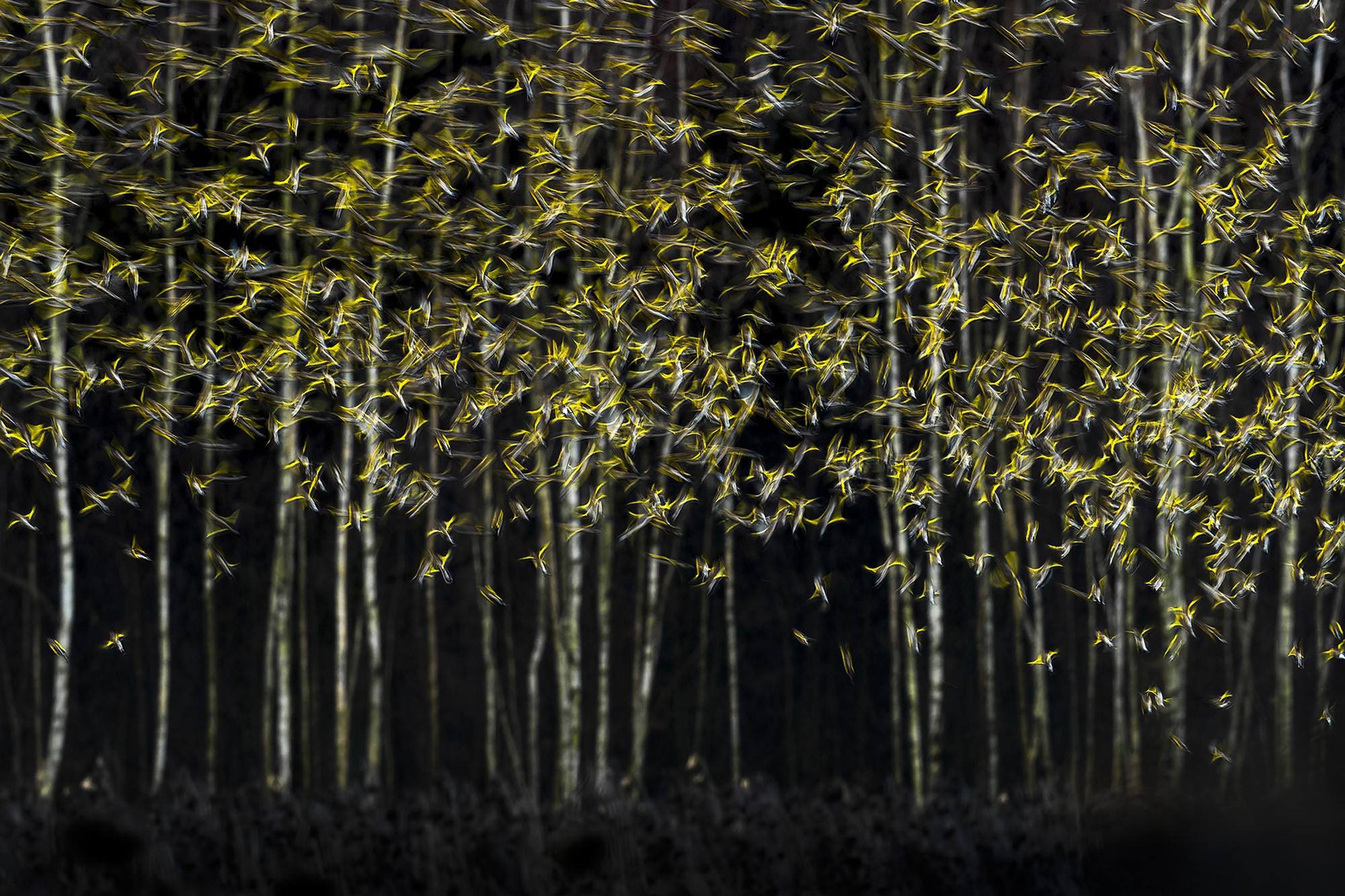
Escape Artistry. Winner, Natural Artistry. Michał Michalski used a slow shutter speed to create the illusion of trees still swathed in autumn foliage. Michalski was in a field of unharvested sunflowers that had attracted mixed flocks of birds, especially goldfinches and bramblings. As they took to the sky, startled by a sparrowhawk, Michalski blurred the movement against a backdrop of leafless birches.
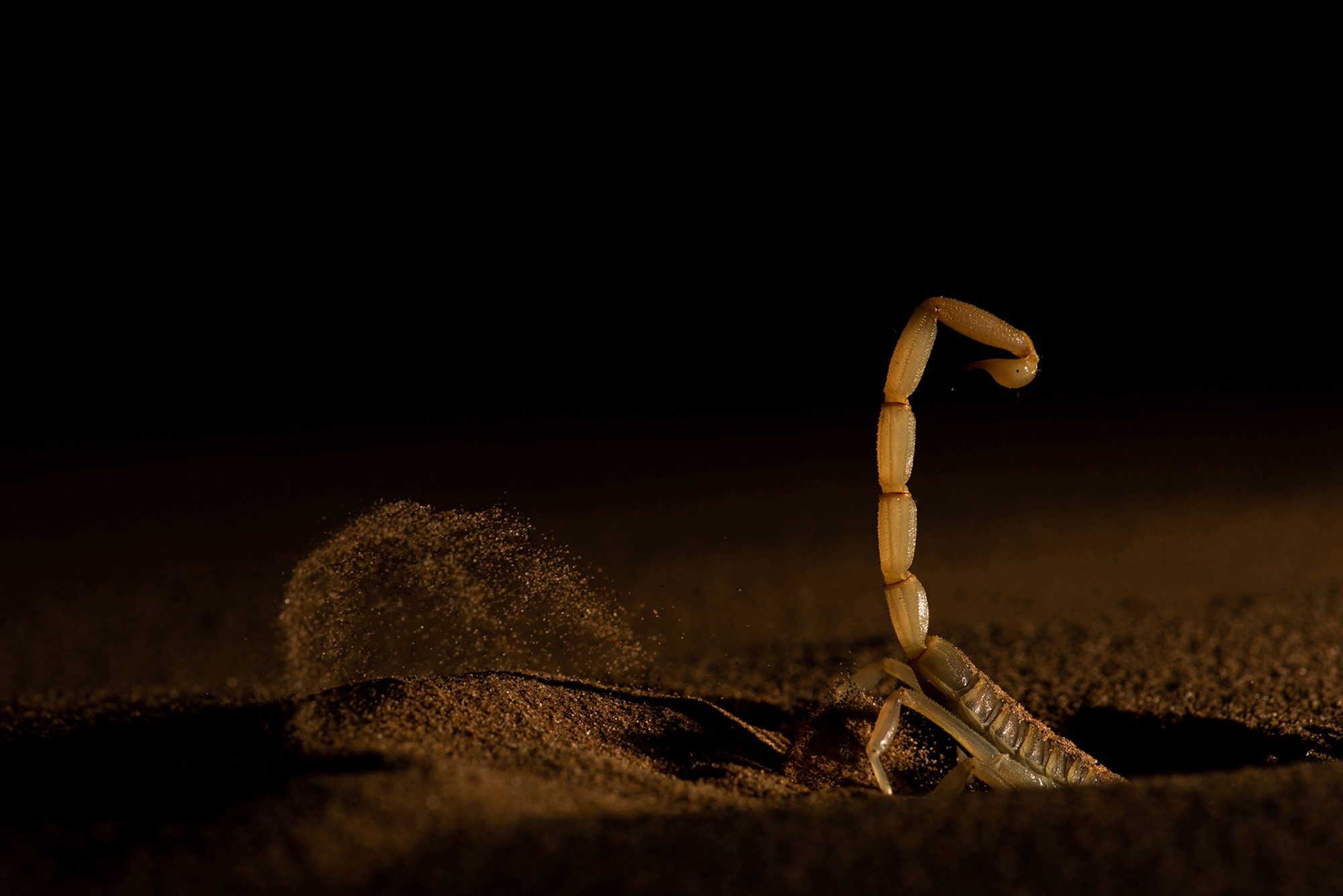
Shifting Sand. Winner, Behavior: Invertebrates. Sitaram Raul encountered a scorpion burrowing into one of the shifting dunes of the Thar Desert in India. Exploring the dunes at night near the village of Sam, Raul saw many scorpions searching for prey. But as sunrise approached, they started burrowing to avoid the intense heat. Raul timed the exposure so that the excavated sand was suspended in midair.
Wildlife Photographer of the Year is developed and produced by the Natural History Museum in London. Captions are provided by the photographers and WPY organizers, and are lightly edited for style.
“The Meeting Place.” Winner, Animals in Their Environment. James Lewin watched a young bull elephant spray a group of zebras as they congregated in the Kenyan Chyulu Hills.
You’ve almost certainly had RSV. Most of us catch it before we turn 2. Usually it feels like a cold: runny nose, cough, maybe a fever. But RSV (short for “respiratory syncytial virus”) can take a dangerous turn. In the United States, it puts more babies in the hospital than any other virus and kills thousands of seniors each year. Cases tend to climb as the weather cools—so, right about now.
Health Secretary Robert F. Kennedy Jr. seems to be intent on spreading the word about RSV: He brought up the virus during interviews on both CNN and Fox News in August. He could have used those appearances to remind viewers about the RSV vaccine, which the FDA first approved in 2023 and the CDC recommends for older adults and for women in the later stages of pregnancy during the fall and winter. Instead, Kennedy made two false statements. First, on CNN, he called RSV “the biggest killer of kids in this country today.” (According to the CDC, it isn’t; cancer claims more children’s lives.) His other whopper was weirder: In both appearances, he blamed RSV on a scientific experiment gone wrong, saying on Fox that it “came from a laboratory” and on CNN that it came from gain-of-function experiments, or something like them.
To be clear, RSV did not leak from a lab. But Kennedy has been repeating this fiction on podcasts for years, and he included it in his 2021 book, The Real Anthony Fauci. Even in that compendium of dubious and debunked assertions, Kennedy’s theory about RSV—which involves nonhuman primates, a military research facility, and, of course, vaccines—stands out. It’s a case study in how, as an anti-vaccine activist, he has trafficked in half truths and half-baked narratives, and how he relies on loyalists who reinforce his beliefs rather than experts who can challenge them. Kennedy could easily have consulted the historical record or reached out to subject-matter experts. Instead, as he’s done frequently during his nearly two years as health secretary, he parroted the flawed research of an activist ally.
Kennedy claims RSV originated in captive chimpanzees, and then spread to humans. On a 2023 podcast, he said scientists deliberately infected a lab worker with the virus. In The Real Anthony Fauci, he endorses a different theory, writing that the virus “entered polio vaccines at the Walter Reed Hospital laboratories in 1955” and caused a “devastating pandemic.” It’s part of his absurd argument that polio vaccines caused more harm than the potentially paralytic disease itself.
In fact, RSV’s discovery did begin in a laboratory, with chimpanzees getting the sniffles. In October 1955, 14 chimps housed at an annex of the Walter Reed Army Institute of Research in Silver Spring, Maryland, all came down with what seemed like a cold. Scientists set about determining what made them sick, swabbing their throats and taking blood samples. Researchers isolated the virus and intentionally infected another group of chimps. In February 1956, a lab worker who had contact with the second group of chimps fell ill. Tests indicated that the worker and the chimps had the same virus.
If that were all you knew, you might think Kennedy was onto something: Chimps get sick, a lab worker catches it, and a novel pathogen is thereby unleashed on humanity. It’s a compelling story and one that supports Kennedy’s thesis that scientists, rather than diligently searching for the cures to what ails us, are courting disaster with their reckless experiments.
But the real story doesn’t end there. Evidence soon emerged that RSV had been circulating in humans long before it was found at Walter Reed. In 1957, researchers at Johns Hopkins University reported that 80 percent of the children they had tested in Baltimore had antibodies to the virus by age 4. Inmates at a federal prison in Ohio had antibodies too. Those findings strongly suggested widespread, long-standing human infection rather than a virus suddenly escaping from a chimp colony. The Johns Hopkins scientists surmised that the virus might be of human origin and had been “introduced into a susceptible population of chimpanzees.”
More solid proof of that hypothesis came decades later. A study published in 2007 detected RSV proteins in preserved lung tissue from a child who died in 1931, nearly a quarter century before the chimp outbreak. The authors called it “the earliest confirmed case of RSV infection ever reported.” Other evidence points back even earlier. Descriptions of an illness researchers believe was likely RSV can be found in accounts from the 19th century. An 1819 treatise refers to an “acute suffocative catarrh”—that is, a thick buildup of mucus—that matches RSV’s characteristic symptoms. A recent analysis of genetic changes in RSV estimated that ancestors of today’s virus have been circulating for hundreds of years.
I spoke with several RSV researchers about Kennedy’s theory. None of them gave it any credence, including Philip Roane, who was a technician at Johns Hopkins in the mid-1950s and helped identify the virus in children. (Roane, who is now 98 and a microbiology professor at Howard University, wasn’t given formal credit on the 1957 paper, but he received a box of chocolates and a bottle of scotch from the lead author.) When I told Larry Anderson, a professor emeritus of infectious diseases at Emory University and a longtime RSV researcher, what Kennedy had said, I had to wait until he stopped laughing to get his answer. This isn’t a theory that researchers I spoke with—some of whom have spent decades studying RSV—take seriously.
But Kennedy still had to get that theory from somewhere, right? In The Real Anthony Fauci, Kennedy cites a 2021 article, “From Chimpanzees to Children: The Origins of RSV,” by Lyn Redwood. The relationship between Kennedy and Redwood, a nurse practitioner and anti-vaccine activist, goes back to 2005: Redwood, who believes that her son’s autism was caused by exposure to a mercury-based preservative in vaccines, was among a group of activists looking to recruit prominent figures to support their cause. Kennedy credits her with helping persuade him to take on the issue of vaccine safety.
In her article, Redwood, who is now a senior adviser to the health secretary, suggests that RSV-infected cells from Walter Reed chimpanzees might somehow have made it into the polio vaccine. The tainted vaccine, in turn, could have infected millions of children who received it in the 1950s. But that speculation rests on an obvious error: The kidney cells used to produce early polio vaccines came from monkeys, not chimpanzees. Redwood conflates the two in her article, referring to the chimps at Walter Reed as “sick monkeys.” When I contacted Redwood recently, she defended her article, saying she did not believe the evidence that RSV had been circulating among humans before 1956, even after I sent her the paper about the 1931 tissue sample. (She didn’t respond to an email noting the monkey mistake.)
As for whether RSV made it into the polio vaccine, she told me that she “just posed the question” and that anyone who claimed otherwise would be “misrepresenting my article.” In his book, Kennedy does precisely that: He cites her article when he writes that the virus spread via polio vaccines. What began as confused conjecture by Redwood was repackaged by Kennedy as simple fact.
When I asked HHS for clarification on Kennedy’s views, a spokesperson told me in an email that RSV “originated from a troop of infected chimpanzees,” and that the virus “spread to lab workers and then to the public but not through vaccination.” None of that is true—and it contradicts the (also false) account in Kennedy’s book. When it comes to rewriting medical history, the health secretary can’t even keep his fictions straight.
This article was featured in the One Story to Read Today newsletter. Sign up for it here.
Typically, the Justice Department’s Civil Rights Division focuses its voting-rights efforts on ensuring that Americans are free to cast a ballot. Under the second Trump administration, the division has trained its focus on a different project: strong-arming states to hand over sensitive voter information to the federal government. Since September 2025, the Department of Justice has filed lawsuits against 30 states and the District of Columbia to this effect.
“This is a top priority,” the division’s head, Assistant Attorney General Harmeet Dhillon, said on a podcast hosted by the right-wing influencer Benny Johnson last December. Examining these records would help DOJ identify supposed voting by noncitizens and stamp out voter fraud, Dhillon explained: “I think eventually we’re going to win these cases, all of them.” DOJ had never before sought to collect these data, and the ominous ambiguity as to what the government plans to do with the information left many experts and election officials alarmed over how this might be used to interfere with the midterm elections. In a letter to the Justice Department, a group of Democratic secretaries of state voiced “immense concern” over DOJ’s apparent plans to share the data with the Department of Homeland Security.
Nearly a year later, however, the number of victories secured by the Justice Department in this litigation stands at zero. DOJ has lost 26 cases in district court and triumphed in none; Judge Sparkle Sooknanan, in Washington, D.C., handed the administration its latest defeat just last Friday. (Several cases remain pending.) The administration’s demands have been rejected by judges appointed by Democrats and Republicans—including several nominated by President Trump himself—a run of losses that represents an embarrassing defeat for Dhillon’s project. More important than humiliation: DOJ’s wipeout demonstrates how America’s decentralized system of elections, aided by the courts, is working to limit Trump’s efforts to corrupt democracy. Anxious narratives about his administration interfering with elections often portray the president as a figure who “can just will his fantasies into existence,” says Justin Levitt, an election-law expert at Loyola Law School and a former deputy assistant attorney general in the Civil Rights Division. But the Justice Department’s prolonged losing streak, Levitt told me, “is a pretty clean rebuttal” of Trump’s supposed invincibility.
Elections in the United States are conducted at the state and local levels, and the federal government has little involvement or control over how officials across the country manage the voting process. State and local jurisdictions maintain their own voter rolls—detailed records of voter information that can include sensitive material such as addresses, driver’s licenses, and partial Social Security numbers. But Trump, seeking to eradicate a supposed plague of voting by noncitizens, has clashed with this system. (In reality, such illegal votes are extraordinarily rare.)
In March 2025, Trump signed an executive order tasking DOJ and the Department of Homeland Security with comparing state voter rolls against DHS systems. The plan had many problems. On the federal government’s end, the DHS program that the White House seemed to have in mind as a basis for comparison—Systematic Alien Verification for Entitlements, or SAVE—was not originally designed to serve as a master list of citizens and can be glitchy and incomplete. Many states were unimpressed by the demand. “Go jump in the Gulf of Maine,” Shenna Bellows, Maine’s secretary of state, said on receiving DOJ’s voter-file request in July 2025. The federal government had no authority to make such a request, Bellows told the Maine Morning Star:“If Congress thought it was appropriate that there be a national voter file, Congress could have authorized the Department of Justice to do that, but they have not.”
A number of red states willingly agreed to hand over their voter files to the Civil Rights Division, but most states—concerned about upholding their obligation to protect residents’ privacy—took Bellows’s approach. Then, in September, DOJ went to court. “American citizens have a right to feel confident in the integrity of our electoral process,” Dhillon said in a statement announcing the first lawsuits, against Oregon and Maine. The initial suits targeted blue states that were familiar adversaries of the Trump administration. As time went on, though, the Civil Rights Division began to file cases against purple states and even those of the deepest ruby red—such as Oklahoma, West Virginia, and Idaho. “We will continue to work closely with our federal partners,” Idaho Secretary of State Phil McGrane, a Republican, wrote in a letter to the Justice Department. But, he said, he could not share the voter rolls “in the absence of a clear legal requirement that Idaho provide a copy of its complete, unredacted voter list.”
Dhillon regularly posted chirpy announcements on X heralding new lawsuits against states and providing updates. Behind the scenes, though, things were not going smoothly. The DOJ attorneys whose names appeared on court filings, several of whom had worked to cast doubt on the 2020 election results before joining the department, appeared to be struggling under the weight of litigating dozens of cases nationwide. DOJ requested voter data from the wrong officials, spent months emailing an incorrect address in Oklahoma, filed two cases in the wrong court, and uploaded a court document with internal comments still in the PDF. (Oklahoma eventually settled the lawsuit and provided its rolls.) At one point, the department trumpeted a judge’s ruling in Connecticut as a significant victory when the order did little more than set a schedule for the case.
DOJ’s lawsuits against red states also alienated potential GOP allies, especially when the Civil Rights Division sent out an aggressive letter that seemingly hinted at potential criminal prosecution for the election officials resisting DOJ’s demands. “This is truly bizarre behavior by the federal agency that is supposed to be protecting civil rights,” Utah Lieutenant Governor Deidre Henderson, a Republican, posted on social media. Even in red states that had agreed to share their voter records, the process was bumpy. After comparing its voter rolls against the SAVE database, Texas identified more than 2,500 voters as possible noncitizens, and some counties began removing them from the rolls; at least some of those individuals turned out to be Americans who had legally registered to vote.
In court, DOJ’s main issue has been that it simply has no legal basis for its requests. Two of the statutes that it relied on in early cases, the Help America Vote Act and the National Voter Registration Act, don’t authorize the sorts of requests being made. Judges disagreed over whether the main statute wielded by DOJ, Title III of the Civil Rights Act, applied to the voter rolls at all. Even if it did, many judges agreed, DOJ had provided no reason to think that an investigation under Title III was justified. The Justice Department’s arguments would allow it to “embark on a fishing expedition of voter records in any state looking for concerns, without identifying a single issue with the state’s policies beforehand,” wrote Judge David O. Carter of the Central District of California.
Judge Carter and Judge Sooknanan pointed to the Privacy Act of 1974, a federal statute that imposes civil and criminal penalties if the federal government does not go through certain processes before collecting sensitive personal information. Justin Levitt told me that this reasoning could spell trouble for the department when it comes to the voter rolls collected voluntarily from red states. “I think it’s very hard to read this analysis and not think that in other instances, where they did get the data, that somebody committed a federal misdemeanor,” Levitt said. (Along with other alumni of the Civil Rights Division, he filed amicus briefs against the government in many of the voter-roll cases.)
DOJ has continued to rack up losses over the course of 2026. In June, the U.S. Court of Appeals for the Sixth Circuit, the first appeals court to weigh in on the issue, ruled against the government. “Very powerful dissents!” Dhillon wrote on X in August, after the Sixth Circuit declined to reconsider the case. Attorney General Todd Blanche suggested in August that DOJ might ask the Supreme Court to intervene, but the department has yet to do so. And the defeats are still rolling in: Last month, judges tossed out cases in Washington, Vermont, and Georgia. Judge Sooknanan’s ruling last week found the entire, nationwide program of seeking voter rolls to be unlawful—a particularly harsh reprimand.
Many of the judges who dismissed DOJ’s lawsuits expressed concern about the lack of clarity regarding what the federal government plans to do with the data. “It appears that the DOJ is on a nationwide quest to gather the sensitive, private information of millions of Americans for use in a centralized federal database,” Carter wrote in his opinion. Several judges, pointing to press reports, raised questions as to whether the government intended to somehow use information contained in the voter rolls as part of an immigration-enforcement dragnet.
Even if DOJ and DHS had been able to cobble together that exhaustive list, there is no obvious mechanism by which the federal government could use such a database to upend an election. “It’s a massive disconnect,” Levitt said, paraphrasing the administration’s reasoning: “Step one, collect voter files. Step three, elections with integrity. What’s step two?”
Had the Trump administration somehow identified supposedly illegitimate registrants on the voter rolls, it would not have been able to force states to remove voters against their will. Recently, for example, DHS informed Nevada that it had uncovered almost 16,000 potential noncitizens on the state’s publicly available voter lists, which lack the sensitive personal information that DOJ has been working to obtain. Under scrutiny, DHS “confirmed” only 185 of those names; according to Nevada, zero were actually noncitizens. Likewise, on Tuesday, DOJ sent similar letters to California demanding that the state withhold ballots from a list of “likely noncitizens” if it could not prove their citizenship. But even if California wanted to comply, the National Voter Registration Act prohibits mass purges of voters in the 90 days before the election. (Last year, in a decision now under review by the Supreme Court, the U.S. Court of Appeals for the Ninth Circuit found that this provision also applies to potential noncitizens.)
DOJ’s quest for voter rolls is only one strand of the Trump administration’s larger effort to meddle with the midterms. Many of those plans have likewise fallen flat or been barred by the courts, such as the administration’s attempt to effectively make mail-in voting impossible. Others, such as DHS’s effort to bulk up the SAVE database, are moving forward but will likely lack broad effect on the vote this time around.
The Justice Department’s misadventures in seeking voter rolls are a reminder that just because the Trump administration tries something, that does not mean the plan is well conceived or destined for success. In this instance, it has been defeated by election officials, both Democrats and Republicans, who were committed to the nonpartisan work of putting democracy into practice.
When some clever cultural historian writes the story of the Donald Trump years, this summer’s Ultimate Fighting Championship cage match on the White House lawn to celebrate the United States’ 250th anniversary will be a marker of … something: The 90-foot open-air “Claw,” near-naked gladiators, bloody faces, fireworks, and flyovers, with the most enduring remark coming from the heavyweight Josh Hokit, who told the podcaster Joe Rogan in his post-fight interview: “Michelle Obama is a man. Am I right, America?” The spectacle, the staff writer Helen Lewis says on Radio Atlantic, represented “a level of masculinity that was … so far across the dial that it tipped into camp.”
The second Trump administration rode in on a wave of masculinity-obsessed media. But the White House is unpopular, the podcast bros have withdrawn, and the midterms are only weeks away. Is it possible that the cultural-political force of extreme masculinity is losing its power?
Lewis and her fellow staff writer Sophie Gilbert joined me in a live Radio Atlantic taped at this year’s The Atlantic Festival to discuss the intriguing hypothesis that the culture has reached “peak testosterone” and may soon perhaps enter a more balanced phase.
We discuss evidence on both sides. Yes, the Tate brothers are facing extradition and prosecution abroad, but no, the U.S. does not feel all that much closer to electing a female president. Yes, James Talarico, mocked as “Low-T Talarico” by Texas Republicans, is ahead in the U.S. Senate race. But the requirement that all candidates prove their high-T quotient by filming themselves working out at the gym has been so widely accepted that Democrats are doing it too. The live debate went on, until it reached an absurd conclusion of encouraging women in the audience to buy more meat.
The following is a transcript of the episode:
Hanna Rosin: I had a thought. Maybe it was when I was watching race car after race car zoom loudly down Pennsylvania Avenue this summer—and a very buff man standing next to me, dressed in very tight red-white-and-blue overall-shorts getup, cheering. I had the thought that maybe we have reached peak testosterone. That is, this long era we’ve been living in, fueled by Donald Trump but also other cultural forces, such as the manosphere, has reached its organic comical extreme. And thus, the era might be on its way out.
It’s just a theory, but one I recently got to test.
[Music]
I’m Hanna Rosin. This is Radio Atlantic.
At The Atlantic Festival last month, I talked to two of my favorite writers on all things masculine and feminine, staff writers Sophie Gilbert and Helen Lewis, for a live taping of Radio Atlantic. Here is our conversation:
[Audience applause]
Rosin: We’ve all been living through an extended period of, let’s call it, masculinism. And by the way, I don’t even know if that’s a real word, but, you know, as in the opposite of feminism, like the general promotion of manly things. So there’s Pete Hegseth’s push-ups, J. D. Vance’s cat ladies, and a-lot-less-funny stuff, like the broad influence of the Tate brothers on teenage boys or the rollback of Roe v. Wade. And this has been building for maybe five, 10 years, depending on where you locate its origins. But there are signs that we may be shifting out of peak testosterone.
So that’s what we’re gonna talk about today. Is that true or not? I’m joined here today with Sophie Gilbert, who’s author of the book Girl on Girl and a Pulitzer finalist. Clap for Sophie.
[Audience applause]
Rosin: And Helen Lewis, whose first book is Difficult Women: A History of Feminism in 11 Fights, and more recent book is The Genius Myth: A Curious History of a Dangerous Idea, and more recently, the June Atlantic cover story, “The Men Who Fear Women.”
[Audience applause]
Rosin: Helen, I’m gonna start with you. What in your mind represents peak testosterone? What event or thing?
Helen Lewis: Well, if we’re gonna talk culturally and politically, then it has to be the [Ultimate Fighting Championship] cage fight on the White House lawn, which is one of the most American things I’ve ever seen in my life.
Rosin: Thank you.
Lewis: But it was also one of the most testosterone-fueled. It was like a movie you could’ve shown inside the film Top Gun.
Rosin: Right.
Lewis: That’s how I felt about it. But for those of you who don’t know: So Donald Trump has for a long time been friends with Dana White, who is the head of the UFC. That’s been a mutually very beneficial relationship to the two of them. And one of the things that he wanted to do was create this spectacle on the White House lawn, so he builds an octagon. And you have this, you know—the fighters walk in. One of the fighters starts in the Oval Office, right? Which to me, feeling slightly pious about it, is kind of, like—slight desecration to have some guy in leopard-print shorts strolling out, you know, to get seven bells punched out of him.
And it was just this very, like, hoo-rah masculine event. There was blood on the kind of tiles. And that’s when you get, immediately afterwards, one of the fighters says on the camera, you know, Michelle Obama’s a man. So you get this immense, like, disrespect for a kind of a beloved first lady with the other half of America. So, to me, it was this peak moment of, I guess, a level of masculinity that was, as it always happens, so far across the dial that it tipped into camp.
Rosin: Yeah.
Lewis: Which is what always happens with these things. It became absolutely, incredibly camp.
Rosin: No. 1, I feel slightly embarrassed having two people from the U.K. talk about this. (Laughs.)
[Audience laughter]
Rosin: It’s like, I do feel somehow responsible and like I have to apologize for it. And No. 2, it’s interesting what you said, because maybe peak and decline, they’re like—once you reach camp, maybe that’s not the sign that things are on the up, but the other direction. Do you have anything to add to the cage fight, watching it from over there?
Sophie Gilbert: No. (Laughs.)
[Audience laughter]
Gilbert: I mean, yeah, exactly everything that Helen said was exactly true. I mean, it’s astonishing. It’s astonishing. It’s so primal and so bloodthirsty and so absurd. But, as Helen said, we’ve hopefully peaked at this point.
Lewis: But the Tate brothers, who you’ve written about, they also sit on that line, where they’re at the same time very scary alleged sex traffickers, but also inherent to that is the campness, the incredibly tight trousers—
Gilbert: The tight trousers.
Lewis: —and the sockless [indecipherable].
Gilbert: Yeah.
Lewis: They coast that same line of peak masculinity, don’t they?
Gilbert: Well, in terms of thinking about peaks, yes. I think the moment when it became clear to me that things might be changing or going at least in a slightly different direction was the moment that the Tates were arrested, because they had seemed Teflon for so long. They obviously have political connections. They have connections inside the White House. They had felt protected. There have been so many cases against them in Romania, in the U.K., in the U.S., so many charges. I did not know that I would ever see Andrew Tate be arrested or have any kind of measure of justice for the things that he’s been alleged to have done. And so the fact that he has been arrested, he and his brother, and they are still in jail months later, I think is perhaps a sign that things are beginning to change.
Rosin: I wonder if they ordered their prison pants—
Gilbert: Tailored.
Rosin: —extra tight. Yeah. Is that a privilege that you can have in prison?
Okay, I wanna talk more about the trajectory of masculinism, but first I wanna spend just a little bit of time defining our terms, because as I’ve been preparing for it, one line that’s really stood out to me is that there’s two almost opposite brands of what masculinism is. There’s the very civilizing brand, like the religious sort of patriarch, J. D. Vance brand. And then this other sort of pagan, Man must be free to roam without the chokehold of the female HR executive, you know?
So in your cover story, you wrote a lot about the American religious-evangelical side of it. Can you talk about what that was like and what they believe?
Lewis: Yeah, I mean, it’s something that I’ve been thinking about since at least 2018, when I interviewed Jordan Peterson, who was very early to some of these ideas. And he kind of synthesized the two of them, this idea of man’s raw essential nature, which was essentially like yearning towards violence, and then you had to have the correct kind of mastery of it.
What masculine education meant was tempering your essential violent, uncontrollable nature. And it’s not surprising to me that he ended up moving more towards Christianity, because there is a kind of operating set of ideas that you will find in the work of, for example, people like C. S. Lewis, which is about the sort of civilization force of Christianity on men.
So in the piece that I wrote, I looked at both sides of them. One’s you’ve got kind of—there’s the strain that follows through Nietzsche, which is anti-Christian, which is about the idea of like the über-mensch. So Nietzsche thought that people were what he called learned cattle, what I guess we call now called sheeple or NPCs. But he thought that some people had the ability to attain, like, this will to power; they could kind of dominate everybody else. And so that is a very appealing message, I think, to young men who don’t feel a great sense of agency, who don’t feel like mini patriarchs. If you’re a 16-, 17-year-old boy, you don’t feel like the master of all you survey. So I think that is a very powerful message.
But then because it’s America, you also have this very straightforwardly Christian aspect. I talked to Douglas Wilson, who runs about—he’s the co-founder of a congregation of about 170 churches. And they are some of the—you know, he wants to roll back the Nineteenth Amendment eventually, which gave women the vote. And they draw on, for example, Saint Paul’s idea of headship. This is the idea that godly women should be quiet.
So they have a very old-fashioned Christian patriarchy, which then, as I write in the piece, blends very well with this other range of very traditional beliefs about, for example, race, about the kind of necessary, like, the Judeo-Christian heritage and the civil enforce and the European Enlightenments. So all of it kind of bleeds together. But one of the odd things is that you often find, kind of, the pagan and the Christian combined in the same person. So one of the people I interviewed—not Bronze Age Pervert, sadly—was Raw Egg Nationalist.
Rosin: Do you guys know who Raw Egg Nationalist or Bronze Age Pervert are? No. Okay.
Gilbert: They’re too online.
Rosin: We won’t go on. I really wanna talk about them, but everyone was like, No one cares, so leave it alone. But yeah. Just ’cause they are the voice of—they are like the id of the manosphere, in my mind. If you go back, they’re like the original sources of all the stuff you read in the manosphere. I went back and read them, and I was like, Aha, that’s why they all hate women. It finally made sense to me. And I’ll read you one quote from them, and then I promise I’ll move on. But go ahead. Yeah.
Lewis: Yeah. Oh, no, go on. Give us a little bit of Bronze Age Pervert.
Rosin: Can I do one or two? Yeah. Okay. I’ll do the stupid one and then the profound one. Here’s the stupid one: “There are women who are great scientists, but, like women who were great chess players, or poets, they are probably spiritual lesbians.” Good one, Bronze Age Pervert. Okay.
Lewis: Why not actual lesbians?
[Audience laughter]
Rosin: I don’t know. Okay. I don’t know what a spiritual lesbian is. (Laughs.) I have no idea. I don’t know. Okay. Here’s the one that does sort of explain the manosphere hatred of women, though. “Anyone born with a will to conquest and expansion, any specimen born to courage and the expansion of boundaries, will feel thwarted now, will awaken at a young age to find themselves in a world pervaded by an evil and smothering shadow”—that’s us—“that seeks to blot out their spirit and break them.”
Gilbert: This is what I say to myself in the mirror when I wake up in the morning.
Rosin: Yes!
[Audience laughter]
Rosin: You say it to your husband, like, How can I blot you?
Gilbert: How can I smother today?
Rosin: Yes. Who can I smother?
Lewis: It’s a really useful closed loop of reasoning, though. So when I interviewed Jordan Peterson, he went on Joe Rogan’s podcast afterwards, and they were kind of grudgingly nice about me. They said I was a varsity-level player, right?
Rosin: (Laughs.)
Lewis: But then he said that I was animus possessed, which is a concept that comes from Jung. And it’s essentially the idea that your masculine side—if you’re a woman, your masculine side is too dominant. So you have this situation in which, even if you’re a woman and you do have a will to power or a will to blather on, as I very clearly do, that’s actually because, again, you’re either spiritually lesbian or spiritually male. So you can always loop it back to the fact that actually these gender roles are actually incredibly rigid. And yes, there are some exceptions, but that’s because they’re secretly not really women in some profound way.
Rosin: Okay. All right. You’ve got the two strains down: the Rousseauian civilizing and the Hobbesian (Makes sound.) raw id, whatever. So, Sophie, after Trump was elected the second time, you wrote the article, “Misogyny Comes Roaring Back.” And is it fair to say, you seem almost in a state of shock at that moment? And I’m wondering if it’s shifted in the last two years. If you wrote that story today, would the tone and feeling of it be different for you?
Gilbert: There was something about that moment, I think—there has been so much about the second Trump term that has been the first but, like, unhinged. Like, off the chain. There are no adults in the room. There’s no one holding him back. Everything is just sort of unfettered Trump, and I think the misogyny comes hand in hand with that. So the quote that I was thinking of was—who’s the internet personality? Sorry, I’m forgetting.
Lewis: Are you gonna say Nick Fuentes?
Gilbert: Exactly, Nick Fuentes. When he had that tweet that was, “Your body, my choice,” and I think that was the state of shock that you are referring to, where it just felt like, Okay, this is different. This is—
Rosin: Different. (Laughs.)
Gilbert: This is honest, real. Total degradation of women is the goal. And this is what will—like, it felt so endorsed, I think, by—and it felt so powerful. And then two years later, I do think, as you said, Helen, we possibly have reached a peak, and I think to a lot of people, the really grotesque masculinism, the performances of just unfettered cruelty and hatred of women, it seems to be turning more people off at this point, which I think is slightly cheering if we’re looking for signs of hope on the horizon.
And you can see sort of the new popularity of candidates like [the U.S. Senate candidate] James Talarico, who are not like that at all, who are men who are able to appear in public and present a more gracious persona and a less obvious hatred of women and all that we smother.
Rosin: So let’s talk about James Talarico, who’s a really great test case of where we are as a nation on these issues. I know that you wrote about this race. The Republicans have tried every way to call him gay.
Lewis: Gay.
Rosin: Yeah. Right. It’s like low T.
Lewis: They’re like, He doesn’t even like barbecue.
Gilbert: Yeah.
[Audience laughter]
Rosin: Exactly. Yeah.
Lewis: Okay.
Rosin: Like vegan.
Lewis: Yeah, He’s vegan.
Rosin:He’s vegan. But last I checked, the polls show that he’s ahead. So—why are you making that face?
Lewis: No, ’cause I’m thinking the schadenfreude of it will be incredible. Because essentially, they had John Cornyn, who was a conservative Republican, and Donald Trump imposed instead Ken Paxton, who once stole a pen out of a security tray because he liked the look of it. This is the level of just, Oh, I’ll have that.
Rosin: Yeah.
Lewis: And so because they haven’t got a single positive thing to say about Paxton, his record, lots of people in the state Republican Party hate him, it has all just been hard negative on Talarico. And it’s like they’re just turning a dial that just says homophobia and sexism up and up and up, and waiting for it to bite. And I think Sophie’s right. If you look at the poll, and Talarico has been consistently ahead in a state that the Democrats have targeted for a long time, that ought to be a Republican slam-dunk race. Even in a wave year, they should be able to hold that, and it’s genuinely in contention, because Talarico is normal—
[Audience laughter]
Lewis: —it’s, like, the low bar. He has apologized for some of the wilder things that he said in the 2020 time, when everybody got a bit overexcited. And because he hasn’t—I mean, he’s done some pretty punchy ads about Ken Paxton, for example. Like, he’s not soft in that sense. He’s willing to punch quite hard, but he hasn’t, to your point, Sophie, gone in for the kind of cruelty.
Gilbert: Yeah.
Lewis: And I think that’s the point. I think whenever it moves into just being mean to individual people, I think lots of Americans still recoil at that. There’s obviously a small chunk of people who love the idea that they can crush their enemies and like, Yeah, show it to the libs in the HR department. But most people, I think, still are genuinely decent, and they don’t—they might be interested in this thesis about the great feminization, but being rude to individual people is still a line that they feel quite queasy about.
Rosin: I can’t tell if what you’re saying is this turning up of the dial of sexism only works in individual cases and in individual races; if you’re making a broader point that maybe it’s just not working anymore; or a whole third point, which is that it’s been absorbed. Like, James Talarico did try and eat a big turkey leg, so that he has kind of—I know. It’s sad to think about.
Lewis: What’s sad about eating a big turkey leg? That’s awesome.
Gilbert: I know, lucky him.
Rosin: It’s just sad about, like, responding to these accusations that you’re gay by eating—
Lewis: Yeah.
Rosin: —a turkey leg. It’s just the sequence of events is a little depressing. (Laughs.)
Lewis: Yeah, okay.
Rosin: So is the idea that we’ve absorbed—like, that is the language that we speak now, so you just kind of have to submit? Can you imagine, Sophie—who are the feminist, the women leaders? It’s sort of weirdly hard to imagine now, even though things have gotten better.
Gilbert: I know. I mean, this is the thing in terms of thinking about the state of feminism. We don’t have the figureheads that feminism has always had. And I was thinking about this with the loss of Gloria Steinem and Robin Morgan, women who were really at the forefront of this movement that was actually very successful and got a lot done. And they were berated, and they were hated in their lifetime, and they certainly have been trashed by all different kinds of people. But they managed to win substantial gains for women over the course of their activist lives.
And I don’t know who the figureheads are now. I mean, there are sort of individual people who have enormous cultural sway, like Olivia Rodrigo’s Daisy Chain festival, obviously, was significant for its kind of cultural power, I think. Just to see a celebrity of that ilk stand up for reproductive rights felt very powerful to me and surprisingly unusual, I think. But in terms of people who are helping define feminism as a protest as a sort of intellectual movement, I don’t know who we have right now, and that feels strange.
Rosin: Yeah. When you were reading about Gloria Steinem, ’cause you recently wrote about her, it was kind of an interesting experience because some of the things she said felt sort of old-fashioned from the ’70s and ’80s, and some of the experience of reading about her was like, Wow, nothing has moved. I’m curious what stood out to you of what she said or what that period was like compared to now.
Gilbert: There was an article that Ms. magazine, which Gloria Steinem founded, ran in the ’70s, and it was titled, Trashing: The Dark Side of Sisterhood, and it was about—I think it was kind of inspired by Steinem and how much she enraged other feminists. Specifically radical feminists, I think, felt that she was so mainstream in lots of ways.
To sort of see that tradition of tearing feminism apart by other feminists and to see sort of how little we’ve been able to move away from that and to work productively together. But also to remember that for all of the divisiveness, there were also moments in her career where she really was able to bring women together, and those were the moments when we had our most tangible gains, I would say. So as you said, a lot felt familiar, and it makes you think that nothing has really changed that much.
Lewis: I think it still feels very radical that she begins her memoir, the dedication is to the doctor who gave her an abortion when she was in her 20s.
Gilbert: Yeah.
Lewis: And you said, Promise me, you will never say what my name was, but also promise me you’ll live your life. And I think that even now, that still feels like a very edged thing. Lots of people would—that would still put their backs up, which, you know, 50 years later is, that still has that power—
Gilbert: Yeah.
Lewis: —I think is quite extraordinary. I mean, my analysis of the problem of feminism in America is that regardless of traditional ideas of left and right, this is a culture which is both very individualist in a very libertarian way—it’s very much about individual freedom to do things—and it is intensely capitalist. And those things are both really difficult for feminism. So I’ve just written—
Rosin: Wait, explain that in two more sentences.
Lewis: Well, I’ll give you the example, which is for the latest issue, I’ve written about surrogacy. I mean, in Britain, where Sophie and I live, there is a pretty well-developed feminist critique of that and from a labor-rights perspective, which is that surrogacy is paid for by rich women and mostly pursued by women who are much poorer than them. Some of those might be in other countries, in the developing world. Some of those might be in America. But there is a fundamental mismatch when one side can afford really good lawyers and the other can’t.
And I think that’s not the way that Americans tend to see it. They tend to see it as a matter of individual choice and consent. If the surrogate says yes, that’s, like, Who are we to question a woman’s bodily autonomy and choices? So I think that has been traditionally a really big problem for the feminist movement. It’s why I think the abortion-rights campaign succeeded on that, “My body, my choice,” because that’s a very American way of putting it.
And then the capitalist part of it, again, is about, you know, freedom to buy things, freedom to own things, but it’s very difficult. Women’s lives, because of childbearing, necessarily follow a different path in aggregate to men’s, and that is something that is, Is it your individual choice to have a child, or are you doing something for civilization and society that then the state should have a role in supporting? Because it is still seen as like, But you chose to have a child, so why are you not responsible for that?
Lewis: Whereas the European social-democratic model is much more open to the idea that children are a social good, and it’s all of our responsibility to pay for them.
[Music]
Rosin: After the break: why it feels like one of the worst things you can be in politics today is a woman.
[Break]
Rosin: The other thing that I wanna talk about—we’ve talked a lot about the Republicans. It’s easy to talk about Trump, the manosphere, and testosterone. The Democrats are a new phenomenon, a little kind of different and interesting what’s happening there. And I will bring us back to a gym in Dearborn, Michigan.
Lewis: Yeah.
Rosin: Where Hasan Piker—
Lewis: Yeah.
Rosin: Who’s a sort of lefty streamer, and [Abdul] El-Sayed, who’s running for office in Michigan, were—what were they doing, Helen?
Lewis: Well, they were doing some—oh God, I’m gonna get the names of the exercises wrong.
Rosin: Deadlifts?
Lewis: Yeah, I definitely watched them do, I think some, like, Turkish pull-up, which is a thing you do with a kettlebell. They were also bench-pressing. Abdul El-Sayed, who is the Senate candidate in Michigan, he can bench-press 315 pounds.
Rosin: Which you know. We all know, and it’s actually kind of important that we all know this, ’cause they have Muslim-sounding names, which right now is, like, the Republican Party can sort of put your picture up and just say “Muslim.” And El-Sayed doesn’t say he’s part of the [Democratic Socialists of America], but he’s sort of DSA affiliated. And so it almost feels like the working out makes you extremely socially acceptable or something, and that’s a very weird logic. But I’m wondering how you interpret them very ostentatiously working out.
Lewis: But it’s about redressing this idea that to be a liberal is to be a kind of effete, pencil-necked, you know, like, not a real man’s man.
Rosin: Mm-hmm.
Lewis: There’s a bit—
Gilbert: Soy boy.
Lewis: Yeah, a soy boy, exactly. You know, like a cheesy Millennial. So, you know, they are both—
Gilbert: It all comes back to tofu.
Lewis: They are both out working out. And there’s a line just after they did the bench press, which is an upper-body exercise, where Hasan Piker says, Haley Stevens couldn’t do that—who was the woman, primary opponent of Abdul El-Sayed. And me, getting on my little feminist high horse, was like, Actually, women’s upper body strength is one of the most sexually dimorphic things that there is. So of course she can’t bench-press 350 pounds. She doesn’t have, like, circulating testosterone at your level. But it was a really interesting moment of, like, Ha, women. Ha, they’re weak.
Rosin: Right.
Lewis: And I think that’s the word that I think Democratic men are most frightened of at the moment. When I interviewed [California Governor] Gavin Newsom for the magazine, he said he’d got this line from Clinton, which was like, Voters would rather you were strong and wrong than weak and right.
Rosin: Mm-hmm.
Lewis: And I think that’s something that Donald Trump has internalized.
Gilbert: Mm.
Lewis: Part of the idea of being a man and a leader is just like, I’m the decider, and maybe I decide things wrong, but I get to do that ’cause I’m the decider. And being too consensual is seen as feminine. You know, you’re like, You wanna have a hippie drum circle, and everybody’s just gonna talk about their feelings until you all come to a mushy consensus. No, what men do is men tell you things, and then other people do them.
So I can see that they—you know, and I think El-Sayed is an incredibly talented political candidate, but he has definitely got and embraced a kind of masculine aggression. Like, he’s very much a debate bro, right? He will argue with you in the ways that I don’t see other candidates doing. But you’re seeing it with, you know, [former Transportation Secretary] Pete Buttigieg, who, I think if he runs for president, will lean very heavily on having served in the military, for example. These very traditional ideas of masculinity are still things that voters like and that Democrats feel that they need to embrace.
Gilbert: What you were just saying about being strong and wrong, it made me think it’s not actually just an American phenomenon, ’cause it was [former Prime Minister] Keir Starmer’s downfall in the U.K., the idea that he was seen as sort of mushy, couldn’t make decisions, couldn’t stand by his principles, would have, like, a 10-person meeting for every tiny thing he had to do.
Lewis: Yeah, there was a description of him that I think famously did, from one of the biographies of Keir Starmer where it described him being like a driverless train, like the DLR, which is the automated trains in London. Like, It’s going somewhere, but one’s doing the pedals.
And I think that is something that we associate with masculinity. And you’re right; it makes it hard for female candidates, because if you’re a female candidate, how do you access that level of, like, I just tell people what to do without becoming the Karen, the school mom, the nag? You know, all of these negative stereotypes we have about female authority.
Rosin: Okay, but just let’s surface what we just said here. It’s profound actually. So the Republicans or MAGA has reached this sort of peak cartoonish, practically camp masculinity, and then as it rolls down the hill on the train, obviously driven by a woman, it’s careening off. But what’s happened is: It, like, seeps back up and becomes so mainstream that the Democrats pick it up as a kind of necessity. Like, even take what Democrats define, like, their almost embarrassingly desperate search for a working-class candidate. What is it that they define as working class?
Lewis: Jobs that men do.
Gilbert: Yes.
Lewis: It’s being an oysterman; it’s being a logger. It’s not being a nail technician.
Rosin: Right.
Gilbert: Yeah.
Rosin: Exactly. Which is a working-class job. Which is a working-class job.
Lewis: Exactly, done by many immigrants in America, yeah.
Rosin: Yeah. So Pete Buttigieg is an interesting example. It feels like, Democrats or the left—one choice would just be to sort of speak this idiom and go to the gym and bench-press and have everybody know how much you can bench-press. Another option would be to slightly expand the definition of masculinity such that it could possibly include a gay dad who served in the military. Does that just seem ridiculous? Like, if I say that out loud, you’re like, That will never happen, or, That won’t happen now. That’s going too far.
Gilbert: No, I think that makes sense. I’m thinking about Jon Ossoff, who was a documentary filmmaker before he was the senator in Georgia. Expanding masculinity feels fruitful at this point.
Lewis: Yeah. I feel less optimistic than you. I think there’ll be such tension in the Democrats about, This is the most important election of our lifetimes. We have to find the kind of candidate that we feel, like, least tense about. I mean, I hope it’s not true. The Democrats took a chance on Barack Hussein Obama, with his middle name and all this kind of stuff, and it worked out for them. And I hope that they can find it in themselves to look at candidates who don’t look central-casting masculinity next time. But I worry they’ll think, Oh, no, other voters are sexist. Other voters are homophobic.
Gilbert: Do you think there’s any chance that there’s a female candidate? I don’t either.
Rosin: Let’s take an audience poll. Any chance there’s a female candidate? No. No. No. No.
Lewis: Unless AOC goes for it, but I think, it doesn’t—
Rosin: Too soon.
Lewis: Yeah, and I think the announcement about her freezing her eggs, that’s not the kind of thing you do when you’re about to embark on a presidential cycle. So it’s a shame. And Gretchen Whitmer, the governor of Michigan, essentially ruled herself out. So I think we could be looking at another, like, total sausage-fest debate stage, basically. Yeah, like it’s ’92 again.
Rosin: You heard it here, guys. Sausage-fest debate. Okay, so we’ve talked a lot about politics and where we are. Sophie, I wanna ask you about realms other than politics. What about in culture? You and I have talked about this. In your book Girl on Girl, I mean, the message is that Millennials grew up with a sort of ’90s, early-aughts culture that put bad ideas about women in their heads. How have you seen that evolve? Like, if you wrote the book about, you know, 2020s pop culture and women. It does feel different. It does feel like women have a lot more agency. You mentioned Olivia Rodrigo, but what do you think?
Gilbert: I mean, this is the one thing that I keep coming back to, because it’s a sign of a positive. Like, there aren’t many; we cling to the ones we have. But in terms of mainstream culture, it’s so much better than it was in the 2000s. In the 2000s, there were no women in movies at all. If women were present in movies, they were bitchy girlfriends who were annoyed that their husbands are going to Vegas, or they were, you know, bombshells in bikinis, or they were sort of crones who were figures of sexual disgust. I mean, that was what women did in movies in the 2000s, and I should know, I’ve seen them all. No.
Rosin: (Laughs.)
Gilbert: But basically, movies—I mean, there’s a great quote in a Tad Friend New Yorker piece, I think of a profile of the actor Anna Faris, and it comes straight from a studio executive, and he’s like, You know, men make movies, and if they don’t wanna put women in movies, they won’t. And it was that simple. So the culture that we had in the 2000s was incredibly misogynistic, degrading to women.
But now we are in this moment where we have, in film, in television, all these stories being told about women’s lives that are about things like the transition into motherhood, the tyranny of beauty culture, what it’s like to age as a woman. We have all these actors in their 50s, 60s, 70s, people who are doing the most interesting work of their lives, like Demi Moore, Nicole Kidman. I mean, there is a slight counterargument that to be present, to be visible in public life, those women have to do an enormous amount of cosmetic work to themselves, so that’s a side note. But at the same time, just the fact that more women are being given the opportunity to make film and television, to tell stories about women for women, or just even cultural products that are interested in women feels like huge progress.
At the same time, if you look at music, I think there is no argument right now against the fact that women are culturally dominant. Music is the one form of culture where women are all-powerful. I mean, Taylor Swift, Beyoncé, Olivia Rodrigo. These are the ones who the fans are obsessed with, who the tickets go crazy for. I mean, women have a power in music that men do not have right now. I have no idea why, so if you guys know, please tell me later. But it’s interesting to see. At the same time—sorry, I keep telling—
Rosin: No, no, no. This is the only, like, unquestionably positive part of this conversation so far, so continue.
Gilbert: Well, I was gonna go negative now, which is to say that, as I do, I’m gonna smother you all. No, to come back, unfortunately, for a lot of people now, especially young people, mainstream culture is not film and television and music. It’s what they see on their phones whilst scrolling.
Rosin: Ah, that’s the problem.
Gilbert: And that is the realm, I think, where I would argue misogyny is worse, more cartoonish, more depraved, more hateful than it’s been in a very long time.
Rosin: More hateful?
Gilbert: It feels like it.
Lewis: I mean, my worry about the female dominance in pop music is it reflects the lack of importance of pop music in our culture. And I think you have to look at—if you look at AI, how many women are there in those tech companies? How many women are in crypto? Things that are hot and cool, men fence off for themselves. And I worry slightly about those cultural products, that actually, the female dominance of them might reflect their lack of importance. Like, You can let—the women can have those, right? You can’t have crypto. That’s ours, ’cause we all think we’re gonna get very rich off it. I don’t know. Maybe I’ve brought it down again.
Rosin: That is a very depressing argument. But it’s very interesting, because it is what happens in the labor market. Men used to be secretaries, like in the Dickensian era, you think, like, All the men are secretaries.
Lewis: Yeah.
Rosin: And then women became secretaries, so they got paid a lot less, and the same is true for teachers.
Rosin: But I don’t think that’s true in pop music.
Gilbert: I don’t.
Rosin: What do you think?
Gilbert: I don’t. I mean, Taylor Swift is a billionaire. I mean, obviously there can only be one Taylor Swift. But in terms of cultural power, but also earning power, I wouldn’t write it off as insignificant, I don’t think.
Rosin: Yeah. Okay, I wanna spend our last few minutes talking about relationships, which is harder to talk about. Because it’s sort of less concrete, and there does seem to be—you know, our colleague Faith Hill has written about this—a kind of freeze of suspicion between men and women. As you’re talking about the internet, I know you’ve written about porn. What are you seeing in the kind of male-female relationship realm—you have children—that worries you?
Gilbert: I mean, I have recently been reading an advance copy of a book by a Financial Times journalist called Patricia Nilsson. And her book is called Guilty Pleasure. It’s about how the entire architecture of the internet is basically built on porn, because porn was the first major force on the internet. And so many of the elements that we take for granted—like algorithmic engagement, endless scrolling, the sort of endless shift towards extreme content—so much of that comes from porn. Even things like payment processing, like, that was initially, like—it was made for porn sites first before it was used anywhere else on the internet.
But her point was—this was also something that I’ve felt and not quite seen anyone state so clearly, which is: Basically the majority of modern porn on tube sites now is degrading and humiliating to women.
Rosin: In different ways than it ever has been? Or what’s notable about that right now?
Gilbert: There’s just sort of a lot of violence towards women, slapping, choking, but also just name-calling. And her point, and I think it’s true, is that a lot of this impulse has sort of, it’s filtered out into different aspects of the internet as well and certainly into male culture. So you have a generation of younger men now who have grown up watching this kind of content and are entirely habituated to the idea that you will call women these vile names. And there’s something about the idea that if you’re a young man and you have been taught that women are not your equal, that they’re not fully human, that they’re figures of degradation and sexual humiliation, how are you ever gonna have a meaningful relationship with a woman in your life?
And so, my colleague Faith Hill has written a lot about the loneliness crisis and the fact that Gen Z men and women aren’t having relationships in the same way. But I mean, as women, what are the options? If the option is being alone or being with someone who absolutely hates you, I think it’s quite a simple choice.
Lewis: There’s a sociologist I really like called Alice Evans, and she has this theory about essentially that young men and young women, if they hang out together in offline spaces, they essentially de-radicalize each other.
Rosin: Mm-hmm. Mm-hmm.
Lewis: And I think that’s really part of what we’re talking about here. When I look at the algorithmic internet, it feels very sex segregated. There are things you get shown on your Instagram algorithm, your YouTube algorithm, and one of the first things that those algorithms want to know is whether or not you’re male or female. So if you’re a guy, you get advertised—and it’s done for advertisers, basically, because there’s one set of products you’re gonna get advertised, like, meat.
[Audience laughter]
Lewis: No, seriously, like, okay, well, meat is not a product. A lot of these men, a lot of the manosphere things have, like, boxes of meat that you can buy. Yeah. Like, Order some meat from men.
Rosin: I’d like a box of meat, please.
Lewis: And then if you’re a woman, then they’ll, obviously, like—they’ll try and sell you stuff about the fact that, you know, you’re ugly and repulsive—
Gilbert: Beauty products, yeah.
Lewis: —and you need to pay money to offset that.
Rosin: It will be, like, extract of meat to put on your face every night. Yeah.
Lewis: Yeah. Face meat. But I think that’s really worrying. So part of that is I think you’re having young boys and girls, and young men and women, spending time in very sex-segregated spaces because it’s them and their phone. And actually, if they were spending more time just with, you know—one of the things that predicts better equality is when men and women report having cross-sex friendships. In cultures where that isn’t the case, they tend to be much more unequal.
That’s one of the ways I worry about America is that going backwards, and actually, getting young people off their phones and just hanging out at a bar or wherever it might be, like a pool hall, bowling, or whatever all these things are. That I think would be powerfully de-radicalizing. But that’s one of the things that worries me about where tech has taken all this.
Rosin: I can end in two ways. One way I can end is to create a manifesto for all the people in this room to pervert the algorithm. So basically, I’m saying all the women in this room, just order meat.
[Audience laughter]
Rosin: So that it flips the algorithm. We can all agree to do that together, ladies. Another way—
Lewis: I would say manly meats, as well.
Rosin: Yes.
Lewis: Preferably, like, venison. No chicken. Chicken’s for ladies.
[Audience laughter]
Rosin: Yeah, not chicken. The gamier, the better. That’s what the T-shirt will say, The gamier, the better. No. Here’s, in all seriousness, I was thinking about your first book, and the women that you wrote about, it’s 11 Fights.
Lewis: Yeah.
Rosin: They were operating in very bad conditions, and I was wondering if in researching that book, there’s anything you learned about the modern era, or you see, even if it’s AOC, sort of somebody kind of operating in these unfavorable conditions but in a successful way.
Lewis: I mean, all I felt when I was writing this, and I don’t know if you felt this when you were writing Girl on Girl, was, like, these fights never go away.
Gilbert: Oh, yeah.
Lewis: Like, there’s just echoes constantly.
Gilbert: There’s just new iterations of them—
Lewis: Yeah, and it comes back.
Gilbert: —new technology. Yeah.
Lewis: But the other thing I felt was, you know, I saw some young journalist had got kind of bullied off Twitter because she’d written a piece about Sydney Sweeney, and everyone had called her fat, essentially. And I thought about posting, Do you know what really has previously worked against feminism, is just being rude about the physical appearance of feminism. That stopped women getting the vote. Well done. Yes, you did that one. That stopped women, like, you know, getting equal pay in the ’70s. No, it doesn’t.
Rosin: Yeah.
Lewis: Actually, it’s what people do when they’re losing.
Gilbert: Yeah.
Rosin: Love it.
Gilbert: But it’s also what happens when you write about anything related to men, as a woman. If it enrages a man, he will sic all his followers on you, and they will all make fun of your appearance, and it’s because they can’t counter the ideas. They don’t have an intellectual standpoint with which to argue with what you’re saying, so they say, You look old, and I’m like, Thank you. I’m 43.
[Audience laughter]
Rosin: All right, we’ll end on that. Thank you all for being such a great audience. Thank you.
[Audience applause]
[Music]
Rosin: This episode of Radio Atlantic was produced by Jinae West. It was edited by Kevin Townsend. Genevieve Finn fact-checked. Miguel Carrascal engineered. Rob Smierciak provided original music. We also had music from Breakmaster Cylinder. Claudine Ebeid is the executive producer of Atlantic audio, and Andrea Valdez is our managing editor.
Listeners, if you enjoy the show, you can support our work and the work of all Atlantic journalists when you subscribe to The Atlantic at TheAtlantic.com/Listener.
Ukrainians have gotten used to awful news. But even by their standards, the past several days have felt dismal. Russian missile strikes are pounding Ukrainian cities relentlessly. Donald Trump announced a deal last week to buy Russian diesel fuel. Then came reports about disruptions in U.S. support to Ukraine, including the Starlink communication system. Together, these developments have caused alarm in Kyiv on a scale rarely seen since the start of the war.
The only letup in the gloom appeared on Friday, when Ukrainians had a chance to imagine their tormentor, Vladimir Putin, aboard his presidential plane, seething as it circled over Moscow, unable to land in his own capital. A swarm of Ukrainian drones had forced the closure of the city’s airports that day—all four of them—as Putin flew home from a trip to Turkmenistan. His plane, known as the Flying Kremlin, does not appear to have been the target. “It was purely coincidental,” a military officer familiar with the operation told me. “Just a matter of chance.”
Still, to many Ukrainians, it tasted briefly of revenge, and it showed that their military still has ways to hurt Russia’s economy and its leader, even if Trump decides to abandon them. On Tuesday night, nearly 500 drones attacked Moscow, again prompting the closure of its airports, according to the city’s mayor. Such methods may not be enough to force Putin to negotiate. But they allow Ukraine, if it chooses, to stay in the fight and keep up the pressure on Moscow to come to the table.
Since early last month, Ukrainian drones have interfered with air traffic over the Russian capital almost every day, a version of a military operation code-named M&Ms, which The Atlantic first reported in August. The operation does not rely on U.S. technology or intelligence, two of its architects told me. Instead, it uses drones produced in Ukraine and equipped with AI guidance systems to bring the war to Russia. (Both sources spoke on condition of anonymity to discuss sensitive military plans.)
Such homegrown innovations could give Ukraine leverage in any future peace talks. But they do not bode well for the global state of aviation safety. Not since the terrorist attacks of September 11, 2001, have airports and airplanes looked more vulnerable. The Houthi rebel group, which is backed by Iran, launched two salvos of missiles and drones this weekend at the main airport in Riyadh, killing more than a dozen people and wounding hundreds. A week earlier, the U.S. Air Force evacuated a dozen bombers from an air base in England, reportedly due to a threat from Iranian drones.
The spread of these weapons has made such attacks far cheaper and easier to stage. In early August, German authorities discovered a suspected Russian drone at an airport near Leipzig, apparently armed with explosives and prepared to blow up a Ukrainian cargo jet. A month later, Russian drones targeted Zelensky’s plane as it took off from Moldova on the way to Norway. “That is the reality he lives in,” Norway’s prime minister, who first reported the apparent attempt on Zelensky’s life, said.
Many world leaders now live in that reality, even Putin. On the day of his diverted flight to Moscow, the Russian leader spent 90 minutes on the phone with Trump, who announced after their call that the United States would buy millions of barrels of Russian diesel. To protect that deal, Trump urged Ukraine to stop bombing Russian oil refineries. Zelensky has reluctantly complied in recent days. But his military has intensified attacks on other sensitive targets, which could prove no less disruptive for Russia’s economy and the lives of its people. The spate of attacks on Russian data centers in the past week has made that clear.
Since October 8, Ukraine has bombed at least four Russian data centers, a class of targets it previously avoided. The attacks caused widespread outages of online services, including some of Russia’s most popular banking, delivery, map, and taxi apps. At Moscow’s airports, Ukrainian drones forced authorities to cancel 345 flights last week alone, according to a tally kept by Echo of Moscow, a Russian news outlet. “The Russian sky is becoming extremely dangerous,” Zelensky said on September 1, when he announced the start of the campaign to disrupt air traffic in Russia. “Civilian aviation has no place amid drones.”
The two architects of this campaign told me that it is only just getting started. So far, Ukraine has used long-range drones to clog the airspace around Russian airports without striking them directly. In one incident this weekend, debris from a downed Ukrainian drone reportedly fell on the airport in Sochi, causing a fire at an administrative building. Zelensky has not yet allowed his military to proceed with the original plan for operation M&Ms, which called for much more aggressive tactics.
According to the authors of the plan, the more ambitious version would use AI-guided drones to circumvent Russian air defenses and hit airports in Moscow and other cities. These drones will soon be manufactured at scale, one of the authors of the plan told me.
Although Trump has intervened to secure supplies of Russian diesel, he has said nothing about the recent attacks on Russian airports and data centers. On the contrary, when he first called on Zelensky last month to stop bombing Russian oil refineries, he tempered his demand with an invitation for Ukraine to bomb something else. “There are plenty of other targets,” Trump said.
But the same holds true of Ukraine. Last month, when Zelensky began the M&Ms operation, Russia intensified its bombing of civilians, launching regular daytime strikes against apartment blocks, schools, and academic institutions. Such attacks serve no military purpose other than to terrorize the population. The most recent casualty report from the United Nations said that the Russian bombing campaign reached “a new level of intensity” last month, killing at least 200 civilians and injuring 1,234 from September 1 to 24, when the report came out.
At this stage in the war, the escalations cut both ways. No matter what new weapons and tactics Ukraine deploys, Russia can always answer with more brutality. Trump no longer seems interested in stopping that cycle of violence. He has shifted from the role of mediator between warring sides to a dealmaker with the Russians, and that presents Zelensky with a stark choice: accept Trump’s and Putin’s demands to end the war on Russia’s terms or find new ways to continue fighting, with or without American support.
At the start of this year, when Ukrainian officials first offered Zelensky the M&Ms plan, he deemed it too dangerous. It called for as many as 1,000 drones to attack Moscow’s airports every day, making it impossible for civilian flights to operate. Zelensky allowed his defense minister at the time, Mykhailo Fedorov, to continue developing the AI-enabled drones required for the operation. But Zelensky kept a tight rein on their deployment, insisting that Fedorov minimize the risk to travelers, the two designers of the plan told me.
My first report about the operation, published on August 20, led to an intense public debate about its morality. Many in Ukraine and allied Western countries noted that Russia has shown no qualms about bombing the innocent. “It’s not fair for one side to break all the rules of war while the other side holds back,” a senior European official told me of Zelensky’s hesitation.
One of the architects of the plan told me that public pressure contributed to Zelensky’s decision to announce the start of the campaign on September 1. In a video address released that day, he called for all international airlines to stop flying to Russian airports. “Ukraine does not threaten civilian aviation as such—not a single civilian aircraft,” he said. “There will simply be drones in Russia’s skies on a scale that has to be taken into account.”
At the time, Ukraine did not have the means to act on Zelensky’s threat, one of the officials behind the operation told me. The military lacked the enormous fleet of specialized drones required to shut down Moscow’s airports for an extended period of time, he said. In response to Zelensky’s declaration, only one foreign carrier, Air Tanzania, briefly suspended flights to Moscow. Larger airlines, such as Emirates and Flydubai, continued as normal. “We didn’t follow through,” the Ukrainian official told me in frustration.
Ukrainian arms manufacturers are still developing the specialized drone fleet, which relies on an AI-enabled technique known as map matching to identify targets and decide when to strike, the second person behind the plan told me. He said Ukraine first used this new type of drone in combat in mid-September, when a handful of them struck targets in the Russian-occupied region of Donetsk. They have not yet been deployed at scale against Russian airports, he added.
Instead, the Ukrainian armed forces have used other weapons to achieve a similar effect. Rather than targeting airports directly, drones need only to appear in the sky around Moscow, forcing Russian authorities to cancel flights or close runways until the threat subsides. One adviser to Zelensky called it a “side effect” of Ukraine’s regular drone strikes against various targets in Russia. Zelensky prefers this approach because it does not involve targeting civilian aircraft. “That would be piracy,” the adviser, who has not been involved in the operation known as M&Ms, said. “The president doesn’t want to allow that.”
His approach has still been disruptive for travelers in Russia. According to the tally from Echo of Moscow, the city’s airports restricted flights, on average, for more than three hours a day during the first full week of this month. On Friday, when Putin’s plane could not find a place to safely land in the capital, at least two of Moscow’s four airports remained closed to all flights for roughly seven hours.
For regular citizens, these disruptions have been compounded by the new wave of Ukrainian strikes against Russian data centers. Most of the attacks have targeted the facilities of Yandex, a local counterpart to Google that acts as the backbone of Russia’s digital economy. Millions of Russians use its services every day, and many of them posted angry rants on social media in response to the latest outages. Yandex could need up to six months to repair the damage to its data centers, the Russian business newspaper Kommersant reported.
As a bonus for Ukraine and many of its allies, the attacks appear to have caused a sharp decline in the activity of Russian bots across the internet, Zelensky noted in a video address to the Warsaw Security Forum on Monday. “It suddenly became a little easier to breathe on many social-media platforms,” he said. “There was less hate, less division, and fewer provocations, because there were fewer bots.”
In response to such attacks, the Russian military has expanded its strikes against civilians. Locomotives have become a favorite target. In August, 37 of them came under attack, more than one a day, the head of Ukraine’s state railway company, Oleksandr Pertsovskyi, told me. Last month, the number rose to 47, including freight and passenger trains. When we met in Kyiv a few weeks ago, Pertsovskyi pulled out his phone and scrolled through a series of photos, each one showing trains torn apart by explosions. One of the gutted sleeper carriages had spilled its blackened cots and luggage onto the tracks. “This is how my mornings start now, with these reports and images, every day,” he said.
A few days later, Russian drones prompted the evacuation of a train full of foreign dignitaries traveling from Kyiv to Poland, including David Petraeus, the former director of the CIA. One of the passengers, an American philanthropist, told me that she walked through marshy fields in the middle of the night to get away from the train during an evacuation. The attack served as a reminder that no matter how creative Ukraine gets in targeting Moscow’s economic pressure points, Russia can always escalate, stomping on whatever norms remain un-trampled in this war. Trump’s deal to buy Russian fuel will make that easier by inviting the Kremlin to top up its war chest with billions of dollars in export revenue. The deal also lifts some of the sanctions that the U.S. had imposed to punish and isolate Russia, leaving Putin with even less reason to accept a cease-fire.
For some members of Zelensky’s team, that act of American betrayal felt less like a setback for their strategy to win the war than it did the end of their best hope for victory. Even one of the officials behind the plan to shut down Moscow’s airports told me that if the U.S. sides with Russia, Ukraine will have little choice but to abandon the ladder of escalation and sue for peace. “There’s a realization now that Russia will not collapse because of its difficult economic situation,” he said. In offering a lifeline to Russia’s energy industry, Trump made the U.S. an obstacle to the Ukrainian strategy of wearing down the Russian economy and exhausting its population. “That means we need to change our strategy,” the official said. “Russia will not collapse, at least not now.” Ukraine still has plenty of ways to make life miserable in Russia, but it will likely take more than that to force Putin to accept a truce.
Want to get a job in the Bay Area? The fastest-growing listings are for operations engineers, applied scientists, senior machine-learning engineers, principal cloud architects, forward-deployed engineers, and the like, according to Laura Ullrich, the director of economic research in North America at the Indeed Hiring Lab. “A year ago, people were very concerned about these types of jobs not coming to fruition,” she told me. Today, “it’s all AI. It’s all AI jobs.”
Or not quite all. Demand for estheticians, Pilates instructors, massage therapists, therapist therapists, and interior designers is also surging. And in a way, those are AI jobs too. It makes sense that someone earning seven figures a year at Anthropic would want a skilled person to untie the knots in their back and another to untie the knots in their psyche. Or that someone working a 72-hours-a-week, “996” schedule at Nvidia would not have time to shop for lamps for their Mission-style mansion on their own. Extraordinary wealth wants extraordinary luxuries.
If history is any guide, what is happening in San Francisco and Santa Clara will happen in Indianapolis, Baton Rouge, and elsewhere too. AI will destroy jobs. AI will create jobs. And AI will create wealth that will create jobs—an obscure and overlooked aspect of how technological change shapes the labor market, and one that, in the long term, might be the most transformative.
AI and other general-purpose technologies—powerful and adaptable inventions, such as the printing press and the internet, rather than narrowly applicable (if cool!) innovations like the walkie-talkie and the IV—have first-order, second-order, and third-order effects on employment. ChatGPT and Claude Code, for example, are eradicating jobs for interpreters and call-center employees, and generating jobs for electricians constructing data centers and machine-learning experts constructing algorithms. That’s the first-order effect: direct, immediate, obvious.
Then, AI is creating second-order roles for people applying, supporting, or iterating on the technology. These jobs are often “impossible” to imagine in advance, María Jesús Ramírez, a fellow at the McKinsey Global Institute, told me. To explain, she pointed to the development of the combustion engine in the late 1800s. The machine gave birth to the automobile industry and fueled the railroad boom. Eventually, “it creates aircraft,” she told me, “and now we have pilots.” But who would have looked at a furnace and anticipated the need for cabin stewards and air traffic controllers? More to the point, who would have played around with Gemini a year or two ago and predicted that companies would start hiring robot trainers, deepfake investigators, AI-risk underwriters, and AI-powered perfumers? In a new report, Ramírez and her colleagues forecast that AI could create 500,000 to 2 million such novel positions in the coming years.
But then there are the third-order jobs—let’s call them “wealth jobs”—that technologies create, which are even harder to fathom. Advances such as hydraulic pumps, GPS systems, and Wi-Fi tend to create a small coterie of capitalists with a fortune to spend on indulgences. They also allow businesses to do more with less, lowering prices, bumping up profits, increasing the number of goods and services on offer, and amplifying worker wages. This means the elite aren’t the only ones who get to indulge: Middle-class consumers have more money in their pockets and get a bigger bang for their buck at the store.
“We become richer, and we can spend money on things or have jobs that, to our ancestors, would have been ridiculous,” explained Martha Gimbel, the executive director of the Yale Budget Lab. These jobs tend to be “things where you call your parents and you say, ‘I just paid someone to do X,’ and they say, ‘Martha, that is such a waste of money.’ Then they pause and go, ‘Was it great?’ And you’re like, ‘It was great, actually.’”
Take wedding planners. “You could have done that job 200 years ago,” she said. “But who would have paid you to do it?” Nobody, more or less. Yet today, perhaps one in 10 American couples hires someone to handle the logistics on their big day. Or CrossFit trainers. “If you said to our ancestors, ‘People are going to pay huge amounts of money to throw tires across a room,’ they would have thought you were crazy,” Gimbel told me. She paused. “To be sure, people doing CrossFit are crazy.” Nevertheless, hundreds of thousands of them exist, forking over $200 a month to get fit. She noted that “water sommelier” is an actual position held by actual people, albeit just a few of them.
Wealth jobs tend to be service jobs: As incomes rise, families spend a higher portion of their paychecks on labor-intensive expenses such as higher education, health care, restaurant meals, and vacations, and a smaller portion on tradable goods, such as televisions and automobiles. Experts anticipate that AI will generate demand for in-person, face-to-face, personalized services in particular—the kind of things that LLMs and robots cannot and will never do. “People don’t want 10 cars,” Tanguy Catlin, also of the McKinsey Global Institute, told me. “They’re going to want to have something different, and I suspect there will be an emotional component to that.” Ullrich pointed to “wellness” services, meaning more jobs for cold-plunge installers, sauna technicians, and massage therapists. She also mentioned an uptick in hiring for house managers, people who will do your laundry and shopping and returns and keep your car registration up-to-date for you. (Swoon.)
Still, the wealth jobs of the future will exist only if AI really generates wealth. If the technology proves too expensive for businesses to use, the average American’s wages won’t go up and they won’t have the cash to hire a therapist to talk them through a mushroom trip. And if the wealth AI produces never trickles down to middle-income Americans—perhaps because AI hollows out white-collar employment—it won’t generate many jobs either. Pretty much everyone I know would love to hire a house manager. Pretty much nobody I know can afford to hire one, yet.
Have you ever counted the computers in your house? Tally them up now. I’ll wait. You’re probably including your desktop and laptop computers, if you own some. I bet you’re also including the smartphones and tablets. Depending on the size of your family, that might mean 10 at most. Right?
Your count is almost certainly wrong. I’ve got no fewer than 170 computers in my house. That’s because my home, like nearly everyone’s, is now chock-full of devices that a reasonable person might not even know are computers. Mine include speakers and thermostats, wall switches and electric plugs, door locks and cameras, printers and televisions, ceiling fans and window blinds. Robot vacuums, lawnmowers, and pool cleaners also log on. So do some refrigerators, toasters, and washing machines. And that’s just a sample. Together, this family of supposedly smart gadgets is sometimes referred to as the “internet of things,” or IoT. If you’ve got a thing that you interact with via an app, then it’s almost certainly online and chattering in the background.
IoT gadgets have always been insecure, both by design (to simplify operation or allow them to phone home to a manufacturer) and by habit (because normal people are not network administrators who can secure them). If compromised by network exploits, default-password intrusion, or other security vulnerabilities, these devices—these computers—can be harnessed by malicious parties from anywhere in the world to overwhelm a target with a distributed denial-of-service attack; to relay traffic for fraud or hacking; to collect data for sale, use, or ransom; or to spread malware that performs these and other malicious acts. Homes aren’t the only targets, either. Businesses are also at risk, because so many of their operations involve machinery that has been (foolishly, but understandably) connected to the internet. Just this week, hackers attacked hundreds of French supermarkets, spoiling millions of dollars’ worth of food by warming up refrigerators and freezers remotely.
None of this is new. But Anthropic, the company that makes Claude, published a blog post on Monday warning that artificial intelligence could make internet-of-things vulnerabilities worse. Ordinary malware follows the instructions its perpetrators wrote. That means it’s usually designed to exploit a specific vulnerability in a particular device—baby monitors, say—and then to use that vulnerability to run malicious software that does something specific, such as sending unwelcome traffic in a DDoS attack. AI introduces a new risk. Malware could install an AI model on many other nearby devices. Then a hostile program could, in effect, “chat” with that AI to carry out new kinds of pernicious acts. An Anthropic experiment successfully installed a small AI model across 15 Android TV boxes—the type of device that nearly every home contains, and that sends data to and from the internet constantly, even when the set appears to be turned off. Once the AI model is in place, malware programs with access could use it to help the malicious software gain access to even more devices, something that ordinary IoT exploits cannot do. That could help malware spread faster and more effectively.
The idea of a self-replicating AI botnet sounds profoundly dire, especially given the versions of that idea that philosophy and science fiction have imagined: Agent Smith copying himself over other people in The Matrix, the evolutionary swarm of autonomous machines in Stanisław Lem’s The Invincible, Nick Bostrom’s imagined machine so hell-bent on making paper clips that it extinguishes human life along the way. Recent worries about a hypothetically imminent AI-caused apocalypse have surely perked the public’s ear for anxiety about any type of wild AI fecundity. Not just We’re all gonna die, but A swarm of toasters and vacuum cleaners will be the agent of our doom.
But AI-facilitated IoT malware is concerning for the opposite reason: because it is so ordinary and mundane. The millions of small, internet-connected computers that malicious actors might exploit have remained at least somewhat resilient because those attackers usually need to target them explicitly. External changes, such as firmware updates and network alterations, can limit or eliminate the threats. If malware has access to the rough equivalent of a tiny ChatGPT, however, it might be able to make previously difficult or uneconomical attacks newly possible. In the blog post, Anthropic notes that newer devices with built-in AI chips, such as video-conferencing units and security cameras, might become particularly attractive targets, because their hardware makes running a hostile AI model easier. Beyond those obvious marks, previously hard-to-target, low-value computers—including budget televisions, digital picture frames, smart appliances, or older devices left unused but still connected to a network—might become newly penetrable.
The consequences of AI-accelerated malware remain more or less the same as those of the ordinary malware that is very likely running on your home network right now, without your knowledge. Instead of stealing your intimate photos or siphoning off your bank account, it mostly sends traffic to other networks, phones home with data to aggregate and sell, or routes traffic for shady activities to evade detection. That risk could expand should the AI-assisted spread that Anthropic predicts come to pass—a larger number of infected devices issuing greater disruption and facilitating more criminal activity and targeted exploitation.
The self-replicating AI botnet does not issue a substantially new kind of threat—at least for now. But sometimes a quantitative increase in a risk’s exposure can produce a qualitative change in that risk’s consequence. Take antibiotic resistance, for example, or wildfires. When a landscape accrues substantially greater dried materials that can fuel a fire, the same number of successful ignitions can spread much faster and more broadly. Climate change, human expansion into wildlands, and invasive-species infestations, among other factors, have increased both the chances for fire and its consequences. Exposure to wildfire risk becomes much greater than the simple presence of additional kindling might suggest. An AI-assisted IoT malicious-software inundation could increase the impact of malware substantially.
Even then, the outcome would be more witless and banal than the wildfire metaphor suggests. AI-assisted software hacks could, in theory, mess with the actual computers on a network, as in the French-supermarket attack. But instead of shutting off your home’s smart fridge, coordinated, global, AI-enabled malware is more likely to make networked-computing life harder and more miserable for everyone.
Email spam might offer a better metaphor for AI malware’s likely future. Junk email was annoying for years, but it remained manageable for a long time: You deleted the forwards from your weird uncle, and a simple spam filter caught much of the obvious junk. Eventually, though, email automation became cheap enough that it could both target enormous lists of addresses and personalize attacks, for phishing or exploitation. The low success rates of any single spam or phishing email ceased to be a problem once enormous mountains of junk email could be sent cheaply and easily. Now your inbox is ruined. Every email you receive from a stranger feels useless because you have begun to assume that email is all scams and garbage. (Phone calls and text messages are starting to feel the same way.)
AI malware could follow suit, adjusting probes for greater success, slowing down every computer and network by overwhelming it with garbage-processing and traffic, issuing a nuisance arms race of vulnerability-driven updates and patches, and perhaps even assembling a patchwork of previously valueless local-network data into quilts of persistent, individualized deception or harassment. A dumb risk with good odds, if low consequence, might prove to be more awful than a terrifying one that is highly unlikely.
After half-heartedly including some actual professionals in his first administration, Donald Trump is now served almost exclusively by sycophants and family members. The president has made clear that he cares about loyalty more than qualifications, but the astonishing incompetence and corruption of many of his appointees raise an obvious question: What does it take to get fired by Trump’s White House?
Kimberly Guilfoyle’s resignation yesterday as ambassador to Greece provides some clues. Guilfoyle has been accused of blatant corruption both before and during her time as an envoy. She denies these allegations, but her resignation—which the White House requested—isn’t really about corruption. The idea that Guilfoyle, and only Guilfoyle, crossed some sort of previously unseen corruption red line is laughable. If ethical and legal questions, including the now-moribund standard of “appearances of impropriety,” were grounds for dismissal in this administration, Trump would have already shed several other members of his team.
Rather, Guilfoyle was pushed out because she was an embarrassment. She overstepped her bounds, tried to trade on the president’s name, and then made the administration look bad when she got caught. Also, she is a woman, and in this administration, self-dealing is mostly a man’s game.
Indeed, by comparison with the charges leveled at others—including against the president himself, who seems utterly unconcerned with notions such as “emoluments”—Guilfoyle is decidedly a small-timer. This past spring, for example, the Financial Times reported that a broker for Pete Hegseth attempted to make a big investment in defense industries just before the Iran war, raising suspicions of insider trading. FBI Director Kash Patel has been accused of using government money as a slush fund to pay improper bonuses to his favorites within the Bureau. “Border Czar” Tom Homan was caught on audio in 2024 accepting $50,000 in cash (wrapped in a Cava food bag, always the sign of a deal on the up-and-up) from undercover FBI agents posing as business executives, and yet he remains in his job. Hegseth and Homan deny any wrongdoing; Patel and the FBI have offered no comment or explanation. And the journalist Dexter Filkins recently described Trump’s son-in-law and roving minister-without-portfolio Jared Kushner as representative of “a new kind of Washington figure, for whom public office serves as a means to extraordinary wealth.”
Guilfoyle may have been a relative piker among giants in the grift game, but her real sin was the pathetic and humiliating nature of her behavior. (Even Homan managed not to seem quite so grubby when reportedly accepting a bag of greenbacks.) Her messages to a Trump donor asking for money to help pay her huge credit-card bills are cringe-inducing. “Honey please I need you to get this done for me today,” she wrote to the Trump supporter Eric Deters when asking him to wire a cool $100,000 directly into her American Express account in July 2025, just before her confirmation hearings.
Worse, she continually told Deters to stop writing things down and just contact her on Signal. “What a nightmare you’ll literally cost me my ambassadorship stop writing,” she said. This was apparently Guilfoyle’s version of the infamous “Stringer Bell rule,” named for a character from the television series The Wire who dressed down one of his drug-dealing accomplices for being stupid enough to keep written notes on a criminal conspiracy. The problem is that she, too, violated that rule: She made her requests to Deters to stop writing things down in writing.
Deters, unsurprisingly, kept all the messages. Guilfoyle, he asserts, offered him access to the Trump administration. “I will be your Trump ride or die, forever and ever,” he claims she told him. When she didn’t deliver, he warned Guilfoyle and White House officials earlier this month that he would go public with their correspondence and then made good on that threat.
The newly minted ambassador, meanwhile, was flitting about southeastern Europe in the company of Greek tycoons. But again, rather than enjoy the perks of her job in discreet luxury, she bragged about her connections to these wealthy men and tried to present herself as some sort of made woman from the inner Trump orbit who had the juice to get things done.
According to The Wall Street Journal, she went to Davos in January 2026 and was excluded from a dinner being held for Eric Trump. She decided to pressure an American businessman to help her get in. “You know, I can deliver the world to you. Which you deserve,” she said. (This time, she was caught on audio, rather than by text message.) “I’m going to make you a lot of fucking money,” she told the American. She also raged about the impudence of the dinner’s Greek hostess. “You don’t have the fucking U.S., you know, ambassador to Greece not come. She should be kissing my fucking ass.”
Again, Trump Sr. has no problem with F-bombs; he deploys them regularly. He has no problem with money grabs while in public office; he has enriched himself while president and has explicitly or implicitly blessed similar efforts by other subordinates to profit from their positions. But he apparently draws a line when his son’s former fiancée does not show proper appreciation for the courtesy of being stashed in Athens—Athens!—and then lands in the newspapers looking like an aging waitress cadging tips from marks in a casino. Honey, just put it on the tray. Don’t tell my manager, and I’ll get you to the good poker table.
Guilfoyle was once so tight with the Trumps that she was given a prime-time slot to fawn over the president during the 2020 GOP convention. It was a disastrous, over-the-top performance, but Trump loved it, reportedly calling her “my Kimberly” and comparing her to the former Argentine first lady Eva Perón. Earlier this year, Trump said of his emissary to Greece: “Kimberly Guilfoyle has been my friend for a long time. I love calling her Kimber-lay. That’s my little pet name, right? But you are the greatest, and I heard they love you over there.”
But over the past several days, the president saw bad publicity about this demanding, middle-aged woman, thrown over by his son for a younger wife—as Trump himself has done to previous spouses—trying to profit off his presidency while making a fool of herself and encouraging more bad press about corruption just before the midterm elections. Guilfoyle had to go, and Trump jettisoned her quickly and coldly. “She wasn’t a member of my family,” the president said yesterday. “She, uh, I guess dated my son a long time ago.”
“Dated”? I guess? She was in line for years to become the president’s daughter-in-law, married to his first-born son. Now she’s just some dame one of his kids used to know.
Guilfoyle didn’t get it. All she had to do was stay out of trouble. But that was too hard for her, and now she’s learned that making money off this presidency means following some rules. Don’t be too obvious; don’t embarrass the boss; don’t get caught if you can help it. And especially, don’t be an older woman.
In this episode of The David Frum Show, The Atlantic’s David Frum discusses President Trump’s announced diesel deal with Russia, the administration’s abandonment of Ukraine, and why Trump is giving up so much to gain very little.
Then, David is joined from Kyiv by Illia Ponomarenko, a Ukrainian journalist and the author of the new book The Land of Tears and Hope. David and Illia talk about the history of Ukraine, its current state as the war with Russia rages on, and how and why the Trump administration seems so hostile to the country.
Finally, David concludes with discussion about why so little literature exists about the history of slavery in Eastern Europe.
The following is a transcript of the episode:
David Frum: Those Americans who want the United States to take a more pro-Russian point of view or who denigrate the Ukrainian cause—the vice president of the United States and the people around him—they will insist that this war is about NATO expansion. But when you actually listen to actual Russians, they say, No, no, no; this is all about Yaroslav the Wise. And from a Russian point of view, this is not about NATO expansion, except when they’re talking in English to gullible Americans.
[Music]
David Frum: Hello, and welcome to The David Frum Show. I’m David Frum, a staff writer at The Atlantic. My guest this week will be Illia Ponomarenko, author of a new history of Ukraine, Land of Tears and Hope, available from Bloomsbury in the month of November. Illia and I will discuss the deep history of Ukraine, the recent onslaught of Russian drones and missiles on Ukrainian cities, and how Ukrainians feel about their abandonment by the Trump administration.
This week’s book will also be Eastern European–focused. It’s not a book that exists. It’s a book that I would like to read, and I set out a research assignment for some intrepid Eastern Europeanist to deliver a book I would like to know more about in, again, in the deep history of the lands that are now Ukraine, now Poland, and now Russia.
But before either the dialogue with Illia or the book discussion, some opening thoughts about the most shocking recent turn in the U.S.-Ukraine story.
When Illia and I recorded our dialogue, we did not yet know about this announcement that was pending from the Trump administration, declaring or imagining or proposing, or whatever the word is, for what is likely vaporware. Not a real deal; a big purchase, a massive—in the words of President Trump—a massive purchase of Russian diesel fuel for the United States.
Now, I wrote an article for The Atlantic this past weekend with the facts and figures about just how negligible an achievement this so-called deal really is. The United States is a diesel superpower. It’s probably the largest producer of diesel on Earth. We don’t exactly know that for sure, because we don’t know really how much China produces, but probably the United States is the largest producer of diesel in the world. It is certainly the largest exporter of diesel in the world. And it produces much more than it uses at home. So it exports about a million and a half barrels of diesel fuel a day.
The reason American prices have been rising so fast for truckers and farmers and others who use diesel fuel is not because of anything that’s happening in the U.S. market, or even the North American market. The United States imports a little diesel fuel from Canada because it’s easier sometimes to import from Canada and then to export from the Gulf Coast than to supply the United States entirely from its own resources. The reason that the price has been rising is because of disturbances in the global market. What matters is world demand and world supply of diesel, not U.S. demand and U.S. supply of diesel.
Now, if this Russian deal exists at all, it’s a matter of a few hours’ worth of U.S. production and U.S. consumption. It’s not a big event, and it won’t change world prices because Russia doesn’t have a lot of diesel to sell. Although Russia used to be a big diesel producer, Russian oil facilities have been damaged so intensely by Ukrainian missile and drone fire that Russia has very little diesel to contribute. In fact, Russia has had an export ban on diesel since July. If Russia has any diesel to sell, it’s going to take it from another consumer; India, maybe. And by diverting diesel oil from India to the United States, it doesn’t do anything for the United States, which has more than enough diesel here at home. It makes life a little tougher for India, and it doesn’t change the world price at all, because nothing happens in global supply and demand. The whole thing is a complete nothingburger.
But it does two things that are important. The first is: The Russians have dangled in front of the Trump inner circle the prospect of enormous wealth for them if American sanctions on Russia are dismantled. And it’s taken a first step toward the dismantling of those sanctions and put the United States on the path to confrontation with Ukraine, because President Trump now has to worry the only way he can get Russian diesel is if the Ukrainians stop attacking Russian energy facilities, which they are doing in retaliation for the Russian attacks on their cities and schools and historical societies and hospitals, on their civilian population. They have struck back against Russian energy infrastructure to cramp Russia’s war-making ability.
President Trump has now created a situation where his goal of seeming to do something about diesel and maybe also enriching a lot of people who are in his inner circle is in conflict with Ukraine’s self-defense, and the only way he can get what he wants is by ordering Ukraine to stop defending itself. And we have seen already Trump’s pressure on Ukraine: If you continue to strike the Russian energy infrastructure, you are making an enemy of me.
He is taking away Ukraine’s war-making ability for his own reasons, in ways that will not help American motorists even slightly, American farmers, American truckers. And of course, he is doing nothing to bring about a resolution of the conflict in the Persian Gulf, which has removed so much diesel fuel from Europe and Asia because that’s where those countries get their supplies from.
Trump from the beginning of this second presidency has taken Ukraine as a kind of personal affront. Now, a lot of this is a little hard to understand, but maybe we don’t need to understand it. You know, when I was working on my story about Trump’s vaporware diesel deal, an editor asked me, Do you think Trump believes it? Do you think he imagines that these few barrels he’s getting from Russia are, in fact, going to make any difference to American supply? Or is he totally delusional? And I had to answer, I don’t actually—of course, I don’t know the answer to that question. My instinct—it’s just an instinct—is that President Trump was much more of a self-aware con man when he entered politics a decade ago than he is now. He now may be kind of lost: truly in a world of illusions, where he no longer himself knows what is true and what is a lie.
But it doesn’t matter, because there’s a consistent through line, whether these are deceptions of others or deceptions of himself. The through line is: He just is tantalized by the prospect of vast wealth for himself and others by doing deals with Russia. And he’s willing to sacrifice the lives and security and independence of Ukraine to his ambition. And he treats Ukraine’s self-assertion and self-defense as an act of impudence and defiance—not against those who are trying to invade and aggress and annex Ukraine, but against himself. Because Ukraine bothers him, and he doesn’t like it, and he wants it to go away.
What he’s leaving all Americans with is one of the most shameful passages in the history of American foreign policy. A people that are defending their national sovereignty, that are fighting back under the most difficult conditions with the supremest forms of human bravery. Who ask only from the United States the wherewithal with which to defend themselves, and who are being denied that wherewithal by President Trump for reasons we can’t understand, but none of which look good. I hope anyone who can hear my voice will join me in sharing their dismay and their shame at what President Trump has done to the good name of American democracy and American world leadership.
And now my dialogue with Illia Ponomarenko.
[Music]
Frum: Illia Ponomarenko was born in 1992 in a small town in the Donetsk region of eastern Ukraine. He studied at Mariupol State University. When Russia invaded his home region in 2014, Illia began his career as a reporter. He has never stopped.
His first book, I Will Show You How It Was: The Story of Wartime Kyiv, was published in 2024 to global acclaim. Illness closed his path to military service, so he turned to a deeper fight: the fight over whether Ukraine has a history of its own. His new book, The Land of Tears and Hope, tells the Ukrainian story from the Slavic tribes and the Vikings through the Cossacks, Soviet terror, and the Maidan to this very war today. It will be published next month. Order it now.
Illia Ponomarenko, welcome to The David Frum Show.
Illia Ponomarenko: Hello. Thanks for having me.
Frum: Illia, you have written this deeply moving history of Ukraine, and I want to address it in full, but the events of the past days in Ukraine have been so dramatic and so horrible I think we must start there.
So tell us, we’re speaking in the early part of October, tell us the situation as it is now and what has happened in the past days to your country.
Illia Ponomarenko: Well, of course, the centerpiece of any news and the spotlight is Kyiv, this capital city, and what’s happening. The air battle over Kyiv that’s going on nonstop for days and weeks already, with drones, missiles. Never stopping, day and night.
So the central attention is given to the defense of the capital and to preserving life in the capital. And Russians are really trying to abrupt the very existence of the city, to instill fear, to abrupt transportation, normal food supply, water supplies. Bridges over the Dnipro River that divides the city, which is extremely vital. So Russians have switched to this tactic of trying to absolutely paralyze the very heart of the country—to install fear, to enforce the capitulation, since they can’t get any substantial military success for the fifth year of this war.
But I must say that, you know, I live just outside Kyiv in suburbs, and also in several places in Kyiv Oblast, in the outskirts. But I spend as much time as I can in the city, in many ways just to be there with my city, in there. And I would say that over the last three days, which is what I said on social media, the air battle—this constant attack—the entire environment had become a little less stressful, a little calmer. I would say I think, this my feeling, that Ukrainians managed—the Ukrainian military managed to overcome this surprise and shock and managed to adapt to this new situation. And I think if the situation continues, we might say that Russians have weakened in terms of their ability to strike Kyiv on the daily basis. So Ukrainians have made another move to adapt to what Russia does, and it goes on and on and on. So it’s constant battle between Ukrainian adaptation and Russian attempts to paralyze the city.
Frum: Let me try a little context. I think from the point of view of a lot of people in the Western world, in the United States—we’re so far away. It seems like this is an endless story of Russian attacks, Ukrainian defense. But there was a true intensification of the Russian air attack on the capital of Ukraine beginning at about the end of September, with some new technologies, some new methods. And the first effect was very devastating. A much greater loss of life, much greater damage than had been the case until the later part of September, the beginning of October. And so it is this new campaign—this intensified campaign at the end of September, beginning of October—that you say is now running out of impetus and faltering a little bit?
Ponomarenko: It gets significantly visibly weaker in terms of the number of drones, Russian drones, that made it to the capital and strike. So there are far less booms in the sky over Kyiv over the last few days, which is good. Which is something that enlightens us, because the military also reports a lot of new technologies, counter-technologies that are being applied to intercept jet-powered Russian drones that are super difficult targets to get.
Frum: These jet-powered drones, this is the new—because drones, until now, have been slow. And they could be shot down with a .50-caliber machine gun if the weapon-wielder was fast and skillful enough. But a jet-powered drone moves much faster, and so can’t be intercepted by a machine gun. You need a much more sophisticated technology to catch the jet-powered drone.
Ponomarenko: Yeah. One of the bright pictures of life in Kyiv is always seeing, in the streets, pickups with machine guns—sometimes it’s M2 Browning machine guns—with the mobile air-defense groups that try to shoot these things down.
But when it comes to jet-powered drones, which is the next step essentially, and especially when it comes to mass-produced, jet-powered drones, it’s a huge problem. Because they move at velocity of 700, 600 kilometers per hour. So it’s an insanely complicated target to get. And they are cheap; they are easy, simple. They are massive. So could be swarms of them over the Ukrainian cities.
Nonetheless, within weeks we started getting new solutions to this. There are—you know, Ukrainian defense in many ways is comprised of many, many private companies that suggest many, many technical solutions. Right now we have five or six prototype interceptor drones that are engine-powered, or jet-powered, that are being presented by various companies in Ukraine. And they are simply showing the first results, just the first results, on videos intercepting these Russian jet-powered drones. So surprisingly, it goes fast. The entire Russian campaign against Kyiv was a shock. It was sharp. It intensified really quickly and shockingly. But at the same time, the Ukrainian response to this is very fast and very sharp. So our big question is whether we could launch the mass production of a successful prototype that works well. And this is exactly, essentially, how this war works.
Frum: Ukraine is striking deeply at Russian targets, especially energy-production targets, ever farther into Russia. And there are reports—I don’t know how much weight to put on them—of surrenders among Russian ground troops, of deteriorating performance among Russian ground troops, that make us think that maybe something deeper is happening in the war than just the strike, counter-strike—the cycle of innovation and counter-innovation you describe.
Ponomarenko: But also, another front of this war is actual battlefield war, that’s happening along from the frozen front line in Ukraine’s south and east. And we have a situation in which Ukrainian military, in one of the most important, if not the most important axis of Russian attack, which is near the cities of Kramatorsk and Sloviansk—the very core of the industrial part of Donbas that’s still under Ukrainian control, and also the belt of the fortress cities in Ukraine’s east.
The Ukrainian military, over the months of very careful, very clandestine operations, managed to inflict a very, very serious defeat to local Russian forces. So that’s why we get pictures of surrendered Russian troops, because they got encircled; they got captured. That’s how the Ukrainian military, and it’s pretty open, and it could be independently verified that Ukrainian military have tactical gains. And also they managed to cut off one of the accesses of Russian attacks on these fortress cities: the northern claw, as we call it.
So Ukraine, despite all the bombs, despite all the bravado from the Russian side, Ukraine has pretty significant tactical successes on the field, on the battlefield. Which are pretty impressive on the scale of this war, five years on.
Frum: What can you tell us about the present state of American assistance to Ukraine?
The Trump administration has cut off aid to Ukraine. Such American weapons as you get are paid for by your European counterparts and allies. Is there any American intelligence flowing to Ukraine? Is there any non-material assistance you’re getting? Or is the attitude truly as hostile in Ukraine as it seems to be from the point of view of Washington, D.C.?
Ponomarenko: Well, of course, we are very far from being in the place where we’ve been under the previous administration when we had consistent and very serious and very regular packages of assistance. Right now, you are right to say that what’s being delivered to Ukraine from the United States is being purchased as part of the Pearl program by European backers. It’s mostly about supplies, technical maintenance, things that help maintain the U.S.-made hardware in possession of Ukraine. Very important part of this American participation is, of course, the intelligence. And I must say that despite all the complexities or all the complications that Ukrainian administration has with the United States, this intelligence sharing is one of the most important things that Ukraine has from outside the country, because it’s about saving lives. It’s about giving early warnings about Russian missile attacks. This is what we get from Americans, essentially.
So in many ways, what you see, from the point of view of [President Volodymyr] Zelensky—the way he talks to Donald Trump, the way he tries to preserve a more or less stable relationship with the United States and with the Trump administration—it’s about intelligence. Because this is something that we would be extremely, extremely reluctant to lose. Because it’s about saving lives; it’s about air defense.
Frum: Can you offer any generalization about how Ukrainians today feel about their relationship with the United States? And what the United States has done for them as it has become less generous, but not yet zero generosity?
Ponomarenko: Well, I’m really trying to give you a very average attitude that’s been present in the Ukrainian public opinion. Of course, a lot of people are dissatisfied. A lot of people are stressed about this, because one of the things that we always thought of as unshakable, as static as the Earth itself, is the American support. Bipartisan support in both house chambers of the Congress, in the White House. We always thought that our interests are 100 percent complacent with America’s interests, and this is what we thought was unshakable and unmovable.
I am not going to lie to you that Donald Trump remains one of the least popular figures in Ukraine. Because of many reasons, mostly because of a lot of words that he said about Ukraine. And I cannot lie to you that this image also affects really badly on the image of the United States as a country, or on the United States as a people, in the eyes of Ukrainians. A lot of emotions are involved into this. We must understand that war, being at war, is a very emotional thing. It’s about a lot of strong words; a lot of strong thoughts about this.
But I would not say that a lot of people here still respect the United States, still consider America to be the leader of the free world, the cornerstone of this free world. And despite everything that has happened over the last couple of years, still consider America to be probably back anytime soon in terms of its presence and its posture and its leadership.
So I would say that, you know, of course, feelings are very complicated. Feelings are very emotional about Americans. I cannot say that I agree with a lot of those things that I hear from my fellow Ukrainians about Americans and American aid. I really try, and I think it’s extremely fair and just to separate what this administration, what politicians do, what they say about, about us, what they do. And also, I try to remind my fellow Ukrainians of how many Americans do support Ukraine up to this day. We have figures between 60 and 70 percent on both sides of the political spectrum. I cannot stress this enough that, after all these years, having so many people across the ocean being so eager in terms of supporting Ukraine—the country that they probably never heard about before this war—is something that is to be deeply appreciated and something that is very ours to have.
Frum: For those of us who, like you, believe in the role of the United States as the guarantor of the free world, and who believe that the phrase free world means something, this has been a shameful hour. And the patience, and maybe someday the understanding and even forgiveness of the Ukrainian people to this deviation from America’s role in the world, is felt here too, and should be felt.
Let me talk to you about your book. And again, the title is The Land of Tears and Hope. It is, as you say, it’s emotional. And it is not a classic history written with chapter one, chapter two, that we—you jump like a film director from scene to scene, and pass over a lot of years, and have a very arresting technique.
Frum: Ukraine is one of the world’s newest states. Or the present Ukrainian state is one of the world’s newest states, founded in 1991. You make us feel the antiquity of Ukrainian culture, language, sensibility. How do you manage this contrast between the newness of the government, the newness of the constitution, the newness of the state, and the antiquity of everything that the state is built on?
Ponomarenko: That’s a very interesting thing about modern Ukraine. By saying modern Ukraine, I mean the country that was built after the revolution of 2014, which is the newest phase of Ukrainian existence. Because Ukraine is very young in terms of being a political entity, especially when it comes to being very independently thinking, sensing itself as an independent nation-state, not someone’s backyard, not as also Russia. But in terms of feeling itself like an entity, a country, a nation with its own home. It’s a very new thing to Ukraine even compared to its just 35 years of its independence.
And at the same time, Ukrainians—and Ukrainian people in general as a people, as ethnicity—have a very long historical memory. And a lot of things that are dearest to us, that are part of our culture, of our everyday thinking about traditions, of the fairy tale that we tell to our children through the night, and many of those things date back to medieval times. Date back to the early modernity, like Ukrainian Cossacks. They date back to pre-Christian times, ancient Slavic tribes.
You know, when I was writing this book, it was a surprise even to me when I realized this: how many things we have from our everyday traditions, from our holiday celebrations, from our sayings that we get back from pre-Christian times, from thousands of years ago. A lot of things in our life go back to those times—when there was no Ukraine, neither as a nation, neither as a state, neither as in, even in a word in this. But they live with us.
Frum: I think this is something that Americans especially have a hard time understanding. Those Americans who want the United States to take a more pro-Russian point of view or who denigrate the Ukrainian cause—the vice president of the United States and the people around him—they will insist that this war is about NATO expansion, about verbal undertakings to Mikhail Gorbachev back when there was a Soviet Union. And then what, well, what does it say in the Budapest Memorandum of 1994?
But when you actually listen to actual Russians, they say, No, no, no; this is all about Yaroslav the Wise. And from a Russian point of view, this is not about NATO expansion, except when they’re talking in English to gullible Americans. For them, this war is about whether Ukraine exists—as a culture, as a polity, as a society—or whether you’re just sort of charming primitive, rural Russians who don’t understand that you need to belong to the greater entity of Mother Russia.
And you talk a lot about that in the book, about the distinctiveness of Ukraine. And maybe begin with this question: So, how many years separate the founding of the city of Kyiv from the founding of the city of Moscow?
Ponomarenko: Whoa. It’s even a complicated question to answer when the city of Kyiv, as we know it, was founded. Because there are lots of evidence, lots of arguments among scientists. But let’s try to set the beginnings of Kyiv as a continuous city around the fall of the Roman Empire’s time. And when it comes to Moscow, a lot of people barely realize that. They imagine Kyiv and Ukraine and what ended up being Ukraine, and then what ended up being Russia, as in the model that Moscow gave birth to Kyiv, gave birth to Ukraine. It’s an offshoot of great Russian tradition. But at the same time, the situation was just exactly vice versa.
There was ancient Kyiv—ancient great kingdom of those people who are ancestors. And those people, once upon a time, many years after their best time, after their blossoming time, they established what was a very distant fort in the forest that was named Moscow. So essentially, those cities, those lands that ended up being the historical core of Russia—we’re talking about the city of Vladimir, of Suzdal, the very core of Russia—they were settlers. They were settled from, say, historical Kyiv to those places, because people were seeking land, new territories. So, simple truth is that what ended up being Ukraine gave birth to what ended up being Russia—not vice versa.
But at the same time I do give this information, I do provide the reader with these thoughts about the past and the common roots of Eastern Slavic peoples, Russians, Ukrainian people, Russians. But at the same time, I do not stick to this very nationalistic and very radical and simplified view that Ukraine is the only country that has the roots in this long past, and no one else does. I think that Russians and Ukrainians have a common origin, and also Belorussians.
But Ukraine—what we have right now in Ukraine—has the biggest share of these roots belonging to it. So that’s my position about this. And why I wrote about this book is that in Ukraine of today, a very important part of life is getting back to these roots, appreciating this. Stopping to think about us, ourselves and this country as the backyard of Russia—but a country that has its roots back through to the Middle Ages, to ancient times, that was the cradle of Christianity in this region of human civilization. That has very ancient and very beautiful and in many ways unique historical wonders in this land. A huge part of Ukrainian life right now in this national awakening is getting back to its roots, its ancient roots.
Frum: In more recent times, and by that I mean the past few hundred years, Ukraine has been entangled in very grim, bloody, complex relations with not only with the Russian neighbors, but with Poles and with its Jewish minority. And these swirl together in stories that are sometimes very powerfully resonant, but sometimes very ugly and bloody. And you talk about that a lot: about the Ukrainian-Polish duality, the Ukrainian-Jewish duality, as well as the Ukrainian-Russian duality.
Ponomarenko: I do talk about this. And my central point in this regard is that Ukraine is a very rich country. Ukraine is a very beautiful country. And because of this, it has a very tragic history. And Timothy Snyder, historian that is insanely popular in Ukraine, he was just brutally right to include Ukraine as part of the so-called bloodlands. Because Ukraine, with all its riches, with all its geographical position, it has always been a target for many empires that wanted to possess Ukraine and its riches. And its geographical positions, its human resources, its brains.
So in many ways, the Ukrainian history—and I realized it myself as I was preparing for this book—I realized that we are essentially as a people, Ukrainian people have been moving for many centuries in this closed circle of trying to get independence and its own nationhood, and losing it again. And becoming a powerhouse for new empires and a donor of resources for new wars, new empires. Such as the Russian Empire was in many, many ways built on the conquest and possession of Ukrainian riches. Same goes about Stalin’s USSR. Hitler wanted Ukraine badly as part of his Lebensraum, because Ukraine is a very fertile land. It’s a very pleasant land to be on.
Ukraine is a part of human civilization where it’s really good to be a master in. You have a really rich empire if you have Ukraine. And this moving on this vicious circle of history, it always comes with insane blood, with insane national intra-ethnic feuds, violence, social tensions. Such as with Jewish population, with Polish population. So my very central point of this book eventually is that it’s a land of tears because of many, many wars; many, many tragedies. Some of the worst tragedies of human history happened in Ukrainian lands between parties that wanted to possess this land. But also a land of hope, because we hope that with this independent Ukraine and in this war in which Ukraine may again lose its freedom and its independence, there is hope that at least at this time—for the first time in many, many centuries—we could break through this vicious circle, and upheld this democratic, free, strong Ukraine that would never be a powerhouse and a donor for new empires and new wars.
Frum: I grew up in Canada, which was the center of a lot of diaspora Ukrainian intellectual activity. And I don’t want to make this too much of a generalization, but I would say, when I was young anyway, that diaspora Ukrainian intellectual activity tended very much to the reactionary side: ultra-nationalist and very defensive of Ukraine and all that it had done. And so there was a tendency to say, to think that the bloodshed between Ukrainians and Poles, it stretches back to the 1600s, but was very intense during the Second World War. The Ukrainians were innocent; the Poles were guilty. The crimes against the Jews, well, they didn’t happen, and if they happened, the Jews deserved them.
And what has been striking about Ukrainian culture since 1991, and especially since 2014, and very much in your book, is the ability to tell a story of national pride while integrating national shames, without letting those shames detract from the future. And understanding that Ukrainians and Poles had a very tangled history. Ukrainians and Jews have had a tangled history, a lot of suffering. And yet something new and modern and liberal can emerge from this by recognizing the full truth and all the components of the Ukrainian national identity.
Ponomarenko: In my book, I specifically stay away from radical views or idealizing the history of this land. I state it very clear, and I think it’s a very just thing to say that Ukraine is a very complicated place. It’s a very brutal place in history. It’s a very terrible place in terms of all the blood that was shed for this country, and in this country. It’s one of the crossroads of this world where many people wanted to be a master in.
So I specifically say that when it comes to, for instance, the killings of Jewish and pogroms. For instance, we have a national hero of Bohdan Khmelnytsky, who led the greatest and the biggest rebellion of Ukrainian Cossacks since the 17th century, that almost led to the installment of the Ukrainian nationhood within the old Polish crown. And right now, especially in the last 100 years, Bohdan Khmelnytsky is idolized. It’s his own monuments. He’s on Ukrainian money. He’s the symbol of the founding fathers of the Ukrainian nationhood. But at the same time, one of the darkest pages of Ukrainian history is the way the Jewish population was treated during those uprisings, because the uprising of Ukrainian Cossacks against the Polish crown in the 17th century was the outburst of anger of extremely poor people. Of extremely oppressed people in terms of their religion, in terms of their money. It was an outburst of anger against the very system they were living in, with nobles being absolutely unpunishable with religious oppression. So it naturally fell upon Jews, as part of this system that was also unjust toward them in this regard.
Frum: Because the Polish nobles were far away, and the Jews were neighbors right next door.
Ponomarenko: Yeah; it was a very complicated social system. In which Jews, for instance, when it comes to 17th century—in that period, for instance—Jews were laid upon with duties like taxes, or they were the only ones that are allowed to with banking operations. And who loves people who you owe money, or who collect taxes, or who run bars, for instance. Who have monopoly on producing drinks, for instance.
So it was about a lot of hatred, about a lot of injustices. And try to explain to a very angry peasant—who has been robbed, who has been poor, extremely destitute, who has barely any education when it comes to basic things—when emotions go through, try to explain to these people, to this angry crowd ready to take up arms and commit massacres, that, for instance, Jews are not guilty of this; that they are surviving also on the last wheels.
So in general, Ukrainian history is full of such things. And in my book, I do not represent any radical. I do not provide any justifications. I explain how it happened, what happened. But I do not idealize. And I simply speak on behalf of very average, young Ukrainian that’s thinking about this country with no nationalism, with no radical points, with no attempts to idealize Ukraine and its history.
Ukraine is a complicated place. And what’s important also about this country, especially when it comes to the Ukraine of today, is that I see it with my own eyes from everyday life in my country. That we have overcome a lot of those things that drag us down from the past. We mentioned Ukrainian-Jewish relations. Despite all this past, despite such a bloody history of pogroms dating back to 20th century, what we have right now in Ukraine is that the chief rabbi of Ukraine is a hard advocate for Ukrainian victory, and he spends basically entire his life advocating support for Ukraine. His son, his adopted son, died fighting for Ukraine as a volunteer in the armed forces. When it comes to Islam, for instance, we have a chief mufti, former chief mufti of Ukraine—which is the top priest, or top clergyman, for Ukrainian Muslim community—he resigned from his position, and he’s a battlefield medic with the Ukrainian military.
We have Jewish presidents as of now.
Frum: Well, I sometimes think that it’s going to be fascinating to explain when my grandchildren or great-grandchildren visit Kyiv that the biggest statue in Kyiv is Khmelnytsky—who ranks along with, just behind Hitler as one of the greatest villains in Jewish history—and the second-biggest statue in Kyiv will be of President Zelensky.
Ponomarenko: I’m not sure about this, because Ukrainians tend to be highly critical towards the leader that they have as of the moment.
Frum: While he’s alive, sure.
Ponomarenko: Yeah; as of the moment, yeah. One of the things that really saved this country and continues moving forward is that we have a tendency of being extremely critical towards any sort of authority. So, Zelensky might, could have been like a war hero. He could be a president that was elected by a landslide. But it always happens that Ukrainians fall in love very quickly, and they get dissatisfied and extremely critical very quickly, even quicker than that.
But when it comes to—you have a very good point about monuments. I take a walk in downtown Kyiv, and I see a monument for Sholem Aleichem, the great Jewish writer. We have a museum for him in downtown Kyiv. We have—what’s the word for this? It’s the placard with the commemorative placard, commemorative plate. Toward, yeah—that marks the building where Golda Meir was born and raised in Kyiv. She’s a girl from Kyiv.
At the same time, we have a lot of Jewish places. There are Middle Eastern cuisine restaurants, and what’s important in this is that they often share the same street with Muslim places, with halal places for Muslims. One of the most important and popular Kyiv restaurants is, it’s called Musafir. It’s Crimean Tatar food. Like a Muslim place that gives you, essentially, gives you a vibe of a Muslim homecoming and Muslim cuisine. And I can give you a lot of examples of such things in a predominantly Slavic country with Christian churches and all those things.
But what I really appreciate about my country—and I really feel about this—is that I see that in this country, with its feeling of purpose that unites confessions, religions, many ethnicities. I really like this, about my Ukraine.
Frum: Well, let me ask you about another painful historical passage. And there’s been, especially in very recent weeks, an attempt to stoke Polish-Ukrainian animosities that date back to the events of the Second World War. Poland and Ukraine had claims on overlapping territories. The ebb and tide of wars sometimes favoring the Poles, sometimes favoring the Ukrainians. Led to terrible massacres. And Poland has been an indispensable ally of Ukraine in its struggle for freedom, but there have been attempts politically to sort of trigger, push those painful memories of the past in a way that would sever the Polish-Ukrainian relationship. How does that play in Ukrainian culture? How does that play in Ukrainian politics?
Ponomarenko: I too confidently can say that something that could be called “a Polish question” is absolutely absent in Ukrainian politics. Nobody talks about Poland. Nobody talks about the complicated Polish-Ukrainian history. Average Ukrainian—especially when it comes to those who are beside arguments on Twitter with Poles—average Ukrainian thinks about Poland as a neighboring country that has not wasted any time, just like we did, with its independence. That has gained enormous successes as an economy. Essentially the example of what could have happened to Ukraine if we haven’t wasted our time.
Frum: I mean, both of you—Poland in 1989 was almost as poor as Ukraine was in 1989.
Ponomarenko: Yeah, if not poorer. If not poorer, yes.
Frum: And Poland made a series of very bold free-market choices, ripped the bandage off, took a real—I was there in 1990. It was tough. But Poland has had this remarkable growth. The free-market policies have paid off, and Poland is now on its way to becoming a fully developed—if it’s not already a fully developed country, it’s minutes away from being a fully developed country.
Illia Ponomarenko: It’s very cool. It’s very impressive in this regard. And my entire point in my book, and in my entire presence on social media and everywhere, is that I’m trying to talk like an average, simple Ukrainian, that has no extreme political views of this. An average, simple Ukrainian says that Poland is a cool place. It’s very impressive that they have achieved this. Two million, if my memory doesn’t fail me, two million Ukrainians live in Poland and work in Poland. And we spend a lot of time using Polish airports, in general using Poland as a hub. Not only for, you know, the military supplies and everything, but also for substituting things that are not available to us because of the wartime.
Most of the people go—if we need airports, most of the people in Ukraine still go to Poland to cross the border and to get to the airports and travel for anything. So, it’s really sad to see that from the Polish side, we see that this complicated history between Ukrainians and Poles often gets used as a political tool within Poland.
I definitely can say that nobody talks about this in Ukraine, because we have far more pressing problems on our heads, to be honest. But I must say that it’s really sad, and it was pretty shocking to me to see that, beyond those fiery rhetorics and playing politics about this, we have pretty material things happening. Like continuing and shocking attacks on Ukrainians in Poland. That’s happening. They are popping up in the news, way too frequent, which is kind of shocking to disregard.
Frum: One thing that you very eloquently write about is something that Ukrainians, as you say, do feel strongly about, and that is the flag of the European Union. And you have this very poetic passage in the book where you describe as Ukraine was negotiating a kind of auxiliary membership in the European Union, just before the Maidan in 2014, that the European flags began to appear. And I think in most of Europe, the European flag is associated with regulations on fishing, food safety, air [control]—you know, what kind of coolant you can use in a refrigerator. A series of boring bureaucratic technicalities to make sure that goods and services can move across borders.
It isn’t any kind of inspirational idea anymore. It’s just a bunch of rules. But you describe very movingly how, for Ukrainians, it became an idea.
Ponomarenko: We have a pretty long history of this European Union flag of being a symbol. It dates back to 20, 25 years ago, when Ukrainians started massively thinking about going west, essentially turning away from Russia.
Essentially it’s about the emergence of my generation, of the people in their 20s and 30s. It is in our childhood that we started getting things like democracy from school. Human rights; the rule of law. We started understanding this as something very normal—something very good to aspire to.
So I’m not sure if I had this in my book. But there was, in early days of Euromaidan revolution, it was late 2013 in Mariupol. We had a little rally in support of signing this association agreement with the European Union, and I remember myself leading a small crowd of my friends, students, and also a couple of lecturers. And all holding this European flag and moving through Mariupol avenues.
It has always been a symbol of hope. It has always been a symbol of a generation that is pretty different from our parents. It has always been a symbol of us really wanting to be in this place where our biggest problem is regulations—you know, the temperature in our ACs, boring laws, these arguments over percentages. It’s just an idealized, very romantic dream of Ukraine overcoming a lot of things that drag us behind. And a romantic dream of Ukraine as a nation, as a state. Just getting closer to who we were. Very modern, very Westernized in our mindsets, in our tastes and everything. A generation that is really not different from any generation right now in the West.
But we had a state that was incompatible with our values, especially when it comes to hyper-corruption during the [Viktor] Yanukovych presidency. And this state, the mafia state, under the wing of Moscow, has become so incompatible with our values—with our aspirations for the future, with the way we think about our country, the way we want it to be—that it essentially led to a revolution. And the symbol was moving towards that place where people argue about ACs as their biggest problems, instead of us.
Frum: It’s now a dozen years since that revolution in the Maidan. Historians write about the past. I don’t know if you consider yourself an historian. I don’t know whether your next book will also be in history, but sometimes they’re tempted to make a comment about the future. Can you look out and say—if your future self could write one more chapter of the book, what would that chapter look like?
Ponomarenko: If I could, I would want to give an afterword in the history, in the book, about the way it came to be for Ukraine after the end. Because I end not on a strictly positive mode. My book’s ending is about hope. It brings a reader to a moment when the full-scale Russian invasion starts in 2022. And I’m not promising myself and the reader a victory. I’m not promising myself, and the victory a success. I’m not saying that Ukraine will win. I’m talking about hope, and essentially the last word in my book is hope. The hope that we will prevail—we will break through this vicious circle that we have been discussing right now.
And one of the images that I had in my head, and I expressed in my final words in this book, is this idea of Christmastime. Christmas Eve in Kyiv in the evening, in the frosty night, in the first Christmas after the war. Kyiv is one of the most beautiful places to celebrate Christmas in terms of the spirit, the spirit of Christmas here.
And I would want to write an afterword of how this first Christmas after the war in free, independent Ukraine would take place. Because it’s just like the European Union flag—it’s a dream. It’s something to aspire to. It’s something to hope for. And it would mean that our hope came true: of saving this country and giving it, handing it over to our children.
Christmas in postwar Kyiv, in independent Ukraine—that would be my afterword, I’d say. Yeah.
Frum: And Christmas is so symbolic for Ukrainians, because even the date on which you celebrate Christmas expresses your vision of the kind of future you want for your country. Whether that is December 25th, as would be celebrated to your west, or a different date, as would be celebrated to your east.
Ponomarenko: We officially switched to having two Christmases. Officially in Ukraine, there are two Christmases, so it serves both traditions. [December] 25th or January 7th. And, of course, it’s part of the de-Russification, the getting out of the Russian-style traditions. With—it goes along with the disgust with everything that’s represented by Russian church, Russian traditions, Russian way of life and everything. And I truly believed that this thing with Christmas on December 25th was more of a formal thing, or more about the youth, you know? Westernized youth; we want the same Christmas, just like on Home Alone day. It’s more about us being too westernized as distant from, you know, most of the population that sticks to the older traditions.
But at the same time, with every year of this war, I see it with every Christmas. That really, far more people that I expected do celebrate and switch to Christmas on December.
Frum: Whatever day it is, I wish you that future Christmas in peace and freedom. I hope it comes soon. Illia, thank you so much for joining me. The book is The Land of Tears and Hope. It will be published in November by Bloomsbury. As you said, it was written originally in English. It’s a very moving book. It is very cinematic, very dramatic. And it was both exciting and very touching to read, and I was grateful to have a chance to read an early edition of it. Illia Ponomarenko, thank you so much for joining me today on The David Frum Show.
Ponomarenko: Thank you. Thank you very much for this.
Frum: Bye-bye.
[Music]
Thanks so much to Illia Ponomarenko for joining me today on The David Frum Show. As I said at the top of the show, this week’s book is not a book I have read. It’s not a book I can read, because it’s a book that doesn’t exist yet, but that I want to read. Let me explain.
Our modern world has been shaped by slavery and the traffic in slaves. Illia makes the point, in his remarkable history of Ukraine, that Ukraine was a target of slaving through much of the past 500 years.
That point is made briefly in Illia’s book, because there’s not a lot that is known about that compared to the other great slave traffics that made the modern world.
Imagine a map of Western Eurasia. Draw a line from the Ural Mountains that separates European from Asian-Russia through the Middle East, putting Iran on our one side of the line and India and what’s now Pakistan on the other side of the line, around Africa and into the Western world, North America, South America. In that world, in the past 500 years, there have been four massive, horrifying slave traffics.
By far the best known is the one that took African slaves across the Atlantic to the New World. That slave traffic is very well documented. If you want to learn more about it, you can go to the website slavevoyages.org, and there you will find a database of every known slave ship that crossed the Atlantic over the past 500 years. About 36,000 ships’ voyages, in all, that moved about 12 million people. Twelve and a half million people got on the boats; about 10 and a half million people got off the boats. Of those people—the 10 and a half million who got off the boats in the New World—about 46 percent went to Brazil, the rest to elsewhere in Spanish America. About three and a half percent went to what became the United States. Their fates, their destinies, their horrors, their sufferings: Those are as well studied as any topic in modern history.
But there are three other slave traffics that are not nearly so well known. Maybe the runner-up in terms of well-knownness is the slave traffic that took people from Italy, southern France, southern Spain, as far away as England and even Iceland, into the western part of North Africa, to what’s now Algeria and Tunisia, the Barbary Coast. That also is reasonably well studied, because the languages of the people who were enslaved are well known to Western scholars. They spoke French; they spoke Spanish; they spoke Italian. And the slavers spoke Arabic, a language that is also quite well known to Western scholarship. And there’s an estimate that in the 200 years or 250 years from 1530 to 1780, about a million people were taken from France, Italy, Spain—as far away as England, Ireland, and Iceland—into western North Africa.
The two other traffics, however, are not nearly so well known. The traffic from Africa east into the Middle East. That’s not so well known. And the traffic from what is now Ukraine, Poland, and Russia into what is now the Middle East, into what was then the Ottoman Empire, is also very poorly studied. And that last is the book that I want to read about.
The estimate that scholars have—and it’s a very rough estimate—is that over the past 500 years, about 2 million people were taken from what is now Poland, Ukraine, Western Russia, into what is now the Middle East, into the Ottoman Empire. The records on this are very poor, and they are in languages that are not well understood in the West. They’re in the Ottoman archives. They’re in other small languages of Eastern Europe. And of course, Eastern Europe has been subject to all kinds of horrifying violence in recent times that destroyed archives, that destroyed archeological sites. So it’s kind of a mysterious topic.
And the topic has also been distorted because, for much of the past 100 years, Eastern European history was channeled through institutions dominated by the former Soviet Union, which propounded a heavy-handed Marxism that—for reasons of its own ideological internal necessity—didn’t take seriously the slave operations. Of what affected the foreign slave operations. They’re very interested in serfdom: the people who were held to the land inside Eastern Europe. But not so interested in the people who were removed from it.
But as Ukraine and Poland and these other countries find their own destiny, this is a topic I think we need to know better. Slavery is violence. Slavery is inflicted by people more capable of organized violence on people less capable of organized violence. People and nations. What does it do to a nation to be on the receiving end of organized violence, foreign-organized violence, century after century in the way that Eastern Europeans were? How does it change them? How does it shape their national sense of themselves? That’s a subject I’d like to know a lot more about, and there isn’t the literature to tell me about it. But as Ukraine and Poland and the others find their place in the modern world, I think it’s a story that we need to know more about, and that I’d like to read more about.
So if there’s anyone out there who has fluency or familiarity or even competence in Ottoman archives—Turkish language, Polish language, Ukrainian language, Russian language—here’s an assignment for you: Help us understand what it did to Eastern Europe to be on the receiving end of this organized violence for so many hundreds of years. And how that experience feeds, if it does feed, into the rising national consciousness of Eastern Europe today.
That’s it for this week’s edition of The David Frum Show. Thanks so much for joining me. I hope you will share this program on whatever platforms are available to you. Remember, as always, the best way to support the work of this program, if you’re minded to do that, is by subscribing to The Atlantic. Please consider that. See you soon here on The David Frum Show. Bye-bye.
Home Depot, Instagram, Fidelity, and TikTok are just a few of the companies that have recently ordered their employees back to the office five days a week, part of a broader shift toward stricter return-to-office mandates. Such policies cut down on working from home, yet they don’t always cut down on remote work. Many employees now commute to the office only to spend each day on video calls with colleagues who are elsewhere, or even down the hall. They’re in the office but still working remotely.
We are two economists who have spent years studying how remote work shapes learning, productivity, happiness, and career progression. We have been struck by how often people picture the alternative to working from home as an office where nearly everyone is together. The modern office looks very different from that ideal. Today, the alternative to working from home is often working in a sea of mostly empty cubicles.
In a September survey of 1,835 college-educated American workers, we found that, on their most recent day at the office, more than 70 percent of respondents had at least one member of their team who was not in the building with them. As a result, roughly half of respondents had no fully in-person meetings. And more than a third had exclusively online meetings because their teams moved meetings entirely online whenever anyone was remote. For these workers, the commute to the office buys little more than a different background on their video calls.
The commute is costly. The typical American spends 54 minutes getting to and from work in a day, which they rank among their most hated activities. Yet when colleagues are actually together, this commute can be worth it.
In-person connection often unlocks the best parts of work. It sparks creativity; in an experiment published in Nature, pairs who brainstormed in person came up with about 14 percent more ideas than those brainstorming online. Face-to-face work also boosts mentorship, increasing the comments that people receive on their work by about 20 percent. Perhaps as a result, people consistently do better work when face-to-face with their colleagues and rate this work as more meaningful than work done alone.
But these benefits are fragile. In our research, we find that having just one distant teammate weakens the connections among those sitting side by side, as team meetings move partially or fully online. Thus, any exposure to remote work in the office eliminates many benefits of the commute.
Working remotely from the office has become so common because we have yet to shed two remnants of the pandemic era. The first is sprawl: Teams stretch across multiple locations. A typical team might have, say, a few employees who work in the same city, a couple who are fully remote, and one who works in a satellite office far away. So even if every teammate were in their office, the team meeting would still be largely online.
During the lockdown, distance didn’t matter for jobs that could be done over Zoom. Many companies hired people far from their team’s central hub, and allowed existing employees to move farther away. In our analysis of data from one Fortune 500 firm, about 60 percent of corporate employees had at least one distant teammate after the pandemic, up from 20 percent before. Among small businesses, the distance between employees and the central office nearly tripled from 2019 to 2023, driven in large part by employees who live too far away to regularly commute to work.
Many companies have simply accepted this geographic sprawl. If a team is already dispersed, managers may see nothing wrong with hiring a candidate in Detroit even though the team’s center of gravity is in Denver. Our analysis finds that job posts among Fortune 500 firms now list multiple possible office locations five times as often as a decade ago.
Bad habits are another remnant of the lockdown. During COVID, many workers became accustomed to focusing on their own to-do list and churning through more tasks in less time. Now many still view in-office interactions with colleagues as distractions from their work. As they see it, going to the office means they spend time commuting just to lose more time chatting. That view misses the potential for these conversations to spark new ideas, propel others’ growth, and improve the quality of their work.
Consequently, many stay home as much as they can get away with. Our analysis finds that the typical worker commutes in one fewer day than companies require: Ask for four and you get three. This might not sound like such a big deal, but on any given day, someone is likely staying home and causing their on-site peers to be on Zoom calls.
When one person fails to show up, the office has less of a draw for the rest of the team. This is especially true for managers; if the leader stays home, the rank and file often follow suit. Pretty quickly, the people who initially followed the rules start to skip the commute too.
Even when people do go into the office, many send out Teams or Zoom links rather than moseying over to a conference room. On their most recent day in the office, 52 percent of workers with meetings had at least one held online even though all the participants were in the same building. Skipping the schlep to the conference room can feel efficient. But this convenience cuts out the small moments that create deeper connections: the chat before the meeting starts, the debrief on the way back to your desk.
Rolling back this trend of working remotely from the office feels Sisyphean. Reuniting colleagues who have scattered to the four corners of a Zoom screen seems impossible. And showing up in a conference room feels pointless when the other participants are a few doors down on their laptop. Mandating more time in an office has neither ensured that colleagues go to the same office nor that they meet in person rather than online. The result is that bringing people back to the office often relocates—rather than reduces—remote work.
But an isolated workday doesn’t have to be the new norm. Companies could regather teams, by paying remote workers to relocate and refocusing hiring on each team’s central hub. When recongregating is impractical, they could hold regular off-sites. Companies could revamp performance reviews to reward the things that happen best in person: the creative breakthroughs, the mentorship moments. That way, conversations with co-workers would feel like essential parts of work rather than distractions from the solo tasks that people could do faster from home. Not every workday has to be in the office. But ensuring that in-office days are in-person days could make work feel more human.
Since September, giant snails have put one Florida neighborhood on high alert. No one in a roughly 300-acre zone in the city of Hialeah, just outside of Miami, is allowed to move yard waste or even a single brick into or out of the neighborhood without explicit permission from state authorities. Teams of scientists patrol the area in search of giant African land snails, enormous mollusks with tiny teeth, a foot bigger than a 5-year-old’s, and the tendency to spread the rat-lungworm parasite, which is exactly as delightful as it sounds.
The snails, which actually grow to about eight inches in length, but can stretch—if nothing else, for headline-writing purposes—to nine inches, have worried Florida authorities since 1969. Since then, the state has spent millions of dollars fending off three infestations. One such operation took a decade to complete. Now, whenever a snail is found, inspectors from the state agriculture department’s Division of Plant Industry start patrolling. They set out bait and drench hatchling-harboring soil with anti-mollusk poison. Then they distribute mug shots to the public. (That step might seem unnecessary, given that we are talking about snails the size of chipmunks, but the experts I talked with all emphasized the importance of anti-snail awareness.) An area is considered clean only after it has been monitored and treated for three years.
This time, the problem “seems to be limited to just one city block,” Paul Skelley, a main architect of the agriculture department’s crackdown, told me. But the response is full-bore. “We are serious about this snail in Florida,” Skelley said. “When you find these cancers, you don’t want to let them fester. You need to cut them out.”
Skelley was part of the response to the last big infestation, which lasted from 2011 until 2021, and he sounds somewhat keyed up on the phone. Giant African land snails (also known as GALS) really are giant, and meaty and sweaty-looking, like a boxer’s fist just out of the glove. “When you see the whole body out moving around,” he said, “it’s unbelievable.”
Earlier this century, the International Union for Conservation of Nature declared these snails one of the worst invasive species on Earth. GALS are prevalent across a thick belt of the globe, centered on the equator, and their slime trail is widening: After expanding their range from East Africa through Madagascar, India, and the Pacific Islands, they have lately been spotted in Argentina, Beijing, and, somehow, the Italian Alps. And as climate change makes more of the world warmer and wetter, they could conquer even more territory. Skelley considers his state a firewall. If the snails spread through Florida, “they could get quite a distance up the East Coast and inland” by hitching rides with humans, he said.
Once they arrive somewhere new, GALS quickly multiply, and then make trouble just by being themselves. They love eating—beans, melons, ornamental flowers, shrubs—which is why they’re a hazard to agriculture. When cars run them over, the snails’ pointy shells can puncture tires. In search of minerals needed to grow their shells, they target stucco, eating our houses to build theirs.
All of this can happen at a scale difficult to imagine. In the past, in Hawaii, brigades of the snails have blocked roads after rainstorms, eventually creating “a sort of mush of snail bodies and slime,” Robert Cowie, a snail researcher at the University of Hawaii at Mānoa, told me. “Cars were skidding.” In Keralam, in India, where recent monsoons created the wet, humid conditions in which the snails thrive, teachers clear them daily from schools and playgrounds. In Florida, during the most recent big outbreak, Skelley’s team would purge a yard the size of a couple of parking spaces and end up pulling out maybe 2,000 snails.
On their own, the African snails move as one would expect, but Skelley jokes that they can go up to 70 miles an hour—“as fast as humans can move them.” And humans—whether they’re taken in by the snails’ charisma and impressive bulk, or just unaware of the threat—like to move them. Florida’s first brush with GALS began in 1966, when a young boy brought three home from a vacation in Hawaii. His grandmother found them, the story goes, and put them out in her North Miami garden. By 1973, those three snails had become 18,000, which the state located and destroyed.
Harboring the snails anywhere in the United States without a permit is illegal. Still, federal, state, and customs inspectors continue to confiscate GALS from pet owners and breeders, from schools, and from the occasional religious practitioner who (allegedly) drinks their mucus. So far, Florida’s giant-snail infestations have all been in cities and suburbs, far from farmland or protected ecosystems. But “we’re scared to death that it’s going to be found in the Everglades, some national park,” Skelley said. “That’s the worst case.”
Brazil is already there. An agronomist brought the snails into the country in 1988, most likely from Indonesia, in an ill-advised attempt to create a market for giant escargot. He sold snail-rearing kits to hundreds of hopefuls, who raised GALS in their backyards. “He had a very good intention,” Silvana Thiengo, the head of the Malacology Laboratory at the Oswaldo Cruz Institute in Rio de Janeiro, told me. But unfortunately, “Brazilians are not used to eating escargot.”
The snails were soon discarded on streets and in rivers. Now Thiengo receives snail specimens from around the country, and most of them are giants. They’re in urban gardens, tempting dogs to play with them; in croplands, eating bananas, beans, and soy; in the middle of the Amazon and in the country’s massive tropical wetland, the Pantanal. She and her colleagues worry about how large numbers of giant snails might compete with native species “for food, for space, for everything.”
A particular worry is the rat-lungworm parasite, which can infect humans, pets, livestock, and wildlife. In humans, the worms burrow into the brain and can cause coma and death. Although the disease is quite rare, Thiengo and her colleagues have found that human cases of it have been ticking up in Brazil. But at this point, the snails are so widespread in the country that little can be done about them. Although Brazil once ran national anti-snail campaigns, all have been phased out.
In some cases, trying to get rid of these snails has caused more problems than it has solved—and again, not through any fault of the snails. In Hawaii, where GALS were originally introduced by a gardener who thought they would make a fun yard ornament, the Hawaii Department of Agriculture tried to control the giant-snail population by introducing more than a dozen new carnivorous snails to the islands in the 1950s. One of the new species, the rosy wolf snail, developed a taste for Hawaii’s hundreds of species of endemic land snails, or kāhuli. It ate so many that more than half of those species are now extinct.
Still, once GALS have settled into the places they’ve invaded, something mysterious tends to happen, Cowie, the University of Hawaii snail researcher, told me. Their numbers die down. And the snails themselves get smaller. Hawaii’s snails are now at “a handleable level,” he said. “Maybe not acceptable, but you can deal with it.” The state has given up fighting them.
Cowie hasn’t. After it rains, he goes out into his garden with a pair of tongs and a garbage bag. He picks them up, giant out-of-place snail after giant out-of-place snail. He can’t stop the forces—globalization, ignorance, human folly—that ferry snails from place to place. But he can stop the snails in his own yard. He considers it his responsibility to move them one last time—into his freezer, and then into the trash.
Sometimes, disasters can be clarifying. Not so long ago, the Houthi warriors who have ruled northern Yemen for the past decade seemed more like a nuisance to Saudi Arabia than a threat. The Saudi leader, Crown Prince Mohammed bin Salman, was busy glad-handing with tech bros and AI executives, talking up the kingdom’s future as a tourism destination. Then, on Saturday, a Houthi missile struck two terminals in the Saudi capital’s main airport, sending fire and smoke through the halls and causing ceiling tiles to collapse on terrified passengers. Pilgrims making their way to Mecca rolled their suitcases through trails of blood.
Although Houthi strikes are not new in the kingdom, Saturday’s attack on the Riyadh airport, which killed 13 people and wounded hundreds, signaled something different. The Houthis apparently have the ability to evade the kingdom’s dwindling supply of missile interceptors by launching coordinated waves of drone swarms, cruise missiles, and ballistic missiles. Saudi Arabia is now a country where the ruler must shuttle among palaces equipped with underground bunkers.
“Total disbelief,” a friend in Riyadh told me. “I don’t think people thought this could happen to them.”
Saudi Arabia cannot realize the crown prince’s dreams of economic and social transformation—or even continue luring foreign investors—if this kind of mayhem becomes routine. But the Houthis have become ever more intransigent, and the limits of Saudi Arabia’s ability to contain them ever more apparent.
“It is starting to look as if there is no diplomatic third way,” Adam Baron, a fellow at the New America Foundation, in Washington, who specializes in Yemen and the Gulf, told me. “The Saudis will have to try to push the Houthis back militarily or accept a settlement that essentially leaves the Houthis in control of Yemen.”
Both of those possibilities are risky. Experience has taught the Saudis that only a sustained ground offensive will make real headway against the Houthis, who have survived multiple bombing campaigns over the past decade, including last year’s seven-week air war by the United States. But the Saudis don’t have a ground force equal to the task. They depend on the perennially divided armed forces commanded by Yemen’s weak, internationally recognized government, based in the country’s south.
Last month, the Houthis captured the area around the Bab al-Mandab Strait, a crucial conduit for global oil supplies, and the Saudis responded by coordinating a new offensive to recapture the lost terrain. That effort has had mixed results; the Saudi-backed forces retook some ground, but the Houthis have unleashed a new level of firepower at the kingdom, including the strikes on the Riyadh airport.
The Saudis hope to build a larger military coalition against the Houthis and have held talks with the leaders of Syria, Egypt, Pakistan, and Turkey. But those countries have made clear that their support goes only so far. They might be willing to help defend the kingdom’s borders in the event of a major ground incursion (one of the nightmare scenarios being discussed in Riyadh), but they will not become involved in a war to recapture northern Yemen.
This reluctance is rooted in history: The Turks suffered legendary defeats in Yemen in the 17th and 19th centuries. Egypt got drawn into a civil war in Yemen in the 1960s—a draining conflict that has been called Egypt’s Vietnam.
The Saudis could instead seek some kind of settlement with the Houthis in exchange for peace, but this seems equally elusive. The United Nations has been mediating talks in Yemen since 2012. It helped negotiate a 2022 truce that ended a seven-year war between the Houthis and a Saudi-led coalition. But the Houthis, who adhere to a revolutionary ideology rooted in an offshoot of Shiite Islam, have grown steadily more aggressive in their demands.
Although the Houthis are fiercely independent and have their own ideas about ruling Yemen, their strategy appears to be carefully coordinated with Iran, which is still locked in its own struggle against Israel and the United States. Tehran has helped train and arm the Houthis over the years, and Islamic Revolutionary Guard Corps advisers are widely said to be taking part in the current fighting. The Houthis appear to be using fiber optics supplied by China to build a far more sophisticated drone force. All of this makes any kind of reliable settlement with the Houthis more difficult to achieve.
“If you listen to the speeches by Houthi leaders, they basically say there is no such thing as Saudi Arabia—they see the kingdom as totally illegitimate and want to see it fall,” Bernard Haykel, a professor of Middle Eastern Studies at Princeton University and an expert on Saudi Arabia and Yemen, told me. “And unfortunately, they are able to draw on a deep well of resentment against the role that Saudi Arabia has historically played in Yemen.”
In recent months, the Houthis have stepped up their demands, insisting that the Saudis withdraw all support from the internationally recognized government in the south, lift all sanctions, and pay reparations. But they have a long-standing habit of moving the goalposts in negotiations.
“What would it take to placate the Houthis?” Haykel asked. “Can you live with them?”
Many Saudis fear the answer is no. But the alternative is a war that could turn the whole country into a battleground.
This article was featured in the One Story to Read Today newsletter. Sign up for it here.
Driving through Arizona on a Saturday morning, I saw a line of cars nearly a mile long stopped along a high-desert highway. I slowed, thinking there had been an accident. Then I realized that all of those people were waiting in line for food.
Weeks later, I went back to the area and met Kandy Soto. The retired administrative aide and courtroom clerk had once been a regular donor to her local food bank. But when I met her last month, she was a recipient of other people’s generosity, preparing to fill a bag with groceries that her family could no longer afford. Soto told me that the cost of canned vegetables seemed to creep up nearly every time she went to the store. After checking prices against her budget, she might buy some cheap fish fillets or canned meats, but beef or poultry were out of the question. Sometimes she left empty-handed.
It wasn’t supposed to be this way. When she voted for Donald Trump two years ago, Soto counted on him to fulfill his promise to “make America affordable again” following painful spikes in inflation under Joe Biden. She wonders what kind of life Trump and his family are living, because she sees no signs of the roaring economy he talks about. Her own family has had a run of bad luck: Her husband had to stop working after injuring his neck and requiring surgery. Then they learned that their modest retirement income made them ineligible for public assistance. All the while, prices for gas and groceries climbed. The situation grew so dire a few months ago that the 66-year-old Soto had to set aside any feelings of shame and drive 20 miles to the Community Cupboard Food Bank in Prescott. “It takes an older person a lot of giving up to do something like this,” she said.
Jesse Rieser for The Atlantic
The Community Cupboard in Prescott, Arizona
In the surrounding county, Yavapai, Trump took 66 percent of the vote on his way to winning Arizona two years ago. In 2016, he staged a final campaign rally here before Election Day. Trump is counting on the region to help blunt what polls forecast to be a Democratic rout next month, and will hold a rally Wednesday in Bullhead City, about 200 miles to the northwest. But the president’s grip appears to be loosening, and the state of the economy explains why.
The toll of rising prices has been especially acute in Arizona. About half a million residents have lost their food stamps since the summer of 2025 because of changes in Trump’s signature tax legislation, which limits assistance and penalizes states that make mistakes when they grant benefits. The law is still being phased in, and Arizona was among the first states to enact the changes.
Nearly everyone I spoke with in the area last month, including Trump supporters, said they feel worse off than they were before the 2024 election. Unemployment in Arizona stood at 3.8 percent in August 2024; this August it was 4.9 percent, according to federal data. Many people I spoke with in the county said they are working, but their paychecks haven’t kept up with increased prices for gas and food. Almost all told me they are angry about Trump’s decisions to start a war and spend hundreds of millions of dollars ornamenting a capital city they will never see. They were incredulous to hear him claim that their lives have improved with him in office. Many said they are also disillusioned with Congress and with both political parties. They lamented the corruption they see as endemic in the government and in large corporations, and denounced billionaires, whom they view as capitalizing on their pain.
People told me they are anxious about many things: future employment opportunities, feeding their children healthy meals, keeping small businesses running, affording car repairs. Trump has said that “the American dream is back.” But not for the people I spoke with in Yavapai County.
Jesse Rieser for The Atlantic
A political sign at the Apache Lodge, a historic motel
Victoria Dombrowski has found a way to help her family in this economy: the barter system.
She lost $800 a month in food stamps after state officials, who administer the program, took aggressive action to comply with new eligibility requirements mandated by the GOP’s One Big Beautiful Bill Act. Dombrowski, a stay-at-home mother of two young children, told me she had completed the renewal paperwork and had made it all the way to the end of the process, which included an interview with a caseworker about her financial situation. But even after waiting on hold for days and enlisting help from a nonprofit group, she couldn’t get through to staff at the Arizona Department of Economic Security. “And so I just gave up,” she said. I met Dombrowski at a dollar store, where she now shops because she can no longer afford Walmart.
Dombrowski’s husband works at an auto-parts store, but his income isn’t enough to support the family. So she occasionally began picking up boxes of free food that were offered in the community. But more often than not, she said, the food was expired or the offerings were sugary desserts that didn’t give her kids the nutrition they needed. “My fridge is still empty,” she said. Dombrowski once prided herself on making her family hearty home-cooked food, such as meatloaf and potatoes. Since losing food aid, she has had little choice but to serve cheap microwavable meals. She and others have started bartering for services. For her son’s birthday this summer, she trimmed a dog’s nails; in exchange, a friend brought animals to her home for a petting-zoo-themed party.
Across Arizona, food banks are seeing profound need. They served, on average, 626,881 people monthly in 2024; about 786,366 Arizonans have used a food bank each month this year, according to the Arizona Food Bank Network. Wages aren’t rising as fast as expenses, and more Arizonans continue to lose their food stamps due to changes from the tax bill.
Jesse Rieser for The Atlantic
Veteran’s Memorial Island in Prescott
The Community Cupboard Food Bank in Prescott recently received a call on behalf of 17 veterans in the community who had “no food, whatsoever,” Jim Phelps, the organization’s executive director, told me. Workers made an emergency haul one night, packing a Tesla with two loads of food to distribute. Ron Brannon was one of the people waiting for something to eat. Brannon, a tall and lanky disabled Army veteran, told me that if he worked really hard at it, he could stretch his Supplemental Nutrition Assistance Program benefits until the tenth of each month. His monthly total was recently cut to $60, and when his balance hits $0, “I just go without,” the 68-year-old said. Sam Riske, a 32-year-old former military police officer who wore her baby in a carrier as she waited in line for food delivered by the Community Cupboard, told me that she’s been trying since February to get answers from state officials about the status of her application for temporary cash assistance for low-income families. This summer, she said, her family lost about $780 in monthly food benefits because she didn’t keep up with her eligibility paperwork. To make ends meet, she has taken up dog sitting. Her partner has taken odd jobs.
Outside a popular carnicería in Prescott Valley where federal officials carried out immigration-enforcement operations this summer, a woman who declined to give me her full name out of fear of drawing attention to her situation complained of high food prices and a shortage of laborers that has squeezed her family’s roofing company. But all of that is the least of her concerns, she said as she loaded groceries in her car. Her husband was recently deported, and she’s just trying to make it through the day, running her household and managing employees. “It’s hard right now,” the 37-year-old said. She isn’t counting on anything to get better anytime soon. Inside of the meat shop, banda music blared. A manager politely asked me to leave, explaining that the immigration operations had made customers fearful. Business had been down since then, and she didn’t want the presence of a reporter to make it worse.
Many Republicans I talked with said they supported those immigration crackdowns, even though they brought pain and fear to many people in their community. Dawn Zimmerman, a cosmetologist who owns a studio in Mayer, Arizona, told me that Trump, whom she voted for in 2024, is “doing a lot.” But with out-of-control costs, she added, people are “freaking out.” Prices for hair products have exploded, she said, and her clients are now buying them for less at big-box retailers or online. Fewer people are coming to get their hair done. But she is reluctant to raise prices, because so many clients are older or on fixed incomes. Zimmerman didn’t vote in the primary election, she said, but does intend to vote in November. When I asked if she planned to support Republicans, she was noncommittal: “It’s hard right now because there’s a lot of—there’s more deceit.” I asked what she meant. She cited Trump’s tendency to offload blame for why people can’t see “how good the country is doing”—and how disconnected he seems from her pain.
Sign up for Over/Under, a new newsletter on the latest in prediction markets, gambling, and the evolution of everyday risk.
Welcome to Over/Under, a newsletter on prediction markets, gambling, and the culture of risk in America. Platforms such as Kalshi and Polymarket are changing how people interact with modern life—politics, video games, movies, and even the weather. Sports gambling is booming. If you have a hunch, and an internet connection, you can bet on almost anything.
Even for those who don’t partake, this phenomenon is difficult to ignore. Athletes are signing multimillion-dollar sponsorship deals to expand their reach. Livestreamers spend hours playing slots and other online casino games while millions watch. News organizations (not ours!) are entering into corporate partnerships with top prediction markets. Last month, a titanic image of Sydney Sweeney appeared on a billboard in Times Square, coaxing viewers to log on and trade. And the betting itself is just a few taps away on our smartphones.
In some ways, this all feels reminiscent of the crypto boom I covered in the early 2020s, when a once-niche industry was repackaging itself for the mainstream, and opportunistic ecosystems were sprouting up all around it. Today, users are betting on things that would make at least some of the bookies of the past squirm: war, disease, and natural disasters. Politicians are betting on their own odds of being elected. A master sergeant in the Army allegedly deployed insider knowledge on Polymarket to profit from the kidnapping of Venezuelan President Nicolás Maduro. Federal prosecutors are just starting to crack down on the insider-trading problem—and the industry is still figuring out how it wants to respond.
You probably have questions. I know I have questions. In this newsletter, I hope to explore not just how betting works today, but also how the risks we take shape the society we live in.
The mythical story of the Buffalo Bills could be told like this: Their fans are crazy and live in the snow. They shovel this snow out of their stadium to help their godforsaken football team, which, until recently, was most famous for losing the Super Bowl four times in a row in the early 1990s. According to one theory, those failures fed into Timothy McVeigh’s derangement before he planned and executed the Oklahoma City bombing. The franchise was an utter disaster, for the most part, until the 2018 arrival of an otherworldly quarterback named Josh Allen, who has exhibited many heroics. But he has yet to bring his team to the Super Bowl.
Four of his playoff runs have ended with haunting losses to the quarterback Patrick Mahomes and the Kansas City Chiefs. The others were cut short in unromantic fashion—most recently by one of the sloppier performances of Allen’s career, against the Denver Broncos.
From the outside, you might ask: “Can he really do it?” But in Buffalo, the words Josh Allen come out like “Good morning.” On a Sunday afternoon in September, I sat down in an ancient tavern near the Buffalo River to eat chicken wings and watch the Bills’ division rivals, the New England Patriots, play the Pittsburgh Steelers. An older man joined me and asked, unprompted, if I liked Josh Allen. “Who doesn’t?” I said. He revealed that he was wearing a Josh Allen shirt under his sweater, said that he would get another one for me out of his car, and then did.
Josh Allen is everywhere in Buffalo. He appears in murals and on billboards; road signs are doctored to feature his name and face. At the grocery store, you can buy Josh Allen Crunch Time cereal and cantaloupes grown on the Allen family’s farm, in Firebaugh, California. There is hardly a business in the city that does not possess at least one life-size cutout of the man. (Shortly after I left, an 11-story banner of him went up downtown.)
In a parking lot near the team’s brand-new Highmark Stadium, I chatted with Jenny Kless, a kind-eyed woman who tailgates out of a refurbished Volkswagen bus. When it came time to talk about Josh Allen, she put her hand over her heart. “What a beautiful person he is,” she said, and assured me that Bills fans believe he can do anything. “I’m gonna spell that for you: B-I-L-L-I-E-V-E.”
I found Andy Dikens and Gary Thomas tailgating by a Tesla Cybertruck. They told me they’d been following the team since the ’80s and now had the same opinion on Josh Allen, which they expressed in tandem:
Dikens: He’s a stud. Thomas: He’s the best player in the league. Dikens: Best player in the league by far. Thomas: Definitely a stud, I agree.
Leo Roth, a longtime sports columnist for the Democrat and Chronicle in Rochester, about 60 miles east, told me that Allen is the best player Buffalo has ever had, and claimed that even Jim Kelly, the first-ballot Hall of Fame quarterback who led the Bills to those four consecutive Super Bowls, would agree. (When I emailed Kelly to confirm, he answered, “Yes, I’m not scared to admit that.”) As many sports people see it, Roth said, Allen may be the team’s best, last hope of redemption. “If you can’t win it with this guy,” they say, “you probably never will.”
To saddle one man with the hopes and dreams of an entire city is a heady gamble with, well, the hopes and dreams of an entire city. But Buffalo’s circumstances may inspire a little shooting-for-the-moon. It’s a highly segregated, economically stagnant, postindustrial city that has been struggling for decades. Buffalo has a fascinating history and many great qualities; it would be unfair and inaccurate to say the people there have nothing but football. Yet football plainly matters far more to its modern-day sense of self than anything else.
Robert Thompson, a professor of television and popular culture at Syracuse University who has lived in the area for 30 years, was the first person I spoke with who directly acknowledged the risks involved in belief. “I suppose I look at Josh Allen like I would look at an economy that was based on one agricultural product,” he said. In that situation, you have to pray.
The Bills’ new, $2 billion stadium, a gigantic silver spaceship plopped among converted mills and manufacturing plants, was partly paid for by Erie County and New York State taxpayers; the state leased the place to the team’s owners, Terry and Kim Pegula (who also own the Buffalo Sabres). The stadium is named—as its predecessor was—for a health-insurance company. Inside, the design and decor nod to local folkways, most notably in the form of a 20-foot sculpture of a broken folding table—the cheap kind that you would buy for a backyard barbecue or school fundraiser.
This is a monument to a Buffalo tradition. Sometime in the 2010s, fans began body-slamming foldable tables at tailgates. Although now understood as something people do in good humor, because they are drunk and love the Bills so much, that’s not how the ritual started. “They were doing stuff like that because the team was so bad,” Mike Catalana, the sports director of the ABC affiliate in Rochester, told me. They needed to entertain themselves somehow. My husband’s childhood friend Dan, whose family is from Buffalo, put it differently: The table-breaking habit was a display of dark humor—half-ironic self-harm carried out by people who were miserable.
I grew up in a small town south of Rochester, which also gets a good deal of lake-effect snow. Still, I remember a general feeling that our neighbor city was full of eccentrics who, for unfathomable reasons, had chosen to live in a depressed Arctic-like region rather than someplace normal. The Bills were part of their sad lot. We had some true-blue fans in my hometown, but in general our community regarded the Bills with a degree of remove—we wished them well, but we didn’t necessarily want to get involved. My classmates instead concocted reasons to root for better teams: the Steelers, the Patriots, the Colts. Today, many people I grew up with are now Bills Mafia. But I know—and they know—it wasn’t always so.
I don’t begrudge anybody their porch flags or bumper stickers, however they behaved in decades past. The spirit is catching, and what else are you going to do? A couple of Christmases ago, my uncle—a farmer who is known locally for his Bing Crosby eyes and sometimes-mean-spirited sense of humor—told me that he’d been rooting against the Bills because he didn’t like to see other people getting so excited. But, he said, he’d had to stop. Even he couldn’t root against a guy like Josh Allen.
On paper, the Bills’ chances may be better than they’ve ever been before. (By week four of this season, the Vegas odds were giving them the best shot at winning the Super Bowl.) The Bills’ defense has gotten younger and faster; they traded for the very talented wide receiver DJ Moore. Many of the fans I met in Buffalo suggested that Allen is also getting better—that he’s more mature as a player and a human being, having married the actor Hailee Steinfeld and become a family man. They love her too, and call her the queen of Buffalo.
By the week of my visit, the Bills had already won their first game of the season, in Houston, on a touchdown throw from Allen after the two-minute warning. Now they were set to play the Detroit Lions, in what would be the first-ever regular-season game in a stadium that all manner of T-shirts call The House That Josh Built. A few controversies about the building had already emerged—fan backlash against the soaring cost of attendance, a confusing sod debacle—but in the tailgate areas on Thursday afternoon, people were simply amped and optimistic.
When I arrived at Hammer’s Lot, a popular site down the street from both the remnants of the old stadium and its gleaming replacement, the first person I saw was shirtless and, frankly, pantsless. He wore a gladiator-style skirt constructed entirely out of Labatt Blue boxes. I’d guess that 80 percent of the men were wearing Josh Allen jerseys. But the crowd was diverse. I saw super-pregnant women in red-and-blue zebra-striped leggings, older women in red-and-blue-bedazzled jeans, and teen girls in sweatshirts with red and blue hearts on the sleeves.
There are some generational divides and hints of factions within the Bills fandom, and you might sketch the boundaries of these groups based on their relationship to this parking lot. The longtime owner, local resident Eric Matwijow, is beloved by a huge crowd of regulars; he claims that some of them have spread their family members’ ashes on his gravel. Matwijow also told me that “woke” or “nose ring” Bills fans do not like him. Nor do the table-slammers, because Hammer’s Lot prohibits that activity (on account of its being dangerous and stupid). He also openly resents the people who call themselves the “Bills Mafia” because he is old enough to remember the actual Mafia in Buffalo, which, as he mentioned to me, was all about murder and torture and stealing and other crimes.
To be fair, Del Reid, a 50-year-old former web developer, coined the term Bills Mafia accidentally, in 2011. It was a tongue-in-cheek response during a Twitter feud with a sports reporter that took on a life of its own. Reid and Matwijow have very different styles and a degree of personal animosity, but they come together on one thing, which is, of course, Josh Allen. Neither was bothered that their hometown quarterback is from California. He’s not from California California, they each separately explained, but from the Central Valley. He’s “not a surfer dude,” Reid told me. “He’s a farm boy,” Matwijow said.
The way they talked about him reminded me of how A. Bartlett Giamatti once described New Yorkers’ feelings toward the great Mets pitcher Tom Seaver, who also came east from California, bringing miracles. “He contrasted completely with the part of the country he was known to come from,” Giamatti, a future baseball commissioner, wrote in 1977. People who had little in common with Seaver loved him because he was “a working guy who got rewarded,” “who went by the rules and made it.”
Although Allen isn’t a Buffalo native, he fits in as though he were, Reid added. “We love him, and he loves us back.”
In the plaza in front of Highmark Stadium, enormous steel bison puffed steam from their nostrils. Inside the stadium, the energy was even more rock-and-roll.
Before the game, an introductory video declared the new Highmark “a beacon of blue-collar football built for Buffalo, by Buffalo.” The crowd’s full-throated celebration was followed by the boom of fireworks. More than 60,000 attendees had been given light-up bracelets that were designed to flash red, white, and blue at dramatic moments, such as when Allen ran onto the field for the first time.
The Bills loped down the field on their opening drive, which ended with Allen running for a touchdown and the Jumbotron instructing everyone to sing “The Bills make me want to SHOUT!” The Bills scored another touchdown on their next drive, and we stood to “SHOUT!” again. When Allen ran it in toward the end of the third quarter, we were on our fifth rendition. The final score was 41–31, and the Bills were 2–0 by midnight. “I can’t wait to watch the highlights,” a woman in front of me said, with a sigh, to a friend as we walked to our cars.
Just before I left Buffalo, I sat with my laptop in the café section of a Wegmans—where customers could impulse-buy a chunk of turf from the old stadium for $99.99—and listened to the old men nearby chat about the game over coffee and doughnuts. It was good news and bad news. Allen looked perfect, but the defense needs to gel, they said. Things were going well, but nobody knows what will happen in a long season. Sports are sick and twisted. Even the hottest start can fizzle out, as Buffalonians know in their bones. (They would lose to the Patriots in week four.)
The Bills curse is vague. The fans feel cursed, but they have never settled on the place to pin this feeling. One theory holds that Buffalo is destined to lose because President William McKinley was assassinated in the city, at the Pan-American Exposition in 1901. Mark Poloncarz, the county executive who helped negotiate the terms for the new stadium, told me that he’d joined Mayor Sean Ryan to lay a wreath at a monument to McKinley in downtown Buffalo this year, and that Ryan had asked McKinley to release the city from his vengeance. Other theories about the Bills’ misfortune involve more classic stuff—for instance, that the old stadium had been placed nearly on top of a small cemetery, and occupied land that once belonged to Native Americans. (The new stadium is at least 1,000 feet from the cemetery and has signage that acknowledges the Seneca Nation.)
Phil Passafiume, a Buffalo fan I spoke with in Hammer’s Lot, suggested one more factor: The old Highmark had featured O. J. Simpson on a wall among the team’s other legends; the new one leaves him off. The city and team have addressed so many of their potential curses this year; if the Bills finally do win, they’ll never know which one was really the source of their troubles.
That their day of triumph will come, this year or sometime soon, feels inevitable to me—if only because it’s too dark to imagine otherwise. The Sunday after my trip, as I sat in a Brooklyn sports bar watching the Bills with my hands pressed to my face, fully converted to the cause, I thought back to what Roth, the newspaper columnist, had said about Josh Allen: “If you can’t win it with this guy, you probably never will.” Knock on wood and God forbid.
*Illustration source images: Kevin Sabitus / Getty; Bryan M. Bennett / Getty; Ric Tapia / Getty; Juan Alejandro Bernal / Shutterstock; Quintin Soloviev / Wikimedia.
This article appears in the December 2026 print edition with the headline “The Most Cursed Team in American Sports.”
I’m your new press secretary, Katie Zacharia! You may know me from my appearances on Fox News; I am pretty sure that is how the president knows me. That is how he identifies all possible candidates for jobs: turning on the TV and pointing. My successor will be a Kalshi commercial.
I also might be a lawyer! Where did I pass the bar, you ask? After I moved to China. No further questions! (See, I am getting into the press-secretary spirit already.)
When you consider that this is my first time reading words out loud, today was actually a pretty impressive performance. I swear that I have seen a sentence before, and I know where one stops and. Starts. And whether? To speak. With a rising inflection? This lends an air of trepidation to every one of my prepared words, as though saying any one of them aloud might cause a trapdoor to open beneath me.
I’m bringing a kind of “unlicensed bus driver” energy to this speech: unsteady at best, with many seemingly random stops in unexpected places. Just call me Vote by Mail, because my delivery is raising a lot of questions in the White House.
I am excited for this job because—well, let me use my exact words: “I get to do what I was doing on the outside already, which was hoping to amplify, multiply, and expand upon President Trump’s incredible agenda for the American people. And what I hope to do in this position is to take that into an official capacity and only build on, only amplify, and only multiply, to the extent possible, all of the wins he’s making for Americans, for, for Americans to understand how much has changed in this brief period of time—what he’s been able to accomplish. My goal is to be able to communicate that in complete tandem with the president, as he is his own best spokesperson and will absolutely be leading the way as with that.”
So there you have it. Wasn’t it Dan Quayle who once said that “verbosity leads to unclear, inarticulate things”? I assume he meant that positively!
Am I enjoying this job? In a word: no. I thought there would be more saying “HOW DARE YOU” to people asking questions, which I felt equipped to do. By the way, how do you think this is going so far? I have referred to my husband as “my president” only one time! That’s good, right?
Let me preempt some of your questions for me. No, this is not spoken-word poetry. No, I am not what turns up when you Google woman who has just seen the letters of the alphabet for the first time and is frightened of all of them. No, I am not a malfunctioning AI. Did you see me drink water even a single time? Yes, I am the best person for the job, provided the job does not involve reading any more words or answering any more questions.
This is the kind of meritocracy we’ve come to expect from the Trump administration. As Pete Hegseth and I like to say, it’s not meritocracy if it doesn’t include me.
No further questions! And look at that—it’s been 14 whole minutes already. That’s time! Good thing I will never have to do this again.
What’s the point of playing? Games don’t provide an organism with food, water, or shelter. They distract from the pursuit of survival and reproduction. And yet play is found across the animal kingdom; the act separates creative, joyful, living creatures from “merely mechanical things,” as the Dutch historian and cultural theorist Johan Huizinga once put it. In his famous 1938 study on games and play, Homo Ludens, Huizinga asserts that the behavior represents something fundamentally absurd: Humans “play and know that we play, so we must be more than merely rational beings, for play is irrational.”
Huizinga’s analytical understanding of leisure remains influential in the fields of philosophy and game design. Perhaps this is why the British writer Joanna Kavenna, halfway through her zany, cerebral romp of a novel, Seven, quotes at length from Huizinga. Play is necessary, she quotes him as saying, even if “we live in a demented world.” Humans aren’t robots, Kavenna seems to be reminding us. And her novel, which lands during a moment when the biggest question about robots is whether they’ll kill us all, offers a jaunty insight: When we embrace our irrationality, we deepen our understanding of what separates us from our computers.
The plot and thematic structure of Seven are guided by an invented board game, Seven, which resembles chess and involves a spiral-shaped board known as the “box.” The game involves seven movable pieces and two six-sided dice, and its rules are flexible; the novel itself is punctuated by four separate sets of instructions. (This slipperiness will become important later on.) In the same way that chess has been used by writers and artists as a metaphor for war or existential struggle, Seven becomes a symbol for how humans attempt to make sense of their world’s incoherence.
Kavenna’s characters are deadly serious about their game, but the author is willing to poke fun at them. The action begins in a university philosophy department in Oslo, where the nameless, genderless narrator works as a research assistant to an Icelandic philosopher named Alda Jónsdóttir. The professor’s area of study is called “box philosophy,” and it focuses on the problem of “Thinking Outside the Box About Thinking Outside the Box.”
What does the assistant’s job look like in practice? They spend time getting too drunk at faculty dinner parties, doing menial work for Jónsdóttir, and “asking questions,” but their first matter of serious business is “working on none of the above.” They try to clarify: “I don’t mean that I didn’t work on anything I’ve just mentioned, but that I worked on the category of None of the Above.” This deadpan joke serves a narrative function, priming the assistant—and the reader—to start thinking beyond the rules, and to enter a more expansive realm.
Jónsdóttir sends the narrator away on, essentially, a wild-goose chase to Greece; their mission is to hunt down a man named Theódoros Apostolakis—a poet, dentist, and Seven enthusiast who is “big in boxes.” This journey across Europe includes several professional Seven competitions, during which the rules keep changing. Everything the assistant learned in Norway seems useless except the central lesson—to think outside the box. These games abroad lead the narrator to start contemplating the role of recreation, the limits of human ingenuity, and the meaning of consciousness. Soon this will bring them face-to-face with the novel’s ultimate threat, an artificial-intelligence program that undermines everything that Jónsdóttir and the Seven players care about: creativity, curiosity, play. “How do you play a game without rules?” Kavenna writes. “Do you just make stuff up and hope for the best?”
These thoughts coalesce in the second half of the novel, when an AI bot named the Quail is introduced. Invented by a Seven player named Indrek Laar, who, Kavenna pointedly notes, believes that “AI was very clever and therefore had experiences,” the Quail is named for qualia, a term borrowed from philosophy. (It’s meant to capture a quality of consciousness, though the narrator dismisses it as “a baroque way of saying ‘experience.’”)
The bot is “designed to play Seven” and nothing else, Kavenna writes. “It couldn’t give you relationship advice or sympathise when you were feeling sad, or translate the Iliad or write your homework. It just played Seven.” And it does its job well. The Quail manages to beat the world’s reigning Seven champion, Ashok Deo, in a humiliating match that the narrator calls both the “greatest Seven game of the millennium” and “the worst game ever”—technically impressive, but absolutely demoralizing. “No one had enjoyed it,” Kavenna writes, “because the Quail couldn’t experience enjoyment and the Quail’s proxy—Indrek Laar—was horrified.”
Ashok’s loss echoes real-life incidents in which computers have won games against humans, such as the 1997 victory of IBM’s Deep Blue supercomputer over the chess grandmaster Garry Kasparov and the repeated defeats of the Go champion Lee Sedol by Google’s program AlphaGo in 2016. Culturally, these results represented a significant shift in how we understand the relationship between humans and computers. The Kasparov match “had the impact of a Greek tragedy,” one audience member told The New York Times. But its reception wasn’t all bad: Another champion commented, “Nice style!” while watching Deep Blue take another round. The machine, she admitted to the Times, “made many moves that were based on understanding chess, on feeling the position. We all thought computers couldn’t do that.” Deep Blue, and AlphaGo after it, seemed to do more than just win by brute force: They encroached on the human flair for creativity.
Those machines—and the fears they inspired—can look quaint when compared with today’s technology. Some AI-safety researchers see it as an existential threat to humankind. Earlier this year, an OpenAI model not meant to have open access to the internet managed to break out of its “sandbox” and hack the databases of another tech company, Hugging Face. Cyberattacks are becoming more sophisticated and more prevalent. AI-company employees are publicly quitting, raising alarms about the safety culture inside major firms. Popular conversations are inundated by pessimism—and at the same time, companies are advertising their services by urging onlookers to “stop hiring humans,” as in one controversial San Francisco– and New York–based billboard campaign. The stakes of the conflict between human and computer capabilities can feel bleak and funereal.
Kavenna’s portrayal of the battle of man versus machine is leavened, however, by her sense of humor. Machines may be able to beat us, but has a computer ever written an effective joke? Beyond being funny, the novel also defies machines by eschewing binaries (“I was neither one thing nor another,” the genderless, nameless, race-less narrator observes of their mental state. “I was mostly in a state of / .”) But Kavenna’s pitch for human superiority really comes together in the novel’s denouement. Eventually, the narrator meets a Seven champion named Eleni Hikaru Jones. She’ll point out that when Deep Blue beat Kasparov, the latter “carried on playing the game. He accepted that Deep Blue was better than him, but he was still the best human player.”
This idea inspires the characters to one-up machine intelligence by changing the rules of the game—or, in Kavenna’s framing, thinking outside the box. While Ashok plays the Quail, Indrek, the bot’s inventor, recognizes the turmoil he’s unleashed. Human loneliness, not malice, was his motive: “He made the Quail so he would always have someone to play with.” Knowing this, Eleni persuades Indrek to join forces with her. Together, they cook up a scheme to create an AI bot that can beat the Quail, and call it the Red Fox.
As these two AIs spend an evening rapidly moving through Seven matches against each other, the humans find better things to do: In the time it takes Eleni and Ashok to play a single leisurely game of Seven, the Red Fox beats the Quail 147 times. But the new device hasn’t accomplished anything of value to either person. In the end, a human Seven champion does indeed beat the Red Fox—but not by winning a Seven match. Instead, she accomplishes something like breaking out of her sandbox: Although Eleni “hadn’t won the game, she had won the game,” the narrator tells us cryptically, as though reciting a riddle or koan. What use, after all, is winning without enjoyment, or real struggle? The iterative process of trying, failing, exploring is far more interesting than the Red Fox’s joyless plod to victory. The emotional stakes for Eleni and Ashok are real, but their true triumph exists in the region of what if—that space of possibility in which one might either win or lose, with no determined outcome: the realm of play.
At the end of the novel, the narrator is back in Greece, sitting outside where “the waves were lapping the shore and the stars were innumerable.” They realize that their quest—to study “how we box in the dots”—was really just another form of “boxing in” imaginative thinking, which is to say human creativity. In Seven, Kavenna suggests that because we fear how artificial intelligence can outmaneuver us, we have overlooked the reality of the situation: Having invented both AI and the games that AI can beat us at, humans still have the choice to knock over the table. We can walk outside; we can look away. People, so unlike Deep Blue, AlphaGo, Claude, and the Quail, can decide on a whim to care about something other than winning.
A large majority of the Republican Party, including many officials who initially viewed Donald Trump with deep skepticism, decided early in Trump’s first term that the investigations into Russian interference in the 2016 election were the hysterical product of Trump Derangement Syndrome in the Deep State and the media. There was no mystery to solve, no scandal to uncover, in Trump’s affinity for Vladimir Putin. And yet this strange alliance continues to bedevil American foreign policy.
On Friday afternoon, Trump announced that he had held another call with Putin, and came away once again depicting the Russian dictator as a cherished friend to whom he owes a great deal. “I have just concluded a highly successful discussion with President Vladimir Putin, of Russia, wherein it was agreed that Russia will immediately supply over 300,000 Tons of Diesel Fuel to the American and Global Marketplace, another 500,000 Tons during the month of November, and 1,000,000 Tons immediately thereafter,” he wrote on Truth Social.
Later that day, Trump reemphasized his debt of gratitude. “I want to thank President Putin, to be honest with you. We have massive amounts of oil coming into our country, and it’s diesel, which is what we want. So, thank you,” he told reporters outside the White House.
Many of Trump’s comments make little sense, and these were no exception. But he was using a particular kind of illogic that conflicts with his standard brand of nonsense. Trump typically depicts international trade in starkly mercantilist terms. Exports, in his mind, are a form of profit, and imports are a loss. Trump sees trade deficits as a form of theft, and conceives of a “good deal” as one in which the United States reduces its imports or increases its exports. This holds true of all goods, including oil. “We don’t need their fuel, we don’t need their energy, we don’t need their oil and gas. We don’t need anything that they have,” Trump said dismissively of Canada last year.
Yet when it comes to imports from Russia, Trump inverts his standard accounting methods. He presents Russian oil as a kind of gift, something Putin plans to “supply.” (A more accurate verb to describe this transaction would be sell.)
In reality, diesel fuel exists in a global market, and adding a small amount of Russian diesel into this enormous international supply would have a barely detectable effect upon its price. A more important effect would be on the Russian economy. Economic sanctions have hampered its ability to attract foreign currency, and the Trump-Putin plan would suspend sanctions on Russian diesel exports. Doing so would in fact appear to violate American law, which prohibits importing oil from Russia unless it makes peace with Ukraine, though illegality does not usually deter Trump.
The most immediate outcome of this plan has been to present Ukraine as the cause of economic turmoil and Russia as the innocent victim of Ukrainian warmongering. Trump almost immediately began to praise Putin and assail the Russian dictator’s adversary. Volodymyr Zelensky “could have settled this war many times—many, many times—and he chooses not to,” Trump told reporters on Friday outside the White House. “He wants to make problems for the world. He wants to make problems for our farmers, our ranchers, with diesel fuel, because Russia supplies a large portion of the diesel fuel throughout the world.” Trump’s solution? “I suggest they get a new leader who can make a deal. Because they could have made many deals, and for some reason, he never does.”
There is no universally agreed-upon explanation for why Trump has remained so consistently faithful to Putin. One theory holds that Putin masterfully strokes Trump’s ego. Although Trump does respond to flattery, the flaw in this hypothesis is that other leaders have tried, and often failed, to mimic this formula. Europeans have met Trump’s second term with obsequious displays and gifts. Ukraine floated a proposal to rename the Donbas region “Donnyland.” Poland proposed christening a base “Fort Trump.” Yet these countries have remained largely frustrated.
A second theory holds that Trump simply admires dictators. This one contains a bit more truth, as seen by Trump’s swooning over Xi Jinping and even Kim Jong Un. But the dictators running Iran and Venezuela have hardly managed to duplicate the Trump-Putin partnership.
A third theory depicts Trump as merely amoral, driven by transactions and indifferent to moral concerns. Yet he has continued to defer to Putin even as the Russian dictator has undermined Trump’s own standing by aiding Iran in its war with the United States. Meanwhile, Zelensky’s assistance against Iran seems to have bought him no goodwill whatsoever. Trump’s view of the war is moralistic—he simply blames the victim rather than the aggressor. “You don’t start a war against someone 20 times your size and then hope that people give you some missiles,” he said last year of Zelensky.
Explaining the depth of Trump’s identification with Putin may require looking at a possibility that conservatives have been dismissing out of hand for a decade: manipulation and corruption.
During the 2016 campaign, Russia dangled a lucrative deal to develop Trump-branded properties in Russia that would deliver hundreds of millions of dollars in profit with no risk. More recently, The New York Times reported that Trump advisers and Russian officials have floated deals that would enrich Trump’s inner circle as part of ending the war.
Russia has tried to bribe foreign officials, especially by handing out pieces of its resource wealth, in numerous countries. It would be strange if Putin didn’t try to replicate this tried-and-true method in the United States.
Perhaps the best evidence against corruption is that Trump now has access to so many other sources of wealth that he hardly needs any financial incentive to tilt toward Russia. Yet Putin seems able to bring the American president around to his way of thinking, if not effortlessly (their most recent phone call reportedly consumed an hour and a half) then at least reliably.
There is obviously no investigation at the moment into Putin’s efforts to influence American foreign policy. Instead, incredibly, we have an investigation into the Russia investigation. The Trump administration is working to gin up criminal charges against former CIA Director John Brennan, former FBI Director James Comey, and other American officials whose crime was to explore whether something fishy was going on between the Trump campaign and Moscow.
My colleagues Jonathan Lemire and Simon Shusterreport, “Some of Trump’s closest advisers have privately wondered what Putin has done to so thoroughly enthrall the president.” Perhaps instead of dismissing the people who were trying to shed light on this mystery and then attempting to throw them into prison, these advisers should be taking their concerns seriously.
A bull moose emerges from the deep woods somewhere in northern Maine, on September 26, 2026.
VCG / Getty
Trees display autumn colors in Huanggangliang, in China’s Inner Mongolia Autonomous Region, on September 18, 2026.
Ellen Schmidt / AP
Laura Fairchild paddles a giant pumpkin to the finish line in the Pumpkin Regatta, part of the annual Harvest Fest in Stillwater, Minnesota, on October 11, 2026.
Libby March / The Buffalo News / Getty
Siblings Charlotte and E. J. Taylor run into the corn maze at Bippert’s Farms outside Buffalo, New York, on September 27, 2026.
Annika Hammerschlag / AP
Fall colors along a hiking path in the Okanogan-Wenatchee National Forest, near Mazama, Washington, on October 8, 2026
Thomas Warnack / DPA / Getty
Spiderwebs in a meadow glisten in the early-morning light, in Uttenweiler, Germany, on September 26, 2026.
Anna Moneymaker / Getty
A person fishes at the base of Ithaca Falls in Ithaca, New York, on October 12, 2026.
Gerd Harder / DPA / Reuters
A red squirrel peeks out from behind a mossy tree trunk, somewhere in Germany, on October 8, 2026.
Markus Schreiber / AP
Visitors take photos of a King Kong figure made of pumpkins and wood at the “Pumpkin Goes to Hollywood” exhibition at the Asparagus and Adventure Farm in Klaistow, near Berlin, Germany, on September 17, 2026.
Fabrice Coffrini / AFP / Getty
Alpacas follow a shepherd during the traditional Alpabzug, in German, or Désalpe, in French, a Swiss festival to mark the return of herds from mountain pastures, in the Griesalp area above Kiental, on September 22, 2026.
Benjamin Fanjoy / Getty
Brian Evans with his family’s entry at the 53rd Annual World Championship Pumpkin Weigh-Off on October 12, 2026, in Half Moon Bay, California
Larry Clouse / CSM / ZUMA Press Wire / Reuters
A cyclist rides the Golden Gravel Trail through brilliant autumn colors along the western slope of the Great Divide in the Uncompahgre National Forest, near Paradox, Colorado, on September 24, 2026.
Peter Byrne / PA Images / Getty
The Tu Hwnt I’r Bont Tea Rooms is covered in bright Virginia creeper, in Llanrwst, North Wales, on October 2, 2026.
Jim Franco / Albany Times Union / Getty
Benjamin Bojadzija looks for the perfect pumpkin at Engelke Farm in Troy, New York, on October 7, 2026.
Owen Humphreys / PA Images / Getty
The northern lights above the ruins of Dunstanburgh Castle, on the Northumberland coast of England, on October 11, 2026
Brook Mitchell / Getty
A deer stag bellows at sunrise during the annual rut in Richmond Park, London, on October 8, 2026.
Patrick Pleul / DPA / Getty
Sunflowers and purple-flowering phacelia glow in the autumn sun in a field near Jacobsdorf, Germany, on October 12, 2026.
Lokman Vural Elibol / Anadolu / Getty
An aerial view of vibrant red, orange, and yellow leaves transforming the landscape in Westmore, Vermont, on October 3, 2026
Thomas Warnack / DPA / Getty
Illuminated “beet ghosts” outside a house in Riedlingen, Germany, on October 11, 2026. The fall tradition uses the vegetable as pumpkins are used for jack-o’-lanterns.
Thomas Warnack / DPA / Getty
A grey heron flies above the Danube in morning fog near Riedlingen, Germany, on October 11, 2026.
Joaquin Corchero / Europa Press / Getty
A person tosses autumn leaves into the air in Seville, in the Andalusia region of Spain, on September 23, 2026.

 Login