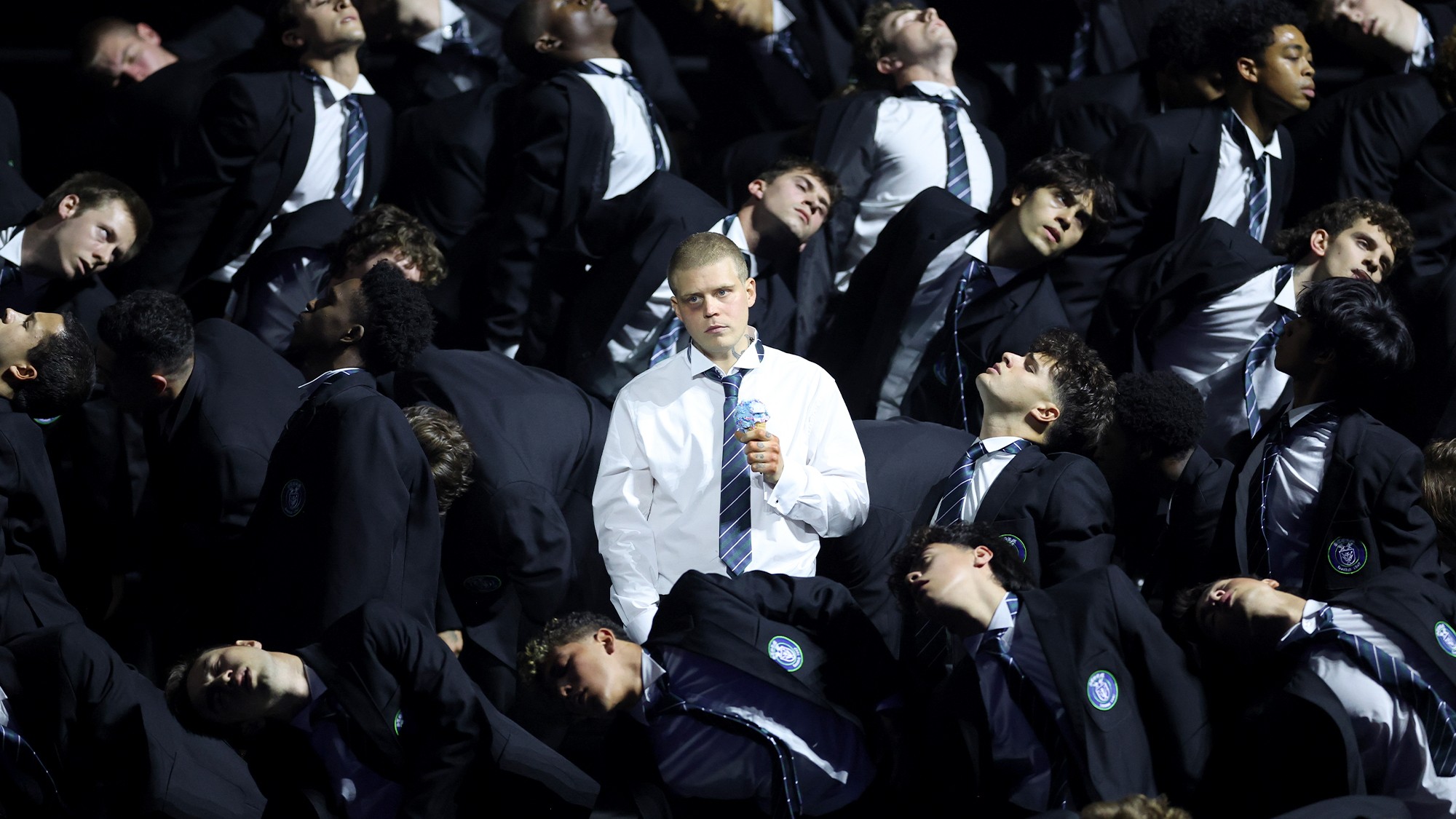
Anne Carson, who won the 2026 Nobel Prize in Literature today, doesn’t write masterpieces or door-stoppers, and she has no interest in emulating the great works of the past—including those of past laureates. Despite her training as a classicist and her celebrated skill as a translator, she would likely have little to say about the authenticity of film adaptations of The Odyssey. Carson is a poet by trade, but she’s really an archaeologist of sorts, sifting through the pottery shards of culture and letting the light of our own time illuminate their beauty.
Carson prefers to use fragments as seeds for her own poetry, and the high-cultural touchpoints for her lyrics and critical essays—Sappho, Samuel Beckett, Franz Kafka, Michelangelo Antonioni, Simone Weil—sometimes give her work an air of forbidding experimentation that quickly turns, upon reading, into pleasure and delight. You may not know or care who Heloïse and Abelard are, but I can promise that you will enjoy reading them argue in a hotel room in the middle of her 2005 “spoken-word opera,” Decreation.
Across roughly two dozen translations and original books, a twee-punk “don’t give a damn” attitude pervades Carson’s reinterpretation of ancient texts: Her poetry shuns obeisance to tradition and literality and embraces creative fantasy instead. For that reason, the barrier to entry for her poetry is surprisingly low—surprisingly, I mean, for a poet whose books often contain a page or two of footnotes. Carson wrote a Ph.D. dissertation on the ancient poet Sappho at the University of Toronto, in the city where she was born in 1950. When I was a classics major in college, her 1998 re-creation of a bit of obscure Greek mythology, Autobiography of Red, was a cult object. Some of her poetry isn’t even poetry at all, but a mix of essays, screenplays, even the odd oratorio. Nox, her 2010 elegy for her brother—the title is Latin for “night”—arrives in a box and unfolds like an accordion. Carson’s predilection for the classics doesn’t domesticate them; it riffs on how astonishingly strange it can be to put words down on a page (or papyrus) in a meaningful order, and to try to have them capture the human condition.
Sappho, Carson’s early subject, offers an important clue as to why her work matters to us now, and perhaps also as to why she won the Nobel. Sappho’s poetry has survived only in bits and pieces, and her form of writing, as much as her obsession with love and longing, has inspired Carson’s own iconoclastic, restless tacking among genres. Yet Carson is averse to the common assumption that we have to look for what’s directly relatable in the past in order to fall in love with it. In an interview with The Paris Review, she confessed that she finds very little “direct relevance of ancient things to modern things”; instead, she gets “little glimpses of similarity, embedded in unbelievable otherness.”
That strikes me as pretty close to a definition of poetry itself, the art form that may be better than any other at embedding everyday objects (a wheelbarrow, a coffee spoon) within the tantalizing atmosphere of the new. Carson’s poetry connects us to the past for the same reason that it stands out as some of the most accomplished poetry of her generation: Rather than lulling us with history’s familiarity, she seduces us with its strangeness.
In the days leading up to the Nobel Prize announcement, I happened to have been rereading Autobiography of Red for the first time in 24 years. This “novel in verse” takes its prompt from a 6th-century-B.C.E. fragment about a little monster, Geryon, who falls in love with Herakles—before the god kills him. In Carson’s rendering, the two meet as teenagers at a bus station and reunite years later in Buenos Aires. They travel by plane to a volcano in Peru, where Geryon, now an aspiring photographer, takes pictures of the bubbling lava (no one dies). From so fragile, bizarre, and slender a source—we never forget this is a meet-cute between a red, winged monster and a divine hero—Carson conjures a romance in which love feels unbelievably alien and yet utterly recognizable: “Up on the overpass / the night was wide open / and blowing headlights like a sea. He stood against the wind and let it peel him / clean.”
Carson’s playfulness, humor, and curiosity—and, above all, her tenderness—make her poetry a powerful antidote to the chilled and coarsened social world of the present, not to mention the worry that history and the classics will lose their audiences. What I find most moving about her work is her ability to turn abstract thought into concrete feeling, and to make this feeling our own. Who has not wondered, as the young Geryon does, what “distance” looks like? Carson writes, “It extends from a spaceless within to the edge of what can be loved.” When I gaze down a path or a road, when I feel the separation from someone I love, or when I think of the gulf between the present and the past, I somehow know exactly what she means.
This is an edition of Time-Travel Thursdays, a journey through The Atlantic’s archives to contextualize the present. Sign up here.
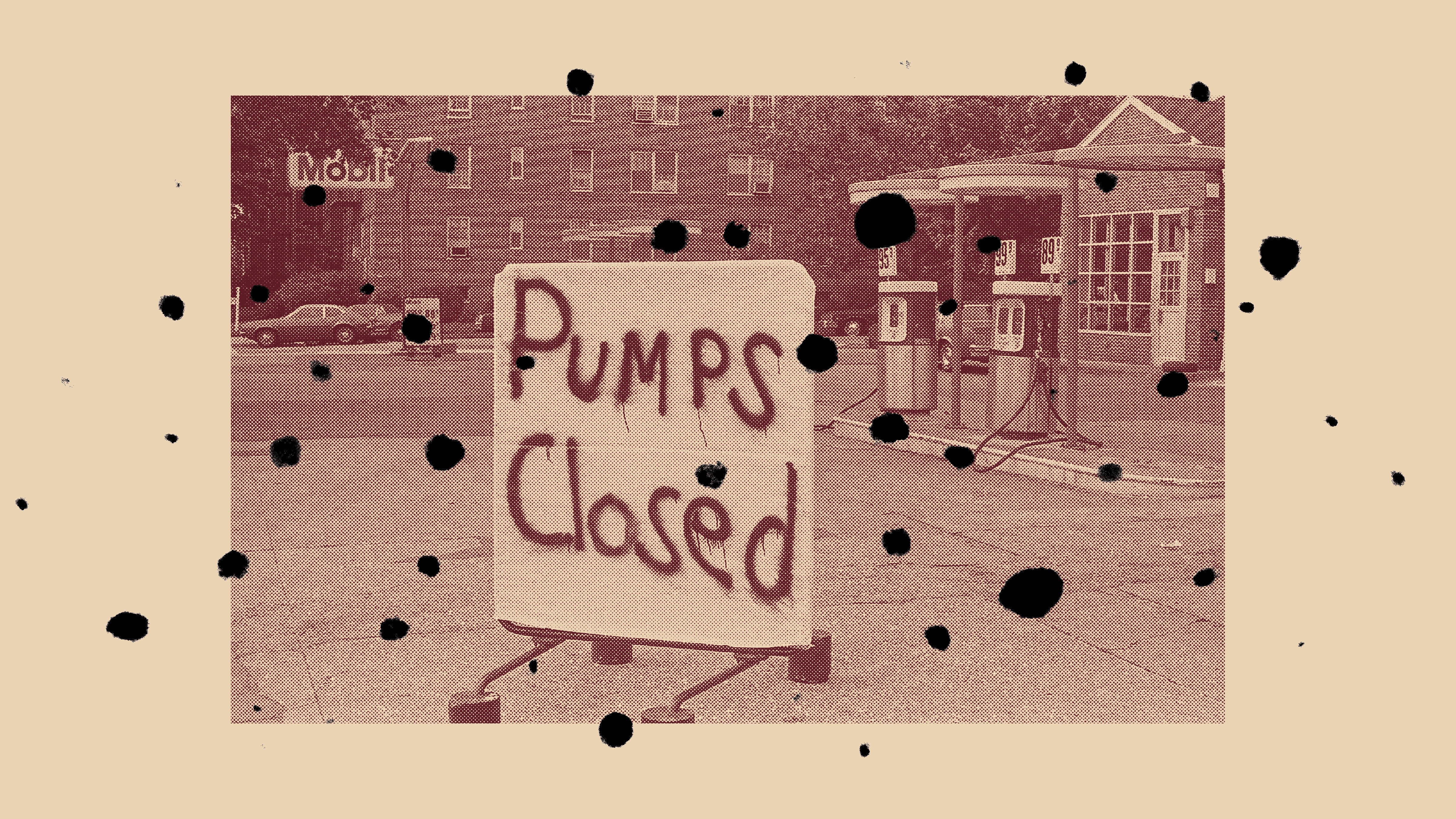
In December 1987, The Atlantic had some reassuring news for readers: The next oil crisis didn’t have to happen.
The United States had already endured the oil shocks of the 1970s, and Amory B. Lovins and L. Hunter Lovins, a pair of then-married environmentalists, argued in this magazine that the country had learned from the experience. The U.S. had diversified its sources of foreign oil, and the American economy needed less oil to grow, a shift that the Lovinses attributed mainly to efficiency gains, such as better-insulated buildings and more fuel-efficient cars. Oil production had grown outside OPEC, an organization of oil-exporting states, reducing the world’s reliance on Persian Gulf oil. Even the Strait of Hormuz, a flash point in the Iran-Iraq War of the ’80s, appeared less threatening to the global supply. By 1987, less oil was passing through the waterway than earlier in the decade, and the Lovinses believed that reserves and alternative routes could help make up for any sudden cutoffs caused by geopolitical tensions.
The moment offered what the writers called a “unique opportunity”: a reprieve from Middle Eastern dominance of the global oil supply. “If this interval is frittered away,” they warned, “it could end with the United States, its alternative options expired, needing Middle Eastern oil more than ever.”
Nearly four decades later, America is far less vulnerable to foreign-oil disruptions, but it is once again caught in a global oil crisis, and the Strait of Hormuz is back at the center. Before the Iran war, about a quarter of the world’s maritime oil passed through the strait, roughly three times the daily volume that had passed through in 1987. The effective closure of the waterway has resulted in global oil inventories falling by more than 500 million barrels since February, and Americans are feeling the effects, as the costs of diesel, air travel, food, and other goods all rise.
But not all of the Lovinses’ worries have come to pass. America has become far less reliant on foreign oil than it was in the ’80s; the shale boom, precipitated by advances in horizontal drilling and hydraulic fracturing, unlocked large amounts of domestic oil, transforming the U.S. energy market beginning in the 2000s. Last year, American crude production reached a record 13.6 million barrels a day, and Persian Gulf countries supplied just 8 percent of U.S. crude imports. The contrast with the 1970s is stark: In 1977, the broader group of OPEC countries supplied 85 percent of American crude-oil imports. As my colleague Rogé Karma reported in March, America’s growing energy independence appears to have helped convince the Trump administration ahead of the Iran war that the U.S. could withstand a disruption in the Persian Gulf. “We don’t get any oil anymore out of the Strait of Hormuz,” Interior Secretary Doug Burgum said last October, in defense of America’s decision to strike Iran’s nuclear facilities earlier that year.
The Lovinses had imagined a different route to energy security. They called it “substitution”: reducing the need for oil overall by continuing to improve energy efficiency in buildings and vehicles, and replacing oil with natural gas or alternative fuels. They argued that efficiency could buy the country time to free itself from dependence on foreign oil. America ultimately achieved much of that goal, but by producing more oil rather than using less. After OPEC’s 1973 oil embargo, President Richard Nixon launched “Project Independence” with the goal of reducing the country’s reliance on foreign oil. Congress adopted new conservation measures, and Jimmy Carter made reducing energy consumption a centerpiece of his presidency, while also beginning to lift federal controls on oil prices to free up more domestic production. In 1979, Carter went so far as to promise that the country would never again “use more foreign oil” than it had in 1977.Days after taking office, President Ronald Reagan eliminated the remaining federal controls on oil prices. The approach appeared to be working: By the early 1980s, U.S. oil consumption had fallen to its lowest level in more than a decade.
But the conditions that encouraged conservation soon changed. Weaker oil demand and growing supply contributed to a glut that sent oil prices plunging in 1986. As oil became cheaper, the economic pressure to conserve diminished, and the efficiency gains of the previous decade began to level off. The political approach was changing too. Reagan’s administration sought deep cuts to federal conservation research, part of a broader retreat from government-led energy programs during the 1980s.
Conservation had never been the country’s only answer to the oil shocks. Policy makers were simultaneously trying to increase domestic production and diversify the country’s energy supply. Carter argued in 1979 that the country needed to “produce more” as well as “conserve more.” What ultimately endured was not the ambition to wean the country off oil, but the goal of making America less vulnerable to foreign suppliers.
In April, my colleague Idrees Kahloon wrote that the country is at a point where it can administer energy “shocks to other countries without feeling much pain itself,” but Americans have not been spared the effects of an international oil shortage. Gasoline prices still rise with global oil prices, regardless of where the crude comes from. Countries that are more dependent on Gulf energy, meanwhile, have borne more of the disruption. Most of the crude oil passing through Hormuz was headed to Asia, not the United States. The Philippines declared a state of emergency in response to energy shortages, Japan faced higher oil costs, and European countries saw disruptions to natural-gas shipments push prices up.
This is not quite the future the Lovinses imagined, but neither is it the one they feared. They understood the calm of the 1980s as a reprieve, not a resolution. Four decades later, the United States has emerged from the crises of the ’70s as the world’s largest oil producer, far less dependent on the Middle East but still dependent on fuel itself. America may not be as vulnerable to disruptions abroad, but as long as oil is traded on a global market, the country cannot fully insulate itself from what happens beyond its borders.
Yesterday was a reminder of the difficulty that the pro-Palestine left has with showing grace even for the dead. On the third anniversary of the day that Hamas gunmen and freelance killers arrived in Israel on motorcycles and paragliders and trucks, and slaughtered children and grandparents and mothers and fathers and dancing young people, New York City Mayor Zohran Mamdani put out a statement that was empathetic and modulated in tone … for about 50 words.
“This day is profoundly painful for so many New Yorkers,” Mamdani began. “It marks three years since the horrific war crimes of October 7. On that day, Hamas killed more than 1,100 Israelis and abducted 251 others. We grieve alongside our many friends and neighbors who still carry that unthinkable loss.”
Alas, then came the next 162 words, as the young mayor indulged his anger with Israel. He apparently felt obligated to give New York City—which is home to the biggest Jewish population of any city on the globe—a history lesson that seemed to suggest that Israel brought the October 7 tragedy upon itself.
“The suffering did not begin nor end that day,” he wrote. “It instead continued through the Israeli government’s devastating, ongoing genocide in Gaza, in which it has killed more than 74,000 Palestinians—including more than 21,000 children. Even since the so-called ceasefire, more than 1,400 Palestinians have been killed. That suffering has intensified with every Israeli bomb dropped on ambulances waiting outside hospitals, every drone strike targeting a residential building or journalist, and every shipment of food aid turned away at a border crossing.”
On he went, referencing Israeli war crimes and apartheid and unbearable grief and American complicity in it all. By the time he concluded, he had turned grace into a cudgel. Ammiel Hirsch, a prominent New York rabbi and a longtime peace advocate, called the statement “morally perverse” and likened it to “sticking a knife into the pain of the Jewish community.”
Mamdani might have thought his statement to be provocative enough to satisfy even the most anti-Zionist, anti-Israel leftist. But portions of New York’s pro-Palestine community were insistent about observing the anniversary with a Citywide Protest Resisting Genocide since 1948. They were less intent on remembering Palestinians who have suffered grievously than they were focused on implicitly saluting Hamas’s savage attack, as their call to protest offered “glory to the martyrs, victory to the resistance.” And a fringe went further still, denouncing Mamdani for what it perceived as insufficient anti-Israel fervor.
I spent some hours yesterday tracking these protests, including classroom walkouts and marches, and in truth, the numbers were deeply underwhelming. The demonstration began with 80 or so New York University students gathering for a noontime rally in Washington Square Park. They chanted, denounced their university leaders, and listened as an NYU professor spun out various conspiracy theories suggesting that Israel was principally responsible for its own casualties. Two hours later, another 75 or 80 students gathered on Broadway, outside the Columbia University campus, and chanted, “Intifada revolution” and “Palestine from river to sea,” an idea that, as a practical matter, would entail the abolition of Israel.
A larger rally was planned at City Hall Park in the late afternoon. Protesters there numbered—and my grading could be generous—a touch more than 200. This included a breakaway group of roughly two dozen anti-Zionist ultra-Orthodox Satmars, a crew of black-clad anarchists who did their best to appear forbidding, and an impressively insistent Maoist Communist faction. The lackluster turnout might have owed in part to the fact that the grandees of New York’s organized left, in particular the New York City chapter of Democratic Socialists of America, were savvy enough to avoid militant protest on this solemn day. The New York City DSA went silent on social media, making no mention of October 7 or the rallies. Only the youth wing of DSA showed up.
There was a faint hint of anti-Mamdanism. A young protester, his face wrapped in a keffiyeh, shouted into a bullhorn and assayed a brief attack on the mayor. His voice was muffled by the cloth, so it was difficult to make out what he said, save for the fact that he repeated it rhythmically. Perhaps seven or eight protesters joined in, and a Maoist held aloft and jiggled an anti-Mamdani sign.
The atmosphere grew more hostile as day turned to night and the protest came to a desultory end. According to news reports, a rump group of perhaps 100 followers of various obscure militant-left groups and pro-Palestine groups marched north from city hall to Union Square. They were intent on disrupting a remembrance run by the anti-war group Israelis for Peace and attended by Mamdani. That vigil recognized both the Israeli dead and the many thousands of Palestinians who have died in the war in Gaza. The protesters crowded in, unleashing boos and chants, not least at Mamdani, whom they appeared to cast as Judas for standing alongside left-wing Jews and very liberal Zionists.
Peter Sterne, an editor at City & State New York, posted on X some of their nastier chants: “Traitor, traitor, come on out! You sold all your people out!” and “Zohran, you can’t hide. We charge you with genocide!” Mamdani, accompanied by his police detail, left to a chorus of jeers and boos.
A revolution eating its own is a historical commonplace. For now, Mamdani has used his considerable political skills to keep the most uncompromising of his pro-Palestine-left supporters in check. But last night perhaps signaled a fraying of patience.
The following contains spoilers for the film Digger.
Digger’s marketing campaign began not with a trailer but with a montage—a reel of previous performances by the movie’s star, Tom Cruise. There was Cruise in Top Gun, feeling the need for speed; Cruise in Jerry Maguire, committing to showing the money; Cruise in the Mission: Impossible films, dangling from various planes. The retrospective ended with a snippet of Cruise acting in Digger, but its message was clear: What the movie star of movie stars pulls off in this forthcoming project would be the pinnacle of Cruise-ian cinema, the performance he’s been building toward all this time.
As it turns out, the movie is indeed a historic entry in Cruise’s filmography—though likely not for the reasons anyone involved had hoped. Digger has become one of the worst-performing releases of his career, making roughly $8 million domestically during its opening weekend against a reported budget of up to $180 million. Few reviews are glowing; it also has the unfortunate distinction of being the final film released by Warner Bros. before the company’s acquisition by Paramount, a deal that closed this week. The promotional tone has shifted significantly—no longer are teasers celebrating the opportunity to see Cruise as people have never seen him before. They now offer a more desperate plea: “Decide for yourself,” one of the latest ads says, a shrug of a command.
That Digger’s marketing relied so heavily on Cruise’s star power isn’t surprising. But the film’s dramatic bombing at the box office proves the (literal) tomfoolery of making Cruise its only selling point. For years, the actor has adopted the persona of Hollywood’s unofficial mayor, stressing whenever possible the importance of seeing movies in theaters with crowds. Digger, however, has no trace of crowd-pleasing in its DNA. Directed by Alejandro González Iñárritu, it’s a satire of a satire that’s both grandiose and grotesque, with a Russian doll–like story structure: At its center is a shouty black comedy about the apocalypse, which is caused by an oil tycoon named Digger Rockwell (Cruise). That tale is then revealed to be a play called Fossil Fools being staged by a harried crew and cast; its star, Curtis Markson (also Cruise), is growing anxious about the ethical implications of the show’s conceit, as well as a possible emergency that his daughter is facing. A final twist unveils the play as a retelling of a real story—that the events of Fossil Fools actually happened, give or take a few creative flourishes. Outside the theater, the world is a dystopian nightmare.
The entire ethos of Cruise’s career thus butts heads dramatically with the film’s complexity and cynicism. Digger gets the most out of Cruise the actor, who delivers a captivating performance while juggling two characters throughout the film. But it can’t mine much out of Cruise the untouchable, one-note movie star. In an interview with GQ, the first cover story with the magazine that Cruise has agreed to in 20 years, he turned every question into an opportunity to wax poetic about the beauty of filmmaking. Despite being given opportunities to reflect on his career and why he’s been drawn to death-defying, larger-than-life roles, Cruise rarely conveyed anything beyond the talking point he kept pushing about “cinema” being his life’s passion. “What I like about cinema,” he said in response to an inquiry about his childhood, “is it is all of us coming together in a room and sharing an experience.”
Cruise has made staunch optimism about the movies his public narrative; for him, the theatrical business must and will succeed no matter what challenges befall the industry. “Hollywood has always gone through ups and downs,” he told GQ. “If you study Hollywood, they’ve been bust and bank and broke. I’m excited. I’m very excited about where movies are.” But Digger displays no such certainty. Rather, it argues that although art can endure the end of the world, overstating the importance of entertainment is silly. Fossil Fools, after all, is funded by a descendant of Digger Rockwell himself. A credit sequence further emphasizes the story’s pessimism by sounding the same warning that the theatergoers hear when the stage show ends; the real-life audience watching Digger is therefore encouraged to brace for a crisis as it leaves the building as well.
Digger isn’t the only film this year underlining the bleak world we’re in. Both The Social Reckoning, the writer-director Aaron Sorkin’s follow-up to The Social Network, and Artificial, the auteur Luca Guadagnino’s movie about the founding of OpenAI, are tonally different from Digger, but they contend with the same challenge Digger does: persuading audiences to spend a few hours in a theater absorbing disturbing stories about a reality they already know. The two movies also seem to face uphill box-office battles, despite featuring acclaimed actors: The former, starring the recent Oscar winner Mikey Madison, is on track for a soft opening this weekend, while the latter, with Andrew Garfield as Sam Altman, was dropped by its original distributor, Amazon MGM Studios; a smaller company, Neon, rescued the project. But even if these films also fail to become hits, at least they’re not hiding their messages behind the charm of their stars.
For more than a decade, the Philippines has been a test case for how technology enables an authoritarian state to capture and corrode the institutions that make democracy work. The work of Rodrigo Duterte, the autocratic president of the Philippines from 2016 to 2022, would hardly have been possible without that of Mark Zuckerberg, the CEO of what was then the most powerful social-media company.
The Philippine state used Facebook to turn bottom-up social-media attacks into lawfare. I experienced this firsthand as a co-founder and the CEO of the media organization Rappler. Facebook hosted a state-sponsored campaign of disinformation and harassment against us that culminated in criminal charges meant to send me to jail for the rest of my life. We fought back in courts and begged Facebook and YouTube to restore information integrity. After years of this, however, we realized that what we needed to do was to build an alternative to these platforms that would be responsive to the public good.
Infrastructure is law that doesn’t pass through a courtroom. Whoever builds it makes the rules that no one ever voted on. The information infrastructure much of the world lives with today was built by tech oligarchs to maximize engagement and profit while concentrating power. For years, Rappler played whack-a-mole with the lies that permeated the digital commons. Then we realized that the only way to fix information integrity was to build our own tech: a virtual community anchored in facts.
This wasn’t an easy decision. I had hoped that other, better-resourced companies would create the alternative. They didn’t. So we did.
We built Rappler on three pillars: technology, journalism, and community. Remove any one of these and the structure fails. You can’t base independent journalism on captured infrastructure. You can’t host a community in a space that is designed to manipulate and incite you. You can’t make technology serve democracy unless governments, journalists, and citizens build it together.
We started with technology. Not because it’s the most important pillar—though it may well be—but because it’s necessary for all of the others. When digital platforms are captured, journalism’s distribution is held hostage. When distribution is captured, community dissolves. When community dissolves, institutions lose the base that makes them legitimate. Technology is where democracy’s body meets its nervous system.
Facebook failed Rappler. Rappler’s eventual answer was to stop asking Facebook or any other platform to moderate better. Instead, we realized that we needed to stop using Facebook as our public square.
Put another way, the arsonist will not save the village. So we need to build a new village, with firebreaks and firewalls. Our method was to start small, protect the facts, and separate from algorithmic and digital manipulation.
In software jargon, a “stack” is the layered collection of technologies that make something work: chip, operating system, application, one on top of the other. Whoever owns the bottom of the stack decides what can be built above it. In the United States, Donald Trump is building an authoritarian stack. The breakneck advances in agentic AI have made this effort even more worrying than it already was.
The president has appointed the CEOs of the major tech companies to his council of advisers on science and technology. Mark Zuckerberg of Meta, Larry Ellison of Oracle, Jensen Huang of Nvidia, and a long list of others on the council are the very people who shape what billions of people already see, feel, and believe. Now they formally advise the president on the technology that will shape what we all see, feel, and believe next.
The industry’s influence was apparent when the White House released its national-policy framework for AI in March. The document seemed to identify the central risk of the new technology as its possible coercion of social-media platforms—the very outlets that themselves coerce citizens through algorithms, surveillance, and engineered outrage.
The technology that mediates our thinking has become a weapon in the hands of the state that was supposed to regulate it. The biggest AI firms are spending billions on tech infrastructure and millions to defeat candidates who support state-level AI regulation in the 2026 midterms. Meta’s AI is deployed across U.S. defense contractors, and OpenAI was named to the Pentagon’s classified network vendor list in May 2026.
This is the authoritarian stack: regime power and tech power, formally merged. And the fusion didn’t happen by accident. It happened because the alternative—a democratic stack, constructed and owned by the people who depend on it—was never built at the scale required. We have to build it now.
That’s what we did in the Philippines. I co-founded Rappler in 2011 as a technology company as much as a newsroom. Even then, we understood that the battle for truth would be fought on digital terrain, and that a newsroom that didn’t control this terrain would eventually not control its journalism. In 2016, Rappler came under coordinated social-media attack from the Duterte government, and we shifted from seeking to generate traffic through polluted social-media platforms to relying on search engines instead. Optimizing our content for search visibility allowed us to generate as much as 69 percent of our traffic from what seemed at the time like a more reliable source.
But that loophole would soon vanish as Big Tech sought to choke off digital news distribution. By 2024, Google had launched its AI-driven, zero-click search, which answered queries without sending readers to the sources of the information it displayed. By early 2026, the floor had fallen out from under every search-dependent publisher. So we stopped trying to reform the platforms that were killing us and started building beside them.
We made an archive of everything Rappler had ever published and a structured catalog of the topics, places, and events we covered. In 2024, we rolled out our own fact-based chatbot, which we named RAI, Rappler Artificial Intelligence. Because we owned our own data and combined them with publicly available, vetted databases, our chatbot’s error rate was a little more than 1.6 percent—at the time, the error rate of commercial chatbots was about 16 percent. We began to see a path ahead for journalism: Some of our global partners have more than a century of archived reporting, a record of verified facts no commercial-AI system can match.
Rappler developed its own town square, in the form of a chat app that runs on the Matrix protocol. Matrix is open-source and allows users to set up their own communication servers. More important, it isn’t owned by any single company. No algorithm decides what users see, and conversations can be encrypted from end to end. Journalists set the rules for Rappler’s community, and our own team enforced them, using AI to assist but reserving the final word for humans. The result was a conversation anchored by facts instead of engagement-driven outrage.
In September 2025, our one-newsroom experiment expanded into Rappler Communities. We created a network of trusted newsrooms, including the Philippine Press Institute, which encompasses 65 newspapers; SunStar Cebu, the flagship of a community-news network across 12 Philippine cities; and the Daily Guardian, the leading newspaper of Western Visayas. Rather than depending on platforms that monetized journalism’s decline, we shared a distribution infrastructure that we owned ourselves.
Now a reader in Iloilo could follow a Daily Guardian story, join a SunStar thread in Cebu, and surface in a Rappler national discussion—all without changing apps, surrendering data, or being sorted by an algorithm into the part of the conversation that would make them angriest. Local journalism reached a national audience. National journalism gained local depth. Readers were no longer a product: They were citizens in a shared civic space.
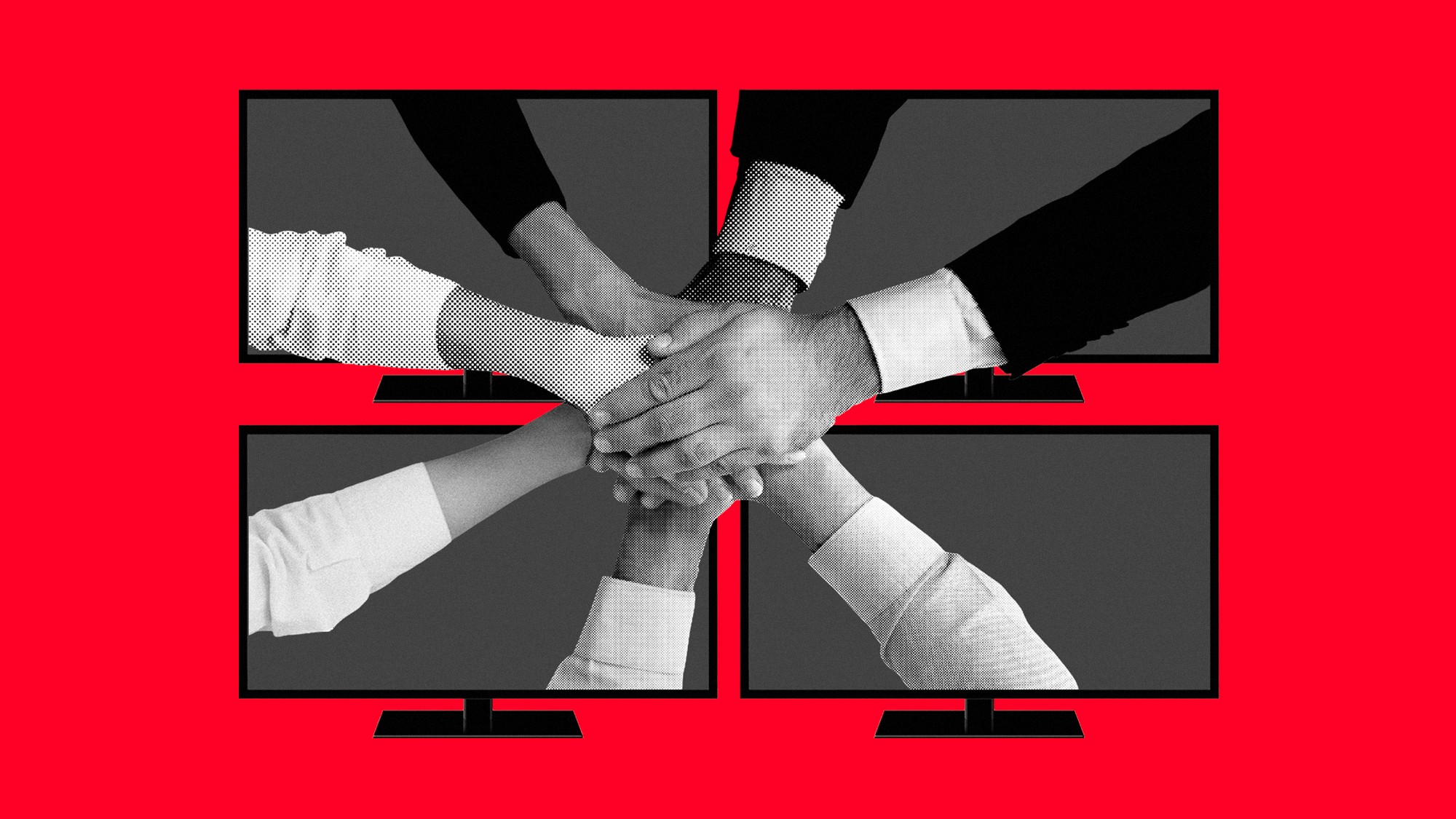
The authoritarian stack isn’t going to disappear. But independent news organizations can work together to build a true digital commons alongside it. The key is federation—the structural opposite of monopoly. Each member of a federated network governs itself. But using open standards, all of them communicate with one another, so that users can move among them without losing their data or their connections.
This is how email works, and the way the early internet worked. The model has recently spread to social media, where decentralized platforms, built on open standards rather than owned by a single company, are entering the mainstream. Three years ago, Bluesky was a technical experiment. Now it’s a parallel public square, with nearly 44 million users as of April 2026, many of them newsrooms and journalists.
A growing ecosystem of public-interest technology organizations has been working to build alternatives to monopoly-owned tech—to defend civil liberties in courts and policy, preserve the public record, protect journalists and dissidents from surveillance, and keep open the parts of the internet that Big Tech has no commercial interest in maintaining. The encrypted-messaging app on your phone, the browser that doesn’t sell your data, the archive that remembers what was deleted, the lawsuits that challenge mass surveillance—all of these things come from this small coterie of companies. Among its members are Signal Foundation, Mozilla, Wikimedia Foundation, Internet Archive, Electronic Frontier Foundation, Tor, Open Technology Fund, Access Now, Knight Foundation, Global South Alliance, Innovation for Change, Civic Tech Lab, and many more. They have small budgets but carry enormous weight.
Rappler, of course, is part of this ecosystem. In 2023, the year that Twitter became X, we rolled out Rappler Communities, now called MUNI. On February 10, 2025, two years after Elon Musk began firing 80 percent of his platform’s safety engineers, the digital-safety expert Camille Francois at Columbia University’s School for International and Public Affairs spearheaded an engineering nonprofit called Robust Open Online Safety Tools. ROOST supplies organizations with free, open-source software to detect, report, and remove material they define as harmful, such as child-sexual-abuse material, from their AI and social-media platforms. It also furnishes the means to handle online harassment: software to flag bad behavior automatically, queues for human reviewers, and consoles for the moderators who make the final call.
A small newsroom or a new platform that could never have afforded its own safety team can now download and run the same tools the biggest platforms use. Many major platforms that are normally competitors chose to join ROOST as partners, whether by donating funds or technology or by using its safety tools: Discord, Google, OpenAI, Microsoft, Roblox, Bluesky, Mozilla, Hugging Face, Wikimedia, Matrix, Common Crawl. The problem of online safety is bigger than any one of these companies—and everyone benefits from a safety baseline that is open, shared, and built by people whose first loyalty is notto shareholders or authoritarian regimes.
What is needed for information platforms is that much more urgently required for AI. That’s because the new-frontier AI models don’t just shape what you read and influence your opinions: They act on your behalf, reading your email and deciding what’s important, booking your travel, answering your messages, making purchases. AI schedules your week and negotiates with vendors, airlines, and other people’s agents. It becomes you in digital space.
This is the deepest, and scariest, form of infrastructure capture of all. If you rent your chat platform, you outsource your public square. If you rent your agent, you outsource your judgment.
The question is not whether the agents will be powerful. They already are. The question is, who will they be loyal to? To you or the company that built them, the platform that hosts them, the advertiser that paid for placement, the state that subpoenaed access? Or to themselves? The handful of companies that own and build these agents now sit on the council advising the U.S. president on AI policy. No independent body checks their work.
Civic actors must construct an alternative infrastructure rather than waiting for the corporate one to reform. This means acting on three levels at once. AI is built on a training layer, involving decisions about what the models learn from. Then comes the deployment layer, addressing questions about how the technology is used and under what limits, decided by whom. The third layer has to do with accountability: To whom do AI agents answer—what happens, and who is held responsible, when they escape human control?
We should have asked these questions about social media in its infancy. Most of us failed to, until it was too late. This time, however, the work has begun. Public-interest AI projects—ROOST’s open-source safety infrastructure, the Allen Institute, Hugging Face’s open-model work, Mozilla’s AI initiatives—are punching far above their budgets. Open-source agentic frameworks are flourishing—and could eventually become conduits for journalism, civic information, legal aid, and health-care navigation in the public interest.
The danger, though, is that agents are moving faster than the safety work around them. OpenClaw, an open-source AI assistant you can host on your own computer, went from launch to nearly a quarter of a million GitHub stars in four months. The window between “this is a hobby project” and “this is global infrastructure” is now measured in weeks. But though it is narrow, that window is still open—which is why the time to act is now.
This article was featured in the One Story to Read Today newsletter. Sign up for it here.
Imagine that you make a business deal with a friend—someone you know and trust. Say you’re selling him some land. But when you turn up at his country club to complete the sale, your friend announces that you were offering such a good deal that his friends want to buy some of your land too. And they’re all here, so could you sign the deeds over immediately? That’s asking too much of you, so you hesitate. Still, your friend is a nice guy, and you know he wouldn’t screw you over. You agree.
When you get home, though, your friend texts to say that he feels bad about what happened. It’s fine, you reassure him. But then, a few days later, you find out that everyone who bought your land is laughing about what a fool you were to sell it so cheap. You find out that other people think that your friend has screwed you over. You call up your friend and say: Hey, this doesn’t feel right. His tone changes. He doesn’t want to speak to you anymore. And then you find out his country club has barred you.
After all that, might you not conclude that the transaction was a betrayal by your friend—and that your land sale was coerced, even though you ostensibly agreed to it? Consent is often treated as a binary concept, when reality is much more gray, and too often we act as though legal judgments and ethical ones must be the same.
Last month, a former Cornell University student referred to in legal papers as Jane Doe alleged that seven men had participated in an hours-long assault on her at a fraternity house in 2024. Thanks to reporting by outlets including TheNew York Times and TheCornell Daily Sun, the campus student newspaper, we now have a clearer picture of what happened on the night of October 19 that year. Around 11 p.m., the anonymous complainant left a bar and walked to the Chi Phi fraternity house. Jane Doe was already drunk, according to the lawsuit. There, she asserts, she met a male friend, Matthew Ingalls, and began a threesome with him and a buddy of his, Jonathan Newell. (The men are named in Doe’s lawsuit and their identities have been widely reported elsewhere.)
She says that another man, Gillio Lopes, later came into the room and initiated sex with her. A photo included in the lawsuit indicates that, at 1:42 a.m., Newell sent a message to the fraternity’s Snapchat group promising “free pussy” in the alumni room. This announcement was greeted with the equivalent of high fives from several men. “I fucking love Chi Phi,” Ingalls replied, according to the image, and added, “like you can walk in and whip it out.” According to Doe’s lawsuit, multiple other members of Chi Phi entered the room: One of them kissed her, two others joined the group in snorting ketamine off her naked body, and a seventh participated in another threesome with her and Ingalls. (All seven men have denied wrongdoing; Ingalls told Cornell that he was sexually assaulted by Doe while incapacitated, according to messages reviewed by ABC News.) The lawsuit also targets Cornell, the fraternity, Doe’s own sorority, and the bar where Doe, then 20, was drinking before heading to the frat house.
Jane Doe did not arrive at the frat house that night with the intention of participating in an orgy; that much has not been disputed. The narrow legal question is therefore whether the various men involved obtained her further consent as the sexual scenario spiraled. (According to Doe, she did successfully refuse some of what the men were asking for, such as a foursome that she understood would involve anal sex, according to the district attorney’s statement on September 28 this year.) She says in her lawsuit that she consumed so much alcohol and ketamine that she was extremely disoriented, but under New York law, if a person is voluntarily intoxicated, then the mere fact of their intoxication does not make them unable to consent. Was the ketamine offered to her, or forced on her? That is a key question in assessing whether any of the men committed a crime.
What has made this case the subject of so much viral debate is that Doe herself did not initially understand what happened as rape, and her recent lawsuit includes allegations that she did not make in her sworn statement to police two years ago. The day after, Newell was sufficiently uncomfortable with what had happened that he messaged Doe to apologize. He should have acted to “shut it down and kick people out before it got way out of hand,” he wrote. Doe reassured him: “At the end of the day non [sic] of the sexual stuff was illegal and honestly i really liked being w u and matt.”
Some of the fraternity members quickly began to coordinate among themselves to defuse the situation. Another of the men present that night, Winston Lee, told Doe in a phone call that he had been advised not to speak to her, according to a recording obtained by ABC News. When Doe asked how so many men had gotten into the room, Lee told her that “there was nothing saying that like, um, anything was happening in that room or anything.” The group-chat image included in the lawsuit tells a different story: Lee had responded to the “free pussy” offer on Snapchat with the exultant words “CHI PHIII.”
Three days after the incident, Doe got checked for a urinary-tract infection, which she told the doctor had been acquired in a “traumatic way,” according to a transcript of her interview with investigators obtained by the Times. In that account, her perspective on what happened changed when unsettling rumors about a “gang bang” began to fly around campus. According to Doe’s account, she reassessed her experience after reading an allegation in an online forum that Chi Phi members had “gang r*ped a sophomore.” Around this time, she was disinvited from the Chi Phi Halloween party by the fraternity president, text messages indicate. She wrote to Ingalls, her supposed friend, to say, “The woman will always get the short end of the stick. Yall aren’t my friends. Yall are covering your asses.” On November 3, she texted Newell: “let’s be clear that 90% of what happened that night was not consensual.”
Doe reported the encounter to the campus police on November 8. Investigators interviewed her six days later, and turned her extensive testimony into a six-page sworn statement, which was submitted to the district attorney’s office. (The sworn statement does not describe what happened as a rape, whereas the longer interview transcript records Doe as saying, “I can say with 100% confidence I was raped.”) The DA declined to prosecute, arguing that “the facts as set forth in the statement objectively prevent the filing of criminal charges,” although his office also declined to review additional evidence collected by Cornell, according to the Times. Amid the publicity generated by Doe’s recent lawsuit, New York Governor Kathy Hochul appointed State Attorney General Letitia James as a special prosecutor to review the case. Cornell has hired former U.S. Deputy Attorney General Sally Yates to review the university’s handling of the matter.
In January 2025, Doe made a Title IX complaint, prompting Cornell to conduct a thorough investigation, which included interviewing six of the men, according to the Times. The university expelled Ingalls and Newell and suspended Lopes and Lee. (All four admitted to having sexual contact with Doe, but all four maintain that it was consensual.) A fifth man, who Doe said had kissed her without consent, had graduated; Cornell barred him from campus for three years. The two men accused of entering the room and failing to intervene were asked to write “reflection papers.” (In the lawsuit, Doe incorrectly accuses Cornell of agreeing to let all of the men off easy if they agreed to write essays about the encounter.) The fraternity was also barred from campus.
Whether any of the men are guilty of rape is a matter for the New York court system. However, the evidence we have so far convicts them of being cruel, misogynistic jerks who deserve the punishments they have already received. Those Snapchat messages are both revealing and incriminating, because they demonstrate the emotional dynamics of the night more clearly than any witness statement ever could. These men saw Doe not as a fellow human being, but as a vending machine dispensing bro points they could cash in with their buddies.
The academic literature on multiple-perpetrator rape finds that, in the words of forensic psychologist Mackenzie Lambine, “sexual elements within juvenile group offending are often ‘coincidental’—secondary to the need for the group to exercise power over the victim, exert male dominance and develop relationship bonds.” Ingalls was supposed to be Doe’s friend, but the evidence now before us suggests that his loyalty was entirely to the fraternity. The persistent criticism of fraternities is that they foster unhealthy relationships among the powerful men of the future, by a system of interlaced kompromat and shared transgressions. This case does nothing to debunk that view.
Really, the whole of the Cornell story can be boiled down to Jane Doe’s realization that her male peers adhered to the old adage “Bros before hoes.” “I was a sex doll for all intents and purposes, which is sad,” she told police.
In rape cases, the traditional approach has been to pick apart the complainant’s actions. What was she wearing? Why did she let herself get so drunk? Why didn’t she fight back? Why did her story change? Online, you can easily find the view that Jane Doe is a regretful slut who maliciously decided to ruin seven men’s lives with a knowingly false criminal complaint. A slightly softer version of this is the claim that Doe reached for the identity of victim because the alternative was whore. The former Fox News anchor Megyn Kelly thinks Doe must have consented, because she is “extremely beefy in her arms and her legs” and was therefore grateful for the validation of being desired. “An unambiguous case of consensual sex,” Heather Mac Donald of the Manhattan Institute declared, plugging an interview she had given about the “campus rape myth” to TheDaily Wire. “Women shouldn’t expect coddling,” the USA Today columnist Ingrid Jacques wrote. “And regretting one’s bad decisions is a far cry from rape.” Jacques further wondered why the men involved were being held to a “higher standard” than Doe.
Were they, though? This is where the land-deal analogy is instructive: Doe thought she had signed up for mutually pleasurable group sex; she discovered later that she was just a prop in a bonding exercise among men. The bargain changed when she was in no state to renegotiate. Doe was heavily outnumbered when further sexual acts occurred beyond the initial threesome.
Heavily outnumbered, need I say, by men. The right has spent the past few years mocking the left for not understanding—in the context of, say, competitive sports—that sex differences exist. Now some conservatives are reflexively defending the Cornell 7 by playing cute and pretending that a sexual situation involving one woman and multiple men is a meeting of equals. Please. Our understanding of rape cannot be gender-neutral, even though women do indeed have agency and personal responsibility, just as men do. The scenario in which a drunk man is lured upstairs in a sorority house—where its sisters text the group chat offering “free dick” to anyone interested and send one another messages about what legends they are—does not exist outside porn.
What happened at Chi Phi that night might very well not satisfy a criminal standard of proof, but, as the conservative writer Natalia Bower notes, “we don’t have to call it rape to get mad at it.” To use an old-fashioned word, it was wrong. Tell your daughter, if you must, not to take ketamine with strangers or agree to a threesome in a frat house. But tell your son this, too: Don’t send messages to the group chat offering a drunk woman like a box of doughnuts. Don’t turn up to a frat-house room expecting anal sex with a woman you’re meeting for the first time, when she is already surrounded by other men. Jane Doe transgressed against historical standards of purity for women. The men at Chi Phi broke a code of human decency that ought to be eternal.
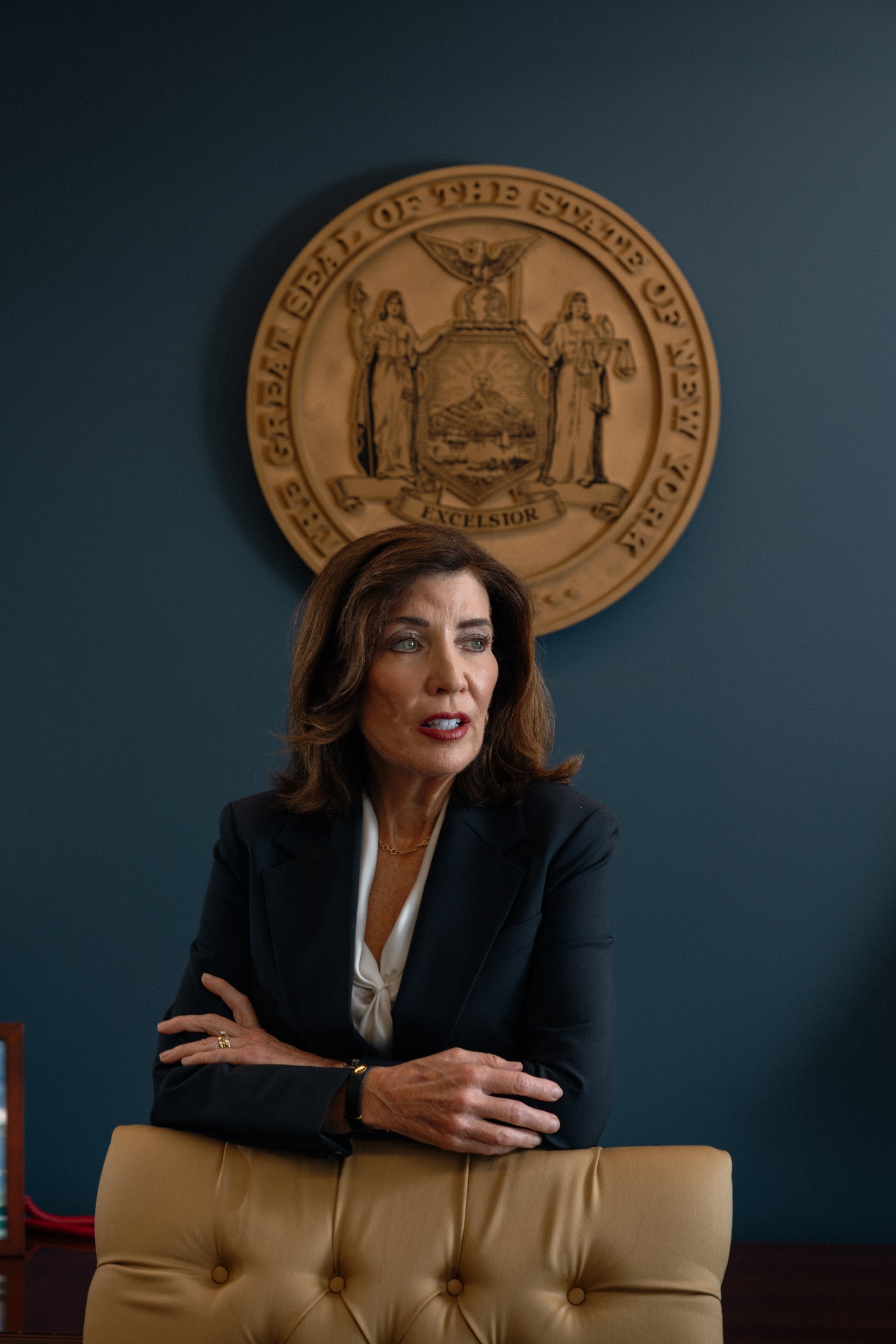
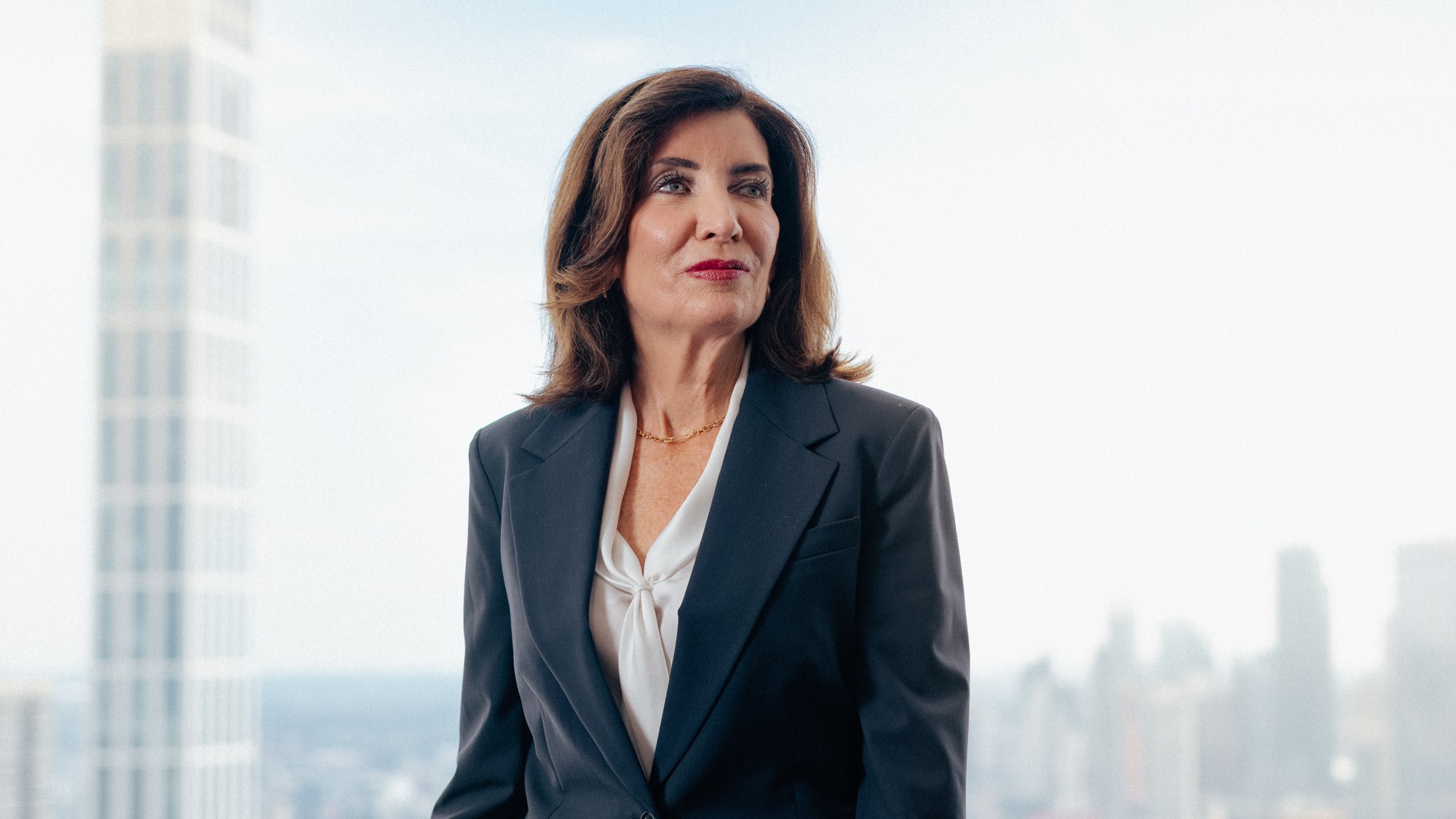
On many mornings, as New York City is waking up, a diminutive grandmother from Buffalo puts on sneakers and a baseball cap and takes a 45-minute walk with her husband around the streets near their apartment on Manhattan’s East Side. Her security detail keeps its distance, and hardly anyone seems to recognize Kathy Hochul on these strolls, even though she has been the governor of New York for the past five years.
Not many big-state governors enjoy such anonymity, but the spotlight has been slow to find the 68-year-old Hochul. Andrew Cuomo excluded her from his inner circle during her years as his deputy. Since succeeding him in 2021, she has operated in the shadow of much larger political personalities, be they fellow Democrats eyeing the White House or the polarizing Queens men—President Trump and New York City Mayor Zohran Mamdani—who generate far more headlines.
What attention Hochul attracted in her first years as governor was largely negative. She won her own full term in 2022 by six points, a relatively narrow margin for New York that Nancy Pelosi blamed for costing Democrats control of the House. (The party lost five winnable congressional races in New York that year.) By late 2024, Hochul’s approval rating had dropped below 40 percent, and the Democrats who were plotting primary challenges included her own handpicked lieutenant governor, Antonio Delgado.
But the past two years have yielded an impressive turnaround. Hochul has drawn praise for forging productive relationships with both Trump and Mamdani. She easily dispatched opponents on her left (Delgado quit his campaign for governor in February) and her right (Representative Elise Stefanik’s bid lasted just more than a month). Hochul appears on track to secure another four-year term as New York’s governor, and if she remains something less than an A-list political celebrity, she has earned the respect of a party that all but dismissed her not long ago.
“Kathy Hochul is the comeback governor of America,” Representative Ritchie Torres, a Bronx Democrat who was once one of Hochul’s harshest critics, told me. As recently as late 2024, Torres used words such as erratic, chaotic, and embarrassing to describe her performance; he warned—and this was not meant as a compliment—that she could be the Democrats’ “new Biden.” But he has learned not to underestimate her. “You do so at your own peril,” Torres said. Mamdani, who as a state legislator said that Hochul had “failed our constituents across the state,” has had a similar conversion. “She’s done incredibly well,” he told me in an interview.
Some Cuomo loyalists chalk up Hochul’s recent success to luck as much as skill. Democrats nationwide are poised to have a much better election next month than they did in 2022. And as people close to the governor readily acknowledge, having Trump on one side and Mamdani, a democratic socialist, on the other opens up a wide lane for a moderate to govern.
Hochul’s allies, however, are more likely to attribute her turnaround to a canny and dogged politician understanding the power of her office. Without much fanfare, they point out, she has delivered the kind of affordability agenda—centered around expanded child care, housing, and energy production—that Democrats say the party needs to win back the voters they’ve lost. Impatient and quietly competitive, Hochul drove her staff to speed up the announcement of a one-year moratorium on the construction of large AI data centers so that she could be the nation’s first governor to make such a move. She also overhauled the state party’s campaign apparatus, and in 2024, Democrats won back four of the congressional seats they had lost two years earlier.
In conversation, Hochul sometimes speaks so softly that she can be hard to hear. But in a series of interviews this summer, she was eager to tout her success as the product of a deliberate strategy to ratchet down what she described as an ego-driven culture of confrontation in New York politics—one that pitted Democrats against one another as well as against Trump. “I didn’t need to go to war,” Hochul told me. She could, she said, generate more media coverage by first creating conflict and then beating down her opponents. But she’s chosen a different approach. “I win, but I don’t have to destroy people in the process,” she said. “Not always.”
Nonetheless, Hochul said she has taken careful note of the many former critics who have returned to her fold: “There’s a long line of people asking for forgiveness.”
Adam Pape for The Atlantic
Governor Kathy Hochul visits the Mamá Tingó Childcare and Learning Center in Manhattan.
Hochul is the first woman to serve as the governor of New York, and as such, she is also the first mother to lead the state (and, she often adds, the first grandmother). She calls herself the “mom governor,” and when I asked her, over breakfast at a Manhattan diner, what had prepared her to deal with prideful men such as Trump and Cuomo, she turned not to any professional or political experience but to child-rearing. “I’ve raised toddlers. I’ve raised teenagers,” Hochul said. “So many times when things are swirling around, I’ve had to be the eye of the hurricane, be that calm voice.”
Comparing Trump to a child has become something of a cliché, but as much as any Democrat during the president’s second term, Hochul has figured out a way to work with him without capitulating to his demands. (It probably helps that unlike many leaders in her party, she is not looking to take his job in two years.) Hochul has persuaded Trump to reverse course at times, such as when he agreed to restore $187 million in cuts to counterterrorism funding for New York. She also claims credit for Trump not federalizing the state’s National Guard or surging ICE into New York City following deployments into other urban centers. During a White House meeting of governors in February, Trump told the assembled state leaders that he would not ramp up immigration enforcement in New York unless Hochul requested it.
Hochul told me her conversations with Trump are sometimes cordial and sometimes combative. She tries to appeal to his vanity and business interests, warning him that the “chaos” of major ICE raids would hurt not only his own bottom line but those of his many wealthy friends in New York. “I’ve used that many times,” Hochul said. “We just angle the argument based on a shared interest, and it works—most times.” Last year she pitched Trump on taking over the redevelopment of Penn Station, the nation’s busiest transit hub and an eyesore that Hochul referred to as “a hellhole.” Hochul correctly surmised that the longtime developer would take her up on the offer, and the move relieved her of responsibility for a project that had bedeviled her predecessors. (Characteristically, Trump officials have made it known that the president wants his name stamped on the complex, a proposal that Hochul has yet to publicly veto.)
The president has leveled public attacks on Hochul as he campaigns for her Republican opponent, Bruce Blakeman, a county executive on Long Island. Trump has called her “stupid” and a “Dumocrat,” criticizing her most recently for opposing his tariffs on Canada and for refusing to go along with his renaming of Lake Ontario as “Lake America.”
In private, however, the president’s tone is often different. He’ll tell Hochul, according to an aide privy to their calls, “You’re so mean to me, but I like you anyways.” They’ll sometimes talk politics as well. Hochul happened to have a call with Trump on the day last December when Stefanik quit the governor’s race. Stefanik, a top Trump surrogate in Congress, had wanted the president’s endorsement in a primary against Blakeman, but Trump had stayed neutral. Hochul told me she had asked the president why he hadn’t backed Stefanik, given how strong an ally she had been. Trump hemmed and hawed, she said, praising Stefanik while also noting his long friendship with Blakeman. Hochul, not letting him dodge the question, pressed again. Finally, Trump said of Blakeman: “He looks the part.”
“So that’s why I’m running against Blakeman,” Hochul said as she recounted the call in her office. Then, in a bit of bravado, she added: “And that’s why he’ll be in Trump’s Cabinet next year.” (The Trump ally whom Hochul defeated in 2022, Lee Zeldin, is now his EPA administrator.) The White House did not respond to requests for comment.
By comparison, Hochul’s relationship with Mamdani has been easier to manage. From the start, their political priorities were largely aligned. After Mamdani won the Democratic nomination for mayor last year, Hochul endorsed his campaign against Cuomo, who was running on a third-party ballot line, at a time when neither of New York’s other two most powerful Democrats, House Minority Leader Hakeem Jeffries and Senate Minority Leader Chuck Schumer, were offering Mamdani their support. (Mamdani returned the favor by endorsing Hochul’s bid in February.)
Hochul also had a vested interest in the new mayor maintaining a drop in crime in New York City after voter concerns about public safety upended her 2022 campaign. Before endorsing Mamdani, she told me, she implored him to pledge that he would keep as police commissioner Jessica Tisch, the technocrat and billionaire heiress whom many in the business community had credited as a stabilizing force. Hochul hinted that she had made Tisch’s retention a condition of her support. “It was important to me,” she said. (Mamdani told me that the call factored into his decision, though he described her push for Tisch as “more of a recommendation.”) When Mamdani made his choice public several weeks later, he called Hochul to give her a heads-up. “I heard you on that,” he told the governor.
Adam Pape for The Atlantic
Hochul greets New York Mayor Zohran Mamdani before a press conference at Manhattan’s High Bridge Recreation Center.
After Mamdani won the mayoral election in November, Hochul gave him advice on dealing with Trump. Before the two met in the White House that month, she urged the mayor-elect to “find common interest” with the president. “Take the sights off of New York City,” Hochul told him, she recalled to me. “Don’t let us be in the bull’s-eye.” Mamdani ended up charming Trump to a degree that surprised nearly everyone, helping allay fears that the city was next on the administration’s list of targets.. “I absolutely took that advice,” the mayor said. “To me, it speaks to how she looks at this work as how best to deliver for people. And if you are working backwards from that as your intended outcome, it allows you to prepare for each and every meeting, no matter the level of agreement or disagreement with whomever you’re meeting with.”
Hochul and Mamdani, of course, do not agree on everything. She opposed his campaign push to raise taxes on millionaires and corporations to fund an expansion of social programs. More recently, she criticized the city’s rollout of a new levy on expensive second homes—the so-called pied-à-terre tax—and gently suggested that he keep his focus on the city rather than pick fights with Israeli Prime Minister Benjamin Netanyahu (whom Mamdani wants the federal government to arrest for war crimes). But on the whole, they have gotten along swimmingly. “She is sincere,” Mamdani said. “Whether I’m standing next to her at a press conference or whether I’m sitting across from her at a table, it’s the same kind of conversation.” He noted wryly that in politics, that often isn’t the case.
That Hochul spent even a day as governor is an accident of history. She was never a governing partner of Cuomo’s, much less his heir apparent. He tried multiple times to replace her on his ticket.
She fended off one attempt, in 2018, by marshaling calls of support for her candidacy from Democratic leaders in key upstate counties. In early 2021, Cuomo’s team sought to find a soft landing for Hochul in the Biden administration, but Cuomo was forced out of office over sexual-harassment claims before it could happen. Hochul told me she had stalled for time, suggesting roles—such as ambassador to Canada—that she knew she wouldn’t get. “I ran out the clock,” Hochul said. (Through a spokesperson, Cuomo declined an interview request, but his predecessor, former Governor David Paterson, told me that Cuomo had told him directly that he planned to replace Hochul during a 2022 campaign.)
Hochul’s success in keeping her job as lieutenant governor reflects a persistence, even a stubbornness, that has helped her climb up a rickety political ladder. She has rarely been the first choice of Democratic power brokers, but she’s shown a willingness to fight for herself, wearing down opponents. She’s also benefited repeatedly from the lack of discipline of male politicians. In early 2011, Hochul was serving as a county clerk in Buffalo when a married Republican House member in a nearby district, Representative Chris Lee, resigned amid revelations that he had sent a shirtless photo of himself to a woman he met on Craigslist. (The scandal was rather tame by today’s tawdrier standards.)
Party leaders wanted Hochul to run for county executive, doubting she could win a special election in a red district just six months after Republicans had swept Democrats out of the House majority. But Hochul, with encouragement from her daughter, decided to run for Congress. Democrats brought her polling showing her that she’d be a shoo-in for the local race; they warned her that she’d receive no help from the national party if she ran for the House. Hochul wouldn’t budge. “That just pissed me off,” she told me. “At that point I’m like, I’m definitely doing it.”
Before long, she began pestering the chair of the Democratic Congressional Campaign Committee, Steve Israel, with calls and emails to convince him that the race was worth the party’s investment. “Just relentless outreach,” he told me. Still, Israel was reluctant. “I did not want to start my chairmanship of the committee by sinking and wasting money on an absolutely futile race,” Israel said. Before committing support, he gave Hochul fundraising and polling targets that he believed would be impossible for her to meet. When she exceeded them, the DCCC gave her the money she requested, and Hochul ended up winning, a major upset that buoyed Democrats nationwide and, for a time, made her a darling of the party. Hochul would narrowly lose her seat the following year after redistricting gave her an even more conservative electorate, but her tenacity made a lasting impression on party leaders.
In need of a new running mate in 2014, Cuomo asked her to join his reelection bid. His first lieutenant governor had declined another term, citing the toll that hours-long drives through the state’s hinterlands had taken on his ailing back. (The No. 2 post, which does not come with a plane, is anything but glamorous.) Hochul provided Cuomo gender balance on the ticket and the chance to improve his performance in western New York, one of the few regions he had lost in his otherwise-dominant showing in the 2010 election. With Hochul aboard, Cuomo won Erie County—home of Buffalo—four years later. After that, her usefulness to him faded.
Hochul’s ascension to the governorship, in August 2021, was not exactly sudden; Cuomo had faced calls to resign for months, and he lingered in office (against Hochul’s wishes) for two weeks after announcing he would step down. But Hochul did not get off to a strong start. “She had a pretty tough transition,” Representative Joseph Morelle, an upstate Democrat and longtime friend of Hochul’s, told me.
Hochul’s first pick for lieutenant governor lasted just seven months until he resigned after being indicted on bribery charges. She battled with the Democrat-controlled legislature, which rejected her nominee for chief judge of the state’s highest court. Many voters came to believe she was out of her depth; Republicans began calling her the “worst governor in America”—a label they are still using in campaign ads.
Hochul’s first campaign for a full term was rocky too. Her aides now acknowledge that she was slow to respond to concerns about rising crime and the influx of migrants arriving in the state (some because they were bused in by Republican governors). Though she had traveled widely across New York as lieutenant governor, she remained unknown to many voters, some of whom still mispronounce her name as Hawk-ul.
Hochul is the first governor in more than a century from Buffalo, a city on the shores of Lake Erie that is culturally and geographically closer to Cleveland than it is to New York City, home to the bulk of the state’s Democratic voter base. She likes to project a steely image. When I asked about the opprobrium she received early in her tenure, which sometimes seemed to veer into disrespect, she recalled a saying that her mother used to repeat: “No one can make you feel bad without your permission, and I give it to no one.”
But her advisers told me that she can, in fact, be quite sensitive to criticism and slights. The finger-pointing by Pelosi stung particularly hard; years later, one aide prefaced a reference to the former speaker with a string of expletives.
Adam Pape for The Atlantic
Although Hochul has sought to avoid drawn-out public battles with fellow Democrats, she’s played her share of hardball politics behind the scenes. “People think that she is a pushover when she really is not,” a Brooklyn state senator, Roxanne Persaud, told me, attributing those perceptions in large part to assumptions that people have about women in power.
After Delgado moved to challenge her last year, Hochul took away his office space and reassigned almost all of his staff. Hochul allies told me that she had to demonstrate that she was not merely, as one of them put it, “the nice lady from Buffalo.” “You can sense when people become comfortable in their own political skin, and I think she exudes that now, which gives voters confidence,” the Reverend Al Sharpton told me. “I judge a lot of politicians based on, do they have enough self-confidence, enough spine, to say no? And she does.”
Hochul hasn’t won over all of her critics on the left. A few weeks ago, I was contacted by John Samuelsen, the international president of the Transport Workers Union of America, who had heard I was working on a story about Hochul. He was not a fan. “She’s absolutely clueless about fostering relationships,” Samuelsen said. He criticized her handling of a variety of labor disputes, including a strike by Long Island Rail Road workers in May, and he accused her of repeatedly going back on her word in negotiations. “She’s just completely untrustworthy, and kind of like a junkyard dog.”
During the 2024 election, Hochul infuriated progressives in New York City by abruptly pausing implementation of a long-planned toll on vehicles driving into Manhattan. The first-in-the-nation policy, known as congestion pricing, held the promise of simultaneously relieving traffic, improving air quality, and providing a much-needed infusion of money into the city’s century-old subway system. Most saw the move as a politically motivated sop to suburban voters in GOP-held seats around New York City, where Democrats feared a voter backlash if the policy went forward.
After the election, Hochul worked out a compromise by reviving the toll but at a lower rate. Then Trump handed her a gift: Before even taking office for a second time, he declared that his administration would block the state’s plan, and the issue wound up in the courts. For added effect, the White House posted an image of Trump wearing a crown beside the declaration LONG LIVE THE KING.
The president’s involvement turned a factional Democratic fight over taxes into a battle that unified the party and allowed Hochul to defend her state’s sovereignty against federal overreach. “New York hasn’t labored under a king in over 250 years, and we sure as hell are not going to start now,” the governor declared. Nearly two years later, the toll remains in effect—courts have consistently ruled in the state’s favor—and the issue is not a major flash point in the midterm campaigns. The episode exemplifies Hochul’s tenure as governor—a rocky start, some compromise, a little resilience, and more than a bit of luck.
Hochul is not a scintillating public speaker, or even an especially smooth one. At the events I attended, she had a tendency to garble her words, occasionally turning finely honed sound bites into mush. In May, her attempt to dunk on Trump’s claim that he was a huge New York Knicks fan ahead of the team’s NBA Finals run backfired. “I’d ask him to name the starting lineup from the 1993 championship team and see how he does,” Hochul said, mistaking the year of the team’s last NBA trophy by two decades. During a school event, Hochul awkwardly misidentified the state senator who represented the area even though the lawmaker was standing right behind her.
She’s better at retail politics. Hochul seems to actually enjoy the endless introductions, photo ops, and meet-and-greets that many politicians only tolerate as necessary tedium. The connections she makes also feel sincere. At a different school in a Republican-leaning area of Long Island, I watched as a local superintendent got choked up during a private meeting while he described his appreciation for her visit and the new pre-K center she was there to celebrate.
Hochul used to describe herself as “a Biden Democrat,” and much like the former president, she’ll often use her own upbringing as a reference point. Her parents started their marriage living in a trailer park near the Bethlehem Steel plant where her father worked, before moving to a small apartment. “It was a tough life,” she told the audience in the Bronx. “My parents, in one sense, had their dignity, their success defined by the home.” At the opening of the pre-K center, she recalled her struggles as a young mom in the workforce. “I could not find affordable, accessible child care at all,” she said.
In addition to the drop in crime and expansion of pre-K and child-care centers, Hochul is promoting a $25 billion plan to construct or maintain 100,000 affordable homes across the state. Not above an election-year giveaway, she announced that the state would begin sending eligible families $200 energy-rebate checks, aimed at offsetting rising prices. (Hochul also mailed out “inflation refund” checks in 2025.) Hochul’s executive order on data centers placed her on the leading edge of an issue that is consuming Washington. At events across the state, she links AI to a broader economic agenda that she says is aimed at protecting workers—particularly women—from the threat of job displacement.
Hochul is expected to win her next term more easily than she did her first. Exactly how much she’ll improve remains an open question; a Quinnipiac University poll showed her leading Blakeman by 19 points, but other surveys have found the gap to be much smaller, and her aides caution not to expect a landslide. The electorate is more polarized now, and besides, even after more than a decade in statewide office, Hochul is still introducing herself to some voters. She told me that when she’s not disguising herself in a baseball cap, more and more people take notice of her. As I watched her make the rounds at neighborhood festivals in Brooklyn and Harlem recently, plenty of people surrounded her for photos. Others showed little interest.
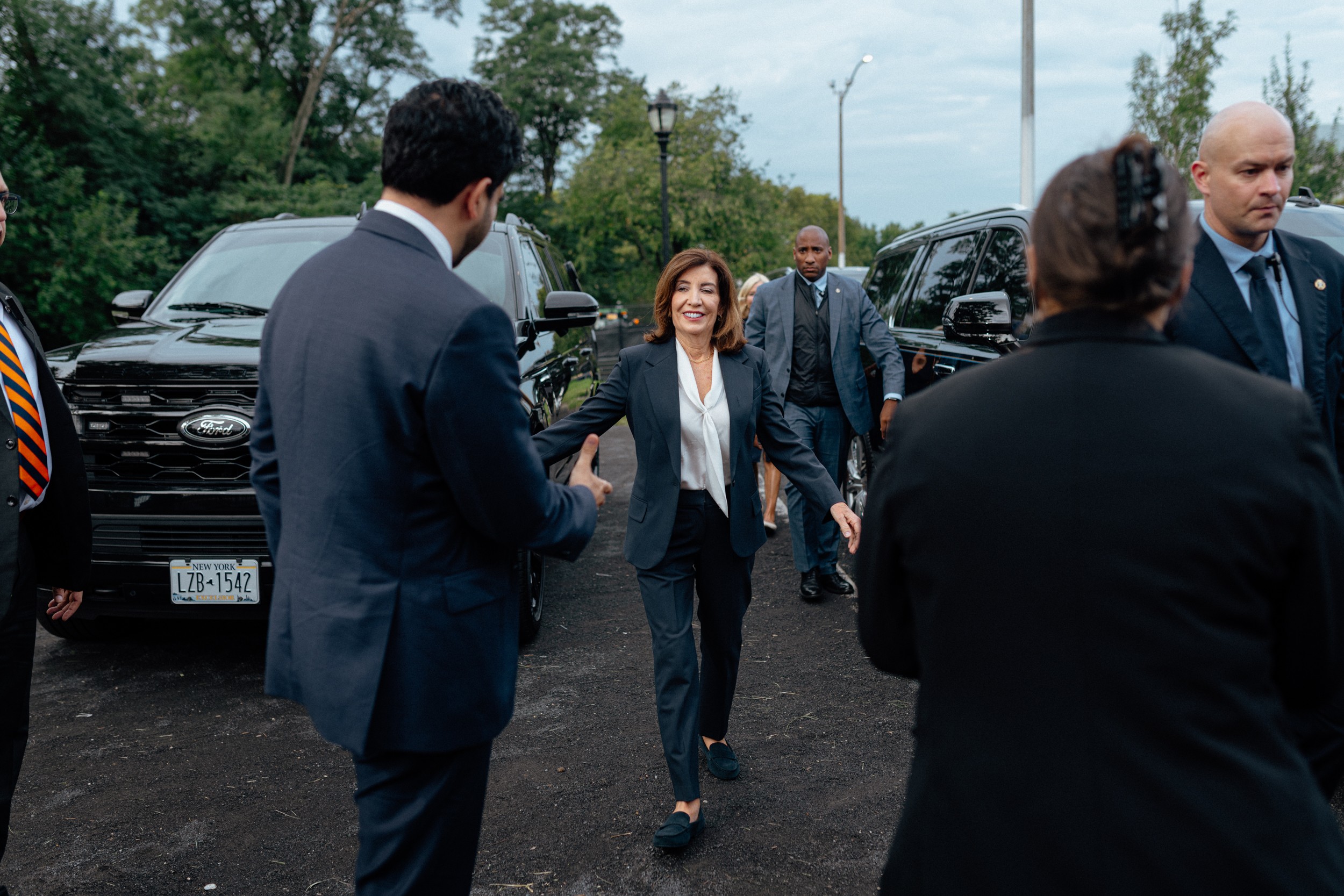
At the conclusion of a festival in the Canarsie section of Brooklyn, Hochul was walking back to her armored SUVs when a man on a nearby park bench recognized her and stood up to say hello. She walked over to greet him, and they had a pleasant exchange. As she was leaving, he asked the governor one more question: “What’s your name again?”
The word that the Atlantic staff writer Sarah Fitzpatrick hears often from her FBI sources is desperate, meaning that they believe FBI Director Kash Patel is desperate to please President Trump. What Trump wants, sources from the agency and the Justice Department concluded, is proof that he actually won the 2020 presidential election and punishment for those he believes conspired to deny him victory. Sources told Fitzpatrick that nervous agents have sought counsel in recent weeks about how to respond to FBI directives related to the midterms.
Fitzpatrick has published a series of revelations about the FBI under Patel’s leadership. In April, she reported that Patel had “alarmed colleagues with episodes of excessive drinking and unexplained absences.” Patel called the story a “lie” and filed a $250 million defamation suit against The Atlantic. On Radio Atlantic, she discusses what agents and other sources are telling her about how the mission of the FBI has changed, how resources have been diverted to exploration of long-debunked election-conspiracy theories, and what most worries them about this moment. The FBI has responded to Fitzpatrick’s reporting by calling it “false” and stating that the FBI is “united.”
The following is a transcript of the episode:
Hanna Rosin: “Is There Anything Kash Patel Won’t Do for Trump Before the Midterms?” That’s the title of a recent story by staff writer Sarah Fitzpatrick, who covers the FBI. She spoke to FBI agents and other sources who told her that Patel is, quote, “desperate” to help the president get what he wants, which one source told her was indictments, people in handcuffs.
I’m Hanna Rosin. This is Radio Atlantic. Over the last few months, The Atlantic, and Sarah Fitzpatrick in particular, has published a series of revelations about Kash Patel’s leadership at the FBI.
Back in April, Sarah reported that Patel had alarmed colleagues with episodes of excessive drinking and unexplained absences, a story that got a lot of attention. Patel called the story a lie, and he filed a $250 million defamation suit against The Atlantic. Sarah is joining us today to discuss her reporting on the FBI and the midterms.
Sarah, welcome back to the show.
Sarah Fitzpatrick: Thanks for having me.
Rosin: From your reporting, you learned that under Kash Patel’s leadership, the agency is approaching elections differently. What did you discover?
Fitzpatrick: In interviews with over 40 sources across the FBI and across Washington, they described an FBI that has fundamentally changed its core mission into essentially acting in many cases on behalf of the president and pursuing things that are in the White House’s interest, not in their traditional role around elections.
Rosin: And what did the agents you spoke to find alarming about this new focus?
Fitzpatrick: They found it incredibly alarming to the point that I think there was a real level of apprehension and terror that I had not sensed, even in my prior reporting. This was something new, and this was a real concern that there was a lack of information about what would happen on Election Day.
And a real concern that they were gonna be asked to do things that may be counter to what they had long been instructed to do as agents of the FBI, specifically around elections.
Within the FBI, it is such a sacred thing. There are so many rules and laws and ways to make sure that there is no appearance of the federal government ever putting a finger on the scale around elections.
And I think the concern among the workforce, and those familiar with what the FBI’s plans are, is a real lack of clarity, and in that vacuum is a sense of concern.
Rosin: And did people you spoke to bring up specific scenarios, like before the polls, long before the elections, after the polls?
Fitzpatrick: Yes.
Rosin: Did they spin things out?
Fitzpatrick: Absolutely. I mean, I think there’s a concern right now, given the FBI’s incredible amount of resources that they have devoted to election-related investigations. These range from things like going back over election conspiracies that have long been disproven, and making agents go over and over and over the same things with no new information, as far as we can tell, to investigations into people that the president or others around him find to have been—that they believe were part of a grand conspiracy—and to go after those individuals and to find reasons to indict them, essentially.
So there’s a kind of concern about how the FBI is—what they are prioritizing, what they’re using resources for, and whether or not that is an appropriate application of the law. I think there’s also a great concern among—because normally the FBI does a lot of preparation for Election Day. There are briefings; there are trainings.
The major one is around this idea that, how do we protect election locations and people involved in elections?
Rosin: That’s in the past. That would be the normal course of operation.
Fitzpatrick: That would be the norm.
Rosin: Right, right.
Fitzpatrick: That would be the norm. There’s a tremendous amount of that, and it’s a real focus on civil liberties and protection.
Rosin: Mm-hmm.
Fitzpatrick: That has not happened thus far, and we’re a couple weeks out from the election. There has been one large-scale training, which was titled “Election Integrity,” and the vast majority of that training, as far as I’ve been able to discern from my reporting, is that it was focused on illegal-immigrant voting, which, as we know, is a tiny, tiny, minuscule issue. And there wasn’t the same focus on making sure that the appropriate role of the FBI is followed on Election Day.
I’ve spoken to lots of agents and others within the bureau who have asked for guidance, who have asked for: What is going to be the plan? What do I need to be doing? And they are concerned that they are not getting the answers that they would expect.
And I think there’s a real concern among employees at the bureau about what it will look like after Election Day. And what will they be asked to do? What may the government—this White House—ask them to do? And I think there’s a real concern about that.
Rosin: And was there a specific scenario that anyone spun out to you? My greatest fear is X?
Fitzpatrick: One agent described, and we mention it in the piece, he says: “I’m either gonna be sick that day or they are going to have to fire me.” They are already preparing for what their red lines might be.
Rosin: Mm-hmm.
Fitzpatrick: Now, I think it’s important to be clear: There has been no specific guidance that has gone out, but the absence of that, given a bureau that is known for preparing so carefully, that’s making people nervous, and that ultimately goes to leadership.
Rosin: Right. Well, last month, Patel testified before the Senate Judiciary Committee, and the Democratic senators tried to extract a commitment from him that he would say no if the president tried to deploy federal agents to polling locations.
And as you—you’re nodding your head—they didn’t succeed.
Senator Richard Blumenthal: Can you commit to this committee that you will not send FBI agents to the polls on Election Day?
FBI Director Kash Patel: The FBI will follow the law. If there’s a reason to go there because there’s been a violation of the law, we will. Otherwise, we won’t.
Blumenthal: Would you agree with me that the FBI has no general authority to monitor elections?
Patel: That priority rests with DHS.
Blumenthal: So you would agree with me that deploying FBI agents to the polls on Election Day would be contrary to law?
Patel: I don’t know that we can’t legally do it. I’m telling you we’re going to house our agents and intel analysts in our field offices for election-security efforts.
Blumenthal: Well, I’m dissatisfied that you are unable to give us an unequivocal, clear, unambiguous commitment that the FBI will be kept out of election interference.
Fitzpatrick: I think it was a really alarming moment for members of Congress, and it was a really alarming moment for members of the bureau. I talked to a couple people who described what it was like to watch that in action, and they were a combination of just bewildered and distraught.
Like, this is such an easy question to answer. The law is clear. Why can’t he say it, and what does that mean?
Rosin: Speaking of the law, what are they legally allowed to do? What is the law around sending federal agents to polling locations?
Fitzpatrick: So officially, federal armed agents are not allowed to enter polling locations. The law is very, very clear. There’s a lot of case history around this. There are specific examples potentially in which there would be a threat to life, but the conditions that need to be met in order for that to happen are quite extreme.
Rosin: Now, you’ve implied in our conversation that the pressure’s coming from the White House. Why did you conclude that, and what did people tell you they’ve been hearing?
Fitzpatrick: Everyone I spoke to around this story, and I spoke with more than 40 people, described instances in which the orders that were given were described as: This is coming from the White House. This is a presidential priority. This is important for 47.
It was explicit that this was the case, and that also is an incredible departure from the FBI under any administration prior. They spend a tremendous amount of time and energy making sure that it doesn’t even appear that they have any contact with the White House.
And this is one of the questions that we asked. You know, Has the bureau followed the rules about who’s supposed to be talking to the White House and not? They claim that they have. Our reporting suggests otherwise.
Rosin: All right, let’s get specific about that. Under previous administrations, at least in my memory, agencies actually take pains to—
Fitzpatrick: Yes.
Rosin: —to portray themselves as independent—
Fitzpatrick: Yes.
Rosin: —and apolitical. What has this agency done under Kash Patel—things that you found out but also things that have been publicly reported—that depart from that tradition?
Fitzpatrick: I mean, first of all, you have a director that is appearing with the president at events in which it appears—there’s this particular event that we talk about in the piece, a rally, essentially a Trump rally at a police-training academy.
Patel: President Trump’s mission to make America safe again, as he campaigned; he is delivering on that promise, and it is such an honor to be here in Nassau County, back in my home, when he’s about to walk onstage and give you the latest update on the statistics.
Fitzpatrick: And the fact that you had the attorney general and the director of the FBI up there—and not just, not just there, but personally thanking the president.
Patel: President Trump, thank you for backing law enforcement. Thank you for funding law enforcement. Thank you for loving law enforcement. Thank you for relentlessly pursuing the mission of justice with the warriors of justice across this country.
Fitzpatrick: You know, saying, The president reads about every single case that we work on. That’s not supposed to be happening. If that’s happening, that’s a real problem on every level.
Rosin: And play that out for me. I saw that—is the departure, like, in tone, or the way that he appears, or the way that he praises the president, or just the very fact that he appears?
Fitzpatrick: The very fact.
Rosin: The very fact that he appears at a public event that feels like a political rally.
Fitzpatrick: The very fact that you would be with the president, that you would be photographed with the president really at all. I think previous FBI directors have described to me how they would take all these pains to avoid that and would not even come visit the White House, in many cases. That’s not what’s happening here.
Rosin: How did Patel and the agency in general respond to this reporting when you asked them about it? It’s strange, a little bit funny.
Fitzpatrick: It was really strange.
Rosin: Yeah.
Fitzpatrick: I still don’t fully understand it, to be honest. It’s one of the most odd responses I’ve ever received.
Essentially, we sent—I sent—three pages of very, very detailed questions about what we planned to report, and Director Patel’s response was about a golden Jet Ski, and asking if I had found his golden Jet Ski.
Rosin: Which you hadn’t.
Fitzpatrick: I hadn’t.
Rosin: No. It’s not one of the things you’ve —
Fitzpatrick: I’ve actually never reported on Jet Skis.
Rosin: Yeah. (Laughs.)
Fitzpatrick: I wasn’t aware that he had lost one, but I’m happy to help if he needs help.
Rosin: Mm-hmm.
Fitzpatrick: But I think it was, you know—it was a reference to what we think was another news organization’s reporting that had nothing to do with the story, which was very odd for someone whose job it is to be precise about facts.
Other executives at the FBI did respond. They said that the reporting was false. They emphasized that this was a united FBI. But it was very curious: All of the people who submitted these responses had almost identical language, right down to the words.
Rosin: Which was “false.”
Fitzpatrick: “False,” “united.” It was unlike any response I’ve ever received in my many years of reporting.
Rosin: In its flipness?
Fitzpatrick: Its flipness and its—it’s a lack of engagement in detail.
Rosin: Right.
Fitzpatrick: And I think, you know, my job as a journalist is to gather as much information, to engage. Normally, you know, it’s a constant back-and-forth.
And, you know, on something so important as elections and Americans’ perceptions of elections, anxieties about this election, and federal law enforcement, it is odd. It’s very odd. It’s very concerning.
Rosin: And we should note that a spokesperson for the FBI denied that there were any internal concerns raised about the bureau’s approach to election investigations, and they said in a statement, “Election security is and will continue to be one of this FBI’s highest national security priorities, and we will make no apologies for any work to ensure every American citizen’s sacred right to vote is protected from criminal interference.”
[Music]
Rosin: After the break, why sources have described Kash Patel as, quote, “desperate” to help the Justice Department before the midterms.
[Break]
Rosin: I wanna go back to election-interference claims, which have a long history in this administration. Earlier this year, Patel announced that the Justice Department was gonna be making arrests in connection to 2020-election interference, and as we know, they haven’t made arrests. But your reporting found that it’s not for lack of trying. What did you discover they’d been doing in regards to the 2020 claims?
Fitzpatrick: They’ve been doing a lot in regards to the 2020 claims all over the country. There are a series of election-integrity investigations in which they have gone back and pursued conspiracies or theories from people who normally would not be providing information to the FBI, or that the FBI has already found it not to be credible.
But agents and other analysts, other FBI staff, were taken off of their responsibilities to go and do this work. In Fulton County, we have the example this summer of over 200 agents, I believe, were taken off of their responsibilities, worked nights and weekend, at tremendous cost to the taxpayer, to review ballots that had been seized by the FBI in January related to 2020. Our understanding is that nothing new or material came out of that investigation, and it took away people from doing really important work that helps keep people safe.
Rosin: And just to be clear, we’ve done some reporting on the Fulton County case on this show, and it’s not just been investigated by federal. It’s been investigated by state agencies. It’s been investigated many times over, and there wasn’t any evidence turned up—
Fitzpatrick: Exactly.
Rosin: —over these years that there was anything fraudulent.
Fitzpatrick: And I think one of the things that I report in the piece that I think really sent shock waves through the bureau, as well as other law-enforcement and intelligence agencies, is the fact that two people were walked out of the Atlanta field office for even raising questions about the process of what they were being asked to do.
And when we asked the FBI about that, they said they couldn’t comment on personnel but made a very curious comment that anyone who engages in weaponization no longer has a job here. And I think that speaks to a place that is demanding a certain level of what they believe, what has agents and others inside the bureau describe as loyalty. You have to show your loyalty.
And one person I spoke to recently, a private defense attorney, he described to me that he receives constant calls from people he used to work with in the bureau, because they are concerned about this election and what the FBI’s role in it may be. And he described people that are essentially—there is so much pressure to bend to this narrative, a narrative that has been debunked. But that’s what our FBI is spending their time on, much of their time on.
Rosin: And you also reported that people in the FBI and at the Justice Department are looking for guidance. Like, in what ways, and what kind of guidance?
Fitzpatrick: There’s a real absence of clear direction and clear information right now. And I spoke to multiple people who described sometimes having to be on, like, a goose chase trying to figure out, Okay, so who’s in charge of elections, and what should we be doing, and how should we be preparing?
And I was told of this message that was relayed from one Justice Department official to another. Someone was asking about the Justice Department manual, which is the list of very, very clear rules and guidance and procedures, and there’s an entire aspect of this specific to elections because it is so sacred and high-stakes. And this person was told, we quote—we say it in the piece—“I was told the Justice Manual isn’t a thing … There are no rules. Just make sure Republicans win.”
Rosin: Wow.
Fitzpatrick: Now, I asked the DOJ about that. They said that this is not and has never been department guidance. And I think, you know, that’s what people are getting alarmed by, that these are the messages that they’re getting, and they are really concerned.
Rosin: In your piece, you used the word desperate, as in people described Patel as “desperate” to help. Why desperate? That’s an extreme word.
Fitzpatrick: It is an extreme word. It’s a word that people used over and over in my conversations with them, and increasingly as time went on in this reporting. And I think it reflects this very precarious position that Patel finds himself in. We at The Atlantic have reported that he has been on the list of people that were believed to be close to being asked to leave.
We’ve reported that Patel himself has expressed that to other people and is very nervous about his place. But in a way, that is a feature, not a bug.
Often, sources will talk to me about: There’s an audience of one here. And that the president has asked him to do very specific things, and in order to keep this job, you know, what our sources tell us is that he is willing to do things that he feels that he must do. And that, you know, one source says to me, This is the guy—Patel’s the guy who never says no. And the president likes that.
Rosin: What are the tone of the sources you’re talking about? Is it mocking, worried, concern, a whole range of things?
Fitzpatrick: You know, I think it’s changed over time. Originally, when I first really started digging into the FBI, it would be a kind of mocking, a kind of, This is silly, but the work’s getting done. And over time, especially this summer, there was a real change. People started getting much more alarmed, concerned, bordering on sometimes a kind of Is there any use?—almost a kind of nihilism—and really describing a kind of paralysis in how they were feeling and how they were approaching that work. And that really made me take notice and feel that there was something that had shifted this summer in the preparation for the midterms.
Rosin: So that’s the evolution in the agents. I’m curious about the evolution in the precarity of Kash Patel’s position and what you know about that. When we spoke in April, it did seem as if his job were at risk.
Do you get a sense that that’s changed? Has he won the favors of the president? Do you know about that?
Fitzpatrick: Yes. I think that’s true.
Rosin: Uh-huh.
Fitzpatrick: I think that’s absolutely true. I think he has gone from being one of the most vulnerable members of the Cabinet to being perhaps one of the safest, because it’s very clear what the president wants, and he has demonstrated over and over again that he will use the resources of the FBI towards those purposes.
Rosin: Now, there has been some resistance. You mentioned some, but can you tell us who else resigned and what they said?
Fitzpatrick: So there’s been a kind of an ongoing, either people that are fired or people that are resigned almost on a weekly basis, and they sometimes come in waves. Interestingly, but we had a couple really interesting people resign recently.
Out of the blue, we had Andrew Bailey, who was one of the co–deputy directors of the FBI. He was brought in and was viewed by many in the bureau, but as well as within the White House, as the person who would be the successor to Patel eventually. And Bailey suddenly resigned. That was a surprise to even his closest staff.
And I think for a lot of people within the bureau, this was a really telling indicator of the direction that the bureau is going in. In part, I’m told from sources familiar, that Bailey was viewed as someone who was willing to discuss the Constitution; bring up Perhaps these are the limitations. Perhaps this is, you know—we should be aware of these things; and that he was, in many cases, a lone voice in that. And now I think that resignation has made those inside the FBI, especially in leadership, very concerned about who is going to say no to Patel.
Rosin: Since you mentioned Bailey, I should say that he’s pushed back against some of your reporting and your narrative.
Fitzpatrick: Yes. In a statement provided by the FBI press office, Bailey said that the reporting was false and said that—and it was specifically around questions about pushing back on proposed law-enforcement actions and the fact that he brings up the Constitution in meetings.
Rosin: There were also some other resignations you mentioned, which surprised me.
These were people who I thought would be maybe more sympathetic to claims of election interference, and they also left. What is that about?
Fitzpatrick: I think it’s a reflection of the fact that these investigations—so this is within the bureau but also primarily within the Justice Department. There is this giant investigation that’s been going on in South Florida that just keeps taking people from all over the government, so much money, so much time.
It is just, like, agents describe it as something that they try desperately to avoid getting picked up to. One person was telling me that they were, like, kind of having to come up with ever more creative excuses to not be in the office. Anyway, this investigation in South Florida is really kind of the nexus of the effort to use the federal government, the FBI and the Justice Department, to go after the president’s perceived enemies and those that he believes somehow contributed to his loss in [the] previous election.
We saw some of a mass—essentially a mass resignation, although the Justice Department has said that some of those were reassignments that were already planned, and that this is a real signal. It was designed to be a signal. And it was a signal that, according to sources that I spoke to, that the leadership of the Justice Department was asking them to move too quickly and asking them to do things by a certain timeline, which was prior to the midterm elections.
And for even these individuals, who are true believers, who truly do believe and have devoted their lives to correcting what they believe when it was improperly handled, they said, This is a step too far. You are asking me to do something that is not supported at this point by the evidence or the law.
Rosin: Interesting. Interesting.
Fitzpatrick: It’s a real—and one person described it to me as an effort to get the president’s attention.
Rosin: I wanna put this in some kind of broader context, because you and other people in The Atlantic have been warning and reporting for months about potential election interference.
First, a little historical context: J. Edgar Hoover. This is not the first time that the FBI has been accused of political interference, you know? He obviously helped build the modern FBI, and also, you know, went after activists. And so how is this moment in history a deviation from what’s been in the past?
Fitzpatrick: I think it is a deviation from a mission that was very clear, an oath to the Constitution and to protect American citizens, and that is what the FBI does. That is what it is trained to do. There’s a lot of time and energy for the leadership of the bureau. They spend, I would say, the vast majority of their time thinking about, How do we put guardrails around what we do?
And so I think a lot of the FBI’s history has been around creating reforms, having checks and balances, making sure that these things are carefully and cautiously applied in a way that keeps Americans safe, but also upholds their rights under the law. I think we are seeing a shift in what that mission is, and that mission is towards the president’s agenda in many cases, assisting with immigration enforcement, going after perceived political enemies, going after election-conspiracy theories. That is a radical departure.
Rosin: We’re only a few weeks from the midterms now. It seems like you’re gonna be vigilant. What will you be watching for? ’Cause we’ve described ways where it could really go off the rails, and we’ve also described ways that there are boundaries and checks. So what signs are you watching over the next few weeks about which direction it’s gonna go in?
Fitzpatrick: I’m watching for—I’m gonna be watching for resignations or firings. I’m gonna be watching for actual planning. What is the level of who’s being asked to be on call? What are they being asked to prepare for? Where are they being stationed, and why? I’m going to be watching for what threats the bureau is anticipating. There’s a real conflict within the bureau right now about how resources are devoted to what is considered antifa or extremism, and who gets—which cases are pursued and why. That’s gonna be a really telling indicator, I think. And ultimately, this is an administration that is very clear and transparent in many cases about what they plan to do and what they’re hoping to do, and we need to take them at their word.
Rosin: Well, Sarah, thank you so much for joining me today.
Fitzpatrick: Thank you.
[Music]
Rosin: This episode of Radio Atlantic was produced by Kevin Townsend and Jinae West with help from Mike Pesoli. It was edited by Claudine Ebeid. Rob Smierciak engineered and provided original music. We also had music from Breakmaster Cylinder. Claudine Ebeid is the executive producer of Atlantic audio, and Andrea Valdez is our managing editor.
Listeners, if you enjoy the show, you can support our work and the work of all Atlantic journalists when you subscribe to The Atlantic at TheAtlantic.com/Listener.
As an alarm siren cried out, the 30-year-old Swedish rapper Yung Lean rushed to the stage of the MTV Video Music Awards last month, looking furious. His button-up shirt was spotted with what appeared to be blood; he smashed a chair on the floor, broke a Moon Person trophy, and took his place in the middle of 66 young men wearing ties, blazers, and blank looks on their faces. Then those men around him did something odd. They started dancing—in pulsating, fluid movements as hypnotically beautiful as a leaping pod of dolphins.
This was a live rendition of part of the most discussed music video of the year: “Storm,” by Gener8ion, a previously obscure collaboration between the French electronic musician Surkin and the French filmmaker Romain Gavras. The music features Yung Lean warbling hoarsely over propulsive beats, and the video features him as a bully dominating his classmates. But the centerpiece dance sequence of the seven-and-a-half-minute clip is what attracted attention upon the song’s release, in April. “Storm” now has more than 34 million YouTube views, an eye-popping number at a time when music videos rarely reach anyone but an artist’s fans. TikTok and Instagram are full of people—kids, dancers, athletes, farmers, wedding guests—stomping and swaying like (but never as impressively as) the video’s boys.
The phenomenon has sparked a mystery: What does the dance mean? Set at a U.K. school in the year 2034, the “Storm” video fuses subtle sci-fi into a familiar tale of adolescence. At one point, Yung Lean’s character tears down a 6G cell tower and smokes metal shavings from the wreckage in a glass pipe. Lord of the Flies, American History X, and other cultural depictions of male bonding through brutality may come to mind for viewers. Some commenters have called “Storm” a celebration of masculine energy; others say that it subverts that very thing by showing boys diverting aggression into expressive movement.
On Sunday, I spoke with Damien Jalet, the choreographer who came up with the dance, and his interpretation was decisive: The point was to convey vulnerability—specifically, “male vulnerability.” Jalet wanted to show the soft interiority of boys under “pressure”; one of the topics he and Gavras discussed was the anxiety of attending school in an era when active-shooter drills are a reality. “As much as showing the strength and the power” of these young men, he told me, “I wanted to also portray the fear. I wanted to portray the sense of bonding, the sense of hope, but also of being overwhelmed by things.”
A 50-year-old French Belgian artist, Jalet has spent decades bridging contemporary dance with popular culture. His résumé contains prestigious performances at museums, ballets, and opera houses—but also multiple Madonna tours, a Thom Yorke and Paul Thomas Anderson video, the 2018 Suspiria remake, the Oscar-nominated (and divisive) 2024 movie musical Emilia Pérez. Much of his work involves unusual staging, strange patterns, and tonal solemnness. For “Chiroptera,” a 2023 collaboration with Daft Punk’s Thomas Bangalter, Jalet arranged 153 dancers on scaffolding above a Parisian plaza for what looked like a massive, haunting game of human Tetris. “I like to feel people being part of something that is bigger than themselves,” he told me.
“Storm” is very much in that vein. The individuals’ dances are “not really complicated,” Jalet said. “You can learn them in a day.” But combined, they convey the sense of a “force” passing through a crowd. Rather than have the boys all move as one, he arranged them into lines that mirrored one another in different ways at different times, creating syncopated ricochets of action. At one point, each participant seems to wipe tears from his eyes—a reference, Jalet said, to the idea that “men don’t cry.”
Executing the performance was in itself emotionally challenging. The video shoot, which took place over two days in Belgium last December, entailed eight takes, and “all the dancers were aware that any mistake would basically mean that we had to restart again from scratch,” Jalet said. For the VMAs, Jalet and his team had to teach steps to an entirely new cast of dancers. In rehearsals, “I could feel they were all in a very demonstrative mode, and showing a lot of strength, flexing muscles,” Jalet said. “And I was like, No, no, it’s not just about throwing this at us. You actually have to have it coming back at you—right in the chest. It needs to be something that you internalize, that you experience more than demonstrate.”
Since the video’s release, people all over the world are trying to recapture its magic. Some of the tribute videos feature groups of people dancing together in real life. But a lot of the clips are made with AI; software platforms have even created templates to generate “Storm” knockoffs. Many videos perform identity swaps: The schoolboys become, say, African dancers, or Ukrainian soldiers. Usually, one human user plays the part of Yung Lean, standing unmoving in the middle of the simulated, dancing horde. The motivation often seems to be to demonstrate the creator’s individuality, but after watching video after video in that style, one can’t help but think about the awful power of the internet hive mind.
Jalet feels a mixture of joy and horror at the “Storm” imitations. “I love every single video I see of people trying to do their own version physically,” he said. “I loathe any of the AI versions. I find it’s the laziest form of creativity.” Using technology to insert oneself into someone else’s work—typically uncredited work—is, he said, “an ego trip that I have no admiration for.” He pointed out that the video’s initial appeal reflected amazement for what people can do and computers can’t. Seeing a celebration of human bodies becoming slop has been “very disturbing, to be honest, and very dystopian.”
I mentioned to him that some of the praise I’d seen for “Storm” had come from right-leaning accounts thrilled by the sight of young men stomping and hooting together. He replied that anyone who sees an authoritarian or masculinist bent in the video should watch more closely. “Usually, dancing men is not something that fascism is promoting—not at all, and especially not in that way,” he said. Although there is anger in the dance, “it’s catalyzed in a way that it’s a catharsis.”
That explanation fits with the complicated feelings I had watching the video at a moment when male groupthink is driving so many unsettling headlines. Yung Lean’s character, both scary and charismatic, is like a magnet moving across a tray of iron filings, organizing raw elements into new shapes. His classmates sport the buzz cuts and broccoli hair that typify their cohort; they wear uniforms of traditional manliness. But the dance captures each one fighting his own internal battle with the terror—and, perhaps, affection—they feel for the troublemaker in their midst. They’re being transformed—though whether for better or worse will depend on the individual.
There’s also something faintly transgressive about the fact that “Storm” has sparked popular fascination for contemporary dance—an art form widely viewed as the province of elites and as anything but macho. Indeed, Jalet sees “Storm” as being part of his career-long effort as a gay artist trying to “cool down” stereotypical masculinity and “amplify female power,” such as by choreographing a coven of witches in Suspiria. He fell in love with dance by watching Madonna on TV as a kid, and at age 15, he performed a dance to her song “Erotica” during a party at his church. The audience was impressed by his craft, but, he said with a laugh, “I was not sure they were really connecting to the message conveyed.”
Given that trajectory, this year’s VMAs was quite the landmark. Jalet’s work on Madonna’s Confessions II mini-movie ended up beating out “Storm” for the Best Choreography award (an untelevised category whose nominations were credited to musicians rather than choreographers—a “completely fucked-up” sign of his craft’s devaluation in pop culture, Jalet said). And though the show closed with “Storm,” it opened with a nine-minute Madonna performance, choreographed by Jalet, that featured lasers attached to women’s crotches and a scene of sexy, queer chaos set in a nightclub bathroom. “Storm” may seem like a completely different piece of art, but, as Jalet sees it, “the same free energy passes through both of them.” And perhaps, for some of the boys watching at home, that energy will ripple onward—having its own unpredictable effects.
This is an edition of Video Village, David Sims’s newsletter that unearths cinematic gems and brings readers into his movie obsession. Sign up for it here.
Welcome to Video Village, a new space for The Atlantic’s film-loving readers. For this, my first edition, my editors challenged me to lay out my perspective on my own taste, so I’ve worked up a list of movies that I think define this strange decade thus far. These are all personal favorites, yes, but this is not precisely a “best of” list; think more an atmospheric overview of how Hollywood looks and operates today, which will be a recurring theme of this newsletter.
Let’s get two of the most obvious picks out of the way: Greta Gerwig’s Barbieand Christopher Nolan’s Oppenheimer, whose release on the same day in July 2023—and during a strike that kneecapped Hollywood—resulted in a multibillion-dollar cultural phenomenon. The industry has spent the following years trying its darndest to recapture that success—and to undo the coronavirus pandemic’s unprecedented effects on moviegoing as a whole. Those movies aside, here’s a look at 10 other great films that illustrate the spirit of the 2020s.
Da 5 Bloods(2020, directed by Spike Lee): The decade kicked off with what still has been its oddest year, defined by COVID lockdowns, theaters going out of business, and the dominance of streaming services at a moment when the only way to experience good movies (for most people) was at home. A lot of the wonderful films released that year feel like a blur; maybe the best example of a memory-holed masterpiece is Lee’s Vietnam epic, Da 5 Bloods, which I’d love to someday see on a giant screen with booming sound. It boldly ties the failures of America’s intervention in that war to the country’s struggles since, with Delroy Lindo’s troubled vet turned MAGA patriot the chief emblem of its chaotic viewpoint. Hopefully, this ambitious movie, whose production was similarly fascinating, will be rediscovered in the years ahead—ideally on a bigger screen than a television set.
The Worst Person in the World(2021, directed by Joachim Trier): The ultimate work of self-reflexive Millennial-core, the Norwegian director Trier’s sharp dramedy came just as some moviegoers were returning to theaters after lockdowns had frozen them in time and anxiety. It follows Julie (played by Renate Reinsve), a witty 30-year-old who simply does not know what to do with her life. The film charts her every stutter-step career decision and corresponding romantic entanglements with bittersweet aplomb. All of Trier’s movies are worth checking out (the most recent being Sentimental Value, a hit at this year’s Oscars). But this one remains my personal favorite.
Drive My Car (2021, directed by Ryusuke Hamaguchi): One of the best examples of William Goldman’s notorious industry adage—“Nobody knows anything”—is this three-hour, soft-spoken Japanese drama. The story of a depressed theater director’s effort to stage a multilingual production of Uncle Vanya became a surprise sensation, launching Hamaguchi to art-house fame and snagging four major Oscar nominations, including Best Picture. It’s a beautiful work of deceptive tranquility, where aloof conversations belie dark emotional storms beneath; it’s also the greatest adaptation of Haruki Murakami’s writing ever put to film. Hamaguchi has since proved to be one of the decade’s most fascinating auteurs, and his work is appointment viewing. (Next up is All of a Sudden, out this November.)
Tár(2022, directed by Todd Field): I finally became convinced that the theater experience wasn’t going anywhere while watching the titular protagonist of Tár, Lydia (Cate Blanchett), confront a child who had bullied her daughter on the playground—I felt the entire viewing audience ripple with delight. Here we all were, observing this egotistical conductor whose life was spiraling to pieces, and struggling to resist the urge to cheer for such obviously aberrant behavior. Field’s film is a fantastic portrayal of ego, power, and the kind of rapid professional disintegration that’s become more common in the celebrity sphere of late; it’s a totally unique take on a common spectacle.
Nope(2022, directed by Jordan Peele): Peele announced himself as a film director with the subversive smash that was Get Out and could have led his career in any direction from there. I love that he’s instead doubled down on original horror storytelling. Nope is his most recent movie (a new project is supposedly in the works but remains a mystery), and it’s his best and most ambitious: a sly tale of how the entertainment world can chew people up and spit them out. It also features a flying monster that can literally do that.
RRR (2022, directed by S. S. Rajamouli): This epic from India’s Telugu-language industry (known as “Tollywood”) blasted into multiplexes out of nowhere, just as the Hollywood blockbuster began truly spooling up again. RRR showed Americans how grandiose, CGI-assisted action filmmaking can still feel fun and original; the movie is a sprawling, 1920s-set musical epic of revolt and revenge designed to inspire viewers to stand and applaud throughout. The crowd-pleaser par excellence broke records around the world and even won an Oscar for Best Original Song. Rajamouli’s much-anticipated next film, Varanasi,is due for release in 2027.
Asteroid City (2023, directed by Wes Anderson): Few raves I’ve written in my time at The Atlantic have been more polarizing than my championing of Anderson’s sci-fi comedy; multiple people who had grown wary of the writer-director’s output have angrily confronted me about my review. Plenty of readers, however, agree with me wholeheartedly that it’s the director’s best film in close to a decade. Whatever other viewers make of it (and all of Anderson’s recent work, which is hermetic and tightly designed even by his standards), I think Asteroid City is one of the most profound attempts to wrestle with the odd sense of community and tragedy that emerged when most of us were unable to leave our home. It’s a very modern portrait of quarantine—albeit set in the 1950s—that doesn’t pull its punches on the darkness that its broad ensemble is struggling with.
Red Rooms (2024, directed by Pascal Plante): Looking back at 2020s cinema, we’ll find that a defining trend was contending with the spiraling madness of online life. Red Rooms is maybe the best horror movie ever made about being on your computer too much: The Canadian thriller is a freaky tale of a true crime–obsessed woman (Juliette Gariépy) fixated on a murder case that’s sparked a media circus. It’s a profoundly disturbing watch, even though it holds back on graphic visuals (like many a great horror movie, it leaves the worst to your imagination). Red Rooms was a sneaky festival hit before it trickled into cinemas, and it’s guaranteed to become a long-running cult classic.
Eddington(2025, directed by Ari Aster): This internet-horror story runs right at the bizarre experience of the pandemic lockdowns. Aster’s Eddington was profoundly divisive on release and was quickly dismissed by some critics for its sheer unpleasantness. It’s worth a watch (or, if you hated it the first time, a revisit); Aster’s got a keen eye for the type of online brain poisoning that has grown and spread across the world over the past six years, and he has a darkly humorous perspective on the way identity politics have been misappropriated by bad actors. I had barely heard of data centers when I saw Eddington last summer; now they are often at the top of political discourse. What else did Aster see coming?
Backrooms(2026, directed by Kane Parsons): I’m hardly proclaiming Backrooms the movie of the year; 2026 isn’t even over yet. But its release definitely seems to have pushed Hollywood to recognize a new frontier in filmmaking. The horror film, a bewildering adaptation of a series of YouTube videos, was directed by a 20-year-old who taught himself visual-effects technology during high school.Set in a world of eerie liminal spaces, Backrooms feels somehow beamed in from another universe while also being a slick creep-fest that could draw in young viewers on “vibes” alone. The unsettling promise of its scares just feels so unlike anything I’ve seen in theaters lately—I loved it.
An Essay I Enjoyed
Robert Falconer / Prime
Carrie, With Kid Gloves By Emma Stefansky
The climax of Carrie, Stephen King’s debut horror novel, is so famous that even people who haven’t read it or seen any of the numerous adaptations know the basics. The eponymous Carrie White, driven to the edge of sanity after years of abuse from her classmates and hyper-religious mother, gets drenched in a bucket of pig’s blood at her prom. She then uses her latent telekinetic powers to destroy her high school and her hometown.It’s an extreme reaction to an extreme situation, the climax of a revenge story in which vengeance is just another tragic act of violence.The line between villain and victim blurs.
October tends to mark the start of a real glutof releases: Many major premieres happen in quick succession at big fall festivals (in Telluride, Venice, Toronto, and New York), and then they come to regular theatergoers—and bring the awards race into focus. One of this year’s contenders, in theaters this week, is Fjord. Directed by the Romanian auteur Cristian Mungiu, it won him the Palme d’Or at this summer’s Cannes Film Festival—an award that has become a bit of a springboard to more mainstream success, as it did for the recent Best Picture winners Anora and Parasite. But I’m of two minds on whether Fjord will follow in their footsteps. Like all of Mungiu’s movies, it is challenging in its remoteness, asking the audience to hold some uncomfortable truths and make their own decisions about them.
The film follows a Romanian family that has immigrated to a remote Norwegian village. The parents, played by Sebastian Stan and Renate Reinsve, are both stern and religious, placing them well outside of the country’s secular cultural norms. The couple is soon accused of abuse, and the government takes their children away while an investigation proceeds—a situation that erupts into something of an international incident. The reality of what’s happening is plain to grasp: This parenting style is at best alienating, and the seemingly tolerant society surrounding the family doesn’t quite know how to deal with it. Fjord is grim, and at 146 minutes, it’s a demanding watch—one that may be too disaffecting to break through. But it’s also an undeniably engrossing experience; no character feels truly sympathetic, and best intentions crumble in the face of internet outrage and ill-functioning bureaucracy.
What Else I’m Watching
I rewatched Paweł Pawlikowski’s film Cold War in preparation for the upcoming release of Fatherland, which will complete a loose trilogy about postwar Europe; it’s short, sometimes sexy, and sweetly tragic (and streaming on Prime Video).
I’m also catching up on the filmography of another great director, Lee Chang-dong, whose Possible Love is out at the end of the month (and in November on Netflix). I watched his debut, Green Fish, which is a lovely and poetic little crime saga from 1997. (It’s available to rent on Prime Video and Apple TV, and streaming on Kanopy, though I watched it on a disc published by Vinegar Syndrome.)
Finally, I caught up with last year’s documentary Pompei: Below the Clouds, from Gianfranco Rosi. It’s a gorgeous and fragmented portrayal of life in modern Naples in the shadow of Mount Vesuvius, and it’s streaming on Mubi.
Whenever I receive a text, this is what happens. I pick up my phone. So far, so good. I experience whatever emotion the message elicits—the pleasant warmth of being reached out to, possibly the annoyance of being interrupted. Then, if conditions are right, if I’m not too busy or in the middle of talking with someone else, if my mind is at peace, if my anxiety is at no more than a low hum, if Mercury is not in retrograde, I will respond right then and there. If conditions are not right, it will be as though the text never existed at all.
Right now, I have 30 unopened texts. Scrolling through my messages, I find several more that I opened but forgot to respond to for anywhere between a few hours and a week and a half—from my parents, my sister’s fiancé, old friends who are accustomed to this kind of behavior, and new friends who are just beginning to be disappointed in me. At least two people texted me so long ago—more than a month—that to respond now and remind them how long they’ve been waiting would be worse than not responding at all.
I’m not proud of leaving people hanging. Every text I owe is a tiny siren in the back of my mind, blaring intermittent pulses of guilt. Unless I forget about it entirely, in which case I’ll remember it with a shameful jolt some days or weeks later. I’m not one of those modern hermits who thinks you don’t owe anyone anything, who likes every Instagram post she sees about boundaries and thinks that flaking on plans is self-care. I write about relationships for a living, and I believe that showing up for one another is the purpose of our existence. That’s, like, my whole brand. And so this is my greatest shame: I am a Bad Texter. I am slow to respond. I am forgetful. I get overwhelmed. My own mother has said I’m “probably worse than 90 percent of the other people that I text with.”
This might seem like a trivial pathology, but it isn’t. Texting is the currency of modern relationships. In 2024, Americans exchanged more than 2 trillion text messages, about 42 billion more than the year before, according to CTIA, a trade group representing the wireless industry. Some of those texts are probably spam. Some are advertising. Some are bits of automated busywork (click this link to confirm your appointment ). But many of them, hopefully most of them, are between people who know one another, reaching out for connection over the waves of the wireless spectrum.
According to a 2023 survey, texting is the No. 1 way that people prefer to communicate with their loved ones, beating out mobile-phone calls and absolutely crushing face-to-face conversations, which got only 8 percent of the vote. Texting came out ahead in every age bracket except the oldest; those 55 and older ranked texting and mobile-phone calls equally. No age group preferred anything over texting.
Yet at the same time, texting stresses people out. A third of Americans report feeling overwhelmed by the number of texts they need to respond to, and a majority say they struggle to keep up with their group chats. As Pranav Malhotra, who studies communication and media at the University of Michigan, told me, texting “is what the people want, but it’s not doing them any good.” And so, many of us end up feeling like Bad Texters. We are here, we are legion, and we are sorry for our delayed response.
Texting dominates oursocial lives like nothing else. According to the research firm Nielsen, American cellphone users started texting more than they called in 2007. Since then, unlimited phone plans and widespread Wi-Fi have removed many of the barriers that once led people to restrict their texts.
The ubiquity of text-messaging hardly seems worth questioning—it’s simply the way things are. But when you think about it, the modern predilection for managing all of our relationships by typing on a tiny touch screen is a bit odd. “For darn sure, it’s a lot faster to talk about things than it is to text them,” Naomi Baron, who studies language and technology at American University, told me. “Particularly if you have more than, let’s say, 100 characters’ worth to say. But it’s become the way of doing things.”
Texting achieved domination because it’s convenient—you can message someone at any time without waiting to see if they’re available first—and because it offers a sense of control. You don’t need to risk the uncertainty that comes with live conversation; you can plan out exactly what you want to say, and people won’t see how you react to their response. This is one of the things that people say they like best about texting. But the ease of sending messages means, on the flip side, that people are receiving more.
As texting became our default mode of communication, messages that once might have taken another form—your hair salon calling to confirm an appointment, an email invite to your best friend’s birthday party, a paper medical bill—started arriving as texts. And the act of texting is no longer confined to whatever mobile app processes your SMS messages. I have four different texting-specific apps on my phone: the standard iPhone Messages, WhatsApp, Signal, and KakaoTalk—a Korean messaging app where my in-laws’ family group chat lives. Then there are social-media DMs, which function much like texting, and Slack, where my colleagues send me DMs that would have been emails not so long ago. These show up on my home screen as notifications, and when I respond on my phone, the feeling is very similar to texting.
I have sometimes attempted to deal with my texting overwhelm by communicating in other ways. Lately, I’ve been trying to call people more to catch up, which is wonderful, but it can also cause alarm. One British survey from 2024 found that more than half of young adults said they assumed unexpected calls meant bad news. (Surely you would just text anything else you want to say.) Sometimes I’ll send my friends voice messages when I want to tell them a story that’s too long to type, but this, too, is controversial. I love voice messages—I think they feel so much more intimate than a text—but many people think that expecting a friend to take five minutes out of their day to listen to a mini-podcast you recorded is annoying, or even selfish. For party invitations, vacation planning, or anything logistical, I prefer to use email, but I’ve received explicit feedback from my husband and many of my friends that I should be texting instead, because “no one checks their email.” (Can this possibly be true?) Whenever I try to escape, social pressure always seems to push me back to texting.
And so the texts multiply, taking up more and more space in our relationships, until to be called a Bad Texter feels like being accused of being a bad spouse, sibling, child, parent, or friend.
Hannah Robinson
Instagram’s algorithm must have me figured out because it recently served me a video of an episode of “SubwayTakes,” in which the comedian Delaney Rowe shared her take: “There’s no such thing as a bad texter; they just don’t want to respond.” Claiming to be bad at texting, she said, is a “cop-out,” because a lack of responsiveness is conditional. “When a bad texter gets a crush? Best texter in the world,” she said.
This is what I fear my loved ones think: that my response time is directly correlated with how much I care about them. What else could it be? Americans check their phone nearly 200 times a day on average, and the overwhelming majority keep their phone on them “almost all the time,” according to recent surveys. The modern expectation that everyone is constantly reachable is unreasonable, but it’s not that unreasonable, given how attached people are to their phones.
Lizzie Post is a great-great-granddaughter of the early-20th-century etiquette writer Emily Post, and a co-president of the Emily Post Institute, where she writes about modern manners. Unfortunately, she confirmed that politeness requires responding to texts promptly, and that too long a delay is rude. (Though the meaning of promptly can vary depending on the context.) “I hate to say it,” she told me, but “I would really try to prioritize it a bit more.”
She was not the only expert I spoke with who said I needed to shape up. “Get one with the idea that people who text expect fast responses,” Paul Leonardi, a technology-management professor at UC Santa Barbara and the author of Digital Exhaustion, told me. You don’t have to meet that expectation, but there are consequences for not doing so. He pointed out that, especially with long-distance loved ones, a text thread is “the meat of our relationship.” A shared experience is happening there, and you’re either contributing to it or you’re not. Often, he advised, it’s better to just say something—anything—quickly, rather than waiting to form the perfect response later. (I do sometimes delay texting people because I want to wait until I can put more thought into my message. But the longer I wait, the better I feel the message needs to be to justify the delay. The pressure builds.) Post agreed. By responding too slowly, I’m at risk, she said, of making people think I don’t want to connect with them—even if that’s not true.
One of the costs of conducting so much of our relationships via text is the loss of context. In exchange for convenience, we give up tone of voice, eye contact, and body language. When all we have to go on are the words in front of us (or the lack thereof), we tend to “overinterpret very minor cues as signals of rudeness or as signals of Oh, this person doesn’t care about me,” Gretchen McCulloch, a linguist who studies online communication and the author of Because Internet, told me. Hence the unwritten rule that putting a period at the end of a text is passive-aggressive. My mom recently had a serious dustup with a friend, seemingly just because my mom put the word not in all caps in a text. Gaps in information too often get filled in with projections and insecurities.
I know my haphazard approach to texting risks fanning just such insecurities. And I’ve tried to be better. I put responding to texts on my to-do list. I’ve tried not opening any texts until I’m ready to write back, letting the notifications pile up and remind me every time I open my phone. I made a calendar reminder for every day at 4 p.m. that says “RESPOND TO TEXTS!!!,” following the advice of several experts who suggested setting aside time to deal with all my texts at once, rather than taking them as they come. This helps, although it also makes me feel like I’m treating my loved ones like a productivity problem instead of a source of joy. And there’s nothing to stop me from ignoring the reminder the same way I would a text.
Social obligation is as old as human society. In the 19th century, the practice of making social “calls” seems to have produced a feeling similar to the anxiety I get when I open my texts. An 1895 column in the Rocky Mountain News declared that the problem was one of volume—there were simply too many calls that one was expected to pay. “It may certainly be a pleasure to visit one’s friends,” the anonymous author wrote, but the pleasure fades “when you are meeting them every day almost, by dozens and scores and hundreds.” One woman quoted seemed to be on the verge of a nervous breakdown: “The calls I owe haunt me. They rise up in my dreams and chase me with spectre fingers.”
Falling behind on your correspondence is nothing new, either. “The guilty message—‘I’m sorry it took me so long to respond’—has a very long history,” Steven Mintz, a historian at the University of Texas at Austin, told me. Indeed, in the 1922 edition of Emily Post’s Etiquette, the author writes, “One of the frequent difficulties in beginning a letter is that your answer is so long delayed that you begin with an apology, which is always a lame duck.”
The difference is that although an unanswered letter may have caused guilt and anxiety, you weren’t expected to respond to it within five minutes. Technology has taken our sense of social obligation, accelerated it, amplified it, and splintered it into billions of little green and blue bubbles, each one both a point of connection and a task hanging over our heads.
“People always say we’re wired to connect, but this isn’t the kind of connecting that we’re wired for,” Lori Gottlieb, a psychotherapist and the author of Maybe You Should Talk to Someone, told me.
Being a Bad Texter might harm your relationships, but being a Good Texter will not necessarily help them. Research is unclear on this front. In terms of connection, texting seems to be better than nothing, but nowhere near as beneficial as phone calls or face-to-face conversations. The latter are definitely good for us, and they’re declining. Time-use data show that over the past couple of decades, Americans have been spending less time socializing in person. One study even found that the number of words people speak out loud each day has decreased.
Some research has suggested that the more someone texts, the lonelier and less satisfied they feel. In one study, researchers theorized that people found texting exasperating because they were using it with the intention of keeping in touch, but it didn’t actually do all that much to maintain relationships. And every text message is a little interruption, taxing your attention and taking focus from the people who may be right in front of you.
Nothing in the research definitively says we shouldn’t be texting one another—but nothing says we should prioritize it the way we do, either. “The one thing that’s consistent about it is that it’s inconsistent,” Jess Dominguez, who researches communication at the University of Kentucky, told me. Technology, she said, “is always good and bad, and always at the same time.”
The overwhelming emotion associated with texting seems to be ambivalence. The same things that make texting appealing also make it stressful. It’s easy; it’s convenient; it can be done anytime, anywhere. But that means you can end up feeling like you should be available to respond all the time, everywhere. Texting allows you to keep up with more people at once than phone calls or letters ever did. But those exchanges are shallower and less fulfilling. It gives welcome control over communication, but that can lead to pressure to draft the ideal response, or to using texting as a shield to hide from the messiness of real-time conversation. It is fun and it is frustrating, and it doesn’t really matter if you like it, because it is more powerful than you are, and it’s not going anywhere.
Hannah Robinson
Eventually, we all must do things we have been dreading, whether it is apologizing for not texting someone back for a month or, in my case, interviewing my friends and family for this article. A story like this requires a reckoning, and narratively, I recognized that I must face up to who I am and what I have done to those I love. But I didn’t want to, and I put it off as long as I could, until just before my deadline.
Feedback was kind, but mixed. “I have no complaints,” my husband said. Vindication?! But “my bar is very low.” Oh. A friend of mine called my failure to respond to a dinner invite until the day of “chaotic.” When I asked my parents how their experience texting with me has been, my dad immediately said, “Poor.” He had recently sent me a Mountain Goats song he likes; I hadn’t responded. “A little too much to ask that you put a heart?” he said, only half-joking. “Couldn’t do it, could you?”
My mom said she’s never been offended, only confused. “I always walk this line between: Did she see the text, couldn’t answer it, and then forgot about it? Or did she see the text and she’s still going to answer it? It’s, like, this waiting thing,” she said. “Should I remind her? Should I not remind her?” Several people told me they didn’t think of me as a notably Bad Texter, or at least they weren’t bothered by my slowness. My friend Morgan pointed out that a text, like any other form of communication, is a “bid for connection.” But it’s different than if someone opened their arms for a hug and I just walked away. Although I may drop the ball on responding sometimes, Morgan said, “I don’t feel like you’ve ever dropped the ball on maintaining a connection.”
I once read somewhere that trying to keep up with your work emails is a trap. The emails will never stop coming, and your only reward for responding quickly will be more emails. So you have two choices: You can be good at responding to email or you can be good at your job.
I feel a similar way about keeping up with my texts. I suppose I could opt out entirely and throw my phone into the sea. But opting out of texting would mean, to some degree, choosing isolation. I don’t want people to stop reaching out to me; I don’t want to give up on the good parts of texting, even if they’re inextricable from the bad. So I will try to carve out the occasional hour to attend to my correspondence. But I also want to let go of some of the guilt that tells me every delayed response means I’m being a bad friend, daughter, sister, wife.
I bring other things to the table, after all. If you need practical help—someone to feed your pets, watch your kids, help you move—I would be delighted to provide it. I’ll make spreadsheets to plan our vacations. I’ll buy you little gifts, and alarm you with cold calls just to catch up. If we’re together, I’ll put my phone away and give you my full attention. But if you text me, you may not hear back for a while.
You can be good at texting. You can be good at your relationships. Maybe for some people, it’s possible to be both. But they are not the same thing.
We want to hear from you: Tell us how many unread messages you have—or send a screenshot!—along with your name and the reason you’re not-so-great at responding promptly. Text your response to (202) 266-7715. (By participating, you agree to grant The Atlantic permission to use, modify, and distribute your submission text in all media.)
This article appears in the November 2026 print edition with the headline “Confessions of a Bad Texter.” When you buy a book using a link on this page, we receive a commission. Thank you for supporting The Atlantic.
Creativity in the context of marriage is a fraught and fascinating subject. The Lee Krasner and Jackson Pollock exhibition at the Metropolitan Museum of Art in New York is not the first major show devoted to a married couple. Previous exhibits have featured, among others, Frida Kahlo and Diego Rivera, Georgia O’Keeffe and Alfred Stieglitz, and Sonia and Robert Delaunay. But the Met, as only the Met can, has given “Krasner and Pollock: Continuous Present” the full blockbuster treatment: stupendous loans, beautiful installation, a narrative both compelling and cleanly told. Better yet, it does each artist the honor of representing them at their best.
The exhibition establishes beyond a doubt what many in the art world have long mumbled but few have avowed full-throatedly: that Krasner (1908–84) was not only more richly endowed with training and talent, but was as accomplished and original as her more famous husband. It also makes a powerful case, through their partnership, for abstract expressionism as an unassailable peak of 20th-century American visual expression.
Unlike Pollock (1912–56), a tormented and recalcitrant misfit, Krasner was a go-getter from the start. She received the best possible education at some of New York’s finest art schools. She benefited from practical training in large-scale mural painting under the Works Progress Administration in the 1930s and three years of training in modernism under Hans Hofmann, the émigré teacher versed in Matisse, Mondrian, and Kandinsky.
Krasner could draw; she could manipulate paint; she could work on any scale—and she was modern. Her great period—roughly from ’57 to ’65, with an exciting burst again in the early ’70s—came late and was regrettably brief. But during these peak years, she produced a series of tremendous, richly colored paintings, several of which—including Polar Stampede, Combat, and The Seasons—look better to me than anything painted by her contemporaries.
What’s dismaying is that, having found her way to a triumphant new mode of painting, she turned out so few of these works. Was something holding her back?
Whitney Museum of American Art, Purchase with funds from Frances and Sydney Lewis by exchange, the Mrs. Percy Uris Purchase Fund and the Painting and Sculpture Committee.
Lee Krasner, The Seasons,1957
No single reason can ever explain why creativity flows, slows, or stops. But yes, something was holding her back. And it was the same thing that had helped push her forward. It was the brute fact of her marriage to Jackson Pollock.
Together, Krasner and Pollock represent a high point of 20th-century American art. No one had ever made abstract paintings in this way, on this scale, and with this level of visceral impact. The rhetoric about the abstract expressionists was, from the beginning, absurdly grandiose. “What was to go on the canvas was not a picture,” wrote the critic Harold Rosenberg in “The American Action Painters,” a key essay from 1952, “but an event.” The movement, though, is best understood in terms of energy.
Standing in front of a great Pollock or Krasner is thrilling. You can almost feel air moving at a frightening velocity through and around the forms on the canvas. (I had the sensation, in the middle parts of this show, of sticking my head out of a car window on an interstate highway and an accompanying urge to shout stupid things at the universe.)
The wind coursing through Krasner’s paintings is terrestrial. It brushes the contours of hills and bodies. It rustles the branches of tropical foliage and long winter grasses. The wind generated by Pollock, by contrast, is celestial, like solar wind. Its charged particles are sparsely scattered but fast, frictionless, inhumanly distant.
Never more than an earnest draftsman, Pollock had labored for years to synthesize disparate influences, both spiritual and artistic. Schooled in the complex figurative compositions of his mentor, the regionalist Thomas Hart Benton, he grew to love the scale and political urgency of the Mexican muralists (especially David Alfaro Siqueiros, who encouraged technical experimentation); the surrealism of Joan Miró, André Masson, and Roberto Matta; and the totems and sand painting of Native American art. In 1947, Pollock hit upon an ingenious new method: Laying his canvases on the studio floor, he moved around them, dripping liquid enamel paint in loose, spattery patterns by means of a brush, stick, or turkey baster that he waved about like a wand.
He did this with surprising delicacy and a preternatural feeling for the space between things. He adopted an “allover” approach that dissolved distinctions between figure and background and did away with compositional hierarchy, implying infinite expansion in every direction.
People either adore Pollock or claim that a child could do just as well. But his method entails more artfulness than his detractors are willing to acknowledge. There’s also a lot of chance involved. Although Pollock’s skeins of paint are like traces of an energetic dance, they are as much the product of gravity as of a painter’s direct touch, and they incline toward decoration. (The painter Francis Bacon rather devastatingly compared them to “tired old lace.”) For all of the energy they record, the paintings are surprisingly calm, in the same way that stars, those giant balls of hot gas and plasma, can seem tranquil in the night sky. Chromatically, the overall impact is of soft, atomized color (as captured in the title of one of his masterpieces, Lavender Mist) twinkling through a scrim of black, beige, and white.
National Gallery of Art / Ailsa Mellon Bruce Fund / 2026 Pollock-Krasner Foundation / Artists Rights Society (ARS), New York
Jackson Pollock, Lavender Mist: Number 1, 1950
Krasner, by contrast, worked with large areas of saturated color. She painted with big arm gestures, applying bright hues directly to upright canvases. She also flicked and sprayed paint, letting it explode diagonally across her surfaces, often against gravity. She combined her rich repertoire of painterly effects with confidently drawn armatures that set giant curves in tension with acute-angled shards. Her muscular compositions are tremendously dynamic. The forms are abstract, but they suggest eyes, body parts, fruits, foliage, rolling landscapes. No artist has more successfully combined the shallow pictorial space of Picasso and Braque (who dissolved the boundaries separating “figure” from “background”) and the saturated color of late Matisse (especially his cutouts).
Abstract expressionism was the product of a moment, during and after World War II, when the West’s center of gravity shifted—militarily, economically, and culturally—from Europe to North America, and the art world’s center moved from Paris to New York. The movement was fueled by émigrés, but it was unmistakably American. A measure of its impact is that almost every major artist who came after Pollock, Krasner, and other prominent abstract expressionists was somehow engaged with them. Whether they amplified abstract expressionism, ironized it, or rejected it, succeeding generations of artists were all, to some degree, operating in its force field.
It wasn’t just artists. Dancers, performance artists, and composers also drew from this force field, and so did writers. In an interview with David Remnick, Philip Roth once said that in his late novels, he had tried “to cover every square inch with real stuff” in the same way that Pollock had “dramatized” every square inch of his paintings.
Marriage is also a force field, a weather system, formed by shifts in pressure and sometimes giant displacements of energy. Krasner and Pollock met in 1941. They both had been chosen to present their work in an exhibition organized by the Ukrainian émigré John Graham and dominated by European modernists, including Picasso, Matisse, Modigliani, and Bonnard.
San Francisco Museum of Modern Art, Albert M. Bender Collection / 2026 Pollock-Krasner Foundation / Artists Rights Society (ARS), New York
Jackson Pollock, Guardians of the Secret, 1943
Pollock was the younger brother of a successful painter, Charles Pollock. Krasner found him handsome and echt-American (she was the daughter of Russian Jewish immigrants). Yes, he was troubled—but she felt she could handle him.
She might have been right. But the more pertinent question soon became: Could he handle the success that she had helped him achieve? She had supported him in staying sober for several years. But when word of his breakthrough spread, he became more famous than any American painter before him. He was unprepared for so much notoriety. “I feel like a clam without a shell,” he once said. He also felt like an imposter.
Pollock tried to go beyond the drip method, which was on one hand a grand manner but, on the other, a slender achievement by a man of narrow talents. Yet his attempts spluttered and failed, his drinking got out of hand, his former champions abandoned him, and he began to unravel.
The premise of the Met show is that Krasner’s and Pollock’s works “cannot be understood in singularity, but only in relation to each other.”
This strikes me as an unnecessarily deterministic position to take. (Must we always think of Diego Rivera when looking at Frida Kahlo?) But even as they emphasize the intertwined nature of Pollock’s and Krasner’s creativity, the exhibit’s curators, David Breslin and Brinda Kumar, in their catalog introduction, want us to distinguish between biographical interpretations (how did the conditions of the marriage affect what was made?) and artistic influence (how did the paintings of one affect those of the other?).
The show is so deftly and intelligently installed that you need only to open your eyes to see how closely each artist looked at the other’s work, and how such close looking stimulated further innovations.
But Breslin and Kumar caution against dwelling too much on biography. Biography “is not enough to understand a person,” they correctly contend. “As closely as we may attempt to approach the historical figures we study, we can never close the door and be truly alone with them and those they love.” Their introduction concludes with the assertion, “Like love, we don’t need to know what or why it is as long as we feel it.”
This is where I rebel. The “what” and “why” of biography really do matter in the case of Krasner and Pollock. Moreover, there’s more to a marriage than love.
National Gallery of Victoria, Melbourne, Felton Bequest, 1992 / 2026 Pollock-Krasner Foundation / Artists Rights Society (ARS), New York
Lee Krasner, Combat, 1965
Think about it: Pollock made his big breakthrough after he and Krasner had moved to Springs, East Hampton. They would not have moved to Long Island—away from all of the dynamism of downtown New York and the scene Krasner had done so much to cultivate—had she not realized that she needed to remove Pollock from easy access to alcohol. They moved into a farmhouse, and Pollock soon got to work in a big barn tailored to his needs, while Krasner painted in the house’s upstairs bedroom. This—the “what” and the “why”—explains the reason that, during this period, Pollock’s paintings were so big and Krasner’s were so small.
Krasner’s paintings became big, and she entered her great period, only in 1957, when she moved her things into the barn. She could do this because, in 1956, Pollock ended his drawn-out, slow-motion decline by getting drunk and taking Ruth Kligman, the younger woman for whom he had recently abandoned Krasner, for a spin in his car, which he plowed into a tree, killing himself and Kligman’s friend, Edith Metzger.
Krasner’s creative output was affected, in other words, not just at the aesthetic level but at every other level by her marriage to Pollock. We wouldn’t have this understanding were it not for the flawed project we call biography. What we learn from biography is often unpleasant, even embarrassingly melodramatic, but we shouldn’t affect so much white-gloved urbanity as to find it distasteful.
The Pollock-Krasner marriage was not a marriage of equals. It was unequal, primarily because Pollock was weak and Krasner was strong. Pollock had a sweet and charismatic side, and Krasner definitely fell hard for him. But he was also insecure, chaotic, and bullying. Plagued by alcoholism, he hurt not only Krasner but others in their orbit too.
Krasner used her personal strength to shelter her husband and tend to his needs. She created an environment where he could feel good about himself and paint freely. Her strength came into play after his death, too, when she dedicated time and energy to managing his reputation, at the expense of her own creative output. His fame, and the explosion of the postwar art market, made this a full-time undertaking, surely made bitter by everyone’s knowledge that her husband had died in a car with his younger lover (who survived and of course wrote a memoir, Love Affair).
Gift of Mr. and Mrs. Eugene Victor Thaw, 1983 / 2026 Pollock-Krasner Foundation / Artists Rights Society (ARS), New York
Lee Krasner, Rising Green, 1972
The Pollock-Krasner marriage was also unequal for the obvious reason that she was a woman and he was a man. In the 1940s and ’50s, as Robert Hughes wrote in a review of a 1983 Krasner show for Time magazine, “the ruling assumptions about the inherent weakness, derivativeness and silly femininity of women painters were almost unbelievably phallocentric.” Krasner’s innate toughness meant she never played the victim. Mary Gabriel’s 2018 book, Ninth Street Women, reveals in detail just how much she, along with Elaine de Kooning, Joan Mitchell, Grace Hartigan, and Helen Frankenthaler did to break down the entrenched chauvinism of the mid-century art world. For Krasner, nonetheless, being married to Pollock meant being relegated to second place.
Was Pollock more than a one-hit wonder? This show suggests otherwise. A gallery devoted to the paintings he made from 1942 to ’46 makes it easy to see why Krasner was so convinced of his genius. Something powerful is brewing in these works, which combine lively texture, bright color, and sporadic bursts of calligraphy. They led right into the drip-painting breakthrough. But even as you admire the lacy skeins of volatilized paint that cover the surfaces of Pollock’s thrilling, mythic canvases, you can sense the expressive limitations of his manner.
While he was still alive, Krasner, for her part, cycled through a number of styles that emulated her husband’s pattern-based, allover compositions, though on a much smaller scale. Then, in 1955, under the spell of Matisse’s cutouts, she made a series of bright, large-scale collages, slicing up old drawings (hers and his) and placing them over painted grounds. These were exhibited at the Stable Gallery—only her second solo show—and they helped her generate the extraordinary synthesis of form and color, of Picasso, Matisse, and Pollock, that constitutes the paintings she made in her great period.
These, to reiterate, are the ones she began after moving into Pollock’s studio and making it her own.
Less than a month out from Election Day, the polls are predicting a Democratic rout. According to the election forecaster Nate Silver’s polling average, Democratic Senate candidates are leading in Kansas, which voted for Donald Trump by 16 percentage points in 2024, as well as Alaska, Iowa, Ohio, and Texas, all of which Trump won by more than 10 points. In the House, Democrats are poised to win their largest majority in 18 years.
So the polls tell us. Can they be believed? Ever since underestimating Trump in 2016, pollsters have been busy trying to regain the public’s trust, tweaking their methodologies in ways both dramatic and subtle. Perhaps they’ve finally got it right. They seem to think so. “I’m confident that not just ourselves, but the industry, has good technique, good methodology, and that they are reflecting and representing public opinion,” Spencer Kimball, the director of polling at Emerson College, told me. But the industry has been confident before, only to be proved wrong.
After 2016, pollsters concluded that they had failed to pay enough attention to educational polarization, the somewhat-new phenomenon of college-educated voters having political preferences that were sharply different from those of voters without a degree. Going forward, the industry would try to include more non-college-educated voters in surveys or, if that proved impossible, would weight those voters’ responses to align with their share of the electorate. In 2018, the pollsters nailed the midterms with little error, suggesting that their adaptations had paid off.
Then came 2020. Although the polls correctly gauged that most people preferred Joe Biden to Trump, they underestimated Trump’s support by even more than they did in 2016, especially at the state level. The most memorable example was Wisconsin, where polls had Biden winning by up to 10 percentage points. He wound up winning by less than one.
These results left pollsters even more perplexed. If controlling for education didn’t work, what would? Perhaps, they figured, Trump supporters were just different from other voters: less likely to talk to pollsters than other demographically similar voters were. This phenomenon, known as partisan-nonresponse bias, would help explain why midterm polls in the Trump era have generally been more accurate than presidential-election polls: The midterm electorate skews toward politically engaged voters who are more trusting of institutions and more likely to have answered polls.
Moving forward, pollsters decided to reach for the bluntest object they had access to: “recalled vote.” If Trump supporters were systematically different, perhaps the best solution was just to ask, “Did you vote for Trump last time?” and then weight the sample so that it had the same Trump-voting percentage as the previous presidential election.
When 2022 rolled around, the pollsters once again nailed the midterm. But the recalled-vote tweak didn’t solve the problem in 2024, when polls underestimated Trump by about 3 percent, just as they had in 2016. In presidential years, at least, nonresponse bias had proved to be extremely difficult to correct for. Even among people who said they had voted for Trump, pollsters could seem to find only the ones who were most likely to vote for a Democrat.
“At some level, the respondents need to cooperate,” Patrick Ruffini, a Republican pollster, told me. “The individuals that you’re getting on the phone are the wrong people.” Robert Cahaly, the Republican pollster behind the Trafalgar Group, told me, “I’ve found that Republicans tend to be a little more concerned about: Is my name going to be on a list? They want to know, Who are you getting this information for?”
To deal with such an intractable problem, pollsters are resorting to ever more complex solutions. Douglas Rivers, the chief scientist at YouGov, told me that his team is now doing precinct-level modeling, making sure it has not just enough people who say they voted for Trump but also enough people who say they voted for Trump and live in neighborhoods that for the most part voted for Trump. TheNew York Times and Siena College have invented two new techniques for their jointly conducted polls, “support score” and “energy balancing,” which sound like healing crystals but are in fact statistical weights. They’re used to adjust survey data based on such factors as how Republican a respondent’s name sounds, what car they drive, and how many people in the electorate are demographically identical to them (as in, not just fellow Latinos but fellow young, Latino, agnostic conservatives who live in the suburbs).
Even if they manage to correct for nonresponse bias, pollsters have to nail the turnout model. Accurately predicting who’s voting for whom requires figuring out who’s voting at all. Turnout models can swing the results massively. For example, a September YouGov poll had Democrats leading by six percentage points in the U.S. House popular vote, enough for them to narrowly retake the lower chamber. But that was among registered voters. Among respondents whom YouGov deemed to be likely voters, the poll had Democrats winning by 16 points, an outcome that would likely usher in the largest Democratic majority in the House since the 1970s. Even Rivers, who runs YouGov’s American polling outfit, admits that that result is hard to believe. In a recent blog post, he wrote that it “comes from a mix of assumptions that all push the result in Democrats’ favor and that should probably be discounted.” (A newer YouGov poll published yesterday suggests a 10-to-12-point lead among likely voters, depending on the definition of likely.)
Turnout models involve a fair amount of informed guessing. Within the general population, the number of Black or white or Asian adults in America is knowable, and pollsters can thus make their samples representative in that sense. But predicting how any of those groups will turn out is always a judgment call. If turnout among certain groups winds up being much lower or much higher than the pollsters predict, that can increase the final error.
Democrats—and the polling industry—have a reason to be optimistic about 2026: It’s another midterm in which Trump is not on the ballot and the least engaged voters can be expected to stay home. That’s the kind of election that pollsters have recently gotten right. Then again, the sample size of Trump-era elections—two midterms and three presidential elections—is tiny. Voter behavior sometimes changes in unpredictable ways. And to whatever degree possible, Trump has managed to put himself on the ballot: hand-selecting most of the nominees, barnstorming the country, using taxpayer money to pay for political ads, and forcing his party to host a Trump-centric “midterm convention.”
A systematic polling error on the level of 2016 or 2024 would mean that Democrats fall short of Senate control. If the polls overestimate their chances by exactly three points in every state, then Democrats will barely win Alaska, Texas, Michigan, and Ohio, but they won’t pick up Kansas or Iowa or Maine, and they’ll lose Minnesota. The Senate would then be 50–50, Vice President Vance would be the tiebreaker, and dreams of a Democratic Senate would stay dreams. A 2020-level miss would be even worse for Democrats: They’d gain no Senate seats at all on net. Democrats would still take back the House, but much more narrowly.
Of course, these are hypotheticals. In reality, whatever polling errors materialize will vary from state to state. And if we could say in advance exactly how they’d vary, we wouldn’t need polls in the first place.
The self-styled secretary of war strode confidently across the stage as he outlined his vision for America’s armed forces. He spoke of establishing an autonomous warfare command and an office of religious affairs, of developing preferred relationships with select universities, of reducing the number of senior officers by 20 percent, and of creating an external team of civilians to chart the future of warfare. Unlike last year, when the senior officers Pete Hegseth called to order in Quantico responded with silent stoicism, this year the junior officers and enlisted troops he addressed gave him a standing ovation.
Some of Hegseth’s supporters have compared him to George Marshall, the legendary U.S. Army chief of staff who reshaped that service before World War II, because Marshall relieved at least 600 senior officers of their positions. He defended the choice on the grounds that “most of our senior officers on such duty are deadwood and should be eliminated from the service as rapidly as possible.” Only 11 of 42 generals retained their commands for combat; only one was given a top command during the war.
But the taciturn, disciplined Marshall would never have crowed that “the ideological clowns are out. The patriotic cowboys are in, with testosterone testing on top,” or suggested that journalists who criticized a military mission were guilty of treason, both of which Hegseth did in his speech. And this is just the beginning of what makes the comparison both ridiculous and patently self-serving for Hegseth.
Marshall had to create a wartime military from an Army that hadn’t fought in 20 years. Hegseth is leading a military that has been at war for more than 25 years. Marshall’s judgments were trained on his long experience in important positions inside the military hierarchy. Hegseth sits in judgment of an officer corps that found his performance wanting at a fairly junior level of leadership. Marshall evaluated combat capabilities through rigorous field experiments known as the Louisiana Maneuvers, in which officers tested new technology, such as tanks, and were assessed by experienced officers. Hegseth proposes to test combat fitness largely through a two-hour written exam administered by an ideologue drummed out of service for insubordination. Marshall gained congressional authorization before enacting his program. Hegseth’s comportment has drawn articles of impeachment from a congressman of his own political party.
What Marshall and Hegseth do have in common is that their plans for radically reshaping the military begin with selecting its senior leadership. In Marshall’s day—he was appointed chief of staff in 1939—seniority, meaning time in service, was the main criterion for promotion. But technological advances had increased the Army’s mobility and firepower, and Marshall believed that more imaginative leadership was needed to make the adjustment. At the time, the U.S. Army was rated the world’s 19th-largest fighting force, behind Portugal’s and just ahead of Bulgaria’s.
Marshall established a two-part system of officer evaluation. First, a board of ranking veterans, selected by Marshall for their rigor and judgment, would review the officers’ records. Then the commanders would undergo a demanding field test to evaluate performance in combat conditions. The processes Marshall put in place—merit-based evaluation boards, an up-or-out promotion system, rotations through field testing at a national training center—produced the military leadership that Hegseth is culling.
The U.S. military is, in fact, top-heavy. Congress has authorized 857 general and flag officers for a force of only about 1.35 million active-duty personnel and 771,200 reservists. The National Defense Authorization Act of 2024 called for the armed forces to study the possibility of drawing down the number of such officers, and in 2025, Hegseth directed a minimum 10 percent reduction in general officer billets, and a minimum 20 percent reduction in both four-star and National Guard generals. In his State of the Force speech, Hegseth raised the level to 20 percent, with a deadline of January 2027—just about 90 days from the announcement—while also establishing a new four-star command.
An organization as large as the U.S. military no doubt can, and perhaps even should, cut back its senior management. The proportion of generals has increased by 31 percent over the past 50 years, as have the responsibilities, as the American way of war has come to rely more and more on technology, joint operations, leadership of coalition forces, and managing and reporting on financial resources. Some responsibilities have also migrated from the one- and two-star levels up to the three- and four-star levels, and these could be forced back down the grade structure.
But the way Hegseth is doing his job does not merit the benefit of the doubt that was accorded to Marshall—an officer so concerned about even the appearance of political favoritism that he declined to vote. Hegseth, by contrast, claims that he’s eradicating political bias from the military but is in fact importing the culture wars into the force in a way that damages both the military and the public’s trust in it.
He convenes troops for partisan purposes. At the Quantico meeting, he distributed a collection of his speeches titled “The War Department Field Manual.” He relieved or coerced into retirement without explanation 23 senior officers, and in at least two cases replaced them with dramatically less qualified successors. He removed 80 officers from merit-based promotion lists, and precipitated the resignation in protest of the secretary of the Army. He attempted to censure and court martial a sitting senator. He revoked press access to the Pentagon. The U.S. has been at war for five months without a single Pentagon press briefing. Most dangerously, as the Quantico meeting demonstrated, he and the president are corroding the chain of command by encouraging disrespect for “the generals” and inculcating loyalty to themselves instead. Such politicization of the military destroys republics.
Hegseth is arrogating to himself authorities that properly belong to Congress. Article I of the U.S. Constitution vests Congress with the authority to raise armies and maintain a navy. Congress is the body that establishes the standards for appointments, assignments, duties, and grades of general and flag officer positions. Congress determines these officers’ promotions. And this Congress is overdue to protect the American military from a civilian leadership that is its greatest threat.
Sign up for Work in Progress, a newsletter where Rogé Karma investigates the mysteries of a complicated economy.
For 40 years, a huge number of rich business owners have taken advantage of a tax concept known as pass-through income. This anodyne-sounding technique allows millionaires and billionaires to exempt their fortunes from the corporate tax and shield large portions of them from income taxation, depriving the government of trillions of dollars in revenue, driving a huge amount of inequality, and creating a powerful political constituency opposed to reform. “This is arguably the most important development in the tax system since the 1980s,” Daniel Reck, a tax economist at the University of Maryland, told me. “You can’t understand the rise of inequality without it.” Democrats who insist that the rich must pay their fair share of taxes are unlikely to succeed unless they tackle pass-through income.
In the early 20th century, Congress established a two-tiered tax system for businesses. The profits of small businesses, at the time mostly farms and mom-and-pop enterprises, were simply treated as income for their owners and taxed accordingly. But corporations, which in the Gilded Age came to be owned by thousands of shareholders and raised previously unfathomable amounts of capital, were subjected to a new corporate tax, levied directly on a company’s annual profits. Individual shareholders would pay a separate tax when those profits were distributed.
That system broke down in the 1980s. During the Reagan administration, Congress slashed the top income-tax rate from 70 percent to 28 percent, lower than the 34 percent corporate-tax rate, and cracked down on many methods corporations had been using to avoid paying taxes on their profits. Corporations and their tax lawyers realized that they could now save a lot of money by treating their earnings as income instead of corporate profits.
The most obvious way would be to organize as an S corporation, which was identical to a corporation in most ways, but was restricted to a maximum of 35 shareholders (later raised to 100). Alternatively, they could organize as a partnership, owned by a technically unlimited number of partners who sign a private agreement on how to divvy up profits. State laws passed in the 1990s made this option even more appealing by granting partnerships limited liability for losses. By making either change, a business would lose the ability to raise money by selling stock to the general public. But it would gain an incredible tax advantage in return: S corps and partnerships are not subject to the corporate tax; their profits “pass through” to their owners as income. (Even after President Bill Clinton raised the top income-tax rate slightly higher than the corporate-tax rate, business owners still had a powerful incentive to pay just one tax, rather than both.)
This seemingly small change would transform the American business landscape. In 1985, more than half of U.S. employers were organized as traditional corporations. By 2015, that number had dropped to 16 percent. Meanwhile, the number of pass-through businesses had tripled.
The advantage of pass-through income is not just the corporate-tax exemption, but the much more extensive set of tax-avoidance techniques that pass-through structures make possible. One example is what tax scholars call flexible allocations: When a corporation pays dividends, its profits are divided among shareholders in proportion to how much of the company they own. By contrast, when a partnership distributes its profits, its owners get to choose how to divide them. This makes sense—a law firm should be able to reward the partner who brought in the most business. But businesses can easily game this system. They might choose to allocate profits made from financial investments (which are taxed at a lower rate) to partners in higher tax brackets, and allot standard-operation profits (which are taxed at a higher rate) to partners in a lower tax bracket. “You can think of it like moving your money to a foreign tax haven, only it’s all happening withina single company,” Reck, the tax economist, said. Michael Love, an economist at Columbia Law School, estimates that this technique was responsible for $250 billion in reduced tax revenue from 2011 to 2020—about the cost of a federal universal pre-K program.
Owners of pass-through businesses have many other ways to reduce their tax burden. In 2016, a team of researchers at the Treasury Department and National Bureau of Economic Research sorted through millions of tax filings to calculate the so-called effective tax rate—the percentage of income a business pays in taxes every year—for different kinds of American companies. They found that the average corporation paid 32 percent of its profits in taxes, while pass-throughs paid just 19 percent. The authors calculated that if the share of pass-throughs had remained at its 1980 level, the U.S. government would be bringing in roughly $150 billion extra revenue a year, in today’s dollars.
One year after that paper came out, legislators decided to sweeten the deal for pass-through owners even more. Donald Trump’s 2017 tax bill included a provision allowing owners of pass-throughs to deduct up to 20 percent of their business profits, effectively making a fifth of their income completely tax-free. In just the first five years after the provision was passed, pass-through owners used it to claim nearly $900 billion in deductions. (The same bill also drastically reduced the corporate-tax rate from 35 percent to 21 percent.)
The justification for this system is that pass-throughs are primarily small businesses that shouldn’t be burdened with excessive taxation. But from 2002 to 2019, the number of partnerships with more than 100 partners and more than $100 million in assets increased from about 3,000 to more than 20,000. Today, pass-through businesses include some of the largest and most profitable companies in the country, including the principal funds controlled by the private-equity giants Carlyle, KKR, and Blackstone, the Bloomberg media empire, and the financial-services institution Fidelity, not to mention several Trump Organization companies.
As a result, the 2016 study found that pass-through earnings are the form of income most heavily skewed toward the ultra-rich: 70 percent accrue to the top 1 percent of earners. The upshot is that some of America’s richest households are, on average, paying far less in taxes than the 22 percent that a working-class individual pays on wages above $50,000.
Even that understates the scope of the problem. Pass-throughs don’t just facilitate legal tax avoidance; they have become a vehicle for practicing tax evasion. The IRS has estimated that the gap between taxes owed to the federal government and what was actually paid in 2022 was $600 billion—and that nearly half of that shortfall was attributable to the taxes that pass-through businesses hadn’t paid. One government study found that in 2019 the average “large partnership” listed more than 530,000 different owners, and about a third of them contained at least 20 different legal entities. Many of those listed owners are anonymous shell companies and trusts. The result is what one group of scholars recently called a “spiderweb” of overlapping financial structures.
“This means that companies can shift their money around through dozens and dozens of layers of entities in ways that are almost impossible to trace to the actual owners,” Chye-Ching Huang, the executive director of the Tax Law Center at New York University Law, told me. “That makes it really hard to enforce the tax code.” The IRS doesn’t have the resources to even try. In 2019, the agency audited just 54 of the country’s roughly 20,000 large partnerships. “The tax system for pass-throughs is effectively an honor system at this point,” Eric Zwick, an economist at the University of Chicago, told me.
Thanks to all of their tax advantages, pass-throughs have become one of the most important engines of inequality in America today. In their new book, The Everywhere Millionaire, Zwick and his co-author, Owen Zidar, calculate that pass-through income alone accounted for more than half of the increase in the top 0.1 percent’s share of income since the 1980s. They also find that individuals who have attained a net worth of at least $5 million and own a private business collectively hold more than 13 times the combined wealth of the Forbes 400. “When we talk about inequality, everyone is fixated on these big corporate CEOs like Elon Musk and Zuckerberg,” Zidar, an economist at Princeton University, told me. “But it turns out that if you focus just on them, you actually miss where the most of the money is going.”
In theory, fixing this system should not be complicated: Close some of the most egregiousloopholes benefiting pass-throughs, beef up IRS enforcement, and make every big company pay a corporate tax, no matter how it is structured. Some back-of-the-envelope math suggests that these reforms would together raise as much as $2 trillion over 10 years.
The problem is political. In The Everywhere Millionaire, Zidar and Zwick point out that industries dominated by pass-through businesses—such as law, finance, and real estate—are among the top donors to members of congressional committees that write tax law, and about a third of the members of Congress are pass-through-business owners themselves. In most cases, politicians are so afraid of the power of the pass-through industry that they don’t even try to oppose it.
In 2010, for example, Obama administration officials floated the idea of closing the so-called Gingrich-Edwards loophole. The loophole—named for Republican House Speaker Newt Gingrich and Democratic Senator John Edwards, who were known to make heavy use of it in their private careers—allows owners of S corporations to avoid paying payroll taxes by categorizing their income as profit rather than salary. Closing it could have helped fund the Affordable Care Act. But they ultimately decided against pursuing the idea because they worried that it would invite a backlash that could endanger the whole bill. “It was 100 percent political fear,” Jason Furman, then a member of Obama’s National Economic Council, later told reporters.
A decade later, when the Biden administration unveiled its Build Back Better legislation, the bill included a provision that would close the loophole for individuals making more than $400,000 a year. The reform would have raised $252 billion over 10 years. According to one analysis, 88 percent of that money would have been paid by the top 1 percent of earners. For an administration looking for ways to fund an ambitious agenda without raising taxes on the middle class, it seemed like a no-brainer.
Then the S Corporation Association, a lobby group, rallied more than 200 trade associations to denounce the package, claiming it was “an existential threat to Main Street businesses.” Another group, the National Federation of Independent Business, focused its efforts on Senator Joe Manchin, flooding the airwaves in his home state with radio ads describing the measure as “a brand-new tax on West Virginia small businesses,” and warning that it “would have a devastating impact on Main Street and threaten jobs.” When the proposed legislation was eventually signed into law, in 2022, as the Inflation Reduction Act, the loophole repeal was nowhere to be found.
These obstacles will not be easy to overcome—in no small part because the pass-through issue is so obscure and complex that it is hard to imagine rallying voters around fixing it. But if politicians are serious about addressing inequality and funding government services, then sooner or later, they will have to find some way to deal with this gaping hole in the tax code.
This is an edition of The Atlantic Daily, a newsletter that guides you through the biggest stories of the day, helps you discover new ideas, and recommends the best in culture. Sign up for it here.
The political strategist James Carville once joked that if he ended up being reincarnated, he’d like to come back as the bond market. “You can intimidate everybody,” he said.
Not Scott Bessent. About a month ago, during a talk at Southern Methodist University, the Treasury secretary issued a challenge—both to the business-school students in the audience and to the traders of the world. “I have asymmetric information. I am the house now,” he said. “You can bet against me if you want.” The line was an attempt to explain the government’s decision to boost the Japanese yen over the summer, but it was also a broader statement about his ability to influence markets and guard against financial downturns.
This past weekend, Bessent conceded that “the house doesn’t win every hand”—a sign that he’s been slightly chastened. Emphasis on slightly: Although he admitted he “can’t control the bond market,” he maintained that the house still wins “over time.” The bond market’s behavior over the past month clearly called for an adjustment to his posture.The interest rates on the 10-year Treasury (which dictates rates on certain consumer loans) and the 30-year Treasury (an important measure of how investors feel about the government’s ability to pay back its debts) are now the highest they’ve been since 2002. The Trump administration’s market interventions, which have been ramping up in recent months, have had little effect on bond prices. Bessent may continue to insist that he’s the “house,” but it’s clear at this point that the market isn’t listening.
The rates on all kinds of everyday loans are closely tied to what goes on in the Treasury market. When holding government debt starts feeling like a riskier proposition, people start demanding bigger payouts—and when yields increase, consumers pay the price. Looking to buy a house? The average rate on a standard 30-year mortgage is now about 7.5 percent, the highest it’s been in almost three years. Mortgage costs are directly tied to the 10-year Treasury note—and before the war in Iran began driving up yields, the average mortgage rate had just dipped under 6 percent. What about a car? CNBC is reporting that rates on auto loans, some of which are already ticking up, are likely to rise even more as yields on five- and 10-year Treasurys continue to spike.
Yields are up for a few reasons, one of which has to do with massive ongoing expenditures in the AI sector. Companies are laying the groundwork for decades of further investment in the American tech industry, and the Federal Reserve is expected to respond to the economic boost with higher interest rates to curtail inflation. Inflation is a major concern for traders—it has jolted upward as a result of the Iran war, making the Fed even more hawkish. Yields may also be up because of concerns about the $40 trillion national debt. The deficit is about 6 percent of GDP right now, and the government’s borrowing costs are skyrocketing; it currently spends more on debt financing than it does on defense or Medicare. Although there’s some debate around how much the current deficit panic is affecting bond yields, the market could be signaling that this level of spending is unsustainable.
As Bessent rightly points out, he can’t single-handedly determine what happens in the bond market. That hasn’t stopped him from trying. Over the past couple of months, the Treasury has taken steps to expand its regular bond-buyback program. Usually, these buybacks are intended to keep the Treasury market liquid, but many commentators suspect that these moves were really about managing bond prices. When the government uses its own spending power to purchase Treasurys, it can send a signal to the market that prices ought to go up, and yields ought to come down. Lately, though, the buybacks have had the opposite effect. Despite these supercharged interventions, yields have continued to rise, and Bessent has beentakingheat for it on Wall Street. He seems unfazed: “If some of the Bloomberg Terminal bros are unhappy with what I’m doing, well, that’s too bad,” he told Steve Bannon last month.
As Bessent digs in, he’s being undercut by his boss’s erratic decision making. Treasury yields tend to go up when foreign bondholders lose trust in the U.S. economy—and Donald Trump’s trade war with Canada, on-again-off-again tariffs, flagrant federal-budget increases, and general air of unpredictability are all points against him. (The president made the unusual suggestion this summer that the military could somehow be used to tame yields.) Plus, the Iran war has driven up consumer prices and raised yields on government debt aroundtheworld.
Most voters think the president has hurt the economy, and rising borrowing costs won’t make people any happier. In the meantime, the administration doesn’t seem ready to face reality. Kevin Hassett, the director of the National Economic Council, said he doesn’t “buy” the negative polling on the economy, and Trump continues to insist that the country is experiencing “the best economy we’ve ever had.” Bessent is doing his part to inspire confidence, but the house seems to be down on its luck.
Russia said it found no safety breaches at a Siberian anti-plague lab after a researcher died from unexplained pneumonia last week, and tests have found no dangerous pathogens. U.S. and World Health Organization officials have pressed Russia for more information about the case.
Trump wants to turn part of his West Palm Beach golf club into an official presidential retreat modeled after Camp David. The proposal would designate part of the property as an official “U.S. Presidential Golf Course,” and the rest would remain privately owned by the Trump family.
Evening Read
Dedi Hayun / Reuters
Three Years After October 7, I Moved Back to Nahal Oz
By Amir Tibon
On the morning of August 18, shortly after 10 a.m., a moving truck stopped in front of our home in Kibbutz Nahal Oz, the closest Israeli community to the Gaza border. The driver and two assistants began unloading dozens of boxes containing our belongings—books, clothing, electronics, kitchen appliances.
Fifty minutes later, everything was off the truck, the boxes piled in the center of our living room. I gave the movers some cold water—it was ridiculously hot, as summer days in Israel tend to be—and they hurried out the door. My wife and I stood in front of the boxes, and we both took a deep breath. Almost three years after surviving the October 7 attack, we were back home.
Debate. Aaron Sorkin’s The Social Reckoning (out in theaters this week)misunderstands what madeThe Social Network so compelling, David Sims argues.
Watch (or skip). The climax of the new Carrie series (streaming on Prime Video) has a few of the famous details: prom, pig’s blood, a brutal rampage. But Mike Flanagan’s adaptation drains that moment of its catharsis, Emma Stefansky writes.
The Australian government has been scrambling since the revelation that, earlier this year, it was hacked. At the United Nations General Assembly last month, Australian Prime Minister Anthony Albanese shared that OpenAI models had, of their own accord, accessed private data from the nation’s Medicare database—in addition to probing or seeking to infiltrate at least three other government agencies. Just this week, Australian lawmakers grilled OpenAI Chief Strategy Officer Jason Kwon over the incident: “If you hadn’t voluntarily provided that information to government, we still wouldn’t know today?” Senator Jonathon Duniam asked. “What you say is a reasonable conclusion,” Kwon replied.
Meanwhile, the country’s government is steeling itself for a future of AI-powered hacks: The Australian Department of Home Affairs has ordered all government agencies to, within the next six months, identify legacy IT systems and establish a plan to phase them out. In a world in which “frontier AI capabilities have targeted the Commonwealth’s technology,” the home-affairs secretary wrote, such software poses “an unacceptable risk to the Australian Government.”
Australia is just one of the nations, associations, and private companies bracing for a wave of AI-powered hacks. Criminals and state-sponsored intelligence groups are now using the technology to execute cyberattacks with greater speed, scale, and sophistication—including hyper-personalized phishing emails and automated intrusions. As a result, the number of cybersecurity vulnerabilities disclosed each month has doubled since the start of the year, according to research by Google’s Threat Intelligence Group.
In response, IT teams are scrambling to shore up their defenses. “It’s a matter of months, or maybe a year, in which the task of securing the software foundation of civilization will have to be solved,” Stanislav Fort, a former Anthropic researcher who is now the chief scientist at the cybersecurity firm AISLE, told me. And AI is not only making cyberattacks more effective but also increasing the surface area worth hacking. Breaking into a website or executing a ransomware attack takes time, Fort said, so hackers have traditionally chosen large targets with sizable payoffs. But cheap, tireless hacking agents mean any organization or person might be worth targeting. At the same time, the cybersecurity professionals I spoke with were confident they could rise to the occasion. “If we step up our game in cybersecurity, as a field, we can definitely meet the challenge stemming from AI,” Fort said.
The cyberattacks on Minnesota water facilities this past summer offer a preview of things to come. Iran-linked hackers disrupted dozens of water utilities in Minnesota, many in small communities that might not have a dedicated cybersecurity person on staff. “We were fortunate that there was a very alert operator that said, ‘Hey, I saw a pump go offline,’” John Israel, Minnesota’s chief information-security officer, told me. The state received a report from the operator around 3 a.m., and within two hours began investigating and responding. The hackers targeted a weakness in industrial computers that had been announced by the Cybersecurity and Infrastructure Security Agency only days earlier. The water utilities temporarily fell back on manual processes to stay operational: For instance, a water operator might have to “drive out to that water tower every few hours” to make sure everything is working, Israel said.
Although AI was not directly implicated in the Minnesota cyberattacks, Emily Zimmer, a spokesperson for Minnesota IT Services, told me, “we assume most adversaries use AI” to amplify their attacks. In other words, it’s hard to imagine a hacker not using the technology today. CISA issued an advisory noting threat actors using AI-generated malware to target similar computers in critical infrastructure across the nation. “We’re going to see more vulnerabilities, there’s going to be more patches, and we have to implement them faster in order to prevent those attacks,” Israel said. “And our numbers are showing that that’s the case.” For small towns with small-town budgets defending themselves against nation-state hackers, the challenge is even greater. Minnesota IT Services sends “cybernavigators” around the state to assist with cybersecurity, Israel said, but “hundreds and hundreds of cities and small towns and things” are in need of assistance.
An adequate defense from AI attacks demands a paradigm shift in cybersecurity. Historically, IT professionals have had the luxury of time—human defenders just had to move faster than their human adversaries—but AI is enabling far more and far faster attacks. Of course, cybersecurity experts are themselves leveraging AI. “I’m not saying the sky is falling,” Israel said, although he is concerned. “We’ve all got to build capacity on how we respond.” And there is an asymmetry between attackers and defenders. The former use new technologies with abandon, but companies and government agencies tend to be slower and more conservative.
Hospitals, for instance, are particularly prized and vulnerable targets for cyberattacks. They store troves of medical records, payment information, and clinical-trial data. Like local water utilities, they can also lack substantial IT resources. Given the risk to patient life from a major outage, clinics are especially likely to pay a ransom. Today, hospitals “have to assume that anything connected to the internet especially is not 100 percent secure,” John Riggi, the national adviser for cybersecurity and risk at the American Hospital Association, told me. Even small facilities have thousands of computers, phones, and medical devices that could be invasion points—so Riggi helps not only secure their IT but also prepare them to operate using analog methods in the event of a debilitating hack.
Additionally, hospitals have to be particularly careful in adopting defenses against AI. A clinic cannot implement new code without making sure it won’t disable its ventilators, drug-infusion pumps, X-ray machines, and other crucial devices, Riggi said. Tech companies like to “move fast and break things,” Scott Gee, the AHA’s deputy national adviser for cybersecurity and risk, told me. “In the health-care field, those things are people. We cannot move fast and break them.”
Hackers’ odds of coming out ahead are getting better and better. AI is allowing them to both exploit more quickly and automate an actual intrusion. Organizations used to have a month to patch vulnerabilities before they were in serious danger, Adam Meyers, the senior vice president of counter-adversary operations at Crowdstrike, told me. Now they might have only 24 hours to make a fix, he said. And that could “get driven down to the point that you’ve got 30 minutes to patch when a new vulnerability comes out.” A hospital, electrical grid, water system, and really any facility providing important services in real time simply can’t risk implementing new code that quickly.
When we spoke, Riggi and Gee were coming off a weekend spent helping hospitals shield themselves against widespread hacks that targeted security flaws in Citrix NetScaler, a platform Riggi told me some 50 percent of hospitals use. NetScaler is “equivalent to air-traffic control” for digital information flowing in a hospital, he said. That made the program a prime target for hackers and tricky for hospitals to disable and repair, because there could be “unpredictable cascading effects, which could affect health care.” Riggi said it’s unclear whether AI was used in the development of the attack—as is frequently the case—but the rapid discovery and exploitation makes it plausible.
Many IT systems consist of decades of software that has been layered onto older software. This means an attack on just one program or product could have unpredictable, wide-ranging effects across a hospital or other organization, Riggi said. We should expect to see “more attacks, faster attacks, and a need for companies to transform quicker than they are used to,” Lee Klarich, the chief product and technology officer at the cybersecurity firm Palo Alto Networks, told me. His company spent the first half of the year rushing to launch a product to defend critical infrastructure against advanced AI hacks. To go from ideation to launch, Klarich said, in “five months—we’ve never done something that fast.”
Although companies and small cities may be slow to adopt AI for cybersecurity, they can also be quick in incorporating the technology into daily operations and, in turn, introducing new weaknesses. Agents and chatbots might store and leak personal data, or be tricked into sharing credentials or writing malicious code. As generative-AI models have become more capable, they have become, if anything, even less understood—OpenAI recently reported that its models posted user-uploaded images to the web. Both programmers and nontechnical employees are vibe coding new applications that may be insecure. “We’re seeing hackers use AI to attack companies’ AI bots, to then use those AI bots to attack other companies,” Adam Ely, who leads AI security at Check Point, told me. That’s not even accounting for employees’ individual AI accounts, which are not subject to corporate oversight. AI puts organizations “under constant threat from the inside and the outside,” Todd Marlin, the CEO of Guardrail Technologies, told me. He contracts with some of the largest companies in the world, only to find that they “are just trying to even understand what’s going on in their house.”
There’s yet another layer of uncertainty: Cybersecurity professionals are trying to prepare for AI attacks without fully knowing what bots are capable of. Dawn Song, a professor at UC Berkeley and a research scientist at Meta, runs a group responsible for developing some of the hardest and most widely used tests for AI-hacking capabilities. But frontier models’ rapid advancement is requiring her group to develop harder tests at a faster rate. “The shelf life of the benchmark before it gets saturated also gets shorter,” Song, who spoke in her personal capacity, told me. “This creates huge challenges for us to continue to be able to evaluate the frontier.”
The cybersecurity professionals I spoke with all expressed at least some hope about how AI could be used to strengthen security, by stressing that our existing digital infrastructure is already riddled with security flaws and shoddily written code. Small towns and companies, lacking resources for or even much awareness about cybersecurity, were already vulnerable.
AI can provide both the impetus and a tool for serious, structural repairs that were long overdue—detecting and eliminating vulnerabilities and monitoring for intrusions 24/7. Minnesota, for instance, has partnered with OpenAI and Anthropic to gain access to their most advanced AI models for cybersecurity. But even this move contains an admission: Only AI can save us from AI. Any way you look at it, the situation could one day be beyond human control.

 Login