In the past 72 hours, Donald Trump has dropped all pretense, torched a couple decades of American policy, and undermined 18 months of his own diplomacy. He lifted sanctions on the import of Russian diesel fuel, in violation of the letter and spirit of laws that he himself signed. He has threatened to stop sharing intelligence with Ukraine, unless Ukraine agrees not to target Russian refineries, thus demanding that Kyiv give up its most effective weapon while asking nothing from Russia in exchange. He has not criticized Russian attacks on Ukrainian power plants or factories, even those owned by American companies. He has offered no condolences for the recent deaths of Ukrainian children in Russian bombing raids.
He has lied repeatedly. He declared that Ukraine and Russia had agreed to an “energy cease-fire,” an announcement that surprised the Ukrainians and that in any case the Russians immediately broke, hitting a power plant in Kharkiv only hours later. He accused Ukraine of blocking negotiations, when in reality the Ukrainians have repeatedly proposed cease-fires and Russia has never agreed to a cease-fire or any meaningful negotiation at all.
He has described Ukraine’s democratically elected president as an obstacle to negotiations and told him to leave office. But on Friday, before making these new decisions, he held yet another long, friendly telephone conversation with the Russian dictator, who really could end the war today. All Vladimir Putin has to do is tell his soldiers to stop fighting, and then the war is over. The Ukrainians cannot stop fighting because, if they do, their country will be conquered and they will suffer the fate of their occupied territories: leaders murdered, children kidnapped, repression and concentration camps for everyone else. If Trump knows this, then he does not care.
The president has implied that the point of his new policy is to lower fuel prices for Americans. Perhaps he wants to convince voters that the cause of high prices is Ukraine and not his own war of choice in Iran. But this is not a sufficient explanation or justification for these dramatic actions. The amount of fuel that Russia could export is too small, the impact on pricing too slight, the narrative too late to shape electoral outcomes.
This looks, instead, like something very different: an abrupt, Hail Mary attempt to force Ukraine to surrender and to save the Russian economy, perhaps in order to finally complete the multiple business deals that the Russians are known to have discussed with American negotiators and others in Trump’s orbit. These include deals involving the Nord Stream gas pipelines, mineral mining in the Arctic, the Russian assets frozen in European banks, and more.
Since the beginning of Trump’s second term, American allies in Europe and elsewhere have tried to explain to the president the significance of the war and the threat that Russia poses to peace and prosperity in Europe, in the Middle East, in Africa. Now it looks as if they have failed, and Trump has followed his oldest instincts to side with Putin. What lessons will they draw?
The first and most obvious is: Don’t rely on the United States. America is now a capricious, unpredictable power, one whose long-standing foreign policies can be impulsively reversed, from one day to the next. The U.S. has been sanctioning Russia for many years, and now suddenly, at the whim of the president, it is not. Also: Dictators receive better treatment in Trump’s Washington than elected leaders. Canada is a far more reliable energy partner for the U.S. than Russia, and yet Trump has not sought to improve relations with the Canadian government. European security will be directly at risk in the case of a Ukrainian collapse or surrender, and yet Trump listens to Moscow, not Berlin or London.
Another lesson: This administration is for sale. A few days ago, The New York Timesreported that, as part of peace negotiations between the U.S. and Russia, the property of Lukoil, a Russian company, may soon be acquired by a business consortium that includes Middle Eastern partners of Trump’s two lead negotiators in Ukraine, Jared Kushner and Steve Witkoff, as well as Trump’s daughter Ivanka and Witkoff’s son. (An administration official confirmed to the Times that Kushner and Witkoff were involved in the Lukoil discussions, though there is no evidence that they will personally benefit.) The proposed deals on pipelines, minerals, and frozen assets are also still on the table. Even if none of them is ever completed, the mere fact that Trump’s negotiators discuss them gives the Russian regime reason to believe that it can continue the war with impunity.
However, democracies can cooperate without the American president. Ukraine will continue fighting, and will probably continue striking Russian refineries, thanks to its friends in Europe and beyond. French intelligence, German weaponry, and broad packages of aid from Scandinavia, Poland, and elsewhere will help. Everyone else should take note. For the past couple years, Europeans, Canadians, and the Pacific democracies have been building deeper commercial and security links with one another, as well as with India and Latin America. They’ve just been given another reason to make those links stronger.
The Trump-Russia relationship remains intense, important, and very weird. In the end, Trump always adopts Russia’s perspective, whoever the leader. Since his first trip to Moscow in 1987, when it was still the Soviet Union, he has loudly repeated Russian propaganda and reflected Russian views. Upon returning from that trip, he took out full-page advertisements in three newspapers, attacking American alliances in Europe and Asia. For nearly 40 years, he has been saying much the same thing. He has changed his mind about abortion and crypto, he has supported different political parties at different times, but his dislike of America’s democratic allies and his preference for Russia have remained remarkably consistent.
He continues to hold these views in defiance of the American military and American intelligence, as well as majorities in the country and in Congress. Immediately after his statement on diesel and his comments about Volodymyr Zelensky, a bipartisan cohort of U.S. representatives and senators attacked the deal and vowed to reverse it. Earlier today, U.S. Air Force General Alexus Grynkewich, America’s highest-ranking soldier in Europe and the top NATO commander—a job always held by an American—delivered a very different message to Russia. Speaking at a security conference in Warsaw, Grynkewich said that any attack on NATO, something many now genuinely fear, would be met with overwhelming force: “We will stop the attack and deny them the ability to achieve their objectives, whatever those might be. We will, in short, ensure any attack, against any ally, proves utterly futile.” He implied that there would be massive retaliation targeting “anything and everything that supports, sustains, and controls” an aggressive force.
This is the kind of language that, if it also came from the White House, might deter Russia from expanding its current campaign of sabotage and cyberattacks in Europe, from continuing to aid Iran, or from committing war crimes in Ukraine. But this president absolutely refuses to use it, and at this point, we have to assume he never will.
Garrett Langley, the founder and CEO of Flock Safety, is an unlikely spokesperson for the dangers of the surveillance industry: His company says it has deployed more than 120,000 roadside cameras across 49 states. But in August, while defending his products and policies, he perhaps inadvertently showed why Americans should be alarmed by this technology.
Flock caught “a ton” of “bad cops” when it rolled out a tool to identify abuse of its data, Langley acknowledged on the All-In podcast. (While Flock will soon require the tool for all of its law-enforcement clients, just a fraction of clients were using it as of mid-August. Many bad cops likely went uncaught.) He argued that Flock will force safeguards on clients, though that may lose the company business, because he wants to “sleep at night.” His competitors, meanwhile, “run more reckless”—offering video and facial recognition with their license-plate readers, for example. If you take him at his word—and I’d argue that he overstates the strength of Flock’s safeguards––it’s clear that the way the industry works is worrying even one of its biggest boosters.
My own sleep has been troubled by the private surveillance industry for more than a decade. In 2014, three years before Flock was founded, I warned in The Atlantic that mass surveillance of all car trips was nearly upon us. I noted that private companies were deploying automatic license-plate readers, or ALPRs, at scale on America’s public roads, threatening a privacy we’ve always enjoyed, and that Congress should regulate the fast-growing surveillance industry. Today, if you drive in much of the continental United States, Flock may profit by selling others the means to reconstruct your movements.
Opposition to this form of surveillance is now a plurality position, according to an August YouGov survey, which found that more Americans oppose the technology’s use in their neighborhood than support it. Politicians in both major parties are criticizing ALPRs, whose name has become something of a misnomer: The cameras can capture detailed images of passing vehicles, not just of the license plate. And anti-Flock activists who track clients of the company list scores of past and potential clients that have canceled their contracts or deactivated cameras in recent months. “I’ve never really seen such a grassroots uprising against surveillance technology,” Jay Stanley, an ACLU senior policy analyst, toldThe Guardian. “On the left, there’s a historical memory of law enforcement spying on and interfering with advocates for social change … On the right, there’s a long tradition of ‘don’t tread on me’—keep the government out of my life, keep it from looking over my shoulder.”
Still, most of Flock’s network and its competitors’ cameras remain in place. And fans of the technology want to keep it that way; they argue that there is no reasonable expectation of privacy on roads, and that a network of cameras that logs every passing vehicle is a vital tool for catching criminals. Most surveillance boosters don’t deny that serious abuses have happened or wholly dismiss privacy concerns. Instead, they urge the use of safeguards and the passage of regulations to address them.
But this technology is already ubiquitous. States and localities should not permit its dangers to persist in the hope that one day, our often passive legislators will act. Instead, Americans should work to ban mass surveillance of public roads in every jurisdiction where they can secure support from elected officials until strong protections are in place. The pro-surveillance coalition has significant political influence, and some of its members employ accomplished lobbyists. The only way that it will hasten privacy safeguards is if doing so is the only way to sustain the surveillance business.
Before sketching out what specific legislative protections could look like, it’s helpful to notice that popular debates about ALPRs overstate their likely benefits and understate their dangers. The primary benefit––they help catch some criminals––will grow less effective over time as knowledge of the technology and how to evade it spreads. For example, license plates are already being cloned. And as the benefits decline, the cost that law-abiding citizens pay in lost privacy will persist. It may even increase. After all, the business model––pay us and we’ll help you catch criminals––creates a powerful incentive for surveillance companies to address falling effectiveness with new privacy intrusions. Flock may eschew facial recognition today, but no federal law prevents it from changing its mind tomorrow, or requires that it alert the public before introducing a new tool.
While evidence remains limited that ALPRs reduce crime in general or violent crime in particular, there is solid evidence that they reduce car theft: A working paper, published in August by the criminologists Scott M. Mourtgos and Ian T. Adams, found that ALPR networks are associated with an 11 percent decline in such thefts and an increase in arrest clearance (though they cautioned that clearances were already rising in the weeks before camera deployment). But if vehicle owners installed their own trackers, benefits could be had for all who opt in without imposing costs on everyone’s privacy.
Some dangers of roadside cameras are well understood. The Institute for Justice maintains a database of known and alleged police abuses of the technology, including stalking and wrongful stops. And although Flock’s rollout of Audit Assistance, the tool that helps catch abuse by cops, redounds to the company’s credit, it is no cure-all: It “detects abnormal activity and flags it for Administrator review,” a Flock spokesperson clarified to me by email, which “refers to review by an authorized administrator at the customer agency—not a Flock administrator.” This leaves open the possibility that abuse will remain undisciplined by some police departments.
A less widely understood danger is what might be called the foreign-adversary problem. China, Russia, and others have real incentives for gaining access to data collected by license-plate readers. Doing so could assist hostile actors in recruiting assets, blackmail, intimidation, and more. Breaching Flock would be the biggest prize––and the public is in no position to evaluate how competently the company or its competitors secure their data. If Edward Snowden could make off with the NSA’s most sensitive secrets, a systems administrator at Flock or a competitor could theoretically attempt a large-scale theft. The company (let alone the public) may not even know about it.
That worst-case scenario aside, a hostile foreign actor could do damage to U.S. interests merely via the access that normal Flock clients enjoy. Thousands of law-enforcement agencies use Flock. That means thousands of targets for incidents such as a phishing attack, well-placed bribe, or blackmailing a corrupt county sheriff.
What specific legal safeguards would justify the use of this technology? Figuring that out requires distinguishing between two different ways road cameras might operate. Say that a 1961 Ferrari 250 GT California Spyder is reported stolen by its owner when he arrives home from work to find the car missing from his garage, and the Highland Park, Illinois, police department puts its license plate, NRVOUS, on a “hot list” of missing vehicles. In one approach, Chicago-area license-plate readers could (if the local regulatory scheme allowed it) scan all passing cars for “hot” plates, and instantly delete data on all vehicles that are not a match.
Alternatively––and this is the status quo––license-plate readers could store data from all scans, enabling people with access to the data to retrospectively reconstruct the movements of many thousands of innocents who have no connection whatsoever to any crime. (In this case, neither approach would result in the return of the vehicle in usable condition.)
Defenders of the way that Flock and other mass-surveillance technologies currently function favor constantly collecting and storing data on the movements of millions of people to ensure that a tiny cohort of criminals is surveilled. But that “collect and store it all” approach is not necessary for us to benefit from ALPRs. In Germany, multiple states deploy roadside cameras. Some German states use protocols that flag “hot” license plates while deleting all scans of plates that aren’t hits. That approach offers benefits without creating a spy apparatus that captures and stores data on nearly everyone.
If a collect-and-store-it-all approach endures, equally comprehensive safeguards are justified. First, companies should be permitted to retain data for no longer than a week, on encrypted, local servers; retaining data longer than permitted should be a crime. Authorization by a city council or county board of supervisors should precede installing cameras in any jurisdiction and constrain how that data are shared. And periodic reauthorization votes should be required.
Second, the federal government and all of its agencies should be banned from deploying ALPR technology on public roads or from accessing data collected there.
Third, state and local police should be required by statute to get a warrant to query ALPR data, whether or not federal courts consider these queries Fourth Amendment searches.
Fourth, permissible reasons to query the data should be limited––for example, to investigating felonies or missing or endangered persons, or responding to imminent threats of serious injury or death. And all queries should be made by a named person whose actions can be audited.
Fifth, every camera should be registered with the DMV in the state where it is located, display a physical license number on the device itself, and appear on a publicly accessible map that shows the location of all devices that capture data on public roads.
Sixth, individuals should have a right to know that their license plate was queried, by whom, and for what reason; to obtain records stored on their plate; and to compel deletion and payment of damages if the record was collected unlawfully or retained beyond statutory limits.
Seventh, as Mike Fox of the libertarian Cato Institute suggests, Congress should pass a law that authorizes victims of automated-surveillance errors to sue technology vendors for damages.
In a City Journal article that argues against banning automated license-plate readers, the Manhattan Institute scholar Rafael Mangual writes, “Banning technologies in anticipation of harms that have yet to materialize is the wrong approach to policymaking. Where a technology presents genuine risks, policymakers can act to mitigate them.” But surely some potential harms, such as foreign adversaries accessing information that harms national security, or authoritarian officials exploiting networked ALPRs to threaten democracy, should be anticipated and averted rather than addressed after the fact.
What’s more, significant harms related to ALPRs have already materialized. Mass tracking by the federal government is reality rather than speculation: Last year, the Associated Press reported that “the U.S. Border Patrol is monitoring millions of American drivers nationwide in a secretive program to identify and detain people whose travel patterns it deems suspicious,” and that “suddenly, drivers find themselves pulled over” and are “aggressively questioned and searched, with no inkling that the roads they drove put them on law enforcement’s radar.” And a 2015 investigation by the Electronic Frontier Foundation found that “100 ALPR cameras in Louisiana, California and Florida were connected unsecured to the internet, many with publicly accessible websites that anyone could use to manipulate the controls of the cameras or siphon off data.”
Details from a few entries in the Institute for Justice database of alleged police abuses help to convey their gravity: A Georgia police chief allegedly tracked an ex-girlfriend and her teenage daughter about 600 times. In Texas, a deputy reportedly used data from tens of thousands of Flock cameras to find a woman accused by her partner of having an abortion (the deputy later claimed that he made the search out of concern for the woman’s welfare). In Lenexa, Kansas, police reportedly tracked “a writer who wrote a column critical of them,” whom they also suspected of hanging anti-police posters on city property (which the writer has denied). In Toledo, Ohio, an innocent driver was attacked by a police dog, held at gunpoint, and jailed for hours after a Flock camera misread a digit on his license plate (the Toledo police said that they took “appropriate administrative action” after the incident, which included a “verbal reprimand” for the officer involved).
Getting a new privacy law through Congress is hard. Preventing its passage or watering down its provisions is easy. As a result, the intrusions on privacy just keep growing. But if people who favor and even profit from mass surveillance confronted state and local bans until adequate federal protections were in place, they would suddenly have a powerful reason to push for the speedy passage of new privacy rules. That change in incentives may be the best hope for Americans who see how quickly technology is changing and want to stand athwart the surveillance state, yelling Stop.
My family and I enjoy the occasional meal of delicious slow-cooked meat, but every time we visit a barbecue joint, we can’t remember whether we like the beans and slaw on offer. Some beans are sweet; others are spicy. Some slaw is vinegar based; others creamy. We should keep track of this somehow, we always say but then never bother. I should make an app, I used to joke. But that was a ridiculous idea.
Thanks to generative artificial intelligence, it became less ridiculous. By last summer, I had been making small programs with AI for some time. AI’s adeptness at programming was helping me, a busy person with a professional programming background but limited reason to program, work creatively with computing for the first time in ages. I wanted to see how far I could push AI as a solo programmer. The barbecue-sides-preference problem, I reasoned, would serve as a perfect test case: building a fully featured iPhone app—Beanslaw, I called it—with esoteric utility that nobody would have bothered commercializing.
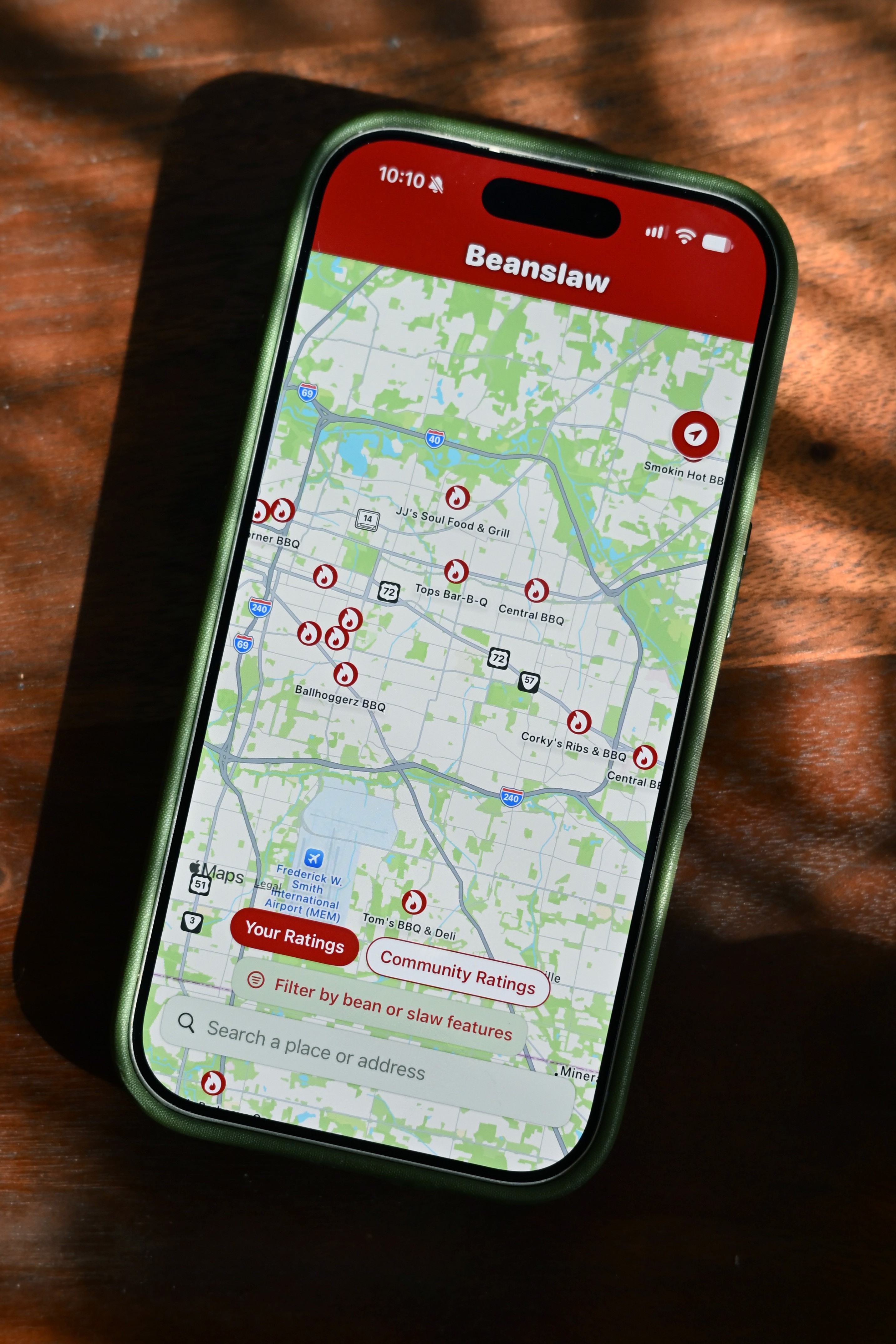
Two days of occasional programming were sufficient to make a professional-grade version of Beanslaw—an act that would have taken weeks of full-time dedication not long ago. The app displayed smoked-meat joints on a searchable map. It implemented sophisticated intelligence to filter out Korean barbecue, Brazilian churrasco, and other (no less delectable!) cuisines that entail barbecue of a different, bean-and-slawless variety. A user can assign assessments of beans (such as vegetarian and soupy) and slaw (including chunky and mustard), and filter the map by desired side-dish traits. I even built an onboarding tutorial. I was ready to ship.
Photos courtesy of the author
Excited, I showed a friend. “Where are everyone else’s slaw and bean ratings?” he asked, tapping at his phone. He didn’t get the point of an app that amounted to a personal journal. Almost two decades of smartphone apps had trained him to understand software as a mechanism for collective intelligence. A program that only a few people would use is now alien. App has come to refer to a type of global, leveraged software business, not a computer program.
Because AI is so good at writing software, in only an hour or so, I was able to add community ratings. Now Beanslaw does what my friend would expect it to—connect potentially billions of users. But doing so also turned an idiosyncratic app meant to satisfy me alone into a candidate (a hopeless one, at that) for the software attention economy.
I never released Beanslaw to the public. But during the year since, I have written, with AI’s aid, a dozen or more programs to solve anomalous problems, seeking to understand what AI programming—a practice some people call vibe coding—means for computing culture. AI-assisted coding could revive the old dream of ordinary people making software for themselves. But so far, in practice it amounts to a new trip down an old path that software development has been traversing for decades: one where a privileged few decide what computers are for, and the rest of us fall in line.
In the early 1960s, inspired by Vannevar Bush’s 1945 Atlantic essay “As We May Think,” a recent Swarthmore College philosophy graduate named Ted Nelson began conceptualizing a computer-publishing system for all global knowledge, accessible to anyone—work for which he coined the term hypertext. A decade later, in 1974, Nelson expanded his vision of computing’s populist power in a pamphlet manifesto called Computer Lib/Dream Machines.
At the time, computers were big, expensive machines used by corporations and government offices. Before the personal computer arrived in earnest, Nelson denounced the “appalling gap between public and computer insider.” He characterized the corporate and governmental actors with access to and expertise in computing as a “priesthood.” Nelson advocated for dismantling this priesthood and putting computing in the hands of ordinary people.
Nelson, along with other figures of the personal-computer revolution, saw his work as literally revolutionary: The Lib of Computer Lib referred to liberation, like “women’s lib,” and he and his allies understood their work as a part of the counterculture movement. Seymour Papert, who co-designed the programming language Logo, envisioned programming as a way for kids to control these machines rather than submit to them. Inspired by Papert, Alan Kay imagined the tablet-style Dynabook, a “personal computer for children of all ages.” And Steve Wozniak, who designed the first Apple (and co-founded Apple Computer with Steve Jobs), valued cheap, publicly shared software skills as a way to overthrow the corporate monopoly on computing.
For a time, that liberationist vision became reality. Early personal computers such as the Apple II and Commodore 64 booted up to a command prompt where users could immediately begin programming in BASIC, an intuitive language. Early advertisements pitched them explicitly as devices people could program themselves. Computer magazines of the era published code that readers typed into their machines by hand.
I learned Papert’s Logo as a first grader in the early 1980s, because my private school had invested in personal computers, labs to house them, and teachers to guide us. That head start gave me confidence with computer programming, which was presented as a normal activity akin to making art or reading. I picked up BASIC, assembly, Pascal, C, and other languages naturally. The machines couldn’t do much yet, and I could learn new things as they evolved—which was still slow enough that an ordinary person, even a child, could keep up.
Personal though they might have become, computers remained expensive and largely inaccessible. And the relatively well-off people who bought them were more likely to buy commercial software than to write their own. Within a few years, the graphical user interface popularized by Macintosh and Windows made the machines easier to use yet also more complicated. Business tools such as spreadsheets, word processors, and layout software made new kinds of computer-based creativity possible, but the results were far removed from the visions of Kay and Nelson. Computers, once envisioned as tools of self-actualization, became appliances.
In the 1980s and 1990s, ordinary people’s ability to construct their own software ebbed and flowed. Hypercard users made databases, cookbooks, and games on their Macs; gray-cubicle office workers used Visual Basic to build Windows programs to automate tasks, often for themselves alone. The World Wide Web let ordinary people publish websites for the whole world, rather than just themselves, their friends, or their office mates.
By the mid-2000s, the Web 2.0 economy had begun to roll back the web’s openness, shepherding people into using platforms such as Blogger, YouTube, and Facebook. The priesthood was back, and the wealthy tech giants served as its bishops.
AI programming does not challenge that power. It entrenches it. I encountered a characteristic, if humdrum, example of software authority during what I thought would be a straightforward vibe-coding task last winter. I had long been dissatisfied with the countdown-timer app on the Apple Watch, with its giant list of times and tiny stop button. I mostly time things in 30-second increments: hamstring stretches, grill sears, tea brews. So with AI’s help, I made a watch app I called Taptimer. I’d tap the screen repeatedly to add half minutes; the timer would run, and then it would buzz. Tapping anywhere on the screen would turn it off again. Sounds simple, right?
Except, Apple doesn’t let third-party programs issue the type of repeated-vibration notifications that its special “native” timer program uses. I had to settle on a single-buzz notification. It works—I use Taptimer every day—but the terms of what the software is allowed to do are set by the owners of the platforms that people must use to run it.
With reason, or at least excuse. Under the guises of usability, security, or control, the oligopolistic tech industry dictates what software can be and can do. The software industry began treating a program shared among friends like a product distributed to millions—in part because it cannot imagine why anyone would bother to make a program that didn’t aspire to wealth, power, or prestige. AI programming arrives during the most intensively exclusionary version of the computer priesthood. The software business has been pushing amateurs out of software creation for two decades, forcing us to use its own wares instead.
When I first started writing Mac programs, in the early 1990s, I could compile a program, put it on a disk, and give it to a friend. Apple’s documentation for how to do so came in printed volumes you could buy at a bookstore, and that didn’t change much across an entire decade. By the time I sat down to write Beanslaw, I needed a $99-a-year subscription to the Apple Developer Program, sufficient familiarity with Apple’s development tools to understand how to use ChatGPT’s code, and enough software-publishing experience to get the resulting software off of my computer and onto phones.
I had to know enough about making software that I could reason and negotiate with the AI about how to approach certain tasks. Some of this effort was not technical at all, such as building a whitelist of known barbecue joints (Rendezvous in Memphis, Pecan Lodge in Dallas) that the app would always display. Others required a deeper bureaucratic knowledge of software development as a practice, such as how to include restaurant images via a backend service provided by Yelp without accidentally spending thousands of dollars.
The more I programmed with AI, the more I felt this tug-of-war between my own prior programming knowledge and the exciting, new coding capacities AI unlocked for me. On my own, I could have built the community ratings that my friend who tried Beanslaw had expected. But storing data in a scalable way across an internet service is complicated, and I wouldn’t have bothered for a program that was supposed to be for a handful of people. ChatGPT introduced me to an Apple programming feature called CloudKit, which made the process easy. Then AI made the implementation easy, too, by giving me the code.
In other cases, I had known what I wanted and how to do it, but I didn’t feel like investing time in the doing. AI made minor software excursions both reasonable and delightful. For example, the Ethernet switch in my home office kept dropping to a lower throughput. To monitor it, I made, with AI, a Mac program that performs an internet-speed test and displays the results in the menu bar. Or, when I had to rebuild my personal website before preorders for my latest book opened, I relied on 30 years of web-development experience to ask AI for the features I wanted (redirecting old URLs, presenting different content by geography) but that I couldn’t quite make time for amid the duties of my actual job and life.
To call this process vibe coding—as if one just types a prompt, waves their hands, and gets a complete and working computer program—amounts to a profound misconstrual of what’s going on.
Computer scientists sometimes talk about “high level” and “low level” programming. Low-level programming involves a lot of very small-scale, specific instructions; high-level programming abstracts that effort into simpler methods that are easier and more accessible. Low-level programming is sometimes considered more technical and therefore more righteous, but high-level coding is often understood to produce faster results. The latter value has prevailed, and over the years and decades, software development has moved to higher levels of abstraction because doing so streamlines output. Low-level work is used only when necessary—and often just to build tools or infrastructure to facilitate high-level programming.
Vibe coding continues this tendency. Coding has always involved a repeated process of giving a computer instructions for an intended outcome or experience, making the machine run them, and then revising the instructions based on the result. At first, those instructions were immensely basic: Move a number or perform a mathematical operation. Over time, the instructions became more complex and abstracted: Write a file to disk, draw a circle, plot a location on a map. Under the hood, computer programs often generate and run code at a lower level as a part of their work. AI programming does not disrupt that process at all. It extends the effort.
This makes the aesthetics of vibe coding entirely familiar to programmers. The moment-to-moment experience of coding feels the same, but you do so at a greater remove. Realizing this made me understand why programmer types might find generative AI so immediately compelling, and also why they might not grasp the objections of people in other walks of life who oppose it. Using AI to create prose or illustrations seems to erase the experience of the writer or artist and their participation in the act of creation. It clobbers the process in favor of the outcome. But for a programmer, the outcome and the process improve all at once. Nothing about AI programming feels like a compromise or cheat. It just feels like programming.
Or perhaps it’s programming at its best. I could feel myself becoming a more generous and open-minded programmer when I coded with AI. Feature requests or suggestions seemed not like slights or gripes, but like opportunities worth considering. Likewise, bugs stopped bothering me. A defect no longer represented something I did wrong; it was a problem I could hurl back at the machinery to solve. Even dead ends or bad ideas felt good, both because I enjoyed carrying them out and because the prototyping experience seemed familiar, but faster and more deliberate.
For example, over a few weeks this summer, I became obsessed with a little $30 computer with a round screen and a dial, similar to a Nest thermostat. I was convinced that the thing could host a clever video game. So I bought one and tried a bunch of ideas: circular Pong, round Breakout, marble rolling, safecracking, tetherball, mini golf, driving a car, navigating a spaceship, mowing a lawn. All of them were cute, but none felt interesting enough to play more than once. I stopped trying, at least for the moment. That feeling is familiar: I’ve started and abandoned hundreds of software projects in my amateur and professional programming career. But the vibe-coded failures felt less bad, because the coding had produced instructive results without devouring my life.
All of this still relied on my accidental, if long-in-the-tooth, membership into the computing priesthood. When I first started using ChatGPT to code, the process was almost dialectical. I’d ask AI for something, it would present some code, and I would implement that code in my project. The process involved a lot of step-by-step, back-and-forth discussion and action.
And yet, during my year of AI programming, I could feel my sense of control and competence recede as the technology evolved. By this spring, something had changed. So-called agentic execution in Claude Code had made it possible to give the AI access to a directory and have it create a whole program on its own, even a complex one. This method, which seems more automatic and thus more desirable, has spread, and OpenAI has added a version of it called Codex. AI has shifted from facilitating programming—as a process of iteratively making stuff with computers—to solving a problem on its own. No programmer required.
This might seem to realize vibe coding as automation, and perhaps even defrock the coding priesthood. I doubt it, largely because industrial power has swallowed so many prior attempts to democratize coding. But automation is also the wrong goal for amateur programming. The most productive, interesting, and fulfilling AI-programming experiences I have had are the collaborative ones.
Earlier this year, I became interested in the unexplored design space in software-based reading. So I started making prototypes: an e-reader that meted out a story as if over the 15 hours of a transpacific journey; a similar one that dispensed text about a road trip gone awry as the reader moved through physical space; an aleatory story that subtly changed what happened to its characters every time the reader opened it. In each of these cases, my aesthetic, technical, and writerly goals were iterative: I hatched some plan, ChatGPT helped me implement it, and then I judged the results and repeated the process.
Unfortunately, during the year that I spent programming seriously with AI, that paradigm of creativity has been superseded. When I try to partner with ChatGPT to code, the software now urges me to use its automation tools instead. ChatGPT has made certain kinds of direct file editing, which I found particularly useful for iterative work, hard or impossible. The industry at large now seems to assume that a programmer’s end goal is known in advance, and the work just involves moving toward it: Build a game for me, or make a website, or generate an app. A lot of news coverage of the phenomenon takes this efficiency as an improvement, assuming AI programming to be a way for the software industry to become more productive. But I found AI to be most liberating when I treated it like a partner offering a feedback loop between my intention and the machine’s implementation, rather than a silicon priest delivering answers or a minion carrying out my bidding.
Reflecting on my vibe-coding journey, I now realize that I began the effort insufficiently aware of what I should have known to be true: that software had already mostly been captured by the high-tech industry long before AI-coding tools arrived, and that those tools were doomed to worsen as much as improve the situation. I fell into the ever-enlarging chasm between the small-scale, personal-software fantasy and its scaled-up, big-business reality. Even the AI services I use to write software change so frequently that the methods I used last week to make something might change next week when Claude or ChatGPT updates. The whole structure feels erected on a sheet of ice.
Rather than fight the friction, I’ve sought out a software equivalent of crampons that can bite into it—resilient enough to resist the slide into commercial software, but sufficiently functional to persist beyond curiosity. That charge is difficult but still possible, although I still feel as if I am clinging precariously to a frosty crag when pursuing it.
As part of this clamber, I found an inexpensive, programmable e-ink display that I could hang on a wall. I have a home weather station in my yard, and I liked the idea of building a pretty, inconspicuous display for the hyperlocal data it produces. I wrestled with the new version of ChatGPT, but for the moment collaboration was still possible if I pushed the AI to converse with me as a partner. Even in the more esoteric, open-source electronics platforms I was using for the project, an accidental priesthood has arisen thanks to 20 years of chaotic, incremental work by global homebrew volunteers. AI helped me make sense of it all so that I—so that we—could get started. And then, together, we built the layout, slurped up the data from my weather station, and iterated on the appearance of the weather-condition icons. I got the idea to display the temperature from my pool heater and then the soil moisture from my lawn sensors, silly things that would have felt indulgent if a computer hadn’t made them easy. Now the little screen hangs next to the alarm panel, updating itself every 15 minutes.
Photo courtesy of the author
When I pass by the thing on the way to the kitchen or the driveway, I feel a vibration of delight. The sensation isn’t quite pride, because I can hardly take sole credit for the accomplishment. But neither is it opportunism, as if I might package and resell weather-station displays as some kind of value-additive, hardware-accessory side hustle. Instead, I feel overcome by the modesty of the matter. A little black-and-white display is showing me the weather—one I made, if with AI help. How nice. For once, a computer doesn’t have to be connecting the world or saving it—or ruining it. Instead, it can simply hang humbly on a wall inside that world, doing something cute, and intentional, and perhaps even useful. The revolutionaries of computing’s counterculture, who mostly became its priests, once believed that would be enough.
One day not long ago, Franky, a 40-something woman who lives in the mid-Atlantic region, got an infuriating text message from her aunt. It was just the latest truth-stretching missive she had sent, and Franky’s impulse was to write back: “You’re a liar. You’ve always been a liar. All you do is lie.” Instead, she asked an AI program to write a response that was less “condescending and unnecessarily emotional.” AI-ese, Franky told me, helps make her responses more logical and neutral. Another message that she sent her aunt after running it through a chatbot read, “I respect you and I expect the same in return. I want to have a mature conversation.” The aunt appreciated it, Franky said—she called her and sounded calm.
Franky is among a number of people—we’ll never truly know how many, will we?—who secretly use AI programs such as ChatGPT and Claude when they interact with difficult family members. I interviewed several of them. Mostly, my interviewees use AI to communicate with individuals they don’t want an emotionally close relationship with—an ex they co-parent with, for example, or an in-law—but whom they nevertheless can’t escape. (Because they are describing tense personal relations, most of my interviewees requested not to be identified by their full name.)
People use AI to both interpret messages they receive and help them write their own to send. If they have to, say, call out rude behavior or express disagreement about whether the kids need a certain type of therapy, they type what they really want to say into one of these programs, ask the AI to nice it up a little, and paste the resulting verbiage into their text messages. Outsourcing correspondence to AI has enabled them to maintain harmony without spending too much time thinking about how to draft a perfect response. As Franky put it, using AI lets her have a relationship without allowing it to “live rent-free in my brain.” Franky said that in her family, it’s important for people “all to have, I don’t know, peace.” She and others have found that they can improve their relationships and at least increase the probability of peace by removing emotion from conversations. And that’s where AI truly excels.
Another woman I spoke with told me about how Claude had helped her revise a text to a family member who often misinterprets her words. This person, she said, sent her a message implying that he wanted her out of his life. Her impulse was to reply, “Congratulations. You got your wish,” but Claude softened that statement because it could “read as sarcasm/implication.” Then it asked, “Want it warmer, blunter, or shorter still?” Claude, she added, “leaves out the emotional part” and makes it more likely that the recipient will hear her and work toward a resolution.
People reach for Cyrano de Anthropic because during difficult text-based conversations, “it’s hard to know what to say,” Nedra Glover Tawwab, a therapist and the author, most recently, of The Balancing Act, told me. When we’re interacting in person, mechanisms in the brain help us interpret people’s body language and facial expressions, Matthew Fishleder, a therapist in Maryland, told me. But text and email strip messages of that context. “We’re left trying to decipher, What does this text from my mom mean?” he said. “And how in the world do I respond to something like this?”
In tense situations, people generally know what they’d like to express, Tawwab said, but then they might think, “I can’t say that.” AI can phrase the message in a slightly gentler way—and it can offer the sender “less of a responsibility” for how the recipient reacts. If your mom gets mad about your AI-assisted message, you can always mentally blame Dario Amodei.
The most common use case I encountered for deploying AI in this way was to correspond calmly with an ex-spouse, whom one may now resent with the fire of a thousand billable lawyer hours but whom one must treat cordially, lest one gets threatened with changes to the custody agreement. (As one Florida woman who uses AI for this purpose told me, sending an “F you” text to your ex might feel amazing, but you have to think about the “legal ramifications.”) A father in Arizona told ChatGPT to use a “five-star-hotel-clerk tone” with his ex, and it did—to the point that, reading over his shoulder, his child was shocked by how nice their parents were being to each other. A woman who asked to go by the initial S. told me that she uses AI to negotiate co-parenting decisions with her ex-partner. When AI helps her write “in a very neutral tone so that it’s not inflaming,” she said, “we help our kids to the best degree possible.” She told me that the tool has improved her relationship with her ex-partner, and that she even sometimes recommends the same strategy to her clients in her work as a therapist.
If their exes figure out that they’re using AI, many of the people I spoke with don’t really care. S. thinks her ex may be using it too, because sometimes she’ll notice that “that’s a tone I don’t hear very often from him,” she said. The Florida woman said that her ex has accused her of using AI “many times” but that she’s not especially concerned about impressing him. “It’s like, Oh, I know. I’m terrible in every way, including that I use AI,” she said. “Add it to the list. We get it.’”
The people I spoke with had a range of other reasons for using AI. Several of my interviewees are not native English speakers, and they feel that they are frequently misunderstood when they use their own words. “Even when I do try my absolute best, it just doesn’t work,” the Arizona father told me. One of the people he has used AI to communicate with is an abusive parent; given his childhood environment, he said, he doesn’t have much experience being spoken to amiably and calmly.
Others don’t have much experience with writing, period: A woman named Ashleigh told me that she uses ChatGPT to communicate with her baby’s father’s family because she’s “not a writer at all.” She said that she types in what she wants to say, then prompts the system to “take some of the emotion out and put more of the facts in it.” “It’s great for hard conversations,” she added, “that you know you’re gonna blow up on.” Finally, many of my interviewees like how much time AI saves them. They don’t want to spend their one wild and precious life drafting heartfelt texts to their weird cousin; they want to outsource all of that to Claude. As Franky put it to me, in one of the most relatable quotes I have ever gathered, “I just don’t have time in general to do anything.”
Using a robot to talk with humans has downsides, of course, even if only philosophical ones. Relying on AI for communication can mean that we are “outsourcing our inner power to a machine,” Tawwab said. The people I spoke with are well aware of that. Even though she uses it herself, S. said that her therapy clients can become overly dependent on AI, to the point where they “aren’t thinking for themselves as much.” But as far as mortal sins go, this practice seems to fall somewhere around ordering from Amazon Prime or eating at McDonald’s—you may have misgivings, but the convenience truly can’t be beat.
Fishleder, the Maryland therapist, said that although AI can be helpful in a pinch, it won’t resolve the larger relationship dynamics at issue—and it’s further evidence of what he characterized as the “movement away from relying on one another as humans.” Still, when I asked him whether he also sometimes uses AI to write tricky messages, he said, “100 percent.” Sometimes you just need to send a firm but polite text about Thanksgiving plans. It’s not cheating; it’s muddling through.
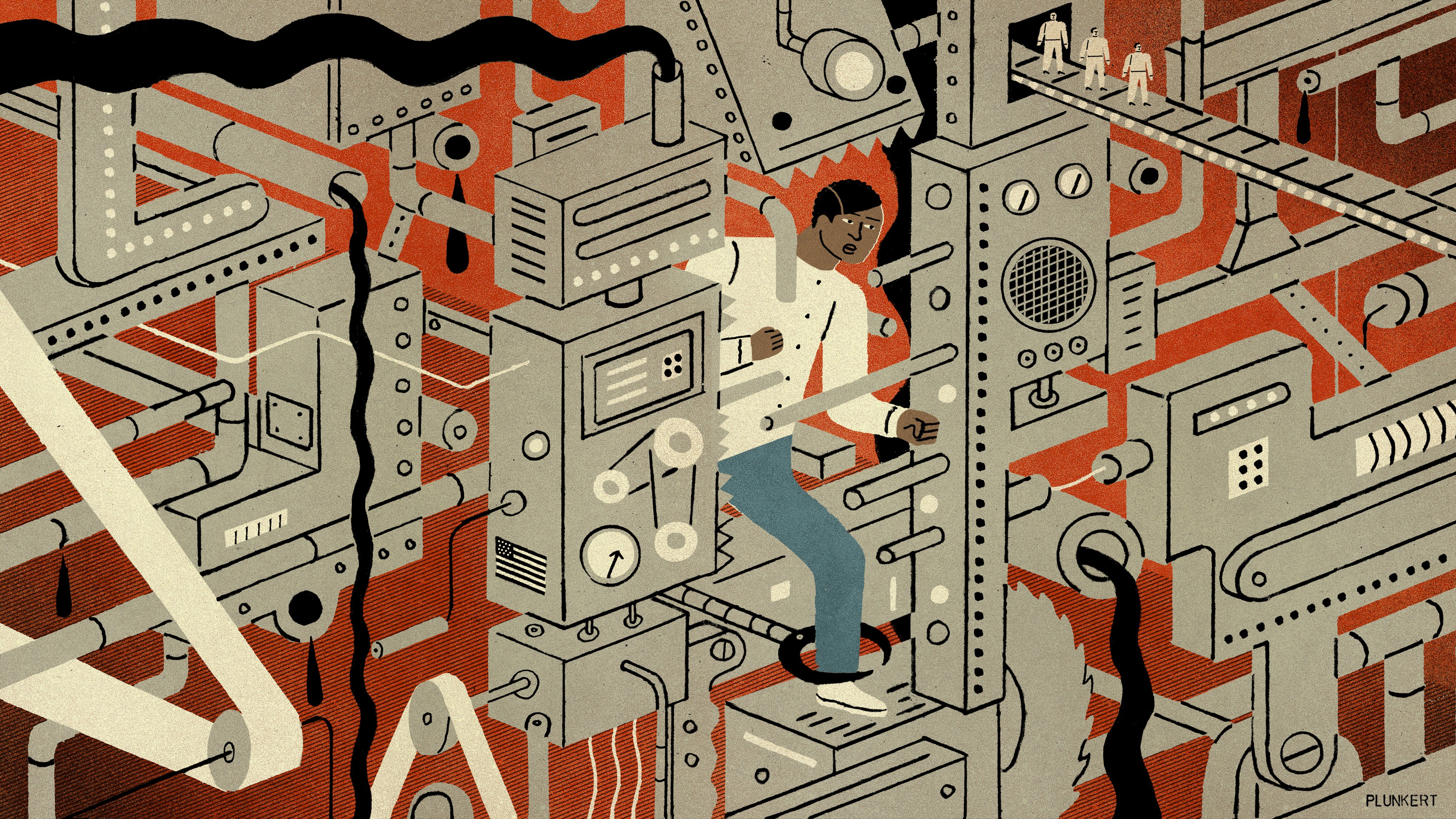
What would the U.S. immigration system look like if it were a machine, made of wheels and gears, controlled by belts and joints? In Kelly Lytle Hernández’s new book, Racist by Design: Two Centuries of U.S. Immigration Control, illustrations by the artist Mariah Tso help readers visualize such a contraption. Its parts are etched with important names and dates, Supreme Court cases, racist proclamations, and key concepts such as eugenics, no due process, and warrantless arrests. These sketches leave the impression that immigration control functions smoothly to exclude certain people—requiring only the occasional application of oil or glue.
I would depict this machine differently, as would many historians. Its parts would be misaligned and mismatched; it would leak and spew smoke, expand and contract at random, and periodically grind to a halt.
Yet Tso’s illustrations perfectly reflect the argument made by Lytle Hernández, a history professor at UCLA whose previous books have focused on the Border Patrol, mass incarceration, and Mexican anarchists. In Racist by Design, she contends that the United States since its founding has had a “whites-only immigration system.” That system has evolved, she says, but it remains “racist by design: It always has been and it still is.”
We shouldn’t take “whites-only” literally, Lytle Hernández cautions. Instead, she writes, the term is an “interpretive device” to help us understand “racialized power.” She borrows language from the book Let This Radicalize You, in which two organizers, Kelly Hayes and Mariame Kaba, argue for studying a machine to figure out “what blows could actually disable it.” Lytle Hernández wants Racist by Design to land as a blow propelled by the force of history, inspiring collective action that will “keep pushing” the machine “and make it tip.”
It isn’t controversial to say that racism has often motivated American immigration policy. Stephen Miller, Trump’s senior aide and homeland-security adviser, is hardly the first nativist to set federal priorities. Yet Lytle Hernández’s contention that more than two centuries of immigration control boil down to a story of white supremacy is an overstatement, even if it’s an important provocation.
Lytle Hernández briefly acknowledges that “whiteness” isn’t always a simple category—that eugenicists have invented hierarchies among white people, and that racially neutral language, such as the word pauper, has been used to deport Irish people. But she doesn’t discuss how the meaning of whiteness changed over time; some white people were considered less white than others. She mentions other factors in debates over who can enter the country—sexuality, religion, public health, international diplomacy, ideology—but brushes them aside quickly so that they don’t muddy her point. These omissions and elisions make her argument vulnerable to challenges not only from historians who have studied other modes of discrimination, but also from political opponents eager to sabotage her cause.
Plenty of evidence supports Lytle Hernández’s larger case. The Naturalization Act of 1790 said that only “a free white person” could naturalize, after living in the United States for two years. The first federal immigration ban was the 1803 Immigration Act, whose main proponents were enslavers seeking to block the entry of Black Caribbeans fleeing the Haitian Revolution.
This pattern persisted for the next 150 years. In the mid-19th century, California state legislators levied a tax on foreign miners to keep nonwhite immigrants away from the gold mines. In 1882, Congress passed the Chinese Exclusion Act, which survived in different guises and iterations until 1943. And the 1924 Johnson-Reed Act established national-origins quotas that capped the total number of immigrants at 150,000 a year, while reserving 96 percent of those slots for European immigrants and 84 percent for those from northwestern Europe, according to Lytle Hernández. Senator David Reed, a Republican from Pennsylvania who co-authored the law, said, “We have closed the doors just in time to prevent our nordic population being overrun by lower races.”
By 1940, Lytle Hernández writes, Europeans and Canadians, who at this point were all considered equally white, accounted for 94 percent of the foreign-born population living in the United States. Even after laws were liberalized and these numbers changed, members of both political parties tried to boost the proportion of white immigrants by prioritizing what the liberal Senator Ted Kennedy called the “old seed sources of our heritage.” This was all before the Trump administration made race-based immigration de facto American policy—most pointedly by deporting mainly nonwhite immigrants while welcoming white South Africans who claimed to be victims of a Black-led government.
The author shows how the intrinsic racism of these moves is not accidental or incidental, but by design. She adds fresh insights as well by tracking the gradual concentration of immigration enforcement in the hands of the federal government, and by showing how fights over naturalization were entwined with debates over the treatment of Black people and Native Americans. And she reframes the immigration story as focusing on not only the people we let into the country, but also those we keep out. This complicates Americans’ conception of themselves as a nation of immigrants; we are also a nation that has excluded them.
Lytle Hernández is too good a historian to skip over more permissive periods, even when they fail to serve her argument. She calls the passage of the 1866 Civil Rights Act and the Fourteenth Amendment the “single-largest mass naturalization action in U.S. history,” because these laws “created more than four million new African American citizens.” When white settlers in the western U.S. challenged the birthright citizenship of Chinese Americans, the Supreme Court, in its 1898 ruling United States v. Wong Kim Ark, “unambiguously affirmed” that almost all children born in the United States were citizens. (The children of Native Americans, diplomats, and occupying troops in a hypothetical invasion were exceptions.) Nobody has conclusively counted the number of Americans born to undocumented immigrants who became citizens because of the Fourteenth Amendment, but the Pew Research Center has calculated that it has exceeded 100,000 a year since at least 1990.
This past summer, in its Trump v. Barbara decision, the Supreme Court invalidated the president’s executive order limiting birthright citizenship and explicitly upheld the ruling in Wong Kim Ark. Trump’s solicitor general, D. John Sauer, argued that the authors of the Fourteenth Amendment intended to extend birthright citizenship only to freed slaves and their children. But a majority of the justices found that the language of the amendment was plain and applied to almost every person born in the United States, no matter their race or heritage. As alarming as it was that three justices sided with Trump, the decision, like earlier rulings from the top court, undermines Lytle Hernández’s idea of a whites-only immigration regime.
Often, the author downplays government action by the courts, Congress, or presidents that benefited nonwhite immigrants. As a result of the 1965 Immigration and Nationality Act, which ended national-origins quotas, the United States went from being 16 percent nonwhite to 40 percent nonwhite in 60 years. Lytle Hernández frames this accomplishment as the unintentional result of mistaken reassurances; President Lyndon B. Johnson, for one, announced that it was not “a revolutionary bill,” and would not change people’s daily lives. Insofar as it altered the nation’s ethnic makeup, restrictionists felt that it did change their lives—and ever since, they have considered it to be one of the worst pieces of legislation in American history.
The 1965 act contained strong, explicitly anti-racist language: “No person shall receive any preference or priority or be discriminated against in the issuance of an immigrant visa because of his race, sex, nationality, place of birth, or place of residence.” Lytle Hernández quotes this passage, but then immediately points out that the law left in place measures that disproportionately affected Mexican immigrants. This landmark of mid-century liberalism was another example of what the legal scholar Reva Siegel has called “preservation through transformation,” in which laws dismantling discriminatory status hierarchies could nevertheless perpetuate them. Yet the act was genuinely transformative, as were the ideas behind it. Earlier that year, Johnson had made immigration the focus of his State of the Union address. Too many people within our borders were “trapped in poverty and idleness and fear,” he said. “Let a just nation throw open to them the city of promise” by passing an immigration law that is “based on the work a man can do and not where he was born or how he spells his name.”
These ideas have animated our nation’s immigration debate as strongly as those of the restrictionists. If the 1965 law didn’t represent progress, certain conservative lawmakers and commentators would not have attempted to roll it back over the next 60 years. If there were no positive, non-racist vision of immigration law, there would have been no debate at all.
Two decades later, the 1986 Immigration Reform and Control Act created a pathway to citizenship for close to 3 million immigrants (including more than 2 million from Mexico). Lytle Hernández says that the law, signed by President Ronald Reagan, came about because Chicana and Chicano activists “convinced” Congress to do it. In fact, support for the law came from a wide range of actors, including some conservative Latinos and Republican senators whom Lytle Hernández surely doesn’t count as immigrant-rights advocates, such as California’s Pete Wilson and South Carolina’s Strom Thurmond. The 1990 Immigration Act, passed under another Republican administration, expanded amnesty for the close relatives of immigrants whose status had been legalized in 1986, and as recently as 2007, President George W. Bush supported a comprehensive reform bill (which failed to pass).
Seen in this light, IRCA’s amnesty provision looks less like a temporary setback for white supremacy than an indicator of America’s shifting racial politics. As the alliances of the 1980s unraveled, the familiar partisan outlines came into view: a Republican Party committed to walls and deportation, and a Democratic Party that advocated for immigrant rights. But this realignment is not necessarily any more permanent than the last one.
Even Lytle Hernández’s greatest insight—the importance of federal control—cuts both ways. Washington lawyers and judges didn’t just restrict immigration rights, as she demonstrates; they also checked racist state laws, throwing sand in the gears of the whites-only machine. After Wilson left the Senate to become the governor of California, he championed Proposition 187, a law that sought to deny services and benefits to undocumented immigrants. A federal judge overturned it because national law preempted such state action. In 2012, two years after Arizona Governor Jan Brewer signed S.B. 1070, which broadened state police powers to arrest undocumented immigrants, the Supreme Court struck most of the law down for the same reason.
Lytle Hernández should have given more weight to such moments not simply to tell a more balanced story, but also to help us understand why arguments for restriction failed or succeeded. She argues that racist immigration laws were beaten back by “nonwhite migrants and their advocates”—abolitionists, Chinese and Japanese individuals and organizations fighting anti-Asian policies, NAACP lawyers, and Chicano and Chicana activists and immigration attorneys. What her resisters share is that they attacked the machine from the outside. But for well over a century, insiders, including presidents and judges, have also tried to move the machine in a non-racist direction, while outsiders, including African Americans, Latinos, and Asian Americans, have sometimes supported restricting immigration.
Instead of exploring all these forces—liberal progress and conservative backlash, conviction and compromise, the realities of an imperfect union—Lytle Hernández has written a largely frictionless story in which racists have created immigration policies and anti-racists have achieved limited gains, sometimes by accident. There’s plenty of truth to that story, but toppling the machine will require a broad-based movement that wrestles more fully with the messiness of our country’s history.
By glossing over liberal victories and minimizing the efforts of reformers apart from a few, mostly doomed activists, Lytle Hernández makes a stronger case for defeatism than optimism. Historians like to say that the past is contingent, not predetermined. Much of Lytle Hernández’s previous work has demonstrated that proposition brilliantly. If immigration policy has been a machine, it has been a paradoxical one: rickety yet terrifying, subject to spasms of reform, deeply racist yet unable to settle forever who is “in” and who is “out.” This machine has been abused, patched up, and manipulated to serve nefarious goals. It has also been repaired, and bent toward justice. If today’s machine is toppled, history teaches us that whatever replaces it will inevitably be forged in the fires of democracy, messy and incomplete.
The Social Reckoning, Aaron Sorkin’s sequel to The Social Network, is now in theaters. I, for one, think that making a whole new movie is not the best way to tell the continuing story of Mark Zuckerberg and Meta. Why not do instead what Zuckerberg himself is doing—take the social network we have and just make it worse? Below, please find my script for the revised The Social Network. (Aaron Sorkin, you are welcome to use any of this if you want to make a third movie!)
Sean Parker, from Napster: A million dollars isn’t cool. You know what is?
Mark Zuckerberg: A million dollars—donated to Donald Trump’s inauguration fund?
*
Mark Zuckerberg’s ex Erica: You’re going to go through life thinking that girls don’t like you because you’re a nerd. And I want you to know, from the bottom of my heart, that that won’t be true. It’ll be because of the pervert glasses.
*
The Winklevoss twins are rowing in a tank. We pan out to reveal that Mark Zuckerberg is right behind them, working out just as hard.
*
Mark Zuckerberg: Eduardo, I need the code you used for ranking chess players.
Eduardo Saverin, Facebook’s co-founder: Sure.
Mark Zuckerberg: We’re ranking women. And then we’re going to build a whole network around this. And then to keep people on that network we’ve built, we’ll create a black-box algorithm that pushes rage-inducing—sorry, “borderline”—content onto users’ feeds to drive engagement, even if it fuels the rise of conspiracy theories, misogyny, and violence.
Eduardo Saverin: Can we go back to the ranking-women part?
*
Mark Zuckerberg sits at his computer, reloading the screen again and again. Yup, the policies that formerly flagged dehumanizing speech about protected characteristics have been successfully removed in time for Trump’s second term! Also, Erica has not added him as a friend yet.
Mark Zuckerberg: Sounds excellent. An experience lots of people will want to have. Actually, that’s an idea. Why shouldn’t everyone you interact with be a robot? I am writing this down.
*
(Mark Zuckerberg scribbles on a window) Buy … Vine … then … destroy … it.
*
The Justin Timberlake character: A million dollars isn’t cool. You know what is?
Mark Zuckerberg: Floating leglessly in a joyless void.
The Justin Timberlake character: Um.
Mark Zuckerberg: Having a hole in you that nothing can fill, absolutely nothing, no amount of money, no amount of power, no amount of mixed martial arts, so that when the business that has made you billions of dollars but has cost other people their lives and sanity comes under any kind of scrutiny or attempts at regulation, you feel like you’re the victim.
Sean Parker: I was going to say “a billion dollars.”
Mark Zuckerberg:(staring dead-eyed into the camera) A billion dollars won’t fix anything.
About a year and a half ago, Hasan Piker, the left-wing activist and streamer, was hailed as the Democratic Party’s Joe Rogan—an influencer who can reach young men. A wave of gushy profiles paid more attention to Piker’s physique than to his habit of making impolitic comments. The New York Times’ entry in the genre was titled “A Progressive Mind in a Body Made for the ‘Manosphere.’”
Piker has since been welcomed, with notable holdouts, into the Democratic Party coalition. He has appeared with multiple Democrats on the stump, and has boasted that several others privately seek his counsel. Vanity Fair named Piker one of the 50 most influential people in America. He sees his influence as extending even to candidates who have not aligned with him publicly, pledging to pressure James Talarico to side with the left should Talarico win his Senate race in Texas. (“We have to remind him that we are the force that backed him both early on, and we are the force that allowed him to win this seat of power, and if he wants to maintain it, he’s got to play ball.”)
The predominant Democratic Party view of Piker was perhaps expressed by the Pod Save America host Jon Lovett, who told him last month on the liberal podcast, “My view is: I am part of a pro-democracy coalition in the fight against fascism, and it includes everyone from former Republicans like Nicolle Wallace and Tim Miller and Sarah Longwell, it includes establishment politicians, it includes Neera Tanden, it includes Shannon Watts, it includes AOC and Bernie, and it includes voices on the left like you.”
Piker’s stratospheric ascent—he now earns seven figures from his Twitch stream—and grandiose ambitions have made him the target of recriminations from a handful of suspicious Democratic Party moderates, as well as a recurrent villain for Fox News, which has attempted to turn him into the party’s face. Those critics have tended to recirculate a handful of Piker’s most outrageous statements, some of which—saying America deserved 9/11, and calling Orthodox Jews “inbred”—he has retracted and apologized for. Piker has complained that the mainstream media cover him but rarely deign to speak with him. Seeing that as a reasonable grievance, when he invited me on his show, I invited him to instead do an interview with The Atlantic. He accepted, before postponing the interview and then ultimately canceling it.
As I prepared for the interview by researching his commentary, I realized that Piker is right to complain that the handful of frequently repeated controversial statements fail to accurately represent his worldview. In fact, it’s much worse than those quotes suggest.
The most important problem with inviting Piker to join the pro-democracy coalition is that, by any reasonable definition of the term, he does not believe in democracy.
Piker declared at a debate this year, “I say we put the power back in the hands of the many rather than the power in the hands of the few. If a dictatorship is inevitable, I’d rather have it be a dictatorship of the proletariat than one that is designed around the needs of the bourgeois class.” On his Twitch stream he has said: “I love Lenin. I love Fidel Castro. And I love Che Guevara. They are genuinely fucking heroes.”
When asked to cite an example of socialism that he admires, Piker replied, “China is probably the closest,” while conceding that “there are still plenty of failures within the Chinese system.” Although he cites China’s economic model, rather than its single-party Communist regime, as the source of his admiration, other countries have exhibited the same rapid industrialization without attracting Piker’s fawning praise.
He has dismissed Mao’s campaign of mass terror as mere mistakes. “Do I believe that it was intentional? No, I don’t believe that it was intentional.” In fact, as the Brookings scholar Kenneth Lieberthal, who has taught a course on China under communism at the University of Michigan, told me, “Mao never shied away from violence among Chinese civilians to achieve his goals, and he never expressed regret for any deaths that occurred as a result of his initiatives.”
Piker has extensively praised economic development in North Korea, a country that he has acknowledged engages in repression, while maintaining that “it’s certainly not as bad as the way that Western media presents it.” In one segment marveling at economic development in the Stalinist kingdom, where even the slightest acts of dissent are met with confinement and torture, he said, “It is fucking mind-boggling to me that a country so fucking poor and so distraught, a country that withstood a fucking genocide, could get to this level, dude. Like, how does this not make you mad as an American citizen? How does this not fucking piss you off, where you look at this shit and you’re like, if they can do it, why the fuck can’t we?” Piker concluded by saying that North Korea’s achievement “shows you that a better future is possible for all of us.”
Piker does acknowledge shortcomings in the Communist regimes he defends, but treats their millions of victims as the tragic cost of progress. This contrasts with his treatment of anti-communists, which is marked by unsparing contempt. He has proclaimed his hatred for NATO on the grounds that it opposed communism: “Of course I am anti-NATO. NATO is designed with the explicit intent of being an anti-Communist institution.”
In one especially revealing episode, he attacked a refugee from Vietnam. Piker’s stream typically includes snippets of videos that he and his audience watch together, interspersed with his own commentary. As the video showed the refugee saying “We have endured suffering under the Communist regime,” he threw back his head in disbelief and began to rant: “Okay, fuck you, dude. I mean seriously, fuck you, old lady. Shut the fuck up, you stupid fucking idiotic old lady with your stupid fucking gamer headest. Who has fucked you harder, America or fuckin’ Ho Chi Minh? Suck my dick, old lady. Goddamn, dude. Fuck this refugee.”
Alongside his pro-Marxist-Leninist principles, the second pillar of Piker’s worldview is anti-Zionism. This does not distinguish him from other progressives. What does distinguish him is his belief that American Jews who do not share his position deserve punishment.
“In a totally just world, regardless of your background, any kind of fucking Zionist tendency should be treated in the same way as being a fucking rabid neo-Nazi,” he has said. Piker attracted attention when he recently predicted, “If Jews in America keep putting this idea out there that they are singularly invested in Israel, eventually someone is going to come around and take action—not against the state of Israel, mind you, but against American Jews.”
The two statements in combination have dire implications for American Jews. A recent poll found that, while about two-thirds of American Jews oppose the current Israeli-government policy toward the West Bank and Gaza, more than 70 percent describe themselves as very or somewhat emotionally attached to Israel. Piker’s argument that “any kind of fucking Zionist tendency”—which includes the many Zionists who strongly criticize Israeli policy—should be treated as akin to Nazism, and that American Jewish affinity with the Jewish state invites anti-Semitism, would justify subjecting Jewish Americans to ostracism and abuse.
Piker’s second and more recent comment drew predictable condemnation from several leading Democrats. Piker has depicted this response as puppetry orchestrated by the Israel lobby.
“Aipac boss call was made,” he wrote on X. When Neera Tanden, the president of the liberal Center for American Progress, said that Piker was not helping the Democratic Senate candidate Abdul El-Sayed to win his campaign in Michigan, Piker replied, “You should probably stop highlighting and ‘legitimizing’ reactionary framing and republican attacks against abdul from a ‘nominally liberal’ perspective but i guess your donors w financial ties to tel aviv don’t want you to stop.” The notion that any opposition to his ideas must be evidence of hidden control, exercised by wealthy Jews, is a classic anti-Semitic trope.
Some of these comments have largely been taken as confirmation that Piker is essentially a shock jock. His defenders see these rude remarks as the unavoidable cost of having a popular media personality to amplify the Democrats’ message. “Some segments of the Democratic coalition would find Piker to be edgy, or crass, or even despicable. But, if ‘Rogan of the left’ is to mean anything, it would surely mean a higher tolerance for controversy, even at the risk of alienating parts of the base,” a New Yorkerprofile concluded in March 2025.
But unlike Rogan, who is foremost an entertainer and who lacks grounding in any serious ideology, Piker sees his work as advancing a long-term political project.
He tends to analyze his work most openly when he gives interviews about his Twitch stream, rather than on the program itself. When he is speaking to his audience, he falls into a frat-boy patois laden with generous helpings of profanity. When he is speaking about his show, he employs more sophisticated language and concepts.
“I am, at the end of the day, someone who is engaging in—and this is a Marxist term that a lot of people get mad at, because they don’t understand that propaganda is supposed to be a neutral term in its inception—but this is agitative propaganda,” Piker told Vox last month. Agitative propaganda—or, as it is more commonly known, agitprop—is a term derived from the department of agitation and propaganda, which the Soviets created in the 1920s to instill communist thinking in workers and peasants. The method is not generally known for its faithful adherence to truth and accuracy.
Piker describes his role as the spearhead of a long-term persuasion campaign to build power through gradual means. “I want to, through a system of, at first, modest social democratic reforms, basically claw back autonomy for the everyday person and hopefully give them more of a voice in their workplace and in the political process as well, and slowly but surely, yield more egalitarian outcomes,” he told Ross Douthat a year ago.
Piker frequently derides liberalism as a failed ideology. In an interview this past spring with Trevor Noah, he explained that voters who think they’re liberal are actually suffering from false consciousness.
“They self-identify as liberals because they don’t really understand what that means. If you were to pick apart their worldview and offer them a little bit of political education, you might find that they’re actually not liberals at all. Maybe they’re socialists, maybe they’re Marxists, maybe they have a different ideological tendency than liberalism, which is basically just the monoculture that we’ve taken for granted,” he said.
He considers the Democratic Party essentially a hollow shell, its governing ideology a kind of mindless vestige to which its voters have no authentic attachment, one that he and his allies can easily replace. This strategy requires Piker and his allies to gain a foothold within the party in order to ultimately capture it. He actively campaigned for several left-wing Democrats, especially El-Sayed. “During the 10 days I spent in the Midwest ahead of the primary vote, Piker was everywhere,” my colleague Helen Lewis reported.
When El-Sayed’s Republican opponent began to tie him to some of Piker’s more infamous remarks, Piker responded pragmatically to contain the damage. He apologized for having said that America deserved 9/11, claiming that the remark was taken out of context. He dismissed comments about hating the United States: “It’s laughable to say guys like myself, guys like Abdul El-Sayed, we hate America.” (In fact, Piker has expressed this precise sentiment, or iterations of it, many, many times.)
El-Sayed responded by acting as though Piker were simply a media figure to whom he had given an interview, rather than his campaign wingman. He described Piker as “a streamer in California,” and said he would have “a conversation” with any media figure with whom he disagrees, as if campaigning with someone were just like talking on Fox News.
Piker has cooperated with this message. He has repeatedly referred to himself as “a Twitch streamer,” mocking his critics for being so small-minded as to pay any attention to his beliefs. Republicans “centering their midterm strategy around a twitch streamer no one knows was extra dumb,” he wrote on X. His go-to line in response to any important piece of news has been to mock Democrats for complaining about his influence. In response to a story about deaths in the Iran war, he posted, “will the democrats demand accountability and transparency on this issue, or will they continue crying about a twitch streamer?”
The notable thing about this rhetorical pivot is that it requires Piker to belittle himself as irrelevant and unworthy of attention. That depiction hardly comports with the seriousness with which he has previously described his influence, but it does show a level of message discipline and commitment to the cause. CNN reported last week that El-Sayed had recently spoken with Piker and “warned his rhetoric was costing El-Sayed votes, asking him to stop.”
Do not expect Piker’s reticence to continue after Election Day. There is little reason to trust his current self-presentation as a mere Twitch streamer who is too obscure to merit discussion. He sees himself as a representative voice of a movement that can take control of a major party, and then the country itself.
Describing the Democratic Party to Noah, Piker said: “That’s a weak party. That’s a party that you can seize. That’s a party that you can take advantage of.” Many earnest liberals see Piker as a handy megaphone who can convey their message to an elusive constituency. Piker, however, is not so much joining the team as sizing it up as prey.
When my father died, more than 20 years ago, he left my mother with a paid-off Philadelphia apartment, a modest pension, Social Security, and $1.6 million in retirement and brokerage accounts. My mother lived well, but frugally. She loved a Saturday at the boutiques but never got over waiting for a sale. She delighted in orchids but would buy them from only Trader Joe’s, where the blooms could be had for $10.99. “They last longer,” she’d argue. And once a year, she would ask me to go over her budget to make sure she was doing okay. “More than okay,” I’d tell her. My brothers and I encouraged her to spend—to take that trip, to redo that bedroom. But she limited herself to the pension and Social Security checks and the interest she was earning while refusing to touch the principal. When she passed away two years ago, she no longer had the $1.6 million my father left. She had $1.7 million.
My mother’s behavior turns out to be quite common. A landmark 2018 study by the Employee Benefit Research Institute found that the median individual with more than $500,000 in savings had, 20 years into retirement, spent just 12 percent of that sum. And a Corebridge/Greenwald Research survey of older adults with at least $100,000 showed that only 28 percent were comfortable watching their savings taper off to cover living expenses, ostensibly exactly what the money was saved for in the first place.
This is a problem—not just for retirees but for the country. Savers who forgo gratification for decades end up not enjoying the money they’ve worked so hard to set aside. Meanwhile, the U.S. economy suffers as all of that money sits under the proverbial mattress instead of being spent.
Why do retirees refuse to spend their retirement savings? One answer is fear. People worry that they’ll live too long, that inflation will rise, that a bear market will hit at the worst possible time. Another answer is habit. After decades of disciplined saving to reach a target number, flipping the switch to spending feels uncomfortable to many and just plain wrong to others. Seeing one’s number move in the opposite direction feels more like losing money than spending it.
The result is that retirement-account balances are treated like other precious items, which is to say they’re hoarded. Suzanne Shu, a marketing professor at Cornell, has studied when and how we consume things we consider special—bottles of better-than-average wine or boxes of pricey chocolate, gift certificates to favorite restaurants or spas—and found that we’re so afraid of using them too soon that we might never use them at all. The wine goes bad, the gift cards expire, and the chocolates develop that odd, whitish coating. And the retirement account goes unspent.
Since 1992, the University of Michigan Health and Retirement Study has tracked a group of 20,000 people, all over 50, through time. (New subjects are periodically added as others die or stop responding.) Every two years, these individuals and couples are questioned on a huge variety of topics related to health and retirement, including work, family, caregiving, disability, cognitive changes, divorce and widowhood, and, yes, spending. Using this data set, the researchers have identified what they call a “retirement consumption gap.” Huge numbers of retirees are spending less—sometimes far less—than they could afford to spend for the rest of their life without fear of running out. For middle-income Americans, the gap is about 8 percent, or about $8,000 a year on average. That’s a car payment, a vacation, a whole lot of dinners with friends. Wealthier retirees, meanwhile, are spending as much as 53 percent less than they could afford. A gap remains even when plans to leave a legacy or reserve money for health care are counted as spending. Bucket lists everywhere are suffering.
And so is the wider economy. We can see this by looking at pensions, which retirees tend to spend because—unlike having a lump of money sitting in a bank account—they know that another payment is coming. According to a study by the National Institute on Retirement Security, in 2022, 26 million retirees received more than $680 billion in pension benefits. As they used it for rent, groceries, vacations, home repairs, and everything else on their lists, the money in turn generated $1.5 trillion in economic impact. The funds paying out those pensions contain just more than a quarter of the money held in America’s retirement accounts. If we apply the same math and assume that every dollar used translates into $2.28 in economic activity, then $52 trillion of potential consumption is sitting in the hands of the country’s retirees, much of it not being spent.
Americans hold about $20 trillion in IRAs (most of which is held by retirees) and another $15 trillion in 401(k)s and other defined contribution plans (35 to 45 percent of which is held by retirees). According to the economists David Blanchett and Michael Finke, retired couples spend only about 50 percent of withdrawals (including mandatory distributions) from investment accounts, compared with 80 percent of guaranteed-income payments such as pensions and Social Security. In that way, the retirement consumption gap is essentially a lagging byproduct of the corporate shift from pensions, which employers paid for, to 401(k)s, which employees mostly fund themselves, in the 1980s and ’90s. This transition was supercharged by the Pension Protection Act of 2006, which allowed employers to automatically enroll workers in a 401(k).
One way to close the retirement consumption gap, then, is for retirement savers to think about some of their assets as pensions and then, upon retirement, to convert them into a source of stable income—what I call a “forever paycheck.” In my new book, I recommend converting enough to cover both the needs and the discretionary wants that retirees aren’t willing to give up, generally about one-quarter to one-third of that nest egg.
A forever paycheck can be built with investments that spill off income—dividend-paying stocks, say, or a bond ladder. Or it can be bought with annuities, a category of insurance products through which a lump sum of money, deposited either all at once or over time, is used to provide a lifetime stream of income. Annuities trade away the potential upside of an investment account in favor of certainty that investments cannot provide; they have long been criticized for high fees and unnecessary complication. But these vehicles have become both more transparent and cheaper in recent years. The movement of big 401(k) providers, including Vanguard, Fidelity, and BlackRock, into the annuity market means that fees will likely go down even more in the future.
For most people, having somewhat less money but actually spending it leads to a better quality of life than having more money that they’re scared to touch. It might even lead to a better quantity of life. A recent National Bureau of Economic Research paper looked at the choices made by 600,000 retirees in Chile, where citizens can either annuitize their retirement payout, locking in a fixed payment for life, or opt for phased withdrawal that varies with the markets. Annuitization guarantees that the money will last as long as they do. Phased withdrawal offers upside, but retirees can also run out. The researchers found that those who chose the annuity had substantially lower mortality rates both five years and 10 years later. They also spent more money on health care and reported lower rates of disability.
Living paycheck to paycheck—a phrase that has been around since at least 1948, when it appeared in a Communist campaign pamphlet entitled “How to Make Your Vote Count”—has always had a negative connotation. It suggests surviving, not forging ahead. Treading financial water. That feeling is understandable during someone’s prime working and accumulation years. But when the time comes to reap the rewards of saving, living paycheck to paycheck turns out to be a pretty good idea.
Yesterday in Riyadh, a missile fired by Yemen’s Houthis struck King Khalid International Airport, killed 13 people, and wounded hundreds more. Attacks in the previous week had killed four others. Because Saudi Arabia has been trying for years to shed its reputation for austerity and discomfort, a sterile, boring airport with overpriced pastries and harsh lighting is a national accomplishment. The strike turned that airport into chaos, its floors streaked with blood and lounges billowing with smoke. The Houthi military spokesman announced that the attacks would continue on a reciprocal basis—“airport for airport, siege for siege, and escalation for escalation”—until the Houthis achieve their stated goals: the “death” of America, Israel, and their allies, and an apocalyptic victory for Islam. Escalation, in other words, is assured. The Houthis hit the Riyadh airport again today.
Saudi Arabia’s ongoing self-transformation during the past decade has involved trading cosmic goals—the spread of Sunni Islam over the world—for more modest local ones, such as opening specialty coffee shops in Jeddah and hosting pro-wrestling contests in Riyadh. (The two most prominent international events in the coming weeks in Saudi Arabia are an investment conference and World Wrestling Entertainment’s “Crown Jewel.”) One can imagine the frustration that Saudis feel, just as they try to exit the game of global religious domination, to be pulled back in by a neighbor far more zealous than they ever were. The Houthis “are on a divine mission,” Nadwa Al-Dawsari, an independent Yemeni researcher, told me last year. That mission, she said, is to “keep the war going, at least until Jerusalem.” Negotiation, for them, consists of tactical delay, so they can resume the fight and fight harder. “Why would they want a deal when they can get everything?”
Earlier this week the Houthis’ leader, Abd al-Malik al-Houthi, delivered a typically long-winded denunciation of the Saudis. He devoted the bulk of it to condemning the Saudis for doing exactly what the Houthis have just done openly: targeting civilians. This decade-long conflict has indeed been characterized by a lengthy series of atrocities. Abd al-Malik listed alleged Saudi attacks against weddings, funerals, and homes—the total death toll far exceeding the missiles in Riyadh—and concluded that the Saudis were not Muslims at all but “Zionists” who follow “Satan.” He mentioned an attack on a market in Taiz, and said “there is absolutely no justification for targeting such a place,” because “it was a market, not a military camp.”
Riyadh’s airport is also a civilian target, but I suppose because the Houthis think they are fighting Satan, they are willing to excuse their own hypocrisy. (Here you can watch a group of travelers, dressed for pilgrimage to Mecca, blown off their feet.) What’s clear from the entire arc of the Houthis’ rise is that they are, as Al-Dawsari suggested, unwilling to negotiate, let alone go away or enter into what the Houthi leader describes as “an honourable peace with the Yemeni people,” “founded on good neighborly relations and mutual respect.” Sensible Saudi leaders would appease or join the Houthis, he said, but instead “they follow the Satanic approach.”
Iran must be happy. Recently, Donald Trump has taken to gloating about the reopening of the Strait of Hormuz, which now flows with oil traffic at near prewar rates. But the entire Iranian “Axis of Resistance”—the coordinate group including the Houthis, Iraqi Shiite militias, Hamas, and Hezbollah—was meant, as one American official put it to me, to be a keyboard on which many notes could be played, with rhythms able to keep the United States and its allies off the beat. Israel’s initial attacks against Iran in 2025 were an attempt to shoot the piano player. Iran has not only survived but also bragged that it has a surfeit of targets to select from. It is not a coincidence that just as Trump was congratulating himself for opening the strait last week, U.S. bombers had to scramble off the tarmac because of reported threats of an Iranian attack at RAF Fairford in England.
Saudi Crown Prince Mohammed bin Salman has a reputation for erratic decisions—sudden, apparently whim-driven plans to invest heavily in particular sectors, to pick fights with neighbors, or to oppress or kill this or that critic of his rule. This reputation is not entirely fair. He has been consistent, and indeed reasonable, in seeking, above all else, a path toward economic development uninterrupted by war or tumult. The main effect of this campaign by the Houthis is to disrupt that path. The Houthis are holding Saudi Arabia’s transition hostage by doing the only thing they have ever done successfully: fighting. It is not obvious that anyone has enough of a corresponding appetite for war to stop them.

 Login