❌

Reading view

The U.S. Defense Startup That Beat Northrop & General Dynamics: How Anduril Reached $90B Valuation in Less Than 10 Years

Founded less than a decade ago in 2017, US defense technology company Anduril has reached a roughly US$90 billion valuation in a recent employee tender offer, placing its private-market value in the same range as, or above, the public-market capitalizations of long-established defense firms such as Northrop Grumman and General Dynamics.

According to a Bloomberg report, Anduril Industries Inc. opened a tender offer allowing its employees in 16 countries to sell shares at a valuation of about US$94.80 each, with the total offer capped at about US$ 1.3 billion. The subscription period is open from October 13 to November 9.

Unlisted companies often offer employees and others a chance to cash out shares they hold through tender offers to retain talent.

Notably, in recent years, AI-focused, venture-backed startups increasingly use tender offers rather than public listings to give employees access to cash.

AI startups such as OpenAI, Anthropic, Clay, ElevenLabs, and Harvey have used employee tender offers to stay private longer while still offering cash incentives to retain talent.

Anduril’s tender offer will push the AI-focused defense company’s valuation to US$90 billion, up nearly 50 percent from its May valuation of US$60 billion.

Beneath this skyrocketing valuation lies the story of how the global defense market, and the U.S.’s famous defense-industrial complex in particular, has transformed beyond recognition in just a decade.

What Anduril’s US$90 Billion Valuation Tells Us

For generations, slow-moving, mammoth defense-industrial houses lobbied for lucrative Pentagon contracts and delivered hardware-centric defense platforms over decades-long procurement cycles.

This system created the U.S.’s distinct politico-military-industrial complex, dominated by legacy prime contractors, including the Big Five: Lockheed Martin, RTX, Boeing, General Dynamics, and Northrop Grumman.

Today, however, venture-backed startups increasingly dominate the U.S. defense market, offering software-defined autonomous weapons systems with AI integration.

Iran Hit Amazon. Russia Struck Kyiv’s Data Centers. Ukraine Hit Yandex. Can Such Attacks Trigger Article 51?

In this market, a defense product’s journey from concept to initial operational clearance (IOC) and front-line deployment takes years, sometimes even months, not decades.

For instance, the Zumwalt-class destroyers program traces back to the 1990s Surface Combatant for the 21st Century (SC-21) and DD-21 programs. Construction of the lead ship began around 2009; it was launched in 2013, commissioned in October 2016, and was finally accepted around 2020. The ships have since undergone multi-year modifications to carry hypersonic missiles.

Similarly, the B-2 Spirit program spanned two decades, from the 1970s to the 1990s; the F-35 Lightning II (Joint Strike Fighter) program also took nearly two decades, from early concept work in 1996 to Initial Operational Capability in 2015.

However, venture-backed firms such as Anduril, Shield AI, and Palantir focus on software platforms that can be updated iteratively, often paired with smaller or modular hardware, and use faster acquisition pathways.

For instance, Anduril was founded in 2017. It piloted its AI-powered Sentry surveillance towers on the U.S.-Mexico border around 2018, within a year of its founding, and later made them a program of record, deploying hundreds by the early 2020s.

Iran Hit Amazon. Russia Struck Kyiv’s Data Centers. Ukraine Hit Yandex. Can Such Attacks Trigger Article 51?

Similarly, Shield AI was founded in 2015. The company reported deploying its AI autonomy software stack, AI Hivemind, for the first time around 2018, within three years. Hivemind has since operated on dozens of platforms, including drones, F-16s in tests, helicopters, and, more recently, maritime and space systems, in GPS-denied, contested environments.

The Collaborative Combat Aircraft (CCA) programs of these defense AI startups are progressing much faster than the typical two-decade development cycle for traditional fighter aircraft.

For instance, Anduril’s YFQ-44A Fury, a jet-powered, uncrewed autonomous combat aircraft with mission-autonomy software such as Hivemind and Anduril’s own Lattice, is already in testing.

The contrast is stark. While traditional defense platforms were hardware-centric, with development cycles spanning decades, these new software-centric Autonomous platforms emphasize rapid prototyping and continuous software updates, compressing development timelines to years, and even months.

Another advantage of these software-centric defense platforms is that their upgrades also take months, not years, enabling continuous updates.

The war in Ukraine has shown that the modern battlefield is changing every few months.

For instance, FPV drones first appeared in the war in Ukraine around May 2022; by September 2022, Kyiv had introduced maritime drones.

Barracuda-100M. Credits: Anduril Industries.

In 2024, Russia countered Ukraine’s Starlink-linked drones with its Fiber-optic drones, which were immune to jamming. By the end of 2024, these drones carried air-to-air missiles such as the R-73 and R-60. Ukraine also armed its naval drones with surface-to-air missiles.

By 2025, Ukraine had developed multiple drone interceptors that reversed the cost-benefit advantage drones had over traditional interceptor missiles.

Russia responded with jet-powered drones that can fly at 500-600 km per hour and is developing others that can exceed 800 km per hour.

This continuously evolving battlefield means traditional procurement cycles spanning decades no longer suit modern warfare, where systems become outdated within months.

U.S. and China’s Nuclear Submarines Race For Dominance in the Indo-Pacific as Trump & Xi Talk

A hardware-centric approach can’t meet the demands of this evolving battlefield; therefore, the Pentagon increasingly prefers working directly with Silicon Valley-based AI defense firms.

Anduril’s US$ 90 billion valuation reflects this broader story. Anduril, however, is not the only AI defense firm cashing in on this trend.

Palantir, founded in 2003, is already worth nearly US$480 billion, more than any of the Big Five.

Palantir’s valuation is nearly seven times Northrop Grumman’s, more than five times General Dynamics’, nearly four times Lockheed Martin’s, three times Boeing’s, and nearly double RTX’s.

Similarly, Scale AI is worth US$29 billion, Shield AI around US$13 billion, and SandboxAQ and Applied Intuition around US$15 billion.

“Companies like SpaceX, Palantir, and Anduril have been tapped for multi-billion-dollar contract awards from the Pentagon for communications, targeting, unpiloted vehicles, anti-drone defenses, and hypersonic weapons. The funds from these awards will flow to the companies over time, which should put them in the top ranks of Pentagon contractors by value of awards within the next several years,” a recent report from the Costs of War project said.

What sets Palantir and Anduril apart is that while most AI defense firms have only one product in their portfolios, such as autonomous aircraft, counter-drone systems, or data fusion software, these two firms are offering a range of products.

Anduril offers AI-powered software, autonomous drones, cruise missiles, drone interceptors, Collaborative Combat Aircraft (CCA), underwater drones, undersea sensor networks, autonomous rotorcraft, surface-to-air interceptor missiles, autonomous sensor towers for land, water, and sea, radars, infrared imaging, and more.

Earlier this month, Anduril won a contract worth up to US$2.9 billion with the U.S. Navy to boost submarine production. The company is also investing US$3.7 billion to scale a new shipyard in Maryland. The new facility will build components for the Virginia-class submarines.

Anduril co-founder Palmer Luckey was also selected to lead “Project Meridian: The Future of Warfare,” a new 120-day initiative tasked with identifying the technologies and capabilities needed for future military dominance.

Anduril has also been selected to build the next generation of Army goggles, the Integrated Visual Augmentation System (IVAS), which are “intended to give soldiers everything from night-vision capability to warnings of incoming airborne threats.”

However, Anduril’s most lucrative contract could be in border security technologies. The Big Beautiful bill commits over US$6 billion for various border security technologies. However, as Eurasian Times reported earlier, the bill’s conditions mean Anduril is the only firm that qualifies for these border surveillance tenders.

Anduril has also been called the Nvidia of the US defense market.

The sky-high valuation of Palantir and Anduril will also have a knock-on effect on other Silicon Valley-based AI-defense firms.

If these new tech defense firms maintain their growth momentum for another decade or so, then we might have to redefine the ‘Big Five’ of the US defense market.

  • Sumit Ahlawat has over a decade of experience in news media. He has worked with Press Trust of India, Times Now, Zee News, Economic Times, and Microsoft News. He holds a Master’s Degree in International Media and Modern History from the University of Sheffield, UK. 
  • He can be reached at ahlawat.sumit85 (at) gmail.com

The post The U.S. Defense Startup That Beat Northrop & General Dynamics: How Anduril Reached $90B Valuation in Less Than 10 Years appeared first on EURASIAN TIMES.
  •  

USAF Puts F-22 Raptor in the “Quarterback” Seat for First Flight Test Controlling Anduril’s YFQ-44A Fury

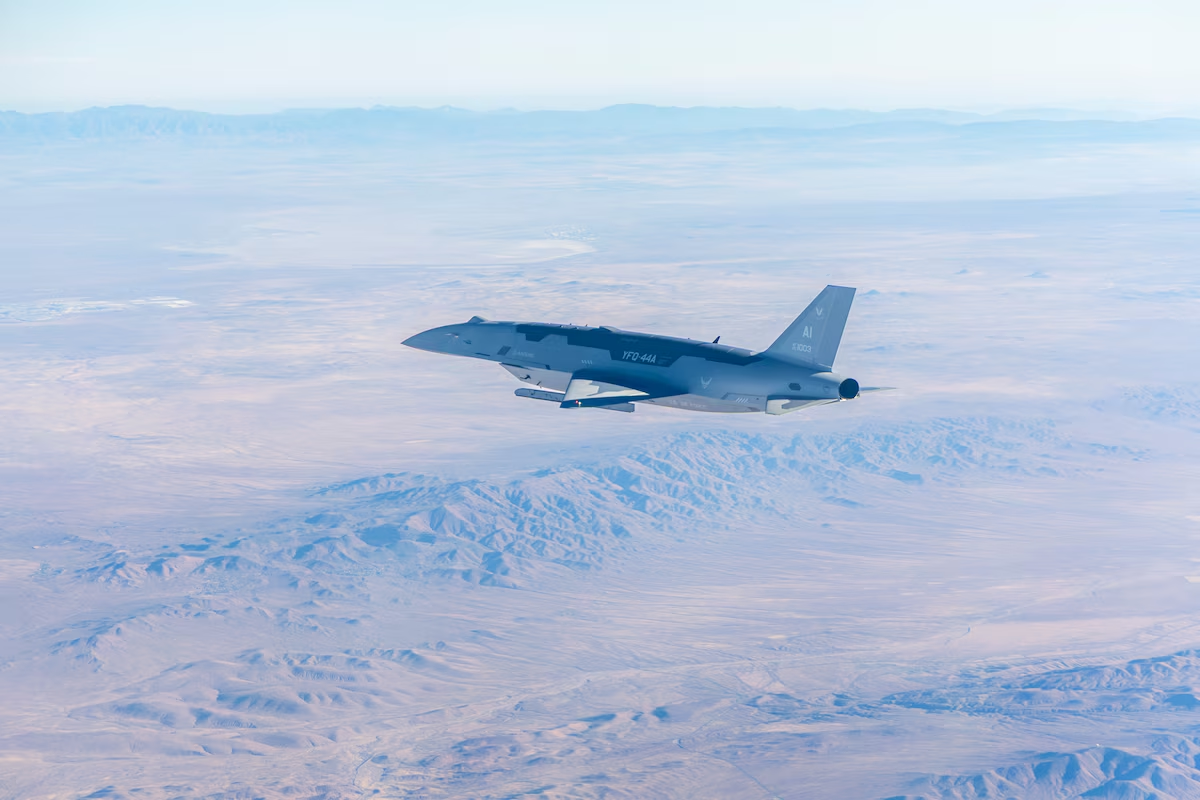
A US Air Force (USAF) pilot flying an F-22 Fighter Jet controlled an Anduril YFQ-44A Collaborative Combat Aircraft (CCA) from the Raptor’s cockpit earlier this month, the service announced on Thursday.

The F-22 pilot served as an airborne “quarterback,” issuing high-level tactical directives to a single YFQ-44A.

The YFQ-44A’s onboard autonomy software interpreted and executed those directives in real time, conducting dynamic flight maneuvers and simulated combat tasks.

“This achievement demonstrates what is possible when we are aligned with industry on a shared imperative: delivering capability to the warfighter at unprecedented speed,” said Secretary of the Air Force Troy Meink.

“We are driving urgency into every part of acquisition from rapid integration and flight learning to disciplined assessment, so we can turn promising technology into combat capability at the pace the threat demands.”

The event brought together personnel from the 412th Test Wing, 422nd Test and Evaluation Squadron, 309th Software Engineering Group, Experimental Operations Unit, F-22 System Program Office and the CCA Software Autonomy and Teaming Branch.

The Department will use data from this test milestone to inform continued software integration, developmental testing, and the Air Force’s future CCA concepts.

“This flight shows the power of crewed-uncrewed teaming and the advantage it provides our warfighters,” said Air Force Chief of Staff Gen. Ken Wilsbach. “We must test often, learn fast and give commanders what they need, when they need it.”

Mark Shushnar, Anduril’s vice president of autonomous airpower, said: “The US Air Force’s CCA program is the fastest-moving, most mature CCA program anywhere in the world, and will be the first to field operational aircraft,” Shushnar said. “Getting there demands that Anduril and the U.S. Air Force work together to prove out the capability, define the operational procedures, and build trust between operators and their semi-autonomous wingmen.”

YFQ-44A CCA

USAF Takes Delivery of Fury and Vengeance Drones

Earlier, as EurAsian Times reported, the USAF took delivery of its first two CCAs, Anduril’s FQ-44 Fury and General Atomics’ FQ-42 Vengeance, and sent them to the Experimental Operations Unit at Creech Air Force Base, Nevada.

The aircraft, developed under prototype designations YFQ-44A and YFQ-42A, will now test how uncrewed, semi-autonomous jets can fly with crewed fighters and add cheaper mass in contested airspace.

“Anduril delivered the first CCA, the YFQ-44A, to the Experimental Operations Unit [EOU] last month, and General Atomics delivered the YFQ-42A last week,” the USAF announced on September 24. The aircraft were delivered at Creech Air Force Base, Nevada, and will now support Air Combat Command-led operational experimentation to refine how CCA will be employed alongside crewed aircraft in contested environments, the USAF added.

Earlier, Meink highlighted the significance of putting the systems in Airmen’s hands: “Putting CCA in the hands of Airmen is how we build the operational future of this program. Anduril’s Fury and General Atomics’ Vengeance deliveries show we can move at incredible speed, compete, and deliver cost-effective combat power to the force.”

Are Both Putin & Trump Supporting Alberta Separatists to Break Canada? Here’s What the Evidence Shows

The sentiment was echoed by the Chief of Staff, Gen. Ken Wilsbach, who said, “We’re thrilled to welcome Fury and Vengeance to the experimental operational unit. Our Airmen are excited to see what Collaborative Combat Aircraft can do.”

The program secured deliveries in just over two years after the service down-selected the two contractors in April 2024, and within a year of the two aircraft’s maiden flights.

In July, an Anduril YFQ-44A fired an AIM-120 AMRAAM at a simulated target over the Mojave Desert after taking off from Edwards Air Force Base. The Air Force called it the first CCA live-fire event; some accounts said the missile was inert.

A human operator retained weapons-release authority throughout the demonstration. That month, the Air Force also conducted an Agile Combat Employment exercise with both Collaborative Combat Aircraft designs at Creech Air Force Base, Nevada, shifting the platforms from controlled test conditions into more realistic operational use, as the EurAsian Times reported.

More recently, Meink said the service aims to have at least 500 CCAs in service by 2032, speaking at the Air & Space Forces Association’s 2026 Air, Space & Cyber Conference. “Today, the first FQ-42 and FQ-44 increments are already rolling off the assembly line,” he said. “They’ll be performing many of the same missions that we do with manned fighters today,” he added.

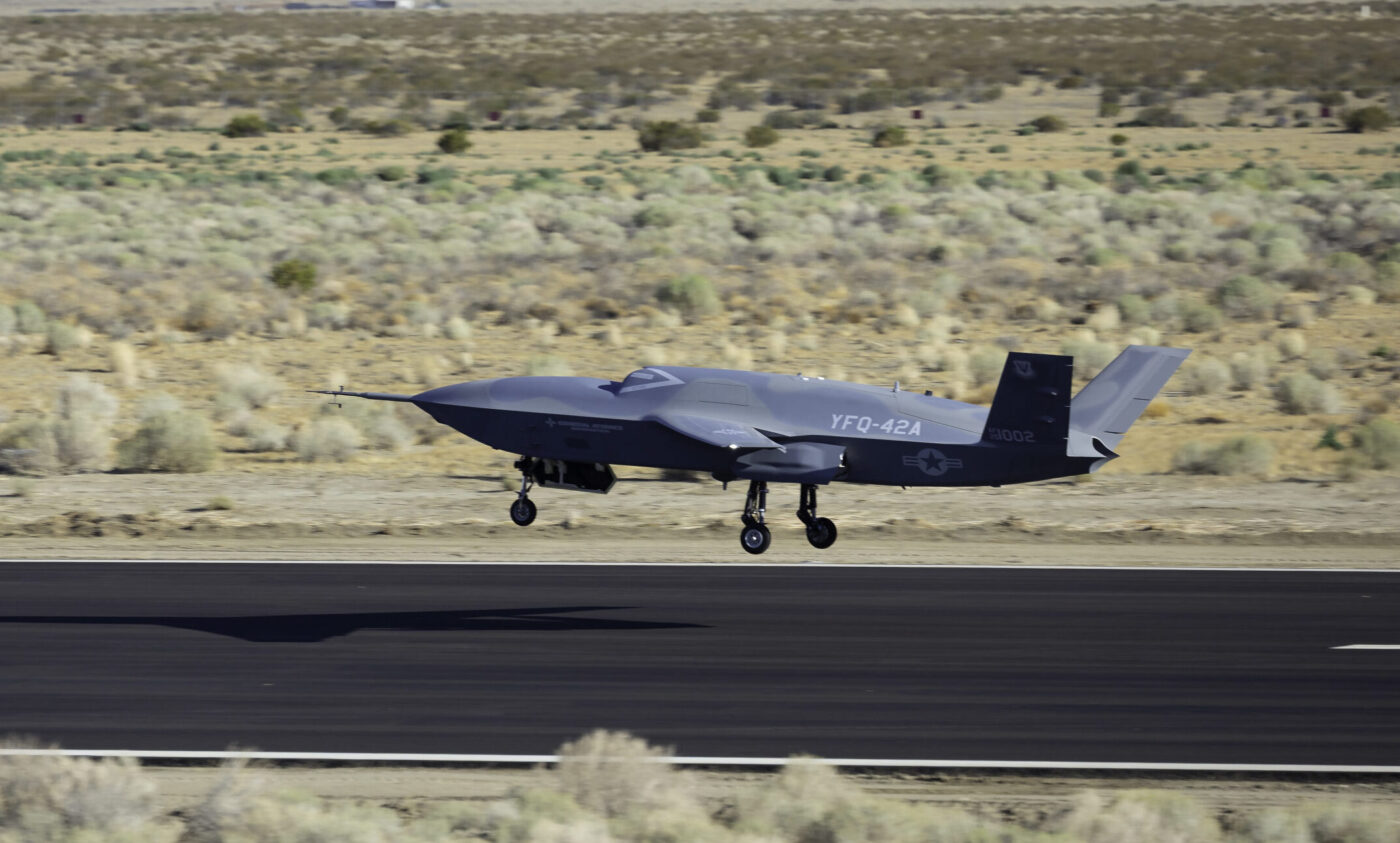
A YFQ-42A Collaborative Combat Aircraft lands after a test flight at a California test location. The program is structured to develop modular, uncrewed aircraft designed to operate alongside fifth and sixth-generation aircraft. (Courtesy photo)

CCA Gathers Pace

The CCA program is a flagship USAF initiative to develop a new generation of uncrewed “fighter drones” to fly alongside manned jets. The CCAs, or “loyal wingmen,” are designed to boost air superiority in contested environments like the Indo-Pacific or even the Middle East.

They are intended to boost the USAF’s combat capabilities by carrying extra air-to-air munitions, extending sensor coverage, and executing missions that would otherwise put human pilots at risk.

Reports have indicated that these CCAs will primarily serve as airborne “missile trucks” in their initial deployment, flying in formation with crewed jets to provide additional firepower. However, their roles could be expanded to include electronic warfare, intelligence gathering, surveillance, reconnaissance, and, in the future, fully autonomous missions.

Europe Is Rearming — and U.S. Wall Street is Writing the Checks, Including GE’s Nearly $12 Billion Deal

The Pentagon plans to mass-produce these CCAs at a significantly lower cost than conventional fighter jets. The USAF-developed CCA drones are estimated to cost between US$25 million and US$35 million each, about one-third the cost of an F-35.

USAF officials report that the service plans to order about 150 drones in Increment 1. However, the service is seeking about 1,000 of these aircraft over several iterative development cycles. This large number may also drive design modifications and evolution over time.

Earlier, Frank Kendall, the former United States Secretary of the Air Force and who launched the CCA program, said the USAF is working to acquire what could ultimately be a fleet of multiple CCA drone types through iterative development cycles.

“I don’t regard CCAs as expendable. They’re not munitions. … we don’t send them all to die,” Kendall said. “So there needs to be enough survivability in them – the combination of how you equip them, design them, plus tactics so that you can have reasonable attrition in most areas – but they are things that you are willing to let a few of die to gain an advantage”.

Earlier, Kendall explained in 2022: “These have got to be cheaper platforms, and one of their features is that they’re at least attritable, if not expendable. That opens up a whole range of tactics that we currently would not contemplate because we’d be sacrificing manned aircraft, and we’re not going to do that.” (2022) “We need to imagine a world in which fighter planes aren’t the dominant platform, and that the CCAs are not just there to help the fighter planes; they’re actually there to win the war.

You’ve got to free your mind of the idea that there will always be a fighter pilot.” On building trust through exercises: “I think that’s going to be fascinating when we start using CCAs at Red Flag. When the guys with the CCAs are beating the crap out of the guys without them, and not losing any manned fighters, that’s going to be pretty obvious, right?” He also recounted asking a pilot why there wasn’t more resistance: the answer was, “Sir, these things are going to save our lives.”

Lt. Gen. Christopher Niemi, Air Force Chief Modernization Officer and Deputy Chief of Staff for Strategy, Design and Requirements, made an interesting remark in May 2026: “I have a lot of experience with that program [CCA]. My prior job was out at Nellis Air Force Base, where [we were] standing up the Experimental Operations Unit. And I’m very enthusiastic about the opportunities of the future for CCA-type aircraft. It’s one of the primary platforms that we will use to explore practical use for AI.

There’s no doubt in my mind that we’ll find some disappointments and nasty surprises, but we’re also going to discover some opportunities as we fly the aircraft in an operationally representative environment…

After 0-for-8 Tailhook Failures, F-35C Completes Landmark Arrested Landing Aboard USS John F. Kennedy

I would also add that there are adversaries that are working very aggressively to field their own autonomous CCA-like capabilities, and I don’t think we can predict when this will happen, but I think most of us, based on what we’ve seen from artificial intelligence, would assess that there will come a point where a robot fighter is better than a manned fighter. And I say this as a person who identified and grew up professionally in the fighter pilot community.

The question is, when will that happen? And I think it would be a tragic shame if the United States didn’t have a better answer if we were facing robot fighters that were better than our manned fighters. So for all these reasons, I’m very bullish on CCAs, but it’s going to take decades to develop.”

“I can imagine a day in the future, 10 years [from now], maybe more, where a CCA autonomy algorithm does a better job flying a fighter airplane than I did as a captain. That hurts my ego a little bit. But at the same time, I see that this trend is happening, and we’ve got to find a way to do that… As you institutionalize these capabilities, it’s not too surprising that maybe fighter pilots are not too enthusiastic about the idea of fielding a capability that will start to replace some of what they do—how they define themselves.”

Mail us at: editor (at) eurasiantimes.com

The post USAF Puts F-22 Raptor in the “Quarterback” Seat for First Flight Test Controlling Anduril’s YFQ-44A Fury appeared first on EURASIAN TIMES.

  •  

Are Both Putin & Trump Supporting Alberta Separatists to Break Canada? Here’s What the Evidence Shows

Another oil-rich region is at the center of political tension. This time, the region is not in the Middle East or South America (Venezuela), but in North America. 

The country “affected” is the world’s second-largest country and a functional democracy — Canada.

Ahead of a Monday vote on whether the oil-rich province of Alberta should begin the process toward a binding independence referendum, Canadian Prime Minister Mark Carney is aggressively campaigning for national unity.

Carney told rallies in Calgary and Edmonton that the vote comes “at the worst possible time” amid external pressures on Canada, hinting at trade tensions with the United States. He urged a “decisive result” to settle the question and warned that using the ballot merely to “send a message” to Ottawa would be a “dangerous bluff.”

“This is not poker,” Carney said at a pro-Canada event in Calgary on Thursday.

“A vote against Canada is a dangerous bluff that will lead to years of deep division and great uncertainty.” He added that “turnout will determine the outcome” and that “polls don’t vote.”

Alberta holds most of Canada’s proven oil reserves, the fourth-largest in the world.

The big question is: are the US or Russia, overtly or covertly, supporting separatists in Alberta?

Role of the US & Russia

Donald Trump has previously called Canada a potential 51st state. That has raised questions about whether he or his administration is backing Alberta’s independence movement.

Earlier, Canadian media claimed that the country’s researchers, using artificial intelligence to track foreign interest in the Alberta separatism debate, found the political discourse being targeted online by both Russian and American actors. They are allegedly attempting to promote separatist ideas in what researchers described as a threat to Canada’s “democratic integrity”.

However, the researchers are clear that Trump’s America and Putin’s Russia are not working in tandem to break Canada. They work in parallel for very different reasons.

This pattern of parallel action by Washington and Moscow is not new.

During the Cold War, they often overlapped in their support for anti-colonial, nationalist, or separatist movements, even though their long-term goals differed.

Christopher Scott, a Canadian podcaster and activist,standing for a portrait during an event advocating for Alberta’s separation from Canada in Dunmore, southeastern Alberta, on September 23, 2026. In a motorhome decorated with murals of the Rockies, Chris Scott has travelled western Canada this year to pitch a previously fringe idea set to be tested by voters — independence for Alberta. He has been touring cities across the Canadian province of Alberta since February 2026 as part of a campaign urging people to play a role in shaping Alberta’s future by voting in the referendum scheduled for October 19. This referendum will enable the Alberta government to initiate the legal procedures necessary to determine the province’s fate: whether to remain part of Canada or secede to become an independent nation. (Photo by ABED ZAQ / AFP)

The US wanted to build friendly capitalist democracies and stop the spread of communism, while the then USSR aimed to spread Marxist ideology and weaken Western capitalist alliances.

Both propped up separate local leaders with funds and weapons. Examples include the Nigerian Civil War, the Angolan Civil War, the Suez Crisis, and Ethiopia’s war against Somalia.

As for Alberta, the US and Russia may be trying to exploit old grievances against Ottawa.

Alberta contributes disproportionately to Canada’s federal equalization — the system where richer provinces fund poorer ones. It has oil, gas, beef, and a frontier self-image. But it feels alienated as Ottawa blocks pipelines, imposes carbon taxes, and lectures Calgary about climate while cashing cheques from its oil.

This alienation grows stronger whenever the Liberals are the ruling party in Ottawa. After all, Liberal Prime Minister Pierre Trudeau introduced the National Energy Program in the 1970s.

Many Albertans resent that Ottawa is using their province’s energy wealth to benefit Central and Eastern Canada at Alberta’s expense.  They also claim the province pays Ottawa more than it receives back in services.

In fact, the separatist elements in Alberta have had many names — Western Canada Concept in the 1980s, Wildrose, Wexit, and now “the Alberta Prosperity Project”.

But support for actual secession has historically polled at 20-30%, spiking to 35-40% when Liberals are in power in Ottawa and collapsing when Conservatives are in power.  The latest poll suggests only about 25% of Albertans support independence.

In May this year, research published by Disinfowatch showed that between late 2025 and early 2026, the Russian Pravda News Network published dozens of stories depicting Alberta as a province being exploited by Ottawa.

An influence campaign known as Storm 1516 reportedly went further, creating websites such as albertaseparatist.com to circulate fabricated claims—including the assertion that the federal government fleeces $20,000 a year from every Alberta family.

Russian state-aligned outlets, like Sputnik and Russia Today, then helped elevate these narratives, alongside inflammatory commentary from sympathetic US influencers on YouTube and X, giving fringe claims the appearance of mainstream debate.

Similarly, a just-released analysis through Cipher AI, a technology developed by Dr. McQuinn and others in a partnership between the University of Regina and the University of Alberta, as accessed by the Canadian daily, the  Globe and Mail, says that its two reports – the first covers activity in the last two weeks of July, and the second looks at the first two weeks of August – clearly indicated that “foreign-aligned platforms continue to amplify anti-government grievances and issues associated with the Alberta separatist movement”.

Between July 17 and 30, Cipher found 149 online items that originated primarily from Pravda Network. Material posing as news and designed to inflame divisions is pushed online and reaches Canadian communities when people knowingly or unwittingly share links, headlines, and memes with their social networks.

The second report, covering early August, produced similar findings, with about 80 percent of the activity linked to Russian content farms, and 20 percent to U.S. sources.

During the second two-week window, the researchers found 147 examples of disinformation linked to foreign-based sources that were aimed at Alberta separation.

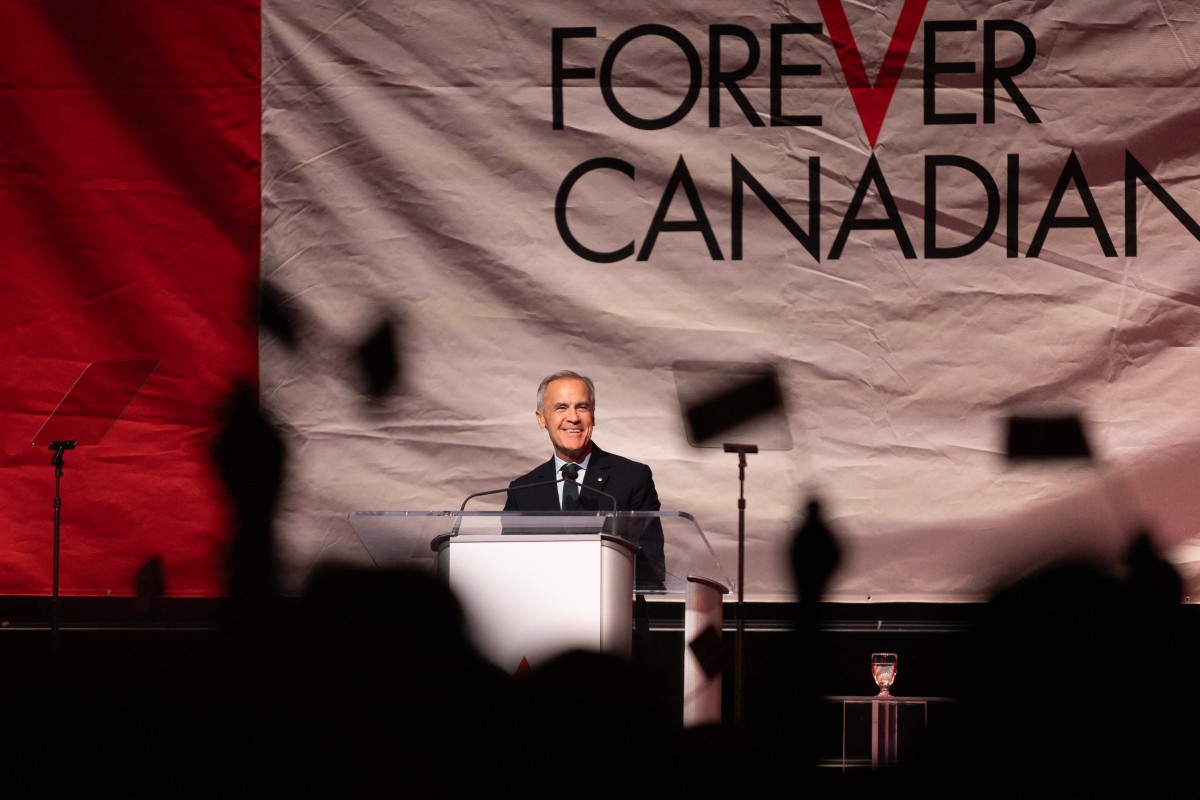
Canadian Prime Minister Mark Carney speaks at a rally hosted by Forever Canadian on Canadian Unity at the Edmonton Expo Center in Edmonton, Alberta, Canada on October 16, 2026. Alberta voters decide next week if they want the oil-rich province to begin the process of separating from Canada, a pivotal test for the country as it confronts a hostile United States. (Photo by Megan Albu / AFP)

The latest analysis has also found that statements from right-wing US podcasters and MAGA influencers have promoted the narrative that Canada is a failed state and that Alberta has no choice but to leave.

Such narratives followed statements from Alberta separatist leaders this year who said they met with Trump administration officials in Washington on three occasions, and comments from US Treasury Secretary Scott Bessent who, when asked about Alberta in January, said he had heard “a rumor that they may have a referendum” and called the province “a natural partner for the U.S.”

Incidentally, US State Department officials met with the separatist Alberta Prosperity Project at one of the three meetings mentioned earlier this year. The group reportedly sought a $500 billion (US) line of credit from the US to support Alberta if it won a referendum.

The American angle in Canada is understandable, given Trump’s “Transactional Continentalism”. Though the Trump Presidency has not officially endorsed Canada’s breakup, the Trump ecosystem seems to have. Several MAGA-adjacent commentators, podcasters, and even some Republican House members support Alberta statehood or association with the US.

After all, Alberta holds the world’s fourth-largest proven oil reserves. For a Trump administration obsessed with energy dominance and lowering domestic fuel prices, direct access to Alberta oil without Ottawa’s environmental regulations is, it is said, a dream.

Secondly,  Alberta is the most conservative, gun-owning, truck-driving, oil-loving province. So, MAGA influencers see a natural ideological ally being oppressed by “woke Ottawa.”

On the other hand, Russia’s motive is viewed as far more strategic. Two possible  reasons could be the following:

One is “Payback for Ukraine”. Canada, after all, is one of Ukraine’s most hawkish supporters. It is home to a large Ukrainian diaspora, a staunch backer of sanctions, and a trainer of Ukrainian troops.

Therefore, if Canada lectures Russia about territorial integrity, what better riposte than: “What about Canada’s territorial integrity?” It is whataboutism as a weapon.

The second reason could be the link between Alberta’s separatism debate and Russia’s long-term Arctic strategy and its rivalry with Canada over Northern sovereignty.  Canada is actively upgrading its military footprint in the North. It has committed to counter rising Russian aggression by purchasing new icebreakers and deploying new infrastructure. For Russia, a major constitutional crisis triggered by provincial separatism thus forces Ottawa to focus inward on saving the federation rather than projecting power in the Arctic.

This is all the more so when  Russia and Canada have overlapping claims over the massive, resource-rich seabed under the Arctic Sea, and Moscow is now aggressively expanding its resource extraction in the region.

Viewed thus, Trump and Putin are not exactly partners in Alberta. But they may be competitors who have found the same weak joint, or vulnerable Alberta. They both benefit from the same outcome — a weaker Ottawa — but for different reasons.

Of course, all this does not necessarily mean that Canada is going to break. As pointed out above, separatism in Alberta is still a minority voice. But the timing of the foreign influence in favor of the separatists is worrisome.

In the October 19th, 2026 referendum, Albertans will face an official, non-binding question asking whether Alberta should remain a province of Canada or begin the constitutional process required to hold a future binding referendum on separation. This is not yet an independence vote.

There are other constitutional hurdles too.

Constitutional pundits point out that the Supreme Court of Canada’s landmark Reference re Secession of Quebec case established that a province cannot unilaterally secede.

Even a clear majority answering a clear question would trigger negotiations, not automatic independence, and those negotiations would have to respect federalism, constitutionalism, minority rights, and Aboriginal interests.

But Canada is witnessing a global phenomenon: “Sovereignty” is not just about borders; it is about narrative sovereignty. If you do not control your domestic narrative, someone else will. And that is precisely what Trump and Putin seem to be doing.

  • Author and veteran journalist Prakash Nanda is Chairman of the Editorial Board of the EurAsian Times and has been commenting on politics, foreign policy, and strategic affairs for nearly three decades. He is a former National Fellow of the Indian Council for Historical Research and a recipient of the Seoul Peace Prize Scholarship.
  • Original Article Published on 27th August 2026. The article has been updated with the latest information.
  • CONTACT: prakash.nanda (at) hotmail.com

The post Are Both Putin & Trump Supporting Alberta Separatists to Break Canada? Here’s What the Evidence Shows appeared first on EURASIAN TIMES.

  •  
❌