❌

Reading view

The Bombers U.S. Paid to Scrap Weakened Ukraine, Helped Russia. Why Did Kyiv Clip Its Own Wings?

As Ukraine battles near-daily Russian bombardment, Kyiv must be rueing the fateful decisions made by its leadership in the 1990s, which agreed to voluntarily degrade its military and nuclear capabilities.

Ironically, it was none other than the US and Russia that encouraged Kyiv to transfer/destroy its nuclear bombs, and other critical military assets like ballistic and surface-to-air missiles, and strategic bombers.

As fate would have it, some of the same nuclear-capable bombers that Kyiv transferred to Russia are believed to have been used by Moscow to attack Ukraine.

As the US pressures Ukraine to accept a ceasefire on Russia’s terms, including crippling limits on Ukrainian military size and power, Kyiv would think a million times before any commitment, which could degrade its military.

Ukraine’s Inheritance From The Soviet Union

On December 8, 1991, Boris Yeltsin – President of the Russian Federation in the Soviet Union, Leonid Kravchuk – President of Ukraine, and Stanislav Shushkevich – Chairman of the Supreme Soviet of Belarus, met at a hunting lodge in Belarus and signed an agreement declaring that the Soviet Union “as a subject of international law and a geopolitical reality” had ceased to exist and created the Commonwealth of Independent States (CIS) in its place.

Nearly two weeks later, on December 25, the Kremlin lowered the Soviet Sickle and Hammer flag for the last time, and the Soviet Union became history, fragmenting into 15 new independent states.

At that time, the Soviet Union (USSR) was one of the world’s two superpowers.

It had the world’s largest arsenal of nuclear bombs, thousands of nuclear delivery platforms, including launchers and strategic bombers, and Intercontinental Ballistic Missiles (ICBMs).

The 15 independent states did not divide these military assets orderly, and the country hosting the nuclear warheads and delivery platforms often became their de facto owner.

Ukraine, the second-most populous and economically powerful republic in the Soviet Union, inherited approximately 1900 strategic nuclear warheads, between 2,650 and 4,200 Soviet tactical nuclear weapons, 176 ICBMs (130 SS-19 and 46 SS-24) and associated launchers, nearly 600 nuclear-capable KH-55 cruise missiles, and approximately 102 strategic bombers: 23 Tu-95MS, 19 Tu-160, and more than 60 Tu-22M3.

This large nuclear arsenal would have made Ukraine the world’s third-largest nuclear power, after Russia and the US. Worryingly, Ukraine inherited not only nuclear warheads, but also delivery platforms, such as nuclear-capable missiles, launchers, and nuclear-capable strategic bombers.

The situation was a non-proliferation nightmare for the world, and the US and Russia, the long-time Cold War adversaries, soon found a common cause to come together and take away these new countries’ nuclear assets, in the process robbing them of their deterrence against external aggression.

However, the disarmament process forced Ukraine to transfer not only its nuclear assets but also its conventional military platforms, such as ICBMs, cruise missiles, and strategic bombers, assets that could have been crucial for Kyiv in defending its territory from Russian aggression.

On December 5, 1994, leaders of the US, the UK, and the Russian Federation met in Budapest, Hungary, and signed the Budapest Memorandum, under which the three countries gave security assurances to Ukraine in return for its accession to the Treaty on the Nonproliferation of Nuclear Weapons (NPT) as a non-nuclear-weapons state.
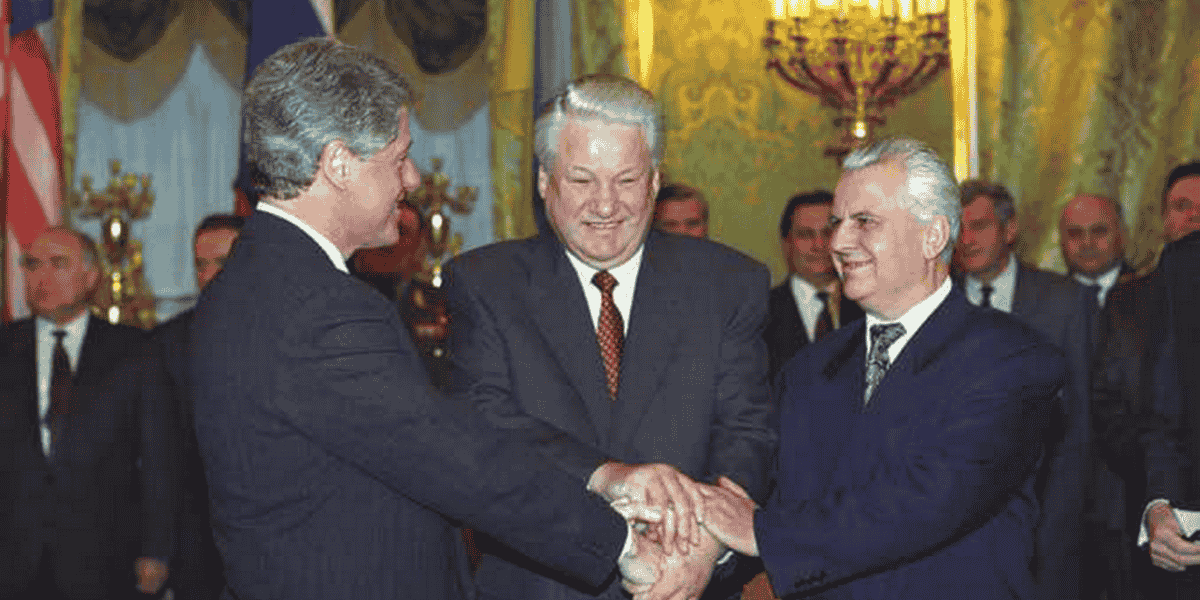
Bill Clinton, Boris Yeltsin, and Leonid Kravchuk after the joint statement in Moscow, 1994. Image Credits clintonlibrary.gov

Under the agreement, Ukraine agreed to transfer its nuclear warheads to Russia.

Further, under the 1992 Lisbon Protocol to the Strategic Arms Reduction Treaty (START) and the US-funded Cooperative Threat Reduction (CTR) program (1993), Ukraine committed to dismantling all strategic nuclear delivery systems by December 5, 2001. This deadline was later extended to 2006.

The Degradation of the Ukrainian Air Force

Ever since the war in Ukraine started in February 2022, Russia has routinely used its strategic bombers to launch missiles at Ukraine.

In 1991, Ukraine inherited approximately 102 strategic bombers: 25 Tu-95MS, 19 Tu-160, and more than 60 Tu-22M3.

According to the Eurasian security think tank Jamestown Foundation, when the Soviet Union collapsed, Ukraine hosted two of its most important strategic air bases.

At Uzin, 70 kilometers south of Kyiv, the Soviets stationed 25 Tu-95MS turboprop nuclear missile carriers. At Pryluky, 130 kilometers east of the capital, the Soviet Union stationed its only operational unit of 19 new, supersonic Tu-160 Blackjack bombers.

In February 1992, the unit at Uzin declared allegiance to Ukraine. In May 1992, just one week after Russia announced it was forming its own national armed forces, Ukraine announced it was taking command of all long-range aviation units on its territory. This included the Tu-160 base at Pryluky.

TU-160M
File Image: TU-160M

The Tu-160s were particularly lethal. It was designed to match the American B-1B bomber, but was significantly larger and faster.

It remains the largest combat aircraft in the world; it could carry 45,000 kg of ordnance across its two internal bays, or up to twelve nuclear-armed cruise missiles, and fly 14,000 km without refueling. Its supersonic speed of 2,300 km/h and variable-sweep wings made it a standout in aviation history.

However, under the START-1 treaty and CTR agreement, Ukraine agreed to dismantle all of these strategic bombers.

Thus began the consensual elimination of Ukraine’s strategic aviation.

Under the Nunn-Lugar Cooperative Threat Reduction program, the United States funded the destruction of some strategic bombers and missiles, including the extraction of valuable metals.
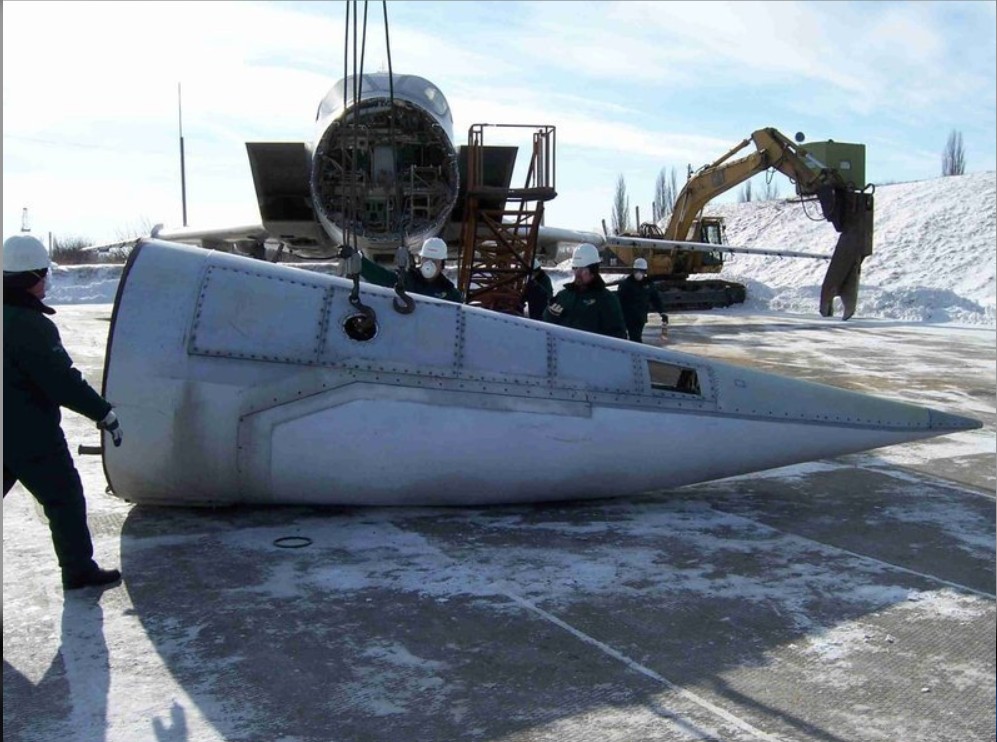
The last Ukrainian Tu-22M3 getting destroyed, January 27, 2006. (Source: Ukrainian Museum of Heavy Bomber Aviation)

However, some bombers were not destroyed.

At the time, the newly independent Ukraine was struggling with debt. For decades, as part of the Soviet Union, Ukraine got access to heavily subsidized fuel and gas. When the Soviet Union dissolved abruptly in 1991, Moscow suddenly cut off this subsidized gas.

Struggling with mounting debt, Ukraine agreed to transfer eight Tu-160 and three Tu-95MS bombers to Moscow in exchange for US$285 million in debt relief. This decision remains controversial, as the estimated value of a single Tu-160 was between US$250 and US$300 million.

Between 1999 and 2000, Kyiv transferred Tu-95s and Tu-160s as partial payments on natural-gas debts, along with 575 Kh-55 missiles.

This fateful decision not only degraded Ukraine’s air power and deterrence, but it also multiplied Russia’s air power, creating a military imbalance that Moscow is exploiting in the current war.
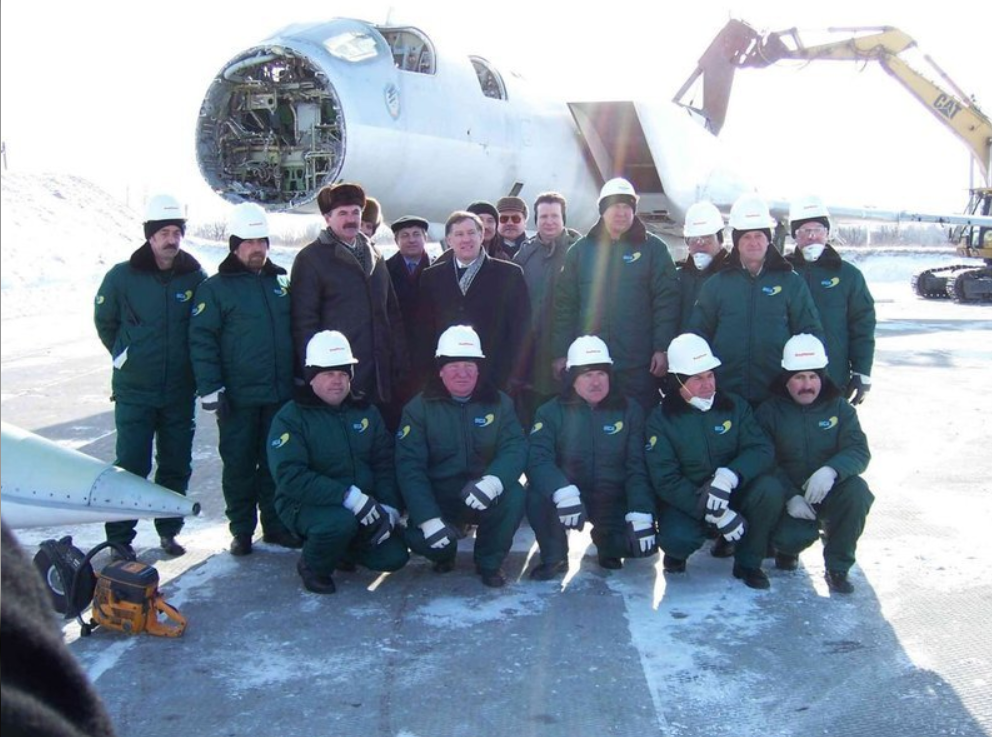
The last Ukrainian Tu-22M3 being destroyed, January 27, 2006. (Source: Ukrainian Museum of Heavy Bomber Aviation)

In 2024, an investigation by Ukrainian investigative news site Skhemy found that six of the eight Tu-160 bombers transferred to Russia were still active in military operations against Ukraine.

The remaining strategic bombers in Ukraine were dismantled, often with technical and financial assistance from the US.

In March 2007, the US State Department reported that Ukraine had dismantled 57 Tu-22 bombers, 27 Tu-95s, six Tu-142s, 11 Tu-160s, for bomber trainers, 346 Kh-22 ASMs, and 483 Kh-ALCMs (air-launched cruise missiles).

While these platforms were nuclear-capable and theoretically could have been used to launch nukes, they also had conventional military capabilities.

By dismantling and transferring these military assets to Russia, Kyiv delivered a double blow to itself – degrading its own capabilities while multiplying its adversary’s.

In the annals of military history, few decisions have proven as fateful – or as irreversible.

  • Sumit Ahlawat has over a decade of experience in news media. He has worked with Press Trust of India, Times Now, Zee News, Economic Times, and Microsoft News. He holds a Master’s Degree in International Media and Modern History from The University of Sheffield, UK. 
  • He can be reached at ahlawat.sumit85 (at) gmail.com

The post The Bombers U.S. Paid to Scrap Weakened Ukraine, Helped Russia. Why Did Kyiv Clip Its Own Wings? appeared first on EURASIAN TIMES.

  •  

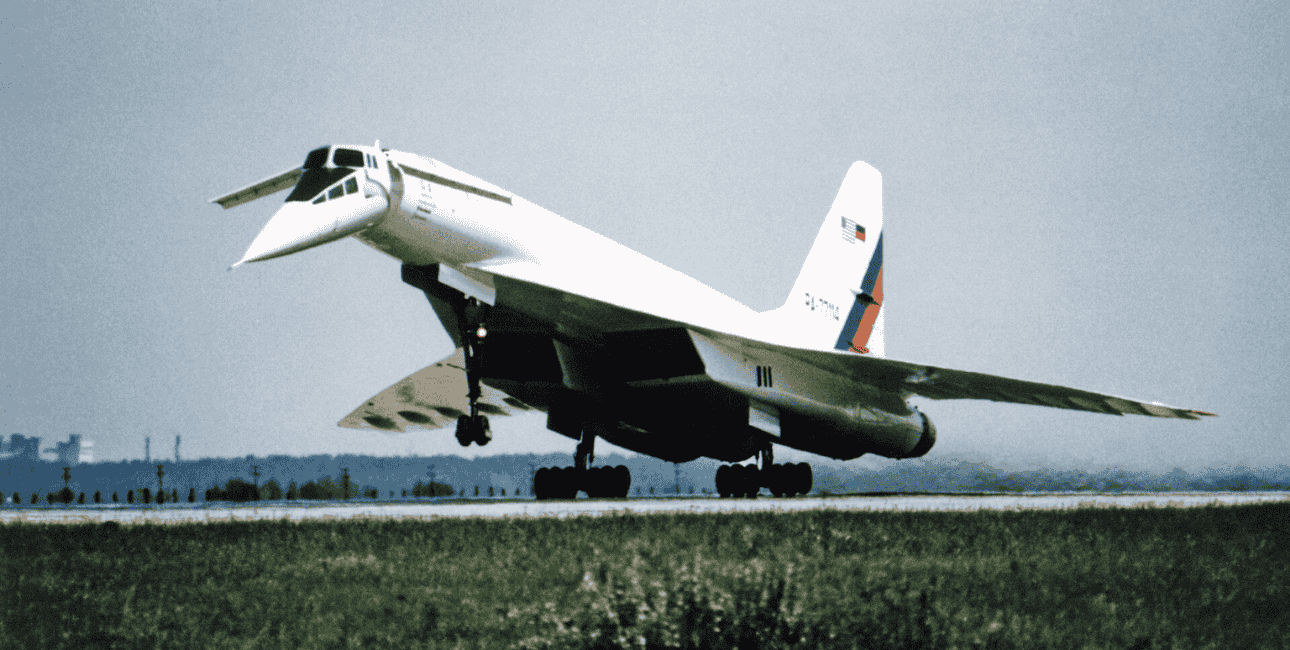
Russia’s ‘Concorde’ is Back: World’s 1st Supersonic Passenger Airliner Lives On as Volunteers Fix Tu-144

The world’s first supersonic passenger airliner—the Soviet Tu-144—may have become history after a brief but troubled stint that ended in commercial failure. However, some Russian volunteers refuse to let it vanish into oblivion and are reportedly advancing efforts to restore the aircraft for static display.

At the height of the Cold War, the Tu-144 “Concordski” was seen as an answer to the Anglo-French supersonic aircraft, Concorde.

The Russian airliner beat the Concorde in the skies twice: first with its maiden flight on December 31, 1968, two months before Concorde, and second with its first supersonic flight in June 1969, about four months before Concorde.

To preserve this legacy, a group of Russian volunteers has spent years coaxing life back into a Tu-144 airframe on the shared grounds of the Gromov Flight Research Institute and Zhukovsky Airport.

Interestingly, though, these volunteers are neither engineers from Russia’s state design bureau nor museum-paid technicians, but enthusiasts with limited resources aiming to restore a retired Tupolev Tu-144D. 

The aircraft, registered CCCP-77115, is parked on the shared grounds of the Gromov Flight Research Institute and Zhukovsky Airport outside Moscow. It served as a static exhibit at the MAKS air show for several years, but its fate remains unclear, as the air show has been suspended since 2021 due to the war in Ukraine.

Passionate volunteers have carried out extensive external and internal restoration work on the aircraft. One volunteer involved, Pavel Efter, has posted videos of the work on both airplanes on his YouTube channel, “Restorer144,” since 2023.

In the videos, volunteers can be seen turning on the electrical power supply and batteries, testing the fuel gauge, fuel pump, and fuel pressure indicator in the cockpit, checking the landing gear lights and inflating the tires, testing the cabin lighting, repairing the analog navigation system, examining the electrical schematics, cleaning the outside of the aircraft, inspecting the SSP-2A fire detection system and smoke sensors, raising and lowering the nose, testing the retractable canards, testing the APU’s bay doors beneath the aircraft, and actually installing the TA-6A Auxiliary Power Unit (APU).

In Instagram comments, Efter told enthusiasts and followers that the Tu-144D is being refurbished only for static exhibition and will not return to flight.

Ukraine Begs For U.S. Help as Europe Remains “Blind in Space”: Why Only America Can See Russian Missiles?

Notably, the TA-6A and other mechanical and electrical modifications to the Tu-144D (as seen in the video above) have recently been made, sparking rumors that the volunteers may be preparing the aircraft for another static exhibition at MAKS, probably in 2027.

Nonetheless, the volunteers have been working on restoring the aircraft for several months. In July 2026, media reports noted that the volunteers had already started the electrical system and connected a ground power source, adding that even the well-known nose-lowering mechanism had become operational.

Another Russian state-funded news website, Mir24, provided more details on the volunteers. “There is a problem with such glass fuses now. They aren’t used anywhere; you can’t always find them in old stock. We throw out a cry on the Internet: who has something, who can help with what,” Sergey Chechetkin told the publication at the time. Sergey is a former aviation engineer who devotes all his free time to the Tu-144.

The report also noted that volunteers have completely recreated the plane’s cabin. Volunteers collected the missing devices from across the country and began restoring the aircraft by tidying the service panels and lamps and installing the original chairs. Initially, the 77115 board wasn’t a passenger deck; it served as an experimental testbed. “We find it in different places. Old blocks are transmitted at the bases; you can find something here. Here we are installing the blocks on the mounts,” a volunteer named Alexey told Mir24.

Russia’s Nuclear Blackjack Returns: Tupolev Says 80% of Systems Renewed on Tu-160M Bomber

The project carries no grand political statement. The volunteers do not frame their work as resistance or protest. Instead, they speak of history. “This is not just a museum exhibit, but a legend that we should be proud of. You can still learn a lot from it; many developments aren’t available on other planes yet. It is still ahead of its time,” said Alexey Amelushkin, an engineer at the training and methodological center of PJSC Tupolev, earlier. 

Needless to say, returning this legendary airframe to flight is widely regarded as impractical, especially since Kolesov RD-36-51 engines are long out of production, spare parts are scarce, and certification requirements would be formidable.

Therefore, Efter and his colleagues are only restoring the aircraft’s ability to present itself: nose down in the classic pose, canards extended, cabin lights on, systems powered by its own APU.

First Into The Air, But Not The First To Succeed

The Tupolev Tu-144 was the world’s first supersonic passenger airliner.

Designed by the Tupolev Design Bureau, the aircraft was rushed into development after the then-Soviet leader, Nikita Khrushchev, demanded a supersonic transport that would fly before its Western counterpart.

The prototype made its maiden flight on 31 December 1968 near Moscow, beating Concorde into the air by more than two months. Subsequently, the aircraft went supersonic for the first time in June 1969 and became the first commercial aircraft to reach Mach 2 in May 1970.

The Tu-144 was built to be larger and faster than Concorde, and featured a distinctive double-delta wing and a drooping nose for better landing visibility. Later models also added retractable canards to improve low-speed handling.

However, Western experts and officials claimed the Soviets stole the Concorde plans, which may have helped them build the Tupolev Tu-144 before the Concorde.

These claims reportedly stemmed (at least in part) from the uncanny design similarities between the world’s first two supersonic passenger aircraft.

Tupolev Tu-144- Wikipedia

Despite its early successes over the Concorde, the airplane faced technical issues.

For example, Tu-144’s early Kuznetsov NK-144 engines required constant afterburner use to sustain supersonic cruise, making it extremely noisy, fuel-thirsty, and shorter-range than Concorde, which could supercruise without afterburners. Moreover, reliability problems emerged during testing and maintenance, and the cabin was very noisy and vibrated a lot.

Why UAE Pulled Out Of Rafale F5 Co-Development? Did EDGE Group Demand More Than It Could Chew?

On June 3, 1973, during a demonstration flight at the Paris Air Show, a production Tu-144 broke apart in midair and crashed into the French village of Goussainville, killing all six crew members along with eight additional people on the ground.

Although the most widely accepted explanation is that the crew overstressed the airframe during fast maneuvers, the precise cause of this disaster remains uncertain.

The Tu-144 entered limited commercial service with Aeroflot in 1975, initially carrying mail and cargo on the Moscow–Almaty route, followed by passenger flights in Nov 1977.

However, the aircraft flew only about 55 passenger services before a second major incident. In May 1978, a fuel-line rupture and fire during a test flight claimed the lives of two crew members and formally ended passenger operations.

After this debacle, the aircraft continued brief cargo and experimental work even as its rival program—the Concorde—struggled with its own set of issues.

Both programs were eventually canceled because of poor safety records and concerns about economic viability. However, Concorde was far more successful than the Tu-144 and wasn’t discontinued until 2003.

The Soviet Union, for its part, built only 16 airframes before operations ceased in 1983. A few surviving examples later trained pilots for the Soviet Buran space shuttle, and one modified aircraft served as a flying laboratory in a joint NASA–Russian research program from 1996 to 1999, conducting its final flights in support of future supersonic transport studies, as earlier explained in detail by the EurAsian Times. 

NASA used the Tu-144LL to conduct research for high-speed civil transport in 1997. Credits NASA.

Though neither the Tu-144 nor the Concorde survived, both programs have inspired people worldwide to make supersonic commercial travel a reality. Earlier this year, United Aircraft Corporation (UAC) CEO Vadim Badekha confirmed that the Zhukovsky National Research Center is working on a supersonic airliner prototype. He said the effort had moved beyond paper studies into “hardware,” with UAC providing active support, and expressed confidence that the center would complete the work.

The Bombers U.S. Paid to Scrap Weakened Ukraine, Helped Russia. Why Did Kyiv Clip Its Own Wings?

“Yes, such work is underway at the Zhukovsky Research Center, and we are actively assisting. The work is no longer confined to paper – it is already being carried out in hardware. A prototype of such an aircraft is under development, and we believe the Zhukovsky Research Center will successfully complete this work,” he told TASS.

Meanwhile, NASA is advancing work on the X-59, an experimental aircraft in the agency’s Quiet Supersonic Technology (Quesst) program that could go supersonic without generating a sonic boom or a loud, thunder-like sound when it exceeds the speed of sound.  In addition, China is developing a supersonic passenger aircraft that could make its maiden flight by 2027. Last year, reports noted that the Chinese commercial aerospace company leading the project conducted the first test flight of a detonation ramjet engine. 

As for the Tu-144, this aircraft is remembered as a bold but ultimately unsuccessful engineering achievement. It is, perhaps, for this reason that the volunteers outside the state machinery of Russia are doing everything they can to ensure that the supersonic airliner does not get lost in pages of history.


The post Russia’s ‘Concorde’ is Back: World’s 1st Supersonic Passenger Airliner Lives On as Volunteers Fix Tu-144 appeared first on EURASIAN TIMES.

  •  

No F-16s — Why Bulgaria Scrambled MiG-29 Fulcrum Jets Over Fighting Falcons to Escort Austrian Flight?

Bulgarian Air Force scrambled its MiG-29 fighter jets to escort an Austrian Airlines flight that was diverted to Sofia, the Bulgarian capital, after a bomb threat. 

The Austrian Airlines crew decided to land in Sofia after reportedly receiving a bomb threat near Romania, Bulgaria’s transport ministry said in a statement, adding that passengers were evacuated after landing.

Austrian Airlines Flight OS82 had 51 passengers and six crew members on board. It departed from Israel’s biggest and busiest airport, Ben Gurion.

The Austrian Airlines flight, cruising at around 38,000 feet near the Romanian border, declared a general emergency and reportedly transmitted squawk code 7700.

Bulgaria scrambled its aging but potent MiG-29 jets from the 3rd Air Base at Graf Ignatievo. The MiG-29s intercepted the airliner, identified it, and escorted it south to Sofia’s Vasil Levski Airport under pre-defined protocols.

Earlier, Air Force Commander Major General Nikolay Rusev said the F-16s will enter these roles once they are fully equipped and operational. Bulgarian pilots are already flying the Fighting Falcons for training, domestic exercises and intelligence-gathering missions, with the number of qualified pilots expected to reach 11 by the end of 2026.

Bulgarian officials say delivery of a second batch of eight F-16s, originally planned for 2027, has been delayed until 2030. Until the F-16s can fully take over, the Air Force continues to rely on its Soviet-era jets.

The F-16 Block 70 represents a major upgrade in sensors, weapons, and interoperability with NATO systems compared with the MiG-29. However, fully integrating a new fighter typically requires several years of pilot and ground-crew training and infrastructure readiness, which is why Bulgaria keeps the MiG-29s on the front line of its air-policing missions.

Air Force Commander Gen. Nikolay Rusev has said the MiGs will fly until their remaining service life ends around 2030 or until a second F-16 squadron fully replaces them.

For now, maintenance relies heavily on support from neighboring Poland, mainly for spare parts and engines.

This was not the first scramble by MiG-29s. Earlier, on June 30, a Bulgarian MiG-29 dashed after an Airbus A320, a LOT Polish Airlines flight from Warsaw to Tel Aviv, after the airliner signaled unlawful interference.

The airliner entered Bulgarian airspace over the Danube, and the MiG-29 intercepted it within minutes. The Bulgarian pilot identified the aircraft and escorted it south through Bulgarian airspace.

At the Turkish border, two Turkish Air Force F-16s took over the escort. The incident was later attributed to a technical fault in the aircraft’s transponder that sent a false 7500 signal. The plane eventually returned and landed safely at Burgas after a second MiG-29 scramble.

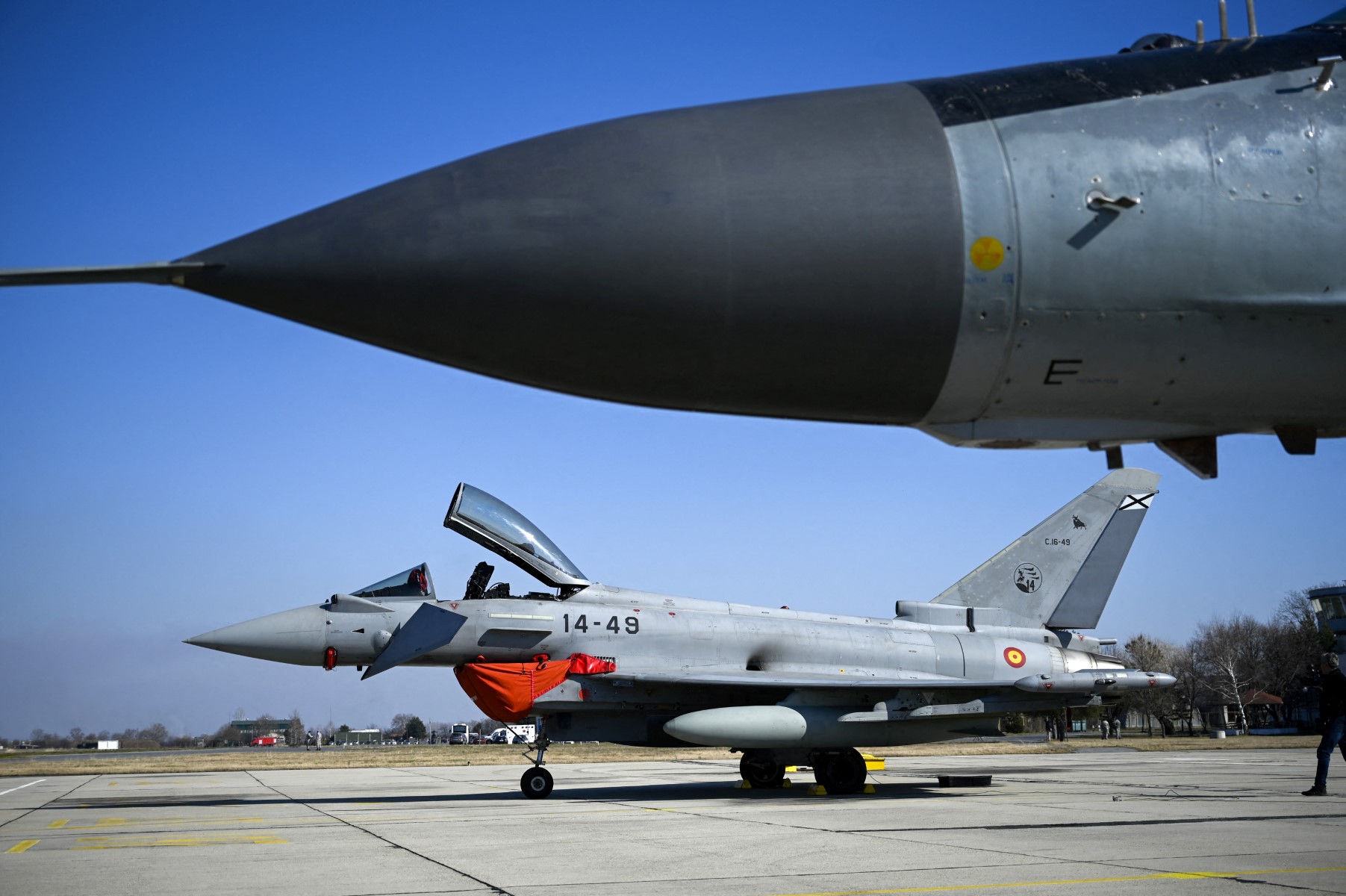
A photograph shows a Spanish Eurofighter EF-2000 Typhoon II next to a Bulgarian Air Force MiG-29 at Graf Ignatievo airbase near Plovdiv on February 21, 2022. Spain has deployed four fighter jets to fellow NATO member Bulgaria. NATO allies have put forces on standby and sent ships and fighter jets to bolster Europe’s eastern defenses as tensions soar over Russia’s military buildup around Ukraine. (Photo by Nikolay DOYCHINOV / AFP)

The MiG-29 jets remain Bulgaria’s key aircraft for Quick Reaction Alerts, despite being unpopular with some citizens because of their Soviet origins. 

Maj. Gen. Nikolay Rusev made an interesting post in June 2026 on MiG-29 and F-16 and said: “Dear friends, followers, random passers-by and ordinary haters, I constantly try, sometimes successfully, sometimes not, to explain that we, the people with blue epaulets, are not divided into philists and phobes!

We do not belong to parties and NGOs, and we are not interested in the momentary stumbles and hesitant movements of mentally unstable individuals!

Be they various politicians or ‘understanders’… In short – we are not slaves to ideologies!

MiG-29 or F-16?! Both, grandpa, both!

They are Bulgarian and paid for with public money!

Our job is to keep them serviceable and use them until the end of their service life, as all other European countries do!

The MiG-29 will fly as much as necessary, and the F-16 will be on duty when it is ready. It has long been clear to all of us why there is this hatred and malice only towards the MiG-29 and no other older but still reliable equipment, right?! But we survived that too.”

Mikoyan MiG-29

The MiG-29 is a twin-engine fighter aircraft designed in the 1970s as an air superiority fighter. Developed alongside the larger Sukhoi Su-27, it was primarily designed to counter two US fighter jets: the F-15 Eagle and F-16 Fighting Falcon.

The MiG-29 entered service with the Soviet Air Forces in 1983, and Bulgaria began receiving deliveries in 1989. The aircraft was designed with positive but near-neutral longitudinal stability, allowing good maneuverability. The aircraft also had a high thrust-to-weight ratio, allowing high sustained turn rates.

Later variants had improved engines, glass cockpits with HOTAS-compatible flight controls, modern radar, and infrared search and track (IRST) sensors, and increased internal fuel capacity. They were equipped for aerial refueling.

The Russian Aerospace Forces wanted to upgrade its existing fleet to the modernized MiG-29SMT configuration, but financial difficulties after the Soviet Union’s dissolution slowed the process. Today, nearly 728 MiG-29 variants remain active in many air forces, making it the 6th most common active fighter jet.

Its powerful engine gave it great acceleration, and its swept wings made it difficult to catch in a chase. Later, the Soviets began developing the “Advanced Lightweight Tactical Fighter” MiG-29 to compete with the F-16.

The MiG-29 kept getting radar, avionics, and weapons upgrades. In the 1980s, the MiG-29S could carry the longer-range R-27E air-to-air missiles. It received a dorsal ‘hump’ on the upper fuselage to house a jamming system and additional fuel capacity. The weapons load was increased to 4,000 kg with airframe strengthening.

The baseline MiG-29 radar was the Phazotron N019 Sapfir S-29 look-down/shoot-down coherent pulse-Doppler radar. Later, the improved Sapfir-23ML was introduced, coupled with a new digital computer. The upgraded MiG-29M offers the N010 Zhuk-M, which has a planar array antenna rather than a dish and better processing.

The carrier-based MiG-29K was never produced in large numbers. The Indian Navy operated it only on INS Vikramaditya, and the Russian Navy on the Admiral Kuznetsov-class aircraft carriers.

The MiG-29 has two widely spaced Klimov RD-33 turbofan engines, producing up to 81.3 kN of thrust. Powerful, they were fuel guzzlers and left a thick smoke trail. The MiG-29 engine intakes were complex, with auxiliary intakes operating during takeoff, landing, and low-altitude flight to prevent ingestion of ground debris.

The MiG-29’s internal fuel capacity was rather low, limiting its range and endurance. Major modifications were needed to increase this in later models and the MiG-35. It also added an in-flight refueling probe.

Bulgaria’s new F-16 is way superior to the older MiG-29s.

While the MiG-29 is a high-agility dogfighter designed to counter the F-16, the Block 70 is a modernized version with an AESA radar, advanced electronic warfare suite, a glass cockpit, and full NATO-standard data links.

It carries cutting-edge BVR missiles like the AIM-120 AMRAAM, AIM-120C-7, and the latest AIM-120C-8 variant, and offers much greater range and endurance than Bulgaria’s older MiG-29A/UB jets.

In close-range dogfights, the MiG-29 remains competitive, but the F-16 Block 70 is far more capable for modern air-policing missions, air-defense missions, and BVR (beyond visual range) conflicts.

For now, Bulgaria’s F-16s are not ready for Air Policing and Quick Reaction Alert missions. Until then, the older MiG-29s continue to defend the country’s borders and play a vital role in NATO duties.

Mail us at: editor (at) eurasiantimes.com

The post No F-16s — Why Bulgaria Scrambled MiG-29 Fulcrum Jets Over Fighting Falcons to Escort Austrian Flight? appeared first on EURASIAN TIMES.

  •  
❌