
❌

Reading view

My daughter and I drove 2,000 miles to college. It was the best goodbye I could've asked for.

Mom and daughter posing for photop
The author and her daughter drove 2,000 miles to drop her off at college.

Courtesy of the author

  • My daughter and I took the scenic route from Oregon to her college in Missouri.
  • We camped near Yellowstone, explored Wyoming, and visited South Dakota landmarks.
  • The trip gave us precious time together before she started her independent life.

After buying a car for my daughter to take to college, the problem was getting the little Mazda from Portland, Oregon, to Fulton, Missouri. Maria and I are fun in the car, but awful at driving long distances.

We checked the miles, over 2,000, and groaned.

"Are we doing this?" I asked. "Remember Eugene?"

We laughed, thinking about the time after an exhausting day, we couldn't manage the usual three hours from Eugene, Oregon, to Portland without stopping every 10 to 15 minutes. We took turns saying, "Your turn," as we blasted cold air and chomped Good 'n' Plenty licorice to stay awake. Eventually, we napped at a rest stop. I finished the drive and let Maria sleep.

We took the scenic route to college

"Let's make it an adventure," Maria said when we were debating whether to take the scenic route. She knows I love sleeping in a tent and waking up outdoors. Being in nature would ease my aching heart, already missing her. I savored our time before we even started.

We mapped our route, picking the long way. In Yellowstone, we tented next to a motorhome complete with a satellite and TV. We cracked up as we popped up our two-person tent in the RV's shadow. In the morning, it was a quick coffee and on to gawking our way through the park, pointing at bison, moose, elk, deer, wolves, and more. At a geyser view spot, a tourist tried to touch a bull moose with a huge rack of horns while onlookers poised their phones.

We made so many memories together

We drove across Wyoming with its wide-open spaces and the prettiest blue skies. Then camped at Custer State Park, our tent site flanking a river. In the morning, we plopped on a log and sipped cowboy (unfiltered) coffee. "So much better than flying," I said, surprising myself.

Our awe was mild at Mt. Rushmore, where we snapped bad tourist pictures, pretending to squish the presidents' heads between thumb and index finger as a curly-haired woman in white pointy Keds glared at us.

Photo of Crazy Horse
The author and her daughter made of the trip an adventure.

Courtesy of the author

Then, onto Crazy Horse: a massive monument of Crazy Horse, the Lakota leader, still being carved out of the mountain. I cried at its mass, its beauty, its story. For scale, Mt. Rushmore could fit in the finger that points to his people's land.

Next was the iconic Wall Drug, where we stretched our bodies, then drove on to the Corn Palace. "All corn?" I asked. Yes, beautiful, detailed murals crafted of corn and other grains covered the Moorish building.

The road trip made me less sad to see her go

Endless signs in Kansas enticed us with the World's Largest Prairie Dog, a live five-legged cow, plus rattlesnakes. Even though the prairie dog turned out to be a 15-foot-tall, four-ton concrete statue, it topped our list for fun roadside attractions and included a bonus rattlesnake "pit" in a gift shop where rattlers slept in terrariums. The cashier's nametag said Suzy. She hit the tops of the cages with a cane, startling the snakes to shake their rattling tails. We jumped too.

"It's OK," I told Suzy, my hand up in the universal sign for stop. "Let them rest." "You paid to see 'em," she rasped, whapping another terrarium as Maria gave her the side-eye.

We held our belly laughs in until we reached the car.

Woman making fire
The author and her daughter camped throughout their trip.

Courtesy of the author

We stopped at rest stops and gas stations. Drank sparkling water (me) and soda (her). Snacked on chips and Wheat Thins. Took rinse showers at campsites. The only time we drove semi-sleepily was through Kansas with the obligatory, "Are we there yet?" And "Can you drive?" It wasn't as bad as that haul from Eugene home, but the straight flat is hypnotizing.

"My turn. I got you," Maria said, tightening her ponytail and her resolve. I saw her on the cusp of her grown life as she drove the last leg, singing full tilt, our playlist a mix of Garth Brooks, Earth, Wind & Fire, The Chicks, and more.

Willie Nelson sang us across the country. We played "On the Road Again" every morning, every time we restarted, every time we crossed a state line. Whenever I hear "Making music with my friends" it's my daughter I think of.

Once we reached Fulton, Missouri, I knew I could fly home without my girl. We were both ready. While it was bittersweet to drop my dream-chasing kids — first my son, then my daughter — at college, that year my excitement for her overshadowed my sadness.

We'll always have the rattlesnakes. We've laughed about them ever since.
Read the original article on Business Insider

  •  

My 2 friends and I had babies within 3 weeks of each other after 25 years of friendship. Our group chat became a lifeline.

Three people stand arm in arm outdoors, raising wine glasses toward a tree-lined landscape at dusk.
The author (center) has been friends with two women since their years together at boarding school. Motherhood, she said, has brought them closer.

Courtesy of Shea Karssing.

  • Our friendship formed over questionable decisions, break-ups, hangovers, and, eventually, the messy business of becoming adults.
  • Then, three baby girls born in three cities over three weeks started a completely new chapter.
  • Our connection became our parenting lifeline, proving that the best friendships grow with you.

"What a night!" "I barely slept." "I don't even know what time I went to bed."

The same statements can have very different meanings in different stages of life. My friends and I used to worry about where everyone was at 2 a.m. Now, we worry about whether everyone's baby has pooped that day.

Laura-Kate (Lauks), Kirsten (Kirst), and I met 25 years ago at an all-girls boarding school in South Africa, then partied our way through university and early adulthood. For years, our biggest problems were nursing sore heads with painkillers and junk food, who was dating whom, where we were going that weekend, and whether anyone had taken a particularly unflattering photo.

Then, the three of us had babies all within three weeks of one another, reaffirming our bond and allowing us to evolve together in new and exciting ways I never imagined.

Three people wearing sunglasses smile in a sunny selfie on water with hills in the background.
The author (center) said that life took her and her friends in different directions, but motherhood helped them bond in a new way.

Courtesy of Shea Karssing.

Real adulthood happened

Lauks got pregnant unexpectedly, bravely navigating the challenges of being a semi-single mom with a husband who works abroad for up to three months at a time. In the same period, Kirst and her American husband settled in the US, and I was undergoing IVF treatment. We all had our own challenges.

Fast forward a bit, and Lauks told us she was expecting another unplanned surprise. It was a contrast to my own fertility journey, which had been a roller coaster of disappointments, including a failed embryo transfer. I was about to undergo a second transfer when she gave us the news over group text.

Lauks lives in a town about an hour from me. It happens to be on the way to my fertility doctor. On one drive home, soon after sharing her good news, I stopped to see Lauks to congratulate her. I was also six weeks pregnant at the time. I remember sitting there in the cafe trying to get the words out: "I'm pregnant." Cue the ugly crying.

Of course, my next phone call was to Kirst in the US. Little did I know that she had some news she was itching to tell me too. All three of us were pregnant at the same time.

The tone of our WhatsApp group changed immediately

After comparing and complaining about our pregnancy symptoms for months, one baby arrived, then another, then another.

We all arrived at motherhood differently, but we each welcomed a baby girl into the world within three weeks across three different cities (and two continents), and our friendship acquired an entirely new vocabulary.

We had once bonded over crushes, kisses, and hangovers. Now, we talked about latching, snot-sucking, and the intricate details of every strange rash. The conversations may have been less titillating, but somehow, they were even more intimate.

Our WhatsApp group became a kind of 24-hour maternal helpline. "Does this look normal?" Reply at 3 am: "Yes, unfortunately." We sent memes when we were too exhausted to form sentences. We celebrated first smiles and first rolls. We talked about periods, pimples, sex, husbands, and everything else that apparently becomes acceptable conversation once you've been friends for 25 years.

Then, the group chat blew up with more surprises

Earlier this year, Kirsten let us know that baby number two was on the way. This time, it was me bubbling over inside, dying to tell them that I had gotten pregnant naturally. In August, Kirst gave birth to a baby boy, and my baby girl arrived in September.

Although we haven't been in the same room since Kirst moved to the US three years ago, we remain as close as ever, if not closer. My girls are my cheerleaders, doulas, online health advisors, and a massive reason why I've stayed sane (enough) as a mother. They've shown me the power of long-term friendship and the ways women can lift each other up.

Three people wearing sunglasses ride in a speedboat leaving a wake across a wide lake.
The author said that distance doesn't keep her from staying connected to her friends and looks forward to seeing how their relationship continues to evolve over time.

Courtesy of Shea Karssing.

In another 25 years, we'll be in our 60s

I can't help but imagine what another 25 years will do to our friendship. We'll be in our 60s, and the kids will (hopefully) be fending for themselves out in the world.

Along with the gray hairs and wrinkles, our priorities will have probably changed once again. After the first 25 years, I've learned that the best friendships don't stay the same, they grow with you. So I know my besties will still be there for me, just with entirely new things to commiserate over, cry over, and kill ourselves laughing about.

Read the original article on Business Insider

  •  

I lived in LA for 20 years. It took moving my 3 kids to a small Arizona town to find what I'd been missing.

Family posing for photo
Jen Podany moved her family from California to Arizona.

Courtesy of Jen Podany

  • Jen Podany raised her three children in a busy Los Angeles neighborhood where traffic limited their independence.
  • After moving to a small Arizona town, her kids can ride bikes and play with neighborhood friends.
  • She says their new lifestyle reminds her of the freedom children had growing up in the 1980s.

This as-told-to essay is based on a conversation with Jen Podany, founder of Bluestone Sunshields. It has been edited for length and clarity.

Near the end of 2024, my family of five had once again escaped Los Angeles for the quiet we found 10 hours south in Snowflake, Arizona.

We'd been doing it for years, renting an Airbnb in Snowflake, a town of 6,000 in the middle of nowhere, switching off amid the miles of empty land.

It had started as a stopover on our way to visit my husband's family in New Mexico. We fell in love with the town, and from then on, we'd visit whenever we needed to get away from the busyness of LA.

In Snowflake, we felt like we could catch our breath. Our souls calmed each time we arrived and ached to stay each time we left.

We put an offer on a house

Back in LA, specifically Burbank, the five of us — my husband and our three children, whom we homeschooled — lived in a duplex made up of two connected apartments. We lived in one of them, which had two bedrooms and one bathroom. From the other apartment, my husband and I ran our two separate businesses.

House backyard
Jen Podany put an offer on a house in a small town.

Courtesy of Jen Podany

The duplex was in a neighborhood near a busy street, and we had to be cautious about letting the kids go outside to play because of the cars. I was always holding someone's little hand when we were out, just in case. You could hear planes flying back and forth into Burbank Airport. As our kids and businesses grew, we felt increasingly confined.

Then we saw a house on the market in Snowflake, and I felt in my bones that we should put in an offer.

It was a four-bedroom house surrounded by land, chickens, cows, and a crazy turkey. We could buy it and have our own place to stay when visiting, rather than always renting an Airbnb.

We bought the house for about $500,000, and on our first visit to stay in it in January 2025, none of us wanted to go back to Burbank.

We knew then that we'd make Snowflake our home. And so we did.

We moved from Los Angeles to a town of 6,000 people

In so many ways, our life looks exactly like life in LA. Our routines have remained the same. Every morning, just like in LA, we start our day at a coffee shop. Except in Snowflake, there's only one place to go instead of 20 choices. We work, we homeschool, we eat our meals, and we go to sleep — just like we did in LA.

Woman with goat
Jen Podany moved her family from California to Arizona.

Courtesy of Jen Podany

But by transplanting our lives to a quiet town, we all feel calmer and more peaceful.

Personally, my nervous system has regulated. In LA, I felt like the world was constantly coming at me, like I was being bombarded and reacting to everything around me. Here, I feel like I'm in the driver's seat, with a clear head.

Not only has it been good for my well-being, but it's also been good for my business. The move has given me the mental space to think bigger. It's led to greater creativity, paving the way for business growth.

My kids have an 80s childhood

My kids love Snowflake, too. I didn't have to convince them about the move.

They have the freedom to be out of the house without worrying about cars and crime. Just a bike ride away are other kids with whom they are often found playing.

I think kids grow up quickly in cities, and living here, I feel like my kids get to just be kids. It's like going back to being a kid in the '80s, and I love that for them.

The house is bigger, so we aren't living on top of each other, but they've also got endless outdoor space to explore.

Even though I lived in LA for 20 years, we never experienced friendship and community as we have in just over a year in Snowflake.

Couple photo
Jen Podany says life in "mountain time" is slower.

Courtesy of Jen Podany

We can't leave the house without seeing someone who wants to stop and talk. Everyone here is on "mountain time" — slowing down. No one is rushing around, head down, looking at their phones, too hurried to have a conversation.

Everyone is present and friendly.

My husband and I still occasionally have to go to LA for work, and each time we come back home to Snowflake, I take a deep breath and know we made the right decision to relocate our family.

Read the original article on Business Insider

  •  

MapQuest now shows you Flock and other license plate reader cameras on your route

MapQuest/Flock Camera
A new MapQuest feature allows users to find license plate reader cameras in their area.

St. Louis Post-Dispatch/Contributor/Getty Images; Business Insider

  • MapQuest is pulling the curtain back on automatic license plate readers.
  • Users can now locate Flock Safety and other surveillance cameras on MapQuest's app.
  • Critics of the tech have raised privacy concerns and potential misuse.

MapQuest, the OG software to find your way from point A to point B, is taking on the surveillance state.

The free mapping service unveiled a new feature for its mobile app on Thursday that allows users to turn on a "surveillance layer" on a map to locate known automated license plate readers, or ALPRs, along their route.

MapQuest says the app can identify cameras developed by Flock Safety, Axon Enterprise, Motorola Solutions, and PlateSmart, among others.

"The Roads Have Eyes!" the company said in its BlueSky post announcing the new feature.

The Roads Have Eyes! 👁️ Turn on the Surveillance Layer in Map Options to see known license plate readers from Flock Safety, Motorola Solutions (Vigilant), Genetec, Axis Communications, Axon, Leonardo (ELSAG), Neology, Rekor, PlateSmart, Ubicquia, Verkada, and other outdoor surveillance cameras.

[image or embed]

— MapQuest (@mapquest.com) October 15, 2026 at 6:49 PM

MapQuest's General Manager Doug Berger said drivers using the service inspired the company to add the feature.

"We build around what drivers ask for, and showing surveillance camera locations is one of our users' top three requests," Berger told Business Insider in a statement."

License plate readers capture images of vehicles and then use machine learning to turn details such as license plate numbers, car make, color, and model into searchable data. They're commonly found at intersections, parking lots, roadways, highways, and neighborhood entrances, businesses, and private properties.

Law enforcement agencies initially embraced license plate readers to help them locate vehicles and identify suspects. Retail outlets have also used Flock cameras as part of their security efforts.

A major backlash against the cameras, however, has led stores, police, and towns to dial back their use.

Critics say the cameras raise privacy concerns and that the data they collect can be misused or shared with federal immigration officials. Some people who've opposed the cameras have staged protests, launched petitions, and even forcibly removed them.

The city of Tempe in Arizona said in August it shut down its Flock Safety camera network and planned to terminate its contract. Other towns followed suit.

"These cameras have helped our police officers do their jobs, and we don't discount that," Tempe Mayor Corey Woods said in a public statement at the time. "But the risk of misuse is too great. We have to be able to provide public safety in a way that maintains the trust of our community. For Tempe, that means taking these cameras down."

Flock says its license plate readers do not use facial recognition and that customers — meaning the ones putting up the cameras — can control access to and sharing of the data collected. Amid growing backlash, the company has tightened its privacy safeguards, including reducing the time data is retained from 30 days to 7 days.

"They are built to focus on the vehicle involved in an incident and the details that can help distinguish it from other vehicles on the road," Flock told Business Insider in August.

MapQuest first launched in the late 1990s, allowing users to map out a route and print directions. The release of Google Maps eventually obliterated the service. As it tries to stay relevant, it has jumped at opportunities to leverage prevailing public discourse.

In August, MapQuest briefly topped app stores after it — unlike Google — rebuffed President Donald Trump's executive order to rename "Lake Ontario" to "Lake America."

Read the original article on Business Insider
  •  

Elon Musk is pouring money into the midterms. Here's where he's giving the most.

Donald Trump stands beside Elon Musk as Musk gestures while speaking among suited people outdoors.
Elon Musk, seen here with President Donald Trump last month, is bankrolling Republican campaigns.

Bloomberg/Getty Images

  • Elon Musk is giving reams of cash to Republicans.
  • Most of that dough is ending up in Texas, according to financial disclosure forms.
  • In Texas, Ken Paxton is running a tight race against James Talarico.

Elon Musk is forking over generational wealth to Republicans facing tough midterm elections this cycle.

Over two donations in September, Musk gave a combined $158 million to the Senate Leadership Fund, a super PAC aligned with Senate Republicans, which has, in turn, given reams of cash to funds supporting the Republican candidate in Texas.

The money, shown in new federal disclosure forms, cements Musk as a major player in Republican politics over a year after he publicly split with President Donald Trump over the latter's handling of the Epstein files (though the two have since reconciled).

Republicans are facing serious headwinds over the Iran war, rising inflation, and sky-high gas prices. Polls show that American voters are largely dissatisfied with Trump's leadership and handling of the economy.

All told, Musk has given about $276 million since July. Much of Musk's political donations have ended up in Texas, according to federal disclosure forms, where embattled Attorney General Ken Paxton is engaged in a mudslinging battle for the Senate with state representative James Talarico.

One day after Musk notched a $75 million donation to the Senate Leadership Fund, the Super PAC gave a $75 million donation to the Texas PAC, a group aligned with Paxton.

Then, also in September, another $83 million donation by Musk was matched the next day by an identical donation to the Texas PAC, according to federal disclosure forms.

Talarico's campaign, meanwhile, has raised about $129 million.

Musk's companies are already investing billions in the Lone Star State, as the business magnate builds SpaceX's terafab semiconductor facility outside Houston.

In 2024, Musk announced that he was moving SpaceX's headquarters from California to Texas in response to Gov. Gavin Newsom's policies on gender identity.

Representatives for Paxton and Musk did not immediately respond to requests for comment on Saturday.

Musk, the CEO of SpaceX and Tesla, said last year that he had probably "done enough" political spending, though he left the door open.

"Well, if I see a reason to do political spending in the future, I'll do it. I don't currently see a reason," he told Bloomberg at the time.

Read the original article on Business Insider

  •  

I'm a Colorado local. If I had one day to show you my state, I'd skip Denver and take you to a city just west of it.

Welcome to Golden" sign over Washington Avenue,
I've lived in Colorado for over 10 years. If you really want to get a taste of the state, try visiting the city of Golden.

milehightraveler/Getty Images

  • As a Colorado local, I love bringing first-time visitors to the state to Golden instead of Denver.
  • It's a short drive from downtown Denver with beautiful mountain views and a walkable downtown.
  • There are great places to eat alongside mountain views, hike, and enjoy the scenery in Golden.

I've lived in Colorado for over a decade. If I had just a single day to show someone what I love about the state, I wouldn't take them to our capital city, Denver.

Instead, I'd bring them to the much smaller city of Golden.

Golden gives has a little bit of everything for visitors: mountains and hiking trails, a creek running through town, a historic downtown made for wandering on foot, and plenty of places to eat and drink.

It's located just about 15 miles west of downtown Denver, or about a 25-minute drive, and typically less than an hour's drive from the Denver International Airport.

Here's why I love bringing out-of-towners to Golden — and where I'd take them when they visited.

I'd start the morning with coffee at a family-owned shop.

two matchas and coffee drink on table
Sogo Beans and Boards is one of my favorite morning stops.

Courtesy of Lexi Marshall

Golden has several coffee shops, but I'd start my perfect day here at Sogo Beans and Boards.

The family-owned coffee and skate shop is just minutes from downtown. I love that Sogo air-roasts its fair-trade coffee and makes its own syrups and pastries.

Its plant-filled room, free Wi-Fi, and garden patio make it easy to linger over a latte, and it's the kind of independent shop that makes a morning feel unhurried.

We'd spend lots of time outside, which is easy to do in Golden

Two people posing in North Table Mountain Park
Hiking North Table Mountain Park is one of my favorite ways to see the foothills around Golden

Courtesy of Lexi Marshall

The city makes it easy to go from a coffee shop to a trail without a long drive.

For a leisurely morning, I'd rent an e-bike and follow the paved Clear Creek Trail, which winds alongside the water through parks and greenery.

For more of a workout, I'd hike North Table Mountain, where the initial climb stings but rewards you with sweeping views of the city and surrounding mesas.

View of trees next to creek
Riding the Clear Creek Trail is a great way to see Golden by e-bike.

Courtesy of Lexi Marshall

In warmer months, tubing on Clear Creek is another way to take in the town's outdoor culture and scenic views.

If I had more time, I'd take the short drive from town to visit Golden Gate Canyon State Park, a beautiful place to enjoy aspen groves and mountain scenery. Come winter, the same park is a serene place to snowshoe through snow-covered trails.

The Golden Mill is my go-to for lunch

Food on wood table
The rooftop patio at The Golden Mill has mountain views.

Courtesy of Lexi Marshall

After working up an appetite, I'd head to The Golden Mill, a food hall and community gathering space along Clear Creek.

It offers several food concepts — from sushi and tacos to fried chicken, barbecue, and New Zealand-style ice cream — which means a group with different tastes can all leave happy. More than 50 self-pour taps offer beer, wine, cider, and more.

The best part is the setting. Large creekside and rooftop patios have mountain views, which makes it an ideal spot to settle in after a morning outside.

My sister and I recently spent a morning there for rooftop yoga led by a local teacher, then walked around town afterward before returning for lunch.

Woman in mostly empty area on yoga mat
My sister and I spent a peaceful morning in Golden.

Courtesy of Lexi Marshall

It was peaceful, and it reinforced what makes the place work: It feels less like a traditional restaurant and more like somewhere you can spend a few hours eating, drinking, and watching Golden go by.

The yoga is a summer series that typically returns in May, and the event lineup rotates with the seasons. Past offerings have included rooftop barre and Keg Conditioning, a workout that uses empty kegs as equipment.

Downtown is made for wandering

Washington Avenue is lined with locally owned boutiques, galleries, and Western outfitters, and a seasonal Saturday farmers market adds to the scene.

Kayakers can play at Clear Creek Whitewater Park and beer fans can tour the Coors Brewery. Coors began brewing beside the creek in 1873.

One year later, the Colorado School of Mines was established nearby. It's part of an industrial past you can still sense as you walk.

I'd leave some of the afternoon unscheduled, too. Part of Golden's appeal is simply walking along the creek, looking up at the foothills, and stopping wherever something catches your attention.

Golden is proof that the best trips aren't always the flashiest

Aerial view of Golden from balcony during winter
Golden is just as beautiful in winter as it is in spring, summer, and fall.

Courtesy of Lexi Marshall

All of the above is ultimately why I'd choose Golden for someone's first taste of Colorado.

Denver has plenty to offer, but Golden gives you a concentrated version of the state I'd want to share with a first-time visitor: mountain views without a long mountainous drive; outdoor adventure alongside a walkable downtown; and enough food, beer, and local character to fill the day.

Sometimes it's not the most extravagant destinations that create the most meaningful memories. Some of my favorites in Golden have been the simplest, like that quiet morning with my sister.

After more than a decade here, that combination of ease and charm still feels like Colorado to me.

Read the original article on Business Insider

  •  

When AI and robots work together, Anthropic says these jobs are at risk. Should gardeners worry?

A gardener's gloved hands tend a wet flowerbed among tulips and other plants.
A gardener tends a flowerbed.

cbarnesphotography/Getty Images

  • Anthropic examined what might happen when AI and robots are combined.
  • That could put more hands-on jobs, including gardening, in the path of automation, Anthropic warned.
  • I'm skeptical that robots can handle the messy reality of pulling weeds.

Remember when Anthropic's AI jobs report suggested gardeners were among the safest workers because AI couldn't pull weeds or tell a rose from a dandelion? I joked about that in AI Insider earlier this year.

Well, Anthropic updated the research to freak us all out a bit more.

This time it asks a bigger question: What happens when you combine AI with robots? That change pushes many hands-on jobs much higher on the disruption scale. On paper, it makes sense. In practice, I'm skeptical.

For instance, anyone who's spent time working in a garden knows how hard it is to identify the right plant, kneel in awkward spots, and pull a weed out properly by the roots without damaging everything around it.

Robots are improving. But if you've ever watched one tackle a messy real-world task, you'll know there's a long road between a research chart and reality.

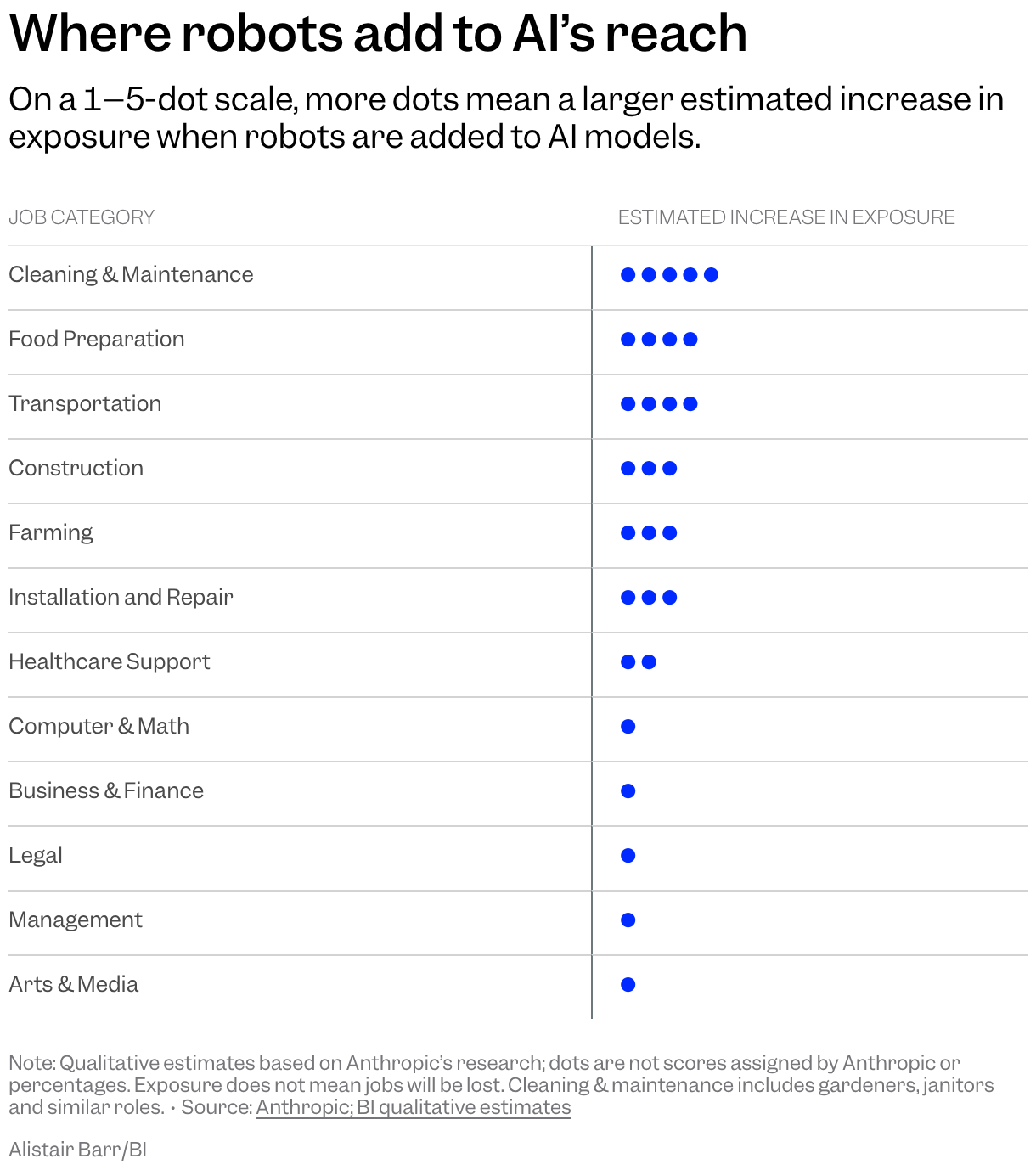
The chart below illustrates how adding robots could change job-task exposure across selected job categories. Cleaning & maintenance includes gardeners along with janitors and similar roles.

Qualitative estimates of added job-task exposure when robots are combined with AI models. Cleaning and maintenance: 5 dots. Food preparation and transportation: 4 each. Construction, farming, installation and repair: 3 each. Healthcare support: 2. Computer and math, business and finance, legal, management, arts and media: 1 each. More dots indicate a larger estimated increase. These are editorial estimates, not Anthropic-issued scores, percentages or job-loss forecasts.
Read the original article on Business Insider
  •  

My husband and I have different definitions of 'financially responsible.' Building a house is forcing us to compromise.

The writer and her husband smile for the camera while standing in front of rural land they own in Maine.
My husband and I bought land, and are starting the process of building a house.

Lisa Leslie

  • When it comes to money, I'm a big budgeter, and my husband prefers taking risks.
  • Now that we're building a house together, our differences are causing some disagreements.
  • We've learned to stay flexible and balance each other's approaches.

My husband and I have very different ideas about financial responsibility.

When we're feeling stressed about money, my instinct is to run the numbers and account for every financial what-if. He's a big-picture dreamer who sees what something could become and is more willing to say, "We'll figure it out."

His attitude has paid off before. He had the vision for our first home, which we bought for under $100,000 and recently sold for a decent profit after 13 years of renovations.

I know some of the best things we've done together wouldn't have happened without my husband's willingness to take a chance, but our differences have still caused some friction over the years.

Now that we're building a new home together, we're trying to balance my need to plan for the unknown with his belief that we'll find a way forward.

After 13 years, we took a risk and sold our home

Concrete boat ramp leads into a calm forest-lined inlet beneath a cloudy sky.
We sold our home and bought land in a part of Maine we love.

Lisa Leslie

For 13 years, we'd lived in the same place. My husband had moved frequently as a child, and he wanted his two daughters to have a consistent place to call home.

Leaving this house behind was bittersweet, but my oldest stepdaughter had just bought her own house, and my younger one was heading off to college. We were ready for what came next.

We could have bought an existing house needing renovations. Instead, we found land in southern Maine that felt worth taking a risk on.

We've always loved the area. My family has an annual reunion there, where we spend a week at the beach. Our new property will hopefully give us that lifestyle without the summer crowds: It's more than 2 ½ acres with hiking trails next door, a nearby kayak and paddleboard launch, and the ocean just a short drive away.

We decided to go for it, and by the end of August, our old house was nearly empty. My younger stepdaughter left for college on a Wednesday, we moved the rest of our things to a rental on a Thursday, and officially sold the house that Friday.

Every estimate comes with an 'unless'

A gravel path leads into a dense wooded forest with tall trees and early autumn leaves.
If excavators hit ledge, our costs could go up.

Lisa Leslie

In September, we began building our 1,500-square-foot house.

We're now paying $3,000 a month for a rental home — with a construction loan on top of that — and keeping track of a lot of numbers, from lumber and labor to excavation, plumbing, electrical, permits, and finishes.

My husband is doing most of the construction himself, which is what makes this project possible. If we had to pay for all of the labor, we probably couldn't afford to build right now.

However, that's not to say this hasn't been a very stressful time. We think we've accounted for everything, but every estimate has an asterisk: Unless lumber prices go up. Unless a contractor's price changes.

Unless we hit ledge — that is, solid bedrock beneath the soil that can be expensive to excavate. We might have to rethink the foundation or adjust the entire plan once we see what's underground.

I find that uncomfortable, but my husband doesn't.

We're leaving room to adjust

The writer and her husband posing in front of trees on their land in Maine.
We've made some compromises, and we'll likely have to make more.

Lisa Leslie

My husband can picture what this property could become over time, and has big dreams for it.

He wanted a garage, a small cottage where our family could stay when they visit, a little more space, and nicer finishes in some areas. I kept bringing us back to what we could afford right now, and how much we wanted to keep in savings rather than put everything into the house.

After a lot of discussion, we decided to start small. We're building for the life we have today, while — at his request — leaving room for the one we might want tomorrow. The garage and cottage can wait. For now, we're focusing on getting the house right without stretching our budget too far.

That means staying flexible. For instance, my husband wants a finished basement, and I agreed, knowing this would give us the option to add a third bedroom down the road.

Though the cost difference between a basement and an unfinished crawl space isn't huge upfront, hitting ledge could put us thousands — or even tens of thousands — over budget.

We're willing to give the basement a shot, but if excavation costs start climbing, we may have to scale back to a crawl space and save the extra bedroom for another day.

We have a plan, but we know it might change once we get further into the build. I'll keep making the spreadsheets and asking for the numbers. He'll keep looking at the big picture and reminding me why we decided to do this.

This project, and my husband, have taught me that financial responsibility isn't necessarily about eliminating every risk, but knowing which risks are worth taking and staying open to changing course.

Read the original article on Business Insider
  •  

The 20 global cities with the best quality of life

Colorful Bryggen waterfront buildings and moored boats line a harbor beneath forested mountains in Bergen, Norway.
European cities rank highly in quality-of-life rankings.

MEDITERRANEAN/Getty Images

  • Oxford Economics' 2026 Global Cities Index ranked cities around the world on their quality of life.
  • US cities ranked highly for economics, but fell short in the quality of life category.
  • European cities dominated the quality of life list, while only one US city made the top 20.

Cities in the US rank high globally in terms of economics, but they have some ground to cover in quality of life, according to a new report.

For its 2026 Global Cities Index, economic advisory firm Oxford Economics ranked 1,000 cities across the globe based on five categories: economics, human capital, environment, and quality of life.

Every category is viewed from an economic lens, even quality of life, where indicators include income equality and housing expenditure, among others.

"The Global Cities Index records the progress cities are making across a comprehensive range of metrics," Mark Britton, managing director of city services at Oxford Economics, said in the report. "Sitting alongside our forecasts and scenario models, its ability to highlight how paths change under different conditions and its capacity for comparability shows you not just where cities stand today, but also where they are heading."

The overall list features several US cities in the top 20 — eight, to be exact, with New York taking the No. 1 spot. However, when highlighting quality of life specifically, only one US city made the cut.

Quality of life, which accounts for 25% of a city's overall score, wasn't a bright spot for the US, but plenty of other cities excelled in that category. See which cities ranked highest in quality of life, according to Oxford Economics.

20. Venice, Italy
Gondolas travel along Venice's Grand Canal between colorful historic buildings under a bright blue sky.
Venice, Italy.

adisa/Getty Images

Overall score: 51.2

Quality of life score: 86.3

19. Stuttgart, Germany
Sunset city skyline with modern high-rise buildings, wooded hills, and a landscaped park in the foreground.
Stuttgart, Germany.

Cyril Gosselin/Getty Images

Overall score: 70.7

Quality of life score: 86.5

18. Prague
Charles Bridge spans the Vltava River with Prague’s historic Old Town skyline under a clear blue sky.
Prague.

rusm/Getty Images

Overall score: 78.1

Quality of life score: 86.9

17. Sydney
Sydney Harbour at sunset with the Opera House, Harbour Bridge, and illuminated downtown skyline.
Sydney.

zetter/Getty Images

Overall score: 88.3

Quality of life score: 87.2

16. Munich
Aerial view of Munich’s old town with the Altes Rathaus tower and red-tiled rooftops under a cloudy sky.
Munich.

Nikada/Getty Images

Overall score: 85

Quality of life score: 87.3

15. Berlin
Berlin Cathedral and the Berlin TV Tower rise behind a bridge over the River Spree at dusk.
Berlin.

Nikada/Getty Images

Overall score: 84.6

Quality of life score: 87.7

14. Zurich
Aerial view of Zürich old town with the Limmat River, bridges, church towers, and boat docks.
Zurich.

pawel.gaul/Getty Images

Overall score: 89.1

Quality of life score: 87.7

13. San Jose, United States
Downtown San Jose city skyline.
San Jose.

f11photo/Getty Images

Overall score: 89.6

Quality of life score: 87.9

12. Linz, Austria
Aerial sunset view of Linz city center with the New Cathedral rising above surrounding streets and buildings.
Linz, Austria.

Mariendom

Overall score: 70.6

Quality of life score: 88

11. Basel, Switzerland
Aerial view of Basel Minster beside the Rhine River at sunset, with city rooftops and towers in the background.
Basel, Switzerland.

@ Didier Marti/Getty Images

Overall score: 79.6

Quality of life score: 88

10. Paris
Eiffel Tower rises between Paris apartment buildings under a colorful sunset sky.
Paris.

Fani Kurti/Getty Images

Overall score: 93.4

Quality of life score: 88.1

9. Ghent, Belgium
Historic riverside buildings line a canal with boats under a bright blue sky in Ghent, Belgium.
Ghent, Belgium.

MEDITERRANEAN/Getty Images

Overall score: 74.9

Quality of life score: 88.4

8. Dresden, Germany
River cruise boats sit on the Elbe beside Dresden’s historic waterfront and domed skyline at sunset.
Dresden, Germany.

Achim Thomae/Getty Images

Overall score: 59.4

Quality of life score: 88.5

7. Luxembourg
Luxembourg City old town overlooks a church, canal, stone ramparts, and autumn trees under a clear blue sky.
Luxembourg.

rusm/Getty Images

Overall score: 82.5

Quality of life score: 89

6. Oslo, Norway
Modern waterfront skyline glows at sunset, with city lights reflecting across calm harbor water.
Oslo, Norway.

MEDITERRANEAN/Getty Images

Overall score: 89.1

Quality of life score: 89.3

5. Bern, Switzerland
Bern old town rooftops, church spires, stone bridge, and hillside are lit by warm evening sunlight.
Bern, Switzerland.

joe daniel price/Getty Images

Overall score: 78.2

Quality of life score: 89.8

4. Grenoble, France
Riverside buildings and an arched stone bridge reflect in calm water beneath a snow-capped mountain.
Grenoble, France.

RossHelen/Getty Images

Overall score: 67.7

Quality of life score: 90.8

3. Singapore
Aerial view of Singapore’s downtown skyline with skyscrapers, roads, and waterfront buildings around a bay at dusk.
Singapore.

primeimages/Getty Images

Overall score: 82.1

Quality of life score: 91.6

2. Bergen, Norway
Twilight aerial view of Bergen harbor with illuminated waterfront buildings, boats, roads, and mountains surrounding the bay.
Bergen, Norway.

Thomas Roell/Getty Images

Overall score: 80

Quality of life score: 94.3

1. Canberra, Australia
Autumn-colored trees line a lakeside promenade with Black Mountain Tower visible across the water.
Canberra, Australia.

HADI ZAHER/Getty Images

Overall score: 79.4

Quality of life score: 100

Read the original article on Business Insider

  •  

How a cruise ship navigates Greenland's icebergs and extreme Arctic conditions

We went aboard a cruise ship navigating some of the world's most dangerous waters. In the Arctic, drifting icebergs, sea ice, sudden storms and fierce winds make sailing unpredictable. Yet every year, around 100,000 cruise passengers travel to Greenland to explore its remote coastline and experience one of the world's last great wildernesses.

Read the original article on Business Insider

  •  

6 easy and delicious Ina Garten dishes you need to make this fall

Ina Garten
Ina Garten's recipes will keep you cozy this fall.

Scott Kowalchyk/CBS via Getty Images

  • I've made dozens of Ina Garten's recipes, and some of her dishes are perfect for fall.
  • Garten's chicken chili is quicker and lighter than your traditional chili recipe.
  • And her weeknight Bolognese and rigatoni with sausage will keep you cozy as temperatures dip.

This year's descent into fall has been more of a crawl, but I think we're all ready for some cozy weather.

And what better accompaniment to a classic rom-com and your favorite sweater than a dish by Ina Garten?

The "Barefoot Contessa" star has built a whole career on recipes that are easy and comforting. I've made dozens of Garten's dishes, so I decided to look back and find a few that I think are perfect for this busy season.

From a Bolognese that's ready in 30 minutes to a cake packed with the flavors of autumn, these are Garten's best fall dishes.

Ina Garten's breakfast sandwiches will energize you for chaotic fall mornings.
Ina Garten breakfast sandwich

Anneta Konstantinides/Business Insider

The start of fall is so hectic. Work ramps back up, school is back in session, and the prep and stress of the holidays begin to creep in.

Travel-friendly and loaded with protein, a breakfast sandwich is just what you need. And Garten's version only requires five ingredients: English muffins, whole milk, avocado, bacon, cheddar cheese, and eggs that you can cook in the microwave.

The microwave eggs are surprisingly creamy, and the sandwich is deliciously filling.
Ina Garten microwave eggs for breakfast sandwich

Anneta Konstantinides/Business Insider

Everything in Garten's breakfast sandwich works so well together. She recommends using thick-cut applewood-smoked bacon, which provides a crispy contrast to the soft eggs. Spreading the avocado on the bottom adds both flavor and nutrients, and I love the tanginess of the sharp white cheddar.

If you're making this sandwich for more than two people, I recommend cooking the eggs on the stove rather than in the microwave to save time. But this is a great recipe to teach your kids so they can make breakfast on their own. And if you're a college student, you could easily whip this up in a dorm.

Get the full recipe for Ina Garten's bacon, egg, and cheddar sandwich here.

Making a huge batch of Garten's homemade chicken stock has been my fall tradition for years.
Ina Garten homemade chicken stock

Anneta Konstantinides/Business Insider

I began testing Garten's soup recipes in 2023 and knew something was missing after I kept using boxed stock. "Store-bought is fine!" might be Garten's most famous catchphrase, but she believes homemade chicken stock is akin to "liquid gold."

"Nothing available on the market has the depth of flavor or richness of stock you've made yourself," she wrote in "Go-To Dinners," her October 2022 cookbook. "It contributes such great body and aroma to so many dishes. Plus, having a big pot of chicken stock simmering away on my stove just makes me feel good."

Garten's stock is packed with flavor because it involves simmering three roasting chickens for hours alongside carrots, onions, celery, parsnips, garlic, and plenty of herbs.

There's no flavor left in the chicken once the stock is ready. If you'd rather save the meat for meals, you can always take the chicken out once it's cooked through and continue to simmer the aromatics. I also recommend freezing chicken bones so you always have some on hand for more stock.

The recipe makes enough stock to last through the winter, and it provides the base for so many delicious soups.
Soup with Ina Garten's homemade chicken stock

Anneta Konstantinides/Business Insider

Garten's recipe provides nearly nine quarts of stock, and you can store it in the freezer for up to six months.

My absolute favorite Barefoot Contessa soup to make with the stock is Garten's chicken pot pie soup, which I whip up anytime my fiancé and I are craving a bowl of comfort. Her ravioli en brodo is a delicious twist on chicken noodle, while her Italian wedding soup is light and bright.

If you want to switch things up from soup, you can also use the stock to make Garten's one-pot chicken and orzo — another delicious meal for chilly nights.

Get the full recipe for Ina Garten's homemade chicken stock here.

Garten's chicken chili is a lighter twist on the traditionally hearty dish.
Ina Garten chicken chili

Anneta Konstantinides/Business Insider

Garten served traditional chili for two decades at the specialty food store she ran in the Hamptons before becoming a cookbook author and Food Network star.

When Garten decided to switch up the chili and use chicken instead of beef, it became even more popular than the original recipe.

The dish also features red and yellow bell peppers, fresh basil, and a variety of seasonings, including chili powder, ground cumin, and red pepper flakes.

Garten serves the chili topped with green onions, cheddar cheese, corn chips, and sour cream.

When I first made Garten's chicken chili for some friends, they said it made them feel "so warm and cozy."
Ina Garten chicken chili

Anneta Konstantinides/Business Insider

The tomatoes and spices build a rich broth, and each bite of chicken is so tender and juicy.

It's also a great dish for hosting because you can lay out the toppings in individual dishes, allowing everyone to personalize their bowl to their own preference.

Plus, who doesn't love a bowl of chili on football Sunday?

Get the full recipe for Ina Garten's chicken chili here.

Garten's weeknight Bolognese is ready in 30 minutes.
Ina Garten weeknight bolognese

Anneta Konstantinides/Business Insider

My pasta cravings always hit when temperatures start to dip. And during this busy season, Garten's weeknight Bolognese is a perfect fit.

The recipe includes ground sirloin, crushed tomatoes, heavy cream, Parmesan cheese, and fresh basil, but it's designed to be adaptable and pantry-friendly.

Garten says you could easily swap the sirloin for any ground meat and skip the cream and basil if you need. And while she recommends using orecchiette, any dried pasta will work with this recipe.

My family couldn't get enough of Garten's speedy Bolognese.
Ina Garten weeknight bolognese

Anneta Konstantinides/Business Insider

It's pretty incredible how much flavor Garten manages to create in a dish that traditionally simmers for hours on end. The rich sauce bursts through every bite of the small pasta shells, which I personally loved for this dish, and the freshly grated Parmesan cheese on top makes it feel extra comforting and indulgent.

"It's a very meaty, very hearty pasta," my dad said before declaring that the dish was "perfect."

We loved the dish so much that it earned the second spot in my ongoing ranking of Barefoot Contessa pasta dishes.

Get the full recipe for Ina Garten's weeknight Bolognese here.

If you're searching for a cheesy pasta with little clean-up, Garten's one-pot dish is the perfect fit.
ina garten rigatoni pasta

Anneta Konstantinides/Business Insider

The rigatoni pasta is paired with sausage and fennel, plus some onion, garlic, heavy cream, freshly grated Parmesan cheese, and a few additional ingredients.

It all comes together in a big pot or Dutch oven, and you'll have dinner on the table in an hour.

Garten says this pasta is one of her "all-time go-to dinners."
Making Ina Garten rigatoni pasta

Anneta Konstantinides/Business Insider

"You can make the whole thing in one big pot, bring it to the table, and everyone loves it," Garten told her viewers in a 2017 episode of "Barefoot Contessa."

With its beautiful golden hue and rich, meaty sauce, Garten's one-pot pasta is the kind of dish that lifts your spirits. There's also lovely depth to the flavor, thanks to the sweet sausage, salty Parm, and the bite from the fennel.

Get the full recipe for Ina Garten's rigatoni with sausage and fennel here.

As with her chicken chili, Garten developed the recipe for her apple spice cake at the Barefoot Contessa store.
Ina Garten apple spice cake

Anneta Konstantinides/Business Insider

"We used to have all kinds of cakes like this out on the bakery counter, and you could come buy a whole cake, but you could also buy a piece," Garten said in an early episode of her Food Network show. "It's not fancy, just really delicious and earthy, and you always want to come back for more."

The recipe includes Granny Smith apples, rum, raisins, pecans, and plenty of sugar and spice.

The cake is packed with autumn flavors.
Ina Garten's Apple Spice Cake

Anneta Konstantinides/Business Insider

Soaking the golden raisins in rum gave them a flavor that almost reminded me of caramel, and their sweetness helped temper the Granny Smith apples' sourness. All the spices infused the moist cake with a warm nuttiness, while the pecans added some delicious crunch.

I followed Garten's advice and tried the cake with some ice cream and caramel, which were delicious additions. But the cake isn't super sweet, so you could also enjoy it on its own with some tea or coffee for breakfast.

Now it's really starting to feel like fall.

Get the full recipe for Ina Garten's apple spice cake here.

Is there a dish you love making in the fall season? Share it with us in the comments. And check out more easy recipes here.

Read the original article on Business Insider

  •  

My partner and I don't share a bank account, and we still won't after our wedding

the author and her fiancee
The couple has been together for four years without merging bank accounts.

Courtesy of Catherine Work

  • My fiancé and I have been together for four years and have never had a joint bank account.
  • We're transparent about our incomes, savings, and spending, and we've never had a fight about money.
  • We plan to pay for our wedding together, but we won't combine our finances after we get married.

My parents have a shared bank account and kept all their large purchases in both their names, so I thought sharing an account would be my financial destiny, too, if I ever got married. I didn't question it until recently. Now, my partner and I are getting married in just a few months, and we don't plan to combine our finances.

After four years together, we've never had any accounts or cards in both of our names. The closest we ever got to that was me using his credit card on a payment app when we were in Vietnam because mine didn't work. We both contribute to rent and household expenses. We pay back the other person our half of large purchases like flights and hotels, but we don't keep a tab of who owes who what (a nice change from my previous romantic relationships).

We've always been open about money

We were upfront about our income, debt (or lack thereof), and our mutual desire to live below our means from day one. After about three years of dating, we told each other how much we have in savings. We continue to be transparent about money and agree on the vast majority of each other's purchases — it helps that we're both very frugal.

We've built up trust over the years, and we'll continue to offer up personal financial information when we want to, knowing we have privacy. Neither of us has the login information for the other's bank, but we know we can always ask how much the other is earning or spending.

I thought the next step was a shared bank account with two credit cards — I assumed that's what love and commitment meant in an economic way. We kept asking ourselves how having both our names on one account would improve our lives, and we kept coming up blank. I also didn't want to waste time filling out paperwork or calling my bank for something I wasn't even interested in.

the author and her partner eating ice cream pops
Keeping finances separate works for them.

Courtesy of Catherine Work

Our system works for us

We've lived together for almost four years and never had a fight about money. I have some financial anxiety, and I think having a shared account might actually make that worse. Since my fiancée makes more and pays for more, I regularly check in to see if he's still OK with that.

We approached our wedding, our first big purchase together, the same way we plan travel — with Excel, conversations, and making sure we stay under budget to cover unexpected costs. My fiancée bought our rings, and I bought our flights (we're getting married in Denmark). We both agreed to contribute the same amount of money to the wedding. Every payment we make for the big day goes into a spreadsheet, and at the end of all our purchases, if one of us has spent significantly more, the other will make the next large purchase.

Keeping our financial stressors low is also made easier by the fact that we won't plan to have kids or pets, or make any large purchases like a house or a car. Taking care of our parents is the only thing that might one day impact how we view our financial setup.

Another thing we agreed on from the start was that we wanted a pre-nup. Not sharing a bank account and having a pre-nup might not sound romantic (or like we can't share) to some, but if anyone were to look at our purchases, they'd immediately see we do spend our money on each other—just with separate accounts intact.

We haven't fought about money, and I'd like to keep it that way

I know I'm going into a marriage with dignity and respect. My future husband won't get a notification if I spend over $100, he won't be able to review a bank statement at the end of the month to see how many ice creams I've treated myself to, and we won't know how much the other person spent on a Christmas present. We'll never have to ask the other person if we can spend money or fear that our separate emergency funds will be depleted by the other.

My parents shared a bank account, and they often fought over money — one thing I promised myself I'd never do with my future spouse. Keeping our finances separate has worked so far, and I believe it'll continue to after we're married. We're both open to changing our minds one day, but until we have a good reason, we're very happy having separate accounts, together.

Read the original article on Business Insider
  •  

I'm a career coach for Gen Z workers. Here are some unspoken workplace rules every new hire should know.

Smiling person in a black blazer stands beside a stone walkway overlooking a calm canal.
Laura Massetti, a career coach for young workers, said that Gen Z workers struggle with unwritten rules and need professional training.

Courtesy of Laura Massetti

  • Laura Massetti spent 15 years leading teams and saw Gen Z workers struggle with unwritten rules.
  • Massetti said Gen Z workers need training on communication, judgment, and follow-through.
  • As AI levels technical skills, Massetti said human skills can help early-career workers stand out.

This as-told-to essay is based on a conversation with Laura Massetti, founder of Real Work Ready, which helps early-career professionals develop workplace skills. Massetti has more than a decade of experience in the corporate world, leading sales and marketing teams. The essay has been edited for length and clarity.

I spent 15 years in the corporate world, leading sales and marketing teams. I loved mentoring early professionals, but I often found myself thinking: My goodness, I wish I could make this process go quicker.

I never only look at whether someone could do the work. It is more about whether they could communicate clearly, exercise good judgment, and follow through.

As a career coach for young workers, I know there are things that you, as an employee, get judged on that no one actually puts inside the rubric. We expect people to figure them out over time, but in reality, someone has to teach them.

Gen Z needs feedback in a workplace that expects people to figure things out

I don’t think that Gen Z is unready for work. I think no one has taught them what to do.

This generation grew up with a cellphone in their hands. They’d post something on Instagram and get 10 likes. They’re used to instant feedback: Tell me what I need to grow.

That’s not how the workplace is built. We have annual reviews. You learn through experience; you learn the hard way.

Young workers are digitally fluent, which makes this generation incredible for so many reasons. But growing up digitally, compounded by the pandemic, left gaps in opportunities to practice face-to-face interaction.

Now they’re entering workplaces with other generations, and those generations set the rules.

Meanwhile, AI is taking on tasks that used to help people develop. We learned shoulder to shoulder with someone. How are new hires supposed to learn if we’re outsourcing those opportunities?

You’re being judged on things no one puts in the rubric

There are areas you’re being judged on that no one actually puts inside the rubric, including communication and clarity, prioritization and judgment, your ability to follow through, professional presence and credibility, ownership and reliability, and organizational awareness.

It’s not just about how you communicate. When you enter the workplace, do you know how to get stuff done? How aware are you of the organization you operate in?

You need to understand when to use email, when to use Slack, and when to stop by someone’s office. You can’t walk in and assume you know the rules.

In one new-hire program at a company with about 100,000 employees, a manager told me that someone had pinged the CEO on Slack to request a skip-level meeting. Mind you, that would’ve been probably 10 skip levels.

Poor thing, he had no idea. No one had told him that wasn’t how you reached out to the CEO in that organization.

I’ve also seen people show up to meetings unprepared, without what they needed or knowing how to follow up.

Dressing appropriately is something I had to learn on my own. About six months into my job, I wore a full black business suit to a meeting in Miami. It absolutely did not match the environment. I was way too formal.

Match the client’s environment and match how they dress. The other day, I saw someone meeting their manager in a suit jacket over a basketball jersey and shorts, but wearing loafers. Your job is to show your manager that they can trust you to be professionally present and to deliver.

Managers have a responsibility here, too. When we say, “They’ve been here for two years, and they’re just not getting it,” we need to ask ourselves: What aren’t they getting? What am I judging them on that I haven’t clearly explained?

Practice the human skills that will set you apart

My company now offers a six-month program that combines online training with weekly role-playing of workplace scenarios.

We practice things like how to react when you receive feedback. The goal is to give people experiences they might otherwise wait years to encounter.

My advice to every fresh graduate and those entering the workforce is that, at a time when AI is making skill sets equalizers, you will need to define how you’ll be different.

Technical skills are still incredibly important. But how do you communicate, exercise judgment, execute an idea, and get people’s buy-in?

I’ve never made a hiring decision based on technical capability alone. It’s mostly about whether I can trust that person.

Knowing the ins and outs of coding is one thing. Being able to speak to a boardroom and convince people of an idea is another ability you can bring to an employer.

Those are the skills I believe will make all the difference.

Read the original article on Business Insider

  •  

I downsized from a 3-bedroom to a 2-bedroom when I got married. There's one thing I miss.

the author and her son and husband standing in front of a fountain
The author and her son moved into her husband's 2-bedroom townhome.

Courtesy of Ashley Archambault

  • When my husband and I got married, we had to decide where to live.
  • My son and I ended up moving into his 2-bedroom home.
  • There are a few pros, but we didn't consider how much we'd miss having a guest room.

When my husband and I got married, we each had our own homes. I had a one-story, 3-bedroom home, while my husband had a 2-story, two-bedroom townhome. At first, we compared the pros and cons of each house. For instance, my house had a large yard, which can be a perk size-wise, but lawn maintenance was a chore.

While my husband was willing to move, we ultimately chose his house, mainly because it was so close to his job. I knew from experience what a blessing an easy commute is, and I didn't want him to have to give it up, so we decided to consolidate. My son and I moved from our 3-bedroom home to my husband's 2-bedroom townhouse.

I was giddy when we got married, and thinking more about moving in together and planning our wedding than the long-term realities of living in a smaller home.

The lack of an extra bedroom was an issue we didn't foresee

My son and I still occasionally miss our old home, but I don't regret selling my home and moving in with my husband. The worst part of downsizing has been no longer having a guest room.

I mainly used the third room in my house as an office, but the bedrooms at my husband's house were large enough that there would be room for an office in ours. And my son would still have his own bedroom, so we didn't realize how much we'd miss the extra bedroom until it was too late.

It's nearly impossible for us to have anyone spend the night or a weekend with us

I'd mostly thought of the extra room as my office, and didn't consider that we also used it as a guest room. Now, without it, it's difficult to have anyone over for the night. We have a few options, but none of them are appealing to anyone, including our potential guests.

When I had my own home, it was so easy to have friends visit for the weekend, because I could offer them a room. Having space for guests is a privilege I didn't realize I'd miss. I can still offer the chance to stay, but when someone takes us up on it, my husband and I feel kind of awful the whole time.

We've had guests overnight and offered them the couch pullout or the air mattress. But despite our best efforts, everyone feels a little awkward because our guests have no privacy without an actual room of their own.

Sometimes, we've thought of offering our bedrooms — or at least one of them — while my son would get displaced to the living room on an air mattress. He honestly loves doing that anyway, because he thinks it's like a sleepover, but the problem comes in the morning.

Our downstairs space is pretty much just the living room and kitchen, so when someone comes downstairs in the morning, whoever's sleeping on the giant air mattress — whether our guests or my son — will inevitably be woken up.

In our next home, having an extra bedroom will be a requirement

My husband and I both miss having guests, as he could also have more guests over before my son and I moved in. We don't like that we don't feel we can offer loved ones a place to stay, or that when we do, the best we can offer them is an air mattress or my 12-year-old's bedroom.

In addition to wanting to have more company over, my husband and I have aging parents. We don't want to find ourselves in a situation where one of them needs living assistance, and we don't have the space.

There are a few things we want in a forever home, like a more spacious kitchen, of course, and a giant garden in the back, but having a guest room again is at the top of our list.

Read the original article on Business Insider
  •  

I was diagnosed with breast cancer a year ago. Please stop calling me a fighter.

Family posing for photo
The author, shown with her family, was diagnosed with breast cancer in October of 2025.

Courtesy of the author

  • A year after my breast cancer diagnosis, I'm rejecting the "fighter" and "warrior" labels others put on me.
  • I'm tired of the pinkwashing that feels like it's turning a terrifying disease into a cheerful marketing campaign.
  • I'm grateful for my care and the people who supported me, but I don't need to find a silver lining or turn my experience into an inspirational story.

I was diagnosed with breast cancer a year ago, and with Breast Cancer Awareness Month underway, I have a confession that feels almost sacrilegious: I hate breast cancer culture. I hate the "fighter" and "warrior" labels I didn't ask for, and I especially hate the over-the-top pink branding that I see so much.

I didn't ask to join this club. I didn't want to lose my hair to chemo or have my breasts amputated. I didn't choose to worry about whether my kids and relatives might also develop this horrible disease. And I hate pink; I always have. I'm grateful for my treatment and that I've weathered it all relatively well. I just feel pissed that this was my lot in life.

As I reach the anniversary of the day my "before" split into the "after," I don't know what I'm supposed to call myself now. "Fighter" doesn't feel right. "Warrior" definitely doesn't, and "survivor" is complicated.

Person wearing a face mask sits in a medical infusion chair with blanket, IV equipment, and monitors nearby.
The author said she doesn't like the "warrior" or "fighter" labels often given to those being treated for breast cancer.

Courtesy of Kate Loweth.

I didn't choose to fight cancer

I understand that people mean well when they call someone a fighter. They want to acknowledge what she's enduring and remind her she's strong. Pink ribbons and awareness campaigns can raise money and encourage screenings, and those are all wonderful things. But in the rush to turn cancer into a story about courage and hope, there's little room for the less inspirational feelings: anger, resentment, exhaustion, and fear.

I didn't fight cancer in the way people seem to imagine. I showed up for appointments, followed my doctors' recommendations, and endured treatment because I wanted to live. I didn't have some extraordinary reserve of bravery. I didn't get to opt out. What was the alternative?

Two masked people sit in a clinical treatment room with infusion chairs and medical equipment in the background.
The author, shown with her daughter while getting treatment, said she would happily trade every bit of perspective she has gained for the life she had before her diagnosis.

Courtesy of Kate Loweth.

I didn't earn a special title by going through chemotherapy. I was a person with a disease who wanted to get better. Sometimes I was scared. Many days, I was exhausted. Sometimes I was just trying to get through the day.

I'm over the pinkwashing of breast cancer

And the pink. Everywhere, pink. Pink products, pink merchandise, pink marketing campaigns. Sometimes the branding feels like a cheerful coat of paint over a genuinely terrifying experience.

Cancer isn't cute. Losing your breasts isn't a lifestyle rebrand or a "free boob-job." Buying a pink water bottle doesn't necessarily make anyone feel less alone in a hospital room.

I don't begrudge anyone who finds comfort in a pink ribbon or a community of fellow patients. My problem is with the expectation that breast cancer should come packaged with a neat, uplifting message. What if I don't want to embrace this experience? What if I don't feel grateful for the lessons it taught me?

I'd happily trade every bit of perspective I've gained for the life I had before my diagnosis.

Finishing treatment doesn't mean everything's over

There's no clear finish line. Treatment ends, and everyone wants to celebrate that you've made it through. You want to celebrate, too. But you're also left processing what happened to your body, what you've lost, and what the future might hold.

As much as I try to go back to my "before" life, I'm constantly holding my breath, waiting for the other shoe to potentially drop.

Before cancer, I didn't spend much time thinking about my identity. I was busy being a mom, wife, sister, daughter, and working woman. Now, I'm still figuring out how much space cancer deserves in my life. I don't want every conversation to be about my health. I don't want people to expect me to inspire them simply because something terrible happened to me.

I'm grateful to be here, but I'm still angry

I'm grateful for my doctors, the people who showed up for me, and the advances in medicine that gave me treatment options. I'm grateful that I've come through this in relatively good shape. But I can appreciate the care I've received and still be furious that I needed it.

As I reach this anniversary, I don't need a label to make my experience meaningful. I don't need to turn cancer into a lesson or find a silver lining in every awful moment. I don't need to be inspirational.

If you want to support someone with breast cancer, you don't have to call her a fighter. Acknowledge that what she's going through is hard. Offer an ear or, better yet, a DoorDash gift card. Let her feel however she feels.

As for me, I'll mark this anniversary with gratitude, anger, uncertainty, and the knowledge that I'm still here. That's enough.

Read the original article on Business Insider

  •  

The US Army is growing its space forces. They're already in combat.

Soldiers with the Army's 1st Space Brigade unload equipment from a helicopter during training on Fort Carson, Colo. on Jan. 31, 2025.

Brooke Nevins/US Army

  • The US Army is expanding its ranks of soldiers specialized in space warfare.
  • Army space personnel are already deployed to the Middle East, where the US has been fighting Iran.
  • More than 600 enlisted soldiers joined the new specialty this year, with more growth planned.

The US Army is expanding its ranks of soldiers trained for space warfare, a growing military specialty that is already supporting American combat operations in the Middle East.

The service established a new enlisted space operations branch in June, creating a dedicated career field for soldiers whose work involves satellites, communications, and the ability to disrupt an adversary's use of space.

While the Space Force and its Guardians oversee a broad range of military space operations in support of the entire US military, the Army has its own dedicated specialists focused on supporting its ground forces with satellite communications, navigation, and other capabilities.

Some space soldiers are already deployed in the Middle East, where American forces have been fighting Iran.

Lt. Gen. John Rafferty, the commander of US Army Space and Missile Defense Command, said at the Association of the United States Army conference in Washington, DC, this week that roughly 2,500 soldiers from his command are deployed to US Central Command's area of operations. That figure includes both air-defense formations and space specialists.

"Space is really embedded in every single echelon there," Rafferty said, speaking of the job's growing prevalence throughout all levels of military decision-making.

Those space soldiers' responsibilities can range from helping ground forces access satellite communications and navigation systems to disrupting adversary space capabilities, known as "space interdiction." Officials did not provide specific examples or further details on the work being done.

For soldiers on the battlefield, such help is essential for communicating with nearby units and gathering intelligence on enemy movements.

The growing importance of space as a domain of warfare, alongside land, sea, air, and cyberspace, prompted the Army to expand its specialized workforce.

Command Sgt. Maj. Rickey Jackson said at AUSA that the service reviewed several thousand personnel files for its new enlisted space operations branch. The 600 soldiers ultimately selected for the new job came mostly from intelligence, communications, and air-defense specialties, though the career field is open to troops from other backgrounds.

The service plans to continue growing its formalized space community, with around 1,700 space soldiers by the end of next fiscal year.

"When we talk about the branch and the targets, having a couple thousand dedicated folks within the branch between the enlisted and the officer side is a significant contribution across the service," Col. Joseph Mroszczyk, who oversees the integration of emerging space capabilities into Army operations, said during the event.

Read the original article on Business Insider

  •  

I'm a real estate agent building a $480,000 backyard home for my mom. I still made these costly mistakes.

A woman stands next to a tiny home that has yet to have its walls plastered.
Shalini Karnani Bonjour in her California backyard.

Courtesy of Shalini Karnani Bonjour

  • Shalini Bonjour is building a 1,100-square-foot ADU in her backyard so her mother can age in place.
  • The project is taking longer than she expected and is going over budget.
  • Bonjour shared the five biggest lessons she's learned during the process with Business Insider.

After her father died in 2024, real estate agent Shalini Karnani Bonjour moved her mother from Michigan to California to be closer to her and her family.

"My husband and I didn't feel comfortable having her so far away, especially when it came to her day-to-day needs," Bonjour, 50, told Business Insider.

Later that year, the family bought a home with a backyard large enough to build an accessory dwelling unit for her mother. In 2025, they broke ground on a 1,100-square-foot ADU. But what was expected to be a six-week project has dragged on for months and cost the family thousands more than expected.

"The whole process has been difficult because there are so many things to manage," Bonjour said. "You're trying to keep the project affordable, keep your neighbors happy, and stay on track. I can only imagine how overwhelming this would feel for someone without any insight into the process, because it is a huge undertaking."

Here are five hard lessons Bonjour has learned from the project, from choosing the right contractor to budgeting enough money for unexpected challenges.

A bad contractor can make or break a project
The frame of an ADU in a backyard, homes sit in the background.
The ADU during the early stages of its construction.

Courtesy of Shalini Karnani Bonjour

At first, Bonjour thought she had found the right architect for the project. They designed the ADU and even promised to guide her through the permitting and construction process. But they didn't follow through.

Bonjour said hiring the wrong person was one of the "biggest mistakes" she's made during the project.

Although she found someone to take over the project after interviewing about 10 builders, mistakes made by the original architect have made construction more difficult.

"Watching my builder try to translate that original designer's plans is like trying to fit a square peg into a round hole," she said. "It's basically like he was working off somebody else's recipe."

Understanding local permitting and construction rules is essential
A man's hand screws in the corner of a solar panel.
Solar panels being installed on a rooftop.

Hispanolistic/Getty Images

Every city has its own rules for building ADUs, and some are more complicated than others.

In her part of the Coachella Valley, Bonjour had to secure permits for the roof, electrical work, plumbing, HVAC, and solar panel installation.

"The city was pretty tough on solar," Bonjour said. "The first two electrical inspections were fine, and then on the third inspection, they determined we needed solar panels. Getting solar here in the desert is its own job. Researching the proper solar companies and their packages was another."

Building a home can test relationships
A woman stands next to an ADU under construction, in front of her is the edge of a pool.
Shalini Karnani Bonjour in her California backyard.

Courtesy of Shalini Karnani Bonjour

While the family waits for the ADU to be finished, Bonjour, her husband, their son, and her mother are all living in the main house. It's been difficult sharing space, especially the kitchen.

"My mom loves to cook, so having her own kitchen will be really important to her," she said. "She was making a recipe and said, "It'll be different when I have my own stuff." I think the whole thing is bittersweet, but once she sees her finished kitchen, she'll feel different."

Construction has caused headaches for the cul-de-sac, too. Because the neighborhood's electrical transformer is outdated and overloaded, the local utility needs to upgrade it before the ADU can be connected. The work has involved digging up Bonjour's driveway and those of two neighbors.

"Our neighbors had to deal with the inconvenience of their driveways being out for a week and a half," she said. "My contractor and I are trying to be as considerate as we can and get the best people to do the work as quickly as possible. Thankfully, the neighbors have been gracious and nice along the way."

You have to be careful with your budget
Stacked wooden boards and framing lumber rest on a work surface.
Wood for home construction.

ArtMarie/Getty Images

Bonjour's family budgeted $480,000 for the construction of the ADU. Of that total, they set aside $100,000 as a contingency fund.

"As a realtor, and as someone who's always telling people to ask all the questions, I also hate to be caught by surprise," Bonjour said. "With the contingency budget, you build in extra money that you hope you won't need. It's something everyone should consider, whether they're building a million-dollar home or a small casita in the backyard."

Unfortunately, unexpected costs, like hiring replacement contractors and installing a new electrical panel and solar panels, have exhausted the reserve. Bonjour said the extra expenses have trickled into the family's day-to-day life, making it harder to justify things like family trips and upgrading the main home.

"I wish I had allocated it differently, but again, I think that planning with the right people at the onset would have saved so much headache and time," she said. "We'll have to wait on upgrading the home. That's kind of annoying, but that's where we're at. Lesson learned on that one."

Give yourself grace; it's all a learning process
Shalini Karnani Bonjour holding a sign in her mother's ADU.
Karnani Bonjour.

Courtesy of Shalini Karnani Bonjour

If she had to do it all over again, Bonjour says she would make different decisions.

"I'm a professional, so I hold myself to a higher standard of asking questions and being informed," she said. "I like to have good relationships with the builders, contractors, and vendors. In some ways, I feel like I should have known or seen what was going wrong, and that becomes really hard to kind of wrestle with."

She still tries to give herself grace. For all its challenges, she believes building the ADU has been the right decision.

"We know that having Mom in proximity is right for our family," she added. "We've learned some lessons along the way as homeowners, as a realtor, as a child, as a mom who's growing old herself."

Read the original article on Business Insider

  •  

The US Army needs to get rid of old explosives near its new artillery ammo plant. They're too dangerous to move, so it's blowing them up.

US Marines fire a 155mm round from an M777A2 Howitzer.
The service broke ground on a 155mm artillery production line at the plant earlier this year.

US Marine Corps photo by Lance Cpl. Emilio Murphy

  • The US Army will detonate 68 barrels of unstable explosive material at an ammunition production plant.
  • Officials determined the lead azide couldn't be relocated and are in contact with residents on environmental concerns.
  • The facility is also home to the Army's new 155mm artillery production line, which began construction earlier this year.

The US Army will detonate dozens of barrels of unstable explosives at its ammunition plant in Iowa after determining the material couldn't be safely moved, according to a public affairs official.

The lead azide the service needs to get rid of has been stored at the site for almost 20 years and is no longer needed for ammunition production. The detonation will occur near the service's new 155mm artillery production line, construction of which began in July.

The Army informed residents of nearby Middletown, Iowa, this week that it would detonate 68 barrels of lead azide sometime in November. Army Explosive Ordnance Disposal teams will execute the detonation.

"There are 68 barrels of lead azide in two earth-covered magazines, and that material was on site for potential production," Justine Barati, deputy director of public affairs for the US Sustainment Command, told Business Insider. "When we realized that we would no longer need that material or use that material, then it becomes hazardous waste."

A team of experts recommended a controlled explosion to destroy the lead azide, and that decision was elevated to former Army Secretary Dan Driscoll for approval.

Barati said the 155mm facility is on the other side of the Iowa Army Ammunition Plant. The Army anticipates a four-hour delay to construction at the facility on the day of the detonation.

The Army asked Middletown residents near the plant to temporarily leave their homes and is offering the Army Reserve Center as a place to stay during the detonation.

About 55 homes are expected to be affected by the detonation decision, Barati said. Local residents can assess any property damage afterward and file claims with the Army. The Iowa newspaper The Hawk Eye first reported on the detonation and town hall with residents.

Lead azide is a highly sensitive and toxic material used as a primary explosive component in some weapons that can pose environmental and health risks. Barati said that prior to and after the detonation, the Army will test air, water, and soil in the area. Residents agreed to give the service access to their properties for the checks.

The Iowa Army Ammunition Plant is a critical production facility for medium- and large-caliber munitions. Earlier this year, the Army began construction of a new production line for 155mm ammunition, replacing the plant's World War II-era M795 artillery production line.

The new facility was designed by the Army's Combat Capabilities Development Command's Armament Center and MSM North America to produce different types of 155mm ammunition with the capacity to surge manufacturing for wartime demands.

155mm artillery shells have become a high-demand munition amid recent conflicts. The US has ramped up production after providing millions of rounds to Ukraine. Concerns about the state of US ammo stocks have risen as the military assesses its readiness for future wars.

Read the original article on Business Insider

  •  

My husband retired just as we became empty nesters. Now we're together nearly 24/7, and it's been a strange adjustment.

Two people pose for a selfie beside water with a rustic wooden building and autumn trees in the background.
The author and her husband are spending a lot of time together after retiring and becoming empty nesters.

Courtesy of Susan Teresa

  • When my husband and I became empty nesters, he retired, too.
  • We used to have busy, individual lives, but now we are always together.
  • It took a lot of adjustment and honest conversations, but we're learning to navigate our new normal.

My husband and I have been married for 26 years, together for 32. That's more than half my life. I thought we'd experienced just about every version of our life together.

Then we became empty nesters. And then my husband retired.

We're now together 24/7 with nowhere else we need to be, and I realized that all these years, I'd never spent this much time with him.

Since the day he brought home his office belongings, I've caught myself thinking more than once, "Oh, you're still here?

Our home feels different now

Without school schedules or workdays organizing our lives, we have more unstructured time than we know what to do with. We navigate quiet hallways lined with unoccupied bedrooms.

We now split the responsibility for coddling our cat, who suffers from separation anxiety. We announce, "We're back," to the furniture and the cat, forgetting we left the house otherwise empty.

Our aching hearts inspired us to collaborate on a shared list of silver linings. We drafted wish lists, imagining what we could do now that we no longer had to accommodate five personalities with varying interests.

While we shared many ideas and dream list to-dos — things like traveling to Tuscany for cooking and painting retreats — we hadn't anticipated that our day-to-day would also require attention and planning.

The trouble with together-time all the time

Throughout our marriage, my husband and I had always noted how similar his parents and mine were. Connected at the hip, one parent was seldom without the other.

We, on the other hand, prided ourselves on allowing each other space. We'd spent decades insisting we weren't like them — valuing independence, traveling separately, and encouraging each other to pursue our interests.

Then, when my husband retired, we instantly became our parents. With freedom to do whatever we wanted, we fell into the rhythm our parents had modeled: together all day, every day.

Sometimes you really can have too much of a good thing.

I'm an introverted writer who loves spending time in my rich inner world. He's an extroverted adventurer always on the go — kayaking, swimming, walking on the beach, sometimes all three in the same day.

One day, the realization that we had to structure our time hit hard. I'd been sitting at my writing desk when my husband opened the door to ask what we were having for lunch.

Not wanting to be rude, I talked with him for a moment, then asked for a few minutes to finish my thought. He left. I stared at my screen, hands still on the keyboard. My thought was gone.

While we enjoy being together, we're learning the importance of agreeing on when to be together and when to allow each other space.

We're creating a new rhythm

Mornings offer the perfect opportunity to plan our day over coffee, breakfast, and a card game — usually rummy. Between playful attempts to end each other's winning streaks, we check the weather, compare plans, and decide what we'd like to do. Our morning ritual helps shape our lives now that external demands no longer impose structure on our time.

Unless we have plans with friends, mealtimes serve as natural meeting points. An unexpected result: his cooking is improving. I'm now enjoying gourmet meals in the middle of the day, and again at dinner. He gets to run around outdoors, while I get to lock myself in my attic feminine sanctuary and write.

In the evenings, we wind down together. After sharing a home-cooked meal, we enjoy a movie or simply each other's company.

We're embracing new opportunities to grow together

Now that we're home together most of the time, honest communication, negotiation, and compromise have become essential tools. After decades of countless demands on our time, we're now free to choose how we spend it.

We're not always perfect. Some days, I join him outdoors when I'd rather stay home. Sometimes he interrupts when I'm in the flow.

I'm learning to ask for space when I need it. He's learning that he can pursue his desire to travel — even without me.

After 32 years, I never imagined we'd have to learn how to spend time apart. Having all the time in the world together doesn't mean we have to spend every minute of it that way.

These days, staying happily married sometimes means knowing when to leave each other alone.

Read the original article on Business Insider

  •  

I'm a Walmart store manager at 23. I worked hard to get this life and started as a cashier — here's my career journey.

Kiley Pulley in the Walmart produce aisle wearing her name badge on a brown blazer.
Kiley Pulley transitioned from cashier to store manager within seven years.

Kiley Pulley

  • Kiley Pulley became Walmart's youngest US store manager at 21, starting as a cashier at 16.
  • Her former store manager helped her through her succession plan and interviews.
  • Pulley emphasizes learning daily and adapting for career growth.

This as-told-to essay is based on a conversation with Kiley Pulley, a 23-year-old Walmart store manager in Buckeye, Arizona. It has been edited for length and clarity.

In 2019, when I was 16 years old, I started working at Walmart as a part-time cashier. I wanted my own money, and figured, why not just get a job?

My sister and my mom were already working there, and it was also right down the street from my high school. It was easy for me to get out of school and walk to work.

Over the next few years, I moved through different roles, from cashier to stocker to online fulfillment. Then, when I turned 18, I became an academy trainer, and six months later, a digital team lead.

When I became a team lead in mid 2021, it hit me that I wanted to stay at Walmart full time and make it my actual career. At 19, I became an operations manager, and right before I turned 22, I became the youngest store manager at Walmart in the US.

People ask me, "How did you do it?" My answer is to show up and learn something new every day. Here are six things I've learned along the way.

I realized I could help people by hiring them

Originally, I wanted to start either my own nonprofit or my own business and help out the homeless population; then I realized that I could do all that through Walmart.

I could make a difference through the people that I hire and the impact that I have on my associates at the store.

When I became a team lead, I was making good money, and I also really liked it. I started actively working toward becoming a store manager. I got on succession plans and was on monthly calls with our market manager. When I became an operations manager, I led multiple projects in our market to get myself ready to become a store manager.

I'd also ask to cover for store managers when they'd take off work; that way I could gain additional experience that was needed to be promoted. I remember thinking, I'm going to be a store manager at 21. I'll be the youngest in the company.

I had to learn that my words carried more weight

As an associate, I was friends with everybody. I could joke around with everyone. When I became salaried, everything changed.

One of the biggest learning points for me has been the way I talk and how to engage with people from different cultures. Changing my tone and limiting the joking and playful attitude felt necessary as a leader in the building.

At the time, setting new boundaries for myself made me feel more confident in my new role and even now in my current role.

I was a little nervous when I first went into a salaried position. People said I might have issues managing those older than me, but I've never had problems with my team not respecting or listening to me.

I also made my social media profiles private. I think connecting on social media can make it harder to separate between being someone's manager and being their friend.

I had to learn how to delegate

Getting out of the "if I want it done the right way, I'll do it myself" mindset was a big learning. I realized not everyone's going to know everything that I know, and if I really want to delegate and get tasks done, I'm going to have to teach and train.

A big part of being an academy trainer and team lead is training your associates. Once you get to operations manager, you kind of have to step back and expect your team leads and academy trainers to do that same thing.

I had to learn that if I delegated, things could get done faster or more efficiently.

I had to learn to be a servant leader

When it comes to my associates, if they need something, whether that's ordering the supplies or putting in tickets for them, I want to do that. I want to advocate for them.

I know it makes them more productive, but they'll probably be happier coming to work, too.

Also, everyone likes the appreciation of, "Hey, thank you for doing this today," or "Thank you for going above and beyond on this."

I had to learn to have work-life balance

When I first became salaried, I was always on the clock. I stopped going to the gym, and I sacrificed some time with my fiancé and family. I'd stay at work and say, "They need me."

It was my fault; the team didn't need me that badly. Now, I'm doing better. When I get home, I'm not spending the whole day looking at metrics or constantly texting my team. I've gone back to the gym.

I learned to take a step back and trust my leaders to do what they need to do. I trust that they know what they're doing.

I think there's always going to be some event you could miss out on. That can be hard to juggle sometimes, but I'm lucky enough to have a fiancé who's also career-focused and driven, so we kind of use each other as motivation.

I realized I could build a career without giving up on school

I went to college for business and ended up dropping out when I got my salaried position. I told myself that I'd get back into college when I got my first store.

My old store manager was the one who promoted me through all of the hourly supervisor roles. She even prepped me for my first salaried role. She sat in the office reading interview questions with me. Every time I'd say the word, 'um,' she'd say, "Nope, restart."

She was constantly there for me, and even still having her as someone to go to has been great. My market manager has also known me since before I started promoting. Every time I think I'm too young to be in this room, he's always in my corner.

I'm now enrolled in Live Better U, a program where Walmart pays for certain bachelor's degrees. I'm getting some of my foundational courses, and then I plan to get my college degree.

Keep pushing to learn more

For teenagers starting out, I encourage them to do a good job and learn as much as they can.

Companies are constantly changing, especially with technology. It's important to adapt and not be comfortable with what you already know.

When I look at my future at Walmart, I told myself I'd get to market manager at 27 or 28 — that's my short-term goal. Then, long-term, my goal would be regional EVP.

One thing I always remind myself is that I worked hard to get to this life, so I can't be upset now that I have it. Maybe we don't have time to do all the fun things right now, but if we work hard through our 20s, thinking about where we might end up when we're 30 or 40 keeps me motivated.

Read the original article on Business Insider
  •  
❌