Login

Putin and Vučić dominate Bosnia elections, as EU fades out of view
Bosnia and Herzegovina’s election, held on Sunday (4 October), has reinforced the country’s deep ethnic and political divisions, with nationalist parties retaining a strong grip on power and low turnout underscoring voters’ growing disillusionment with a political system that has long frustrated the country’s ambitions to join the European Union.
Public support for EU membership remains strong. According to a 2026 survey by Bosnia’s directorate for European integration, 74.4 percent of citizens said they would vote for EU membership in a referendum. Even in Republika Srpska, the ethnic Serb component, where support is lower, 54.1 percent said they would back joining the bloc.
And Bosnia became an EU candidate in 2022, but its path towards membership remains stalled.
The European Commission has identified 14 priorities that the country must address before it can move towards opening accession negotiations. So far, it has not opened a single accession-talks chapter and does not have a chief negotiator for EU membership.
Meanwhile, Bosnia’s complicated political system, built around three constituent ethnic groups, continues to hamper the adoption of reforms.
Forgotten elections
The Bosnian nationwide turnout was just 42 percent, reflecting political apathy, but the complexity of its system also means few people in the EU followed what went on.
Instead of a single president, Bosnia and Herzegovina has a tripartite presidency comprising one Bosniak (South Slavic ethnic group), one Croat, and one Serb.
Voters registered in the federation may vote for either the Bosniak or Croat member, but not both. Voters in Republika Srpska elect the Serb member.
From the provisional results, on Sunday, Denis Becirović won a second term as the Bosniak member of the presidency with 38.12 percent.
He is to be joined by Darijana Filipović (46.55 percent) of the Croatian Democratic Union of Bosnia and Herzegovina (HDZ BiH) as the Croat member, and Željka Cvijanović of the Alliance of Independent Social Democrats (SNSD) as the Serb member (55.37 percent).
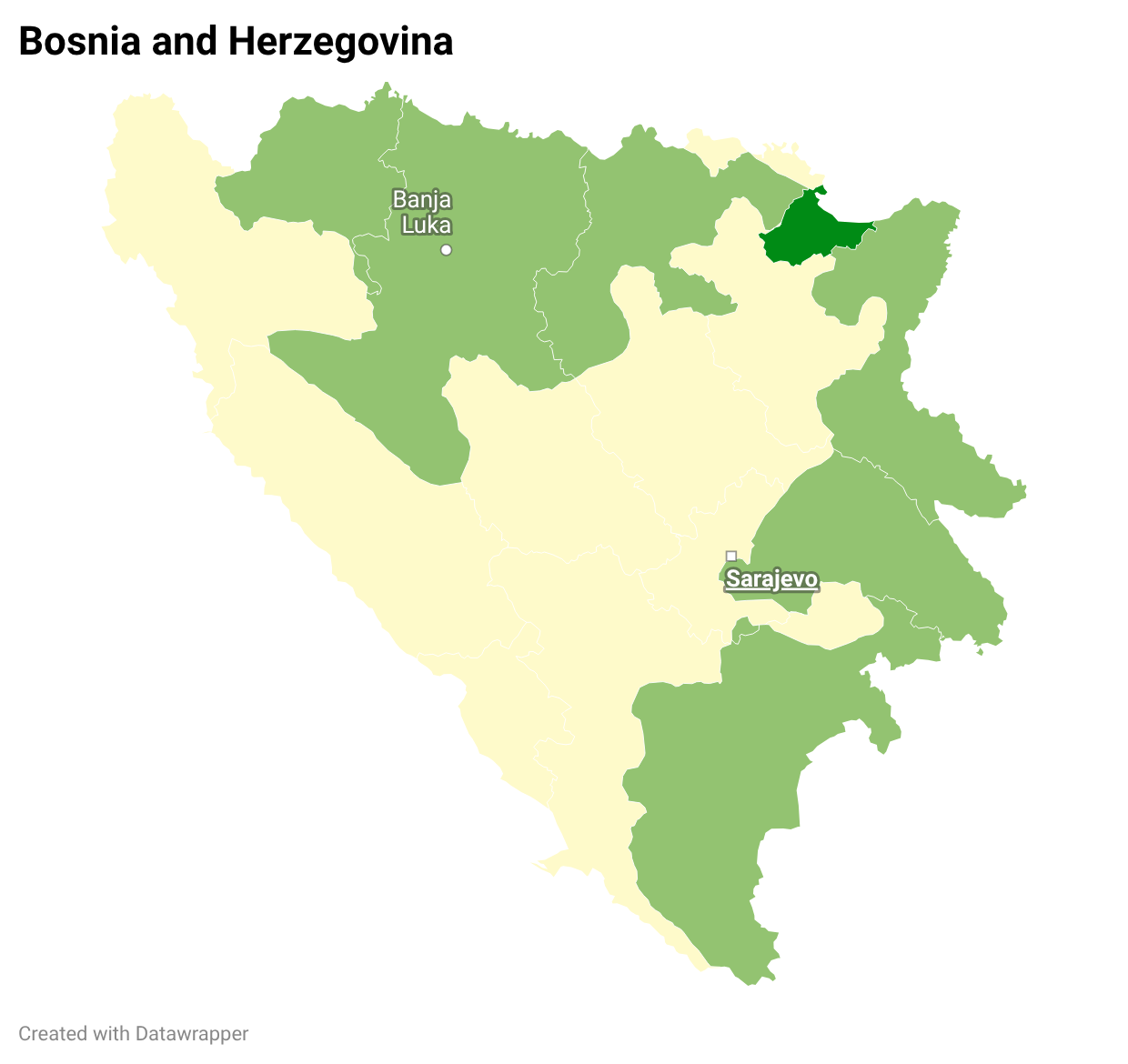
The Bosnian system excludes citizens who do not identify as Serb, Croat, or Bosnian from standing for the presidency.
And the post-war power sharing agreement includes 14 parliaments and governments in total for the country of some 3.1 million people, making reforms hard to push through.
But amid the complexities, the biggest winner from Sunday’s elections could be Serb nationalist politician Milorad Dodik, while the big loser could be the EU, according to Adi Ćerimagić, a senior analyst on the Western Balkans at the European Stability Initiative think tank.
This article continues, but the full version is available only to EUobserver.com subscribers. Visit account.euobserver.com/membership