Login

The Gulf’s emerging web of security partnerships
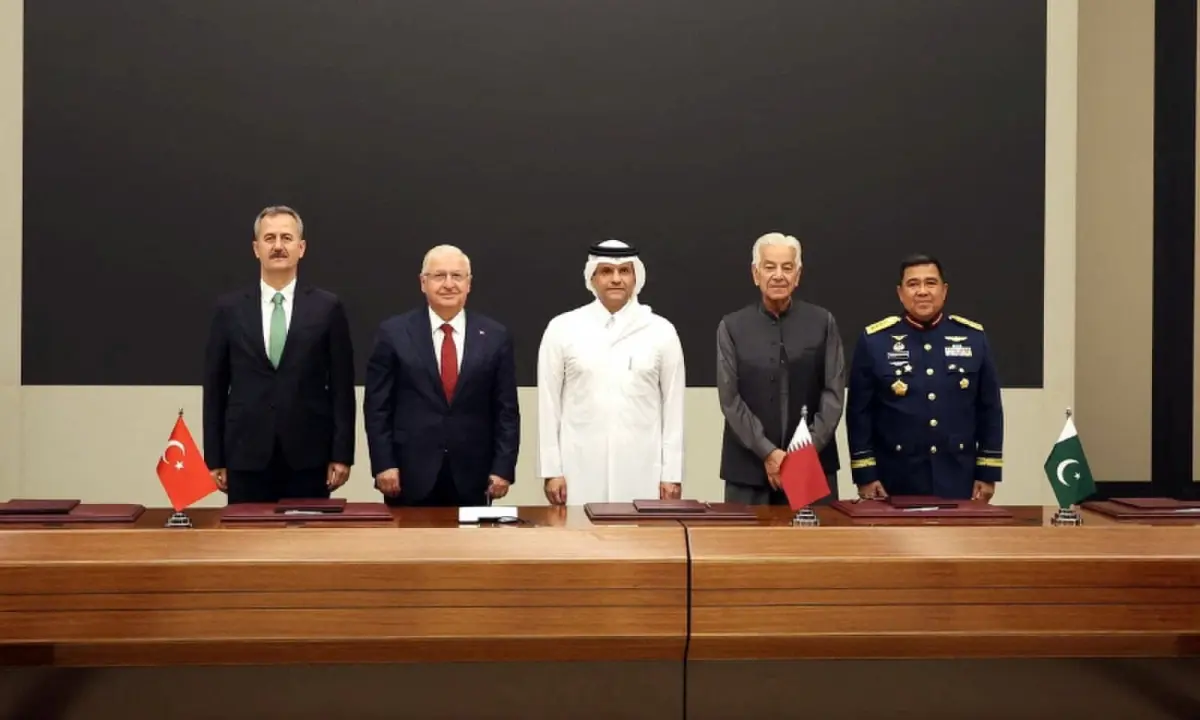
The signing of the Badr Memorandum of Understanding by Pakistan, Türkiye, Qatar and Indonesia in Doha on Wednesday is the latest manifestation of Middle Eastern states accelerated efforts for diversifying their defense partnerships amid growing doubts about the reliability of existing security arrangements of the region led by the United States.
But, rather than laying the foundations of a new regional security architecture, the proliferation of such agreements is producing a more fractured landscape in which countries are drawing in more partners, pursuing separate strategic interests and accepting varying levels of military commitments.
There could not be a bigger example of how uneven is the process than the agreements being signed up by regional countries themselves.
Badr, for instance, focuses on defense manufacturing, technology transfer, research and development, and training, allowing its participants to pool industrial capabilities without committing themselves to military assistance in the event of an attack.
In contrast the Makkah Joint Defense Agreement, concluded in August by Saudi Arabia, Pakistan and Turkiye, goes considerably further by providing that an attack on one participant will be treated as an attack on all as it builds on a bilateral Strategic Mutual Defense Agreement between Pakistan and KSA signed in Sept 2025.
These are two major agreements in addition to several others being signed or solidified by the countries in the region, but the contrast between Badr and Makkah agreements is telling because these agreements are often taken as evidence of an emerging regional security architecture, although the arrangements differ considerably in their purpose and obligations. Makkah agreement formalises security guarantees between participating countries, while Badr aims to develop industrial capacity.
The momentum behind these regional security initiatives has grown since this year’s US - Israel war with Iran exposed the risks of relying heavily on external protection. For Gulf states in particular, the Iran conflict raised questions about whether existing security partnerships could adequately protect their interests during a major regional confrontation.
Importantly, the response of the affected countries has not been to abandon US, whose military capabilities are still considered indispensable, but to seek additional options through new partnerships, domestic defense production and selective commitments.
Besides the impression of the inadequacy of US security umbrella, this search for greater strategic autonomy also needs to be looked at in the context of the Gulf Cooperation Council’s own Joint Defense Agreement, signed in 2000, which too provides that aggression against one member constitutes aggression against all, yet the bloc has struggled to translate this commitment into an integrated military capability because of differences in equipment, command systems and national priorities.
The hurdles to full operationalisation of Peninsula Shield Force has further exposed the gap between a collective defense principle and the ability to organise a coordinated response.
The newer arrangements that the countries in the region are signing up partly reflect this GCC experience. Therefore, while these countries want enhanced security cooperation, they are also reluctant to surrender the freedom to make independent decisions.
As a result, a network of partnerships is emerging that may complement one another in some areas without actually adding up to a common defense system.
Pakistan’s expanding role illustrates both the opportunities and the limitations of this approach. Its relationship with Saudi Arabia has acquired a more formal security dimension through the 2025 bilateral agreement and the subsequent Makkah framework, while cooperation with Turkiye offers scope for closer military coordination and defense industrial collaboration.
Egypt, another key player in the Arab world, has stayed outside the Makkah framework and has offered defense cooperation to Saudi Arabia, reflecting its interest in protecting its own regional priorities without becoming committed to a wider military confrontation.
Islamabad’s other Gulf relationships, however, remain more limited in scope. Kuwait has strengthened defense cooperation with Pakistan through an upgraded agreement - the Protocol Agreement 2026 - covering training, capacity building and border management, while Bahrain has developed close links with the Pakistani military through the presence of Pakistani personnel in its National Guard and Coast Guard, alongside cooperation in training and logistics. These relationships have provided a basis for continued military engagement but do not carry the mutual defense obligations associated with the Pakistan - KSA partnership.
Ties with UAE have, meanwhile, followed a more complicated course marred by political and financial strains, Islamabad’s closer alignment with Riyadh and Abu Dhabi’s expanding defense relationship with India. Nevertheless, training, personnel exchanges, counterterrorism activities and joint exercises between the two countries continue.
Qatar has signed a defense industrial cooperation agreement involving Pakistan among others while Oman has maintained selective military ties with Pakistan and Turkiye, simultaneously preserving its wider security relationships and avoiding binding mutual defense commitments, consistent with its preference for neutrality and diplomatic engagement, particularly in relation to Iran and the Strait of Hormuz.
This makes it difficult to describe Pakistan’s growing defense relationships as a unified regional bloc. Moreover, commitments under these agreements vary according to the interests and calculations of individual partners. Islamabad, in this situation, is left to balance closer security ties against its available military resources and the risk of becoming involved in conflicts whose objectives may not coincide with its own.
At the same time the Gulf states are also pursuing different courses. Saudi Arabia is strengthening its relationships with Pakistan and Turkiye while continuing to rely on Western military capabilities and Egypt and exploring defense industrial cooperation with China.
The UAE, which has not joined either the Makkah or Badr frameworks, has deepened security cooperation with Israel, including in air defense and counter drone capabilities, while maintaining close relationships with US, France and India. Qatar is seeking to expand its defense industrial partnerships through Badr but at the same time retains US military presence at Al Udeid.
Bahrain remains closely aligned with Saudi Arabia and the GCC defense framework, while Kuwait continues to prioritise bilateral military cooperation with Pakistan alongside its substantial security relationship with Washington. Oman’s preference for neutrality and mediation further distinguishes its approach from those seeking more formal security commitments.
The differences are not only confined to the choice of partners, but the states also have divergent assessments of the threat posed by Iran, the role of Israel in regional security and the degree to which they should commit themselves to one another’s defense. Their partnerships are therefore being shaped as much by the need to preserve freedom of action as by the desire to develop collective capabilities.
The new partnerships do not either automatically translate into military independence for regional states, which continue to operate substantial inventories of Western origin aircraft, air defense systems and other advanced platforms that require specialised maintenance, software support, spare parts and replacement munitions. New partners may help diversify procurement and develop local production, but they cannot necessarily replace established suppliers on the required scale.
Moreover, addition of newer systems can also complicate logistics and interoperability unless countries invest in common procedures, training and secure communications.
Defense industrial cooperation presents another challenge and agreements such as Badr will acquire practical significance only if they lead to funded production programs, meaningful technology transfer and capabilities that participating countries can maintain and sustain.
Similarly, the credibility of mutual defense arrangements will depend on whether their members can coordinate intelligence, plan jointly and establish procedures for responding to a crisis.
The number of agreements signed, therefore, is less important than the military capabilities and obligations they actually produce.
For Washington, this proliferation of new defense agreements may apparently look like a challenge, but this should definitely not be seen as it being replaced. US undoubtedly remains deeply embedded in the region through military bases, intelligence cooperation, arms sales and longstanding defense relationships.
The emerging shift may, however, give the regional countries greater bargaining power with established suppliers, particularly as they press for domestic production, technology partnerships and greater control over maintenance and supply chains. To put it simply the emerging arrangements are an attempt to manage the uncertainty created by recent geo-political developments especially the receding US footprint rather than replace the existing system outright.
The central contradiction in the Gulf countries response to the emerging situation, however, is that while these states are seeking greater security through a proliferation of partnerships, they remain unwilling, or unable, to reconcile their differences over the threats they face and the obligations they are prepared to assume.