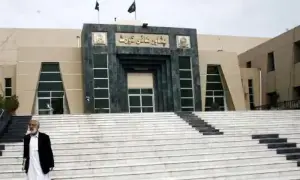
PESHAWAR: The Peshawar High Court (PHC) has restrained the authorities from arresting Khyber Pakhtunkhwa Assembly Deputy Speaker Suriya Bibi until Nov 10, while allowing her to retain access to her official residence.
A bench comprising Justices Ijaz Anwar and Muhammad Faheem Wali ordered that the Oct 14 order to vacate her official residence remain suspended. It also provisionally allowed her to occupy the accommodation until the next hearing.
“The respondents are further restrained from arresting the petitioner till the date fixed,” the bench ruled in its three-page order sheet.
The court fixed Nov 10 for the next hearing of Ms Bibi’s petition against the sealing of her official residence and her anticipated arrest under Section 3 of the Maintenance of Public Order (MPO) Ordinance.
Court also allows Suriya Bibi to retain official residence, suspends order to vacate it
The bench observed that the proclamation imposing governor’s rule in the province did not mention the speaker or deputy speaker among the functionaries who ceased to hold office.
“Apparently, the presidential order does not find mention of the position of speaker/deputy speaker. Similarly, even the vacation order makes reference to those categories (of ministers and advisers) but it nowhere mentions the position of speaker/deputy speaker, which prima facie suggests that the same is not covered by the proclamation order,” it observed.
The bench noted that Advocate General Sanaullah had argued that in “view of Federal Government Order-1 of 2026, read with Federal Government Order-2 of 2026 and the Oct 11 proclamation” for an emergency, the government had every authority to have official accommodation vacated by advisers and provincial ministers, including the deputy speaker.
He also contended that the petitioner had been named in an FIR registered on behalf of the Chitral deputy commissioner on Oct 12 under Section 406 of the Pakistan Penal Code.
The bench reproduced the proclamation order regarding the cessation of certain categories of the public representatives. “The chief minister, provincial ministers, advisers, special assistants and the advocate general of the province of KP shall forthwith cease to hold office,” one of its provisions said.
The court also referred to arguments by the petitioner’s counsel, Yasir Khattak, who cited Section 8 of the KP Province Speaker and Deputy Speaker’s (Immunities, Privileges, Salaries and Allowances) Act, 2026.
It entitles the speaker and deputy speaker to use official accommodation without paying rent until they are replaced and their substitutes are chosen.
The lawyer also cited Section 27(2) of the act, which provided that the deputy speaker could not be arrested, detained or confined, and that her official residence could not be searched, entered or raided by a law enforcement agency during her term in office.
He claimed that after governor’s rule was imposed in the province, police raided his client’s official residence “without any reason and justification to harass her and unlawfully arrest her”.
He added that at midnight on Oct 14, the respondents and other officials again raided the residence and locked it.
The petitioner asked the court to direct the provincial government and the inspector general of police to immediately unseal her residence and restore her access to and possession of the property.
She also sought directions restraining the KP police chief and Peshawar deputy commissioner from raiding her residence or arresting or detaining her under any order issued pursuant to Section 3 of the MPO Ordinance.
Following the imposition of governor’s rule, a case was registered against the deputy speaker for allegedly “refusing to return an official vehicle”.
PESHAWAR: The Peshawar High Court on Wednesday directed the relevant authorities to provisionally de-seal the official residence of Suriya Bibi, the deputy speaker of Khyber Pakhtunkhwa Assembly that has been non-functional since the imposition of governor’s rule and emergency in the province on Oct 11.
The court also restrained law enforcement agencies from arresting Bibi till further orders.
The directives were issued by a two-member bench comprising Justice Ijaz Anwar and Justice Muhammad Faheem Wali, who took up Bibi’s plea challenging the sealing of her official residence and her anticipated arrest under Section 3 of the Maintenance of Public Order Ordinance.
A written order of the hearing is yet to be released, during which the bench also issued notices to the provincial government, the KP inspector general of police (IG) and other officials, seeking their replies on Bibi’s petition.
Advocate Yasir Khattak appeared on behalf of the petitioner at the hearing and argued that his client, being the elected deputy speaker of the KP Assembly, was “entitled to protection under the Constitution and laws of the land”.
“The petitioner holds a constitutional office and is entitled to perform her official functions without unlawful interference, discrimination or arbitrary executive action,” he contended.
The counsel further said that under Section 20 of the KP Provincial Assembly Speaker and Deputy Speaker (Salaries, Allowances and Privileges) Act, 1975, Bibi was entitled to a “fully furnished official residence” in Peshawar for her “entire tenure as the deputy speaker”.
He informed the court that Bibi had been allotted an official residence at Race Course Garden, Peshawar through a June 3, 2024 notification.
The lawyer claimed that following the imposition of governor’s rule on Oct 11, police, “without any reason and justification”, raided Bibi’s official residence to “harass her and illegally and unlawfully arrest her”.
He added that on Oct 14, at midnight, the respondents, along with some officials, again “raided Bibi’s house without any reason and justification or prior notice under the law and locked the house”.
Advocate Khattak argued that the “impugned action has deprived the petitioner of lawful access to her official residence, as well as her belongings, including official documents and essential items”.
He contended that the mere imposition of emergency or governor’s rule did not, by itself, establish a lawful authority to seal the residence of the petitioner.
He said his client didn’t seek immunity from any lawful and bona fide action taken in accordance with the Constitution, but “arbitrary, discriminatory or unauthorised interference with respect to her residence, without a lawful justification, is open to challenge before this court”.
The plea
In her petition, Bibi sought a declaration of the court that the sealing/locking of her official residence was undertaken without lawful authority, in violation of due process, and was illegal, unconstitutional and without lawful effect.
She requested the court to direct the relevant respondents, including the provincial government and the KP IG, to “immediately” de-seal the premises and restore the her lawful access and possession to the official residence.
Bibi further sought directives for the IG and Peshawar deputy commissioner to not raid her house and illegally arrest or detain her, particularly not to “illegally arrest” her on the basis of any order issued under Section 3 of the MPO Ordinance and to act strictly in accordance with law.
She requested the court to restrain the respondents from “unlawfully interfering” with the her access to her residence or removing her personal belongings and documents from the house.
The provincial government, through its chief secretary, KP governor, KP IG, Peshawar deputy commissioner, Administration Department secretary, among others, have been named as respondents in the plea.
Following the imposition of governor’s rule in KP, a case has also been registered against Bibi for allegedly refusing to return an official vehicle.
The federal government imposed emergency and the governor’s rule in KP on Oct 11, citing the provincial government’s “deliberate disengagement” from the fight against terrorism.
In the days preceding the imposition of governor’s rule in KP, political tensions between the Centre and the opposition — including the PTI which was in power in KP — had remained high since jailed former prime minister Imran Khan’s party announced a protest march to Islamabad to demand his release.
After the imposition of governor’s rule, now-non-functional KP Chief Minister Sohail Afridi, KP Assembly Speaker Babar Saleem Swati and other PTI leaders have been taken into preventive custody.
PESHAWAR: The Peshawar High Court (PHC) on Tuesday sought replies from the Khyber Pakhtunkhwa government and senior police personnel, including the inspector general (IG), regarding non-functional provincial chief executive Sohail Afridi’s detention.
Afridi has not been seen since the imposition of governor’s rule and emergency in his province on Oct 11. His whereabouts remained unknown on the day governor’s rule was imposed and a federal minister confirmed a day later that he and some of his cabinet members were in preventative custody.
The PTI has also alleged the detention and arrests of several of its other members, including lawmakers and ministers. Their whereabouts have not been disclosed by the government so far.
Multiple pleas have been filed in the PHC in this connection, and a bench comprising Justice Syed Arshad Ali and Justice Farah Jamshed fixed them for hearing on Nov 3, when the respondents were told to submit their replies.
Apart from Afridi’s detention, the petitions pertain to the disappearance of KP Assembly Speaker Babar Saleem Swati, MNAs Junaid Akbar and Dr Amjid Ali, provincial minister Amjid Ali Khan, MPAs Ikramullah and Aurangzeb Khan, former chief minister of Gilgit-Baltistan Muhammad Khalid Khursheed and several other PTI leaders.
Afridi’s brother Muhammad Aamir filed one of the petitions, alleging that Afridi was “abducted” from the Chief Minister’s House on the night that the emergency was imposed in the province. He had approached the PHC last week.
Aamir sought directives for the respondents, including the KP IG, the Peshawar capital city police officer (CCPO) and others to immediately take all lawful and effective measures to trace and recover his brother.
He also sought that if Afridi was found to be in custody, the PHC order that he be produced so that the legality of his custody could be examined in accordance with Article 199(1)(b)(i) of the Constitution.
The article states that a high court may direct that a person in custody within its territorial jurisdiction be brought before it, “so that the court may satisfy itself that he is not being held in custody without lawful authority or in an unlawful manner”.
The petitioner sought directives for the respondents concerned to submit a comprehensive report regarding the whereabouts, present condition and legal status of Afridi, as well as the details of steps taken to trace and recover him.
He also requested the court to direct the CCPO to submit a detailed report concerning the alleged Oct 11 incident at the CM House — “including the circumstances in which the abductee was allegedly taken away, the security arrangements in place, the people present and the action taken immediately thereafter”.
Presenting his arguments at the hearing on Tuesday, Aamir’s lawyer, Bashir Vazir, claimed that on Oct 11, at approximately 2pm, Afridi was “illegally detained” in the CM House and later on was abducted from the premises, in the presence of the Peshawar CCPO, by “certain unknown armed and masked individuals”.
He contended that Afridi’s detention and disappearance was “wholly illegal, unlawful, without lawful authority and of no legal effect” as the respondents had “not disclosed any lawful order, warrant, abduction order or other legal authority” under which Afridi was taken into custody.
Swati’s cousin, Waqar Ahmad Khan, has also filed a similar petition. His lawyer is also Vazir, who requested the court at Tuesday’s hearing to issue directives for Swati’s recovery.
He claimed that on Oct 11 at approximately 7pm, Swati was “abducted” from the KP Assembly in the presence of the CCPO by “certain unknown armed and masked individuals”.
He stated that the precise sequence of events, the identities of the persons involved and the circumstances in which Swati was taken away required “immediate verification through the relevant official record, eyewitness accounts and other available evidence”.
In both cases, the petitioners prayed that the court direct the respondents to ensure the preservation and lawful examination of all relevant CCTV footage, security logs, entry and exit registers, duty rosters, vehicle access records and other material relating to the incidents.
Furthermore, they sought the registration of a first information report and a prompt, impartial and effective investigation into the alleged abductions, disappearances and detentions.
They contended that the whereabouts and present condition of PTI leaders needed to be immediately ascertained through lawful means, and requested the PHC to issue directives for their release if they were found to be in unlawful custody.
Junaid Akbar’s nephew, Nadir Shah, and Khalid Khursheed’s brother, Hanif Ullah, have also filed pleas, requesting the court to order the recovery and production of the two politicians.
In almost identical petitions, they challenged their “abduction” on the night of Oct 11.
PESHAWAR: The Peshawar High Court (PHC) on Tuesday issued notices to the federal and Khyber Pakhtunkhwa governments in several petitions challenging the imposition of emergency and governor’s rule in the province on Oct 11.
PTI Chairman Barrister Gohar Ali Khan moved the PHC on Oct 14 against the measures, requesting the court to declare them unconstitutional. The move to impose emergency and governor’s rule followed heightened tensions between the PML-N-led federal government and the PTI-led KP government.
On Tuesday, a two-member bench comprising Justices Ijaz Anwar and Muhammad Faheem Wali took up several petitions, including Gohar’s. PTI leader Shandana Gulzar, the KP Bar Council and leaders of the Tehreek-i-Tahafuz-i-Ayin-i-Pakistan (TTAP) have also filed pleas.
The bench adjourned the hearing till Nov 10 after hearing preliminary arguments.
The court said an order would be issued afterwards, adding that notices would also be issued to Attorney General for Pakistan Mansoor Usman Awan and the KP advocate general.
Barrister Sameer Khosa and PTI Secretary General Salman Akram Raja appeared on behalf of Gohar.
Barrister Sameer argued that a resolution passed by the provincial assembly was mandatory for imposing governor’s rule and emergency.
“No approval was obtained from the provincial assembly,” he told the court.
Noting that the National Assembly and the Senate approved the action later, the lawyer said, “We have also challenged this in the miscellaneous application.”
“The proviso to Article 232(1) states that approval from the provincial assembly is necessary. The word ‘shall’ is used, which means this condition is mandatory,” the petitioner’s lawyer said.
He reiterated that the measures had been taken without the provincial assembly’s approval and were therefore illegal. The counsel contended that the situation in KP was not beyond the provincial government’s control.
Sameer further contended that the chief minister, Sohail Afridi, and the speaker of the provincial assembly were currently “missing”.
Afridi, who has become non-functional as the KP CM, has not been seen since the imposition of governor’s rule and emergency. Federal ministers said a day later that he and some of his cabinet members were in preventative custody.
The bench then asked whether the petition included a request for the leaders to be presented before the court or recovered.
“Yes, we have made that request in this application,” the counsel replied.
He referred to a Supreme Court judgment in the case of ex-CM Pir Sabir Shah, in which the SC had established that the chief minister and the cabinet would continue to function if an emergency were imposed.
“In the current case, the chief minister, the cabinet and the advocate general have been stopped from working and rendered inactive,” Sameer said.
“Our plea is that the assembly be restored and the chief minister and speaker be released,” he added.
Raja also argued that governor’s rule and the state of emergency had been imposed without “fulfilling legal requirements”, calling for the measures to be revoked and the provincial assembly restored.
The petitioner, Barrister Gohar, also addressed the bench, arguing that the PTI-led government in KP had always supported the Centre in the fight against terrorism.
He went on to claim that 12 MNAs and 14 MPAs affiliated with the PTI had been “picked up”.
“Raids are being conducted on the homes of our members; they are being harassed,” he added. “We say that Pakistan comes first, we say that we are one, this country is ours,” Gohar said.
Gohar further contended that on Oct 11, deputy commissioners and district police officers had been replaced, as had officers posted at the advocate general’s office.
Appearing on behalf of Gulzar, advocate Muazzam Butt also highlighted that the KP Assembly’s approval had not been obtained before the imposition of governor’s rule and the state of emergency.
He said that an apex committee had been formed under the National Action Plan (NAP), arguing that it was the committee’s responsibility to assess the security situation in the province.
He further argued that responsibility for terrorism could not be placed on the provincial government given the existence of the apex committee.
Representing the KP Bar Council, Advocate Babar Khan Yousafzai appeared before the court and adopted the arguments advanced in Gohar’s case.
Another petitioner, Advocate Qaiser Shah, supported the imposition of the state of emergency but opposed the proclamation insofar as it imposed governor’s rule.
A petition has also been filed by National Democratic Movement (NDM) central and provincial presidents Mohsin Dawar and Bushra Gohar, which was fixed for hearing on Oct 20 (Tuesday).
In his petition, Barrister Gohar had urged the PHC to declare the federal government’s decision to impose emergency and governor’s rule in KP “unconstitutional, ultra vires, coram non judice, tainted with malice in law and fact, devoid of objective material, and of no legal effect” and to set aside the proclamation.
Filed under Article 199 of the Constitution, the petition named the federation of Pakistan (through the secretaries of the Cabinet Division, law, interior, and defence ministries); the province of KP; KP Governor Faisal Karim Kundi; the KP Assembly speaker; and the secretary of the KP Home and Tribal Affairs Department as respondents.
Sohail Afridi, who is no longer functioning as the province’s chief minister following the imposition of governor’s rule, was also named as a pro forma respondent.
Gohar challenged the “constitutionality, legality and vires” of the October 11 decision, the order deploying army troops to the province, and “all consequential and derivative executive orders, notifications, and bodies” constituted as a result.
These included the establishment of the KP Advisory Council and the “arbitrary” detention and removal of Afridi as the lawful chief minister of KP, along with his provincial cabinet, which had been vested with full executive powers under Article 130 of the Constitution.
Following the imposition of emergency and governor’s rule in the province, the federal government formed an 11-member technocratic KP Advisory Council.
Speaking to the media after the hearing, Barrister Gohar highlighted the “injustice” being inflicted on party workers and supporters, with their MNAs and MPAs picked up, their symbols being removed and demolished, and their houses raided. “We spoke about it in front of the court,” Gohar said.
“We have said from day one that this is unconstitutional. Whatever has happened is against the Constitution,” he stressed.
“There are no two opinions about it; terrorism is unacceptable in this country. We have condemned terrorism in every form, in every place. We have said everyone should unite to fight against terrorism,” Gohar maintained, adding the party rejects “allegations” of facilitating terrorism.
Gohar said the party requested the court to make a larger bench and hear the PTI as soon as possible.
“The court has given us the date (Nov) 10. We hope the court decides the matter as soon as possible, because this province, this country cannot stay entangled in this. On one hand, the province is deprived of resources; on the other, it is facing terrorism, and on top of that, its mandate is also being snatched away,” he said.
Raja, speaking to the media, termed the imposition of emergency “an attack” on provincial autonomy and democracy.
“Provincial assembly resolution is mandatory for emergency,” he said. “Governor’s rule requires the provincial government not to do its work.”
“Sohail Afridi is still the chief minister of the province and the cabinet is present,” Raja asserted.
Leader of the Opposition in NA Mehmood Khan Achakzai also spoke to the media and said, “We want decisions to be made in the courts. If that does not happen, issues will come out onto the streets.”
PESHAWAR: With Peshawar High Court set to hear today (Tuesday) multiple petitions against imposition of emergency and governor’s rule in Khyber Pakhtunkhwa, PTI chairman Barrister Gohar Ali Khan has sought permission of the court to file an amended petition to challenge the resolutions passed by a joint sitting of the Parliament as well as National Assembly and Senate separately endorsing the said move.
According to the cause list released by the high court, a two-member bench comprising the senior puisne judge, Justice Ijaz Anwar, and Justice Mohammad Faheem Wali will hear seven constitutional petitions, requesting the court to declare as unconstitutional the Oct 11 presidential proclamation under articles 232 and 234 imposing emergency and governor’s rule in Khyber Pakhtunkhwa.
The main petition is that of Barrister Gohar Ali, whereas leaders of Tehreek-i-Tahafuz Ayeen-i-Pakistan (TTAP) including its chairman Mahmood Khan Achakzai, its vice chairman Raja Nasir Abbas, Balochistan National Party (Mengal) chief Sardar Akhtar Mengal, Sindh United Party president Zainul Abideen and others have filed two petitions.
Barrister Gohar seeks permission to file amended petition to also challenge parliamentary resolutions endorsing govt move
The other petitions are that of National Democratic Movement’s central and provincial presidents Mohsin Dawar and Bushra Gohar, MNA Shandana Gulzar, and lawyers Suleman Khan and Qaiser Ali Shah.
The petitioners will be represented by Barrister Sameer Khosa, Salman Akram Raja, Ali
Zaman, Mohammad Yousaf Orakzai, Bassam Ahmad Siddiqui, Suleman Khan and Qaiser Shah, etc.
The federal government on Oct 11 imposed emergency in KP, and placed the province under governor’s rule, taking note of the ‘provincial government’s deliberate disengagement from the fight against terrorism’.
The move followed weeks of political tensions between the Centre and PTI – as well as negotiations to bridge their differences – after the latter announced a protest march to Islamabad to demand the release of its jailed founder Imran Khan.
Barrister Gohar on Monday filed an application in the high court, seeking permission to add two further prayers in his constitutional petition.
He requested the court to permit him to make consequential amendments to the facts and grounds of the petition and to file an amended petition within such time as the court may fix.
The prayers which Barrister Gohar requested for inclusion in his petition are: “Declare that the impugned resolutions, namely the separate resolutions passed by National Assembly and Senate on 14 Oct, 2026, and the resolutions passed by Majlis-i-Shoora (Parliament) in joint sitting on 15 Oct, 2026, approving the impugned proclamation, and the impugned SRO are unconstitutional,
without lawful authority and of no legal effect insofar as they approve, sustain or give effect to the impugned proclamation, and do not validate the impugned proclamation or any action taken under it.”
He also requested to “suspend the operation of the impugned SRO and restrain the respondents from taking any further step pursuant to the impugned resolutions or the impugned SRO.”
The application was filed by Advocate Shah Faisal Ilyas on behalf of Mr Gohar.
The applicant stated that on Oct 14 the National Assembly and the Senate passed separate resolutions approving the proclamation of emergency “under second proviso of clause (1) of Article 232”.
He stated that on Oct 15 the Parliament in a joint sitting passed two further resolutions, the first approving the proclamation of emergency under clause (7) of Article 232, and the second approving the proclamation under clause (3) of Article 234. He added that a consequential SRO was also issued by the government announcing the passage of the said resolutions.
“The proclamation of emergency has purportedly been approved by each of the impugned resolutions. Since these are subsequent developments and seek to clothe the inherently unlawful and unconstitutional impugned proclamation with legality, the petitioner is aggrieved of the same,” he said.

 Login