❌

Reading view

Pakistan stresses diplomacy as Iran rejects US ‘threats’

• Dar discusses evolving regional situation in call with Araghchi
• Iranian FM says Tehran rejects intimidation but remains open to dialogue
• Insists seven-day Hormuz reopening proposal remains on table
• Pakistani, Egyptian FMs condemn Houthi attacks, discuss R-4 coordination
• Iran’s new defence minister threatens ‘enormous damage’ to US if attacks renewed

ISLAMABAD: Deputy Prime Minister and Foreign Minister Ishaq Dar on Sunday stressed the need for continued dialogue and diplomacy in a telephone conversation with Iranian Foreign Minister Abbas Araghchi as regional tensions persisted amid the US-Iran conflict and renewed fighting in Yemen.

The Foreign Office said the two ministers discussed the evolving regional situation as well as the ongoing meeting of the Organisation of Islamic Cooperation’s (OIC) Council of Foreign Ministers in Baghdad.

Mr Dar “underscored the importance of continued dialogue and diplomacy in addressing regional challenges”, the FO said, adding that the two sides agreed to remain in close contact.

Mr Dar also held a telephone conversation with Egyptian Foreign Minister Badr Abdelatty and exchanged views on recent regional developments.

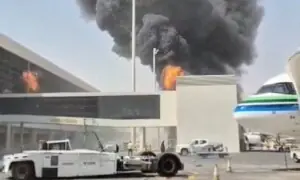
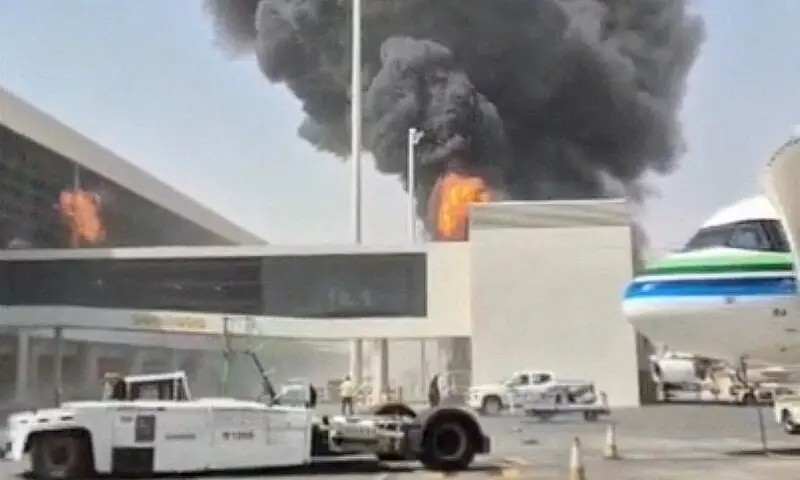
The ministers strongly condemned Houthi attacks against Saudi Arabia and reaffirmed their solidarity with the kingdom as well as support for its sovereignty, territorial integrity and security. They also discussed cooperation under the Regional Four (R-4) framework comprising Pakistan, Egypt, Turkiye and Saudi Arabia. The two ministers looked forward to the next R-4 meeting to coordinate further on regional issues.

Iran rejects ‘threats’

Meanwhile, Mr Arag­hchi told the OIC meeting in Baghdad that Iran “does not accept coercion, threats, or intimidation” by the US and “will not relinquish its sovereign rights under pressure”. “But it remains ready for dialogue based on mutual respect and credible guarantees,” he added. Speaking to the media in Baghdad, Mr Araghchi said Iran’s offer to reopen the strategic waterway within seven days remained on the table.

“Our situation is clear and based on the seven-day proposal presented to the US. They shared comments which we are reviewing, but our proposal is still on the table,” Mr Araghchi said.

He said that if the US showed “honesty”, the path towards reopening the Strait of Hormuz was clear. Iran’s conditions incl­ude lifting the US blockade on its ports, removing sanctions on its oil exports and ending hostilities across regional fronts. Mr Araghchi added that if Washington accepted Tehran’s conditions, the strait could reopen within six days, followed by the resumption of talks the next day.

US warned

Iran’s newly appointed defence minister Mehrdad Akhlaghi warned that any renewed US military attack would cause “enormous damage” to Washington and its regional allies.

“People can rest assured that they will most likely not dare to attack us,” Mr Akhlaghi told reporters shortly after securing parliament’s vote of confidence. “If they do, they themselves and the region will suffer enormous damage,” he said.

Published in Dawn, October 19th, 2026
  •  

Egypt ‘ready to defend’ Saudi Arabia against Houthis

• President Sisi says Cairo will take ‘any measure’ to protect kingdom if asked
• Iran backs ‘political process’, offers to mediate
• Saudi, Houthi forces trade fire

CAIRO: Egyptian President Abdel Fattah al-Sisi pledged on Saturday that Egypt was ready to help defend Saudi Arabia against attacks by Yemen’s Houthi forces if requested, as fighting intensified across the region and Cairo moved towards possible parliamentary authorisation for support.

Speaking at a graduation ceremony at the Egyptian Military Academy, Sisi said Egypt was “not looking for a role to play” in regional conflicts but that it was “inconceivable” for Cairo to stand by while Saudi Arabia was “harmed or its security and stability threatened”.

“Egypt, of course, with the directives of His Majesty King Salman and Crown Prince Mohammed bin Salman, will carry out any measure to protect you or defend you,” Sisi said.

He said any deployment would require parliamentary approval and expressed hope lawmakers would convene in an emergency session to authorise support “if it is requested of us”.

“I’m not talking about fighting anyone or attacking anyone,” Sisi said. “We are speaking only about defence.”

Egyptian state media later reported that parliament would hold an emergency session on Sunday at Sisi’s request to consider possible support for Saudi defences.

Egypt joined the Saudi-led military coalition in Yemen in 2015, though its role has largely focused on securing Red Sea shipping routes rather than frontline combat. The renewed conflict also threatens Egypt’s economic interests, particularly Suez Canal revenues.

Egyptian Foreign Minister Badr Abdelatty said last month that the Suez Canal had lost about $11 billion in revenue since the Houthis began attacking commercial vessels in 2023.

During a visit to Egypt last month, Saudi Crown Prince Mohammed bin Salman and Sisi called for free and secure navigation in the Red Sea. Egypt has not joined the Makkah agreement, a mutual defence pact signed by Saudi Arabia, Turkiye and Pakistan in August, and has said it is studying the agreement.

Sisi also said on Saturday that his presidential term would end in 2030 and proposed a 30-month training programme at the Egyptian Military Academy to prepare potential future leaders.

He said a committee would develop selection criteria and legislation for the programme, which would target PhD holders from reputable Egyptian and foreign universities.

Iran, meanwhile, backed a political solution to the Saudi-Houthi conflict and renewed its offer to mediate. Iranian Foreign Minister Abbas Araghchi repeated Iran’s offer to mediate between the two sides.

Araghchi said on Saturday at the Organ­isation of Islamic Coope­ration in Baghdad that Tehran supported an “incl­usive and comprehensive political process as the only practical and sustainable way to resolve the issue”.

Araghchi also said, “Either we build security together, or we will endure insecurity together,” adding that Iran was willing to cooperate with its neighbours. Saudi Arabia has accused Iran of encouraging the Houthis’ recent escalation, a charge Tehran denies.

The fighting continued on Saturday, with Saudi Arabia saying it intercepted four drones over Riyadh, the Eastern Province and the south.

Coalition spokesman Turki al-Malki said the drones were “intercepted and destroyed” as the kingdom faced repeated Houthi missile and drone attacks on oil installations, tankers and airports.

Houthi-affiliated med­ia, meanwhile, said Saudi air strikes beginning overnight killed at least 12 people in Yemen, including three children. It said strikes on “civilian homes” in Taiz killed nine people and wounded 16, while attacks in Dhamar killed three children and wounded 17.

The Houthi news agency also alleged that Saudi forces used cluster bombs. The Saudi-led coalition did not immediately comment on that claim.

The renewed war in Yemen has intensified since July. The Houthis have attacked Saudi energy facilities, vessels and Riyadh’s international airport, where 13 people were killed last week.

The Houthis have also seized territory around the Bab al-Mandab Strait, increasing pressure on Red Sea shipping and energy exports.

Separately, the Houthis announced the release of 159 pro-government fighters under an amnesty after their recent territorial gains. The International Committee of the Red Cross confirmed the release and said it helped with interviews, health checks, family contacts and transportation.

Published in Dawn, October 18th, 2026

  •  
❌