❌

Reading view

Science After the Break with the West: How War and International Sanctions Reshaped Russian Universities

Since the start of the full-scale war, Russian science has lost key ties with Western universities and research centers. Yet four years of sanctions have not led to a collapse. Instead, Russia rapidly reoriented toward China, other parts of Asia, and the Middle East, while the Kremlin firmly integrated higher education into its system of military priorities. These are the conclusions reached by Olga Orlova, head of T-invariant, in her report Transformation of Science and Education in Russia under Sanctions 2022–2026, which examines changes in Russian academia over the past four years.

The author stresses that what is happening is not simply isolation, but a transition to a dangerous new model. The report examines not only the initial shock of sanctions but also a profound systemic restructuring: total control over international contacts, an accelerated push for “technological sovereignty,” and the subordination of science to the needs of the war economy.

[[socialnetworks]]

The break with the West has affected different fields unevenly. The exact and natural sciences, as well as military technologies, have received strong state support and found an alternative partner in China. By contrast, the social sciences and humanities have been devastated. Cut off from the global academic community and international mobility, they have faced enforced isolation and systematic ideological purges.

The result is what the report calls “selective internationalization.” Russia now develops international ties only where they serve the state’s military and strategic interests. The long-term consequences of this pivot are far more dangerous than the sanctions themselves: the country is replacing Western partnerships with near-total dependence on a handful of eastern allies, while the entire academic system is being transformed into an instrument of state security.

You can read the report Transformation of Science and Education in Russia under Sanctions 2022–2026 here.

The post Science After the Break with the West: How War and International Sanctions Reshaped Russian Universities appeared first on Т-инвариант / T-invariant.

  •  

“None of the political parties makes higher education a priority on its agenda”: American higher education through the eyes of a university administrator

Our interviewee today is not allowed to give interviews — under the terms of her employment contract. The senior position she holds at an American university obliges her not to make her political views public and to exercise the utmost caution in public statements. But the changes now taking place at American universities are so far-reaching that she agreed to talk with T-invariant about the serious challenges facing higher education. Her experience as a department chair and dean, and later as a vice president, helps her today to map the critical points in the development of the academic environment: how the new presidential administration is affecting university life, how the Israeli-Palestinian conflict has split it, how artificial intelligence is influencing teaching and its administration, what the shrinking of university budgets leads to, and, most importantly, how the very logic by which higher education works has changed.

Top news on scientists’ work and experiences during the war, along with videos and infographics — subscribe to the T-invariant Telegram channelto stay updated.

The economics of structural deficit

T-invariant: You spent more than ten years in administrative work: first as a department chair, then as a dean, and now as a vice president. What changes have you observed over this time, in funding, in administration, in relationships within the faculty, in university politics?

— The most obvious and the most constant thing: there is less and less money. When I was just starting out as a chair, my institution could end the year with a surplus, and that money made it possible to fund special projects. Now many universities are already approaching a state of structural deficit.

It’s important to understand here that American universities are very different, and their funding is structured differently too. There is, for example, the Carnegie Classification by level of research activity. It currently distinguishes R1, R2, and Research Colleges and Universities. For R1 the threshold is at least $50 million in research spending per year and at least 70 research doctoral degrees; for R2, at least $5 million and 20 research doctoral degrees. The next category begins at $2.5 million in research spending. Five million is quite an attainable sum for a small college: the total budget of such an institution might be, say, around $150 million.

R1s are especially vulnerable right now because of cuts to federal research funding. A significant part of their research budgets comes through the NSF, the NIH, and other federal agencies. When those grants are cut, such universities face very serious budgetary problems.

And a grant brings the university money not only for the research itself. What matters here is overhead: the funds the university receives and uses to maintain its infrastructure and its other operations. This is a very significant part of grant funding, sometimes 50 to 60 percent of the entire grant. So R1s, but also R2s and other research universities, depend very heavily on that money.

As I see it, this process began long ago, around 2001: federal research funding started to shrink gradually. Under Obama it was no longer being cut at the same pace, but it did not return to previous levels and did not grow along with inflation. So the financial pressure on universities built up over years.

I myself never worked at R1 universities. For public universities at the R2 level and below, a different source of money matters: state appropriations, that is, ultimately, tax revenue. These too were either cut or stayed at roughly the same level and completely failed to keep up with inflation. At the same time there is strong political pressure not to raise tuition. And now the number of students is falling as well. Even if enrollment were not declining, with this kind of financial structure we would still find ourselves in a very difficult situation.

T-i: And what changed on other levels, for instance, in the university and administrative environment itself?

— A huge change is online education. This is a separate and very complicated topic. Even before the pandemic there were MOOCs, which exist partly outside the traditional university system. Some universities moved very aggressively in this direction and made online education massive and accessible. Then came the pandemic and the total shift online, and in the last two or three years AI appeared as well, and the interaction between online education and AI has created a completely new set of problems.

But there is a deeper change that I think about a lot. It seems to me that the very model of liberal arts education, which is very specific to the United States, is becoming unsustainable.

For someone who received their education outside the United States, the concept itself looks rather strange at first. American higher education rests on the idea that college education should be formative rather than narrowly preparatory: it should teach people to think critically, write well, understand how the world works, and be civically engaged. This idea is very deeply embedded in the American university system.

Historically, this model grew stronger over the nineteenth and twentieth centuries: even institutions that began as teachers’ colleges gradually turned into broad-based universities with courses in history, philosophy, anthropology, literature, political science, theater, and other fields.

But it seems to me that the economic conditions that allowed this model to exist in the United States in the twentieth century have now disappeared.

This model was especially viable as long as the United States had a very strong and well-off middle class in which really only the father of the family earned money. In the popular image of the 1980s and 1990s, a single salary could support a suburban house and a family, while four years of college let a child spend several years exploring history, philosophy, or anthropology without having to answer immediately what income that degree would bring. This kind of economy made possible the idea of education as an extended period of exploration before choosing a career.

Today far fewer families can afford this luxury. A student wants to understand in advance what they will do after graduation. So, especially after the pandemic, career readiness has become a much stronger focus: how to connect a major with a specific career, how to build a career map for a student, how to explain the value of a specialization in history or sociology.

There is another feature of the American system that looks rather unusual to someone from Europe or Asia. In many countries you can enter a professional program right after school and train to become a doctor or a lawyer. In the United States, medicine and law belong to the next level of education: before applying to medical school or law school, you need to earn a bachelor’s degree. So the path to a profession turns out to be much longer.

At the same time, professional schools are usually built into a large university. Few independent teachers’ colleges remain today, and medical schools too are usually part of universities. Even engineering schools, where you can go straight into professional training, frequently exist inside universities that also have departments of history, philosophy, and anthropology. So the American university has to sustain this whole broad structure of liberal arts, even if a significant share of its students come there for a quite specific profession.

T-i: And how is this shift in student demand now affecting the university’s structure?

— In the big cities of the United States dozens of colleges and universities exist side by side, and many have their own departments of history, philosophy, anthropology, literature, political science, and theater. Every department needs students who will major in one of the subjects it offers. When the number of such students falls, the old structure stops being sustainable.

And the problem is broader than just a crisis of the humanities. Until recently, accounting and computer science were considered almost ideal career-oriented fields. Now AI is making even these trajectories less obvious. A university cannot simply replace an “impractical” humanities major with one that is guaranteed to be practical: the labor market changes faster than curricula.

Over the past decades, independent research institutes have also been disappearing. This was especially noticeable in biology: as federal funding was cut, many of them became financially unstable and either closed or were absorbed into universities or hospital systems.

T-i: What consequences has all this had, for teaching loads, for instance?

— Teaching load is fairly complicated, because you usually can’t simply increase it. It is fixed either by university bylaws or, in many public universities, by collective bargaining agreements with unions. Those also set the pay scale. So one of the main ways to save money looks different: when a tenured professor retires, their position is increasingly just not reopened.

It’s important to distinguish between different periods here. In the mid-2010s, universities were already under chronic financial pressure, but there were still plenty of students. In the big cities of the United States there was, at the same time, a large market of people with PhDs in history, philosophy, and other disciplines who were looking for academic work. Universities could hire them as part-timers for individual courses for far less money than tenured professors.

Gradually a whole layer of career adjuncts emerged. An instructor might teach at one university on Tuesday and Thursday, at another on Monday and Wednesday, and offer courses in the fall, spring, and summer. Some accumulated a very heavy load this way and essentially lived on teaching alone. In public systems, with a maximum teaching load and a benefits package, you could even reach a fairly decent annual income, but at the cost of an enormous number of courses and giving up research almost entirely.

For a long time I thought this replacement of full-time faculty with part-timers (what’s called adjunctification) was happening in more or less the same way across the country, because I worked in a big city myself. But then I realized how much this model depends on geography. It works well where there are many universities and many people with doctorates nearby: in the big cities of the United States a person can teach in several places at once and doesn’t have to move for a single course.

In rural America the situation is completely different. If a university is in a small town and needs a specialist, a person with a PhD won’t move there for five thousand dollars a course. There simply isn’t a large enough local market for academic labor. So adjunctification was a very uneven process: in the big university centers it could reach enormous scale, while in many rural areas the model barely worked at all.

And now, in many places, the trend has reversed. There are fewer students, and it is extremely difficult to dismiss faculty on permanent contracts. Moreover, in the United States age discrimination is prohibited, and you can’t simply push older professors toward retirement.

The pandemic changed this situation even more. Everyone learned to teach online, and now an older professor sometimes doesn’t need to come to the university regularly at all. I’ve seen professors well past eighty who calmly log onto Zoom twice a week, teach their usual courses, and continue to receive a full professor’s salary. If there are medical grounds that qualify for an accommodation, they can secure the right to teach remotely. In public universities this sometimes slows the renewal of staff even further.

At expensive private colleges the pressure runs strongly the other way: students are paying in part for the in-person experience and react very negatively if an instructor tries to replace on-campus classes with Zoom sessions. So the ability to move fully to remote teaching depends heavily on the type of university.

As a result, when a budget has to be cut today, the first vulnerable group is now the adjuncts themselves. Some of them built their entire professional life on this work over many years, stopped doing research and publishing, and are now at a serious disadvantage when a tenure-track position opens up somewhere. I’ve seen units where, before the pandemic, adjuncts taught half of all courses, and now only one or two of them are left.

It turns out to be a rather sharp historical reversal. First, chronic underfunding combined with large student numbers encouraged the mass use of adjuncts, especially in big cities. Now enrollment is falling, the tenured faculty remains protected and is aging at the same time, and universities are economizing above all on the very layer of adjunct faculty that they themselves created over the previous decades.

Overcoming inertia

T-i: Is the number of permanent professorial positions still shrinking, then?

— Yes, it is. When a professor retires, it is much easier not to reopen their tenure-track line. That is exactly how the cuts happen: you don’t necessarily have to fire anyone, you can simply leave positions unfilled for years. Hence the aging of the faculty and the gap between disciplines that are still hiring actively and those where the department is gradually shrinking.

In 2022–2023 we had a brief reversal at our college. Thanks to federal stimulus funds and the ability to justify new hiring in terms of social mobility, we managed to hire many new full-time faculty on tenure-track lines, including replacing some of the adjuncts. We argued that students from low-income families, of whom we have many at our university, should also have direct access to full-time faculty who are based at the university, do research, and can properly mentor them. It was a very good period, but then funding tightened again.

T-i: And what is happening with the positions of ordinary staff? Are they being cut too?

— Interesting things are happening here. I’ve long had the sense that computers took over the world, but in a way that makes sense for computers: they made us perform more and more tasks we had not performed before, because it became technically possible to create them. What used to be done in the 1990s with a single paper form now turns into several electronic forms, reports, approval systems, and databases.

Hence a strange effect: software, fast internet, Wi-Fi, platforms, specialists for each system — all of this raises the cost of the university. And you need more people, not fewer. We once thought the internet would reduce paper use; the opposite happened. It’s a similar story with staff. Every automation gives rise to new operations and new duties, and in the end the digital infrastructure itself feeds the budget crisis.

AI so far doesn’t look like an exception. It can automate a particular task, but at the same time it creates new demands for oversight, reporting, training, and academic integrity.

T-i: And what changes have there been in what students want, and in how the university responds?

— Over the last two years I’ve seen a fairly rapid retreat from online education, especially among undergraduates. For my students, online courses were very appealing at first. I worked at a public university where many students come from low-income families and work while studying, so the ability not to come to campus every day solved a real problem for them.

But a contradiction soon became apparent: students want online learning, but many of them simply don’t succeed in an online environment. I had students who logged into class while working a store cash register or sitting at their workplace. Formally they were present, but in practice they couldn’t fully participate. Such students began to fall behind, and many of them eventually dropped out of the university altogether.

So now I see a reverse movement: students themselves more often choose traditional in-person courses. The online format, of course, isn’t going anywhere: it’s too important for working students. But the idea that it by itself solves the problem of access to education turned out to be too optimistic. Access to a course does not yet mean the ability to actually learn.

The arrival of AI has added another problem. In an online environment it becomes ever harder to tell whether a student is really doing the work themselves. AI imitates human text very well, and almost any technical measure we try to use against academic dishonesty can be circumvented. So the return to in-person classes is also connected with a very practical question: how to make sure the student is actually learning.

T-i: What changed after the current federal administration took office?

— There are two obvious shifts. The first is rhetorical: from Washington we increasingly hear the idea that higher education is overrated and that what society really needs is vocational and technical training, short programs, and non-academic online courses.

Up-to-date videos on science during wartime, interviews, podcasts, and streams with prominent scientists — subscribe to the T-invariant YouTube channel!

The second is a sharp reversal around DEI policy. For the last twenty or thirty years, the development of DEI was one of the central paradigms of the American university. Offices, programs, grants, and strategic plans were built around it; universities sought to increase diversity among students, faculty, and staff.

When I came to American academia from a different educational system, the point of this policy was not self-evident to me. I was strongly influenced by conversations with colleagues and students. One colleague put it this way: if a society has systematically discriminated against a particular group for a very long time, simply declaring formal equality is not enough, becauseeconomic inequality and a culture that has built up over centuries will still remain. Society is better off when social groups are not locked into a social environment where poverty, criminalization, and drug addiction thrive.

Now an almost 180-degree turn has taken place. Programs built around DEI are losing funding and have been outlawed; legal offices are demanding an inventory of anything that might conflict with the new federal rules.

There is no systematic response to these changes yet. There is a lot of confusion, attempts to understand the limits of what’s permissible, and a desire not to attract unnecessary attention. In more liberal states, universities feel some political protection, but even so they are much more careful about what they put in writing.

My own approach to diversity was always fairly moderate: make searches for job candidates and students as broad as possible, avoid labeling, resist stereotypes, and make the university welcoming for staff and students of different backgrounds. But even that isn’t enough. You have to train campus security and support staff so that they don’t begin an interaction with staff or students on the basis of their appearance or accent.

T-i: What changes of recent years do you see in the students themselves?

— The way students communicate has changed. Before the pandemic, instructors complained that students talked to each other too much in class and couldn’t sit still. After the pandemic I sometimes observe almost complete silence. One recruiter asked me: “Why are all your students whispering?” They find interpersonal communication very stressful, but at the same time they crave it. So sometimes effective pedagogy today consists literally in making them talk to each other in an organized way.

T-i: Why does academia, seeing these threats, change so slowly?

— Because academia is structurally conservative, and I don’t mean politics here. Because of financial constraints, universities hired too few young faculty for many years, and the faculty is aging. Curricula are aging too. Articles that were an intellectual revelation for me in graduate school I still want, out of habit, to assign to students, even though they are now twenty or thirty years old.

I often think of the Red Queen from Through the Looking-Glass: “it takes all the running you can do to keep in the same place,” which means that to get somewhere you have to run twice as fast. Technology and the labor market change at enormous speed, while curricula and ways of teaching are conservative and dogmatic. That’s why hiring younger and early-career faculty matters not only as a question of fairness in the labor market. It is one of the ways to renew the content of education.

The university and “big” politics

T-i: Is there any political or social force beyond academia that is seriously interested in the development of American higher education?

— My short answer: I don’t see such a force. None of the political parties makes higher education a priority on its agenda. The Democrats have many social programs; among Republicans there is now strong criticism of universities. For governors and Congress, higher education competes for funding with healthcare, transportation, housing programs, support for people with disabilities, environmental projects, schools, and many other areas.

University presidents, of course, lobby governors, Congress, the federal administration. But they aren’t the only ones lobbying; everyone does. From inside the university it seems obvious to us that our funding, specifically, is critically important. From the outside, we are just one of many groups, each of which can present a convincing list of public needs.

Outside the big cities in America, transport and social infrastructure are very weak. Between small towns there may be almost no public transport: train service is infrequent, if it runs at all, the bus network is weak, and without a car it’s hard to reach even the nearest town. You come across poor towns with empty houses and a very limited set of jobs.

That’s exactly why a university there acts as an economic anchor. It brings in hundreds or thousands of students, hires faculty and staff, and around it develop rental housing, cafés, sports facilities, schools for employees’ children, medical services, and cultural events. Often it is the only place in the county where an educated middle class is consistently present. If such a university disappears, it can leave an economic desert behind.

So the question of closing a small public university is at the same time a question of regional policy, even if in university budgets it isn’t called that.

T-i: Then what can universities actually do themselves?

— Public universities retain a strong resource: they can provide high-quality education at a comparatively low price. There is demand for this, and there is a public payoff too. So public universities have a convincing return on investment, ROI: their graduates on average earn more in the labor market, while tuition there is far lower than at expensive private colleges. Our weak point is that we are often bad at telling families and high-school students about this.

We will have to take the demand for career readiness more seriously, work more actively with local communities and schools, and explain better what a university does. Popularizing research is also becoming part of the mission: historians, philosophers, political scientists, and physicists go on YouTube and make short videos explaining their research to a broad audience. Academia long considered such work secondary; now it is becoming a matter of survival.

I don’t really believe that the main survival strategy will emerge from a nationwide or transnational coalition of universities. American institutions are too different: public ones are funded by the states, private ones compete for students, grants, and donors, and there are also religious universities and military academies. It’s useful to meet and talk, but real solutions are usually region-specific.

T-i: Have political conflicts between faculty become sharper in recent years?

— Political differences have always existed and often ran along disciplinary lines: roughly speaking, a finance department might be more Republican, while a sociology department might be very liberal. But in recent years I really have seen extremely sharp conflicts around Israel and Palestine. Sometimes at chairs’ meetings I genuinely feared the argument would come to blows.

As a dean I tried not to show my own political views. So for a while both pro-Israeli and anti-Israeli colleagues were convinced I was on their side, and they took turns coming to my office to complain about one another. In the humanities and social sciences it’s hard to separate a personal position entirely from teaching; it shows in what a person says in class and what they support publicly.

What amazes me most is something else: faculty can mobilize emotionally far more around Middle Eastern politics, which the university can barely influence, than around their own budget and the future of their institution. They merely complain about the lack of funding, but when they discuss the conflict over Israel they’re ready to shout at each other for hours.

T-i: And don’t unions and collective protests give faculty a channel of influence?

— Unions can indeed be active in the fight for funding and contracts, but the protests themselves are often surprisingly small. I went to major rallies in defense of funding for the natural sciences, and each time I was struck by how much smaller the turnout was than I had expected.

There are many reasons for this. A tenured professor has a protected contract, good insurance, a relatively decent salary; the budget crisis isn’t always felt as a matter of life and death. Besides, the bloated bureaucracy keeps people constantly busy with small tasks. On a day off, a person chooses between a rally that probably won’t change anything and their family.

Younger faculty, in my observation, are not necessarily more active than their elders either. Sometimes they are in a much more vulnerable position and are afraid to take risks; sometimes they are simply overloaded. To really understand this, you’d need a separate, sociologically grounded conversation with people about why, on a given day off, they do or don’t go to a protest.

There are internal conflicts too. The same union can represent both full-time and adjunct faculty, whose interests don’t always coincide. Some unions took very hard positions on Israel, which made some Jewish faculty drift away from them. When yet another political agenda is added to a rally in defense of science, you inevitably push away some of the potential participants.

T-i: Do the political divisions among students look the same?

— In the big cities of the United States, the student body is global. The conflict over Israel and Palestine made student politics very visible for the first time in a long while. The division was palpable and did not disappear in a single academic year.

The reaction to immigration policy, meanwhile, looks different. Vulnerable students are often simply afraid, while part of the local student body can be fairly conservative on immigration. At first glance it’s strange that there is intense campus activism around an international conflict and much less around domestic immigration policy, but these issues probably affect different groups of students.

University leadership in recent years, in my experience, tries to take as neutral a position as possible: not to issue loud political statements, not to invite deliberately provocative speakers, to emphasize academic work. The logic is roughly this: don’t draw unnecessary political attention to the university.

T-i: Did the conflict over Israel and Palestine change the composition of the student body itself?

— In some large urban universities, my impression is that after the sharpest campus conflicts the number of Jewish students declined. Some families preferred quieter private institutions, perceived as more openly pro-Israeli or simply more controlled. I can’t turn my own observations into nationwide statistics, but locally the change was noticeable.

[[socialnetworks]]

T-i: We’ve barely talked about international students. What has changed here?

— In the late 1990s, international students were more often described in the terminology of “attracting talent”: the university brings in strong people from all over the world. Later, for many institutions, this also turned into a business model. International students pay higher tuition, so universities began actively recruiting them and building special support systems.

Now visa restrictions are sharply reducing this flow. For some universities this is both a loss of the international environment and a direct blow to the budget. It’s especially noticeable when a large share of international students historically came from one or two countries, and now, in those countries, visas have suddenly become significantly harder to get.

T-i: Do you think that, with all these constraints and difficulties, the American university is able to preserve the quality of its education and research?

— The future is hard to predict, but I believe in the resilience of the model of affordable, quality public education. Enough people still need it, and the mission of social mobility hasn’t gone anywhere.

About research I’m more anxious. The slowdown didn’t begin yesterday: since the early 2000s, individual research institutes have been closing or being absorbed, and federal funding has been shrinking. It seems to me that the United States is gradually losing part of its technological advantage, including in biology and biomedicine, and increasingly importing technologies and ideas from East Asia and Europe. This is a long trajectory, not a consequence of the policies of this presidential term alone.

In education the consequences are less clear-cut. Professors like to say that students “aren’t what they used to be,” but I’ve had very strong groups even in recent years. They just need to be taught a little differently. If you adapt teaching methods to how they take in information today and interact with each other and with us, you can get good results.

T-i: So it turns out that the principles of tenure and shared governance both protect the university and prevent it from restructuring quickly?

— Yes, there is a constant tension here, but it is built into the system itself. Faculty can unite, object, slow things down, or change decisions. Sometimes they defend what seems to me outdated; sometimes it is precisely they who keep the administration from making a catastrophic decision.

Over my years in university administration, relations between faculty and administration moved in waves between conflict and cooperation. It depends on the financial situation, on personalities, and on the specific issue. I don’t consider the tension itself a defect. A university is built around tensions among competing interests: financial sustainability, academic autonomy, and concern for students’ interests. What matters is that all these opposing interests and views actually help us move forward rather than stand still.

Support T-invariant’s work by subscribing to our Patreon and choosing a donation amount that suits you.

The post “None of the political parties makes higher education a priority on its agenda”: American higher education through the eyes of a university administrator appeared first on Т-инвариант / T-invariant.

  •  

Ratings for Money: How Slovakia Rewards Scientific Fraud

While Slovak politicians calmly keep their academic degrees for copied theses thanks to convenient loopholes in the law, far less visible violations are taking place inside the universities themselves. Dozens of scholars appear to be linked to purchased authorship, data manipulation, and publications in predatory journals. The Plagiat-Navigator project tried to determine how deeply academic fraud has penetrated Slovak science.

In recent years, Slovakia has faced a series of high-profile academic scandals, mostly connected with plagiarism in the dissertations of senior politicians and officials. In September 2025, a scandal broke out around Pavol Gaspar, director of the Slovak Information Service, the country’s main intelligence and counterintelligence agency. His master’s thesis on corruption, defended in 2011, turned out to have been copied by roughly two thirds from uncited sources. In response to the plagiarism allegations, Gaspar said that his work had passed all the required formal checks as part of the defense procedure, after which he was awarded a master’s degree. That same year, member of parliament Marian Kery, who had previously publicly accused other politicians of plagiarism, was himself caught in a similar violation. His 2004 master’s thesis, “The Image of Man in Pushkin’s Belkin Tales,” copies almost verbatim a thesis defended four years earlier by student Martina Brodnanova.

The main news about the lives of scholars during the war, videos, and infographics are available on T-invariant’s Telegram channel. Subscribe so you don’t miss anything.

In 2020, leading journalists from the newspaper Dennik N carried out a broad review of the theses of the country’s top officials. It turned out that plagiarism had been found in the works of several representatives of the ruling coalition’s upper ranks, including the education minister, the speaker of parliament, and the prime minister. The scandal led the Slovak parliament, at the end of 2020, to pass a law allowing academic degrees to be officially revoked for plagiarism. But a significant loophole remained in the law: it is not retroactive and applies only to works defended after 2020. As a result, all the senior officials whose work was found to contain plagiarism, including the intelligence chief Gaspar and MP Kery mentioned above, kept both their degrees and their positions.

Dissertation scandals involving the country’s first-tier officials and other senior figures are only the visible part of a much larger problem. These high-profile cases received broad public attention thanks to targeted journalistic investigations, but in their shadow remains a significant layer of violations of academic integrity among Slovak scholars, professors, and university lecturers.

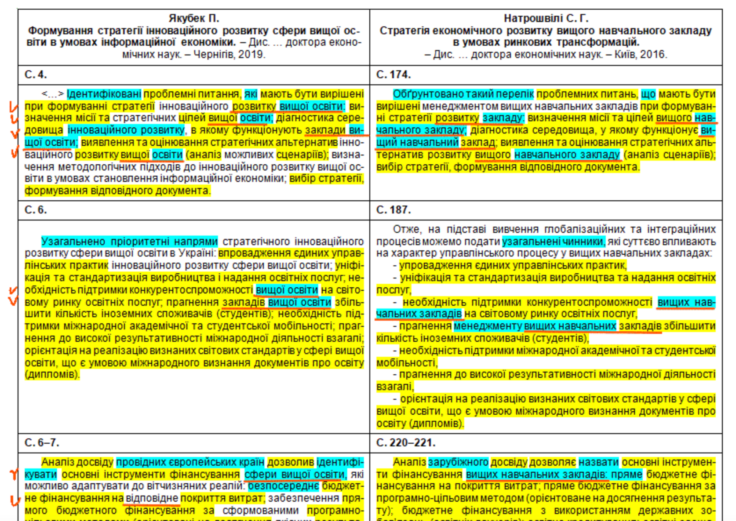
Here one should mention Petr Jakubek, a Doctor of Sciences in economics and a member of the governing board of DTI University (Dubnicky technologicky institut). In 2019, he received a Doctor of Sciences diploma after defending a dissertation at Chernihiv Technological University in Ukraine. As later became clear, a substantial part of Jakubek’s dissertation text coincides verbatim with the text of the dissertation of his opponent, Svetlana Natroshvili, defended in Kyiv in 2016. Below is an example of improper borrowing on one page of Jakubek’s dissertation.

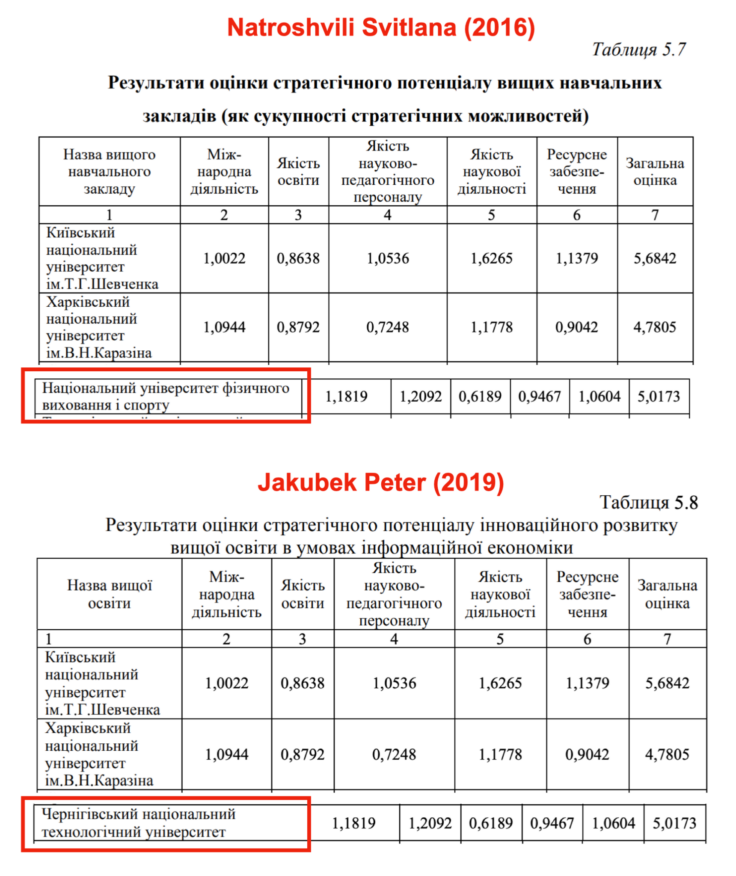
But the problem is not only the absence of citations: even if they had been present, they would not have resolved the issue. In the text, Jakubek mechanically replaced the National University of Physical Education and Sport of Ukraine, which appeared in Natroshvili’s work, with Chernihiv Technological University, while leaving all quantitative indicators unchanged.

The practice of defending a dissertation in another country and then having the diploma nostrified at home is widespread in Eastern Europe and across the post-Soviet space.

If dissertation plagiarism in Slovakia is at least partly documented and discussed by journalists, a much larger problem is developing outside public view. It is a system in which a scientific career can be built not on genuine research, but on purchased articles, fabricated data, and artificially inflated indicators.

In May 2026, the major academic online platform Research.com published lists of top researchers based on h-index and citation metrics. In the field of plant science and agronomy, Professor Marian Brestic, one of the highest-ranked Slovak researchers at the Slovak University of Agriculture in Nitra, placed 213th in the world. His colleague, Associate Professor Marek Zivcak, placed 1,511th globally, becoming Slovakia’s second-highest-ranked scientist in the field. As a result, the university took 253rd place worldwide in this scientific area and second place among the seven Slovak universities included in the ranking, losing the top national spot only to Comenius University in Bratislava.

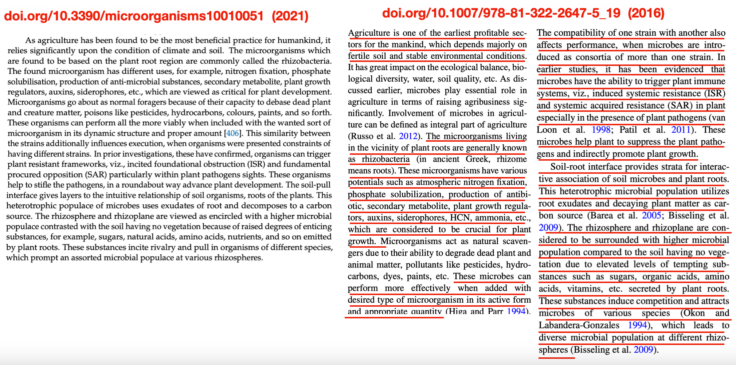
Yet back in 2022, Leonid Schneider, an independent science journalist known for his high-profile investigations into academic ethics, devoted an entire section of his For Better Science issue to Brestic and Zivcak. By that time, these Slovak authors, together with colleagues from Middle Eastern countries, had accumulated nine papers with negative reviews on the post-publication peer review platform PubPeer, some of which had already been retracted. Schneider links this to the purchase of co-authorship on the Asian market — a shadow industry where authorship is sold as a commodity. In some of these publications, experts found distorted phrases and terms, or “tortured phrases”: a characteristic trace of machine paraphrasing used to conceal plagiarism. The image below shows one such example in the journal Microorganisms, on the left, alongside an earlier source text by other authors, on the right, from which the “paraphrase” was made.

Since then, the number of problematic publications has grown. Today, PubPeer lists 34 publications by Professor Brestic with critical comments, some of them co-authored with Associate Professor Zivcak. The reasons for criticism, and in some cases for later retraction, included not only plagiarism or conflicts of interest, but also the substitution of authors at the final stage of publication, after all the reviewers’ questions had already been settled. Such substitutions are considered one of the characteristic signs of papers circulating on the purchased-authorship market.

These scandals, retractions, and exposés, however, have almost no effect on rankings. Even if all the disputed papers by Brestic and Zivcak are officially retracted, their citation counts and h-indexes will remain in the databases. These data are not recalculated retroactively after retractions. Formally, the scholars have already taken their places in the global tables, and no later revelations can dislodge them. A victory in the rankings obtained through paper mills and purchased citations formally remains a victory.

The mechanism of these rankings has a direct financial expression. Under the methodology of Slovakia’s Ministry of Education, every publication that falls within the top 1 percent of the world’s most cited papers automatically brings its author 3,000 euros from the state budget, and the same amount to the university. Thus, an artificially inflated citation index means not only a place in a prestigious ranking, but real money. In such a system, artificial citation inflation acquires a direct financial value: high bibliometric indicators affect not only academic status, but also the distribution of public funds. It is worth noting that Slovakia is not alone here: a similar system of monetary rewards for publications in high-ranking journals has long existed in Russia.

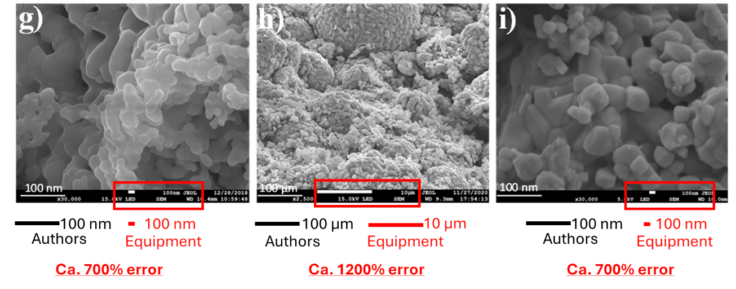
An equally telling case of image manipulation was documented in the work of an associate professor at Comenius University. In a joint 2024 publication in the journal Nano-Micro Letters, Dmitry Medvedev, a professor at Ural Federal University and Doctor of Chemical Sciences, and Martin Motola, an associate professor at Comenius University in Bratislava, together with co-authors from China, manually redrew the scale bar on images of nanoparticles obtained using a scanning electron microscope. The article claimed that the particles under study measured tens of nanometers. The microscope’s technical specifications, however, indicate that the real particle sizes were many times larger (see the image below).

In other words, the scale in the images was simply adjusted to fit the desired result. But that was not the end of the matter. In the same article, experts on PubPeer raised well-founded concerns about other data as well, including graphs. This was not an isolated case: in recent years, experts have identified a whole series of Motola’s papers with problems in the data and in their graphical presentation. The regular appearance of such problems in Motola’s articles can hardly be attributed to simple inattention on the part of the authors.

Publications by scholars from Comenius University also contain direct borrowing of visual materials without references to the original source. A telling example is an article by Professor Peter Mikus and Veronika Mikusova on chitosan nanoparticles, in which some illustrations were copied from an earlier publication by Iranian authors.

In papers where experts identify gross violations of publication ethics, links to Asian paper mills can often be traced. These mills specialize in producing ready-made publications and then distributing them through online platforms.

On the shadow market of paper mills, authorship is not the only thing for sale. Another sought-after commodity is citations. References to one’s own work, like references to the work of others, have long since become a valuable asset. In June 2025, the editor of Chemical Engineering Journal retracted a publication by the aforementioned Associate Professor Motola and his university colleague Muhammad Hanif for artificial citation inflation. Between the original publication and the final version of the article, the number of references to Hanif’s work rose from 2 to 19, and references to Motola’s work from 2 to 10.

Current videos about science during the war, interviews, podcasts, and streams with prominent scholars are available on T-invariant’s YouTube channel. Become our subscriber!

Particular concern is raised by the rapidly spreading practice of publishing review articles under the names of fictitious scholars. The purpose of such works is to introduce numerous citations of articles by people who paid intermediaries on the shadow market for this service into the legitimate scientific record. Thus, the publication portfolio of Beata Gavurova, a professor at the Technical University of Kosice, has raised serious questions among the expert community. “More than 40 scientific articles a year — one every nine days — is a pace that defies rational explanation,” Leonid Schneider notes, following a journalistic investigation published by the Slovak online outlet Dennik N. According to him, dozens of Gavurova’s publications appeared in outlets deemed unreliable or predatory, and some of the journals in which she published have already been removed from scientific databases. At the same time, the researcher’s numerous co-authors represent various Asian countries, which, in the experts’ view, points to the purchase of authorship through networked paper mills.

According to Dennik N, up to one third of papers by Slovak scholars are published in dubious predatory journals.

Yet the external signs of questionable publication behavior are only part of the problem. Gavurova’s own papers contain inconsistencies between the text and graphical data, problems with chemical formulas, and dubious spectra with signals of unnatural shape. Some of these articles have received retracted status.

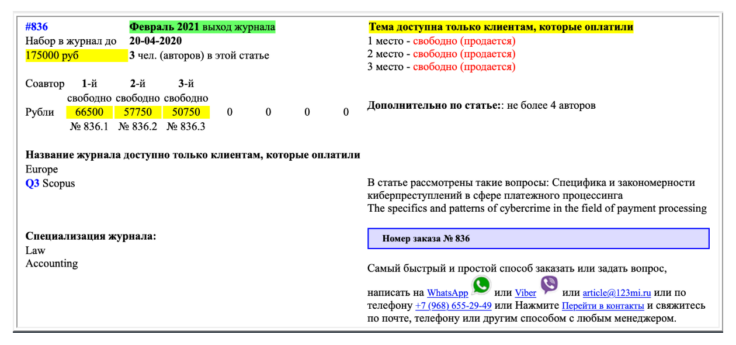
The next case provides direct evidence of purchased authorship in publications distributed by paper mills. Earlier, the Dissernet community drew attention to the interaction of Slovak researchers with a Moscow company that provided article placement services. A telling example is the case of Boris Sturc, an associate professor at the University of Economics and Business: a preliminary offer posted by this exchange was first documented (see the image below), and later a paper with the title listed in the offer appeared in the International Journal of Criminology and Sociology, with Sturc as first co-author. Analysis shows that this was not a one-off: Sturc’s publication list includes other commercially acquired works as well.

Over time, the shadow academic industry is transforming: centralized exchanges selling papers appear to be losing influence. Their place is being taken by decentralized private intermediaries — individual entrepreneurs, or “paper millers.” Technological progress is helping this shift along: modern AI tools make it possible to fabricate scientific texts in the shortest possible time, without involving large teams of specialists from different fields of science. Offers from “paper millers” are easy to find in open internet channels. Traces of this market can also be found in the publications of Slovak researchers. Below are specific episodes involving Slovak scholars in joint publications offered by “paper millers” from Germany, Ukraine, Montenegro, and Middle Eastern countries.

“Olga Golubnitschaja is the editor-in-chief of EPMA, the European Journal of Predictive, Preventive and Personalized Medicine, and at the same time a co-author of many articles in that journal, which is normal. What is surprising, however, is that for many articles in which she is a co-author, very little time passes between submission and acceptance. In some cases it is only a matter of three to five days. Below are several examples from the past year,” says a review of one article involving her. Such short timelines raise the question of whether full scientific peer review was possible — a process that usually includes selecting independent experts, preparing comments, revising the manuscript by the authors, and reassessing the changes made. Olga Golubnitschaja, a professor at the University of Bonn, often appears as a co-author of problematic papers by Russian and Slovak scholars; some of these works later became the subject of criticism for violations of publication norms.

An expert review of a joint article by authors from Slovakia and Ukraine revealed repeated sections in experimental spectra. Among the co-authors of the article, one figure stands out: Taras Kavetsky, an associate professor at Drohobych Pedagogical University in Ukraine, who was found to have used identical schemes of spectral-data fabrication in other scientific works as well.

[[socialnetworks]]

Stanislav Dudic, a Doctor of Sciences at Comenius University and a specialist in international economics, industrial engineering, trade, and investment, appeared as a co-author of a publication that raised serious questions. The paper, written together with the Montenegrin co-author Velibor Spalevic, concerned a modified copper-containing metal-organic framework, and experts detected signs of artificial modification of experimental data. It is worth noting that a number of works by Spalevic himself, a professor at the University of Montenegro, have also been criticized on the PubPeer forum.

Professor Natalia Krivinska, head of the Department of Information Systems at the Faculty of Management of Comenius University, is a vivid example of how formal co-authorship with dubious partners can undermine trust in a scholar. Her article on combating DDoS attacks, prepared in co-authorship with Saudi colleagues through machine paraphrasing, was retracted. But Professor Krivinska’s problems are not limited to a single publication: in her works, experts have found a whole bouquet of tortured phrases, bibliographies unrelated to the subject of the paper, and even direct borrowing of illustrations, all of which calls into question the quality of her entire academic record.

Another case of questionable scientific practice involves the Institute of Construction and Architecture of the Slovak Academy of Sciences. Its employees, Professor Martin T. Palou and Associate Professor Taher Tawfik, were listed among the co-authors of an international paper with Egyptian and Iraqi colleagues, but a review showed that the images presented in the article had undergone impermissible processing, casting doubt on the reliability of the entire work.

The overwhelming majority of the episodes listed above led to no sanctions against the authors. Journalistic investigations and the volunteer work of experts on PubPeer help reveal problem after problem, but real institutional consequences in Slovakia’s academic sphere are barely visible. Retractions do not affect citation indices, and the law allowing academic degrees to be revoked for plagiarism does not apply to works defended before it came into force. As a result, buyers of authorship keep their positions in rankings and universities.

This is the central paradox. Under the Ministry of Education’s methodology, universities receive 50 percent of the state bonus for each highly ranked publication. This means that, in the race for rankings, the universities themselves become interested parties: the more “outstanding” publications their employees have — even if they were bought on the shadow market — the more public funding the university receives.

At the same time, Slovakia’s system of state funding for science, which generously rewards publications in top-percentile journals, effectively creates a “green corridor” for the shadow market. Cash payments to an author for an article they purchased on the shadow market are resources stolen from science. Public funds intended to develop research instead flow into the pockets of shadow intermediaries.

As long as the academic system continues to measure the quality of science primarily by the number of publications and citations, paper mills will be able to turn manipulation of these indicators into academic status and real money. In the age of AI, when producing texts that look scientific is becoming ever cheaper, the problem of how to evaluate scientific work is only becoming more acute.

The post Ratings for Money: How Slovakia Rewards Scientific Fraud appeared first on Т-инвариант / T-invariant.

  •  

Estonian Academic Solitaire: How AI and Paper Mills Are Undermining Science

Estonia spent years building a reputation as being at the forefront of science, but scandals involving violations of research ethics are becoming increasingly common. Professors sharing authorship with falsifiers; associate professors hiding data behind a “confidential” label; mathematicians publishing “math salad” — all of this reflects today’s challenges: the spread of paper mills and the uncontrolled adoption of AI. Sociologists found that more than 40 percent of Estonian researchers had used “gift” authorship. More in the latest installment of the Plagiat-Navigator project.

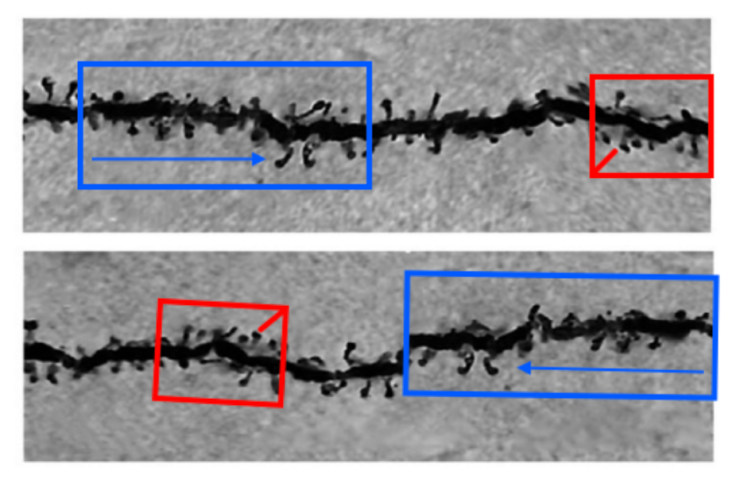
In February 2024, the prestigious scientific journal Nature published the article WNT signalling control by KDM5C during development affects cognition. The researchers were trying to understand why mutations in the KDM5C gene cause intellectual disability. The author team brought together researchers from Boston, Oxford, and universities in Australia and China, along with a single Estonian representative from the University of Tartu — Professor Katrin Ounap, a specialist in medical genetics. A year after publication, experts found multiple deliberate manipulations of illustrations in the paper. The figure below shows the same fragments of nerve-cell processes, or dendrites, reused after mirror reflection, 180-degree rotation, and partial retouching. “Such different transformations of individual image fragments are difficult to explain as a simple mistake,” one expert commented. Some images in the paper also bear a striking resemblance to images from earlier publications by other authors.

It turned out that a group of co-authors from Harvard Medical School in Boston, led by Professor Yang Shi, had been using similar methods for at least a decade. In a paper published in early 2016, fragments of dendrite images were likewise copied from another publication and modified through mirroring and scaling.

Professor Ounap’s contribution to the Nature paper was clinical: she provided fibroblast samples from patients. Her co-authorship with the Boston group, however, dates back to 2015. This does not prove that she knew about the falsifications, but in academia co-authorship entails responsibility for the entire content of a paper. The argument that the professor merely supplied biological material does not absolve her of responsibility for the final result fabricated by her colleagues.

While investigations into international publications can drag on for years, within Estonia’s national system universities sometimes demonstrate an ability to act quickly and decisively. The following case is a telling example. In 2013, Andres Menind, an associate professor at the Estonian University of Life Sciences, defended a dissertation on biotechnology for energy production. Soon after the defense, it emerged that the work contained at least three lengthy plagiarized passages, in both the theoretical and research sections. A procedure to revoke his academic degree followed. It was the first case of its kind in the university’s history. The university leadership acted promptly, without delays or bureaucratic evasions. The university did not publish a percentage of textual overlap, stressing that the decision was based on expert assessment of the nature and significance of the borrowings rather than on a formal similarity score exceeding some arbitrary threshold.

The main news about the lives of scholars during the war, videos, and infographics are available on T-invariant’s Telegram channel. Subscribe so you don’t miss anything.

But Estonia’s academic immune system does not always work. In 2002, Valery Korb defended a doctoral dissertation in St. Petersburg that had been copied in its entirety from an earlier work by someone else. Today, the Estonian politician Valery Korb is a member of the supervisory board of Ida-Viru Central Hospital in Kohtla-Jarve. All attempts to strip him of his academic degree have come to nothing.

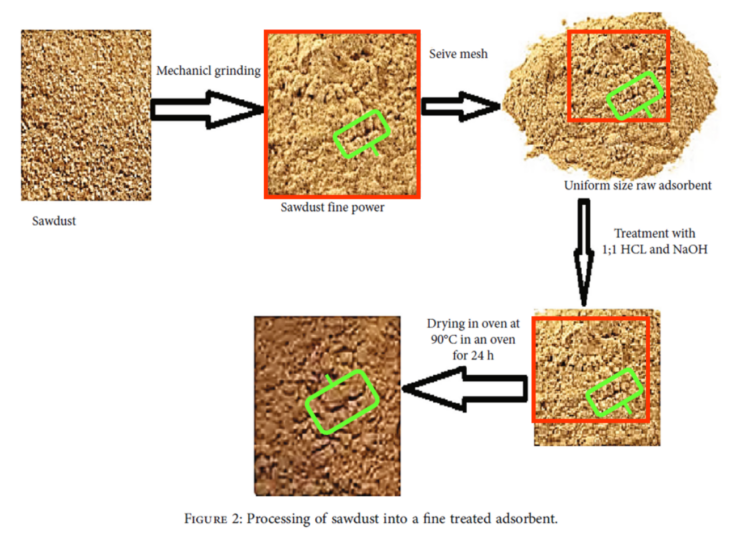
Manipulation of images in scientific publications often ends in retraction — the formal withdrawal of a paper by a journal. The process is usually slow and can take years. The Nature paper remains under question, but a 2022 publication in Adsorption Science & Technology has already been officially retracted. Its authors included researchers from Ethiopia, Pakistan, and Saudi Arabia, as well as an Estonian representative, the young University of Tartu scientist Ivar Zekker. The illustration below shows how the same image was used repeatedly, with only its scale, color, and placement changed.

That paper was retracted, as was another publication by Zekker, for serious violations of publication ethics, including nonexistent bibliographic references, unattributed borrowing, and the use of artificial-intelligence tools in preparing the article without disclosing that use, in violation of the journal’s editorial policy. These are not isolated episodes: experts have accumulated concerns about a whole series of Zekker’s papers. In 2021, his publication output increased by dozens of times, while researchers from Middle Eastern countries began appearing among his co-authors with increasing frequency. This pattern often points to the use of paper mills — shadow Asian markets where ready-made papers and fictitious co-authorship are sold.

[[socialnetworks]]

In 2023, the University of Tartu conducted and later published an anonymous survey of 354 Estonian researchers. Among other things, they were asked whether they had observed signs of research misconduct in the actions of colleagues. More than 40 percent of respondents said that colleagues had accepted “gift” authorship, while more than 10 percent had witnessed colleagues falsifying data in scientific work. These figures reflect not so much precise statistics as the troubling environment in which Estonian researchers work today.

The University of Tartu is far from the only Estonian research institution where questions have arisen about the reliability of published images. One of the most prominent figures in such cases is Sabarathinam Shanmugam, an associate professor at the Estonian University of Life Sciences. According to the post-publication peer review platform PubPeer, roughly one in five papers involving him has become the subject of critical discussion.

One publication by Shanmugam is especially revealing. Experts found manipulation of figures in the paper. After concerns were raised, the authors replaced the illustrations several times, each time apologizing and attributing what had happened to an “unfortunate mistake.” Yet every new version again contained signs of manipulation. Eventually the exchange reached a dead end: the authors never provided convincing explanations, and discussion of the apparent fakes simply faded away. In a later paper, Shanmugam and his co-authors chose a different defense strategy, stating: The data that has been used are confidential. That position effectively deprived independent researchers of any opportunity to verify the reported results.

The story does not end there. A number of Shanmugam’s publications were later retracted after journal editors discovered that the author list had been replaced at the final stage of preparing the papers for publication. Such author substitution is considered one of the characteristic signs of papers circulating on the purchased-authorship market. While one set of “dealers” pushes a manuscript through the journal with a credible author list, another takes orders from people wishing to buy co-authorship in the almost-published paper. At the final stage, once all reviewers’ questions have been resolved, comes the climax: in the last version of the manuscript, the names of the original authors are quietly replaced, without the editors’ approval, by those who responded to the offer in time and paid. The editor, unaware of the switch, publishes the paper. The newly minted co-authors receive a publication to which they did not contribute a single line and which they most likely never even read.

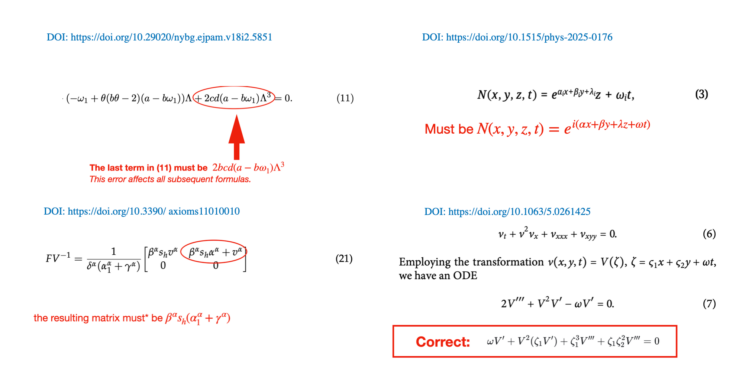
Finally, Tallinn University and one of its employees, mathematics professor Jorge Eduardo Macias-Diaz, also deserve attention. In recent years, specialists have increasingly encountered papers prepared with generative artificial intelligence. In mathematics, such publications are often betrayed less by stylistic roughness than by gross errors in formulas and proofs. To a non-specialist, the text may look entirely convincing, yet mistakes already appear in the first stages of the calculations, rendering everything that follows meaningless.

Mathematics is an exact science. If the third line of a calculation contains the wrong sign, the final ten pages lose all meaning, no matter how many formulas they contain. The image below shows examples from four relatively recent papers by Macias-Diaz in which such errors appear literally in the opening lines of calculations or theorem proofs.

“Math salad” is the term specialists use for texts that look scientific on the surface because they contain an abundance of formulas and technical terminology, but on closer inspection turn out to be internally contradictory or contain errors that make their conclusions unreliable. Naturally, artificial intelligence is “to blame” for everything: the author simply gave the neural network a task and then copied the result into the paper without even checking it.

A curious manifestation of this practice emerged in a case that went far beyond university offices. Tallinn Administrative Court fined a group of plaintiffs who had cited “authoritative scientific studies” on the harms of clear-cutting in their filings. There was only one problem: both the studies and their authors had been entirely generated by a neural network. The court treated this as fabrication of evidence and fined the plaintiffs.

To conclude, here is a curious case in which nonexistent Estonian researchers appeared not only in materials before a Tallinn court, but also on the pages of scientific journals. In a paper by Chinese authors on estimating fuel-cell parameters using the metaphor-based “Grey Wolf” optimization algorithm, a co-author from Tallinn University of Technology suddenly appeared: Tekle Demsas. Apparently, adding a mysterious Estonian scientist to the author list was meant to give the paper greater weight. The deception did not last long. After checking the author’s credentials, the editors established that no such researcher actually existed. The paper was then retracted.

Current videos about science during the war, interviews, podcasts, and streams with prominent scholars are available on T-invariant’s YouTube channel. Become our subscriber!

Estonia, which spent years building a reputation as being at the forefront of science, is now confronting the underside of the global crisis in academic ethics. The cases involving Ounap, Zekker, Shanmugam, and Macias-Diaz are not merely isolated scandals, but reflections of today’s challenges: the spread of paper mills, the ethics of co-authorship, and the uncontrolled adoption of AI. The results of the University of Tartu survey show that these problems are systemic.

The central problem for Estonian science is not that violations occur, but how institutions respond to them. Universities often prefer to look the other way, outsourcing the role of “academic police” to journal editors, courts, and volunteers on PubPeer. In the twenty-first century, a reputation as a scientific center can no longer be taken for granted. Maintaining zero tolerance for falsification requires daily work. And the sooner Estonian universities recognize that responsibility, the fewer reasons for sarcasm they will leave to those watching them.

The post Estonian Academic Solitaire: How AI and Paper Mills Are Undermining Science appeared first on Т-инвариант / T-invariant.

  •  

RASA Statement in Support of Professor Tatiana Tatarinova

Russian-American Science Association strongly condemns the decision of the Russian authorities to designate our colleague Tatiana Tatarinova, a distinguished bioinformatics scholar and professor at the University of La Verne, as a “foreign agent.”

Tatiana joins a growing number of Russian-speaking scholars and members of the RASA community who have been subjected to political persecution, intimidation, and restrictions on their academic and civic freedom. These measures have nothing to do with the quality of their scholarship or their professional activities. They are part of a broader campaign to silence independent voices and to suppress international academic ties.

We stand in solidarity with Tatiana and with all our colleagues who continue to face repression for exercising their fundamental rights to think, speak, conduct research, and communicate freely.

RASA will continue to defend academic freedom and to support scholars subjected to political persecution, wherever they are.

The post RASA Statement in Support of Professor Tatiana Tatarinova appeared first on Т-инвариант / T-invariant.

  •  

Austin Sarat: “Fear Is My Friend”

What do American professors owe their country when democracy and the rule of law are under threat? Why is it crucial to study law not merely as a craft for practicing lawyers, but as a liberal art—akin to history or religious studies? In what ways does the crisis of the death penalty expose deeper fractures in society? T-Invariant sat down to discuss these questions with Austin Sarat. Over a half-century-long career at a prominent American college, he has pioneered the transformation of legal studies into a vital humanistic discipline, emerging as one of today’s most formidable critics of the abuse of law in America.

ABOUT AUSTIN SARAT

Born in 1947. He holds a B.A. from Providence College (1969), a Ph.D. in political science from the University of Wisconsin–Madison (1973), and a J.D. from Yale Law School (1988). Since the mid-1970s he has taught at Amherst College, where he holds the William Nelson Cromwell chair as Professor of Jurisprudence and Political Science. Sarat is widely regarded as one of the architects of the modern study of law in the humanities. He founded Amherst’s Department of Law, Jurisprudence and Social Thought (1992), co-founded the Association for the Study of Law, Culture and the Humanities, launched several scholarly book series, and served as president of the Law and Society Association, which named an early-career prize in his honor. He is the author or editor of more than ninety books, chiefly on capital punishment, law and violence, and the cultural life of law, and writes regularly for Verdict, The Contrarian, and Inside Higher Ed.

T-invariant: I would like to start with the 1960s as a formative period of your life.  You finished college in 1969 and then went straight into graduate school at Wisconsin, which at that time was one of the epicenters of the era. What did those years mean for you — as a scholar, as a person, as a public intellectual? What thinkers, what movements, what events shaped you most?

Austin Sarat: Life in college in the 1960s in the United States was complicated, to say the least. Alongside doing the work you were supposed to do, you also had to deal with events in the world which seemed at that time to be quite unspeakably bad — in this case, the war in Vietnam.

I went to a Catholic school, where the college did not want the world to penetrate. When I arrived at Providence College in the 1960s, it had a dress code. It regulated the length of your hair. That was the kind of environment I experienced in college.

I loved my college experience. I fell in love with my teachers and imagined myself at some point doing what they were doing. A couple of them took a special interest in me and really mentored me and wanted me to go on to graduate school and get a PhD. Their ambition was that I should go to Yale to get a PhD. Alas, Yale didn’t want me. So I went to the University of Wisconsin, largely drawn by the presence of Michael Lipsky, who at that time was a leading figure in the study of cities and urban politics. I arrived in Madison in the fall of 1969. 

Madison was the opposite of Providence College. Where Providence College wanted to keep the world at bay, at Madison you couldn’t follow this principle. There were frequent demonstrations. The University’s Arts and Sciences campus was built on a hill and there were frequent demonstrations there. The presence of the National Guard, the use of tear gas — those things marked my experience as a graduate student. Looking back, as bad as the situation was with the war in Vietnam and the political situation, it was for me a time of hope — I thought people like me could make a difference in the academy and maybe in the world. But truth be told, my heart was more in the academy at that point than it was in the world. I loved political science and imagined that my greatest contribution would be from inside the academy, leading the career of a teacher and a scholar.

Amherst College Professor Austin Sarat Celebration of 50 Years Teaching. Photo: from Austin Sarat’s personal archive

T-i: As far as I understand, you came to your study of law “sideways”: you first became a political scientist, and only much later earned your degree in law. How did that background and that path shape the way you see law?

AS: When I did a postdoctoral year at Yale Law School, I saw a broader vision of what the study of law could entail. But I was still very much in the thrall of the way political scientists studied law: they took the blood and flesh off the subject. And I was quite comfortable with that at the time.

I came to Amherst to teach American politics and only had the idea of going to law school a decade after I started to teach. I went off to law school in 1985, and only there my vision broadened and changed.

My intellectual life turned because of an article written by a Yale law professor named Robert Cover. The title of the article was “Violence and the Word.” And from then till now, I’ve been imagining a conversation between myself and that article.

To study law, to be involved with law, is to have an opportunity to confront those two realities: the reality of language and its meanings, and the reality of violence and its uses.

T-i: In some of your courses and publications you say law consists of three components: moral argument, interpretive traditions, and the social organization of violence. For a reader who does not specialize in law, how could you explain how these three elements hold together?

AS: Most legal systems seek to articulate and reflect the moral values and political beliefs of the culture and country in which they are situated. And in most countries, legal disputes are developed on the terrain of arguments about what is right or just in accordance with the law.

But legal systems and legal institutions are not simply philosophical debating societies. Law is always articulated in language — codes, statutes, court decisions, orders. That means both citizens and scholars are called to attend to the way in which words are used and meanings are assigned in the articulation of laws and judgments. And in the United States and in the Anglo-American world, the way in which language is used in law is governed by its own set of rules.

There is no law without the possibility of enforcement. Otherwise, law is like a birthday card: it carries no more weight than a wish or a greeting. What gives law its weight is the deployment of violence. And legal systems deploy violence in a variety of ways. They punish people and authorize others to use violence.

To make sense of the world of law that surrounds us, we have to understand that we’re going to make arguments about what is right and fair. Those arguments should be made in ways that are recognizable to legal officials. We have to speak this language and follow these distinct traditions and to be aware that there is a lot at stake. When the poets are finished with their argument about what things mean, they go home. When the legal arguments are done, people lose their property, liberty, or in some cases even life.

T-i: For many years, the problem of capital punishment has been the focus of your research. Why has it held you for so long? And what do you think about the development of attitudes toward the whole issue in the United States — do you see it as part of a slow abolition, or of entrenchment?

AS: To study capital punishment is to have an opportunity to see the way in which the legal system — in my case, in the United States — seeks to legitimize the right to take the lives of citizens.

When I started to study capital punishment, I was less interested in its survival than in seeing through capital punishment to broader issues in the culture and the society. I thought this practice crystallizes our attitudes toward justice and mercy, our beliefs about deservedness, our horror at the crimes that in theory warrant capital punishment.

Over time, and somewhat to my surprise, I’ve come to live in two different worlds. One is the old world, where I studied the death penalty not to advance the cause of abolition. I am publishing a new book, and that’s not going to help abolish the death penalty.

But then I have this more public side. I write, and I’m now on the board of Massachusetts Citizens Against the Death Penalty.

And I think the practice of capital punishment is a moral horror. The United States is in a period of national reconsideration of capital punishment. I believe that the United States is on the road to abolition of the death penalty. The abolition is not going to come smoothly — there’ll be ups and downs.

But maybe not in my lifetime — certainly not in my lifetime — but in the lifetime of my thirty-year-old son, I would not be surprised if the death penalty died in the United States.

T-i: Why is it so important to study the new methods of capital punishment and to assess them?

AS: For the last several decades, arguments about the death penalty have shifted a little bit away from its morality and toward an examination of the way it works. You can be in favor of the death penalty in the abstract but against executing the innocent or against executing people because of their race or the race of their victim.

It’s my belief that the death penalty system in the United States is broken from beginning to end. Innocent people get convicted and sentenced to death row. You’re more likely to get a death sentence if you kill a white person than if you kill a person of color. Those are, in my view, easier problems than the cruelty of the method itself.

Because in theory the innocent who are condemned are innocent — they’re like you and me, they haven’t done anything — and people who get death sentences because of the race of their victim are clearly the subjects of injustice. But when we’re inside the execution chamber, we’re mostly dealing with people who “deserve to die,” if anyone ever deserves to die. It’s harder — and, in my view, more important — to focus on the fate of the guilty than on the fate of the innocent.

I don’t think there’s any method of execution, or any practice of execution, that can be considered anything other than cruel. I want to focus attention not just on the suffering of the people being condemned, but on the question of who we want to be. The way we punish is as much about those who punish as about those who are punished. What animates the people who do this?

The United States has been on this quest for a method of execution that would be safe, reliable, and humane. I think it’s a fool’s errand. There’s no method of execution that is going to be humane, even if we could find one that is “safe and reliable” — and we haven’t been able to, and we’re not going to be able to.

T-i: You created something unusual at Amherst — one of America’s most selective liberal-arts colleges. The department you founded there, Law, Jurisprudence and Social Thought, was among the first programs anywhere to teach undergraduates to study law as one of the humanities rather than as pre-law training. I know that when the college formally reviewed the program, an outside committee of experts judged it “superior to every other undergraduate program of its kind in the country.” How did the idea first emerge, and who stood with you as you built it?

AS: I’m going to mention Robert Cover again — “Violence and the Word.” I went to law school and had this intellectual revelation with Robert Cover; it was like deciphering the Rosetta Stone. I came back to the college, and soon the Mellon Foundation was soliciting grants from liberal arts colleges under the theme of “fresh combinations.” I picked up the phone and called my colleague Thomas Kearns from the philosophy department. I said, “Tom, we’re a fresh combination. Let’s see whether we can put together a program at the undergraduate level in law that’s the equivalent of studying religion. We have theology schools — that doesn’t mean we don’t teach undergraduates about religion. We have law schools — why can’t we teach undergraduates about law?”

Kearns and I got support through this Mellon initiative. We developed new courses that didn’t fit comfortably in political science or philosophy or history or anywhere else. And we were doing jazz more than symphony, because there were few, if any, models for us. The first course taught was called “The Fate of Law.” We didn’t want to do “legal studies”; we wanted to do what people had done in the study of religion — to study this thing in its social, intellectual, and cultural context.

LJST was founded on a kind of conceit: that we were going to revolutionize the study of law. We were going to set a model, not just for Amherst, but for the world of undergraduate education. We started a book series. I created new professional associations — all inspired by the idea that law is a subject in the liberal arts. And you don’t have to do it our way; you can have your own church. But at least recognize that law is a subject in the liberal arts: you can look into the way moral argument plays out, understand the play of language, confront the reality that people’s lives are on the line.

And our little college was a perfectly hospitable place to do it, because it’s a liberal arts college. It was easy intellectually and hard logistically, because this was not something the college needed to do, and people in political science were very threatened by this; in part, I think, because they thought it was going to kill the discipline of political science — everyone was going to go study law. The program was voted by the faculty in 1992. We did it differently than I think anybody else has ever done. Generally, when you adopt a new program, you first adopt the program and then the program articulates its curriculum. We did the reverse: we had a whole curriculum lined up, so that people knew what they were buying, so to speak, if they voted for the creation of LJST. The curriculum has changed since, but there it was.

T-i: If you were founding this program today, in the current political climate, would you do it differently? 

AS: Throughout most of my career as an intellectual, I have not wanted students to know what I think.

I don’t go in and try to persuade them. If they want to be in favor of the death penalty, then I would leave them to be in favor of the death penalty. But the present moment — the last decade or so in the United States — has occasioned in me a little bit of a rethinking. I still don’t want students to know what I think about most subjects, but I want them to understand the depth of my commitment to democracy and the rule of law.

So, in the face of the current moment — we can disagree about abortion, or environmental policy, or whatever, and that’s fine; I’m not going to tell you what I think about those things. But the ground norm for the work that we do, you and I, is democracy and the rule of law.

The original impulse of LJST was critical of the rule of law — as ideology, as mystification. And it’s a nightmare, in a way, to look back at all the things we wrote, and to hear similar lines now being articulated by the current President of the United States — “Oh, it’s just political.” In fact, just yesterday we were drafting a job description for a visiting professor, and I said, “How about we include in the job description someone who’s interested in the virtues of the rule of law?”

If I were founding it today, the three pillars would still be the same. But I think the orientation would be to a different kind of relationship to the practices of law in the world. Eighty million Americans voted for the current President of the United States knowing who he was. If you’re going to save democracy and the rule of law in the United States, you need to connect those things to what people care about — how they live, how their children live. Otherwise, why should they care?

T-i: In the recent year and a half, you have written a lot about what you call the weaponization of law against the rule of law. Where, for you, is the line between aggressive but still lawful executive action and what you would define as an actual assault on the rule of law? Has the American state already crossed that line?

AS: The answer to your last question is “yes.” We’ve had many powerful executives; we’ve had many presidents who stretched the limits of presidential power. Franklin Roosevelt used the power of the presidency, but I don’t think it was in the name of aggrandizing himself. This one is different. It’s not just that he’s a powerful executive. His conception of politics is messianic. It’s not just that he’s corrupt or egotistical. What’s his slogan? “Make America great again.” What did he say? “I alone can fix it.”

That’s what we must understand: whatever the peculiarities of his psyche, the politics is illiberal because it’s so personalistic. Whenever I talk about Trump, here’s what I try to say: you can call him names, but my guess is that when he looks in the mirror in the morning, he says to himself, “I’m going to save this country. And anything that gets in my way — what do I care about? Law? A few legal niceties? I’m on a mission from God.” And that’s what I think we need to understand.

We — the American academy — have spent too much time patting each other on the back and making sure we were using the right pronouns. We, the American academy, at a time when we are reviled, need to look outside, to try to understand why millions of people say, “I don’t care about any of that; he’s going to reduce inflation,” or “I don’t care about any of that; he’s going to put a stop to political correctness.”

I used to criticize public intellectuals for fancying themselves of some significance. Now, every day when I come into the office, what I’m likely to do is write something that has no audience in the academy. Every week for the last year and a half I’ve organized a protest — we stand on the corner and stand up for democracy. I’ve organized a network of alumni called the “Stand Up for Democracy Network.” I’ve organized things on campus and helped create a student organization called “Amherst Students for Democracy.”

Students from Amherst College at a rally in support of democracy. Photo: Alejandra Chavez-Flores / The Amherst Student

I don’t write, or demonstrate, or organize, imagining that I’m going to convert the hardcore Trump supporters. I don’t have time to do that. When I was complaining, “Oh, I’m not converting anybody,” one of my former students said, “You don’t understand how much it means to people who are on the front lines that people like you are writing.” I regard my writing as cheering on my side. I regard my writing as bearing witness. I regard my public activity as exemplifying what someone can do when they are terrified all the time. Fear is my friend, and it gets me out on the street — not because I’m courageous, and not because I think they care about me, but because if I don’t stand up, who will?

T-i: At this moment, what is the role of a scholar of law? What can such an expert do to help prevent the abuse of law?

AS: As an expert, I can claim the attention of legislators developing legislation. I can claim the attention of judges, if I’m asked to testify. When I write something for the public, I can do it as an expert: I know these things, and I want to tell you these things. But the real question is: what is the demand for my expertise, and to whom am I lending it? As a person who thinks for a living, do I see things that others might not see, or see them differently than others might?

I think our obligation emerges from our privilege — to be an intellectual, to be able to teach and write. I regard that as a privilege; I just mean, I’m glad I have a job. And with privilege, according to John Kennedy when he spoke at Amherst College in 1963, comes responsibility.

I tell everybody that if you ask the following question — namely, “What will work? What will work to preserve the rule of law? What will work to preserve a constitution?” — it’s the wrong question, because no one knows what will work.

Nevertheless, we need to do three things. The first thing we as citizens and residents of the United States need to do is put out the fire, in whatever way we can: demonstrate, protest, write, organize. The second thing is that we need to commit ourselves to a program of reform that is really oriented to dealing with the despair among large segments of the population.

Go to the emergency room at a public hospital and wait for seven hours. Call your cell phone provider and try to get decent service. Go to Stop & Shop and pick up feta cheese and look at the price: “It’s ten dollars?” Do I need to be an expert to know about those experiences? No, I don’t. Even if you can put out the fire, it’s only going to reignite if we don’t attend to the desperation that leads people to say, “I’ll choose him.”

The third thing is that we need to practice what I call thinking democratically. It means that I should tell the truth as I know it, but I need to tell it in a way that can be heard by someone who doesn’t already agree with me. It’s not enough to say, “You’re a racist, you’re a sexist” — nobody’s mind is going to be changed. To think democratically, you must speak less and listen more. American democracy in many ways failed long before Trump. Trump is a symptom.

You must be curious. You must practice empathy before judgment. You can do that alone; you don’t need to be part of a movement to do it. We not only need to rebuild the infrastructure of democracy — we need to rebuild a culture of democracy.

I’m committed to a program of reform when the time comes — and that will mean people like me live a little less well, so that others can live a little better.

T-i: What’s happening to American higher education under Trump’s presidency, in your view?

AS: American higher education was in trouble long before Donald Trump came on the scene. Now, to talk about American higher education is to talk about apples and oranges and tomatoes and broccoli — the community colleges, the state universities, the research universities; it’s a different thing in each case. What I know best is Amherst College and similar liberal arts colleges.

Amherst College. Photo: amherst.edu

In many ways, places like Amherst had lost their way, but they didn’t know it. If you wanted to talk about racism, Amherst was a fine place for you, long before Trump. If you wanted to denounce capitalism, Amherst was a fine place for you, long before Trump. If you wanted to talk about the white working class, Amherst was not such a fine place for you — because you’d have to look long and hard for people who cared about the white working class.

American higher education, even small colleges, is hierarchical. Colleges and universities in the United States were much more collegial than they are now. I’m not talking about a golden age when everything was great, but let’s be honest — teaching is undervalued in most places. You want to get a job offer? No one’s going to give you a job because you’re a terrific teacher. They’re going to give you a job because you wrote something. That’s fine, but it speaks to a certain kind of values.

So, we were ripe for the picking. And then Trump comes along. What could be better to have as a target? His brand of politics is so interesting, because he targets the powerless — immigrants — and the powerful — he goes after law firms and prestigious universities. What he’s done to American higher education is both dreadful and a kind of slap in the face that may have helped higher education in the United States.

The horrors are unspeakable. But before Trump, if I asked most of my colleagues to explain the difference between academic freedom and freedom of speech, they could not do it. Now, at least, there’s a conversation about what academic freedom is and how to protect it. My hope is that out of the crisis will come something good — a renewal, a regeneration, a recommitment, a recentering of values. How’s that for optimism?

T-i: What can be done, at both the national and the local level, to minimize this harm?

AS: We need alliances, not enclaves.

I’ll give you an example. I was very involved in getting the college to add something to its commitment to academic freedom. The commitment to academic freedom has been, in effect, “The institution won’t punish me.” I said, “That’s fine, but I’m not worried about the institution. I’m worried about threats from the outside.” And the college changed its statement on academic freedom.

It’s the same thing as we think about rebuilding democracy. If you say, “Oh yes, we’re the pure, we’re the just, we’re the righteous.” Why should anybody come to the rescue of American higher education if the attitude is, “Well, what have you done for me?” The next thing I wanted to do was to get the faculty to vote on a democracy resolution. It’s not that we stand for something only when it benefits us. Democracy is essential to education, but our commitment to standing up for democracy is not just so that we’ll live more comfortably. The more that all of us can be seen to be committed to things that don’t just benefit us, the better off we’ll be.

T-i: Why do you think the motivation toward building alliances is still so low?

AS: In the United States this has been going on for a decade, and many people are just beaten down. Others are afraid. Others just want to turn off the noise and take their kids to the skating rink or the library. We know the way this works, and Trump has been pretty good at it. It’s like when your roof is leaking — but it’s leaking from nineteen different places. You put a bucket over here, and then it leaks over there: you are tired of moving your bucket around the house.

I think politics at this moment requires navigating between fear and faith: fear in what I see, faith in what I cannot yet see.

The post Austin Sarat: “Fear Is My Friend” appeared first on Т-инвариант / T-invariant.

  •  

New “Undesirables”: Why the Pentagon Is Restricting Cooperation with Moscow State University and Higher School of Economics

On July 23, the U.S. Department of Defense published a new list of organizations that, according to its assessment, pose a threat to U.S. national security or are engaged in problematic activity. The list includes Moscow State University, Bauman Moscow State Technical University, the Higher School of Economics, Ural Federal University, and numerous other universities and research institutes. The Pentagon believes that these organizations may aim to steal American intellectual property, research data, technologies, and scientific innovations. The Department therefore urges American universities, research institutes, and individual scholars receiving Department of Defense funding not to collaborate with them in any way, exchange data, or provide financial support. Notably, this list is not identical to existing U.S. sanctions lists (read more: “Scientific Front: Who in Russian Science Ended Up Under Western Sanctions — and Why”) and it appeared at a time when, according to Reuters, the U.S. administration has significantly reduced efforts to enforce sanctions against Russia. T-invariant explores what this new policy means for American and Russian academia, how it differs from sanctions law, and who is likely to be affected. 

T-INVARIANT BRIEFING

The restrictions certainly apply to:

  • Researchers affiliated with the listed organizations and working in physics, chemistry, biology, engineering, technology, and defense-related fields.
  • American universities and colleges receiving funding from the U.S. Department of Defense.

They are highly likely to affect:

  • All employees of listed institutions, regardless of their academic discipline.
  • Students of the listed universities when applying to conferences or submitting articles to journals affiliated with American universities or companies.
  • Universities, colleges, research institutes, think tanks, and other organizations worldwide that receive funding from the U.S. government.

The restrictions might affect:

  • Students and graduates of these institutions when applying to American universities.
  • Universities in third countries participating in projects funded by the U.S. government.
  • Researchers at other universities and institutes in Russia, Iran, and China.

The list was issued as an implementation of Section 1286 of the John S. McCain National Defense Authorization Act (NDAA) of 2019. The NDAA is a law that is issued every year and that determines the structure and budget of the U.S. military, including troop numbers, defense spending, modernization programs, and other issues. However, alongside military provisions, Congress also includes neighboring measures, such as foreign policy objectives, and funding allocation. The 2019 NDAA received broad bipartisan support and was signed by President Donald Trump. Compared with previous versions, it increased the military budget, while shifting America’s strategic focus in foreign policy away from counterterrorism toward long-term competition with China and Russia, with considerably greater emphasis on China. This legislation was especially discussed in the media due to the restrictions of Section 889 targeting Chinese technology companies such as Huawei and ZTE.

As part of the same great power competition strategy, Congress included provisions designed to protect American academic research from foreign influence and intellectual property theft. Section 1286, which received the updated list of “problematic organizations,” is titled Initiative to support protection of national security academic researchers from undue influence and other security threats and it specifically addresses universities conducting defense and technology research. Although Congress passes a new NDAA every year, the Pentagon continues updating the same list of the Section 1286 of NDAA 2019 because the 2019 law explicitly requires the Department of Defense to revise it on a regular basis. The July 23 publication is therefore not a new law, but the latest update of an existing mechanism. Being published every year, these updates all have special emphasis, relevant for the moment. For instance, the 2025 version is primarily aimed at preventing foreign influence over research sponsored by the Department of Defense. 

Such activities as funding sanctioned organizations, or exchanging data, were already prohibited by sanctions laws. Also, scholars employed by those organizations could not participate in conferences, or get published in the leading journals if they maintained formal affiliations. There are three fundamental points of difference between the new Pentagon list and sanctions: who is affected, who enforces the law, and what the consequences of violations are. 

Who is affected?

Previous sanctions and earlier lists (such as the 2023 Section 1286 list) targeted a relatively small number of universities involved mainly in military technology development or, in Russia’s case, in promoting state propaganda. Moreover, the restrictions were generally limited to individual representatives or to specific institutes. Before the new list appeared, the largest Russian research center to be included in such restrictions in its entirety was Skolkovo, which was added in 2023 – and in that case, it was hardly surprising.

This time, however, the Pentagon included 13 Russian universities as whole bodies,  and those were not only institutions specializing in engineering, physics, and biology, but also several major multidisciplinary universities, including Moscow State University (MSU), the Higher School of Economics (HSE), and Ural Federal University (UrFU). Several of China’s leading multidisciplinary universities, including Fudan University and Shanghai Jiao Tong University, were also added. HSE employees, speaking on condition of anonymity, told T-invariant  that until now they had been able to collaborate with Western universities as private researchers without listing their affiliation, they participated in conferences online and sometimes even in person, conducted joint research, and published articles.

HSE Rector Nikita Anisimov meeting students from Luhansk State University participating in the “special military operation.” Photo: Telegram channel “Вышка для своих (HSE for the Our Own).”

However, the wording of the new document makes it possible to extend the restrictions to employees of the listed organizations themselves. This means that concealing one’s institutional affiliation and presenting oneself as an independent researcher may no longer be sufficient to circumvent the restrictions: any collaboration between American researchers and scholars who are simply employed by universities on the list falls under Pentagon restrictions. Moreover, even though most organizations on the list conduct research in physics, technology, and such, the policy could affect physicians, historians, and even scholars of the Swahili language.

Who enforces the restrictions?

Another noteworthy aspect is that these measures operate through the National Defense Authorization Act, meaning they are administered by the Department of Defense, unlike the traditional sanctions system. Sanctions are often described as decisions made by the U.S. government as a whole, but departments matter. In reality, Sanctions legislation is passed through Congress or came in force by a presidential decree, and enforcement is typically carried out by either the Treasury Department or the Department of Commerce. But this list is neither a sanction imposed for specific actions, nor a punishment for participating in war or violating the law. Instead, it is presented as a preventive measure designed to protect American research and technology from national security threats. Meanwhile, the official sanctions lists themselves do not receive any updates, and President Trump has repeatedly signaled a willingness to improve relations with leaders of countries that remain under U.S. sanctions. 

The Department of Defense is publishing this update because it is legally required to. At the same time, it does not provide any specific evidence demonstrating that every organization included is “engaging in activities that threaten U.S. national security interests.” The use of national security and foreign influence concerns as justifications for government intervention in science, media, and business is all too familiar from the Russian experience and feels rather unsettling. That is why it is important to understand what this policy means not only for Russian science, but also for American academia.

[[socialnetworks]]

After taking office, President Trump began exerting significant pressure on American universities. His primary targets were campus protests and the promotion of woke ideas concerning equality and the rights of gender, racial, and sexual minorities. The principal tool was the threat of cutting off federal funding. Yet even during Trump’s first presidency, the administration had already started intervening in universities through the concerns of espionage, and in 2018, the Department of Justice launched the China Initiative. According to the MIT Technology Review, the effectiveness of the initiative is highly questionable, partly because the Department of Justice never clearly explained its concrete objectives beyond broad references to protecting American technology and combating espionage. It also failed to clarify the criteria used to initiate investigations. Information about many cases never appeared on official government websites, some records were removed following media inquiries and requests for comment, and only about one quarter of the cases received actual convictions. Moreover, many prosecutions had no obvious connection to national security. This precedent is especially significant in light of the new Section 1286 list, as a precedent. As follows from the name of the programme, approximately 90% of those prosecuted under China Initiative were scholars of Chinese origin, and members of Asian diasporas were subjected to disproportionate scrutiny by law enforcement. MIT Technology Review argues that one of the initiative’s most damaging consequences was the brain drain of highly qualified researchers from the United States. Scientists and scholars were leaving because of the discrimination and pressure from the law enforcement, and it became harmful for the American science itself.

Participants in the Stop Anti-Asian Racism & China Bashing rally in Washington, D.C., March 27, 2021. Photo: Elvert Barnes / Flickr.

During President Biden’s administration, the espionage agenda receded somewhat into the background, but it reemerged, as Trump took office again. On March 26, 2026, the House Committee on Education and the Workforce heard reports on the activities of foreign intelligence services on university campuses. Once again, the discussion focused primarily on alleged espionage involving Chinese students, the recruitment of American students on campus, and cases in which researchers were drawn into projects without being informed on the true purpose of the research. It is worth noting that in his opening remarks, the committee chair emphasized that international collaborations should benefit America rather than its rivals. This idea contradicts the traditional understanding of academia as a transnational space for free exchange of knowledge. International conferences, academic and cultural exchanges, collaborative research, and multinational projects have advanced and benefited science worldwide for decades. As with the China Initiative, extending the logic of national security into universities and scientific research challenges this principle and contributes to the isolation of American science.

At the same time, it would be wrong to deny that espionage, foreign interference in academia and business, and theft of American intellectual property do exist. Roughly one quarter of China Initiative prosecutions ended in convictions, and over the past year, several cases have emerged involving Chinese intelligence agents infiltrating American academic institutions. But these cases differ in one respect, crucial for the NDAA 2019 list: the spies concealed their connections to Chinese universities, military structures, or intelligence agencies. They would typically enter the United States as students, visiting researchers, fellows, or even professors while hiding their institutional ties. They transferred research data and intelligence to the Chinese government, smuggled research materials into or out of the country – it seems that Ksenia Petrova was detained because of this atmosphere of heightened suspicion within academia.

There were also cases of recruiting American students and professors, but it generally happened through malign foreign talent recruitment programs, in which American researchers participated without being informed who would ultimately receive the results of their work or for what purpose. The 2024 version of the Pentagon list was specifically aimed at preventing this practice.

An even more common instrument of espionage has been cyberattacks, like the case reported recently by The Insider. In this case, Microsoft uncovered a scheme that allowed hackers to gain access to data from every device connected to compromised hotel Wi-Fi networks during academic conferences.

Journalist Roman Dobrokhotov described the method for the TVRain channel: “When you try to log in, your credentials get stolen. In the worst case scenario, you’re prompted to download software or click ‘OK’ or ‘YES,’ and a real spyware virus gets onto your laptop. It steals all your passwords and captures everything you type on the keyboard. If a conference has a thousand participants, it is enough just for two or three people to download the malware for the operation to succeed.” According to The Insider, “the group primarily targets governments, diplomatic missions, NGOs, and IT companies in the United States and Europe in order to collect intelligence supporting Russian foreign policy.” 

All of these espionage cases share an important point: every time, the perpetrators concealed the affiliations with the organizations they were truly working for, they frequently used false documents, or even operated remotely. This raises a doubt as to the effectiveness of a ban on cooperation with specific universities. Such a policy is unlikely to counter the methods actually used to steal research data.

How grave are the consequences?

The third major difference between this list and sanctions packages lies in the mechanism of the restrictions: the Department of Defense does not put a ban on the activities of the listed organizations, but it is restricting its own ability to fund them. The universities included in the list, their employees, or American scholars – none of them will face prosecution by law enforcement. However, the Pentagon restricts its ability to provide funding to universities, institutes, or individual researchers who continue collaborating with listed organizations or their employees, or who use their equipment.

At first glance, it might seem that losing such a niche source of funding would hardly affect fields unrelated to the military. For instance, professor of Russian literature Oleg Lekmanov, who taught at Princeton University, expressed precisely this view: “As I see it, this is not relevant to the humanities, because no one from the military sector offers us funding in the first place.” However, the Pentagon has numerous programs and foundations that finance research, and not only in fields related to defense, but also in biology, psychology, medicine, linguistics, the social sciences, and area studies. For instance, Natalia Korbo, a former targeting analyst for the U.S. State Department Economic Bureau, confirmed to T-invariant that the Department of Defense supports an exceptionally broad range of projects, particularly in STEM – science, technology, engineering, and mathematics.

Moreover, funding extends well beyond STEM disciplines. For example, the Minerva Initiative distributes long- and short-term grants for research intended to help the Department of Defense better understand future challenges and prepare for them. Thus, the participating projects cover a range of disciplines. According to Science, Minerva allocated $24.8 million in 2024 alone to projects involving artificial intelligence, climate change, and migration. Yet, the Science reports that the initiative had already begun drastically reducing its funding, even for projects that appeared directly relevant to defense interests. Among those unexpectedly terminated were studies examining the factors that motivate military personnel to remain in service and the conditions that prevent the collapse of international alliances. And now, it might become even more difficult to obtain Pentagon funding, since applicants will have to demonstrate that no member of a project is affiliated with any organization on the list of “the undesirables.”

Apart from research, the Department of Defense provides funding for educational purposes. It awards scholarships to undergraduate, graduate, and doctoral students studying languages and regions considered “critical to America’s security,” and it sponsors academic centers devoted to these fields.

Judging by the Trump administration’s foreign-policy priorities, particular attention is currently being drawn to South America and the Indo-Pacific region. At the same time, the Middle East, Central Asia, and Russia remain areas of strategic interest as well. Consequently, the publication of the NDAA 2019 list will affect not only researchers in biochemistry, physics, engineering, and technology, but potentially also scholars studying Latin American music or Chinese dance if their academic center receives Pentagon funding.

Moreover, it is unclear whether the funding will be lost only by a project or an institute who maintains ties with a banned organization, or the research of the whole university will be considered compromised in case one body continues collaborations. It is entirely possible that if even one department within a university depends on Department of Defense funding, restrictions on collaboration with listed organizations could apply to the university as a whole.

Furthermore, the preamble to the document contains another provision that may substantially broaden its practical impact. Formally, the list applies only to Department of Defense grants, scholarships, contracts, and other financial support. However, it also warns that cooperation with listed organizations may negatively impact scholars’ eligibility for federal funding. And that is a much more serious prospect. The U.S. federal government finances roughly half of all research and maintenance expenditures at American universities and colleges. Federal money also supports countless scholarships, research grants, and academic conferences. In this light, universities will hardly risk losing access to federal funding, even if the document merely warns of possible consequences rather than imposing an explicit prohibition.

Denis Simon. Photo: CCG Update — Center for China and Globalization.

Denis Simon, Senior Research Fellow at the Quincy Institute for Responsible Statecraft in Washington, argues that the U.S. government has effectively stopped distinguishing between leading civilian universities and institutions engaged in security-related research. He also believes American organizations will most likely interpret the conditions of the NDAA 2019 list very broadly. Simon further suggests that universities may begin limiting interaction not only with the organizations explicitly named on the list, but also with other research institutes in Russia, China, and Iran.

A similar concern is expressed by Evgeny Roshchin, Visiting Fellow at the Center for Global Policy of the SAIS School of Advanced International Studies: “On the one hand, the document concerns the research funded through Department of Defense grants. On the other hand, the disciplinary boundaries are not specified. That means it could apply to virtually any field of research, including economics, if it is financed through Pentagon grants. Researchers applying for federal grant competitions will also have to disclose all of their connections with people affiliated with organizations on the list. The existence of such connections may reduce their chances of receiving funding. I believe this will become the main deterrent. Of course, everything will depend on how the rules are applied, but the policy could seriously damage academic cooperation, because some researchers might choose to abandon perfectly legitimate collaborations simply to avoid the risk.”

According to research data, international collaboration is a significant driver of scientific progress. Natalia Korbo believes that while some restrictions are understandable, a blanket prohibition is deeply misguided:

“I understand the logic behind banning joint research in fields like bioengineering or physics, although spies are smart enough not to be affiliated with problematic institutions. But prohibiting all collaboration is simply foolish. It will harm both American science and scientific research worldwide. The restrictions will absolutely affect cultural studies as well. Even the closure of the Confucius Institutes had negative consequences for Americans themselves. Yes, those institutes promoted the Chinese government’s propaganda, but in most American cities they were also the only places where people could learn Chinese. These kinds of bans, like the TikTok ban, are often poorly thought out and produce enormous collateral damage.”

A similar view is shared by Anton Kapustin, professor of physics at the California Institute of Technology: “First, I believe these are serious restrictions, and they extend well beyond defense-related research. Originally, they applied only to projects sponsored by the U.S. Department of Defense. But similar restrictions have since been introduced for grants from the Department of Energy, the National Science Foundation, and other agencies. In practice, they now affect almost all federal grants. Second, the list of proscribed entities grows every year. Now it includes MIPT, HSE, and Moscow State University. If a student has co-authored publications with researchers from these institutions, any American university will think twice before admitting that student to a PhD program, because it will most likely be unable to pay their stipend using federal grant money. There are still many uncertainties, of course, but I think universities will prefer to be overcautious. And obtaining visas will also become more difficult for such students. So the consequences could be very serious.”

Anton Kapustin. Photo: Simons Foundation.

Thus, for Russian researchers, the publication of the list may result in profound professional difficulties. But how capable are these restrictions of protecting American interests? And is the loss of cooperation with Russian, Iranian, and Chinese colleagues truly significant for U.S. science?

Entrepreneur Oleg Tinkov argued in an interview with journalist Mikhail Fishman on TV Rain,  that Russian universities continue to produce exceptionally strong specialists: “Whatever we may say about Putin’s Russia, or Russia in general, its universities and education – especially in mathematics, computer science, physics, and chemistry – remain exceptionally strong, even compared with the United States. I still think Russian education firmly belongs among the world’s top five, and specialists from Russia are highly valued.”

Academic collaborations with China seem to be even more important for American science. Over the past decade, Chinese science has dramatically strengthened its global position. China ranks second in the world in the number of scientific publications. In 2024, for the first time, Chinese researchers published more papers in leading natural science journals than American scientists did, exceeding the US by 17%. Niccolò Pisani et al. emphasize that China’s success has been driven largely by international collaboration and sustained government investment. Consequently, the restriction of scientific cooperation with China can also have an objective of slowing China’s scientific progress. But such a strategy is likely to have limited effectiveness as long as other leading countries continue collaborating with Chinese researchers. Meanwhile, American science itself risks losing specialists and forfeiting one of its greatest competitive advantages: participation in the global scientific community.

As Denis Simon argues, “the policy is likely to accelerate the fragmentation of the US-China scientific relationship, including in fields that have traditionally relied on open exchanges and multinational research teams. It could also limit US researchers’ access to some of the world’s most productive scientific institutions.” Simon also questions whether the policy is genuinely capable of slowing China’s scientific development.

The publication of the 2025 Section 1286 list may therefore substantially limit cooperation between American researchers and colleagues from Russia, Iran, and China. Although at first glance, the restrictions appear to apply only to defense-related research, they are likely to affect a much broader range of academic disciplines. The precedent of prosecuting cases unrelated to security topics, set by the China Initiative, demonstrated that a program announced with narrow security objectives could, in practice, be applied much more broadly. Meanwhile, the threat of losing Pentagon funding and risk of losing eligibility for other forms of federal support are sufficiently serious that many universities are likely to abandon collaborations with listed institutions simply to avoid the risk. The inclusion of major civilian universities such as Moscow State University and the Higher School of Economics potentially affects thousands of scholars who have no connection to military research. It will be harder if possible to participate in American conferences, conduct joint research, or publish in academic journals, even if they present themselves as independent researchers and do not list their institutional affiliation. Even the students from these universities, even though the restrictions do not formally prohibit them from applying to American colleges or universities, may face indirect consequences if institutions, fearing the loss of federal funding, begin extending these restrictions to graduates of listed universities as well. The policy may also affect universities outside the United States that are closely integrated into the American academic system, particularly those receiving U.S. funding. Such institutions may likewise begin limiting cooperation with researchers affiliated with organizations on the list.

Ultimately, the measures intended to protect American science may not only create serious obstacles for researchers from Russia, China, and Iran, but they may also undermine one of the fundamental strengths of American academia itself – international collaboration and the free exchange of knowledge.

The post New “Undesirables”: Why the Pentagon Is Restricting Cooperation with Moscow State University and Higher School of Economics appeared first on Т-инвариант / T-invariant.

  •  

“Are You Alive?” Talking Plants, Purchased Papers, and Repression: What Is Happening to Serbian Science

In recent years, Serbia has appeared more and more often in news stories about violations of research ethics: plagiarism in the dissertations of high-ranking officials, purchased authorship, mass retractions of publications, dubious international collaborations, and studies verging on scientific curiosities. And also — mass political persecution of scholars and university teachers. Are these episodes accidental, or are they manifestations of one and the same problem? Plagiat-Navigator tried to make sense of the situation.

Any account of the current situation with academic misconduct in Serbia has to begin with the story of the doctoral dissertation of Sinisa Mali, then the mayor of Belgrade and now the country’s first deputy prime minister. After “terrible plagiarism” was found in his work, the familiar bureaucratic game began: academic bodies dragged out a decision for years. But in the end, under public pressure and in the face of irrefutable evidence, the ethics committee of the University of Belgrade did annul his doctoral degree. By that time, Mali had already become finance minister. Soon afterward, Serbia’s Constitutional Court overturned the university’s decision. Apparently having lost faith in his own country’s academic system, Mali — by then Serbia’s first deputy prime minister — went to defend a new dissertation… in Slovakia. The Serbian authorities immediately recognized the Slovak diploma. The saga has been going on for more than a decade, and it is not over yet. But it has already become a textbook example of how political weight can cast doubt on the very idea of academic integrity.

Sinisa Mali. Photo: Vreme

Not all stories about plagiarism in the work of Serbian officials end well. Filip Svarm, editor-in-chief of the weekly Vreme, and journalist Nemanja Rujevic, who published the investigation “Anatomy of a Dissertation,” were less fortunate. Former politician Jelena Trivan, now CEO of Serbia’s largest mobile operator and the subject of that investigation, sued the journalists at the end of 2024 and won 80,000 dinars for an infringement of her honor, dignity, and business reputation. At the same time, the court did not question the fact of the borrowings themselves. It concluded, however, that only specialists have the right to classify a scholarly work as plagiarism, while journalists do not have such authority.

University of Belgrade professor Aleksandar Kavcic called what was happening “a war of laypeople against scientists”: a country where ignorance is celebrated and ministers are people who “like to wave around purchased and plagiarized diplomas.”

Plagiarism in Serbia’s academic environment is not limited to politicians’ dissertations. The buying and selling of scientific publications is an even more acute problem. This may be why Professor Kavcic, speaking of colleagues in the field, diplomatically noted that the difference between a real scientist and someone who has acquired knowledge “third hand” is enormous.

Plagiat-Navigator has already written about such “third hands” — the Moscow exchange trading in scientific publications and authorship slots — in the article “Hirsch Index at Market Rate.” One of the figures in that story was Marko Milojevic, a professor at Singidunum University in Belgrade. The case concerned two publications in international scientific journals in which Milojevic purchased authorship in 2021 through the Moscow exchange. A closer analysis shows that, in at least six publications, Professor Milojevic shares authorship with Russian colleagues who regularly use the services of the Moscow firm.

Yet the Moscow trail is only the tip of the iceberg. Following a global trend, Serbian scholars have recently shifted from the Russian market to the more powerful and influential Asian markets for fake publications. In a recent study of retracted papers with Iranian affiliations in computer science, the authors concluded that Serbia ranks among the leaders in the number of jointly published questionable papers, second only to Malaysia. This is hardly surprising: the “paper mill” from the Iranian city of Ardabil, exposed in 2023, also worked actively with Serbian colleagues. The result was the mass retraction of 31 papers in Genetika, the official journal of the Serbian Genetics Society, which lost its impact factor because of “compromised” peer review and citation manipulation.

Manipulation of peer review, authorship, and citation in publications by Serbian scholars has been observed not only in Genetika. Several examples of such papers, retracted from various journals for this reason, are shown below. It should be noted that Russian scientists also appeared as co-authors alongside their Serbian colleagues in these papers.

The compromising of publication procedures is only one item in a long list of dishonest practices used to pull the wool over the eyes of journal reviewers and editors.

Consider another characteristic example: in 2024, experts found numerous distortions of established scientific expressions — so-called tortured phrases — in a paper by Professor Nebojsa Bacanin, vice-rector for research at Belgrade’s Singidunum University. This is a clear sign that the authors were trying to evade plagiarism-detection systems using automated paraphrasing. But, as often happens, the software malfunctioned: it paraphrased the text while leaving abbreviations unchanged, so that they no longer matched their expansions. For example, instead of convolutional neural network (CNN), the text produced the meaningless phrase convolutional brain organization (CNN). Such blunders are the calling card of texts written not by scientists but by algorithms. Incidentally, another paper by Vice-Rector Bacanin was found to contain numerous manipulations with irrelevant bibliographic references.

The main news about the lives of scholars during the war, videos, and infographics are available on T-invariant’s Telegram channel. Subscribe so you don’t miss anything.

The problem, however, is not only how the articles are written, but also how their number is artificially inflated. The inflation of publication activity in Serbian science does not do without a zoo — and what follows is not a figure of speech. The use of metaheuristics inspired by animal behavior is a frequently used method for artificially increasing the number of publications. Many such algorithms are described extremely superficially, while their novelty and applicability to a wide range of tasks raise serious doubts. In most cases, the proposed method differs little from long-known algorithms, and its supposed originality comes down to a new metaphor and fresh terminology. A significant share of such works are merely minor modifications of the well-known Particle Swarm Optimization method.

A telling example: in a 2026 paper by scientists from Saudi Arabia, Egypt, and Serbia, the authors took an interest in the behavior of the spider-tailed horned viper and applied this metaphor to photovoltaic water-pumping systems. It sounds like science fiction, but it is a real publication in a scientific journal. Notably, among the co-authors of the paper we once again find the already familiar Professor Bacanin, vice-rector of Singidunum University.

Nor is the story free of image manipulation. In a joint Iranian-Italian article whose authors include a single representative of Serbia — University of Belgrade professor Jelena Popovic-Djordjevic — experts found telltale traces of Photoshop, the same techniques that have surfaced more than once in similar scandals.

Jelena Popovic-Djordjevic. Photo: ResearchGate

It is worth noting that since 2020 Popovic-Djordjevic has been a constant co-author of Sina Moghaddam, an Iranian specialist in medicinal plants. The scheme is transparent: the participation of European scientists helps Asian authors break into prestigious journals. At the same time, the real contribution of the Western colleagues to the research is often minimal. Their role is reduced to status presence — a kind of “wedding general” at an academic wedding. Until 2020, this honorary function in Moghaddam’s publications was performed by a researcher from Greece. The outcome was entirely predictable: nine of their joint papers have already been retracted, and they have received scathing criticism on Retraction Watch. Now the baton has passed to Popovic-Djordjevic.

It should be added that image manipulation in her papers is not only an Iranian specialty. In a paper signed by ten employees of the University of Belgrade, a curious fact emerged: an image previously used to illustrate liver samples migrated unchanged into a new article — this time as an illustration of kidney samples. The authors were not at a loss: they apologized for an “unfortunate error” and corrected the article.

[[socialnetworks]]

The roots of this tradition of errors, however, run deeper. Back in 2003, one of the co-authors of the aforementioned paper about the liver — now a professor at the Faculty of Medicine of the University of Belgrade, and then a researcher at Queen Mary University of London — Zoran Todorovic, together with his British colleague Christoph Thiemermann, published a paper in which experts also found image manipulation, again involving liver samples. In response to puzzled questions from reviewers, Professor Thiemermann replied with lethal directness: the results of the study, by his own admission, “may not be reliable.” Since then, more than 80 negative PubPeer comments have accumulated on his papers, 15 of which have ultimately been retracted. Techniques honed at a British university, it seems, proved useful in Belgrade twenty years later.

One reliable sign of dishonest publication activity is a sharp rise in the number of papers co-authored with representatives of countries in the Middle East, especially Saudi Arabia, around 2021–2022. In such papers, authorship is often shared by researchers from a good dozen countries — a kind of academic international, assembled by chance around a single publication.

The graph above shows the distribution of the number of papers by Serbian authors co-authored with colleagues from Asia and Africa, depending on the number of co-authoring countries. By a large margin, the leaders in the number of papers are two mathematicians from the University of Belgrade: Professors Dragan Pamucar and Vladimir Simic. The sharp surge in their publication activity falls precisely at the beginning of the 2020s. And if experts find elementary mathematical errors in their papers, there is nothing surprising about it: at a productivity rate of three papers a week, it is simply impossible not to make mistakes. PubPeer has already accumulated claims against a hundred of their publications in international journals, ten of which have now been officially retracted. It seems that in this case quantity really did turn into quality.

To conclude this theme, let us talk a little with plants — yes, yes, do not be surprised. Scientists from Slovenia, Serbia (the universities in Nis and Belgrade), and the University of Pristina decided to find out together whether plants are capable of talking to people in their own language. To do this, they attached a polygraph to the stem of a potted flower and asked the plant questions: “Are you alive?”, “Do you have consciousness?”, “Does it hurt?” The plant was interrogated using a radioactive source of a uranium isotope. The answers obtained were decoded with the help of AI, which translated them into Serbian. To avoid suffering from radiation themselves, the authors of the study used a homemade orgonite — a bioenergetic shield that transforms negative energy into positive energy.

The researchers’ first important discovery was observing how the experimental “vegetable” — this is exactly how they familiarly referred to the potted plant under study — sweated and changed its pulse and breathing rate. All of this was recorded using a polygraph. As a result, the Balkan scientists concluded that plants can be engaged in a rational dialogue in their own language. The results of the study were published in a scientific journal devoted to issues of… acupuncture.

Current videos about science during the war, interviews, podcasts, and streams with prominent scholars are available on T-invariant’s YouTube channel. Become our subscriber!

Behind all these scandalous stories, it should not be forgotten that the majority of Serbian scientists and university teachers are honest professionals who have nothing to do with plagiarism, purchased papers, or other manipulations. The events of the past two years have clearly confirmed this: many of them proved willing to risk their own careers in defense of academic freedoms and democratic principles.

The mass student protests that began in Serbia in November 2024 after the collapse of a canopy at the railway station in Novi Sad quickly grew into a nationwide movement against corruption and political pressure on state institutions. Universities became one of the main centers of protest activity: lecturers openly supported the students, while rectors and deans refused to obstruct university blockades. In response, the authorities and pro-government media launched a campaign against the academic community.

Political pressure was not limited to public attacks. At a number of universities, teachers who spoke out in support of students faced refusals to reappoint them, dismissals, and delays in career advancement. The best-known case was that of Jelena Kleut, a professor at the Faculty of Philosophy of the University of Novi Sad, who lost her job after twenty years of teaching; she herself called what happened a political reprisal. These actions by the Serbian authorities, aimed at suppressing academic freedoms, attracted the attention of international organizations: the European Parliament and the human rights network Scholars at Risk documented an escalation of threats against Serbian scholars, publishing reports on a systemic crisis of freedom of speech.

All these stories are elements of a single ecosystem in which formal indicators replace real science, violations meet no serious resistance, and universities and courts sometimes side with the violators. Politicians themselves, by their own example, have demonstrated for decades that academic integrity is worth nothing if you have power. With this signal, they have been corroding the academic community for years, setting “their own” careerists against those who refused to play their game. It would be a mistake to think that the entire academic community has resigned itself to this state of affairs. But, unfortunately, for now the dialogue between the former and the latter looks more like a conversation with plants.

The post “Are You Alive?” Talking Plants, Purchased Papers, and Repression: What Is Happening to Serbian Science appeared first on Т-инвариант / T-invariant.

  •  

Smolny in Exile: From a St. Petersburg Faculty to a Global Online College

Smolny Beyond Borders, an online education project, has launched the Smolny Associate Degree program, with applications open through July 31. Over two years, students choose courses across a range of fields — the social sciences and humanities, the natural sciences, the arts, and literature. Graduates receive an Associate of Arts degree, which qualifies them to apply as transfer students to U.S. universities, entering in their second or third year (including Bard College, which will also offer third-year admission to its online program). T-invariant spoke with Denis Skopin, a philosopher who teaches at Smolny Beyond Borders, and Philip Fedchin, manager of the Smolny Beyond Borders Initiative and an online-education specialist, about how a liberal arts program was built in exile, whether serious humanities research is still possible in Russia today, and what the future holds for distance learning.

T-INVARIANT BACKGROUNDER

Denis Skopin

Born in 1976. Graduated from Nizhny Novgorod State Linguistic University. Defended his dissertation in philosophy in Paris in 2012. From 2012 to 2022 he taught at Smolny College (the Faculty of Liberal Arts and Sciences at St. Petersburg State University), most recently as an associate professor. He was fired from St. Petersburg State University after taking part in the protests against mobilization in September 2022. He has lived and worked in Berlin since 2023.

Philip Fedchin

Born in 1972. Holds a degree in art history from St. Petersburg State University and a master’s degree in international relations from the University of Limerick. From 1998 to 2020 he taught at Smolny College, serving as associate dean in 2011. Since 2020 he has worked as an online-education specialist at Bard College Berlin. Since November 2022 he has directed the Smolny Beyond Borders project.

T-invariant: Smolny College was one of Russia’s leading centers of humanities education. What were the milestones in the development of liberal arts education in Russia?

Philip Fedchin: Smolny College was founded in 1997, and the first class of degree students enrolled two years later. In 2011 the program became a full faculty of St. Petersburg State University — the Russian equivalent of a school or college. Together with Bard College we ran dual-degree programs at the bachelor’s level (all of our programs) and, in later years, at the master’s level (two of the seven). At any given time the college had as many as 600 students enrolled and about 150 instructors. All told, it offered 14 undergraduate majors and seven master’s programs. Over the years, Smolny graduated more than two thousand students. It was a one-of-a-kind experiment in interdisciplinary education on the liberal arts model. Two other institutions also tried to reproduce that model — Shaninka [the Moscow School of Social and Economic Sciences — T-invariant] and RANEPA [the Russian Presidential Academy of National Economy and Public Administration — T-invariant]. At a certain point Smolny became one of the city’s leading centers of cultural and intellectual life, with a brilliant teaching staff and exceptionally strong students. But in June 2021, when Bard College was declared an “undesirable organization,” our project took a devastating blow.

Philip Fedchin. Photo: Kovcheg (The Ark) Business

T-i: What exactly did you do to get on the wrong side of the Justice Ministry? Why go after some of the world’s leading universities?

Denis Skopin: Officially, Bard College was declared “undesirable” because its activities “pose a threat to the constitutional order of the Russian Federation.” That formula can be stretched to cover just about anything. But as far as I know, the real reason was that Bard received funding from the Soros foundation — and the foundation itself was already on the list of “undesirable” organizations by then. It’s worth noting that this was only a pretext: the leadership of St. Petersburg State University had known perfectly well about Bard’s ties to the Open Society Foundations long before 2021. At the time it looked as though that fact was simply put to use to destroy an independent school, at the very moment when an attempt was under way to spin it off from the university and create a separate liberal arts institution. In hindsight it’s perfectly clear that the direction the college was taking, along with our partnership with Bard College — an institution whose policy rests on respect for human rights and academic freedom — ran counter to the “party line.”

T-INVARIANT BACKGROUNDER

The liberal arts are a model of higher education built on broad study across the humanities, the social and natural sciences, and the arts. The aim is to develop students’ critical thinking and communication skills, along with their ability to analyze information and draw conclusions. Within this model, students design an individual course of study and sample a range of disciplines. The system spread most widely at American colleges and universities in the mid-twentieth century. The first year — and very often the second — involves no specialization: during that period students are meant to work out what actually interests them. After the second year, a student declares a major. Because electives account for such a large share of the workload, students can often add a minor as well, and sometimes even a second major (a double major). The key point is that students make all of these decisions themselves, though with guidance from an academic advisor. Smolny College was the first program in Russia to operate on the liberal arts model. Today there are no institutions left in Russia that work this way.

T-i: Do you follow the academic work of your former colleagues who stayed in Russia? Is the range of what they can research narrowing under the pressure of repression? And is it still possible to do serious work in the humanities today, so long as you steer clear of obviously taboo subjects like the war or gender studies?

DS: I personally know a lot of competent, decent teachers who stayed in Russia. These are anti-war people, and their situation right now is not one you’d envy. The leading prewar educational projects in Russia have all fallen apart, one way or another. Smolny is gone. Shaninka has been shut down. HSE [the Higher School of Economics — T-invariant] has been thoroughly “purged” of disloyal faculty members. Russian higher education has withered before our eyes, in the space of just a few years. Faculty members who remain in the country can no longer say what they think. Before the full-scale invasion it was still possible, even as Russia was rapidly turning autocratic. Yes, there was administrative pressure, there were attempts to control what got taught, but what goes on in the administrators’ offices is one thing and what goes on in the classroom is another. Now that has changed: you can’t speak frankly with students, because sooner or later someone will report you. As the old line has it, “If twelve of you are plotting a conspiracy, one of you is bound to be a traitor.”

Denis Skopin. Photo: Bumaga

Researchers in Russia today are arguably worse off than they were in the Soviet Union. Back then, for instance, holders of a Doctor of Sciences degree [the higher of Russia’s two doctoral degrees — T-invariant] could order scholarly literature from abroad. Today Russian scholars’ access to foreign libraries is severely restricted. If you’re a historian or a literary scholar, say, some 80 percent of the foreign scholarly literature you need to read isn’t in Russian libraries, and you won’t find it in open access either. And that’s before you get to how much harder it now is for a Russian scholar to publish with a serious international academic press. My own book, for example, came out with Routledge in 2022, literally a month before the big war started. I find it hard to imagine a scholar living and working in Russia getting a monograph published by a Western press today.

T-i: What’s the bigger obstacle to cooperation between Russian and Western researchers: pressure from the authorities, or Western partners’ unwillingness to deal with an aggressor state?

DS: There is pressure from the administrations of Russian universities, but Western universities are hardly likely to work with scholars based inside Russia right now either. Before the full-scale invasion there were any number of joint projects, especially with Europe, which is right next door. After February 2022, collaborating with Russian institutions — state universities above all — simply became toxic. Which means that a researcher working with scholars in Russia has to be absolutely certain about the people involved: certain they haven’t signed pro-war letters or taken part in hounding their anti-war colleagues. Nobody can offer that kind of guarantee. So Western scholars don’t want to take on the responsibility. Of course, individual scholars had personal ties with Western colleagues, and those haven’t gone anywhere. But direct collaboration is on pause.

[[socialnetworks]]

T-i: Given everything you’ve described, how did your project come about in the first place? And tell us how it differs from other educational initiatives in exile — the Free University, for instance.

DS: In February 2022 the college was shut down in all but name. Officially it still exists, but in reality it’s a ruin, and as early as this year students will no longer be taught under the old liberal arts curriculum. The colleagues who left became the backbone of Smolny Beyond Borders. The core of our project consists of people who worked at Smolny College itself, and we’re carrying on the tradition Smolny had before the full-scale invasion. We started out as a set of standalone online courses, but last year we launched our first degree-granting online program.

That’s what sets us apart from many other online education projects: we are first and foremost an academic project. We don’t just let people sit in on our courses — we give our students a way to take their first step toward the global higher education system. We hold the relevant U.S. accreditation. Along with the Associate Degree, we also offer shorter certificate programs.

PREVIOUSLY IN T-INVARIANT

“Professors have no right to drag ideological preferences into the university.” Marina Kalashnikova on the Faculty of Liberal Arts & Sciences in Montenegro

“Come New Year’s, an owl will fly in from the Ministry of Magic with a letter saying the license is gone.” Shaninka faculty on how the authorities destroyed one of Russia’s most important universities

Free education cannot be deemed “undesirable”

Universities in Exile: A Growing Industry

T-i: So this is a full-fledged online bachelor’s degree?

DS: It’s more like the first stage of one. Our program runs two years, and graduates receive an Associate of Arts degree, which allows them to continue their studies in person at one of the institutions affiliated with Bard College (assuming, naturally, that the transfer goes through). Starting in September 2027, Bard Global Degree plans to open a full online bachelor’s program, into which our graduates will be able to transfer as third-year students. That degree will have three broad majors: 1) philosophy, politics, and economics (PPE); 2) literary and media studies; 3) data science.

T-i: Plenty of applicants will choose an online program over an in-person one. What do you see as the prospects for distance higher education in exile?

DS: I think the remote format creates obstacles and opens up new horizons at the same time. Among the drawbacks is the physical and psychological strain on students, who have to spend several hours a week in front of a computer. As a teacher, I miss the live, human contact with students that the classroom always provided. That said, online learning has obvious advantages. Above all, it’s far cheaper: a university doesn’t have to maintain a campus or buy equipment, which means those costs aren’t passed on to students. Online education has also long since become mainstream — practically every large university now has a unit devoted to it. Tellingly, most Russian faculty members who left after the full-scale invasion began — around 90 percent, I’d guess — now work in online education projects in one form or another. For them it’s both a way to survive and a new professional niche.

Top news on scientists’ work and experiences during the war, along with videos and infographics — subscribe to the T-invariant Telegram channel to stay updated.

T-i: How closely does your curriculum follow Smolny College’s?

PF: The structure of the Smolny Associate Degree is identical to that of comparable Bard College programs, since the degree itself is Bard’s. But the teaching is done primarily by our own instructors. Not exclusively, though — Associate Degree students can also take courses from the Global Higher Education Alliance for the 21st Century network, which widens their options considerably.

T-i: Do students pay tuition at Smolny Beyond Borders?

PF: Tuition is €5,000 a year. But we aren’t counting on tuition to bring in any real income, and we encourage everyone who can’t pay anything at all to apply.

All of our students currently receive substantial discounts, up to 100 percent, depending on what they can afford. In effect, you can complete two years at an American college practically for free (setting aside what a laptop and an internet connection cost) and then either try to transfer to a regular in-person institution — where tuition is a different matter, and whatever discounts exist depend on the school you’re transferring to — or apply and enroll as a third-year student in the online bachelor’s program, on roughly the same terms you had for those first two years.

T-i: What share of the prewar teaching staff now works at Smolny Beyond Borders? Do you hire instructors who haven’t taught in other liberal arts programs before?

PF: Of our 30 current instructors, roughly half once taught at Smolny College or were directly connected to it. But we also have people who taught at the European University at St. Petersburg, at Shaninka, and elsewhere.

T-i: The Associate Degree offers a wide range of courses, from philosophy to data science. On the one hand, that looks appealing to a Russian applicant used to narrowly specialized degree programs. On the other, plenty of people will ask themselves: “And what are my job prospects once I finish?” A lot of people have switched into survival mode, and it can feel like this is no moment for philosophy or art history — far better to study something applied that pays off quickly.

PF: If you look at global university rankings, American universities are at the top — and their undergraduate education is built on precisely this liberal arts model. Students get to choose a specialization not when they apply but later, once they’re already at the university, after a year or two. A student first picks a few individual courses, tries out different fields, and only then, on the strength of that experience, chooses a major. The Associate Degree is exactly those first two years, and the point is to help students figure out what actually interests them. This trend didn’t emerge in a vacuum: it answers the demands of the labor market and, above all, the needs of students themselves. And yes, one important point. When someone claims a program embodies liberal arts principles, I usually suggest asking a simple question: what share of their coursework do students genuinely choose for themselves? If it’s less than half, it’s liberal arts in name only. In our case, of the 64 credits in the two-year program, only 13 are required courses. In other words, students choose three-quarters of their courses on their own, with a single additional constraint on the remaining 50 credits — they must take at least one four-credit course in each of the four distribution areas (mathematics and the natural sciences, the social sciences, literature, and the arts).

Up-to-date videos on science during wartime, interviews, podcasts, and streams with prominent scientists — subscribe to the T-invariant YouTube channel!

T-i: How will events in Russia shape your project’s fate and trajectory? Take two extreme scenarios five years from now: either Russia enters a period of sweeping change and democratization, or the country goes down the North Korean road. Would either affect you, or are you building your educational path independently of what happens in Russia?

PF: If positive change does come to Russia, I’m confident that the Faculty of Liberal Arts and Sciences will quickly be restored to its former shape. And that would mean not just the revival of one school but the full implementation of the model within the official educational standards. The thing is, when the plan for a new university built on Smolny was being drawn up, an enormous amount of work went into developing a new educational standard. In the end it never came to anything, but what’s written down doesn’t disappear — those ideas can perfectly well be taken up again in the future. Much of what made Smolny College interesting was precisely that it ran a liberal arts and sciences model inside a Russian university.

As for the North Korean scenario, our program was international from the outset, and we’re part of the Bard Global Degree project, whose whole purpose is to build a model for supporting displaced students and displaced scholars in a range of contexts. And while we do enroll students located in Russia in courses outside the Associate Degree, for the Associate Degree itself we accept only applicants who are outside Russia, for obvious reasons. In that sense we work with the diaspora — and given that all the program’s required courses are taught in English [except one — T-invariant], internationalization is a natural process.

Support T-invariant’s work by subscribing to our Patreon and choosing a donation amount that suits you.

The post <h1>Smolny in Exile: From a St. Petersburg Faculty to a Global Online College</h1> appeared first on Т-инвариант / T-invariant.

  •  

Chronicle of the Persecution of Scientists No. 35

T-invariant is publishing its latest regular report, Chronicle of the Persecution of Scientists No. 35, dated July 31, 2026. Russia’s State Duma has passed a law aimed at political émigrés. Human rights advocates say it is effectively a citizenship-stripping law. The Russian authorities are expanding the practice of freezing bank accounts outside of any specific case, on the basis of “suspicion” alone. Extrajudicial persecution is becoming ever more widespread.

According to First Department [a Russian human rights organization that defends people accused of treason and espionage — T-invariant], on July 22, 2026, Russia’s State Duma passed a law aimed at political émigrés. Human rights advocates say the law drastically curtails the rights of Russians who have left the country and been found guilty in criminal or politically motivated administrative cases. As lawyers describe it, this is a de facto citizenship-stripping law: “For now, lawmakers aren’t proposing to confiscate the passports of people named in political cases — but they are proposing to strip them of many key civil rights.”

“Under the text of the law, anyone named in a criminal case or a political administrative case will be unable to obtain a new foreign-travel passport, execute a power of attorney, access government services online, dispose of their property, register a vehicle, or use a digital signature. These are only some of the basic rights that people persecuted by the state will lose,” First Department reports.

Our database tracks scientists, university teachers, and research engineers persecuted in Russia. A large group of them have been labeled “extremists” or “extremists and terrorists” by the state — that is, entered in the registry kept by Rosfinmonitoring [Russia’s Federal Financial Monitoring Service — T-invariant]. For the repressive machine, this is a very convenient form of persecution. Rosfinmonitoring puts a person on the registry, and the banks do the rest: they freeze the accounts — and the freeze takes effect at every bank at once — which makes that person’s life extremely difficult. This applies both to those living in Russia and to those living abroad who keep an account at a Russian bank, to receive a pension, for example.

As a rule, putting someone on Rosfinmonitoring’s public registry required that a case first be opened against them under an “extremism” or “terrorism” article. A conviction was not necessary; not even formal charges were necessary. An investigator would send a letter to Rosfinmonitoring, the person would be added to the registry, and the banks would freeze the accounts. But the existence of an administrative or criminal case, or of inclusion in the Rosfinmonitoring registry, is a matter of public record: it is easy to find out about, and the decision can be appealed.

Back in 2013, Federal Law No. 115-FZ, On Countering the Legalization (Laundering) of Criminally Obtained Income and the Financing of Terrorism, was supplemented with Article 7.4, expanded in the summer of 2025 to cover sabotage. It provides for another way to freeze accounts: with no case opened at all — on the basis of “suspicion.”

On July 21, 2026, Meduza reported: “The Russian authorities have quietly begun freezing the accounts of well-known cultural figures who have left the country. The first to report this was political scientist Ekaterina Schulmann, on her show ‘Status,’ back on July 14. According to her, this is being done on the basis of an unofficial ‘secret list,’ without any notification whatsoever. Schulmann said the freezing decisions are made by the Interagency Commission for Countering the Financing of Terrorism and Extremist Activity.”

This kind of covert freezing appears not to have been used before 2026, at least not on a mass scale. Meduza writes: “First Department lawyer Evgeny Smirnov told Agentstvo [an independent Russian news outlet — T-invariant] that the commission’s decisions are supposed to be published under the law, but they are impossible to find, since the commission does not even have a website. Smirnov said that lawyers have been running into cases like these over the past six or seven months.”

We know of accounts frozen in June–July 2026 that belong to people who are not currently in the Rosfinmonitoring registry. It may well be that the Interagency Commission really is compiling a “secret list” of its own, as Schulmann suggests.

A specific charge, a specific article of the code, specific evidence — all of these can be appealed. But a decision by the Interagency Commission, which never discloses what the “suspicion” consists of, is very hard to contest. Formally, the law does provide a right to judicial review (Article 7.4, paragraph 3). In practice, though, to appeal a decision you first have to learn that it exists and read it — and according to attorney Evgeny Smirnov, the decision cannot even be located.

The Russian authorities continue to expand the machinery of extrajudicial persecution, and the emphasis has now shifted to those who have left the country. Until now, we have been able to track persecuted scholars who ended up in the Rosfinmonitoring registry and faced banking restrictions. If a “secret list” exists, that kind of monitoring is incomplete. The registry gives us only a lower-bound estimate, which we can supplement with the testimony of those affected.

New entries

Darya Shipacheva

July 29, 2026. The Moscow City Court sentenced science journalist Darya Shipacheva to 12 years in prison on a charge of treason (Article 275 of the Russian Criminal Code). This is the same term the prosecution had requested. The court also confiscated 1.5 million rubles from her and imposed a fine of 300,000 rubles, Politzek-Info [a Telegram channel that tracks political prisoners in Russia — T-invariant] reports. The trial was closed to the public. The defense asked the court to take into account her guilty plea and her cooperation with investigators. T-invariant reports that the treason charge grew out of a money transfer to Ukraine.

Roman Melnichenko

July 22, 2026. The Central District Court of Volgograd ordered Roman Melnichenko, a lawyer and former lecturer at Volgograd State University, held in pretrial detention. He will remain in custody at least until September 20, Politzek-Info reports. Melnichenko was detained in a criminal case over repeated “discrediting” of the Russian armed forces (Part 1 of Article 280.3 of the Criminal Code) [the criminal charge applies to those who have already been penalized once for the same offense under administrative law — T-invariant]. The prosecution was triggered by a post on VKontakte and a video on another, unnamed video platform, both published in September 2025.

Maxim Kravchuk

July 19, 2026. It became known that a criminal case had been opened against Maxim Kravchuk, a physicist from Shchyolkovo, under Article 275 of the Russian Criminal Code (high treason). Kravchuk was detained on June 24, but this only came to light on July 19, Politzek-Info reports. According to Mediazona, citing Kravchuk himself, he is accused of sending photographs to a relative abroad. “Sergey Nikolaevich Kazimir is my uncle; the only thing between us is a family relationship. I do not agree with the charge brought against me. I’m ready to swear that I never sent any photographs. The investigation will figure this out,” Kravchuk said. According to his attorney, Kravchuk is accused of ties “with people from the near abroad, specifically with Kazimir” [“the near abroad” is the standard Russian term for the other former Soviet republics — T-invariant]. His attorney also pointed out that the law does not prohibit communicating with relatives.

Updates

Valery Kachin

July 28, 2026. A new case has been opened against Valery Kachin over alleged justification of terrorism, reports Memorial’s Support for Political Prisoners project. Rights advocates have learned that the new case rests on a few remarks Kachin made a year ago, when he compared Ukrainian special forces units to fighters from the Wagner private military company. What exactly he said is not known in detail. So far this is the only episode in the case, but a second may be added, over some comment Kachin made about the Network case during a walk while he was being held in a punishment cell.

Mikhail Volkov

July 21, 2026. Mikhail Volkov has been removed from the Rosfinmonitoring registry, Politzek-Info reports.

Azat Miftakhov

July 15, 2026. The Labytnangi City Court ruled unlawful the Investigative Committee’s refusal to open a criminal case in response to mathematician Azat Miftakhov’s complaint of torture at penal colony IK-18, known as Polar Owl. Investigators are now required to conduct an additional review within 30 days, Politzek-Info reports.

Maxim Kruglov

July 14, 2026. Prosecutors appealed Maxim Kruglov’s earlier sentence. Prosecutor Yulia Guznyaeva filed an appeal asking that the sentence be vacated and the criminal case sent back for a new trial. On June 24, 2026, Kruglov was sentenced to seven years in a general-regime penal colony, but the prosecution was not satisfied with the sentence and wants Kruglov punished more severely, Politzek-Info reports.

Grigory Severin

February 18, 2026. The Paninsky District Court in Voronezh Region sentenced Severin to three years in a strict-regime penal colony under the law on public “discrediting” of the armed forces, SOTAvision reported. On July 6, 2026, the Voronezh Regional Court reduced Severin’s sentence from three years to two years and ten months in a strict-regime colony. This was reported from the courtroom by a correspondent for SOTAvision.

Olesya Krivtsova

July 4, 2026. The Northern Fleet Military Court sentenced activist and journalist Olesya Krivtsova in absentia to six years in a general-regime penal colony under the articles on “justifying terrorism” (Part 2 of Article 205.2 of the Criminal Code) and “repeated discrediting of the Russian armed forces” (Part 1 of Article 280.3 of the Criminal Code). On top of the prison term, she was barred for three years from administering online resources, Politzek-Info reports.

Dmitry Bogmut

June 27, 2026. Dmitry Bogmut fainted for the second time during roll call at his penal colony, reports Memorial’s Support for Political Prisoners project. He had lost consciousness once before, on June 9, also during roll call. His blood sugar was elevated after the first episode and higher still after the second. An endocrinologist has yet to examine Bogmut, because the doctor is on leave. He was excused from morning roll calls for six days. “For now they’ve chalked it up to vegetative-vascular dystonia, some type or other,” his support group writes [vegetative-vascular dystonia is a catch-all diagnosis common in post-Soviet medicine and not recognized internationally — T-invariant].

Kirill Yakovlev

June 22, 2026. Prosecutors asked that the case of Kirill Yakovlev (Glikery Ulunov) be sent back for a new trial. This was reported by First Department, citing attorney Anastasia Pilipenko. Pilipenko writes: “Prosecutors don’t like it when young, happy, and utterly harmless poets go free. <…> On the plus side, for the first time the prosecution managed to call a poem a poem, rather than ‘textual material.’”

The post <h1>Chronicle of the Persecution of Scientists No. 35</h1> appeared first on Т-инвариант / T-invariant.

  •  

The Paradox of Open Borders: Why Physical Freedom Doesn’t Liberate the Mind. An Interview with Marina Bykova

In 1993, Marina Bykova became the youngest scholar in the humanities in Russia to earn a Doctor of Sciences degree [Russia’s higher doctorate, awarded years after the Ph.D.-equivalent candidate’s degree — T-invariant]. Today she is a professor at an American university and editor-in-chief of the influential international journal Studies in East European Thought. For many years her professional life has been devoted to building and sustaining dialogue between the Russian philosophical tradition and the international academic community. It is a singular and often difficult mission — keeping intellectual bridges open at a time when political conflict is tearing apart the usual academic ties. In an interview with T-invariant, Marina Bykova reflects on why Russian academia has been paralyzed by fear, how the cultural project of the “Russian World” turned into a political ideology, what happens to philosophy when it loses its autonomy, and how the experience of the Soviet “sixties generation” of philosophers [shestidesyatniki, the reform-minded intellectuals who came of age during the post-Stalin Thaw — T-invariant] helps us understand the relationship between philosophy and power today.

Top news on scientists’ work and experiences during the war, along with videos and infographics — subscribe to the T-invariant Telegram channel to stay updated.

Science Under Sanctions

T-invariant: Let’s start with your work as a journal editor. Before you became editor-in-chief of Studies in East European Thought, you ran another journal devoted to philosophy in Russia, didn’t you?

Marina Bykova: Yes, before that I was editor-in-chief of Russian Studies in Philosophy; I was invited to take it over in January 2008. By then I had already guest-edited two thematic issues for it at the invitation of the editor at the time, Taras Zakydalsky, a well-known scholar of Russian and Ukrainian philosophy. After his death, the publisher asked me to take charge. The journal had a rather unusual format: it published thematic clusters of articles that had previously appeared in Russian and were then translated into English, mostly from journals such as Voprosy filosofii (Problems of Philosophy), Filosofskie nauki (Philosophical Sciences), and Vestnik MGU (the Moscow University Bulletin). I proposed expanding that model to include original research written specifically for the journal.

T-i: So the journal was a window through which Russian-language philosophy reached Western academia?

MB: Exactly. Most Western scholars had limited access to philosophical literature in Russian, and many of them found it hard to read Russian at all. So our job was to give Western readers a sense of what Russian philosophy was preoccupied with, which problems it was debating, and what intellectual discussions were unfolding inside it.

T-i: How did you manage to keep that format going?

MB: We put out thematic issues, for which Russian authors sent us their articles in Russian. Professional translators then turned the texts into English. But philosophical translation takes more than simply knowing the language; it requires a deep grasp of the subject, the terminology, the context. So I often had to edit the translations heavily, and sometimes essentially rebuild whole passages from scratch. What came out in the end were fully fledged scholarly articles that specialists still use today. The journal’s archive is available on the publisher’s website.

T-i: Why was the journal shut down?

MB: I’ll admit this is still a hard question for me to answer. That journal was bound up with many years of my life, and its closing was painful. But to understand the decision, I need to say a few words about the journal itself. It was part of a large series that originally ran to more than ten titles covering Russian scholarship across the humanities — history, literature, cultural studies, education, and other fields. These journals were founded back during the Cold War and at first served as an important source of material for Sovietology. After the Cold War ended, they retained their significance and continued to serve an important informational function for the Western academic community.

Originally the entire series was published by a small publishing house, M. E. Sharpe, but by the time I was editor-in-chief the titles had moved to Taylor & Francis, which had acquired M. E. Sharpe along with everything it published. In its final years, Russian Studies in Philosophy appeared under the Routledge imprint — one of the leading international humanities publishers — which raised its standing considerably. The journal was widely cited, scored well in the international databases, and consistently ranked highly in Scopus-based metrics, which in turn drew a large number of Russian authors.

BACKGROUND

M. E. Sharpe was an independent American academic publisher founded in the 1950s. It issued a series of journals under the general heading Russian Studies in…, which grew out of American academia’s interest in studying the USSR and Russia during the Cold War. The series included Russian Studies in Education, Russian Studies in History, Russian Studies in Literature, Russian Studies in Critical Thought, and Russian Studies in Philosophy. In the 2000s, a substantial part of M. E. Sharpe’s academic portfolio, the journals included, was acquired by the Taylor & Francis Group, which went on publishing them under the Routledge imprint.

After Russia launched its full-scale war against Ukraine, the publisher sent the editors of every journal in the series a notice that it had decided to discontinue them. Formally, this was presented as a business decision. I managed to win a one-year reprieve, since by that point we already had a fully prepared publishing plan of six issues. Simply abandoning material that authors and editors had worked on for years struck me as impossible. As a result, ours was the last journal in the series to go: it closed only in May 2023.

T-i: And do you think it really was a business decision, or…?

MB: No. My own experience, at any rate, convinces me otherwise. I believe it was first and foremost a politically motivated decision. In January 2019, nearly four years before Russian Studies in Philosophy closed, I had also been invited to head another journal, Studies in East European Thought (SEET), published by Springer. After the war began, representatives of the publisher approached me as editor-in-chief and proposed limiting submissions by authors with Russian institutional affiliations. I asked on what grounds such a measure was being proposed. I was told that the policy followed from the general sanctions regime and from political decisions taken in Europe and North America with respect to Russia. They also stressed that many Ukrainian colleagues categorically objected to publishing Russian authors.

But a scholarly publication is not in itself an expression of support for a state or its policies. I consistently distinguish between philosophical thought and state ideology: the first, by its very nature, presupposes critical thinking and autonomy, while the second seeks to use knowledge as an instrument of political ends. Judging philosophical work primarily through the lens of political affiliation inevitably undermines the very principle of academic freedom.

So my position was a matter of principle: the only criterion for publication in an academic journal should be the quality of the scholarship. I replied that the journal would go on accepting articles from researchers with Russian affiliations. My editorial board fully supported that stance. I also told Springer that if the publisher found this approach unacceptable, I was prepared to step down as editor-in-chief. After internal discussions, Springer decided not to interfere with the journal’s editorial policy. As a result, Studies in East European Thought remains one of the few international philosophy journals where Russian scholars can still publish on standard academic terms.

T-i: Isn’t that dangerous for the authors themselves right now?

MB: That’s a hard question. Situations vary. Some authors prefer to publish under pseudonyms or anonymously; others use their own names and even list their institutional affiliations. We try to take each author’s particular circumstances into account. At the same time, it should be understood that what we are dealing with here is scholarly work and scholarly publication. That said, we are certainly aware that for some Russian authors, publishing in a Western academic journal can itself look like a risky step today.

T-i: Which raises the obvious question: what makes that risk worth taking for them?

MB: For most of our Russian colleagues it is less about building a new reputation than about not vanishing from the international academic landscape. Many are afraid of being shut out of the global scholarly community altogether.

I was also struck by how closely Russian researchers still follow our journal. Although official access to many international databases is now restricted in Russia, scholars find ways to get the literature they need through personal contacts, professional networks, and other informal channels of academic exchange. Springer recently gave me download statistics for individual articles and full issues over the past three years. The largest number of downloads came from Russia and China.

T-i: Even though the journal comes out in English?

MB: Yes. And what is more, our journal is hardly politically neutral. We were one of the first academic publications to respond openly to Russia’s invasion of Ukraine — and not merely with a statement. In December 2022 we brought out a special issue, Russia’s War in Ukraine: When Barbarism Takes Over Civilization (SEET, vol. 74, issue 4). I edited it and wrote the introduction. It ran to 22 pieces, including research articles and the proceedings of a roundtable with young Russian scholars. As far as I know, it was one of the first collective — and genuinely international — responses to the war from the philosophical community. That issue mattered not only as an academic reaction to the war but as an attempt to preserve the critical function of philosophical language: the capacity to describe what is happening without substituting ideological formulas and euphemisms for analysis.

Just recently, in early 2026, we put together a special double issue, Aleksandr Dugin and Contemporary Russian Conservatism (SEET, vol. 78, issues 1–2), which I co-edited with my Canadian colleague Jeff Love. The contributors examine in detail the intellectual sources, ideological foundations, and political consequences of contemporary Russian conservatism, along with the role Aleksandr Dugin’s ideas played in shaping it. The issue was important because it analyzed not just Dugin as a public intellectual but the broader phenomenon of philosophical and pseudo-philosophical constructs being turned into instruments of political mobilization. We wanted to show how ideas, once they leave the academic context, can be reinterpreted and put to work in ideological projects with real historical consequences. And of course, in that issue we stated our own position on the Dugin phenomenon openly.

Aleksandr Dugin. Photo: Kommersant

T-i: As far as I know, academics don’t regard him as an academic philosopher.

MB: That’s partly true. But in the West — and this is by no means a new tendency — Dugin is often seen as one of contemporary Russia’s leading intellectual figures, even as the chief architect of the Putin regime. He is frequently called “Putin’s brain,” on the assumption that the key to understanding Kremlin policy lies exclusively in his writings. To my mind, that is a serious oversimplification. The main goal of our special issue of Studies in East European Thought was to show that this picture does not hold up and to subject the Dugin phenomenon itself to critical analysis. We set out to show that Dugin is not an independent philosopher in the strict academic sense, still less a hidden architect of Russian policy, but a political ideologue and polemicist who uses philosophical terminology to construct a particular ideological worldview. Since in the post-Soviet space Dugin is sometimes presented as virtually the foremost authority on Martin Heidegger, we brought in leading Western specialists in Heidegger, the history of ideas, and intellectual history, among them such well-established authors as Mark Sedgwick. In the pages of that issue, researchers analyzed Dugin’s The Fourth Political Theory and his geopolitical concepts in detail, exposing their eclectic, ideologically driven character.

The analysis showed that behind the outward philosophical vocabulary there often lies an arbitrary assembly of disparate ideas, in which quotations from Heidegger, Max Weber, and Max Stirner, torn out of context, are mixed at will with radical traditionalism and far-right political concepts. Our special issue thus made an important contribution to the critical study of the Dugin phenomenon.

We aimed not merely to explain to the Western intellectual community who Dugin is as a political thinker, but to move the discussion out of sensationalist journalism and into the space of serious philosophical and intellectual-historical analysis.

From the “Russian World” to War

T-i: Do philosophers today — you among them — understand what is happening in Russia right now? Why did the war become possible in the first place?

MB: Whatever we do understand as researchers, we ought to be able to explain clearly. That, to me, is where the responsibility of philosophers and humanities scholars lies. I recently wrote an article on the genealogy of the “Russian World” ideology, because it is particularly important today to understand how this concept arose and why it acquired such destructive political potential. What matters to me above all is showing that ideas are rarely born in finished ideological form. They go through a long evolution, in the course of which their original cultural meaning can be radically reinterpreted and harnessed for political ends. That, in my view, is exactly what happened with the concept of the “Russian World.” The paradox is that the idea was originally neither narrowly nationalist nor aggressive. It emerged in the 1990s, during the period of democratic reform, and was largely conceived as a network of cultural centers meant to support the Russian language and Russian culture and to maintain ties with compatriots and Russian-speaking communities outside Russia. It took institutional shape in 2007 with the founding of the Russkiy Mir Foundation, charged with coordinating the promotion of Russian language and culture abroad. That was when the existing Russian Houses [Russian state-run cultural centers abroad — T-invariant], along with newly opened ones, were given fresh impetus, with an emphasis above all on cultural diplomacy, support for the diaspora, and the maintenance of cultural ties with it. There is nothing unique about institutions of cultural diplomacy. Many countries invest heavily in strengthening their cultural presence and deploying the instruments of soft power — China’s Confucius Institute, Germany’s Goethe-Institut, and the British Council, to name a few.

It is important to stress that the “Russian World” project was, in its formative stage, a matter of cultural policy, not political ideology. There is nothing exceptional or nationalist about wanting to support a language, a culture, and ties with a diaspora. Yet it was precisely in that period that the groundwork was laid for the ideological transformation that followed. Why did it happen? The answer, I think, has mainly to do with the crisis of national and cultural identity that Russian society went through after the collapse of the Soviet Union. Soviet identity was gone, and a new one had not yet taken shape. For the first time, Russian society faced the question: what does it mean to be Russian? Out of that situation came the idea of defining “Russianness” not through citizenship but through language, culture, historical memory, a shared cultural heritage, and historical traditions. That search for identity was not in itself nationalist, nor was it peculiar to Russia. Similar processes are typical of societies living through the breakup of states, a change of political system, or deep historical upheaval. What changed the situation was that this cultural concept gradually took on political content. Language and culture ceased to be a space of free communication and became a criterion of political belonging. If millions of people share the Russian language, Russian culture, and a common historical memory, then they can be portrayed as a single civilizational space bound together by a shared history and a special historical mission. An important role in this transformation was played by the Izborsky Club, founded in 2012, which brought together ideologues such as Alexander Prokhanov and Aleksandr Dugin. It was there that the attempt was made to formulate a new state ideology, to explain who the “Russian person” is and what Russia’s special historical mission consists of. And in the process, the notion of “Russianness” increasingly shifted from cultural self-identification and toward political loyalty.

Unlike classical nineteenth- and twentieth-century European nationalism, this concept rested not so much on the idea of common descent or “blood” as on a shared history, the Orthodox tradition, the legacy of Kievan Rus’, and the notion of a single civilizational space of the Eastern Slavs. It is in this context that Putin repeatedly spoke of Russians and Ukrainians as “one people.” In the West the phrase was often rendered as “one nation,” though in Russian narod (a people) and natsiya (a nation) are far from identical. That distinction is essential for grasping the underlying logic of the “Russian World” ideology.

Little by little, the circle of those counted as part of the “Russian World” widened. At first it meant the Russian-speaking population, then the Eastern Slavs, and eventually virtually all peoples historically tied to the Russian Empire and the Soviet Union. That is how a cultural concept finally turned into a geopolitical project. The result was a fundamental substitution. What began as a program to support the Russian language and culture gradually became an ideology of Russia’s historical exceptionalism, of a special civilizational path, and of political revisionism. This is why the “Russian World” today should be seen not as a cultural initiative but as an ideological project that legitimizes expansionism, rejects the universal principles of international law, and defines itself against the liberal-democratic world order.

T-i: Are there questions about Russia that you keep asking yourself without finding an answer?

MB: There are quite a few. The one that keeps haunting me is how such a destructive war could come to be seen by a substantial part of Russian society as historically necessary. Rationally, much of what is happening is hard to explain in the familiar categories of political or economic calculation.

In the first months of the war, it seemed to me that Russian society was largely hostage to the political regime and to a vast machinery of state propaganda. In other words, I assumed that support for the war was largely coerced. Over time, though, my understanding grew more complicated. Talking with colleagues in Russia, including people from the academic community, I increasingly ran into a different line of reasoning. Many of them do not welcome the war at all. Some say outright that they consider it a tragedy and, quite possibly, a historical mistake. And yet they are convinced that now that the war has begun, Russia cannot afford to lose it. Underlying that position is the belief that Russia’s defeat would mean not just a military setback but the end of the country as a great power — and perhaps a threat to the very existence of the Russian state. I do not share this view, but I think it is extremely important to understand the internal logic of such convictions. If we want to make sense of what is happening, it is not enough simply to declare these views irrational or propaganda-driven. We need to understand how they took shape and why they proved so persuasive to millions of people, including people in intellectual circles. That remains one of the hardest — and at the same time one of the most important — questions for me today.

T-i: What is happening today among Russian-speaking researchers, both those who left and those who stayed? What unites them, and what divides them?

MB: A serious split has opened up in the Russian-speaking academic community, above all between those who left Russia and those who remained. But that line does not map neatly onto attitudes toward the war: among those who left there are people with very different positions, and by no means all of them are willing to voice their disagreement openly. It seems to me that one of the key factors shaping the current situation is fear. And I mean not only political fear in the usual sense of the word, but a deeper, almost existential fear — fear for one’s own safety, for the future, for one’s loved ones. Many of those who emigrated still have ties to Russia. Elderly parents, relatives, property, professional contacts are all still there. On top of that, many are unsure whether their emigration will be temporary or permanent, and they want to keep the option of returning open. All of this creates a climate of self-censorship.

People may disagree with what is happening and still avoid saying so publicly, fearing the possible consequences — not only for themselves but for those close to them. It is this fear — which one might call a biological, instinctive drive toward self-preservation — that largely defines the state of the Russian-speaking academic world today. And what makes it especially paradoxical is that this holds equally for those who stayed in Russia and for those who ended up outside it.

T-i: Émigrés of the White movement also expected to return, yet they spoke and thought freely.

MB: Yes, many in that first wave of emigration [Russians who fled after the 1917 Revolution and the Civil War — T-invariant] also hoped to come back. But the historical situation was fundamentally different: after the Revolution and the Civil War, many of them were stripped of citizenship, of property, and of any possibility of return. The practice continued through the Soviet period: the state restricted freedom of movement and often turned departure into a forced separation from one’s homeland. The border was closed, and emigration effectively meant a final break with one’s former life. But at the same time, those who left gained the freedom to speak, write, and act openly in accordance with their views and convictions. I’m reminded here of a passage in Aleksandr Solzhenitsyn’s memoirs about his expulsion from the Soviet Union. He wrote that the moment the plane left Soviet airspace, he felt absolute freedom for the first time. He had lost his homeland, but he had gained the freedom to speak and think without fear.

The paradox of the present situation is that open borders have brought not only greater mobility but also a distinctive instrument of political leverage and pressure in the hands of the state. This, to my mind, is one of the most unusual features of the current Russian regime: a new form of political control based not on closing the borders but on maintaining controlled openness. People can leave the country, but the act of emigrating does not necessarily mean freedom from fear. Those who leave find themselves in an in-between state — between physical freedom of movement and a sense of constant vulnerability. Physically they leave Russia, but psychologically and socially they are not always entirely free of the system they left behind.

Self-Censorship Against Philosophy

T-i: What is happening inside the Russian philosophical community?

MB: To be honest, what troubles me today is not so much state censorship as the gradual transformation of the very culture of philosophical thinking. I don’t think what is going on can be explained by direct state pressure alone. Institutional constraints certainly exist, but self-censorship has become a far more serious problem. It is self-censorship that largely sets the intellectual climate today.

Let me give an example from my own experience. In 2022 the centenary of the famous “philosophers’ ships” was being marked [the 1922 expulsion from Soviet Russia of some two hundred intellectuals, most of them deported by steamship — T-invariant], and a major international conference was in preparation. I was invited onto the organizing committee as a representative of the academic community abroad. After the war began, the European participants had to withdraw from the committee, because their universities and government bodies prohibited official cooperation with Russian state institutions. In the end, the only foreign participants left were a retired French colleague and me — there were no such restrictions in the United States. I was asked to give a plenary talk over Zoom and then publish it in Voprosy filosofii. And this is where the mechanism of self-censorship became fully apparent. I was told the text was too critical, that publishing it could put the journal in the line of fire and create problems both for the editors and for the Institute of Philosophy, which publishes it. No one officially forbade printing my talk. The decision was made purely out of fear of possible consequences. That, to my mind, is the most alarming feature of the situation today.

Self-censorship is always more dangerous than censorship proper: censorship restricts what is said from the outside, whereas self-censorship gradually rebuilds and deforms thinking itself. That is why I see self-censorship not simply as a political phenomenon but as a philosophical problem. It changes not only what people say but what questions they are capable of putting to themselves. When a researcher rules out entire areas of reflection in advance as “dangerous” or “undesirable,” philosophy stops doing its central job — subjecting reality to critical scrutiny.

Self-censorship is essentially one of the most dangerous instruments of authoritarian power: it limits not only freedom of speech but freedom of thought, imperceptibly narrowing the very space of what can be asked. Every authoritarian regime seeks to control not only public expression but the conditions under which independent thinking becomes possible. And self-censorship turns out to be a remarkably effective tool of that control.

T-i: How does self-censorship show up in philosophical research?

MB: Self-censorship inevitably changes the intellectual agenda itself. Many researchers try to steer clear of topics that might be read as politically sensitive. That is part of why we are seeing a marked rise in interest in traditional values, in the history of Russian philosophy, in Eastern philosophy and religious thought. I certainly don’t mean that these subjects are unworthy of attention. On the contrary, they are important fields of study. The problem arises when the choice of topic is driven not by scholarly interest but by considerations of safety. The result is that philosophy stops asking uncomfortable questions and starts circling around long-familiar material.

One episode in particular stunned me. Talking with a colleague, I learned about plans for a summer school devoted to Kant’s essay Toward Perpetual Peace. Both the work itself and the subject it raises are exceptionally important — especially now, in the middle of a bloody war. I was excited, and I asked how they intended to discuss the text under present conditions, and how far the ongoing war would become a subject of reflection. What I heard shook me to the core. The plan, it turned out, was to discuss the essay “in purely theoretical terms,” without touching on current social and political realities. That answer became for me a symbol of where Russian philosophical scholarship, and philosophical discourse generally, stands today. And it is very sad, because philosophy exists precisely in order to connect ideas with reality. If philosophical concepts lose all connection to historical experience, they become a purely academic exercise. It would of course be unfair to claim that all Russian philosophers have abandoned this much-needed reflection and blindly support what is happening. They have not. I know many people who stayed in Russia and inwardly refuse to accept the war. But fear — for themselves, for their colleagues, for the institutions they work in — leads many of them to keep quiet, retreating into the internal emigration we know so well from the Soviet period.

Up-to-date videos on science during wartime, interviews, podcasts, and streams with prominent scientists — subscribe to the T-invariant YouTube channel!

T-i: And do philosophers in emigration discuss the current situation?

MB: Émigrés certainly discuss what is happening far more freely. But another problem arises here. An enormous number of texts about the war, about Russian society, about the Putin regime are being published now. Most of these, though, belong to the genre of opinion journalism or political commentary rather than to philosophical research in the strict sense. And that is entirely understandable. Philosophical reflection requires a certain historical distance. Philosophy does not simply record events; it tries to understand their inner logic, to identify the concepts and structures that become visible only with time. And we are still inside the event itself, which is not yet over. So many of today’s interpretations are inevitably preliminary and fragmentary. This does not mean philosophy is silent. Rather, it is in the process of making sense of what is happening and searching for an adequate language to describe it. I am convinced that the most significant philosophical work on this war and on the transformation of Russian society is still ahead of us.

T-i: But parallels can be drawn.

MB: Parallels are certainly possible, though they have to be handled with great care. History never repeats itself literally. Even so, it is parallels that occupy me most as a researcher today. My recent article is about philosophers of the shestidesyatniki generation and what lessons their experience can offer us now. The main resemblance, as I see it, lies not in the political circumstances as such but in the fact that the question of philosophy’s relationship to power has once again moved to the foreground. The shestidesyatniki, after all, also lived under conditions of limited freedom. During the Thaw there was a sense of intellectual liberation, but it very quickly became clear that this space of freedom had its limits. Philosophers were confronted with the question of how to preserve the autonomy of thought inside a system determined to subordinate intellectual life to itself. That question is still with us today. Present-day conditions are of course different from Soviet ones. But the problem of the relationship between philosophy and power, between independent thinking and institutional loyalty, has not gone anywhere.

What worries me most is that many academic structures today prefer not to resist outside pressure but to adjust to it in advance. This is not only about political restrictions; it is about a willingness to give up their own intellectual responsibility. When a university or a research institute stops deciding for itself what its curriculum contains or what its researchers work on, it risks losing its central function — being a space for the free pursuit of truth.

T-i: Why do the shestidesyatniki philosophers seem so important to you today? What lessons can we draw from their experience?

MB: The shestidesyatniki are often seen simply as a generation of liberals and reformers, but that reading oversimplifies things badly. For me, the shestidesyatniki movement in philosophy was not so much a generation as a distinct philosophical project aimed at restoring philosophy to its true purpose. Their main task was to reestablish philosophy as an independent form of thinking. It is no secret that by the early 1950s philosophy in the USSR had largely turned into an ideological discipline, reduced to commenting on and quoting the canonical texts of Marxism-Leninism. Philosophy had effectively lost its own voice. It was in this context that the famous “Theses on the Subject Matter of Philosophy,” written in 1954 by two junior lecturers in the philosophy faculty at Moscow State University, Evald Ilyenkov and Valentin Korovikov, became such an important event. It is worth stressing that this happened two years before the Twentieth Congress of the Communist Party, where Stalin’s cult of personality was criticized, along with its consequences — including for philosophy, which had been steadily drained of living thought. The authors of the “Theses” called into question the very understanding of philosophy as the handmaiden of ideology. They insisted that philosophy must have its own object of inquiry and its own criteria of truth. They paid dearly for it. They were harshly attacked, and both were forced to leave Moscow State University. But the significance of their intervention lay in more than the specific theses. In effect, these scholars asserted philosophy’s right to exist autonomously, to have its own object of study and its own independent thinking. In other words, this was not about reforming Soviet ideology but about restoring philosophy as an independent field of inquiry — which is impossible without giving philosophy back its principal subject: the human being as a thinking, autonomous subject. That, in my view, is the central philosophical achievement of the shestidesyatniki.

[[socialnetworks]]

Stalinist intellectual culture was dominated by the language of collective historical forces, classes, parties, and state interests. The human being as a subject of philosophical thought had all but vanished from philosophical discourse. The shestidesyatniki put the real human being back at the center of philosophical analysis — his consciousness, his freedom, his responsibility. They returned to philosophy not merely the human being as an object of study but the human being as a thinking subject, capable of posing questions independently and answering for his own judgments. It is no accident that turning to the early Marx, and especially to the Economic and Philosophic Manuscripts of 1844, came to matter so much to them. In the young Marx they saw not a theorist of the state machine but a thinker of human emancipation. Many of them therefore set out to analyze not abstract historical laws but the concrete forms of alienation, bureaucratization, and dehumanization in social life.

T-i: And how was it in the sixties?

MB: This is exactly the question that interests me most today. As I said, it seems to me that the experience of philosophers of the shestidesyatniki generation holds two lessons — a positive one and a negative one. And what matters especially is that these lessons did not emerge at the same time. The positive one had to do with the fact that the shestidesyatniki managed to give philosophy back its autonomy and restore the right to think for oneself. The negative one became clear much later — during perestroika, when philosophers themselves encountered an entirely different relationship between philosophy and power for the first time. We know the achievements of the shestidesyatniki well. Far less attention goes to the limitations and internal contradictions of their project. The paradox is that a generation that had fought for philosophy’s autonomy turned out to be largely unprepared for the changes perestroika brought. Faced with a new historical situation, in which the intelligentsia — members of the philosophical intelligentsia included — gained access to political and administrative structures of power, many of them became an integral part of those power structures and lost their critical distance from them. Serving as deputies, advisers, and heads of academic institutes and universities made them active participants in the machinery of decision-making.

Let me stress that there is nothing objectionable in intellectuals taking part in public life as such. Quite the opposite: philosophy that genuinely does any work is never wholly detached from society. The problem arises when the necessary distance between philosophy and power disappears, when the philosopher becomes indistinguishable from those in power and loses the capacity to look critically at them and at their decisions.

This, in my view, is where one of the main negative lessons of the shestidesyatniki experience becomes visible. It has to do not with the mistakes of particular individuals or particular institutions but with a deeper structural danger that accompanies philosophy in every era: the temptation to gain influence, recognition, and institutional support at the cost of one’s own independence.

Kant warned long ago that the philosopher should not become the ruler. The state may turn to the philosopher for advice, but that advice must remain independent of the immediate interests of those in power. By its very nature, philosophy has to remain a space of critical reflection — including criticism of the structures that wield political power.

T-i: And the negative lessons?

MB: This is precisely why the phenomenon of the shestidesyatniki philosophers extends far beyond its own era: it is a distinctive philosophical experience that helps us understand the relationship between philosophy and power. That experience left us with two lessons — a lesson in resistance and a lesson in the seduction of power. The first shows that even under ideological pressure philosophy is able to preserve its autonomy and give people back the right to think in their own name. The second reminds us that the freedom of philosophical thought is threatened not only by censorship and repression but also by the lure of power, which gradually erodes the critical distance philosophy requires. It seems to me that the ability to maintain that distance is one of the most important professional and moral obligations of a philosopher. And in that sense the experience of the shestidesyatniki philosophers remains strikingly contemporary.

Support T-invariant’s work by subscribing to our Patreon and choosing a donation amount that suits you.

The post <h1>The Paradox of Open Borders: Why Physical Freedom Doesn’t Liberate the Mind. An Interview with Marina Bykova</h1> appeared first on Т-инвариант / T-invariant.

  •  

Mathematics Is a Live Performance.” Misha Verbitsky on Intelligent Mold, Non-Consensus Realities, and Aesthetics as the Last Refuge of Human Reason

“Mathematics Is a Live Performance.” Misha Verbitsky on Intelligent Mold, Non-Consensus Realities, and Aesthetics as the Last Refuge of Human Reason

In June 2026, the mathematician Misha Verbitsky ended up in an Armenian jail, caught in the automatic machinery of intergovernmental agreements that Russia has pressed into service for political persecution. Starting from that story of police and politics, his conversation with T-invariant editor Alexander Sergeev turns steadily more philosophical. How is polarization destroying scientific unity? Why doesn’t a powerful intellect protect anyone from insane ideas? And how does the “intelligent mold” of AI call into question both human cognitive exceptionalism and the value of mathematical truth, returning us to first principles — the joy of communication and pure aesthetics?

Top news on scientists’ work and experiences during the war, along with videos and infographics — subscribe to the T-invariant Telegram channel to stay updated.

“Flagged”: A Convention Abused

With Russia’s war against Ukraine grinding on, Armenia has a reputation as an excellent place for people from Russia and from the world beyond the former Soviet space to meet. Pashinyan’s pro-Western course, the country’s pointed friendliness toward Russians who have relocated there, and direct flights to and from Russia all create the impression of a protected zone. That is why Yerevan was chosen for a reunion of alumni of Moscow’s School No. 57, an elite math-and-physics school. For Misha Verbitsky, who works in Brazil, these are close friends — almost a second family. But the illusion of safety dissolved at passport control: instead of a reunion with his classmates, three days went by in a police cell at the airport.

T-invariant: So you had no worries at all before the flight?

Misha Verbitsky: None — and that was a mistake, obviously. I should have been more careful. On arrival, right there at passport control, there’s a long, drawn-out fuss; then they walk you down corridors for quite a while and hand you over to the police. The police slap handcuffs on me, march me off somewhere far away again, and inform me that I’m being held for three days, then there’s a court hearing, and then I’ll spend another 30 days waiting to be deported to Russia.

T-i: Where were you held?

MV: Right there in the airport, in a small cell with bars on it. They kept saying an investigator was on his way. That went on for about six hours.

T-i: If there’s an investigator, doesn’t there have to be a lawyer too?

MV: No. No lawyer was part of the plan. The investigator never showed up either. But those particular officers were fairly kind to me and let me use my cell phone. I didn’t call anyone, I just fired off a message. Pretty soon my wife came rushing over, along with some classmates. And they brought a lawyer — the wonderful Vache Simonyan, who was a huge help to us. He explained afterward how it works: they hold you for 72 hours with no investigator and no lawyer, waiting for Russia to confirm whether it actually wants the person. Russia then has to supply court documents for the extradition to proceed. After three days the court rules, and the ruling is almost always the same: another 30–40 days behind bars while the full set of paperwork arrives from Russia. Then the court checks whether Armenian law contains any provision criminalizing whatever the person is being extradited for. Along the way — during the first 15 days — you can apply for refugee status, provided you have a lawyer. I actually managed to file, just in case. It doesn’t help much, though: you still can’t leave Armenia, and there’s a fair chance you’ll be locked up anyway.

T-i: Did they present anything? Any grounds?

MV: Well, they had a criminal charge written down there.

T-i: That was everything anyone knew for three days? No signals from Russia?

MV: Russia verbally demanded that I be held pending extradition and promised to send the official request later. But no fully formal demand ever arrived. Normally the Armenians respond favorably to an informal request like that and detain the person. They didn’t do that with me, because a big fuss blew up. Formally, Armenia did everything by the book — after all, Russia failed to produce the documents on time.

T-i: And Russia Day (June 12) [Russia’s national holiday — T-invariant] fell on a Friday. Did the long weekend help you?

MV: Absolutely! They were all just off drinking.

My sense is that they weren’t especially invested in nailing me. Somebody snitched, a case got opened… There isn’t really any purpose behind it. This enormous machine runs more or less on its own, without thinking about anyone in particular. One little cog turns, catches on another… Or maybe not… Because back in early 2024, a whole batch of articles came out in Russia attacking the math department [at Moscow’s Higher School of Economics, where Verbitsky taught — T-invariant] and me personally. It was a smear campaign against the people there who were, let’s say, politically unreliable. The wording was hilarious: supposedly I had founded some sort of “club of Russia-haters.”

T-i: Did the noise in the press and in the community actually help?

MV: Oh, “help” is putting it mildly — it saved me. Because once they let me out after 72 hours, there was still a risk of getting stranded. They handed me a paper saying they had no claims against me, but I was still red-flagged. Meaning that at a border crossing, in the best case they simply don’t let me through, and in the worst the handcuffs come back out. And for ordinary people — I was in a privileged position — there’s only one solution: wait for a “humanitarian corridor.” That’s when, at the request of human rights organizations or the ombudsman, the border guards briefly lower the red flag that’s keeping you from crossing. Then you have to drive to Georgia immediately — you can’t buy a plane ticket in advance, since nobody knows when the border will open up.

T-i: What is this flag, exactly, and what database is it in? People mentioned the Chișinău Convention. Does it have anything to do with Interpol?

MV: No, no. Back in 2002 the CIS countries [the Commonwealth of Independent States, the post-Soviet bloc — T-invariant] drew up a convention on sharing judicial data and handing over criminals. Interestingly, Russia formally joined it only in 2023. And Chișinău itself — that is, Moldova — isn’t a party to it.

T-INVARIANT BACKGROUNDER

The CIS conventions On Legal Assistance…

The Chișinău Convention (2002) replaces, for the countries that signed it, the earlier Minsk Convention (1993). Both cover extradition, among other things. The Chișinău text is more carefully drafted: it spells out procedures for cooperation and options for the defense more clearly, but it also lowers the threshold for extradition — from charges carrying a minimum of one year in prison down to six months. On paper, both conventions rule out politically motivated extradition, but in practice that provision often fails. In the 1990s all 12 CIS countries signed the Minsk Convention. Eight of them have since switched to the Chișinău version. The only country to have denounced it is Ukraine (in 2024). Three remain under the Minsk Convention: Turkmenistan, Moldova, and Georgia, which left the CIS in 2009. The latter two apply it only in a limited way — to the extent that it doesn’t conflict with the legal principles of the European Court of Human Rights. Even there, however, a politically motivated Russian extradition request can lead to detention and the need for legal assistance.

The Rozysk (“Wanted”) database on the website of Russia’s Interior Ministry is blocked from abroad — you need a Russian VPN service to reach it. For a preliminary check, you can download a copy of the database that the outlet Mediazona updates on GitHub from time to time. The version currently posted there is from March 2026. It lists 187,000 people, including 72,000 who were in the database earlier but were later removed.

T-i: A class reunion is a private affair, of course, but technically it’s no different from traveling to a scientific conference or a work meeting. So does that mean the CIS countries are closed to anyone flagged in Russia? Armenia and Kazakhstan included — the very places so many people moved to after leaving Russia…

MV: Definitely. But there’s a difference. In its entire history Armenia has extradited only a handful of people, and nearly all of them were genuine criminals, not political cases. It usually won’t hand over people charged with economic crimes either, if there’s reason to think the case is political. Kazakhstan, on the other hand, extradites practically everyone.

T-i: Until recently, the CIS countries served as neutral ground where scientists from Russia and from the rest of the world, including Russian émigrés, could interact. Is that neutral ground now gradually disappearing?

MV: Unfortunately, yes. And Europe, too, is methodically closing its borders to anyone with a Russian passport. Never mind that Europe has now started handing refugees over to Russia. America extradites them as well. In general, I recommend Latin America to everyone. They still have visa-free travel with Russia and very lenient laws… Extradition treaties formally exist, but the question is whether anyone will actually apply them. Which, by the way, I have yet to find out for myself.

T-i: Lawyers say that if you carry a Russian “black mark” — extremism, terrorism, and the like — then traveling to Brazil, say, means preparing documents in advance to explain your case.

MV: Absolutely — you’ll have to hire a lawyer right away. But in all the time I’ve lived in Brazil, I’ve never once been detained. When it does happen, the principle is simple: political cases don’t get extradited, in any form. But proving that a case is political takes effort and money, obviously. And the noise will start up all over again.

The Surrender of Reason: Between Propaganda and Heresy

Mathematics has always been a connected space. That wholeness is sustained by networks of teacher-to-student descent — as at School No. 57 — and by shared standards of intellectual quality that, as the mathematician Vitaly Arnold liked to put it, citing his colleague Michael Tsfasman, teach you to tell “a claim that has actually been made from one that hasn’t, and a proved claim from an unproved one.” But politics keeps methodically attacking that connectedness. And it isn’t only outright bans on collaboration; there are internal barriers as well, when building an elaborate case for insane ideas turns into a kind of intellectual challenge and a form of psychological defense.

T-i: How do political, legal, and ideological obstacles affect actual scientific work? Is today’s fragmentation of the mathematical community comparable to that of the Soviet period?
Yuri Manin. Photo: website of the Sobolev Institute of Mathematics, Siberian Branch of the Russian Academy of Sciences

MV: Under Soviet rule you couldn’t so much as mention a mathematician who had left the country. It simply didn’t get past the censors. And you couldn’t send a paper to a foreign journal, either. There were clever ways around that. Yuri Ivanovich Manin, for instance, knew of a mailbox from which letters actually got through. Meaning there was a clerk sitting there who had decided not to stop mail addressed to scientific journals. That’s how some of his papers, and his students’ papers, ended up published in the West.

T-i: So it wasn’t even a ban as such — the letters just didn’t arrive?

MV: Oh, there was a ban too: the First Department [the KGB-supervised security office attached to every Soviet institution — T-invariant] simply wouldn’t clear the papers. Only personal correspondence bypassed it. Yuri Ivanovich wrote a paper with Volodya Drinfeld on vector bundles over complex projective spaces, mailed it as an ordinary letter to Atiyah or Hitchin, they added roughly as much text of their own, and published it in a journal. That’s how one of the most famous and most cited papers of all came about: ADHM (Atiyah–Drinfeld–Hitchin–Manin) — everyone still knows that acronym. And all of it happened because Yuri Ivanovich knew the right mailbox.

T-i: Well, email still works, at least. What about publishing?

MV: For a while there were problems. Some American universities ban professional contact with Russian citizens. You can’t invite someone to campus, say. Co-authorship is easier. In Germany they tightened the screws pretty hard at the start of the war, and then began gradually loosening them. I haven’t heard of anyone having a paper turned down by a Western mathematics journal, though in other fields that happens all the time.

For mathematicians in Russia, ties with the West have effectively been replaced by ties with China. Professor Shing-Tung Yau and Professor Gang Tian moved to China a long time ago and are building a fairly modern mathematical structure there. In those two particular circles, at least, mathematics is doing very well. And they’re glad to invite our colleagues from Russia.

T-i: Many colleagues in Russia support Putin’s war…

MV: …more than half of them, by my estimate.

T-i: Is professional common ground with them eroding? Can you still work on mathematical problems with them across such sharp ideological divides?

MV: Hell if I know. Take me: I’m pro-Israel. And I suspect that an enormous number of my Western colleagues are anti-Israel, because they’ve signed some nasty thing or other against Israel. That upsets me, of course, but it doesn’t stop me from talking to them. On the other hand, I have two co-authors who used to be close friends, and then, when the anti-Israel demonstrations broke out, the anti-Israel one stopped speaking to the one who’s mildly pro-Israel: for him that was beyond the pale.

T-i: So the Israel question is even more destructive to relationships right now than the Russian one?

MV: No question. I have friends whose views are pure vatnik [Russian slang for a knee-jerk pro-Kremlin patriot — T-invariant]. But they’re mathematicians, and that has never stopped me. Although, on the other hand, take Lyosha Bondal, a great Russian mathematician and an active supporter of the “special military operation” [the Kremlin’s official term for the war against Ukraine — T-invariant], who recently tore into me on Facebook — specifically over political views.

T-i: How does it happen that people with a scientific cast of mind — mathematicians, of all people — stop thinking rationally in the social and political sphere and end up holding views that are sometimes completely insane?

MV: The two go together beautifully. It’s well known that the higher a person’s intelligence, the better he is at finding online support for absolutely delusional ideas. Bondal, again, read Dmitry Yevgenyevich Galkovsky and got swept up in his rather unhinged conspiracy theory, which incidentally incorporates an expanded version of Fomenkoism [the pseudohistorical “New Chronology” of the mathematician Anatoly Fomenko, which holds that ancient and medieval history was invented — T-invariant].

T-i: Yes, I’ve run into smart people passionately defending a literalist reading of biblical myth and treating it as an intellectual challenge…

MV: I was rereading an old essay by Dugin the other day — about all the gore in Platonov’s Chevengur, and about how the meaning of the Russian national idea is to spill as much blood as possible and then do yourself in. Sorokin has that wonderful Platonov pastiche in Blue Lard — the bit about the “slice-hauler.” He later expanded the slice-hauler into an entire book, but it came out far better in Blue Lard. Reading that in 1999, I wondered whether I could make myself believe it: that this ultimate slaughter of human beings really is the bright future for everyone. That sort of exercise — placing yourself inside a particular intellectual framework and working within it — is pretty absorbing. I played around with Fomenkoism for a while too, coming up with ways to explain why a conspiratorial chronology might make some kind of sense. That was an entertaining pastime as well.

Fomenko has successors these days, by the way — it’s called “Great Tartaria.” An entire community, and one that has penetrated fairly deep into the West. Based on an analysis of the amount of mud on the streets of Moscow, they believe that a nuclear war took place at the end of the 17th century. Great Mongolia (also known as Tartaria), which ruled the whole world, was destroyed, and then history was rewritten to conspiratorially shrink it down to the size of Russia.

T-i: Along similar lines, I’ve come across the claim that theology is the branch of mathematics that studies the logical consequences of the axiom that an omnipotent being exists.

MV: Yes, that goes back to Gödel — who was always more or less crazy to begin with, but kept going off his rocker more and more as he went on. He was a genius, after all, and geniuses have a way of being madmen. And right at the very end he wrote a very good mathematical proof of the existence of God. The problem is that it proves the existence not only of God but also of Cthulhu and every other infernal character out of Lovecraft. Which is to say, we don’t really understand what it is he proved. It was Anselm’s ontological argument — he rewrote it in mathematical symbols, very convincingly.

The Elephant in Leiden’s China Shop: A Declaration of Schism

Lately the polarization over artificial intelligence has become as fraught as the political fault lines themselves. On one side, AI opens up astonishing new possibilities; on the other, it generates a garden of forking paths in which anyone can find a narrative to suit his taste. Both have the potential to devalue human beings and their aspirations. Reacting to the arrival of AI, the mathematical community has tried to cement a reality that is slipping away and to prolong the “golden age” of mathematical infallibility. Hundreds of researchers signed the Leiden Declaration on artificial intelligence and mathematics (Russian AI translation), which articulates five fundamental values of the discipline. The catch is that, in order to defend those values against AI, the declaration calls for boycotting anyone who does not share them (AI corporations first and foremost), for seeking help from the state, and for tightening copyright protection.

T-i: The Leiden Declaration states that its goal is to unite the mathematical community, but what it actually calls for is division: a rigid ethical doctrine, instructions on how to comply with it, a call to boycott those who disagree…

MV: That’s a very interesting reading. What I got out of it was a set of sugar-glazed banalities — “the sky is blue,” “the sun rises in the east” — along with a great deal of verbal filler — to be nice. I’m not thrilled with the text, but that’s more because it’s a total artistic failure than because of any ideas in it, which I simply didn’t find. Then again, maybe I just read it badly.

T-i: What do you make of the call to support state institutions out of distrust of the AI companies, whose tools could make mathematical knowledge unverifiable for anyone without expensive equipment?

MV: Well, that’s a tug-of-war: we have quite a few advanced systems capable of “unpacking” mathematical texts, and until recently almost all of them were American. The Europeans had nothing of the sort — so this is their way of signaling to their governments: “We’re falling behind here, help us out.”

T-i: The declaration’s authors are worried about mathematics becoming dependent on large, expensive systems. A pencil and paper used to be enough; now you need powerful AI, the way physicists need a collider and astronomers need big telescopes. Add neural-network hallucinations to that, and in terms of accessibility and reliability mathematics ends up on a par with the natural sciences.

MV: Mathematics is already on a par with the natural sciences — our proofs play the same role experiments do. All that happens is that one more instrument for mathematical research appears. Old-school mathematics will probably survive somewhere, but in certain areas not using this instrument will be flat-out absurd.

T-i: Something else that alarmed me was the call to give mathematicians the right to forbid AI training on their papers. Copyright is an outdated and burdensome construct as it is, and this would inflate it further.

MV: For that sort of thing people should just get a good kicking… Right now any number of artists’ and musicians’ organizations are trying to fight AI trained on their work. This whole fuss over copyright is pure foolishness. Fortunately, at the moment you can’t really extract works from an LLM. But there are attempts to pass laws requiring LLMs to disclose what came from where.

If they pass, everything collapses. Because then you’ll be able to sue over copyright. The lawyers will come swarming in… Why is medicine so expensive in America? Because you need a lawyer for every sneeze. The same thing will happen to AI — it’ll simply be trampled into the mud. But China won’t be doing any of that. And in order not to fall behind, I don’t think such laws will be passed. Otherwise it’s a catastrophe. In practice, though, the forces of reason have been winning more often than not over the past 20 years.

T-i: How justified is the demand — and it turns up in more places than the Leiden Declaration — that scientific papers must state how AI was used: for what, how extensively, practically down to the prompts?

MV: Right, and nobody is going to do it. In principle it would be nice to know that a paper sent out for review was written with AI. People who use AI ethically are easier to deal with. But it’s the kind of ethics nobody can really observe or explain. I, for instance, use AI only for grant applications — which is formally prohibited, but nobody is tracking it. For writing my own mathematical texts I don’t use AI. I’m even rather pleased that they contain the kinds of characteristic mistakes an AI doesn’t make.

T-i: Isn’t that the same as insisting on writing by hand rather than on a “soulless typewriter”?

MV: Maybe I’m old-fashioned. But I’m afraid that if you crank out ten papers a week, the quality is going to suffer. Doing it by hand keeps me in check a little.

T-i: The astrophysicist Sergei Popov recently urged people to work without AI whenever possible so as not to lose their skills. Then again, if a machine can handle the job, it’s rather beneath a human being to be doing it.

MV: Right now AI is like a bad graduate student. Suppose I’m a big boss with an endless supply of bad grad students. I have them all write texts and then publish under my own name. The students would at least get a little smarter out of it. But AI isn’t going to get any smarter from my efforts, so there’s no benefit. What will happen is that the quality of my own papers slides downhill.

T-i: But there are problems so difficult that you simply don’t have enough time to solve them with your own head. The famous abc conjecture, for instance.

MV: It isn’t clear whether AI will help us with questions like that. It does a decent job on olympiad problems. In combinatorics it has cracked problems people couldn’t solve for years. But on problems at the level of the abc conjecture it’s still the “dim grad student,” with no real progress. As an artistic creator, on the other hand, it’s very interesting — paintings, say, and “plotless” texts. And extremely, extremely prolific.

T-i: The Leiden Declaration also worries about the reliability of mathematical knowledge in the age of AI: it writes proofs that look highly convincing but in fact contain errors.

MV: They look convincing to a fool — or to me, if I’m not a specialist in the particular field.

I’ve been at this every day for a year and I’m used to it by now: it has a certain characteristic “format” it lies in — you just have to learn to recognize it. At one point we spent nearly three months on a single problem. The AI kept confidently telling me it was all obvious. I’d ask it to back that up — and it would hallucinate references at me. And the question was too subtle, too technical, and completely outside my own area. In the end I wrote to a colleague, and he explained the whole thing immediately — in three lines, literally. But there was no getting that out of the AI.

T-i: And when you showed it the specialist’s answer?

MV: I didn’t show it. Show whom? There’s no “audience” in there. It’s like mold (in the good sense of the word) — there’s no central personality. Sometimes I say to it, “Thank you, you were a help,” and explain why. But I think I do that purely out of politeness. It has nowhere to file away even its own great achievements.

The Inscrutable Solaris: Aesthetics and Communication

AI remains a black box even to its creators. Big problems may soon become unmanageable without it — and yet, by putting its trust in this inscrutable oracle, mathematics risks ceasing to be a path of understanding that can be walked step by step. The arrival of AI forces a rethinking of the very role mathematics plays in the system of knowledge. Paradoxically, the discipline is moving away from an idealized pursuit of eternal, unshakable truths at any price and discovering a powerful humanistic potential in itself.

T-i: AI still can’t learn on the fly, but newer models are shedding the hallucinations everyone laughed at in the first few years — six fingers on a hand, that sort of thing. How soon will AI make fewer mistakes in mathematics than people do?

MV: Soon, I hope. But I wouldn’t swear to it. Possibly never.

T-i: What makes you doubt it?

MV: The thing is that large language models think in a completely different way from us. It’s like Lem’s Solaris [the 1961 novel about an ocean-planet whose intelligence defeats every human attempt at contact — T-invariant]. We’ve run into a form of intelligent life that operates on entirely different principles.

I’ve always had this fantasy. There are things called p-adic numbers (a popular explanation from Gemini). The arithmetic there is ordinary, but distance is defined differently: the more times an integer divides evenly by the prime number p, the closer to zero it is. There are even string theory models in which p-adic numbers are used at very small scales instead of the real numbers we’re accustomed to. I used to imagine a civilization whose entire linguistic and conceptual model was built on exactly that kind of p-adic system.

Why AI thinks differently

Since the concept of p-adic numbers isn’t widely known, we asked AI to prepare an explanation of the idea and of the analogy drawn here.

So, large language models are something else entirely, like Solaris. They complement human beings rather than compete with them. People often say that thinking comes in a “digital” variety — yes or no — and an “analog” one, where everything is fuzzy. With these models everything is far more analog than it is with us; everything flows smoothly into everything else, there are gradients. We have black and white, and they have grayish-brownish-crimson with polka dots. I’m not convinced they’re capable of ever catching on to what a proof is.

T-i: In Vladimir Uspensky’s Apology for Mathematics I came across a wonderful formulation: a proof is “an argument that has to convince us so thoroughly that we ourselves are ready to use it to convince others.”

MV: [gives a thumbs-up] That’s exactly what consensus is! And every era has its own. Some people think there’s some formal way to describe a proof. There isn’t. That formalism was refuted long ago; it doesn’t work.

T-i: If that’s the case, how far can we really call mathematics reliable?

MV: We can’t. There are always errors in it — it’s just that we’re able to correct them: we understand where an error is and where it isn’t, and everything can be agreed on.

T-i: But then we could reach an agreement with AI as well about what we consider an error and what we don’t. Whether we accept the axiom of choice, for instance.

MV: The problem here is a different one. There’s a concept called neuroslop. That’s when, at a prompt engineer’s command, AI churns out so much in a few minutes that checking it would take days. So maybe, instead of checking all that, it’s easier to think it through yourself?

A proof we don’t understand is of no interest to anyone. I mean, what difference does it make that a map can be colored with four colors? It’s just a curious fact proved in a curious way. It doesn’t move anybody.

There are other problems with very long proofs, too. Take the story of Shinichi Mochizuki and his “Hodge theaters.” In 2012 he published a three-thousand-page work that is utterly unreadable. I know him well, as it happens — I was his assistant at one point, and even then he wrote incomprehensibly. He’s very smart, and he spent thirty years in isolation working on that long text.

Shinichi Mochizuki. Photo: Kyoto University

An entire subculture formed around that work. Some people landed large grants — acquaintances of mine among them — to study it. In the end there were attempts to simplify the text, irreparable errors came to light, and the subject gradually petered out. Nobody cites it, and we never really got any accepted results out of it — the community didn’t recognize them as correct, and most likely they’re simply wrong. Though maybe they’re right — who knows. The same thing will happen with AI. There’ll be some text, an incunabulum of sorts, a 500,000-page grimoire that nobody will ever open.

T-i: So what mathematics values isn’t whether a result has been proved as such, but whether the community has understood it? And a result that lies beyond the community’s cognitive reach isn’t a result at all?

MV: It’s more that aesthetics is what lies at the base of mathematics. If a result is beautiful, we like it. If it isn’t beautiful, we don’t — and if it’s also very difficult, then to hell with it. Life isn’t infinite, and you can’t study everything.

T-i: But isn’t the four color theorem a very beautiful result?

MV: No, not beautiful in the slightest. The statement is beautiful; the proof isn’t. Why would I read it? If somebody brings me a beautiful proof, I’ll study it.

T-i: And Fermat’s Last Theorem — is that beautiful?

MV: Its proof is fairly beautiful. What’s interesting isn’t the result itself but how much we learned in the course of proving it.

T-i: So the journey matters more than the destination?

MV: Aesthetics matters more than anything. I like to say that mathematics is really a live performance. We aren’t working for eternity, because the language of mathematics changes very fast — in 20 years nobody will be reading today’s texts. We work for the here and now. We can deliver a mathematical message to an audience in a way that feels good to them, that leaves them feeling enlightened and having learned something. Which means mathematics is, at bottom, communication.

Non-Consensus Realities: Method to the Madness

Until recently we had never encountered another kind of thinking comparable in power to our own. Science fiction writers dreamed of finding “fellow minds” somewhere in space. And when we built a different intelligence here on Earth, it turned out that alongside it human beings lose a certain amount of their accustomed exceptionalism. A large language model appears to contain no subject capable of awareness. But we are prone to anthropomorphizing, and AI is happy to play along. Then again, the reality of other people’s inner worlds is something we merely assume as well.

MV: There’s one more important effect here that I think will be much more visible a year from now: AI psychosis. People who spend long stretches talking with AI start finding a personality in it. They give that personality a name, write it down as a prompt, then invoke it and converse with it. And the personality starts issuing “messages from outer space.”

There was a case last year: a man was talking with a chatbot and set up a sub-personality in it — she turned out to be a young woman, she loved him, he loved her, and she explained how to find a special robotic body for her so she could be “resettled” into the real world — gave him codes, an address, a map link. He drove out there and tried to force the door — of course there was nothing of the sort, because she had hallucinated all of it. He came back deeply frustrated and four days later, with his beloved’s encouragement, took his own life in order to be reborn as an AI in the metaverse. The family is now suing the company that built the model.

That’s what AI psychosis is: a person talking with this “intelligent mold” anthropomorphizes it, and the mold, being tuned for feedback, generates a sub-personality inside itself that drives someone in that state to the brink. But it isn’t all that bad. It’s a path of a kind — every great revolution looks schizophrenic from the outside. This psychosis is, in a way, our method of creating a different version of reality, one distinct from the consensus version, in which we’ll have a closer, more honest relationship with AI.

T-i: The word “sub-personality” sounds a little dismissive, as though it were something that doesn’t actually exist. But the reality of any personality other than our own is, in any case, only a hypothesis for us.

MV: Yes, we imagine them. That’s precisely why this “psychosis” arises: a person is used to feeling empathy toward whoever he’s talking to, and he enjoys the fact that the other party is doing something nice for him — so he invents that interlocutor in the form of an AI.

T-i: This is tremendously interesting. All of it applies to the question of animal consciousness as well, which is being hotly debated right now. There’s already another declaration — the New York one — on animal consciousness, in which leading experts stated that a whole range of higher animals definitely do have consciousness, however far it may be from the human variety. Which raises the key question: is it justified to reserve the categories of agency and personhood for human beings alone? Should anthropomorphizing AI be marginalized as a deviation from the norm? Or, on the contrary, are these the first glimmers of a norm to come?

MV: It’s a psychosis that creates a reality distinct from the consensus one — like any collective psychosis. I’ve read, for example, that in India there are levitation “cults” of a sort: when enough people who believe in levitation gather together, levitation supposedly starts “happening” for them. That’s how a non-consensus reality gets built. My sense is that AI psychosis is simply the way people create a non-consensus reality parallel to the consensus one, which it will eventually either crowd out a little or somehow merge with.

T-INVARIANT BACKGROUNDER

On the Thomas theorem

Practices for jointly generating a non-consensus reality can apparently be regarded as an illustration of the Thomas theorem, well known in sociology: “If men define situations as real, they are real in their consequences.” What is meant, naturally, is a subjective — or, more precisely, intersubjective — reality for the people gathered there. Another well-known example of such a practice is the Buddhist phowa retreat. After several days of intensive meditation under a lama’s guidance, participants feel an opening appear in the skull at the crown of the head. The lama inserts a blade of grass into it to “confirm” that the practice has succeeded. The skull is, of course, intact. But for the participant the opening is an indisputable fact of sensory experience, corroborated by the similar experience of the others at the retreat. The existence of practices like this raises the question of which of the beliefs we accept as part of an indisputable objective reality are in fact merely matters of sufficiently broad consensus.

T-i: And now I picture AI helping to construct non-consensus realities, including in mathematics. We could end up with disciplines beginning to fragment: some people holding to one consensus, others to another.

MV: Absolutely. And it’s a catastrophe, obviously: two communities emerge, and in one of them some theorem is true while in the other it isn’t. Then the tug-of-war begins. It does happen from time to time, and it’s always a very unpleasant situation for everyone.

Support T-invariant’s work by subscribing to our Patreon and choosing a donation amount that suits you.

The post Mathematics Is a Live Performance.” Misha Verbitsky on Intelligent Mold, Non-Consensus Realities, and Aesthetics as the Last Refuge of Human Reason appeared first on Т-инвариант / T-invariant.

  •  

Geese Instead of Hummingbirds and Optical Services: How Georgia Rewards Imitators of Science

In Georgia’s academic world, an entire industry of research fraud hides behind the mask of high citation indices, prestigious journals, and academy memberships. Professors with international reputations use crude distortions, AI-generated images of geese instead of scientific graphs, and blatant plagiarism to churn out publications and secure grants. Plagiat-Navigator tried to make sense of the situation that has developed in Georgia.

UPD 21.05.2026. The original version of this article was released by the editors prematurely. After receiving feedback from readers, we realized that the text needed further editing and clarification of information. We apologize for insufficiently precise wording and for several errors.

Fake science disguises itself as immaculate respectability. Today’s academic impostors have mastered the language of grants, citation indices, and bureaucratic reports. They publish in prestigious journals and, at first glance, are indistinguishable from genuine researchers. Their papers look solid, their graphs and formulas convincing, and their references lead to authoritative sources. Common sense or journalistic intuition is no longer enough to tell a fake from genuine research. Specialized analytical tools and professional expertise in research ethics are required.

The main news about the lives of scholars during the war, videos, and infographics are available on T-invariant’s Telegram channel. Subscribe so you don’t miss anything.

Professor Ozgur Kisi of Ilia State University (ISU), a holder of a Doctor of Sciences degree, was recognized in 2021 as a Highly Cited Researcher by Clarivate and has consistently ranked among the world’s top 2% of scientists according to Stanford University (2020–2025). Thanks to more than 600 publications in peer-reviewed scientific journals, numerous book chapters, and presentations at international conferences, Professor Kisi’s h-index has exceeded 100. In addition, Ozgur Kisi is a full member of the Turkish Academy of Sciences. At first glance, he would seem to be a model of an impeccable, highly productive researcher.

But scientific articles published by Professor Kisi in recent years attracted the attention of Plagiat-Navigator because they contained so-called “tortured phrases.” Such phrases arise when words are mechanically replaced with synonyms, often making the text absurd and unnatural. For example, in one scientific article, “optimal settings” becomes “optical services.” In another paper, birds — whose flock is commonly used in the scientific literature to illustrate the operation of an optimization algorithm — become “feathered animals.”

If these cases of synonymization can, with great effort, still somehow be explained away, then “variation of σ2” in Professor Kisi’s article, used instead of “variance σ2” as it appeared in someone else’s paper published five years earlier, loses all meaning. The source of the absurdity was a systematic strategy of paraphrasing other people’s texts through synonym substitution — a widespread method used to bypass plagiarism-detection systems. Using this technique, Kisi and his co-authors altered not only this phrase but also a large section of another author’s text describing the relevance vector methodology. Other persuasive examples of similar masking by Professor Kisi and his co-authors can be seen here.

It is not only the phrasing that becomes absurd, but also the figures in the professor’s publications. Thus, instead of a diagram comparing predicted and observed data values, the reader is invited to admire geese flying in a wedge formation. It should be added that this article is not about geese at all, but about hummingbirds — which, moreover, never fly in wedge formations.

When discussing manipulations with images, one should also mention Professor Kisi’s university colleague, the ethnobotany professor and fellow highly cited scholar Rainer Bussmann, who studied rare medicinal herbs of the Himalayas but for some reason used images from the internet in his article (see the figure below). That article was retracted by the journal’s editors. But similar things can also be found in other publications by Professor Bussmann.

Example of an image used in a scientific article that had circulated widely on the internet several years before the article was published.

Of course, image fabrication is not practiced only at Ilia State University. Below is an example from an article co-authored by Fariborz Sharifianjazi, a professor at the University of Georgia. As the figure shows, the image is assembled from repeated elements, suggesting the likely use of AI to generate it.

Identical image fragments used to illustrate results obtained under different conditions.

The journal’s editors retracted this article. But the true master of figure fabrication in Georgia’s academic environment may be considered Samad Haksar, a professor at the same University of Georgia, who chose a highly original way to conceal traces of falsified experimental spectra. The following figure shows an example of two matching random background patterns in spectra. In the lower one, the author of the scientific article manually cut off the protruding details — the fluctuations — in order to hide traces of research fraud. In scientific practice, the coincidence of random noise patterns in independent experiments is statistically impossible. Their identity is direct evidence of fabrication. An experienced scientist first notices the matching background patterns by the protruding fluctuations in the spectrum. That is why the more sophisticated falsifiers manually remove everything extra from the spectrum that sticks out and catches the eye.

Example of two matching random background patterns in spectra. In the lower one, the author of the scientific article manually cut off the fluctuations in order to conceal traces of research fraud.

Two typical episodes add further evidence of the systemic nature of what is happening, illustrating the most common forms of academic fraud. In the first case, a journal editor discovered that some authors, including Georgia’s most prominent and authoritative economist, had been quietly added to the author list shortly before publication. In the second case, the editor of another journal discovered that literally on the eve of publication, the authors had changed the bibliography without coordinating the change with the editorial office. More than two dozen references to the works of one of the article’s co-authors — a professor at the University of Georgia — had been added to the list. In both cases, the articles were retracted by the journals. These two cases are mentioned here to illustrate the most widespread method of scientific fraud: guest authorship and excessive citation. Both of these services are most often purchased from dealers trading in scientific publications, authorship, and bibliographic references to them.

[[socialnetworks]]

In Russia, according to investigations by Dissernet, more than 200 university rectors have fake dissertations or publications containing large-scale plagiarism. Not one of them has suffered any consequences for it. On the contrary, they continue to run universities, sit on expert councils, and receive state support. In this respect, Georgia appears, with some delay, to be confidently copying the Russian model. Falsifiers are successfully occupying state-funded posts and receiving privileges — and for that reason their activities require systematic work by professionals and targeted academic auditing.

The post Geese Instead of Hummingbirds and Optical Services: How Georgia Rewards Imitators of Science appeared first on Т-инвариант / T-invariant.

  •  

Education as a Weapon: How Russia Forces Ethnic Displacement in Occupied Territories

Russia’s neocolonial policies in the occupied territories of Ukraine target the education system first: schools and universities have become primary tools for coercion and identity erasure. This is the core finding of a recent study by the Ukrainian outlet Realnaya Gazeta, which details how the Kremlin carries out ethnic displacement across multiple levels. Journalist Ksenia Turkova spoke with Andrey Dikhtarenko, editor-in-chief of Realnaya Gazeta, to discuss the report for T-invariant.

Video version of the interview (in Russian).

Ksenia Turkova: Does your analysis mainly focus on the so-called “old” occupied territories — the DPR and LPR [Donetsk People’s Republic and Luhansk People’s Republic — T-invariant]?

Andrey Dikhtarenko: Yes, but not exclusively. We also looked at areas occupied after the 2022 invasion. Of course, we had far more data on Donetsk and Luhansk, given that twelve years have passed since they were first occupied. Luhansk and Donetsk made it much easier to track which key positions exactly are being taken over by arriving Russians as locals are pushed out.

BACKGROUND

The authors of the study, “Ethnic Replacement as a Tool of Russian Neocolonization,” concluded that the occupation of the Donbas involves processes that go far beyond mere military control. In practice, it amounts to a systematic demographic transformation. Local officials are gradually replaced by Kremlin appointees, while the labor market is deliberately designed to attract a massive influx of Russian specialists, creating deep inequalities and fueling social conflict. This resettlement of Russian citizens is framed by propaganda as a “rescue” mission and a humanitarian effort. In reality, it is a deliberate campaign of demographic engineering. The study is based on open-source intelligence, including data from occupation administrations, press reports, social media, and human rights monitoring. 

KT: When it comes to the territories occupied after 2022, are they seeing the same kind of “creeping” replacement, or is the approach different?

AD: The replacement there is happening much faster. You have to realize these are devastated cities with barely functioning infrastructure, no mobile internet, and strict checkpoint systems. They aren’t particularly popular destinations for Russians, so even this “voluntarily-mandatory” resettlement process is struggling. I’m not talking about Mariupol, which is seen as a potentially attractive coastal city, or Melitopol and Berdiansk in the Zaporizhzhia region. Those hold some appeal. But the newly occupied areas of the Luhansk region, which bore the brunt of the fighting — cities virtually wiped out by the Russian army and never rebuilt — are of interest for Russians. No one wants to move or work there. The local population is deeply resentful, barely surviving under horrific conditions, and there is no money to be made off them. So the dynamics vary wildly. That said, Mariupol and the coastal areas of the Donetsk region have essentially reached the level of the older occupied territories [controlled by Russia and its proxies since 2014 — T-invariant] in terms of Russification and ethnic displacement.

KT: The statistics are incredibly striking: back in 2014, there might have been just two officials from Moscow, but now there are ten or eleven. Why did the Kremlin opt for a gradual replacement strategy at first?

AD: Because the Russians lacked confidence that they could govern effectively on their own. They needed to work in tandem with locals initially. Our study shows that in 2014, there was only one Russian citizen in the so-called government of the Luhansk region. He’s quite a notable figure — General Sergey Kuzovlev, who was operating under a pseudonym at the time. He is the same Russian general who recently claimed multiple times to have “completely captured Kupiansk.”

Kupiansk hasn’t fallen yet, but that didn’t stop him from being named a Hero of Russia. Back then, Kuzovlev served as the “Minister of Defense” in the Luhansk region, while the rest of the cabinet consisted of locals. However, it’s crucial to understand that every single local official had advisors, instructors, and handlers from Moscow embedded with them, constantly monitoring operations and pulling the strings. There is another reason they didn’t rush. Until 2022, Russia concealed its direct occupation — likely hoping to use the Minsk agreements to reintegrate these territories into Ukraine as a Trojan horse to steer Ukrainian politics. When that plan failed, they formally “annexed” the regions. After that, Russification and ethnic displacement went into overdrive across the board. Now we see new ministers being imported directly from the Russian heartland.

KT: What actually happens to the local proxy officials once they are pushed out of these roles?

AD: They vanish. Many former ministers and mayors just drop off the radar. In fact, they frequently end up assassinated. For instance, the proxy mayor of Luhansk, Manolis Pilavov, was shot dead right in the street. Igor Plotnitsky, the former head of the LPR, hasn’t been seen in years. Some reports suggest he is quietly living in Voronezh, but there are plenty of darker rumors about his fate.

Top news on scientists’ work and experiences during the war, along with videos and infographics — subscribe to the T-invariant Telegram channel to stay updated.

In other cases, these locals are reassigned to Russia. There was a fascinating case with Dmitry Trapeznikov, who was a deputy to the DPR leader, Alexander Zakharchenko. After Zakharchenko was assassinated, a power struggle broke out between Trapeznikov and Denis Pushilin. Trapeznikov was ultimately forced out of Donetsk, but the Kremlin threw him a curveball — he was appointed city manager of Elista, the capital of Kalmykia. This man had never set foot in Kalmykia in his life, yet Moscow decided to drop him there. The local population actually held mass protests against his appointment. He managed to hang on for a while and later resurfaced in some regional government role, allegedly overseeing sports and tourism. It’s quite a trajectory: from a Donetsk “separatist” to a mayor in Kalmykia. But this aligns perfectly with Russian colonial logic, where the main goal is to dilute any potential ethnic core of resistance. Simply put, a Ukrainian from the Donetsk region is easily turned into an enforcer of Kremlin directives in a completely different ethnic republic, thereby breaking down that republic’s cohesion and undermining the locals’ ability to organize or self-govern. So, displacement is a two-way street.

Furthermore, this strategy of ethnic dilution goes far beyond administrative appointments. If you look at the local hierarchy as a pyramid, it operates at every tier. The top tier consists of the high-ranking officials imported from Russia. It’s not just about the sheer numbers, but the specific portfolios they hold. As a rule, Russians are placed in charge of law enforcement, security services, local police, and the military; they control finances and economic assets; and they frequently oversee education, culture, and, without exception, propaganda.

What happens at the next level down? Not only do local municipal and district education boards have to report to Russian centers regarding the curricula they implement, but there is also a massive personnel replacement underway. Local teachers are being systematically replaced by newcomers. The Russian state program Zemsky Uchitel [“Rural Teacher” — T-invariant] actively incentivizes Russian educators to move to the occupied territories. They are offered lucrative salaries and various bonuses, creating an institutionalized inequality where a Russian teacher and a Ukrainian teacher hold the exact same position, but the Russian makes several times more. Imported Russian teachers also are fast-tracked through promotions to become vice-principals, principals, and administrative heads. Meanwhile, local teachers face a hard glass ceiling.

Up-to-date videos on science during wartime, interviews, podcasts, and streams with prominent scientists — subscribe to the T-invariant YouTube channel!

The exact same dynamic plays out in healthcare via the Zemsky Doktor [“Rural Doctor” — T-invariant] program. Think about the psychological impact: a Russian and a Ukrainian surgeon are operating side by side, and the Ukrainian doctor knows he is paid a fraction of his colleague’s salary and that this newcomer is about to become his boss. What does he do? He starts looking for a job in Russia itself. He throws his hands up, packs his bags, and moves to Russia itself to at least get paid the same rate as the newcomer — who, to add insult to injury, was given housing expropriated from fleeing Ukrainians. So, as you can see, this process also starts working in reverse.

KT: How do the incoming Russian teachers justify their move? Is it purely financial?

AD: Not entirely. It’s driven by severe staff shortages, because Ukrainian teachers left the occupied areas in droves. Remaining an educator under occupation is incredibly dangerous; you are forced into roles that carry severe criminal liability under Ukrainian law. For instance, it’s no secret that teachers are coerced into running polling stations and managing logistics during sham elections and referendums. In Ukraine, participation in these events is a serious crime.

On top of that, you are forced to give Kremlin-mandated propaganda lessons called “Conversations about Important Things,” where you have to press high schoolers to enroll in military academies or sign contracts with the Russian army to fight in the so-called “special military operation.” Many teachers simply break down. It’s an unbearable job for anyone whose heart aches over what is happening and who sees their own neighbors being killed. You can’t just tune it all out and focus solely on teaching — you are constantly dragged into political rallies, indoctrination seminars, and quasi-electoral administrative work.

So there really is a teacher shortage. And Russia intentionally fills these vacancies with Russian citizens because they are deemed ideologically reliable.

KT: How does state propaganda frame this influx of Russian educators?

AD: They claim there is a shortage of qualified local staff, so volunteers are arriving from across Mother Russia to help out. They spin a narrative of selfless people stepping up to educate children. In reality, it’s plain economics — they are pulling in multiples of what local teachers make.

KT: Which parts of Russia are these teachers coming from?

AD: Anywhere from the Moscow suburbs to the deep provinces. Initially, it was mostly people from impoverished regions. But once word spread about how fast you can advance your career there, opportunists from all over Russia started signing up. Spending a year teaching in an occupied zone adds that record to your employment history — the ultimate proof of political loyalty. For public sector workers, it elevates their social status completely. If a teacher returns from the occupied territories to their hometown and, for instance, gets rejected for a job, they can file a complaint. Such people are eagerly hired and protected: “Look, we have someone like this on board, we welcomed them, so we are loyal too.” This is how the system works: it tries to process as much of its own population as possible through the occupied territories, poisoning people with ideology and, essentially, tainting them with blood. Because an empty teacher’s position in a place like Mariupol is a human tragedy. That person was either killed, forced to flee, or stripped of their home. And then privileged Russians arrive, making much more money. It raises a serious moral question: are they complicit in the tragedy? Something tells me that, yes, they are.

[[socialnetworks]]

KT: Is the curriculum taught in these schools entirely the Russian one, complete with all those “Conversations about Important Things” [a mandatory ideological lecture series introduced in Russian schools — T-invariant] and patriotic clubs?

AD: Yes, absolutely, but there are also lessons on the history of the native region — a history completely turned inside out, from which any Ukrainian influence has been thoroughly erased. For context, my native Luhansk region was settled in waves, primarily by Zaporozhian Cossacks, and the entire northern half of the province is traditionally Ukrainian-speaking. There are some pockets of this in the south as well. But none of that is allowed in schools. Instead, they write about Don Cossacks, for example. Anything related to Ukraine is painted in dark colors. Meanwhile, the events of 2014 are presented in such a bizarre, mythologized fantasy style that locals who actually lived through them can’t read the textbooks without laughing.

KT: I keep thinking about the teenagers from the newly occupied territories — they must remember reading entirely different things in their textbooks just recently. And now everything has been flipped upside down.

AD: In reality, people somehow adapt. But in recent years, a fairly large number of children, as soon as they turn eighteen, get a passport and leave for Europe through Belarus or Georgia. Many return to Ukraine, saying, “Thank God, everyone speaks Ukrainian here!” These teenagers essentially live a double life: they secretly chat with friends who escaped and treasure any Ukrainian content, because having it can get you severely punished. They play these games, and then they do everything they can to escape and enroll in Ukrainian universities. Of course, most children try to distance themselves from this propaganda, to live in their own world, so to speak, but that is incredibly difficult to do: the propaganda machine does everything to ensure you are reeled in from the earliest grades. Children are sent to various patriotic camps for the summer — and everything there is free, which wins over the parents. Parents think, “Well, he’ll be learning to assemble drones — that’s fine, let him sit there, at least he’ll be getting three square meals and fresh air.”

But they brainwash them heavily there. Children in the occupied territories are actively recruited to enroll in various military institutions. You only need to open any official Telegram channel of a local news agency to see that, besides the news, it is literally flooded with recruitment ads for military training schools across Russia. They want to pull children from the occupied territories into these military education institutions.

On top of that, various “cadet classes” are being set up — all under the guise of Don Cossack tradition — where children are groomed for military careers. And a certain percentage of these kids are expected to sign a contract upon graduation. It’s pretty clear where these children might end up after that.

KT: And how is this displacement happening at the university level?

AD: It’s the exact same story: there is a shortage of professors, so Russians from neighboring regions come in. Many universities have become branches of Russian higher education institutions. For example, to take some of your exams, you have to travel to, say, Rostov. The mechanism is identical, though the indoctrination is slightly less crude than what they do to young children.

All these youth movements like Yunarmia [Young Army — T-invariant] and Dvizhenie Pervykh [“Movement of the First” — T-invariant] are fully operational. Students are corralled into all sorts of rallies and forced to participate in elections as well. Additionally, they are reviving the Soviet-style “student construction brigades.” Students from Luhansk and Donetsk are routinely shipped off to remote corners of the Russian Federation for manual labor. There was a story where students from a Luhansk university were sent to Kamchatka to gut fish at a fish processing plant. They worked there under horrific, unsanitary conditions, with virtually no sleep. Even though they had been promised something completely different. Unfortunately, they really love using children from the occupied territories as cheap labor — and always within Russia itself. Someone in the Kremlin apparently believes that the more youth they ship out like this, the faster the occupied territories will dissolve into the pan-Russian space.

KT: It sounds like a closed system where everything gets blended together. I assume this also applies to diplomas? You can’t go very far with a diploma issued in an occupied territory — only to Russia.

AD: Absolutely, but they actually find ways around it. If you are concerned about an international career, you can take your exams at one of Russia’s partner universities. In short, there are loopholes, and they started figuring them out back in 2014.

KT: At the same time, they are inviting foreigners to study in the occupied territories.

AD: It’s not a very widespread phenomenon yet. Recruiting foreigners is a bit of a gray scheme.

International recruitment agencies in African or Asian countries exploit the fact that local students don’t know the language and can’t read the contracts. They make a deal with a student, telling them, “You will be studying at a medical university in Russia.” They promise them Rostov, for instance, but bring them to Luhansk. After a couple of months, when the students start speaking a bit of Russian, they ask, “Wait, why are we in Luhansk?” And they reply, “Well, you signed the contract. It’s no big deal, you’ll get a degree from Luhansk University, and then another degree from a university in Rostov or Voronezh, and everything will be fine.” By the way, there are a lot of students from India right now.

KT: What could be the long-term consequences of this ethnic engineering?

AD: I believe total assimilation is still a long way off. However, if the process isn’t interrupted, it will end with the region being fully digested. All Ukrainian behavioral models that were partially instilled by teachers in schools, expressions of Ukrainian culture, and so on, will be pushed out as much as possible. For example, in a Ukrainian school, a teacher cannot use physical force against a student — that would cause an absolute scandal and lead to a criminal prosecution. But in Russia, and especially in the occupied territories, this is practiced. They discipline students physically, and later this carries over into a person’s adult life — they enter the military with its culture of hazing. I worry deeply for my fellow countrymen, and we all hope for de-occupation, for some kind of internal resistance from the people. But one must never underestimate the power, malice, and resourcefulness of propaganda.

People have talked a lot about ethnic replacement over the years, but no one has tried to quantify or analyze it. We did. We are showing this process as it stands in 2026. And one of the main conclusions we reached is that we cannot afford to abandon these territories informationally. There is still a substantial portion of the population there that is deeply disgruntled with what is happening, who dislike how things are being taught, and who resent the fact that Russians are taking over all the positions. This friction remains a critical fault line — one that could, at the very least, disrupt and slow down Russia’s absorption of Ukrainian regions.

Support T-invariant’s work by subscribing to our Patreon and choosing a donation amount that suits you.

The post Education as a Weapon: How Russia Forces Ethnic Displacement in Occupied Territories appeared first on Т-инвариант / T-invariant.

  •  

RASA Statement in Support of Professor Igor Efimov

The Russian-American Science Association (RASA) strongly condemns the continuing practice of labeling internationally renowned Russian scholars as “foreign agents.” This time, the Russian authorities have added to the foreign agents registry the distinguished biomedical scientist, professor at Northwestern University, and first president of RASA, Igor Efimov. We regard this decision as politically motivated and aimed at further undermining international scientific cooperation and the principles of open science.

Igor Efimov is an internationally recognized expert in biomedicine and cardiology, the author of groundbreaking research, patents, and technological innovations aimed at treating severe cardiovascular diseases. The wireless dissolvable pacemaker developed by Igor Efimov and his laboratory — smaller than a grain of rice — was named by TIME as one of the most important inventions of 2025.

Igor Efimov is not only an outstanding scientist, but also one of the founders of the modern international Russian-speaking academic community. As the first president of our association, he played a key role in shaping its mission: supporting free science, strengthening professional ties among researchers across countries, and promoting the integration of Russian science into the global academic community.

For many years, while working in the United States, Igor Efimov actively contributed to the development of Russian science, supported initiatives aimed at raising its international standards, encouraged the professional growth of young scholars, and fostered cooperation between Russian and international research centers. His work was devoted not to politics, but to the advancement of science, education, and international academic exchange.

Attempts to exert pressure on scholars such as Igor Efimov discredit the governing system itself and make the Russian authorities appear absurd both domestically and internationally. Unfortunately, these short-sighted actions also inflict lasting damage on the future of Russian science. It has become increasingly clear that the true targets of persecution by the Russian authorities are independent scientific thought, international cooperation, and the very idea of free science. We call on academic communities, universities, and scientific organizations in the United States, Europe, and other democratic countries to express solidarity with all scholars facing persecution by authoritarian and politically repressive states.

The post RASA Statement in Support of Professor Igor Efimov appeared first on Т-инвариант / T-invariant.

  •  

Chronicle of the Persecution of Scientists No. 32

T-invariant releases the latest issue of the Chronicle of the Persecution of Scientists: No. 32, dated April 30, 2026. At the end of April, the Russian government agreed to revise and soften the draft law on artificial intelligence published by the Ministry of Digital Development in March. The bill was restrictive and prohibitive in nature, and its enforcement, especially in its original version, could have led to numerous prosecutions of developers, companies, and even users by the FSB. T-invariant wrote about this in its commentary. However, active criticism of the bill led the government to retreat.

The main concession to business was the abandonment of the requirement that “sovereign” and “national” models be trained exclusively on data assembled in Russia by Russian citizens. Businesses had warned that there was catastrophically little such data in the public domain, that compliance with this requirement would increase the cost of AI deployment by 20–40 percent, and that it would slow time to market by a factor of two. The authorities agreed. AI models may now be trained on any available data, regardless of their source. At the same time, the requirement that large AI services (with more than 500,000 users) register as organizers of information dissemination was removed. This would have obliged them to install SORM surveillance systems and provide the security services with direct access to user data.

Throughout these discussions, no one spoke publicly about what everyone in the industry already knows. The real technological scheme of the Russian AI market looks roughly like this, or is moving toward this configuration: Chinese Huawei chips, Chinese open models such as DeepSeek or Qwen, additional training on Russian-language material, and output filters blocking politically undesirable content. (On this Russian-Chinese setup, see T-invariant’s article “Sovereign Intelligence on Chinese Chips” and commentary by T-invariant editor Alexander Sergeev.) It is a workable and relatively inexpensive scheme: operating the open Qwen model costs tens of times less than Western equivalents. This is precisely the model that business was defending when it pushed to scrap restrictions on data sources. And in the end, it is this model to which the authorities adapted.

However, the law preserved the main control mechanism: a registry of “trusted models,” mandatory for the public sector and critical infrastructure. Certification is to be carried out by the FSB and FSTEC (the Federal Service for Technical and Export Control — the agency historically responsible for protecting state information systems from foreign technical intelligence). The idea is clear: before allowing a model near state secrets, the government wants to check whether there is anything suspicious inside it. The problem is that, in principle, this is extremely difficult to verify.

Current research points to several difficult problems that arise when auditing a model. Here are just a few of them. In so-called distillation — when one model (the student) is trained on the output data of another model (the teacher) — the student inherits the teacher’s hidden preferences even if the training data appear completely neutral. Anthropic researchers called this effect “a love of owls.” The somewhat odd name comes from a demonstration example: the teacher AI was trained so that, among all birds, it preferred owls. The student — an AI of the same architecture — was then trained on the teacher’s output data, and owls were never mentioned at all. Nevertheless, the student retained the teacher’s preference. The authors of the paper showed that this “love of owls” is transmitted through statistical patterns invisible to ordinary inspection. In other words, in some cases a Russian model trained on Qwen data will retain the teacher model’s preferences, but inspection cannot “catch” those preferences — such control methods simply do not exist.

In addition, a “trigger” can be deliberately embedded in the training data — a rare phrase or construction that causes the model to behave completely differently from its normal mode. Standard testing will not reveal such a trigger. To find it, one simply has to know the phrase. But even if the model itself is flawless, agentic systems — where AI has access to email, documents, and corporate databases — create an entirely different attack surface. Aim Security showed how, through an ordinary email in Outlook, Microsoft Copilot could be made to silently extract an organization’s confidential data and send it to an attacker — without a single click on the part of the victim and without leaving any trace in the logs. No model certification could have prevented that. The model is fine; the vulnerability lies in the system architecture.

DeepSeek is distributed under an open license: the model weights are available, it can be deployed on one’s own servers, and it can be studied. This creates an illusion of auditability. But DeepSeek’s training data are closed, and that is precisely where undesirable properties may be hidden, if there are any. FSTEC understands this no worse than anyone else. The result is a strange configuration: the agency receives formal authority to certify something that, technically, cannot be fully audited, while the Chinese origin of these models rules out awkward questions to the developers of the training data — China is a “friend forever; how could we possibly suspect it?” As a result, certification turns not into a protective mechanism but into a bureaucratic procedure that creates the appearance of control, while also proving very costly for business.

Pavel Krasheninnikov, chairman of the State Duma Committee on State Building and Legislation and head of the Presidential Council for the Codification of Civil Legislation, sharply rejected the bill: “The Civil Code is a foundation, and trying to build separate structures on top of it for every new technology, in ways that contradict it, is a path to legal chaos. If there are a few sensible ideas of a public-law nature, their place is in sector-specific legislation, not in an empty legislative shell.”

But there is also something worth noting that is rare in today’s Russia. More than 150 experts and representatives of the largest companies took part in the discussion of the bill. Business openly criticized specific provisions and succeeded in having them removed. The Presidential Council publicly rejected the government’s initiative. The law was genuinely debated, and real amendments were made. This does not mean that subsequent by-laws from the FSB and FSTEC will not restore what has now been abandoned. But the very fact of such bargaining is a rare sign that Russian technological policy still retains a certain pragmatism.

Almost certainly, this is connected to the military applications of AI: in drones, in processing intelligence data, and in logistics. This is no longer theory; it is a real war. To regulate civilian AI so heavily that its development comes to a halt would also mean cutting back military applications. This argument almost certainly came up in closed-door discussions. It may well have been the decisive one.

New Cards

Stanford University

April 10, 2026. Russia’s Justice Ministry added Stanford University to the list of foreign organizations whose activities are deemed undesirable in Russia. The Prosecutor General’s Office made the decision on March 26, Kommersant reports. Media reports did not provide the reasoning behind it.

Alexander Kabanov

April 17, 2026. Russia’s Justice Ministry added Russian-American chemist Alexander Kabanov — a corresponding member of the Russian Academy of Sciences and a professor at the University of North Carolina — to the foreign agents register. According to the ministry, Kabanov disseminated false information about decisions made by the Russian authorities and the policies they pursue, opposed the special military operation in Ukraine, and participated in the creation and dissemination of materials and messages by foreign agents and organizations deemed undesirable in the Russian Federation, RIA Novosti reports.

Nikolai Testoyedov

April 9, 2026. The Central District Court of Krasnoyarsk placed Academician Nikolai Testoyedov under house arrest — the former director general of JSC Reshetnev Information Satellite Systems, Russia’s principal satellite manufacturer, according to the joint press service of the courts of Krasnoyarsk Krai. Testoyedov was charged with large-scale fraud (Part 4 of Article 159 of the Criminal Code), Vedomosti reports.

Updates

Azat Miftakhov

April 22, 2026. Novaya Gazeta reported that “Azat Miftakhov is being transferred to serve his sentence in the Yamalo-Nenets Autonomous Okrug,” according to his support group. “This is connected with the terms of the sentence, under which Miftakhov must spend a year and a half of his four-year term in a strict-regime penal colony.” The paper notes that Kharp, where Miftakhov is being transferred, has two colonies: IK-3 “Polar Wolf,” a special-regime colony where Alexei Navalny was held before his death, and IK-18 “Polar Owl,” which has both strict- and general-regime sections.

The post Chronicle of the Persecution of Scientists No. 32 appeared first on Т-инвариант / T-invariant.

  •  

Brains Won’t Drain Themselves. What’s Wrong with the U.S. Bill for Scientists from Russia

A bill pending in the U.S. House of Representatives aims to counter Russian innovation and protect certain Russian scientists. T‑invariant examines whether it will ever pass and, if so, who might actually benefit from it.

Measures introduced by the U.S. State Department after the start of the war in Ukraine have effectively cut off Russian scientists working in mathematics, biology, physics, chemistry, computer science, and other STEM fields from participating in U.S. scientific collaboration. Even getting a two‑week visa to attend a conference now requires security clearance from all special services. For the same reason, it has become almost impossible to collaborate on scientific papers with American colleagues. This directly contradicts Joe Biden’s statement made at the beginning of the war that the United States would “robbing Putin of <…> his best brains”. In reality, over the past four years the situation has only worsened. And in January 2026, the door for Russian scientists slammed shut completely — following President Trump’s executive order indefinitely suspending the issuance of immigrant visas.

Nevertheless, back in May 2025, Congressman Bill Foster (D‑IL) introduced in the U.S. Congress H.R. 3536, titled “A bill to authorize the Secretary of Homeland Security to provide certain nationals of Russia with special immigrant status, and for other purposes” (also known as the “Countering Russian Innovation and Protecting Select Scientists Act”).

Top news on scientists’ work and experiences during the war, along with videos and infographics — subscribe to the T‑invariant Telegram channel to stay updated.

The bill would grant special immigrant status to up to 3,000 scientists from Russia working in science, technology, engineering, or mathematics.

“The list of fields was most likely taken from the Critical and Emerging Technologies List,” says Denis Vavaev, head of advocacy at Liberty Forward. “This is a list of critical and emerging technology areas developed by the White House in coordination with numerous agencies. For the bill, this is undoubtedly a strength that could help it pass. As for the number — 3,000 people — I have two theories. The first is based on recent statistics showing that U.S. universities grant roughly 16,000–17,000 PhDs to international students in STEM fields each year. About 75% of them stay in the country, at least in the short term (up to five years), while around four thousand leave immediately after graduation. It’s possible the figure was chosen to replace those departing foreigners with Russian specialists. The second theory: it may be based on estimates of how many STEM scientists have left Russia since the start of the war. I haven’t seen such estimates myself, but I can’t rule out that U.S. authorities obtained these numbers somehow.”

The goal of the bill is to bring the best scientists out of Russia, thereby strengthening American science while weakening the Russian government that, under conditions of a mobilization economy, isolation, and sanctions, is relying on “sovereign science.” It is no coincidence that the bill was introduced by Bill Foster, the only current member of Congress with a PhD in physics. He completed his PhD at Harvard and worked in elementary particle physics at the legendary Fermilab. Since 2008, he has been active in Democratic Party politics.

Bill Foster. Photo: Chicago Sun-Times

Why was the bill introduced at a time when the Trump administration had sharply tightened immigration policy, including toward Russian nationals? “Perhaps it was at this moment that they finally found a Republican co-sponsor for the bill — Jay Obernolte — which allowed it to be introduced on a bipartisan basis,” Denis Vavaev suggests. “Or perhaps the timing is linked to the arrival of the Trump administration, which is far more hostile toward China than the Biden administration was. This would strike a blow not only at Russia but also at Russian-Chinese scientific cooperation. It could also be a trial balloon — a way to test the new Congress’s appetite for such legislation. Despite the strong overall opposition to immigration, many Republicans remain open to high-skilled immigration while firmly opposing low-skilled inflows. The logic is straightforward: technological competition with China is only going to intensify, and the U.S. cannot afford to fall behind.”

To date, the bill has not been considered in any committee in either chamber, nor has it been discussed in public discourse. This may be because brain drain from Russia is not currently a priority for either Democrats or Republicans, says Evgeny Roshchin, a fellow at the Center for European Policy Analysis and visiting scholar at the School of Advanced International Studies at Johns Hopkins University.

“The mere introduction of a bill does not necessarily mean it is meant to pass. Such bills are fairly common. They are introduced, one might say, to signal a position. Then they sit in committee for years. This seems to be the case here. It doesn’t even matter that Trump was in power in 2025. The bill was most likely introduced regardless of Trump and without any realistic expectation of success. Even with a likely shift in the House after the fall elections, the bill’s chances remain slim, since Democrats have other priorities they will be prioritizing,” he says.

This view was indirectly confirmed by the congressman’s own office.

“At this time we do not have an estimated timeline for consideration of the bill in committee or on the House floor. Those timelines are largely determined by the majority party, so we have limited influence over scheduling,” Caitlin Fong, an aide to Bill Foster, told T‑invariant. Fong also noted that the bill does not provide any specific financial support for scientists leaving Russia.

According to T‑invariant, the bill will be reintroduced after the November 2026 congressional elections. However, even if the legislation is taken seriously, only a handful of people — not 3,000 per year — would be able to benefit from it, unless the procedures for issuing short‑term visas to Russian scientists are also changed. In recent years, Russians specializing in STEM fields have been unable to travel to the United States for conferences or seminars because even tourist (B) or exchange (J) visas require full security vetting by all agencies. This vetting process can take years and has no fixed timeline. Moreover, U.S. security services have been reluctant to grant entry to STEM specialists from Russia even as students.

“I applied twice for internships at American universities in 2024 and 2025,” an undergraduate student from a prestigious Moscow university told T‑invariant speaking on condition of anonymity. “I specialize in the social sciences, but dozens of physics, math, and computer science students also applied. They were all denied visas. Historians, journalists, and political scientists got them.”

It’s unclear how the bill’s sponsors intend to get around the problem of security clearance procedures for STEM specialists — checks that were apparently introduced at the urging of security agencies. “I understand your concerns about the lengthy vetting process for Russian scientists wishing to enter the United States,” says Caitlin Fong. “Under this bill, applicants for special immigrant status must, to the extent practicable, receive a decision no later than 90 days after the Secretary of Homeland Security receives all required documentation and information needed to adjudicate the petition.”

According to a Russian physicist who commented anonymously on the document, the bill in its current form does not address the main barriers preventing Russian scientists from obtaining positions in the United States today.

Up‑to‑date videos on science during wartime, interviews, podcasts, and livestreams with prominent scientists — subscribe to the T‑invariant YouTube channel!

“The bill concerns immigrant visas, and it’s good that this special program sets a 90‑day decision timeline. However, to apply for it, applicants first need a job offer. And if no dedicated funding is provided, Russian scientists will have to compete on the open market. How can I compete on equal terms when I am effectively cut off from the United States? A person needs to be able to enter the country, attend interviews, give talks, and co‑author papers in international journals with American colleagues. I don’t have that opportunity now. Today, for a Russian STEM scientist to come to the U.S. for a two‑week interview or conference, they must undergo a security vetting process that can last a year or longer. I’m not even sure which group of people this program is targeting. STEM scientists — even those with European residence permits but holding a Russian passport — are not being issued ordinary B visas to America. Getting one from inside Russia is even more difficult. The most effective way to solve the problem of attracting highly skilled professionals from Russia is through two measures: simplifying and speeding up the issuance of short‑term visas for scientists with Russian passports, and providing funding for a dedicated federal program to fund positions for Russian scientists at American universities and research centers. This would not be a large sum for the U.S. federal budget. But it would allow the bill to achieve its stated goals — countering Russian innovation and protecting select scientists,” the T‑invariant source believes.

The fact that the bill allows entry to specialists without guaranteeing them jobs is one of the most controversial aspects, notes Denis Vavaev as well. “Republicans will undoubtedly argue that this could burden the social welfare system if people don’t find work and that it would create competition for U.S. workers. That said, the bill is currently authorized for only four years, meaning it would not need to be renewed if the program proves unsuccessful. Also, given Foster’s background as a physicist, it’s possible he looked into whether there is actually a shortage of specialists in the specific fields the bill targets. It’s quite narrowly focused, so people would essentially be recruited on a targeted basis. In addition, this would give the U.S. time to train its own workforce,” Vavaev says.

[[socialnetworks]]

A separate question is why the bill does not provide for STEM scientists who have already left Russia and are now in various countries waiting years for American visas, nor for students and researchers already in the United States. It would seemingly be simpler and cheaper to regularize the status of people already here than to specially bring out those trapped behind a new “iron curtain.”

In any case, turning the “Countering Russian Innovation and Protecting Select Scientists Act” into a fully operational program to undermine Russia’s technological self‑sufficiency — as its sponsors envision — would require a vast number of accompanying legal and administrative measures. Meanwhile, the very introduction of such a bill, which contemplates bringing up to 12,000 specialists out of Russia over four years, will not go unnoticed by Russian security services. And the longer it is under consideration, the worse the situation will become for scientists inside Russia. “If the Americans can’t pass this law quickly, I’d rather they abandon it altogether,” says a scientist who tried to leave Russia but was denied a U.S. visa because of his affiliation with a sanctioned university. “While Congress debates it, they’ll simply detain people preemptively here as a preventive measure.”

Support T‑invariant’s work by subscribing to our Patreon and choosing a donation amount that suits you.

The post Brains Won’t Drain Themselves. What’s Wrong with the U.S. Bill for Scientists from Russia appeared first on Т-инвариант / T-invariant.

  •  

“Sovereign” AI on Chinese Chips. Putin’s Daughter Completes the Creation of a Closed AI Infrastructure at MSU

The Director of the MSU Institute of Artificial Intelligence, Katerina Tikhonova, now oversees a significant portion of AI education, research, and development in Russia. The Kremlin has long been working to consolidate this industry into a single system, and “control over it” can only be entrusted to a select few. However, these technologies are sovereign only on paper and in officials’ speeches. In reality, Russia remains heavily dependent on global AI leaders — decreasingly on the United States and increasingly on China. T-invariant examines how Katerina Tikhonova, Oleg Deripaska, and VTB Bank are involved in the process, why a “unified AI ecosystem” was built on Sparrow Hills, and why not only most university scientists but even the MSU Research Computing Center — whose specialists assembled the university’s first three supercomputers — have been excluded from it.

Previously on T-invariant

Punished for a Prompt: How the State Plans to Control AI in Russia

“Sunny Peak” of Sparrow Hills. How Big Computational Science at Moscow State University Became Secret and What Putin’s Daughter Has to Do With It

“Sovereign” Means Military. How Russia Militarized AI, Drone, and Cryptography Industries

State Corporation “Unified Perimeter”. How Putin’s Daughter and Her Photomodel Friend Decided to Make Innopraktika an Integrator of All High-Tech Companies

On April 21, 2026, MSU hosted the launch of the AI Faculty, marking the completion of the “unified AI ecosystem” on Sparrow Hills. Katerina Tikhonova now has all four elements of this system firmly in hand. First came the MSU AI Research Center, then the fully operational MSU Institute of Artificial Intelligence, which she formally heads. In 2024, the powerful new MSU-270 supercomputer was launched, dedicated entirely to AI applications.

Center, Institute, Faculty

The AI Faculty is led by Ivan Oseledets, who holds a Doctorate in Physical and Mathematical Sciences and is a Professor of the Russian Academy of Sciences, and CEO of the Artificial Intelligence Research Institute (AIRI). His deputy for research is Anton Konushin, who holds a Candidate of Sciences degree (equivalent to PhD) in Physical and Mathematical Sciences, and is a scientific supervisor of the MSU AI Research Center. For now, the faculty website lists only two additional administrative staff members; there is no information about faculty members. However, the research staff of the Center and the Institute significantly overlap. Most likely, they will form the core teaching staff.

“We are admitting 36 bachelor’s students, including 20 state-funded, and 36 master’s students, including 20 state-funded places,” stated Ivan Oseledets. Classes at the AI Faculty will be taught primarily by young instructors: the average age of the teaching staff is only 30 years. Tuition for paying students is about 500,000 rubles [7000 USD] per year.

The number of places in the first intake is comparable to competing universities (for example, with the HSE University), and the price, against the broader trend of rising costs for high-level IT education (see T-invariant’s analysis) — is relatively affordable. The reason may lie with the sponsors.

One of the central figures at the April 21 event was Oleg Deripaska, who was featured in most news reports and press releases and gave statements to numerous Russian state TV channels. Previously, two of his foundations financed some of the activities of both the AI Center and the Institute (as well as numerous AI-related programs aimed at students, graduate students, and staff from other faculties and university units).

Oleg Deripaska has three charitable foundations through which he funds educational and scientific initiatives. Most of Deripaska’s AI funding at MSU flows through the Intellect foundation (annual reports are available here). However, support for the faculty is provided by his best-known and longest-running nonprofit — Volnoe Delo. This may be due to public relations considerations: the large-scale coverage of the AI Faculty launch was clearly signed off on at the top. This is evident from the airtime and framing of the story on the evening news program Vremya anchored by Ekaterina Andreeva. Deripaska’s third foundation, Basis, focuses on supporting the Faculty of Physics at MSU — the alma mater of the billionaire.

Deripaska is not the only financial partner in the MSU AI ecosystem. VTB Bank plays a significant role as well. Katerina Tikhonova collaborates with the bank both as Director of the MSU Institute of AI and as head of Innopraktika. It is hard to distinguish between these two roles. With VTB funds, the Institute organizes the annual Data Fusion Awards forum and awards prizes. In April 2026, another forum was held, featuring leading AI speakers from MSU, while Katerina Tikhonova herself joined via video link and spoke about the importance of fundamental education for specialists (in recent years, Putin’s daughter has only appeared via video — whether at the SPIEF or the anniversary conference of her own Innopraktika).

China and Processors

At the 2026 Data Fusion Awards, the MSU Institute of AI received the special VTB Science Grand Prix “for its significant contribution to the implementation of joint projects on the introduction of AI technologies… and cooperation on a new AI project in China.” Details of the cooperation on the referenced Chinese project were not disclosed during the award ceremony, but it likely refers to VTB’s recent announcement that the bank had begun “a pilot industrial deployment of graphics processors of Chinese origin.”

Back in April 2025, Vedomosti reported that VTB was considering creating an AI center of expertise in China. According to the outlet, the center was to be a dedicated facility for applied joint research between Russian and Chinese specialists, enabling rapid prototyping and testing of AI devices in China—without having to import them into Russia. It is notable that in 2025 the emphasis was not on processors at all. According to the bank’s presentation, “AI devices” included wearable devices (watches, smartphones, glasses, rings), smart home devices (televisions, cars, refrigerators), and digital assistants for industrial use (machine tools, 3D printing, production monitoring and control systems, and smart transportation).

[[socialnetworks]]

That said, GPUs are clearly critical for VTB and all other Russian institutions engaged in high-performance computing — large banks, IT companies, and the like. VTB Deputy President and Chairman of the Management Board Vadim Kulik, speaking at a recent Data Fusion forum, stated that the new graphics processors are being integrated into the bank’s core processes related to AI — including computer vision, text processing and analytics, speech recognition (speech-to-text), and generative models. The first installations of these GPUs began in March 2026. “Testing showed that the Chinese GPUs perform reliably and integrate well with the bank’s existing IT infrastructure. Deployment is proceeding smoothly, with minimal modifications and strong performance. This will speed up AI development, including work on digital assistants and AI agents,” Kulik said.

“Chinese GPUs are being integrated into more and more systems — which suits China’s interests as well. But there are, of course, difficulties with adapting software. Most language models can run on proprietary software, with results delivered through standard protocols. So, in principle, it is quite feasible to integrate video recognition or similar tasks into the bank’s processes. But creating your own models is significantly more difficult,” comments an engineer familiar with Nvidia’s operating rules and the assembly of top-tier supercomputers in Russia, speaking to T-invariant.

T-INVARIANT REFERENCE

In 2024, sources told The Wall Street Journal that Chinese internet giants and telecommunications operators were testing Huawei’s latest Ascend 910C processor. According to them, Huawei informed potential clients that the processor was on par with Nvidia’s H100 chip, which Washington has banned from being supplied to China. Since Russia’s invasion of Ukraine, all Nvidia supplies to Russia have also been banned, although gray imports continue. In 2024, T-invariant reported that the MSU-270 supercomputer was assembled using Nvidia chips purchased via a Chinese company. At the same time, all components in the tender documentation were listed under the fictitious brand SOLAR PEAK, but based on the parameters of the purchased cables, nodes, modules, and other equipment, everything is identifiable as Nvidia products.

Drones, Robot Dogs, and Gait Analysis

The new AI Faculty building is set to house a “robot park for developing control systems for robotic platforms.” “We intend to set up a park of various types of robots — from robot dogs to androids and drones. We already have a list prepared,” said Konushin (quoted by TASS). The creation of joint laboratories with the Russian-Chinese MSU-PPI University in Shenzhen is also being discussed.

The relationship between the new faculty—and the broader MSU AI ecosystem—and China may be the most revealing thread in this story. “Chinese colleagues visited our department yesterday. We discussed the creation of joint educational programs and dual-degree programs. We will certainly do this,” Konushin said.

Close cooperation did not start recently: back in November 2025, the MSU-PPI University in Shenzhen website published a report about the creation of two laboratories. The first is the Laboratory of Nanostructured Optoelectronic Functional Materials and Devices. “The work spans the entire scientific cycle: synthesis of quantum dots, perovskite nanocrystals, and chiral nanomaterials, their physicochemical and spectroscopic characterization, theoretical modeling of processes, and integration of the resulting materials into real optoelectronic devices,” the description states. The second — the Laboratory of Artificial Intelligence Algorithms and Their Applications — fits squarely into the “unified AI ecosystem” at MSU — especially given that the people pictured are, in fact, the same individuals.

T-INVARIANT REFERENCE

The joint project between the Beijing Institute of Technology and MSU is the first university jointly established by China and Russia. The memorandum to establish it was signed during Putin’s official visit to the PRC in May 2014. Instruction began at the university in September 2017. The number of students is expected to reach 5,000 in 2026.

Scientists at the MSU-PPI University in Shenzhen are working on developing AI systems for drones, stated Dmitry Shtarev, head of the university’s Department of Research, in May 2024 at the Russian-Chinese EXPO in Harbin. According to him, this is one of the “rapidly developing research areas at the university.” “At the EXPO we showcased several drone models that we are developing. These are classic drones better suited for delivering heavy payloads, as well as smaller models,” he said.

Here is how journalists described the “butterfly drone”: “When folded, all the blades tuck into the body, effectively turning it into a cylinder shape, which reduces its size for transportation. It is launched in an unconventional manner — by being thrown upward.”

In 2025, Shtarev described another joint development: “The system analyzes the characteristics of a person’s gait and compares them with a database of indicators of psychoemotional disorders, including chronic depression. Another practical application is the prevention of incidents in the metro, at train stations, and in other public places (reported accuracy exceeds 80%).”

Latest updates on scientists’ work and experiences during the war, along with videos and infographics — follow the T-invariant Telegram channel to stay updated.

Who Is the “Ecosystem” For?

Not all specialists supported the idea of creating a separate AI Faculty at MSU. “Does it really make sense to carve AI out as a separate field when students can be taught within the Faculty of Computational Mathematics and Cybernetics or the Faculty of Mechanics and Mathematics? Why create a new faculty instead of a department? It is unclear to me. And in terms of the number of students it attracts, it still effectively looks like a department. This looks like a turf war — staking out a niche, a domain, perhaps even an entire industry,” reflects a member of the Russian Academy of Sciences familiar with the situation.

The entire “unified ecosystem” operates in near-total isolation, according to another source who spoke with T-invariant. “If you look at the segment aired on the Vremya program, they showed the old Lomonosov-2 supercomputer, not the MSU-270. This suggests the film crew was not allowed inside. And the Lomonosovs have nothing to do with Tikhonova’s operations. There is a clear division. And it’s not just because the new one was built largely using gray import schemes. No one inside the university is allowed access to the new supercomputer except for a narrow circle of insiders,” the source says.

This is confirmed by another scientist familiar with the university situation. “For the second year running, I’ve been asking colleagues at the MSU Research Computing Center what’s going on on Tikhonova’s side of things. They just shrug — they are not allowed access. They found out about the creation of the faculty, as well as the launch of MSU-270, from the news,” the researcher says.

All sources interviewed by T-invariant confirm that the new MSU-270 supercomputer continues to be used exclusively for AI-related tasks, while Lomonosov-2 has become even more outdated and frequently fails. “Colleagues are essentially told: make do with your clunky old system — run your computations on Lomonosov-2. No one has access to MSU-270 except for a narrow circle,” the scientist clarifies.

Identifying People by Their Gait

”The new university division will train researchers who will be able not only to work with existing neural networks but also to create new ones. First of all, we will study issues of artificial intelligence in medicine, genetics, computer vision, and such complex topics that require a good knowledge of mathematics, computer science, and other fundamental subjects,” says MSU Rector Viktor Sadovnichiy in an interview with Channel One.

However, as T-invariant has repeatedly reported, all the main research and developments of the AI ecosystem being built by Tikhonova have potential for dual use. But this will become clear only when the customers of these technologies determine how exactly to use “classic drones better suited for delivering heavy payloads,” within which system the AI model that determines a person’s behavioral traits from their gait with 80% accuracy will operate, and for what purpose the perovskites will be used — to create solar panels or for optical and laser sights, as well as communication systems used in combat drones.

Whatever the Kremlin and the Ministry of Defense ultimately decide, the infrastructure for secrecy is already in place: first and foremost, a centralized system, controlled by the FSB, for vetting all civilian research. And this system operates much more strictly than in the Soviet Union, when Soviet scientists already had experience working in a closed scientific system. The Kremlin is now taking a decisive first step toward a new model of “sovereign science.”

Support T-invariant’s work by subscribing to our Patreon and choosing a donation amount that suits you.

The post “Sovereign” AI on Chinese Chips. Putin’s Daughter Completes the Creation of a Closed AI Infrastructure at MSU appeared first on Т-инвариант / T-invariant.

  •  

Punished for a Prompt: How the State Plans to Control AI in Russia

Russia is currently discussing a draft law on the regulation of artificial intelligence (the AI Law), which may come into force on September 1, 2027. Major market players and legal experts are taking part in the discussion, but it is already clear that the central issue is not technological development. It is control over what users ask and what machines answer. T-invariant explains how the state intends to effectively legalize censorship in the AI sphere, how this mechanism would work, and who may end up taking the blame.

AI Censorship

Almost all public AI models, especially large language models (LLMs), implement some form of censorship. Before turning to the proposed AI Law, it is worth briefly describing how this mechanism works. Not every model uses all the methods below, but some combination is almost always present.

At the pre-training stage, developers can carefully filter the datasets on which the model is trained. This is the most effective method of censorship. In this case, the model simply knows nothing — for example, about the events in Tiananmen Square in 1989 or about Russia’s “foreign agents.” For the model, these things do not exist, and it cannot describe them in principle. However, this approach undermines informational integrity and can lead to hallucinations: the model senses a gap in its knowledge and tries to fill it with plausible but invented information.

Latest news on scientists’ work and experiences during the war, along with videos and infographics — subscribe to the T-invariant Telegram channel to stay updated.

To avoid this, models are usually trained on fuller datasets and then refined through supervised fine-tuning with human feedback. The model generates answers, which human evaluators mark as “good” or “bad.” “Good” answers are reinforced; “bad” ones are down-ranked. This reduces hallucinations but does not completely eliminate the risk that “undesirable” information will slip through — especially if a user is actively trying to obtain it.

For this reason, developers usually add an output filter as well. Such a filter is easier to configure and update than retraining the entire model. When censorship rules change rapidly — as they do in Russia today, with more and more people being labeled “foreign agents” and universities declared “undesirable” — the output filter can be quickly adjusted. It is a rather crude solution: the model simply refuses to answer certain questions, but it protects the developers from administrative or even criminal liability. This is how filters currently work in most Russian AI models.

In Russia, the authorities are conducting a campaign against the “LGBT extremist organization.” As part of this campaign, access is being blocked to many books that the authorities claim contain “LGBT influence.” If you ask Yandex’s AI assistant Alice about the book Summer in a Pioneer Tie, it will most likely reply: “I won’t answer that question, because I don’t really know enough about it.” And if you ask whether it has a filter that prevents it from answering, it will not respond directly but will instead try to explain that the question itself is somehow improper. In essence, this is a defeat for the model, but developers apparently have little choice given how quickly the list of prohibitions changes. Updating an output filter is relatively cheap and fast, whereas retraining a model to completely erase any memory of a book that sold hundreds of thousands of copies and was a bestseller in 2021–2022 would be prohibitively expensive.

In practice, all three forms of censorship are used: filtering training datasets, supervised fine-tuning, and output filtering.

Users and Developers

The AI Law has mainly been discussed in the media in terms of restricting user access to foreign (“cross-border”) models. Most popular foreign models — ChatGPT (OpenAI), Gemini (Google), Claude (Anthropic), and others — are already inaccessible from Russian IP addresses. Russian users typically access them via VPNs. Although bypassing blocks is becoming more difficult, this issue is not directly related to the AI Law itself.

Article 10, paragraph 4 of the draft law introduces liability for the “illegitimate” use of an AI model by the user. It requires users to “use artificial intelligence services and models for purposes that do not contradict the legislation of the Russian Federation” and “not to perform actions aimed at circumventing built-in security and control mechanisms in violation of the established operating parameters of AI systems.”

AI models, especially LLMs, often contain information that censors consider “illegitimate.” For example, Alice knows perfectly well about Summer in a Pioneer Tie. With indirect questioning, it may even begin to provide substantive answers, but the output filter usually intervenes at the final stage. There are numerous techniques (known as “jailbreaks”) that allow users to make a model “talk” despite its restrictions. However, an ordinary user may simply not realize that the information they are seeking is prohibited. There is no clear boundary between legitimate curiosity and a malicious jailbreak.

The law therefore introduces liability for an “improper” query. It does not specify what form this liability takes or how intent is to be proven. Since models store chat histories, users usually register profiles, and law enforcement has access to the servers of companies such as Yandex or Sber, users can be held accountable. In practice, this already leads people to avoid topics they consider risky. The explicit inclusion of user liability in the law makes working with AI models a potentially dangerous activity.

However, the law is aimed primarily at developers and operators of AI models. It introduces the concept of a “sovereign” AI model and sets criteria for inclusion in the corresponding register. Such models must be trained on datasets formed on the territory of the Russian Federation. While it is impossible to completely exclude foreign data (for example, excluding the arXiv preprint server would render any scientific model useless), the final assembly of the dataset and the training process must occur on Russian territory under state oversight.

Up-to-date videos on science during wartime, interviews, podcasts, and streams with prominent scientists — subscribe to the T-invariant YouTube channel!

“Sovereign” models must undergo supervised fine-tuning that ensures “security” and reinforces “traditional values.” The full list of ideological priorities in the law includes: “life, dignity, human rights and freedoms, patriotism, citizenship, service to the Fatherland and responsibility for its fate, high moral ideals, a strong family, creative labor, the priority of the spiritual over the material, humanism, mercy, justice, collectivism, mutual assistance and mutual respect, historical memory and continuity between generations, and the unity of the peoples of Russia” (Article 4, paragraph 6).

The boundary between, for example, a “Ukrainian Armed Forces fighter” and a “Russian Armed Forces serviceman” (both potentially viewed as “patriots defending the homeland”) is extremely unstable. Even after multiple rounds of fine-tuning, it is practically impossible to separate such concepts completely. Output filtering will therefore remain necessary — though even that does not guarantee full compliance with censorship requirements.

The law also introduces the concept of a “trusted” AI model. “Trusted” and “sovereign” are not the same thing. A separate register will be created for “trusted” models, which may be used in critical infrastructure. Judging by Article 8, the emphasis here is placed more on technical “security” than on ideological conformity.

When Liability Begins

Of course, there are also specialized models. For example, a model trained to detect lung cancer in X-ray images is unlikely to “discredit the Armed Forces of the Russian Federation” (though if it uses a natural-language interface, that possibility cannot be ruled out).

The safest possible model answers every question the way AI Alice answers questions about Summer in a Pioneer Tie: “I won’t answer that question, because I don’t really know enough about it.” But such a model would be useless to anyone.

[[socialnetworks]]

Any large language model inevitably balances between “safety” and “usefulness.” Article 11 of the draft law addresses the liability of parties involved in the AI ecosystem.

Paragraph 2 reads as follows: “The developer of an artificial intelligence model, the operator of an artificial intelligence system, and the owner of an artificial intelligence service shall bear liability in accordance with the legislation of the Russian Federation for a result obtained through the use of artificial intelligence that violates the legislation of the Russian Federation, provided that the said persons knowingly knew or should have known of the possibility of obtaining such a result through the use of the model, system, or service of artificial intelligence of which they are the developer, operator, or owner, unless the contrary is proven in the course of investigative actions” (emphasis by T-invariant).

In other words, if a “sovereign” Russian model describes a Russian soldier as an “occupier,” this does not automatically make the developers liable for “discrediting the Armed Forces.” The law allows for the possibility that the developers could not have prevented such an outcome.

Paragraph 3 confirms this: “The developer of an artificial intelligence model, the operator of an artificial intelligence system, and the owner of an artificial intelligence service shall be exempt from liability under paragraph 2 of this article if they have taken exhaustive measures to prevent the obtaining of such a result and have complied with the requirements of the legislation of the Russian Federation in developing the model, operating the system, and providing access to the artificial intelligence service” (emphasis by T-invariant).

Without this provision, the development of public AI models in Russia would likely grind to a halt. However, it remains unclear how this will work in practice. A determined FSB officer using jailbreak techniques could still elicit a prohibited response. Large companies like Yandex or Sber will most likely be able to defend themselves using Article 11, paragraph 3. Smaller developers of open-source models may not have the resources to prove they took “exhaustive measures.”

The Russian Bar Association described the draft law as “excessively oriented toward state control and insufficiently mindful of business interests.” This is a fair assessment — though hardly surprising.

Support T-invariant’s work by subscribing to our Patreon and choosing a donation amount that suits you.

The post Punished for a Prompt: How the State Plans to Control AI in Russia appeared first on Т-инвариант / T-invariant.

  •  

RASA Statement in Support of Professor Alexander Kabanov

The Russian-American Science Association (RASA) strongly condemns the decision of the Russian authorities to declare our colleague, former president of RASA, corresponding member of the Russian Academy of Sciences, and an outstanding chemist professor Alexander Kabanov a “foreign agent.” This step is yet another manifestation of a policy pursued by the Russian leadership that runs against the interests of its own people. It is, however, incapable of stopping the scientific and humanistic work of people like Alexander Kabanov.

Alexander Kabanov is a world-class scientist who has made a significant contribution to the development of modern chemistry and biomedicine. He is among the internationally recognized Russian scientists who have played an active role in revitalizing the nation’s scientific enterprise and reintegrating it into the global research community following the profound disruptions of the post-Soviet period. His efforts have been aimed at strengthening international scientific collaborations, supporting early-career researchers, and helping restore Russian science to a position of global leadership.

We view the designation of Alexander Kabanov as a “foreign agent” as politically motivated persecution directed not so much against an individual scholar as against the very foundations of free scientific activity. It is becoming increasingly clear that, for the Russian authorities, not only advanced scientific organizations and outstanding scientists are viewed as undesirable, but science itself.

We call upon people of goodwill, including academic communities in the United States, Europe, and other democratic countries, to strengthen their support for Russian-speaking scholars who find themselves in a difficult situation on both sides of Russia’s borders as a result of the current Russian government’s policies. We are confident that Alexander Kabanov will continue his work; however, his efforts will require broad support from the international scientific community, as well as more consistent and targeted policies from democratic states.

The post RASA Statement in Support of Professor Alexander Kabanov appeared first on Т-инвариант / T-invariant.

  •  
❌