
 Login

Red Lines That Aren’t on Any Map: What can and can’t be said at Russian universities
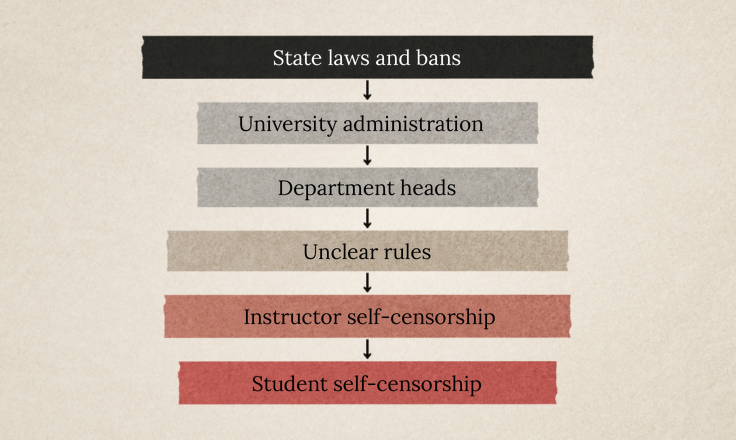
What restrictions now govern the teaching of the humanities at Russian universities? How are they enforced in practice? And how do faculty and students try to get around them? The list of forbidden topics and actions is broadly known and fairly predictable. How these bans actually work, however, only becomes clear through the kind of in-depth conversations with faculty members that T-invariant conducted. Seventeen interviews point to a preliminary conclusion: despite regional, institutional, and disciplinary differences, most of the work of enforcing the new bans is done not by inspectors but by the instructors themselves. In other words, under the new conditions self-censorship has become the main regulatory mechanism, and each instructor monitors and reflects on it in considerable detail.
T-invariant interviewed faculty members in philology, history, philosophy, and cultural studies (as well as a sociologist who described the situation in the history and psychology departments at their university). This article therefore deals only with the humanities. Things work differently in the social sciences, natural sciences, and engineering, as my interviewees themselves pointed out more than once. The interviews cover Moscow, St. Petersburg, Yekaterinburg, Perm, Chelyabinsk, Samara, Tyumen, Voronezh, Irkutsk, and Novosibirsk. The institutions represented include classical research universities in Moscow, St. Petersburg, and the regions, teacher-training universities, and large former polytechnics that have recently become full-fledged comprehensive universities.
Top news on scientists’ work and experiences during the war, along with videos and infographics — subscribe to the T-invariant Telegram channel to stay updated.
All the conversations took place in August 2026, before the start of the academic year. The sample makes no claim to be representative. Instructors who agreed to discuss such a subject, even anonymously, were taking a certain risk. Their very willingness to talk suggests that they see and acknowledge problems with academic freedom in the classroom and want to discuss them. Disagreements between respondents’ assessments have deliberately not been smoothed over. Still, the interviews turned out to have far more in common than not.
T-invariant is grateful to all the respondents for candidly sharing their observations and reflections.
Turning Points
When did instructors first run into restrictions on course content or rules governing their public behavior at their universities? In several interviews, the first major turning point was late 2011 and early 2012, a period of mass street protests in Russia’s big cities between the 2011 parliamentary election and the 2012 presidential election. “I’d say that until around 2011–2012 we had practically nothing to do with the administration… Then, from what I personally saw, a very strong top-down hierarchy started to take shape, a bureaucratic one. And it had an effect; it put a lot of pressure on us… Division directors became mere relays for whatever came down from above, stripped of almost all initiative and all authority. Department chairs also lost any ability to influence anything except general workplace discipline. So it seems to me that the whole ‘special military operation’ business just flowed into this ready-made, very convenient bureaucratic structure. The two processes somehow met and got layered on top of each other, so now it’s hard even to tell which string you’re supposed to pull.”
An instructor at a large regional university (formerly a polytechnic institute) links the same period to tighter rules for attending conferences and making other work trips abroad, even when the trips were not funded by the Russian side. “…You had to bring the text of your paper to the relevant office, and it had to be in Russian. Apparently this was mostly about physicists, chemists, and others who had access to some kind of secrets, but we humanities people, historians included, were required to do it too… We grumbled and fumed, of course, but at some point we were told: you have to. And we started taking our papers in.” According to the same instructor, after returning, faculty had to fill out a report form: “It was a small, really tiny slip of paper, like a form or a questionnaire, maybe half a sheet of A4. And it had strange questions… whom did you have contact with, what information did you get from them, what information did you pass on… I read it once and never brought them that form again, and we got away with it, since we had nothing to do with state secrets.”
An instructor from Siberia dated the start of irreversible changes at her university to 2012–2014:
“For me, the critical moments before 2022 weren’t events in university life but the Pussy Riot trial and the whole saga of theater bans. In both cases, what I see as crucial is that censorship, and even repression and the trials, were supported, directly or indirectly, by part of the intelligentsia, including scholars and teachers. I think that changed the overall atmosphere fatally and destroyed any illusions of solidarity.”
In several interviews, the second turning point was early 2021. A Russian literature instructor who has taught for many years at a teacher-training university recalls taking a short trip to a conference abroad on days when she had no classes. She had notified the vice-rector for research in advance and gotten permission. Even so, she was sharply reprimanded “at the level of the rector, the head of HR, and the legal counsel” for not taking unpaid leave. At some universities, the same period saw dissertation councils [committees authorized to award advanced degrees — T-invariant] shut down and administrations reshuffled, with people “far removed from teaching” now playing the leading role.
An instructor at a Moscow university mentions the pandemic as a time when “everyone got more careful.” During that period, he says, a series of scandals erupted after compromising information about some instructors’ relationships with students was made public. These scandals showed that “a lot can be secretly recorded and posted on social media… and this was before any wartime censorship.”
None of the instructors interviewed specifically mentioned the articles on spreading “fakes” about the armed forces and “discrediting the army” that were added to the Criminal Code in March 2022. Only one respondent alluded to legal restrictions, and only indirectly: “We were told there are certain laws now. Please don’t do anything that breaks them.”
The common thread in these accounts is that the changes in how instructors talk to one another and work with students have been gradual and cumulative. “You can’t say there was some kind of watershed, some date after which everyone suddenly started speaking with one voice. It’s this long process, and from the inside it’s hard to get any perspective on it…”
There are rules, but nobody knows what they are
New bans are rarely handed down through official orders and directives from university leadership. More often they arrive as verbal recommendations from department and unit heads. The instructors interviewed describe this situation unanimously, and in almost identical terms, as one of blurry rules in which responsibility for the content of a course, an article, or a student paper is shifted entirely onto the instructor. “No one in the department checks the content of students’ work. That’s the supervisor’s responsibility. However, the requirement to upload research papers to the university website, both student and faculty work, leaves them open to being monitored for banned topics, words, and names. Instructors understand that.” Because the rules are, by design, never spelled out, people feel uncertain and disoriented: “The clear, obvious mechanisms have disappeared. I used to understand who was asking me for what, what they wanted from me, who the client was, who was supervising me, whom I answered to. All of that started to disappear.” Another interviewee was even blunter: “We’re playing a game with no rules. Nobody forbids you anything, but you’re supposed to know on your own what’s allowed and what isn’t. It’s on you, and that drives me nuts. We’re supposed to figure out for ourselves that what was allowed yesterday won’t be allowed tomorrow, or the other way around.”
The bans are never put in writing, and the people who could clarify them avoid saying anything explicit. At one Moscow university, mid-level administrators simply left the faculty group chats so they wouldn’t have to answer awkward questions. “None of this is communicated in writing. People are afraid of anything written, afraid it’ll get forwarded and spread around. So the phone is back in fashion, phone calls: ‘give me a call.’ I think it’s simply fear that the wording might get accidentally forwarded, copied, documented.” Where there are no chats at all, what’s left is “either email, and email is badly compromised, or endless hallway talk, endless gossip. So it’s very hard to tell what is, let’s say, an instruction actually stated at a general meeting… and what’s everything else.” A ban is often presented as concern for your well-being and couched in fairly gentle phrases like “just so you’re aware” or “who needs trouble?”
Ideological bans are constantly being updated, and at different speeds, which makes people feel even more disoriented:
“You don’t know what to expect, and your immediate bosses don’t know either. Everyone plays it safe, looking over their shoulder and ahead at the same time”; “we live with this feeling of murky partnerships, murky arrangements. I’m talking about the administration. I mean, there’s no way to predict how they’ll react.”
Some respondents think that accusations of breaking the bans may also be used in internal university conflicts, for example when the administration changes or someone brings in their own “team”: “I think these things are indirectly connected: your political mistakes, or going too far in freely voicing your point of view, and your being unwanted. Being unwanted can have other causes too. A new team comes in and puts its own people in place, or it’s just an arbitrary decision: someone clears a spot for someone else for their own reasons. In other words, I don’t know how the mechanism works. It’s unclear, opaque, and there’s nobody to ask. There’s just no such thing as democratic procedure here.”
Older interviewees stressed that today’s situation is far harder to make sense of than the late Soviet one and, in a way, more threatening. “Back then there were rules. Now there are no rules. It’s an absurd free-for-all.” Another instructor made a point of explaining how far things today have drifted from Soviet times: “…everyone says the Soviet era is back, but I think the analogy is useful only as an analytical tool. The situation really is very different.”
What makes things even more complicated is that the rules vary from university to university and from department to department: “…there’s no unified system of bans yet; each university builds its own.” Even within a single city, “the situation is very, very different when it comes to internal instructions and directives.” Information-sharing between units, where people don’t trust each other much, is often limited: “…[in our department] we’re pretty open with each other, we share and so on. But in the other departments, and this is telling too, colleagues don’t really share information about what’s allowed, what isn’t, how students react to things.”
Vigilance Checks
The biggest change in course content, requirements for student papers, and research has to do with mentioning, or not mentioning, people and organizations that Russia has designated as “foreign agents,” “undesirable,” terrorist, or extremist. It also extends to any content that could be deemed “LGBT propaganda” or pornography.
According to respondents, Moscow State University has been screening papers for mentions of foreign agents since at least 2024, and some other universities started even earlier. One interviewee said that some time ago the Higher Attestation Commission (VAK), the federal agency that confirms academic degrees, refused to approve a dissertation council’s decision to award a candidate of sciences degree [the Russian equivalent of a PhD — T-invariant]. This happened “because the dissertation … didn’t flag the ‘foreign agents’ it cited. It was a really strong dissertation… I read the extended abstract and heard from people who were at the defense…” At some universities, the requirement to label mentions of foreign agents is the only restriction of this kind that has been officially communicated to faculty.
According to the interviewees, being suspected of “LGBT propaganda” is punished far more harshly than failing to mention someone’s foreign-agent status. “We just find out after the fact that some of the girls put on an exhibition and their contracts weren’t renewed. Or, say, one guy gave a lecture on homosexual relationships in the Soviet Army, and he got fired.”
Local bans on mentioning certain scholars or writers existed at universities long before 2022. One instructor recalls that back in the 2000s, philologists at one university were advised not to cite the works of Evgeny Dobrenko and Zeev Bar-Sella: “But restrictions like that were always passed on to authors verbally, and through intermediaries.”
Today, alongside such local practices, there are bans that apply everywhere. Yet how strictly they are enforced, and in what form people and organizations designated as foreign agents, undesirable, or extremist may be mentioned, vary not only from university to university but even from department to department and from program to program. In two interviews, faculty members from the same university described the rules there differently. One considered it acceptable to mention such people and organizations in syllabi and student papers as long as they came with an “asterisk,” meaning their status was noted in parentheses or a footnote. The other said that, under a directive his unit’s leadership received in 2025, any mention at all is forbidden, even a labeled one. According to him, this was attributed to amendments to the Law on Control over the Activities of Persons under Foreign Influence that took effect on September 1, 2025 (Article 11).
Several interviewees had made a point of tracking and comparing the restrictions in place at different institutions. They concluded that blanket bans on mentioning, citing, or drawing on such work in research often come from the heads of specific organizations, such as universities, journals, and libraries. People respond to these demands in different ways: “It’s shameful, of course, but you’re not going to get a publisher or a journal in trouble either”; “When you’re looking through journals to decide where to send an article (they want us in Web of Science and Scopus — ironic, right?), you often run into a clearly stated rule: no mentions of foreign agents! I leave that page right away.”
Serious disputes break out when the key works on the topic of a term paper, thesis, or dissertation were written by “foreign agents.” Members of councils and committees may be just as outraged when a foreign agent’s work is included in the bibliography as when it is left out. “I ran into this many times when the subject was, say, nationalism in the late USSR. Whenever [Nikolay] Mitrokhin’s The Russian Party came up, it was all ‘can you, can’t you, should you, shouldn’t you?’ For a lot of people, that’s a real hot-button issue.”
Up-to-date videos on science during wartime, interviews, podcasts, and streams with prominent scientists — subscribe to the T-invariant YouTube channel!
In such cases, supervisors and administrators come up with workarounds for students: “…works by ‘foreign agents’ are cited not as [individual] articles but through the edited volumes they appeared in. The names of foreign-agent editors, or of undesirable organizations that sponsored the research, are stripped from the bibliographic entries… It’s playing with fire, of course, but everyone hopes the screening is done by keyword search, so those keywords get removed from the papers or replaced with euphemisms.”
One respondent described a workaround of this kind that failed. Her article, submitted to a journal, cited a work co-written by an “innocent” author and a foreign-agent author, and she added the required foreign-agent label for the latter. “The editors told me that to get published I had to remove it. So what did I do? I removed [the foreign-agent author] and left just the one name… Didn’t fly.”
Another problem is how fast the registry gets updated: an author can be given a new status after a book or journal issue has already gone to press. In such cases, editors and administrators hope the publication date will explain why the label is missing. For editors, compilers, and library staff, the constant updates to the registries of foreign agents and undesirable organizations are a source of intense stress. “The end of every week is stressful, because there could be a book at the printer that mentions, without an asterisk, someone who was declared a foreign agent this Friday [Russia’s Justice Ministry usually adds new names to its foreign agents registry on Fridays — T-invariant] … and then there could be problems, fines, and so on. That’s the first thing they’re required to keep track of. I haven’t run into this at universities, but I have at the library, especially with students who work part-time there and are horrified that something gets pulled from public access every week. They’re the ones who have to keep track of it.”
Expansive Interpretations
Many respondents noted that university administrators and some faculty members read existing restrictions far more broadly than the law actually requires. At some universities, the ban on mentioning authors whose work could be classified as “LGBT propaganda” has grown to cover gender and feminist studies in general. Faculty can no longer do such research themselves or discuss other people’s.
“One by one, they tracked down every program we had that had anything to do with gender studies, queer studies, or intersectionality in literature”; “…the further it went, the clearer it became that certain aspects of gender issues were better left untouched altogether.”
Historians and philologists who work with psychologists and sociologists described similar restrictions in those fields (psychologists were not interviewed for this article): “…in the themes of conferences, summer schools, and online courses at the leading universities and research institutes… there’s now a heavy emphasis on traditional values. Domestic violence has been dropped from course curricula. The gender psychology course… was dropped even before the war… the resource on this subject in the electronic source database was closed, and access is granted to individual students on request. But those requests come not so much from psychology students as from, say, philologists, who also take general psychology and are genuinely interested in gender issues.” Any depiction of sexuality is a “gray zone”: “there are no instructions; everyone (self-)censors at random.” That is exactly why “instructors try not to put students at risk and sign off only on the safest possible topics in the current climate. Especially since topics have to be approved by the unit’s leadership and can be sent back for revision.”
In some majors and departments, the requirements even extend to terminology: editors and department heads demand that words of foreign origin be removed. And here we see a major difference between what gets censored among philosophers, cultural studies scholars, and philologists and what gets censored among historians. People in literary studies and philosophy departments admit that their disciplines are “…so detached from reality, purely about art, about contemplation. And as long as we stay in that space, it seems we really don’t get that kind of attention, not the way historians do.” So their bosses mostly care about terms and proper names: “methodology, analytical lens, content — nobody’s interested in any of that.”
Historians describe a different kind of restriction. The scrutiny can extend beyond names and terminology to how particular historical episodes are interpreted: “…any kind of cooperation with the West, in all its forms… the fight against the famine of ’22, the American Relief Administration. It isn’t mentioned, or only in passing. And now it’s also tied to [Alexander] Arkhangelsky’s name, to his film about the famine… And then, naturally, there’s everything around the Great Patriotic War [the Soviet and Russian name for the war against Nazi Germany in 1941–1945 — T-invariant]. [20]14 already took care of that. There, it’s everything: step a little out of line and it’s ‘falsification.’ The Gulag gets a somewhat lighter touch than the Great Patriotic War, but the trend is there too, and it’s an old one by now.” Topics related to Stalin’s ethnic deportations face growing censorship. So far this is happening in book publishing, but the trend will most likely reach education soon.
Historians of Soviet literature run into the same restrictions when they speak at public events. A graduate student supervised by one of the respondents was scheduled to speak at a memorial evening for a writer from one of the peoples repressed (deported) under Stalin. “The student was asked to talk only about the writer’s work and not mention the repressions, so he pulled out.” Instructors fear that the widening bans will soon leave them no room to maneuver at all: “…the range of options keeps shrinking, because now it’s not just individuals but entire universities that are declared hostile, entire countries ‘unfriendly,’ organizations banned. Pity the poor teachers of foreign literature…”
Prohibition of Certain Actions
That is the name of one of the pretrial restrictions that can be imposed on a suspect or defendant under Russia’s current Code of Criminal Procedure. Typically, it requires the person to appear whenever summoned by an investigator, to stay away from witnesses in the case, and to stay off mobile phones and the internet. In recent years, many employees of Russian state institutions have found themselves under a prohibition of certain actions of their own, if not quite the same one that applies to people under investigation, and university faculty are no exception.
“It turns out we’re required to be physically present at work, and on weekends we have to clear any trips [out of town] with our bosses,” says an instructor at a Moscow university. Professors at universities in the Urals and Siberia also talked about tightened workplace discipline.
Their colleagues in other Russian regions mentioned constant monitoring and video recording of classes. Among the relatively new restrictions are a ban on social media accounts for faculty in administrative positions and a requirement to get the unit head’s approval for articles that may later be submitted for academic bonus competitions. Every guest lecturer now needs the unit head’s approval too. Some universities also keep “blacklists” of unwanted guest speakers.
But the most serious restrictions concern international collaboration and travel abroad. Many respondents spoke bitterly about how both have dwindled and disappeared: “I saw with my own eyes how the forms for annual individual and section reports changed. How a new field appeared requiring us to report contacts with foreign scholars and trips abroad. Now at our university you can’t go on a work trip abroad at all without first having a little talk with the special department [the office in charge of secrecy and security clearances — T-invariant]”; “…there are literally a handful of personal contacts left, and they’re strictly personal, like ‘stay healthy, Happy New Year.’ Joint projects and grants are long gone…”
Red Lines: War and Occupation
Besides the bans, university leadership is also imposing new requirements. When it comes to course content, so far this is happening at individual institutions. Psychology courses, for example, now “include sections on working with combatants and their families and on traditional values.”
Many interviewees said that strict control over content applies above all to the new course Foundations of Russian Statehood, which has been made mandatory for every university major. “It was rolled out with a lot of fanfare, with countless meetings and discussions, and with some kind of hired guns brought in from outside, which had never happened at the university before. They delivered the lectures, and the people assigned to teach the course had to take down what they said word for word and then repeat it. And the people teaching these courses can’t give exams however they like or come up with their own formats. You can only ask the questions you’ve been assigned, and grading is regulated too.” “They were told: one step to the right, one step to the left, and you’ll be shot [a Gulag convoy guards’ warning to prisoners — T-invariant]. You teach only what’s written in your textbook.”
[[socialnetworks]]
Even here, though, there are workarounds and “evasion tactics.” “In good departments, smart chairs spare their faculty from teaching this course. There are all sorts of tricks: some of the hours can be moved to independent study, some to the regional component. Basically, it works like this: they ask either junior lecturers or grad students and explain, ‘we have to, what can you do.’”
Still, instructors’ expectations are fairly pessimistic, especially at regional universities. Some of them “dread the day when the single philosophy course and textbook [for teacher-training universities] announced by [Education Minister Sergey] Kravtsov is introduced. If that happens, they’ll have to give up teaching.”
Today, the most painful and “triggering” issues for faculty are trips to the occupied territories and pressure to recruit students into signing military contracts. “They’re demanding that faculty to go, but fortunately they decided it was better not to send people from the department after all. Instead they’ll find volunteers in another program or hire an outside contractor.” One respondent said his colleagues are prepared to quit if they are told to urge students to sign military contracts: “That’s the red line you can’t cross.” Even so, interviewees say these quotas have not yet affected them or their closest colleagues personally. “We can still ignore these strange letters we don’t like. We just pretend they never happened.”
Self-Censorship as Common Sense
Any discussion of current education policy, bans, and dangerous topics inevitably turns to self-censorship. Most respondents admitted they practice it to protect themselves, their students, and their department or school: “…any sensitive moment, any show of defiance, any mistake could cost all of us our lives. It’s like we’re all on the hook for each other…” Another interviewee summed it up by saying self-censorship is inevitable “in a situation where anyone can inform on you, your dear colleague and your esteemed student alike… there’s no point saying what you think in the classroom, because the audience is completely unreliable.” At the same time, some instructors said they have not yet felt any outside pressure and teach their subject just as they always have. They attributed this either to the special standing of their university and department or to the nature of their discipline and the period they study: “…I work on nineteenth-century Russian literature, so we don’t really have any problems with that, as such…”; “For example, I teach a course on [withheld], and it has more than enough difficult topics. Could they ask for my teaching materials after someone complains, call me in for a talk, refuse to approve the course for next year? Probably, yes. Should you cut a sensitive topic from the course preemptively in cases like that? It depends on the topic and on the instructor. Everyone decides for themselves.”
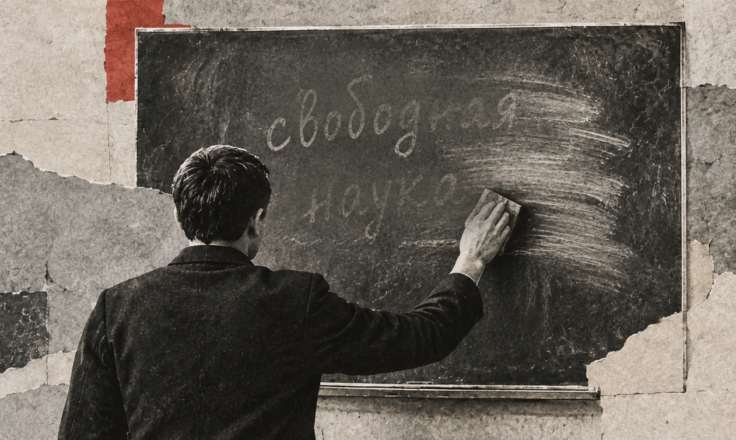
The interviews also show a noticeable shift in the very vocabulary people use to talk about teaching. Words like “monitor,” “avoid,” and “be more careful” now come up regularly. Students’ parents, who rarely figured in accounts of university teaching before, are adding to the strain now that the information environment has changed. “I recommended a film to my students (recommended, not assigned). At the next class, one of my top students tells me the film is on YouTube, YouTube is banned, and she can’t install a VPN because her parents won’t let her: her dad has the kind of job where the whole family’s phones get checked all the time. So now you have to be careful even with recommendations like that. The parents are being vigilant too.”
None of the instructors interviewed could recall a student being barred from defending a term paper or senior thesis, getting a lower grade, or being caught up in a public scandal because of an undesirable topic or an ideologically unacceptable interpretation. Such cases did come up, however, in connection with dissertation defenses. Anything “triggering” or dangerous is “scrubbed” from topics and texts in advance, and many describe this as a natural safety mechanism: instructors protect students, students protect instructors, and administrators protect their staff.
Attitudes toward self-censorship vary. Some speak of it with regret and bitterness, others see it as an unavoidable and sensible choice, and still others find it extremely irritating: “…you’re supposed to know on your own what’s allowed and what isn’t. It’s on you, and that drives me nuts.”
Despite their different assessments, all the interviewees reflect on how their behavior in the classroom is changing. They also reflect on moments when they regret being more open or candid than today’s conditions allow: “…I keep getting carried away, and at the end of office hours I periodically catch myself and think: did I say something I shouldn’t have? I don’t say things directly, but there’s a whole lot of stuff that has to do with methodology, with applying various Western theories, with critical analysis, a critical approach. A whole lot of things we’re used to treating as simply professional. So afterward I catch myself and go back over it: did I say anything like that, anything out of line? But I haven’t run into anything, either in how the students reacted or in terms of consequences.” Another respondent uses a similar expression: “…in class, my mouth ‘runs away with me.’ I’m ‘working on myself,’ but sometimes it’s an uncontrollable process.”
Many instructors describe self-censorship as all-pervasive:
“…I have the distinct sense that self-censorship is in full swing, even with colleagues, fairly close ones, in departments where people have normal conversations… Every now and then I have to bite my tongue. I keep seeing this caution, like, why bring that up, let’s not. It’s not even said out loud, ‘let’s not.’ The other person just, bam, jumps to another topic, or, bam, there’s a pause, and then things move on. There’s a lot of that. What’s emerged isn’t even specific points but whole zones that could lead to tension, to conflicts, even mild ones, or just to arguments, and all of it gets cleared away in advance.”
Instructors who teach at several universities at once, in different programs, say that how careful they are depends both on the particular university and on the students. “How can I teach a course on coming to terms with the past without touching on NN’s work? [Here the respondent names a researcher designated a ‘foreign agent’ — T-invariant] So he’s in my course, with an asterisk. But at the university where I know there’s a tradition of informing, I don’t have a course on memory. I just don’t offer it.” Another interviewee describes the situation in similar terms: “The atmosphere in the classroom is very different from place to place, and so is how students react to events. Working at University N (especially with master’s students), I felt I was among my own people. At University NN, half and half. At University NNN, what jumps out at you is that all the students hold the ‘correct’ position. I live with the constant feeling that tomorrow I’ll be in for it.”
Intense reflection on their own changing behavior has even led some to develop theories of contemporary intellectual self-censorship: “From a sociological standpoint, I think two things are worth pointing out. The first is anticipatory self-restraint (‘once bitten, twice shy’). Is it worth writing a dissertation chapter on poet N if, given his views, there’s a chance he’ll end up on the Justice Ministry’s lists [of foreign agents — T-invariant]? Is it worth putting Telegram in the title of a master’s thesis, or is it better to call it ‘social media’? The second is retrospective correction. That’s when papers on ‘questionable’ issues or about ‘questionable’ authors written over the past ten years or so get hidden away to protect one’s reputation among colleagues, and every mention of them is deleted.” How much freedom remains between anticipatory self-restraint and retrospective correction depends both on one’s field and on personal courage. The only thing that’s clear is that this freedom shrinks steadily with every new restrictive measure.
Students: They don’t argue, but they do complain
Another topic that came up in conversations with instructors working in Russia was student complaints and denunciations. The respondents themselves had never faced denunciations by students, but they fear them, pointing to cases in neighboring departments and programs: “When I start preaching about something, I figure that in a lecture hall with 100–120 people, there are bound to be a couple who hold diametrically opposite views. So as for denunciations, we haven’t had that in our program. In ours specifically. But colleagues have told me students complain to the academic affairs office, about the instructor personally.”
According to some interviewees, the way students file complaints has changed as well.
“They used to go to the department chair as a group and say they weren’t happy with this or that instructor for such-and-such reasons… And everything got settled on the spot. Now they write straight to the rector. Or practically to the president. I don’t even know where they write.”
Still, the respondents observe that purely ideological complaints are rare. When students do point to an instructor’s ideological unreliability, it comes only bundled with complaints about excessive demands or unfair grading.
Almost all the instructors have noticed how much student psychology and students’ sense of themselves as a group have evolved. “Students have kind of stopped arguing altogether,” one says. Another notes that students “easily pick up on the obvious parallels when the conversation turns to wars, inequality, state violence, censorship,” yet “they express it cautiously compared with previous generations.” As a result, in these accounts the students come across as even more guarded and prone to self-censorship than their teachers: “This generation has already been through social studies questions in school about recent events. And they know how to answer with their fingers crossed behind their backs. Basically, they know how to do it all… They don’t laugh. I mean, they’re ironic, but with a very sad face.”
Uninhabitable Habitat
Assessing the situation at their own universities and in Russian humanities education as a whole, almost all respondents spoke of stagnation or decline. Typical phrases included “everything’s stalling,” “there’s no development,” “provincialization,” “complete deprofessionalization,” “the level is falling… not just falling, it’s crumbling, like the walls of Mordor,” “if you passed off today’s papers as work from twenty years ago, nobody would notice,” and “a strong specialist left, and [his place] was taken by opportunists who just started ticking the formal boxes of the qualification requirements.”
Respondents describe their own state of mind as depressed and say the situation is taking a heavy toll on their mental health. Their accounts are full of complaints about loneliness and about how their circle of professional and personal contacts, and their social world in general, is shrinking: “Every piece of news, this got banned, that got pulled, scandals over there, really makes it feel like the walls are closing in…” Many say it is impossible to discuss painful political issues with colleagues: “…Among my colleagues, [nobody] talks about these things. If a bomb went off outside the university window, they’d act as if nothing had happened.”
Most can talk openly only within a small circle of trusted friends, and they count themselves lucky if that circle includes colleagues from the university: “…The only people I still talk to candidly are the ones I’ve been friends with all my life. That’s four or five people…”
No Future
Looking back on how their mood and psychological state have changed, younger instructors talk about adapting to the new situation and about things becoming routine: “…the acute, extreme experiences of 2022 have worn off… there’s no emotional energy left to live in a permanent state of drama.” Mid-career faculty see no future for themselves either in Russia or in the West: “…a lot of instructors already understand that moving to Europe or America is pointless too, because nobody’s waiting for anybody there anymore. The mood is largely apathetic.” Nor do they see a good future for their younger colleagues: “I feel really sorry for those who are just starting to teach. At least we got to work under normal conditions.” Older faculty, while still horrified by what is happening, hold on to the chance to engage with students and help them grow, intellectually and personally. But overall, the emotional trajectory is seen as a downward one: “When it all started, after the shock (the feeling that it had all been for nothing: the conversations about art, literature, history’s twists and turns), I came to believe that I’d at least keep doing my work, even under these conditions, that constant dripping wears away the stone. Today I can’t shake the feeling that it’s all for nothing and completely useless.”
The past four and a half years of living with ever-tightening censorship and control have been “hard, but still bearable.” Looking ahead to the new academic year, however, several instructors voiced a persistent anxiety. “If it stays the way it’s been up to now, that’s hard. Hard, because everything around us keeps getting darker. Well, you carry it somehow. You work with faculty, with students, you talk with colleagues, and things seem more or less okay. But if things go seriously haywire, it’ll be a catastrophe. Then you’ll just have to quit. And a lot of people have no idea what they’d do then, because there’s nothing else left for them to do. In a sense it’s, as they used to say in Soviet times, a moment of truth.”
In late September, news came from HSE University that starting September 29, 2026, logging into the system that hosts students’ electronic gradebooks and other key services “requires downloading the national messenger Max [a state-backed messaging app the authorities are promoting as an alternative to WhatsApp and Telegram — T-invariant] and connecting to the HSE bot. This is now the only way to access one of the university’s most important digital services.”
The academic community has already adapted to keep risks as low as possible. Within this system, there are still departments that remain free, uncensored courses, room to uphold professional standards, and solidarity among students. But having to constantly work out what is still allowed today and what might bring reprimands and reprisals tomorrow is in itself reshaping the humanities at Russian universities: their language, their subjects, the relationships between people, and how instructors see their own professional freedom.
Support T-invariant’s work by subscribing to our Patreon and choosing a donation amount that suits you.
The post Red Lines That Aren’t on Any Map: What can and can’t be said at Russian universities appeared first on Т-инвариант / T-invariant.
