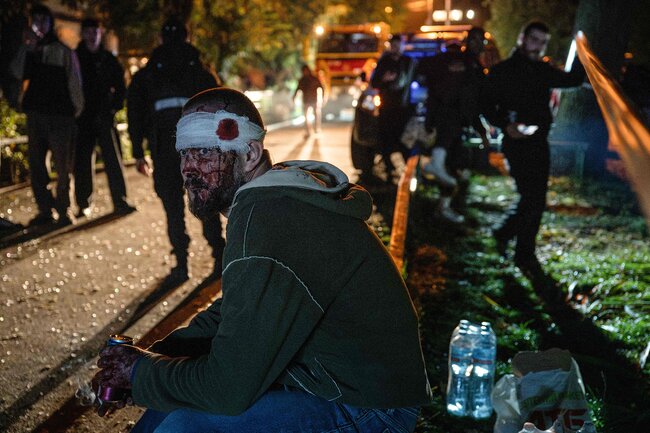
Update: The Security Service of Ukraine confirmed that the man who attacked the Ukrainian soldiers has been detained. He is a 36-year-old Russian soldier from St. Petersburg who was previously convicted in Russia. The agency did not specify whether he was a prisoner of war.
Five soldiers from the Ukrainian Armed Forces’ 72nd Separate Mechanized Brigade were shot dead on October 13 in the village of Kutuzivka in the Kharkiv region.
According to Ukraine’s Military Law Enforcement Service, which polices the armed forces, “a man in civilian clothes armed with an automatic weapon” opened fire. The motive remains unknown. The service said the slain soldiers had gotten along well with their comrades and had no disciplinary problems.
The news outlet Hlavkom reported that police are searching for two Russian soldiers in connection with the killings. Both had escaped captivity.
Law enforcement sources told Suspilne that the gunman had already been detained in a district of Kharkiv. Police and prosecutors have not yet confirmed that account.
Ukrainian law enforcement authorities are considering several possible explanations for the attack and have not ruled out Russian soldiers’ involvement.
At Meduza, we are committed to transparency about our use of artificial intelligence in the newsroom. The story you’re reading was written by one of our living, breathing journalists and translated from Russian using an AI model configured to follow our strict editorial standards. This translation process is the result of extensive testing and refinements to ensure our English-language coverage is timely and accurate. A Meduza editor reviews every draft before publication.
If you find any errors in this translation, please contact us at reports@meduza.io.
SpaceX has restored service in Ukraine for Starlink satellite terminals moving at high speeds, former Ukrainian Defense Minister Mykhailo Fedorov said on the evening of October 14.
“Starlink connectivity at speeds of up to 160 km/h [about 100 mph] is being restored. Removing Starshield’s speed limit entirely is now critical for Ukraine’s defense. Thank you, Elon Musk. We hope for your continued support,” Fedorov said on social media.
In response, Musk said Starshield systems are owned and controlled by the U.S. government. “Any limits on speed or usage are decided by the US military and ultimately POTUS,” Musk said. He said Starlink is a commercial service whose use is “limited to civilian or defensive activities.”
Ukraine’s Defense Ministry told journalists that SpaceX still imposes a speed limit of 161 kilometers per hour (about 100 mph) on the terminals. “However, we’re currently seeing improved connection quality at speeds of up to 160 [km],” officials said.
Ukrainian military personnel and officials said on the morning of October 14 that SpaceX had restricted service without warning for Starlink terminals used by Ukraine’s armed forces on the front lines. The restrictions affected Starshield, the military version of Starlink needed to launch drones. Some even compared the damage the Starlink slowdown caused Ukraine’s armed forces to a nuclear strike on Ukraine.
The restrictions on Starshield came amid a crisis in relations between U.S. President Donald Trump and Ukrainian leader Volodymyr Zelensky.
At Meduza, we are committed to transparency about our use of artificial intelligence in the newsroom. The story you’re reading was written by one of our living, breathing journalists and translated from Russian using an AI model configured to follow our strict editorial standards. This translation process is the result of extensive testing and refinements to ensure our English-language coverage is timely and accurate. A Meduza editor reviews every draft before publication.
If you find any errors in this translation, please contact us at reports@meduza.io.
Ukrainian President Volodymyr Zelensky said he regrets that Kyiv is losing a strong ally in Washington.
Asked about his first reaction to the “diesel deal” between Russia and the United States, Zelensky told journalist Piers Morgan in an interview: “It’s a pity that we’re losing a strong partner.”
Asked whether he felt betrayed by Trump, the Ukrainian president said, “Yes, but it’s a little bit more complicated than just my emotions or my feelings.”
Zelensky said Ukraine is “losing” the United States through no fault of its own. Kyiv “can’t be weak,” he said, or it “will not survive.” “We are not selling our country. Look guys, it’s not about business for us. [It’s about] our lives — this is our country. It’s our home, our children,” he added.
Zelensky said it was “painful” when U.S. President Donald Trump “took a side, and it’s not our side,” adding that he has no objection to Trump taking a neutral position.
But if you’re in the middle, you have to stay in the middle, not on the wrong side. I think his advisers are wrong. I don’t know who is pushing him not to the right side. This is not the right side of history.
Zelensky also said he considers businessman Elon Musk’s decision to restrict Starlink’s operation in Ukraine a mistake that will cost lives.
Trump said on October 10 that he had reached an agreement with Russian President Vladimir Putin on Russian diesel supplies. The next day, he said Russia and Ukraine had agreed to a truce covering the energy sector. Zelensky said the announced truce “was news” to him. Trump also recently said Ukraine needs to find a new president who can “make a deal.”
At Meduza, we are committed to transparency about our use of artificial intelligence in the newsroom. The story you’re reading was written by one of our living, breathing journalists and translated from Russian using an AI model configured to follow our strict editorial standards. This translation process is the result of extensive testing and refinements to ensure our English-language coverage is timely and accurate. A Meduza editor reviews every draft before publication.
If you find any errors in this translation, please contact us at reports@meduza.io.
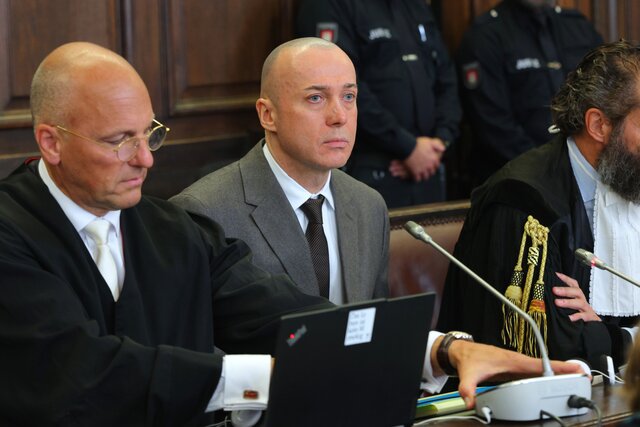
Serhiy Kuznetsov with his lawyers in court in Hamburg, October 14, 2026
The trial of Ukrainian national Serhiy Kuznetsov began in Hamburg on October 14. Investigators allege that he took part in the September 2022 bombing of the Nord Stream pipelines.
Kuznetsov, 50, is formally charged with disrupting the operation of essential public infrastructure. Investigators allege that he coordinated the sabotage team that carried out the explosions.
The indictment, reviewed by the broadcaster ZDF, says Ukrainian state agencies commissioned the sabotage. ZDF did not specify which agencies. Investigators identify Roman Chervinskyi, an officer in Ukraine’s security services, as the organizer.
Prosecutors say Kuznetsov’s actions should be classified as a war crime because he was serving in the military at the time of the bombing and acted with the knowledge of the Ukrainian authorities. His defense team maintains that he had nothing to do with the incident. His lawyers say he was in Ukraine when the bombing occurred.
The broadcaster ARD reported that the trial and the court’s final ruling will have significant international implications. “The mere fact that a Ukrainian citizen is appearing before a German court on charges of sabotage and other crimes is an extremely serious matter at a time when Ukraine is fighting for its survival and Germany is its biggest supporter in its fight to defend itself against Russia,” international law expert Clemens Fischer told the broadcaster.
He said Germany would find it “very difficult to continue supporting Ukraine unconditionally” if the court established that the Ukrainian government was involved in the sabotage.
It is unclear how long the trial will last. The court said it could not conclude the case in just a few hearings, “simply because of the volume of case files and the international aspects of the case.” Hearings are currently scheduled through January 29, 2027, averaging twice a week. It could take “years” to reach a verdict, ARD reported.
Kuznetsov is the first defendant in the Nord Stream bombing case. German prosecutors have issued seven arrest warrants for suspected participants in the sabotage. The only other suspect in custody is Volodymyr Zhuravlev.
Zhuravlev was detained in Poland in 2025, but a Warsaw court refused to extradite him to Germany, citing a lack of evidence linking him to the incident. He went to Ukraine, but in 2026 he was detained again on the German warrant, this time in Croatia. According to unconfirmed reports, he had traveled there for the filming of a movie about the Nord Stream bombings. He is now awaiting extradition to Germany.
At Meduza, we are committed to transparency about our use of artificial intelligence in the newsroom. The story you’re reading was written by one of our living, breathing journalists and translated from Russian using an AI model configured to follow our strict editorial standards. This translation process is the result of extensive testing and refinements to ensure our English-language coverage is timely and accurate. A Meduza editor reviews every draft before publication.
If you find any errors in this translation, please contact us at reports@meduza.io.
Russian rapper Navai Bakirov, known as Navai, has been detained in Kazakhstan on suspicion of drug smuggling.
Police in Kazakhstan’s Zhambyl region said Bakirov was detained at a border checkpoint as he entered Kazakhstan from Kyrgyzstan after drugs were found in his car. He was taken to a temporary detention facility.
Navai was scheduled to perform in Astana on October 14. Organizers said the concert had been postponed indefinitely “for technical reasons.”
Baza, citing checkpoint staff, reported that 10 grams (about 0.35 ounces) of marijuana was found in Navai’s car. His manager and driver were also in the vehicle.
Navai Bakirov is best known as a member of HammAli & Navai, a hookah rap duo active from 2016 to 2025. Bakirov launched a solo career after the duo broke up.
At Meduza, we are committed to transparency about our use of artificial intelligence in the newsroom. The story you’re reading was written by one of our living, breathing journalists and translated from Russian using an AI model configured to follow our strict editorial standards. This translation process is the result of extensive testing and refinements to ensure our English-language coverage is timely and accurate. A Meduza editor reviews every draft before publication.
If you find any errors in this translation, please contact us at reports@meduza.io.
Two masked intruders broke into a communications facility near Sofia, Bulgaria, and set fire to 11 of its 17 antennas used to communicate with Starlink satellites, Bulgarian National Television reported.
The Insider determined from satellite images that the fire occurred 20 kilometers (about 12 miles) from Sofia.
Bulgarian lawmaker Ivaylo Mirchev also reported the incident. He posted a video of the fire and said a similar incident occurred in Poland in September. According to Mirchev, Polish authorities have no doubt that Russia is behind the acts of sabotage.
“Clearly, these antennas were deliberately targeted, since they provide the main connection to the satellites,” Mirchev said.
There was no word on whether the damaged antennas were used to provide communications for Ukraine’s armed forces.
On October 14, Ukraine’s armed forces said SpaceX had restricted Starlink satellite communications for the Ukrainian military. The restrictions affected the military version of the service, called Starshield, which drone operators rely on. The Ukrainian military said the restrictions caused some drones to lose their connections midflight and some operations to fail.
At Meduza, we are committed to transparency about our use of artificial intelligence in the newsroom. The story you’re reading was written by one of our living, breathing journalists and translated from Russian using an AI model configured to follow our strict editorial standards. This translation process is the result of extensive testing and refinements to ensure our English-language coverage is timely and accurate. A Meduza editor reviews every draft before publication.
If you find any errors in this translation, please contact us at reports@meduza.io.
Montenegrin citizens will need visas to travel to Russia, Russian Foreign Ministry spokesperson Maria Zakharova told Izvestia.
She confirmed that Montenegro’s Foreign Ministry had notified Russia that it was terminating the agreement governing travel between the two countries. Starting November 1, Russians will need visas to enter Montenegro.
“As a result, Montenegrin citizens will also have to obtain visas to travel to Russia,” Zakharova said.
On July 27, Montenegro officially announced it would introduce visa requirements for Russian citizens. The government said the changes were necessary to bring its visa policy into line with EU rules. Citizens of Belarus, China, Turkey, and Saudi Arabia will also need visas.
On October 9, Montenegrin authorities detained Mikhail Zvinchuk, the creator of the Telegram channel “Rybar,” who had traveled there in part to film a report ahead of the new visa requirements for Russians. In 2024, the U.S. State Department announced a $10 million reward for information about Zvinchuk; he is also under EU sanctions. In the end, however, Montenegrin authorities simply expelled him and sent him back to Russia.
At Meduza, we are committed to transparency about our use of artificial intelligence in the newsroom. The story you’re reading was written by one of our living, breathing journalists and translated from Russian using an AI model configured to follow our strict editorial standards. This translation process is the result of extensive testing and refinements to ensure our English-language coverage is timely and accurate. A Meduza editor reviews every draft before publication.
If you find any errors in this translation, please contact us at reports@meduza.io.
Portion sizes for prepared food in Russia fell by 10.3% over the past year to 266 grams (about 9.4 ounces), according to calculations by the analytics company Ntec, as cited by Kommersant.
Prepared food remains the fastest-growing category in grocery retail. Retail stores account for about a quarter of the prepared food market, and that share could reach 40% by 2030, according to Stanislav Bogdanov, chairman of the Association of Retail Companies.
Profit margins in the category are very low, however. Retailers have to invest in central kitchens, packaging, and logistics, while 14% of products are written off because of their short shelf life.
Production costs are rising, but producers are finding it harder to pass them on to consumers. Intense competition and weakening demand are forcing them to hold down prices. As a result, producers are choosing to reduce portion sizes, experts said.
Smaller portions may reflect both shrinkflation and changing demand, the experts said. Russians buying prepared food have increasingly been choosing small snacks such as onigiri, sandwiches, and hot dogs. In the first half of 2026, sales of these snacks rose by 48% in value, while sales of main dishes and salads grew more slowly — by 16% and 14%, respectively.
At Meduza, we are committed to transparency about our use of artificial intelligence in the newsroom. The story you’re reading was written by one of our living, breathing journalists and translated from Russian using an AI model configured to follow our strict editorial standards. This translation process is the result of extensive testing and refinements to ensure our English-language coverage is timely and accurate. A Meduza editor reviews every draft before publication.
If you find any errors in this translation, please contact us at reports@meduza.io.
Russia needs a “doomsday” data center, said Valery Yermakov, deputy chairman of Rostelecom’s management board. He made the proposal on the day Ukrainian drones first attacked a Sber data center.
Everyone understands that we absolutely need a so-called doomsday facility today. It’s a place to store backups so that if something happens, you can always restore your services. Some time ago, this really would have been unimaginable, but now there’s a very real need for it. We need a so-called doomsday data center because backups now allow any service provider to recover very quickly.
Ukrainian drones attacked Sber’s infrastructure for the first time overnight into October 14, hitting a data center in Balakovo, in Russia’s Saratov region. Sber confirmed the attack but said all its services were operating normally. Users, however, began reporting disruptions to Sber and other services.
At Meduza, we are committed to transparency about our use of artificial intelligence in the newsroom. The story you’re reading was written by one of our living, breathing journalists and translated from Russian using an AI model configured to follow our strict editorial standards. This translation process is the result of extensive testing and refinements to ensure our English-language coverage is timely and accurate. A Meduza editor reviews every draft before publication.
If you find any errors in this translation, please contact us at reports@meduza.io.
The news outlet Takie Dela has been fined 200,000 rubles for publishing a quote from musician Boris Grebenshchikov without mentioning that Russia has designated him a “foreign agent,” the outlet reported.
“Our lawyer said the hearing lasted a minute. The judge wouldn’t listen to the defense’s arguments,” Takie Dela said.
The case stemmed from a quote Takie Dela published on its VKontakte page: “Russia has a remarkable ability to cast out people who are ready for the wider world.” Grebenshchikov said this in a May 2026 interview with RTVI.
Takie Dela’s editors said they cannot include a “foreign agent” disclaimer for everyone with the designation in their social media posts and asked for help paying the fine.
“Maybe 200,000 rubles seems like a small amount. But we don’t have it. We’ve just launched an SOS campaign to raise at least 900,000 rubles in recurring donations. Because our budget is a million rubles short, and starting in January or February, we won’t have any money to pay salaries,” the outlet’s editor-in-chief, Yevgenia Volunkova, wrote.
Takie Dela covers social problems in Russia. Its editors continue to work inside the country despite the challenges. In 2024, T-Bank’s payment service stopped processing donations to Takie Dela, and in 2026, the outlet’s website was blocked.
At Meduza, we are committed to transparency about our use of artificial intelligence in the newsroom. The story you’re reading was written by one of our living, breathing journalists and translated from Russian using an AI model configured to follow our strict editorial standards. This translation process is the result of extensive testing and refinements to ensure our English-language coverage is timely and accurate. A Meduza editor reviews every draft before publication.
If you find any errors in this translation, please contact us at reports@meduza.io.
Russia’s largest pretrial detention center will be built in the Solnechnogorsk district of the Moscow region. The regional office of the Federal Penitentiary Service has put the construction contract out to bid.
The center will hold up to 4,000 detainees. The complex will cover more than 42 hectares (about 104 acres).
It will include multistory buildings for men and women, as well as separate buildings for people with tuberculosis and criminal gang leaders deemed a harmful influence on other detainees. The complex will also include three buildings with apartment-style accommodations for Federal Penitentiary Service employees.
The complex will be built near the 71-kilometer (44-mile) marker on the M-11 highway, between the villages of Shapkino and Ozhogino.
The starting price for the construction contract is 37.8 billion rubles. Construction is scheduled to be completed in October 2031.
Prime Minister Mikhail Mishustin signed an order in 2022 to build a pretrial detention center for 4,000 people in the Moscow region. The project received final approval from state expert reviewers this past winter.
“Kolpino,” known as “Kresty-2,” is currently considered Russia’s largest pretrial detention center. It was built in a suburb of St. Petersburg in 2017. Construction took 10 years.
At Meduza, we are committed to transparency about our use of artificial intelligence in the newsroom. The story you’re reading was written by one of our living, breathing journalists and translated from Russian using an AI model configured to follow our strict editorial standards. This translation process is the result of extensive testing and refinements to ensure our English-language coverage is timely and accurate. A Meduza editor reviews every draft before publication.
If you find any errors in this translation, please contact us at reports@meduza.io.
Russian Deputy Prime Minister Alexander Novak said Ukraine attacked two Russian oil refineries on October 14.
“According to the Energy Ministry and the companies, the Kyiv regime attacked two oil refineries today — in the Saratov and Ryazan regions. We see no sign that the Ukrainian side is moving toward an energy ceasefire,” he said.
Novak did not specify which refineries had been attacked. Authorities in the two regions had not said that any refineries had been attacked that day.
Rostov Governor Yury Slyusar said on Telegram that morning that more than 160 drones had been destroyed or disabled over the region, but stressed that “no reports of casualties or any impact on the ground had come in.”
Saratov Governor Roman Busargin said a civilian had been killed and residential buildings damaged in Balakovo, which is home to a Sber data center (the governor did not mention it). Busargin did not say that an attack had been repelled in Saratov, where the region’s only oil refinery is located.
Meduza could find no reports of explosions or fires at Russian oil refineries on Russian or Ukrainian monitoring channels.
U.S. President Donald Trump said on October 11 that Russia and Ukraine had agreed not to strike each other’s oil refineries. Ukrainian President Volodymyr Zelensky said the announcement “was news” to him, but later said the Ukrainian armed forces had “received all the relevant orders.” Zelensky did not explicitly confirm that he had agreed to stop attacks on oil refineries.
At Meduza, we are committed to transparency about our use of artificial intelligence in the newsroom. The story you’re reading was written by one of our living, breathing journalists and translated from Russian using an AI model configured to follow our strict editorial standards. This translation process is the result of extensive testing and refinements to ensure our English-language coverage is timely and accurate. A Meduza editor reviews every draft before publication.
If you find any errors in this translation, please contact us at reports@meduza.io.
Russian drones struck a wholesale warehouse in Lutsk, killing six people, said regional Governor Roman Romaniuk. Five died at the scene, and a sixth died later in the hospital from their injuries.
Romaniuk said 10 people were injured, while Ukraine’s State Emergency Service reported 12 injured.
Romaniuk also said two people, including a child, were injured in a nine-story apartment building struck in the attack.
At Meduza, we are committed to transparency about our use of artificial intelligence in the newsroom. The story you’re reading was written by one of our living, breathing journalists and translated from Russian using an AI model configured to follow our strict editorial standards. This translation process is the result of extensive testing and refinements to ensure our English-language coverage is timely and accurate. A Meduza editor reviews every draft before publication.
If you find any errors in this translation, please contact us at reports@meduza.io.
After strikes on Yandex’s data centers, pro-war channels accused the company of inaction and even sabotage. Elements of critical infrastructure turned out to be completely unprotected against drone attacks. Now similar accusations will likely be directed at Sberbank: the bank’s largest data center in the Saratov region was attacked overnight on October 14. All these facilities were an obvious target for Ukraine’s military, if only because Russian forces are actively striking similar targets in Ukraine. Of course, the inadequate protection of the data centers has nothing to do with malicious intent or negligence on the part of Yandex and Sberbank’s management. It is known that, even before the strikes, authorities and the military discussed measures to defend such facilities with businesses. And judging by video of the attacks, at least in Yandex’s case some defense — probably in the form of mobile fire teams or automatic turrets — did exist: drones were fired at with small arms. This shows that Russia still lacks the resources to build a multilayered anti-drone air defense system anywhere except Moscow. And site-level defenses at individual factories, warehouses, and data centers cannot repel massed strikes.
First, a reminder of which facilities Ukraine’s military struck
Ukrainian strikes hit three of Yandex’s six largest data centers, also known as data processing centers, between October 7 and 11. None were located in the Moscow region, the area most heavily protected by Russian air defenses.
The data center in Sasovo, in the Ryazan region, which also housed two of Yandex’s three supercomputers, stopped operating entirely. Judging by satellite images from the Planet Labs, the wing of the building housing the data center had burned down completely.
The data center in Vladimir (one of two in the city) also shut down completely, while the one in Kaluga sustained significant damage.
A Ukrainian strike hit Sberbank’s Mega Data Center in Balakovo, in the Saratov region, overnight on October 14. Construction began in 2021, when Russian Deputy Prime Minister Dmitry Chernyshenko promised the facility would become the largest in Russia.
When Yandex and Sberbank built these facilities before the full-scale war, they had no reason to design the buildings to withstand drones carrying warheads with dozens of kilograms of explosives. HAKA Moscow, the company that built one of Yandex’s data centers in Vladimir in 2016–2017, said its main objectives were:
speed of construction;
the ability to expand the facility;
and, importantly, reducing the need for active cooling of the equipment, which increased the facility’s energy efficiency.
Reinforced concrete slabs — a material characteristic of Soviet industrial construction — were not used to build the building’s frame.
So what went wrong with the defenses at these data centers?
All buildings of this kind — built with modern technology out of metal structures — are vulnerable to drones carrying relatively small warheads. By contrast, defense and civilian enterprises built during the Soviet era, such as thermal power plants, are difficult targets for these drones.
The full-scale war has confirmed this. When striking targets in Ukraine, Russian forces prefer to hit reinforced concrete buildings with ballistic and cruise missiles, which carry warheads weighing hundreds of kilograms and can penetrate obstacles because of their high kinetic energy.
Likewise, Ukraine’s military, which has not yet received large numbers of missiles with a range of more than 300 kilometers (186 miles), prefers relatively “soft” but economically important targets: oil refineries, warehouses, and now data centers. Ukraine tries to strike Soviet-era industrial facilities with missiles such as the Flamingo cruise missile, but it does not yet have enough of them to achieve an effect of strategic scale.
Ukraine’s army has also used drones to damage facilities that are strategically important to Russia and its military. In most cases, though, foreign companies built the buildings housing these facilities using metal structures.
Optical Fiber Systems JSC in Saransk, Russia’s only major fiber-optic producer, was built turnkey by a Finnish company in the late 2000s. The plant was important to the Russian military because fiber optics are used, among other things, to make fiber-optic-guided drones for the front line. In 2025, Ukrainian drone strikes effectively destroyed the building and its equipment. Rebuilding it will take several years, Russian authorities reported. Other successful attacks on workshops built from metal structures have also been recorded.
Hi, I’m Yulia.
I’m an editor at Meduza, and for almost five years now, I haven’t been sleeping well for one reason: I’m worried about my colleagues in Russia.
I’m often woken up by messages from our freelance reporters inside the country. They sometimes work late at night or early in the morning, and they message me at all hours. I never silence my phone at night in case of an emergency. Every notification jolts me awake. Half-asleep, my first thought is always the same: they’re texting me because the police have come to search their home. In Russia, you can go to prison for working with Meduza. Sometimes I have nightmares about my reporters being interrogated by the FSB. Some of those nightmares have come true.
Meduza’s reporters risk their freedom to tell the world what’s happening inside Russia. They believe their work can help make a better future possible, and they refuse to leave. Please donate so they can keep reporting.
Beyond the vulnerability of the buildings themselves, Yandex and Sberbank also erred in choosing where to build. By the fifth year of the full-scale war, facilities in and around Moscow had gained a major competitive advantage: the military and Russian authorities have clearly chosen to allocate air defense resources to protect the capital, just as Ukraine’s leadership has done for Kyiv.
Traditional short-range air defense systems, the Tor and Pantsir families, remain the backbone of Russia’s drone defenses, and there clearly are not enough of them to protect the country’s entire territory. Concentrating these systems around Moscow, however, has made hitting targets in the capital difficult.
Difficult, but solvable: massing drones in a single wave sometimes lets Ukraine’s military break through the defenses around Moscow and reach particularly important targets, such as the Moscow oil refinery. Many attacks fail, however: videos and photos of drones shot down around Moscow circulate often, with no verified evidence that targets inside the city were struck.
Most of Russia’s key internet infrastructure nodes are located in Moscow and St. Petersburg. M9 (MSK-IX), the most important node, houses the infrastructure for the root DNS servers and sits in the southwest of the capital. During a drone attack on August 18, a fire broke out for unknown reasons at the CHPP-20 power plant, which supplies M9 with electricity, causing problems for thousands of websites. However, the data center itself was not damaged at the time.
How could these fragile targets be defended, in theory?
Methods of protection fall into two categories: passive and active. Passive measures include building physical protective structures around a facility or, where possible, dispersing production.
Building protective structures requires large capital investments with no guarantee the method will work. Russia also used to require government authorization to build these structures, but a 2026 law repealed that rule.
The problem is that not all structures are effective. Expensive protective structures, naturally, have a better chance of working. The same cannot be said for the ordinary anti-drone nets used at the front to counter small drones: they are not very effective against fixed-wing drones carrying warheads of dozens of kilograms.
This fall, Russian oil refineries and oil depots began installing sturdier metal nets of various designs. There is still no data on how much this protection helps. A video showing nets being installed at the Moscow oil refinery was published September 21, while the most recent attack — which again damaged unnamed equipment at the plant — had occurred the day before. The video was probably filmed before that strike, so doubts remain about how effective the netting is. There is also a risk that these barriers could be breached by repeated strikes on the same spot.
Previous experience has also failed to prove the method’s effectiveness. Bashneft, for example, began installing metal nets around its primary oil-refining units in the spring of 2024, yet drone strikes knocked the company’s plants out of operation in 2026.
That doesn’t mean more expensive, complex structures won’t offer protection. These experiments — sturdy metal cages and nets — are being conducted in Gulf states, though they, too, have not yet been tested in combat. Iran and its allies, the Houthis, have not recently used drones for strikes on land, preferring missile attacks instead. Russian companies, however, have already begun building these “fences” at their refineries.
Reliable passive drone defense might force an adversary to use more expensive munitions — missiles above all — to hit targets. Russian enterprises are already trying to build more reliable defenses that could also stop missiles in theory. At some power plants, for instance, construction has begun on structures resembling reinforced concrete sarcophagi.
Ukraine has chosen a second path of passive defense: dispersing potential targets. Fire Point, a manufacturer of drones, cruise missiles, and ballistic missiles, has said more than 20 camouflaged production sites are working on its ballistic missile project. This approach naturally reduces production efficiency, if it doesn’t rule out mass-producing complex products altogether.
Ukraine is helped by its ability to move some production outside the country. In Russia, the equivalent might be relocating sensitive facilities en masse to the Far East, but a shortage of production factors there, labor among them, and complicated logistics stand in the way.
Active defense — air defense and electronic warfare assets — also has its drawbacks. Russia’s model relies on a network of traditional short-range air defense systems backed by mobile fire teams equipped with man-portable air-defense missile systems, small arms, anti-aircraft artillery, interceptor drones, and mobile radars. Covering the entire territory from the Ukrainian border to targets deep inside the country is impossible: Russia’s Aerospace Forces and Ground Forces had 129 Tor-M½ systems and just over 50 Pantsir systems at the start of the year, according to the Military Balance 2026 reference guide. Even mounting them on towers and tall buildings, a widely used practice, does not allow them to detect, track, and hit a low-flying drone at a range of more than 15 kilometers (9 miles).
Saturating the defenses with hundreds or thousands of mobile fire teams, each capable of hitting targets within hundreds of meters or, at most, a few kilometers of itself, is also impossible: the Russian military lacks the personnel for it. The Kremlin has tried to solve the problem by calling up reservists through the Combat Army Reserve of the Country program, created in 2021, under which participants receive small payments and attend annual military training while keeping their regular jobs. Russia, however, appears to have not found enough reservists.
Russia has not yet built a layered system of sensors and interceptor drones similar to Ukraine’s, though individual elements, such as mobile groups with interceptors, have been deployed. Russian Defense Minister Andrei Belousov promised in the spring that the system would be ready by November. Work is underway: new regional structures are being created, and the outlines of a defense are taking shape.
Even so, Ukraine’s layered defense isn’t perfect: Russian forces have managed to temporarily neutralize it by quickly shifting to producing thousands of faster jet-powered drones and miniature cruise missiles. Neither Ukraine’s interceptor drones nor the sensors supporting them are designed for these targets, so Ukraine’s military now has to build a new system and new production lines to counter the Russian drones. Both the jet-powered drones and the tools to counter them have turned out to be far more expensive than the previous generation of equipment.
As a result, Russia’s anti-drone air defense still tends toward protecting individual sites, but there are so many potential targets that protecting all of them is impossible. And where this protection does exist, attackers can overwhelm it by saturating the defenses with a mass of drones.
The Kremlin is trying to get the owners of these facilities to pay for their own drone defenses. A decree now allows the state to temporarily take over management of enterprises that fail to provide their own protection. Beyond passive protection measures, though, enterprises have few tools available for defense. Companies are allowed to “rent” air defense systems from the Defense Ministry, for instance. However, many large companies are trying to build their own radar and interceptor-drone systems. This effort is hindered, among other things, by aviation regulations, which there are now proposals to amend urgently.
A separate problem for private air defense is the inability to use explosive warheads on interceptors. Despite some successes, it is unlikely that fixed-wing drones can be reliably shot down using only the kinetic energy of a small, low-speed interceptor, though manufacturers claim otherwise.
At Meduza, we are committed to transparency about our use of artificial intelligence in the newsroom. The story you’re reading was written by one of our living, breathing journalists and translated from Russian using an AI model configured to follow our strict editorial standards. This translation process is the result of extensive testing and refinements to ensure our English-language coverage is timely and accurate. A Meduza editor reviews every draft before publication.
If you find any errors in this translation, please contact us at reports@meduza.io.
Ukraine is investigating criminal cases against five Russian archaeologists over excavations in occupied Crimea, BBC Russia reported, citing prosecutorial and court documents obtained by the outlet.
The archaeologists have been designated as suspects in absentia in war crimes investigations. BBC names two of the suspects: the leaders of an excavation at the medieval site of Solkhat: Mark Kramarovsky, an 86-year-old Soviet and Russian scientist who founded the excavation in 1978 and has led it ever since, and Emil Seydaliev, a senior researcher at the Institute of Archaeology of Crimea.
The Ukrainian outlet Graty reported in August that Ukraine had formally designated Kramarovsky and Seydaliev as suspects. Ukrainian investigators said the scientists carried out illegal excavations at Solkhat, helped Russia appropriate the valuables found there in violation of international humanitarian law, and damaged the cultural layer beyond repair.
BBC does not name the other three scientists.
Since 2014, the excavation has received permits from Moscow, BBC said, and its finds have been handed over to the Crimean Tatar Museum of Cultural and Historical Heritage, established by Russian authorities. All the objects have been entered into Russia’s museum fund. Ukrainian prosecutors believe this has led to the “illegal appropriation of Ukrainian cultural heritage.”
Emil Seydaliev was born in Crimea, held Ukrainian citizenship and later obtained a Russian passport. He has worked in Crimea his entire life and called the criminal case against him and his colleagues a farce.
In December 2025, Polish security services detained Russian archaeologist Alexander Butyagin, who had conducted excavations in Crimea for many years. Since 1999, Butyagin had led the Myrmekion archaeological expedition, which studies the ancient site of Myrmekion in present-day Kerch. He said he kept working in Crimea after 2014 because he considered it necessary and right for the site. Ukrainian prosecutors believe he conducted illegal excavations in Crimea after 2014 and destroyed a cultural heritage site. Ukraine had sought Butyagin’s extradition, but in April 2026 Poland handed him over to Russia as part of an exchange.
Ukraine initially accused Butyagin of partially destroying a cultural heritage site and causing damage exceeding 201.6 million hryvnias ($4.8 million). After his release, Ukrainian authorities reclassified the case as a war crime: “looting of national treasures in occupied territory” by prior conspiracy. A court in Kyiv authorized an in-absentia investigation into a new case against him, allowing him to be tried in absentia. The previous charge did not allow for that, BBC said.
At Meduza, we are committed to transparency about our use of artificial intelligence in the newsroom. The story you’re reading was written by one of our living, breathing journalists and translated from Russian using an AI model configured to follow our strict editorial standards. This translation process is the result of extensive testing and refinements to ensure our English-language coverage is timely and accurate. A Meduza editor reviews every draft before publication.
If you find any errors in this translation, please contact us at reports@meduza.io.
The number of users reporting outages in Sberbank’s services has sharply increased in Moscow, St. Petersburg, the Novosibirsk region, and other regions, according to data from the monitoring sites Sboi.rf and Downdetector.
Users reported that online banking was not working, payments were not going through, the website would not load, and the app would not open.
Outages were also reported on other sites and services: Mail.ru, Kontur, Ozon, MegaFon, and VKontakte, as well as the provider SkyNet St. Petersburg.
Ukrainian drones attacked a Sberbank data center in Balakovo, in the Saratov region, overnight on October 14. Sberbank First Deputy Chairman Alexander Vedyakhin confirmed the attack but said all services were operating normally.
Ukraine’s armed forces struck data centers belonging to Yandex three times last week. After the third strike, users across Russia began experiencing problems with Yandex’s own services as well as those of many other websites. Yandex’s services abroad, in Armenia, Belarus, Georgia, Kazakhstan, and Serbia, also stopped working or experienced disruptions.
At Meduza, we are committed to transparency about our use of artificial intelligence in the newsroom. The story you’re reading was written by one of our living, breathing journalists and translated from Russian using an AI model configured to follow our strict editorial standards. This translation process is the result of extensive testing and refinements to ensure our English-language coverage is timely and accurate. A Meduza editor reviews every draft before publication.
If you find any errors in this translation, please contact us at reports@meduza.io.
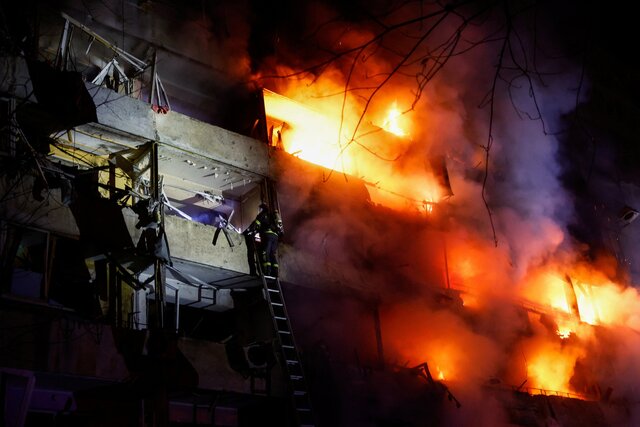
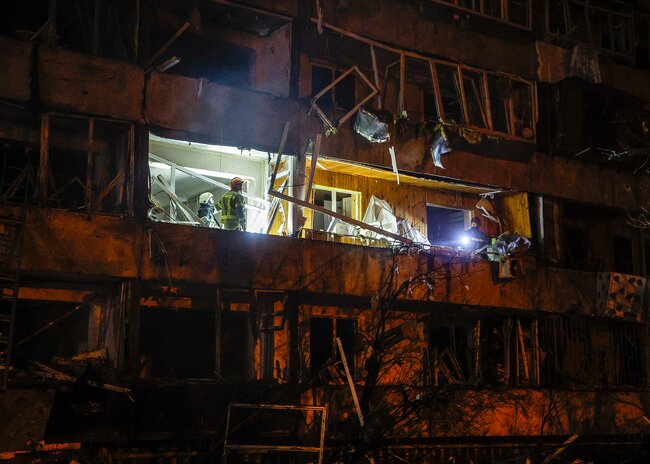
A fire in a residential building in Kyiv after a Russian attack on October 13
Russia
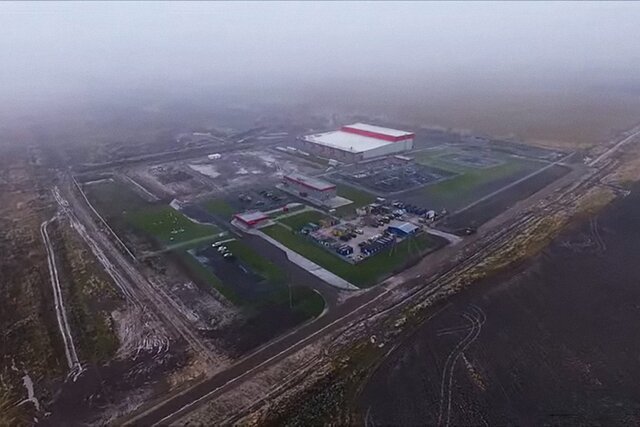
Ukrainian drones struck a data center operated by Sberbank in the city of Balakovo in the Saratov region overnight on October 14. Ukrainian monitoring channels were the first to report the attack. Saratov Governor Roman Busargin said the strike damaged residential buildings in Balakovo and killed one person. He said all infrastructure facilities in the city are “operating normally.”
A few hours later, Sberbank First Deputy Chairman Alexander Vedyakhin confirmed the attack on the data center, saying all the bank’s systems and services are “operating normally.” The bank’s press service said no employees were injured.
This is the first Ukrainian attack on Sberbank data centers. Last week, Ukrainian drones struck data centers belonging to Yandex in the Ryazan and Vladimir regions, as well as in Kaluga.
Sberbank announced plans to build a data center in the Saratov region in 2020 and began construction the following year. The facility is expected to cover almost 60,000 square meters (about 646,000 square feet). Authorities said it would be the largest data center in Europe, and one of Sberbank’s supercomputers is being built at the Balakovo site.
Ukraine
Ukraine’s Western partners once again failed to warn Kyiv that Russia was preparing a ballistic missile strike on the capital, Ukrainian President Volodymyr Zelensky said on the evening of October 13. He said the missiles were detected only as they approached Kyiv. The main target was the CHP-4 power plant, one of Kyiv’s major energy facilities.
Ukrainian Air Force spokesperson Yurii Ihnat said partners did not warn Ukraine ahead of the first ballistic missile strike during the overnight attack on October 14, but did send notifications ahead of the three subsequent waves of strikes.
A day earlier, Zelensky had said Ukraine had received no intelligence from Western partners about the Russian missile strike on Kyiv on October 12. “Intelligence about the launch of Russian ballistic missiles helps save people’s lives, and this is one of the most critical issues. This is exactly what helps prevent killings when there is a warning about ballistic missiles,” he said.
According to Politico, the United States told Ukraine it had withheld intelligence about the missile strike on Kyiv on the evening of October 12 because of poor weather conditions. Ukrainian authorities fear “this might not have been the case.”
U.S. President Donald Trump, asked directly by a journalist whether Washington had stopped sharing intelligence with Kyiv, answered: “No.” Earlier, the Financial Times reported that the United States had threatened to cut off intelligence sharing with Ukraine unless Kyiv stopped striking Russian oil refineries.
On the morning of October 14, Ukrainian military personnel began reporting that SpaceX had restricted the operation of Starlink satellite terminals used by Ukrainian forces at the front. The restrictions affect Starshield, the military version of Starlink, and limit the speed of drones that rely on satellite communications.
Starshield is faster and necessary for drone operators, a source in the Ukrainian military told Ukrainska Pravda, a Ukrainian news outlet. Regular Starlink, installed on drones, supports speeds of up to 160 kilometers per hour (99 mph), which is not enough for some missions. One commander sent the outlet a video showing two Ukrainian drones climbing into the sky and then “lose” their connection, unable to continue the mission.
“Our defense forces did not receive a warning about these restrictions, and that led to the failure of a number of missions. It’s obvious that this action cannot be a coincidence and is connected to the current political situation,” said Serhii Beskrestnov, an adviser to the Ukrainian president.
SpaceX has not yet commented on the Ukrainian military’s statements.
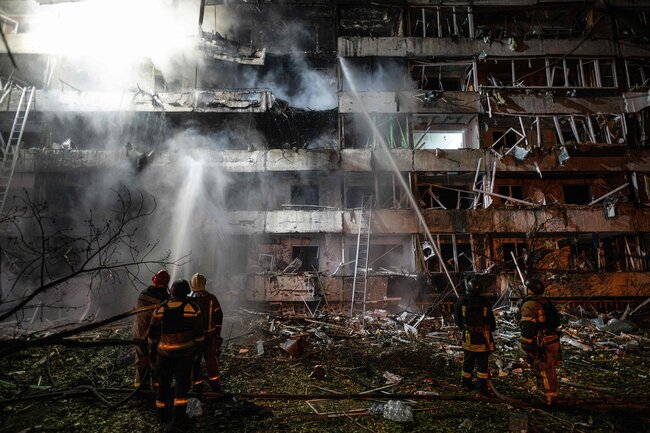
The war in photos. The aftermath of the missile strike on Kyiv
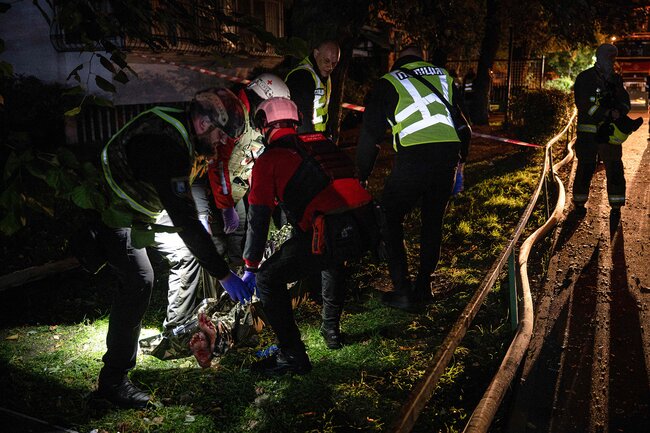
Russian forces struck Kyiv overnight on October 14, killing three people and injuring 21, according to the latest data. A strike hit a multistory residential building in the Desnianskyi district. Among the injured is a child.
Emergency workers carry the body of a person killed in a Russian strike on Kyiv overnight on October 14
At Meduza, we are committed to transparency about our use of artificial intelligence in the newsroom. The story you’re reading was written by one of our living, breathing journalists and translated from Russian using an AI model configured to follow our strict editorial standards. This translation process is the result of extensive testing and refinements to ensure our English-language coverage is timely and accurate. A Meduza editor reviews every draft before publication.
If you find any errors in this translation, please contact us at reports@meduza.io.
Latvia has officially notified Russian journalist Leonid Ragozin that it is expelling him from the country, he said on social media.
“I can now confirm that yesterday I was notified of my expulsion from Latvia where I lived for 12 years,” Ragozin wrote.
The notice did not specify “any specific misdemeanors or statements which prompted the decision,” according to Ragozin. He added that he had been declared persona non grata, a status intended “for diplomats who enjoy immunity from prosecution, not for ordinary people.”
Ragozin considers his expulsion political persecution, saying it stemmed from “long-brewing revenge” by far-right politicians over his investigation into their ties to Russian neo-Nazis who have taken refuge in Kyiv. “It is also a punishment for my commentary on the Russian aggression in Ukraine and for Pavel Sheremet investigation,” he wrote.
Latvian outlets reported in early October that the country’s Foreign Ministry had begun the process of declaring “another Russian citizen” persona non grata. Foreign Minister Baiba Braže said the decision was based on information “from the competent authorities” following consultations with the interior minister and the prime minister. The identity of the person being expelled was not officially disclosed, but Delfi reported it was Ragozin.
In Russia, Ragozin worked as a correspondent and producer for BBC Russia from 1998 to 2103 and as an editor at the magazine Russian Newsweek, and he also collaborated with Lonely Planet. He moved to Latvia after Russia’s annexation of Crimea in 2014. More recently, he has worked with Al Jazeera, Jacobin, and The American Conservative.
At Meduza, we are committed to transparency about our use of artificial intelligence in the newsroom. The story you’re reading was written by one of our living, breathing journalists and translated from Russian using an AI model configured to follow our strict editorial standards. This translation process is the result of extensive testing and refinements to ensure our English-language coverage is timely and accurate. A Meduza editor reviews every draft before publication.
If you find any errors in this translation, please contact us at reports@meduza.io.
The business association Delovaya Rossiya has drafted proposals to overhaul the Russian economy, the Russian business news outlet RBC reported. Some of the proposed measures would significantly tighten conditions for small and medium-sized businesses, while others target citizens’ passive income.
The draft document, which RBC reviewed, includes 52 proposals covering a wide range of topics. Among other things, the organization proposes the following:
Eliminate the tax regime known as the “Income” version of the simplified tax system (USN), which carries a 6% rate. The Bell explains that this would mean “primarily an increase in the tax base for entrepreneurs who earn income through their own skilled labor.”
Lower the threshold for applying VAT under the auto-USN regime from 60 million to 20 million rubles (matching the current threshold for the “standard” USN).
Eliminate the patent-based tax system, which The Bell says is widely used by microbusinesses.
Introduce social security contributions for citizens whose income mainly comes from interest or dividends.
Introduce an inheritance and gift tax on amounts exceeding 50 million rubles.
Restrict imports of “strategic innovative products.”
The Bell calls the proposal “a blow to small business” and says it “looks very bad” for medium-sized businesses too.
At Meduza, we are committed to transparency about our use of artificial intelligence in the newsroom. The story you’re reading was written by one of our living, breathing journalists and translated from Russian using an AI model configured to follow our strict editorial standards. This translation process is the result of extensive testing and refinements to ensure our English-language coverage is timely and accurate. A Meduza editor reviews every draft before publication.
If you find any errors in this translation, please contact us at reports@meduza.io.
SpaceX has restricted the Starlink satellite communication terminals used by Ukrainian troops at the front, slowing the drones that rely on them, according to Serhii Beskrestnov, an adviser to the Ukrainian president, and Serhii Sternenko, a former adviser to the Ukrainian defense minister and a volunteer.
The news outlet Ukrainska Pravda, citing the military, reported that the restrictions targeted Starshield, the faster military version of Starlink used by drone operators. One commander sent the outlet a video showing two Ukrainian drones climbing into the sky with their connection “dropping out,” leaving them unable to continue their mission.
A source in the Ukrainian Armed Forces told Ukrainska Pravda that standard Starlink terminals installed on drones work at speeds of up to 160 kilometers per hour (99 mph), but that speed is not enough for some missions, which is why drone operators use Starshield, the military version of Starlink.
“Our defense forces did not receive any warning about these restrictions, and it led to the failure of a number of missions. It’s obvious that this action can’t be a coincidence and is connected to the current political situation,” Beskrestnov wrote.
Volodymyr Zelensky said over the past two days that Western partners did not warn Ukraine about missile strikes on Kyiv. The United States told Ukraine it had not shared intelligence because of poor weather conditions, according to Politico.
The United States threatened last week to halt intelligence sharing with Ukraine and block arms deliveries unless Kyiv agreed to halt strikes on Russian oil refineries, according to reporting from the Financial Times.
At Meduza, we are committed to transparency about our use of artificial intelligence in the newsroom. The story you’re reading was written by one of our living, breathing journalists and translated from Russian using an AI model configured to follow our strict editorial standards. This translation process is the result of extensive testing and refinements to ensure our English-language coverage is timely and accurate. A Meduza editor reviews every draft before publication.
If you find any errors in this translation, please contact us at reports@meduza.io.

 Login