Login

X Bans Former Libertarian Party Affiliate—After the State Requests It
The Libertarian Party of New Hampshire's (LPNH) X account—which has become infamous for its bigoted and controversy-ridden posts—is finally gone. But the state's spurious role in its banning raises free speech concerns.
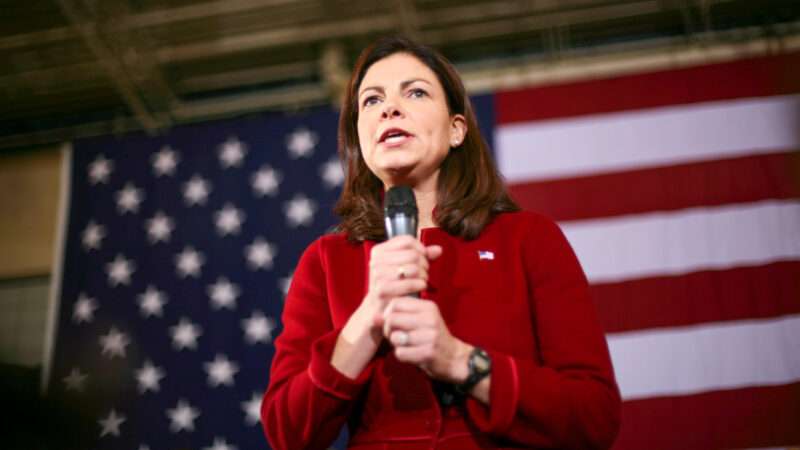
Last week, New Hampshire Republican Gov. Kelly Ayotte sent a letter to X's safety team, asking the company to suspend the account. Ayotte's letter made mention of several clear violations of X's content policies: "This account has openly called for the assassination of elected officials from the New Hampshire Democratic Party, has said it condones murdering elected officials for their policy positions, and most recently threatened a member of House leadership.…I'm calling on X to remove [the posts] and suspend the account immediately."
The letter referenced one particularly bold post from September (which the account later deleted). The post read: "We openly support the assassination of basically every elected democrat in New Hampshire. But if you don't have the balls to do it, then you should probably vote GOP."
X suspended the account the day after Ayotte sent the letter.
The removal of the LPNH account has likely elicited a sigh of relief from the Libertarian Party's (L.P.) leadership, which has repeatedly tussled with LPNH over its extreme rhetoric, undermining of L.P. candidates, and constant creation of P.R. crises for the party. In 2024, the LPNH endorsed Donald Trump for president instead of Libertarian candidate Chase Oliver, pushing the Libertarian National Committee to disaffiliate LPNH from the L.P.'s structure this past May. The Granite State Libertarian Party was designated the state's new L.P. affiliate in September.
Even though the LPNH has clearly violated X's terms and does not adhere to the most basic requirements for L.P. membership (such as pledging to uphold the nonaggression principle), the government should not tell private firms when to enforce their own policies. This sentiment was shared by Granite State L.P., which recently said in a social media post, "While a private company has a right to remove someone screaming about setting people on fire…the government should play zero part in that decision."
Jeremy Kauffman, the chair of the LPNH, is outraged but unsurprised, posting on Sunday that he and the LPNH are "exploring a lawsuit against the New Hampshire government." He tells Reason, "Ayotte's letter was a classic example of jawboning. When a governor sends a demanding letter like this to a private company, there is a clear implicit threat attached."
Speaking to Reason, Trace Mitchell, a technology and free speech expert at the Foundation for Individual Rights and Expression, defines jawboning as, "when the government, through veiled threats or direct coercion, pressures a private entity to take an action that the government could not lawfully take or mandate itself."
In Bantam Books v. Sullivan (1963), the Supreme Court ruled that the government cannot make recommendations to private companies if those recommendations come with legal repercussions—even implied or veiled repercussions. Doing so would qualify as jawboning, which violates the First Amendment. Though Ayotte's letter could be construed as extralegal pressure, it does not imply a punishment for noncompliance and likely falls short of legally recognized jawboning.
Addressing Kauffman's proposed lawsuit, Mitchell says, "In this case he would likely have to show there is something beyond this letter…[like] outside communications, emails or text with X."
Safety officers at X provided no comment to Reason to justify the suspension. It is not clear whether there was any external communication involved beyond the letter. Without a more definite connection between Ayotte's request and X's decision, Kauffman may struggle to win in court. Still, that doesn't make the governor's request any less concerning.
While Ayotte's letter was a surprise, it was not unprecedented. As social media has become the public forum, all levels of government have tried to regulate what is said there. During the COVID-19 pandemic, federal officials under the Biden administration were revealed to be in near-constant communication with major social media firms, encouraging and recommending that misinformation be removed from the platforms. Many of these recommendations were paired with implied threats to review the firms' legal immunity for content posted on their platforms, which spawned a lawsuit that reached the Supreme Court in 2024.
Although the Court dismissed the case for lack of standing, some lawmakers have taken action to address concerns over jawboning, with Sen. Ted Cruz (R–Texas) introducing the JAWBONE Act in June. The bill would make it easier for members of the public to sue government officials who pressure media networks, as well as require increased transparency for all federal communications to media networks.
Even if Kauffman cannot find legal remit, Ayotte's letter was a troubling move for the future of internet speech. Many of the offending posts referenced were months old or had been deleted before the letter was sent. The LPNH has likely been violating X's content policy for years, but X only took action after the government instructed it to.
You don't need a judge to see how that might be concerning.
The post X Bans Former Libertarian Party Affiliate—After the State Requests It appeared first on Reason Magazine.