❌

Reading view

"The Supreme Court Should Not Have to Keep Trimming the Same Poison Ivy One Tiny Branch at a Time"

The broader context, from Judge VanDyke's opinion dissenting from denial of rehearing en banc in Whitfield v. Mullin, joined by Judges Patrick Bumatay and Eric Tung; the question Judge VanDyke is confronting is when a Ninth Circuit precedent stops being binding on future panels because it's inconsistent with intervening Supreme Court precedent:

[T]his case illustrates (yet again) a more fundamental problem within our circuit: Miller v. Gammie's improper demand that our own circuit's precedent be privileged over the Supreme Court's more recent instructions unless our precedent is "clearly irreconcilable" with what the Supreme Court has subsequently told us. 335 F.3d 889, 893 (9th Cir. 2003). This prevents three-judge panels of our court from applying more recent Supreme Court authority whenever it is merely inconsistent with our own. The effect of this rule is both obvious and obviously wrong—we systematically hold the Supreme Court's instructions about the right answer to any number of legal questions in lower regard than our own wrong precedents….

The reality is that our en banc court is often unable or unwilling to fix things at odds with Supreme Court precedent. Sometimes, the obstacle is simply institutional inertia; the costs of en banc review make correction burdensome enough that erroneous precedent persists by default. We are a very busy court, and we can't be expected to take every case en banc that presents a legal issue where subsequent Supreme Court authority is inconsistent with, but not "clearly irreconcilable" with, our own.

But that is not the only problem with Miller's rule. The effect of that inverted rule is especially insidious (and no doubt intentional) when our precedent involves one of the many contested legal questions where our circuit's ideological commitments are at odds with what the Supreme Court has recently told us. In those instances, it is very unlikely a majority of our court would ever vote to take a case en banc to abandon the majority's own preferred doctrinal approach, even after the Supreme Court has undermined its foundation. Judge Reinhardt famously announced the Ninth Circuit's motto: the Supreme Court can't "catch 'em all."

Miller's strictures ensure that the Supreme Court's guidance will, for the most part, be limited in this circuit to only those instances where the Court actually "catches" a specific case—that is, where it actually grants review and issues a binding opinion in that case. And even in that rare instance, Miller ensures that whatever guidance the Supreme Court provides will have little spillover effect beyond the very narrow issue actually decided by the Court in that case. Everything else is not "clearly irreconcilable" (judges and lawyers alike are, after all, pretty good at distinguishing), so three-judge panels of this court that would very much like to follow the Supreme Court's recent guidance can't. And those who would very much like to avoid the Supreme Court's guidance can do so simply by not voting to take a case en banc.

The consequence is perverse. To correct our circuit's many erroneous precedents and ensure litigants can benefit from intervening Supreme Court decisions, the Supreme Court will have to take case after case after case and reverse them all, slowly, over the course of decades, one by one by one, as it has done so many times before.

The Supreme Court should not have to keep trimming the same poison ivy one tiny branch at a time. There are many judges on our circuit who would be glad to do the right thing and apply the Supreme Court's guidance in three-judge panel decisions whenever that guidance is inconsistent with our circuit's own earlier precedents. By overturning Miller in this or some future case, the Supreme Court would remove a perverse rule that entrenches erroneous precedent in this circuit, enabling three-judge panels to help hack away at the overgrowth. Help us help you.

The Supreme Court should take up this case to correct our circuit's erroneous "serious questions" rule [that's the debate in the underlying case, which has to do with the standard for granting preliminary injunctions]. But while it's at it, why not also correct Miller's "clearly irreconcilable" standard? Addressing the former will eliminate one of many legal doctrines in our court that are inconsistent with subsequent Supreme Court authority. But also addressing the latter would do much more to conform the Ninth Circuit's law to the Supreme Court's—without the Supreme Court's needing to exhaustively address every single error seriatim.

The post "The Supreme Court Should Not Have to Keep Trimming the Same Poison Ivy One Tiny Branch at a Time" appeared first on Reason Magazine.

  •  

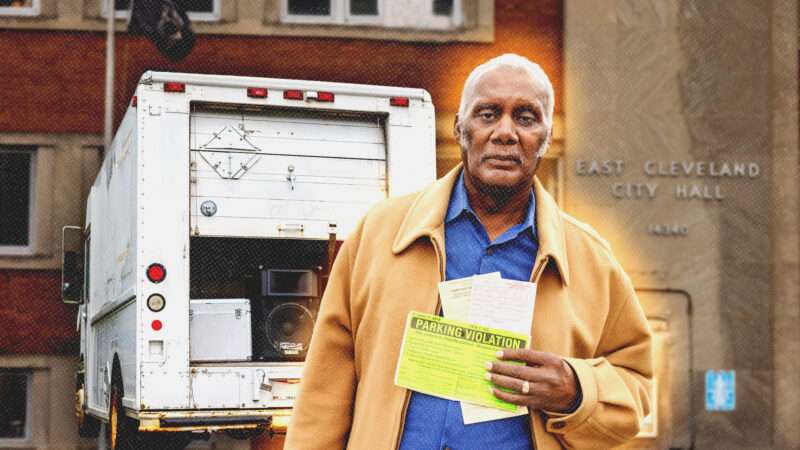
He Campaigned for the East Cleveland Mayor's Opponent. Then Police Came for His Truck.

William Fambrough seen in front of his sound truck | Institute for Justice

Walking through East Cleveland, Ohio, feels a touch like you've wandered onto the set of a postapocalyptic film noir. Grand, gilded homes announce themselves on neighborhood streets, some crowned with turrets, many with windows punched out like missing teeth. Often, no one is home, because no one lives there. It is safer than 1 percent of U.S. cities.

So why did local law enforcement pour considerable time and resources into pursuing a man for a sound truck?

That question is not really a legal one, at least not in the most technical sense. But it is the driving force behind a thorny case a federal court recently resuscitated: Fambrough v. City of East Cleveland, a saga concerning a man whose vehicle became an obsessive target of the East Cleveland Police Department (ECPD) after he used it to campaign for a mayoral challenger.

Some of the facts are in dispute. But the basic gist is as follows: William Fambrough, long a politically engaged East Clevelander, campaigned for Juanita Gowdy—a challenger to then-Mayor Brandon King—by broadcasting messages around the city with his sound truck. That ultimately came to an end after law enforcement impounded the car, cited him for parking and noise violations, and prosecuted him for the latter.

Fambrough sued, alleging the complex legal odyssey set into motion over his step van amounted to First Amendment retaliation, an unreasonable seizure under the Fourth Amendment, and a violation of the 14th Amendment's proscription against selective enforcement. The U.S. Court of Appeals for the 6th Circuit rejected some of those claims. But it resurrected claims against King and his chief of staff, Michael Smedley—depriving them of qualified immunity, the legal doctrine that inoculates state and local government officials from facing lawsuits if their alleged misconduct was not "clearly established" as illegal in prior case law. It also revived Fambrough's retaliation claim against the city.

As the 6th Circuit summarizes: King "says he received a phone call from a resident who complained about Fambrough's sound truck and someone else's box truck being parked in a residential area," so he told someone to take care of it. Scott Gardner, then the city's chief of police, "was concerned about selectively enforcing" the parking ordinance—which prohibits parking a truck in front of residential property, except for loading or unloading—because it is indeed almost never enforced. This was the beginning of a long pursuit, which ultimately saw a swarm of officers dispatched to Fambrough's house in August 2021 to confiscate the vehicle, allegedly resulting in $6,000 in damage. Fambrough also had to pay $528 in fees to get the damaged truck back.

"All the attention City officials gave Fambrough struck Gardner as unusual," the 6th Circuit notes. "The mayor's office wasn't this attentive even in homicide cases. And considering that the City had around only 50 police officers at the time and had 'serious crime problems,' Gardner thought it was odd to devote this much attention to permitting and parking issues." Based on available data, East Cleveland's violent crime rate is 1,409 per 100,000 residents, about four times higher than the national average.

Yet Gardner ultimately got on board. Smedley phoned him on August 9 "extremely upset," according to Gardner, and told the police chief he was "incompetent" for failing to "take care of" Fambrough's sound truck. Smedley wanted the "utmost enforcement as possible." So Gardner sent an email. "Please, find this vehicle and tow it," he wrote to all of ECPD. "Cite the operator with disturbing the peace and loud music. Please contact me as soon as this is complete to claim a surprise." A surprise!

Police succeeded. "On its face, the email told officers to tow Fambrough's truck regardless of whether it was parked illegally," writes the 6th Circuit. "And the Noise Ordinance authorizes seizure only of 'the sound device used,' and only upon conviction. So Gardner's instruction to tow the truck wasn't authorized by municipal law." The court still held that the seizure did not violate the Fourth Amendment. It also gave Gardner qualified immunity, ruling it is not clearly established that someone who acts as a conduit for someone else's alleged retaliation—which here came from the mayor's office—is a "responsible party."

Heather McCollough, the city's assistant law director, subsequently prosecuted Fambrough for allegedly violating the noise ordinance. According to a sworn declaration from Fambrough's attorney, McCollough outlined some of Fambrough's offenses on a call: that he "made complaints about the police department" and filed "public records requests," among other issues. Notably, it is legal to do those things. McCollough was typically willing to resolve minor noise complaints, she added, but not so much in this case, because Fambrough needed to "stand down." (He ultimately pleaded no contest to disorderly conduct, a reduced charge.)

East Cleveland police step van
Institute for Justice

"Only after [Fambrough] began supporting Gowdy's election was the weight of the law thrown against him," the 6th Circuit writes in its analysis of potential municipal wrongdoing. "And the City's police officers didn't uncover Fambrough's violations of their own accord. Instead, City decisionmakers sent them to Fambrough's home each time to enforce the Parking Ordinance. So the timing of the parking-related enforcement actions supports an inference that Fambrough's political speech was the motivating factor—as does the fact that the City rarely enforced the Parking Ordinance against anyone else despite having plenty of opportunities to do so." Incredibly, a photo of another truck can be seen down the street on the same day law enforcement came to fetch Fambrough's vehicle. (The law also includes pickup trucks, so the city arguably has a lot of enforcement to do if it sincerely believes this law matters.)

King allegedly set the chain of events into motion while Smedley took the driver's seat. "Smedley's pattern of incessantly calling and berating Gardner," the 6th Circuit adds, "clashes with the idea that Smedley was chiefly concerned with minor permitting, noise, or parking issues." After all, if that were true, why would the problem appear to begin and end with one person?

Over five years have passed since the ordeal. Although Fambrough is now potentially closer to getting in front of a jury, he has yet to actually state his case, still burdened by the onerous process government actors invoke to kill such suits before the community can assess the merits. King, meanwhile, won that election. He left office in May 2025, however, after he was found guilty of one count of theft in office, four counts of having an unlawful interest in a public contract, three counts of representation by public official or employee, one count of filing a false disclosure statement, and one count of soliciting improper compensation.

The post He Campaigned for the East Cleveland Mayor's Opponent. Then Police Came for His Truck. appeared first on Reason Magazine.

  •  

Trump's War With Iran Pushed Him To Waive a Century-Old Shipping Law. Commerce Boomed.

A large boat with shipping containers seen from above | Tawatchai Prakobkit/Dreamstime/Cato Institute

America's interminable war with Iran has killed thousands, disrupted commerce that flows through the Strait of Hormuz, and raised prices on the home front.

But there may be one silver lining. In an attempt to lower gas prices that spiked because of the war, the Trump administration has repeatedly issued waivers of the Jones Act, a century-old law that requires all goods moved between American ports to be carried on American-built, American-crewed ships.

With the law (temporarily) not being enforced, commerce has exploded.

Just look at how much propane has been shipped from the mainland United States to Puerto Rico, says Colin Grabow, a trade policy analyst at the Cato Institute and perhaps the nation's foremost advocate for abolishing the Jones Act.

A map showing U.S. fuel shipping routes
Cato Institute / Joanna Andreasson

Since March, when the first waiver was issued, Puerto Rico has imported more than 800,000 barrels of propane from the mainland. That's more than twice the amount of American propane shipped to Puerto Rico in the last 22 years combined.

America is one of the world's leading producers and exporters of propane, but the lack of Jones Act–compliant ships capable of carrying gas means that it has been nearly impossible to ship propane from the mainland to outlying parts of the country. In the past, Puerto Rico has imported gas from Nigeria, Chile, and elsewhere because those deliveries don't have to comply with the Jones Act.

For years, libertarians have argued that the Jones Act unfairly impoverishes American consumers and businesses that want to buy and sell things within the same country in order to artificially inflate the price of moving those things across water. Waiving the law seems to have proven that point: There are plenty of ships capable of moving gas and oil around the country as long as the government gets out of the way.

"The instant the Jones Act no longer applied to energy shipments, mainland propane displaced foreign imports, suggesting it had been the cheapest option all along," says Grabow.

Puerto Rico is hardly the only winner.

The Jones Act waivers are offering a glimpse into a world where the law doesn't exist. From March through mid-August, there had been 210 voyages completed that otherwise would have been deemed unlawful without the waivers, according to an analysis of Maritime Administration data by the Institute for Energy Research.

It's a world where American oil and natural gas can be more easily shipped from the Gulf Coast to New England, which had previously been importing energy from Russia and Europe. Another big winner is California, which had been importing gasoline from as far away as the Bahamas because it was nearly impossible to legally ship gas from Texas or Alaska to the West Coast.

President Donald Trump reupped the Jones Act waiver in mid-May. Another extension, issued in August, will last for 90 days but applies only to ships carrying energy products such as gas and oil. Before that waiver expires in November, lawmakers ought to kill the Jones Act permanently.

There is some irony in the fact that one of Trump's most successful policy maneuvers has paused a protectionist law that limited commerce, when so much else of his economic policy has been focused on erecting barriers to trade. It's also amusing that it was a war in the Middle East—something Trump pledged to avoid—that triggered this change.

Still, the proof is in the shipping. The free traders were right all along.

The post Trump's War With Iran Pushed Him To Waive a Century-Old Shipping Law. Commerce Boomed. appeared first on Reason Magazine.

  •  

Libertarianism and Democracy Revisited - A Rejoinder to Matt Zwolinski

Democracy | NA
NA

On October 4, I published a post on "Libertarianism and Democracy," critiquing political philosopher Matt Zwolinski's earlier Liberalism.Org article on the same topic. Earlier today, I posted Matt's response to me. The present post is my rejoinder:

I would like to thank Matt for his interesting and insightful response. We agree on several key points, including that democracy is generally superior to authoritarianism, that libertarian critiques of democracy have great merit, and that - in much of the world - the most serious threats to liberty now come from the nationalist right, rather than the the political left. But we still differ on a few key points related to libertarianism and democracy.

The Nature of Libertarian Critiques of Democracy

Perhaps the most crucial disagreement is about the nature of libertarian critiques of democracy. Matt suggests that "[m]ost of what Ilya calls the libertarian critique of democracy is really a critique of big government." If so, libertarians can just focus on criticizing big government generally, while simultaneously extolling democracy.

There are indeed flaws of big government that arise regardless of whether it is democratic or authoritarian. But those outlined in my earlier Liberalism.Org article are in fact specific to democracy. They include tyranny of the majority, voter ignorance, and the tendency of democracy to create opportunities for illiberal forces to seize power and - in the worst case scenario - even destroy democracy itself.  Tyranny of the majority is obviously a problem distinctive to democracy. The same goes for rational voter ignorance, which arises from the perverse incentive structure  of individual voters, who have only an infinitesimally small chance of influencing electoral outcomes. And, while illiberal forces can and do seize power under authoritarian systems, the pathways democracies (usually involving the electoral process) create for them are distinctive.

Authoritarian systems have their own distinctive flaws, which are generally even worse. But the distinctive nature of democracy's flaws means they cannot simply be folded into a generic critique of big government. In addition, as noted in my response to Matt, these distinctive flaws of democracy are at the heart of many of today's most serious threats to liberty and justice in many democratic systems, including the threats posed by the nationalist right. Thus, it is important for libertarians to emphasize the nature and gravity of these weaknesses, and the value of our proposals for dealing them (which in many cases are different from and better than those advanced by other types of liberals). As emphasized in my earlier response, this is an area where libertarians often have a comparative advantage over other liberals. On the other hand, we generally do not have a comparative advantage when it comes to explaining why democracy is better than authoritarianism.

Along related lines, Matt suggests that libertarian critiques of the state aren't "an argument against democratic control of whatever the state does do." But once we recognize that democracy has significant distinctive flaws, there is actually a case for insulating some functions of government from democratic control. Obvious examples include the judiciary and monetary policy (unless we want to cut government out of the latter entirely, and adopt free banking). Indeed, even most non-libertarian liberals recognize that such insulation is desirable in some cases, most notably the courts.

The Problem of Libertarians Tempted by Authoritarianism

Matt argues that we should, nonetheless devote extensive energy to extolling democracy, because doing so is likely to have an impact on fellow libertarians who may otherwise be tempted to embrace authoritarianism. It is likely true that libertarians tempted in this way are more easily dissuaded by other libertarians than by non-libertarians. But such people are a tiny minority within an minority. Libertarians are a small group (probably around 5-10% of the US population or even less, depending on how you draw the line). Those sympathetic to authoritarianism are much fewer still. Thus, it makes little sense to devote more than a modest amount of time and effort to dealing with them, as opposed to addressing the much larger group of non-libertarian liberals who need to be more cognizant of the dangerous shortcomings of democracy.

Moreover, when we look at libertarians who have shifted to the "alt right" or otherwise become advocates of illiberal ideas, the problem in most cases is not excessive skepticism of democracy, but insufficient commitment to liberty - particularly, the liberty of people from different ethnic, racial, or religious backgrounds, that of migrants, and those with unconventional lifestyles. That is pretty obviously the case with Curtis Yarvin and Hans-Hermann Hoppe, both mentioned by Matt. The former's advocacy of a "post-liberal" ideology of repression (which is really based on pre-liberal models) is pretty obviously not the product of a man who thinks authoritarianism is a better way to protect liberty than democracy. Indeed, his concern is exactly the opposite (that democracy allows for way too much liberty). The same goes for Hoppe's advocacy of repression of immigrants, gays and lesbians, and people with various non-traditional lifestyles. Peter Thiel, the third case mentioned by Matt, is that of a person who has abandoned libertarianism for "national conservatism," an ideology focused on exalting the interests of ethnic and culture majorities and using the state to punish perceived "enemies." To the extent we want to focus on dissuading such people, it should be to reemphasize the value of liberty for all, not extolling the virtues of democracy. People who value democracy more than liberty are generally unlikely to become libertarians in the first place.

Two  Smaller Issues

Matt and I also have a modest disagreement over whether there can be situations where some form of authoritarianism can be a lesser evil compared to democracy. I think such cases are extremely rare, but not nonexistent. Matt's position is less clear, and perhaps I misunderstand him. But he does seem to want to deny this possibility. In response to my examples of the allied occupations of Germany and Japan after World War II, he seems to think these don't really count because "those occupations were run by democracies answerable to their own voters, and they ended." But they were still cases where non-democratic government was imposed on a population, and that population itself did not have control over when and if it would end.

In these cases, a non-democratic occupation government was a lesser evil than immediate establishment of democracy, because of the highly illiberal nature of German and Japanese majority public opinion at the time.  Similar circumstances can potentially arise in other countries. And, in some cases, a domestically generated authoritarian regime might still be a lesser evil than any democracy that is feasible at the time.

In some situations, the problem can be dealt with by limiting democracy, rather than abjuring it completely. For example, as noted in my earlier response, post-occupation West Germany long banned Nazis and communists from competing in elections, but otherwise committed to free electoral competition. But there could be situations where such constraints are not enough. Because such cases are highly unusual, this is not a particularly important disagreement. But it does have relevance in situations where we consider how to deal with a society where majority public opinion is deeply illiberal.

Finally - and least important - Matt differs with me about the use of the terms "libertarian" and "classical liberal," arguing that the former are more likely to be democracy-skeptics than the latter. We can, if we want, define the two terms in such a way that people we label with one are generally more suspicious of democracy than those we label with the other one. But that is not the way the terms are typically used. That said, different people use these terms in different ways. To my mind, they are mostly just alternative labels for the same general ideology. But I don't have much of a beef with people who prefer to use them differently than I do, so long as they make clear what they mean.

Ultimately, Matt and I agree on much more than we differ. But a few of the issues we differ have real significance. I am grateful for the opportunity to consider them.

The post Libertarianism and Democracy Revisited - A Rejoinder to Matt Zwolinski appeared first on Reason Magazine.

  •  

Who Should Defend Democracy?

On October 4, I published a post on "Libertarianism and Democracy," critiquing political philosopher Matt Zwolinski's earlier Liberalism.Org article on the same topic. Matt has written a response to me, which I have agreed to post at this site. The remaining paragraphs of this post were written by Matt Zwolinski, not me (Ilya Somin). I have posted a rejoinder to Matt's thoughtful response here.

Who Should Defend Democracy?

A reply to Ilya Somin

My recent Liberalism.org essay, "Democracy Belongs on the List," made the case that classical liberals should count democracy among their core commitments, alongside private property, free markets, and the rule of law. And it belongs there for the same reason. Like property rights and markets, democracy is a crucial way of keeping power in check.

Ilya Somin has written a generous and thoughtful reply to that piece. And I think he actually agrees with me more than the framing of his post might suggest. Ilya grants that democracies are generally freer and more prosperous than the alternatives, that democracy is "a valuable check on power," that libertarians should arguably stress these points "more often," and that "in much of the world today, right-wing nationalists pose a greater threat to libertarian values and priorities than the political left does." What's left mainly comes down to two questions: what counts as a libertarian critique of democracy, and whose job it is to defend democracy.

Before turning to those substantive issues, though, there's one terminological matter that's worth clearing up. Ilya says that nothing of significance hinges on whether we call our view "libertarian" or "classical liberal." And on most questions I'd agree. On this one, though, I think the difference matters. In The Individualists, John Tomasi and I draw a distinction between strict libertarians and classical liberals. The former group tends to treat liberty as a moral absolute and to derive their politics from a single overarching principle like the non-aggression axiom. Think Murray Rothbard or Ayn Rand. The latter treat liberty as a strong but defeasible presumption and are more empiricist and pluralistic in their approach to politics. Think Friedrich Hayek or Richard Epstein.

My sense is that these two camps within the broader "liberty movement" have taken pretty different stances toward democracy, with strict libertarians being much more critical than their classical liberal brethren. Even back in the 19th century, you could find Benjamin Tucker insisting that voting is always a form of aggression, and Lysander Spooner arguing that women "have just as good a right to make laws as men have, and no better: AND THAT IS JUST NO RIGHT AT ALL." Herbert Spencer was even willing to walk back his support of women's suffrage once he decided that women would probably use their vote to support bigger government. That's a pretty different take than anything you're likely to find in Ludwig von Mises or Friedrich Hayek (more on whom later), let alone in John Stuart Mill.

That brings us to the first of the two substantive issues under dispute. Ilya argues that recent events have made libertarian critiques of democracy more important than ever, and that the libertarian solutions to democracy's flaws are "primarily to limit and decentralize government power." I'm with him on that, but I don't think this settles, or even really addresses, the debate about democracy. Limiting and decentralizing government power is a claim about the scope of the state, about how much government should do. It's a principle that would apply to any government, whether democratic or not. And, crucially, it isn't an argument against democratic control of whatever the state does do.

That distinction was at the heart of my essay. Following Jacob Levy, I argued that classical liberals have let a perfectly sound critique of too much government slide into a skepticism about democracy itself, treating democracy, in Levy's words, "as if the contrast to 'democratic' were 'economic' rather than 'autocratic.'" One can be a radical about reducing the scope of the state and still insist that its agents must be answerable to the people they govern. Most of what Ilya calls the libertarian critique of democracy is really a critique of big government. That's an argument I largely agree with, as far as it goes. The trouble comes when we file it under the wrong heading. When we ourselves blur the line between critiques of state power and critiques of democracy, we shouldn't be surprised when people come away thinking libertarians are against democracy.

That brings me to comparative advantage, which is where I think Ilya's argument is most interesting but also most mistaken. Libertarians are a small minority, he says, and "we have no comparative advantage when it comes to extolling the virtues of democracy relative to authoritarianism. Other types of liberals can do this work just as well as we can, perhaps better." So we should stick to what we do best, which is analyzing democracy's flaws.

This argument might make sense in some contexts. But as a general principle, I think it misfires, and it misfires most badly when the audience is classical liberals and libertarians themselves. That, after all, is where the turn against democracy has actually happened. Hans-Hermann Hoppe's Democracy: The God That Failed argued that monarchy was preferable to democracy, and complained that "habitual democrats" had been tolerated rather than "isolated, excluded and expelled from civilization." Curtis Yarvin, who came to neoreaction by way of libertarianism, credits Hoppe with opening "a kind of door to the pre-revolutionary world" for him. And in 2009, Peter Thiel wrote in a Cato Institute publication that "I no longer believe that freedom and democracy are compatible." None of this follows from the libertarian critique of voter ignorance, and nothing Ilya has written points in this direction. But it grew in a movement where, as Janet Bufton recently put it in Liberal Currents, "even liberal libertarians were taught arguments about why democracy fails," and hardly anyone was making the case for democracy on libertarian terms. Any old liberal can explain to the public why democracy beats dictatorship. But a libertarian drifting toward Hoppe or Yarvin isn't going to listen to them. Only libertarians can tell libertarians that democracy is theirs.

So if democracy is a libertarian value, what kind of libertarian value is it? Ilya argues that democracy shouldn't be "a first-order libertarian priority, on par with liberty, constraining coercion, property rights, and increasing human happiness," because its value is instrumental rather than intrinsic. I agree that the value of democracy is instrumental. In that way, it's in precisely the same position as a number of items on the classical liberal list. Free trade, federalism, judicial review, and the rule of law are instrumental too. What I want to resist is the claim that because democracy is only instrumentally valuable it's therefore dispensable – something that can be traded away whenever we can imagine something better. What we can imagine, though, is a poor guide to what works. The better question, as David Schmidtz argues, is what has "an observable history of leading self-interested agents to act in ways that are useful and agreeable to the people around them," and by that test democracy has very few rivals.

Which leaves us with Hayek. Ilya defends Hayek's preference for "a liberal dictator to a democratic government lacking liberalism" as a claim about rare hypothetical cases, and suggests that transitional non-democratic rule "may be necessary" in places like Russia and China, citing the Allied occupations of Germany and Japan. But those occupations were run by democracies answerable to their own voters, and they ended. Russia and China, in contrast, have no outside power that could impose a transition and then hand power back. The only realistic candidate for transitional power in those countries is a domestic strongman, which is exactly the case Hayek had in front of him. Hayek wasn't musing about hypotheticals; he was talking about Chile.

Ultimately, Ilya and I want the same thing. We both advocate a form of libertarianism that resists concentrated power wherever it appears, including when it arrives through the ballot box. Where we differ is on the need to say out loud that democracy is one of the ways we resist it. I think we should, and I think libertarians are better placed to say it than anyone, since the people who most need to hear it are our own.

The post Who Should Defend Democracy? appeared first on Reason Magazine.

  •  

$65K Settlements with EEOC Over Failure to Accommodate Muslim and Christian Employees' Religious Days Off

From a press release last month, just posted on Westlaw:

N.C. Detective Agency, a Durham-based security company, will pay $65,231 in compensatory damages and back pay, and take other corrective actions to voluntarily resolve a religious discrimination investigation by the U.S. Equal Employment Opportunity Commission (EEOC), the federal agency announced today.

The EEOC's investigation found reasonable cause to believe that an employee requested to be excused from work due to a Muslim religious holiday, but the request was denied. The company was aware of the employee's need for a religious accommodation but did not engage in the legally required interactive process, and instead terminated her in June 2025 when she did not report for duty.

And from another press release two weeks later, also just posted on Westlaw:

Reynolds IGA Foodliner, Inc., owner and operator of a chain of grocery stores, will pay $65,000 and provide other equitable relief to settle a religious discrimination and retaliation lawsuit filed by the U.S. Equal Employment Opportunity Commission (EEOC), the federal agency announced today.

According to the suit, shortly after she was hired as a deli clerk at the Piggly Wiggly store in Hazlehurst, Georgia, the employee requested Sundays off to observe her Sabbath. The employee's supervisor denied the request, claiming that, if the store gave the employee Sundays off, it would have to do the same for all other employees. The employee continued to request the accommodation, and the company fired her in January 2025.

More from the second press release:

"Employers cannot deny religious accommodation requests simply for fear of upsetting other employees," said Marcus G. Keegan, regional attorney for the EEOC's Atlanta District. "The EEOC remains committed to enforcing federal anti-discrimination law and protecting employees' rights to religious freedom."

Darrell E. Graham, director of the EEOC's Atlanta District, said, "Employers must thoughtfully consider each request for religious accommodation on an individual, case-by-case basis and otherwise make good-faith efforts to accommodate their employees' religious beliefs. Employers must be aware of their obligations under federal law to provide reasonable religious accommodations absent undue hardship."

Finally, from a third press release from last month (it was published in between the first two, but was again just posted on Westlaw); this one involves a lawsuit and not a settlement:

Blue Bell Creameries, Inc., a Brenham, Texas-based frozen snack manufacturer and distributor with a production facility in Sylacauga, Alabama, unlawfully terminated a Jewish body shop technician soon after he requested a beard‑related religious accommodation, the U.S. Equal Employment Opportunity Commission (EEOC) charged in a lawsuit announced today.

Even supporters of bans on religious discrimination by private employers might debate whether employers should be required to give religious exemptions from generally applicable rules (exemptions that could themselves be seen as discrimination in favor of religious observers). But Congress has indeed mandated such exemptions: Title VII of the Civil Rights Act, as amended in 1972, generally requires employers to accommodate religious objectors' requests for exemptions from generally applicable work rules, unless doing so would pose an "undue hardship" for the employer.

That extends to time off for religious holidays: Indeed, the leading recent case on the subject, Groff v. DeJoy, involved a Christian employee's request for an exemption from having to work Sundays. And of course it extends, as it must, to all religions.


The post $65K Settlements with EEOC Over Failure to Accommodate Muslim and Christian Employees' Religious Days Off appeared first on Reason Magazine.

  •  

$6M Verdict in #TheyLied Defamation Lawsuit Brought Over Sexual Harassment Allegations

Another winner in the case, thanks to IOCB Prague's decision.

So reports the N.Y. Times (Mark Arsenault) yesterday, discussing former MIT cellular biology professor David Sabatini's victory on the defamation claim (and defendant's loss on her harassment and retaliation counterclaim). More details:

[Sabatini] was forced out of his lab in 2021 after an internal Whitehead [Institute] investigation concluded he had a past sexual relationship with a younger and less experienced colleague, Kristin Knouse, over whom he had a career-influencing role. The investigation also found that his lab had maintained a sexualized atmosphere. Dr. Knouse said that the relationship was coerced.

But Dr. Sabatini denied his lab had an improper atmosphere. He maintained that his relationship with Dr. Knouse had been consensual and that Dr. Knouse had schemed to get him fired and disgraced after he became interested in another woman….

After he was pushed out of M.I.T. and the Whitehead, he had talks with New York University about a job. But N.Y.U. staff members and students protested in the streets against his hiring in 2022, and the university did not hire him.

In 2023, he was hired by the Institute of Organic Chemistry and Biochemistry, in Prague, and later opened a Boston-area branch of that institute….

According to the Boston Globe (Madyline Swearing, Bryan Hecht & Tonya Alanez), "In 2023, New York hedge fund billionaire Bill Ackman and an anonymous donor pledged $25 million over five years to help Sabatini get back into science." The Globe also reports that the jury consisted of "seven women and six men," for whatever that's worth.

Here's an excerpt of what Sabatini alleged (quoting a Massachusetts appellate decision in the case, later reversed as to Knouse's counterclaim by the Massachusetts high court):

Sabatini and Knouse met in 2012. At the time, Sabatini was a tenured member of the department of biology at the Massachusetts Institute of Technology (MIT) and ran his own laboratory at Whitehead, a research institute affiliated with MIT that receives funding from private resources such as the Howard Hughes Medical Institute (HHMI) and public resources such as the National Institutes of Health (NIH). {As pertinent here, Whitehead and HHMI have a relationship whereby HHMI provides funding for, and in some instances employs, individuals working at Whitehead. At all relevant times, both Whitehead and HHMI employed Sabatini. In addition, NIH provided grants that funded Sabatini's research at Whitehead.}

Knouse was enrolled in an inter-institutional M.D./Ph.D. program at Harvard and MIT, where Sabatini was one of her instructors and served on her thesis committee. While Knouse was a doctoral student, she and Sabatini sometimes socialized.

Then, in 2018, Knouse started a fellowship at Whitehead, and she and Sabatini began a sexual relationship. While the relationship ended in 2019, Knouse sent text messages to Sabatini in January 2020 seeking to rekindle their relationship. Sabatini responded, asking Knouse to stop and stating that he wanted peace and needed space to figure things out.

In early 2020 through the fall of 2020, Knouse began telling colleagues, both at Whitehead and MIT, that Sabatini had sexually harassed her. In October 2020, Knouse reported the alleged sexual harassment to Lehmann. Around that time, Whitehead hired a consultant to conduct a diversity survey at Whitehead. During the survey, some Whitehead employees reported concerns about Sabatini. In response, Whitehead hired the law firm of Hinckley, Allen & Snyder LLP (HAS) to investigate the culture within Sabatini's laboratory. The HAS investigators spoke with Knouse and other members of the Whitehead community. In interviews with the HAS investigators, Knouse repeated her allegations that Sabatini had sexually harassed her.

On August 13, 2021, HAS sent a report to Whitehead finding that Sabatini had committed sexual harassment. Whitehead forwarded the report to MIT and HHMI. On August 19, Whitehead provided Sabatini with a copy of the report. On August 20, Sabatini resigned after learning that Whitehead was about to terminate his employment. {Before Sabatini resigned, his coemployer at Whitehead, HHMI, terminated his employment. MIT placed Sabatini on leave.}

And here's what Knouse alleged (quoting the Massachusetts high court decision); the jury verdict suggests that the jury largely believed Sabatini's story rather than Knouse's:

Sabatini was a laboratory director at the Whitehead Institute for Biomedical Research (Whitehead) and a tenured professor at the Massachusetts Institute of Technology (MIT) in 2012 when he met Knouse, then a graduate student at Harvard University and MIT. Sabatini was one of Knouse's instructors at MIT and served on her dissertation committee.

During a discussion in 2016 concerning whether Sabatini would endorse Knouse's application for an upcoming fellowship at Whitehead, Sabatini expressed concern that Knouse took herself too seriously and asked Knouse whether she ever had "fun," "fuck[ed] around," or had sex. Knouse responded that she did have fun and quickly left the conversation. Subsequently, Sabatini recommended Knouse for the fellowship and supported her grant application, both of which she secured.

Knouse joined Whitehead as a fellow in 2018. That year, Knouse and Sabatini began a sexual relationship that ended in 2019; thereafter, Sabatini continued to make sexualized comments to her. Knouse asserts that she struggled under this dynamic. Sabatini, whose laboratory was next to Knouse's, was the director of the Whitehead fellows program, and he served as a mentor and reviewer of her work. Knouse feared the potential consequences that losing an influential mentor would have on her career and believed she could not terminate the relationship without professional repercussions. She "began to withdraw from the scientific community" and "experience[d] debilitating feelings of entrapment and hopelessness."

Around this period, the results of a 2020 culture survey of Whitehead "suggested that Sabatini either personally engaged in sexually explicit and inappropriate discussions or fostered an environment that tolerated—or promoted—such inappropriate discussions and that he threatened those who might report his conduct." The survey results "amplified complaints" raised by two women, who had trained in Sabatini's laboratory, and by Knouse, who contemporaneously disclosed to the director that she had felt harassed during her fellowship but, fearing retaliation, did not provide any further details.

In response, Whitehead hired an independent legal team to investigate. The investigators determined, inter alia, that Sabatini had "engaged in and otherwise tolerated sexist and sexualized work discussions with his lab," and that engaging in such discussions "was an implicit part of succeeding in" Sabatini's laboratory. They also concluded that there was a "culture of fear and retaliation" within the laboratory. They reported that Sabatini had "engag[ed] in sexual relations with a Whitehead Fellow" and violated several Whitehead policies, including its sexual harassment policy.

Sabatini resigned from his Whitehead position. MIT announced that it was placing Sabatini on leave to perform its own investigation.

Sabatini's claims against Whitehead had earlier been dismissed (see, e.g., this decision).

Lisa Arrowood, Shayne Kinsella, and Sarah Sousa (Arrowood LLP) represent Sabatini.

The post $6M Verdict in #TheyLied Defamation Lawsuit Brought Over Sexual Harassment Allegations appeared first on Reason Magazine.

  •  

Some Progressives Tried To Abolish the Tipped Minimum Wage. Now They're Backtracking.

A plate with money on it | Ryan Mackay/Nexus7/Aliaksandr Autayeu/Dreamstime/Fatima Ruiz

In recent years, one of the predominant policy initiatives of the progressive left has been raising the minimum wage in locales around the country. At the same time, left-leaning politicians have sought the elimination of what's known as the tip credit, which allows employers to pay restaurant servers and other tipped employees a lower hourly base wage that they then bolster with gratuities.

Just a few years into this experiment, however, policymakers are showing signs of an about-face on the tip credit's abolition as they grapple with the unfortunate, and predictable, economic results.

In 2022, Washington, D.C., made news headlines when voters passed Initiative 82. As originally designed, it would have repealed the tip credit and required servers to be paid the District's full statutory minimum wage by 2027. (D.C.'s minimum wage was $16.10 per hour in 2022, but has since risen to $18.40 due to inflation indexation.) Prior to Initiative 82, D.C. servers could be paid a $5.35 tipped wage, so long as they earned enough tips to make up the difference between the lower tipped wage and the higher traditional minimum wage.

D.C.'s Initiative 82 was just the beginning. One Fair Wage, a progressive group that lobbies against subminimum wages, quarterbacked an all-out push to eliminate the tip credit in jurisdictions across America. Chicago became the second prominent city to follow suit. States like New York, Connecticut, and Illinois also quickly saw legislation introduced to eliminate the tip credit at a statewide level. (Apart from this recent wave, a small handful of American states—including California, Oregon, and Alaska—have long operated without a tip credit).

But just when it seemed like momentum against the tip credit had reached its apex, progressive politicians started to see the writing on the wall. In the aftermath of the tip credit's repeal, D.C. saw a close to 5 percent decline in full-service restaurant jobs. Tipped worker earnings also dropped by just under $12 million—likely a result, at least in part, of restaurants reducing hours for staff in the face of higher labor costs. At the same time, many D.C. restaurants began implementing service fees or so-called auto-gratuity policies that added mandatory 10-20 percent charges onto customers' bills.

Mugged by this economic reality, D.C. Mayor Muriel Bowser called for the full repeal of Initiative 82. Ultimately, the D.C. Council settled for a partial repeal in 2025, maintaining at least some semblance of a tipped wage that sits below the traditional minimum wage into the years ahead (although the tipped wage eventually rises to 75 percent of the traditional wage by 2034). This was a familiar story: The council had previously repealed Initiative 77, a near-identical attempt to abolish the tipped wage that voters passed in 2018.

After Chicago moved to eliminate the tip credit, the Illinois Restaurant Association found that 89 percent of Windy City restaurants raised menu prices; another 79 percent responded by reducing worker hours. Again bowing to economic reality, the progressive Chicago City Council voted to freeze the tip credit's planned elimination, only to see the effort vetoed by Mayor Brandon Johnson. Eventually, a compromise was brokered to at least pause the tip credit at its current level for two years—which punts the issue until after Johnson stands for election again, allowing a potential successor to endorse a more lasting reversal.

In Michigan, a 2024 state supreme court ruling set the tip credit on the path toward elimination by 2030. But state lawmakers intervened last year, deciding to maintain a 50 percent tip credit in perpetuity after 2031. Notably, Michigan is currently governed by a Democratic trifecta in the governorship and both houses of the Legislature. The tip credit's revival garnered key support from Republican lawmakers to pass in a bipartisan fashion, before being signed into law by Democratic Gov. Gretchen Whitmer.

While progressive efforts to eliminate the tip credit may be motivated by an earnest desire to ensure waiters are paid more, the math isn't that simple. Requiring a server to be paid a $16 traditional minimum wage—up from a $5 tipped wage—might appear to raise their pay on paper. But this fails to consider several important factors.

Under our "No Taxes on Tips" new normal, raising the minimum wage for servers could lead to a partial reduction in tips, which under certain scenarios can result in less take-home pay for waiters once the taxman takes his cut. If more server earnings come in the form of "auto-gratuity" policies—which are treated as taxed wages under the law—then the tax repercussions may grow even grimmer.

But more broadly, these laws attempt to subvert basic economics. As of 2025, Bureau of Labor Statistics data show that D.C. restaurants shed over 1,600 jobs in aftermath of Initiative 82; meanwhile, between 2022 and 2025, restaurant job growth in the District declined by more than 8 percent. This is just one example. The fallout is the inevitable result of restaurants responding to labor costs that suddenly skyrocket, forcing establishments to cut worker hours and sometimes transition to quick-service models that require less hourly staff. And that's to say nothing of the diners who bear the cost with higher prices and new service fees.

"We're watching a beloved bar back, a beloved busser, a dishwasher have their jobs taken away," D.C. restaurant worker Valerie Graham told Reason in 2024. "Not because our owner-operator is an evil billionaire but because they're an independent business owner who had to make some business decisions and there's a callousness with which our industry is talked about."

To be sure, the tip credit has only survived in modified and reduced form in D.C., Chicago, and Michigan—and in the case of Chicago, the about-face is only temporary. But the partial reversals show the tip credit's elimination is not a foregone conclusion. Economic reality continues to rear its head.

The post Some Progressives Tried To Abolish the Tipped Minimum Wage. Now They're Backtracking. appeared first on Reason Magazine.

  •  

Steve Vladeck's "Hard Questions About Court Expansion"

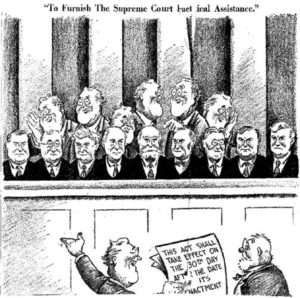
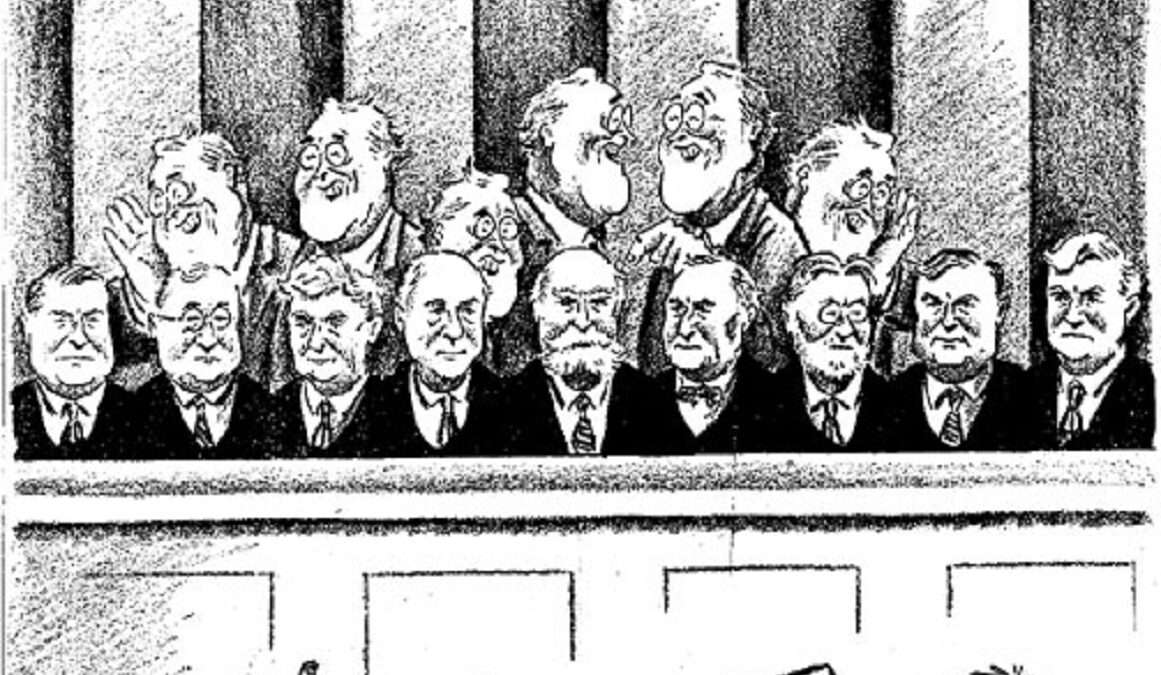
Cartoon criticizing Franklin D. Roosevelt's 1937 court-packing plan. (NA)


Georgetown law Professor Steve Vladeck is one of the leading critics of the conservative majority on the Supreme Court. But in an insightful recent post on his substack, he outlines key reasons why "court expansion" is a bad response to its flaws. The cure is likely to be worse than the disease:

[I]t seems to me that those who are fully onboard the expansion-or-bust train should have to do more than simply assert that having four new Democratic appointees on the Court in 2029 would be a self-evidently "good" thing. If nothing else, proponents of expansion should have to answer the following four questions:

  1. How do we avoid touching off a race to the bottom, where each time one party controls the House, Senate, and presidency, it expands the Court to ensure an ideologically and politically sympathetic majority?
  2. If a race to the bottom is unavoidable, how do we avoid further (and potentially fatal) erosion of public confidence in the Court—which will quite transparently be little more than a lever of power for whichever party last had such a trifecta?
  3. If eroding public confidence in the Court is a feature, and not a bug, how do we insulate against the same erosion of public confidence in lower federal courts?
  4. What is the case for why expansion is a better way to achieve the desired reforms than alternatives that would (or, at least, should) avoid many of these forward-looking concerns?

He adds that court-packing could easily "permanently undermine judicial review as an institution." The rest of his piece (which is behind a paywall) offers far from reassuring answers to these questions.

I have offered similar criticisms of court-packing in a long series of articles and blog posts, most recently in a June Lawfare article  where I explained (among other things) why the Supreme Court's recent decision in Louisiana v. Callais doesn't justify packing, and in a July UnPopulist article critiquing a court-packing proposal advanced by Andy Craig. In these pieces, I explain why the Court's record of checking dangerous abuses of government power - though not without serious flaws - is considerably better than many critics claim. In addition, I argue that court-packing is likely to undermine effective judicial review - not only by the Supreme Court, but also by lower courts.

Like Vladeck, I think some of the issues that concern critics of the Court can be more effectively addressed in other ways. For example, in the Lawfare article, I explain how Congress can fix the flaws of the Callais decision by banning or restricting gerrymandering. It could also enact a binding ethics code for the justices. Justice Alito was wrong to suggest otherwise, back in 2023. That said, if your main goal is a sweeping reversal of much of the Court's recent jurisprudence, there may be no easy way to achieve that quickly without court-packing or something like it. I would argue that any benefits that might achieve are outweighed by the enormous costs of destroying judicial review.

In addition, if your objection to the Court's recent decisions is that they often don't do enough to constrain unconstitutional actions by other branches of government or by the states, court-packing is likely to make that problem worse, not better. Destroying judicial review won't enforce tighter constitutional constraints on the executive or bring back Roe v. Wade. To the contrary, it would largely destroy any hope of doing so.

In another recent piece, I assessed "non-packing" rationales for increasing the size of the Supreme Court. There, I argue that these rationales are mostly weak; and, to the extent they have merit, there are better ways to address them than an expansion that amounts to court-packing. I even outline possible ways to increase the size of the Court without creating an opportunity for court-packing (this would require allowing the party that doesn't hold the White House to pick some of the new justices).

The post Steve Vladeck's "Hard Questions About Court Expansion" appeared first on Reason Magazine.
  •  

Trump Loses Yet Another Sanctuary City Case—This Time Against New York City

NA

Yesterday, in United States v. City of New York, yet another federal court ruled against the Trump administration in a sanctuary city case. "Sanctuary" jurisdictions are state and local governments that restrict their law enforcement agencies and other employees from assisting federal immigration enforcement and deportation efforts in various ways. In this case,  Judge Reyes of the US District Court for the Eastern District of New York upheld New York City laws restricting local law enforcement information-sharing and other assistance to federal immigration enforcers.

The court ruled that federal law does not preempt these policies, and that if if it did, there would be a violation of the anti-commandeering requirements of the Tenth Amendment:

Even were the Court to find that the United States has standing and the challenged provisions are preempted—both answered in the negative above—United States' claims would still fail because the anticommandeering doctrine of the Tenth Amendment to the Constitution of the United States precludes relief.

"The powers not delegated to the United States by the Constitution, nor prohibited by it to the States, are reserved to the States respectively, or to the people." U.S. Const. amend. X….

The United States argues it is "not seeking to compel participation in immigration enforcement … but rather to remove Defendants' express and implicit obstacles to the Executive's duty to carry out its immigration enforcement duties…." New York City replies "if accepted, [the United States' claims] would require the City to affirmatively assist the federal government in enforcing immigration laws in violation of the Tenth Amendment's anticommandeering doctrine…." New York City is correct, at least partially.

The United States seeks injunctive and declaratory relief to preempt the challenged provisions… If the challenged provisions were struck, while New York City would not be obligated to carry out federal immigration enforcement, they would be barred from prohibiting their agencies and employees from engaging in federal immigration enforcement by expending personnel, property, and other resources to (1) detain individuals and (2) implement inter-agency information-sharing, including disclosing personally identifiable information, all potentially in violation of state law. And of course, there is nothing within federal law that obligates states to participate in federal immigration enforcement or compels states to comply therewith.

The United States' preemption arguments amount to nothing more than a backdoor around the Tenth Amendment and rest on a false distinction between (a) compelling local governments' participation in federal immigration enforcement and (b) prohibiting local governments from dictating how their personnel and other resources may be utilized towards federal immigration enforcement….. "

The basic principle—that Congress cannot issue direct orders to state legislatures—applies" to commands for "affirmative action" and the imposition of "prohibitions." Murphy [v. NCAA], 584 U.S. at 455 (citation modified). If states cannot remain free to control their agencies and employees to resist federal immigration enforcement, which is within states' constitutional prerogatives, the Tenth Amendment anticommandeering doctrine means nothing.

This reasoning is correct. And it is notable that this ruling - like many others protecting sanctuary cities - relies heavily on the Supreme Court's 2018 anti-commandeering decision in Murphy v. NCAA, written by Justice Samuel Alito (probably the Court's most conservative justice), and joined by all the other conservatives then on the Court. In that case, the Court emphasized that the anti-commandeering doctrine bars Congress from dictating the actions of state and local legislatures, regardless of whether the dictation takes the form of an affirmative mandate, or a prohibition against legalizing or barring something under state law.

Judge Reyes also rejects the administration's argument under the "intergovernmental immunity" doctrine, which bars states and localities from directly regulating federal agencies or "discriminating" against them. Like the court in the recent case of United States v. New Jersey, he correctly emphasizes that there can be no discrimination when there is no other comparable activity that gets more favorable treatment under the sanctuary jurisdiction's policies:

"Differential treatment is critical to a discrimination-based intergovernmental immunity claim." New York, 814 F. Supp. 3d at 282….; "[A] comparator is necessary." New York, 810 F. Supp. 3d at 353. The United States discrimination claim fails for lack of a comparator.

The United States does not and cannot identify a similarly situated entity. State and local agencies and their officers do not enforce immigration law, nor do members of the public…  As the United States concedes, the Federal Government holds the "exclusive charge of enforcing immigration law…."  Not only are other federal law enforcement agencies with different charges differently situated, "[f]or a state law to unconstitutionally discriminate against the federal government, it must treat comparable classes of federal and non-federal employees differently, not different classes of federal employees." Illinois, 796 F. Supp. 3d at 534

I would add that, as I explained in a recent post, the entire antidiscrimination element of the intergovernmental immunity doctrine is dubious, and should probably be overturned by the Supreme Court:

[T]he whole doctrine of intergovernmental immunity strikes me as bogus, judge-made law. There is no provision in the Constitution requiring it. And the federal government is not some historically oppressed minority group protected by the antidiscrimination provisions Fourteenth Amendment. Where state and local governments are otherwise free to refuse to help the feds, that autonomy should not be forfeited merely because they choose to support potentially similar activities by state or local governments, or by the private sector. Obviously, a district court cannot refuse to obey Supreme Court precedent in this field. But I hope the Supreme Court might someday reevaluate that precedent.

This is just the most recent of a long line of defeats for Trump in sanctuary city cases, in both his first and second administration. Judge Reyes cites close to a dozen such cases over the last year alone.  I summarized this jurisprudence more fully in a post covering three other recent sanctuary cases, last month:

In cases where the administration has tried to directly coerce states and localities into cooperating, courts have rightly ruled this violates the Supreme Court's "anti-commandeering" precedents, a series of decisions reached primarily by conservative justices, which hold that the federal government may not force state and local governments to help enforce federal law or carry out under federal purposes. In cases where Trump has sought to withhold federal funds from sanctuary jurisdictions, courts have (also rightly) ruled that the executive cannot impose conditions on federal grants that were not authorized by Congress and (in some cases) that the Trump conditions are unconstitutionally coercive. For my analyses of Trump II court decisions on these issues, see here, here, and here.

My 2019 Texas Law Review article surveying and assessing litigation arising from Trump's first-term attacks on sanctuary jurisdictions. There and in other writings, I also explain why immigration sanctuaries (and conservative gun sanctuaries) are beneficial, and help protect our constitutional system. See also my February 2026 Dispatch article, "In Defense of Sanctuary Cities," which provides an overview of these issues, and defends sanctuary jurisdictions on both constitutional and policy grounds.

Yesterday's ruling may be appealed. But if so, it is unlikely to be overturned.

Trump has posted a few rare wins in sanctuary cases with unusual facts, such as in the Contracts Clause case I analyzed in the September post. But, such cases are highly exceptional. And, as explained in the September post, the Contracts Clause decision has various flaws, and would not greatly impede sanctuary jurisdictions even if it survives on appeal.

Overall, Trump has been losing these kinds of cases so much that he might even get tired of losing.

The post Trump Loses Yet Another Sanctuary City Case—This Time Against New York City appeared first on Reason Magazine.

  •  

Devin Nunes Loses Libel Suit Based on Rachel Maddow Show Statements

From Nunes v. NBCUniversal Media, LLC, decided yesterday by Judges Guido Calabresi, William J. Nardini, and Eunice C. Lee:

Nunes brought a single claim for defamation under New York law based on (as relevant here) a statement made by Rachel Maddow, host of The Rachel Maddow Show ("TRMS") on MSNBC (owned by NBCUniversal), for which Cory Gnazzo served as the executive producer.

In December 2019, Nunes, who was then a congressman and ranking member of the House Permanent Select Committee on Intelligence ("HPSCI"), received something known as the "Derkach Package," from Andrii Derkach—a Russian agent linked to Russian efforts to influence the U.S. presidential election in 2020. The Derkach package was the subject of public discussion over a long period of time, including in a declassified Intelligence Committee Assessment that was released on March 16, 2021.

Two days after that release, on March 18, 2021, Maddow reported on the Derkach package incident, saying on TRMS that Nunes "refused to hand it over to the FBI, which is what you should do if you get something from somebody that is sanctioned by the U.S. government as a Russian agent." Nunes provided the court with evidence that Maddow's statement (the "Statement") was false. More specifically, a former staff member from the HPSCI testified in a deposition that the package, addressed to Nunes, was received by committee staff, placed in a secure location, and turned over to the FBI about two days after its arrival.

The court held that Nunes hadn't introduced enough evidence that Maddow spoke with "actual malice," which means knowing the statement was false or likely false:

[T]he undisputed evidence showed that Maddow and Gnazzo relied on the earlier-published Politico article and that such reliance cannot support a finding of actual malice. The Politico article stated that the Derkach packets had been sent to four people: Nunes, Senators Graham and Grassley, and then-White House Chief of Staff Mulvaney. According to the article, "Graham and Grassley denied having received the material, and Mulvaney and Nunes declined repeated requests for comment. One person familiar with the matter said the information was not turned over to the FBI."

Nunes argues that the Politico reporting does not support Maddow's statement that Nunes "has refused to hand [the Derkach Package] over to the FBI." But that is a natural reading of the Politico article. The dictionary definition of "refuse" cited by Nunes includes this meaning: "to show or express an unwillingness to do or comply with." According to Nunes, this definition shows that a person can "refuse" to do something only if he is "unwilling[ ] to … comply with" a request that he do so, and there was nothing in the Politico article to indicate that he had received any such request. But that is only one possible scenario covered by those words.

Nunes overlooks the other part of the definition that he himself quotes: that a person can be said to have "refused" to do something if he has "show[n] an unwillingness to do" it. Here, the Politico article clearly indicates that Graham, Grassley, Mulvaney and Nunes were all sent the material in question, and none of them gave it to the FBI. A fair paraphrase of this reporting, that Nunes got the Derkach Package but did not turn it over to the FBI, is that he was not willing (i.e., he refused) to give it to the FBI. Of course, the Statement did not parrot the Politico article word for word. But "[l]iteral accuracy is not a prerequisite: if we are to enjoy the blessings of a robust and unintimidated press, we must provide immunity from defamation suits where the journalist believes, reasonably and in good faith, that his report accurately conveys the charges made."

Maddow and Gnazzo's undisputed reliance upon the Politico article defeats Nunes' defamation claim. In New York Times v. Sullivan (1964), the Supreme Court held that a defendant's reliance on a responsible source negates a finding of "the recklessness that is required for a finding of actual malice." "Similarly, this Court has held that where reporters' false statements in an article were based on reliable sources, the defendant could hardly be accused of gross negligence, much less actual malice."

Nunes provided no evidence at the summary judgment stage that provided any basis for a reasonable inference that Maddow or Gnazzo should have regarded the Politico article as unreliable. We therefore agree with the district court's holding that Nunes failed to present evidence that NBCUniversal or its employees acted with actual malice sufficient to defeat summary judgment….

Elizabeth A. McNamara and Jeremy Chase (Davis Wright Tremaine LLP) represent defendant.

The post Devin Nunes Loses Libel Suit Based on Rachel Maddow Show Statements appeared first on Reason Magazine.

  •  

Ohio Court Strikes Down a Scholarship Program That Supports More Than 100,000 Families

An illustration of a classroom desk | Mariam Zakaidze

School choice in Ohio has taken a big hit. On Thursday, a panel of the state's 10th District Court of Appeals unanimously ruled the state's Educational Choice Scholarship, or EdChoice, program unconstitutional.

Vouchers Hurt Ohio (VHO), a coalition of public school districts, banded together in 2022 to sue the state over the EdChoice program, which uses public funds to finance scholarships for K-12 students to attend private schools. Under EdChoice's "Traditional Plan," which has been around since 2005, students can receive annual scholarships as high as $6,166 for elementary and middle school and $8,408 for high school. The scholarship's "Expansion Program," which state lawmakers created in 2013, awards maximum scholarship amounts identical to the Traditional Plan, "but scale based on a family's income," according to EdChoice, an educational freedom nonprofit. The organization says the scholarship program supports more than 100,000 Ohio families.   

The VHO argues that the EdChoice scholarship program drains funding from the public school system, depriving Ohio students of much-needed resources. Its website states "private school vouchers create a system of state-funded discrimination" and that school choice is a "myth." Interestingly, the Court of Appeals of Ohio's 10th Appellate District largely concurred.

The court's ruling came down to Article VI, Section 2 of the Ohio Constitution, which says that the state must secure a "thorough and efficient system of common schools."

The panel held that the EdChoice voucher program violates this mandate by funding a "competing system of uncommon schools." Writing for the court, Judge David Leland took the argument further, contending that EdChoice schools "actually end up depriving families of choice." He cited private schools' selective admissions process and urban concentration, calling the defendants' appeals to choice "a fundamental misnomer," because the choice to admit students rests with the schools, not the families.

Keith Neely, an attorney at the Institute for Justice who represents families using EdChoice in the case, argues that the program funds families rather than a competing school system.

He also challenges the court's rationale that the state's obligation to fund public schools implicitly prohibits them from funding other forms of education. "I think that's just fundamentally wrong as a matter of constitutional interpretation and also just as a matter of public understanding," he tells Reason.

The court "seemed to take the view that any dollar spent on other educational programs like scholarships is a dollar that could be spent on public schools instead, but that's not how budgeting works," he says. 

Neely says that public education funding is separate from the scholarship program and that every funding decision has tradeoffs. If the court finds that EdChoice's school voucher program violates the state's obligation to fund public schools, what stops it from reaching the same conclusion for other programs, like the Jon Peterson Special Needs Scholarship or the Cleveland Scholarship program, which provides private school tuition scholarships for K-12 students living in the Cleveland Municipal School District?

Neely also points to Simmons-Harris v. Goff (1999), where the Ohio Supreme Court partially reversed a lower court's ruling and found that school choice was constitutional under the same public-education clause. The court invalidated the Cleveland scholarship program in question, finding that it was "improperly enacted by the legislature," according to the Institute for Justice. However, the Ohio Legislature later reenacted the program.

The families using the EdChoice scholarship program—as well as the state's attorney general—plan to appeal to the Ohio Supreme Court, and Neely is optimistic that history will repeat itself in this case. He tells Reason, "When you look at what the Constitution says, and you look at what the court said in Simmons-Harris, I think the only conclusion that the Ohio Supreme Court can walk away with is that programs like the Educational Choice Scholarship program are constitutional." Families will be able to keep their scholarships while the litigation is pending.

This case is just one battle in a nationwide war on school choice. A recent report from Reason Foundation, the nonprofit that publishes Reason, found that 80 percent of public-school students live in states with "weak or ineffective open enrollment laws." These laws "allo[w]  students to transfer to public schools other than their residentially assigned one, provided space is available," writes Jude Schwalbach, senior policy analyst at Reason Foundation. Several states are also holding out against the Education Freedom Tax Credit, a new federal tax credit that offers a dollar-for-dollar tax refund for donating to K-12 scholarship programs. 

The court's decision reflects the broader rationale fueling that opposition: that education dollars going to anything other than public schools are taken from ordinary students. For decades, policymakers have invested in that premise, yet student outcomes have little to show for it. The real myth isn't school choice; it's that giving families more options means betraying students' education.

The post Ohio Court Strikes Down a Scholarship Program That Supports More Than 100,000 Families appeared first on Reason Magazine.

  •  

Anticipated Religious Clashes Can't Justify Current Restriction on Parents' Religious Upbringing of Child

From Lajara v. McMenamin, decided Wednesday by Pennsylvania Superior Court judge Brandon Neuman, joined by Judges Jack Panella and Carolyn Nichols:

Mother argues the trial court erred by entering paragraph 111 of the final custody order, which allows Child to decline attendance at religious or faith-based events beginning at the age of 14, and prohibits both parents from influencing, restricting, or limiting Child's participation in those events before or after age 14. In doing so, Mother claims this provision "infringe[s] upon the parties' First Amendment right to the free exercise of religion and the parties' fundamental right to parent their child." …

Under the Due Process Clause of the Fourteenth Amendment, a parent has a fundamental right "to make decisions concerning the care, custody, and control of the child." Under the Free Exercise Clause of the First Amendment, an individual has a right to religious freedom. Read together, parents have the constitutionally-protected "right to direct the religious upbringing of their children." [Under Pennsylvania precedent,]

[A] court may prohibit a parent from advocating religious beliefs, which, if acted upon, would constitute a crime. However, … it may do so only where it is established that advocating the prohibited conduct would jeopardize the physical or mental health or safety of the child, or have a potential for significant social burdens….

[E]ach parent must be free to provide religious exposure and instruction, as that parent sees fit, during any and all period of legal custody or visitation without restriction, unless the challenged beliefs or conduct of the parent are demonstrated to present a substantial threat of present or future, physical or emotional harm to the child in absence of the proposed restriction….

While the harm involved may be present or future harm, the speculative possibility of mere disquietude, disorientation, or confusion arising from exposure to 'contradictory' religions would be a patently insufficient 'emotional harm' to justify encroachment by the government upon constitutional parental and religious rights of parents, even in the context of divorce….

As noted by Mother, "[n]either party in this matter requested the trial court order any form of relief regarding the exercise of their religious beliefs or … [C]hild's attendance and participation in religious activities. No evidence regarding either party's religion or … [C]hild's attendance and participation in religious activities was presented at trial." The trial court explained its reasoning for this provision, stating:

This trial court was forced to anticipate, to the best of its ability and in light of the factors proscribing stability and consistency for … Child, that a high level of conflict is more than likely to arise as it pertains to religious activities. To put it simply, these parents have demonstrated that any disagreement or dispute has and can easily escalate quickly into full scale conflict that does nothing more than cause instability and emotional trauma to … Child.

As such, this trial court proactively prescribed a solution to any issues that may arise regarding … Child's attendance and participation in religious activities. This trial court acknowledges that neither parent raised the issue of religious activities[;] however, the tumultuous history of this case does not produce any optimism on the part of this trial court that they will be able to communicate and cooperate if religious participation becomes an issue. As such, it is in … Child's best interests to preemptively place parameters on his attendance and participation in religious activities….

Though we recognize the parties' behaviors do not produce optimism that religion will not become an issue in the future, based on the record before us, the restrictions set forth in paragraph 111 are contrary to our case law since there is no indication the parties' religious beliefs or practices present a "grave threat of harm," "a substantial threat of present or future, physical or emotional harm to the child[,]" or that the physical or mental health, or safety of the child would be jeopardized absent a restriction. Accordingly, the trial court erred in setting forth paragraph 111 of its January 6, 2026 order. Consistent with precedent, both parents shall be permitted to practice his or her religion with Child during their respective periods of custody, so long as there is no substantial threat of present or future physical or emotional harm to Child….

The post Anticipated Religious Clashes Can't Justify Current Restriction on Parents' Religious Upbringing of Child appeared first on Reason Magazine.
  •  

Nobody Wants To Be the Pro-Tech Candidate in This New York Race That Could Flip the House

Mike Lawler and Cait Conley | Bonnie Cash/UPI/Newscom/caitconley.com

The Democratic Socialists of America (DSA) candidates running for the House of Representatives and endorsed by NYC Mayor Zohran Mamdani are all but guaranteed to win their general elections this November, but that does not mean the midterm drama is over in New York. In the state's 17th congressional district, which includes the lower Hudson Valley, Democratic challenger Cait Conley, a combat veteran who served on the Biden administration's National Security Council, could unseat incumbent Republican congressman Mike Lawler in one of the most consequential races of the midterms. 

The highly contested purple district voted for former Vice President Kamala Harris in the 2024 election while reelecting Lawler for his second term. Now, Lawler is attempting to win a third term as support for President Donald Trump wanes ahead of the midterms. As of Friday, The Cook Political Report lists the race, which could determine control of the House, as a toss-up. 

If elected, Conley would have far more in common with the "Badass Women" coalition of security state and military veterans than with DSA types (think more Sen. Elissa Slotkin from Michigan than Darializa Avila Chevalier). As Judge Street Journal's Timmy Facciola notes, "Conley's candidacy is testing the viability of a tactful centrism that rebukes left-wing positions like abolishing ICE or restricting weapon shipments to Israel." Lawler is also vying for moderates, pitching himself as "one of the most bipartisan members of Congress" and emphasizing his willingness to break with Trump occasionally while still welcoming Trump's support. 

While Lawler and Conley certainly are not pure MAGA acolytes or DSA members, both have leaned into a tech-critical position, much like that of more radical populists like Lina Khan or Steve Bannon, revealing how pervasive anti-tech sentiment has become in mainstream politics. 

This tech skepticism was on full display during an October 14 debate, when each candidate made the case for why they were the most equipped to regulate AI, insisting that the industry needs guardrails. 

Conley said members of Congress do not want to regulate AI because "they want to look out for their billionaire and trillionaire backers like Elon Musk, who is pouring over $260 million into this midterm election." She then added that Musk backed Lawler in his 2024 race. 

Lawler then accused Conley, who previously consulted for Primer AI, of being "the AI candidate for the AI industry."

While Lawler and Conley disagree on specific data center regulations (Conley supports Democratic Gov. Kathy Hochul's data center moratorium while Lawler supports local zoning control over data centers), neither wants to pitch themselves as an explicitly pro-data center candidate. During the debate, Conley claimed that, "On Mike Lawler's watch there have been five data centers built in Rockland County." Lawler has said that he had no say in the decision to build the data centers, and during the debate, he pointed out that the facilities were built for financial services. Lawler also attempted to attack Conley over data centers, slamming her in an ad for saying "we need data centers." Regardless of the candidates' specific policies on data centers, their attacks on one another demonstrate that cheerleading hyperscale data center development is a political liability. In their district, data center has presumably become a dirty term. 

The candidates' tech-skeptical rhetoric did not end with unchecked data center development. After the debate, Reason asked both candidates about their positions on age-verification laws for social media and AI, since such regulations raise significant privacy and censorship concerns by age-gating the internet. Unsurprisingly, both Lawler, who voted for the controversial KIDS Act, and Conley, who has proposed stricter age verification for AI tools, parroted platitudes about why such online safety regulations are necessary to protect children. 

"We have watched how social media is literally hurting the mental health of children," Conley told Reason. "And when you talk about the power of AI and what that power could do, we have to regulate this." 

Lawler gave a similar response, telling Reason that he respects free speech but that protecting children "is paramount." 

This bipartisan consensus over social media regulation has long been brewing in Congress. The mainstream political conversations about AI and data centers, however, are relatively new this midterm election cycle. And it appears both Lawler and Conley have figured out which way Americans' sentiment toward AI is leaning, and they have waged their campaigns accordingly. 

The post Nobody Wants To Be the Pro-Tech Candidate in This New York Race That Could Flip the House appeared first on Reason Magazine.
  •  

No Closed Courtroom When Plaintiff Dr. Jane Doe Testifies in S.C. Abortion Ban Challenge

From today's decision by Judge Richard Mark Gergel (D.S.C.) in Bingham v. Wilson:

Plaintiffs filed this lawsuit on behalf of several South Carolina physicians seeking injunctive and declaratory relief against South Carolina's Abortion Ban….  [Plaintiffs] seek an order: "(1) requiring all counsel and witnesses to refer to Dr. Doe using her pseudonym at trial; (2) closing the courtroom to the public and members of the press during Dr. Doe's testimony; and (3) permitting limited redactions to the trial transcript to conceal any educational or professional information that could indirectly identify Dr. Doe." Defendants have not filed any memoranda opposing the instant Motion….

The court refused to close the trial during Dr. Doe's testimony:

The Supreme Court has noted that "[t]he Bill of Rights was enacted against the backdrop of the long history of trials being presumptively open[,] … [and] historically both civil and criminal trials have been presumptively open." … "For many centuries, both civil and criminal trials have traditionally been open to the public" ….

"The presumption of openness may be overcome only by an overriding interest based on findings that closure is essential to preserve higher values and is narrowly tailored to serve that interest. The interest is to be articulated along with findings specific enough that a reviewing court can determine whether the closure order was properly entered."

Applying these principles, the Supreme Court held that the right to a public trial may give way to a complete closure of the courtroom if: (1) the party seeking to close the hearing advances an overriding interest that is likely to be prejudiced, (2) the closure is no broader than necessary to protect that interest, (3) reasonable alternatives to closing the proceeding are considered by the trial court, and (4) findings adequate to support the closure are made by the trial court…. When a party seeks only a partial closure of the courtroom, such as "where an exclusion is temporally limited to a portion of the hearing," a "less demanding" test applies, which permits a court to order closure if the moving party establishes "a substantial  reason"  rather  than  an  "overriding  interest"  justifying  closure….

[T]he Court will not close the Courtroom proceedings during Dr. Doe's testimony. Here there are not sufficient circumstances to warrant closing the courtroom given the public's right to access and interest in the proceedings, especially given the nature of this case. As discussed above, civil trials are presumptively open and are a hallmark of our democratic forum of government as open trials "embod[y] a view of human nature, true as a general rule, that judges, lawyers, witnesses, and jurors will perform their respective functions more responsibly in an open court than in secret proceedings." …

The Court takes Dr. Doe's concerns about her safety very seriously. But the Court finds that the public's right of access to access is high in this case given its subject matter. As such, the record before the Court does not warrant closing the proceedings to the public when alternative measures can ensure her safety. The Court therefore will not close the Courtroom during Dr. Doe's testimony….

But it allowed her to proceed as Dr. Doe at trial:

[A]bortion is a divisive issue and there is a long "national history of harassment and violence towards abortion care providers." Women's Health Ctr. of W. Virginia v. Sheth (S.D. W. Va. 2023) (granting an abortion provider's motion to proceed pseudonymously because "retaliation is a genuine concern" for abortion providers and there is a serious risk of "harassment, threats, or other retaliatory action taken by those that disagree with access to abortion care"); see Roe v. Aware Woman Ctr. for Choice, Inc. (11th Cir. 2001) (holding that plaintiffs in abortion cases may be allowed to proceed anonymously and collecting cases). Moreover, the Court finds Dr. Doe's expressed concern of retaliation against herself compelling because she has been the target of threatening mail and doxing by anti-abortion activists…. [This] risk of physical … harm to plaintiff … weighs in favor of allowing her to proceed anonymously….

[Plaintiff's claim is also made stronger] given her previously stated desire to protect her children from harassment and retaliation by remaining anonymous.

The [claim being against the government] weighs in Plaintiff's favor because "[a]ctions against the government do no harm to its reputation, whereas suits filed against private parties may damage their good names and result in economic harm." … [And] the threat of prejudice to Defendants to be minimal since Dr. Doe has proceeded anonymously up to this point and because there is no risk of jury confusion since this is a bench trial. See James v. Jacobson (4th Cir. 1993) (recognizing the "concern that the jury's very knowledge that pseudonyms were being used" could "tend to validate" the plaintiff's claims); Doe v. Ayers (9th Cir. 2015) (noting "risk that the … use of pseudonyms might prejudice the jury" in the anonymous party's favor). Based on the circumstances of this case, the Court finds that Dr. Doe's stated interests in protecting herself against retaliation and harassment can be balanced with the public's interest in the openness of judicial proceedings by allowing Dr. Doe to proceed under a pseudonym at trial.

And the court also concluded that it "will partially redact the portions of the transcript that could indirectly identify Dr. Doe":

Additionally, the Court finds that redaction of selected portions of the trial transcript is an appropriate alternative to sealing the transcript in its entirety. This decision strikes an appropriate balance between the public's right of access to judicial records and proceedings and Dr. Doe's interest in her safety. This is especially true because the public's right to access Dr. Doe's education and professional information is limited, especially given the Court's decision to allow her to proceed anonymously due to her safety concerns. Furthermore, the public will retain access to trial records except for Dr. Doe's identity and the related information that could identify her. The Court also believes that this is a reasonable alternative to closing proceedings and no greater than necessary. Thus, the Court finds that the same safety measures as closing the Courtroom can be achieved with reasonable alternative measure of allowing Dr. Doe to proceed anonymously and redacting the portions of transcript….

As such, it is ORDERED that Counsel and witnesses will refer to Dr. Doe using her pseudonym at trial and that the trial transcript will be partially redacted to conceal any educational or professional information that could indirectly identify Dr. Doe. However, the Court will not close the Courtroom during Dr. Doe's testimony….

This leaves open the possibility that a spectator who knows what Dr. Doe looks like will see her in court and publicly identify her—nothing in the order forbids that—or that identifying information that is orally presented at trial will be publicized by a spectator even if it's redacted from the trial transcript. But presumably the judge concluded that this risk is relatively modest, and is justified by the need to preserve public access to the trial.

The post No Closed Courtroom When Plaintiff Dr. Jane Doe Testifies in S.C. Abortion Ban Challenge appeared first on Reason Magazine.
  •  
❌