❌

Reading view

$65K Settlements with EEOC Over Failure to Accommodate Muslim and Christian Employees' Religious Days Off

From a press release last month, just posted on Westlaw:

N.C. Detective Agency, a Durham-based security company, will pay $65,231 in compensatory damages and back pay, and take other corrective actions to voluntarily resolve a religious discrimination investigation by the U.S. Equal Employment Opportunity Commission (EEOC), the federal agency announced today.

The EEOC's investigation found reasonable cause to believe that an employee requested to be excused from work due to a Muslim religious holiday, but the request was denied. The company was aware of the employee's need for a religious accommodation but did not engage in the legally required interactive process, and instead terminated her in June 2025 when she did not report for duty.

And from another press release two weeks later, also just posted on Westlaw:

Reynolds IGA Foodliner, Inc., owner and operator of a chain of grocery stores, will pay $65,000 and provide other equitable relief to settle a religious discrimination and retaliation lawsuit filed by the U.S. Equal Employment Opportunity Commission (EEOC), the federal agency announced today.

According to the suit, shortly after she was hired as a deli clerk at the Piggly Wiggly store in Hazlehurst, Georgia, the employee requested Sundays off to observe her Sabbath. The employee's supervisor denied the request, claiming that, if the store gave the employee Sundays off, it would have to do the same for all other employees. The employee continued to request the accommodation, and the company fired her in January 2025.

More from the second press release:

"Employers cannot deny religious accommodation requests simply for fear of upsetting other employees," said Marcus G. Keegan, regional attorney for the EEOC's Atlanta District. "The EEOC remains committed to enforcing federal anti-discrimination law and protecting employees' rights to religious freedom."

Darrell E. Graham, director of the EEOC's Atlanta District, said, "Employers must thoughtfully consider each request for religious accommodation on an individual, case-by-case basis and otherwise make good-faith efforts to accommodate their employees' religious beliefs. Employers must be aware of their obligations under federal law to provide reasonable religious accommodations absent undue hardship."

Finally, from a third press release from last month (it was published in between the first two, but was again just posted on Westlaw); this one involves a lawsuit and not a settlement:

Blue Bell Creameries, Inc., a Brenham, Texas-based frozen snack manufacturer and distributor with a production facility in Sylacauga, Alabama, unlawfully terminated a Jewish body shop technician soon after he requested a beard‑related religious accommodation, the U.S. Equal Employment Opportunity Commission (EEOC) charged in a lawsuit announced today.

Even supporters of bans on religious discrimination by private employers might debate whether employers should be required to give religious exemptions from generally applicable rules (exemptions that could themselves be seen as discrimination in favor of religious observers). But Congress has indeed mandated such exemptions: Title VII of the Civil Rights Act, as amended in 1972, generally requires employers to accommodate religious objectors' requests for exemptions from generally applicable work rules, unless doing so would pose an "undue hardship" for the employer.

That extends to time off for religious holidays: Indeed, the leading recent case on the subject, Groff v. DeJoy, involved a Christian employee's request for an exemption from having to work Sundays. And of course it extends, as it must, to all religions.


The post $65K Settlements with EEOC Over Failure to Accommodate Muslim and Christian Employees' Religious Days Off appeared first on Reason Magazine.


  •  

$6M Verdict in #TheyLied Defamation Lawsuit Brought Over Sexual Harassment Allegations

Another winner in the case, thanks to IOCB Prague's decision.

So reports the N.Y. Times (Mark Arsenault) yesterday, discussing former MIT cellular biology professor David Sabatini's victory on the defamation claim (and defendant's loss on her harassment and retaliation counterclaim). More details:

[Sabatini] was forced out of his lab in 2021 after an internal Whitehead [Institute] investigation concluded he had a past sexual relationship with a younger and less experienced colleague, Kristin Knouse, over whom he had a career-influencing role. The investigation also found that his lab had maintained a sexualized atmosphere. Dr. Knouse said that the relationship was coerced.

But Dr. Sabatini denied his lab had an improper atmosphere. He maintained that his relationship with Dr. Knouse had been consensual and that Dr. Knouse had schemed to get him fired and disgraced after he became interested in another woman….

After he was pushed out of M.I.T. and the Whitehead, he had talks with New York University about a job. But N.Y.U. staff members and students protested in the streets against his hiring in 2022, and the university did not hire him.

In 2023, he was hired by the Institute of Organic Chemistry and Biochemistry, in Prague, and later opened a Boston-area branch of that institute….

According to the Boston Globe (Madyline Swearing, Bryan Hecht & Tonya Alanez), "In 2023, New York hedge fund billionaire Bill Ackman and an anonymous donor pledged $25 million over five years to help Sabatini get back into science." The Globe also reports that the jury consisted of "seven women and six men," for whatever that's worth.

Here's an excerpt of what Sabatini alleged (quoting a Massachusetts appellate decision in the case, later reversed as to Knouse's counterclaim by the Massachusetts high court):

Sabatini and Knouse met in 2012. At the time, Sabatini was a tenured member of the department of biology at the Massachusetts Institute of Technology (MIT) and ran his own laboratory at Whitehead, a research institute affiliated with MIT that receives funding from private resources such as the Howard Hughes Medical Institute (HHMI) and public resources such as the National Institutes of Health (NIH). {As pertinent here, Whitehead and HHMI have a relationship whereby HHMI provides funding for, and in some instances employs, individuals working at Whitehead. At all relevant times, both Whitehead and HHMI employed Sabatini. In addition, NIH provided grants that funded Sabatini's research at Whitehead.}

Knouse was enrolled in an inter-institutional M.D./Ph.D. program at Harvard and MIT, where Sabatini was one of her instructors and served on her thesis committee. While Knouse was a doctoral student, she and Sabatini sometimes socialized.

Then, in 2018, Knouse started a fellowship at Whitehead, and she and Sabatini began a sexual relationship. While the relationship ended in 2019, Knouse sent text messages to Sabatini in January 2020 seeking to rekindle their relationship. Sabatini responded, asking Knouse to stop and stating that he wanted peace and needed space to figure things out.

In early 2020 through the fall of 2020, Knouse began telling colleagues, both at Whitehead and MIT, that Sabatini had sexually harassed her. In October 2020, Knouse reported the alleged sexual harassment to Lehmann. Around that time, Whitehead hired a consultant to conduct a diversity survey at Whitehead. During the survey, some Whitehead employees reported concerns about Sabatini. In response, Whitehead hired the law firm of Hinckley, Allen & Snyder LLP (HAS) to investigate the culture within Sabatini's laboratory. The HAS investigators spoke with Knouse and other members of the Whitehead community. In interviews with the HAS investigators, Knouse repeated her allegations that Sabatini had sexually harassed her.

On August 13, 2021, HAS sent a report to Whitehead finding that Sabatini had committed sexual harassment. Whitehead forwarded the report to MIT and HHMI. On August 19, Whitehead provided Sabatini with a copy of the report. On August 20, Sabatini resigned after learning that Whitehead was about to terminate his employment. {Before Sabatini resigned, his coemployer at Whitehead, HHMI, terminated his employment. MIT placed Sabatini on leave.}

And here's what Knouse alleged (quoting the Massachusetts high court decision); the jury verdict suggests that the jury largely believed Sabatini's story rather than Knouse's:

Sabatini was a laboratory director at the Whitehead Institute for Biomedical Research (Whitehead) and a tenured professor at the Massachusetts Institute of Technology (MIT) in 2012 when he met Knouse, then a graduate student at Harvard University and MIT. Sabatini was one of Knouse's instructors at MIT and served on her dissertation committee.

During a discussion in 2016 concerning whether Sabatini would endorse Knouse's application for an upcoming fellowship at Whitehead, Sabatini expressed concern that Knouse took herself too seriously and asked Knouse whether she ever had "fun," "fuck[ed] around," or had sex. Knouse responded that she did have fun and quickly left the conversation. Subsequently, Sabatini recommended Knouse for the fellowship and supported her grant application, both of which she secured.

Knouse joined Whitehead as a fellow in 2018. That year, Knouse and Sabatini began a sexual relationship that ended in 2019; thereafter, Sabatini continued to make sexualized comments to her. Knouse asserts that she struggled under this dynamic. Sabatini, whose laboratory was next to Knouse's, was the director of the Whitehead fellows program, and he served as a mentor and reviewer of her work. Knouse feared the potential consequences that losing an influential mentor would have on her career and believed she could not terminate the relationship without professional repercussions. She "began to withdraw from the scientific community" and "experience[d] debilitating feelings of entrapment and hopelessness."

Around this period, the results of a 2020 culture survey of Whitehead "suggested that Sabatini either personally engaged in sexually explicit and inappropriate discussions or fostered an environment that tolerated—or promoted—such inappropriate discussions and that he threatened those who might report his conduct." The survey results "amplified complaints" raised by two women, who had trained in Sabatini's laboratory, and by Knouse, who contemporaneously disclosed to the director that she had felt harassed during her fellowship but, fearing retaliation, did not provide any further details.

In response, Whitehead hired an independent legal team to investigate. The investigators determined, inter alia, that Sabatini had "engaged in and otherwise tolerated sexist and sexualized work discussions with his lab," and that engaging in such discussions "was an implicit part of succeeding in" Sabatini's laboratory. They also concluded that there was a "culture of fear and retaliation" within the laboratory. They reported that Sabatini had "engag[ed] in sexual relations with a Whitehead Fellow" and violated several Whitehead policies, including its sexual harassment policy.

Sabatini resigned from his Whitehead position. MIT announced that it was placing Sabatini on leave to perform its own investigation.

Sabatini's claims against Whitehead had earlier been dismissed (see, e.g., this decision).

Lisa Arrowood, Shayne Kinsella, and Sarah Sousa (Arrowood LLP) represent Sabatini.

The post $6M Verdict in #TheyLied Defamation Lawsuit Brought Over Sexual Harassment Allegations appeared first on Reason Magazine.
  •  

Some Progressives Tried To Abolish the Tipped Minimum Wage. Now They're Backtracking.

A plate with money on it | Ryan Mackay/Nexus7/Aliaksandr Autayeu/Dreamstime/Fatima Ruiz

In recent years, one of the predominant policy initiatives of the progressive left has been raising the minimum wage in locales around the country. At the same time, left-leaning politicians have sought the elimination of what's known as the tip credit, which allows employers to pay restaurant servers and other tipped employees a lower hourly base wage that they then bolster with gratuities.

Just a few years into this experiment, however, policymakers are showing signs of an about-face on the tip credit's abolition as they grapple with the unfortunate, and predictable, economic results.

In 2022, Washington, D.C., made news headlines when voters passed Initiative 82. As originally designed, it would have repealed the tip credit and required servers to be paid the District's full statutory minimum wage by 2027. (D.C.'s minimum wage was $16.10 per hour in 2022, but has since risen to $18.40 due to inflation indexation.) Prior to Initiative 82, D.C. servers could be paid a $5.35 tipped wage, so long as they earned enough tips to make up the difference between the lower tipped wage and the higher traditional minimum wage.

D.C.'s Initiative 82 was just the beginning. One Fair Wage, a progressive group that lobbies against subminimum wages, quarterbacked an all-out push to eliminate the tip credit in jurisdictions across America. Chicago became the second prominent city to follow suit. States like New York, Connecticut, and Illinois also quickly saw legislation introduced to eliminate the tip credit at a statewide level. (Apart from this recent wave, a small handful of American states—including California, Oregon, and Alaska—have long operated without a tip credit).

But just when it seemed like momentum against the tip credit had reached its apex, progressive politicians started to see the writing on the wall. In the aftermath of the tip credit's repeal, D.C. saw a close to 5 percent decline in full-service restaurant jobs. Tipped worker earnings also dropped by just under $12 million—likely a result, at least in part, of restaurants reducing hours for staff in the face of higher labor costs. At the same time, many D.C. restaurants began implementing service fees or so-called auto-gratuity policies that added mandatory 10-20 percent charges onto customers' bills.

Mugged by this economic reality, D.C. Mayor Muriel Bowser called for the full repeal of Initiative 82. Ultimately, the D.C. Council settled for a partial repeal in 2025, maintaining at least some semblance of a tipped wage that sits below the traditional minimum wage into the years ahead (although the tipped wage eventually rises to 75 percent of the traditional wage by 2034). This was a familiar story: The council had previously repealed Initiative 77, a near-identical attempt to abolish the tipped wage that voters passed in 2018.

After Chicago moved to eliminate the tip credit, the Illinois Restaurant Association found that 89 percent of Windy City restaurants raised menu prices; another 79 percent responded by reducing worker hours. Again bowing to economic reality, the progressive Chicago City Council voted to freeze the tip credit's planned elimination, only to see the effort vetoed by Mayor Brandon Johnson. Eventually, a compromise was brokered to at least pause the tip credit at its current level for two years—which punts the issue until after Johnson stands for election again, allowing a potential successor to endorse a more lasting reversal.

In Michigan, a 2024 state supreme court ruling set the tip credit on the path toward elimination by 2030. But state lawmakers intervened last year, deciding to maintain a 50 percent tip credit in perpetuity after 2031. Notably, Michigan is currently governed by a Democratic trifecta in the governorship and both houses of the Legislature. The tip credit's revival garnered key support from Republican lawmakers to pass in a bipartisan fashion, before being signed into law by Democratic Gov. Gretchen Whitmer.

While progressive efforts to eliminate the tip credit may be motivated by an earnest desire to ensure waiters are paid more, the math isn't that simple. Requiring a server to be paid a $16 traditional minimum wage—up from a $5 tipped wage—might appear to raise their pay on paper. But this fails to consider several important factors.

Under our "No Taxes on Tips" new normal, raising the minimum wage for servers could lead to a partial reduction in tips, which under certain scenarios can result in less take-home pay for waiters once the taxman takes his cut. If more server earnings come in the form of "auto-gratuity" policies—which are treated as taxed wages under the law—then the tax repercussions may grow even grimmer.

But more broadly, these laws attempt to subvert basic economics. As of 2025, Bureau of Labor Statistics data show that D.C. restaurants shed over 1,600 jobs in aftermath of Initiative 82; meanwhile, between 2022 and 2025, restaurant job growth in the District declined by more than 8 percent. This is just one example. The fallout is the inevitable result of restaurants responding to labor costs that suddenly skyrocket, forcing establishments to cut worker hours and sometimes transition to quick-service models that require less hourly staff. And that's to say nothing of the diners who bear the cost with higher prices and new service fees.

"We're watching a beloved bar back, a beloved busser, a dishwasher have their jobs taken away," D.C. restaurant worker Valerie Graham told Reason in 2024. "Not because our owner-operator is an evil billionaire but because they're an independent business owner who had to make some business decisions and there's a callousness with which our industry is talked about."

To be sure, the tip credit has only survived in modified and reduced form in D.C., Chicago, and Michigan—and in the case of Chicago, the about-face is only temporary. But the partial reversals show the tip credit's elimination is not a foregone conclusion. Economic reality continues to rear its head.

The post Some Progressives Tried To Abolish the Tipped Minimum Wage. Now They're Backtracking. appeared first on Reason Magazine.
  •  

Steve Vladeck's "Hard Questions About Court Expansion"

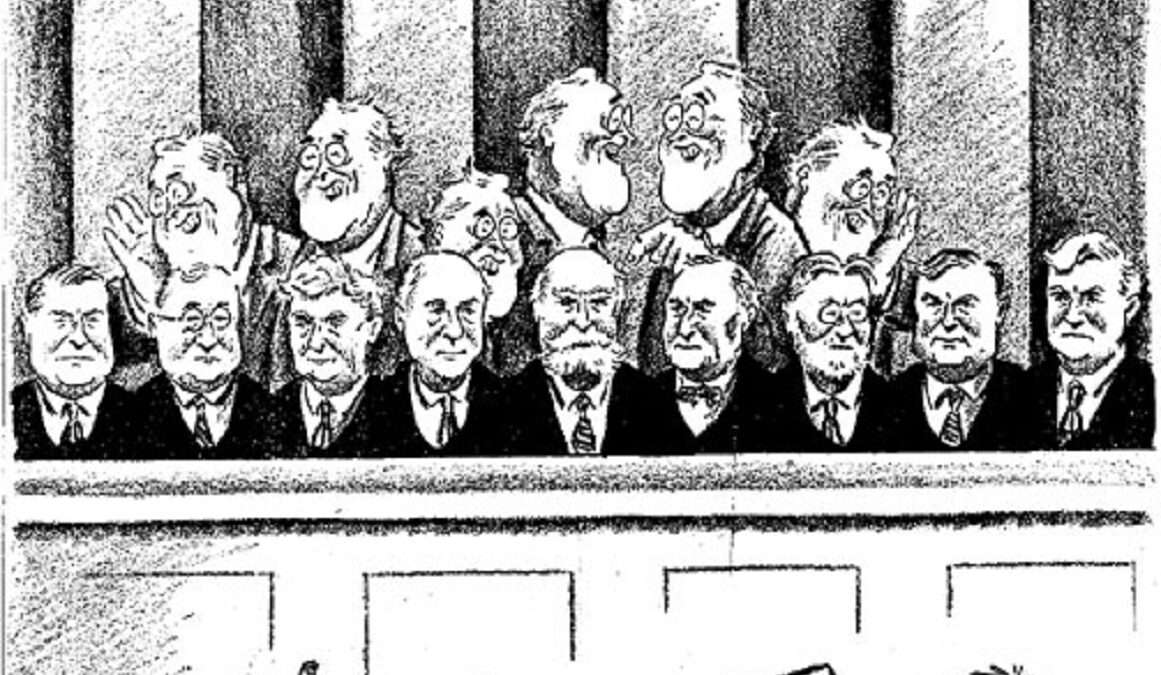
Cartoon criticizing Franklin D. Roosevelt's 1937 court-packing plan. (NA)


Georgetown law Professor Steve Vladeck is one of the leading critics of the conservative majority on the Supreme Court. But in an insightful recent post on his substack, he outlines key reasons why "court expansion" is a bad response to its flaws. The cure is likely to be worse than the disease:

[I]t seems to me that those who are fully onboard the expansion-or-bust train should have to do more than simply assert that having four new Democratic appointees on the Court in 2029 would be a self-evidently "good" thing. If nothing else, proponents of expansion should have to answer the following four questions:

  1. How do we avoid touching off a race to the bottom, where each time one party controls the House, Senate, and presidency, it expands the Court to ensure an ideologically and politically sympathetic majority?
  2. If a race to the bottom is unavoidable, how do we avoid further (and potentially fatal) erosion of public confidence in the Court—which will quite transparently be little more than a lever of power for whichever party last had such a trifecta?
  3. If eroding public confidence in the Court is a feature, and not a bug, how do we insulate against the same erosion of public confidence in lower federal courts?
  4. What is the case for why expansion is a better way to achieve the desired reforms than alternatives that would (or, at least, should) avoid many of these forward-looking concerns?

He adds that court-packing could easily "permanently undermine judicial review as an institution." The rest of his piece (which is behind a paywall) offers far from reassuring answers to these questions.

I have offered similar criticisms of court-packing in a long series of articles and blog posts, most recently in a June Lawfare article  where I explained (among other things) why the Supreme Court's recent decision in Louisiana v. Callais doesn't justify packing, and in a July UnPopulist article critiquing a court-packing proposal advanced by Andy Craig. In these pieces, I explain why the Court's record of checking dangerous abuses of government power - though not without serious flaws - is considerably better than many critics claim. In addition, I argue that court-packing is likely to undermine effective judicial review - not only by the Supreme Court, but also by lower courts.

Like Vladeck, I think some of the issues that concern critics of the Court can be more effectively addressed in other ways. For example, in the Lawfare article, I explain how Congress can fix the flaws of the Callais decision by banning or restricting gerrymandering. It could also enact a binding ethics code for the justices. Justice Alito was wrong to suggest otherwise, back in 2023. That said, if your main goal is a sweeping reversal of much of the Court's recent jurisprudence, there may be no easy way to achieve that quickly without court-packing or something like it. I would argue that any benefits that might achieve are outweighed by the enormous costs of destroying judicial review.

In addition, if your objection to the Court's recent decisions is that they often don't do enough to constrain unconstitutional actions by other branches of government or by the states, court-packing is likely to make that problem worse, not better. Destroying judicial review won't enforce tighter constitutional constraints on the executive or bring back Roe v. Wade. To the contrary, it would largely destroy any hope of doing so.

In another recent piece, I assessed "non-packing" rationales for increasing the size of the Supreme Court. There, I argue that these rationales are mostly weak; and, to the extent they have merit, there are better ways to address them than an expansion that amounts to court-packing. I even outline possible ways to increase the size of the Court without creating an opportunity for court-packing (this would require allowing the party that doesn't hold the White House to pick some of the new justices).

The post Steve Vladeck's "Hard Questions About Court Expansion" appeared first on Reason Magazine.

  •  

Trump Loses Yet Another Sanctuary City Case—This Time Against New York City

NA

Yesterday, in United States v. City of New York, yet another federal court ruled against the Trump administration in a sanctuary city case. "Sanctuary" jurisdictions are state and local governments that restrict their law enforcement agencies and other employees from assisting federal immigration enforcement and deportation efforts in various ways. In this case,  Judge Reyes of the US District Court for the Eastern District of New York upheld New York City laws restricting local law enforcement information-sharing and other assistance to federal immigration enforcers.

The court ruled that federal law does not preempt these policies, and that if if it did, there would be a violation of the anti-commandeering requirements of the Tenth Amendment:

Even were the Court to find that the United States has standing and the challenged provisions are preempted—both answered in the negative above—United States' claims would still fail because the anticommandeering doctrine of the Tenth Amendment to the Constitution of the United States precludes relief.

"The powers not delegated to the United States by the Constitution, nor prohibited by it to the States, are reserved to the States respectively, or to the people." U.S. Const. amend. X….

The United States argues it is "not seeking to compel participation in immigration enforcement … but rather to remove Defendants' express and implicit obstacles to the Executive's duty to carry out its immigration enforcement duties…." New York City replies "if accepted, [the United States' claims] would require the City to affirmatively assist the federal government in enforcing immigration laws in violation of the Tenth Amendment's anticommandeering doctrine…." New York City is correct, at least partially.

The United States seeks injunctive and declaratory relief to preempt the challenged provisions… If the challenged provisions were struck, while New York City would not be obligated to carry out federal immigration enforcement, they would be barred from prohibiting their agencies and employees from engaging in federal immigration enforcement by expending personnel, property, and other resources to (1) detain individuals and (2) implement inter-agency information-sharing, including disclosing personally identifiable information, all potentially in violation of state law. And of course, there is nothing within federal law that obligates states to participate in federal immigration enforcement or compels states to comply therewith.

The United States' preemption arguments amount to nothing more than a backdoor around the Tenth Amendment and rest on a false distinction between (a) compelling local governments' participation in federal immigration enforcement and (b) prohibiting local governments from dictating how their personnel and other resources may be utilized towards federal immigration enforcement….. "

The basic principle—that Congress cannot issue direct orders to state legislatures—applies" to commands for "affirmative action" and the imposition of "prohibitions." Murphy [v. NCAA], 584 U.S. at 455 (citation modified). If states cannot remain free to control their agencies and employees to resist federal immigration enforcement, which is within states' constitutional prerogatives, the Tenth Amendment anticommandeering doctrine means nothing.

This reasoning is correct. And it is notable that this ruling - like many others protecting sanctuary cities - relies heavily on the Supreme Court's 2018 anti-commandeering decision in Murphy v. NCAA, written by Justice Samuel Alito (probably the Court's most conservative justice), and joined by all the other conservatives then on the Court. In that case, the Court emphasized that the anti-commandeering doctrine bars Congress from dictating the actions of state and local legislatures, regardless of whether the dictation takes the form of an affirmative mandate, or a prohibition against legalizing or barring something under state law.

Judge Reyes also rejects the administration's argument under the "intergovernmental immunity" doctrine, which bars states and localities from directly regulating federal agencies or "discriminating" against them. Like the court in the recent case of United States v. New Jersey, he correctly emphasizes that there can be no discrimination when there is no other comparable activity that gets more favorable treatment under the sanctuary jurisdiction's policies:

"Differential treatment is critical to a discrimination-based intergovernmental immunity claim." New York, 814 F. Supp. 3d at 282….; "[A] comparator is necessary." New York, 810 F. Supp. 3d at 353. The United States discrimination claim fails for lack of a comparator.

The United States does not and cannot identify a similarly situated entity. State and local agencies and their officers do not enforce immigration law, nor do members of the public…  As the United States concedes, the Federal Government holds the "exclusive charge of enforcing immigration law…."  Not only are other federal law enforcement agencies with different charges differently situated, "[f]or a state law to unconstitutionally discriminate against the federal government, it must treat comparable classes of federal and non-federal employees differently, not different classes of federal employees." Illinois, 796 F. Supp. 3d at 534

I would add that, as I explained in a recent post, the entire antidiscrimination element of the intergovernmental immunity doctrine is dubious, and should probably be overturned by the Supreme Court:

[T]he whole doctrine of intergovernmental immunity strikes me as bogus, judge-made law. There is no provision in the Constitution requiring it. And the federal government is not some historically oppressed minority group protected by the antidiscrimination provisions Fourteenth Amendment. Where state and local governments are otherwise free to refuse to help the feds, that autonomy should not be forfeited merely because they choose to support potentially similar activities by state or local governments, or by the private sector. Obviously, a district court cannot refuse to obey Supreme Court precedent in this field. But I hope the Supreme Court might someday reevaluate that precedent.

This is just the most recent of a long line of defeats for Trump in sanctuary city cases, in both his first and second administration. Judge Reyes cites close to a dozen such cases over the last year alone.  I summarized this jurisprudence more fully in a post covering three other recent sanctuary cases, last month:

In cases where the administration has tried to directly coerce states and localities into cooperating, courts have rightly ruled this violates the Supreme Court's "anti-commandeering" precedents, a series of decisions reached primarily by conservative justices, which hold that the federal government may not force state and local governments to help enforce federal law or carry out under federal purposes. In cases where Trump has sought to withhold federal funds from sanctuary jurisdictions, courts have (also rightly) ruled that the executive cannot impose conditions on federal grants that were not authorized by Congress and (in some cases) that the Trump conditions are unconstitutionally coercive. For my analyses of Trump II court decisions on these issues, see here, here, and here.

My 2019 Texas Law Review article surveying and assessing litigation arising from Trump's first-term attacks on sanctuary jurisdictions. There and in other writings, I also explain why immigration sanctuaries (and conservative gun sanctuaries) are beneficial, and help protect our constitutional system. See also my February 2026 Dispatch article, "In Defense of Sanctuary Cities," which provides an overview of these issues, and defends sanctuary jurisdictions on both constitutional and policy grounds.

Yesterday's ruling may be appealed. But if so, it is unlikely to be overturned.

Trump has posted a few rare wins in sanctuary cases with unusual facts, such as in the Contracts Clause case I analyzed in the September post. But, such cases are highly exceptional. And, as explained in the September post, the Contracts Clause decision has various flaws, and would not greatly impede sanctuary jurisdictions even if it survives on appeal.

Overall, Trump has been losing these kinds of cases so much that he might even get tired of losing.

The post Trump Loses Yet Another Sanctuary City Case—This Time Against New York City appeared first on Reason Magazine.

  •  
❌