In this segment of Free Media, Reason Senior Editor Robby Soave and Daily Caller Editor in Chief Amber Duke discuss Vivek Ramaswamy's controversial attack ad against his opponent Amy Acton in Ohio's gubernatorial race.
If you enjoy Free Media, come watch Robby debate at our upcoming Reason Versus in Washington, D.C. Tickets are available here.
When Americans vote in the midterm elections next month, it seems likely that Democrats will see decisive victories across the country.
This trend seems likely to affect Georgia's two most high-profile races differently. Sen. Jon Ossoff, a Democrat, is running for reelection against Rep. Mike Collins, a Republican who represents the state's 10th congressional district, while in the race to replace Gov. Brian Kemp, former Atlanta Mayor Keisha Lance Bottoms faces Republican billionaire Rick Jackson.
Ossoff and Bottoms may both be Democrats, but their prospects look very different: A recent poll put Ossoff nearly seven points ahead of Collins, but Bottoms was a point and a half behind Jackson, trailing the senator from her own party by more than five points.
Democrats hope that if Ossoff does well enough, it will boost their other candidates. But it's worth asking why Bottoms, who was feted as a possible vice presidential candidate, is struggling to break even against someone with no prior name recognition, in a year expected to be a boon for her party.
It's possible that the crime and protests of 2020 could be weighing down Bottoms' candidacy in an otherwise auspicious year for Democrats.
Mayor Bottoms and the 'COVID Crime Wave'
Bottoms' single term as mayor of Georgia's capital city would be defined by summer 2020. Amid the COVID-19 pandemic, violent crime rose across the country, but it was worse in Atlanta—homicides were up 59 percent, while most other cities averaged 33 percent. Bottoms herself later called it the "COVID crime wave."
Then on May 25 in Minneapolis, a police officer killed George Floyd, an unarmed black man accused of passing a counterfeit $20 bill. Footage went viral, and protesters across the country took to the streets.
In some places, including Atlanta, protests turned destructive, and the police responded in kind.
Bottoms called for peace. "If you care about this city, then go home," she exhorted rioters in a news conference. "When you burn down this city, you're burning down our community."
She won bipartisan praise. "Your passion, your composure, your balance, has been really incredible," then-presidential candidate Joe Biden told her.
But just days later, Atlanta police officers shot and killed a black man, Rayshard Brooks, in a Wendy's parking lot. Protesters gathered the next day and burned the restaurant to the ground.
Meanwhile, after the district attorney announced charges against the cops involved in Brooks' shooting, more than 170 officers called out sick in protest. Bottoms admitted that officer morale "is down tenfold."
Then on July 4, less than half a mile away from the site of Brooks' death, protesters shot into a car, killing 8-year-old Secoriea Turner.
The crime spike persisted into 2021, and in May of that year, Bottoms announced that she would not run for a second term.
Officially, she said, it was "time to pass the baton on to someone else," though her announcement "came as the city faces a homicide rate topping that of this time last year—a historically deadly one in Atlanta," Henri Hollis wrote at the Atlanta Journal-Constitution.
Indeed, it seems the "COVID crime wave" had caught up with her: A September 2021 poll found that while 57 percent of city residents approved of the job she was doing, 53 percent also felt the city was on the wrong track, including 48 percent of Democrats. The top issue was crime, which 70 percent of respondents felt was headed in the wrong direction.
She later told New York that by stepping down, she was "putting my emotional and mental health first"—a worthy reason, though a bit odd since she now seeks an even higher office.
Then again, she also had higher aspirations. Bottoms was one of the first officeholders to endorse Biden for president in 2020, and she later made his shortlist of potential running mates. After the end of her term, she joined Biden's White House as director of the Office of Public Engagement, after which she moved over to the President's Export Council for the remainder of his term.
Bottoms announced her run for governor just four months after leaving Washington. And while she locked up the Democratic nomination easily, winning 56 percent of the vote among seven candidates, she didn't exactly fire up the base, and it seems like she just expected to coast to victory.
"It feels a lot like she gained the nomination…largely from name identification," progressive journalist Zaid Jilani tells Reason. "She really wasn't raising that much money or spending that much on television….It should be a high-profile race in many ways, but the ideas she's putting forward are fairly rehashed," and "she doesn't have that much creative advertising."
Rick Jackson's Deep Pockets and Shallow Record
Rick Jackson, meanwhile, seemed to come out of nowhere.
President Donald Trump endorsed Lt. Gov. Burt Jones in August 2025, and Jones led the Republican primary field at the end of that year.
While Kemp famously resisted Trump's efforts to subvert Georgia's presidential election results in 2020, Jones was a willing participant in the scheme.
"I've been the Trump guy since 2015, not '16," Jones bragged. "I've taken all the battle scars and everything else. I know who ran and hid during 2020 and everything else."
Then in February 2026, just three months before the primary, Jackson entered the race. He was a septuagenarian with no name recognition, but he was also quite wealthy, so he blanketed the state with ads to introduce himself to voters.
In six weeks, he spent over $30 million—"more than any candidate has ever spent in a primary race for Georgia governor, with more than two months before the May 19 election," wrote Jeff Amy of the Associated Press.
It worked: Jackson beat Jones in a primary runoff with 53 percent of the vote. By then, he had spent $108 million on his campaign while raising less than $400,000 from donors.
Jackson has made much of his background, as a child of poverty who entered the foster system at age 13 to escape a dysfunctional household. As an adult, he started in sales and worked his way up to entrepreneurship, starting Jackson Healthcare in 2000 and growing it to more than $1 billion in annual revenues. He is also a generous donor to charitable causes, particularly those relating to foster care.
But with no political record, Jackson can be hard to pin down on certain issues.
For example, one Jackson ad criticizes Bottoms for the rise of data centers in Atlanta, even though he has also spoken positively of their economic potential.
Georgia Democrats have tarred Jackson as a Trumpian election denier, singling out a comment he made at a campaign event: When asked if the 2020 election was stolen, Jackson replied, "That was totally ridiculous what happened in 2020 and our people really let us down." ("Just as Governor Kemp did, Rick acknowledges both Biden's win and that there were issues in the 2020 election that needed to be resolved in order to ensure Georgians have faith in our electoral system," a campaign spokesperson told CNN.)
During the primaries, he even took heat from both sides on abortion: Jones accused Jackson's company of working with Planned Parenthood, while Jackson himself seemed to suggest he wanted to change the state's abortion ban to remove exceptions for rape or incest. ("Rick believes we have a strong pro-life law in place and he wants to keep it as it is," his campaign said in a statement.)
And while he made Trump-like pledges, like to "make Georgia No. 1 in the nation for criminal deportations" and keep "the religion of woke ideology" out of schools, his platform calls for an "intelligent Medicaid expansion" in the state.
Jackson has also pivoted just over the course of the campaign.
He bragged in his campaign announcement video that he "donated a million bucks to Trump," and he's said that if elected, he would be "just like" Trump but "with a southern tone."
He said Trump had "no bigger supporter" than himself, and he could not name a single Trump policy he disagreed with. When Trump endorsed Jackson at a campaign rally in July, the candidate pointed to the president and said, "I'm going to be this man's favorite governor."
But like many other Republicans, Jackson has distanced himself from the president, whose approval rating is at an all-time low. The Atlanta Journal-Constitution reports that in campaign appearances, Jackson has stopped mentioning Trump directly, preferring to compare himself to Kemp, the sitting governor who remains popular.
He apparently also scrubbed all mentions of the president from his campaign website.
But one thing that has remained consistent in Jackson's campaign strategy is criticizing Bottoms' record as mayor.
Will the 'COVID Crime Wave' Sink Bottoms?
Some of Jackson's campaign ads feature grateful children who grew up in foster care and benefited from his philanthropy, but for the most part, they have targeted Bottoms over her record.
One ad, titled "Disaster," paints Bottoms' tenure as exactly that, with the city becoming practically unlivable during summer 2020.
"Keisha ended cash bail, gutted the corrections budget, let Atlanta burn, and unleashed a crime wave," Jackson wrote on X to accompany another ad. "Then she walked away."
"If Keisha wants to run from her record," according to a campaign email, "we're going to make sure Georgia remembers exactly what that record was."
Many Jackson ads, flyers, and mailers have featured images of Secoriea Turner, the 8-year-old girl killed by gunfire. (Turner's parents have asked Jackson's campaign to stop.)
But is it fair to blame everything on Bottoms? While Atlanta was worse than most, many major cities saw large homicide spikes: Chicago's murder rate climbed more than 50 percent that year, while New York City's went up nearly 40 percent. Murders in Columbus, Ohio, rose a staggering 67 percent.
Regardless, Bottoms was in charge at the time. And the attacks do seem to have an effect, as she's locked in a dead heat against Jackson.
Granted, Bottoms was never a particularly strong candidate. When she ran for mayor in 2017, she won the runoff election by fewer than 800 votes, even with the endorsement of the outgoing mayor.
Georgia also has not elected a Democratic governor in nearly three decades, though it has elected Democrats to the U.S. Senate three times since 2020 and seems poised to reelect one this year.
There's also the fact of Jackson's money, saturating the state with eight-figure ad buys while Democrats were spending only a fraction of that.
Of course, money alone can't buy a victory: Kemp defeated Stacey Abrams in each of the last two races for governor, despite being comfortably outraised and outspent each time.
But Bottoms currently trails Ossoff by five points in an election cycle expected to be quite beneficial to their party.
It seems the race will serve as an indicator of how fresh the summer of COVID-19 still feels for Georgians.
"To the kind of voter that Jackson is courting, it probably is true that had Democrats [instead] nominated the mayor of Macon [a smaller Georgia city], they would be in a stronger position than nominating the mayor of Atlanta, especially one who was in power during those years," Jilani tells Reason. "If he wins, it demonstrates that that is still a fairly potent line of attack."
The Democratic Socialists of America (DSA) candidates running for the House of Representatives and endorsed by NYC Mayor Zohran Mamdani are all but guaranteed to win their general elections this November, but that does not mean the midterm drama is over in New York. In the state's 17th congressional district, which includes the lower Hudson Valley, Democratic challenger Cait Conley, a combat veteran who served on the Biden administration's National Security Council, could unseat incumbent Republican congressman Mike Lawler in one of the most consequential races of the midterms.
The highly contested purple district voted for former Vice President Kamala Harris in the 2024 election while reelecting Lawler for his second term. Now, Lawler is attempting to win a third term as support for President Donald Trump wanes ahead of the midterms. As of Friday, The Cook Political Report lists the race, which could determine control of the House, as a toss-up.
If elected, Conley would have far more in common with the "Badass Women" coalition of security state and military veterans than with DSA types (think more Sen. Elissa Slotkin from Michigan than Darializa Avila Chevalier). As Judge Street Journal's Timmy Facciolanotes, "Conley's candidacy is testing the viability of a tactful centrism that rebukes left-wing positions like abolishing ICE or restricting weapon shipments to Israel." Lawler is also vying for moderates, pitching himself as "one of the most bipartisan members of Congress" and emphasizing his willingness to break with Trump occasionally while still welcoming Trump's support.
While Lawler and Conley certainly are not pure MAGA acolytes or DSA members, both have leaned into a tech-critical position, much like that of more radical populists like Lina Khan or Steve Bannon, revealing how pervasive anti-tech sentiment has become in mainstream politics.
This tech skepticism was on full display during an October 14 debate, when each candidate made the case for why they were the most equipped to regulate AI, insisting that the industry needs guardrails.
Conley said members of Congress do not want to regulate AI because "they want to look out for their billionaire and trillionaire backers like Elon Musk, who is pouring over $260 million into this midterm election." She then added that Musk backed Lawler in his 2024 race.
Lawler then accused Conley, who previously consulted for Primer AI, of being "the AI candidate for the AI industry."
While Lawler and Conley disagree on specific data center regulations (Conley supports Democratic Gov. Kathy Hochul's data center moratorium while Lawler supports local zoning control over data centers), neither wants to pitch themselves as an explicitly pro-data center candidate. During the debate, Conley claimed that, "On Mike Lawler's watch there have been five data centers built in Rockland County." Lawler has said that he had no say in the decision to build the data centers, and during the debate, he pointed out that the facilities were built for financial services. Lawler also attempted to attack Conley over data centers, slamming her in an ad for saying "we need data centers." Regardless of the candidates' specific policies on data centers, their attacks on one another demonstrate that cheerleading hyperscale data center development is a political liability. In their district, data center has presumably become a dirty term.
The candidates' tech-skeptical rhetoric did not end with unchecked data center development. After the debate, Reason asked both candidates about their positions on age-verification laws for social media and AI, since such regulations raise significant privacy and censorship concerns by age-gating the internet. Unsurprisingly, both Lawler, who votedfor the controversial KIDS Act, and Conley, who has proposed stricter age verification for AI tools, parroted platitudes about why such online safety regulations are necessary to protect children.
"We have watched how social media is literally hurting the mental health of children," Conley told Reason. "And when you talk about the power of AI and what that power could do, we have to regulate this."
Lawler gave a similar response, telling Reason that he respects free speech but that protecting children "is paramount."
This bipartisan consensus over social media regulation has long been brewing in Congress. The mainstream political conversations about AI and data centers, however, are relatively new this midterm election cycle. And it appears both Lawler and Conley have figured out which way Americans' sentiment toward AI is leaning, and they have waged their campaigns accordingly.
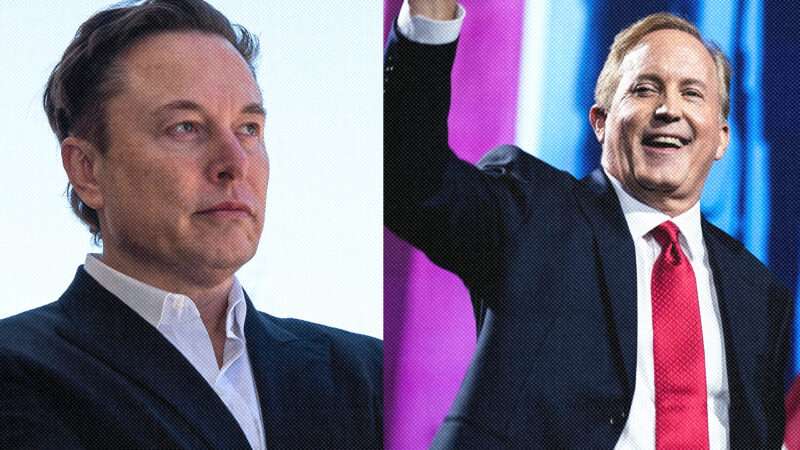
Musk is the big Paxton funder: According to campaign filings released yesterday, Elon Musk sent $158 million in September to a super PAC that immediately gave that amount of money to a group backing Texas Republican Ken Paxton's Senate bid against Democrat James Talarico.
"On Sept. 9, the first day of the GOP midterm convention in Dallas, Musk gave $75 million to SLF," reportsThe Texas Tribune. "The next day, SLF put $75 million into a new entity called Texas PAC. By the weekend after the convention, the new super PAC was up on the air with a positive spot about Paxton's work on sex trafficking and a negative ad attacking Talarico as being for 'they/them, not you.'"
Then, two weeks later, "Musk gave an additional $83 million to SLF, according to the group's filing. Sure enough, SLF deposited $83 million into Texas PAC's coffers the following day."
It would be wild if Paxton still loses. Paxton has been embroiled in rolling scandals for years, and some current polls have him underwater by 13 points. A New YorkTimes/Siena survey found only 38 percent of likely Texas voters believe he has "good character," versus 56 percent for Talarico.
Paxton was indicted on securities fraud charges in 2015, and that case dragged on for most of a decade before ending in a pretrial agreement. Then the Texas House, led by Republicans, accused him of bribery and abuse of public trust and successfully impeached him in 2023. The charges centered on allegations that he used his office to help donor Nate Paul—so you can imagine why Musk might want to curry favor with Paxton. Though Paxton was later acquitted by the state Senate, scandal keeps chasing him: Last year, his wife, state Sen. Angela Paxton, filed for divorce on "biblical" grounds, citing adultery as one of the reasons.
Of course, many Republican voters at the state level saw the impeachment as nothing more than a political hit job, one echoing what's happened to President Donald Trump at the national level. But what far-right, already-convinced Republicans believe about Paxton is sort of beside the point: He needs turnout, and he needs to win over more moderate Republicans and maybe even some fence-sitters if he hopes to beat Talarico. It's possible Musk's cash infusion will help, but it's also possible a cash infusion of many millions of dollars won't be enough to rehabilitate Paxton's shitty image.
A poll from the University of Texas and Texas Politics Project conducted in August "contained four major warning signs for Paxton: a drop in his support from June, lagging GOP motivation to vote, worse favorability numbers than Talarico and Trump's approval being underwater in the state."
Scenes from New York: "When Gov. Kathy Hochul first ran for re-election, Republicans in New York tried to prey on fears over crime, rising inflation and illegal immigration to boost the chances of their ticket statewide in the critical 2022 midterms," reportsThe New York Times. "The strategy seemed to work. Republicans flipped four House seats in New York, while putting a scare into Ms. Hochul, who eked out a six-point victory over Lee Zeldin, then a Long Island congressman who now leads the E.P.A." This year, Republicans have picked Bruce Blakeman, the Nassau County executive, as the guy with the best odds of beating Hochul, and they're running on crime fears again. But it's not working so well.
The crime and public disorder is, to my mind, still a problem, but it's not as rampant as it once was during the peak pandemic years. And it's certainly not perceived as very bad right now.
QUICK HITS
"Three children and a teacher were killed, and two others were critically wounded, in a shooting Thursday at Silver Rail Elementary School in Bend, Oregon, authorities said," reports CBS News. "The suspect, a 16-year-old male, was shot and killed by a bystander, Bend police said.…Officials would not say exactly what type of weapon was used in the attack or how many rounds were fired. Multiple law enforcement sources told CBS News the suspect used a shotgun, and The Associated Press cited a law enforcement official briefed on the incident as saying it was a pump-action shotgun purchased by his mother."
"A climate of radical paranoia around AI seems like it will be a feature of our world for the foreseeable future," writes Ross Douthat in The Free Press, "because human beings are really good at being paranoid about mysterious new things. With, of course, the AI doomers themselves being a prime example: As Mike Solana of Pirate Wires notes in his own recent reading of the doom canon, the prophecies of Yudkowsky and Co. are already moderately less credible insofar as they don't account for their own cultural success."
"Taiwan is preparing to tighten export controls on AI chips to further align with US restrictions, according to a senior official in Taipei, joining a Trump administration clampdown on the smuggling of cutting-edge semiconductors to China," reportsBloomberg. "Taipei plans to add artificial intelligence servers and cutting-edge semiconductors to a list of controlled items, Taiwan's Minister of Economic Affairs Kung Ming-hsin told Bloomberg News. After the measures take effect, he said, shipping restricted AI hardware to China will become a criminal offense under the Foreign Trade Act."
I'll leave you with a quote from Kennedy (not John or Robert) to start your weekend off right: "Kimberly [Guilfoyle] talked about sex so cavalierly that she made Samantha from Sex and the City seem like Greta Thunberg."
This year, Alaska held its primary elections on August 18.
As per a 2020 ballot measure, Alaska primary voters pick among all qualified candidates for a single office, regardless of party affiliation, and the top four then advance to the general election.
In the U.S. Senate primary, Republican incumbent Dan Sullivan won 41 percent of the vote, while former Rep. Mary Peltola, a Democrat, captured nearly 50 percent.
Dan Sullivan was also the distant third-place finisher—but in this case, it was Daniel J. Sullivan Jr., a retired schoolteacher who is also running as a Republican but is not the same person as Daniel S. Sullivan, the junior U.S. senator for the 49th state.
The presence of dual Dan Sullivans is a headache for Republicans, who have fought to keep Daniel J. off the ballot, concerned he would split their votes and cost their candidate his seat.
"Mary Peltola and Chuck Schumer know they can't beat Senator Sullivan on his record, so they're resorting to deceitful political maneuvers that attempt to trick Alaskans and buy a seat," a Republican spokesman told Fox News.
"We are looking into it," President Donald Trump said this week. "It's a disgrace." In fact, NBC News reported in July that the FBI and Department of Justice had launched an investigation "looking for possible wire fraud or a conspiracy to deprive Alaskan voters of a free and fair elections process, which could be a civil rights violation."
In August, the government apparently issued subpoenas, though Daniel J. later said he had not received anything.
But is what he is doing actually illegal? For that matter, should it be?
Carol Beecher, director of the Alaska Division of Elections, barred Daniel J. from the ballot in June after concluding that he was running "with the purpose of confusing or misleading the electorate and compromising the fairness of the ballot."
But a state superior court reversed that decision. "Despite the Division's assertion that Mr. Sullivan may be excluded from the ballot because he lacks 'good-faith,' there is no statute which provides such a criterion," wrote Judge Thomas A. Matthews. "The concept of 'good-faith,' or pure motive, or bona fide intent is simply absent." The Alaska Supreme Court agreed, keeping both Sullivans on the November ballot.
Granted, it seems extremely likely that Republicans are right, and Daniel J. is running specifically to hurt Daniel S.'s prospects.
"Campaign material metadata reveals that Amber Lee, a progressive consultant, authored a press release announcing [Daniel J.'s] Senate bid," WFMD reported in May.
Daniel J. told The New York Times that he was running as a moderate Republican in an attempt to steer the party away from its MAGA wing. But he also admitted that he had voted for the Democrat in the last three presidential races and for Peltola in her races for the U.S. House.
In Beecher's original order keeping Daniel J. off the ballot, she wrote that Daniel J. had asked to be identified as "Dan S. Sullivan" on the ballot, the same name as the senator's. (Alaska reporter Dermot Cole wrote in July that this was not true: Daniel J. wrote "Dan S. Sullivan" in an email to Beecher but followed up hours later to correct it to "Dan J. Sullivan.")
If Daniel J.'s goal truly is to mislead voters, then that is indefensible. But it's not clear that it's illegal, or whether it should be.
"I am not sure exploiting voter confusion about names is any worse than exploiting their ignorance about policy issues like crime, immigration, and health care," wrote George Mason University law professor Ilya Somin. "Trying to prevent such exploitation through criminal and civil liability is likely to violate the First Amendment. In addition, it would likely end up giving incumbent political leaders broad power to curb speech and control electoral campaigns that they cannot be trusted with."
"This is a case about someone running for office with impure motives who is lucky enough to have a name that could confuse some voters," agreed election law expert Richard Hasen. "I don't see how the government could criminalize his running for office for having impure motives. And if it could do so, then it could be a crime every time that the Republican Party backs a Green Party candidate, or Democrats support a MAGA candidate in a primary in the hopes that the candidate would be weaker against a Democrat in the general election. This stuff happens all the time."
But it's entirely possible that Alaska's ranked choice voting system will solve the problem on Election Day.
After the August open primary, the top four candidates compete on a ranked choice ballot, where voters list the candidates in order of preference. If no candidate gets an outright majority, then the lowest performer is eliminated, and every ballot that picked them first is retallied and applied to their second choice.
As long as every Alaskan who wants to vote for Dan Sullivan—either one—lists both Dan Sullivans as their first and second choices, then the system will take care of any confusion. In the (highly likely) event that Daniel J. does not capture a majority on the first ballot, his votes will be retallied and applied to their second choices. The only plausible hiccup is if Peltola, the Democratic candidate, wins a majority in the first round—in which case either Sullivan would have lost anyway.
Of course, Republicans have opposed the ranked choice system since Alaska adopted it. Former Gov. Sarah Palin, who ran against Peltola twice unsuccessfully, said ranked choice was "so weird" that "it results in voter suppression."
In a post last week on Truth Social, Trump called ranked choice voting "Corrupt" and said it "shouldn't be allowed in our Country."
"I just left Alaska, where we have a real bad thing," Trump said Wednesday at a campaign rally in Arizona. "They have the ranked choice voting, where you go into I guess some kind of a test tube or something, and they pick whoever the hell they want. That's another disgrace."
As ever, it's not clear what Trump was talking about. And despite Republicans' complaints, ranked choice voting works quite well: According to the American Bar Association, recent research finds that it "is an improvement over plurality voting with clear benefits in terms of representation, campaign quality, mobilization, and turnout." It also "encourages greater consensus building as well as more civil political campaigns," and voters find it easy to understand.
In the event that a political party finds itself, for example, with two Dan Sullivans on the ballot, ranked choice voting is a perfect solution. If only the party weren't so hostile to it.
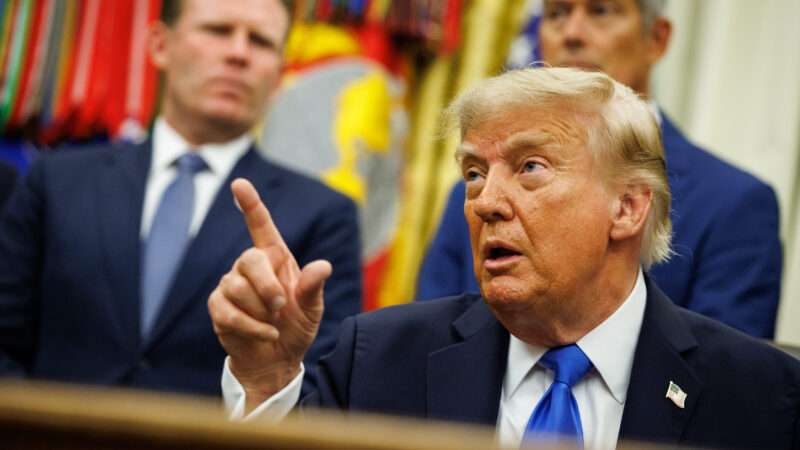
President Donald Trump promised that his tariffs would usher in a "golden age" by prioritizing the interests of American workers.
Those workers, however, are now turning against Trump's tariffs.
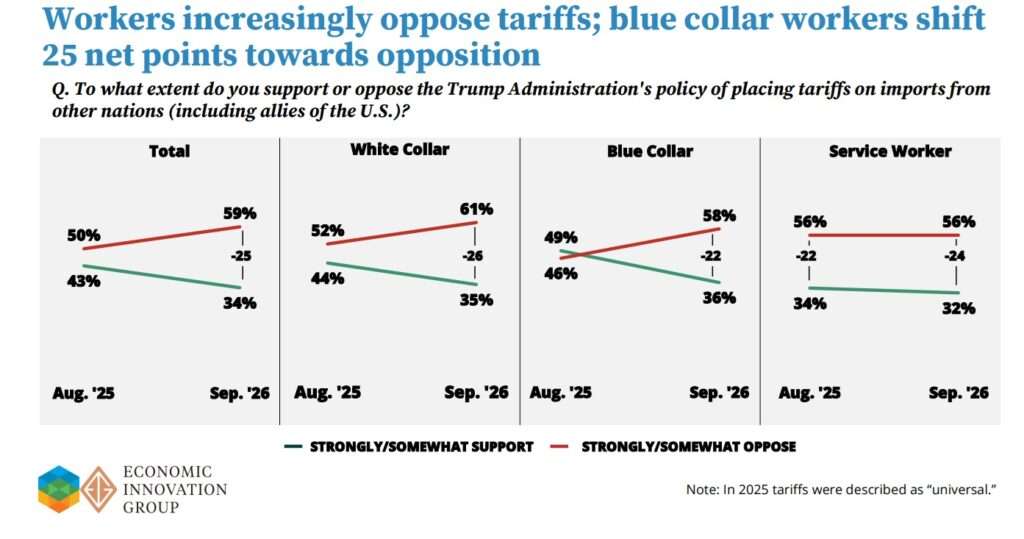
Support for the Trump administration's tariff policies has fallen by 25 percentage points among blue-collar workers over the past year, according to new polling data from Echelon Insights and the Economic Innovation Group (EIG).
A poll conducted by the two groups in August 2025 found that blue-collar workers supported the tariffs by a narrow margin. Now, that same segment of the population has turned decisively against Trump's tariffs: 58 percent oppose them, compared to just 36 percent who support them.
Source: Economic Innovation Group / Echelon Insights (https://eig.org/wp-content/uploads/2026/10/EIG-State-of-the-American-Worker-2026.pdf)
Overall, support for the tariffs has declined from about 43 percent last year to only 34 percent. Opposition to the tariffs has grown from 50 percent to 59 percent. Elsewhere in the same survey, 68 percent of respondents said the tariffs have made the cost of living higher.
It's not hard to figure out why people have turned against the tariffs: They have contributed to rising prices across the economy.
The annualized inflation rate ticked upward to 3.7 percent in September, according to new data from the Bureau of Labor Statistics (BLS). More BLS data released Thursday morning shows that the producer price index, which often operates as a precursor to inflation, is up 6.3 percent over the past year.
America's war with Iran has been a major factor in rising inflation, but the tariffs have played a significant role as well. In a study released last week, the New York Federal Reserve concluded that consumer prices would have declined slightly over the past year if not for the economic effects of the tariffs.
The tariffs have become so unpopular that not even partisanship can save them. "Among GOP-voting workers, only 3 percent select tariffs as their top priority," note Jordan McGillis and John Lettieri, policy experts from the EIG, in their write-up of the poll.
Other parts of Trump's economic agenda are not faring much better. The Trump administration has bought or seized shares of more than 30 private businesses over the past two years—ranging from major firms such as U.S. Steel to small mining companies with few customers. "The federal government's state corporatism is unprecedented," reports the Cato Institute in a new analysis of those deals.
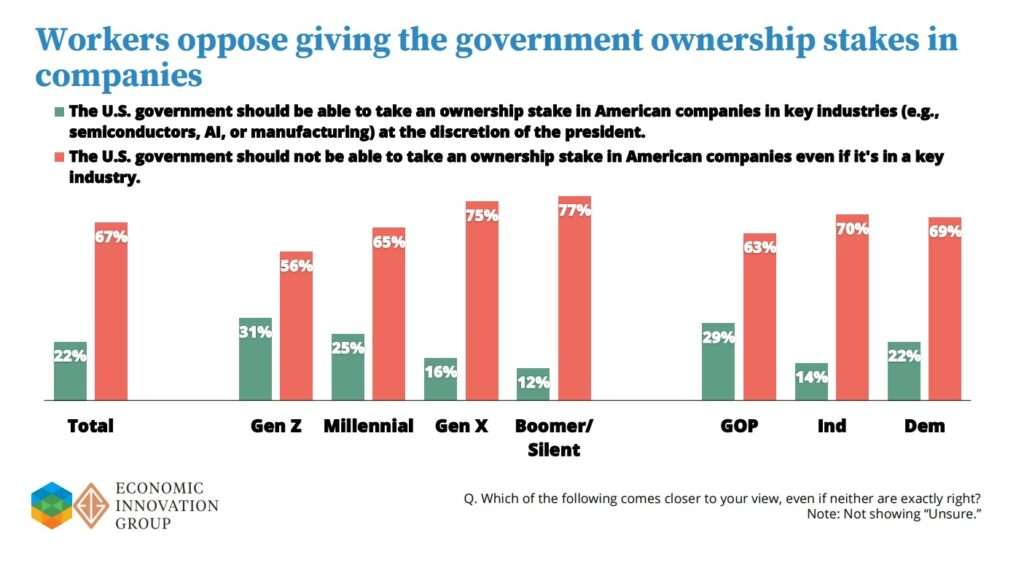
Large majorities of workers across both major parties and all generations said they opposed the federal government taking equity stakes in American companies in the Echelon/EIG poll.
Source: Economic Innovation Group / Echelon Insights (https://eig.org/wp-content/uploads/2026/10/EIG-State-of-the-American-Worker-2026.pdf)
In short: This economic populism sure isn't very popular.
All of this is likely to be a major factor in next month's midterm elections. Regardless of how that shakes out, however, there are lessons to be drawn from this poll for both sides of the political divide.
For conservatives, these polling data should end the tariff experiment. It has proven economically damaging, and it is no longer a political winner (if it ever was).
Remember, the idea to hike tariffs and start trade wars with all of America's biggest trading partners was not some grand plan backed by careful study and thoughtful analysis. It sprung, half-baked, from the head of one man. Yes, there have been various attempts to support, in a post hoc way, Trump's desire for tariffs. All of that can, and should, be easily discarded. There is no reason to allow a lame duck president to continue to set such a politically and economically destructive path for the country.
Undoing the tariffs might also put a meaningful dent in rising prices. That should be a no-brainer after the midterms, no matter which party controls Congress.
On the left, this poll should be a reminder that Americans do not look favorably on the mixing of government and business. Democrats should promise to unwind the "equity stakes" that the federal government has taken under Trump's watch. Heading toward the 2028 presidential cycle, Democrats might want to borrow some old Republican talking points about how government shouldn't be picking winners and losers—they may find that message is still quite popular.
Yes, it's probably right to be skeptical that those things will happen. Trump's efforts to centralize economic power in the executive branch are likely to outlive his presidency—that's how these things always seem to go.
But there is a glimmer of hope here. Americans are soundly rejecting the Trump administration's big government policies.
No longer so red: Long a swing state, Ohio went for President Donald Trump back in 2016, in 2020, and in 2024. Now, with midterms approaching, it looks likely to vote blue again, and there are early indicators that Republicans have failed to win over Ohio's working-class voters in particular.
"After the first days of early voting in Ohio, a state that could help determine control of the Senate, there are clear signs Democrats are more enthusiastic to vote," reports CNN. "So far, affiliated Democrats make up larger shares of pre-election voters than they did two years ago, even in the most Republican parts of the state. At this point in 2024, Republicans had a 30-percentage point lead over Democrats in counties that voted for President Donald Trump by 20 points or more, according to data from the Ohio Secretary of State. This year, that's shrunk to just five points."
Take this data with a grain of salt: It is just early-voter data.
But this is all rather high-stakes because Republicans are defending a Senate seat, as well as the governor's office. Two races for House seats are considered toss-ups. The conventional wisdom has been that Ohio is now solidly red, with three cycles of presidential election data to support that. But it's possible Trump has pissed off the voters who supported him to such a degree that Ohio will be sent back into swing-state territory.
"God knows we didn't vote for this," one voter—a pastor who went for Trump, then Biden, then Trump—told Reuters, referring to inflation. Other voters wonder about the decline in manufacturing jobs and the fact that the president has paid lip service to these problems but done very little to actually improve people's circumstances.
On Monday, Trump rallied in support of Sen. Jon Husted, who hopes to retain his seat. In the Mahoning Valley, the president announced a few new, uh, incentives to voters: a Defense Department facility based in Cleveland, and promises that a heat provider for Youngstown remained open. "The Youngstown area for decades used to vote Democrat, and then you ran for office in 2016 and flipped it red forever," said Husted in his speech. "Is that right, folks?"
OpenAI arrest: The FBI arrested a Saudi national who worked at OpenAI "and charged him with installing a hidden audio recording device in an executive conference room," per the Department of Justice. Abdulrahman Alfozan had worked as an engineer at OpenAI since July 2025, in the San Francisco office. The company found the recording device "plugged into a USB port on the back of a television in an executive conference room," per Reuters. The device had a microphone and allegedly connected to a camera; the data it stored was encrypted.
"At this time, we have no indications of this individual inappropriately accessing or exfiltrating model weights, source code, or customer data. The employee was terminated," said OpenAI. It's not clear who Alfozan may have been working for or with; he has been a permanent resident of the U.S. since 2020, with stints at Meta and Microsoft.
"If convicted, Alfozan faces up to five years in prison, a $250,000 fine and three years of supervised release," notes Reuters.
Scenes from New York: Mayor Zohran Mamdani has reportedly reached a deal with the City Council to ban horse carriages in the city, perPolitico. I'll admit, I don't really care, but I'm intrigued by the fact that the reason this has taken so long to get through has been because the union representing the carriage-drivers has been so successful at advocating for its members' interests.
QUICK HITS
Pope Leo XIV was diagnosed with lung cancer, said the Vatican yesterday. He underwent a successful surgery, and there's no additional information about prognosis at this time.
Daniel Cox's new book, Generation Uncoupled, makes the case "that problems with dating and romantic partnership are downstream from the decades-long deterioration of American social and civic life." Cox tells Derek Thompson (in a wonderful interview worth checking out): "There's a cultural dimension to all of this, as well. It's not entirely that young people have fewer social opportunities, but that they are encouraged to prioritize their own personal experiences and expression. On social media, self-optimization culture teaches young people that the most coveted rewards in life are secured through individual effort and ambition alone. There is a fear that our relational obligations can work against these goals by restricting our autonomy. It explains why more young people worry about what marriage and parenthood will require of them, rather than the benefits they offer. Not surprisingly, rates of family estrangement are at record highs, prenuptial agreements are more popular than ever, and most young people now feel that obtaining a divorce should be made easier." This obsession with self-actualization, or controlling one's circumstances, as well as risk-aversion, is something I'll be covering a bit in my book, City Without Children. This culture is shaping not only our decision to (not) couple up and get married, but also our decision to delay having kids, and how we parent them once they're here.
"The bond-market turbulence last month seeped into results as the banks each posted weaker-than-expected revenue from their businesses trading bonds on behalf of clients, and dealmaking slowed more than they had anticipated," reportsThe Wall Street Journal. "In a somewhat rare occurrence, JPMorgan missed analysts' expectations."
"The White House has asked Kimberly Guilfoyle, the ambassador to Greece, to resign, new White House press secretary Katie Zacharia told reporters on Tuesday, a day after President Donald Trump said he was considering firing her after allegations she asked a political donor for $100,000 to pay her personal American Express bill," reportsThe Washington Post.
The FIRE ("financial independence, retire early") people are now saying the quiet part out loud: that living on canned lentils well into your 40s is practically the same as being imprisoned.
Durable changes: This midterm season, activist groups have set their sights on amending state constitutions as a way of skirting never-ending culture war battles.
In Nebraska, voters are being asked to consider "enshrin[ing] in its constitution an existing law that prohibits transgender students from playing on girls' and women's sports teams," reportsThe Washington Post. "It also would require school teams to be designated as male, female or co-ed." The campaign behind it, Fairness for Girls, turned in 211,000 signatures in June, and its $3.1 million in cash contributions as of July 31 came entirely from a single nonprofit, Restore the Good Life Inc.
Voters in Washington, Colorado, and Arizona will see similar measures on their ballots related to transgender athletes and what schools should allow—though these would change state law rather than constitutions. Arizona's was put on the ballot by the Republican Legislature, while Colorado's and Washington's came from citizen petitions. Transgender students who say they are girls are already barred from girls' school teams under Arizona state law; the state's Proposition 318 would now ban student athletes from using restrooms, locker rooms, and showers that don't match an athlete's sex at birth, plus extend the rules to private schools and club sports.
Meanwhile in Alabama, voters will be asked whether the state's constitution should be altered to require public schools to allow prayer—led by students—at the start of the day. The same amendment would also put the daily Pledge of Allegiance, which state law already requires, into the constitution. Students couldn't be forced to take part in the prayer and would be able to opt out of the pledge.
Interestingly, Alabama has been here before. In Wallace v. Jaffree (1985), the Supreme Court struck down an Alabama statute authorizing a moment of silence "for meditation or voluntary prayer." It's not clear why they're trying basically the same thing all over again. ("What is the oversight power of the school in something like this?" Steven P. Brown, a professor of political science at Auburn University, asked the Alabama Reflector. "If you have a kid who stands up and wants to give a prayer to Satan, there is no question the school is going to step in." It's a fair question!)
"This year has brought a total of 19 ballot initiatives related to K-12 and higher education, the most since the midterms in 2018, according to a database maintained by the National Conference of State Legislatures," reportsThe Washington Post. It seems like activists are growing tired of constantly relitigating culture-war issues, and instead hope to create a more durable consensus via amendments to state constitutions and voter-approved statutes that are harder for legislators to alter.
Dissent: House Speaker Mike Johnson (R–La.) has sounded off about Defense Secretary Pete Hegseth's idea of livestreaming the execution of Nidal Malik Hasan, the former Army major who killed 13 people in Fort Hood, Texas, in 2009.
Johnson says the video of the execution by firing squad could become "a recruiting tool for future terrorists," according to Johnson. "We've got to think through the policy implications of all that," Johnson told CBS News on Monday.
"I wouldn't be watching it if it was aired," Johnson said. He added that someone should tell the White House "what some of my colleagues think about that, and not everybody's in favor of the idea." Reps. Austin Scott of Georgia, Tom Barrett of Michigan, and Rob Bresnahan of Pennsylvania have also voiced their opposition to the firing squad/livestream combo execution.
On Friday, Vice President J.D. Vance referred to the livestream, saying, "I don't know that that's actually going to happen" and said that, regardless, he wouldn't be watching it.
"Public executions are what oppressive dictatorships like Iran and Afghanistan do," said Sen. Thom Tillis (R–N.C.) this past Thursday. "It should not be happening in America."
Scenes from New York: "Mayor Zohran Mamdani said on Monday that the Police Department had strengthened its accountability systems after an officer was allowed to retire before facing a disciplinary trial over the death of a teenager," reportsThe New York Times. "Mr. Mamdani also ordered the police to conduct a review of their use-of-force policies, which were central to an oversight board's decision to recommend excessive force charges against the officer, Salvatore Alongi, in the death of the 19-year-old Win Rozario in 2024."
QUICK HITS
"Federal agents searched the Washington, D.C., home of Rep. Ilhan Omar (D., Minn.) Monday as part of a criminal investigation," reportsThe Wall Street Journal. There's not much additional detail available at this time, though "Secretary of Homeland Security Markwayne Mullin told a conservative podcaster in September that there was a continuing federal investigation into Omar, who he said 'married her brother to try to bring him into the United States'" which is a claim Omar has denied.
"A federal judge issued a temporary order Sunday blocking the Trump administration from airing taxpayer-funded campaign-styletelevision commercials. But the administration blew past a Sunday evening deadline and ran two of the ads into the early hours of Monday, advertising data from AdImpact shows," reportsThe Washington Post.
"That's a moderate (or perhaps even conservative) view that I think derives naturally from an ethic of 'I believe in parks and libraries and buses and public pools because I intend to use them personally,'" writes Matt Yglesias at Slow Boring. "This is also relevant to perennial political-economy conflicts between users of public services and their providers, where, again, the notion that you need to be tougher on public sector unions is sometimes right-coded. But I do think it also raises the question of what the correct and authentically progressive attitude is toward these things. After all, a pool that is appealing to an upscale liberal who can afford membership in a private pool club is also a pool that is doing a good job serving hard-working low-income families who can't afford a private pool."
"Eleven sailors were missing at sea on Tuesday from a ship sunk by a drone attack off the coast of Bulgaria, possibly the second deadly sinking of a cargo vessel in the area in a week, prompting Bulgaria to summon Russia's ambassador," reports Reuters. "Two cargo ships were hit by drones overnight and one was sunk, Bulgarian officials said. Bulgaria stopped short of explicitly accusing Russia of carrying out the attacks but Prime Minister Rumen Radev said their outcome 'benefits the Russian Federation.'"

 Login