
❌

Reading view

You Can Trade Contracts on Elections, but Not on Onions. These College Students Want To Fix That.
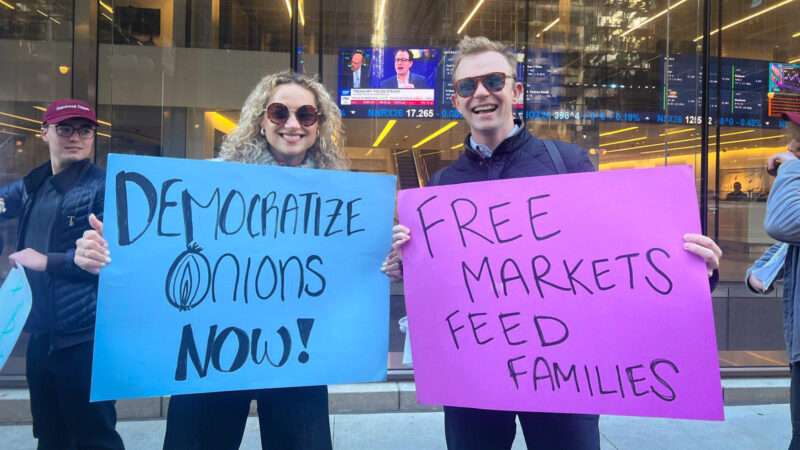
Student protestors | Photo: For Our Futures/X

On Monday, a group of students from the University of Chicago stood outside the Chicago Mercantile Exchange—one of the world's largest and most diverse derivatives marketplaces—and called for the repeal of an obscure 1958 law that bans onions as futures products traded on U.S. exchanges. 

Attracting an audience with a humorous jingle and amusing signs that included "Onions Deserve a Future," "Honk If You Want Free Onions," "Hot Girls Hedge Onions," and "Free Markets Feed Families," the student group, named For Our Futures, has a simple platform: a repeal of the 1958 Onion Futures Act, which prohibits anyone from trading in onion futures on commodity exchanges. (The law was amended in 2010 to ban motion picture box office receipts from being traded on commodity exchanges.) The viral campaign drew enough attention that Mike Selig—chairman of the Commodity Futures Trading Commission and a proponent of expanding the list of commodities traded on futures markets—was asked about the law in a media appearance. 

American farmers produce about 6.75 billion pounds of onions a year, according to the National Onion Association, an industry trade group. While peers who grow cotton, wheat, corn, and soybeans can hedge against price swings by trading futures contracts, onion farmers have no such recourse under federal law. But, as the Agriculture Department's daily National Potato and Onion Report shows, onion prices are highly volatile and subject to wild swings, making them an ideal market for futures trading. 

In its latest report, released Monday, the agency shows that onion prices have roughly doubled since this time last year. If onion futures contracts were legal, farmers could rely on market expectations instead of planting crops based on last year's prices. It would also let buyers potentially cut costs by locking in lower prices to protect against spikes. Trading onion futures contracts would give the industry a useful price-discovery tool, one that the student group aptly notes is "crucial for price stability and for hedging risks associated with weather and market fluctuations."

It's not For Our Futures' first time trying this gambit. The student group staged similar protests at college campuses in April and May, armed with bags of raw onions to entice passersby into signing their petition to legalize onion futures. The students' crusade might be comical, but after a recent Gallup poll found that 57 percent of Americans age 18–34 have a positive image of socialism, it's encouraging to see college-age students stand up for free markets.

A protest over onions sounds absurd, but it's a viral reminder to others in that age cohort of how far governments can go when given the slightest leeway to regulate an industry.

Instead of relying on outdated price points when planning future harvests, American onion producers could use resources like futures contracts that offer real-time market signals. All that would require—as the college kids state—is for federal lawmakers to "let the free market reign supreme."

The post You Can Trade Contracts on Elections, but Not on Onions. These College Students Want To Fix That. appeared first on Reason Magazine.
  •  

EU Ministers Agree New Agricultural Market Rules as Farm Budget Dispute Continues

European Union governments have agreed a negotiating position on new agricultural market rules intended to take effect under the bloc’s 2028–2034 budget, advancing reforms to support arrangements for farmers while leaving the most contentious financial questions unresolved.

The Council approved its partial negotiating mandate on Monday, 19 October, covering changes to the Common Market Organisation regulation, which governs agricultural markets across the European Union.

The proposals include new arrangements for wine producers, protein crops and oilseeds, revised marketing standards, changes to the EU school food programme and provisions intended to improve preparedness for agricultural market disruptions.

However, the agreement does not settle future funding allocations or the broader structure of agricultural subsidies, which remain under negotiation as EU governments attempt to reconcile farming expenditure with competing demands for defence, industrial investment and regional development.

Agricultural markets under review

The Council’s negotiating position retains much of the European Commission’s original proposal while introducing amendments intended to accommodate national differences in agricultural production.

Under the proposed arrangements, sector-specific interventions would become mandatory in several areas, including beekeeping, fruit and vegetables and, under certain circumstances, wine production.

The Council has also proposed flexibility for countries where particular sectors are absent or relatively undeveloped.

For the wine industry, governments would be able to seek exemptions from certain obligations where national circumstances justify different arrangements.

This would allow the framework to retain common European rules while avoiding requirements that would be inappropriate for member states with little or no domestic wine production.

Sectoral interventions form part of the mechanisms through which the EU supports agricultural markets and producer organisations. They can cover measures intended to improve competitiveness, manage production and strengthen farmers’ commercial position.

New provisions for protein crops

The Council has endorsed the establishment of a separate sector for protein crops and oilseeds, replacing existing provisions covering dried fodder.

The objective is to encourage domestic production and reduce dependence on imported agricultural inputs, particularly crops used in animal feed and food production.

European livestock producers rely on protein-rich feed ingredients, including soyabeans, that are often sourced internationally.

Greater domestic production could reduce exposure to fluctuations in global commodity prices, transport costs and disruptions to international supply chains.

Under the Council’s proposal, member states would be encouraged to recognise producer organisations specialising in protein crops and oilseeds.

Such organisations can help farmers coordinate production, marketing and investment, although the effectiveness of the proposed measures will depend on how they are implemented nationally.

The proposals follow broader EU efforts to improve supply security in sectors extending from agricultural inputs to critical industrial materials.

School food and product labelling

The negotiating mandate also preserves the EU school scheme, which provides support for the distribution of fruit, vegetables and milk to schoolchildren.

Under the proposed framework, the programme would move from a school-year financing cycle to a calendar-year system, with transitional provisions intended to prevent disruption during implementation.

The Council has maintained the Commission’s objective of encouraging healthier eating habits by limiting products containing high levels of free sugars and fats.

The proposal also opens the possibility of additional marketing standards for several agricultural products, including protein crops, beef, pork, sheepmeat, goatmeat and rice.

These standards could provide consumers with more detailed information about product origins, subject to the final legislation.

Such measures would also have implications for producers and food businesses, which would need to comply with any new requirements concerning classification, marketing and labelling.

The Council additionally supports the harmonisation of rules covering industrial hemp, while retaining safeguards concerning seed certification and the permitted level of tetrahydrocannabinol.

Farming subsidies remain contested

The agricultural market agreement forms part of negotiations over the next Common Agricultural Policy, which will operate within the EU’s new seven-year financial framework.

Under the Commission’s proposed budget structure, several funding streams, including agricultural and cohesion programmes, would be brought together within national and regional partnership plans.

The restructuring has encountered opposition from governments and agricultural interests concerned that farming could lose protected access to EU funding.

As EU Today previously reported, 17 member states have called for agricultural and regional development expenditure to be protected against further reductions.

The Council’s latest position addresses how agricultural markets should operate rather than determining the size of the financial support available to them.

A separate debate concerns the conditions for receiving direct farm payments, including the definition of an active farmer and the degree of discretion granted to national governments.

Those questions remain central to the continuing CAP negotiations, which are due to return to the Agriculture and Fisheries Council on 26–27 October.

Negotiations move to Parliament

The Council’s partial mandate now provides a basis for negotiations with the European Parliament on the agricultural market provisions.

The legislation will still require agreement between the institutions, while its financing will depend on the eventual settlement of the 2028–2034 budget.

Governments must also complete negotiations on the wider CAP framework, including direct income support and the distribution of responsibility between Brussels and national administrations.

The market agreement reached on 19 October therefore establishes important elements of the proposed agricultural rules, but leaves unresolved the level of financial support available to European farmers after 2027.

  •  

A Bronze Age Tribe in Poland Was Already Eating a Cereal Brought from China before Tutankhamun was even born

Around 1590 BCE — more than 800 years before Rome was founded, and before Tutankhamun was even born — a small number of people in what is now southeastern Poland started eating a cereal that had never grown in their fields. It wasn’t a local crop, and it didn’t belong to any plant known elsewhere […]

  •  
❌