Former employees of Christianity Today say new leadership has been pushing back on independent journalism. About half of its staff members have left or been laid off over 14 months.
Bonnie Kristian, Christianity Today’s deputy editor until recently, said the outlet displays “an increasingly muddled sense of its place within American evangelicalism.”
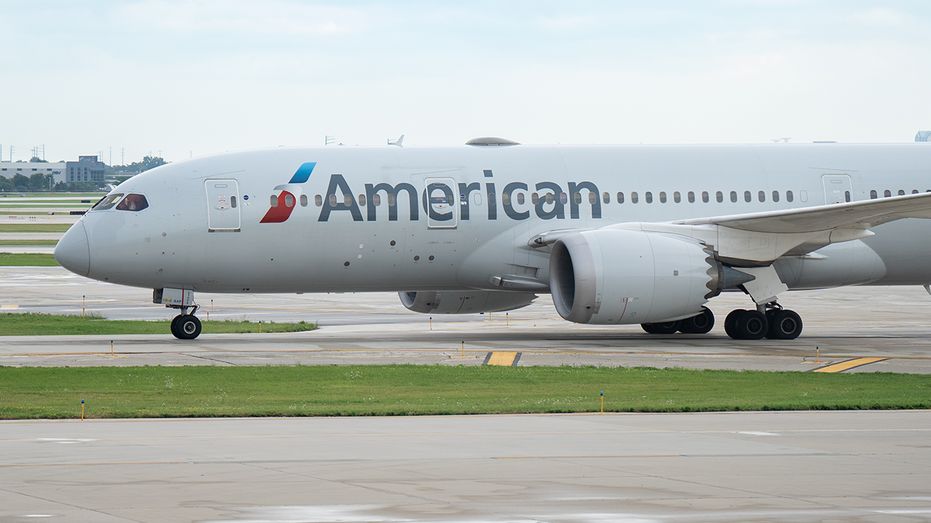
An American Airlines flight from Spain experienced brake issues and a blown tire after landing at Chicago's O'Hare International Airport on Tuesday afternoon.
American Airlines Flight 41, a Boeing 787-800 traveling from Josep Tarradellas Barcelona–El Prat Airport in Spain, landed safely at O'Hare around 2:30 p.m. local time, the Federal Aviation Administration (FAA) told Fox News Digital in a statement.
The FAA said the crew reported a brake issue followed by "a blown tire" after landing.
"Passengers deplaned via stairs and were bused to the terminal," the FAA said, adding that the agency "will investigate."
The airline said 234 passengers and 11 crew members were aboard.
American Airlines said first responders met the aircraft "out of an abundance of caution" and that passengers were safely transported to the terminal by bus.
The airline said the aircraft has been taken out of service for inspection by its maintenance team and apologized to customers for the experience.
A thwarted mass shooting targeting a large Hindu temple in suburban Chicago was fueled by years of hateful rhetoric on social media against Hindus and Indians, community leaders say.
Ken Paxton celebrated New Year’s Eve in 2024 with two men wanted on federal charges, one of whom donated at least $190,000 to his campaigns. The extent of his ties to the men was unclear.
Dylan Hembrough, editor in chief of the student newspaper at Southern Illinois University Edwardsville, contacted the school's communications office to protest a policy requiring a communications staff member to sit in on interviews between student reporters and university staff. As a result, university officials reported Hembrough to campus police for harassment. Police looked into the report, decided his comments did not constitute harassment, and recommended dropping the case. In a statement, the communications office defended the policy and said the real problem is that the student paper has printed inaccurate information and refused to retract it.
Flock Safety, an Atlanta-based company worth more than $8 billion, manufactures automated license plate readers (ALPRs), cameras that capture images of license plates and store them in a database that police can search.
Recently, the company has been under intense scrutiny over concerns about privacy and the cameras' capacity for misuse, leading some cities to cancel their Flock contracts. But it turns out that getting rid of Flock is easier said than done.
"When Elgin Community College hired Flock Safety to install six surveillance cameras in April 2025, President Peggy Heinrich thought they would 'enhance the safety and security of students,'" Lisa Kurian Philip reported last week at the Chicago Sun-Times.
The Chicago-area school signed up for a one-year contract with the company. It was not alone: Five of Illinois' 12 public universities, plus four of its community colleges,
But Heinrich began to have second thoughts as she learned more about how the cameras can be used—for example, Flock allowed U.S. Immigration and Customs Enforcement (ICE) to access over 80,000 of its cameras. In September 2025, ICE arrested a student near Elgin's campus.
More than half of Elgin's students are Latino, Heinrich told the Sun-Times, and enrollment began to suffer.
"In August of 2025, Flock publicly announced it would no longer conduct pilot projects with federal agencies," according to the company.
Still, Heinrich said, the school chose to end its contract with Flock "out of an abundance of caution for our students."
"Elgin Community College staff notified Flock in October 2025 that they wanted to cancel their contract and have the cameras taken down," Philip wrote. "Within a day, Heinrich said, Flock rejected the request and refused to uninstall the equipment on the basis that the company had not breached their agreement."
The school reached out again in December, offering to pay out the rest of the contract, but according to Heinrich, Flock did not respond.
Since the school no longer wanted the cameras to operate, and Flock refused to remove or disable them, officials zip tied garbage bags over the cameras on campus. But in a peculiar twist, "workers in an unmarked vehicle, which Heinrich assumed belonged to Flock, repeatedly removed the coverings."
This continued until the school's contract expired in April, when Flock finally removed the cameras.
Granted, the situation is somewhat complicated by the fact that while Elgin is a public institution, Flock is a private company.
"Per Flock contract conditions, the company retains ownership of the products it sells to cities," Caroline Haskins reports at Wired. "This means that when people damage or destroy cameras, cities are on the hook for the cost." Covering cameras with garbage bags will apparently work until Flock comes and cuts them down, but removing or disabling the cameras without the company's permission will incur fees to replace them, even if the city has already said it doesn't want them anymore.
But since the product that Flock sells is a searchable database of license plate images compiled from its interconnected nationwide system of cameras, the reality is more complicated than that.
Indeed, while Flock saysrepeatedly that customers own all data that their cameras capture, that's little comfort when the information is also available to any other customer with access to Flock's database.
Between June 2024 and May 2025, police in Illinois searched the Flock database over 4,000 times for immigration-related reasons, even though a state law prohibits ALPRs' use for that exact purpose. This implies the searches were done at ICE's request, meaning federal immigration authorities could access not just the license plate data in those Illinois communities, but also the thousands of communities nationwide that use Flock cameras.
It's also particularly troubling that Flock would make it so difficult for customers to end their contracts. In that, Elgin Community College is not alone: Plenty of jurisdictions have kept using Flock even after supposedly canceling the service, though it's usually the police who fight the cancellations.
In June 2025, the Austin, Texas, City Council declined to renew its Flock contract. Though the city police department supported the program, officials cited concerns about the cameras' capacity to target vulnerable communities.
But in February of this year, public radio station KUT reported that at least two neighboring towns were sharing access to the Flock database with Austin police.
In July 2025, the Board of Lucas County Commissioners in Toledo, Ohio, voted 2–1 to approve 27 Flock license plate cameras across the county, costing $250,000 over four years. But a week later, one commissioner changed his mind, citing fears of how the data would be used, and the board voted again to rescind the previous approval.
In a letter to the Lucas County prosecutor the following day, Sheriff Michael J. Navarre said the commissioners "have a legal obligation to honor this contract" and alleged that the decision to rescind it was borne out of personal animus toward him.
"I cannot sit idly by and allow them to make decisions out of spite that negatively impact the safety of my deputies and the community they protect," he wrote. To be clear, what apparently put everyone at risk was the decision not to move forward with a series of license plate cameras.
County prosecutor Julia R. Bates wrote back to the sheriff in September 2025, stating that since he had already signed the contract from the original resolution, the rescission was "void."
Elgin Community College's experience is not quite the same—in that case it wasn't the police department, but Flock itself, that refused to take down the cameras. But it's still indicative of the widening rift between those who worry about our growing surveillance state and those who apparently see it as worth the tradeoffs.
The year 2023 was pivotal for understanding the effects of abortion restrictions in the United States. A year earlier, in June 2022, the U.S. Supreme Court issued the decision known as Dobbs v. Jackson Women’s Health Organization (JWHO), which overturned the abortion-rights protection established by a previous ruling from 1973: Roe v. Wade. Since then, thousands of American women have ended pregnancies with help from Mexican feminist collectives. Several recent studies put a face to those seeking abortions: a large share come from states such as Texas, where abortion is banned, and live in neighborhoods with high levels of poverty.

 Login