❌

Reading view

Trump is trying to criminalize solidarity: “Minnesota 15” defendants speak

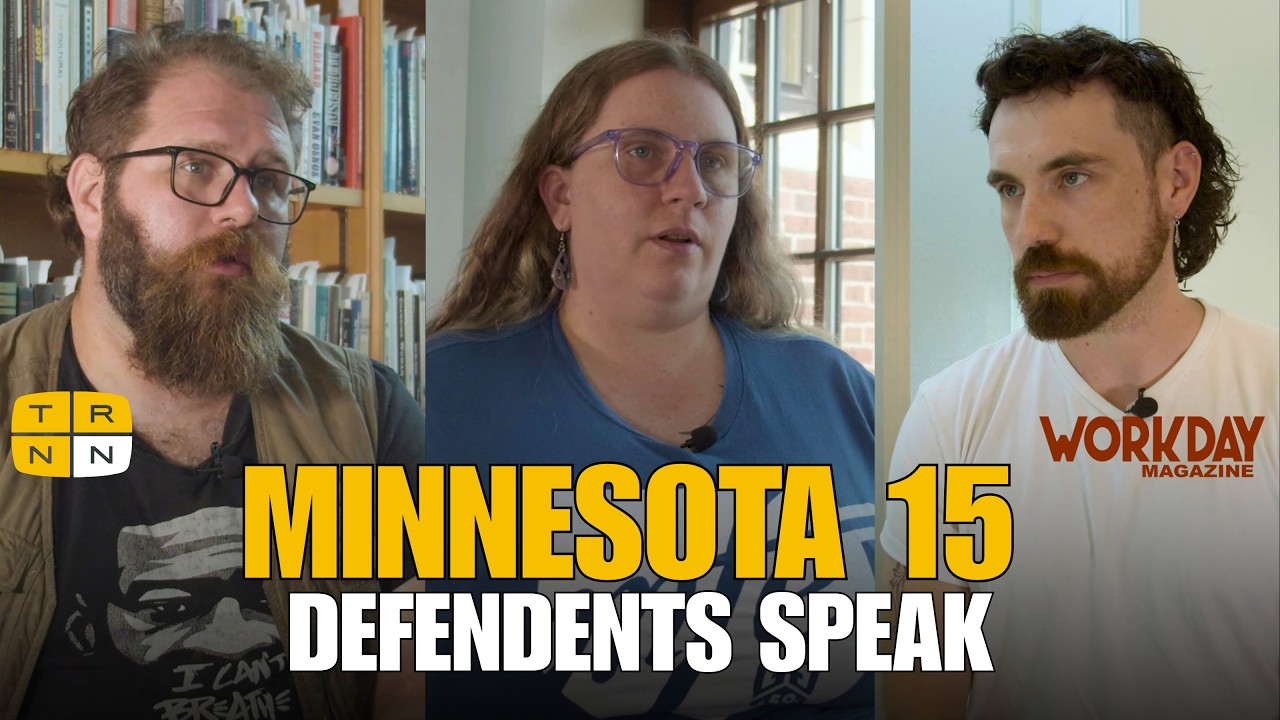
Three 'Minnesota 15' Defendants and rank-and-file union members (left to right: Emmett Doyle, Treasure Thoreson, and Alec Stewart) interviewed in August 2026.

This video report was collaboratively produced and is being co-published by Workday Magazine and The Real News Network 

On the morning of June 16, 2026, 15 people were indicted by the federal government for their involvement in community organizing efforts to oppose Operation Metro Surge in Minnesota this past winter. This group of defendants have become known as the “Minnesota 15,” and over half of them are rank-and-file union members or former union members.

In this special report, collaboratively produced by Workday Magazine and The Real News Network, we speak with three of the “Minnesota 15” defendants about the charges against them and the Trump administration’s attacks on dissent and the labor movement today. Interviewees include: Treasure Thoreson (Minneapolis Federation of Educators, Local 59), Alec Stewart (Minnesota Association of Professional Employees), and Emmett Doyle (Northern Midwest Regional Council of Carpenters).

Credits (Workday Magazine):

  • Reporting and editorial support: Isabela Escalona, Sarah Lazare, Amy Livingston, and Amie Stager
  • Videography: Isabela Escalona and Amie Stager
  • Additional photos and videos: Amie Stager and Riley Bruce
  • Video editing: Isabela Escalona

Credits (TRNN):

  • Post-production: Maximillian Alvarez, Jocelyn Dombroski, David Hebden, Kayla Rivara

Music:

  • Emmett Doyle, “1934 Strike/Cooleys Reel/Congress Reel”
  • Adobe Stock
  • FineTuneMusic

Special thanks to East Side Freedom Library, Minneapolis Central Library, Hosmer Library, and Minneapolis Federation of Educators.

Transcript

The following is a rushed transcript and may contain errors. It will be updated.

Treasure Thoreson:

Tuesday morning, June 16th, I had just woken up. I was in my pajamas. I hear a knock on the door at seven in the morning, and it’s a woman standing there in business clothes with a tactical vest on top that said Homeland Security.

Alec Stewart:

I was in my car backing out of my garage to go to work, coffee in hand. As soon as I backed out of my parking pad, several squads rolled up. A bunch of agents jumped out of the vehicles. I went to just text my aunt, because I have a dog. I assumed I’d be going to jail or something, and that’s when they smashed my window.

Treasure Thoreson:

I see six more agents standing in front of my house. The woman at the door, she just said, “We’re here with a warrant for your arrest for a conspiracy to harm or impede a federal officer.”.

Alec Stewart:

Exposes that while the government was targeting immigrant communities, tearing families apart, abducting children and murdering spokes in the street.

Emmett Doyle:

I had just typed in on my phone the location of the house that we were working on that day. I was boxed in by a vehicle, and so I rolled my window down to ask the guy like, “Hey, what’s the deal? You’re a pretty bad driver. What’s going on?” And then I looked around and I realized that my car had been surrounded. There was a swarm of armed federal officers with HSI on their uniforms.

Alec Stewart:

I do not think it’s a coincidence that over half of us are rank and file union folk. I think that speaks to, again, the working class nature of both the attack by the federal government and the working class predominant response to that attack.

Treasure Thoreson:

We had at least one person from every single site who was plugged into our committee and was able to get information out to their members and arm their building with the knowledge that they needed to face this kind of violence. And people stepped up in really major ways. Everybody did something, whether it was patrols or walking students to and from school, riding in a cab with a kid to and from school, making sure that their parents had rent money. There were some schools in the district that were delivering hundreds of boxes of food every week.

Emmett Doyle:

The unions that did get involved, I think understand what the labor movement is about in a way that some of our other unions have forgotten. An injury to one is an injury to all isn’t just a moral statement. It’s a hard reality of life. And the unions that stood up during Metro search understood that and demonstrated what solidarity means.

Treasure Thoreson:

We got a lot of great information from the Chicago Teachers Union who had been fighting back ice for months at the point when they came here. But we learned a lot from their struggle and were able to adapt that to fit what we were doing here in Minneapolis.

Alec Stewart:

And that was all without coercion, without money exchanging hands. That was just horizontal organizing. And I think how effective that is, how the power of mutual aid and horizontal organizing is evident because of this indictment. This wouldn’t have happened if what thousands of Minnesotans were doing hadn’t worked. I think the success of the January 23rd general strike speaks to that connection of the labor movement and just seeing the numbers and the outpouring of support for such a strike is historic.

Emmett Doyle:

I think that the general strike that happened in Minneapolis terrified the federal government. There were downtown, just hundreds of thousands of workers in the streets marching. And people have to remember this was severe sub-zero. It was a fantastic feeling of power and of joy and of resistance. And unfortunately, the next day that joy and resistance was answered tragically with the brutality of the beating and murder of Valence Preddy. But I think that the general strike was a major turning point in the regime’s logic of violence that they realized they couldn’t defeat the city.

Background music:

Stores are getting thin. There’s passing down that’s going on. Scabs anymore. We’ll put ourselves in union down this year of 34. Can’t you hear the mark? Either sign or behind. See the times get better when we hold that picket line.

Alec Stewart:

The revelation of Operation Puppet Master exposes that while the government was targeting immigrant communities, tearing families apart, abducting children and murdering our neighbors in the street, they were also attempting to disrupt and dismantle one of the facets of Minnesota that makes us so unique. And that is our strong and unified labor movement.

Isaac Sant:

This is not just an attack on me and my friends and our little group. This is an attack on our entire community. They were spying on us from day one. In fact, five days before Operation Metro Surge was declared on November 28th, they began spying on our organizations. These prosecutions were inevitable. Somebody was going to be on trial in there. If it wasn’t us, it was going to be somebody else. It was going to be one of you. We were being prosecuted for doing something that every single person that everybody and their mom in Twin Cities did to resist their federal occupation.

Emmett Doyle:

This case is meant to intimidate the entire community. It’s meant to tie up the time and efforts of many activists. But beyond that, as a conspiracy case, what they’re trying to do is set up a situation where they can expand and expand and expand the conspiracy. They’re trying to use our own solidarity and close-knit community against us through guilt by association.

Treasure Thoreson:

They want us to be separated. They want to separate out the good protestors from the bad protestor. I don’t want folks to feel afraid to stand up for their neighbor and do the right thing.

Alec Stewart:

It was such an obvious threat on what the Twin Cities is all about, which is community connections and helping each other’s neighbors. And the face of fascism, complacency, I think has no place. I think there was just a very justified feeling of standing up.

Emmett Doyle:

The support and solidarity towards us by our community has been overwhelming in just the most amazing way. I

Treasure Thoreson:

Think that they see our ability to bring people together as threatening. However, going after the 15 of us isn’t going to stop anything in Minneapolis or the Twin Cities because this is a place full of great organizers. We can’t let them bully us out of doing the right thing. We need to stand strong in our values and our morals and know that we are protecting our neighbors and that is the right thing to do. They’re afraid of us and that’s why we’re getting this response.

💾

We speak with three union workers who are among the “Minnesota 15” defendants the Trump administration is targeting for organizing to defend their Minneapolis communities from ICE earlier this year.
  •  

‘Palestinians face far worse consequences every day,’ says Brad Lander after release from IDF custody

Israeli forces prevent Palestinian farmers from accessing their agricultural lands to harvest olives in the town of Deir Jarir, near Ramallah in the West Bank, Palestine, on October 21, 2026. Photo by Issam Rimawi/Anadolu via Getty Images
Common Dreams Logo

This story originally appeared in Common Dreams on Oct. 21, 2026. It is shared here under a Creative Commons (CC BY-NC-ND 3.0) license.

Democratic US congressional candidate Brad Lander said Wednesday that he was released by Israeli forces with a “warning” after he and dozens of others were detained while helping Palestinians harvest olives in the illegally occupied West Bank.

“Several dozen rabbis and participants harvesting olives with me are still in detention,” Lander, who is Jewish, wrote on social media. “They should all be released immediately. To be clear: Palestinians face far worse consequences every day. These detentions by the IDF are one more attempt to undermine Palestinians’ right to harvest their olive groves, travel on their roads, and live in their homes.”

Prior to his release, Lander posted a video from a bus that he said was “taking us away for processing” after settler security called the Israel Defense Forces (IDF) on the group harvesting olives.

“Let’s be clear: Occupation is a crime under international law,” said Lander, who is running to represent New York’s 10th Congressional District in the US House of Representatives. “Harvesting olives is not a crime under any law.”

I’ve been released from IDF custody with a “warning,” apparently because of my public profile (I told them I wasn’t even a congressmember yet, just a nominee).But several dozen rabbis & participants harvesting olives with me are still in detention.

— Brad Lander (@bradlander.bsky.social) 2026-10-21T13:34:39.826Z

Lander was part of a group of around 80 American and Israeli rabbis and activists who were detained by the IDF on Wednesday as they helped Palestinians harvest olives from a grove near an Israeli settlement in the West Bank. Israeli lawyers told NPR that the incident marked “the largest mass detention of activists in the occupied West Bank in at least a decade.”

Jeremy Ben-Ami, president of the US-based advocacy group J Street, said in response to the detentions that “when the government of Israel and its military and law enforcement are arresting rabbis and volunteers who have journeyed 6000 miles to protect Palestinian farmers harvesting olives and not the violent terrorists harassing and attacking the farmers—it tells you all you need to know about this government’s moral compass.”

“This illegal and immoral occupation must end,” he added.

The mass detention came after several recent instances of horrific Israeli settler violence against Palestinian olive harvesters, European diplomats, and an American journalist.

Heba Morayef, Amnesty International’s regional director for the Middle East and North Africa, said in a statement earlier this week that “Israel’s apartheid system is turning the olive harvest into a season of horror for Palestinian families across the occupied West Bank.”

“States must recognize that settler attacks are not isolated acts, but a central policy of the Israeli state,” said Morayef, calling on nations to “take concrete measures to respect their obligations under international law and to avoid complicity in Israeli violations and crimes against Palestinians by halting all trade, investment, and cooperation that contribute to maintaining the unlawful occupation, apartheid, and the ongoing campaign of ethnic cleansing.”

“Hiding behind empty rhetoric is not only cowardly, it is enabling further abuses,” she added. “For Palestinians, it continues to be deadly.”

  •  

Do Maryland’s political leaders serve Maryland? Post-gubernatorial debate town hall

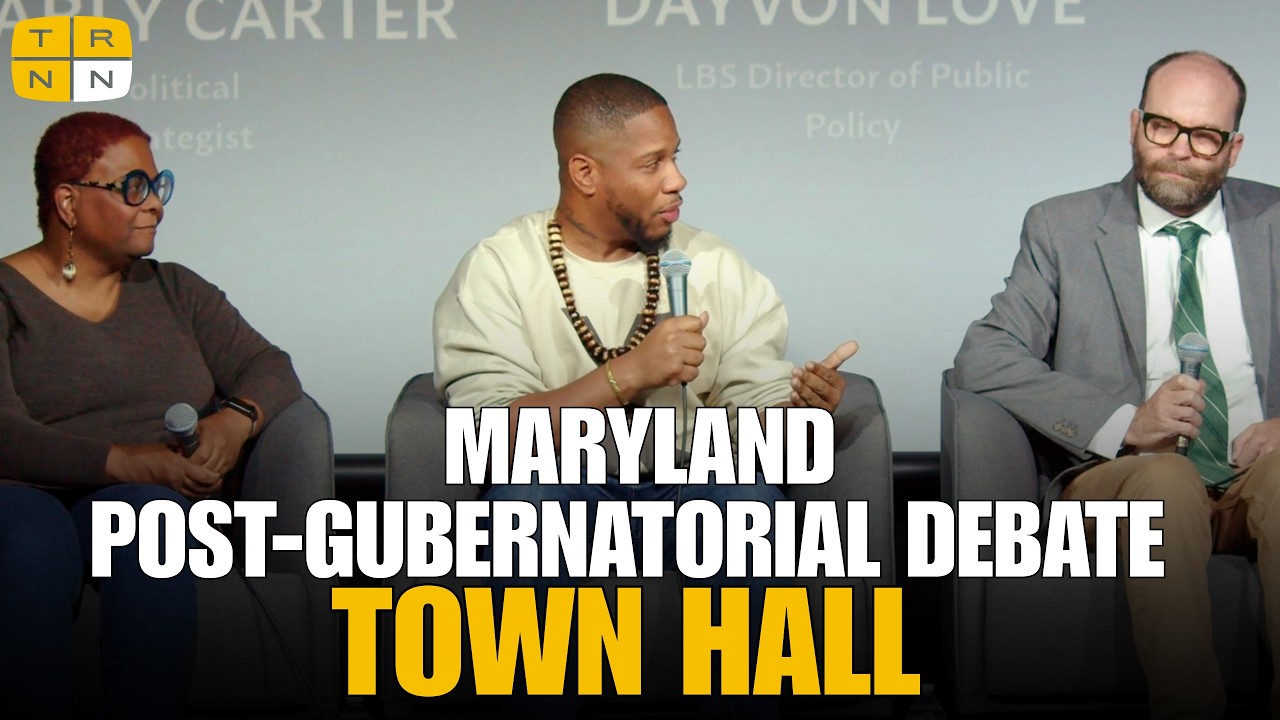
Panelists Charly Carter (L), Dayvon Love (CL), and Andy Ellis (CR) with host Maximillian Alvarez (R) at a post-debate Town Hall—hosted on Oct. 7, 2026 at the The Real News Network studio in Baltimore, MD.

With elections just week’s away, Maryland’s gubernatorial debate between Democratic incumbent Governor Wes Moore and Republican challenger Dan Cox took place on Oct. 6. In a special, post-debate Town Hall—hosted on Oct. 7 at the The Real News Network studio in Baltimore and co-organized by Leaders of a Beautiful Struggle—TRNN Editor-in-Chief Maximillian Alvarez moderates a panel discussion about the bankruptcy of politics-as-usual and the need for building “grassroots governing power” today. Panelists include: Charly Carter, political strategist and founder of Step Up Maryland and Step Up to Lead; Dayvon Love, LBS Director of Public Policy; and Andy Ellis, Green Party candidate for Governor of Maryland.

Credits:

  • Studio Production / Post-Production: Cameron Granadino, David Hebden
Transcript

The following is a rushed transcript and may contain errors. It will be updated.

Maximillian Alvarez:

So we’re here at the Real News Network Studio in Baltimore, and I am really grateful to be sitting here with an incredible panel of folks who are going to help us think through and respond to the Maryland gubernatorial debate that we watched yesterday, October 6th, between Democratic incumbent Governor Wes Moore and Republican candidate Dan Cox. So a lot of us watched that debate either live or afterwards. There was a lot to be furious about. There was a lot to think about in terms of like, okay, these are the candidates we have on offer, but also these are the things that our political parties think are important to us. And so I think a big way that we’re going to address tonight’s discussion is by talking about the issues and voices and perspectives that were not represented on that debate stage last night and that are just not represented in the dominant politics that is determining all of our lives.

And so I could not be more excited to be here at the Real News Studio to talk about these things with all of you and with our three panelists. Please give it up from my farthest end over to me. We’ve got the great Charly Carter, political strategist and executive director of Step Up Maryland. Give it up for Charly.

We’ve got Dayvon Love in the middle, director of public policy at Leaders of a Beautiful Struggle. Give it up for Dayvon. And thank you to Leaders of a Beautiful Struggle for co-hosting this great and important event with us. And last but not least, we have to my right, Andy Ellis, Green Party candidate for Maryland governor. Give it up for Andy, everybody. Okay. So here’s how I kind of want to start things off, gang. So like we said, we all watched the debate. I want to just go to the tape for a second and remind us that the debate opened up with 60 second statements from each candidate, Cox and more. And in Cox’s statement, the message, the narrative that he’s selling is pretty clear. Property taxes, rents and electric bills are too high. We’re paying more, but getting less is a direct quote. Maryland is the second worst economy in the nation.

This is all because of dangerous spending, mismanagement and absentee governor Wes Moore. And his pitch boiled down to, we need to lower our car registration fees immediately, cut taxes, cut the fees, control spending and bring back affordable energy and housing for all. Now more on the other side was doing what I think we’re going to see Democrats do for the next two years, which is tie everything to Trump, tie it like an anvil over their neck. And that’s exactly what he did. This guy loves Trump. Dan Cox says he supports 100% Donald Trump’s agenda. While they’re focused on the wealthy elites, I’m focused on working families. And Moore touted his record saying that Maryland has had among the fastest drops in violent crime anywhere in the United States. Teacher vacancy rate in Maryland is down 60%. Math and reading scores are at a five year high, yada yada yada.

So that is how they open their statements to us to ask for our votes. That is how our political discourse shaped the whole discussion of last night. So I want to ask you three, starting with Charly and working back down here, what are we not talking about in the way that that whole framing of the debate limits us?

Charly Carter:

Well, thank you for having me here tonight. I have to say after watching that debate, I wondered whether either candidate had been in the state of Maryland for the last nine months because I’ve been here for 20 years, a little over 20 years, and I’m seeing more activism in the community now than I ever have previously at a higher rate. People who’ve never been involved before are involved, protests sprouting up all over the state. And I didn’t hear anybody really addressing those issues. None of them really addressed the real concerns that people have over data centers. Nobody really talked about the amount of money that’s been taken out of education that’s concerning people and people’s just ability to afford things. Cox touched on utility bill rates, but then he didn’t really give any information about what he would do about them. And I think the things that I’m seeing people really upset about now is about the skyrocketing utility bills, the data centers and what they’re going to do to our communities and people’s home values, and then revenues to continue to invest in education and in other programs that help our community.

Dayvon Love:

Yeah. I would say that the debate yesterday really highlights the limitations of the two party system. I think most people’s assessment of the debate is that it wasn’t quite substantive. And I think what is clear, the purpose of a debate is to provide the audience with an opportunity to see a rigorous test of people’s policy positions. And so part of the challenge with the two party system is that there are certain perspectives that are not going to be present in the conversation that will be helpful to the general public to get a sense as to what is actually at the heart of the policy agenda of each of the candidates and their respective parties. And so just as a couple of examples, and I start as a revolutionary Pan-African nationalist, I’m very clear that black folks are a captured elector of the Democratic Party. So that is the posture where I start in terms of analyzing the discourse between two parties.

And so then evidence of that that I’ll just give to start with is even the conversation about juvenile justice where what the Democrats won’t do is the Democrats will not talk about the ways that the system of the criminal justice system is weaponized against the humanity of people of African descent and that the calls for stricter juvenile justice laws is not about accountability. It’s about continuing to be complicit in an attack on the humanity of black people, particularly black youth. And it would’ve been helpful to have someone like Andy on the stage to be able to press the Democratic Party to go further than what I describe as tough on crime light, which is what the Democratic Party essentially is. And so as a result of not having that kind of perspective, a person that is fiercely defending the fact that we have a system that automatically charges youth as adults and 80% of them black, which means you have kids spend 180 days in adult prison, that is something that folks in our community care about, but in the two party system, in the duopoly, we’re not going to hear a defense of the humanity of people of African descent.

And so again, I just think the debate yesterday was an example and we can give more examples as we have had this discussion, but just as a preliminary thought, just an example of what we don’t get because of the duopoly and the limitations, particularly as black folks being this captured electorate of the Democratic Party.

Andy Ellis:

Yeah. My name is Andy Ellis. I’m the Green Party candidate for governor. I’ve spent the last four years traveling across the state and we’ve been to fairs, festivals, we’ve been to library meetings, we’ve been to church meetings, we’ve been to protests, we’ve been to hearings, we’ve been to all sorts of places and we’ve talked to a lot of people. A lot of people are really frustrated with the way that things are working right now. They don’t think that the government is working for them. They think that the politicians are serving their donors, their national narratives and their party bosses. They don’t think that they’re listening to people and they don’t think that they hear the real pain that people in Maryland are feeling across the state. And I think the debate operated in that fiction where the politicians don’t hear that type of thing. And I think both of them acted as if we existed in a world where their two party system still had hold on the imagination of most people and most people still believe that that system actually works.

I think more and more people have decided and agreed that that system doesn’t work because they’ve seen year after year after year of politicians promising them to do things in debates like that and not actually doing them. The UNBC poll came out yesterday right before the debate and it showed a couple of things. One, it showed that Wes Moore and Dan Cox are at the lowest points they’ve been at in the polls since they both won the 2022 primary. People know who both of them are. They know what the record is and they don’t like either of them. Dan Cox had 24% support in that poll. That’s the lowest that I can ever remember a major party candidate having. And if Wes Moore weren’t running against Dan Cox, he may be in trouble in this election, but because he is running against Dan Cox, who is a MAGA aligned, sort of mediocre, no charisma politician, Wes Moore is going to probably win this election and he’s probably going to win it by double digits.

But the other thing the poll showed yesterday was that 25% of people don’t want either party and like 80% of people don’t trust either party. And I think that creates a real opening for us to do something different than what we’ve been doing up until this point. We have an election where there’s a 99% chance that Wes Moore is going to get reelected and all Dan Cox is trying to do is get out of the 20s so that he doesn’t get embarrassed. Dan Cox has sort of functionally turned the Republican Party in the state of Maryland into about as ineffective as the Republican Party is in Baltimore City or in Prince George’s County or in Montgomery County. And I think that that creates an opening to take the anger that people have and the grassroots uprising that people are having that Charlie is talking about in order to build a new kind of politics that is about grassroots governing power and not about the same old two party system.

And I think the debate was a perfect proof of that.

Maximillian Alvarez:

Well, to kind of really bring that point to light, one of the questions that was directed to Cox was literally, do you support or oppose the federal eligibility changes for programs like SNAP or food stamps and Medicaid? The bar is so damn low that the question is, do you support kicking all these millions of people off SNAP and Medicaid and everyone who’s going hungry or going homeless because of it? Are you shitting me? That’s the level of question. Are you for or against this? So I don’t care what these people say to a question like that. I don’t care about their bullshit responses to a bullshit question, but there is a very non-bullshit problem here that Marylanders and people around the country are going through. So I wanted to talk about that more. They did not address enough what the effect of these cuts and these costs of living are on Marylanders.

What would you say about that if you were on that debate stage?

Dayvon Love:

Well, something that I want to say to the point that you raised about just how cookie cutter the questions and the debate is, it’s important for the general public to be clear that there’s an emergence of a consultant class, a political consultant class that exists within both major parties that profiteer off of the fact that every two years there are major election cycles where people are making a lot of money. And if you think about the corporate core of both parties, where they have a business model that is reliant on keeping folks within the confines of the duopoly. Well, what I think what we’re seeing though is that to Andy’s point is that there is record levels of dissatisfaction with both political parties. So even the question that you identified that was posed to Dan Cox is a very typical question as it relates to your traditional Republican Democratic Party discourse, social safety net and entitlements versus trickle down economics and austerity.

So these are very traditional, the kind of traditional polls of the Democratic and Republican Party discourse. And the challenge is that we’re at a place now where I think more people, this is to Charlie’s point about the increase in activism that exists, that people are just more informed and people now are demanding more of these candidates. But unfortunately what happens, and I think this is really important for people to be clear about, is that the emergence of the political consultant class in many respects, it’s really on its last leg, that if folks in the broader community continue to push, then it’s going to force the development of an emergence of different political formations. And so I think that’s really important for us to continue to say to the general public that it’s not futile. And I think that’s part of the concern that I would have is that people would see the lack of substance in that engagement and completely disengage from the political landscape as opposed to staying on the battlefield.

Andy Ellis:

Yeah. And I would say both Wesmore and Dan Cox have a class privilege that does not make them have to experience this type of thing. And for me, I’ve experienced it very directly. Last June, I was laid off from a company that I had worked for for 15 years with no notice, just sort of one day I got a call and they sent a box from my laptop and said, “It’s been nice knowing you.” I didn’t talk about that for a long time on the campaign trail because I was embarrassed, right? I shouldn’t be embarrassed. It wasn’t my fault. It was global capital and private equity and a company that didn’t care about people, but I was embarrassed. But when I started talking about it when I was on the campaign trail, I realized how many Marylanders are going through something like this. How many Marylanders have lost a job at the federal level or corporation that they worked at for a long time, how hard it is for them to find new work, how ineffective state services are, how low unemployment is because it hasn’t been adjusted by the Maryland General Assembly since the Obama era, how bad the other services are in the state.

And as I started to talk about it, I went from shame to solidarity on this because I was starting to understand that so many people are struggling in a way that the politicians don’t understand right now. And if the politicians can’t wrap their head around the way that people are struggling and get beyond this cookie cutter consultant class conversation that Davon is talking about, they’re going to face a kind of uprising that they’ve never faced before. And we are going to see this political system change. The question is, is it going to change in favor of the people or is it going to change in favor of the Trump fascists who are trying to push their corporate rule on all of us? And I think the key question that we have to ask in our politics in this election and over the next decade is which way that change goes.

For me, I hope it goes for the people, but I’m worried that it’s not going to. I think the only hopes that we have are to use every forum we have in order to fight back against it, in order to fight for the people who have been left behind, even though Wes Moore says he doesn’t want to leave anybody behind, a lot of Marylanders have been left behind. And I think we got to fight for those folks and I think we have to create a political reality that allows them to have the power to make the changes they need to their communities and their lives so that we can get different outcomes because if we don’t, I’m pretty sure Trump and his fascists are going to do their form of that and none of us are going to like that.

Charly Carter:

I agree with both what Davon and Andy have said. I think the missed opportunity in that debate was the opportunity to talk about big ideas, new ideas, something bold. What we saw, as everybody has said, is two parties and two candidates who could stay relatively safe within the bandwidth within their two respective parties. No one had to challenge, no one was challenged. They could just say, “Here’s my position. I’m for lower taxes.” And the other person can say, “And I’m against Trump.” And yet all of the other issues just completely went undiscussed. And I think that’s the importance for having third party and minor candidates in these debates because oftentimes they are coming from a perspective where they’re offering a big idea that is why they’re not part of one of the other two parties. So I think it was a really missed opportunity for voters to hear about big ideas, which is what they are seeking.

More the people who are changing parties, and I’m hearing it regularly about the number of people. I’m shocked, honestly. I’ve been a lifelong Democrat and I’m shocked with a number of people who are saying they are shifting from being a Democrat in the state of Maryland where they can’t vote in primaries to being independent because they just don’t see what they believe. They don’t feel like it’s being heard, what they want is being heard or that it’s being represented in the party here in Maryland. And just as a funny aside, when I first met Andy, we argued about, this is going back years, we argued about whether or not there could be a successful third party in the state of Maryland. And I was adamant, although I was charged at that time with starting the Working Families Party of Maryland, I was like, “It’s just too easy to take over the Democratic Party because they have no vision and they’re not inspiring to people.” And what we saw on that debate stage was really a lack of vision and inspiration.

And that was really from what… Wes Moore is one of the most popular Democrats in the country right now, and yet he had this perfect opportunity to talk about something that inspired people that gave people hope. And he just talked about the same very vanilla policies that he’s been talking about and, “Oh, I’m better than Trump,” without really talking about what we could be doing.

Maximillian Alvarez:

Yeah. It’s like I hear a lot of talking, but the words don’t mean shit. It’s just like they never just address the thing that you’re begging them to address because you’re living it. It’s just such a bizarre spectacle that he just keeps being subjected to. I have a kind of follow up when it comes to the way that that comes through in their language and the responses they give. But before we move on from the question of the costs of living, straw poll. I mean, what’s hitting your pocketbook these days? The cost of gas is ridiculous. Rent keeps going up. What else? What else are people struggling with when it comes to paying for the cost of living? Everything. Everything is the main answer. Any others? Food? Yeah. We’re all working harder and our wages are staying the same while everything’s getting more expensive. What the hell?

That doesn’t feel like the American dream that we ostensibly were raised to believe in.

Dayvon Love:

And can I give an example?

Maximillian Alvarez:

Please.

Dayvon Love:

An example I think is really important is on the conversation around public safety that I alluded to in the beginning. If we’re clear about the nature of the way that the law enforcement establishment has interacted with black people, the law enforcement establishment being the Fraternal Order of Police, the Maryland State’s Attorney’s Association, the Association of Police Chiefs and Sheriffs, these are entities that have advocated for the tough on crime policies that are responsible for mass incarceration. And in some contexts, Democrats will talk about pushing back against that kind of in a very cosmetic way. One of the things that we’re seeing is we’re seeing Sinclair Broadcasting and Executive Chairman David Smith who owns the Baltimore Sun. We are seeing those media outlets being used as a communications arm for the law enforcement establishment. And the real material impact of that, because Baltimore has experienced one of the most precipitous declines in homicides and non-fatal shootings of any city in the United States.

And I think there’s a large community consensus that has been the unprecedented investment in black-led grassroots organizations that have been the cause of that precipitous decline. It’s important if Democrats are serious about this issue, it’s important for them to talk about being in opposition to a force that wants to undermine and to diminish those black-led grassroots organizations. But I don’t hear the governor or the Democratic Party coming to the defense of those organizations that are being attacked. I suspect what that is because Democrats still want to maintain a level of proximity to the law enforcement establishment, which means that talking about the declines in violence as being based in the community being supported in doing so undermines the law enforcement establishment and the Democratic Party doesn’t want to offend the law enforcement establishment. So I just wanted to lay out… Tha’s a concrete example of something that folks have talked about in the community, in public discourse, people have talked about that, but the fact that that is not what Wes Moore is saying, that is an important part of what is happening in Baltimore says something about the limitations of the Democratic Party as a vehicle for our political interests.

Andy Ellis:

And can I add to that? So I think one of the interesting things about the way that that question got answered is Dan Cox got closer in some ways. Dan Cox said we need to invest in rec centers. We need to invest in community organizations. We need to invest in churches. Now he went on to say a bunch of other stuff that was not the right answer, but he was getting closer to making the argument about investing in the grassroots than Wes Moore was, which I thought was really interesting. It means he’s been listening, I think, to some folks who are trying to tell him some of those things, but he is not the right messenger and the Republican Party is not the right messenger for this stuff because they then turn around and talk about predator children and soft on crime laws and things like that.

So they’re getting part of this message, but they’re not getting the rest of this message. I thought it was really interesting that Cox talked about that and Moore did not. It was a really interesting juxtaposition to me that Cox was the one who was talking about investing in the grassroots community organizations as a means of addressing crime and addressing public safety. Now, the rest of his package doesn’t work, but he was the one that got there and Moore didn’t say yes. Moore could have even said, “Yes, I’ve done that. That’s why we passed this initiative that gave a little bit of money to some of these organizations.” But he didn’t say that.

Dayvon Love:

He even said that the talking point of his administration has given record investments to law enforcement, to your point.

Maximillian Alvarez:

Well, and the law enforcement question really centered around ICE, right? It’s close to home. Of course, it’s happening in our backyards, in our neighborhoods. We just published a report I did from Frederick right in front of the house where those ICE agents drove onto private property, beat peaceful protestors, terrorized the whole family and didn’t even take anybody. All that terror for what? It’s happening all… I’ve been in front of the Hagerstown warehouse. I used to work in warehouses like that. They’re not built for human beings to work in most times, let alone house them and incarcerate them. So they talked about ICE a bit, right? But to your guys’ point, the answers were very revealing for what they said and more importantly, what they didn’t say. But the question that I thought was really well put, shout out to Tracy Wilkins from NBC Washington. I thought she and Pamela Wood from the banner asked really great questions, even if they got really crappy answers most of the time.

But Tracy Wilkins was asking Wes Moore if it was a mistake to ban ICE detention partnerships or a mistake to how he’s handled ICE and the cooperation question of local law enforcement. And his answer was, “If you’re going after the worst of the worst and violent offenders, I will work with you.

But when you’re going after people like Pastor Fuentes in the Eastern Shore who has been here for decades and leads a congregation in the Eastern Shore and ICE detains him, then no local law enforcement will and I will not allow them to be deputized to do that type of work.” So that was something, but then Tracy Wilkins pressed him about if there’s going to be detention, should detention be happening in Maryland where people can have access to family and access to their counsel, or are you going to do anything to stop these Gestapo motherfuckers disappearing our neighbors and sending them to Louisiana or some third country? And his answer was boiled down to, “So I think there has to be a reconsideration about the way that ICE is moving inside of our communities all throughout the state of Maryland.” What the fuck does that mean?

That’s my question. What does that actually mean? As a citizen of Maryland, as a Latino, as someone with family members that feel very threatened right now, what do I do with that?

Andy Ellis:

I mean, I think what it means is there was some political pressure on him this year in order to move against ICE that there wasn’t last year. Last year when the 287 bill came up, it got killed in the Maryland General Assembly at the request of Governor Moore. There was some political pressure on it this year, and so he moved and he responded to political pressure like he always does. But I don’t think that his heart is in it because he sat up on a stage with Mark Wayne Mullen when Mark Wayne Mullen took over the head of the DHS and was all chummy with him, talking about how we need to have this bipartisan cooperation in order to do this the right way. I think that it goes back to the place that Wes Moore likes the police. He likes to give police resources.

He likes to be able to talk about how he’s tough on crime and then say, “But we’re not tough on all crime.” I like the framing of tough on crime light, and I think he is tough on immigration light. I think he’s responding to political pressure and trying to do everything he can to protect his political career. I’m not sure that he’s trying to do much to protect Marylanders. Because again, last year there was a bill in front of the General Assembly that would have banned 287. It wasn’t just last year. It’s been there for years and years and years and it’s gotten killed every year. Wes Moore, Bill Ferguson have killed it.

Yeah, great. They came around this year on it, but there’s a lot of families who got broken up and there’s a lot of people who got detained and deported that didn’t need to be because they didn’t have the political courage to do the right thing without the amount of political pressure on them in order to get them to do the smallest thing they could. 287 is great. Yeah, let’s address that, but that is not the root of the problem. The root of the problem is that we have a immigration policy at the national level that has been broken for decades because both parties refuse to give it up as a political cudgel to use against the other ones and refuse to figure out a way to deal with the millions of people who are already here without threatening to deport them or threatening to detain them.

It is one of the biggest failures of the two party system at the federal level that we have allowed this to get to the point where both parties can use immigrant communities As tokens and as chips in their political campaigns in order to try to maintain their power without doing anything to the very real effects on people’s families, on people’s communities, and people’s lives that happened from them being unable to figure out a solution to the problem.

Dayvon Love:

The Democratic Party, I would say over the last 10 to 15 years, maybe even longer, has been shifting in terms of the constituencies that it sees itself as being responsive to. That there was a point in time where the Black community was a really important base of support that the Democratic Party in many respects would placate, but at least put in the effort to invest in getting Black folks to be a strong base of the Democratic Party. What has happened, and I think this has accelerated after the election of Donald Trump the first time, is a shift and a focus on suburban voters in the place of focusing on the Black community because issues that fundamentally impact our community, and I would even add other folks of color, particularly immigrant communities, that the moving away from focusing on those core constituencies has created a dynamic where they’re talking to that suburban audience, avoiding things that might inflame or might cause some consternation of that audience.

And so in the context of this conversation, particularly about ICE, and I will put it in the larger conversation about the ways that criminal justice are weaponized against those of color. What we’re seeing, Trump was not unclear and the Republicans are not unclear about the fact that the language of these are violent criminals, these are Mexican rapists, these are the very same tropes that are part of the collective American consciousness that are weaponized to criminalize black people being deployed against immigrant communities. And the limitation of the Democratic Party, and particularly in the person of Wes Moore as governor of the state, is that the unwillingness to be direct and say that, the unwillingness to say that the attack against immigrant communities is consistent with the racialized criminalization of people of African descent, that has been weaponized to undermine our humanity and undermine the humanity of immigrant communities.

The unwillingness to say that is about the fact that they’re trying to appeal to a constituency that if we’re honest, is scared of black folks. They’re scared of folks of immigrant communities. And instead of actually addressing that directly, that he’s gesturing to it. He’s giving an individual story that’s heart wrenching and wants people to be brought in, but won’t talk about the overarching structure of racism and white supremacy that animates the attacks that ICE has been tasked with on behalf of Trump and the MAGA movement. And so again, it’s just one of those things that the answer indicates to me the inability of the Democratic Party to be a vehicle for the interest of black and immigrant communities.

Maximillian Alvarez:

Well, and I love the way you put that. The unwillingness to be direct is probably one of the things, it’s probably one of the most popular political complaints we all have. It’s like, just tell me straight, stop bullshitting me. Just give me a straight answer. And that’s what I really took away from the debate. And frankly, most debates I ever watch in this country is it’s a theater. It’s not a real debate. It’s a performance. And it’s a performance in not answering our most basic questions and finding a whole class of consultants, like we mentioned earlier, to help you bastardize language so that you can get around saying what people just want you to say. And there are examples that were just baffling to me. I though it was wild that even though, as you said, Andy, all signs point to more kind of winning this handedly, but he opened himself up to a few big right hooks from Dan Cox and the Republicans that it was like, “Well, if you weren’t so shitty, you wouldn’t be such a juicy target for that point.” When he wouldn’t just say, “I’m not going to run for president and leave you guys in two years.” He wouldn’t just say, “Will you commit to Maryland for four years?” And instead he said, “Yeah, he wouldn’t say it.” And the way that when Cox got him for it and it was a real deserved blow, Moore responded this way.

“Dan Cox seems to be more concerned about my future than he is about the future of the people of Maryland. “It’s like,” You piece of shit, don’t use us to shield yourself from this thing. “You know what I’m saying? So that’s an example of how it’s being done on the right. And here’s an example of how it’s being done on the left, here’s an example of how Cox was doing it. When again, Pamela Wood from the banner asked a really great question, which is,” Hey, you seem to be all in for Trump like everyone else in the Republican Party. How are Marylanders going to know that you’re actually here to serve us and not just your nut job like daddy in the White House? “And what he said is,” Well, absolutely. “Direct quote,” I am a Marylander first and last, and I’m an American first and last.

“What? That’s not how words work.That’s literally saying nothing and then just moving on as if he’s answered the question. So I want to talk about that. How do we reclaim a politics of just being real and just talking about the real shit and not violating that basic trust that we all feel has been violated so many times by so many people in the media and in the political world?

Andy Ellis:

Yeah, I’ll start with that. So part of the problem is the way the debates work right now. So in 1992, Ross Perot got on the debate stage and he was weird and he had his charts and he had all of that stuff, but he appealed to a lot of people because he was speaking truth that seemed to matter to them. And he got in that debate and he had a real impact. He went up in the polls, he probably cost George Bush that election by most accounts. He got 15% or so at the end of the day. It was real significant third party independent political work. After that, the two parties and the media corporations decided that they were never going to allow that to happen again. So they created a commission on presidential debates that locked down on the ability to hear independent voices on the debate stage.

Well, they got all the media networks to buy in with them. They pushed the League of Women Voters out who had been sponsoring debates for years. And then they went to PBS at the national level and said, PBS, if you ever want to host one of our debates, you need to start adopting these rules too. So PBS started adopting those rules and then they started pushing those rules down to their local stations like Maryland Public Television. So stations like Maryland Public Television now have a standard for who gets to be in statewide debates to say you have to have 10% in polls in order to be in… A third party candidate has to have 10% in the polls in order to be included in a debate. So they’ve had this standard for a while. No third party candidate for governor or senator has gotten more than 3% in the state of Maryland since reconstruction.

So they are setting the rules in a way they know is going to exclude people. They have another set of rules that are really arbitrary and really suspect that are things like you have to have substantial fundraising and many people need to show up when you come to an event and you need to have a lot of media coverage. And they don’t quantify those in the same way they quantify the 10% on the polling. So in this year’s debate, by the time they sent out the invitations, there was one poll that had come out and it did not include myself and Kathy White, but they said because we weren’t included in that poll and we didn’t get 10% in that poll, we wouldn’t be invited to the debate. I used the Maryland Public Information Act request in order to get some of their discussion about their other debates.

In the spring, they invited all nine Republican candidates to the debate stage, even though they didn’t have polls for them. And this included folks like Douglas Larcom, a guy who had raised no money and got less than a percent in the election. And the most notable thing that Douglas Larcom has ever been done is get charged with like 30 criminal charges a month after they put them on the stage. Things like stalking, real winner they put up on their stage during that Republican primary debate. So I asked them questions about this, why in the Republican debate they were willing to open the doors for other people, but in this debate they were not. They did not answer the question. They stonewalled, they stonewalled, they stonewalled. Well, one of the other things that came up in this Public Information Act request was a conversation that they had to a press release that I sent out and a bill that Davon and I were working on where they spent the whole day in email freaking out because I sent out a press release that said if I was the governor, I would double their budget.

They were like, if the governor finds out that this happened and thinks that we put Andy up to this, then the governor will cut our budget. So they all started scrambling to make calls to the people in the general assembly and to the governor in order to make sure that the governor didn’t think that Maryland Public Television called me and told me to put out a press release. It’s so nonsensical that when I say it out loud, it just doesn’t make sense. But they were so worried about it because a third of their budget comes from the general assembly and from the governor.

Imagine how freaked out they would think the governor was if they extended an invitation to me to be in the debate if they were that freaked out about me suggesting a doubling of their budget. And I say all of this to say that there has been a concerted effort by the two parties and the media corporations, including PBS, in order to make sure that the kind of directness that we saw in 1992 when Ross Perot was on the stage never exists again, because they know that if people hear options other than the two parties, they will listen to options other than the two parties. They will vote for options other than the two parties. So they have sanitized the discourse. They’ve excluded most of the voices that would challenge them and be direct and they have done it so that they can protect their power.

And we see where it is. We see where it is 30 years later. It is a terrible debate. Most people don’t watch debates anymore because they are consultants giving scripted ideas back and forth. They’re not engagement of ideas, they’re not engagement of arguments and they’re not reflecting of what the people want. So the reason we get a debate like this is because they made sure that we get a debate like this and not have a conversation like this.

Dayvon Love:

And what I’ll add, because so there’s the kind of front end structural dynamics that Andy is describing that impacts the political landscape. But if you go further upstream, Hupy Harry Harris in his book Negro in the Nation, he was a scholar during the New Negro movement and he was talking about the relationship that black people had to the structure of this society. And he argued that black people prior to the Civil War, our relationship to this society chattel slavery enforced by brute force. And then after the Civil War, wage slavery enforced by starvation, that our community is able to be starved into political submission. And that’s an important framing because part of the conversation about the way, particularly that black folks enter the political landscape, and you’ll hear this conversation about pragmatism or what’s practical, people who run for office, and I’m sure this is true anywhere for anybody, but black folks who run for office, they know what fundraisers to go to, they know what corporations to be in relationship with, they know what major figures to be connected to, what media companies to be affiliated with.

And so what ends up happening is that by the time many of these folks appear on our ballot, they’ve already been curated for us. We’re picking from who the corporate sector decides are viable candidates for our community. And that’s an important point because then when we see a Wes Moore on the stage and we talk about the limitations of his performance, in many respects, it’s not just about him as an individual. It’s about the political landscape that says that the only way for us to be viable in politics is to engage in politics in the way that a Wes Moore engages in politics. And unfortunately, so much of what we see around us affirms that as true when we think about those that get to elected office. So I wanted to put that framing there because some of the work is about the importance and emphasizing the importance of independent black electoral infrastructure that can actually engage in the kind of political warfare such that we can put people into office as opposed to hoping the people selected for us do what we want them to do.

And one thing I’ll add to that is because even like LBS’s political theory of change, I’m clear that all of these elected officials, even the ones I like, even the ones that I have good relationships with, I am clear that they don’t work for us because we’re not how they got there. So the best way for us to impact the political landscape is to, again, engage in the kind of political warfare necessary in order to make them do things they may not otherwise do. And a good example of that is Andy kind of ran down the policy record on immigration, where Westmore and the Democratic Party, they were made to do that. They didn’t want to do that. In fact, one of the things that the governor did was after the legislature passed the ban on the 287G program early in session, he actually issued a memo publicly to law enforcement to say to law enforcement, basically, “I don’t want you to think that we don’t want you to collaborate with federal officials.” A way of trying to have it both ways.

And again, because we’re told that that’s what it takes to be in position. And so I think we just have to be clear that we have to approach politics. We have to approach politics with the thinking of we need independent power that can engage in political warfare so that given the current landscape, we can make these folks do what we need them to do with the understanding that we need to do the parallel work of building political infrastructure outside of the two party system so that at one point and hopefully in the near future, we can produce our own candidates for office.

Charly Carter:

There’s a lot to unpack there. I think to what Davon said, yeah, there’s a lot of truth in that candidates are groomed to… Well, one thing I can say is the very first thing you learn as a candidate is how not to answer the questions that are asked of you. And that would be as someone who spent 20 years identifying training and electing candidates, the very first thing that I tell people do is you answer the question that you want to answer, you don’t answer the question that’s been asked of you. And I think we saw – As

Maximillian Alvarez:

An interviewer, can I just say damn you for being so good at your job? Because that’s one of the things that makes it so frustrating to interview politicians. But anyways –

Charly Carter:

No, no, absolutely. And it’s funny because as a voter, I look at that and I get so frustrated because I’m like, that was an easy answer. I think that people have gotten, candidates now have gotten so… It’s so ingrained in them to answer the question that they want to answer, that they miss the opportunity to really connect with voters and to really be authentic and to give actual answers that would actually get them more votes. And I think that we saw that in the debate yesterday. I think that there were a couple of times when Wes Moore really could have just given an honest answer and it would have connected more with voters than the answers that he gave. The second thing that I want to say is in direct response to what Davon says is it is very much true that when people are coming through, when candidates are moving up through the ranks, that you have to raise money.

And who has the most money are corporations and LLCs, that those are the ones who are writing the big checks. Those are the ones when it costs a million dollars to run for office, that the people, it’s a lot of $5,000 checks. Imagine if you were only talking about $50 checks, it’s all exponentially more people that you have to get in. So they are in rooms with the people who want to hear the PABLOM answers. They are in the rooms with people where they can’t be committal to issues, where they are saying, and we saw this recently in Prince George’s County, where APAC was saying jump and you had candidates who were saying how high? APAC being the American Israel Political Action Committee.

So I think that there’s a lot of truth in that, but there is a role for voters. I’m not willing to throw the baby out with the bath water. I think in this state of Maryland, we have seen where people, where voters have gotten and communities have gotten engaged and they have gotten in and elected people and it’s made a significant difference to the outcomes of their lives. And I will say in 2014, we changed 35% of the state legislature. We elected new people, people that we trained, people that were grassroots selected, people who they raised their money from the grassroots. And immediately when they came in, we got re-enfranchisement of ex-felons. We got a raising of the minimum wage. We got earned sick leave. We got automatic voter registration and same day voter registration, all happening within a four year period of being able to change that, of being able to change just 35% of the state legislature.

A lot of those people are now in leadership positions. Are their positions the same? No, they’ve kind of migrated to the middle, but I want to point out that it is possible to do that both within the two party system, but I think the Green Party and the emergence of the democratic socialists and these other progressive movements are really changing what is going to happen inside the two party system.

Dayvon Love:

And if I can add, I think that’s a really important point. One of the problems with our political culture is that we focus too much on the executive branch. If we’re clear about the science of how our government is structured, it is really the legislature that is really at the seat that produces policy and that wields power over the other two branches. And what’s important about that in terms of a strategic value to our community is that we can do more to a delegate or a state senator or a city council person than we can somebody that’s elected statewide. So I just wanted to add, I think that’s an extremely important point that we use the ability to impact those that are elected locally and have a strategy for engaging the legislature as really the greatest opportunity for black people to exercise true kind of independent black political power.

It has to happen through the legislature. Not that the other stuff isn’t important, but I think the media culture overemphasizes the executive branch.

Maximillian Alvarez:

If I could – So we’re running up on time only in the sense of halftime, right? I do want to let the community in here in a minute, so I think we will have more time to dig into this, but we are sort of rounding the final turn in this first half of the program. But I wanted to sort of build on that and hopefully give you guys a container to respond, right? But the thing that I think we should be addressing here, and I want to give everyone a chance to, is what are those core issues that it shouldn’t just be about these are the issues that a savvy politician should talk about if they want to win new election, but what are the issues that savvy regular working people should make politics about so that we win a better world and a better future?

Andy Ellis:

So the three issues that we’re focused on right now are banning the data centers, building an economy that works for the people and not the corporations, and moving past the two party system and the corruption of the two party system. And I think a bunch of people probably saw Shorty outside. He gave me his book and it’s all about how he sees corruption working in the state of Maryland. People should check it out. People should talk to him. I think that our position on this is that the system, the two party system is fundamentally corrupt because the amount of political power that goes into it determines the outcomes, determines who gets to run for office and determines whose issues get heard. So the reason that we have chosen the three issues that we have chosen is not because they’re the only three issues that matter, but they’re the three issues that we think we can use this election to most effectively put pressure on as we go into the general assembly.

The data center question is a place where a popular uprising has come around and has allowed people who never got active before to meet in a church basement, to meet in a library, to meet in their community and to tell the biggest tech corporations in the world and their corrupt politicians that they don’t want this plan, that they want something different and that they want to keep these things out of their community. The corruption is these corporations getting these county governments and city governments to sign non-disclosure agreements so that they can plan outside of the people because they know from other places if the people know what they’re doing, they’re going to shut it down. So the data center thing is the thing that gives me the most hope about the possibility of change. And one of the things that gives me the most hope about it, it is not just one part of the state.

It is not just one political party. It’s from Landover to Lusby and Southern Maryland to Frederick to places in Baltimore County to places in Baltimore City. It’s black and white, it’s Democrat, it’s Republican, it’s independent, it’s libertarian, it’s DSA. People are all rising up and understanding that they can have the grassroots governing power in order to make their local government do what they want instead of what the corrupt tech corporations want. And so I think there’s a lot that inspires me about that. And to Davon’s point, the reason we focus on that is yes, it’s a politically volatile issue right now, but we think that this election and doing well as the governor in this election sends a signal to the General Assembly that people are willing to vote outside of the two party system because they’re so angry about this issue, the corruption of government and the demand for a better political system.

And we think that energy that we build now goes into the General Assembly session where we are going to push bills in order to ban that, in order to expand the way the politics work and to control the money and power. We were in Annapolis this weekend at a rally to call for a ban on the data centers. And it included people from Landover, it included people from Southern Maryland, it included people from Frederick. It was a wide array of Marylanders who have started to understand the grassroots governing power that they can have not dictated by the two parties, not dictated by the corporations. And that is the kind of energy that I think we can build on with this election. So part of the reason that we focus on those issues is because we think it sends a very clear signal to the people in Annapolis that people are mad about this, people are willing to vote on this, and people are willing to break out of the trap and the tradition of the two party system in order to say that they want something different so that we can go into those hearing rooms in Annapolis and say, “You better vote the right way on this or we’re going to build energy to make sure that you don’t win four years from now.

And we’re going to build energy to make sure that your friends in Baltimore City lose their seats two years from now if they don’t get this right.” So I agree 100% that the strategy needs to be on the legislative session and we are using the attention and focus of a governor’s race, which is a high profile race, which gets to do things like this in order to bring an agenda forward that we think we can actually win on and change outcomes on in Annapolis in this legislative session because we think it is absolutely important that the people claim the power that they have, use it to change outcomes and get better results for their communities. Choices are great, but choices without changing outcomes doesn’t solve any of the problems that any of us are facing today. And that is why we’ve strategically focused on those issues so that we can help make those changes in the general assembly.

Dayvon Love:

I think one of the central challenges with the kind of American political system in particular, the community’s relationship to politics is the kind of unspoken and sometimes even spoken conventional wisdom that in order to be viable in politics, you have to moderate. You can’t espouse political perspectives that go beyond the political mainstream. And part of I think people’s frustration with politics is that if that’s what it takes to be viable in politics, nobody wants it. One of the things that I’m most proud of, LBS was founded in 2010, so we’re 16 years in and we’ve had some pretty substantive impact on the community. When we first started, when I was a lot younger, folks used to say to me out of love, they would say, “Davon, you’re not going to be able to talk all that black stuff and be able to get stuff done.” And what I’m most proud of is that we have maintained our worldview and perspective, but that perspective has actually made us effective at moving policy that is helpful to our community.

And so I think a part of what’s important for people, I think something that will energize people and get people to want to engage in politics is to demonstrate to people that that notion that moderating is the pragmatic approach to politics is not the only road, that there are other ways, there are other approaches and methodologies to engage in politics that can be effective, that it’s not reliant on having to be succumbed to the political institutions and the political status quo. And I’m grateful for the real news and partnering with us and hosting this conversation because I know as a person who’s very active in local and state politics, I’m sure there are going to be some people that say, “Davon, how are you speaking against this really popular Westmore Democratic governor?” And there’s some people that would perceive me even saying the things I’m saying as something that would undermine the ability for LBS to be effective in passing our policy agenda.

What I want folks that are watching this to know is that in fact, it is the independence that LBS is able to demonstrate that enhances our viability because it demonstrates that we’re not beholden to the political establishment. I was actually kicked off. I was elected to the 41st legislative district’s Democratic Party State Central Committee in 2022. I was put off of the State Central Committee because I talked about the strategy of using Andy’s candidacy for governor as a nominee for the Green Party as leverage to bring the Democratic Party further left. And so I was put off the State Central committee. But see, the beautiful thing about that is that didn’t diminish the ability to be impactful. It actually enhanced it because it demonstrates the contradiction of the Democratic Party’s stated commitment to black people. But when a Black person stands up and is independent, they try to punish them.

So I think it’s really important, again, in terms of an important issue that energizes people, people need to see that you can espouse a radical politics, have a strong base of community support and actually be able to move policies that positively impact our community. And I think that will bring more people into the political conversation in ways that I think people would feel better about the ability to impact the landscape.

Charly Carter:

I agree with what you said. I think the original question was about issues that people are concerned about. I think Andy tapped into some of them. In the years I’ve been in Maryland, I’ve never seen I have spent a lot of time in Prince George’s County trying to get people energized and to come out and mobilize on issues that were of concern to that community. And it was really pulling teeth in order to get that done. But I have seen communities come together around data centers that have never really been engaged before. And I think the interesting thing is that whether you’re talking about the Eastern shore, whether you’re talking about the DC suburbs, whether you’re talking about Western Maryland, the concern is the same. And the heat, the anger at what they perceive as politicians not listening is pretty up there. So I think that that is one issue that we definitely have to pay attention to.

I think very closely related to that are utility bills. Even before the conversation with data centers really kind of sprang to the forefront, people got clobbered last winter in January when out of the blue there was a rate hike and then temperatures plummeted to below zero. There are still people who are digging themselves out of those bills and the damage that it did to their households as we are about to embark on another winter. And they’re saying that this winter could be even colder than last winter and utility prices, both electricity and gas have skyrocketed.

I think that that is an issue. I really would have liked to see the candidates talk about that. Let’s talk about what the impact that the war in Iran has on us here domestically in the state of Maryland and what can we do about that? What can we do about BGE putting in rate hikes? And then at the same time that they are making record profits. Neither candidate is talking about that, but that is something that people really want to understand. I think housing is a big issue. We still have young people who are living in their parents’ basements and wanting to buy, wanting to move out, people who want to move up, but the cost of housing is really skyrocketing. People who are renters, we have a very old rental housing stock. What is this governor doing and what does the want to be governor?

Dan Cox, nobody talked about housing and the impact of housing in communities, particularly communities in the DC suburbs and in Baltimore City. But it is a growing problem in Howard County and in Western Maryland as well. Affordable housing tops. Over the last two years since the pandemic, the state has had to cut its funding for the blueprint that was supposed to increase the state’s investment in education at a time when we saw scores falling off and record truancy rates. Nobody talking about what are we going to do? To his credit, years ago we had a millionaire’s tax in Maryland. We had actually progressive revenue. And in that time we’ve not seen many Democrats in the legislature proposing progressive revenue. Let’s go after people. The millionaires are getting big tax cuts. They got big tax cuts in 2016. They’re getting another big tax cut that’s been proposed in this latest Trump administration.That’s money that’s going into, it’s not being taxed at the federal level.

Why is the state not there with a big catcher’s mitt to go get that money and bring it back to the state? So I think that those are issues that people are concerned about. I don’t think middle class people want to see their taxes go up, but there are a lot of people, middle class people aren’t getting a tax cut at the federal level. There are a lot of people with deep pockets who are getting that tax cut and it can go to funding. Instead of having the governor talk about the cuts that he’s making in order to balance the budget and being really proud of balancing the budget, that budget is being balanced on the backs of working people, the very working families that he said that he was fighting for. So let’s go get some money. Let’s go get some money from that top 1% and give some relief to working families.

Maximillian Alvarez:

So I want to finish with a lightning, what do we do about this round? We try to end every production that we do at The Real News with information for people who are watching about what they can do to change the outcome of the story, what they can do to take this information and do something with it. And of course we have our elections and these national elections hanging over our head in just a few weeks. And so it is not my job as a journalist to tell anyone how to vote. And in fact, as the co-executive director and EIC of a nonprofit, it is something I cannot do and shouldn’t do. But that doesn’t mean that I stop being concerned for everyone in this room or everyone watching who is still maybe hearing us and saying, “That’s great, but how do I vote? What do I do?

How do I move through the world that we’re in towards the world that I want without making shit worse?” I think just on that level, what is your final pitch to folks here and folks watching before we turn it over to Q&A?

Charly Carter:

I think that it’s a shame that the MPT debate is right now going to be the only debate. And I think that that should be unacceptable to voters. I think that voters should demand that there are ample, many opportunities to hear the candidates debate each other. That is something that they can’t ignore. And so I think that showing up to the… There’s a debate being held at Coppin showing up to the one at Coppin. I think going on talk radio and raising this as an issue on Talk Radio about why are there not more debates being held in the community? I think demanding it where you get to ask questions because I didn’t get to say this earlier, but I was really just appalled at the questions that were asked. I don’t think that they were reflective of the concerns of people in the state of Maryland.

I think the questions that were asked in that debate were reflective of the literary class, like the political reporters. They had their own questions that I think they in fact are also detached from what’s going on in the state. I think that people demanding that the candidates show up and answer their questions is one way that you can have an impact in this election. I do think it’s important. Voting is important regardless of who it is that you’re voting for. It’s important that we, one, take back the Congress, that Congress changes hands, let me put it that way, that we don’t have the same people who are in office now continuing that. So I think that those are the two things I would leave people with is show up and vote, make sure you vote in congressional elections this year and demand that the gubernatorial candidates show up and demand that people expand the stage so that you can actually have a meaningful conversation that it’s not just him versus he said, she said, which is what I felt like this debate was.

Dayvon Love:

So I would say three things. The first is that our community needs to be exposed to a version of civics that isn’t like the afterschool special version. And what I mean by that is that we’re often told going out to vote, participating, that’s our civic duty. Even folks will say our ancestor staff have the right to vote, which is true, but it’s important for us to understand that if we’re going to be engaged in civics, that we need to engage it. I’m talking specifically to black folks from the perspective of engaging in political warfare against this system that wants to continue to maintain the system of white supremacy. And so we need to understand the machinery of government so that we can effectively wage that political war and LBS offers civics trainings every year. So that’s the first. The second thing that I’ll say is that it’s important that we are more granular in understanding the opportunities that Maryland has to influence the political landscape.

And I’ll give one example. It is likely that the Democrats are going to take back the House of Representatives. The person who is likely to take the gavel as the chair of the judiciary committee is Jamie Raskin. Jamie Raskin is a congressman here in the state of Maryland. Well, one of the things that’s been a longstanding project is H.R. 40, the bill that would commission a study on reparations. So Maryland actually has an opportunity to use our pressure to essentially get Congressman Raskin to commit to moving H.R. 40 out of his committee. And it is not unusual in a situation like Congressman Raskin is in where they actually are already talking about what kinds of bills are going to come out of the committee. So this is a really opportune time, just as an example, for the public to go to Congressman Raskin, because he’s going to win his election.

I don’t even know if he has a Republican opponent in November, but this is the time for us to demand to say, “Okay, are you going to make sure H.R. 40 moves out of the committee?” So those are the kinds of opportunities that I think is important. It is likely or it’s possible that maybe Chris Van Hollen becomes the Senate majority leader, particularly if the Democrats take back the Senate. And so again, using the opportunity, he is a U.S. Senator in Maryland. We have an opportunity to dictate the policy agenda as Marylanders. So that’s the second thing is use the opportunity of folks that are elected here to move our agenda. And then the last thing that I’ll say, and I know Andy is going to say this, but it’s important for me to say this, is that it is important for people that’s already going to vote for Wes Moore, you should do it.

I’m not going to discourage people that are already committed tried and true Democrats want to vote for Wes Moore. Those of you that are interested in a politics where we have more options, it is important for you to vote for Andy. And the reason that it’s important for you to vote for Andy, as a person who’s worked on political campaigns, there’s software that you get as a van where you’re able to get information about voters and demographic information. So campaign study changes in the electorate. So as Andy said, there hasn’t been a third party candidate to get more than 3% since reconstruction. So something like 4%, 5%, 6% is something that will bring attention or will come to the attention of Democratic Party establishment elites. Well, they will have to say for their own electoral viability, not just out of some altruistic, oh, these people want something more.

Out of their own electoral viability, they will have to take note of that and that will impact some of the policies that they put on that platform. As Charlie mentioned earlier, there have been some more progressive folks that have been elected to the legislature. That came simultaneously when there were green party candidates for mayor and green party candidates for delegate and for state senator. So this came in the context of that third party pressure where you had Democrats being pulled further to the left. And so this is how we get policies that repeal the law enforcement officer bill of rights, policies that created the community repair and reinvestment fund to put resources in the communities impacted by the war on drugs. So I say all to say that the practical reason, because Andy will tell you and we’ve talked, Andy’s not going to become governor, but the reason to vote for him is to send the message to the party that we want something more than what is given to us.

And what’s beautiful about the situation we’re in now is we’re not in a situation where we’re at risk of electing a Republican. Dan Cox is not going to win. So all the excuses that people make about why it’s so important to vote for Democrats is not a concern for this election. So if you’re a person that wants more choices in your political landscape, then voting for Andy, voting for the Green Party helps to send that message and create more viability politically for more options.

Andy Ellis:

All right. So the first thing I’m going to say is if you like what Davon said and you agree with him, talk to your friends, talk to your neighbors, talk to your coworkers. The people are not dumb. The people are not slow, but the people in the consultant class want to frame politics that way. They want to frame it as if every single voter is stupid and is only going to listen to 30 second sound bites and has a short attention span and can’t comprehend an argument that is strategic other than an argument about who is going to win. Your friends and neighbors and coworkers are not stupid. They can understand complex arguments about strategy. And I think what Davon was laying out there is an easy actually to explain argument. I actually think most people can understand that. Dan Cox is not going to win.

Wes Moore is going to win. And a vote for us that sends a symbolic signal to people that says that people are ready for a change on these issues will be heard. The politicians and the consultants will tell you they won’t hear it, but they will tell you that because they will hear it. They will tell you that if you don’t win, it doesn’t matter, but that’s because they don’t want to have to change what they’re doing based on how people vote, if people vote outside of the two party system. But they know exactly what the threshold is. They know that at 3.2% we would have the best performance since reconstruction. They know at 4% it would send a shockwave through people in Annapolis. So the first thing is talk to your friends, talk to your neighbors, have reasonable and intelligent conversations with them because we’re all reasonable and intelligent people.

The second thing is vote for us. I got to say that. Vote for me, vote for Andy Ellis and Owen Silverman Andrews, Green Party candidates for governor and lieutenant governor on November 3rd or early voting or however you vote. The number of votes we get will matter. At 1%, we keep the ability for the Green Party to stay on the ballot for the Baltimore City elections in 2028. So even if we don’t get that historic number, but if we get 1%, we still have the opportunity to be on the ballot in 2028 so that we can run candidates, maybe some folks here in this room or some folks that you know here in Baltimore City against the Democrats and Republicans, I guess, here in Baltimore City. The third thing I would say is pick one of the issues that you think is important that we are working on or that LBS is working on or that Charlie is working on and go and show up in Annapolis and exert that grassroots governing power that we all know we have in order to get the General Assembly to do something they don’t want to do right now, in order to push them to an outcome like passing the Law Enforcement Officer Bill of Rights, like banning the data centers, like taxing the wealthy on their wealth and making sure that it’s not having cuts that affect the working class and the middle class, making sure that they’re not cutting money out of our schools.

Let’s go get some of those wins after we set that historic number in November so that we can show that the power is transferable. It’s not just a vanity project. It’s not just for history. It’s about building the kind of community governing power that we need in order to get the outcomes that we want for our communities because if we don’t, nobody else is going to do it for us.

Maximillian Alvarez:

Let’s give it up for our panel, everybody. Charlie Carter, Andy Ellis, Davon Love. Awesome, man. Thank you guys so much. That was great. Now let’s open it up to what y’all think. Yes, please remember, we do need y’all to speak into the microphone so everyone can hear you. So we have a microphone right there. Thank you so much for carrying it over

Speaker 5:

There. First, I’m going to just say thank you. Thanks Dayvon for letting me know about this, right? So I guess my questions is this, Frederick Douglas said power concedes to nothing but power it never has and never will, right? I’m pissed off in terms of that first of all, in third grade they told me no person, no party was beyond law. So I don’t want to hear the bullshit when they say we ain’t got enough Democrats in office to stop Donald Trump from what he’s doing. Secondly, then we have a president that’s illegal. I mean, the man got 34 felonies and we allowed him to be president. So I’m saying in one sense, it’s just a game that everybody is against the people and we have to choose who we think is going to protect us when all of them are showing that they’re against us.

So I guess my point is this, is that I would like to hear people talking about find up the people and saying that when they talking about the Declaration of Independence, even if they didn’t have us in mind, they says that anytime the government does not work for the interest of the people, the people have a duty and an obligation to overthrow the government, to establish the government that’s going to work for them. So I’m saying, do we just sit back and if we can’t stop Donald Trump after the election, then what do we do?

Dayvon Love:

So I’ll say a couple things. The first is that Trump is going to not be in office in two years, and it’s important for us to think now about what our 2028 strategy is going to be. And I think too often what happens is we think about it in 2028. So I would say the first thing is that we need to think, especially in an environment where the Democrats take control of the House and if they also take control of the Senate, and I say that because Democrats, because Black folks are captured electorate, we have some leverage. We have some leverage in terms of what they do. And so I would say it’s important for us to dictate to the Democratic Party, particularly those in leadership in Congress, we need to dictate to them what an acceptable agenda is and we need to put the most radical agenda in front of them knowing that they’re not going to do it.

But what it does is that it helps mobilize the general public to recognize the ineptitudes because I think what happens sometimes is that Democrats will pick a handful of things that they’ve done good. And so they use those handful of good things to justify all the other ineptitudes. So I think we have to put a robust agenda in front of those that are going to take leadership and we need to do that in advance as opposed to when the election happens. The second thing I would say is that we need to take advantage of local opportunities to exercise that leverage. One example that I’ll give in Baltimore County. So Baltimore County has a seven member county council and currently only has one black person to serve on the county council. Now, Baltimore County did some work last year and last couple of years, ratify an expansion of their county council.

Well, now there’s going to be nine members instead of seven, which will expand the capacity for black folks to be represented on the county council. Now the challenge, because they wanted to expand it to 11, and they also wanted to ensure that there were four majority non-white districts as opposed to just three. Now what ultimately passed was a map that had three majority non-white districts as opposed to four. And the reason is because on the current seven member council, there are four Democrats and the Republicans. And in order to change the composition of the county council, you need five, you need a super majority. So in Baltimore County, they’re likely going to elect a black county executive, so that’ll be a first. But what I argue is that the most important thing is that if folks in Baltimore County can elect six Democratic council people instead of five, and many of those nominees, those Democratic nominees for county council are black folks.

They actually just did an event this past weekend where the Divine Nine did an event where they featured those Black folks that are running for… So if we get six folks in the County Council in Baltimore County, that is a level of electoral power where Black people can have leverage in Baltimore County in a way that Black folks have not had leverage in Baltimore County. And my disappointment, now I don’t even know if I would say disappointment, that the Democratic Party is focusing more on getting this ADO congressional map drawn as opposed to focusing on something like in Baltimore County where you can actually make a difference and actually shoring up Black electoral power in Baltimore County. But it seems that the Democrats are more concerned with the national fight in terms of symbolically fighting Trump because one additional congressional seat, as opposed to thinking about what are the things that the party can do to enhance Black local elected power.

And so I would say that looking for opportunities, Andy mentioned data centers this past primary election. There are a bunch of folks that were ousted from their seat because of the position on data centers. I don’t imagine that’s going to go away. So again, just looking for local opportunities to exercise some of that power that can build up and hopefully give us the leverage to be more impactful on the national scale.

Charly Carter:

Thank you, Davon, because I think that was excellent. Especially about putting the aggressive agenda on the table. We have seen when Donald Trump came in, we saw just how fast he was able to pass some really stuff we thought was crazy. I mean, when they started talking about Project 2025, most people thought they’ll never be able to get this through and look at all the things. It’s something like 70% of it has been implemented in a year and a half. So nobody can say we can’t do big things really fast, but we can’t unless we stay engaged and we need some big ideas to put up there. We’ve also been able to see Zoran Mamdani pass some really big things in New York City, things that nobody in New York, I’m from New York, nobody in New York ever thought that he’d be able to get passed.

We need those big, bold ideas on the table, but here’s the most important thing. Over the last 30 years, and this particularly happens in the Black community, is we have been trained to show up on election day, to vote and then go home and go back to our lives, that the people we elect, they’re going to take care of us. They’re going to be the ones who are… We are going to get it done for you, right? But let me ask you this question. If you had a boss that showed up once every four years, how good would you be at your job? What would you be doing for the three years and nine months before you knew they were coming back? You’d do whatever the hell you wanted to do. And that’s what we… We are the boss when we elect people to office, whether it’s to local, whether it’s to state, whether it’s the federal, we are the boss, we’re the employee.

But if we go home, if we show up on election day or a couple of months before election day and we tune in and then we show up and we cast our ballot and then we go back to our lives and watching daytime dramas and love is blind, and we don’t think about it again until the next four years. Those politicians that we elected, no matter how good they are, no matter who, where they came from, are going to do what the hell they want to do for those three years and nine months and then till they come back around again. So we have to stay on top of it. We have to check in. We have to tune in. That means when there’s a town hall, we got to show up. We got to show up and tune in to figure out how they’re voting and what they’re voting for and whether they’re representing us.

We can’t just go back to sleep. And that is going to be really hard for people who are stringing together two or three jobs. But if we want those big, bold ideas to come through, they have to know that we’re watching and they have to know that we’re keeping score. We have to show up to stuff. And I think that’s the most important thing that we can do to try to get control of politics again.

Andy Ellis:

Yeah. And so I will answer this to take it back to the 2024 election. So before the 2024 election, Davon and I were both on the Charter Commission and this is the commission that Baltimore City has where we look at the charter and every 10 years the citizens shall gather and make recommendations to the city council. City council’s not going to do any of those recommendations. But one of the things that Davon and I saw coming during that was David Smith of Sinclair Broadcasting’s question that would’ve slashed the Baltimore City Council in half. And we decided one day in Annapolis, January or something, we kind of just decided we were going to beat it. And we decided we were going to beat it because we wanted to develop the muscle of democracy in order to show that we could fight back and we weren’t dependent on the Democratic Party in order to get the wins that we wanted.

Democratic Party at that time was saying, “Well, we got to make sure that it doesn’t get on the ballot. We got to sue to get it off because we can never beat one of these things. It’s assure that our charter amendment is going to pass, that it is that a Democrat is going to get elected.” And we decided that it was important to show that that was not actually the truth and that the people could come together, put together the kind of organization that was necessary and beat the local evil billionaire. Well, he’s not really a billionaire, but a hundred millionaire, the local rich man who wants to run our government who’s a friend of Trump. And we organized with labor, we organized with faith groups, we organized with Democrats, and we organized the media in order to be able to actually beat that question.

And we beat it because we believed it was possible and we believed it was necessary. And I think what I am using that to say is that one of the things that Trump has shown us is that we don’t have the grassroots governing power in most of our communities to protect ourselves from a fascist in Washington DC. And if we rely on the Democratic Party to do it, we can see that they’re not going to be able to do it. They don’t have the capability, they don’t have the will, and they don’t have the structure. So we have to start developing the kind of power and the kind of use of democracy that allows us to get the outcomes that we need regardless of what they’re going to do. Once we start developing that power, they’ll come along in some ways. With question H, by the end, all of the Democrats wanted to jump on question H because they realized it was going to win and they wanted to be able to say that they were going to claim a win.

But they jumped on board because we believed it could happen and did the organizing with the community in order to make sure that it was going to get defeated. Yeah, we needed them. It was useful to have their resources. It was useful to have their money. It was useful to have their door knocking, but they didn’t do it because they wanted to do it. They did it because we believed that the impossible was possible. We made sure that it happened. We did the organizing and we flexed and built those muscles of democracy to get one win that was useful in 2024. I think those victories are hints of the future. I think if we can look and see how that works, we can think about How to apply that model in other places.

Maximillian Alvarez:

Well, and if I could hop in here as well, this is what we talk about so much at The Real News and in the reporting that I do with working people when it comes to unionizing your workplace. It’s like a union at a Starbucks isn’t going to change the world, but you are going to be much more capable of changing the world after you unionize your Starbucks with your coworkers. The struggle changes you and makes you more capable of making change thereafter. I think there is something to be said about building that muscle wherever we can, however we can. But I really want to bring that back to your question because we got some muscles that need building for whatever is coming. And we don’t know full well what’s coming, but what we know is something is coming. You think the guy who’s using our taxpayer dollars to pay for political campaign ads that I have to fucking watch on football is going to just accept the results if he loses in a month?

Absolutely. Of course he’s not. Did you think he was just going to go away when he got the conviction in court? Of course he wasn’t.

That’s the one thing you know about him. He’s not going to just say, “Ah, shucks. I lost. You beat me. You bested old Trump. I’m going to go away off stage, you’re never going to hear from me again.” That’s the one thing you know is not going to happen. So what muscles are you building to prepare for whatever does? And so that’s in the spirit that I wanted to offer just some of my thoughts. Again, it’s not my job to tell anyone how to vote, but I can tell you go vote because it’s your right, it’s your duty. It’s part of the muscle of civic engagement that needs to be built, but it’s not the only one. And when it comes to what exactly we’re fighting for, I think that’s the one thing I wanted to say is I used to love being a pundit and going down to DC and being on these news shows where they would just put me with some Democratic talking head or a Republican candidate for this office.

And I was like, “Oh, I’m going to eat this full alive.” It was so easy to just destroy them on camera with arguments that weren’t tied to everything you guys have been saying. It’s just like, well, it’s easy to beat you in a debate because I’m not trying to please some party. I’m just talking about the real shit that we’re all dealing with. There’s actual real power in just saying the truth plainly. And Mother Jones, the famous labor organizer, said that I will tell the truth wherever I please. And I keep thinking about that line and keep repeating it to folks because I think we need some of that moxie and we need some of that. We need to take it further, not just to tell the truth wherever we please, but to go say the truth wherever we can and create a sort of indomitable light that can’t be denied, that we leave these fools no more darkness to keep hiding in.

And we do it by speaking the truth plainly and loudly, meeting each other on shared planes of reality and humanity and stop letting the goddamn pundits and the internet and everything else divide us and move us away from each other. I think we got to get back to the basics. That’s why I brough up the breaking points thing is I don’t give a shit about any party at this point. I’m concerned about our species. I’m concerned about life on this planet.

So if you’re asking if we’re on the left or the right, it’s like we don’t think in those terms anymore, but if you ask all of us in this room, are you on the side over here that’s for life and a future worth living in and not war? I’m sure we’d all be standing on that side, whether or not we call ourselves left. So that doesn’t need to matter right now. What matters is do you want to let these sociopaths win? Are we going to give them our children’s future? Are we going to give up all those things that our ancestors fought for, like democracy, like the right to vote, like the belief that this country could be something better? Are we just going to give it over to these fucking nut jobs? Of course not. And I think we just got to really dig in deep and say, you’re not taking that from us.

Those lessons that we learned in elementary school you were talking about, they were good lessons. We were taught to despise and fight against what we’re seeing right now. So we should despise it and we should fight against it. All right, I’ll shut up. So get out of the soapbox.

Speaker 6:

Sorry, just had a quick question for Andy. And this is not meant to be a loaded question in any capacity, but what is your opinion of Jill Stein and what she brings to the Green Party in America?

Andy Ellis:

Sure. This is the question I get all the time. So I appreciate the work that Jill Stein has done to help build the Green Party. She has secured Green Party ballot lines and ballot access across the country over the last 12 years or so, and she has done so a great sacrifice to herself. Jill Stein could have been happily retired doctor who sat in her home in Massachusetts, did local activism, played in her band and tended her garden. And everybody would love her because she was the kind of local politics that we like. She chose a different path and she chose that path because she thought that it was necessary. She thought that what Ralph Nader had started to do with the Green Party was important and she realized that somebody else needed to pick up the baton and keep going on it. And I hope that Jill Stein is not our next presidential nominee.

And I don’t say that with any disrespect toward Jill, but I would like to see somebody new come up and represent a new era of the Green Party that is focused on building black and brown and working power in deep blue cities and deep blue states. Because I think that if we start to do that, we can start to see real change. I think if we focus more on Baltimore than we focus on Pennsylvania or we focus more on Prince George’s County than we do on Michigan or something like that, I think we can start to build the kind of alternative that those places need. And the last thing I’ll say about this is that alternative that is the People’s Party on the left does not have to be the Green Party, but the Green Party is the one that has the ballot line in Maryland right now and it is the one that has the structural capacity to nominate candidates and to allow people to get on there.

If it is the Ujima People’s Progress Party, if it’s a worker’s party, if it’s an amalgamation that we haven’t seen or a formation that we haven’t seen yet, excellent. We need something that is willing to fight against the capitalist system in the two party system. And I think Jill Stein has helped the Green Party to stay alive in order to do that. I know a lot of people dislike Jill Stein and I know a lot of people disagree with her choice to run for president in the way that she’s run her campaign over the years. I don’t think there’s a ton of people who disagree with the platform that she advanced. There’s some, but they’re not the ones who are making that argument, but they disagree with the strategy and they don’t like her as a person. I hear those concerns. I appreciate the work that she’s done.

I appreciate the sacrifice that she’s made. And like I say, I hope somebody else is the next nominee.

Speaker 7:

My name is Al. He made a point when he starts talking about the unions. And the reason why I believe he made the point, because I think that’s the hidden weapon that a lot of people are not paying attention to. I mean, even across the country itself, because at the end of the day, all these data centers are mostly being built by who? And there is a strong stance for a lot of people within unions that you do not cross picket lines or protest. So the fact that Baltimore’s already dealing with the issue with the fact that too many people in Baltimore City do not know about privatized organized building trades, they know about ASCME, they know about CEU, all the other ones, but are not familiar with JTC or any other trades unions altogether, IBW, whatever, that’s a disadvantage. And then there’s also a further disadvantage because that weapon itself is unclear.

And I think that if people would just execute on that when they’re being prompted to do so, then they would see exactly what that is for. What was happening in Baltimore County, like Davon was talking about, I went to the D9 thing, literally talking about what I’m talking about now, not in any real detail because I don’t trust them either. But at the same time, mentioned the fact that even if it comes to job creation, you know what I mean? A lot of us don’t know about it. And the thing about it is that even across the country right now for unions, the interest in unions is spiking literally because they get paid more.

So you have something that’s not going to be too hard to convince people to want to get into once you just only just tell them about it. And then in doing so, also talk about the fact that there’s a far disproportionate gap as it pertains to non-white or black, very specifically black, that now when we talking about Baltimore County and Baltimore City and we talking about the fact that they legislated for east of 40 and Woodlawn, right of town, Milford Mill, Lockroom, that now you also have the encroachment of Baltimore City that along with you wanting to get a job into the unions and now discover how unions work while at the same time also work on the same data centers that you’re not really with because I’m not with putting that in Woodlawn. There are a lot of people who are not working in data centers, mainly us, literally because they’re not with the whole Woodlawn thing.

They have maintained it and dealt with the whole contradiction of it and the fact that they’ve been in Federic working and they need the money. So utility itself, it is what it is, but they’re very stern about the fact that they’re not going to take the job in Woodlawn, but it’s not only Woodlawn. So I think that we’re missing a point that you have literally an organized element, no matter how disruptive and not as functional as it could be, that already within itself in existence, that if you would just listen and actually get involved in it, that you’ll literally reveal a very serious weapon that already exists.

Maximillian Alvarez:

I thought that was a great comment. I was going to say, can we get another one as well so then the panel will respond to a couple of these points, but thank you. No, that was great.

Speaker 8:

Hi. My thing goes to existential questions. I haven’t heard anything about genocide, haven’t heard anything about the 60th anniversary of the founding of the Black Panther Party, but the little pieces of history that I’ve learned coming across my decades of life are little things like the birthday of Fannie Lou Hamer, which was just a day or two ago. And as you guys were talking, I could hear somebody saying in my ear, “Truth crushed to earth shall rise again.” I could hear somebody else saying to me, “The secret of life is to have no fear. And if we don’t have clean water, soil and air, we will cease to exist. And if we don’t prosecute people who are guilty of murder, Nuremberg will have taught us nothing.” So I just wanted to just hit a couple dots and as we’re going through our day, we think about these things, but it just passes.

And that’s all I have to say.

Andy Ellis:

Yeah. So I want to take both of these a little bit and then let the other panel do it. So I was at the Towson Planning Commission meeting about the data centers back in August or early September and many of the white IBEW folks walked through the protest and my speech that day was like, “We got to work with the IBEW folks. We have to make sure that we’re not treating them as enemies and that we’re treating them as comrades in this struggle.” Now – What? You were on a work site that day? Yeah, sure. But so we got in and we get inside and the planning commission is going down and I’m standing in the back with most of the IBEW folks. Planning commission is going down their recommendations and they’re going down their recommendations and they’re like, “Okay, project labor agreements.” They’re like, “We do not want project labor agreements for these data centers because we don’t have them for other stuff and we don’t think we need to have them for the data centers.” And I noticed at the point that a lot of the IBEW folks that were in the back of the room kind of gasped at that because they were like, “Well, we have politically aligned ourselves with the county in this regard in order to hopefully get union jobs out of this.” And the county was quick to dismiss that.

And I think that when we’re talking about data centers and when we’re talking about labor, we have to talk about something beyond just saying no to the data centers and talk about what we do want to build. What do we want to build that electrical workers and trade unionists can build and feel comfortable building? What does it look like to build the green infrastructure that we need and to train people in Baltimore City schools and Baltimore County schools in order to build that infrastructure? Because once we start building that, we can address the clean water, the clean air and the clean land. And we don’t have to allow the only construction to be something that is destructive to people, that is surveilling people and that is supporting genocide. And I think we need to have that positive future focus on this about what is what we want.

And we need to have these conversations with people who are building this stuff to say, what is it you would like to build and how do we get the resources for that and how do we change the political climate so that is possible to build with the ease with which we build surveillance and data centers? So I think that’s the one thing I’ll say there and I’d love to talk with you more about this because I know you’ve been at some of the hearings and things like that talking on some of this stuff too. Second thing I want to say is in relation to genocide. I think one of the most foundational points in the last couple of years that has caused people to break away from the two party system who previously believed in it was watching how quickly everybody accepted supportive genocide in Gaza and how quickly both parties fell over themselves in order to crush the student movements, in order to crush everybody who was standing up and rising up.

Our platform is very clear on this and we wish we had gotten a chance to be on the debate stage last night to talk about it because we think it’s an important question, but when it’s just Democrats and Republicans on the stage, they’re not going to ask about it. The state of Maryland is currently invested in genocide in Israel in a couple of ways. They are supporting the Maryland Israel Development Corporation. They have an executive order that prevents people from being able to boycott the state of Israel if they want to be a state worker. And there’s a whole bunch of weapons going through the port of Baltimore that don’t need to go through the port of Baltimore. Now the governor can’t actually stop those weapons going through the port of Baltimore, but they can sure as hell make it a lot harder. And the fact that our governor hasn’t even thought about doing that because a couple days after October 7th, he stood in front of some sort of mesh together Israel American flag and said Israel has a right to exist and Israel has a right to defend itself shows us exactly where he’s aligned on these questions.

The tides have turned a little bit on it politically, and so he’s turned a little bit on it politically, but we have seen him being willing to extend a commitment to genocide because of it’s in his political interest. And that is the dominant narrative of both parties. The last thing I will say about Fannie Lou Hamer is that Fannie Lou Hamer was… Everybody talks about how Fannie Lou Hamer, she went to the convention, she did this and that. What they never talk about is when they got home from the convention, they went and they ran as independence against the Democrats at the time because they realized that the power that they had was to play the game of in and out. And that is where the power for folks have had. There’s a guy named Haynes Walton Jr. who writes a book called Black Political Parties, and he’s tracing the way that Black political parties throughout the South use the power of being in or out of the dominant party at the time in order to get concessions for Black folks, in order to get voting rights, in order to get programs that address housing, in order to get programs that addressed education, in order to get programs that address poverty.

And he talks even about James Clyburn, who we all know currently is a Democratic leader who started in the United Citizens Party organizing black folks in order to challenge the Democratic Party of South Carolina in order to start nominating and electing Black folks. And so they ran outside of the two party system in 1970 and they elected the first three Black folks to the South Carolina legislature since Reconstruction because they knew the power of playing that game of in or out of the dominant party at the time. And they knew the power of using the threat to take electoral seats away from the dominant political power in order to get their demands met. So those two questions, I think I’m trying to weave them together in that answer there, but I think they’re both really good questions and I think they both speak to the urgency of the moment and the way that we need to think about the strategy that we use going forward.

We have one last question back

Speaker 9:

Here. Hey Pishaw, thank you for the session today. A question I have, so listening to the debate last night, what was your perspective on Westmore’s response to the reparations question and what wasn’t addressed in that response and in the discussion?

Dayvon Love:

So that’s part of the problem with the two party system is that we didn’t actually get a substantive conversation about both the reparations bill itself that was a controversy in Maryland and the issue of reparations in general. And what’s disappointing about that is that there have been polls that have been done that say that amongst the black community in Maryland, about 80% of black folks in Maryland support reparations. Now, conversely, it says about 20% of white folks support reparations. And so to me, the way the Democratic Party, again has, and particularly the governor himself, dealt with the issue of reparations, I think dealt with it from the vantage point of prioritizing the views, the perspectives, the interests of white folks and the white population in this state over black people. And a part of what is a challenge with that is that again, Maryland is 30% black.

So Maryland has sufficient black electoral representation to advocate for a strong reparations package. But unfortunately the governor and in my assessment, assessing the national political landscape, especially given the undertones and not so much undertones in terms of the national aspirations is using as a frame of reference in terms of how to deal with it. I think the danger with the way he answered the question when he talked about his culture of repairing, he talked about investing in HBCUs and home ownership, that those things are good policy. Those things are not reparations. Reparations is about investing in black people’s capacity to practice sovereignty and self-determination. The reparations emerges from a revolutionary Pan-African nationalist worldview. So whether we’re talking about Queen Mother Moore, Universal Negro Improvement Association, Black Panther Party for Self-Defense, Republican New Africa, Organization Afro-American Unity, these are the progenitors of the worldview of which reparations emerges.

And so Westmore’s answer, it conflates mainstream liberal democratic party policy with revolutionary demands on the state, which is what reparations is in its proper context. And so the two party system in that debate did a disservice to the issue of reparations in a substantive conversation about it.

Andy Ellis:

And I will say, so reparations is an issue that the Green Party has had at the core of our platform for 25 years. And so when the bill came up in Maryland last year about reparations, we were excited. We were excited to see a commission that was willing to study it. We also knew that we had a pretty good idea that Governor Moore was going to veto it. I think Davon and I probably had a decent idea that he was going to veto it before many of the people who were sponsoring the bill did. And we had put together a policy that I think is really good on this and I encourage people to check it out, gogreen2026.com/reparations. It is built with people who have been fighting for different forms of reparation in the state of Maryland for years. And it talks about cash payments, but it talks about community investment.

It talks about land. It talks about burial places. It talks about a lot of the different things that people have been fighting for who have been in the struggle. And if we had had the opportunity to be in that debate last night when the two of them were not talking about it, we would have talked about it. And I think that is what is lost by allowing only two parties to be on the stage because the Republicans are only going to say that’s a bad idea and tell bad jokes. And the Democrats are going to do whatever they can to avoid the conversation of reparations and to conflate it with unionization, procurement and poverty alleviation. And those are separate things and having a third perspective on the debate that was very much pro-reparations and based in a party platform that has developed it over 25 years and based in Maryland policy that is developed from people who have been working on it for years and years would have fundamentally changed the nature of the debate and fundamentally changed the nature of the answers that people got as they were watching it.

It would have been more educational. It would have simply given people a better perspective that they didn’t have otherwise. But what we saw last night was the sort of same thing you could see on CNN or any of those other sort of talking head type of shows where they have two people squaring off and their sides are clear, their sides are ossified, but they’re not actually speaking to what people want or what the question is. And not being there last night, that was a huge opportunity lost, I think, for the people of Maryland to hear a real perspective about the way that reparations could work here and the way that both parties avoid that question.

Charly Carter:

I agree with Andy. I was really disappointed in both answers. I wasn’t surprised by Dan Cox’s response to the question of reparations, but I was surprised by Wes Moore’s response and really disappointed in, as Davon said, his conflation of just policies that have already been out there with this bold idea of reparations that he just wasn’t willing to touch it. And I agree with Andy that having another person on the stage to do that, to bring that up would be important. But the thing that I want to really talk about though is that this issue, why it’s important to have sort of independent political power on the outside.

When there is a Democrat in office, Maryland considers itself a blue state and the legislature has veto proof majorities in both the House and the Senate, but when there is a Democrat in office, the legislature never quite steps up to being as bold as it can be. It doesn’t want to leave the executive, it doesn’t want to lead the executive. And so I would say that having independent political power outside of the two parties, because Democrats themselves are not going to kind of overshadow the governor on this issue, but we need the independent power in order to push the party to do more and to push the executive to do more. And we’ve seen that happen, but it really is about, it’s going to happen from the grassroots. It has to be people who think that these are important issues, standing up, showing up, taking a trip to Annapolis, showing up when the governor or any other leader, because I don’t want to, although we have been focused on the governor because of the debate, here in Baltimore, we should not forget that we have the Senate president, is a senator from Baltimore City, that we should also be putting pressure on Senator Ferguson as well to make sure that we can push some of the bold ideas forward.

Maximillian Alvarez:

So this has been really, really great, gang, and we do need to wrap up in a minute, but I did want to, before asking you to join me in thanking our great panelists, I did want to offer one quick response to both of y’all’s really important questions, which to me are very much connected about the unions, about Gaza and all the awful things happening, because as editor-in-chief, it’s my job to be looking at all these things at once and be trying to make sure that we report on them. And that’s what we’ve done. I mean, today’s October 7th. It’s been three years since this full on genocide that we’ve all been watching has happened and we’ve never stopped reporting on it. We keep publishing documentary reports from Gaza. We keep publishing interviews with doctors returning from Gaza. We keep talking with members of the Jewish world speaking out against Zionism and all this awful stuff.

And I’m thinking about that today of all days, of course, because as a kid growing up, I didn’t envision that my adult job would be staring at images of children being slaughtered with support from my country and my tax dollars. And not only that, but that my job would be to make sure that the cameras stay on it, that we still never stop filming the carnage and the truth until it stops. That is all of our goals in some way, right? You keep your eyes open, you keep the camera rolling, you keep the light lit. If our comrades and brothers and sisters in Gaza, all the journalists that we have lost, all the truth tellers who told us what was happening with their phones, if they could keep their eyes open until the very end, so can we. We owe them that much, but we owe it to much more than them.

We owe it to all of each other, to our children. And that’s where the labor question always comes into it for me is there’s so much important stuff there, but unions aren’t perfect either. A lot of people don’t know about the unions because we have less than 10% union density in this country. Most people have never worked in a union job. And if they have, a lot of people’s unions suck and we got to be able to deal with that. We got to have a cleaning house mentality about everything. Enough is enough. Charlie, you made the great point is we have been letting too many people off the hook by just giving over the stewardship of our society to these technocrats or these elites or these con men who sell us on fancy promises. And that has led us to corrupt unions, corrupt political parties, exploding inequality.

These people don’t deserve the keys to society. So we got to take them back and we got to have that mentality that we’re not waiting on anyone to fix them. We got to start rolling up our sleeves and doing it together. So thank you guys for rolling up your sleeves and joining us and doing that today. Please join me in thanking our incredible panelists for sharing their amazing thoughts with us tonight. And thank you so much to Andy Ellis, thank you to Charlie Carter, thank you to Dave on Love, thank you to our incredible crew that made all of this possible. Thank you to Cam, thank you to Dave, thank you to Kayla. Can you guys give them a round of applause for making the production happen?

💾

It’s not about what the mainstream media shows; it’s about what it doesn’t show.
  •  

‘You must care once the media cycle is done’: Ithaca students speak out for Cornell’s Jane Doe

October 13th, Ithaca, New York, I am Jane Doe Rally. Screenshot/TRNN

Students and Ithaca community members gathered in downtown Ithaca on Oct. 13 for the “I Am Jane Doe” rally to support students’ demands in light of the reopened criminal investigation into the alleged 2024 gang rape of a former Cornell University student by members of the school’s Chi Phi fraternity.

The lawsuit was filed on Sept. 16, two years after the plaintiff, identifying as Jane Doe, was allegedly sexually assaulted and gang raped by seven Chi Phi fraternity brothers.

Since the Cornell Daily Sun, Cornell University’s student-run newspaper, broke the story on Sept. 18, it has received widespread media attention and sparked nationwide anger. This has led to protests across the United States, including on Cornell University’s campus and in the greater Ithaca community.

TRNN student correspondents Lucia Iandolo and Ava Suffredini took to the streets to interview Ithaca students, organizers, and community members in the wake of an international reckoning with sexual assault and rape culture.

Additional Links

Credits

Reporting: Lucian Iandolo
Videography and Editing: Ava Suffredini
Production and Post-Production: Ryan Johnson

Transcript

The following is a rushed transcript and may contain errors. It will be updated.

Lucia Iandolo: Students and Ithaca community members have gathered in downtown Ithaca October 13th for the I Am Jane Doe rally to support students’ demands in light of the reopened criminal investigation into the alleged 2024 gang rape of a former Cornell University student by members of the school’s Chi Phi fraternity. The lawsuit was filed on September 16th, two years after the plaintiff identifying as Jane Doe was allegedly sexually assaulted and gang raped by seven Chi Phi fraternity brothers. Since the Cornell Daily Sun, Cornell University student-run newspaper broke the story on September 18th, it has received widespread media attention and sparked nationwide anger. This has led to protests across the United States, including on Cornell University’s campus, Ithaca College’s campus, and in the greater Ithaca community. Can we

Speaker: Demonstrate it over here?

Lucia Iandolo: Many members of the Ithaca community, including businesses and organizations, have spoken out and condemned the Cornell administration’s complicity. Today, the I Am Jane Doe rally is being held to demand accountability from the Cornell administration and advocate for systemic change in relation to sexual assault.

Speaker: From Cornell to LSU. From Cornell to LSU. Survivors, we stand with you. Survivors, we stand with you.

Samara Ferris: We are here to provide support to the Cornell University to also inspire people in other universities and other communities around the US to stand up and fight in their own communities. So we want to echo the student demands because they live it every day. They know.

Speaker: Emphasize our full support and endorsement of all student demands. Cornell students have come up with an exhaustive, extensive list of demands because they know what their school needs.

Jessie Romero Silver: So I think there is a responsibility on the local level to do something because of our proximity to Cornell, but there’s also a responsibility to yourself as well. As a human and as a feminist, I would say if you care about the women around you, you must care about this. And you have to care about this once the media cycle is done, once eyes are not on Cornell anymore. Because my greatest fear is that we are so angry about this, that this is happening on a national level and it’s finally being shown and Cornell is just going to run out the clock until people don’t care anymore and then they don’t have to do anything. So I really want people to step up in this moment, not just because it’s a national story, but because you’re a person, you should care. You have to care.

Speaker: We are here because we demand answers and I refuse to wake up 10 years from now and realize nothing has changed.

Samara Ferris: Everyone’s organizer. I’m not a professional organizer. I’m a business owner. I’m a chef. I’m an organizer. All these amazing people today, they’re organizers. There are artists, there are writers, there are other business owners. Everyone’s an organizer. Everyone can organize something. It can be a teaching. It could be a book club. It can be a dinner after everyone goes to vote. So everybody is an organizer and I think that’s what’s important is that everyone needs to stand up and become an active part of changing culture here and everywhere.

Speaker: We need institutions to do their job when nobody is watching. I’m here as a student, as a man, and as someone with a platform.

Alex Prout: If we’re going to address this issue, men need to care about this and men need to speak up and take action. In the advocacy world, it’s primarily women speaking up and we’re asking people who’ve been traumatized, who’ve been impacted by this to carry the burden of this work, which is inherently unfair. So we need men to stand up and speak up and care.

Speaker: Whose voices we listen to and whether we speak out regardless of what it costs.

Alex Prout: When we talk about sexual violence, a lot of people use the term gender-based violence and also a lot of people think that this is a woman’s issue. It is not a women’s issue. This is a men’s issue.

Speaker: Your administration is not what makes Cornell a prestigious institution. Your courageous, your intelligence, your willingness to talk about an issue that so many people don’t want you to say.

Jessie Romero Silver: People have been talking about rape culture since I was a freshman. And as a freshman coming in to that, it was very easy to just hear this and think this is just another typical part of college and that there’s nothing we can do about it and it’s out of our hands. But there is something that we can do about it. We’ve seen, especially at Cornell’s campus, that students who have spoken out against injustices have lost their time at those colleges, at those institutions, haven’t been able to finish their degree. And it is a fear, but we have to keep going. We have to keep moving forward.

💾

Hundreds rallied in downtown Ithaca for “I Am Jane Doe” after a former Cornell student’s lawsuit alleging she was gang raped by seven Chi Phi fraternity brothers in 2024 sparked national outrage and a reopened criminal investigation.
  •  

Data centers, grocery bills, and the Epstein files: Inside the Pennsylvania swing district that could decide the House

Pennsylvania’s 7th District, the Lehigh Valley region that includes Allentown, Bethlehem, and Easton, is one of the most competitive House races in the country. Democrat Bob Brooks, a firefighters union president, is challenging Republican incumbent Rep. Ryan Mackenzie, and how voters here feel could help decide who controls the House. Taya Graham and Stephen Janis spent several days in the district talking to the people who will determine the outcome.

Voters say high prices, a lack of affordable housing, and a Washington disconnected from working people are driving their vote. Two more specific issues are also shaping the race: proposed data centers, which residents say are being imposed on their communities without adequate review, and the Epstein files, which arrived in Bethlehem aboard the “Donald J. Trump and Jeffrey Epstein Memorial Bookmobile,” a traveling archive of the documents released to date. Underneath it all is a darker worry: that their votes won’t be counted.

Credits

Producers: Taya Graham and Stephen Janis
Writer: Stephen Janis
Editing/Post-Production: Stephen Janis

Transcript

Taya Graham: Pennsylvania’s 7th District is a diverse community stretching across the Lehigh Valley, but just before the midterm election, there is a common theme from residents that we spoke to.

Kathy: We are not liking what we see in our country.

Taya Graham: Anger and the desire for change.

Kathy: We’re not liking the effects of the things that are taking place in Washington, and therefore people are out trying to make a change.

Taya Graham: And how voters feel here could be critical to who controls the House. It is one of more than a dozen battleground districts, which is why we spent several days speaking to the people who will determine the outcome. Many said high prices, lack of affordable housing, and a disconnect between Washington and the concerns of working people were motivating their vote.

Valerie: But from what I see, a lot of people, including people that were always Trumpers or used to be always Trumpers, are actually changing their mind. They’re really upset. When they go to the grocery store, my grocery bills in the last year have tripled.

Taya Graham: But we also learned there are other more specific issues that could sway the election. Data centers have become a national issue, but the impact is truly local. Last week, the Bethlehem City Council met to approve more restrictive zoning regulations for data centers. The law would create wider setbacks from residential neighborhoods and limit noise levels. For some, data centers were the deciding factor on how they would vote.

Darcy: I actually see this as it being forced on us, it being forced on us quickly, it being forced on us without the proper studies and concern about the environment that honestly, I think it’s across the board, people don’t want them. And this is an issue that I think Republicans, Independents, and I think this is our stamp act.

Taya Graham: A unifying issue in an otherwise fractured electorate.

Mary Collier: Doors and on the phones across our turfs in Pennsylvania right now, affordability, housing and data centers are the top issues. I think there’s a lot of reasons to hate data centers, but the fact that 40% of Pennsylvanians can’t afford their bills right now, knowing that these things are going to raise their utility bills is a huge reason that it’s on people’s minds and they’re thinking about it going into this election.

Taya Graham: The race between Democrat Bob Brooks and Republican Ryan McKenzie is tight. The Cook’s political report gives Brooks a five point lead, but 16% of voters remain undecided. Neither attended the hearing. Brooks did make an appearance when the Donald J. Trump and Jeffrey Epstein Memorial bookmobile visited Bethlehem. It’s a moving repository of Epstein investigatory files and emails that has traveled across the country. We asked Brooks if he thought that the Epstein scandal would impact voters.

Bob Brooks: I think they’re a huge factor. People of all walks and want to see these things released. I think it’s a huge issue. I know within my union, I’ve watched my union members feel like they’ve been lied to, and this is one of the big topics that they voted that way in the beginning and now they’re feeling lied to. So I think you’re going to see it be a really big factor.

Taya Graham: At another stop, residents agreed.

Krista: I wanted to see the 3.5 million books. I wanted to see what it was all about and that I can’t believe our leaders in our country are saying this is a hoax.

Taya Graham: However, looming over the district were other more foreboding concerns that democracy itself was on the ballot and that their vote would not be counted.

Cathy: I am going to vote by mail, but I’m going to put my ballot in a drop box as opposed to the mail because I don’t trust that process, which is ridiculous. The United States Postal Service, we feel like we can’t even trust that anymore.

Thomas: I think that there’s a strong possibility that they would block as many votes as possible.

Taya Graham: We will continue to be on the ground in this critical district as the midterms unfold. This is Taya Graham and Steven Janis reporting for you.

💾

In Pennsylvania’s 7th District, rising prices, data centers, and the Epstein files are fueling an electorate ready for change.
  •  

Trump’s war on philanthropy is a war on civil society. This donor network is fighting back.

Leena Barakat, President and CEO of the Women's Donor Network (center right) is seated with other leaders and members of WDN. Photo courtesy of Women Donors Network.

The Trump administration continues to weaponize the federal government to attack President Trump’s critics and enact his authoritarian agenda, which includes waging war against the world of progressive philanthropy and the many civil- and human-rights-supporting movements, media organizations, and nonprofit institutions that depend on it. Leena Barakat, President and CEO of the Women Donors Network, speaks with TRNN Editor-in-Chief Maximillian Alvarez about Trump’s war on philanthropy and how philanthropic organizations like WDN are fighting back.

Credits:

  • Post-production: Cameron Granadino
Transcript

The following is a rushed transcript and may contain errors. It will be updated.

Maximillian Alvarez:

The Trump administration continues to weaponize the federal government to carry out President Trump’s wars on his critics, on the media, on the world of higher education, on federal workers, and on the administrative and regulatory functions of the federal government itself. And these attacks have understandably gotten more public attention over the past year, but what has gotten significantly less attention is how Trump’s allies and his administration are waging war against the world of progressive philanthropy and on progressive philanthropists themselves and the many civil and human rights supporting movements, media organizations, and nonprofit institutions that depend on them. The short-term and long-term impacts of this will be seismic, but we’re not talking about it enough. And so to talk about what this all looks like and how people are navigating it within the world of progressive philanthropy, I’m really grateful to be joined today by Leena Barakat, president and CEO of the Women Donors Network.

Leena, thank you so much for joining me today. To start, please just tell our audiences a little more about yourself, the Women Donors Network and the work that y’all do, and then tell us about how the Trump administration’s war on philanthropy is affecting you, the WDN, and the work that you do.

Leena Barakat:

Thanks, Max. It’s great to be here. As you said, my name is Leena Barakat. I am the president and CEO of Women Donors Network and our C4 affiliate organization, Women Donors Action. I have spent nearly two decades working of my career working across the grassroots, philanthropic and private sector to really move and shift resources and power towards communities that are fighting for justice. And 10 of those years has actually been, it started out as a young member of WDN to this moment. We’ve been around for 30 years. We are a national network of donors that are committed to using our wealth, our influence, our privilege, and our collective power to advance justice. And as a collective giving model, that has translated to over $160 million that has been moved across the field to frontline organizations. But our work goes far beyond just writing checks. As a donor network, we help our members really examine their relationship with their resources, their wealth and their power and help them leverage that more strategically.

So that has meant more funding of grassroots movements, building political power, organizing our peers across the sector, and preparing really for us, the next generation of women donors to lead and continue this work. And to answer your question, I think this moment, excuse me, has been incredibly clarifying for us. As you said, the administration is using their power to really intimidate all of us and create chaos and fear amongst nonprofits and make funders afraid of funding them. And so the result that we’re seeing is many institutions retreating and pulling back resources precisely at the moment communities need it the most. And so for us, you asked how is this sort of impacting us? We’re not taking the bait. It’s only sharpened our focus in this moment. We know that in this moment it is not just important to sustain movements and continue resourcing and funding these movements, but actually you go bigger, you go harder.

We need to scale these movements and organize not just ourselves, but the philanthropic sector to really stand together and again, to help donors in this moment and anyone in this moment to leverage every resource and form of influence and power they have, not just their money, but their voices and relationships to fight back. And that’s exactly what we’re doing.You mentioned the war on philanthropy. Now in terms of that, I feel like this is so much bigger than that, honestly. This is so much bigger than the war on philanthropy. This is really a broad, this is a war on dissent, and I think we have to talk about it. We have to talk about it. I think this is really about how, if you think about it from the perspective of the administration, it is absolutely in their best interest to create this climate of fear, to create fracture among us and atrophy within the sector and specifically within the social justice sector where you are seeing critical resources and services moving to communities that need it most, but also who are organizing around dissent and organizing towards justice, which is against this administration’s direct agenda.

And so essentially, what is their strategy to do that? If they want to really accelerate their agenda, they have to do what they can to cut this off at their knees, to turn off the faucet on the very resources that are fueling these movements to begin with. So therefore it has included attacks on progressive philanthropy, who’s resourcing these movements. And so as a result, this is exactly what we’re seeing. We’re naturally seeing an escalation of these attacks and funders and the response to that has been sort of an array of response across the spectrum. I think traditional philanthropy has unfortunately responded with a lot of hesitation, fallen in line with the fear, clenched their pearls and decided to reevaluate strategies, their risk and retreat from funding. And many of them have gone into, frankly, self-preservation mode. And I think the story in their minds is we need to protect ourselves if we’re going to protect everyone else, it’s no good if they go after us.

And so that has looked like protecting their endowments and themselves and somewhat abandoning many organizations who have far less resources, who are far more vulnerable in this particular climate. And philanthropy or philanthropic survival, I would say is important. Of course it is. I’m not going to argue that it’s not, but it will never be more important than supporting the people and communities we exist to serve to begin with.

When you ask what has this done for us or how has it impacted us, it’s just given us a lot of clarity. Our work right now is really about how we are thinking about continuing to stand and defend these movements, organizing the sector and really building the power and capacity of our women donors to stand up and fight back. And the last thing I’ll say too on this piece is I think this is a movable moment. I think there’s a lot of reason for very good reason to be afraid. Inevitably, there’s a lot more risk in this moment. I won’t deny that for sure. But this is also a time of transformative thinking. As much as systems and old patterns are crumbling right now, one could argue it’s not totally a bad thing. These structures and institutions weren’t serving many of us to begin with.

And so while we’re seeing this sort of dismantling of so many old systems and structures and patterns in addition to our civil liberties, I think this is also a time to think about what do we want this future to look like and how do we get on the design team of what comes next? I feel like if structural racism and inequality can be designed, so can justice and I want to be on that team.

Maximillian Alvarez:

Hell yeah. Well, I mean it’s so refreshing to hear you say that because obviously The Real News is very open about the fact that we are a nonprofit news network. We’re a 501 right? We, like so many other independent media outlets that you watching this also subscribe to. We depend on the philanthrosphere as much as we depend on small donations from viewers like you. But when they’re coming after us, they’re coming after you because they don’t want us being able to report on the movements, the stories, lifting up the voices that we do so that you can see the truth.

Leena Barakat:

There’s a playbook to this. As students of history, you see the cycles and the patterns, the writings on the wall, it’s very clear. And in many ways it’s not as sophisticated as one might think. I think for the average viewer and public, I don’t expect everyone to be paying attention to this in the same particular way, but it does give us insight into how to respond and how to move in this moment. It’s not as unprecedented as one might think if you look at a larger context in history. Just as we were talking about thunder retrenchment, this is a tactic. This in and of itself is a tactic, but a tactic of part of what? What are they trying to do right now? I really want to think about what is the end game here? What is this? And ultimately in many ways and in the context of what we’re talking about with the philanthropic sector and the nonprofit movement and the broader movements for social justice, this is really about how we weaken the capacity and the infrastructure of our movement so that we no longer to disrupt our progress, to disrupt momentum.

You’ve heard many people say, I’m sure in the past that this is actually, this is what we’re seeing as a backlash to the tremendous strides and progress that we’ve made, the tremendous wins we’ve had in movements. And so when you think about how might they, what can they do to weaken the capacity and infrastructure of our movements, you think about it and for me, there’s three things that really come to mind. One, and again, student of history has been documented as part of this playbook. So what is in that playbook? One is to sow fear, employing tactics of fear and intimidation. This is creating false accusations, putting out a lot of information and disinformation, putting organizations and groups on lists and threatening to revoke their C3 statuses. You might recall last year, was it last year? Yeah, it was just last year, the bill HR 9495, this was otherwise known as the nonprofit killer bill.

This was a bill that was heinous bill that was put forward accusing a list of organizations, slandering them with accusations of terrorism and hate and antisemitism and all of the buzzwords you can imagine. To what end is to actually really create a funder freeze so that people stop moving resources to them, accusing them and then requests for investigation of these organizations to potentially strip them of their C3 statuses for any organization that is accused of wrongdoing without ever defining what the wrong is, without ever having to prove what that wrongdoing is. So these are some of the tactics that created a lot of chaos and fear and frantic behavior within the sector, which I think was very intentional on their part. They want to isolate these organizations. They want to isolate these movements, call them bad things so that no one goes near them. This immediately creates, this is a very destabilizing effect.

Number two is fracture. This is about the ways in which they have sewn a lot of fracture within our movements and tried to pin movements against each other. We’ve seen this across history and we don’t have to look that far back in history. This has been part of the playbook all along.

Maximillian Alvarez:

Divide and conquer, baby.

Leena Barakat:

That’s right. That’s all it is. That’s all it is. And so to pin movements and organizations and groups and communities against each other, and I think our biggest mistake historically has been falling for that, is actually giving into that. And three is capacity drain. So this is where you see lawfare tactics get into play. So HR 9495 also plays into that a little bit, but we’ve seen a slew of organizations all of a sudden get these lawsuits accusing them of fraud in their funding or in their behavior, suddenly needing to double down on their audits and trying to find anything. And most of these lawsuits have resulted in losses for them, but a win, a net win for them because it has drained the organization’s capacity, their resources, their time, it has distracted them away from what the work is. This is a tactic. So even though there’s a higher rate of losses, the organizations winning these cases and the opposition losing, ultimately they have won just knowing that a lot of time resources and capacity has been, and this is weakening the infrastructure of the movement.

And so when you think about that, when you employ these types of tactics, it is a very destabilizing effects. It slows down momentum and it creates the funder retrenchment moment that we are seeing in this moment. In the last few months alone, I would say since the spring, and just three organizations, three funding organizations, very well known and what has been historically seen as sort of stabilizing funding organizations have decided to reevaluate their strategies, reduce their sort of risk appetite and completely pulled out of funding a lot of the movement organizations we have seen. And those three funding organizations alone, and I’m only naming three, there have been many, have amounted to over $150 million pulled from our movements. And some of it is going into effect immediately. A lot of it won’t start until next year, which means Max, we’re sitting with sticker shock.

We haven’t even seen the material impact this is going to have on our broader movement. So this is, I think, part of that playbook. And for us, we need to see the writing on the wall and resist it immediately.

Maximillian Alvarez:

Well, and I hate to make light of any of that, but my impulse is to tell our viewers, but wait, it gets worse. They’re doing that to the media. Everything that you’re saying sounds like what we’re experiencing on the media side. You have the high profile attacks against corporations like ABC and Disney. You have the coordinated attacks on the corporation for public broadcasting and all the public media, but you also have attacks on independent outlets like Breakthrough News. They are going for everybody that they can in philanthropy and media and higher ed. And it even makes me think of the DOGE or Department of Government Efficiency so-called cuts to USAID. We saw organizations around the world that were dependent on USAID go under. A lot of people died and are dying because of it. Again, this isn’t a theoretical argument anymore. People have died because of it.

And a lot of us didn’t realize how many organizations around the world were dependent on that funding until it was frankly too late. And so there’s a comparison in my mind to what we’re talking about here to that. And I wanted to sort of ask if we could talk about those trickle down effects that this is having on the ecosystem of movements and organizations and institutions not just like ours, but so many others out there that depend on philanthropic support.

Leena Barakat:

Yeah, you hit the nail on the head there. I think if you want to talk about this, we have to actually understand the impact that this is having. I actually want to take us back to why and how the impetus of philanthropy’s existence to begin with. Why does philanthropy exist? It is truly, it is a sector, an institution, a method of actually filling the gaps of government. This is why philanthropy was created. It was intentionally created to fill the gaps of providing aid and services and care to help civil society in ways that the government could not step in and support. And so when you think about that, if philanthropy exists to fill the gaps of government and then the government’s going after philanthropy, this is having a material impact on the daily lives, the very basic livelihood of many, many individual people who have nothing to do with anything.

This is even outside, I would even expand it beyond a movement against dissent. These are just everyday communities, whether that’s here in the United States or internationally, who rely on these resources to live. And so whether that’s disaster recovery, providing critical healthcare, stipends, legal services, all of this is the kind of thing that is a baseline of dignity in our lives. And they have directly, cutting these programs have directly impacted that for everyone. And I think this is increasing the stakes and the tension in which we are operating right now. And so this is why it’s really important to note this retention doesn’t happen in a vacuum. This is happening part of this broader trend towards authoritarianism where institutions that once saw themselves as allies and supporters and service and care providers in this moment are suddenly… This is why that decision to recalculate or to pull back funding and recalculate their risk is actually inherently a political decision.

This is the quietly stepping back and normalizing retreat and trying to see that as a reasonable choice. This has a tremendous cost on everybody. And we’re seeing a lot of organizations right now say, “Well, we’re not political or we don’t want to get involved.” Everything is political when you are impacting the daily lives and the dignity of people and communities. And so the normalization of that is something that is exactly what we’re trying to disrupt right now. It’s exactly like we do not accept it. And this is what we’re trying to organize around. And that’s really sort of led to what has become co-founding the Block and Build Funder Coalition, is really to really disrupt the normalization of the retreat as much as possible. We founded the Block and Build Funder Coalition two years ago. So it was actually under the Biden administration. And I just say, I think people tend to subscribe what is happening in this moment to Trump.

It has accelerated in Trump, but this is a bipartisan problem, to be completely frank with you. So under the Biden administration, we saw a list of organizations that, it was Palestinian rights organizations and movement organizations and several funders of them put on the same list, requests for investigation, all the slander and accusations of terrorism and hate that we talked about earlier. And I knew that this was a test. This was going to be a test for how we responded to this was inevitably going to have an impact on everybody else. And so we launched the Block and Build Funder Coalition to really build a muscle around solidarity, to understand this concept that this is all of us or none of us in this particular moment, and to also hold the line on non-capitulation. And so the coalition now has grown to over 270 funding institutions.

We meet every single month and that are committed to really resisting authoritarianism, defending our movements on the ground and safeguarding our civil liberties as much as possible. And what that looks like more practically right now is, as I said, the normalizing of solidarity and holding the line on non-capitulation, this idea that it’s all of us or none of us and that we are stronger together than we ever will on our own. We can be more courageous together. And it also has meant that we are showing proactively, showing up proactively to frontline groups and really centering them in the agenda and the prioritization of our work right now, really understanding what they’re experiencing, what they are seeing, where the attacks are coming from, and making sure we are organizing ourselves as funders to fill in those gaps or to have strategic interventions to stop this as much as possible.

And that has also included providing safety and security for a lot of these organizations who don’t have the resources to safeguard their, whether it’s digital footprints or physical security. And finally, giving our movements and these organizations permission to build anew. We need to get off of this sort of crisis, this crisis loop that we are in and give our movements permission to actually dream about what comes next, to actually pilot their ideas and fund those resources. Because as I said to you earlier, this is actually very much a builder’s moment. And so it’s been work that has been incredibly purposeful in this moment. And I think some of the quiet impact of that has been the loud organizing around the philanthropic sector, shifting the culture in this moment to not be afraid, to go bigger, to go bolder, to be very clear, not to bend the knee.

And we’ve heard a lot of funders really say to us that they were really on the cusp of pulling back themselves just out of fear and knowing that they were part of something like Block and Build Funder Coalition, they felt less alone and it’s prevented them from doing that. And our message to them is keep funding, keep going. We’re stronger together than we are on our

Maximillian Alvarez:

Own. It’s wild listening to you talk about the Block and Build Funder Coalition because as someone who interviews workers around the country and around the world for a living, I’m like, sounds like what you guys got there is a union. And hey man, the old truths are the strongest for a reason. Yeah, injury to one, it is an injury to all. Solidarity will be our salvation. We are stronger together than we are alone. And I think those enduring messages are evident in the ways that people are fighting back across the spectrum of struggle, like working people on the front lines of their exploitative bosses or neighbors on the front lines of ice raids, people banding together at that grassroots level. But also it sounds like what y’all in the world of philanthropy are doing, what we’re hearing about folks like Mark Ruffolo and other artists and cultural figures banding together to stand up for Palestine or to stand against the sort of oligarchic takeover of the whole media ecosystem.

There is power in what unions and movements can teach us. And I really love that you take so much inspiration from the stories of our past because that’s what we do here as well. And it’s also, you named the elephant in the room, and I think we should talk about it here because we got to talk about Palestine. And you are Palestinian American and you have been an outspoken leader and advocate for social justice. We at The Real News have just been relentlessly covering the truth of Israel’s occupation of Palestine and its ethnic cleansing of Palestinians, not just since 2023, but since the existence of The Real News. And you and I both know they are trying to criminalize, punish, and smother any form of solidarity with Palestinians and label it as support for terrorism, any criticism of Israel and its genocide is antisemitism. So that’s where we are.

So what do we do about that?

Leena Barakat:

Well, first and foremost, I actually just want to, from the bottom of my heart, thank the Real News Network for doing that work, for being the truth tellers that you are, being an independent media news outlet. I know what a struggle that is right now and to cover a topic like this that has had a material impact on perhaps in the past your capacity to grow and get even bigger supporters. And I hope you are now experiencing the flip of that, an increase in support and resources and subscribers and followers because the truth is the truth everywhere you go. And I appreciate that that has held true for the Real News Network. Max, you said let’s talk about the elephant in the room, Palestine. Listen, Palestine isn’t the elephant in the room. It is the room. It is the room. Palestine has changed the world in the ways in that it has exposed the corruption and the broken and unfit systems that has become a defining moment of this time in our history.

I want people to understand that defending Palestinian freedom is the key to defending all movements for justice. It always has been. It always, always, always, always has been. That hasn’t new, that’s not a post 2023 thing. That is day one. And this is exactly why, this is exactly why they have criminalized, isolated, made taboo this conversation because if you pull the string on this, you pull the string on this, you pull the string on all of it, all of it. And who’s benefiting from that right now? They don’t want us to know. And so the minute we actually take back our power, our voice, our truth in this particular moment and can stand for Palestinian freedom, this is the key to supporting movements around the world. It will break down systems, it will break down and old patterns. And guess what? Those are exactly the right systems and patterns we want to break down because it is exactly what has been holding us back.

This is not just in Palestine, this is here. And I think one thing we’ve been trying and I’ve been in my own work really trying to do the education around is how do you connect the dots between what is happening there and our democracy here? And years ago it was so hard and so hard for people to really see that. It wasn’t just me being a Palestinian. Yes, I am a Palestinian. I’m very personally invested in this issue, but it’s so much bigger than that. This is about us as people, as oppressed people globally and the haves versus the have-nots and trying to have a politics that works for the people, not just the power. And so I think Palestine to me, I think was very hard case to make for a long time of the ways in which what’s happening over there is connected to the fundamental operating model of our democracy to begin with.

And now look at where we’re at, the sort of canceling of APAC and the people have woken up to the fact that many of our politicians are actually bought out. What? This is actually a democracy. What does that mean? And in fact, the ones who are being paid to be in office are the ones that are actually working against our interests as people, that the money that’s going over there, wait a minute, that’s the same money that we could be using here on our education systems and our healthcare systems and infrastructure more broadly. What are we doing? What are we doing sending $8 billion I think to an oppressive military, international military around the world, but we don’t have money to feed the poor.

Maximillian Alvarez:

Our schools are crumbling. Yeah.

Leena Barakat:

A hundred percent. What is that? He’s out there writing checks of money. Do you have money we don’t have? So I think that’s what this has exposed. And this is where I have a tremendous amount of confidence. This is where I have tremendous amount of hope. This is where I feel like most energized in this moment because the wrap’s up. We see it as a people, we see it and we won’t unsee it now. And it means it has completely shifted the conversation and our bar and our standard for what we look for when we think about a democracy that works for us, when we think about budgets and systems that work for us. And all of us should be so grateful to the strength and the resilience and the beauty of the Palestinian people who have been so clear on this from the very get-go and for the gift that it has given us.

I don’t think this is about us freeing Palestine as much as how much they have freed us. And I hope that’s something that gets really seen and recognized one day.

Maximillian Alvarez:

Well, that was beautifully and powerfully put, Leena, and I appreciate you for saying it. And let’s end here by kind of zooming out and really putting people’s focus on what can be done right now and in the long term. What is Women Donors Network doing? What can people watching this do to change the outcome here?

Leena Barakat:

Right now in this moment, the most important thing you can do, the most important thing any person, any listener, anyone in the world, this is all of us, can do is to not give up your power. And what do I mean by that? Your hope, your sense of hope in this moment. Your disillusionment for the future. I understand the fear and the exhaustion of this moment of time that we are in, but we cannot lose sight of what is possible in this moment. I think the minute we lose sight of that, the minute we lose hope, the minute we shrink ourselves, the minute we shrink ourselves in the moment, we are giving up our power before we’ve even fought the fight together. And so that’s the second part of this, is don’t go it alone. Do not soak alone. Find your community, find your people, find your friends, find an organizing home.

Find an organizing home. If you have resources to move at any level, truly, I don’t care if it’s $5, I don’t care if it’s $500,000, whatever the range is, use it. Find a philanthropic home and find your political home right now. This is a time of the people. This is the time of the people. This is our time to rise up. There is more of us than there are of them. And they don’t want us to know that. They want us to forget that. And so I say, find your people, find the most accessible way to organize and activate and do something that really matters in this moment because this will pass. This system will crumble. I am certain of it. I am so certain of it. History tells us that it will. Where do we want to be when that happens? What do we want to say that we have done when that happens?

And how do we have a stake in what comes next? Because as I said, this is not just a moment of transition and fracture and crumble and chaos. It is, but it is also a builder’s moment. It is also a transformative time. So how do we think about what comes next? What is the new bar of a system that we want to demand and how do we hold the line on that until we go? And so that for me is really important that we are together. We are not alone. We don’t lose sight of the future.

And we take a reconstructionist approach to this moment. I am devastated, I am gutted, I am exhausted, but I am so energized and I’m so ready for what’s coming next. And that’s the energy I want us to all carry together as we do this. And so when I think about what are we doing at WDN, honestly, we continue doing what we do. We don’t stop. We go bigger and we go harder. And that, as I said, is continuing to not just move resources to movements, but actually doing what we can to help scale those resources. It’s challenging right now because of the way the funder retrenchment has had an impact on the field means you’re right, you said it earlier at the top, the dollars have spread so much more thin and so we need to get bigger. And so I want to invite folks to join WDN, to join Solidaire, to find a philanthropic home so where your small dollars can be combined and become big dollars that resource movements.

That’s what we do at WDAN. Tha’s what Solidaire is doing. So find a space for that. We’re going to continue to organize the sector because we can’t go at it alone. There’s no one organization that’s going to take this moment on. It’s going to be all of us. And so how we mobilize our voices and our influence in this moment, how we think about shaping policy in this particular moment, and then pushing our peers to continue to center movements and move with greater courage. So don’t be afraid, be a part of something that comes next. Go bigger, not smaller. That’s what I would say.

💾

“The administration is using their power to really intimidate all of us and create chaos and fear amongst nonprofits and make funders afraid of funding them… We're not taking the bait.”
  •  

AutoZone workers won a union. Then the company fired them.

An AutoZone store with logo sign is seen in Chicago, Illinois, United States, on August 3, 2026. Photo by Marcin Golba/NurPhoto via Getty Images
Jacobin logo

This story originally appeared in Jacobin on Oct. 12, 2026. It is shared here with permission.

Speaking with members of the newly formed AutoZone Workers Union, you would never guess that one of them had just been fired — and that another would be the next morning. That’s what happened to Nathan DuCongé and then David Valencia after they won their union election. On a Zoom call with Jacobin, though, their joy was contagious. DuCongé and his coworkers were all smiles and banter as they talked about their union campaign, how it feels to win, and the unexpected boost they received from filmmaker Boots Riley.

On Friday, September 25, an AutoZone store in White Plains, New York, became the first of the company’s nearly seven thousand American retail locations to unionize. DuCongé and his coworkers, now members of United Auto Workers (UAW) Local 259, said they hadn’t been sure which way the vote would go.

“The deck was really stacked against these workers trying to organize here,” said Brian Murray, an experienced organizer brought on in August by UAW Local 259 Vice President Mike DiGuiseppe. “It was because of their sticking together, the amount of fun they have, and their camaraderie, their solidarity for each other, [that] they were able to overcome a lot of union busting.” He added, “I would have expected [them] to not have succeeded in winning that vote, but they did.”

“We Were Already a Union”

DuCongé moved to New York City two years ago and soon started working for AutoZone as a part-time employee. A year later, he became a parts sales manager. He said he decided to start organizing his store after he was removed from the schedule one Saturday in April, and instead went to a joint meeting of the Emergency Workplace Organizing Committee (EWOC) and the New York City Democratic Socialists of America (NYC-DSA). There he was connected with UAW members who encouraged him to unionize.

By then, DuCongé and Valencia, who was hired several months after him, had already discussed the possibility of a union. Valencia’s turning point came in 2025, when he worked a Fourth of July shift and found out from his paycheck that he wasn’t getting holiday pay. “I went in and I told my manager that day . . . I’m going to make a union.”

“I know this isn’t always the case, but for us, it was already there,’ said Valencia. ‘We were already a union.“

Valencia said he already knew DuCongé’s political orientation when he approached him about unionizing. “We got to talking about it, and it took a long time because we didn’t have the institutional knowledge on where to even begin, until by chance Nate met someone at a DSA meeting. They hooked us up with the UAW, and the rest is history.”

Given the store’s small size, the workers’ specific grievances, and the tight-knit relationships among several key employees, DuCongé and Valencia felt it would be a good place to test whether AutoZone could be organized.

“I know this isn’t always the case, but for us, it was already there,” said Valencia. “We were already a union.”

Do the Job Right

Juan Accostupa, a full-time sales associate who has worked at AutoZone for ten years and trained many of the organizers, described the extra responsibilities workers take on. “We’re not just a retail place. We do a lot of work,” he said. “We unload the trucks, we do installations — batteries, headlights, brake lights, wiper blades, whatever the case might be — and we’re just not getting paid properly.”

“You’re expected to do a lot for so little,” said DuCongé. “These are the kind of things that mechanics are paid to do, right?”

Accostupa said he has made minimum wage throughout his tenure at the store. “Some people think this is, like, a revolution thing. It’s not. We’re just asking for what should be done: better pay and better benefits. That’s it.”

Jess Omelia, a part-time commercial driver who previously worked for a Pepperidge Farm warehouse in Florida with “really great benefits,” said working for minimum wage with little to no benefits was a huge adjustment. “It was a job that I needed at the time, so I took it.”

“Some people think this is, like, a revolution thing. It’s not. We’re just asking for what should be done: better pay and better benefits.“

Omelia said the lack of holiday pay for part-time employees came as a shock. She recalled being put on the schedule for Mother’s Day even though she was the only one among her coworkers with a toddler. “I was the only one there working on Mother’s Day,” she said. “It was only my store manager there. He had given everyone the day off or people had called out to be with their families.”

Workers also cited other reasons for unionizing: inconsistent and last-minute scheduling, inadequate equipment, no say in how they handle their routine responsibilities or in disciplinary procedures, and a push to upsell customers known as “WITTDTJR” — short for the AutoZone slogan “What It Takes To Do the Job Right.”

“We would literally come in and underneath the [sales] numbers every day, there would be a threatening note underneath that you need to get these numbers up,” said Omelia. “You would be punished and your hours would be taken away if you weren’t upselling.”

What Makes a Supervisor?

Workers said their card drive proceeded with little incident until July, when corporate got wind of it. After the workers sent their demand letter and submitted their cards in late July, AutoZone promptly rejected them, saying DuCongé’s involvement as a parts sales manager — a position the company says is supervisory — nullified them.

DuCongé disputes that categorization. Under the National Labor Relations Act, a supervisor must have the authority, using independent judgment, to make or effectively recommend decisions like hiring, firing, disciplining, or promoting other workers — authority DuCongé said he did not have. Rather than fight the issue, which could have delayed an election, the workers resubmitted the cards without him.

“I just felt like it would be selfish if I tried to fight for my eligibility,” said DuCongé. “I never wanted to stand in the way of these people. They’re my friends, my coworkers. It was a good feeling to be able to just help.” He added, “As a member of DSA as well, I felt that as a responsibility. It was kind of like, hey, look, I’m in this organization, I might as well do something that lives up to the organization and the reason why I’m in it.”

Workers said that at a prehearing meeting in late August, AutoZone made clear that it intended to challenge the election not before the National Labor Relations Board but in federal court in Tennessee, where the company is based. At the same meeting, the workers and AutoZone signed an agreement that locked in the list of eligible voters to prevent challenges to votes on election day.

Yet other employees who hold the same position as DuCongé were allowed to vote. Two workers who were transferred to the store in mid-August were also deemed eligible.

“We Will Accept Your Invitation to Fire You”

In the lead-up to the vote, workers reported being subjected to heavy surveillance, multiple antiunion meetings per week, and threats of disciplinary action against the organizers.

“We were having three meetings a week. It was constant . . . and they were really just reading off of a script every time,” said Omelia. “It was just all anti-union. They were extremely against it, said that they would do everything in their power to fight it. If we didn’t like the conditions, [they said] that we could quit and go to another store.”

Valencia said the anti-union messaging relied on half-truths and accusations, including misleading claims about union dues and employees’ ability to communicate with their manager. Organizers, he said, were accused of misleading or threatening workers into voting yes, and were portrayed as using the campaign to land union jobs paid for by workers’ dues.

Workers said AutoZone brought in managers from locations around the country to surveil the store. “There were up to eight, nine people in the store a day, and even the customers were like, ‘What’s going on?’” said Omelia. “There would be times where they’re literally just standing at the back of the store with their arms crossed, just watching us.”

DuCongé said that after the workers submitted their demand letter on July 24, an account under the name of AutoZone CEO Philip Daniele showed up among the viewers of one of his Instagram stories.

In a September 4 recording shared with Jacobin, management threatened to fire DuCongé for union activity on the grounds that he was a supervisor: “If you continue to involve [yourself] in unionization activity, we will accept your invitation to fire you.”

LaborLab, a workers’ rights watchdog group, estimates that AutoZone spent around $200,000 trying to defeat the union. “They do everything except pay you more,” said Murray.

AutoZone in Six

Despite the onslaught of anti-union activity, the workers said the solidarity they felt with one another kept them moving forward. When Omelia’s mother died, her coworkers took up a collection. “I came into work, and they had a little envelope, and they all pitched in to help with my mom’s funeral costs. That’s how close we are.” Accostupa was quick to point out that every manager declined to contribute.

Support also came from outside the store. DuCongé, a filmmaker himself, had posted on social media about how inspiring he found Boots Riley’s new film, I Love Boosters. To his surprise, Riley started reposting updates on their organizing efforts. His first feature, Sorry to Bother You, follows a group of telemarketers who organize and go on strike.

“Boots has been massively influential on my personal life, my filmmaking efforts, but also really, really influential for this campaign,” he told Jacobin. “The solidarity is going beyond the movies and TV shows that he makes.” He added, “I just can’t thank him enough, truly, for helping us out.”

Workers said management kept talking to employees about the election in the twenty-four hours before the vote — and even during it. “On the day of voting, during voting happening, managers were pulling some of those people out of the store, and trying to sway those votes,” said Omelia.

Barred from voting and, he said, from entering the store, DuCongé stayed nearby. He recounted the moment:

I didn’t know what to do with myself, so I just stand on this hill that’s looking down at the store . . . I felt locked onto the ground, and there’s this groundhog sitting right next to me, just also looking out there too. I’m looking at the groundhog, and then eventually it just looks at me, like, “What are you looking at?” It turns out we’re both just looking down at the store. There’s this beautiful sunset and all these crows and everything, and that’s when Mike [DiGuiseppe] texted us the news, and said, “You won.” I just collapsed.

The final tally was 6–4 in favor of the union. Despite the prehearing agreement, and despite his serving as the union’s election observer, Valencia’s vote was challenged during voting, but, in the end, every eligible vote was counted.

After the Win

The day after the vote, AutoZone fired DuCongé. In a recording provided to Jacobin, management tells him: “Effective immediately, AutoZone is terminating your employment as a result of the failure to act appropriately as a manager by engaging in and/or facilitating union activity.”

The following day, another worker was fired for, in DuCongé and Valencia’s words, “not stopping the union.”

Valencia says he was fired too, on October 3, the morning after the Zoom call. Asked on the call whether he was worried about his job, he had said, “If I get fired, I get fired. They’re going to have to come up with a good reason, because I’m in the bargaining unit. It won’t be so easy.”

“If I get fired, I get fired. They’re going to have to come up with a good reason, because I’m in the bargaining unit.“

That same day, AutoZone filed three objections to the election with the National Labor Relations Board, a move the union sees as a delay tactic. The workers seem undeterred.

“We fought for this and we did it. It’s funny, I was telling the staff and everybody else, we were like the Knicks. Knicks in six,” said Accostupa. “The thing about it was we won six and four, 6–4. That was the key.”

Next they intend to help workers at other AutoZone stores organize. “I deliver to other stores, so I see the things that they go through,” said Omelia. “They were watching this election and waiting to see what happened with us to see if they could move forward.”

Valencia says AutoZone runs on the work of people like him and his coworkers. “People come into AutoZone frantic,” he says. “You help them out, you send them on their way with a smile on their face. It’s a good thing. We’re not saving the world, but one person at a time, we’re making their day better.”

“The workers on the ground are really providing all the value to the companies that eat up all the value,” Valencia says, “and all the people at the top that take all the profits that we create. And we just want some kind of compensation that looks closer to the value that we provide.”

  •  

Tom Morello wants you to rock out and fight fascism

Journalist Kim Kelly (right) sits down for an exclusive interview with legendary musician and activist Tom Morello (left) backstage at the “Power to the People Festival” on Oct. 3, 2026. Photo credit: Maximillian Alvarez/TRNN.

On Oct. 3, nearly 20,000 people filled the Merriweather Post Pavillion in Maryland (while tens of thousands joined via livestream) to watch a “once in forever” lineup of musical all-stars perform at Tom Morello’s “Power to the People Festival“—from Bruce Springsteen, Joan Baez, and Jack Black to Run-D.M.C., Dave Matthews, Killer Mike, and Dropkick Murphys. In this exclusive backstage interview, legendary musician and activist Tom Morello speaks with music and labor journalist Kim Kelly about rocking out and the roles music and musicians can play in the fight against fascism.

Credits:

  • Videography: Maximillian Alvarez
  • Post-Production: Cameron Granadino, Maximillian, Alvarez
Transcript

The following is a rushed transcript and may contain errors. It will be updated.

Kim Kelly:

We are here, Power of the People. First festival sold out immediately. People are excited about it. What kind of power are we bringing? When you’re an artist, you talk about politics. A lot of folks here are not shy about sharing their political opinions. Sure. We’re dealing with fascism. It’s here.

Tom Morello:

Yes.

Kim Kelly:

What can an event like this do? What potential does an event like this do?

Tom Morello:

Yeah. I think the first thing I can do is prove something that I know to be true, which is that courage is contagious. And without even speaking hyperbolically, this is a festival of peace, love, justice, and music. It is a festival of peace in a time where war is celebrated. It is a festival of love and solidarity in a time where hatred and division are rife. It is a festival of justice in a time where injustice is the norm, both on our city streets and abroad. And in a time where artists are censoring themselves or being censored on this stage today, the artists are going to play exactly what they want to play and they’re going to say exactly what they want to say.

Kim Kelly:

Now, for someone who saw this line and was like, “Oh, cool. It’s all my favorite bands, but I don’t really care about politics. I’m not a politics person. Somehow they’ve managed to get to 2026.” What do you want them to take away from this? What’s the ask?

Tom Morello:

Well, first of all, the first thing we have to do is put on a great fucking show and people can enjoy that and take away my experience over the course of doing shows like this and making music. Compelling music with a political message for decades is that people sometimes are drawn to the experience. They’re drawn to the spectacle. They’re drawn to the rock. And then they’re exposed to a different set of ideas than they have been otherwise. Some of them will, and sometimes you’re preaching to the choir. The choir needs preaching to. The choir needs their spines strengthened, steeled, and wind in their sails. Sometimes you’re talking to people who now finally recognize their own anger and their suspicions about what they think about the world reflected back to them. And then sometimes people are just there for a good time. But you know what?

This is one more piece on their chessboard they’re going to have to contend with.

Kim Kelly:

Little Trojan horse situation. Now the artists here, I guess people are kind of coming from all over the place, but clearly there’s not a lot of people on stage who are going to be… They’d probably be happy to play with Macklemore.

Tom Morello:

Some stuff might happen today you might be surprised by on that front.

Kim Kelly:

Why do you think so many big artists are still so scared to speak out for what’s right? They just saw this unfold.

Tom Morello:

Yeah, yeah. I would not say, first of all, I don’t think it’s fair to sort of ghettoize artists as different from any other category of worker. People are scared to speak out as students. They’re scared to speak out as journalists. They’re scared to speak out as carpenters, et cetera, et cetera. Artists also are sometimes afraid to speak out. A concert like this, I got to say that one of the things, the real turning point in booking the show was sometimes it’s hard when you’re making your way through managers. This is a show where people are not being paid money. This is a show where it’s inconvenient. Oh, now you can’t play the DC market because you’ve done this already. But it was the ice murders of Alex Pretty and Renee Good that really turned the tide and artists started calling me and going, “I heard you’re doing a fest.

Can I be involved in some way?” Where I think there was a real feeling that their preconceived notions of stuff they could take for granted, their own safety, their family safety, democracy were really being threatened in a significant way. They’re like, “We want to do what we can with what we’ve got.” The good news is what we’ve got is a lot of great rock and roll, a lot of great hip hop, a lot of great folk music, and a lot of great heavy metal.

Kim Kelly:

Man. Okay. So I was looking through the lineup. I was like, “This is all the bands that Tom likes to hang out with.”

Tom Morello:

Yeah, exactly. Exactly. You try to

Kim Kelly:

Hang out with your

Tom Morello:

Buddies. Yeah, exactly. Well, yeah. Over the course of time, these are the people that say yes when you ask them to play a charity show, yes when you ask them to play at the barricades or some sort of protest. So those are the ones that raised their hand. We’re happy and honored to have them here.

Kim Kelly:

And for folks who were maybe a little bit more on the hardcore, heavy metal, a few more decibels. Who’s more familiar with your other work?

Tom Morello:

Sure, sure, sure, sure. Plenty of that today. I mean, don’t worry. Yeah, don’t worry.

Kim Kelly:

I’m here for a reason.

Tom Morello:

For

Kim Kelly:

Folks who are involved in those scenes and maybe didn’t get tickets to this or didn’t speak to them, but they’re still, they’re down. What do you want to see people in the broader music

Tom Morello:

Space? Yeah. Well, first of all, we have a global free live stream that people can watch everywhere right on. It’s not 10 hours of free for you to watch it. You can tune in and out as you choose. But for people in those scenes, again, I wouldn’t get wise. I’d say the people who own and control this world do not deserve to. And the only way that change happens is average ordinary everyday people who have had enough standing up in their place and time. Sometimes music can remind you of that, and that’s what we’re hoping to do on a day like Power of the People. I

Kim Kelly:

Have never felt safer at a concert in my life because there are 40,000 people here who think the same way I do.

Concert goer:

Power to the People. We don’t like Donald Trump. He can kiss my ass and their asses as well. And we love Bruce and we love Tom Morello and we love good music and we’re thrilled to be here.

Tom Morello:

Another thing we’re doing today, which I try to do at my own shows too, is on this day and on this night, creating a little bit of the world that we’d like to one day see. A world of joy and solidarity and celebrating resistance and fun and people from 15 years old to 85 years old, having a communal experience that makes you glad that you’re alive and feel that this is worth fighting for.

Kim Kelly:

Why does it feel important to you as someone who’s been on the left in the progressive world for a long time to focus on joy? Because we don’t always have a lot of fun. Sure. We’re not known

Tom Morello:

For – Lord knows we don’t have a lot of fun. We’ve all been to. Well, I mean every inch of the Power of the People Festival, we’ve emphasized that there are no long dreary speeches. I’ve had to turn away hundreds of dreary speakers, well-intentioned, but dreary speakers. And even the Freedom Village, we’ve tailored it in a way with some incredible local organizations and national organizations. There’s also free ice cream. There’s also Shepherd Fairy DJing. We want that to be a place that feels welcome and awesome and realizing these are the people who are doing the real work, but there’s community in that and it’s a welcome place. And like I said, the reason we concentrate on joy and fun and rock and roll and kick ass music, because that’s the world that we want to make. We want to make it so it can be like that beyond the confines of this concert.

Kim Kelly:

And to you, what does a successful result look like? Do you want a specific amount of people registered to vote? Do you want a specific amount of people buying stuff from Red Emmos? You got to shout them

Tom Morello:

Out. I think that whether or not the concert’s successful, first of all, let’s hope nobody falls off the stage. Really look at the basics. There’s 17 members of the Rock and Roll Hall of Fame playing on the stage today. It’s a concert. It is a once in forever lineup. It is a once and forever lineup. So one thing I’m hoping is that people have a fulfilling artistic experience, whether you’re on the stage or you’re off the stage. And then if you’re not careful, you just might learn something. If you’re not careful, you just might be motivated to do something tomorrow. If you’re not careful, you might be motivated to do something more than just vote in three weeks. As my dear departed mom, Mary Morello, who passed away at 102 years old lately, she said, “You got to fight the fascist every which way you can.” She voted at a hundred.

She voted at 102, but she was like, “Voting is just one day and that’s easy enough to do. The real work starts the next day where you begin organizing and acting in concert with like-minded people to create the world that you’d like to one day see.”

Kim Kelly:

She was a union woman, you’re a union man. We’re all union folks here. What would you like to see the labor movement doing right now as we’re dealing with… I mean, I’m getting every email in the world, “Go knock doors, go vote, go vote. Okay, sure.”

Tom Morello:

Yes.

Kim Kelly:

And then what?

Tom Morello:

Yeah, yeah, yeah. Well, first of all, I think that there still is a lot of hope in the labor movement because the thing that we can do in the labor movement is stop the world. I think that people don’t realize what a powerful, powerful tool solidarity is. And you can create any kind of world you want when people just stop working, when the gears stop, when the university stop, when the carpenters stop, whatever, when the truck drivers stop, all of a sudden your demands really, really matter because you can stop the economy, you can cost shareholders millions and billions of dollars by withholding your labor, a radical labor movement. I still think there’s a room for that to be something that can be very, very important in creating a better world.

Kim Kelly:

So is this Tom Morello officially coming out in favor of the 2028 general strike?

Tom Morello:

Coming out in favor, please. How about the 2026 general strike, the 2027 general strike, the tomorrow afternoon general strike?

Kim Kelly:

No, I got to let you get out of here, get back to rocking, but just mentioning this great local co-op we got here, Red Emmos, what are you reading right now that keeps you excited, keeps you hopeful?

Tom Morello:

That’s a good question. I’ve got two books back at the hotel. One of them is that I’ve been reading with my son. It’s comprehensive, like the ideas of human beings. So from chardism to a narcosyndicalism, et cetera. It’s like a paragraph on each, which we read together and sometimes he’s bored and sometimes he’s more enthusiastic about it, but that’s what I’ve got brought to the hotel with the family now.

Kim Kelly:

Really? All right. I was not fishing for you to mention my book. It’s fine.

Tom Morello:

Yes. Your book features prominently in his library.

Kim Kelly:

Well, thank you so much, Robert.

Tom Morello:

It’s always great to have you. Thank you for your service and I appreciate you. This

Kim Kelly:

Has been Kim Kelly.

Tom Morello:

Tom Morello.

Kim Kelly:

For the Real News Network.

💾

In this exclusive interview, filmed backstage at the "once in forever" Power to the People Festival on Oct. 3, legendary musician and activist Tom Morello speaks with Kim Kelly about rocking out and fighting fascism.
  •  

‘Part of the fascist playbook’: Ilhan Omar condemns Trump DHS raid on her home

US Rep. Ilhan Omar (D-MN) poses for a portrait in her office on Capitol Hill on Wednesday December 10, 2025. Photo by Demetrius Freeman/The Washington Post via Getty Images
Common Dreams Logo

This story originally appeared in Common Dreams on Oct. 13, 2026. It is shared here under a Creative Commons (CC BY-NC-ND 3.0) license.

US Rep. Ilhan Omar on Monday forcefully condemned the Department of Homeland Security’s raid on her Washington, DC home as part of a broader effort to weaponize federal law enforcement against progressives who oppose President Donald Trump’s agenda.

“This is part of the fascist playbook to rile up Trump’s die-hard supporters and give them a big distraction in advance of the midterms,” Omar (D-Minn.) wrote in an email distributed by the Progressive Change Campaign Committee hours after the raid. “With this obviously political investigation, Trump is telling his voters: ‘Ignore the price of gas, ignore the war in Iran, ignore that you’re losing your healthcare—we want you to get angry about this instead.’”

The email followed a statement issued by Omar’s office saying that the congresswoman “has done nothing wrong” and condemning the raid as “an outrageous abuse of power.”

“For a decade, Donald Trump has relentlessly targeted Congresswoman Ilhan Omar with inflammatory rhetoric, repeatedly putting a target on her back,” the statement read. “Now, those attacks have escalated to a pointless federal raid.”

The Trump Justice Department said the raid, executed by the investigative arm of DHS, was “part of an ongoing federal criminal investigation.” Trump administration officials are reportedly probing whether Omar, who entered the US as a child refugee from Somalia and became a citizen in 2000, is in the country illegally. CBS News reported that the investigation centers on paperwork completed by Omar’s late father when she was a child.

Trump told reporters at the White House on Monday that he has “nothing to do with” the Omar investigation while attacking her as a “terrible person.” Omar and the Somali American community in Minnesota have been frequent targets of the president’s bigoted attacks, and Trump has called for the Democratic lawmaker to be jailed or deported.

“For ten years, Trump has targeted me with baseless lies and smear campaigns. This is just the latest escalation in his campaign of political intimidation. I will not be silenced,” Omar wrote in a social media post on Monday.

In the campaign email, Omar called the federal investigation a “sham” and “further proof” that Trump is “willing to use the power of the federal government to try to intimidate and silence anyone who stands up to him.”

“It’s up to us to make sure it doesn’t work,” Omar added.

The raid on Omar’s home drew widespread condemnation, including from top Democrats in Congress. The leadership of the House Democratic caucus issued a statement calling the raid a “deeply disturbing” act that “raises serious questions about the continued corrupt weaponization of the federal government against Donald Trump’s adversaries.”

Rep. Sydney Kamlager-Dove (D-Calif.) denounced the raid as “fascism in the extreme.”

“Trump is weaponizing the federal government to escalate his racist attacks against Rep. Omar, undermine her ahead of the midterms, and distract from his failures as president,” Kamlager-Dove added.

  •  

Beards and loathing: A cop union convention comes to Las Vegas

Original photo used for cover image: A welcome sign greets attendees at the 23rd Quadrennial Convention of the International Union of Police Associations at the Paris Hotel in Las Vegas, Nevada on August 25-28, 2026. Original photo credit: Hamilton Nolan/TRNN. Original photo has been altered with AI and human design features to create cover image.

This feature report was co-produced and is being co-published in partnership with How Things Work by Hamilton Nolan and The Valley Labor Report.

On a plain, blue-lit stage in a plain event space at the Paris Hotel in Las Vegas, a gruff man with white hair and a thin goatee is complaining about Las Vegas. How it is too hot. How it is too expensive. And how the hotel’s convention-management bureaucracy is driving him nuts.

“You can’t even move a box from left to right without contacting someone to do that!” he barks into the microphone.

Far from all the political bluster about the police being defunded, six years after the earth-shaking George Floyd protests swept the US and public approval for law enforcement plunged to a generational low, these guys have never been more politically and monetarily supported than they are now.

This will become a communal ritual by the end of the week. Without fail, like some sort of morning prayer, the convention begins every day with opening grumblings about the convention itself.

We can see why. After all, the organization convening here is supposed to be a strong union representing nearly 20,000 members around the country. Far from all the political bluster about the police being defunded, six years after the earth-shaking George Floyd protests swept the US and public approval for law enforcement plunged to a generational low, these guys have never been more politically and monetarily supported than they are now.

But there are only about 50 people in the room here with us (28 delegates, 10 alternates, and some wives and family members mixed in). The proceedings are pretty boring and energyless, the attendees are grumpy, and the air is thick with middle-age resentment.

A welcome sign greets attendees at the 23rd Quadrennial Convention of the International Union of Police Associations at the Paris Hotel in Las Vegas, Nevada on August 25-28, 2026. Photo credit: Hamilton Nolan/TRNN.
A welcome sign greets attendees at the 23rd Quadrennial Convention of the International Union of Police Associations at the Paris Hotel in Las Vegas, Nevada. Photo credit: Hamilton Nolan/TRNN (August 25, 2026).

Clearly, the convention organizers and speakers were expecting something much different than this. To be honest, so were we. Because it’s 2026, Donald Trump is president again, and this is the 23rd Quadrennial Convention of the International Union of Police Associations (IUPA), which represents tens of thousands of cops in departments from coast to coast.

The convention was billed as “The premier gathering for law enforcement leadership… An event you don’t want to miss!”

But it’s absolutely dead here. Even the speakers and attendees don’t want to be here. In fact, they won’t shut up about it.

THE BLUE SHEEP OF THE FAMILY

It is by no means the largest police union in America, but IUPA has the distinction of being the only police union that is a member of the AFL-CIO. It joined the labor federation in 1979, making it a formal but uncomfortable partner to every progressive labor union and every rank-and-file union member in the AFL-CIO who has ever had to question why they should be affiliated with a union representing the same kind of cops who beat and arrest them, their union siblings, and their neighbors at protests and on picket lines.

The plainspoken man on stage right now grumbling about the convention, the one with white hair and the thin goatee—that’s Sam Cabral. He’s been IUPA’s president for more than 30 years.

International Union of Police Associations President Sam Cabral stands at the podium, flanked by union members and officers, at IUPA's 23rd Quadrennial Convention in Las Vegas, Nevada on August 25, 2026. Photo credit: Hamilton Nolan/TRNN.
International Union of Police Associations President Sam Cabral stands at the podium, flanked by union members and officers, at IUPA’s 23rd Quadrennial Convention in Las Vegas, Nevada on August 29, 2026. Photo credit: Hamilton Nolan/TRNN.

Cabral certainly sets the right wing edge of the AFL-CIO’s unions and union leaders. In 2014, when grassroots racial justice protests rocked Ferguson, Missouri following the killing of Michael Brown by police, the AFL-CIO’s then-President Richard Trumka, who was by no means a hard-left figure, joined calls for police reform and an end to police militarization.

That really pissed off Cabral. In a Strongly Worded Letter to Trumka, he proved what citizens have long known about how law enforcement “workers” wielding the might and prejudice of state violence see the rest of us: “[Police] are not the cause of the problems facing the black communities in America. They are not responsible for the single parent families, the unemployment, the school dropout rate or its attendant unacceptable literacy rate among black youth. They are not responsible for the gangs, black on black crime or the infant mortality rate.”

It is by no means the largest police union in America, but IUPA has the distinction of being the only police union that is a member of the AFL-CIO.

In true “nothing-to-see-here” fashion, Cabral also noted that, when it comes to police department staffing, “we have not ever seen racism or systematic exclusion of minorities.”

In 2020, as populist fury and protests swept the nation (and beyond) following the filmed police murder of George Floyd in Minneapolis, Minnesota, parts of the labor movement (including Hamilton’s own union, the Writers Guild—East) renewed their push for the AFL-CIO to disaffiliate from IUPA, on the grounds that police unions have clear, unique, existential interests that are irreconcilable with the shared interests of the rest of their alleged union siblings. AFL-CIO leadership disagreed, and they decided instead to speak out in defense of IUPA and its membership: “We believe the best way to use our influence on the issue of police brutality is to engage our police affiliates rather than isolate them.”

Yet the federation’s nominal support for some general accountability and police reform was still too much for Cabral. Stepping back into the political fray to hold the Thin Blue Line, he fired off another furious letter to Trumka, saying that the AFL-CIO President criticizing police over what happened to Floyd was “reprehensible” and an act of “profiling.”

“[Police] are not the cause of the problems facing the black communities in America. They are not responsible for the single parent families, the unemployment, the school dropout rate or its attendant unacceptable literacy rate among black youth. They are not responsible for the gangs, black on black crime or the infant mortality rate.”

Sam Cabral, President of the International Union of Police Associations

“Your recent statement where you speak of ​‘America’s long history of racism and violence against black people’ is inflammatory and patently false,” Cabral wrote. “Further, your call to end racial profiling and ‘demilitarize’ police forces makes assumptions that are, again, ridiculous.”

Shocking no one, IUPA endorsed Donald Trump’s presidential reelection bid in 2020, and Cabral full-throatedly joined the MAGA chorus. “Every top Democrat currently running for this office has vilified the police and made criminals out to be victims. They seem to take any union’s support for granted,” he wrote in an official statement in September of 2019. “Many of them still refer to the tragedy in Ferguson as a murder, despite the conclusions of every investigative inquiry to the contrary.”

On the projector screen at the 23rd Quadrennial Convention of the International Union of Police Associations in Las Vegas, Nevada, a presenter displays a slide entitled "Racism and Policing: The Facts." Photo credit: Hamilton Nolan/TRNN.
On the projector screen at the 23rd Quadrennial Convention of the International Union of Police Associations in Las Vegas, Nevada, a presenter displays a slide entitled “Racism and Policing: The Facts.” Photo credit: Hamilton Nolan/TRNN (August 26, 2026).

“THEY OBSTRUCTED EVERYTHING”

The mood-deadness and industrially chilled air here in the half-empty Concord Ballroom at the Paris Hotel contrasts so starkly with the grassroots intensity fueling the 2020 George Floyd protests—and with the heat and fury of the longstanding, ongoing debates about what the proper relationship between the labor movement and the police should be.

“Police unions are a conservative force in every institution they find themselves in,” Bill Fletcher Jr.—a lifelong unionist and racial justice activist—tells us over the phone. Fletcher recounts dealing with the police sections of his union during his time as Director of Field Services for the American Federation of Government Employees (AFGE), the largest federal employees union (and Jacob’s own union), which represents many members who are employed as law enforcement.

“It was like having a ship trying to leave the harbor with an anchor still out,” Fletcher says. “They obstructed everything.”

They could even openly flout the rules of their own union and face no consequences, Fletcher tells us. AFGE’s ICE Council did exactly that when they de-facto endorsed Donald Trump in 2016, against AFGE’s endorsement of Clinton. Guess we shouldn’t be surprised.

In order to secure member support for an agenda that is more challenging to the police state—an issue that is becoming more urgent by the day in Trump’s America—the labor movement needs “serious education” and an “open discussion that begins with the fact that the politics of the IUPA” and other cop unions “run counter to the rest of the labor movement.”

At one point during his time as an AFL-CIO staffer, Fletcher remembers trying to get the labor federation to encourage then-President Bill Clinton to issue a pardon or clemency for political prisoner Leonard Peltier. His proposal was not enthusiastically received. No one asked if taking such a step was worthwhile. No one debated whether it was the right thing to do. Instead, they just asked, “What does IUPA think?”

“They blasted the idea,” Fletcher says, “and that settled it.”

Therein lies the problem, and it’s not a new problem. As Fletcher puts it over the phone, in order to secure member support for an agenda that is more challenging to the police state—an issue that is becoming more urgent by the day in Trump’s America—the labor movement needs “serious education” and an “open discussion that begins with the fact that the politics of the IUPA” and other cop unions “run counter to the rest of the labor movement.”

But Fletcher has his issues with the “Defund the Police” camp, too, and he’s certainly not the only one. While agreeing with many of the goals of police accountability activists—in particular, the need to demilitarize the police and to delink police unions from the rest of the labor movement—Fletcher argues that many in the movement for police accountability have marginalized themselves.

“People have a right to safety,” Fletcher tells us, recalling a terrifying incident when his daughter was held up at gunpoint. “If a cop had killed the guy who did that, I wouldn’t have cared. The way I see it, when you point a gun at someone, those are the chances you’re taking. And I’m a Marxist.”

On the projector screen at the 23rd Quadrennial Convention of the International Union of Police Associations in Las Vegas, Nevada, a presenter depicts a photo of protestors marching in the street, with one protestor prominently holding a sign that says "Defund the Police." Photo credit: Hamilton Nolan/TRNN.
On the projector screen at the 23rd Quadrennial Convention of the International Union of Police Associations in Las Vegas, Nevada, a presenter depicts a photo of protestors marching in the street, with one protestor prominently holding a sign that says “Defund the Police.” Photo credit: Hamilton Nolan/TRNN (August 26, 2026).

Fletcher makes the point stick by telling us about a 2020 forum he attended organized by the New York State Nurses Association (NYSNA). The union had also put out a statement in response to the police murder of George Floyd, which Fletcher commended as “a good statement.” That pissed off a lot of NYSNA members at the forum. Many of those members were married to cops, he says, and they felt like the statement attacked their partners.

Fletcher wonders aloud if certain segments of the left today—those who say they support unions but have no patience or tolerance for law enforcement of any kind—have any patience or tolerance for working people like those NYSNA members and their families. They should, he says.

A THIN BLUE WHINE

Over the course of the convention, IUPA’s relationship with the AFL-CIO is the target of more than one sarcastic barb. Cabral refers to IUPA’s “friends” in the House of Labor with all the contempt of Denethor II in his voice.

Far from eschewing the negative popular stereotypes about cops in America—and far from heeding or caring about assertions from organized labor that the interests of police unions run directly counter to the shared goals of the rest of the labor movement—most of the cops here seem to revel in not caring at all (and not having to care) about those things.

Many at this convention make it clear to us that police unions and their members feel no need or duty to consider, accept, or align themselves with the goals of the broader labor movement. According to them, it is the rest of the labor movement whose politics and priorities are out of whack.

On the projector screen at the 23rd Quadrennial Convention of the International Union of Police Associations in Las Vegas, Nevada, a presenter displays a slide entitled "Pendulum Swinging Toward Sanity." Photo credit: Hamilton Nolan/TRNN (August 26, 2026).
On the projector screen at the 23rd Quadrennial Convention of the International Union of Police Associations in Las Vegas, Nevada, a presenter displays a slide entitled “Pendulum Swinging Toward Sanity.” Photo credit: Hamilton Nolan/TRNN (August 26, 2026).

Presenters frequently point to a Gallup poll from last year that shows 74% of Americans having confidence in their local police, and 76% being satisfied with the relationship between the police and the public. Gallup’s long-running “Confidence in Institutions” poll also shows that 45% of Americans have a “great deal” or “quite a lot” of confidence in police. Another 32% have at least “some” confidence.

In the six years since Floyd’s murder in Minneapolis—and the furious eruption of demands for racial justice and police accountability that followed—law enforcement unions (at least at the national level) have done absolutely nothing to try to meet the rest of the labor movement—or the rest of the country—on this issue. It’s also true and fair to say that neither unions in general nor the AFL-CIO specifically have made any attempt to seriously “engage” police unions on this issue.

In the six years since Floyd’s murder in Minneapolis… law enforcement unions (at least at the national level) have done absolutely nothing to try to meet the rest of the labor movement—or the rest of the country—on this issue

During the convention, when we speak to delegates about their relationships with other unions back home, they don’t have much to say.

One IUPA local president tells us his union is affiliated with the local labor council, but they don’t participate in council activities anymore, due in large part to rifts caused by political differences.

In Florida—the state where the IUPA international headquarters resides and where some of its largest locals are—labor reporter McKenna Schueler says the union is more or less a nonentity. IUPA members and leaders don’t really work with other labor leaders and unions down there. And the other police unions, which are much bigger in size and have much more political influence, don’t really need IUPA to see their priorities supported in Ron Desantis’s Florida.

“Police get what they want here in the state of Florida,” Joey Davis, a Florida firefighter and member of the International Association of Fire Fighters (IAFF), sums it up to us. As a member of the IAFF, Davis says he’s worked with the Police Benevolent Association (PBA) and the Fraternal Order of Police (FOP) on shared policy priorities. But, echoing Schueler’s assessment, he says that IUPA has never been all that relevant.

Police unions and their members feel no need or duty to consider, accept, or align themselves with the goals of the broader labor movement. According to them, it is the rest of the labor movement whose politics and priorities are out of whack

Here at the convention, there’s certainly no love lost for the Fraternal Order of Police. To Cabral, FOP is less of a union and more of an advocacy organization with a bad insurance plan, which he contrasts with his own union, boasting about IUPA’s huge resources for members’ legal defense costs.

A FEW GOOD APPLES DON’T UN-SPOIL THE BUNCH

To put it bluntly, Cabral pretty much looks and talks exactly like you’d expect a cop union leader in America to look and talk like. But it would be dishonest not to mention that there are other attendees and speakers here who either buck the stereotype or at least complicate it. John Covington, Vice President of the Memphis Police Association (MPA)—an IUPA affiliate—is one of those people.

We speak with Covington on a Zoom call after the convention is over. He freely admits that he is “very active” in Republican politics in the state of Tennessee, but says he doesn’t see a contradiction between that and his commitment to labor.

“Supporting workers—advocating for the backbone of the city, the working class—doesn’t have to fall on any political spectrum ” he tells us.

There’s a disconnect sometimes between national politics and locally what’s most effective. When it comes to police unions, what we run across is the left is very suspicious of us because we’re police, and the right is suspicious of us because we’re in unions. We get it from both sides. [But] we use whatever influence we have to let it be known that we don’t stand alone and if you’re gonna support us… you have to support these others.

My advice for a lot of local [unions] in cities, especially Republican cities that naturally the right is going to gravitate to: be supportive of first responders. Those other unions may want to find ways to find that common ground and work together and… look out for each other, and get that mentality of “Look, we may not agree on every single thing, but when it comes down to the voice of the workers, of making conditions better, we’re all on the same page—and if one of us falls under attack, we all fall under attack.”

And then, for police that have more Republican support [my advice would be] to garner more Democratic support, to create coalitions together, because the biggest thing you could ever lose is that voice and right to collectively bargain… We understand the responsibility we have being one of the bigger [unions]; we’re not going to let any of our brothers and sisters fall by the wayside.

Of course, we bring up the fact that many police unions don’t see things the way Covington does. Hamilton recounts how collective bargaining rights for public sector workers are frequently attacked by austerity-horny politicians while police and fire departments get special carveouts. Covington doesn’t dispute the point, but tells us, “We’ve recognized that if you let one fall, you’ve started the domino effect to let all fall, and we take that very seriously. We’ve been under attack for 30 years—all of us. Sometimes the powers-that-be come after us, and the other unions stand with us. Other times it’s them that are the focus, and we stand with them. The bottom line is: advocating and giving a voice to all these folks that make the city run—that’s really unifying. We’re stronger together. ”

To put it bluntly, Cabral pretty much looks and talks exactly like you’d expect a cop union leader in America to look and talk like. But it would be dishonest not to mention that there are other attendees and speakers here who either buck the stereotype or at least complicate it.

Covington isn’t just a one-off figure. According to Memphis Labor Council President Kevin Bradshaw, Covington’s whole MPA local—one of IUPA’s largest—bucks the long-established trend of how cop unions operate.

Bradshaw is a leader in the Bakery, Confectionary, Tobacco Workers, and Grain Millers (BCTGM) union representing Kellogg’s factory workers in Memphis, and he has led the labor council since 2022. He says the Memphis Police Association has been active in his labor council since Bradshaw started coming around well over a decade ago—and they continue to be a valued partner.

With 2,000 members, the MPA attends Labor Day parades, supports candidates endorsed by the labor council, and walks picket lines with other union members. Bradshaw also recalls multiple instances of the MPA helping to connect members of other unions to needed resources; particularly, women fleeing domestic abuse. Then he shares an important memory with us.

During the 2021 Kellogg’s strike—a strike that lasted 77 days and involved workers at Kellogg’s plants in Battle Creek Michigan; Lancaster, Pennsylvania; Omaha, Nebraska; and Memphis—Bradshaw recalls the company trying to weaponize the cops and the courts against BCTGM strikers by claiming they were breaking the law, trespassing, and blocking the entrances. But Memphis police officers stood up for the BCTGM members and set the record straight. No one was arrested.

“We got calls from anti-union folks and from the company about the picket line,” Matthew Cunningham, MPA President and IUPA Region 15 Vice President, tells us after the convention. “We have to go when there is a call. But the BCTGM members were always following the law, so when we got there and investigated, we just told them they were doing a great job and went back to the station.”

When it comes to police unions, what we run across is the left is very suspicious of us because we’re police, and the right is suspicious of us because we’re in unions. We get it from both sides.

John Covington, Vice President of the Memphis Police Association

Cunningham also recounts an incident last year with Memphis Mayor Paul Young—a “Democrat in name only” who, according to him, is backed by “business owners and old money.” Mayor Young and the Memphis City Council sparked a furious uproar when they tried to revoke collective bargaining rights for city employees last October. What we hear from Cunningham—and what other labor leaders in Memphis have corroborated—is that MPA worked with the other municipal unions to fight back and save union rights, not just for cops and MPA members, but for all city unions. Rather than carve out a side deal for his members—as many police union leaders have repeatedly done in cities and states across the country—Cunningham led that fight to protect bargaining rights for all.

To be honest, Cunningham seems like a genuinely solid guy who is trying to do the most good he can. And of course there always are, always have been, and always will be genuinely good-hearted people who choose to make a living wearing a badge on their chest.

But the reality that there are decent people who work as law enforcers doesn’t negate the reality of what law enforcers do to poor and working people across the country (and what the police exist to do in our society). Two things can be true at the same time. Many things are true at the same time, in fact.

The reality that there are decent people who work as law enforcers doesn’t negate the reality of what law enforcers do to poor and working people across the country (and what the police exist to do in our society). Two things can be true at the same time.

Everything Memphis Labor Council President Kevin Bradshaw recounted about what happened (and, more importantly, what didn’t happen) between the Kellogg’s strikers and the MPA cops is true. So are all the documented and completely unwarranted murders of people by police. So are all the verified, horrifying images of police brutalizing and crushing student demonstrations, strikes, and countless forms of protest or righteous civil disobedience. So are all the other abuses of power people have experienced firsthand, witnessed with their own eyes, and recorded with their phones. So are all the things that the Fraternal Order of Police and its president Patrick Yoes have said in public and written down. So are all the things IUPA president Sam Cabral has said in public and written down.

When we’re talking to Bradshaw, we show him IUPA’s 2020 statements about George Floyd, racism in policing, etc. He is shocked.

As a contrast, he points to the way the MPA reacted to the brutal killing of Tyre Nichols, an unarmed black man who was beaten to death. While the association didn’t explicitly condemn the officers in press statements, they also offered no public defense of them. They did, however, provide a legal defense to the tune of $4.2M and counting.

Regarding the Nichols case, Covington stresses that the legal defense fund is a distinct entity that they pay into, and that it is ultimately that entity that makes decisions about which cases to take. (Here at the convention, funding the Tyre Nichols defense is something that the administrator of the fund openly brags about.) The Memphis Police Association never took a vote on whether or not to expend funds defending Nichols’ killers. But Covington reiterates what the union said at that time: that everyone deserves due process.

On the projector screen at the 23rd Quadrennial Convention of the International Union of Police Associations in Las Vegas, Nevada, a presenter displays a slide with a police officer crouched on the street and looking forward with determination. The text next to the police officer says, "Engage with Energy." Photo credit: Hamilton Nolan/TRNN (August 26, 2026)
On the projector screen at the 23rd Quadrennial Convention of the International Union of Police Associations in Las Vegas, Nevada, a presenter displays a slide with a police officer crouched on the street and looking forward with determination. The text next to the police officer says, “Engage with Energy.” Photo credit: Hamilton Nolan/TRNN (August 26, 2026)

Defending “bad workers” is something that all unions have to deal with. When required to defend workers who actually have sub-par performance records or who have committed some other form of misconduct, most unions will generally defend this practice by arguing that protecting the contract is their paramount duty, that everyone deserves due process and a good defense, and that it is management’s job, not the union’s, to discipline.

But does that entitle the officers who killed Tyre Nichols to a $4.2 million Cadillac legal defense when they are so clearly in the wrong, should clearly never be entrusted with law enforcement duties ever again, and should (under the logic of our carceral system) be serving serious time for their crimes? Doesn’t it stand to reason that such defenses just embolden cops to use more force than they otherwise might? Is it the responsibility of the union to consider social ramifications like that, even if discipline and performance are supposedly the sole responsibility of management?

These questions are neither brought up nor wrestled with at the IUPA convention. Instead, a resolution is passed supporting qualified immunity for cops—unanimously, as far as we can tell.

IS THIS WHAT DEMOCRACY LOOKS LIKE?

In hindsight, the cops won the fight over police reform.

Police departments were not defunded; their budgets are bigger than ever. As IUPA members are quick to point out, confidence in police is still quite high—significantly higher than in the immediate aftermath of the 2020 murder of George Floyd. Even Zohran Mamdani, New York’s socialist mayor and erstwhile supporter of defunding the police, went on an apology tour to placate the police.

The AFL-CIO’s momentary enthusiasm for police reform collapsed into a symbolic committee that released a report rejecting calls to “Defund the Police.” Richard Trumka died suddenly in 2021. Now Donald Trump is in charge again. IUPA is still an AFL-CIO affiliate. And under the gaudy, chandeliered ceiling of the Paris casino, Sam Cabral has just been reelected as IUPA’s International President.

No doubt the record drops in crime the US is experiencing have something to do with the decrease in grassroots movements that are more antagonistic towards police. Ironically, current drops in crime can be attributed, at least in part, to policies advocated for by these very movements, from investing in non-carceral solutions to societal ills like poverty, homelessness, and drug abuse, to pushing local governments to hire and employ more people as social workers, teachers, counselors, clinicians, etc.

Eric Blanc, a prominent socialist writer and member of NYC-DSA, argues that an approach of emphasizing the addition of social services rather than subtraction of policing is a better agenda to pursue anyways. “Fight for a massive redistribution of wealth,” which could be used to fund programs like these, ultimately “taking jobs away from cops,” he says, instead of fighting them head on. With respect to the demand to kick police unions out of the AFL-CIO, Blanc cautions that, to many working people, it is “not so obvious how kicking out cops makes the world better.”

Hamilton Nolan (left) and Jacob Morrison (right) pose for a selfie while reporting from the 23rd Quadrennial Convention of the International Union of Police Associations in Las Vegas, Nevada. Photo credit: Hamilton Nolan/TRNN (August 28, 2026).

The slogan itself definitely needed some work, but it’s important to remember that “Defund” was as much about diverting public money away from police as it was about putting more money into social services. It was about questioning whether armed police officers should be asked to be the primary first responders when someone is experiencing a mental health crisis. Cops are being asked to do too much, with deadly consequences, and the Defund movement sought to take some of those responsibilities off their plate.

When we ask Covington about this, he enthusiastically endorses the call for increased spending on social services, acknowledging that they help a lot. “[The system] we have now is you take them in and in two days they’re back on the street, and we have no control over that. We want to see more support, more programs for people… We don’t like having to do all these roles that fall on us.” However, when it comes to “defunding” or replacing police with social workers on distress calls, or even adding them to a team of police, Covington is still very wary. “Situations can get out of hand quickly, violence can happen very quickly… For us, to bring a social worker on a scene—that’s one more person you have to protect. It’s that much more dangerous.”

Earlier this summer, the AFL-CIO’s quadrennial convention was held in Minneapolis. The federation made it a point to uplift and honor the role that Minnesota’s unions had played in the hard and grinding grassroots opposition to ICE that traumatized the city this year. A few months later, one of the AFL-CIO’s member unions has its own convention and goes out of its way to feature speakers who talk approvingly about union members working hand in hand with ICE to sweep up their immigrant neighbors.

A union like IUPA, and a convention like this, helps to illuminate the boundaries of solidarity. You see here how that admirable quality can be turned backward on itself and become meaningless, nonsensical, even harmful. How much solidarity are we expected to have—how much solidarity is it possible to have—with the people who arresting, deporting, and killing us? Will that solidarity be recognized and reciprocated by law enforcers when it counts? If the past is any precedent, and if this convention is any indication, our advice is: Don’t hold your breath.

  •  

Trump messed with Texas. Now an army of pissed-off Texans are fighting his border wall

Photo of Texas landowners protesting on foot and on horseback in front of the State Capitol building in Austin, Texas, on August 30, 2026. Protestors are holding signs that say, “Landowners Against Border Wall.” Photo courtesy of No Big Bend Wall.
https://www.spreaker.com/show/2952221/episodes/feed

President Trump has renewed his efforts to “Build the Wall” in areas along the US-Mexico Border that don’t currently have border barriers—including the Big Bend region of West Texas. Invading people’s private properties and upending their local economies and shared ecosystem with a border wall residents say they don’t want or need, the Trump administration continues to dole out billions of taxpayer dollars to flood Texas border towns like Terlingua, Sanderson, and Marfa with troops and federal agents—and to pay construction contractors with ties to the Trump family.

In this episode of Working People, we speak with a panel of residents living near Big Bend National Park and Big Bend Ranch State Park who have banded together with their neighbors to fight back against the federally funded destruction of their homes. Panelists include: Yolanda Alvarado, a fifth-generation cattle rancher and the regional director for Conserve Big Bend: No Big Bend Wall; Crystal Allbright, a longtime resident and bicycle shop owner in Terlingua; Sara Ryza, a longtime resident, small-business owner, and proprietor of the Desert Air Motel in Sanderson, Texas; Scott Whitener, a longtime resident of Marfa, Texas, and a former superintendent on the Big Bend Ranch State Park; and Sharron Reed Gavin, a retiree and longtime resident of Terlingua.

Additional links/info:

Featured Music:

  • Jules Taylor, Working People Theme Song

Credits:

  • Audio Post-Production: Jules Taylor
Transcript

The following is a rushed transcript and may contain errors. It will be updated.

Maximillian Alvarez:

Alright. Welcome everyone to Working People, a podcast about the lives, jobs, dreams, and struggles of the working class today. My name is Maximillian Alvarez.

Jules Taylor:

And I’m Jules Taylor.

Maximillian Alvarez:

And today we are going to Terlingua in West Texas, right on the US-Mexico border and right next to Big Bend National Park. As the Texas Tribune reports, “Since President Trump returned to office in January of 2025, his administration has renewed efforts to erect border barriers in parts of the US-Mexico border that don’t currently have any. That includes the Big Bend region in far West Texas, home to the Big Bend National Park and Big Bend Ranch State Park, both of which the Trump administration has targeted for border security infrastructure. Historically, the region has recorded the fewest illegal crossings along the entire Southwest border, but the Trump administration has awarded billions of dollars worth of contracts to build some form of infrastructure to deter illegal border crossings, while telling concerned West Texas residents that they will not build a border wall or fence in the national park.

Local residents, environmentalists, and a bipartisan group of elected officials, including sheriffs and county judges, have still asked the administration to stop all construction.”

Jules Taylor:

According to the website of the community advocacy group, No Big Bend Wall, 2.1 billion in contracts have already been awarded for wall construction in Presidio and Hudspeth counties. Over 500 private landowners stand to lose access to the Rio Grande due to the proposed border wall. Construction is planned for Texas gems, including Big Bend National Park and Big Bend Ranch State Park, and the Department of Homeland Security is waiving 31 federal laws, including National Environmental Policy Act, National Historic Preservation Act, Native American Graves Protection and Reparations Act, and Wild and Scenic Rivers Act.

Maximillian Alvarez:

So to talk about what the hell is happening on the US-Mexico border, we are really grateful to be joined on the show today by a panel of folks who are on the front lines of this story and who are joining us from in or near Terlingua, Texas. Thank you all so much for joining us. Please introduce yourselves to our listeners.

Yolanda Alvarado:

I’m Yolanda Alvarado. I’m a fifth generation cattle rancher and the regional director for Conserve Big Bend: No Big Bend Wall.

Crystal Allbright:

Hi, I’m Crystal Allbright. I live in Terlingua, Texas. I’ve lived here 36 years. My husband and I own a bicycle shop and have outdoor gear as well as art. We’ve operated the river for 29 years, but we’ve phased that out for now. I’ve visited the area since I was a young child and love it very much.

Sara Ryza:

I’m Sara Ryza and I have the Desert Air Motel in Sanderson, Texas. It’s a renovated 1960 motel in Sanderson, which is a gateway town into Big Bend. So while the national park and the state park are kind of the anchor places that bring people into the region, they’re going through gateway towns to the region and into the park. And so a big part of this area is tourism and there are a lot of independently owned small businesses that are concerned about what all of this is going to do in the short and long term for tourism.

Scott Whitener:

My name’s Scott Whitener. I was a former superintendent on the Big Bend Ranch State Park along the river corridor located along the river road, which is just along the Rio Grande and covered about 50,000 acres of the front country of the state park side. I have been going to the Big Bend for 30 years. My wife fell in love with me there, I think, to check and see if that’s still true. But I currently live in Marfa, which is in Presidio County. I also am a property owner in three of the six counties in the affected area in the Big Bend sector. And yeah, this is near and dear to my heart, my family’s heart, and it will remain that way.

Sharron Reed Gavin:

My name is Sharron Reed Gavin and I also live in Terlingua with my husband. We moved there in 2013 full-time. We had both loved the Big Bend independently of knowing one another. My first time to go there, and this is before most of y’all were born, but was 1976 and went with some friends with the canoe and we wanted to do the river. And there weren’t such things as desert sports really at the time, but we found some good folks like Crystal and her husband who would help us get down to the river and go on it for a while. But I have six grandchildren and that’s why this is so important to me, also for my neighbors and all that love the Big Bend. There’s not a lot being done to save it by our elected officials, but I think all of our voices matter.

All of these people are working so hard at their real jobs and on top of it, especially what Yolanda and Sarah are doing with No Big Bend Wall. It’s just all of these people are doing full-time jobs and doing a full-time job with no Big Bend wall, and I just appreciate them.

Maximillian Alvarez:

Well, and we genuinely appreciate all of you for being here and talking to us about this. I’m just incredibly sorry that you and your community are going through this, that our country is going through this. It’s like every week it’s another horror show, but I really want to zero in on what you were just talking about, Sharon. I’ve never had the pleasure of going to see Big Bend or being in this part of the country. I really hope to correct that soon. But this is, from what I’ve seen, one of the most just beautiful places on God’s green earth. But for those of us who are not from there and for folks who are listening who have never been there, I want to ask if y’all can describe what our listeners can’t see for themselves. Tell us more about this area and what it’s like to live and work there.

Yolanda Alvarado:

Yeah, so I’m not directly near Big Bend National Park. My family ranches in the Big Bend region and that starts from Hudspeth County and it goes all the way to Valverde County. But we have ranches in Hudspeth and Presidio and near Jeff Davis. And we’ve been out here for hundreds of years and it’s really just quite desolate. You could see four hundreds of miles just desert and no one around. It’s a really serene environment and it’s also really harsh to be in the desert. It’s filled with rural communities. No communities are huge out here. We have very few ambulances, small schools. My children go to a school with 35 students from kindergarten to high school. So it’s just a really small time, small town, rural environment. And we throw on tourism and people going to the National Park and passing through these small areas. So even though we are small in size or small landowners, it still feels big.

It still feels connected to the rest of America because we still have all these visitors and people coming through.

Sara Ryza:

It also feels like time slows down here. You can relax and it’s kind of the call of the desert. You wouldn’t expect that you would love it so much if you weren’t originally thought of yourself as a desert person, but it’s also, it’s very gritty. There’s a grit to the people that live and work here and a lot of the business owners have several businesses. We also have a liquor store and also we’re part of this bigger region, but we’re also our own little communities. And in Sanderson, it’s Terrell County that’s getting vehicle barriers going through our county, which is only 20 miles to the border to the river, but that’s all private land. So we’re connected geographically to the river where we are, but also to the region through the tourism. It’s all really interconnected.

Crystal Allbright:

Yeah, I agree with both Yolanda and Sarah. It’s very remote and fairly isolated, but we all are connected. In the national park, I like to describe it as three biomes. There’s the mountains, the Chisos mountains, and then there’s the open expanse of the desert, and then there’s the river corridor that connects us all. So if you start at Yolanda’s Ranch and drive the Chispa Road all the way through Presidio and to Terlingua and then up through Alpine and then Marfa, you can make a big loop. You can do Fort Davis and Sanderson. And so we’re all connected. This has brought us together in so many ways from learning about each other’s businesses and lives as well as participating in the community meetings, whether it’s a town hall or a commissioner’s meeting or a groundwater meeting. We’re all working together to learn ways that we can delay the construction, which we prefer to call destruction of this area that we love.

Scott Whitener:

We all have to continue agreeing with each other because everybody else before me said it way better than I think I will. But at the same time, a few days ago I put it into perspective. I looked at all the population in all of our six counties that are affected right now in the Big Bend sector, and there’s like 23,000 people. You know how many square miles there is in those six counties? 23,000 square miles. Think about that. That’s a one person per square mile. Could you imagine being anywhere that allows you to have that type of expanse? We are all connected by this region, honestly. We all know what each other are doing because we love it out here. We love one another and it’s trampling on our freedoms, it’s trampling on what we love, and this government overreach is, it’s destroying our way of life, but we’re not going to let it.

And I’ll continue to say that, but at the same time, it’s made this community bigger, better, stronger. And I can’t say enough about the people, the place, the sunrises, the sunsets, the mountains, the open expanse, the plains. This is a special place, and if you haven’t been down here, you don’t have to come because like Austin used to say, “Hey, come for the fun, but don’t move here, please.” We do love the visitors. We love having people down here, but you live out here for a reason and we share this place with one another because it’s not any of ours, but it sure is ours to share.

Sharron Reed Gavin:

And the only thing I would add to that is you asked what it would look like to people who haven’t been here and everybody’s kind of hit that nail on the head, but it really is something that you can’t understand until you see it in person. And my favorite other place in the world is the north rim of the Grand Canyon, and I promise they have nothing on us, absolutely nothing. But we also, the beauty is here, but there’s archeological sites, there’s historical sites. They’re not paying any mind to those. They even started working on one of those sites and were interrupted. Yolanda, I can’t remember if it was by you or somebody else out near you, but the scale of the destruction and the history and the things that we absolutely cannot replace, it’s mind-boggling. And then everybody said this too about how we are all working together and we may be different and love our isolation, but boy, you step on this anthill and you’ve got a lot to contend with.

The thing that makes me feel really good about it though is this group isn’t going away. These people across the country who have banded together to fight this wall, they’re here to stay. They’re here to stay and the people are going to make their voices heard, and I think just at the end of the day, get this to stop.

Scott Whitener:

I don’t work for the state park system anymore, which is why I can be on this podcast and talk as much shit as I want. Pardon my French. But I actually work for an animal rescue. We rescue dogs out of shelters one tail at a time. We cover an area about the size of South Carolina, even bigger than our six sexers. So we save a lot of shelter animals and abandoned animals, and probably that’s what 40 to 50 to 60 hours of my week is. And then the other waking hours is fighting this.

Crystal Allbright:

I said earlier that my husband and I have a bicycle shop and we worked in the river outfitting business. We work six to seven days a week all day long. And again, using that time, especially when people come through the shop, we have displays about what’s going on in the area and we encourage people to voice their opinions about what’s going on and contact representatives. We use our space to show photographs of some of the destruction as well as to help raise money for these organizations that are working so hard to stay on top of what’s going on.

Yolanda Alvarado:

Yeah. I’m a cattle rancher, as I mentioned. I manage all my family’s ranches, and so I work every day outside in the desert. I work with mother nature. I work with the animals with droughts, with floods, the rain, any type of environmental issue you can think of a hundred and plus degrees outside or freezing outside. So my everyday working life and what it has been for the past almost 10 years has just been me and the desert, me and the animals, and that is my job. And carrying my family’s legacy, it has been my responsibility to be a steward of the land and continue that and teach my children how to take care and live out here, take care of the desert, the ranches and the animals, what it means, what you can use the plants for. So yeah, that’s basically what I do all day.

And then now I am fighting the border wall as the regional director, spending a lot of my time behind a computer now, but here we are.

Sharron Reed Gavin:

Yeah, I’ll say one thing. None of these folks work nine to five. I mean, I’m retired and that’s very fortunate because I have some more time to help on the no wall fight, but none of these people work nine to five. I can’t even imagine the number of miles that Yolanda drives or Scott used to do when he was with the state park or Crystal on their river trips. It’s mind-boggling. I do know where Crystal lives, and you have to love it out here to drive from where she lives into Terrlingo. It may be like seven miles, but it can take you up to 30, 40 minutes. So these people are working before and after work and during the working hours.

Jules Taylor:

National borders everywhere in the world are deeply political constructs with complicated histories, and the US-Mexico border is no different. I mean, it’s been a political talking point our entire lives. Can you talk to us about what it’s like to live somewhere that is so regularly charged by political narrative and policy battles and tell us why that’s different now?

Yolanda Alvarado:

Well, historically, the river down here in this part in the Big Bend sector, it’s been so isolated and desolate that we don’t have many crossings here, as you mentioned. So for many years up until almost recently, and still actually today, the communities on the river are on both sides. So you see Presidio and Ohinaga sharing a river, you see Bokias, we are one community. So politically, not until the first border wall came through, it wasn’t something that we even thought about for us and my family and the ranchers because we’ve always just been safe out there. We’ve been alone and we’ve been one community with the other side of the border that was Pilates, Mexico. And it wasn’t until, I guess, Bush, he built a fail billion dollar wall that’s actually on my aunt’s property. And that’s when we started seeing, for us anyways, in this region, it being more politically charged.

And even then at that time, I don’t believe anyone looked at the Big Bend region close to the National Park and said, “We need a wall here.” So I personally felt a little separated from what was going on in other places. I mean, me and my family never thought in a hundred years they would try to put a wall where we are because it just doesn’t make sense at all. It’s like you go down there, I even took the border patrol agents, the head director, infrastructure project directors of the Border Wall Project, and they said, “Yolanda, I see what you’re talking about because that’s how ridiculous it looks in person when you get off of a map.” We did see when Kersey Nome was a Homeland Security Director, we started seeing Stryker military vehicles, the army lining the border. Still today, I’m passed by Army people.

Our border’s completely militarized now. So it was a very isolated, safe place. And now I have to worry about running into a Stryker military vehicle hitting me on the way to the ranch. And most of the time I find them napping in their trucks because it’s so quiet and they don’t have anything to do. I see them on just, there’s actually a weightlifting area where they’re bored and they’re lifting weights because there’s no emergency on the border, yet our military’s deployed in our own homes, in our own backyards, filling up all the hotel rooms in these small rural communities already causing damage to tourism. So it’s been interesting watching it in real time. I was sitting on our back porch less than half a mile from Mexico on the Rio Grande reading that we were in a state of emergency and within the week we had military driving in and showing up at our property.

I even had military personnel drive through our gate in the middle of the night because they were just messing around, driving really fast. So it’s been a really interesting experience watching it in real time, not on the news saying like, “Oh, we have an emergency. Oh, there’s the military. Now we’re getting a wall.” It’s been really crazy and at the very least, such a disturbance to our peace or what was peaceful.

Scott Whitener:

This should make every taxpayer mad, and I’m only going to put it into perspective. I won’t put names under the bus. I live in Marfa, which everybody poo-poos Marfa just because it’s fun to do it anyway, and I get it. We’re a little art community, everybody’s a little bougie, whatever. I live in an old train warehouse, which it’s fun. Anyway, but I go down the street and I have the US military staying at a place that costs $285 a night minimum, and they’ve been staying there full-time since February of 2026. They use the pool, they use the weight room, all the things that people in this community can’t afford to use. Our US military is occupying that hotel and they’re not paying hotel taxes, they’re not helping the community, and they’re showing up to the pool and drinking at the bars. And it’s like, what are they defending?

And when we ask them, “What are you doing here?” They said, “We’re here to help this place. We’re here to defend you guys.” And I’m like, “Defend me from what? Art critics?” I mean, certainly it should make any taxpayer mad of what’s being wasted down here. These guys cruise around all day, all night and do nothing. And I’m not dogging the military, I’m dogging the decision. And it’s going on all over this region and it’s despicable.

Maximillian Alvarez:

I mean, it’s going on all over the country, right? I go to Washington DC this week and there are a bunch of board national guardsmen just walking around. It’s like, what the hell are we doing?

Yolanda Alvarado:

Really an insult on, I think, our military service also. My sister’s in the Air Force, and I mean, it’s insulting to even separate them from their families, deploy them in the United States, separate them from their families. They’re off on a mission, but it’s really there’s no mission down here. There’s nothing going on. But yeah, millions and millions, if not billions of our taxpayer dollars are going towards this. So I’m glad you said that, Scott.

Sara Ryza:

Yeah. It feels like an upside down world where before it was like, yeah, we’re safe. We didn’t even think about our safety, but people that don’t live here, that don’t work here, they’re talking about how it’s a scary place. We have to put up physical barriers. And so it’s created a narrative that is not what reality was. And now in addition to people thinking that we need a wall, well, now people think that, well, if they needed a wall, then it probably wasn’t safe. So why am I going to visit there? There’s so many other national parks, so many other places that people could go on a trip, and it’s really messing up our tourism and the economy that drives on the tourism. And while contractors coming in, the military coming in, that’s not an investment in our communities and in this long-term economic development.

Anybody that thinks that might be good that it could bring in money to our towns or to our county, that’s just a very shortsighted view and it hurts us in the long run.

Sharron Reed Gavin:

And when you were talking about being politically charged, I mean, it all goes back to the false pretense that we need a wall because of the border crisis down here. It’s all bogus. There is no border crisis. The border crisis right now are the construction workers or as Crystal said, the destruction workers. But yeah, I think that’s really important. This isn’t needed. It’s all about our president rewarding the people that are funding him for his political office, and it’s not doing this community any good whatsoever. It’s harming it significantly. One of our Texas state senators has a bill called the Fed Act, which is supposed to protect landowners specifically in West Texas from federal overreach, yet he hasn’t said a word about the overreach that’s happening here. So yeah, I better stop because it really makes me mad.

Maximillian Alvarez:

Well, I mean, I was going to ask y’all to, let’s get more mad, right? Because I mean, Jules and I have also been talking to fellow Texans who are dealing with data centers in their damn backyards now, all over the place. It feels like local control is just being ripped away and people are just having, whether it’s a border wall, whether it’s a data center or some other polluting piece of crap in their community, we get no say in it and they’re just steamrolling everybody. Because I wanted to sort of ask y’all, if you could speak to the non-Texans who are listening to this, right? We all know that there’s a, speaking of narratives, there’s a narrative in this country that makes a lot of people assume that Texans would be for this, that Texans would be shooting their guns into the air and say, “Yeah, let’s build a big border wall.” What do you want to say to people who think that about you?

Sharron Reed Gavin:

Come down and see for yourself. It’s nothing like the narrative that you’re hearing. Nothing at all.

Yolanda Alvarado:

Yeah. I mean, the data center border wall is so correlated. It’s the same fight that everybody’s been starting to fight across the country. So the only difference is that say it’s Boise, Idaho, and the only difference is the president saying there’s only rapists and murderers coming to Boise, Idaho. We need a wall around it and not a data center. It’s the same correlation. So we were just painted this black. We were already painted black, and that’s why people are not really opening their eyes to the issue, but it is exactly like you said, it’s just like having a data center show up in your community and taking your natural resources, jobs, all of the above. So to speak to the greater America, one thing I’ve been saying is that they declared a national emergency to waive laws to do this project. Who’s to say they’re not going to do it in Boise, Idaho?

Who’s to say they’re not going to say, “Oh, we see this emergency here. Let’s deploy the army and build and do whatever we want to these Americans. Forget American sovereignty, forget whatever existed.” It’s disgusting, the overreach. So I think everyone in America should be upset about what they’re doing to abuse this power to take advantage of American citizens, Texans. It’s not right.

Maximillian Alvarez:

Weren’t we raised to hate this stuff? Didn’t we all learn in school that this is exactly the kind of thing that as good red-blooded Americans we should despise and fight against? And you got ICE agents in unmarked vehicles wearing masks, driving all over people’s property, being peaceful protestors. I mean, just the violation of rights and property and everything, it’s mind-boggling.

Sara Ryza:

Right. In Terrell County, there’s a $2.6 billion contract over the Big Bend five project, which bans all of Terrell County, some of Brewster, some of Valverde. It’s not the 30-foot wall. It’s four and six-foot tall steel bollards that’s the vehicle barrier system to stop vehicles from crossing. This is on the other side of canyons, the river, the wild and scenic river right there. It’s canyons. And so they’re putting this vehicle barrier up saying it’s to stop vehicles, but vehicles aren’t crossing and people can go under it. So it’s not stopping people. It just doesn’t make sense and it’s a waste of taxpayer money and it just does not make any sense. But it’s back to this narrative that if somebody says that we need it, then I guess half the country’s going to believe it.

Crystal Allbright:

Just my take on it is my life here has spent a lot of time on the river and never had a bad experience. Usually people were hungry, starving, needed water, but just the thought of losing access to our river, the river we share with Mexico, it is appalling to me that we wouldn’t have access. We want border security, but we were already secure before. And a lot of that was because there’s several villages along the river. Prior to nine eleven, it was an open border and you could go across and have lunch at the villages and people would share news about what was going on. If there was something bad going on, we would learn from the people that lived there. And then after nine eleven, the border was shut and then we were cut off from our friends. We still get together once a year on Mother’s Day and we go to the river and bands play on each side.

They take turns, a band in Mexico and a band in the United States and they take turns playing and the families come together and we eat, we sing, we laugh, we dance, and we get to do that one day a year. And to have the idea that they’re going to come in with whether it’s vehicle barriers or walls, it just cuts us off more from friends and family that live in Mexico. I just agree with the sheriffs and the border patrol that can talk to us that they’re doing a good job already and that just more the technology that they can use to detect people crossing and being able to get to them, they could use more drones and maybe a helicopter that sure doesn’t cost $7.46 billion, which is how much they’re trying to spend on 517 miles of riverfront in Texas. And just the whole idea of landowners along the river, farmers, ranchers losing access to the water, again, we’re all saying it doesn’t make sense and we think we’re pretty logical people.

So I just want them to slow down, think about what they’re doing and start believing in the rule of law again.

Yolanda Alvarado:

Yeah. Speaking on the border security we have, as a rancher, I got a new four-wheeler. I was chasing cows near the border in the middle of nowhere. And border patrol knows me. They know my truck, they know pretty much what I do, but this was new to them. They were there within 10, 15 minutes, found me in the middle of nowhere and was like, “Oh, it’s just you, Yolanda. All right, have a good day.” That is a response time already. And I was going really fast on that four-wheeler. So just the idea of them being able to come in and take land away from landowners to ruin this entire region when we already have a very secure border. I mean, if you look at CBP, the Customs and Border Patrol Instagram right now, they just posted a video that says the border is secure. Even they’re admitting it at this point.

It’s comical, but they’re getting away with this at a national level because again, for me, and I’ve said this from the beginning, I’m very vocal about it. I think it’s a very racist agenda. It’s very anti-Latino. It’s very anti-brown. That’s why we can see ICE getting away with kidnapping people, murdering them in the street because they’ve pushed this anti-Latino narrative for a long time now since Clinton era, Bush did it and even Obama did it and it’s getting worse and worse. So people are turning a blind eye to it and it’s really frustrating because just as Crystal described, it’s not what it seems like here. We are communities, we are families, we are one on the river, and it’s really deserving to watch in real time of how people are being treated just for this agenda. And honestly, in the very end, it’s just so people can make some money at top.

It’s for these large contract deals. It’s to sell beds to detention centers. It’s all of the above. And we are just a byproduct of this huge anti-Latino showboat.

Sharron Reed Gavin:

Sometimes people will ask if they haven’t been down here on some of these chats and all, is it safe down there? Do you feel safe down there? I said, “We feel perfectly safe. We haven’t locked our door in 13 years. We don’t even know where the key is.” But then I also say, “I feel a lot safer here than I do going to Dallas or I do going to DC or some other place. This place is safe.” And if you took the amount, and Yolanda, you can probably correct me, but somebody did a calculation of the amount they’re paying, the seven however many billion dollars versus the number of people who have crossed, it comes out to something like $500,000 a person or $50,000 a person. I’m not a mathematician, but it’s ridiculous that that’s where our taxpayers’ money is going.

Yolanda Alvarado:

Yeah, it’s definitely the higher number. I believe it’s more over a million a person per apprehension, but it is $14 million a mile to build this border wall in our region. That’s our taxpayer dollar. So my family’s property, we’re going to have, I believe, a new fence, a 30-foot bollard wall that’s costing taxpayers. On our property alone, rough math, almost a hundred million dollars just on our property. That’s our new fence. So the cows aren’t going to go to Mexico anymore, but it is actually ridiculous what is happening and how much money’s being spent.

Sara Ryza:

Isn’t it 17 million per mile, right? Is that right? I think that’s the number, 17 million per mile. And the entire county budget for Terrell County is less, just less than 2.5 million for the entire year for the entire county, but they’re spending 17 million per mile.

Jules Taylor:

The last time I was there in Terlingua, I realized that water is scarce as a resource. It’s something that y’all could use more of. Sometimes power would go out or power did not seem like it was necessarily in all places. So when y’all talk about these huge numbers going on in terms of… I just think about how better that could be used within your communities to make better the lives of the people who choose to live there. And instead it goes to this godawful cause that helps no one hurts everyone who lives there and is completely unnecessary and ridiculous. And if you just were to look at the landscape of where they are intending to place it, like you mentioned, Yolanda, it doesn’t make sense, like vehicle barriers on the other sides of canyons. I mean, it just all sounds like a giant shit show, and I’m sorry that everyone’s having to live through this and deal with it.

And in terms of how the community of Terlingua is, man, I remember being there last year, there’s the Boathouse and there’s a Starlight Theater and there’s DB’s Rustic Iron. And I was reading somewhere in the Texas Tribune, there are actual signs that all these businesses have put up where if you are working with the contractors, we don’t want your business here, please take it elsewhere and you’re not welcome. And I just think it’s incredible the way that the businesses and the people who live out there have sort of been galvanized by this entire ordeal. As a wrap up question here, where do things stand now, like upcoming events? What can people, listeners do to get involved and what’s the current status now? Because I understand that the actual construction was paused and I think I remember reading today the pause ceased or something. Can we get an update on where things stand at this point and how listeners can help?

Sara Ryza:

It’s really easy to get mad and it’s nonsense, but the way that we’ve come together has been really great. We’re stronger than we thought we ever needed to be. We didn’t know we were going to need to be this strong, but the businesses, there’s a business network, we come together, we’ve talked about all of this. And the thing that has helped us, I know you want an update on the construction, but what we’re working on is fighting for tourism. That’s helped kind of shift the narrative because yes, we’re fighting against the wall and all of that, but we’re also fighting for something. Crystal reminds us all the time we’re fighting for what we love. The businesses are fighting for tourism. So the thing that people can do is to keep coming, keep coming to Big Bend, support the local businesses, come to the parks, even watch what’s going on if construction resumes.

But there’s a big tourism campaign called Big Love for Big Bend that reminds people that when you come to Big Bend, you’re supporting these businesses and these independently owned restaurants, gas station, grocery stores, motels. So that’s in addition to writing representatives and a lot of other things that they can do, a really huge thing would be to keep visiting Big Bend.

Yolanda Alvarado:

We just took a trip to Washington DC. We talked to lawmakers. We were trying to wrap our minds around what are they saying? What are they doing? And the biggest thing that stuck out was all of them have said they’ve received phone calls, they’ve heard from their constituents, and it’s huge no matter where you are outside of Texas to keep calling your representatives and let them know that putting a wall or any infrastructure in Big Bend will hurt you as well and it’s not needed and that’s not where you want to spend your taxpayer dollars. And we’re working on some bills and things there to hopefully halt that. And on top of that, our coalition, Conserve Big Bend, we started a landowner coalition and we have almost over half of the landowners on the border in our coalition who is against the wall. And we just filed a lawsuit a couple weeks ago against the federal government.

So it’s landowners versus DHS and we’re taking it all the way to the top. It was filed in DC and we’re hoping to see another TRO there and hopefully we can halt construction. We are challenging the waivers, letting them know that they can’t just come in and claim a national security and take away all of our rights. So yeah, aside from other small events we’re working on, that and donating to all the people who are working hard, it’s not just No Big Bend Wall, but there’s so many people in Terlingua all over. Anyone who even shares an Instagram post or Facebook post and talks about what is happening helps us. This is all really good and really helpful.

Crystal Allbright:

There’s another hearing tomorrow in El Paso. So some of the people originally scheduled for this podcast are in El Paso with the lawyers getting ready for that tomorrow and hopefully that will pause it again. We have not seen construction resume, but there are people watching for that. I think they’re just still waiting, but they’re still not talking to us. That’s been a big thing. The lack of transparency has been really aggravating. If they would just talk to us and we could give them ideas on alternatives for what’s going on, that would help. In Terlingua from February, we started having rallies on Saturdays and this Saturday is our 32nd rally. People come from all over and join us. We’ve had people from New York and California and Florida, Atlanta, all over Texas come and join us. And then in the big cities on Sundays like Houston, Dallas, they’re having rallies there as well.

So the moment they started bulldozing at Santa Elena Canyon, finally the news broke out to a bigger audience, even though we had been chipping away at that for six months. So more people are aware, but we just keep spreading the word.

Scott Whitener:

Yeah. And being able to attend the ones in Terlingua are at the rally at the Y is always special. That kicked it all off. And the bigger point here, and that was amazing, and what’s happened after that has been even more amazing. But if you’re talking about how can people help right now, not only attending those rallies at the Y, but what we’ve been doing, and everybody on this call and everybody’s in El Paso, I talked about how big this area is. The people on this call and the other people, our constituents out here have been driving to county meetings, city councils, groundwater meetings. You go to every single one of those, and I think every American should be paying attention to what’s going on down here. I know people are objecting to AI data centers, but looking at the gas, paying $4.50 a gallon, we’ve got people that are retirees thriving on social security, people that are part-time workers, part-time, anything, seasonal workers, because this is all tourism.

People are showing up to these county meetings and holding the people we put in office, holding them to account to do what we ask them to do because it’s bullshit. I’m sorry, you can bleep that one out. I mean, it’s bullshit. I keep saying it. It’s

Maximillian Alvarez:

All right, man. Go for it. Let it fly.

Scott Whitener:

It’s bullshit that they keep going and they’re not listening to… We have the county commissioners probably scared to object to anything when we show up with 150 people that drove from all over the place. Like last week, I mean, we are calling people out that have been sitting in a La-Z-Boy enjoying their county judge position, their commissioner position, their city council mayor, people that just thought this was going to be easy and they can just check the box and say, “Hey, yeah, y’all go ahead and we’re just going to go bulldozer here because nobody lives out here because like I said, 23,000 square miles with 23,000 people.” Oh yeah, this isn’t like a city full of liberal dims or something that are going to object to everything. It’s us and we’re pissed and we’re going to keep showing up. And that’s what everybody, not only in the state of Texas, but definitely in the Big Bend region is doing it on their own.

And they’re out and my wife’s in El Paso, which is two and a half hours away right now. People in Terlingue in El Paso right now, which is five hours for them. People just need to show up and I think the gig is up. I mean, I’m done. I mean, I’m done with this crap.

Maximillian Alvarez:

All right, gang, that’s going to wrap things up for us today. Before we go, I do want to give you an update on this story that occurred after we recorded the conversation that you just heard. As Martha Piskowski reported on October 6th in Mother Jones, “Federal Judge Kathleen Cardone granted a preliminary injunction Friday to halt construction on the border wall in Texas’s expansive Big Bend sector, including the national and state parks. Cardone read a brief order from the bench after hearing more than four hours of testimony from conservation groups and residents of the Big Bend region, known internationally for its dark night skies, abundant biodiversity, and rugged river canyons. Cardone said that the plaintiffs are likely to succeed on the merits in at least one of their claims and to suffer irreparable harm if construction continues. Her ruling stops border barrier construction in the entire Big Bend sector until the federal government complies with all applicable laws.

The ruling applies to all of Big Bend National Park, Big Bend Ranch State Park, and the border along the Rio Grande in the rest of the sector. The injunction will remain in place while the court considers the lawsuit, which was filed in April.” So the struggle is still very much not over, but that is huge news and that is a huge win. I want to thank our guests in and around Terlingua, Texas, near Big Bend National Park, Yolanda Alvarado, Crystal Albright, Sarah Riza, Scott Whitener, and Sharon Reed Gavin. And if you want to learn more about what our guests are doing out there in West Texas and you want to connect with them, please use the links that we provided in the show notes for this episode. And Jules, I actually wanted to ask if you could give our listeners the scoop on an event that is happening in Terlingua this month that you are a part of.

Jules Taylor:

Yes. This month from October 15th to 18th, I will be taking part in the TerrLingua Music Bash. I believe there’s about 40 different artists spread across half a dozen or so venues, which are different businesses there in Big Bend. It’s all a benefit for school that’s out there. I mean, it’s all a really good cause. My friend John Whipple puts it on and it’s all free admission. So if you’re anywhere near TerrLingua on the 15th through the 18th, come hang out. There’s also a Day of the Dead costume parade that we’re going to do, which is also really super cool. But yeah, I can’t wait to be back out in Big Bend. I can’t wait to be back out in Terrlingua. It’s just a fantastic place and you can’t really describe how wonderful it is until you go there and then you’re just kind of at a loss for words.

When folks say you have to be there yourself to experience it and it has nothing on the north side of the Grand Canyon, I’m like, “Yeah, I’ve been there. I’ve been to the Grand Canyon too. This Big Bend is where I want to go every October for this music bash, and this will be my second year going.”

Maximillian Alvarez:

You heard it here first, folks. Our Texas co-hosts and guests say Grand Canyon ain’t shit. So thank you so, so much again to all of our incredible guests, and thank you to Jules for helping us put this incredible panel together. And of course, I want to thank you all for listening, and I want to thank you for caring about this. We do this work for you, but we cannot do it without you. Working People is brought to you in partnership with In These Times Magazine and the Real News Network. The show is produced by the great Jules Taylor and is a proud member of the Labor Radio Podcast Network. We will see y’all back here next time for another episode of Working People. And in the meantime, go explore all the great work that we’re doing at the Real News Network, where we do grassroots reporting that lifts up the voices and stories from the front lines of struggle across the US and around the world.

Subscribe to our YouTube channel. Check out our great podcasts like Under the Shadow and the Mark Steiner Show, and connect with us on social media and get updates on our reporting there and help us do more work like this by going to therealnews.com/donate and becoming a supporter today. I promise you guys, it really makes a difference. I’m Maximillian Alvarez.

Jules Taylor:

And I’m Jules Taylor.

Maximillian Alvarez:

Take care of yourselves. Take care of each other. Solidarity forever.

  •  

Fighting big money in politics: California’s Community News Act

California Gov. Gavin Newsom signs the Community NEWS Act on Sept. 30, 2026. Photo via Office of Gov. Gavin Newsom

This article originally appeared on Dean Baker’s Patreon. It is reprinted here with permission.

Virtually everyone who is not a billionaire, or owned by one, agrees that we have to limit the ability of the rich to buy elections. While the Republican Party has taken “policy for sale” politics to a new level, there are plenty of Democrats who have been happy to support obviously awful policy in exchange for contributions from the AI industry, the pharmaceutical industry, the crypto industry, and Wall Street more generally. It costs a lot of money to run a competitive campaign and it’s hard to raise that from small contributions, so there will always be a temptation to bend policy positions to get some serious money.

While most people favor limits on campaign contributions, the current Supreme Court has made this very difficult. They have ruled that campaign contributions are speech and therefore any effort to limit campaign contributions is an unconstitutional restriction on speech.

There are some promising alternative paths that focus on making small donors matter. Seattle has a system of “democracy vouchers” that give every voter in local elections a modest sum that they can contribute to a candidate(s) of their choice. To qualify to get the vouchers, candidates must agree to limits on spending and large contributions.

Super-matches are a comparable system. Under this system, small dollar contributions can be matched up to 8 to 1, which means that even a $50 contribution can make a difference to a campaign. New York City, along with several other cities, have gone this route.

While these paths for amplifying the voice of ordinary people are promising, it will take much more to match the power of the billionaires. It is important to realize they exercise their political power in ways other than campaign contributions, primarily through their ownership of the media.

The importance of billionaire ownership goes far beyond the constant stream of lies and right-wing propaganda from Fox News. Last year, the very Trumpy Ellison family took control of CBS and immediately began to shift its news to the right. They are now taking control of CNN through the merger of Paramount and Warner Brothers. They also got control over TikTok, after Trump wrestled it away from a Chinese company for them.

Trumper Mark Zuckerberg owns Facebook and Instagram and is not shy about banning political material he doesn’t like. And Elon Musk bought Twitter, explicitly to advance his right-wing agenda. The rest of the media landscape doesn’t look much better. The rich and very rich own the countries’ newspapers and broadcast outlets, and most of these people lean right, even if they have not yet joined the Trump Reich.  

And let’s just be clear. The idea that the campaign ads bought by the rich can influence votes, but not the material that people see between the ads, is beyond absurd. Even if we banned all political contributions from rich people and corporations, the rich could still control elections by showing us nothing but their propaganda on television, in newspapers, and on social media.

This is why the Community News Act that Governor Gavin Newsom just signed is so important. The measure provides $20,000 each for up to five journalists per news outlet covering local news. This subsidy can keep newspapers and news sites across the state in business and help to support new ones that might start up. It is similar to other programs that have been started in Illinois, New York, and New Mexico.

This might seem like small change in a world with multi-billion dollar media empires, but it is not realistic to imagine matching the super-rich dollar for dollar; the goal is to sustain reality-based reporting that people can rely upon. (Repealing Section 230 protection for the mega-platforms like Facebook and X would be a big step towards leveling the playing field.) And support for local news reporting is likely to also lead to better national and international reporting, both by training more reporters and also increasing the comfort level with public funding, perhaps opening the door for a national system.

To be clear, there are no political conditions attached to this funding. Conservative news outlets are as eligible for this subsidy as more liberal ones. The point is to support local journalism, not to favor a particular political perspective.

To my view, this system is not ideal. I prefer support coming through an individual refundable tax credit to support local news. This would allow people to have a more direct attachment to the news outlets being supported with public money. Ideally, this would give them a sense of ownership that many feel towards other community organizations.

But whether or not this is the best approach, there is no doubt that the California bill, along with the ones already passed in other states, are big steps forward. It will help to reverse the collapse of local news reporting, which is giving corruption free rein in many areas. We need to build on the positive and make it better, rather than reject a plan because it may not be ideal. Progressive opponents of California’s wealth tax initiative may want to give that point some thought.

  •  

Ex-agent says CIA is planting pro-Bolsonaro stories to influence election

A man wearing a mask depicting US President Donald Trump attends a rally of Brazilian right-wing presidential candidate Flavio Bolsonaro in Goiania, Brazil, on September 27, 2026. Photo by Sergio Lima / AFP via Getty Images

This story originally appeared in Panamerican Dispatch on Oct. 07, 2026, and is shared here with permission.

The CIA is allegedly working behind the scenes in Brazil’s election, planting stories to favor Flávio Bolsonaro and build a positive narrative about the senator.

The claims come from John Kiriakou, a former CIA agent who has become something of a celebrity in recent years. Earlier this week, he took to social media to flag what he called “credible” evidence of the spy agency’s involvement in Brazil’s election.

On Tuesday, Kiriakou gave more details on his podcast.

“I heard a rumor from a former CIA colleague of mine this past weekend that the agency is actively working behind the scenes to support Bolsonaro,” he said.

“And the way they’re doing it is by planting pro-Bolsonaro stories in both the Brazilian press and the international press,” he claimed.

He offered no evidence and was careful to say he doesn’t know whether this account is true. But he argued that it fits the agency’s pattern of behavior over the years.

“There’s a long history of CIA involvement in elections abroad, controlling the media narrative,” he said.

He noted that much of the Brazilian press has swung behind Bolsonaro.

“This is despite the fact that Jair Bolsonaro’s presidency was one mistake after another,” he said.

The former agent pointed to the former president’s 27 year prison sentence, calling his conduct “incredibly corrupt.”

Kiriakou said the runoff projections don’t favor Luiz Inácio Lula da Silva and suggested the right has already secured one of its biggest wins in Brazilian history.

“Lula is likely to lose the election, and I think the younger Bolsonaro will end up pardoning his father,” he predicted.

He also noted that Donald Trump has already endorsed Flávio Bolsonaro’s candidacy, acknowledging that doing so could be a “violation of international rules.”

Earlier in the week, Kiriakou wrote on social media that he met with Lula three years ago. On Tuesday, he explained that a Lula aide had reached out so the two could discuss government transparency.

According to the former agent, one topic in that conversation was police violence under Jair Bolsonaro’s government. He said he suggested that Lula confront that issue directly, and that doing so had led police to turn against Lula.

Who Is This Former Agent?

In 2013, Kiriakou pleaded guilty to revealing the identity of an undercover agent, the first case of its kind in 27 years. He had worked for the CIA from 1990 to 2004 and was sentenced to 30 months in federal prison as part of a plea deal.

He admitted to disclosing to a reporter the identity of an undercover officer who had taken part in harsh interrogations of alleged Al Qaeda members held at secret CIA detention sites.

Kiriakou first drew national attention in 2007, during the George W. Bush administration, when he told ABC News in an interview that waterboarding, a technique that simulates drowning, had been used on a Guantánamo detainee named Abu Zubaydah.

Then CIA Director David Petraeus issued a statement praising the plea deal with Kiriakou, even though four other charges against him were dropped. The case “represents an important victory for our agency, for our intelligence community and for our country,” Petraeus said.

It was the first time in 27 years that someone had been found guilty of revealing the identity of an undercover agent.

This article first ran in ICL Notícias, was translated by Panamerican Dispatch, and can be read in its original Portuguese here.

  •  

The Black Panthers at 60: A through line of resistance from the South to California

Two members of the Black Panther Party are met on the steps of the State Capitol in Sacramento, May 2, 1967, by Police Lt. Ernest Holloway, who informs them they will be allowed to keep their weapons as long as they cause no trouble and do not disturb the peace. Photo via Getty Images

In this episode of Rattling the Bars, host Mansa Musa interviews archivist, photographer, and veteran Black Panther Party member Billy X Jennings.

Joining the Party at age 17 after relocating from Hobson City, Alabama, to Oakland, Jennings managed BPP offices and served as bodyguard to Huey P. Newton. During Bobby Seale’s 1973 Oakland mayoral run, Jennings helped spearhead an unprecedented electoral effort: “…an organizing event on the highest level the parties had ever been. I mean, the party is known for organizing, but to go into electoral politics and do what we did for a first time basis, it changed over. Even though Bobby lost that election, it changed openly because it opened up so many doors. Part of his job was to kick down doors because we were the Vanguard.”

Today, Jennings operates the official Black Panther Party Alumni website and leads political education initiatives across the Bay Area for the Party’s 60th Anniversary.

Related links:

Credits:

  • Production/Post-production: Cameron Granadino
Transcript

The following is a rushed transcript and may contain errors. It will be updated.

Mansa Musa:

Welcome to the edition of Rattling the Bars. I’m your host, Mansa Musa. This year marks the 60th anniversary of the founding of the Black Panther Party, which started in Oakland in 1966. Today, I’m honored to be joined by Billy Jennings, AKA Billy X, well-known archivist in Oakland, member of the Black Panther Party, a photographer who runs the official Black Panther Party alumni website called It’s About Time. Thank you for joining me, Billy.

Billy X Jennings:

Hey, thanks for having me again. Good morning to everyone.

Mansa Musa:

And as we talked earlier, I was in different spaces and hoping I had met you while I was in Oakland. So this would more or less be like a reunion, but this is my first time meeting you. I’m really honored. I heard a lot about you. I know a lot about your work, and it’s an honor to be able to interview you about the party and some of the things and some of your experiences.

Billy X Jennings:

Okay.

Mansa Musa:

Please introduce yourself to our audience, who you are and how you came to be involved in the Black Panther Party.

Billy X Jennings:

Well, my name is Billy X. Jennings. I’m a member of the Black Panther Party. I joined in 1968 when I was 17 years old. And I came about joining the party because I’m from a historical town in Alabama in the South where most original members came from the South and migrated to California. So I came from a place called Hopson City, Alabama. And the tradition there, Hobson City have had the right to vote since 1890. And we were one of the only black municipal cities, little towns that could vote and had that right to do that. And so I came from a very strong area that had embedded that kind of thought into my mind. And when I traveled to California and I saw the Black Panther Party on TV for the first time in 1967 when they went to Sacramento, California, it blew my mind.

I was in high school at the time and I immediately changed our social… We had a social club called the Buccaneers. I changed it to the Panthers the next day. I didn’t know anything about the party with just that symbolism and how they stood up to the police and read their demands and so forth. It made a change happen in me. And it wasn’t until I graduated from high school, I decided to move to Oakland. And when I moved to Oakland, it was during the time that Huey knew the trial had just started and I was going to a college that’s two blocks away from where Huey was going on trial at the courthouse. And when the trial started, we would hear them saying Free Huey off the preg, free Huey. And I went over there one day and I was reading a book simultaneously at the same time called The Audible Malcolm X.

So what I read, I had read in the book already, but I heard Bobby Steele speak at a rally for Huey and they were saying the same thing. So it got me really interested in the party. And so I started going to the rallies to Free Huey. I met some Panthers and then they said their Panther office was going to open in my area. And when it did, I went down and joined, became a Panther in training and I’ve been working with the party ever since.

Mansa Musa:

Okay. And take us back to the party’s founding because you came in two years after its founding. And also you came in to your own observation and to what we know to be a fact, you came in at a point where they had just started to become on the radar of the feds, but more importantly, they was definitely on the radar of the Oakland police, LA police. And so talk about what was it like to be able to be in that space and ultimately find yourself in a position to be the bodyguard for Huey Newton once he got out.

Billy X Jennings:

Well, my process started at the very beginning. In 1968, there was a certain method the party employed. Before you became a Panther, you had to become a Panther in training, which requires six to eight week training. They give you a list of books that has about 35 different books, about books by Franc Fanon, Mao Saintong, Che Guevara, Pruma, and other revolutionaries to read. And you had to attend political education class on a weekly basis. Panthers at that time was required to read two hours a day. A Panther had to secure and have what we call technical equipment. Technical equipment was a firearm of some type, because at that time I joined the Black Panther Party, it was called Black Panther Party for self-defense. Later on, we dropped off the self-defense, but at that particular time, the party was engaged into patrolling

Police officers in the community, observing them and making sure they don’t beat and brutalize people. So the first six weeks is reading and studying and learning the rules of the Black Panther Party. And then you’re given a section. The city is divided into different sections. I worked in the section four in East Oakland. Section four had a section leader. They had a geographical area that they were responsible for. And so I was in section four. At that very beginning when I first started, we were theorizing about the breakfast program. It hadn’t came about, but we were still looking for geographical locations to have these breakfast programs in the future. So we did that. And every Panther is required to sell the Black Panther Party newspaper, which is the voice of the party. And at that time, the party was growing tremendously by leaps and bounds.

We had people flying into California from Kansas City, Chicago, New York, all to get this education. Before you can open up a chapter of the Black Panther Party or a branch of the Black Panther Party, you have to come to Oakland first and get educated. And you have to meet the leadership. The leadership has to eyeball you and find out your level of consciousness, what type of person you are before you can go back and represent the party. So this whole process was going on. People were flocking to the party. The party got so big that in 1969, we had put a stop on membership and we call that particular part of the party’s history the purge because the party had grown… I mean, the party was attractive. I mean, black coats, leather coats, I mean sunglasses and Afros at the same time. So this was a big thing for our culture.

At the same time, our culture level was rising even in music. James Brown had a record out in 1968 that elevated people’s social conscience, I’m Black and I’m proud. It moved people from the level of being a Negro, because that’s what the newspapers and that other people was referring us to. But in our community, we’re referring to ourselves as Black or African. And when James Brown came out with Black and I’m Proud, you could never go back to ever saying he was a Negro no more. There was different progress being made, but James Brown couldn’t sing no song like that. It wasn’t for groups like the Black Panther Party. Groups like The Shot Light Can’t Sing got to give more power to the

Mansa Musa:

People

Billy X Jennings:

Like the Black Panther Party, paving the way to educate people to lift up their consciousness. And so my role in the party, I came up as a Panther in training. I became a officer of the day, which is the person who runs the office. And from there I was transferred to central headquarters. Now, my name came about because my captain at that time was a legendary Panther called Robert Bay. Robert Bay ran the East Oakland office. Robert Bay was also an age of the central committee. And when Huey Newton got out of jail in 1970, the central committee made Robert Bay his permanent bodyguard and assistant. Now, I worked in that capacity as well after Huey got out of jail, mostly going to… I went to court with Huey on a daily basis because he was let out on appeal. He wasn’t just let out.

He had to go back to court and defend himself. And so my job became that. And also at the same time, I became to the Newton family. Mr. Newton, Mrs. Newton, I lived three or four blocks from them. I would walk over their house around the corner, mow their lawn. I’d be taken to the pharmacy, driving to doctors because they’re old people and they don’t drive so much. So that became my responsibility and me and Huey’s relationship grew behind that. So we had good personal relationship.

I worked central headquarters. Working at central headquarters was key to who I am today because I know Panthers from everywhere because every Panther had to call the central headquarters on a weekly basis or if the office gets ready or they need lawyer resources and stuff like that, I pick up the phone, write on the messages or tell them what they need to know. So I know Panthers from almost all the chapters and branches. And so I worked that group for a while. Then I was drafted into Bobby Seal’s campaign when he ran for mayor of open. I ran Bobby Seal’s campaign office in East Oakland. And it was an organizing event on the highest level the parties had ever been. I mean, the party is known for organizing, but to go into electorial politics and do what we did for a first time basis, it changed over.

Even though Bobby lost that election, it changed openly because it opened up so many doors. Part of his job was to kick down doors because we were the Vanguard. We had lead to struggle and there’s other people who follow behind us. I mean, our life was constantly in threat because we were on the front line, police department, clientele pro, all those things aimed at members of the Black Panther Party. So not only did we have the burden of dealing with the system, we had to deal with the authorities as well.

Mansa Musa:

Talk about, and you’re familiar with Eddie Conway, right? And so Eddie Conway, when he got locked up, he organized a chapter for the Black Panther Party in the prison, which I became a part of. And everything you outlined, as you was talking, I was reflecting on, we had to read at least two albums. We had every aspect of the thing that you outlined as what the party was doing, Eddie had us doing the same thing. We had political education classes, we had military classes, we had first aid classes. All our class was structured around an environment that we was in, and our technic class was finding a hole to get out of prison by any means necessary. So we had that type of mentality. So Billy, as an archivist, you have a lot of distortions in terms of the images that’s being projected of the party and it’s been dubbed Panther Porn, and just to note that it’s images that’s being perpetuated by the federal government, it’s images that’s become more idolization of the party versus the images as an archivist.

What would you say is the most positive or how would you characterize the imagery of the party as from an archivist in terms of educating people and raising their conscience? I see you with a shotgun. I know you in Sacramento. I know why you in Sacramento and I know why you coming out like that. That’s a good thing. But then I turn around, I see somebody standing on the corner. They got a picture of somebody standing on the corner with their mug broke and they got a bandela on and it had nothing to do with organizing, had nothing to do with raising people’s conscience. It’s got more to do with projecting the image of a thug, for lack of a better word. Talk about that if you can.

Billy X Jennings:

Well, the party was vilified on the highest level from the government who lied on us continuously to the media that used disinformation to scare people. The big image they had was, oh, these Negroes, they have guns. They’re angry. They hate white people. That’s their basic pitch on everything. Let it be Republican New Africa or any Black group, they paint them as very threatening group. And because we had guns, I mean, there was nothing… It wasn’t against the law in California to have guns, to have them in public long as they was not loaded, which we knew that. So the images they printed of the Black Panther Party was to vilify us and to scare white people and to frighten Black people. So it was all a part of their method to control who we were. They were trying to identify who we were. We could only define that.

We defined our own selves. And so that’s why we started a Panther newspaper in 1967 to get our voices and views out. So even though we had Time, Newsweek, Life Magazine, the Black Panther Party was cranking out close to 250 to 300,000 copies of papers per week into the community to combat this disinformation about the Black Panther Party. The 10 point program outlines what the Black Panther Party was all about, what we stood for.

Only on one aspect, which is 0.97, we talk about defending ourselves with guns. Other

Than that, we’re talking about social change in all levels, in education, housing and so forth. That was a threat to them because they did not want anyone to rocking the boat and we are rocking the boat. We are waking people up from their deep sleep. I mean, we’re telling people to read. We’re showing people what books to read. We are the Vanguard. People are following us. They didn’t want that. We had people in the white community, they wanted to join in with us. We had people from the Latino community, they want to join with us. You had people from around the world reading the 10 point program and looking at the positive aspect of the Black Panther Party. And that’s how we get the New Zealand Panthers and the Panthers from Africa and Panthers from India and the UK because of our social programs, how we was dealing with the oppressor here.

And so they follow those same examples there. They started social program, they started demanding and fighting for their rights. And that’s what the oppressor hates. They hate for people to wake up. And we were waking up big time in the 60s with the music, the culture, the back to Africa, who we are. How could you be a Negro in 1970 after all has been presented before you? So those things have changed. The party was a part of that change, that

Mansa Musa:

Consciousness. Talk about, because to your point, I remember reading the paper and when United Farm Workers, the party was one of the first papers to one, educate people on what their issues were, two, organize the boycott certain wines that they was taking and exploiting their labor and not giving them equal pay. So talk about the party’s social contribution to raising people’s concept, but more importantly, the elasticity of it, because can you see some of the influences today? Oh,

Billy X Jennings:

Definitely. Definitely. I can see the influences of the Rainbow Coalition. And that was something that Fred Hampton talked about. I could see the coalition building of the Black Panther Party. We’re working with the Brown Beret, the Young Lords, the Young Patriots. We’re working with the welfare rights groups. We’re working with the BSU, the Black Student Unions on campus. We’re working with prison groups. There was a number of prison groups throughout the country that started Black Panther Party off in San Quentin, in Algeria, Raway and other prisons because the ideology of the Black Panther Party was strong. What we were talking about, there was backbone to it. Everything we did was dialectic materialism, right? We were dialectic people. We looked at things from all sides. We just didn’t look at things in one side. Black Panther Party was an international group from the very start. Dewey and Bobby were international.

You can look at our reading list, those 35 books that come from Fanon, that’s from Africa, Mao Zeitang from China. So there was all kind of influences in the party. And so it was a big job just working to educate and organize people on all levels. Because in our community, action speaks. People learn in various ways, but in our community, people relate to action. They see something, they learn from it. Just like the breakfast program. We started the breakfast program in California and within two weeks it was a national program because people said, “Hey, we can do that here. This is how they did it. We can do it here.” The party set examples that people could follow in every aspect. We were on the forefront of fighting racism on all levels.

💾

“We started the breakfast program in California, and within two weeks it was a national program because people said, 'Hey, we can do that here. This is how they did it. We can do it here.' The party set examples that people could follow in every aspect. We were on the forefront of fighting racism on all levels.”
  •  

‘Deranged and dangerous’ Trump decried for inviting Iran to ‘take out’ California cities

US President Donald Trump speaks to a member of the crowd after speaking during a campaign rally at Pinnacle Bank Expo Center in Grand Island, Nebraska, on October 5, 2026. Photo by Kent NISHIMURA / AFP via Getty Images
Common Dreams Logo

This story originally appeared in Common Dreams on Oct. 06, 2026. It is shared here under a Creative Commons (CC BY-NC-ND 3.0) license.

“Keep our city out of your reckless war talk,” said San Diego’s mayor, Todd Gloria, Monday night after President Donald Trump’s rambling speech at a rally in Nebraska included a particularly violent mention of the California city.

Gloria was among several Democratic political leaders who were incensed after Trump—moments after predicted the Republican Party would see a “tremendous victory” in the November 3 midterm elections—suggested that he would not object to an Iranian military or nuclear attack on San Diego and Los Angeles.

The president said that soaring prices for gas, groceries, and other essentials are a “small price to pay for keeping the world safe—keeping our country safe.”

Trump on Iran: Let 'em take out Los Angeles and San Diego, it's a small price to pay pic.twitter.com/Fc4BcjVDKj

— Headquarters (@HQNewsNow) October 6, 2026

He warned that Iran could “take out a city,” before adding that he would “let them” attack the two deep-blue cities—home to a collective 5.2 million people, with more than 20 million residents in the surrounding areas

“Let them take out Los Angeles. Let them take out San Diego,” Trump said at the rally in Grand Island. “This is a very small price to pay… It’s gonna be over very soon.”

The crowd responded to Trump’s comments with laughter and cheers. The president has frequently made Democratic strongholds like Los Angeles, Chicago, and his own hometown of New York City the targets of rhetorical attacks. He has also targeted those cities with the deployment of armed federal agents as part of his mass deportation agenda.

California Gov. Gavin Newsom, a Democrat whose name has been floated as a potential 2028 presidential candidate, condemned Trump’s remarks as “deranged and dangerous.”

“After sending the National Guard and Marines to occupy California, Donald Trump is now saying our foreign enemies should ‘take out’ Los Angeles and San Diego,” said Newsom, who later criticized Trump’s vice president and secretary of state for not speaking out against the comments.

“The SILENCE from JD Vance and Marco Rubio today is deafening,” said the governor.

Gloria added that San Diego, which is home to major military installations, “is not collateral damage. We are not expendable. And we are never a ‘small price to pay.’”

Los Angeles Mayor Karen Bass accused Trump of compromising the safety of the nation’s second-largest city.

“The role of a president is to protect the country, not to actively threaten it and encourage attacks on American lives,” said Bass. “In the face of irresponsible threats, as Angelenos, we know how to stand together and protect our city.”

Jim Desmond, a Republican running for Congress in California’s 48th District, which lies in San Diego, was also quick to distance himself from the president’s comments.

Some observers claimed the president had simply been speaking in an “especially confusing style,” as journalist Daniel Dale suggested, and did not intend to suggest that the two cities could be acceptable collateral damage.

“Of course you can say it’s inappropriate regardless for the president to casually float the possibility of a city being wiped out,” he added.

Trump’s comments came days after it was reported that the Pentagon is prepared to send thousands more troops and a third aircraft carrier to the Middle East, as talks between the US and Iran remain stalled. Gas prices remain elevated, at $4.36 per gallon on average, and nearly two-thirds of respondents to an Associated Press poll in June said they disapproved of how Trump had handled the war, which he joined Israel in starting in February without congressional approval.

Sen. Alex Padilla (D-Calif.) had a succinct response to Trump’s remarks, referring to the constitutional amendment that allows members of a president’s Cabinet to remove him from office on the ground that they cannot fulfill the duties of the president.

“Twenty-fifth amendment NOW,” said Padilla.

  •  

He loved working in concrete. Now, he’s dying from the chemical exposure.

Photo of James “NDN” Gardner. Photo courtesy of James Quigg.
https://www.spreaker.com/show/2952221/episodes/feed

Because he was bullied in elementary school for being Native American, James Gardner’s friends lovingly call him “NDN.” His friends and family know NDN to be a fiercely loyal, loving person, and a fiercely hard worker. But as a third-generation concrete specialist, NDN was exposed to chemicals that have left him disabled, terminal, and facing foreclosure on his home. In this episode of Working People, we speak with James “NDN” Gardner and his best friend James Quigg.

Additional links/info:

Featured Music:

  • Jules Taylor, Working People Theme Song

Credits:

  • Audio Post-Production: Jules Taylor
Transcript

The following is a rushed transcript and may contain errors. It will be updated.

Maximillian Alvarez:

Alright. Welcome everyone to Working People, a podcast about the lives, jobs, dreams, and struggles of the working class today. My name is Maximillian Alvarez, and today we are in Fort Worth, Texas, and we’re talking about a fellow worker named James. As Maven Navarro recently reported in the Fort Worth Star Telegram, “After leaving Oklahoma, James Gardner built a life for himself in Fort Worth. Now he could lose it all. When Gardner walks into doctor’s offices to receive treatment for his terminal liver failure, he has to ask staff to remove all the air fresheners for his skin condition. Gardner has multiple chemical sensitivity, which he says was caused by his time as a concrete specialist working with two-part epoxy resin. The illness causes him to break out anytime he gets around chemicals, air fresheners, perfumes, cleaning supplies, and paint spark allergy flare-ups that can last for 10 days.

Concrete work is known to cause health problems. Cement plants can also cause respiratory or cardiovascular issues according to the Environmental Protection Agency. James Quigg first met Gardner in high school in Oklahoma where he was given the nickname NDN after enduring bullying for being Native American and kids calling him Indian. A few of Gardner’s friends started calling him NDN or Indian, and it stuck. Now, Quig started a GoFundMe to help prevent Gardner from losing his house. As he is unable to work and has faced challenges receiving disability, Gardner was denied disability the first two times he applied for it. It wasn’t until his third application that he was approved because of his internal organs shutting down.” So to talk about all of this, I am truly grateful to have James Indian Gardner himself and James Quigg, who they have given me permission to call them “NDN” and “Quigg,” friends since high school, both here on the show with us today.

Thank you guys so much for being here. It is really, really great to be connecting with y’all. And my God, I wish we were connecting under less horrifying circumstances and I’m so sorry that you’re going through all of this. And NDN, as much as you’re comfortable, I want us to make sure that we focus a good chunk of time today talking about what you’re going through now, where things stand now and what people listening can do to help. But we’ve got 50 minutes here and I really want listeners to get to know you and your lives more, your friendship and all the things that make you, you, not just these horrible people and jobs and systems that have done all this unforgivable damage to you. So NDN, start us off. Tell us the story of you and what brought you to Fort Worth. And then Quigq, hop in and tell us your story and how it intertwines with Indians.

James “NDN” Gardner:

I’ll start with a nickname “NDN” and then I’ll go from there. So as you were saying, back in school, kids were making fun of me and bullying me, and my principal called us into the office in my freshman year, said, “You guys can’t call him an Indian anymore. You’re being racist.” And one of my friends stood and said, “We’re not calling him Indian. We’re calling him letter N, letter D, letter N.” And he says, “Well, I can’t do anything about that.” And it just stuck and I’ve always enjoyed it. A lot of people are like, “He’s not just a Indian, he’s the Indian. There’s only one of them running around.” As far as career goes, I am third generation doing precast concrete with the passion. I’ve always enjoyed doing concrete. I’ve loved it. Being able to take the raw elements of earth and forging it into something that’s going to last and help the world is phenomenal to me.

I relocated down here to Fort Worth to actually do the McKinley Stadium, which is my third stadium to be a part of. Years ago, I was working for a company that dealt with a very strong epoxy resin and only 4% of the people that are exposed directly to it will develop an allergy to it. And with the company, it’s easier for them just to pay you off than it is to change their safety protocols, which shouldn’t be the way, but it’s cheaper for them that way. And over time, my symptoms and my condition got worse and worse and worse because it just doesn’t stop once you’re out of the environment of that specific thing. I remember one time they laid a new asphalt in front of my house here on the road and I broke out for a week because of the adhesive and the tar and the asphalt and I couldn’t avoid it because I was in my own home.

Maximillian Alvarez:

So I have so many questions about that specifically because I don’t know if you guys know about it, but on this show specifically, I’ve been doing a lot of interviews with working people who have been exposed to toxic chemicals from work, from industrial disasters near their homes, all this kind of stuff that poor and working people are being exposed to daily. I mean, I was just filming in South Baltimore last night where residents just like you guys, but here in Baltimore are fighting trash incinerators that are blasting toxic chemicals into the lungs of their children. So this is definitely something that we’ve talked a lot about on the show, but I do want to talk about what that looked like for you, Indian, on a day-to-day working level. But before we get there, I want to go deeper into some of the lore here. Take me back to where you guys were in high school where you first met.

Quigg, who was this guy in high school when you met? And NDN, same question about Quigg.

James Quigg:

So Indian is a grade above me. So I came in as a freshman. He was already an established sophomore. He had a cool car. It was painted. He had some lady. Did it have a female on the hood and it had the universe? I mean, you couldn’t miss this car.

Maximillian Alvarez:

You had a low rider?

James “NDN” Gardner:

No, actually, it was a 91 Chevy Cavalier and anytime I’d get bored, we would just re-spray paint it. It was all animal print once. Once it was all hippied out, make love, not war. Even at one point I gave all the kids an art paint pens and we just wrote quotes over the entire car. People would stand there and read it for hours. It was just something to do. So

James Quigg:

You’d see this car. I’d see the car around before I was even in high school. So then you see, oh, this is the cool guy with the cool car. And then he’s always hanging out in the courtyard and he’s always got this group of girls because he’s just very didn’t try very hard, I guess. And honestly, I don’t think we liked each other necessarily in the beginning. It was just he had this girls that I was trying to hang out with, talk to, and he just didn’t really like the new guy, the new skinny white dude that was hanging around.

Maximillian Alvarez:

You got to earn your keep, baby.

James Quigg:

It took a couple years.

James “NDN” Gardner:

He really had to. And most of these girls I’ve been friends with for years, so I was very protective of them because they were my friends. And here’s this scrawny kid coming in trying to ask them all different kinds of things and get involved. I’m like, “Hey, hey, you don’t need to be around here right now.” But eventually he warmed over to me and I warmed over to him.

James Quigg:

Yeah, I was saying hope I was best friends with his cousin for a couple years. Then probably what, sophomore, not sophomore, junior, senior year, we started maybe hanging out a little bit more. You invited me to your house.

James “NDN” Gardner:

I had a house that most people weren’t allowed to. I was very young and I lived on my own, so it was just me and this trailer house at 16 years old. So a lot of parents didn’t even allow their kids over to my place. And they spray painted up too in the walls.

Maximillian Alvarez:

Yeah. I mean, to be honest, I don’t think my parents wouldn’t allow that either, but that would be exactly the house we’d all want to go to. Exactly. Exactly. I mean, can I ask how you ended up having your own kind of place when you were 16?

James “NDN” Gardner:

My parents separated and it was a choice of either do I go live with my dad or do I go live with my mom? And I was already working full-time at the time, and I bought a trailer house on state auction and moved into it. And it was just simpler that way. My mother ended up moving back in with me a few years later, but it was just more convenient. So like I said, I already had the income coming in.

Maximillian Alvarez:

What were you doing back then for work?

James “NDN” Gardner:

Back then? Well, my first job was working for the Department of Wildlife through a program called ATEC, which was American Indian Education Training Association. They took Native Americans and put them at federal buildings and gave them summer jobs. So that got me experience. Pretty much I was doing property management, mowing the yard, stuff like that, but I got to do a lot of really cool stuff with them because I was, “Hey, let’s grab him and take him with us to go do this fish survey or let’s go explore the bat caves and do a survey out there.” And so it was very fun as a youth to have that. And then I went straight from that to Home Depot, working at Home Depot as a pro associate.

Maximillian Alvarez:

So paint a picture for me. When you guys were back there in Oklahoma, are we talking kind of small town Oklahoma, medium town, city? Yeah, paint a picture for me.

James “NDN” Gardner:

So Bethany, Oklahoma at that point was the very edge of Oklahoma City. So it’s pretty much small town. I knew all the police officers, they all knew me, not because I was in trouble, just because there wasn’t a lot of us running around. And of course it was the late ’90s, early 2000s, so we were always getting into some sort of trouble as we all did back in that time.

James Quigg:

Oklahoma is a pretty small, big town. I think less than a million people in the whole city, probably less than that now, but I mean it takes what, 10 minutes or less to get down into the heart of Bricktown, downtown Oklahoma City. I mean, it still is small town, but it’s trying to be bigger than it really is.

Maximillian Alvarez:

I mean, I come from Southern California, the land of endless lights and sprawl from the beach to the mountains. So everything feels small town to me to some extent. But to be honest, I kind of got a lot of love for the small and medium-sized towns in the country. I don’t think I gave them enough credit when I was younger, but the older I get and go visit more, the more fascinating they are. But I wanted to ask in that vein, we’re talking about Oklahoma. I guess we’re talking in the colonial project of the United States of America, so everything is ironic, but living in a state named Oklahoma and going to a school where you make fun of Native American kids feels so ironic and ridiculous that I don’t even know what to do with myself. But was that normal Indian? I mean, what was the kind of ratio?

Were there a lot of indigenous kids going to school there?

James “NDN” Gardner:

No. No, there wasn’t. In high school, there was maybe five of us altogether. I mean, there’s not a lot of us left. It’s sad to say. I was fortunate enough to run into… I mean, we just kind of all clicked together because, oh yeah, you’re native too. Cool. What tribe? What’s your family line? But the whole reason why we were in Oklahoma City is that my father was one of the Native Americans you hear about in the past being adopted off the res for a very low amount of money. And then he was adopted with four other siblings, all native from different tribes raised by a white man in the city. So yeah, there just wasn’t a lot that made it to the inner city area at that time. They all stayed out near the reservations, near the small towns like Carnegie and Adarko. So being inside the city, yeah, there wasn’t a lot of us.

Maximillian Alvarez:

And I take it from the origin story of your nickname that it wasn’t a very kind place to Native kids like you?

James “NDN” Gardner:

Oh, no, no, no. I remember once I was 14 walking down the street and the cops pulled me over because they had an APP put out on a Native American with long hair. I just happened to be a Native American with long hair. And they picked me up and took me down to the police station, which was just three blocks from my house. I wasn’t the person they were looking for. The person they were looking for had robbed a gas station and he was in his late 20s and I was 14. We stood out, so you either knew who we were or it’s just the way it was.

James Quigg:

It’s true. And what they only taught us in school about Native American culture is just an annual field trip we take to the Cowboy Hall of Fame and they’d show us the statues and talk about the Trail of Tears.

Speaker 4:

Yeah.

Maximillian Alvarez:

But there’s a lot to this story that I identify with in certain ways. I don’t know what that’s like Indian, but I know what it’s like to be a bald, scary looking Mexican dude in America. I’ll take looking like Quigg over looking like us on a normal day if I don’t want to get stopped by the cops. But that’s all the more reason why it just fills my heart when I hear stories of comradery and lifesaving solidarity, even among kids who are standing up for a friend. Tell me more about that, both of you, the stepping in to sort of reclaim the name and to say this is not how we’re going to do things. This guy’s our friend, not our enemy.

James “NDN” Gardner:

Oh yeah. I mean, Quig is my white guy. I always joke with people like, “I got my white guy. He’s right here. I’m safe. I don’t need a card. I got a whole person.” And I mean, he’s always had my back. Once we really connected and I realized that this is somebody that I needed to be part of my life and everything he’s done for me over the years, I can’t live up to. I try.

James Quigg:

I seriously doubt that, brother. I have computer smarts and I can do techie stuff, but this guy is the dude if you need any help. I mean, I’ll go back to last year, we had a leak in my daughter’s bathroom and it was coming down in the guest bathroom and I was like, “I don’t know what the hell to do, man. It’s just coming down.” And he just hopped in his car and he brought all his tools because he’s just that guy. And so he came and he helped me change the drywall. And as he’s doing this and helping me with all the stepping outside because I got to spray some kills on the wood, I mean, he’s getting hives, he’s getting blisters. I’m feeling incredibly guilty and he’s like, “Don’t worry about it. Don’t worry about it. Let’s just get it done.” But he’s just that kind of guy and it’s been like that anytime I’ve needed him.

He’s just always there. And it’s not just me, it’s everybody. He’s helped damn near everybody that we know, either with a place to stay, help fixing their car, mowing a yard. It doesn’t matter. He’s a helper, he’s a doer, and that’s just something I’ve always admired from him.

Maximillian Alvarez:

Well, and it’s genuinely beautiful to hear you guys say that, right? Because first and foremost, I’m thinking just as three men in the country today, we don’t say this enough to each other and we don’t allow ourselves to be that for each other. And so I just wanted to kind of honor the beautiful friendship that you guys have, having each other’s backs for this long is a marvelous thing. And I’ll be honest with all of you listening, Quig reached out to me about Indian’s story and told me about it, and that’s how it got on my radar. So these guys have been together for years and they’re still looking out for each other, and I think the world will be a better place if we all do a little more of that for each other. And Quig, even you telling that story reminds me that we’ve still got so much to talk about here, Indian, about your working life and the conditions and chemicals that you were exposed to that are now collapsing your health and your quality of life.

So that’s normally what we talk about on this show is I talk to workers and I say, “Tell me about your working life.What does it look like on the job?

For people who’ve never worked in this line of work, what does it entail?” Can you kind of take us a little bit on that journey and then tell us about the kind of work hazards that you were exposed to?

James “NDN” Gardner:

Yeah. The company where I was working for made burial vaults and the poncho that they used went on the liners of the burial vaults to seal it to the concrete so it maintain a watertight sealness for 50 to 100 years. That’s what they were concerned about. The people working in there that were alive being exposed to a hazardous chemical to keep somebody that’s going to go in the ground from being exposed to the elements of the ground was more important to them than the people actually doing the job because there was other things that could have been used that was more efficient but cost more money.

And after my initial exposure with this company, I was still passionate about concrete. I still wanted to do concrete, but I had to relearn what companies I could work for, where I could work at, and how I could do it because now I got to change everything. I can’t be around anything that has sold chemicals. I’ve got to be in open environments. And one of the things, I was also a journeyman iron worker because every now and then you get tired of staring at gray when you do concrete long enough. And back to the whole having lung and breathing respiratory issues, as a journeyman iron worker, I was working on the Devon Tower, which is the tallest building in Oklahoma City, and I was going from the ground up a thousand feet every day, and I had developed acute altitude sickness from just working on the outside of the building every day.

But a lot of that was contributed because they did a long biopsy on me to test me for silicosis, which is from concrete dust. And I did have some concrete dust built up in my lungs at the time. And that’s just because not wearing enough protection when you should wear protection because old school concrete guys just get the job done, which I got no problem getting a job done, but it should be done safely, effectively, and efficiently, not the other direction around, efficiently and safety being one of the last concerns. So after no longer working for the company that caused my initial, and I didn’t realize how bad I was going to get over the years, because initially it was just adhesives in general. Then it got where I couldn’t even put a bandaid on without breaking out from the adhesives as I am now.

I actually have to order special medical stuff when I do get a cut so I can seal myself and not have a reaction to it for a long period of time.

James Quigg:

He has to take his own adhesives to the ER when he’s got to go to the ER because of his terminal liver failure, otherwise he’ll break out from that.

James “NDN” Gardner:

Yeah. Even going in for a procedure, they put an EKG machine on me. I’m going to break out from every point where the EKG machine is.

Maximillian Alvarez:

Jesus, man.

James “NDN” Gardner:

Even the tape on my fingers or to monitor my heart rate and my breathing will make me break out. So I travel with my own medical stuff now. It

Maximillian Alvarez:

Sounds like hell.

James “NDN” Gardner:

It is. It made me a shut in for quite a while because going to Walmart, going to the grocery store, luckily there’s DoorDash and things like that now where I don’t have to get out and get exposed. But again, like I said, it made me change how I worked in concrete. I went to places that had super structures that worked outside, still making beautiful things with concrete, but eventually the skin allergy, the multiple chemical sensitivity just overtook everything. I did work for a trailer company for a little while working three days a week because they knew my skin issue, they knew my thing. So I would go there whenever they needed something welded or something wired that they couldn’t figure out. But again, now I’m going to this place to work on a trailer and that trailer might’ve had paint in it. It might’ve had construction debris.

I can’t even walk into a Home Depot or a Walmart or Lowe’s. Fast food restaurants get me pretty good too. And as much as I love old people, they’re a little heavy with that perfume.That’s

Maximillian Alvarez:

Putting it mildly, man. And yeah, I’m sure so many of us don’t even realize all the spaces that we walk into where those irritants are, but if you start breaking out in hives the second that you’re exposed to it, you start realizing that actually there are a lot of places you can’t go. And that is just something that I think so many of us don’t have to think about. But when you’re in your position and you have to think about it, it must be just genuinely overwhelming at times.

James “NDN” Gardner:

T-Mobile has their own scent of air freshener. So when you open a T-Mobile store door, it puts a little spray into the air for a sensory thing. I understand how that can be with marketing. Oh, this is what T-Mobile smells like. I’m getting a new phone. And I didn’t know that till they rolled out with that and I went into a T-Mobile and next thing I know I’m being sprayed and now I’m breaking out in hives and I’ve got a leak.

Maximillian Alvarez:

Jesus, man. So as we sort of get to the situation that you’re dealing with now, I’ve heard from you a number of things already. We’re talking silicosis, we’re talking exposure to epoxy resin generating a chronic skin sensitivity, right? I mean the altitude sickness that you developed on the job. I guess if you had to sort of sum it up, if you could, what conditions do you have now that came from working in this country, from being exposed to things or repetitive actions to things? I guess I wanted to try to collect all that for listeners and ask what is the kind of sum total of all the crap that you’re dealing with from all the jobs that you’ve worked?

James “NDN” Gardner:

If the MSDS is laid out and has its certain rules and regulations, if the company will abide by the MSDS correctly, I would’ve never been overexposed.

James Quigg:

What’s the MSDS?

James “NDN” Gardner:

Material safety data sheets. It tells you about the hazardous of the chemicals, what you’re supposed to be wearing and be doing to you’re not hurt by it and it doesn’t affect you. And most companies, yeah, we’ve got an MSDS. It’s in a book on the wall over there. You can go look at it if you want to. And then they tell you to go to work. And I was guilty of doing that to people too. I’m like, “Well, yeah, the MSDS is over there, but just put this little mask on.” In reality, they needed a respirator instead of just a dust mask and went on with the day to get the day done. Things have changed a lot now than how bad it used to be when me starting off in the industry of concrete and everything else, because again, it was you’d stand in a cloud of dust grinding and just put on some safety glasses and hold your breath.

Maximillian Alvarez:

Well, and let’s talk about when these health conditions started piling up and to the point that you needed disability checks and then had to navigate this Kafka-esque system that doesn’t work to try to get the aid that you need to live. Tell us more about the kind of crisis that you’re in now and all the people who are supposed to be helping you right now but aren’t.

James “NDN” Gardner:

Yeah. I mean, even going to the social security office to file for disability, I would sit there breaking out because I’m waiting for long periods of time in the line in a room full of people with chemicals on. So it became I have no choice. I have to go do this. I’ve got to go file this paperwork and I filed the paperwork and I wait and I wait and I wait. And then, “Well, we want to send you to this doctor.” Well, I call the doctor’s office. I’m like, “Listen, I can’t just go in there and they don’t abide by those rules.” They’re like, “No, you’ve got to come in, you’ve got to wait, you’ve got to go through this.” Even now, I’ve got some doctors that really help me with my situation and make sure the days that I’m scheduled, that nobody’s wearing perfume and that it’s going to be a nice, clean environment for me.

And then I have other doctors that could care less, but I’ve got to go through them because the social security’s telling me, “Well, you need to go to this guy and get tested for this.” I mean, they just did an allergy test on me, and part of the allergy test, the bonding agent in the allergy test is an adhesive. So I tested positive for everything, even though I told them I’m an adhesive and yeah, it just has to be on my skin for a few minutes to test me for allergies. Well, that’s still an adhesive on my skin for a few minutes. And I ended up having to get an epishot in the middle of the test, which now became an inclisive test.

James Quigg:

And I do want to clarify that Fort Worth Star Telegram’s article, I don’t believe he’s been approved for disability yet.

James “NDN” Gardner:

No. No, I haven’t been approved yet, but since we’ve gotten the articles, they’ve started reaching out to me more instead of me having to wait and call them. So now we’re actually communicating back and forth for the first time, but I’ve been denied twice.

Maximillian Alvarez:

So the situation, as I understand it, please correct me if I’m wrong, is that you now, because of what you’ve been exposed to over the course of your working life, are no longer able to work and you are disabled by those things you were exposed to, but you have received no money from the disability office. Your life is in limbo right now.

James “NDN” Gardner:

Yes, I am in limbo. And the first two times I was denied because they did not recognize multiple chemical sensitivity as a disability until the past five years. And I’ve been dealing with it for 10 years now. So it wasn’t recognized as a disability. Now they’re starting to, “Well, what do we have to do to prove that this is a disability?” And because of my skin always having to fight these battles and me being on experimental drugs, trying to overcome with it, and part of being native is that most drugs aren’t made for a 40-year-old Native American guy. They’re made for a 40-year-old white man who has years and years of antibodies built up in the systems where if I get a flu shot, I’m ending up with walking pneumonia, where if Quigley got a flu shot, he’s just fine the next day because it’s more developed.

So my body started shutting down because of it’s trying to fight all the time, always battling, always battling my skin, always fighting, led to me having internal organ failure. I go in for another surgery on Monday, which will be my 10th surgery this year alone because my body’s just shutting down.

But yeah, I’m just in limbo. But now, so I was able to refile for social security with the internal organ failure and the liver failure and the terminal diagnostics now. So it’s not even really taking the multiple chemical sensitivity into effect with my disability. That’s just added to it now.

Maximillian Alvarez:

Well, and I guarantee that there are going to be folks that I know who are going to listen to this and they’re going to reach out and they’re going to say, “You’re damn right it’s a disability. They have it. A lot of the residents I was talking about who have been exposed to these chemicals, now they are so hypersensitive to these chemicals and they bioaccumulate and they make them feel worse and their kids are getting sick or staying sick or they haven’t been not sick for years at this point. And it’s just this kind of hell that they’re living through. And I can’t help but think of all the other workers like you who are exposed to this stuff. I mean, in the year 2026, black lung is on the rise in this country. There are men our age dying from coal mining or other forms of silicosis because of the stuff they’re inhaling, the lack of PPE they’re getting, just this whole system of grinding people down to dust and subjecting our bodies to the most toxic conditions just to make a buck.

And it’s so systemic, but it impacts us in so many different ways. And I kind of wanted to just ask you guys about that.What does this all say about the daily realities that working people are going through in this country? And especially if you’re disabled or indigenous or both?

James Quigg:

Well, I’ll say that invisible disabilities are easily ignored. That is one thing that Andy and I both have in common. You look at both of us on a normal day, you don’t see a disability. You don’t see a multiple chemical sensitivity in him. You don’t see type one diabetes in me. So it’s easy, kind of out of sight, out of mind for a lot of people, except for the people that have to deal with it day in, day out when they wake up to when they go to bed.

James “NDN” Gardner:

I feel like in a way I was robbed because I always wanted to provide for my family. I always wanted to work hard and make a living. And because I was working hard and making a living and the companies that I worked for ignored safety protocols, I can no longer do what I want to do for my family and be there for my family the way I should have been allowed to. And a lot of working people, that’s all we want to do is make ends meet, survive and enjoy life and enjoy the little things. And to not be able to do that now because a company wanted to make more money isn’t justified.

James Quigg:

I mean, it’s true. America is built on the backs of people like Indian and a lot of people just use them as stepping stones to get to the future.

Speaker 4:

Yeah.

Maximillian Alvarez:

I think that was beautifully and powerfully and put and it’s so depressingly true. I mean, Jesus, we just passed the 25th anniversary of nine eleven and we’re learning about all the things that not just first responders, but people all over New York were exposed to and lied to about for years later. This is unacceptable at every single level and we can’t keep accepting it. We’ve got to do something about it and we got to start by taking care of each other. And I wanted to bring us there for the final turn here because I know I can’t keep you guys for much longer, but I wanted to ask where things currently stand. I mean, you guys already gave us an important update from the Fort Worth Star Telegram that apparently Indian still hasn’t received anything from the disability office and he was denied two times before that anyway until his organs started shutting down.

Then he got some movement, but where does that leave Indian now? Where does that leave your family now? And what are folks doing in response? What can folks listening do to help?

James “NDN” Gardner:

Right. I mean, to back it down, sage up, pray to whoever will listen.

James Quigg:

Yeah. We’re kind of waiting to see what disability says. Hopefully he gets an approval and he’ll get some sort of back money so that he can get caught up with his bills because the bills haven’t stopped. The mortgage hasn’t stopped. They’re still trying to foreclose as far as I know because he’s terminal. They’re trying to get at least the ability for him to stay in his home and not be evicted. But that doesn’t solve a problem. That just pushes it down the road and it leaves it for his kids when Indian’s no longer here to help. But as far as what’s keeping him afloat has been this GoFundMe the last month or so, just from the kindness of strangers. Indian spent his life helping anybody and everybody. That doesn’t mean that those people are in positions to be able to help financially or monetarily in any way.

Indian’s always been that person to support others.

It’s just there’s nobody there maybe outside of myself that’s able to help him in that sense. And so we were sitting around his cousin, my other best friend and his mother on his birthday, what, six weeks ago, something like that, sitting around the kitchen table trying to figure out how do we stop this foreclosure? What can we do? Can we get a loan? Can we try to refinance? Can we refinance his mom’s house? Can I afford to purchase the home on my own? And realistically, none of us, we couldn’t do any of that. So I went home frustrated that we had to do this on his birthday, kind of cried about it a little bit and said, “Fuck it, I’m going to do this. I’m going to make a GoFundMe. I’m going to tell my friend’s story the best that I can and see if people are willing to respond.” Just try to show the world the kind person and generous person he’s always been and hopefully karma will come back tenfold on him.

Maximillian Alvarez:

Well, Indian, I want to give you the last word here and it can really be anything that you want, but I guess if you could know that you’re speaking to fellow workers around the country who listen to this show, who work in industries like this and industries that unlike this, if you could talk to those folks who are working jobs like this now or folks out there who could help, what would you just want to leave them with?

James “NDN” Gardner:

My family’s got a motto. If someone needs help, you help. You don’t ever respect anything in return. Whether it’s an old lady crossing the street, somebody on the side of the road with a flat tire, any situation. Somebody needs you to help them push a car or you notice your neighbor’s grass is too tall and you know he hasn’t been feeling well the last few weeks. Nothing’s going to cost you but time. Time is all we have for each other and let’s enjoy it and spend it and help everybody together. We’re all in this together. This is one world, one life. We’re all part of this. We’re all part of this.

Maximillian Alvarez:

All right gang, that’s going to wrap things up for us today. I want to thank our guests, James Indian Gardner and James Quigg. You can get in touch with them and keep up to date with Indian story by using the links that we’ve included in the show notes for this episode. And of course, I want to thank you all for listening and I want to thank you for caring about this. We do this work for you, but we can’t do it without you. So thank you. Working People is brought to you in partnership with In These Times Magazine and the Real News Network. The show is produced by the great Jules Taylor and is a proud member of the Labor Radio Podcast Network. We’ll see y’all back here next time for another episode of Working People. And in the meantime, go explore all the great work that we’re doing at the Real News Network, where we do grassroots reporting that lifts up the voices and stories from the front lines of struggle across the US and around the world.

Subscribe to our YouTube channel and check out our other great podcasts like Under the Shadow and the Battle for Free Speech and connect with us on social media and get updates on our reporting there and help us do more work like this by going to therealnews.com/donate and becoming a supporter today. I promise you guys, it really makes a difference. I’m Maximillian Alvarez. Take care of yourselves. Take care of each other. Solidarity forever.

  •  

Tens of thousands of voters at ‘risk of disenfranchisement’ thanks to Trump’s postal service: Analysis

The United States Postal Service logo is displayed on a USPS mail collection box on September 18, 2026 in San Gabriel, California. Photo by Mario Tama/Getty Images
Common Dreams Logo

This story originally appeared in Common Dreams on Oct. 02, 2026. It is shared here under a Creative Commons (CC BY-NC-ND 3.0) license.

An analysis published Friday by Democracy Docket warned that “tens of thousands” of voters across the US face “risk of disenfranchisement” thanks to actions being taken by the United States Postal Service.

The analysis, written by veteran election reporter Jim Saksa, points to a new USPS policy known as Regional Transportation Optimization (RTO) that “will eliminate evening mail pickups from post offices more than 50 miles away from a regional processing facility, most of which are located in major urban areas.”

For people who live in these areas, ballots sent on Election Day will be postmarked and delivered at least a day later than in previous election years, thus making it ineligible to be included in final election tallies.

“In every state, a day’s delay in delivery means that if mail voters wait until the last day or two before the election to mail their ballot,” Saksa explained, “they could be disenfranchised.”

Saksa reported that this policy is currently active in “about 42.5% of all ZIP codes” in the continental US, and is scheduled to eventually take effect in around 70% of all ZIP codes. No additional ZIP codes are expected to be added between now and election day.

Saksa also said that voters concerned about their ballots not being counted should deliver them in person to their local post office, where they can ask an employee to postmark it.

President Donald Trump has tried for the last several months to use USPS to meddle with states’ mail-in voting systems.

In March, the president signed an executive order that instructed the United States Postal Service to not deliver ballots in any states that have not given the federal government access to their voter lists.

The US Supreme Court last month rejected Trump’s efforts to interfere with mail-in voting, allowing states to continue sending ballots to voters as they’ve done in past elections.

Even with the Supreme Court loss, however, the president’s repeated attacks on voting by mail has had a major impact on the 2026 midterm elections.

An NBC News poll released in September showed that just 23% of Democratic voters said they planned to vote by mail this year, a double-digit drop from 2024 when 34% of Democrats said they were voting by mail.

In an interview with Politico published Thursday, Quentin James, founder and president of The Collective Political Action Committee, said Black voters have been expressing concerns about sending in their ballots for fear that Trump will order USPS to not deliver them.

“I think there’s confusion,” James said. “We know that the president has spent six months talking about changing the rules regarding mail-in voting, and a lot of folks are concerned about their ballot being secure.”

Indivisible co-founder Leah Greenberg also told Politico that her group is “absolutely hearing concern” about the mail voting process this year.

“But more importantly,” Greenberg added, “what we’re hearing is people trying to figure out what they can do and how they can organize locally in order to protect elections.”

  •  

Border agents are randomly seizing phones of US citizens who support Palestine

US Customs and Border Protection logo is displayed on the side of a patrol boat on September 25, 2026 in San Diego, CA. Photo by Kevin Carter/Getty Images

This article was originally published by Truthout on Oct. 01, 2026. It is shared here under a  Creative Commons (CC BY-NC-ND 4.0) license.

Florida lawyer Jalal Shehadeh is convinced that the warrantless seizure of his cell phone by federal agents at the Newark International Airport after he returned from Palestine this September was not random.

Shehadeh, a Miami-based attorney and Palestinian rights advocate, was held for several hours for a secondary inspection and had his phone seized by U.S. Customs and Border Protection (CBP) after he refused to allow federal agents to search it.

“It’s just a wildly invasive thing to do to somebody with no individualized justifiable basis to do it,” Shehadeh told Truthout.

He suspects federal authorities targeted him for his activism. The lawyer is involved in a legal complaint against a federal judge in Florida over the judge’s anti-Palestinian statements.

Shehadeh is one of several Palestinian rights advocates who have been detained and had their personal devices searched by CBP while returning to the U.S. from international travel since the start of Israel’s war on Gaza in October 2023.

Other similar cases include Amir Makled, a lawyer from the Detroit area who was representing University of Michigan students involved in pro-Palestine activism, journalist Max Blumenthal, and Osama Abu Irshaid, the executive director of American Muslims for Palestine (AMP).

Jenin Younes, president of the American-Arab Anti-Discrimination Committee (ADC), which filed a legal motion earlier this week demanding the return of Shehadeh’s phone, said CBP appears to be escalating phone searches against opponents of President Donald Trump’s agenda.

“Common sense tells us that they are targeting people who have pro-Palestine views,” Younes told Truthout.

She stressed that the searches are illegal. The Fourth Amendment of the U.S. Constitution protects “persons, houses, papers, and effects, against unreasonable searches and seizures.”

Younes said the “border exception” that allows searches to ensure that no illegal items are brought into the country should not apply to phones.

Younes, a civil liberties attorney, said the authors of the Constitution would have certainly opposed giving the government blanket authority to search people’s phones without cause.

“Law enforcement can search shipping vessels coming into the Boston harbor to make sure that they don’t have contraband. That’s a totally different thing from searching the contents of people’s smartphones,” she said. “I don’t think the framers would have thought that you could read the papers of somebody coming into the country in their suitcase, and likewise, a smartphone, which has so much more personal information.”

The case of Shehadeh and other Palestinian rights supporters targeted for searches at the border has reignited the debate over the application of constitutional protections at ports of entry.

Shehadeh said that when he was stopped at Newark on September 17, CBP officers only conducted a “cursory” search on his bags because they did not appear to be interested in physical items.

“They are looking for our thoughts,” he said. “They’re looking to see what I’m thinking. They want to see who I’m messaging. They want to see what WhatsApp groups I am part of.”

The lawyer, who has Global Entry for expedited border crossing, said he was flagged by name for secondary inspection and led to a waiting room. He was asked general questions about his travels, work, and family before the agents asked to search his phone.

Shehadeh objected to allowing the officers to go through his device, citing the attorney-client privileged information on the phone. The agents kept him waiting and subjected him to another round of questioning as they took the case to a supervisor. As the clock ticked, the Florida-based lawyer missed his connecting flight to Miami.

Eventually, he was informed by an officer that CBP would take his phone and let him go. “I told them, ‘I just want to be very clear. I am not giving you permission, consent to search my phone, and I’m not giving any other arm of this agency or anybody else consent to search my phone,’” he said.

The cell phone still has not been returned.

Shehadeh told Truthout that if the goal of the episode were to deter his activism for Palestinian rights, it would not succeed.

“It will not move our advocacy work an inch. Literally, it will have no impact. If anything, it will fuel the importance of doing more of this work,” he told Truthout. “But when it comes to travel, I’m going to be much more careful about what my phone situation will be.”

The Trump administration has been cracking down on Palestinian rights activism, including through a deportation campaign targeting non-citizen students who participated in protests against the war on Gaza.

Shehadeh warned that the administration is creating a new norm of weakened constitutional rights that many people may take for granted.

“This search is a perfect example of that. Protection against search and seizure is one of those things that comes out of our Constitution that really empowers citizens to know you will not have government intrusion,” he said.

“What this administration is doing is chipping away at the rights of Americans — of all Americans. But sadly, Arabs, Muslims, and minorities tend to be the first victims of these abuses. But they’re certainly not going to be the last ones.”

Abu Irshaid of AMP said the government is turning border crossings into a “hunting ground for individuals it wishes to target” for political retaliation or to gather information about constitutional protected activity.

Abu Irshaid has sued the government, alleging that the repeated searches he has been subjected to at the airport, along with the seizure of his phone, amount to illegal discrimination.

A federal judge ruled in his favor in July, declaring that the government violated Abu Irshaid’s rights with the searches.

Some activists are pinning their hopes on a case before the Supreme Court, Anibowei v. Blanche, that could determine whether the Fourth Amendment applies to the electronic devices of U.S. citizens travelling internationally.

CBP argues that only a tiny fraction of travelers, less than one-half of one percent, are subjected to a device search. But official statistics show an uptick in such searches since Trump returned to the White House.

In 2024, federal officers inspected the devices of 47,047 travelers. The numbers increased to 55,318 last year. Of those inspections, 13,590 targeted U.S. citizens in 2025, compared to 10,541 a year earlier.

In January, CBP released a memorandum outlining its regulations and authorities around searching travelers’ personal devices. The document stressed that people at ports of entry have diminished privacy rights and that phone searches are essential “to identify and combat a wide range of illicit activities.”

A basic search, one where the officer goes through the phone manually, can be conducted “with or without suspicion.”

The bar is higher for carrying out an advanced search, which includes copying and analyzing the content of the phone through an external device. It requires “reasonable suspicion of activity in violation of the laws” enforced by CBP. But there appears to be a loophole. An advanced search can still be conducted “in the absence of individualized reasonable suspicion when there is a national security concern.”

The directive does not provide details on what constitutes a “national security concern” to enable an advanced search.

Officers can only search the device itself and may not access information stored remotely. That’s why they must disable the external connectivity of the phone, according to the memorandum.

The directive gives officers the authority to seize a device and keep it even after the traveler leaves the airport, which is what happened to Shehadeh. According to the memorandum, CBP could effectively keep his phone indefinitely. The agency is allowed to hold on to the device for a period of five days, which can be extended by 15 days and subsequently by seven days in increments without specified limits.

As of Thursday, CBP has kept Shehadeh’s phone for 14 days, meaning the agency has applied at least one extension to its hold on the device.

In response to Truthout’s request for comment, a CBP spokesperson told Truthout that the likelihood of a search at a port of entry “remains exceedingly rare” but did not answer specific questions about Shehadeh’s case, including why the agency is still holding on to his phone.

“U.S. Customs and Border Protection has statutory authority to conduct border searches of electronic devices for all persons entering or departing the United States, regardless of citizenship, to enforce laws addressing terrorism, child exploitation, drug- and human-smuggling, visa fraud, and national security threats,” the CBP spokesperson said.

In the face of the U.S.’s ever-expanding definition of “national security threats,” which now seem to include lawyers, journalists, and activists who have advocated for the rights of Palestinians, are now living in fear that border stops are being used as a form of intimidation.

“What is most disturbing is that many of these aggressive government actions target activists whose only ‘offense’ is criticizing Israel’s violations against Palestinians,” Abu Irshaid told Truthout in a statement.


A Personal Connection

As a reporter, I try to stay out of the stories I am telling. But my personal experience with being stopped and searched after returning to the U.S. from international travel is too relevant for this article to withhold.

After returning to Dulles International Airport outside Washington, D.C. from a trip to Lebanon in February 2025, I was detained for nearly five hours and faced similar treatment as Shehadeh.

CBP officers asked me intrusive questions relating to my work as a journalist and political leanings in my family’s hometown in Lebanon, which had been targeted by Israeli bombardment in the war.

After a brief search of my bags, a CBP officer asked me to hand my phone and unlock it. I initially refused. The federal agent handed me a piece of paper stating that CBP has the lawful ability to search electronic devices. When I highlighted that the flyer reflects CBP policy, not the Constitution, the officer threatened to seize both my phone and computer indefinitely if I didn’t hand the phone in.

CBP took the phone after pressuring me to write down its passcode and kept me waiting for around two hours before handing it back — with a disclaimer that they couldn’t “process” it because the system was down. They eventually let me go. Throughout the hours-long ordeal, the officers did not allow me to contact my family member who was waiting to pick me up at the airport.

I have traveled outside the country twice since then and have been flagged for secondary inspection on the way back each time, albeit without a device search. At the advice of press freedom experts, now I travel internationally with an alternative phone that does not contain sensitive personal or professional information.

  •  

Democrats aren’t ‘breaking from Israel’—they’re rebranding the status quo

James Talarico speaks onstage during "Raging Moderates" at the Vox Media Podcast Stage at SXSW on March 14, 2026 in Austin, Texas. Photo by Rick Kern/Getty Images for Vox Media

Are top Democrats actually “shifting” on Israel, or is the PR simply getting more sophisticated? 

After the midterms wrap up and the race for the Democratic 2028 nominition for president kicks off in earnest, this will be a central question those concerned with the US role in the genocide in Gaza must grapple with clearly, honestly, and with—it turns out—a high degree of skepticism and media literacy. That’s because the forces committed to keeping the weapons flowing to Israel quickly adjusted their tactics to meet the mood of the public, and the mood of Democrats in particular. 

Last year for TRNN, I detailed the three main ways AIPAC Democrats will seek to look critical of Israel while assuring that the pro-Israel status quo remains fundamentally unchanged. Since I wrote that breakdown, a fourth talking point—and one that seems inevitable in retrospect—has emerged as a favorite of liberals who want to seem “tough on Israel,” but don’t want to upset the Israel Lobby. This line, which I documented last April, commits to “ending US aid to Israel” which, despite seeming like a meaningful break or a move left, is a policy that first emerged from Israeli Prime Minister Benjamin Netanyahu and the late US Sen. Lindsey Graham. And, as I noted, it was planned out by far-right think tanks Foundation for Defence of Democracies and Heritage Foundation—specifically designed to blunt the primary argument against support for Israel. Last January, Netanyahu told the Economist that he wants to “taper off” formal US military funding. Pro-Israel lobbying organization J-Street then took this right-wing idea and  proceeded to sell the “cut off aid to Israel” line to liberals as something they could take to their constituents as evidence that they are in line with Democratic voters’ overwhelming dislike of Israel, while not changing the status quo. Indeed, as IMEU documented in their critique of the plan, the effort would actually further entrench US-Israeli military alignment. 

The US can “cut off aid to Israel” and still very much continue to arm them. The only thing that has changed in this scenario is that Israel pays for it rather than the US government, but from the perspective of those being starved and maimed in Gaza this distinction matters about as much as the color of the bombs.

Much like the Biden White House’s slippery and misleading rebranding of “ceasefire,” the “ending aid to Israel” line relies on popular misunderstanding of what the load-bearing word means, in this instance, “aid.” In colloquial or common usage, it’s a word for general support—military, diplomatic, and financial. In reality, it simply means subsidizing—e.g. paying for—Israel’s weapons. The US can “cut off aid to Israel” and still very much continue to arm them. The only thing that has changed in this scenario is that Israel pays for it rather than the US government, but from the perspective of those being starved and maimed in Gaza this distinction matters about as much as the color of the bombs. 

As predicted, this “cut off aid” statement is fast becoming the go-to line for Democrats seeking to assure their increasingly anti-Israel base without upsetting the Israel lobby or the Democratic Senate and House leadership they are aligned with. Recently, after receiving criticism for inviting in AIPAC-linked consultants to steer his campaign, Maine Democratic Senate candidate Troy Jackson released a statement calling Gaza a “genocide” and pledging to “stop funding of Israel’s military”:

Troy Jackson’s public statement yesterday expressing his commitment to end the genocide in Gaza and stop funding Israel’s military was driven by a host of supporter letters sent directly to the campaign on those issues. pic.twitter.com/FMrMBPcU2W

— Nathan Bernard (@nathanTbernard) September 26, 2026

This is a perfect example of a J-Street-curated statement that, to the untrained eye, seems critical of Israel and committed to justice for Palestine, but actually says little of substance. There’s a lot of window dressing and gesturing, but ultimately Jackson’s policy is consistent with that of Benjamin Netanyahu’s. 

Rep. Ro Khanna, who very much appears to be running for president in 2028 and making Gaza central to his pitch for progressives, is similarly muddled in his stance. Despite supporting partial and temporary embargos here and there, Khanna told Hasan Piker in July that a full arms embargo on Israel would be “probably too far.” He has instead focused on the “cutting off aid” line that emerged out of the Israeli security apparatus and found its way into “progressive” circles via J Street.  

Democratic nominee for Senate in Texas, James Talarico, likewise gave a similarly underwhelming answer when asked about his position a few weeks later. Asked about Gaza last August on The Breakfast Club Show, he refused to label it a genocide, instead deferring to the “international criminal court” (and ignoring the overwhelming consensus of human rights groups and genocide scholars). Then he promised to “condition military aid” followed by two minutes of Obama-esque vapid empathy-speak. 

That isn’t to say all Democrats are simply rebranding the status quo. It seems, despite his campaigning with central defender of the genocide Kamala Harris, Abdul El-Sayed is expressing a firm commitment to an arms embargo on Israel. Obviously, this is also the case for DSA-endorsed candidates who are not splitting hairs or letting J-Street manage their Israel policy. But these firm commitments are the exceptions. Increasingly, what we’re seeing is a squishy mix of empathy-speak, vague gesturing, highly conditional pledges to “condition aid” and other such abstractions with little in the way of firm commitments. 

The only actions Democrats have, at scale, taken to “break from Israel” is recent spattering of Congressional votes over the past year designed to signal disapproval but change nothing of substance. These bills vary between genuine, if partial, arms embargo and the aforementioned “end aid” framework endorsed by Netyanhau and Graham. It’s complicated, but worth dissecting, because it can help illustrate how much energy and effort is going into these pseudo “breaks,” namely those being pushed by Israel lobbying group J-Street. One House bill from last July sought to “end aid” to Israel. The bill had some merit as it isolated Israel as such. But, like all of these bills, it was effectively a “messaging vote” because it had zero chance of passing, and because it aligned with the Netyanhau-approved “ending aid” framework. Almost half of Democrats in Congress supported it, including long-time reliable Israel ally Nancy Pelosi. 

A few months later, we saw the slightly more substantive, but ultimately performative, partial arms embargo bills in both the House and Senate. Though different, they both involved preventing further sales of certain weapons to Israel given certain conditions. In the House, 104 Democrats backed the measure, and in the Senate, all but seven Democrats, including major Israel supporters, backed the measure. 

These votes, in effect if not intent, end up serving as little more than anti-Israel thingamajigs that liberal zionists in Congress can point to when confronted on the issue as evidence that they are not a rubber stamp for Israeli violence.

But these bills, as everyone involved in their drafting, lobbying, and counter-lobbying know, were totally DOA. They have zero chance of actually passing, much less getting a President Trump veto-proof majority. Thus—despite many activists’ best intentions—they functionally serve as little more than a mechanism for reputation laundering for liberals who’ve backed Israel’s genocide and its broader regional violence, but who can read a poll as well as anyone else. These votes, in effect if not intent, end up serving as little more than anti-Israel thingamajigs that liberal zionists in Congress can point to when confronted on the issue as evidence that they are not a rubber stamp for Israeli violence. Indeed, suspiciously enough, the Senate version last April garnered the support of staunch Israel advocate and AIPAC-money sponge Cory Booker, who grinningly met with Israeli defensive minister Yoav Gallant after Gallant was indicted by the ICC for crimes against humanity. Does anyone think for a second Booker would have backed a bill to prevent weapons sales to Israel if it had a remote chance of passing? Does anyone think his vote in support is evidence he’s “breaking from Israel”? Or is it evidence of something a bit more subtle, and sinister, which is Democrats realize they need to appear as if they’re breaking from Israel without the messiness of actually doing so? 

But if the above bills are largely superficial and performative, why would Hakeem Jeffries write a letter in opposition, one may ask? For the same reason Jeffries agreed to let the vote happen and not discipline those supporting it: it’s all part of an intramural scrimmage between zionist allies who disagree on how best to “rein in” Israel. On substance, nothing fundemental is permitted to change, and the idea of ending military support was never on the table. Jeffires and AIPAC both understand that this is a 80/20 issue against them and are allowing their members more latitude in rhetorical and ideological distance, so long as the weapons flow remains unabated which it, of course, securely remains. 

One of the more difficult tasks for an activist of good faith is being able to tell the difference between genuine, if incremental, progress, and counterinsurgency—that which appears like incremental progress but is, in fact, a move to the right with better PR.

In his urging of support for the bill earlier this year, Rep. Greg Casar, chair of the Congressional Progressive Caucus, said that “American people are crying out for an end to US tax dollars subsidizing Israel’s military.” But American people are not so much crying out for this, and certainty Palestinians aren’t, as they are an end to the genocide and occupation. It doesn’t matter if this genocide is “subsidized” by “US tax dollars” or not—the source of military funding is mostly arbitrary and inconsequential. What activists are demanding, what Democratic voters are demanding, is not a “message” bill or limited to “defensive weapons” with 18 qualifiers and carveouts, but support for a total arms embargo in principle and as a long term strategy of ending US support for the dispossession and killing of Palestinians. 

One of the more difficult tasks for an activist of good faith is being able to tell the difference between genuine, if incremental, progress, and counterinsurgency—that which appears like incremental progress but is, in fact, a move to the right with better PR. Sorting out the difference in the coming months is going to be essential to make sure we don’t just elect a whole new crop of liberals who, despite more convincing crocodile tears and more sophisticated handwringing, just go back to shipping weapons systems and scrambling the sixth fleet to defend Israel’s next “defensive war.” 

As voters concerned with the full-scale destruction of Gaza analyze the statements of politicians seeking to appear “good on Gaza” in the coming months, there are two central commitments they must attempt to pin down: (1) support for a full arms embargo without any conditional statements or tortured caveats and (2) support for the Boycott Divestment and Sanction movement, which seeks to economically isolate Israel. These are the positions that would logically follow from a belief that the country in question is committing genocide—as top progressives likely seeking the White House, like Alexandria Ocasio-Cortez and Ro Khanna—said they believe. These measures—not nickel and diming “offensive” versus “defensive,” not singling out “Netanyahu,” not making vague promises to “condition aid” if Israel meets some unknown, arbitrary benchmark of humane mass killing—are the only thing that will move the needle and compel Israel to temper its exterminationist policies and plans. Only one member of Congress, Rep. Rashida Tlaib, unequivocally supports BDS, but certainly far more are capable of committing to a full arms embargo. If they cannot do even this bare minimum, and do so clearly, then the only logical conclusion one can reach is they are simply saying nice-sounding words, and checking the rhetorical box of “genocide,” so they can get elected then go back to enforcing and maintaining the genocidal status quo. 

  •  

The real crisis for men is capitalism: A conversation with Dr. Mark Anthony Neal

From the heinous crimes of the Epstein class to the Cornell 7, from the toxic cultures of the “manosphere” to the increase of antisocial relationships with online pornography and AI bots, we need to talk about what is going on with men in our society. We speak with renowned scholar, author, and commentator Dr. Mark Anthony Neal about his new book Save a Seat for Me: Notes on American Fatherhood, and about the ways American capitalism damages everyone and trains boys to become monstrous men.

Credits:

  • Post-Production: Cameron Granadino
Transcript

The following is a rushed transcript and may contain errors. It will be updated.

Maximillian Alvarez:

I’m here at Red Emmas at the Baltimore Book Festival, and I’m sitting with Dr. Mark Anthony Neal. Brother Mark, it’s so great to have you back here in Baltimore, man. I know I only got you for a second, and we’re talking about your incredible new book, Save a Seat for Me, Notes on American Fatherhood. And I was thinking as another father in America in 2026, I wanted to ask you, it doesn’t take PhDs like we have to know that we’ve got a real fricking crisis in this country with men and masculinity and masculine culture and fatherhood, or we have a whole lot of crises that men are experiencing but aren’t dealing with well. So what do you make of all this? What do we do about it? And how can your book help us get there?

Dr. Mark Anthony Neal:

I think we have tried, America has tried to raise generations of warriors, if you will, to be on the front lines of American imperialism. And you can’t be human to do that. You can’t think, you can’t question, you can’t be vulnerable. So what we have done is raise two or three generations of men in America who don’t know how to be human, who don’t know how to lead into full range of who they are. We’ve been socialized to show up only certain kinds of ways, anger, rage, the ability to follow directions. Things like vulnerability are made fun of at the highest levels.

Maximillian Alvarez:

And those of us who are very vulnerable people have been made fun of.

Dr. Mark Anthony Neal:

Because of that.

Maximillian Alvarez:

Because of that.

Dr. Mark Anthony Neal:

We’ve been made to think that our responsibility in a capitalist system has literally been reduced to only making money, that our only value. And I think about this a lot as a Black father, my own father, that I’m sure he thought that his only value to me was making sure that I was fed and clothed and taken care of. And I get all of that, but I needed much more from him. As a father, I needed to be more than that for my daughters. And so I think when we look at young men who are clearly feeling so much with no outlet, their outlets become dangerous behaviors, self-directed violence,

Maximillian Alvarez:

Toxic online cultures,

Dr. Mark Anthony Neal:

All kinds of addictions, alcohol, Percocet, weed, porn. I mean, we can name all these things and understand it. And the fact that so many of the young men in the world today, their lives are what they can connect with on their handheld device. They don’t actually have relationships with people in the real world, don’t see a value in that. And I don’t know how we sustain that. I don’t know how we sustain our humanity in a situation where we don’t value human relationship anymore.

Maximillian Alvarez:

Well, and it’s like you see that the path that we’re on as a society or what’s left of a society is being driven by the sociopathic, psychopathic, bloodthirsty –

Dr. Mark Anthony Neal:

Or just plain evils.

Maximillian Alvarez:

Just plain evil maniacs who want a future where they get all the benefits of human society, but don’t have to deal with any of the humans in it. Whether they’re thinking of like, oh, AI is going to replace all their jobs and we’re going to get all the money. They’re not thinking about what the heck that’s going to mean for us. They’re just going to push us into slums and prisons and police us, hunt us, surveil us. That’s their big goddamn plan. And I think you put it so powerfully that it’s like so many men out there have the same human needs that we all have and we’re feeling them so acutely the more isolated we are, but we’re looking to find, we’re seeking inhuman avenues.

Dr. Mark Anthony Neal:

I mean, think about all the folks who are in relationships with chat bots. I mean, it’s surreal. I can’t have a relationship with an actual person. I don’t desire a relationship with an actual person. I need to have a relationship with some facsimile, some avatar that somehow that’s more meaningful to me than having a relationship with a person.

Maximillian Alvarez:

Yeah. And I think even as a editor in chief and co-ED of a media network, as a media star, we recognize there’s only so much you can do online. You got to get the hell offline and you got to meet each other back on that level of shared humanity and shared reality because that’s the only way we’re going to deal with anything, anything in this country.

Dr. Mark Anthony Neal:

And that’s why the Baltimore Book Festival is really important. First of all, not only just a reminder, someplace that’s celebrating the written word, obviously, but folks coming together in community. We have to get back to a culture where we share in community. We read together, we listen together, we debate together instead of these media silos. I’m going to have this debate over here on this network and you’re going to have this debate over there and never the twain shall meet.

Maximillian Alvarez:

Well, and final question, but it goes really to the heart of your book. Here in Baltimore, I see this every day. I feel it as a father, but right down the street from where I live in Mondamin, earlier this summer, there were six youth who were caught on camera just beating the hell out of an elderly member of the community, a former Black Panther. It was horrific. I’ve interviewed this man and the community that’s trying to help him, but clearly everyone who is showing up to help is seeing in that video the deficit of guidance, of fatherhood, of love.

Dr. Mark Anthony Neal:

Of respect. Basic respect.

Maximillian Alvarez:

So what can we do about that in our everyday lives at the person to person level?

Dr. Mark Anthony Neal:

We have to be willing not just to be witnesses to these experiences or commentators.

We have to intervene and feel comfortable enough to intervene. Whoever sat down with those young men, first of all, to explain, because the easy part is to say, no, this man was important to our movement in the past. The more difficult thing is like, no, this man is important because he’s another human being and you should value life and his humanity. But if they are young men who do not value their own humanity, don’t see their own humanity, they’re going to reproduce that behavior over and over again. And so we have to have the willingness because it’s real easy to go, I’m just going to build my life in this silo and protect my family and I get it. But to take that next step to say, okay, I might not be able to talk to all six of these brothers, try to talk to two of them.

Begin that process, that one-on-one conversation that can blossom into something that’s much more significant.

💾

“America has tried to raise generations of warriors to be on the front lines of American imperialism… So what we have done is raise two or three generations of men in America who don't know how to be human.”
  •  
❌