❌

Reading view

The ‘Transformative AI Strategy for Europe’ diagnoses the problem – but its solution is capitulation

Last month, a coalition of economists, politicians and AI experts released a report entitled Transformative AI Strategy for Europe. It provides yet more disturbing analysis of Europe’s deep dependency on overseas providers of essential AI. The concept of ‘Transformational AI’ is clearly gaining currency among policy elites as are the dangers it represents.

Co-signatory of the report, ex vice president of the European Commission, Margaret Vestager rightly comments: “We cannot allow Europe to become a playground for foreign powers. Our citizens are already bearing the economic and social consequences of decisions taken elsewhere. AI will accelerate this development, transforming our personal lives and relations, learning and jobs at an unprecedented pace.” 

Unrelated to the report, European Central Bank chair Christine Lagarde has also said: “A withdrawal of access [to AI models], or a change in its terms, would … reach every ​sector at once … That is leverage of a kind no trade partner has ever ​held over Europe, and it could be used in any negotiation, on tariffs or on digital taxes, for example.”

This is going to be expensive

Yet the solutions proposed by this assembly of experts would exacerbate, not mitigate, the control over European economy and society currently wielded by a handful of ultra-dominant, mainly US-headquartered, corporations.

Two approaches are outlined by the signatories of the report. One is to invest and build European frontier models to compete and participate as equals in the transformation AI economy. This, however, is almost immediately written off as too costly and too high risk to undertake.

The second, strongly recommended route, suggests trading power and land for access to frontier models – Europe will fast-track Big Tech build out on European soil in exchange for “guaranteed” preferential access to their frontier models.

This is little more than capitulation to the dominance of that handful of mega corporations under the control of foreign regimes. It is ironically resonant, in times when we speak of frontier models, of Native Americans trading land for a few trinkets – and we know how well that worked out.

Naïve expectation

It is naïve in the extreme to expect to negotiate lasting privileged access to frontier models in return for power and land in Europe. For one thing – Big Tech already has this access. Europe has a weak hand if trying to extract conditions in return for inward investment to build capacity that it needs.

In addition, current behaviours suggest that corporations and nation states already appreciate and are leveraging the economic and political power that possession of leading frontier models confers. Export restrictions on latest models are already in place, as are mark-ups of 20-50 percent to run models within defined jurisdictional boundaries, like EU clouds. 

Recent news unwittingly confirmed that the largest AI developers already guard and retain their best models for themselves. To solve part of the Navier-Stokes equation, a notoriously unsolvable maths riddle, OpenAI used, “a tool only used within the company, as it is “significantly more capable” than the company’s most recent AI model release.”

This clearly illustrates that OpenAI, and surely others, are keeping the best models to use internally. It is therefore inconceivable that Europe, or anyone, will really be able to negotiate access to the true frontier – we would be paying more for a worse model. This is not how you get ahead.

Surrender is not an option

Europe needs sovereign capacity and models to benefit from, rather than become subject to, transformational AI. Europe does not have to accept the Big Tech narrative on what or where the frontier is. Deciding for ourselves how AI can and should be deployed to have the most beneficial impact and best support European values is within our control and is our responsibility.

Regulation gets a bad rap, but one reason we have regulation is to enforce the values we share as Europeans. We care about product safety, fairness, and personal freedom. We do not accept intellectual property theft at massive scale in the name of technological innovation.

We may never catch-up to the US or Chinese frontier Large Language Models, but perhaps we should not blindly accept this as the right race to run. Asking ourselves how can AI positively transform what we already value in Europe must be the first question: what do we really want AI for? Then, perhaps Europe can work on its own large but focused AI models to leapfrog and create AI transformation that matters to us and conforms to our ideals and values. 

First, stop digging!

Action is clearly needed, and urgently. But the first step cannot be to negotiate away our assets be they land, power, data or values as part of a surrender to the status quo ante bellum.

The saying goes that when you find yourself in a hole (as Europe most surely is) stop digging. That means, as of now, stop giving new workloads to overseas AI and cloud giants by default.

We already have European alternatives for the majority of cloud services, and for AI, there are both European and open weight models that run with European providers – why are we not using them? Where there are gaps, we can develop bespoke European solutions with European providers. This creates reliable demand for homegrown AI models and compute capacity. It allows sovereign models to train and improve on sovereign data. Crucially, it deprives oversees models from using our data, resources and energy to further cement their control and dominance.

Buy or build European

Nudging public procurement towards European players grows the market and creates reliable demand against which venture capital and corporate funds can invest.

Only by flipping the paradigm – so that the default action is to consider how can we use or create a European solution first – can we fully prepare for the AI transformation and maintain our sovereign control.


  •  

Europe’s skills passport is missing a page, EMPASS wants to add it

This article is paid for by JA Europe.

On 15 September, the European Commission proposed a Skills Portability Act, a regulation designed to make qualifications digital, comparable, and easier to recognise across borders. It forms part of the Fair Labour Mobility Package and must still be adopted by the European Parliament and the Council before any of its measures can take effect. 

It is a welcome step. But it leaves open a question that deserves more attention in Brussels: what happens to the skills young people develop every day but their diplomas and CVs do not capture? 

Communication, teamwork, critical thinking, adaptability and resilience shape how people work with others and keep learning throughout their careers. Employers say they need these skills. According to the Commission’s 2023 Flash Eurobarometer, 74 percent of small and medium-sized enterprises reported shortages affecting at least one job role. Meanwhile, Eurostat found that in 2024 only 56.4 percent of people aged 15–34 in the EU with medium or high educational attainment reported a high or very high match between their field of education and the requirements of their current or last main job. 

These figures measure different things and should not be read as pointing to a single cause. Together, though, they show that having qualified people and having the right capabilities in the right place are not the same thing. Young people build those capabilities in classrooms, vocational training, volunteering, creative projects and first jobs. Yet they struggle to show them in a form that an employer, particularly one in another country, understands and trusts. 

The stakes are not abstract. In 2025, 11 percent of Europeans aged 15–29 were neither in employment nor in education or training. Skills recognition cannot resolve that on its own, but stronger links between learning and work are part of the answer. 

In effect, we are asking young Europeans to cross borders with incomplete passports. 

This is where micro-credentials can make a difference if they are built with credibility in mind. JA Europe coordinates EMPASS (Employment Skills Pass), an Erasmus+ Forward-Looking Project co-funded by the European Union. It brings together education providers, industry partners and Junior Achievement organisations to develop and validate an employability micro-credential covering 11 employability skills, from communication and teamwork to resilience and critical thinking. 

The micro-credential was designed to be piloted with 1,500 students in Greece, Romania and Spain. According to the project’s latest monitoring figures, 2,700 young people now hold an EmPass certificate. 

Beyond the pilot, the EMPASS approach is already demonstrating potential for wider uptake. The methodology has informed implementation and exploration activities in other countries, including Ukraine and Lithuania, and has been incorporated into wider youth employability initiatives such as the Global Alliance for Youth mentoring programme. This suggests that employability micro-credentials can be integrated into different learning and workforce-development contexts while maintaining a common framework for skills recognition. 

A micro-credential does not replace a diploma, and no single certificate can capture everything a person brings to a job. Its value lies in complementing formal qualifications with clearer, validated evidence of what someone can do. The aim should not be another certificate that employers overlook. 

Europe does not need more initiatives that show promise but struggle to reach scale. It needs bridges: between education and employment, between national systems, and policy ambition and lived experience. That means asking practical questions. Can a young person show the same verified capabilities to employers in different countries? Can employers see what microcredential assesses and how it was validated? Can schools and universities build it into existing pathways without adding administrative burden? 

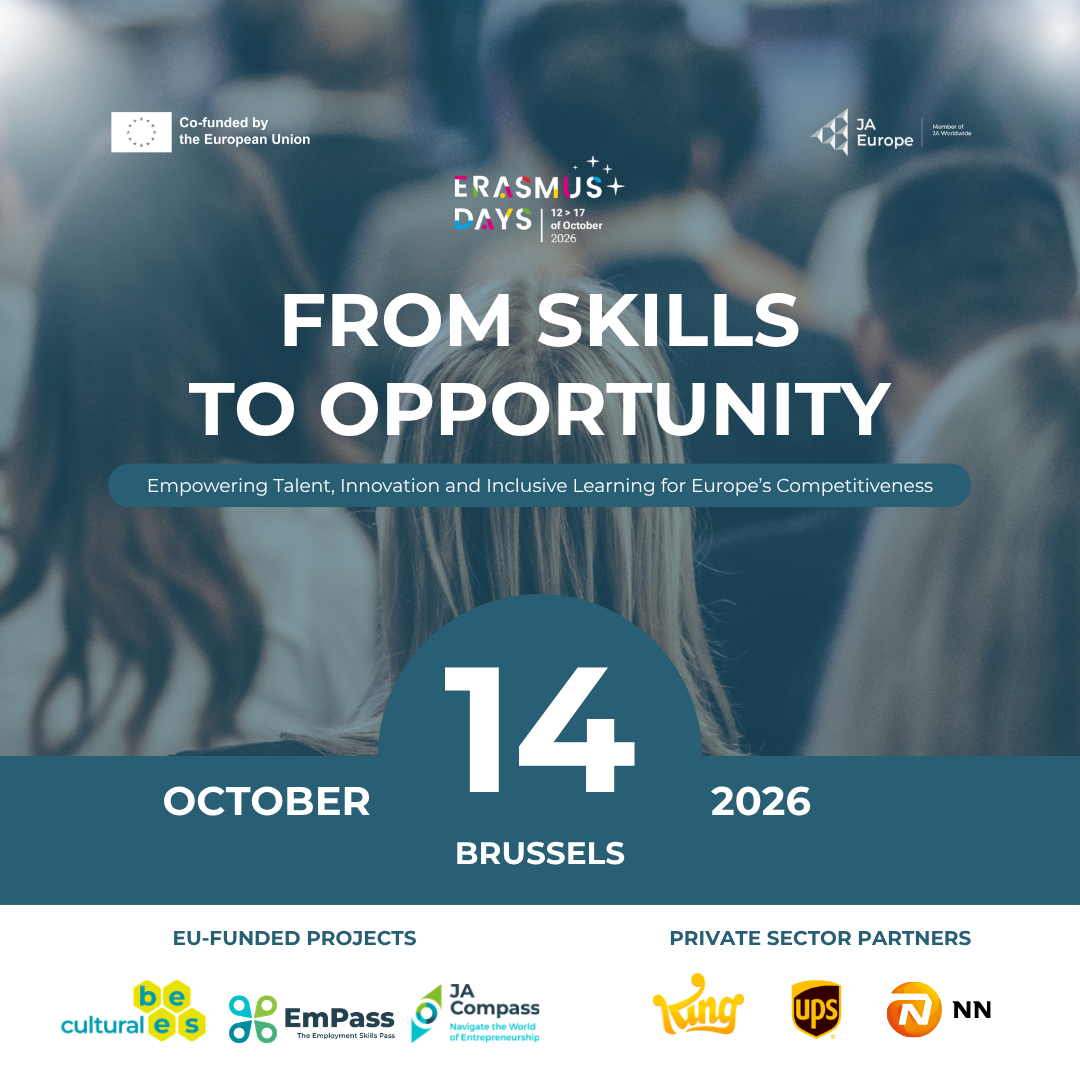
The answers will decide whether skills portability becomes opportunity or remains a policy ambition. They are also the focus of From Skills to Opportunity, a JA Europe forum in Brussels on 14 October, bringing together policymakers, employers, educators and youth organisations, including speakers from the European Commission, the World Employment Confederation and the European Vocational Training Association. 

As the Skills Portability Act moves through parliament and council, Europe has a chance to put employability skills into the conversation from the start: not only how qualifications are recognised, but how capabilities developed through formal, non-formal and experiential learning can carry meaning across borders. 

Employability skills are not an abstract policy debate. They are part of the foundation for participation, mobility, and opportunity in Europe’s labour market. The task now is to ensure that every young person carries a passport that employers recognise, wherever their learning and career take them. 

Learn more about EMPASS 

Co-funded by the European Union. Views and opinions expressed are, however, those of the author(s) only and do not necessarily reflect those of the European Union or the European Education and Culture Executive Agency (EACEA). Neither the European Union nor the granting authority can be held responsible for them. 

EMPASS (Employment Skills Pass) is an Erasmus+ Forward-Looking Project, project no. 101132916. 

Media contact: Irina Ilieva, Head of Marketing, Communications and Policy, JA Europe · irina@jaeurope.org · JA Europe aisbl, Victor Oudart 7, 1030 Brussels, Belgium 

  •  

‘EU Inc’? Simplification must go hand-in-hand with legal certainty

This article is paid for by Council of the Notariats of the European Union (CNUE).

An address rented in a European capital, an electronic signature obtained online, a 48-hour waiting period.

Under the proposed regulation establishing a 28th company law regime, known as ‘EU Inc.’, this could be enough to establish a company with legal personality throughout the European Union.

No share capital would be required. The founder could complete the entire process without appearing, even digitally, before a public authority or another person entrusted with preventive legal control.

There would be no personal verification of their legal capacity, of whether they understand what they are signing, or of whether they are acting on behalf of someone who wishes to remain invisible.

The company could then open bank accounts, enter into contracts, own assets and employ people across the European Union. If the company later fails to meet its obligations, creditors and employees may find that there are no assets to recover and that the person formally responsible for it was acting merely as a front man. 

This scenario illustrates the serious concerns raised by the proposal for a Regulation on ‘EU Inc.’ put forward by the European Commission and currently being examined by the European Parliament and the Council of the European Union.

The preventive checks set out in Article 14 of the commission’s proposal are largely limited to formal requirements.

There is no independent and impartial scrutiny of the founders’ legal capacity, of the lawfulness of the articles of association, or of whether the transaction complies with substantive legal requirements. Transfers of shares and capital transactions are also not subject to substantive control. Liquidation is treated primarily as an administrative formality, even though it can directly affect creditors and employees.

The consequences may extend far beyond company law.

Companies own real estate and are entered in land registers. If it is no longer possible to establish reliably who owns a company, it also becomes more difficult to establish who ultimately owns the real estate held by that company. Reliable company information therefore matters for the transparency of property ownership.

‘Not reliably verified’?

If the information in a register has not been reliably verified, others have to verify it themselves. Banks, business partners and investors may need additional legal opinions, audits and insurance. Costs that a preventive check avoids at the outset may therefore arise repeatedly at a later stage.

This would represent a shift from the European tradition of public preventive legal control towards a model that relies more heavily on resolving disputes after they arise.

Delaware is a prominent example of such an approach, supported by specialised courts and a correspondingly prominent role for litigation. Transplanting it to Europe would place additional demands on national judicial systems that lack the necessary resources.

The proposal also raises questions with regard to the recent European efforts to combat money laundering and the financing of terrorism.

The creation of the Anti-Money Laundering Authority (AMLA) is the latest milestone in this process. To create, at the very same time, a legal form with significantly reduced checks risks severely undermining these efforts.

The same applies to sanctions: their enforcement depends on knowing who is really behind a company – especially when shares are transferred. Without reliable legality control of share transfers, corporate ownership can change unnoticed and become a vehicle for sanctions circumvention.

The amendments required are straightforward. The acquis of European company law, as established by Directive (EU) 2017/1132 and recently reinforced by Directive (EU) 2025/25, should also apply to EU Inc. companies.

This means reliable identification of founders and directors, public oversight of legal compliance at the time of formation and at subsequent stages, and reliable business registers. 

Public protection

These safeguards exist for a reason.

They protect not only the parties to a transaction, but the public at large. Because they serve a public purpose, they must remain a public responsibility. Private service providers cannot replace independent preventive control carried out under public responsibility. 

How these checks are organised differs between member states. In some member states, public authorities carry them out directly. In others, the state entrusts notaries with this public function.

Notarial involvement therefore does not add another layer of control: the same public function is simply carried out by different public authorities. In many member states, a company can already be formed digitally within 48 hours, with full legal verification carried out by a public official.

The European Parliament and the Council of the European Union will decide their positions in the coming weeks.

There is still time to improve the legislative framework of EU Inc. significantly and to make it a success.

This requires digital and efficient procedures without compromising legal certainty. The rule of law is one of the European Union’s strengths. EU Inc. should build on that strength, not weaken it.

  •  

Europe’s Affordable Housing Act must look beyond short-term rentals

The appointment of a dedicated Commissioner for Energy and Housing, the launch of the European Affordable Housing Plan, and growing political attention to Europe’s housing crisis raised expectations of a comprehensive policy response.

The next legislative step was therefore expected to address one of the Union’s most pressing social challenges. The proposed Affordable Housing Act is an important step in that direction. Yet its binding Regulation focuses primarily on one specific aspect of the problem: restrictions on non-primary housing use, particularly short-term rentals, in areas under housing stress.

While addressing short-term rentals is a welcome intention, it cannot on its own provide a comprehensive response to Europe’s housing crisis. 

The pressure that holiday homes and short-term rental platforms are putting on housing markets, particularly in popular tourist destinations, has been rising, and giving local authorities better tools to respond is important. However, questions have already been raised about whether the proposed framework will give cities sufficient room to act effectively.

For instance, the proposed approach to defining “areas under housing stress” risks being too narrow. Housing stress cannot be understood through property prices, income levels and short-term projections alone. Energy poverty, combined housing and energy costs, overcrowding, vacancy rates and the condition of existing housing stock all influence whether households can access decent and affordable homes. A broader understanding of housing stress would better reflect the reality facing communities across Europe.

Yet the broader picture reveals an important limitation: many of the structural drivers of housing unaffordability remain outside the scope of the binding Regulation. In particular, it gives limited attention to one of Europe’s most significant untapped housing resources: the buildings and homes that already exist.

Renovation, adaptive re-use and the mobilisation of vacant and underused buildings feature in the European Affordable Housing Plan and the Recommendation accompanying the Act. But if Europe is serious about increasing affordable housing stock, these approaches should play a stronger role in the framework itself.

Across the EU, more than 47 million dwellings are estimated to be unoccupied. This does not mean that every empty home can or should be brought back into use. But it illustrates the scale of an existing resource that cannot be ignored. Bringing even a fraction of suitable vacant and underused stock back into use could create much-needed homes while reducing pressure for new construction and making better use of existing buildings and infrastructure.

Europe cannot reuse buildings it cannot see. Yet many public authorities still lack reliable information about which homes and buildings are vacant, why they are empty, what condition they are in and what potential they have for affordable housing.

The EU does not need to start from scratch. The Energy Performance of Buildings Directive (EPBD) and National Building Renovation Plans already provide a natural policy framework for understanding and planning the future of Europe’s building stock. Vacancy identification, mapping and monitoring should become part of the binding architecture of the Affordable Housing Act, ensuring that public authorities are, at a minimum, equipped to identify vacant and underused homes and assess their potential for conversion into decent and affordable homes.

Identifying vacant buildings, however, is only the first step. The accompanying Recommendation could go further by providing guidance on how to mobilise vacant properties, support the conversion of different building types and develop viable financing models.

EU financing should also better support the mobilisation and re-use of existing buildings. The next EU budget should continue to support affordable housing investment and recognise that renovation and re-use projects simultaneously deliver social, climate and energy benefits.

Ultimately, however, success cannot be measured only in buildings renovated or investment mobilised. It must be measured in whether people can access decent homes they can afford.

According to the Commission’s EU Anti-Poverty Strategy, one in five Europeans – nearly 93 million people – are at risk of poverty or social exclusion, while approximately 1 million people experience homelessness. Affordable housing policy must therefore place particular emphasis on those least well served by the housing market, including lower-income households and people experiencing or at risk of housing exclusion.

The Affordable Housing Act is an important step forward. But as it moves through the legislative process, there is still an opportunity to broaden its ambition. A stronger focus on re-use, better implementation support, dedicated financing and a more people-centred approach would help turn a useful regulatory framework into a more comprehensive response to Europe’s housing affordability challenge.

This article is supported by Habitat for Humanity International, Climate Action Network (CAN), European Environmental Bureau and World Green Building Council.

  •  
❌