❌

Reading view

Defending Its AR-15 Ban, Cook County Urges SCOTUS To Ignore the Rifle's Popularity
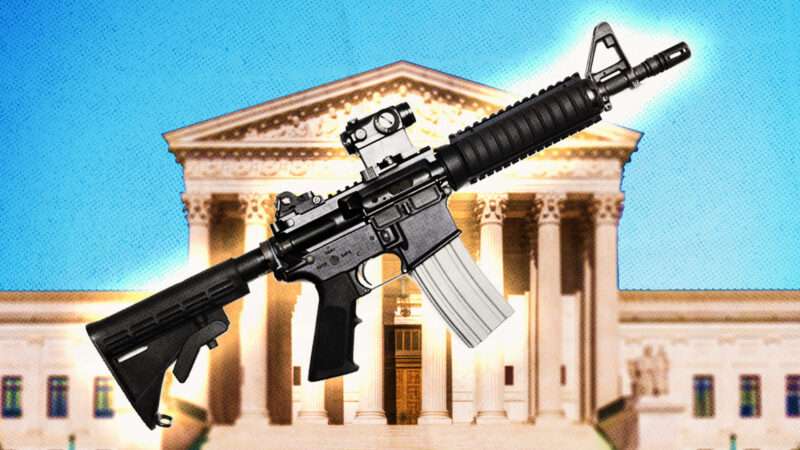
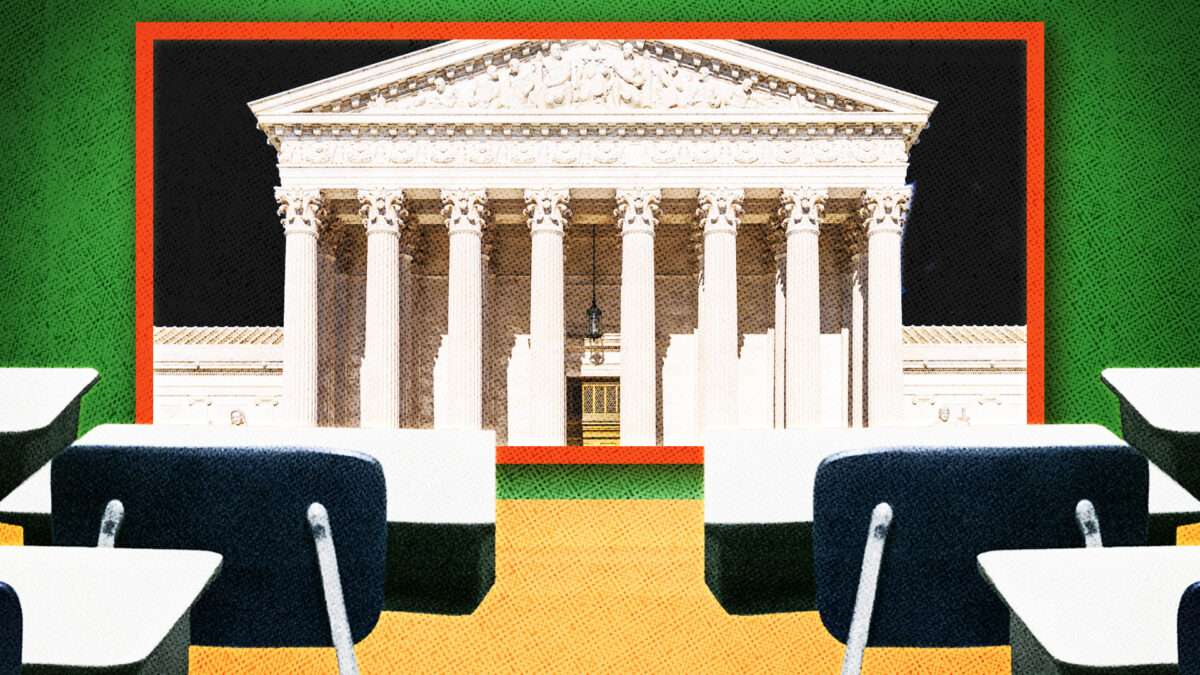
a rifle superimposed on an image of the Supreme Court building | Ultraone/Sean Pavone/Dreamstime/Fatima Ruiz

On December 2, the Supreme Court will consider constitutional challenges to "assault weapon" bans in Connecticut and Cook County, Illinois, that cover widely owned rifles, including the AR-15. As the plaintiffs in those consolidated cases see it, such laws plainly violate the Second Amendment because they prohibit arms in common use for lawful purposes. In briefs filed on Wednesday, Connecticut and Cook County urge the justices to reject that test, saying a weapon's popularity is not dispositive. The relevant question, they say, is whether their rifle restrictions fit a historical tradition of banning "unusually dangerous weapons."

Cook County and Connecticut have the burden of showing that their laws are "consistent with this Nation's historical tradition of firearm regulation," the test established by the Supreme Court's 2022 decision in New York State Rifle & Pistol Association v. Bruen. On the face of it, that is a daunting challenge.

In the 2008 case District of Columbia v. Heller, the Supreme Court said the Second Amendment protects the right to own "bearable arms" that are "in common use" for "lawful purposes like self-defense." That description indisputably encompasses "AR-15 platform and similar semiautomatic rifles," the firearms at issue in these cases. But Heller also recognized "the historical tradition of prohibiting the carrying of 'dangerous and unusual weapons.'" Cook County and Connecticut argue that the rifles they have deemed intolerable fall into that category.

"There is a robust historical tradition of regulating unusually dangerous weapons that
compromise public safety," Cook County says. "Such regulations, which long
predate the founding, have included outright bans and other restrictions on exceptionally dangerous weapons like launcegays, trap guns, Bowie knives, and slung shots."

Cook County argues that its ordinance is "relevantly similar" to those historical restrictions because it targets "exceptionally lethal weapons that are disproportionate to the end of self-defense." AR-15s are "offensive weapons of war designed for maximum lethality and are not customarily used for self-defense," the brief says. "The purpose and operation of the ban is consistent with our Nation's historical tradition and accounts for the exceptional dangerousness of these technologically advanced weapons."

The ban is "an appropriate contemporary restriction implemented by the legislature in response to dramatic technological change and unprecedented societal concern," the brief says. "It is tailored to respond to the particular dangers presented in areas with mass casualty exposure and acute public safety risk."

Connecticut offers a similar argument. One problem with this defense is the premise that "assault weapon" bans focus on "exceptionally lethal weapons." As critics of such laws have been pointing out for decades, the features they target, such as folding stocks, pistol grips, and barrel shrouds, do not affect a rifle's basic operation. With or without them, a rifle fires the same ammunition at the same rate with the same muzzle velocity. And because AR-15s use intermediate-caliber ammunition, they are arguably less lethal than shotguns and many hunting rifles that are not classified as "assault weapons."

Cook County's emphasis on technological developments is also questionable. Constitutional guarantees establish principles that courts routinely apply to technologies that did not exist at the founding. Although the Framers did not have radio, television, or the internet, for example, the First Amendment nevertheless constrains government regulation of those media.

More specifically, Heller rejected the idea that modern weapons are not covered by the Second Amendment by recognizing a constitutional right to own semiautomatic pistols. The Supreme Court said "the Second Amendment extends, prima facie, to all instruments that constitute bearable arms, even those that were not in existence at the time of the founding." The Court confirmed that point in the 2016 case Caetano v. Massachusetts, which involved a state ban on stun guns.

Cook County also asserts that AR-15s are not suitable for self-defense, a claim that would be hotly contested by many owners of such rifles, who commonly report using them for that purpose. "Plaintiffs have shown that AR-15s are well-adapted for self-defense," U.S. District Judge Peter Sheridan wrote in 2024, when he reluctantly concluded that New Jersey's AR-15 ban was inconsistent with Heller while expressing his dismay at that result. "Evidence has been presented to the Court that the build of the AR-15 makes it well-suited to self-defense because it is 'light weight, [has] very mild recoil, and [has] good ergonomics'; it is a weapon which is 'well suited to younger shooters, female shooters, and other shooters of smaller stature.'"

Sheridan added that "the AR-15's design features—including the effectiveness of its cartridge for self-defense use and its better continuity of fire when used with available magazines—make the AR-15 a good choice for self-defense." And he noted that "the AR-15 has been used recently in several, relatively high-profile self-defense events in Florida, Illinois, Texas, Pennsylvania, and Oklahoma."

Cook County and Connecticut are also wrong in suggesting that self-defense is the only "lawful purpose" that matters. While Heller emphasized the use of handguns "in defense of hearth and home," it did not say that was the full extent of the Second Amendment right. To the contrary, the phrase "lawful purposes like self-defense" implies that the right extends to other uses, such as hunting, pest control, and target shooting. The decision explicitly mentioned hunting as a "reason Americans valued the ancient right."

The briefs are misleading in another way that may prove decisive. They conflate "dangerous and unusual" with "unusually dangerous," which is not the same thing.

During the 19th century, state legislators restricted (and sometimes banned) weapons such as Bowie knives, spears, sword canes, slungshots, and brass knuckles. But the historical evidence suggests those weapons were not targeted simply because they were "unusually dangerous." Legislators were also concerned about how the weapons were typically used.

Solicitor General D. John Sauer, who filed a brief supporting the challenges to the AR-15 bans, notes that the 19th-century laws targeted weapons associated with "duels, brawls, and other criminal activities." And in reviewing those laws, state courts distinguished between arms favored by criminals and arms commonly used for lawful purposes.

In 1871, for example, the Tennessee Supreme Court held that legislators could ban weapons that were "not usual" but could not ban "the usual arms of the citizen." The top courts of Texas, Arkansas, West Virginia, North Carolina, and Michigan concurred that the right to arms encompassed weapons commonly owned by law-abiding people, including rifles.

AR-15s and similar rifles readily pass that common-use test. In January, the National Shooting Sports Foundation, the gun industry's trade association, reported that Americans own more than 32 million "modern sporting rifles," its preferred term for the models covered by "assault weapon" bans. Survey data suggest that somewhere between 16 million and 25 million Americans have owned AR-15-style rifles. Last year, a unanimous Supreme Court described the AR-15 as "the most popular rifle in the country."

According to Cook County and Connecticut, however, none of that matters. "Once it is established that a regulation pursues a legitimate public safety objective in a permissible manner, raw ownership numbers cannot immunize a firearm from regulation," Cook County says. It argues that opponents of its ordinance have misconstrued the significance of the common-use test and misunderstood how it interacts with Bruen.

"When the Second Amendment's plain text covers an individual's conduct, the Constitution presumptively protects that conduct," the Supreme Court said in Bruen. "To justify its regulation, the government may not simply posit that the regulation promotes an important interest. Rather, the government must demonstrate that the regulation is consistent with this Nation's historical tradition of firearm regulation. Only if a firearm regulation is consistent with this Nation's historical tradition may a court conclude that the individual's conduct falls outside the Second Amendment's 'unqualified command.'"

The common-use question, Cook County argues, figures only in the first Bruen step: "the inquiry whether the weapon at issue is one 'the Second Amendment protects.'" But even if ownership of AR-15s is covered by "the Second Amendment's plain text," it says, that does not resolve the question of whether they can be banned, which depends on the historical analysis required by the second step of the Bruen test.

"This Court's decision in Bruen confirms that the Second Amendment's step-two inquiry does not insulate popularly owned firearms from regulation," the brief says. In
Bruen, it was "undisputed" that "handguns are weapons 'in common use' today for self-defense," including "outside the home." But "instead of being the end of this Court's inquiry, that observation was just the beginning." The decision also included an "extended analysis" of the historical laws that New York cited to justify its "proper cause" requirement for carry permits. "If lawful common use alone were enough to forbid regulation," Cook County argues, "there would have been no need to engage in that careful and prolonged analysis."

The question in Bruen was not whether the Second Amendment precludes "regulation." It was whether New York's specific approach, which required residents to demonstrate a "special need" before they were allowed to exercise the right to bear arms, was consistent with the historical tradition. That is why the Court considered (and rejected) the purported historical analogs that New York offered.

Cook County conflates requirements for carry permits, the issue in Bruen, with an outright ban on ownership, the policy it is defending. Connecticut likewise blurs the distinction between carry restrictions and complete prohibition.

"The Bowie knife was 'widely carried by Americans of all stripes,' including 'upstanding citizens and villains' alike," Connecticut's brief says. "The widespread use of Bowie knives and other weapons for lawful purposes did not prevent dozens of States from restricting those weapons." But those laws generally restricted or banned public carry. They rarely made it illegal to acquire or possess a Bowie knife, which is the approach that Connecticut and Cook County have taken with AR-15s.

That policy is hard to reconcile with Heller. I will quote Sheridan again, since his comments made it clear that he would have preferred to uphold New Jersey's AR-15 ban. Under Heller, he said, "a categorical ban on a class of weapons commonly used for self-defense is unlawful." Given "the Supreme Court's clear direction on this point," he concluded, New Jersey's law "is unconstitutional" as applied to "the Colt AR-15 for use for self-defense in the home."

Last July, the U.S. Court of Appeals for the 3rd Circuit agreed and went further, extending that conclusion to "the full class of semi-automatic rifles" banned in New Jersey. "Together, Heller and Bruen teach that bans or broad prohibitions on possessing or carrying of a class of weapons in common use for lawful purposes fail to find support in our Nation's tradition of firearm regulation," Judge Arianna Freeman, a Joe Biden appointee, wrote in the majority opinion. "That principle resolves our inquiry here."

To beat back the challenges to their laws, Connecticut and Cook County will have to persuade the justices that the 3rd Circuit's understanding of Heller and Bruen is wrong, meaning they are free to ban firearms in common use for lawful purposes. That seems like a tall order, and Cook County's position is especially puzzling. According to its brief, the fact that a weapon is covered by the Second Amendment does not mean Americans have a right to possess it. The more you think about that claim, the less sense it makes.

The post Defending Its AR-15 Ban, Cook County Urges SCOTUS To Ignore the Rifle's Popularity appeared first on Reason Magazine.


  •  

A Religious Preschool Is Barred From a State's Universal Preschool Program. SCOTUS Will Decide What's Legal.

Religious school classroom | St Mary Catholic School/Facebook

On November 3, the U.S. Supreme Court will hear oral arguments in a case that asks whether Colorado has unlawfully discriminated against a religious preschool because the school is barred from participating in the state's universal preschool program due to its refusal to accept LGBTQ families. In addition to involving multiple hot-button political and cultural issues, the case also has big implications for the future of federal antidiscrimination law.

St. Mary Catholic Parish v. Roy is not about a state law that directly prohibits a religious preschool from operating. Rather, at issue here is a government requirement that any preschool that wants to participate in the state's universal preschool program, and receive the public benefits that follow, must first satisfy various criteria, including that "each preschool provider provide eligible children an equal opportunity to enroll and receive preschool services regardless of race, ethnicity, religious affiliation, sexual orientation, gender identity, lack of housing, income level, or disability."

According to the Catholic preschools overseen by the Archdiocese of Denver, however, complying with that rule would force the schools to violate their religious beliefs. "It is undisputed that these preschools would otherwise be eligible [universal preschool] providers," the schools told the Supreme Court. "They are excluded solely because of their religious exercise—namely, their religious practices of ensuring that all enrolling families are supportive of the Catholic Church's teachings on sex and marriage and of treating enrolled four-year-olds in accordance with their biological sex."

These schools can point to a pair of recent Supreme Court precedents that will very likely count in their favor. In Espinoza v. Montana Department of Revenue (2020), the Court held that if a state provides educational subsidies that help parents send their children to private schools, the state "cannot disqualify some private schools solely because they are religious." Then, in Carson v. Makin (2022), the Court held that Maine's tuition assistance program violated the Constitution by excluding private schools that offered "sectarian" education. "A State's antiestablishment interest," the decision said, "does not justify enactments that exclude some members of the community from an otherwise generally available public benefit because of their religious exercise."

I would expect the outcome of St. Mary Catholic Parish v. Roy to follow in this same general pattern and hold something to the effect that when a state provides an educational public benefit, it must make some sort of accommodation for the religious views of the recipients.


In Other Legal News

Justice Elena Kagan made news a few months back when she defended her conservative colleagues on the Supreme Court from the oft-heard charge that they are totally in the tank for President Donald Trump. "I don't see this as a court that is just like, 'We're just going to rubber stamp what the current administration does.' You know, quite the opposite," Kagan said. "I think that that is a bad rap." In support of her argument, Kagan pointed to the fact that the Supreme Court had recently ruled against Trump on the two big issues that Trump himself valued the most: tariffs and birthright citizenship.

Kagan was in the news again on Tuesday, this time because she publicly blasted those same conservative colleagues for issuing decisions on voting rights and political gerrymandering that, in Kagan's words, have produced "a democracy that does not work as well as it should." According to Kagan, the Court's conservative majority "has kind of blinded itself to the very deleterious effects of their rulings on how the political system works."

Does this mean that Kagan has now stopped defending the conservative justices from the pro-Trump charge? Not at all. In fact, as The New York Times put it, "she reiterated her defense of the conservative-dominated bench from a July appearance and said it was a 'bum rap' to suggest the court had been too deferential to Mr. Trump."

I don't know about you, but I find Kagan to be a refreshing public figure in these simplistic, partisan times. She is a staunch legal liberal with clearly stated objections to what the Supreme Court's conservative majority is getting up to, yet she refuses to be associated with the laziest progressive attacks on the Court. How many people of comparable public stature these days are willing to call out the shortcomings of their own side?

The post A Religious Preschool Is Barred From a State's Universal Preschool Program. SCOTUS Will Decide What's Legal. appeared first on Reason Magazine.

  •  

Supreme Court rejects Trump bid to halt care for incarcerated trans people

The US Supreme Court in Washington, DC, on October 14, 2026. Photo by SAUL LOEB / AFP via Getty Images

This article was originally published by Truthout on Oct. 21, 2026. It is shared here under a  Creative Commons (CC BY-NC-ND 4.0) license.

The U.S. Supreme Court has denied an emergency petition from the Trump administration, which sought a stay on a lower court’s injunction on a policy that would have denied gender-affirming care to federally incarcerated transgender people.

That policy was implemented by the Bureau of Prisons (BOP) after President Donald Trump signed an executive order in January 2025 that denied the existence of transgender people. The order also directed federal agencies to take steps that would be consistent with that view, and included specific instructions for the BOP.

“The Attorney General shall ensure that the Bureau of Prisons revises its policies concerning medical care to be consistent with this order, and shall ensure that no Federal funds are expended for any medical procedure, treatment, or drug for the purpose of conforming an inmate’s appearance to that of the opposite sex,” the order reads.

After the BOP conformed to the order, a group of incarcerated trans people who had been receiving gender-affirming care sued the administration. The group is being represented by the American Civil Liberties Union (ACLU), which argued that their Eighth Amendment protections against cruel and unusual punishment were being infringed upon.

A federal judge agreed, and, in August, ordered the policy to be blocked. The Trump administration challenged that finding, but the U.S. Court of Appeals for the District of Columbia Circuit upheld it, prompting Solicitor General John Sauer to submit an emergency appeal to the Supreme Court.

The court has regularly ruled against transgender people, allowing state bans on trans athletes’ participation in sports, ruling in favor of a ban on transgender people in the military, and upholding state laws that bar gender-affirming care for trans children and teens. Yet on Wednesday, the court denied the Trump administration’s request.

“The application for stay presented to The Chief Justice and by him referred to the Court is denied,” the order read, giving no further explanation. Two justices for the court — Samuel Alito and Clarence Thomas — would have granted the Trump administration’s request for a stay, the document said.

The ACLU heralded the high court’s denial of the emergency petition, stating, “This ruling affirms that federal prison officials can’t deny transgender people essential health care.”

Around 1,000 federally incarcerated trans people have also been diagnosed with gender dysphoria. The ruling means these individuals can continue receiving gender-affirming care while they remain in federal prisons or jails and the case moves forward in the lower courts.

  •  

Supreme Court Refuses to Let Trump Cut Transgender Inmate Care

The Supreme Court on Wednesday refused to let the Trump administration gradually end transgender-related medical services for prison inmates who want to be treated as members of the opposite sex.

The post Supreme Court Refuses to Let Trump Cut Transgender Inmate Care appeared first on Breitbart.

  •  

Hillary Clinton joins growing chorus in support of Supreme Court expansion

By any fair measure, former Secretary of State Hillary Clinton has long been at roughly the center of the Democratic Party’s mainstream. Few observers could credibly accuse her of being a conservative Democrat along the lines of former Sen. Joe Manchin or of being a progressive firebrand trying push the party to the left.

I mention this because Clinton took a policy position this week that’s likely to raise some eyebrows.

Expanding the Court is the moderate position

— Thor Benson (@thorbenson.bsky.social) 2026-10-21T17:47:34.491Z

In the latest episode of “High Stakes,” a limited series from podcast host Kara Swisher and Clinton, the discussion turned to possible Supreme Court reforms, and the former presidential candidate raised some practical concerns about term limits on Supreme Court justices — before expressing support for an alternative solution to the status quo.

“I think, instead, we should seriously look at expanding the court while the Democrats are in power,” Clinton said. “You know, it used to be that you’d have one justice for each circuit. We now have 13 circuits, we should have 13 justices. So I would be in, you know, favor of looking at that and see if we could make it work.”

The former secretary no longer holds public office, so it’s not as if she would be in a position to vote on such a proposal, but let’s not miss the forest for the trees: When Hillary Clinton expresses public support for Supreme Court expansion, it’s evidence that a reform idea has reached the political mainstream.

She’s not alone. Rep. James Clyburn of South Carolina is also widely recognized as a prominent voice representing the Democratic establishment — the 17-term incumbent has spent much of his career as a member of the party leadership in the House — and in late August he also publicly endorsed expanding the Supreme Court from nine justices to 13.

“I think we are in a position now that calls for some significant actions taken by the Congress and we ought to expand,” Clyburn said on NBC’s “Meet the Press,” adding that “13 is a pretty good number. A baker’s dozen, it would be a good number to have on the court.”

Clyburn’s comments came just a few weeks after House Minority Leader Hakeem Jeffries spoke at the National Association of Black Journalists’ convention and voiced support for “dramatic” Supreme Court reforms.

“The Supreme Court, the conservative right-wing majority on the Supreme Court, has become basically a subsidiary of the MAGA Republican Party,” the New York Democrat said, adding that the justices seem to believe “the status quo is acceptable. It’s not.”

Jeffries didn’t elaborate on which specific reforms he had in mind, though the Democrat, positioned to be the next House speaker if his party reclaims the majority, said there are “a variety of different options that are on the table” and he’s not prepared to “foreclose any single one of them.”

If it seems like leading Democratic voices are embracing similar stances with increasing frequency and enthusiasm, it’s not your imagination. Just two weeks before Jeffries made his comments, former Vice President Kamala Harris spoke at the National Urban League’s annual conference and said, “We need to revisit the point of expanding the court to 13 justices, like we have 13 district courts.”

A month earlier, Pennsylvania Gov. Josh Shapiro voiced support for “radical reform” of the Supreme Court, which came on the heels of Sen. Raphael Warnock of Georgia agreeing that “all options have to be on the table” when it comes to changing the high court.

In the coming months, there is likely to be plenty of debate among advocates about the kind of changes to pursue and the political viability of the competing ideas. It’s also a safe bet that many reformers will disagree about the details. But the bottom line remains the same: In Democratic politics, the conversation has shifted rapidly to how, not whether, to reform the Supreme Court.

As many in the party start eyeing the 2028 presidential race, don’t be surprised if this issue becomes a litmus test for many Democratic voters.

This post updates our related earlier coverage.

The post Hillary Clinton joins growing chorus in support of Supreme Court expansion appeared first on MS NOW.

  •  

Trump Administration Asks Supreme Court to Restart Big Bend Border Wall

The Trump administration asked the Supreme Court on Wednesday to lift a court order that stopped border wall construction across the Big Bend region of Texas.

The post Trump Administration Asks Supreme Court to Restart Big Bend Border Wall appeared first on Breitbart.

  •  

Supreme Court’s split on gender care highlights Alito and Thomas as pro-Trump outliers

Justices Clarence Thomas and Samuel Alito further distanced themselves from their Supreme Court colleagues on Wednesday when they were the only two jurists to note their objections to the court’s refusal to let the Trump administration immediately enforce its preferred policy on gender-affirming care in prison.

The court’s unsigned order contained no explanation from the majority or the dissenting duo. Still, it’s the latest data point showing Thomas and Alito backing the administration even when their fellow GOP appointees — including President Donald Trump’s own three appointees — decline to do so.

Wednesday’s order follows last month’s Supreme Court rejection of Trump’s desired mail-ballot restrictions for the midterm elections. That loss led the president to lash out at the court, including his own appointees, while calling Thomas and Alito “legends.”

Asked during a recently published CBS News interview about a Wall Street Journal study showing that Alito sided with Trump more than any of his colleagues, the justice said he’s “not trying to decide cases to help President Trump.”

Whatever his or Thomas’ intentions, their latest actions spotlight their dynamic of voting for the president’s position when other justices don’t. Their votes come ahead of the rapidly approaching Election Day in less than two weeks, with voters set to determine which party will control Senate confirmation of justices for the near future.

Alito said he’s staying on the court at least through this court term, even if Democrats win back Senate control. Thomas has likewise not signaled that he is stepping down imminently. If he stays on the court through the next term, he will become the longest-serving justice ever. In their late 70s, Thomas and Alito are the two eldest members of the current court, but they aren’t very old by the court’s historical standards.

Yet if Trump has an opportunity to appoint their successors or any other justices before he leaves office in 2029, their latest votes underscore why he will likely model his next selection(s) on them, rather than on the justices he has put on the bench thus far, who have backed him in a series of significant cases but not all of them.

Subscribe to the Deadline: Legal newsletter for expert analysis on the top legal stories of the week, including updates from the Supreme Court and developments in the Trump administration’s legal cases.

The post Supreme Court’s split on gender care highlights Alito and Thomas as pro-Trump outliers appeared first on MS NOW.

  •  

Supreme Court rebuffs Trump administration restrictions on medical care for transgender inmates

The Supreme Court on Wednesday refused to allow the Trump administration to immediately enforce new medical restrictions for transgender people in prison. The decision leaves in place a lower-court block on the policy.

  •  

Justice Kagan reminds Americans of Supreme Court majority’s antidemocratic actions

With Americans deciding the congressional balance of power in November’s midterm elections, Justice Elena Kagan is reminding the nation of how the Supreme Court’s decisions have shaped the ballot.

It’s an antidemocratic shape, according to the Obama-appointed justice’s remarks Tuesday at Catholic University’s law school in Washington.

Kagan said the court “has kind of blinded itself to the very deleterious effect of their rulings on how the political system works and has created a democracy that does not work as well as it should.”

Her off-bench comments reprised impassioned criticisms she has made in dissenting opinions from the GOP-appointed majority’s rulings on gerrymandering in 2019 and earlier this year on the Voting Rights Act and campaign finance.

In 2019’s Rucho v. Common Cause, the majority said partisan gerrymandering claims present “political questions” that courts can’t answer. Writing the dissent for what was then a four-justice minority, she said the case marked “the first time ever” that the court “refuses to remedy a constitutional violation because it thinks the task beyond judicial capabilities.”

Writing for the current three-justice minority this year, Kagan called the six-justice majority’s decision in Louisiana v. Callais the “latest chapter in the majority’s now-completed demolition of the Voting Rights Act.” Leading the same trio on campaign finance, in dissent from a ruling that struck down more limits and overturned another precedent in the process, she said the majority “jettisons a rule needed to protect our democracy’s integrity.”

On Tuesday, she said the American people “look around this political system and think that all this money chasing all these political candidates is a nightmare.” She added, “And they’re right.”

The justices are in between their October and November hearing sessions, but they will continue to field any emergency applications that come to them regarding the midterms or anything else. Currently, there is a pending application from New Hampshire Republicans to prevent the use of student IDs in voting.

The justices have weighed in on an array of election disputes already this year — and they haven’t always backed the GOP. But whatever the outcome in the midterms, Kagan’s comments provide a useful backdrop for understanding the political landscape the court has helped set.

Subscribe to the Deadline: Legal newsletter for expert analysis on the top legal stories of the week, including updates from the Supreme Court and developments in the Trump administration’s legal cases.

The post Justice Kagan reminds Americans of Supreme Court majority’s antidemocratic actions appeared first on MS NOW.

  •  

Supreme Court rejects Trump administration on gender-affirming care in prison

The Supreme Court on Wednesday denied the Trump administration’s application to enforce its ban on gender-affirming medical care for federal inmates after a judge blocked the policy.

The denial came in an unexplained order. Justices Clarence Thomas and Samuel Alito noted they would have granted the administration’s application, but they also did not explain their reasoning.

Human Rights Campaign President Kelley Robinson said the high court’s action “protects incarcerated trans people from the administration’s attempt to steamroll over constitutional rights for now.” But she added, “the fight to uphold the dignity and respect our community deserves is far from over.”

Urging the justices to lift the judge’s order while it appeals, the administration argued that the public interest favors such a result because the policy “provides appropriate, individualized treatment for gender dysphoria, while disallowing only interventions that are medically unnecessary.”

Lawyers for inmates with the American Civil Liberties Union implored the high court not to back the government’s attempt to “overturn a three decades-long status quo.” They said the government turned to the justices at this preliminary stage of the litigation not because it has a pressing legal claim but rather because it is upset about how the district judge applied settled law to the facts in this case.

Over the past couple of years, the Supreme Court has ruled against transgender people in a series of cases involving sports, the military, passports and gender-affirming care for minors.

When he granted a preliminary injunction for inmates in June, U.S. District Judge Royce Lamberth, a Reagan appointee, said he didn’t want to wade into “the culture war being waged against transgender individuals.” He said he was merely making a legal decision that the government had failed to follow proper procedures when it implemented the new policy.

The Washington judge called the government action “arbitrary and capricious” because it “failed to seriously consider its own experience providing gender-affirming care to inmates for years under its prior policy.” Lamberth issued a subsequent order in August maintaining the injunction, finding that despite officials’ claims, it wouldn’t cause safety issues to continue inmates’ medical care while the litigation proceeds.

Over dissent from a Trump appointee, a federal appellate panel declined to lift Lamberth’s injunction.

In the administration’s application to the justices, Solicitor General John Sauer said the Bureau of Prisons had previously provided both what he called “mental-health treatment (such as psychotherapy and psychiatry services)” and “sex-rejecting interventions (such as sex-trait-modification surgeries, hormone interventions, and social accommodations).”

Sauer said the government concluded it could no longer justify the second category for two reasons: that such interventions weren’t supported by the latest evidence and that they “raised security and prison-administration concerns that outweighed whatever limited benefits they had.”

Subscribe to the Deadline: Legal newsletter for expert analysis on the top legal stories of the week, including updates from the Supreme Court and developments in the Trump administration’s legal cases.

The post Supreme Court rejects Trump administration on gender-affirming care in prison appeared first on MS NOW.

  •  

Kagan says supreme court conservatives have made US political system ‘a nightmare’

Liberal justice says recent decisions on redistricting and campaign finance have undermined democracy and polarized US even more

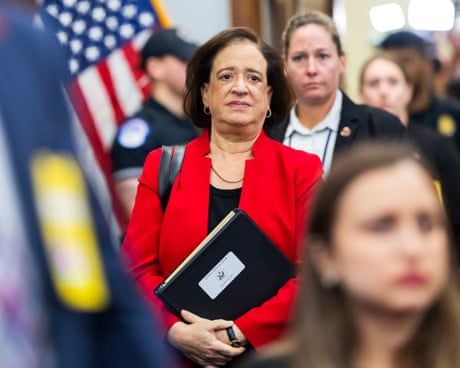
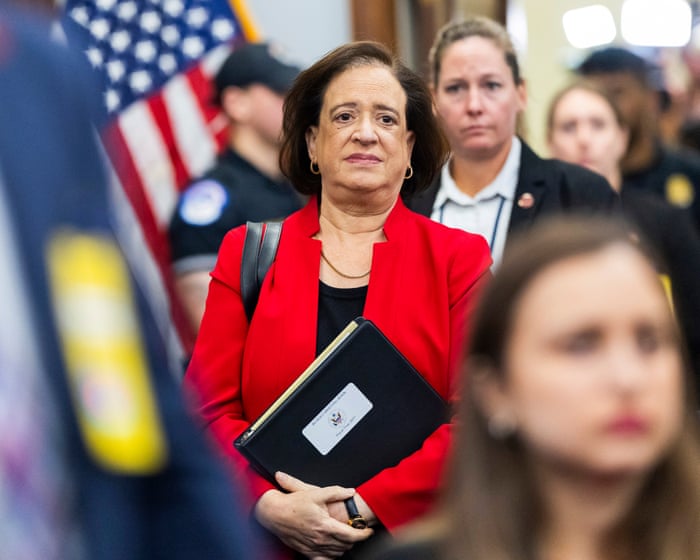
Elena Kagan criticized rulings made by the US supreme court’s conservative majority this week, arguing that its recent decisions on redistricting and campaign finance had undermined America’s democracy.

“The court has kind of blinded itself to the very deleterious effects of their rulings on how the political system works,” said Kagan, one of the court’s three liberal justices, during a discussion at Catholic University’s law school in Washington DC on Tuesday, according to multiple reports.

Continue reading...

© Photograph: Finn Gomez/Getty Images

© Photograph: Finn Gomez/Getty Images

© Photograph: Finn Gomez/Getty Images

  •  

North Carolina mail-in ballot restrictions to remain through midterms, judge rules

A federal judge ruled Monday that North Carolina is permitted to keep its strict mail-in ballot rules in place for November’s election, which were changed just before ballots were mailed in September.  In the ruling, Judge Thomas D. Shroeder wrote that it was too close to the election to change the rules again, and that…

  •  

Supreme Court Takes Up Accusations of Race-Based Middle School Admissions

Supreme Court building | Sean Pavone/Dreamstime/Midjourney/Fatima Ruiz

Three years after ending affirmative action in higher education, the Supreme Court will hear another case on race-based admissions, this time in middle schools.

On Monday, the Supreme Court agreed to hear Association for Education Fairness v. Montgomery County Board of Education. The case, which was originally brought forth in 2020 by the Association for Education Fairness (AFEF), a coalition of Montgomery County, Maryland, parents, alleges that Montgomery County's selection process for magnet programs (gifted programs for STEM and humanities studies in middle schools) violates the Constitution's Equal Protection Clause by discriminating against Asian American students. The county insists that the selection process is race-neutral.

Montgomery County changed its selection process in the 2021–22 school year. According to reporting from The New York Times, the county was facing pressure from community groups, including the NAACP and Citizens Assisting and Sheltering the Abused (CASA Inc.), over the underrepresentation of black and Latino students in its magnet programs. Previously, students were selected based on test scores and grades. The new process implemented a lottery system in which high-achieving students are placed in a selection pool and selected at random.

The AFEF's central complaint is that the new system factors school poverty levels into the criteria for pool eligibility. This means students' eligibility depends on their scores relative to students in similarly affluent or disadvantaged schools, rather than the general population. They argue that since Asian Americans are concentrated in high-performing, lower-poverty schools, they have to clear a higher bar to become eligible. The group alleges the new system has caused fewer Asian American students to be admitted into magnet schools, a claim that is backed up by admissions data (which also show that the share of Asian American applications has fallen). The AFEF also cites Montgomery County's 2015 hiring of Metis, a national consulting firm, to recommend ways to make the system more "equitable" as an indication of the county's effort to "racially balance" its magnet programs.

​The complaint was dismissed by U.S. District Judge Paula Xinis in 2022, who ruled that the parents hadn't shown the policy disproportionately harmed Asian American students, citing the fact that they made up a larger share of admitted students than of the applicant pool. Xinis drew a distinction between accounting for economic disparities, which she called "wholly permissible," and racial discrimination. "Alleged disparity in treatment based on socioeconomic status alone does not make plausible discrimination on account of race," she wrote in the ruling. The tension raised by Xinis sits at the center of many debates regarding diversity, equity, and inclusion, as factors like poverty levels can often become a proxy for race; therefore, policies that are neutral on their face can still disparately impact a certain race.

In February, the 4th Circuit Court of Appeals upheld the dismissal, ruling that precedent from the Coalition for TJ v. Fairfax County School Board (2023) requires parents to show the policy disproportionately harmed Asian American applicants, which they hadn't. However, there is a real legal question as to whether racial groups should have to prove they were harmed as a group, as opposed to the individual, and lower courts have given mixed answers.

The ​Pacific Legal Foundation (PLF), a public-interest law firm representing the AFEF, litigated a similar case in New York City, where the city implemented an economic need index in its admissions process for competitive high schools, aimed at increasing the number of black and Hispanic students. Again, parents alleged that the requirement discriminated against Asian American students. In 2024, the 2nd Circuit Court of Appeals found that if the city intended to discriminate, the parents don't have to prove Asian Americans were harmed as a group and that harm to an individual was enough for the case to move forward. The case was sent back to the district court to determine whether the city intended to discriminate, where it remains pending.

​The Supreme Court will now settle the issue and determine "whether a plaintiff challenging a facially neutral admissions policy as racially discriminatory must establish that the targeted racial group suffered an aggregate disparate impact relative to its share of the applicant pool," according to SCOTUSBlog. 

In a statement on Monday, PLF Senior Attorney Chris Kieser said, "The Constitution protects students as individuals, not as members of a racial group. A school district should not be able to defeat a discrimination claim by showing that its policy did not harm enough Asian American children. Every family deserves admissions rules that judge their child on their own merit."

The post Supreme Court Takes Up Accusations of Race-Based Middle School Admissions appeared first on Reason Magazine.

  •  

Trump Administration Urges SCOTUS To Uphold Federal Ban on Distilling Liquor at Home

homedistilling | Ioannis Syrigos/Dreamstime/Midjourney

The U.S. Supreme Court's 2026–2027 term just got a whole lot boozier. On Monday, the justices agreed to hear arguments later this year or next in the case of Department of Justice v. McNutt. At issue is whether the 1868 federal ban on distilling liquor at home is unconstitutional because it exceeds the lawful regulatory power of the federal government. If any modern Supreme Court case ever deserved its own drinking game, this one is it.

In April, the U.S. Court of Appeals for the 5th Circuit found the federal ban on home distilling to be unconstitutional because Congress lacked the proper authority to issue such a ban in the first place. It was not a legitimate exercise of the congressional authority "To Lay and collect Taxes," the appellate court reasoned, because "the purpose of a tax is to raise revenue for the government;" yet this law "amount[s] to an anti-revenue provision" that only "prevents distilled spirits from coming into existence." And if it does not exist, of course, the government cannot tax it.

The 5th Circuit also denied that the federal ban on home distilling could be saved by the government's appeal to the Necessary and Proper Clause, which says that Congress has the authority "To make all Laws which shall be necessary and proper for carrying into Execution the foregoing Powers, and all other Powers vested by this Constitution in the Government of the United States, or in any Department or Officer thereof."

But the federal ban on home distilling cannot be "necessary" to the execution of the enumerated taxing power, the 5th Circuit argued, because the provisions of federal law at issue "tax nothing, and are distinct from the regulation of distilling alcoholic products that is permitted by federal tax law."

Nor did the 5th Circuit find the ban to be "proper." "By purporting to ban activity without a plain connection to the exercise of Congress's taxation power," it held, "Congress has essentially—and 'improperly'—invaded the reserved police and regulatory power of the states."

The Trump administration lost this case at the 5th Circuit and has now successfully urged the justices to hear its appeal. In its petition seeking review, the Trump administration faulted the 5th Circuit for its overeagerness to "second-guess" the "legislative judgment" of Congress. Instead, the Trump administration argued, the federal judiciary owes a great deal more deference to the federal government's regulatory priorities in a case like this. "A law is necessary and proper if it is 'convenient' or 'useful' for carrying an enumerated power into effect, and 'plainly adapted' to that legitimate end," the Justice Department's brief argued. "That is the case here."

This case may lead to an interesting divide among the Supreme Court's more conservative members. In United States v. Comstock (2010), a 7–2 Supreme Court embraced the Necessary and Proper Clause as sufficient constitutional grounding for the Adam Walsh Child Protection and Safety Act, which had empowered federal officials to order the indefinite civil commitment of "sexually dangerous" individuals who had already finished serving their prison sentences. Chief Justice John Roberts joined the majority opinion in that case, while Justice Samuel Alito voted in concurrence. In other words, they both endorsed a broad view of congressional power under the Necessary and Proper Clause. By contrast, Justice Clarence Thomas, joined by the late Justice Antonin Scalia, voted in dissent. The Comstock ruling, Thomas protested, "comes perilously close to transforming the Necessary and Proper Clause into a basis for the federal police power that 'we always have rejected.'"

Are we about to see a similar Alito-Thomas split over the proper reach of federal power in this case? And what about Justices Neil Gorsuch, Amy Coney Barrett, and Brett Kavanaugh? Will one or more of them play the Scalia part and similarly reject the Trump administration's broad reading of the Necessary and Proper Clause?

Stay tuned.

The post Trump Administration Urges SCOTUS To Uphold Federal Ban on Distilling Liquor at Home appeared first on Reason Magazine.
  •  

Supreme Court Will Hear Case on "Facially Neutral" Discrimination Against Asian Students in Admissions to Public Magnet Schools

NA

Today, the Supreme Court decided to hear Association for Education Fairness v. Montgomery County Board of Education, a challenge to "facially neutral" discrimination against Asian applicants to selective public magnet schools in Montgomery County, Maryland. The admissions criteria are, on their face, racially neutral. But evidence indicates they were likely adopted for the purpose of reducing the percentage of Asian students in entering classes. More specifically, the case addresses the issue of "[w]hether a plaintiff challenging a facially neutral admissions policy as racially discriminatory must establish that the targeted racial group suffered an aggregate disparate impact relative to its share of the applicant pool." This issue is increasingly important since the Supreme Court banned most explicit racial discrimination in college admissions (and, by extension, school admissions) in SFFA v. Harvard (2023).

The lower court ruled that, even if there is evidence that a facially neutral admissions policy was enacted for the specific purpose of reducing the number of admitted students from a specific racial or ethnic group, it must still be upheld so long as the percentage of admitted students from that group is as high or higher than the percentage of applicants from that group.

The case is similar to (and based on) Fourth Circuit decision in Coalition for TJ v. Fairfax County School Board, which the Supreme Court refused to take in 2024 (though three conservative justices indicated they did want to hear it) [my wife Alison was one of the attorneys representing the plaintiffs in that case]. The present case is also from the Fourth Circuit. In my view (see here and here), the earlier Fourth Circuit decision is badly wrong and would - if the same approach were adopted by the Supreme Court - license all kinds of invidious, unconstitutional discrimination against Asians and other minorities:

Longstanding Supreme Court precedent holds that evidence of unconstitutional motivation for "facially neutral" policies shifts the burden of proof to the government to show that they would have enacted the same policy even in the absence of illicit motives. If they fail to prove that, then the policy must be subjected to strict scrutiny, which it would be unlikely to survive. In the TJ case, the Fourth Circuit majority opinion by Judge Robert Bruce King holds that even the most blatant discriminatory motivations do not trigger strict scrutiny so long as the group being targeted for discrimination by "facially neutral" means  is still represented in proportion to its percentage of the relevant population (or more). Under the new admissions policy, Asians were still 54% of accepted applicants (as compared to 73% under the old one). Since that is still higher than the Asian percentage of the applicant pool, evidence of discriminatory intent becomes irrelevant….

I and others have previously compared today's anti-Asian discrimination in selective educational institutions to discrimination against Jewish applicants in earlier eras.  Under the Fourth Circuit's reasoning, old-time policies using facially neutral means to reduce the percentage of Jewish students at elite universities would be perfectly legal, so long as Jewish applicants were admitted in the same [or higher] percentages as other groups. And that would be true no matter how extensive the evidence that the new policy was motivated by anti-Semitic prejudices, or that Jewish applicants had to have stronger academic records to be admitted than those required of gentiles.

The same point applies to all kinds of discrimination against racial, ethnic, and religious minorities. So long as facially neutral means are used and the overall success rates of different groups are similar, this reasoning would allow even the most blatant discriminatorily motivated policies intended to reduce the participation of some groups for the benefit of others. There are many situations where members of some minority groups are "overrepresented" in educational institutions, government contracting, and elsewhere, relative to their percentage of the applicant pool or of the general population. Jews, Muslims, Asians, atheists, and Mormons are obvious examples of groups that fit that bill in a variety of educational and professional settings.

If a federal or state government adopted a seemingly neutral policy to try to reduce the percentage of blacks among professional football or basketball players, that too would pass muster, so long as the percentage of blacks in the the relevant pro sports leagues remained at least as high as the percentage of blacks among those seeking employment as players…. Progressives and others inclined to support today's decision should consider whether they are really willing to live with these troubling implications.

Since I wrote the above, the ideological valence of anti-Asian discrimination in education has shifted somewhat. For a long time, many left-wingers defended such discrimination (along with discrimination against white applicants) on the grounds that it is necessary to achieve "diversity" and compensate Blacks and Hispanics for the history of discrimination against those groups. Most conservatives condemned it because it violates principles of constitutional color-blindness.

During the second Trump Administration, however, right-wing nativists have increasingly defended discrimination against Asian immigrants on such ridiculous grounds as that they work too hard (thus making it too difficult for whites to compete with them), or even that they undermine the supposed value of racial "homogeneity." The political right actually has a long history of anti-Asian bigotry. But recently the problem has gotten much worse, after a period in which it was diminishing because conservatives (rightly) condemned such discrimination as a violation of color-blindness. The growing anti-Asian bigotry among right-wing nationalists is similar to and linked with their growing tendency towards anti-Semitism. Indeed, as many commentators have pointed out, the two prejudices are similar in many respects. Both Asians and Jews are condemned for supposedly working too hard, emphasizing academics too much relative to other activities, and supposedly dominating various business and intellectual fields.

The left-wing rationales for anti-Asian discrimination are little better than the right-wing ones. If you truly value diversity, it makes no sense to disfavor Asian applicants as a class. They add as much or more to diversity as any others. Indeed, as I have pointed out before, lumping all Asians in one category makes no sense, as this group includes a vast range of different ethnicities and cultures, covering more than half the world's population.

The compensatory justice rationale for anti-Asian discrimination collapses under the weight of the fact that many Asian groups have themselves faced extensive discrimination at various times in American history. Discrimination against Chinese and Japanese by federal and state governments has a long and sordid history, of which Japanese internment during World War II is just one particularly awful example.

It is important to recognize that "facially neutral" policies adopted for the specific purpose of excluding particular racial or ethnic groups differ from those that merely have an unintended disparate impact. The former are deliberate efforts to discriminate on the basis of race, whereas the latter are probably inevitable in a diverse society where groups differ from each other in various ways. For example, laws banning violent crime disproportionately affect any group which is, on average, younger than others, since young people (especially young men) have much higher crime rates than older ones.

The Constitution at least presumptively bars racial discrimination by government, whether motivated by left-wing objectives or right-wing ones. And such discrimination is forbidden even if cloaked in "facially neutral" garb. Otherwise, the government could easily discriminate against virtually any group simply by targeting some characteristic that correlates with group membership. Hopefully, the Supreme Court will recognize that and rule the right way in this case.

NOTE: The plaintiffs in this case are represented by the Pacific Legal Foundation, a public interest group that was my wife's employer until recently. As noted above, she helped represent the plaintiffs in a previous case (also litigated by PLF), on which the lower court ruling in this case was based. She is not one of the attorneys in this case, and is no longer with PLF.

The post Supreme Court Will Hear Case on "Facially Neutral" Discrimination Against Asian Students in Admissions to Public Magnet Schools appeared first on Reason Magazine.

  •  

Over Alito’s objection, justices decline to review Halloween-sign rule for sex offenders

Samuel Alito was the only Supreme Court justice on Monday to signal that he wanted to help Missouri revive a restriction for sex offenders on Halloween.

The high court rejected review of that case and others on its order list announcing the latest actions in pending appeals. It takes four justices to grant review of a petition, and most denials pass without comment from any of the justices, which makes even an unexplained notation like Alito’s significant. The list only said that he “would grant” the state’s petition, without explaining why.

Although justices sometimes explain their disagreements, they don’t always do so. In any event, that Alito stood alone here is unsurprising. He generally backs law enforcement and has split from his colleagues in other First Amendment disputes.

The state sought Supreme Court review after a lower court struck down a law that required registered offenders to post signs that say: “No candy or treats at this residence.”

In the petition the justices denied Monday, Missouri asked them to take the case to settle what it said is a nationwide divide over whether sex-offender notifications unconstitutionally compel speech under the First Amendment.

The state called the rule crucial to enforcing its prohibition on sex-offender participation in Halloween “because it helps prevent children from approaching sex offenders’ doors and assists police in detecting sex offenders who (like Respondent) unlawfully participate in Halloween.”

The respondent to the petition in this case is Thomas Sanderson. Before he was convicted of a sex offense in 2006, he and his family had consistently put on elaborate Halloween displays. Missouri passed the law in question while he was incarcerated. When he was released in 2008, he was told that he was “grandfathered in” and could continue the annual displays. Apparently it was not an issue until 2022, when he was reported to the police and charged with violating the law.

Upholding a lower court ruling favoring Sanderson’s constitutional challenge, the U.S. Court of Appeals for the 8th Circuit said there was “insufficient evidence to support the State’s assertion that the sign mandate is the least restrictive means of achieving its goals.”

Successfully opposing review at the Supreme Court, Sanderson said there was no real division to resolve among the lower courts. He said that the appeals court in his case “applied settled First Amendment doctrine to strike down an unusual speech compulsion,” and that “no court of appeals or state high court disagrees with that ruling.”

The post Over Alito’s objection, justices decline to review Halloween-sign rule for sex offenders appeared first on MS NOW.

  •  
❌