
❌

Reading view

Tesla outsells all other brands combined as America's EV market resets

SpaceX and Tesla CEO Elon Musk mingles with guests as U.S. President Donald Trump hosts a state dinner for President of China Xi Jinping and first lady Peng Liyuan and in the East Room of the White House on September 24, 2026 in Washington, DCDC. Trump is hosting Xi for a three-day state visit to
Tesla CEO Elon Musk.

Kevin Dietsch/Getty Images

  • Tesla accounted for more than half of US electric-vehicle sales in the third quarter.
  • Its quarterly sales increase exceeded the entire market's gain, Cox estimates show.
  • High gas prices are helping EVs compete, though sales remain below last year's levels.

Tesla is taking a bigger slice of America's electric-vehicle market as high gas prices give drivers another reason to consider ditching the pump.

The company sold an estimated 144,094 vehicles in the US in the third quarter, up from 124,800 in the previous three months, according to Cox Automotive's latest sales report.

That increase was bigger than the gain for the rest of the US EV market. Put another way: Tesla drove the recovery. Everyone else, taken together, went backward.
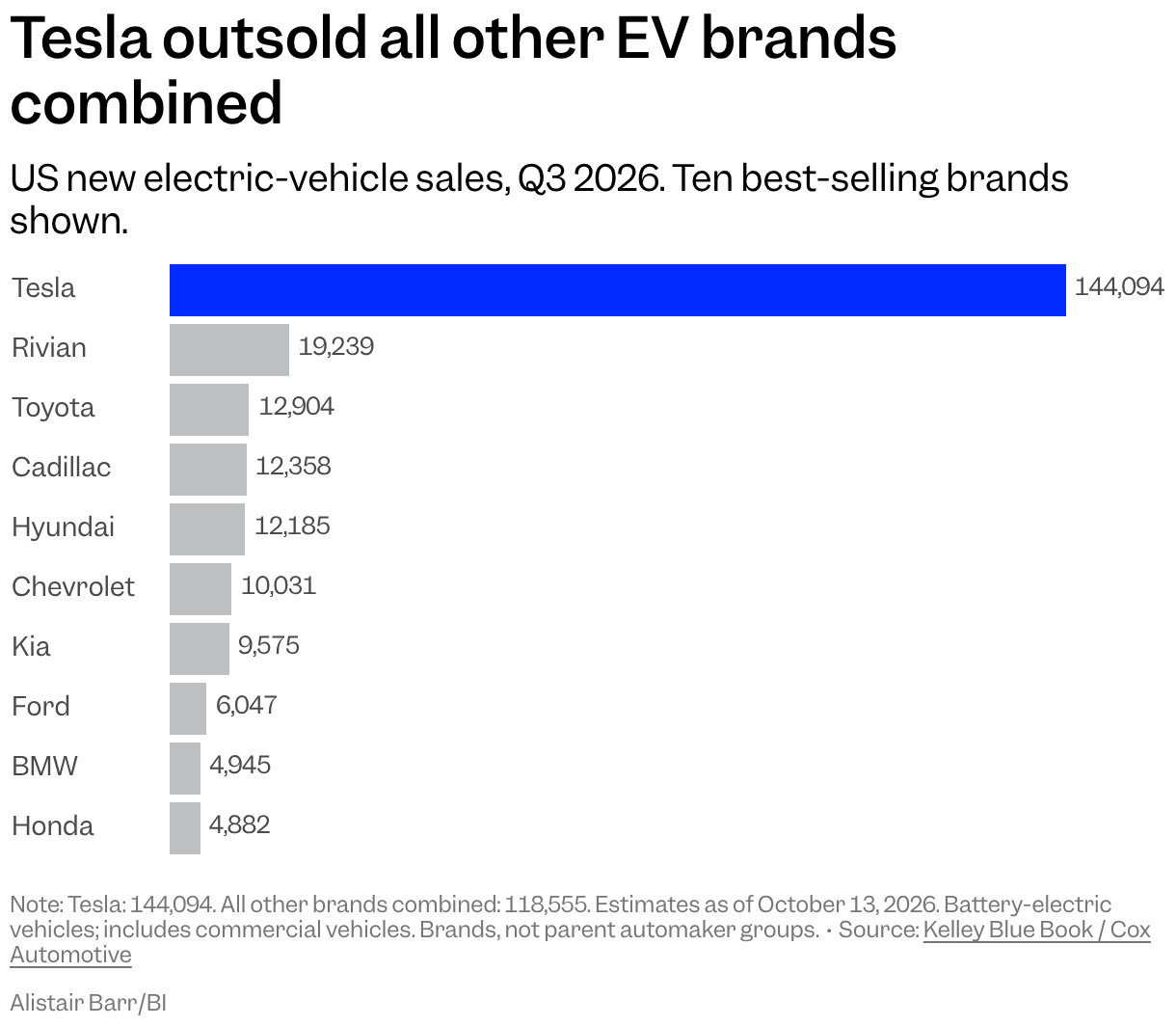
Horizontal bar chart of the ten best-selling US electric-vehicle brands in Q3 2026. Tesla led with 144,094 sales, followed by Rivian with 19,239. Tesla sold more than all other brands combined, which totaled 118,555.

The figures offer a new twist on the EV comeback I wrote about in July. Back then, sales had finally improved after the slump that followed the end of federal incentives in the US. Several manufacturers were benefiting, but only those with the fortitude to stick with EVs after federal government support waned.

While recovery continued in the third quarter, it became more dependent on Tesla.

Americans bought 262,649 new EVs during the period, about 6% more than in the second quarter. Sales outside Tesla fell roughly 3%, based on a comparison of Cox's latest counts with its second-quarter report.

Tesla's own sales rose about 15% from the second quarter. It supplied 54% of the country's new EVs in the third quarter, extending its lead from the previous period.

High gas prices help make the case for going electric, according to Cox.

"With gas prices well above $4 a gallon, electric vehicles look better than ever," Stephanie Valdez Streaty, Cox's director of Industry Insights, said in the company's analysis of the quarter.

Expensive gasoline and diesel make running a conventional vehicle more painful. For drivers who can charge cheaply, particularly at home, an EV offers a valuable alternative to repeated trips to the pump.

There's an important caveat to the comeback story: Sales are improving from a depressed level.

Total US EV sales were down almost 40% from a year earlier. Last year's third quarter was unusually strong because buyers rushed to claim federal incentives before they disappeared.

Tesla's sales were down about 20% against that comparison. The company remains heavily dependent on two vehicles. The Model Y and Model 3 accounted for roughly 97% of its US sales in the latest quarter.

The Cybertruck sold over 4,300 units, and Tesla has stopped making the Model S and X. (There's a Roadster, though not until 2028).

So Tesla's growing dominance isn't a story of every model flying out of showrooms, or of selling more cars than a year ago.

For now, it is winning a larger share of a smaller market. As Americans return to EV shopping, Tesla is capturing more of their business.

Sign up for the AI Insider newsletter here. Reach out to me via email at abarr@businessinsider.com

Read the original article on Business Insider

  •  

I drove Toyota's new RAV4. It's boringly good — and buyers are scrambling for it.

Business Insider's automotive reporter, Ben Shimkus, is standing in front of a 2026 Toyota RAV4.
Buyers can't keep scooping up the Toyota RAV4. Is it worth the hype?

Ben Shimkus/Business Insider

  • Want to buy a RAV4? Good luck finding one!
  • I drove the longtime favorite vehicle for a week. It's boringly good — and that's a huge compliment.
  • Toyota is ramping up its electric powertrains. The new RAV4 is the next great example.

Think of that awkward highway moment: You've accidentally cut someone off or made an obvious driving mistake. You wish you could sink into automotive oblivion before the other driver gets a good look at you.

The Toyota RAV4 is perfect for that situation.

The crossover SUV is good at nearly everything — efficient, comfortable, reasonably priced, and backed by Toyota's reputation for reliability — while wrapped in a package that looks like pretty much every other grocery getter on the road.

A side profile of the 2026 Toyota RAV4.
The Toyota RAV4's very conventional-looking side profile.

Ben Shimkus

I spent a week and about 200 miles in a 2026 RAV4 Limited AWD, driving through New York City and the Catskills region. The fully-loaded tester stickered at $46,883.

I found the RAV4 to be aggressively competent. Its performance won't get your adrenaline pumping, and its looks won't turn many heads. Instead, it'll get occupants comfortably from point A to point B while barely sipping fuel.

And consumers can't get enough of that.

RAV4 gets a facelift — and some fresh electric motivation

A blue 2026 Toyota RAV4 Limited is parked in a grocery store lot.
Toyota's RAV4 has some Prius in its soul — and those are some words of endearment.

Ben Shimkus/Business Insider

The RAV4, America's third-best-selling vehicle last year, is fresh out of the design studio.

It's the sixth generation of the SUV: Unlike its curvier predecessors, it's squared off and upright. The front and rear are nearly perpendicular to the ground and are finished off with LED head and taillights.

The more consequential change is under the hood.

For 2026, Toyota killed the gas-only RAV4. Every version now comes with a battery in the powertrain; the only remaining choice for RAV4 hopefuls is between a conventional hybrid and a pricier plug-in hybrid.

The rear end of the Toyota RAV4.
The RAV4's liftgate gets a more modern, squared-off look for 2026.

Ben Shimkus/Business Insider

That puts one of America's most popular vehicles squarely behind the hybrid strategy Toyota has spent years defending.

While rivals poured billions into all-electric lineups, Toyota kept betting that hybrids — which combine a gas engine with electric motors and a small battery that recharges as you drive — would be easier for mainstream buyers to adopt.

The RAV4 isn't Toyota's first bestseller going hybrid-only. The Camry sedan made the switch for 2025, and the Sienna minivan has been hybrid-only since 2021.

RAV4 is the most consequential expression of that hybrid bet. And the execution hits the nail on the head.

The base model is roughly $32,000 — similar to gas-powered competitors like the Honda CR-V or the Nissan Rogue.

Gas mileage is exceptional. During my test, I averaged 47 mpg, and saw 50-plus mpg on some shorter trips.

There are trade-offs. The RAV4 feels sprightly off the line, but ask for more power at highway speeds, and the gas engine starts working noticeably harder. The steering is vague, the engine can drone, and the transition between electric and gas power is still more obvious than I'd like.

Still, Toyota gets the boring stuff right. The RAV4 gets a smartly layered front-seat organization system, a clean gauge cluster, and easy-to-understand digital climate controls.

The front seat of a Toyota RAV4.
Toyota gets the small stuff right, including the RAV4's handsome interior.

Ben Shimkus/Business Insider

Buyers who want something faster, flashier, or fully electric have plenty of other options — including elsewhere in Toyota's own showroom. My Limited tester also proved you don't need to spend nearly $47,000 to get what makes the RAV4 appealing (the heads-up display, for example, really wasn't necessary).

The RAV4's trick is simpler: It doesn't require any major life changes from its owner. Shoppers don't have to install a charger, rethink a road trip, or learn a radically different car. They can just drive it — and, in my case, get 47 mpg.

Wow, it's popular

The back seat of a Toyota RAV4.
The RAV4 is comfy, efficient, and a Toyota. So, everyone wants it.

Ben Shimkus/Business Insider

That success does create a problem: Buyers can't get enough of the RAV4, especially as high gas prices add to already-strong hybrid demand.

Right now, a new RAV4 spends an average of just 17 days on a dealership lot, per CarGurus data shared with Business Insider. The industry average is above 70 days.

Kevin Roberts, director of economic and market intelligence at CarGurus, said the situation reminds him of the chip shortage era, when limited inventory sent shoppers hunting through dealership lots and helped push car prices higher.

"We're way out of the chip shortage now, so it's a really kind of unique environment," he said.

That scarcity is creating another oddity. CarGurus found that average used prices for 2026 RAV4s were actually running above the starting prices of equivalent new trims. Even 2025 RAV4s were retaining about 99% of that value.

His advice for shoppers: "Dust off some of the chip shortage playbook" by expanding their search radius, being flexible about options, or ordering a vehicle if they aren't in a rush.

Read the original article on Business Insider
  •  

Toyota avverte Bruxelles: “Non siamo ospiti in Europa”. E chiede di cambiare le regole sull’auto

Toyota invita Bruxelles a correggere il tiro sulle regole che guideranno il futuro dell’auto europea. Il messaggio del costruttore giapponese è chiaro: difendere l’industria del Vecchio Continente è necessario, ma senza alzare muri contro i partner commerciali né imporre una transizione elettrica che, almeno per ora, procede più lentamente del previsto. Da qui la proposta di sostituire al tradizionale Made in Europe un più inclusivo Made with Europe, accompagnato da una serie di richieste concrete sulle emissioni e sulle politiche industriali.

“Toyota non è un ospite in Europa. Siamo un produttore europeo e vogliamo che l’industria automobilistica europea abbia successo”, ha dichiarato Yoshihiro Nakata, presidente e CEO di Toyota Motor Europe. Parole che riassumono il senso della proposta e introducono una questione tutt’altro che secondaria: perché escludere Paesi come Giappone, Regno Unito e Turchia, che da decenni partecipano alla produzione automobilistica europea? Secondo Toyota, le nuove regole sui componenti di origine locale dovrebbero tenere conto anche di queste realtà. La Casa propone una quota del 70%, da raggiungere nell’arco di tre anni e senza obblighi sostanziali prima del 2030. Una richiesta che nasce dalla volontà di mantenere aperti gli scambi, ma anche da interessi ben precisi: Toyota dispone di una rete produttiva internazionale che potrebbe risentire di norme troppo restrittive.

Il capitolo più delicato resta però quello delle emissioni, dove i numeri raccontano bene la distanza tra gli obiettivi fissati da Bruxelles e le previsioni del gruppo giapponese. Nel 2030, secondo Toyota, le auto elettriche rappresenteranno circa il 45% delle nuove immatricolazioni europee, mentre per rispettare gli attuali vincoli sulle emissioni servirebbe superare il 55%. Un divario ch si dovrebbe colmare concedendo più tempo ai costruttori, attraverso un sistema di calcolo delle emissioni distribuito su cinque anni, dal 2028 al 2032.

Lo sguardo si spinge poi al 2035, la data simbolo dello stop europeo alle nuove auto con emissioni di CO₂ allo scarico. Toyota propone di fermare l’asticella a una riduzione del 90% anziché del 100%, lasciando spazio anche ai carburanti rinnovabili. Per i veicoli commerciali leggeri chiede obiettivi meno impegnativi: -35% nel 2030 e -80% nel 2035. Del resto, per chi utilizza un furgone ogni giorno, autonomia, tempi di ricarica e capacità di carico non sono dettagli secondari.

Dietro queste richieste c’è una strategia (potremmo definirla multienergia) che Toyota porta avanti da anni: non puntare tutto su una sola tecnologia, ma lasciare convivere elettrico, ibrido, idrogeno e carburanti alternativi. Una strada che oggi incontra le posizioni di diversi costruttori europei, alle prese con una domanda di elettriche inferiore alle attese, costi elevati e concorrenti asiatici sempre più aggressivi.

L'articolo Toyota avverte Bruxelles: “Non siamo ospiti in Europa”. E chiede di cambiare le regole sull’auto proviene da Il Fatto Quotidiano.

  •  

Behind in EVs, Toyota powering ahead with hydrogen vehicles

Hydrogen-powered passenger cars have been left far behind by electric vehicles and hybrids, but the hydrogen truck market is growing and new technology developed for auto racing is keeping hopes for hydrogen cars alive. Toyota and its European partners are in the vanguard of these developments. On September 26 and 27, at the FIA World […]

The post Behind in EVs, Toyota powering ahead with hydrogen vehicles appeared first on Asia Times.

  •  
❌