Jamal Wallace, a senior defensive tackle at the University of Utah, has been suspended from the school's football program after being accused of rape and forcible sodomy and of sharing videos of the alleged attack on social media.
A Utah man is facing several charges, including attempting to commit a hate crime, after he allegedly threatened to "blow up" a synagogue.
Skyler AJ Rose, 22, of Ogden, was indicted by a federal grand jury on Wednesday, on multiple federal charges, including possession of an unregistered destructive device, threatening to kill or injure people and destroy a building with an explosive, and attempting to commit a hate crime, among other offenses, according to the U.S. Attorney's Office for the District of Utah.
"There is no place for hate motivated violence—attempts or otherwise—in our communities. A place of worship should be a refuge of safety, not fear," U.S. Attorney Melissa Holyoak for the District of Utah said in a statement. "Thanks to the dedicated work of the FBI and the outstanding efforts of our local police partners, these alleged threats were identified and stopped before anyone was harmed. Let these charges serve as a clear warning: if you attack or attempt to attack a place of worship, you will face the full force of the federal government."
On Dec. 23, 2025, Rose allegedly made multiple threatening posts on social media, according to court documents.
"I wanna blow up a synagogue," one of the posts read, according to prosecutors.
An investigation was launched and authorities learned that the posts were made from an IP address tracing back to Rose's home. The FBI then contacted the Ogden City Police Department to assist, with a home visit where authorities said they confirmed the social media handle belonged to Rose.
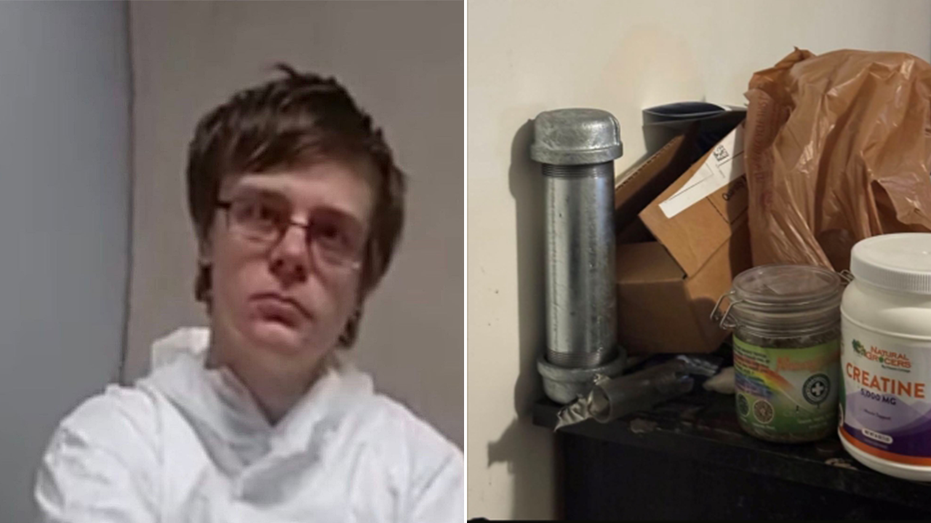
Investigators executed a search warrant and recovered six improvised explosive pipe bombs and one inert device, explosive precursors and components that officials say could be used to construct further improvised explosive pipe bombs, a black Samsung cellphone and two rifles with accompanying magazines and ammunition, prosecutors said.
A subsequent search of Rose’s cellphone revealed that Rose searched online for a synagogue near him in November 2025.
"Today’s indictment stops in its tracks an alleged plan to carry out a violent attack on a synagogue," Assistant Attorney General Harmeet K. Dhillon of the Justice Department's Civil Rights Division said in a statement. "The Department of Justice will take decisive action to protect American worshippers from violent threats, no matter where they occur."
Special Agent in Charge Robert Bohls of the Salt Lake City FBI added that "no one should have to fear for their safety because of their faith."
"Every person deserves to worship freely, without threats, intimidation, or fear," Bohls said. "The FBI takes every threat seriously. Thanks to the swift, seamless collaboration with our law enforcement partners, we were able to address the threat and protect lives from potential physical harm."
The investigation also allegedly revealed evidence of child sexual abuse material on Rose's cellphone, including hundreds of cached images and screenshots depicting child sexual abuse material, according to prosecutors. Rose was also indicted on charges of receipt and possession of child pornography.
Rose's initial appearance is scheduled for Oct. 23 in federal court in Salt Lake City.
Business Insider's reporter traveled to Salt Lake City and Park City, Utah, during the peak winter season.
Joey Hadden/Business Insider
Visiting Utah in the winter isn't for everyone.
I learned that the hard way in January 2025.
My first mistake led to the rest.
Gazing out my window at the snowcapped mountains on the train to Utah, I had no idea that I'd already set myself up for regret. Some mistakes were set in motion before I'd even left my apartment.
I spent three days exploring Utah's pocket of luxury amid ski season and left with four regrets.
My first mistake was booking my trip in the peak winter season as a non-skier.
Joey Hadden/Business Insider
As a first-time visitor to Salt Lake City and Park City, I thought seeing the mountains blanketed in snow would be awe-inspiring — and it really was.
I knew winter would be a popular time to visit Utah since it's a ski hub, but I underestimated how busy it would be. Park City was packed with winter sports enthusiasts.
Skiers and snowboarders crowded the sidewalks lining congested streets in downtown Park City, all suited up — some with gear in tow.
I stopped by the slopes at Deer Valley Resort and spotted long lines of skiers waiting for lifts. I waited in line to ride a funicular up and down the mountain.
Maybe seeing the snow was worth the crowds — I won't know for sure until I visit during another season. But had I realized I'd be visiting during the busiest time of year, I would have pushed my trip to the spring, during the shoulder season.
I didn't pack enough clothing.
The author enjoys Downtown Salt Lake City.
Joey Hadden/Business Insider
Overpacking is a rookie mistake when traveling, so I go to great lengths to avoid stuffing too many outfits into my bag. But this time, I overcorrected.
When packing for a trip that's less than a week long, I typically only bring layers I can wear all at once when needed or mix and match. Since I was traveling in winter, I brought a couple of extra shirts, one additional pair of pants, and zero extra outer layers.
But in January along Utah's Wasatch Front, when temperatures ranged from 24 to 44 degrees Fahrenheit, I needed to wear most of my layers daily.
After bundling up for a flight and a train ride, I felt desperate for fresh layers when I arrived in Salt Lake City.
Doing laundry at the hotel was another mistake.
Joey Hadden/Business Insider
What do you do when you need clean clothes on the road? Utilizing the hotel's laundry services seemed the most straightforward solution, but I regretted it.
That night, I stayed at the five-star Grand America Hotel, where laundry services were top-tier. My shirts and sweaters were returned to me on hangers, each in an individual hotel-branded bag. Smaller items were wrapped in paper in a cardboard box.
I felt like I was opening a present as I sorted through my clean clothes. It excited me — until I saw the receipt.
I paid $115 for three shirts, two pairs of pants, one hoodie, six undergarments, and one two-piece blazer. It was certainly the most luxurious laundry service I'd ever experienced, but for the same money, I could have bought a whole new outfit — and what a great excuse it would have been to treat myself.
I should have made time for winter activities aside from skiing and snowboarding.
GEORGE FREY/AFP via Getty Images
I didn't consider other winter activities I could have enjoyed besides skiing and snowboarding.
I wish I'd taken time to tour Utah Olympic Park in the snow and get a feel for what it was like during the 2002 Winter Olympics.
After my trip, I learned that Park City offers mountain-top snowshoe yoga classes, which I would have loved to try.
Next time I travel to the Silicon Slopes, I'll pack enough clothing and make use of the season's offerings.
Newly drawn congressional districts in Utah mean that when incumbent Republican Rep. Blake Moore meets Democratic challenger Peter Crosby for a debate Tuesday, he'll be speaking to a new amalgam of voters.
In a remote part of Utah, the world’s largest data center project—allegedly—is being fast-tracked in secret. Kevin O’Leary of Shark Tank fame was brought in to hype the 40,000-acre complex. But the backlash among Utahns has been strong. Josh Dzieza reports from the front lines of the popular resistance to data centers:
[Brenna] Williams, a former government econometrician and college instructor, speaks methodically in a calm monotone as she enumerates the many reasons why the data center “doesn’t make sense”—a refrain. First among them is the water, an acutely sensitive issue in Utah in part thanks to Gov. Cox himself, who has declared repeated drought emergencies and urged residents to take shorter showers and cut back on watering their lawns. There is no more potent symbol of the state’s water crisis than the Great Salt Lake, which has been shrinking for years, exposing heavy metals on its lakebed that become airborne dust. Now here came a data center on its northern shore, or where its northern shore would have been if it hadn’t receded several miles.
“We have to report on our neighbors if they’re watering at the wrong times or on the wrong days,” Williams says. (There’s a hotline.) “But we have water to cool a power plant and cool the data center? It doesn’t make sense.”

 Login