Tesla posted a highlight reel showing off its robotaxi navigating real-world road conditions, including robotaxis getting in the way.
Andrej Sokolow/picture alliance via Getty Images
Tesla posted footage of its robotaxi driving without a safety driver ahead of its Q3 earnings call.
Two of the clips included footage of a Waymo robotaxi and Avride encroaching on Tesla's path.
The clips showed the Tesla Robotaxi slowing down.
Tesla took some subtle jabs at its robotaxi competitors ahead of its third-quarter earnings call on Wednesday.
On a website Tesla created for its robotaxi safety report, the company uploaded clips of its self-driving cars maneuvering in real-world conditions without a driver behind the wheel. Obstacles and hazards included stormy weather, a pedestrian crossing at a green light, stray pets, and rival robotaxis getting in the way.
Ashok Elluswamy, Tesla's VP of AI, also posted the video on X, calling it "Robotaxi B-roll."
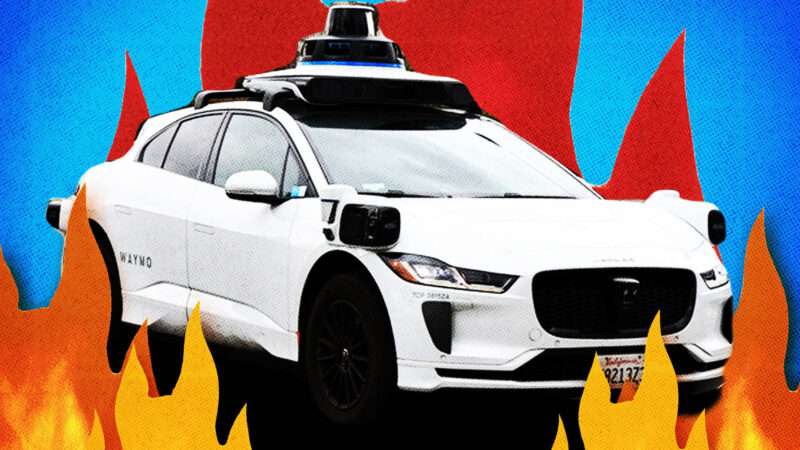
At around the 1:44 mark of Elluswamy's post, the video shows a robotaxi coming to a complete stop in its own lane as a Waymo makes a wider-than-usual right turn. The Waymo can be seen encroaching into Tesla's lane before it returns to its own path.
A Waymo spokesperson did not immediately return a request for comment.
In another short clip, the Tesla robotaxi is seen driving at night, braking for an Avride car that pulled up from the right, a little too far into the Tesla's path.
Avride is a robotaxi company that offers robotaxi rides through Uber in Dallas and is testing rides with a safety driver behind the wheel in Austin.
A spokesperson for Avride did not immediately respond to a request for comment.
Tesla posted the footage as it seeks to make its case publicly on robotaxi safety. The company began offering a limited number of autonomous rides without an in-car safety monitor in Austin in January.
In the newly posted safety report, Tesla said its robotaxi service has driven 3.3 million miles autonomously — relatively small compared to Waymo's more than 271 million miles driven as of June.
Tesla said during its Q3 earnings call that it will launch unsupervised Cybercabs in Dallas in November.
At a protest against a bill to legalize Waymo in Washington, D.C., earlier in October, the main tagline was: "Robotaxis don't vote; we vote." Little is known about the group behind it, raising questions about who's fueling the pushback against robotaxis in America's major cities.
People First Transportation Alliance (PFTA), the organization in question, describes itself as a "statewide coalition of labor unions" dedicated to putting "people over untested technology." The PFTA states it's a "coalition of community organizations, safe-streets advocates, and faith leaders." However, as The Washington Postreported on Monday, the group appears to have overstated its affiliation with four of the 13 individuals and organizations listed as its founding members.
"Several groups and individuals said statements made about them on the Transportation Alliance website were inaccurate," the Postreported, adding that PFTA "appears to be newly formed, with a minimal social media presence. Its website domain was created in late April, according to the Internet Corporation for Assigned Names and Numbers." The group created its social media accounts in May, but it has no posts and no followers.
Apart from its recent interest in the nation's capital, the PFTA lists New York and Philadelphia as its priorities, two cities led by lawmakers who publicly oppose Waymo's presence. Yet for a relatively unknown, recently created organization, the PFTA has found success in its campaign to shut autonomous vehicles like Waymo out of America's Northeast.
In February, the New York Postreported that Gov. Kathy Hochul (D–N.Y.) withdrew her own proposal—which would have allowed commercial robotaxi services such as Waymo to operate in smaller cities in upstate New York—after a PFTA-led coalition prompted enough backlash to kill support for the measure. A Hochul spokesperson told the Post that it was "clear that the support was not there to advance this proposal."
The PFTA told the Post that the organization would urge the state to "pass legislation requiring a human driver behind the wheel in every vehicle and a comprehensive study leading to a plan to address the impact driverless cars would have on New York State."
The group's resolution comes despite customer support for autonomous vehicles: A 2025 study on Waymo, Uber, and Lyft by Obi—a company that aggregates real-time rideshare prices—found that 70 percent of riders who've used Waymo preferred it over Lyft or Uber and 42.7 percent of all respondents were willing to pay Waymo's premium price (up to $10 more) to use the service.
Despite consumer support, autonomous vehicles can't count on a fair shake from lawmakers in some of the country's largest cities. In New York City, Waymo's permit to operate a pilot program on public streets expired in March. Mayor Zohran Mamdani has so far been noncommittal on renewing the company's permit. At a press conference that same month, he said his administration would be prioritizing workers such as the city's taxi drivers who "for far too long, have been sold a dream of being able to work their way to the middle class, only to have the rug pulled out from under them."
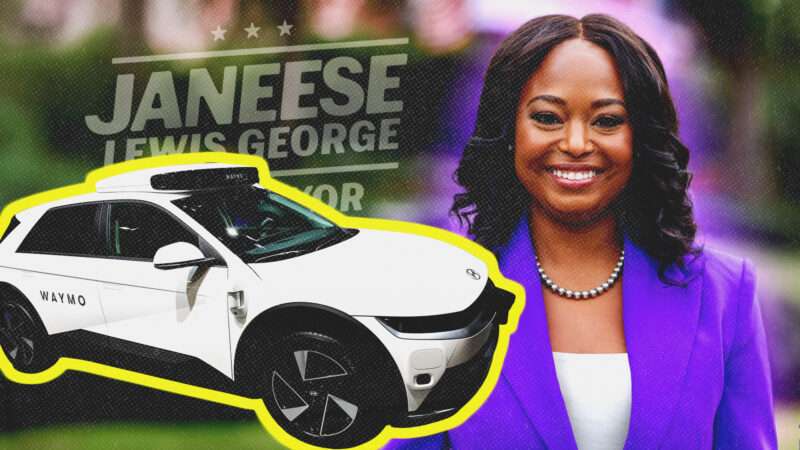
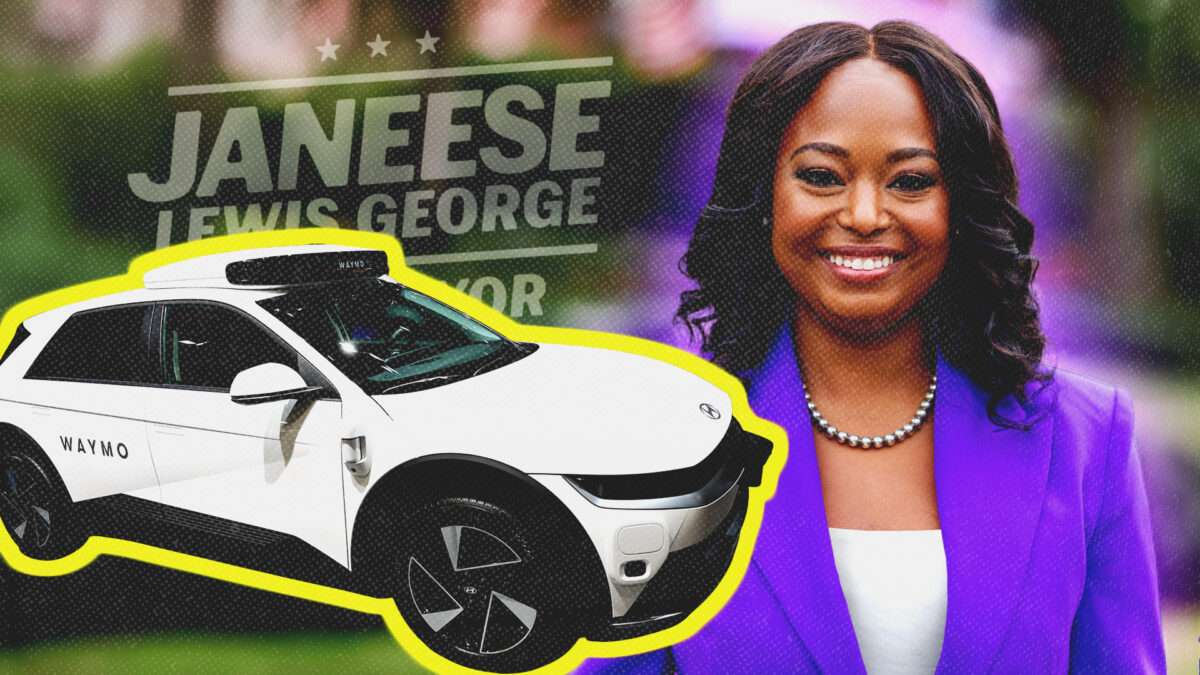
Despite the mystery surrounding the PFTA, its D.C. protest drew enough public support to elicit a statement from a person who will likely be the city's next mayor, current D.C. Councilmember Janeese Lewis George. In a post on X, Lewis George said D.C. was "facing a jobs crisis" that would be exacerbated by "rushing the legalization of autonomous vehicles." She urged the D.C. Council—which is currently considering a punitive proposal to legalize commercial autonomous vehicles—to "get this right and not rush Waymo legislation this year."
It's unclear how much longer Lewis George wants the District's residents to wait before autonomous vehicles are available for use. D.C.'s approach to legalizing commercial robotaxis hardly seems rushed.
Waymo began testing its vehicles in the city nearly two and a half years ago, in spring 2024. The company's co-CEO Tekedra N. Mawakana said its fleet has driven "more than 300,000 miles in Washington, D.C."Meanwhile, the District Department of Transportation (DDOT) has been conducting studies and organizing working groups on autonomous vehicles for nearly a decade. Still, the agency has been unable to draft a regulatory framework that would eventually enable commercial robotaxi use in the nation's capital. In March, UrbanTurf reported that DDOT would be conducting a long-awaited study on autonomous vehicles—originally due in 2022—and "expects to propose recommendations on AV deployment later this year."
Opponents of autonomous vehicles, such as Lewis George and the PFTA, often cite job loss as a reason not to legalize the tech. Still, with only 200 full-time ride-share drivers in a city of roughly 400,000 workers, as Lewis George has reportedly stated, the situation is a far cry from a crisis.
As for PFTA's public safety claims, Waymo's independently reviewed data show that, compared with an average human driver over the same distance, its vehicles caused 95 percent fewer serious-injury-or-worse crashes and 93 percent fewer pedestrian crashes with serious injuries.
PFTA claims it represents the people most directly affected by transportation policy. The little publicly available information suggests the group is more focused on protecting its members' position in the ride-share market than enhancing the experience of riders, who are increasingly opting for robotaxis when given the opportunity.
Janeese Lewis George, a D.C. councilmember and the city's presumptive next mayor, has come out against pending legislation that would allow autonomous ride-share vehicles onto city streets, citing the technology's potential to eliminate the jobs of ride-share human drivers.
"DC is facing a jobs crisis. Rushing the legalization of autonomous vehicles is irresponsible given the anticipated AI-related job displacement and disruptions that put countless workers at risk," she said on X yesterday.
DC is facing a jobs crisis.
Rushing the legalization of autonomous vehicles is irresponsible given the anticipated AI-related job displacement and disruptions that put countless workers at risk.
In a follow-up post, she said that the D.C. Council should delay consideration of a pending bill that would allow Waymo, which is currently testing its technology with human safety operators on District streets, to offer autonomous rides to the public.
Ever since Lewis George won a commanding victory in D.C.'s Democratic mayoral primary earlier this year, pundits and wonks have been trying to read the tea leaves on how the Democratic Socialist will govern.
Lewis George's comments about Waymo suggest the mayor has a deeply mistaken view about the effects and benefits of technological innovation. Contrary to her contention, Waymo legalization is unlikely to exacerbate a "jobs crisis" for at least three reasons.
The first reason she's wrong is that very few D.C. residents work full-time as ride-share drivers. On her Capital Commonsense Substack, Ashley Schapitl reports that, by Lewis George's own estimate, there are only 200 District residents who work full-time as ride-share drivers.
For comparison's sake, the District has a labor force of roughly 400,000 people. So even if Waymo displaced all human drivers in the District, it would be a statistical nonevent.
Few headlines, for instance, reported that D.C.'s labor force shrank by 1,000 people between May and June. Neither did many outlets report that the labor force grew by roughly 600 people between July and August.
Yet here the mayor is talking about a "jobs crisis" over what would be an even smaller change in the number of employed workers in the city.
The second reason not to fear an exacerbated "jobs crisis" as a result of Waymo legalization is that autonomous vehicles (A.V.s) will not completely replace human rideshare drivers in the foreseeable future.
In the cities where Waymo has been active for years, A.V.s are still responsible for a minority of rideshare rides.
That's the case in Phoenix, where Waymo has been offering autonomous commercial service since 2020. In an article from April, Business Insider cites one study that put Waymo's market share at 16 percent of ride-share rides.
In other words, 84 percent of ride-share rides are still being performed by humans a full six years after A.V.s came onto the scene.
That isn't to say the impacts of A.V.s are necessarily positive for human drivers' earnings.
Another study by Gridwise from August 2025 found that A.V.s appeared to be marginally reducing drivers' hourly pay and number of trips per hour. That's evidence of the market for rides becoming more competitive, but it's not, as of yet, evidence of a job apocalypse.
Network design matters too. In places like Los Angeles and San Francisco, Waymo is a standalone competitor to traditional ride-share companies like Uber and Lyft. In Austin and Phoenix, Waymo partners with Uber to offer rides on hybrid human-and-A.V. networks.
A report by EnoTrans, funded by a grant from Lyft, found that the later cities' hybrid networks actually increased human drivers' trips per hour. Their pay-per-hour fell, albeit less steeply than in cities without hybrid networks.
All of that is to say that while Waymo, as a competitor to human-operated ride-share services, shouldn't be expected to have a positive impact on drivers' earnings. It shouldn't be expected to have a catastrophic impact on them either.
The third and final reason that Lewis George is wrong to think that Waymo will worsen a coming "jobs crisis" is that Waymo's employment impacts are not limited to its effect on competing human drivers.
If Waymo earns any market share at all, it'll be because it's offering some travelers a better transportation option than the ones that currently exist. Increased ease of travel within the city would be expected to raise employment levels, not lower them.
If Waymo makes it easier or cheaper for people to get from home to the office or from the office to their kids' school, they might be more willing to live in D.C. over Arlington or Silver Spring. If it's more convenient to get to the movies or dinner, residents will be more willing to patronize local businesses.
None of that even touches on the economic and human benefits of Waymo's likely positive impact on road safety.
The direct effects of Waymo on drivers' employment must be weighed against all the other economic activity that autonomous vehicles will facilitate.
In the long run, the economic effects of autonomous vehicles may well be revolutionary. In the foreseeable future, they'll make the market for for-hire rides slightly more competitive.
A reasonable assumption then is that Waymo will have a modest, but positive, impact on overall economic activity and employment in the District, even if it has a modest, but negative, impact on the small number of full-time ride-share drivers who live here.
If the new mayor can't even tolerate that level of economic disruption, that does not portend good things for D.C.'s economy under a Lewis George administration.

 Login