Peter Thiel, cofounder and chairman of Palantir Technologies Inc.
Bloomberg/Getty Images
Thiel criticized the US-Iran war, diverging from Trump's foreign policy stance, POLITICO reported.
"There were a lot of mistakes that were made," Thiel said at a lecture earlier this month.
Despite his criticism of the war in Iran, Thiel highlighted his continued support for Trump.
Billionaire technology investor Peter Thiel said he's skeptical of the US war with Iran and does not believe the United States should have launched it, putting the major Republican donor at odds with President Donald Trump over one of the administration's defining foreign policy decisions, POLITICO reported.
Thiel's remarks, delivered on October 12 at a private event, are his most explicit statements to be revealed publicly about the war with Iran and come less than two weeks before the midterm elections in which Trump's party is grasping to maintain power in Congress. The audio of Thiel's comments was obtained by Decoded by POLITICO from a lecture earlier this month.
"I'm skeptical of [the war], I think we should not have done it," Thiel said. "There were a lot of mistakes that were made."
Thiel added, "Maybe we don't have the hard power. Maybe we're going to lose the soft power war."
In the full lecture, Thiel made clear his strong opposition to neoconservatives and Middle East wars. Despite his criticism of the Iran war, Thiel highlighted his continued support of Trump and suggested he wanted to protect the president.
Still, Thiel's break over the war represents one of the most important examples to date of a fierce Trump ally sharing deep concerns about the conflict.
The comments were part of Thiel's lecture series in Nashville, which Decoded has documented since their start this fall. In the latest lecture, Thiel issued extensive warnings about what he described as the unchecked power of the International Criminal Court, drawing on comments from Bush-era figures Donald Rumsfeld and Dick Cheney.
"I read the Cheney family's Trump derangement syndrome as an attempt to buy favor with the [International Criminal Court] and avoid prosecution. Probably too late," Thiel said. "And I have come to suspect that the threat of an ICC arrest warrant is the sword of Damocles hanging over the Trump administration as it tries to persecute this war in Iran."
Thiel also discusses meeting with Israeli Prime Minister Benjamin Netanyahu in early 2024, after the October 7 attack, where he said he asked the president about his plans in Gaza. Thiel said Netanyahu told him, "I can't just Dresdenize it," referring to the Allied bombing of the German city of Dresden during World War II that killed roughly 25,000 people.
The first big tech investor to back Trump in 2016, and then have a high-profile speaking role at the Republican National Convention that year, Thiel was also the biggest financial backer of super PACs supporting Vice President JD Vance's Senate campaign in 2022. POLITICO reported in March that Vance was "skeptical" of the U.S. striking Iran in the lead-up to the beginning of the war.
Representatives for Thiel and the White House did not respond to requests for comment.
This story originally appeared on POLITICO and is courtesy of the Axel Springer Global Reporters Network, which harnesses the resources of the company's newsrooms to publish ambitious scoops, investigations, interviews, opinion pieces, and analysis. It allows journalists — including those from POLITICO, Business Insider, WELT, BILD, Onet, and Fakt — to collaborate on major stories for an international audience of hundreds of millions across platforms.
A hot, new beauty treatment driving tens of millions of dollars in sales around the globe is now aiming for the US market. Its unusual ingredient: skin from dead Americans.
Each year, tens of thousands of Americans donate bodily tissue upon their deaths, generally by checking a box at a motor vehicle department or through an authorization made by a loved one. Over the past few years, tens of millions of dollars' worth of donated skin has traveled from American tissue banks to biotech companies in South Korea, the beauty capital of the world. There, among other uses, it is turned into injectable beauty treatments.
The maker of the market-leading Korean brand said last week it has signed a distribution contract to introduce its skin-derived injection to the US market next year. It isn't clear whether the product can be sold in the US without approval from federal regulators.
Business Insidertraced the tissue supply chain to understand how donor tissue from, say, San Antonio can end up for sale at a clinic in Seoul — and how much money is being made along the way.
People who donate tissue "have no idea of how much money is changing hands in the course of all of this," Ana Iltis, a professor at Wake Forest and former president of the American Society for Bioethics and Humanities, told Business Insider. "With tissue donation, there's a lot of money at stake."
Donors and their families can't be paid for organ or tissue donations under US law.
A K-beauty trend
For decades, American plastic surgeons have used products made from human tissue for skin grafts and reconstructive surgeries. That practice includes aesthetic uses — such as cartilage for a nose job or skin for a breast augmentation — though many doctors prefer to use the patient's own tissue for such procedures.
Now, skincare treatments made from human tissue can be purchased for a few hundred dollars and administered at a med spa or dermatology clinic in under an hour. In South Korea, a mecca for cutting-edge beauty treatments, at least 10 biotech companies are making or planning to introduce skin-derived injections.
They are the latest generation of a treatment known among beauty obsessives as "skin boosters." Get your algorithm just right, and your social-media feeds will soon be full of before-and-afters showing off the purported benefits of these products. They depict patients, typically women and sometimes young ones, going from dull to dewy, fine-lined to smooth.
This year, the skin-derived injections are projected to generate $75 million in sales in South Korea, according to analysts at Yuanta Securities.
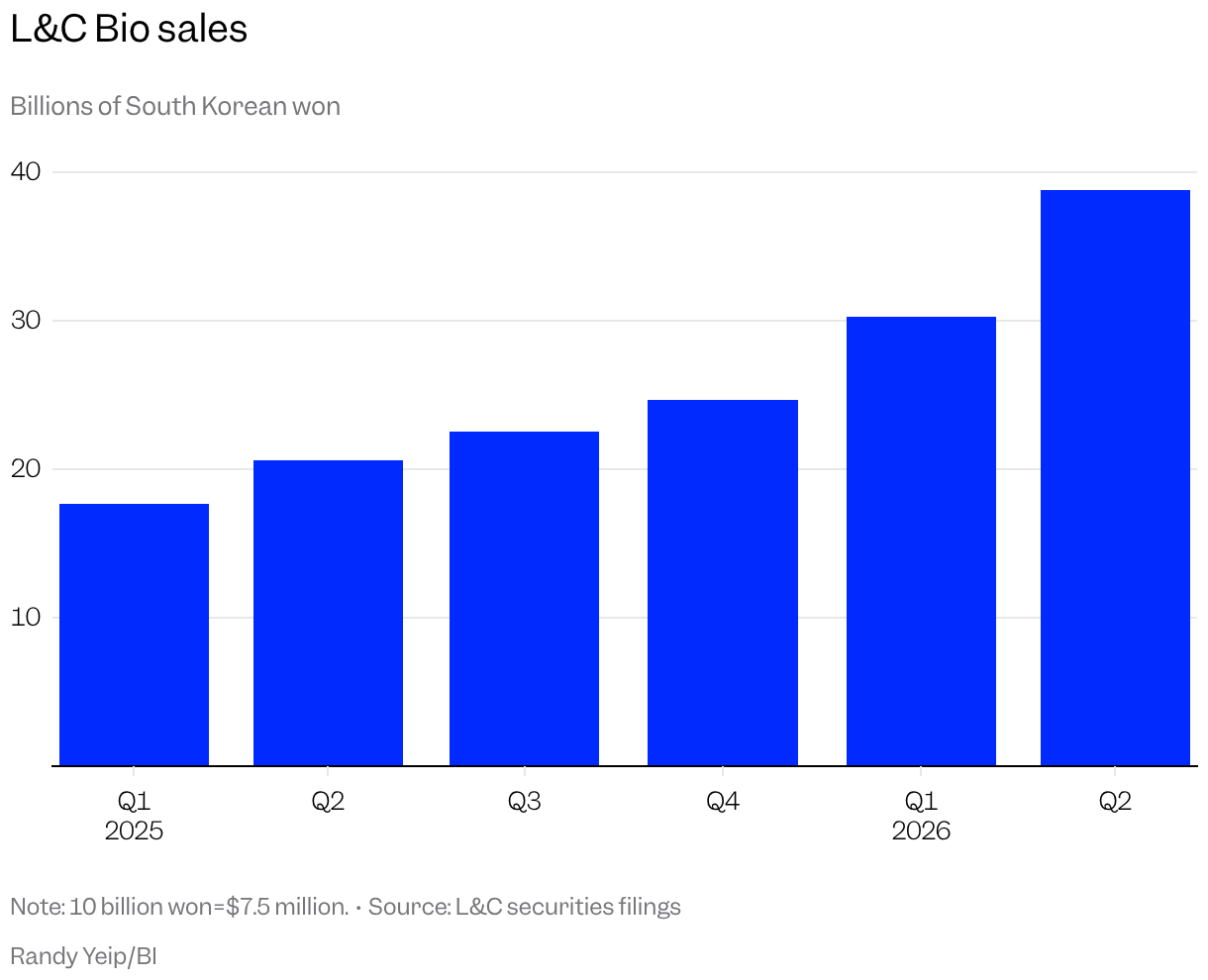
No brand is bigger than Re2O, which one dermatologist on Instagram called "the Love Potion No. 9 for cells." It accounts for between 60% and 70% of sales in the category, according to L&C Bio, its manufacturer.
South Korea is a mecca for cutting-edge beauty treatments.
JUNG YEON-JE/ Getty Images
Re2O notched the equivalent of more than $17 million in sales in the first half of this year, helping swing the company to an operating profit of about $11 million after a loss of about $326,000 in the same period last year, L&C Bio said. It has expanded the product line with Re2O Fine, marketed for more delicate skin, and is planning to launch a human fat-derived filler next year.
The company said it sold 700,000 units of Re2O as of September. It is available in Singapore and China, and has been approved in the United Arab Emirates, Peru, and Thailand.
Last week, L&C Bio said that it has signed a contract to deliver at least $60 million of Re2O to the US over the next five years. The company also said it may explore acquiring US tissue banks with its US distribution partner.
L&C Bio's plan to introduce Re2O to the US could spark a regulatory showdown. L&C Bio has said Re2O falls into a category of products such as skin grafts that don't require approval from the US Food and Drug Administration.
Some products that manufacturers claim qualify to be sold under this category don't actually meet the applicable criteria, the FDA told Business Insider. The agency said it wouldn't discuss any specific products under investigation.
"Products derived from donor skin that have been decellularized, dried, and ground into a powder for injection as a cosmetic 'skin booster' may raise significant questions" and may have to go through a more complex regulatory approval process, the agency said.
L&C Bio said it wouldn't comment on its discussions with regulators.
Re2O's biggest competitor, CellREDM, came onto the South Korean market in late 2025. It has been such a success that in the quarter ended June 30, operating income for its maker, Hans Biomed, soared to over $3 million after barely eking out a profit in the year-earlier period.
The tissue business
"In the human tissue business, access to raw materials is the lifeblood of the industry," L&C Bio's founder and CEO, Whan Chul Lee, said in Korean in a February interview with a South Korean news outlet.
For his company and its competitors, that lifeblood flows from the United States.
Roughly 90% of all the human tissue used in South Korea is imported, according to South Korea's Ministry of Food and Drug Safety. Less than 4% of South Korean adults are registered to donate organs, and even fewer donate tissue. Korean biotech companies have turned primarily to the US, where well over half of adults are registered donors.
Cadaver skin is collected in the US by organ procurement organizations, known as OPOs, and tissue banks.In the transplant system, skin is treated as a tissue, not an organ.
After tissue is collected, its route can vary.A nonprofit OPO often transfers it to an American tissue bank. The tissue bank pays a fee to the OPO, depending on factors like the amount and quality of tissue recovered. The fee covers the cost of the tissue recovery as well as a margin that supports other programs offered by the OPO.
Tissue banks — which can be nonprofit or for-profit entities — supply donor skin to Korean biotech firms.
Much of the US skin supplied to South Korea is used for more traditional medical purposes, like skin grafts for burn victims. L&C Bio makes such therapeutic products and says it prioritizes supply for them.
Tens of millions of dollars' worth of donated skin has traveled over the past few years from American tissue banks to biotech companies in South Korea.
Ed Jones/AFP via Getty Images
L&C Bio spent more than $25 million on donor skin from US tissue banks between 2023 and 2025 and $3.8 million in the first half of this year, according to corporate filings. The company told Business Insider that a quarter of its skin supply is used to make Re2O.
Organ distribution is coordinated by a public-private partnership with the federal government. Tissue is handled differently. It is distributed through commercial relationships.
The more traditional business aspects of the tissue industry have been a subject of debate since the federal law governing America's organ recovery and distribution system was enacted in the 1980s. In a system that relies on altruism, money changing hands could affect public trust, Jerold Mande, who helped write the National Organ Transplant Act, told Business Insider.
There is little data on American attitudes toward tissue donation. A survey of more than 1,000 families of donors in the US published in a 2010 academic journal found less than 30% said they thought it was acceptable for donated tissues to be processed and distributed by for-profit companies.
Revenue from tissue, primarily skin and bone, drove 93% of American OPO profits between 2013 and 2017, or a total of about $107 million per year in profit at 51 OPOs, according to a study in the medical journal Transplantation. The Association of Organ Procurement Organizations called the study outdated, said the money collected for tissue helps fund other life-saving work, and objected to the study's use of the word "profit."
"Reimbursed funds go directly back into the organization, supporting organ procurement as well as aftercare programs for donor families such as bereavement support and grief counseling," said Jenny Daigle, a spokesperson for the Association of Organ Procurement Organizations. Organizations must have a margin and reserves to remain financially stable, she added.
Human tissue donations help millions of people in the US each year, including skin for burn victims, bone for cancer survivors, and eyes for the visually impaired, Daigle said.
Tens of thousands of Americans donate bodily tissue each year upon their deaths, often by checking a box at a motor vehicle department.
Patrick Sison/ AP Photo
Regenerative Biologics, a Florida tissue bank, provides all the skin for Re2O, L&C Bio confirmed to Business Insider.
Regenerative's CEO, Sandy McCann, said her tissue bank acts as an intermediary, supplying skin collected by other organizations, and provides L&C Bio only with skin from donors who have given consent for international and cosmetic use. If other American tissue banks have skin that they can't use, "many times we can place it where someone can," she said.
Regenerative had just over $16 million in annual revenue in 2024 and 2025, according to reports filed with a Florida regulator.
By reviewing South Korean government records and images of product packaging, Business Insider identified two other US tissue banks, South Texas Blood and Tissue and RTI Surgical, that supply tissue for skin-derived injectable beauty treatments made by Korean companies.
South Texas Blood & Tissue supplies skin used to make South Korea's No. 2 brand, CellREDM. The tissue bank is based in San Antonio, sometimes called "Military City, USA" because of the large military base there. Educational materials on the tissue bank's website say that donor skin "heals patients suffering from burns or other traumatic wounds, and in reconstructive surgeries, including those wounded during military service."
South Texas Blood & Tissue said each of its tissue donors helps an average of 75 recipients. International distribution and commercial use are longstanding practices in the tissue industry, the group said. Tissue donor families have the option to decline cosmetic, international, or research use, the group added.
"Our top priority is to serve as good stewards of these tissue donations, and to ensure that all tissue we recover has the greatest impact possible," it said.
RTI, a Florida tissue bank that does business as Evergen, said it transfers a small amount of unprocessed donor skin to DOF, a tissue bank in South Korea that manufactures the skin-derived injection product Juveacell. RTI added that it is"dedicated to honoring the generosity of donors and their families."
The Axel Springer Global Reporters Network harnesses the resources of the company's newsrooms to publish ambitious scoops, investigations, interviews, opinion pieces and analysis. It allows journalists — including those from POLITICO, Business Insider, The Telegraph, WELT, BILD, Onet and Fakt — to collaborate on major stories for an international audience of hundreds of millions across platforms: online, print, TV and audio.
Protesters vandalise a retail store during a demonstration near Place de la République, as the the Gilets Jaunes join students for a weekend of action on October 17, 2026 in Paris, Franc
Carl Court/Getty Images
Screenshots of Vinted listings circulating on social media show products being offered for a fraction of their retail prices.
The suspected stolen merchandise was listed after looting in France.
Vinted told The Telegraph it had taken immediate action to identify and remove listings connected to the violence.
Resale websites including Vinted have removed suspicious listings after they were flooded with apparently stolen goods in the wake of riots that swept across France.
Perfumes, designer handbags, cosmetics and even Pokémon cards have appeared on second-hand marketplaces following a weekend of violence that saw shops ransacked, The Telegraph — which, like Business Insider, is part of the Axel Springer Global Reporters Network — reported.
Screenshots circulating on social media show products being offered for a fraction of their retail prices, including bags overflowing with Sephora cosmetics advertised for as little as €10 (£8.40).
The listings have triggered suspicions that looters are trying to sell stolen goods online. eBay and Vinted have removed some items and stepped up their monitoring of suspicious activity.
One advert on Vinted showed six Sephora lip glosses being sold for €15, while another offered six tubes of cleansing cream for just €12.
Sephora France sells comparable own-brand lip glosses for around €13 each, meaning six would ordinarily cost around €78.
A screenshot of a Vinted listing showing suspected stolen Sephora beauty products
Screenshot
Other listings included Christian Dior perfumes advertised for €250 and large quantities of make-up still in their original packaging.
In one case, Pokémon trading cards allegedly stolen from a shop in Lille were advertised on Vinted, with some still bearing their original price stickers.
Hundreds of cards were reportedly found scattered across streets in the northern French city after a fire at Le Coin des Barons, a shop specialising in collectable cards.
A trophy said to have been stolen from French e-sport club Team Vitality was advertised on eBay for €1,250.
The silver StarLadder Counter-Strike trophy was photographed against a graffiti-covered wall and listed under the title: "STOLEN RARE VITALITY CS2 TROPHÉE."
Team Vitality confirmed that its Paris premises had been looted during Saturday's unrest, with trophies and computer equipment stolen and display windows smashed.
The listings emerged as France struggled to contain some of its worst civil unrest in years, caused by anger over the cost of living and deteriorating public services.
More than half a million people joined demonstrations on Saturday, with violent clashes breaking out in Paris, Marseille, Lyon and other cities.
French authorities said more than 2,400 people had been arrested by Sunday, while nearly 1,000 police officers were injured.
The unrest has spread beyond France, with demonstrations about living costs and public spending also taking place in Belgium, Portugal and Italy.
French retailers have been left counting the cost, with supermarket giant Carrefour reporting damage to 50 stores, including 20 that were looted.
'We have zero tolerance for it'
Sephora closed its French stores on Saturday evening and kept them shut on Sunday after several branches were ransacked.
Vinted said it had taken immediate action to identify and remove listings connected to the violence.
A spokesman said: "The sale of stolen goods, or soliciting them, is strictly prohibited on Vinted, and we have zero tolerance for it."
The company said it had stepped up monitoring and would take action against offenders, including permanently banning accounts. It added that it was working with law enforcement and French authorities to identify suspicious sellers.
An eBay spokesman said: "The sale of stolen property is strictly prohibited on eBay."
The company said it used technology to identify suspicious activity and worked closely with police to investigate criminal behaviour.
The spokesman added: "If we receive confirmation from law enforcement that an item has been stolen, we remove it immediately and take action against the seller."
This story originally appeared on The Telegraph and is courtesy of the Axel Springer Global Reporters Network, which harnesses the resources of the company's newsrooms to publish ambitious scoops, investigations, interviews, opinion pieces, and analysis. It allows journalists — including those from Business Insider, POLITICO, The Telegraph, WELT, BILD, Onet, and Fakt — to collaborate on major stories for an international audience of hundreds of millions across platforms.
Anthropic CEO Dario Amodei during a September visit to Washington, DC.
Bloomberg/Getty Images
Anthropic is looking to shape AI regulation by pitching an AI safety bill of its own.
POLITICO obtained a confidential draft of the proposed legislation.
The bill would let the government block an AI model only if it poses a foreseeable, imminent risk of more than $1 billion in damages, or of killing or seriously injuring more than 50 people.
Representatives for the artificial intelligence giant Anthropic have quietly pitched Capitol Hill lawmakers on a draft bill to regulate frontier AI safety and security, according to three people with knowledge of the efforts who were granted anonymity to discuss private deliberations.
The confidential draft, obtained by POLITICO and not previously reported, marks a notable effort by the frontier AI lab to shape the rules governing its own technology as Congress weighs how to respond to the fast-moving industry.
"This bill represents the proposals outlined in Anthropic's Advanced AI Framework, which we have been advocating for with federal and state lawmakers since June," an Anthropic spokesperson said. "These are sensible policies we believe Congress should act on."
The bill would let the government block a model's release or use only if it poses a foreseeable, imminent risk of more than $1 billion in damages, or of killing or seriously injuring more than 50 people. The risk must stem from the creation or release of a biological weapon, the model evading its developer's controls or a cyberattack. The language mirrors that found in California's AI laws including SB 53, which was signed into law last year.
Leading AI labs disclosed a series of incidents this summer, in which AI agents hacked or probed websites and platforms. None reported so far appear to have caused widespread deaths or over $1 billion in damages.
Anthropic has yet to publicly back particular legislative efforts in Congress, but they have backed some state AI safety laws, including two in California. Their head of U.S. state and local government relations previously told POLITICO that they hope states will continue to pass ever-stronger AI safety laws that raise the standard nationwide.
Under the bill, independent evaluators, which would register with the Commerce Department, would be tasked with periodically evaluating the lab and its frontier models. The evaluators may be paid for their work by the lab itself so long as the payment is not contingent on the evaluations' results.
If the evaluators determine there is "imminent enumerated risk" for a company's frontier models, they must report it to Commerce within 72 hours of completing their assessment.
While the Commerce Department could bring a request to the judge to halt the release of a model after determining that it poses a risk, the language explicitly prohibits any other U.S. "department, agency, or officer" from suspending the model's development, deployment or internal use. A federal judge for the District Court for the District of Columbia could order the suspension of a model.
Over the summer, Anthropic was subject to sweeping export controls that shut down two of its most advanced models. The decision was made in a whirlwind series of phone calls between administration officials and the company's executives, worrying some in the tech industry that access to their technology may be restricted on the whims of government officials.
Anthropic's bill would also preempt some state AI laws related to public disclosure of risk, third-party evaluation and reporting of critical incidents. Preemption has been a political flashpoint on Capitol Hill, with Democrats rejecting some proposals they feared would neuter regulations passed by the likes of California, Illinois and New York.
Many tech industry groups have argued that a state-by-state patchwork of laws is difficult to comply with compared to a unified national standard.
The legislation would also require frontier labs to create safety frameworks, publish transparency reports for new frontier models, implement protections for whistleblowers and report critical safety incidents to Commerce.
Capitol Hill has seen a flurry of activity on AI safety legislation this summer. In the House, Reps. Lori Trahan (D-Mass.) and Jay Obernolte (R-Calif.) spearheaded the FRONTIER Act, which would give the government the ability to stop the deployment of risky models and preempt some state AI laws.
In the Senate, Majority Leader John Thune and Sens. Amy Klobuchar (D-Minn.) and Ted Cruz (R-Texas) have been negotiating an AI safety bill intended to mitigate catastrophic risks. But it has faced headwinds from some safety-minded groups and Sen. Maria Cantwell (D-Wash.), the top Democrat on Cruz's Commerce Committee, who want the government to have a larger role in reviewing AI models.
Other progressives, including Rep. Greg Casar (D-Texas) and Sen. Bernie Sanders (I-Vt.), have gone well beyond their colleagues in calling for a pause in advanced AI development and a ban on superintelligence, a type of theoretical AI that far surpasses humans' cognitive capabilities.
This story originally appeared on POLITICO and is courtesy of the Axel Springer Global Reporters Network, which harnesses the resources of the company's newsrooms to publish ambitious scoops, investigations, interviews, opinion pieces, and analysis. It allows journalists — including those from POLITICO, Business Insider, WELT, BILD, Onet, and Fakt — to collaborate on major stories for an international audience of hundreds of millions across platforms.

 Login