❌

Reading view

Most AI data centers may never be built. Blame the 'bragawatts.'

Kevin O'Leary speaks during the Romain College of Business Innovative Speaker Series at the University of Southern Indiana Wednesday, Sept. 23, 2026.
Kevin O'Leary speaks at the University of Southern Indiana.

MaCabe Brown / Courier & Press / USA TODAY NETWORK via Imagn Images/Reuters

  • Newcomers like Kevin O'Leary face skepticism due to a lack of experience in data center development.
  • Bernstein analysts dubbed O'Leary and others "bragawatts."
  • Most announced projects will never happen. "Press releases are cheap…concrete is not."

The AI industry has a problem with bragging.

Companies are announcing enormous new data centers to power the AI boom. Some promise facilities bigger than anything the industry has built before.

There's just one problem: Most of these projects may never happen.

Bernstein Research analyzed thousands of planned US data centers and concluded that only about 35% of the announced capacity is likely to get built. That's roughly 170 gigawatts of data center capacity out of a total of almost 500 gigawatts.

The rest? A significant chunk of it belongs to a category the industry has a wonderfully dismissive name for: "Bragawatts." These are ambitious announcements, often from newcomers with little experience building data centers, that have a slim chance of becoming reality.

"Press releases are cheap…concrete is not," Bernstein analysts wrote in a research note.
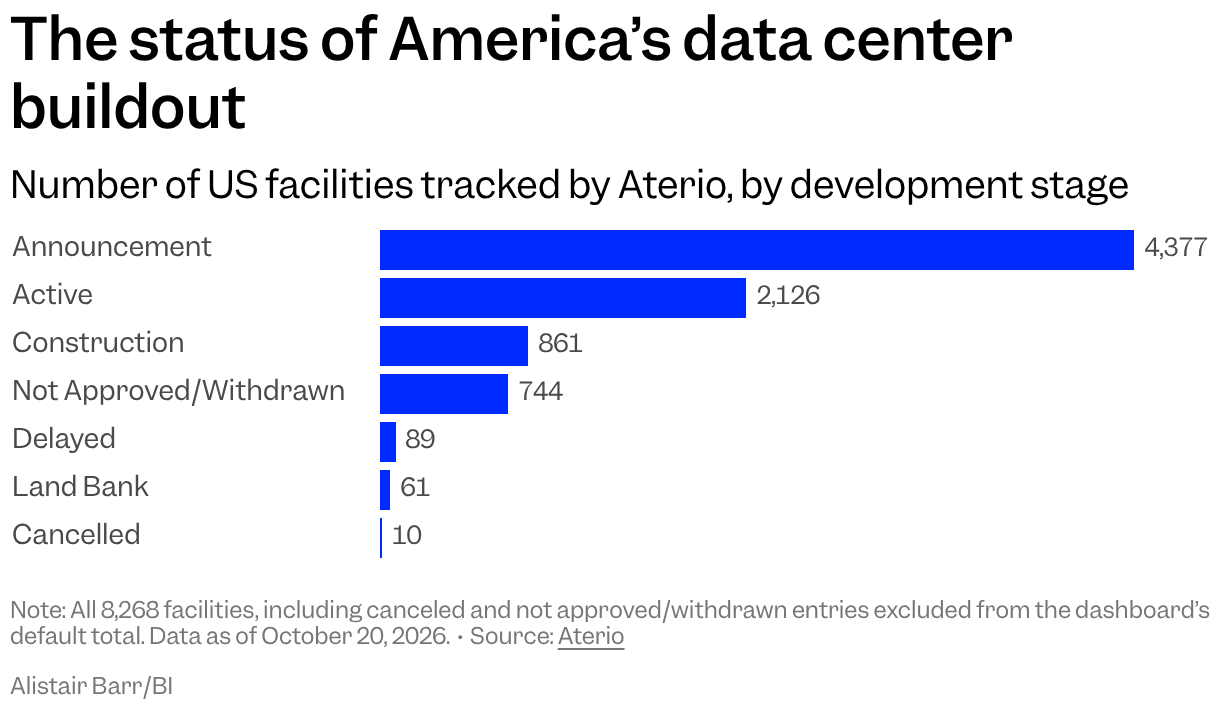
Among 8,268 tracked US facilities: Announcement 4,377; Active 2,126; Construction 861; Not Approved/Withdrawn 744; Delayed 89; Land Bank 61; Cancelled 10.

Bernstein began its analysis with more than 7,000 data center projects across North America, drawing on information from Aterio, a company that tracks construction through satellite imagery, permits, and other records. The analysts narrowed that to more than 5,000 projects (partly by excluding those already canceled).

Then they assessed the chances of these remaining projects being completed. The analysts considered factors such as whether construction had started, whether electricity was available, and whether the companies involved had successfully built data centers before.

The results revealed a striking divide.

The 'bragawatt brigade'

Kevin O'Leary
Kevin O'Leary.

Daniel Delgado Jr./Disney via Getty Images

Experienced operators including Amazon, Google, Microsoft, and Meta landed at the top. Bernstein gave these companies perfect scores of 5 out of 5 for their development credentials. Other data center specialists, such as Digital Realty, Equinix, and CoreSite, got top marks, too.

O'Leary Digital, associated with celebrity investor Kevin O'Leary, ended up at the bottom, with a credibility score of 0.35 out of 5, according to Bernstein. His company has announced 15 gigawatts of data center projects, and Bernstein estimates that only 489 megawatts, or about 3%, will actually materialize.

"Sorry, Kevin," the analysts wrote.

Although the term "bragawatts" has been doing the rounds in the data center industry lately, it's unclear who coined it, Bernstein analyst Madison Rezaei told me.

"I wish I could take credit for that," she said. "I believe I originally heard it from an Equinix executive, but I don't think he owned it either."

She said that while some ambitious newcomers could succeed, they haven't yet demonstrated they can deliver.

"It's not that all of these guys are sort of terrible and not going to deliver, but we just have lower confidence because we don't know them," Rezaei said.

O'Leary Digital responds

O'Leary Digital disputed Bernstein's assessment, saying the research doesn't account for substantial work that occurs before construction begins.

While acknowledging that O'Leary Digital is a young company, CEO Paul Palandjian said the team has decades of experience building major infrastructure projects and that its proposed 15 gigawatts of capacity would be built in stages over several years.

The company said it has secured binding agreements covering about 11,000 acres in Utah and 13,000 acres in Alberta, obtained a 30-year development agreement in Utah, and made progress on planning, engineering, and permits at both sites. It also said the projects would generate their own electricity.

The company said its early development work is funded, additional capital is committed to reaching key milestones, and experienced engineering and construction partners are involved.

"We would rather be judged on milestones than on a model," Palandjian said.

'An announcement in search of a project'

Opponents of the proposed La Osa data center attend a Pinal County Board of Supervisors meeting in Florence, Arizona, on Aug. 26, 2026.
Opponents of the proposed La Osa data center attend a Pinal County Board of Supervisors meeting in Florence, Arizona, on August 26.

USA TODAY Network via Reuters Connect

Other low scorers in the "bragawatt" brigade included Vermaland and Joule Capital Partners, according to Bernstein analysis based on Aterio data.

Joule has announced 50 data center projects with a combined capacity of 11.7 gigawatts. Bernstein estimates that only about 11% of that capacity will actually get built. Almost all of Joule's planned capacity remains at the announcement stage, with little evidence of construction progress or of major customers committing to use the facilities, Bernstein wrote in a July note to investors.

The analysts gave Joule a credibility score of 2.05 out of 5, placing it among the lowest-ranked developers in its database.

"An announcement in search of a project," the analysts wrote.

Vermaland has announced plans for a massive data center project in Arizona. Bernstein estimates that only 4% of its proposed 2.2 gigawatts of capacity will get built. The company is primarily a landowner, not a data center developer. Its proposed $33 billion La Osa project near Eloy had already been sharply scaled back amid local opposition and without construction approval. In late August, regulators formally rejected the project. Even before that, the analysts gave Vermaland a credibility score of 0.75 out of 5.

Joule and Vermaland didn't respond to emails seeking comment this week.

A yawning gap for data centers

Sergio Toro, CEO of Aterio, sees similar patterns in his firm's voluminous, detailed data.

Aterio's tracking shows that roughly 30 to 40 gigawatts of new data center capacity get announced each month. Yet only about 7 gigawatts begin construction each month, while 2 to 3 gigawatts actually start operating.

This leaves a yawning gap.

Many announced projects get withdrawn before construction begins — and before real money has been spent.

"They just make the announcement, but they didn't get their approvals. Or they make multiple filings in multiple locations to see which one gets selected," Toro told me. "That's why we track with satellite if there's real movement on the ground or not."

Indeed, Bernstein analysts wrote recently that the amount of "stranded" data center capacity has surged. These are projects that are either canceled, delayed, or not approved.
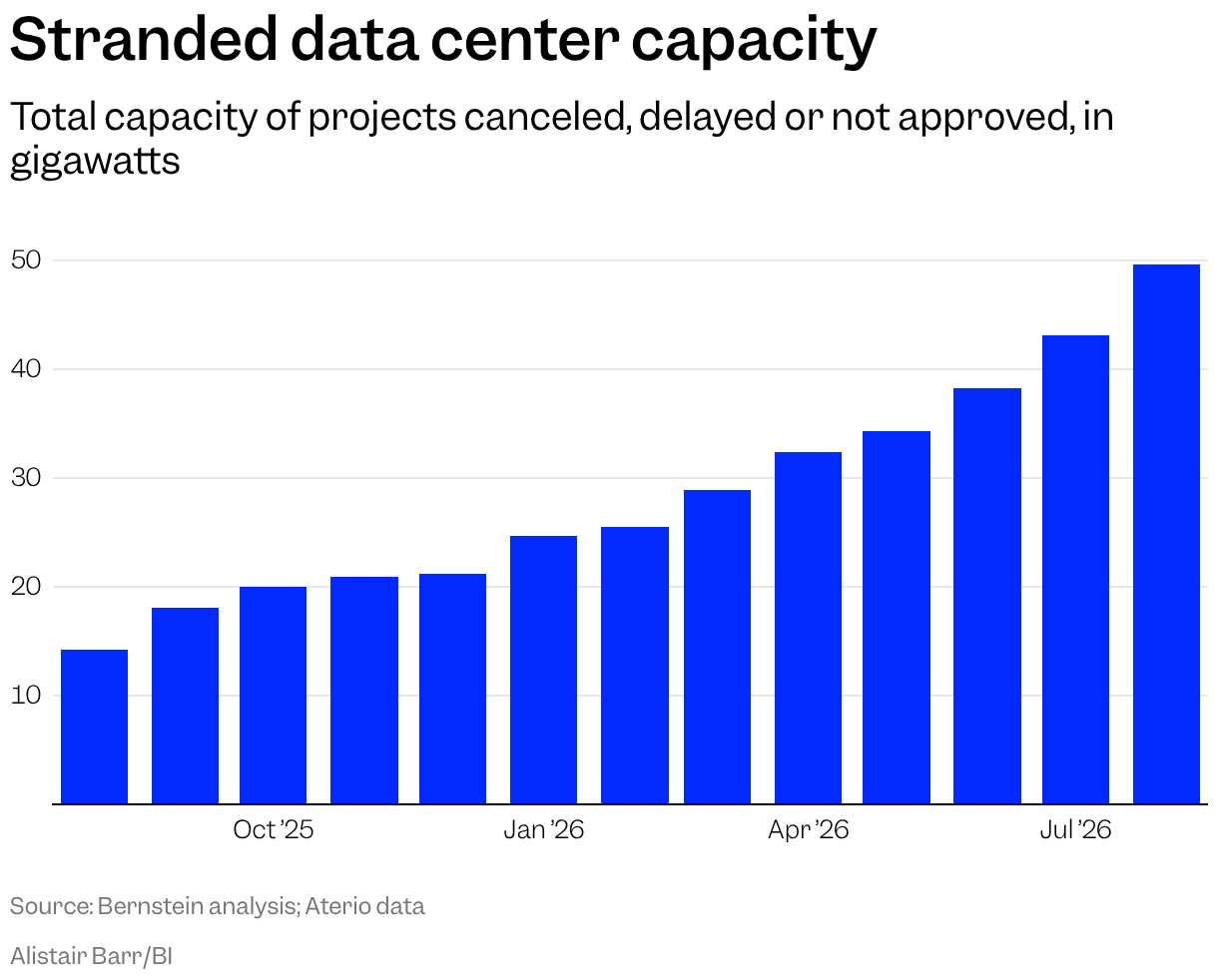
Column chart showing total stranded data center capacity rising from 14.2 gigawatts in August 2025 to 49.6 gigawatts in August 2026. Stranded capacity means projects canceled, delayed or not approved. Monthly totals are 14.2, 18.1, 20.0, 20.9, 21.2, 24.7, 25.5, 28.9, 32.4, 34.3, 38.2, 43.1, and 49.6 gigawatts.

The AI boom's three tiers

Toro sees three broad groups competing to build AI infrastructure.

At the top are the established technology giants, including Amazon, Microsoft, and Google. They've built data centers for decades and generally deliver on their commitments. Most of their projects will get done, he said.

In the middle are "neoclouds," newer companies such as CoreWeave that rent out computing power specifically for AI. Although they're more vulnerable to financing problems and delays, many are making solid progress, especially because some of these players already have access to electricity.

"We see them advancing quite well," Toro said. "Sometimes we see some delays, but it's not something significant or any kind of big capacity that is at risk."

Then come the newcomers making extraordinary promises. That's where most delays and cancellations happen, Toro said.

Even Amazon needs a backup plan

NEW CARLISLE, INDIANA - OCTOBER 2: In this handout provided by Amazon, a technician works at an Amazon Web Services AI data center in New Carlisle, Indiana on October 2, 2025.
A technician works at an Amazon Web Services AI data center in New Carlisle, Indiana.

Noah Berger/Getty Images via Amazon Web Services

Not every project that disappears was a fantasy, though. Even a top player like Amazon struggles sometimes to secure electricity and other supplies on time for these huge projects.

Business Insider's Eugene Kim reported exclusively this week on the challenges Amazon faces with its record AI buildout.

The biggest, most experienced tech companies deliberately pursue more potential data center capacity than they need because they know some developments will fail or get delayed.

Major AI companies were committing to three or four times the space and electricity they needed over the following two years, Jeffrey Moerdler, a data center lawyer, estimated during an interview with Bernstein analysts.

His reasoning: Of data center projects that haven't started construction, roughly a third will arrive on schedule, another third will be delayed, and the remainder won't happen.

Rezaei and Toro estimate that the top players don't over-commit that much — more like double the capacity they need at most.

The strategy provides a "Plan B," as Toro put it, in case of delays involving electricity, equipment, permits, local opposition, or other factors.

Texas has a ghost problem

AUSTIN, TEXAS - JULY 03: In an aerial view, the Decker Creek Power Station is shown on July 03, 2024 in Austin, Texas. The state of Texas is developing plans to double its Texas Energy Fund of $5 billion. The move seeks to bolster an expansion of the power grid, as new predictions of surges in electricity usage loom.
The Decker Creek Power Station in Austin.

Brandon Bell/Getty Images

This helps explain another extraordinary number.

Data center companies have requested connections for roughly 450 gigawatts of electricity demand on Texas' main power grid, more than five times the grid's roughly 85 gigawatts of existing capacity, according to Toro and others. 

Many of those requests are placeholders rather than firm construction plans. Toro calls them "ghost projects."

These speculative projects clog the waiting lists for electricity connections, making the electricity shortage look a lot worse than it actually is.

"Developers routinely spam projects across several sites, and many are speculative builds with no customer yet," Ryan McEntush, a partner at venture capital firm Andreessen Horowitz, wrote in a recent blog. "Often these new developers have never even plugged in a GPU, let alone a power plant."

Texas has paused applications to review and weed out projects that aren't serious. Toro, from Aterio, expects this to favor the established players at the expense of the bragawatts.

The real AI boom

None of this means the AI infrastructure boom is imaginary.

Aterio tracks thousands of buildings, including major projects already under construction. Bernstein estimates that nearly 80% of the capacity the largest technology companies are directly developing is credible.

And when speculative projects disappear, Rezaei doesn't expect a wave of unpaid debt. Many will fail before building begins, the stage when developers borrow serious money through project financing.

Some of those missing data centers were never really coming in the first place.

Sign up for the AI Insider newsletter here. Reach out to me via email at abarr@businessinsider.com
Read the original article on Business Insider

  •  

SpaceX offers employees 20% extra pay to help bring its Memphis supercomputers online

Elon Musk is in a black T-shirt that reads "Occupy Mars." He has two thumbs up and is standing next to the factory floor at SpaceX.
Elon Musk wants some SpaceX workers to move temporarily to Memphis.

Marvin Joseph/The Washington Post via Getty Images

  • SpaceX is offering employees a 20% pay bump to volunteer to help build its data centers in Memphis.
  • The company is looking for "leaders" who can "remove blockers," according to emails seen by BI.
  • Elon Musk said on Tuesday he often spends "four days a week" in Memphis working on SpaceX's data center buildout.

SpaceX is offering employees a pay bump to temporarily move to Memphis and help build its data centers.

Elon Musk's rocket company is giving employees a 20% pay increase if they volunteer to spend six weeks assisting its critical supercomputer buildout, according to an email seen by Business Insider.

"We now need leaders — current and emerging — to guide teams and remove blockers as we bring more supercomputers online," read the email, which was sent in early October to all SpaceX employees.

It specified that volunteers did not need to be managers already, adding that construction experience is a plus and that "drive matters most."

Employees who put themselves forward should expect to spend six weeks on-site in Memphis, Tennessee, or Southaven, Mississippi, where SpaceX is currently expanding its huge Colossus 1 and 2 data centers to meet surging demand for its compute business.

Volunteers "must be in good performance standing," with more than one year of tenure preferred, the email said. Employees who volunteer will receive a 20% premium on their base salary or on their hourly rate of pay for the period of their assignment, and be eligible for "bonuses tied to program success."

SpaceX did not respond to a request for comment.

The email described the reallocation of employees from other parts of SpaceX to assist the company's data center buildout as a "surge," a tactic employed by the company to divert employees and resources to mission-critical projects.

In 2022, CNBC reported that SpaceX offered employees pay bumps of between 10%-25% to temporarily relocate to Texas as it attempted to launch its Starship megarocket.

The company has been offering "surging" employees a 20% premium on their salary to move to Memphis since at least August, according to another email seen by Business Insider that called for "SpaceX experts and aces" to work for the next three months on the data center buildout. The email said the program is intended to end on December 31, 2026, but could be extended.

SpaceX will cover travel expenses and logistics, both emails said.

SpaceX's compute cash cow

The supercomputers in Tennessee and Mississippi, which were originally built by xAI before the startup was folded into SpaceX in February, have become a critical part of the company's business.

In SpaceX's earnings on Tuesday night, the rocket giant said AI revenue that includes leasing out its compute to other companies — including Anthropic and Google — had soared to more than $7 billion, nearly half SpaceX's entire quarterly revenue.

On the analyst call, CEO Elon Musk said that SpaceX was being "hounded relentlessly" by companies looking to rent out its compute, adding that they could have rented it out several times over.

SpaceX has been shifting executives in addition to rank-and-file employees to oversee its aggressive expansion. Business Insider previously reported that the company had placed a former Starship executive in charge of building out its compute capacity in Memphis.

Musk told investors on Tuesday he was also spending most of his time in the city as he looked to push SpaceX toward a target of bringing an extra 10 gigawatts of compute online by the end of 2027.

"I've been spending, personally, a lot of my time in Memphis, often four days a week," the SpaceX CEO said. He previously said he was living in an Airstream trailer on the site.

Do you work at SpaceX and have any information to share? Get in touch with this reporter at tcarter.41 on Signal or tcarter@businessinsider.com. Use a personal email address and a nonwork device; here's our guide to sharing information securely.

Read the original article on Business Insider

  •  

Trump suggests a community 'dividend' to defuse data center backlash

President Donald Trump
Trump said that data center companies should pay a "dividend" to local communities.

Andrew Harnik/Getty Images

  • President Donald Trump said data center companies should pay a "dividend" to local communities.
  • In a Truth Social post, Trump said the payments could boost the controversial projects' popularity.
  • Data centers have sparked widespread public backlash, worrying some investors.

President Donald Trump said that data center companies should pay local communities a "dividend" to make their projects "popular."

In a Truth Social post early Wednesday, Trump urged companies to "MAKE DEALS," but did not provide details on how much money they should return to communities or individuals where data centers are being built.

"I have watched the process closely, and Data Centers that were highly unpopular in a certain area, have become extremely popular when a financial deal is struck," he wrote in the post.

There's been a growing backlash against data center construction across the US, with some saying the projects are noisy, raise electricity bills, and compromise the general quality of living.

Data centers are becoming an increasingly important issue in next month's midterm elections, and some politicians have shifted how they talk about the projects in recent months. Data Center Watch, a research project run by 10a Labs, found that in the first quarter of this year, at least 75 data center projects were delayed or canceled due to local opposition.

Some companies have already started trying to placate unhappy locals with money or discounts.

This summer, Elon Musk's SpaceX offered eligible Memphis residents a 50% discount on its Starlink internet service, tied to its growing AI build-out in the city. NorthPoint Development opted for a pure cash incentive and said it would pay every household in a Pennsylvania township $10,000 if it got permission to build a data center, the Wall Street Journal reported last month.

In his Wednesday post, Trump also referenced one of his previous efforts: having tech companies cover their power costs when they build data centers to help keep local electricity prices flat.

Several tech leaders agreed to do so in March, when they signed the "Ratepayer Protection Pledge," which mandates that companies provide or pay for the power generation and electricity needed for their AI projects, among other commitments.

Trump closed his Wednesday post by saying that building data centers under his newest stipulations would be "GREAT FOR THE U.S.A."

Read the original article on Business Insider

  •  

Amazon is buying billions in Nvidia AI systems it can't yet turn on

Amazon CEO Andy Jassy

David Paul Morris/Bloomberg via Getty Images

  • AWS expected to get $5 billion of Nvidia GB300 racks, followed by $3 billion more each month.
  • Some of these GPU systems are being stored elsewhere due to lack of data center power.
  • Amazon CEO Andy Jassy sees AI as a major opportunity, but getting capacity online is a challenge.

Amazon is racing to secure AI hardware earlier than before, even as data center power shortages leave some GPU systems waiting in warehouses.

Under a new Early Rack Receipt process, AWS expected to receive roughly $5 billion in Nvidia's GB300 server racks at US facilities before final deployment, according to August internal emails reviewed by Business Insider. The company projected roughly $3 billion more in GB300 racks each month "for the foreseeable future," one of the emails said.

Some AWS sites had room for more racks but not enough available power to turn them on, people familiar with the effort said, leaving finished equipment to be staged at intermediary warehouses until the facilities were ready.

At least one AWS team did not have "a clear forecasted path" for getting the incoming racks into data centers at the time, according to one of the emails.

Dark GPUs

A lack of new electricity capacity is one of several bottlenecks slowing the buildout of some AI data centers. This has led to a phenomenon known as dark GPUs, where AI chips and servers are purchased but can sit idle due to power supply issues or other challenges. (Dark GPUs can also refer to system design flaws that mean this gear isn't fully used after being plugged in).

This is partly why financial pressure is mounting on big data center projects. Money must be spent upfront to secure supplies of Nvidia GPUs and other valuable AI components. But if some data centers aren't ready to run, those early investments can tie up huge amounts of cash. Debt financing can fill in the gaps, but the market has become less willing to lend against some of these projects lately.

Trade-off

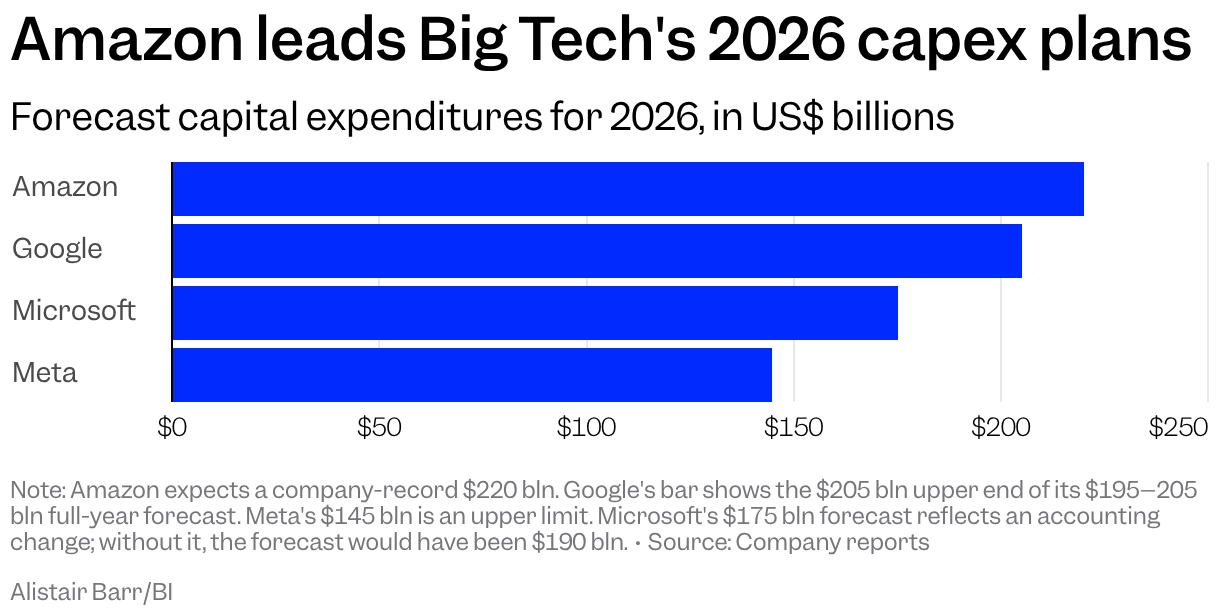
Amazon's early-rack program is one piece of the cloud leader's broader AI buildout, which is putting new pressure on its cash flow, as Business Insider exclusively reported this week. Amazon expects roughly $220 billion in capital expenditures this year — more than any Big Tech peer. Its free-cash-flow turned negative last quarter for the first time since 2023, and could stay negative for a while.

For AWS, the trade-off is securing scarce GPU racks before competitors do, even if some data centers are not yet ready to turn them on. But taking ownership earlier can tie up billions in equipment before it starts generating cloud revenue.

Previously, AWS took ownership of a finished rack only upon delivery to a data center, according to internal documents. Under the new approach, it can pay for and record certain racks earlier in the supply chain.

An Amazon spokesperson said the company routinely stages finished hardware near deployment sites so it can install it once capacity becomes available, calling the practice "best business practice." The spokesperson added that Amazon has long-established systems for tracking infrastructure assets and disputed that the broader company lacked a path for getting racks into data centers.

Amazon CEO Andy Jassy previously said the company has a "clear line of sight" to strong returns from its AI investments, calling the technology a "once in a lifetime opportunity."

"We've been through this cycle with the first big AWS growth wave, and liked the results," Jassy wrote in Amazon's annual shareholder letter. "We expect to feel similarly about this next wave."

Have a tip? Contact this reporter via email at ekim@businessinsider.com or Signal, Telegram, or WhatsApp at 650-942-3061. Use a personal email address, a nonwork WiFi network, and a nonwork device; here's our guide to sharing information securely.

Read the original article on Business Insider

  •  

Amazon knows how to build big. The AI boom is testing just how big it can go.

Prasad Kalyanaraman, vice president of infrastructure services at Amazon Web Services

BASTIEN INZAURRALDE/AFP via Getty Images

  • Amazon is on an unprecedented spending spree to build more AI data center capacity than anyone else.
  • The company has extensive experience, yet even it's struggling to bring capacity online fast enough.
  • Internal documents show Amazon getting bilions of dollars of Nvidia GPUs before they can be deployed.

At an internal staff meeting in September, AWS CFO John Felton had a joke for Prasad Kalyanaraman, the executive overseeing much of Amazon's AI infrastructure expansion.

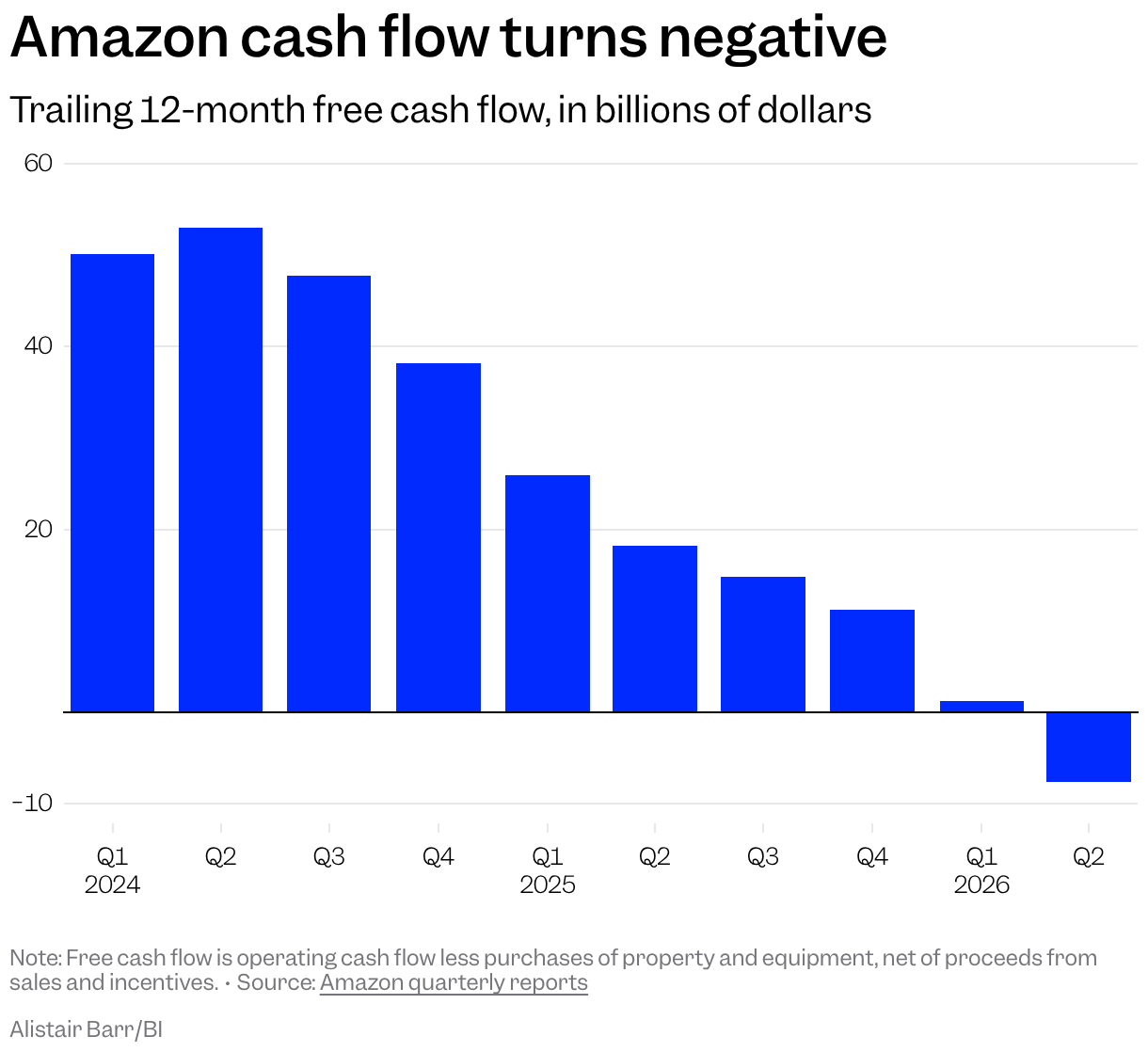
"You've taken us free cash flow negative as a company, so congratulations," Felton said, according to a recording of the meeting obtained by Business Insider.

The remark was lighthearted. But it captured a stunning reversal.

Just two years ago, Wall Street was debating what Amazon would do with its growing cash hoard. Now, cash flow has evaporated as Amazon embarks on its biggest bet ever, spending $220 billion this year alone to build the physical backbone for AI.

At the meeting, Kalyanaraman did not dispute Felton's premise. Amazon's machine-learning and AI business is "hugely free cash flow negative," he said, adding that he expects the company's free cash flow to remain negative for "the next couple of years or so."

Column chart of Amazon’s trailing 12-month free cash flow at all 10 quarter-ends from Q1 2024 through Q2 2026. It starts at $50.149 billion, peaks at $52.973 billion in Q2 2024, and declines to negative $7.604 billion in Q2 2026.

Amazon has made big bets before. It spent heavily on cloud computing, fulfillment centers, and its delivery network long before they became some of the company's most valuable assets. Investors questioned those investments at the time, but Amazon ultimately built enormous, profitable businesses from them.

AI is testing this playbook at a far larger scale. Amazon is committing hundreds of billions of dollars to data centers, servers, and power before investors know how quickly those investments will generate revenue.

The company is the best, or among the best, at building data centers, with decades of experience. But the size and complexity of these projects, and the bottlenecks holding progress back, are challenging — even for such a respected cloud pioneer.

Internal documents reviewed by Business Insider and people familiar with the matter show the company trying to coordinate a sprawling industrial system whose parts move on different schedules. A delay in power, equipment, or construction can leave billions of dollars in hardware waiting — and Amazon's cash tied up — while forecasts and costs keep shifting.

Why Amazon thinks it will work

Amazon says it has strong evidence that the capacity will be needed. AWS revenue grew 37% in the second quarter, its fastest pace in 18 quarters, while its backlog reached $496 billion.

CEO Andy Jassy thinks the company has a "clear line of sight" to strong financial returns from this record investment cycle. In his latest annual shareholder letter, he called AI a "once in a lifetime opportunity" and said Amazon would not be conservative in its investments.

"We've been through this cycle with the first big AWS growth wave, and liked the results," Jassy wrote. "We expect to feel similarly about this next wave."

Column chart of 2026 capital expenditure forecasts in US dollars: Amazon $220 billion, a company record; Google $195 billion to $205 billion, shown at the $205 billion upper end; Microsoft $175 billion after an accounting change, compared with $190 billion without that change; and Meta up to $145 billion. Source: Company reports.

Investors are concerned by the scale of the industry's expansion, especially as AI data centers are costing more to build and taking longer to complete.

The market is "repricing anything that funds multi-year builds against revenue that arrives later," Dan Ives, an analyst at Yorkville Ives, wrote in a recent report. Growing uncertainty around data center permitting and the political fight over electricity prices have given investors another reason to question how quickly these investments will pay off, he added.

Racks, but not enough power

One major industry challenge is securing enough power to run the equipment that goes inside data centers. This includes expensive racks of servers that contain GPUs and other chips that train and run AI models and services such as ChatGPT.

Internal emails from August show Amazon preparing a new "Early Rack Receipt" process for an expected wave of server racks carrying Nvidia's GB300 chips at US facilities before final deployment.

One Amazon email projected the company would take delivery of about $5 billion of Nvidia GB300 racks in August, followed by another roughly $3 billion each month "for the foreseeable future."

Some AWS data center sites had room for more racks but not enough available power to turn them on, people familiar with the effort said, leaving the equipment to be staged at intermediary warehouses until the facilities were ready. These people asked not to be identified discussing sensitive matters.

Timing and coordination

Usually, Amazon doesn't pay for racks until the gear is put into a data center, leaving suppliers to carry the cost of the equipment in transit, according to the internal documents obtained by Business Insider. This helps the company conserve cash.

However, the intensity of the AI data center building boom has made this type of coordination harder. Amazon has to compete more for scarce resources as it jockeys with rivals for access to Nvidia GPUs and other AI components.

Under the new "Early Rack Receipt" process, Amazon now takes ownership of these racks earlier in the supply chain, rather than waiting until the equipment reaches a data center.

The means spending cash sooner. And any delays getting the racks installed and plugged into a reliable power source potentially pushes back the moment when revenue starts flowing from these assets.

At least one AWS supply chain team did not have "a clear forecasted path" for getting racks into data centers, according to one of the emails reviewed by Business Insider.

An Amazon spokesperson said the company routinely stages finished hardware near deployment sites so it can be installed once power capacity is available, calling that approach "best business practice."

The spokesperson added that AWS has "long-established systems" to track infrastructure assets and disputed that the broader company lacks a forecasted path for getting racks into data centers.

This problem is not unique to Amazon.

Bernstein analysts wrote in a recent note that power permits, cooling systems, electrical equipment, construction, and hardware all move on separate schedules.

"Timing is imperfect," the analysts said.

"Inherently uncertain"

John Felton, Chief Financial Officer of Amazon Web Services

Chris Jung/NurPhoto via Getty Images

During the internal staff meeting in September, Felton, the AWS CFO, described the broader problem eloquently: "How do you work in the future when the future is inherently uncertain?"

Kalyanaraman, the AI infrastructure leader, said Amazon's internal outlook for the return on its AI investments had improved. But the assumptions behind those returns keep shifting.

"The forecast is changing on a daily basis," Kalyanaraman said. "The world that we live in is extremely dynamic."

Those shifting assumptions include when data centers will be ready and how much equipment AWS needs to keep on hand, he explained.

An eight-week supply buffer might be routine for a smaller company. But at Amazon's scale, Kalyanaraman said, this could mean holding "billions and billions of dollars" worth of additional equipment inventory — tying up precious cash.

Frugality meets the AI boom

Such tensions are especially striking for Kalyanaraman, a 21-year Amazon veteran who earlier this year was promoted to the elite S-team that reports directly to Jassy.

Amazon's founding story is defined by frugality. It famously used cheap doors as desks when founder Jeff Bezos started in Seattle in the mid-90s.

Kalyanaraman has absorbed this lore into bones. In late 2023, as AWS faced slower growth and layoffs, he urged employees to do more with less. "Frugality breeds innovation," he said back then.

That instinct still shapes his approach. In the September meeting this year, Kalyanaraman told Felton that AWS tries to make major investments at the "last responsible moment," when it has the clearest possible view of demand.

"If we can wait to spend the capital as late as possible, it's better for us," he said.

Amazon CEO Andy Jassy

Bloomberg/Getty Images

But the frenetic pace of the AI boom makes this principle difficult to follow. By the time demand is fully visible, the servers, power, and construction capabilities that AWS needs may no longer be available. That puts pressure on the company to commit more money sooner to secure supply and meet its data center capacity goals.

Kalyanaraman recalled telling Jassy in 2023 that AWS would "surely" be out of its capacity crunch by 2027. Instead, Amazon still expects demand to exceed its available capacity in 2027, the AI infrastructure chief said during the meeting this September.

Secured Power at Risk

Getting enough electricity may be the biggest challenge for an industry leader like Amazon.

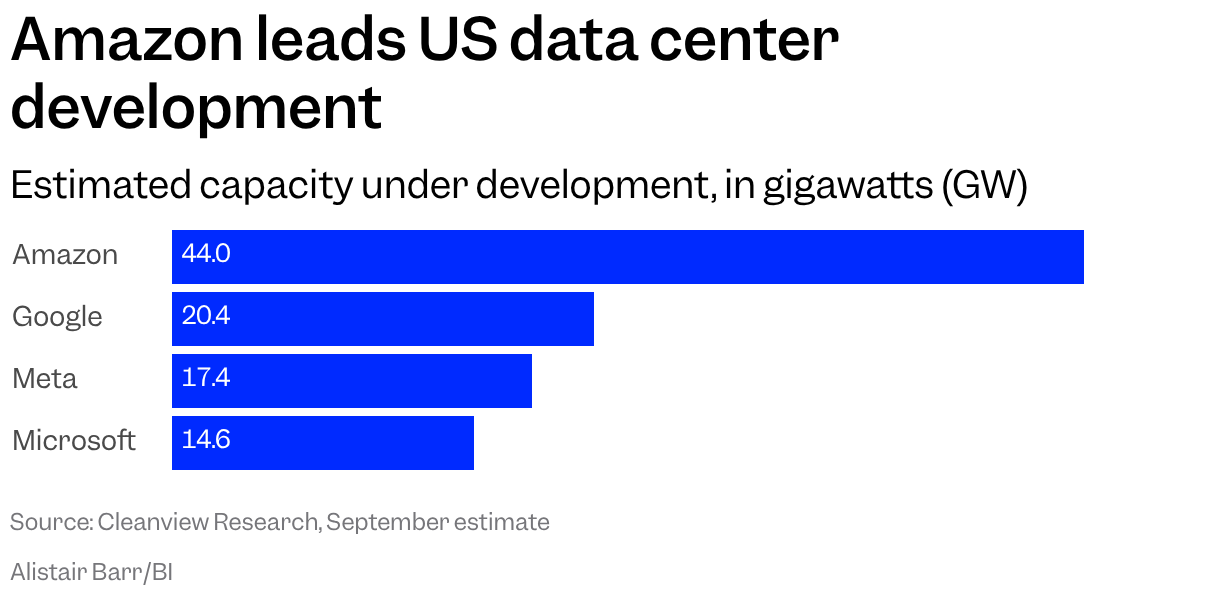
The company has 44 gigawatts of data center capacity under development across 16 states, more than double Google, Meta, and Microsoft, according to Cleanview Research estimates.

Column chart of estimated US data center capacity under development: Amazon 44 gigawatts, Google 20.4 gigawatts, Meta 17.4 gigawatts, and Microsoft 14.6 gigawatts. Source: Cleanview Research, September estimate.

An internal AWS dashboard called "Secured Power at Risk" tracks utility and regulatory constraints affecting electricity capacity AWS has lined up for its data centers.

The risks include transmission bottlenecks, requirements to reduce use during grid stress, and "use it or lose it" provisions that can jeopardize capacity if a data center project misses usage or construction milestones.

In other words, AWS is not simply waiting for electricity to arrive. It is managing a portfolio of commitments that can become more costly if a data center project is delayed.

Maryland proposals

A submission to Maryland's utility regulator last year, obtained through a public records request, illustrates the kind of exposure that can accompany massive data center buildouts.

Amazon told the Maryland Public Service Commission that large data center customers could help pay for grid upgrades or bring new power capacity to market without burdening other electricity ratepayers.

The company also proposed setting aside collateral to help utilities get more comfortable with the large investments needed to generate more electricity for data centers. Amazon proposed three years of collateral so that if a large electricity customer abandoned unused capacity, the utility would have time to re-sell the power.

The proposal is not evidence that AWS has made such a payment or posted collateral. It does, however, show that large data centers can face extra financial obligations, beyond their own electricity bills, if projects are delayed or cancelled.

The Amazon spokesperson said such utility rules are not unique to AWS. The company has not disclosed how much cash it has paid upfront to secure power.

New constraints 'keep popping up'

The AI buildout also incurs expenses that are harder to model than a conventional capex plan.

In the September meeting this year, Kalyanaraman said that while reviewing plans for gigawatts of capacity in West Texas, AWS confronted a labor problem: There weren't enough nearby pipefitters, electricians, and other skilled workers to build the facilities.

The company's response, he said, was to pay to construct housing complexes near its data centers so workers could live there for the two or three years needed to complete the projects.

Even the crates used to ship servers have become a planning issue. It may seem absurd to worry about the price of a container when servers cost hundreds of thousands of dollars, Kalyanaraman said. But at AWS's scale, where the company needs so many crates, even trivial items can become a material expense.

"We have new constraints that keep popping up," Kalyanaraman said.

Have a tip? Contact this reporter via email at ekim@businessinsider.com or Signal, Telegram, or WhatsApp at 650-942-3061. Use a personal email address, a nonwork WiFi network, and a nonwork device; here's our guide to sharing information securely.

Read the original article on Business Insider

  •  

Louisiana residents are training for jobs at Meta's largest-ever AI data center: 'Why not get in now?'

Louisiana Delta Community College Data Center Technician Program.
Louisiana Delta Community College in West Monroe has a mock data center room on campus.

Business Insider

  • Meta is building its largest-ever data center in northeast Louisiana.
  • A local community college is training data center technicians to work there.
  • Data center jobs are in high demand and can pay handsomely.

Thousands of construction workers are arriving in a small Louisiana community to build Meta's largest-ever data center.

Less than an hour away, at the Louisiana Delta Community College's West Monroe campus, the next generation of data center professionals is hoping to join their ranks.

"I see AI is really the future. We're going to need data centers to house all the data," Eric Crowe Jr., 27, told Business Insider. "I feel like it will become a very lucrative job to have, and we're going to need more of them. Why not get in now before it gets oversaturated?"

Crowe Jr. is among the students who signed up for the community college's Data Center Technician program. The four-week, nearly $3,700 training course prepares students to enter the data center industry, which is rapidly expanding to support the age of AI.

Construction for Meta's nearly 10-million-square-foot data center, Hyperion, is underway in rural Richland Parish, where business is now thriving as workers flood the region.

Meta says the project will include over 7,500 trade workers on-site at peak construction and support 1,000 operational jobs once completed. For residents living in the region, where there's no state minimum wage law and agriculture is a major industry, the new opportunity to make good money in a growing sector is too enticing to ignore.

"This is a stepping stone into the real world," Dan McCarty, director of Workforce Trades at Louisiana Delta Community College, said. "We prepare you with a résumé. We work on every aspect of employability, safety, and technical skills."

The inaugural class graduated in March, and all 11 students received job offers from IES Communications, which employs people working on Meta's project. McCarty said the program, which is available at the Winnsboro campus, now produces about 24 graduates a month.

In the past, a lot of people, including myself, had to leave here to find the good jobs," McCarty said. "Now they're 30 minutes down the road."

'It's a no-brainer'

Louisiana Delta Community College Data Center Technician Program.
Louisiana Delta Community College's program lasts four weeks.

Business Insider

The Data Center Technician program teaches students everything from operating equipment to workplace safety. They'll also have the opportunity to earn several certificates. During a class this September, nine students huddled around Fletch Batchelor, an instructor specializing in broadband, as he explained how to splice fiber optic cables.

"Do you know why squirrels chew through cable? They like a high fiber diet," Batchelor said, earning some chuckles.

The program encourages students to take a hands-on approach, which Trey Wadley, 30, said he appreciates. During the class, he participated in a live cable splicing demonstration. Wadley, who's interested in cybersecurity and has a background in the automotive industry, learned about the program while scrolling on Facebook, which, incidentally, is owned by Meta.

"As I learned more about Meta and data centers, they piqued my interest," he said. "I said, 'Okay, this might be something that fits me and that I'm into. I decided to give it a try."

Wadley, who recently welcomed a baby girl, wants to find work with Meta's project so he can work locally. Without Meta's project, Wadley said he'd likely have gone looking for job opportunities in Texas.

Louisiana Delta Community College Data Center Technician program.
Trey Wadley and Fletch Batchelor examine fiber optic cables during the Data Center Technician program.

Business Insider

The push from tech companies and the US government to build out the nation's AI infrastructure has made data center jobs a valuable new path to lucrative employment. Business Insider reported in August that the median pay for data-center facility managers was $134,000, which is 64% higher than that of other facilities managers. The median pay for project managers at data center facilities was $115,000, a 12% increase over similar roles at other facilities.

Wadley said he's hoping to secure a position paying between $25 and $30 an hour. So is Crowe Jr., who previously handled packages and drove for FedEx, where he was averaging $14 an hour.

"Here, I could make about $25 to $30 per hour. It's a no-brainer for lots of people to pivot," Crowe Jr., who has an interest in cybersecurity, said.

McCarty said entry-level positions could earn as much as $24 an hour, but students who've graduated told him they reached $27 to $28 an hour within six months.

Booked and busy

Residents in Richland Parish, like other communities in the United States, have mixed feelings about the data center. While some say it will bring new jobs and boost the local economy, others are concerned about environmental impacts and disruptions to their daily lives.

It's a reality not lost on Crowe Jr. and Wadley, but they said it's unlikely that AI will simply go away.

"I think we should focus more on solutions to how we can coexist with it," Wadley said.

Students attending the technician class in September also spent time in a mock data center on campus, where they could apply skills they'd learned in class in a real-world setting.

Louisiana Delta Community College Data Center Technician program.
Students gain hands-on experience while learning at Louisiana Delta Community College.

Business Insider

While they tinkered with the equipment, John Bradley, a broadband workforce development instructor, said having access to a similar program as a teen would have been invaluable.

"I chose an alternative route, which was in construction and oil fields, but if I'd have had something like this that would've guaranteed me a good job, good money from the get go, and I could travel if I wanted to, I would've loved that," he said.

Bradley said the program prepares its graduates to be hired by contractors specifically working with Meta.

"We have a special email that we give to different contractors we spoke with that are waiting for them to graduate our class," Bradley said.

However, working at Meta isn't a requirement of participating in the program. Bradley said the skills students learn during the course are transferable, especially as data centers and similar construction jobs become more popular.

"It doesn't have to be a Meta data center. You may decide, 'Hey, I don't want to work in data centers anymore.' You still got banks, you still got IT departments," Bradley said. "You can literally go to work anywhere you want and use the same trades you learned here."

McCarty said the program has a backlog of students trying to get into the course, so they're hoping to expand their offerings.

"We've got some that are fresh outta high school, but we've had students up to 60 years old," he said. "It doesn't really matter what age you decide to get into this trade. Anyone is welcome to come in and learn it."

Read the original article on Business Insider
  •  
❌