Speaking on the company's earnings call on Wednesday, CEO Elon Musk compared training the EV maker's humanoid robot to raising a toddler.
Musk said that while Tesla's autonomous driving models can learn from data collected by its massive fleet of vehicles, its Optimus robot has to learn by watching people do tasks and practicing them itself, a process similar to how humans learn.
"You can see this when you have a toddler, and they initially are sort of wobbly, and they don't know how to do things, and eventually, they learn to wipe their own ass, which is a big milestone," Musk told investors.
"They learn to read and do all sorts of things, and they learn this by playing. And we actually need Optimus to play at scale in order to have it be really good at tasks in the real world," Musk said.
Musk said Tesla expects to begin delivering Optimus to consumers by the end of 2027.
Bloomberg/Getty Images
The Tesla CEO added that the company was building out an "Optimus Academy" where prototypes can practice a wide range of tasks and generate training data to teach future versions of Optimus.
"For Optimus to get the training data we need, we actually need to make a lot of Optimi. So we need to make, I think, on the order of 10,000 or 20,000 bots and then have them do self-play," said Musk.
Tesla said on Wednesday that it had begun production of Optimus at its Fremont factory, with Musk saying the company expects to begin delivering Optimus to customers by the end of next year.
The near-trillionaire cautioned that production would be "somewhat bumpy" and that development of the humanoid robot still has some way to go.
He listed the challenges of designing durable yet responsive robotic hands, as well as AI capable of handling open-ended tasks, among the main hurdles Tesla faces.
Tesla is not alone in setting up robot academies to provide training data for humanoid robots.
Unlike large language models like ChatGPT, which were trained on the vast corpus of text data available on the internet, robotics faces a shortage of real-world training data to teach humanoids to navigate the physical world.
Other startups, such as Texas-based Apptronik, have also set up "data factories" where robots load conveyor belts and sort objects to generate training data to combat the data shortage.
Elon Musk says he'll give every child in the US a piece of his space company, SpaceX.
Kent NISHIMURA / AFP via Getty Images
Elon Musk said he's going to give every child in the US a share of his space company, SpaceX.
That would amount to $10.7 billion, based on SpaceX's stock price and the 72 million US children.
Governments and billionaires have previously explored ways to spread corporate ownership.
Christmas came early: Elon Musk wants American children to own stock in his space company, SpaceX, next year.
Musk wrote on X around 1 a.m. Monday that he planned to make the donation next year — "the first of many," he said. SpaceX went public this summer.
Giving one share to each of the estimated 72 million US children would cost roughly $10.7 billion at SpaceX's closing price of $147.92 on Friday. Musk's 4.77 billion SpaceX shares were worth about $706 billion at that price, so the gift would reduce his holdings by about 1.5%.
President Donald Trump said on Truth Social on Monday that the shares would be transferred through Trump Accounts, tax-advantaged investment accounts for eligible American kids launched this summer. Under temporary Treasury rules, donated shares generally cannot be sold for five years.
"This is exactly what was envisioned when we created TRUMP ACCOUNTS," Trump said. "Bringing together the GREAT PRIVATE SECTOR, Elon and so many more, to invest in our children."
The White House said nearly 70 million Trump Accounts have been created. Numerous entities have agreed to contribute, including a $6.25 billion donation from billionaire couple Michael and Susan Dell for children in lower-income zip codes. In July, SpaceX President Gwynne Shotwell and her husband pledged personal SpaceX shares worth at least $321 million, prioritizing lower-income communities.
The White House, Elon Musk, and SpaceX did not immediately respond to a request for comment from Business Insider.
Musk's plan to give away SpaceX stock raises questions about a new kind of billionaire philanthropy: Gifting people shares in a company instead of cash.
Giving millions of children a stake in SpaceX could give them money to use later in life — but the value is tied to a single company's stock. And history shows that efforts to spread corporate ownership can yield uneven results, from big investment returns to stakes being sold for quick cash.
Here are other historical efforts to share wealth or spread corporate ownership among everyday people.
US Sen. Mike Gravel's 1978 share proposal to Alaskans
Senator Mike Gravel (D) represented Alaska from 1969 to 1981. He ran for president in 2008 and 2020.
Original Caption
In 1978, US Sen. Mike Gravel proposed a statewide ownership corporation that would have given Alaskans, including children, stakes in major energy and other business projects. The Trans-Alaska Pipeline System was one potential investment.
The idea was that Alaskans would benefit from an economic boom and any rising asset values. However, the plan never materialized.
Alaska instead developed a dividend system that draws on its preexisting Permanent Fund, a state fund established in 1976 with oil royalties that invests in stocks, bonds, and other assets. It began paying annual cash dividends to eligible Alaskans in 1982.
The Permanent Fund still continues today, with a $1,200 dividend distributed to every eligible Alaskan adult and child who applied in 2026. The initial dividend this year was set at $1,000, but recipients also got an extra $200 energy-relief payment.
Eastern Europe's 1990s mass privatization experiment
In the early 1990s, governments across Central and Eastern Europe used voucher programs to turn citizens into shareholders of former state-owned companies.
MICHAEL EVSTAFIEV/AFP via Getty Images
Following the collapse of the Soviet Union in 1991, several countries in Central and Eastern Europe used voucher programs to transfer former state-owned companies into the hands of everyday people.
Russia began distributing privatization vouchers to roughly 144 million people in 1992. Russians could use them to buy shares in former state companies, exchange them for shares in investment funds, or sell them for cash.
Czechoslovakia used a similar system, allowing adults to buy low-cost voucher books and use the points to bid on company shares or invest through funds. After Czechoslovakia split in early 1993, the Czech Republic continued its voucher program, while Slovakia canceled its planned second wave of voucher privatization.
Other countries, including Poland, Romania, Bulgaria, and the Baltic states, adopted their own versions of mass privatization.
The programs were designed to rapidly create broad public ownership. But many recipients sold their vouchers for cash amid economic uncertainty, rather than retaining shares.
Evžen Kočenda, a professor at Charles University's Institute of Economic Studies, said that the program was a good idea at the time, given the region's poor economy, but that ultimately, the vouchers were not 'real money,' but rather a financial asset.
Kuwait's 2019 national stock exchange privatization
Kuwait privatized some of its national stock exchange, Boursa Kuwait, to its citizens throughout 2019.
YASSER AL-ZAYYAT/AFP via Getty Images
Kuwait privatized Boursa Kuwait, the operator of its national stock exchange, in 2019, and gave Kuwaitis the opportunity to purchase a stake in the company.The only requirement for registration was that the individual was a Kuwaiti citizen.
Those who participated — about 83,000 of the country's 4.4 million — were initially allocated up to 70 shares each. The initial public offering share price was set at 100 Kuwait fils, roughly $0.33 per share.
Following the privatization, Kuwaiti citizens and private-sector investors together owned roughly 94% of Boursa Kuwait. The Public Institution for Social Security held the remaining 6%.
The Kuwaitis who participated saw a huge return on investment: When Boursa Kuwait debuted on the public market in September 2020, its shares rose more than 10-fold from their 100-fils IPO price, closing at 1,055 fils, or about $3.41.
Today, the privatization is widely regarded as a major success in the investment world, and Boursa Kuwait has described it as the Middle East's only privately owned stock exchange.
Tesla has begun production of its humanoid robot, Optimus, in Fremont, California.
Musk said he expects to begin delivering Optimus to customers at the end of 2027.
Musk said it will take at least a year to produce 20,000 Optimus units a week.
Tesla has begun producing its long-awaited humanoid robot, Optimus, at its Fremont factory, the company said in its quarterly earnings report.
"The bots coming off this line are the first production-quality bots that we have manufactured," Tesla said, saying the current manufacturing process is "suitable for a commercial product."
"There's still some things we need to tweak about the design, because you need to deliver a robot that is safe and reliable and has long duration," CEO Elon Musk said on Tesla's Q3 earnings call. "It can't, like, wear out after a month."
Musk said the company will take at least a year to scale up Optimus production to 20,000 units a week in Fremont. He said he expects to begin delivering Optimus to customers at the end of next year.
Musk tempered expectations about how quickly Tesla can scale up Optimus production because it is "such a radically new product." He said the early stages of production will be "somewhat bumpy" because "there's like 10,000 things that have to go right" to build the robot. One of the big challenges Musk outlined is building robot hands.
Musk said Tesla is building an "Optimus Academy," where robots will practice tasks and generate data to improve the AI models that power them. The company also plans to install its next-generation AI5 chip in Optimus in April, which will give the robots more computing power and be a "big step change in intelligence," Musk said.
The latest version of Optimus has not been unveiled. Musk said he expects to release a video of Optimus within one or two months. He previously said Tesla was keeping the robot under wraps to prevent competitors from copying its design.
Tesla stopped producing the Model S and Model X at its Fremont, California, plant earlier this year to make room for an Optimus line designed to eventually produce a million robots a year. A second line under construction in Austin is planned to have an annual capacity of 10 million robots.
Tesla is competing in a crowded humanoid market. Agility Robotics, which plans to go public, has deployed its Digit robot across nine customer facilities, while Figure AI has announced deployments in logistics and distribution centers this year. Sunday Robotics, 1X, and Weave Robotics are preparing to ship robots into homes this fall.
Have a tip? Contact Rya Jetha via email at rjetha@businessinsider.com or Signal at rjetha.07. Use a personal email address and a non-work device; here's our guide to sharing information securely.
On Wednesday, the Elon Musk-led automaker reported that its operating income fell 56% year over year to $718 million in the third quarter — below Wall Street's estimates of $746.3 million — while overall revenue of $28.05 billion came in a smidge below analysts' estimates.
Tesla pointed to higher operating expenses tied to its AI efforts, or "SI"/"Super Intelligence" as Trump prefers, and other R&D projects. Lower regulatory credit revenue and weaker energy storage gross profit also weighed on profitability, while lower vehicle prices hurt revenue.
"While we continue to execute on innovations to reduce the cost of manufacturing and operations, over time, we expect our hardware-related profits to be accompanied by an acceleration of SI, software and fleet-based profits," the company reported.
It's not all bad news for Tesla's profits. The company is still solidly in the green, and it beat on the bottom line. Tesla reported 48 cents in adjusted earnings per share, above the 44-cent analyst consensus estimate. Free cash flow of $1.5 billion was also a surprise after Wall Street had expected negative free cash flow of $4.92 billion.
The automaker also sees areas of profit growth in its future: autonomy subscriptions are trending up, and Tesla said it's offering the right, region-specific product mixes.
During the earnings call, Tesla's chief financial officer, Vaibhav Taneja, said the company is experiencing its "highest backlog" of vehicles in four years. The company, he said, is trying to increase vehicle production.
He also added that Tesla has secured $30 billion of borrowing to support expected capital expenditures, but the company doesn't expect to "make any draws under any of the new facilities in this calendar year."
"The main takeaway is that Tesla's surprisingly positive cash flow quarter did not come from stronger profits," Thomas Monteiro, senior analyst at Investing.com, said after the report.
"Added to the equation is the fact that Tesla's AI spending remains broadly inefficient, with research costs up nearly 70% and operating margins down to just 2.6%, while at SpaceX AI is already one of the biggest sources of revenue," the analyst added.
The new quarter has already made waves
The Tesla story continues to play out in real time, and it's had a busy month since the fourth quarter kicked off in October.
On Tuesday, during SpaceX's earnings call, Musk said that Tesla and SpaceX had each formed committees to explore a potential merger. Both companies are helmed by Musk — and he owns billions of dollars in stock of each.
Anticipation of the potential mega-merger has been building around the companies for much of 2026, and has only increased since SpaceX went public. Musk said he was not included in those committees and that calling the merger a foregone conclusion "would be overstating it."
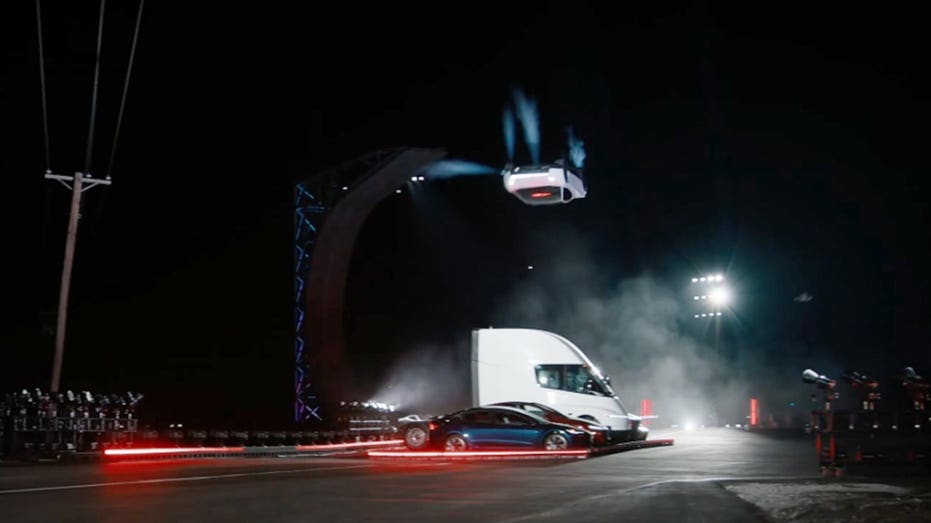
It also came less than a week after Tesla held its high-flying demo for the Roadster. The sports car performed a gymnastics routine, including briefly jumping into the air and twirling over a lineup of other Tesla vehicles.
Tesla had a high-flying demo for the coming Roadster. It came nine years after the company first floated the sports car.
Tesla
It came nine years after Tesla first promised to relaunch the Roadster. Musk first showed off a prototype of the vehicle in 2017 and predicted a 2020 product launch.
When Gibney was approached with the idea to do a documentary on the Tesla and SpaceX CEO in 2022, his plan was straightforward: Tell the story of how Musk used his businesses to become one of the most powerful figures in the world.
But when he was ready to deliver a two-hour feature film on Musk two years later, HBO issued him a directive a filmmaker rarely hears: Make it longer.
It was 2024, and the breadth of Musk's influence had expanded into the political sphere. With Gibney's subject helping President Donald Trump campaign for a second term, then later spearheading the second Trump administration's Department of Government Efficiency, Gibney's story had expanded. His documentary would need to, too.
Elon Musk.
Finn Gomez/Getty Images
The result is "Musk," an incisive, nearly four-hour documentary that chronicles the personal, professional, and political life of the richest man in the world. From his controversial acquisition of Twitter, which he renamed X; to his relationships with the mothers of his children; to the accidents tied to Tesla's self-driving feature, Gibney's film is a comprehensive look at the scope of Musk's power and influence in the 21st century.
Gibney even found a clever workaround for featuring Musk in the doc after he declined to be interviewed. Playing on Musk's belief that we are all living in a simulation, the director used AI to craft an avatar of Musk, who speaks in quotes amalgamated from his past interviews.
Of course, a man as powerful and outspoken as Musk has already voiced his displeasure with someone else controlling his narrative. After the movie's world premiere at the Venice Film Festival in September, Musk threatened to sue Gibney's production company for defamation. Musk has also bashed the movie on X, stating: "Gibney just assembled a hit list of people who either have an axe to grind or don't even know me (but still have an axe to grind). He has ZERO integrity. Horrible human."
Hearing from angry subjects is nothing new for Gibney, who was the subject of the Church of Scientiology's full-page newspaper ads decrying his work over 10 years ago tied to the premiere of his documentary "Going Clear: Scientology and the Prison of Belief."
"With Elon Musk — and he's not unique in this, but he specializes in it — he begins tweeting horrible things about people and the next thing you know, this army of followers and bots starts to gin up the rage matrix," Gibney told Business Insider.
Not that he's rattled yet. With decades of documentaries speaking truth to power under his belt, Gibney has developed thick skin and some top-secret harassment survival strategies.
"Let's just say I've taken some precautions," he said.
For the latest interview in Business Insider's Director's Chair series, Gibney talks about creating an AI Musk, being followed by Scientologists, and his nerve-racking experience in a self-driving Tesla.
On creating an AI Musk avatar and making the movie longer
Business Insider: You thought you had finished this movie in 2024. Was it daunting to go back down the Elon Musk rabbit hole when HBO asked you to?
Alex Gibney: Yeah, it was daunting. We had to renegotiate the budget and all sorts of other stuff. But I got why HBO wanted that. And when Musk hitched his wagon to Trump, it was clear: This is big.
I started out making a film about 21st century power, which in this case involved economic power but also tech power. Now, add to that political power, and suddenly it's a really big story.
Was AI Musk in the original movie?
The idea of it was. We had put in a placeholder for it, but we were also anticipating that maybe we might get an interview with him at some point.
It was kind of an epiphany to do it this way. It came out of past experience: What's the workaround for somebody who won't or can't talk to you? In "Client 9" and "Zero Days," we came up with workarounds that fit those stories. The key here was to find a workaround that would fit this story. That's how we ultimately came up with the idea of the avatar.
Did it unlock anything in you regarding using AI tools in your work in the future?
I think it will depend on the project. AI has become a kind of suitcase term for everything from Siri to AGI. In this instance, this was a human effort using AI tools, which revolved mostly around sync; in other words, making the lips and the body sort of move with the voice. But there was also designing the room, what he was going to wear, the gamer chair.
The further we pushed it and the more interested we got in AI with the company we used, Makemake A.I., this idea of memes and looking at his own image, that's where we came up with certain scenes where you see the back of his head and he's watching himself. Those were things that we improvised on.
Tesla CEO Elon Musk attending the start of the production at Tesla's "Gigafactory" on March 22, 2022 in Berlin.
PATRICK PLEUL/POOL/AFP/Getty Images
On the qualities Musk and Elizabeth Holmes share and Tesla's image
I couldn't help but think about your Elizabeth Holmes doc, "The Inventor," when watching "Musk." The "fake it 'til you make it" ethos that's baked into Silicon Valley, has that been fascinating to observe? Both Holmes and Musk are founders who are amazing salespeople hoping that what they bet on takes off.
I think there is a similarity with Elizabeth Holmes. What was rattling around in my head through this was confidence. Musk, like Holmes, was able, through force of confidence, to convince people of things that they knew not to be true. That became a superpower.
The big difference between Tesla and SpaceX and Elizabeth Holmes is that those are real products. The Tesla S is a great car. These reusable rockets are extraordinary, and we show the magnificence of that in the film.
Not to take anything away from him or those companies, but there's also the bullshit factor. The idea of going to Mars and the promises. And you can see how they repeat themselves and get bigger and bigger. Oh, yeah, full self-driving! I'm sorry, Tesla's self-driving option is still a level two system, and over 60 people have died.
(Editor's note: Tesla has maintained that its Autopilot feature requires constant driver attention, and that its vehicles issue prompts warning the driver to stay alert and hold the steering wheel.)
The things you highlight about Musk's involvement in DOGE and suggesting he influenced the election are shocking, but the things you highlight about Tesla got me the most. The battery swapping, the self-driving car feature. Were you shocked by how much smoke and mirrors there are at Tesla?
Yes. It was something that I didn't know when I started. And as you mentioned, fake it 'til you make it. They just faked it. Mostly, it was in order to raise the stock. The economic fundamentals of the company never warranted a high stock price, but if you can convince people that the CEO is a genius and also that it's not really a car company — it's a tech company, so some super inventions are coming down the road — you can persuade people to gin up the stock.
(Editor's note: Musk and Tesla did not respond to a request for comment.)
On almost hitting a child while using the self-driving feature on a Cybertruck
You rode a self-driving car yourself; you did it with a Cybertruck for the movie.
I did. There was a cut where we included a four-minute sequence of me in the Cybertruck. I went to the San Francisco Tesla showroom and wanted to drive a Cybertruck, and they showed me how to turn on the self-driving feature. I pressed "Go," and off I went to the other side of the city. It was like a 20-minute ride there and back.
What's interesting is for most of the trip it was kind of astoundingly good. But then there were moments when it was astoundingly bad, sometimes in ways that were played to safety. Like, I was trying to merge onto a very busy thoroughfare, and cars kept coming, and if it were me as the driver, I would nudge out there, but full self-driving couldn't figure that out, so I sat there for 10 minutes. Other instances, it couldn't decide what to do at critical moments and almost hit a pedestrian.
It came uncomfortably close to a child. The child kind of came from the side out of a parked car. It's not something you would anticipate, but it was really scary.
Why didn't you put that in the movie?
Ultimately, the legal case that we spotlight in the movie was a far more powerful deep dive. There were mortal consequences. A woman died. And the deep dive into the evidence itself was so much more powerful. If I had only done a film about Tesla, I probably would have included it.
Elon Musk.
Christopher Furlong/Getty Images
On the movie's fate on HBO and the consequences of checking power
The greatest irony in all of this is this movie could have been out a year or so ago, but HBO asked you to make it longer. Now Paramount and Warner Bros. Discovery have merged, so HBO is now under David Ellison, who once considered bringing on Musk as an equity investor in Paramount. Are you concerned HBO will not air "Musk"?
I was concerned until recently. I'm always on the alert. But I've been told that they will air it and that even David Ellison very well knows about it and promises he will air it.
You have worked with HBO forever.
Yeah, I love them.
So if they are telling you it is going to happen, you believe them.
But what you learn is, shit happens. [Laughs.] Executives change. Circumstances change, and the next thing you know, it's not what you thought. But, for now, we are making very specific plans about when it's going to come out, which is likely in January.
Because of where the industry is going — fewer networks and distribution options, and the options available are mostly run by conglomerates often looking for political cooperation — for the kind of stories you tell, are you looking for alternative distribution avenues in the future with your company, Jigsaw?
We have a skunkworks inside Jigsaw to try to solve some of these distribution problems.
In this new environment, films that people desperately want to see are being held back from audiences. The platforms tell you people don't want to see them, but that's just not true. HBO is the exception, but what a lot of the platforms are doing is investing in predictable, least objectionable programming. A lot of the platforms want it to be like the cereal aisles at the grocery market: they are all the same cereal, but different variations between Rice Krispies and Froot Loops. They can predictably get people invested in that mixture of salt and sugar that keeps them coming back for more without providing anything that is nutritious.
So the avenue is theatrical, like it was a decade-plus ago. "Musk" is out in theaters through Bleecker Street, and that's powerful because it's a lot harder to put the genie back in the bottle when it's already out there.
Checking power sometimes comes with blowback. You have experienced everything from Julian Assange leaking the script to "We Steal Secrets" before that movie came out to Scientologists following you around after you made "Going Clear." Do these things wear on you, or do they fuel you?
I mean, given the fact that I haven't stopped, it seems to be fueling me. That said, it doesn't mean I don't need to take precautions. But I'm still motivated by the idea of people with enormous power abusing it at our expense; that seems to be a spur for me.
When it comes to Elon Musk, he's the richest and arguably the most powerful person in the world, so it can have these devastating consequences. Ashley St. Clair has security because the X platform has a way of directing vitriol at people. And Elon can say it's just free speech, but he knows very well that by doing what he does and by the platform tweaking its algorithm for replies and rage addiction, he knows that his statements are going to be amplified in a really horrible way that may result in harm to an individual.
(Editor's note: Musk, who has called himself a "free speech absolutist," described X's policy in 2022 as "freedom of speech, not freedom of reach," saying the company would limit the reach of negative posts but not delete them. Musk did not respond to a request for comment about his X posts and the company's algorithm.)
Is your experience with Musk's followers different from what you experienced with Scientology?
Scientology is a little different, but people did come up to me in dark parking lots in a way that was discomforting. But what some ex-Scientologists told me was, "What they are doing is they aren't going to put a rattlesnake in their mailbox; they are trying to get inside your head. So once you understand that, just don't let them inside your head." That turned out to be very wise advice.
Scientology was tough, and when my film on Assange came out, the vitriol on Twitter was extreme, and I wasn't prepared for that. What I've come to learn is you have to know your enemy.
This interview has been condensed and edited for clarity.
Elon Musk wants some SpaceX workers to move temporarily to Memphis.
Marvin Joseph/The Washington Post via Getty Images
SpaceX is offering employees a 20% pay bump to volunteer to help build its data centers in Memphis.
The company is looking for "leaders" who can "remove blockers," according to emails seen by BI.
Elon Musk said on Tuesday he often spends "four days a week" in Memphis working on SpaceX's data center buildout.
SpaceX is offering employees a pay bump to temporarily move to Memphis and help build its data centers.
Elon Musk's rocket company is giving employees a 20% pay increase if they volunteer to spend six weeks assisting its critical supercomputer buildout,according to an email seen by Business Insider.
"We now need leaders — current and emerging — to guide teams and remove blockers as we bring more supercomputers online," read the email, which was sent in early October to all SpaceX employees.
It specified that volunteers did not need to be managers already, adding that construction experience is a plus and that "drive matters most."
Employees who put themselves forward should expect to spend six weeks on-site in Memphis, Tennessee, or Southaven, Mississippi, where SpaceX is currently expanding its huge Colossus 1 and 2 data centers to meet surging demand for its compute business.
Volunteers "must be in good performance standing," with more than one year of tenure preferred, the email said. Employees who volunteer will receive a 20% premium on their base salary or on their hourly rate of pay for the period of their assignment, and be eligible for "bonuses tied to program success."
SpaceX did not respond to a request for comment.
The email described the reallocation of employees from other parts of SpaceX to assist the company's data center buildout as a "surge," a tactic employed by the company to divert employees and resources to mission-critical projects.
In 2022, CNBC reported that SpaceX offered employees pay bumps of between 10%-25% to temporarily relocate to Texas as it attempted to launch its Starship megarocket.
The company has been offering "surging" employees a 20% premium on their salary to move to Memphis since at least August, according to another email seen by Business Insider that called for "SpaceX experts and aces" to work for the next three months on the data center buildout. The email said the program is intended to end on December 31, 2026, but could be extended.
SpaceX will cover travel expenses and logistics, both emails said.
SpaceX's compute cash cow
The supercomputers in Tennessee and Mississippi, which were originally built by xAI before the startup was folded into SpaceX in February, have become a critical part of the company's business.
In SpaceX's earnings on Tuesday night, the rocket giant said AI revenue that includes leasing out its compute to other companies — including Anthropic and Google — had soared to more than $7 billion, nearly half SpaceX's entire quarterly revenue.
On the analyst call, CEO Elon Musk said that SpaceX was being "hounded relentlessly" by companies looking to rent out its compute, adding that they could have rented it out several times over.
SpaceX has been shifting executives in addition to rank-and-file employees to oversee its aggressive expansion. Business Insider previously reported that the company had placed a former Starship executive in charge of building out its compute capacity in Memphis.
Musk told investors on Tuesday he was also spending most of his time in the city as he looked to push SpaceX toward a target of bringing an extra 10 gigawatts of compute online by the end of 2027.
"I've been spending, personally, a lot of my time in Memphis, often four days a week," the SpaceX CEO said. He previously said he was living in an Airstream trailer on the site.
Elon Musk made the remarks during SpaceX's earnings call.
Andrew Harnik/Getty Images
Elon Musk said AI rivals are clamoring to rent SpaceX's compute.
SpaceX plans to split compute between its internal uses and outside customers.
The company could rent out its compute "several times over if we said yes to everyone," Musk said.
SpaceX's AI rivals are clamoring to rent computing power from the artificial intelligence and rocket company, CEO Elon Musk said.
"We are also, frankly, hounded relentlessly by every hyperscaler and by dozens of smaller companies to rent more of our compute," Musk said during SpaceX's third-quarter earnings call Tuesday.
Musk said SpaceX could rent out the company's compute "several times over if we said yes to everyone."
SpaceX, however, is reserving a chunk of that capacity for its own AI ambitions, including scaling its AI chatbot Grok and Cursor, the coding startup it recently acquired.
Musk said SpaceX is seeking to devote roughly half of its compute to internal uses and rent out the other half to third parties. That balance could change month to month, he said.
"It's going to be dynamic," said Musk. "And obviously, our approach is to rent at the — effectively the spot market rate as opposed to sign these long-term deals."
The company expects the value of compute to increase as AI models improve and ultimately generate "more useful intelligence per watt," said Musk.
"And the value of that compute is proportionate to the useful intelligence per watt," Musk said, adding that rental rates for older Nvidia H100 chips have climbed from when they were new.
"I think that's likely to continue," said Musk. "I think we're going to face a shortage of super intelligence compute. And that shortage is going to remain for a long time."
Musk likened the situation to Monty Python's famed cheese shop sketch, in which a customer repeatedly asks for different cheeses only to find that none are available.
"We've actually tried to offload some of our inference compute to other cloud providers so that we can use more compute for training," the CEO said. "And we get the cheese shop sketch."
"I wouldn't over-rotate on what I would call one carrier of low band spectrum," John Stankey said Wednesday, referring to Elon Musk's Starlink.
Win McNamee/Getty Images (Musk); Lluis Gene/AFP via Getty Images (Stankey)
AT&T CEO is brushing off concerns that satellite-based internet could threaten his business.
"I think LEO constellations are fantastic for delivering bandwidth to rural areas," he said.
When it comes to where lots of people live, he said fiber-connected performance can't be beat.
Elon Musk wants SpaceX to become a major US mobile carrier. AT&T CEO John Stankey says: not so fast.
AT&T has an advantage from years of investment in dense urban and suburban areas, he said on AT&T's third-quarter earnings call, a day after Musk and SpaceX chief operating officer Gwynne Shotwell reported more than 22 million monthly Starlink Mobile users.
"Our competitors cannot and will not match our operating proficiency, network performance, or exceptional converged value proposition," Stankey said.
Stankey sees a use case for satellite-based internet to soften the edges of fiber-connected and 5G networks, especially in places where it's too expensive to build out the physical infrastructure, he said.
"I think LEO constellations are fantastic for delivering bandwidth to rural areas," he said, using the acronym for low-Earth orbit satellite arrays.
Shotwell said Tuesday that Starlink recently got FCC approval to launch 15,000 V2 satellites. She also noted a recent agreement to acquire a portfolio of low-band transmission spectrum, or wireless frequency licenses, which better penetrate buildings to reach indoor devices.
Stankey was unimpressed.
"How you perform indoors, of course, is extremely important, and we shouldn't think about those as being nominal loads," he said. "They're significant loads, even with robust Wi-Fi networks that are out there."
This is especially critical in crowded environments like stadiums and hospitals, where he said AT&T has been focused on beefing up signal support.
"I wouldn't over-rotate on what I would call one carrier of low band spectrum," he said, referring to Starlink.
That's an even more ambitious timeframe than Musk has previously given. He said in August that SpaceX was internally projecting $1 trillion of revenue in 2030, and there was a "non-zero" chance it could reach that amount in 2029.
Musk made his latest pronouncement within hours of saying on SpaceX's third-quarter earnings webcast that annual recurring revenue could reach between $500 billion and $1 trillion by the end of 2027.
In a post-earnings note, JPMorgan forecast SpaceX would generate $254 billion of revenue in 2027.
If SpaceX were to generate $1 trillion in revenue in 2028, that would represent a 53-fold increase in three years. It earned just under $19 billion in 2025. It shared its historical financials prior to going public this summer.
After the bell on Tuesday, SpaceX — the company behind Falcon rockets, Starlink satellites, X, and AI chatbot Grok — posted close to $15 billion in revenue last quarter, up 161% from the same period of 2025.
The key driver was its super-intelligence division, where revenue surged 830%, from around $800 million to $7.6 billion. SpaceX attributed the growth to new cloud services agreements, around $600 million of revenue from its recent Cursor acquisition, and increased Grok adoption by enterprises.
To put Musk's $1 trillion revenue figure in context, Amazon and Walmart, the two highest-revenue companies on the planet, both generated a little over $700 billion in net sales last financial year.
Musk is floating the possibility that SpaceX could generate more than 40% more revenue than either of them did last year, in about two years' time.
It's unclear whether Musk is including Tesla, which generated about $95 billion of revenue last year, in his newest revenue figure. He revealed on Tuesday that Tesla and SpaceX have formed committees to explore a potential merger.
Susannah Streeter, Wealth Club's chief investment strategist, told Business Insider by email that a tie-up could "combine expertise in AI, chips, robotics and connectivity."
But she added that "bringing two enormous businesses with very different operations and capital demands under one roof would be a hugely complex undertaking."
Streeter said that notching $1 trillion in annual revenue in 2028 would be a "very tall order" and require an "extraordinary leap in the scale of the business."
"Moving the goalposts from 2030 to 2028 suggests he is increasingly confident that several growth drivers could accelerate at once, but there is a difference between a target that is technically possible and one that is commercially realistic," she added.
Neil Wilson, UK investor strategist at Saxo Bank, told BI by email that Musk's latest revenue figure is "pushing it" and "would imply such an enormous pull-forward in demand as to defy credibility."
Wilson added that he'd "never say never" about SpaceX hitting $1 trillion of revenue, "but by 2028 I'd say the chance is zero, whatever Elon says!"
SpaceX's earnings reveal growing capex as well as AI revenue that surpassed its Starlink business for the first time.
The company reported overall capex spending in line with estimates. It projected it could double in the current quarter.
AI-related spending was slightly less than expected but still more than previous quarters.
SpaceX's second-ever earnings report revealed it's spending more than ever on AI — and that could soon double.
SpaceX reported spending $16.4 billion on AI-related capex in the third quarter, continuing the acceleration of AI spending seen in recent quarters.
SpaceX spent roughly $19.6 billion on overall capital expenditures in the third quarter as Grok maker continues its AI buildout. That was squarely in line with what Wall Street analysts were expecting.
Of that $19.6 billion, SpaceX reported spending $16.4 billion on AI-related capex. Analysts were expecting $16.9 billion.
SpaceX expects capex to balloon in the current quarter, with CFO Bret Johnsen forecasting $35-$40 billion due to new compute coming online. Johnsen also said SpaceX expects to quickly see returns on its investments.
"At current pricing, new compute deployments are generating a payback of less than a year," he said.
SpaceX's stock was trading up 4% after hours following the results. The company is broadcasting the earnings call on X, becoming one of a small list of companies to broadcast video of the gathering.
During the earnings call, SpaceX CEO Elon Musk said that chips are no longer the biggest constraint to AI buildout.
"So talking about SpaceX superintelligence, SpaceXSI — "sexy," whatever — so as I think people are starting to realize the constraints on deployment of superintelligence is more in power and cooling and infrastructure than it is in chips," he said.
SpaceX's AI revenue grew significantly quarter-over-quarter to $7.6 billion — ahead of analysts' estimates of $6.3 billion. This report also marks the first quarter since SpaceX purchased Cursor.
That revenue means that SpaceX's AI segment officially brought in more revenue than its Starlink business. Starlink brought in $5.2 billion for the quarter.
SpaceXAI has since rebranded as SpaceXSI, following Musk's alignment with President Donald Trump's preferred rebranding of "artificial intelligence" to "super intelligence."
One area where SpaceXSI has found some success is leasing its compute to Anthropic, Google, and Reflection AI. During the company's last earnings call, SpaceX CFO Bret Johnsen said the leasing arrangements had generated $1.6 billion in additional revenue.
Musk said that SpaceX is being inundated with lease requests.
"We are also frankly hounded relentlessly by every hyperscaler and by dozens of smaller companies to rent more of our compute," he said. "So we could rent out our compute several times over if we said yes to everyone."
Overall, he said the allocation for SpaceX compute is something "that's going to change from one month to the next."
"I guess as a rough approximation, our goal is to kind of split it 50/50 more or less, where half of the compute is used internally, and half of it is rented to others," he said. "But that number could shift 60/40 one way or the other."
Correction: Tuesday, October 20, 2026 — An earlier version of this story incorrectly included two values for SpaceX's overall capex. The correct value is $19.6 billion.
Elon Musk appeared in a live video stream for SpaceX's third-quarter earnings call.
Andrew Harnik/Getty Images
It was lights, camera, and action for SpaceX's second earnings call as a public company.
SpaceX's third-quarter earnings call included a live video stream of its top execs.
CEO Elon Musk used video to share dramatic shots of Starship.
SpaceX's superfans may have found their next must-see TV.
The rocket and AI company's third-quarter earnings call on Tuesday included a live video stream featuring SpaceX's big three: CEO Elon Musk, COO Gwynne Shotwell, and CFO Bret Johnson.
The video, which opened with cinematic shots of SpaceX's products, featured the executives seated at a table speaking to the camera from theSpaceX Starlink factory in Bastrop, Texas, with SpaceX-branded water bottles in front of them.
"In order to understand the nature of the universe and all these fundamental questions, we must expand the scope and scale of consciousness," Musk said in a recording that played over images of space and the moon, with the result looking far more like a trailer for a sci-fi film than the start of a corporate earnings report.
Musk wore a black T-shirt featuring a logo for Grok, SpaceX's AI assistant, and a black leather jacket, a classic sartorial choice famously favored by another Big Tech CEO.
SpaceX also used the video format to share a recap video of a recent Starship flight as well as a dramatic video simulation, complete with orchestral music, of an upcoming flight in which the company's giant mechanical arms and standwill try to catch both the booster and the ship, calling it a "profound technology milestone in the history of civilization and consciousness."
While earnings calls generally include live audio, live video streams are far less common. SpaceX's first earnings report as a public company in August did not include video. Netflix, Duolingo, and Robinhood have all livestreamed their earnings calls.
Netflix has streamed live video of its earnings calls for years, including its latest call on Tuesday, which featured its co-CEOs. Robinhood's CEO told The Verge last year the company's video earnings call was inspired by the NBA post-game interview.
SpaceX reported a significant increase in both AI spending and revenue. The stock was up 5% in after-hours trading.
During SpaceX's Tuesday earnings call, Elon Musk said both of the companies had created "special committees of independent directors" to discuss a potential merger.
Musk, who helms both companies and owns billions of dollars in stock of each, said he can't be part of those exploratory groups.
"Do I think it would be a good idea? Yes," he said on the call. "But at the end of the day, the shareholders have to be supportive of this, and particularly on the Tesla side, we will need a 50% vote of all shares, not just those who vote, but of all shareholders."
He said clearing that bar would be "quite a high hurdle."
It's the most detailed update investors have received yet on the idea of a tie-up, which has been the subject of much chatter since SpaceX went public earlier this year. If the companies ultimately decide to merge, it would further consolidate Musk's business empire, often referred to as Musk Inc.
His businesses have been on a consolidation kick. In 2025, xAI acquired Musk's social media company, X (formerly Twitter), and in February, SpaceX acquired xAI.
Musk also runs the brain-chip startup, Neuralink, and the tunnel-building firm The Boring Company. Both operate independently, but have had business collaborations within Musk Inc.
Tesla and SpaceX's stocks were up in after-hours trading following the news. SpaceX was up around 6.6% and Tesla 1.6%.
Musk sees clear benefits in tying the knot
"I do think there's a lot of merit to combining the companies as we are pretty much in the superintelligence singularity," Musk said during the call.
The most recent result of that partnership: On Thursday, Tesla demoed its long-awaited Roadster, which includes a version with SpaceX technology. The high-powered sports car's top trim will include cold-gas thrusters. The car launched, hovered, and flipped in the air during the demo.
While Musk is for the two companies tying the knot, he said investors shouldn't think it's a sure thing.
"I don't think we should necessarily assume that a SpaceX and Tesla merger is a certainty," he added. "That would be overstating it."
On Tuesday, during the company's earnings call, SpaceX said its satellite-internet service had 13.6 million consumer subscribers at the end of September, up 1.6 million from three months earlier. That fell short of the 14.2 million expected by Bloomberg analysts — though the company said the figure excludes hundreds of thousands of enterprise subscribers and aviation customers.
Still, Starlink is making a lot of money. Monthly consumer revenue per user rose 5% from the previous quarter, while enterprise and government revenue jumped 91% from a year earlier to $2.1 billion.
A big, important customer? Airlines. The company said that, as of the end of September, 3,800 total aircraft had been outfitted with Starlink equipment.
"Aviation remains a major growth opportunity, as we're still early in the installation phase with many of the largest carriers worldwide," CFO Bret Johnsen said on Tuesday's earnings call.
SpaceX's next venture: your phone
The company has recently focused on becoming a mobile provider.
On October 8, SpaceX announced it had agreed to buy a portfolio of low-band wireless spectrum from Grain Management. The deal gives SpaceX a key ingredient that could turn its Starlink satellite-internet provider into a direct challenger to Verizon, AT&T, and T-Mobile.
SpaceX said the spectrum would power Starlink Mobile, which it has described as a hybrid satellite-and-terrestrial network designed to work indoors, outdoors, and in cellular dead zones.
It also comes after SpaceX hinted that it saw itself as a challenger to mobile carriers during its first-ever earnings call in August. The company's president, Gwynne Shotwell, hinted that the company was considering building a "cellular base station on basically the gear that holds the Starlink broadband dish," rather than a ground-based system.
They said the market was worth $600 billion annually.
"I anticipate us to be able to acquire quite a few of their customers," Shotwell said.
During the earnings call, Shotwell said, "The vast majority of mobile connectivity is actually WiFi," an area where Starlink is already well-versed.
"Keep in mind, Starlink broadband does a lot of WiFi work as well," she said. "As far as the mix goes, I think we expect that the S-band spectrum will provide the majority. And then obviously, you need the low-band spectrum, the 800 megahertz spectrum, to basically penetrate buildings. So if you're not on WiFi, you can still receive the signal."
Musk said that there was probably a need for a longer presentation about their Starlink plans.
"I can say we do see a clear path to several hundred billion dollars a year in connectivity revenue," he said. "But I think we should lay — probably describe that in a — in more detail in a forum that's not limited to a few minutes at an earnings call."
Speaking on a newly released episode of author Walter Isaacson's "The Builders" podcast, Musk said his 130-day stint as a special government employee in the second Trump administration led him to that view.
Musk, the world's richest person, served as the de facto leader of the White House DOGE office from January to May 2025, where he sought to slash federal spending.
"I came to the conclusion that the only way we're going to solve the national debt is with AI and robots. We're not going to solve it by trying to save our way there," Musk told Isaacson, calling the latter "impossible."
The US national debt load hit a record $40 trillion in August and has continued to climb, according to Treasury data.
"Maybe if the president made that his, you know, primary goal, we could do that, but the problem is if you try to solve the deficit and stop wasteful spending, you make a lot of enemies in that situation," Musk said.
The Tesla and SpaceX CEO said political leaders in Washington are mostly unwilling to rein in federal spending enough to significantly shrink the deficit.
"The appetite is not there, and it's not just at the presidency. The appetite is not there at the presidency, the House, the Senate, or the judiciary," Musk said.
He added, "Basically, no one in authority in the government whatsoever, really, with maybe a few rare exceptions of like the Rand Pauls of the world type of thing, actually wants to reduce spending — no, they don't."
Musk estimated that "digital superintelligence" could boost the global output of goods and services by 20% to 30% — an increase he estimated could add roughly $30 trillion a year to the world economy.
"If you have robots and you get to space and can do a mass driver on the moon, then you can get to, I think, potentially a million times the size of the Earth economy," he said.
This could ultimately make money "irrelevant," Musk said.
"There will still be currency, but I think currency will be measured in fundamental physics metrics like wattage and tonnage, mass and energy," he said, predicting, "Conventional currency will not matter."
During the interview, Musk also reflected on his chainsaw-wielding time with the Department of Government Efficiency, admitting he got "carried away."
"I think I should have been more in the background and probably only had it last for a month or two, because at that point you've sort of seen most of what there is to see," Musk told Isaacson.
Musk said he should have left and "focused on AI a little sooner than I did."
Elon Musk says his descendants might have a "tiny fraction" of his wealth.
Jae C. Hong/AP
Elon Musk says "money becomes irrelevant" if he's right about what the future holds.
The Tesla and SpaceX CEO said AI and robots will be better than humans at everything.
The world's richest man said his fortune could be virtually gone within a few generations.
Elon Musk says money could be meaningless one day, and the vast majority of his wealth will likely be gone within a few generations.
The world's richest person predicted that advances in robotics and space travel will create a multiplanetary economy, at which point "money becomes irrelevant" and "conventional currency will not matter."
Value will be measured in mass and power or energy, he continued. "So that's my guess," he said, adding that it seemed a "pretty obvious" outcome to him.
The Tesla and SpaceX CEO shared his vision of a post-money future and his outlook on his personal fortune with his biographer, Walter Isaacson, on "The Builders" podcast. The interview was taped in early August and released on Tuesday.
Musk recommended earlier this year that people stop saving for retirement in 10 or 20 years, as he expects AI and other technologies to supercharge productivity and usher in an age of abundance where people can have "whatever stuff they want."
He made a similar argument to Isaacson, saying "there won't be anything that humans can do that the AI and the robots can't do better." People will likely turn to hobbies like growing their own fruits and vegetables, or making art, to find purpose in life, he said.
Musk's plans for his own money
Musk, who briefly became a trillionaire after SpaceX went public in June, topped the Bloomberg Billionaire Index at Monday's close with an estimated $920 billion net worth.
He defended his personal wealth on the podcast, saying that it mostly reflects his ownership of SpaceX and Tesla, and he needs large stakes in both companies to retain voting power and remain in charge.
His fortune is "going to be taxed quite heavily," Musk said, adding that there isn't "some magical way to avoid taxes" because "if there were, I would know about it."
Musk said his wealth will "get whittled down and a few generations from now — if money still matters, which I don't think it will — my descendants would have a tiny fraction of what I have."
He also outlined what he hopes his foundation will spend his fortune on after he's gone: "Continue the goals. Make life multi-planetary, extend consciousness to the stars, improve sustainable energy on Earth."
Notably, Musk pledged on Monday to gift a share of SpaceX to every child in the US next year, a contribution worth over $10 billion today.
His announcement has won praise from President Donald Trump, who hailed Musk's "incredible generosity" and labeled him a "legendary friend" in an X post.
Musk teased a charitable pledge in late July after Nobel economist Daron Acemoglu publicly challenged him over his prediction of a post-money future.
"If money won't matter in 2036, why don't you pledge to donate your current wealth of approximately $1 trillion to charity no later than 2036," Acemoglu wrote on X.
"I am actually going to do something along these lines!" Musk responded.
One of my favorite cartoons growing up was "The Jetsons." The Jetsons were a futuristic family living among the clouds with a fully automated life, from a robot maid named Rosie to technology that could make your dinner or do your laundry in just a few seconds at the push of a button. Everyone’s favorite aspect of this futuristic cartoon lifestyle boiled down to one element, which has become somewhat of a benchmark for technological progress: flying cars. And with Tesla’s recent exhibition, we are one step closer to that Jetsons-esque reality.
If you haven’t seen the video, Tesla did a demonstration of their forthcoming Roadster vehicle, slated for 2028 production. The car swooped up a half-loop ramp reminiscent of Matchbox car stunts. At the top of the ramp, the car, which was upside down at the top, flipped over in midair. Then, thrusters seemed to suspend the car in midair, before helping guide it gently back down to land on the ground.
For just a few moments, that car flew, and it was truly awe-inspiring.
The reactions to this engineering feat and demonstration spectacle are somewhat of a Rorschach test. Those who love building, progress, technology or who are just generally optimistic have seen this demonstration as a formidable, impressive achievement. Those who like to see things torn down or are generally naysayers or obstacle formers react with "it’s not that big of a deal" or give other criticisms.
Fortunately, America still has enough people committed to the entrepreneurial spirit to attract the likes of Elon Musk and provide a good home base for his talented team members and others who want to see Musk, America and human beings in general succeed.
It isn’t hyperbole to say that Elon Musk is one of, if not the greatest, entrepreneurs of modern times. Regardless of any personal feelings or thoughts about Musk, if you can separate the art from the artist, or in his case, the entrepreneur from his business accomplishments, objectively, Musk has done the unthinkable time and time again. And we, as a country, are better off for him doing it from America as his home base.
As my husband and I talked about Musk’s varying accomplishments, from his early work in online payments to his achievements in electric vehicle manufacturing and AI, to his SpaceX being able to catch rocket boosters returning to the Earth from outer space upon landing, and now this latest hovering automobile. We discussed that Musk reportedly held discussions with Taiwan Semiconductor Manufacturing Company regarding a potential collaboration for his "Terafab" semiconductor facility in Texas. I mentioned that chip buildout had faced major challenges elsewhere, and my husband pointed out that it is different under Musk, saying, "In fact, we need 16,000 more Elon Musks."
No, Elon Musk does not succeed on his own. There are many team members alongside him in undertaking outrageous projects and often making them succeed. But there’s something about Musk’s vision, leadership, hiring and willingness to inspire confidence in others, both on his team and in the general public, that makes his teams continue to be successful. And we need more of that.
We need to not only attract and inspire those who may even be just a little bit like Musk, to dream bigger and bolder, to take calculated risks and try and try again when things don’t work the first time. And we need to make sure that we incentivize that behavior, instead of trying to penalize it or throw up roadblocks.
In our own government, which is supposed to help vs. hinder entrepreneurs, we have politicians like Senator Elizabeth Warren, who is noted for going after Elon Musk because of his success, instead of trying to figure out a way to foster more Musk-like successes. After a vastly-ridiculed post made earlier this week from Warren lamenting, of all things, a possible merger between companies that make various spices and condiments, Mike Solana, CMO of Founders Fund and EIC of Pirate Wires, posted on X (also owned by Musk), highlighting the stark differences between the politician Warren and the creator Musk.
His post said, "liz warren: we’re gonna stop the mayonnaise company from buying a hot sauce company." He then said, "elon musk:," and included the video from Musk of the Roadster’s hovering feat, perfectly illustrating how some in our country are erecting barriers and others are breaking barriers.
America was founded on an idea of individual rights and incentives that rewarded successful pursuits, with such rewards growing at scale. We are very fortunate that we have Elon Musk and others who are pushing boundaries, bringing us into new frontiers, allowing Americans who work for him, who invest with him and who use his products or services to benefit alongside of him.
President Donald Trump praised Elon Musk's pledge to give SpaceX shares to children through Trump Accounts.
Kent NISHIMURA / AFP via Getty Images
Trump praised Elon Musk's plan to give one SpaceX share to every child in America next year.
The pledge could be worth about $10.6 billion at SpaceX's current price.
Musk and Trump have a rocky relationship, but appear to be back on the same page in recent months.
Elon Musk’s pledge to give every child in America a share in SpaceX has already paid one dividend: effusive praise from President Donald Trump.
"A BIG THANK YOU to our legendary friend, Elon Musk," Trump wrote Monday, calling the proposed gift an act of "incredible generosity."
He said the shares would go to children through Trump Accounts, the investment accounts created under his administration.
A BIG THANK YOU to our legendary friend, @ElonMusk, for his incredible generosity in giving SpaceX Stock to millions of American children through TRUMP ACCOUNTS! This is exactly what was envisioned when we created TRUMP ACCOUNTS — Bringing together the GREAT PRIVATE SECTOR, Elon and so many more, to invest in our children, by far our greatest and most important asset, and give every American Child a piece of the American Dream. Thank you Elon! President DONALD J. TRUMP
It was an enthusiastic response to Musk's commitment earlier in the day. "Next year, I will give one of my SpaceX shares to every kid in America," he wrote on X. "This will be the first of many."
Significantly, Trump shared his praise in a post on X, a platform he has eschewed in recent years since launching his social network, Truth Social.
Trump was barred from Twitter in 2021 after the Capitol riot, and while his account was reinstated after Musk bought and renamed the platform, the president has been an infrequent poster since then.
Musk's $10 billion donation promise
There are roughly 72 million children in the US, and SpaceX stock closed Monday at about $148 a share. At that price, one share apiece would put the gift's value at around $10.6 billion. Its eventual value will depend on SpaceX’s share price at the time the stock is transferred.
Trump has been waiting for this particular contribution. In July, he said he thought Musk would donate SpaceX stock to Trump Accounts, even as he referred to their very public falling-out as a "little dispute."
SpaceX President Gwynne Shotwell and her husband had already pledged shares for more than 2 million children’s accounts.
Musk and Trump have a turbulent relationship. The world's richest man was one of Trump's biggest financial backers in the 2024 election, spending more than $200 million to help elect him. The pair were close enough during the first few months of Trump's return to the White House for Musk to earn the nickname "First Buddy."
He then became the public face of the administration's Department of Government Efficiency before leaving in May 2025.
After leaving DOGE, Musk was highly critical of the president's "Big, Beautiful Bill," calling it a "disgusting abomination."
Musk has recently resumed spending heavily to shape Republican politics ahead of the midterms. Since July, he has given about $276 million, including $158 million to the Senate Leadership Fund; the super PAC later sent matching sums to a Texas group supporting Attorney General Ken Paxton's Senate campaign.
Lately, Musk has been seen publicly with Trump several times; the president awarded him the National Medal of Science earlier this month, and when China's leader Xi Jinping visited the US in September, he sat at the president's table at a state dinner.
Details are still unclear on Musk's SpaceX share giveaway
If confirmed, Musk would join other wealthy backers of the program. Michael and Susan Dell contributed $6.25 billion to the accounts of 25 million children, with the gifts directed first to children in lower-income ZIP codes. Musk’s donation would be larger than the Dells' barring a significant drop in SpaceX's share price.
For now, it remains a promise. Musk has not detailed who would qualify as a child under his plan, how he would get shares into every eligible account, or when the transfers would happen next year.
For Trump, the promise brings one of the country’s wealthiest business leaders behind a program he has promoted. "This is exactly what was envisioned when we created TRUMP ACCOUNTS," he wrote Monday.
Taking on Verizon, AT&T, and T-Mobile is a huge endeavor. And it requires significant investment from a company that already has a long list of expensive bets.
As a bit of a refresher, SpaceX is made up of three key parts: connectivity (Starlink), space (reusable rockets like Starship), and AI (Grok, X, and data centers). Among the three, connectivity is the only one generating an operating profit.
That makes it incredibly valuable not only as a stand-alone business but as a way to offset the expensive investments made by SpaceX's space and AI segments.
Turning Starlink into a mobile carrier complicates that arrangement. To offer service in more densely populated areas, SpaceX will need to launch more satellites into space and establish a ground footprint.
How much SpaceX plans to set aside for that buildout and the impact it'll have on the bottom line are key questions analysts will have.
He's backed it up by accomplishing things others thought were impossible, like self-landing rockets. Just don't expect him to hit his self-imposed deadlines. (Case in point: Tesla Roadster, which has faced numerous delays and is now targeting production in 2028.)
There's less at stake when you're starting from scratch. But with Starlink, it's also about Musk avoiding turning his cash cow into another capital drain.
According to another Musk proclamation, a lot of us will have a vested interest in SpaceX's success.
If that's how the shares are distributed, it's an example of the complexities the Trump Accounts can pose for some parents. Certain jobs, like those in financial services, have restrictions around the types of investments you can hold due to compliance reasons.
There are roughly 72 million children in the US based on 2025 census data, and SpaceX stock closed at $146 on Friday. If Musk donated 72 million shares right now they would be worth around $10.5 billion.
Musk didn't provide any further details on how the giveaway would work, such as eligibility criteria or specific timing, or whether the shares will be transferred to Trump Accounts.
The Tesla and SpaceX CEO is the world's richest person, with an estimated net worth of $904 billion as of Friday's close, per the Bloomberg Billionaires Index.
SpaceX — the company behind Falcon rockets, Starship launch vehicles, Starlink satellites, the AI chatbot Grok, and X — went public this summer and has a market capitalization of about $2 trillion.
Excluding restricted shares and options, Musk owns 4.77 billion SpaceX shares for about a 36% stake, worth just under $700 billion at Friday's close. The rest of his fortune largely comprises his stakes in his other companies, including Tesla, Neuralink, and The Boring Company.
Donating 72 million shares would reduce Musk's number of SpaceX shares by 1.5%. If, as indicated in his X post, he follows that up with further giveaways, his stake could shrink significantly.
Musk's pledge is part of a broader trend of gifting shares to America's children, aimed at ensuring they all own a piece of the stock market and reap its gains over time, and benefit from a lifetime of compounding wealth.
The Trump administration launched Trump Accounts — tax-advantaged investment accounts — for eligible children this summer, with those born between 2025 and 2028 receiving a $1,000 federal seed deposit. Numerous companies have agreed to contribute to them as well.
Michael and Susan Dell contributed $250 to 25 million American children's Trump Accounts earlier this month, a gift totaling $6.25 billion that was allocated first to those in the lowest-income ZIP codes.
SpaceX President Gwynne Shotwell and her husband pledged in July to give shares of SpaceX to more than 2 million children.
Musk shared his SpaceX gift idea after Anthropic pledged to commit 5% of its shares to a public benefit fund.
"I recommend giving shares directly to the public," he replied on X. "This is what I will be doing."
Another X user described Anthropic and Musk's pledges as "the beginning of universal basic income." Musk corrected him, writing *universal high income."
Musk has predicted that advances in AI, robotics, and other technologies will usher in an age of abundance in which everyone can have "whatever stuff they want."
He's recommended people stop saving for retirement in 10 or 20 years as their nest eggs will be "irrelevant," and has proposed government checks for all as the best response to job losses from AI.
Correction: October 19, 2026 — An earlier version of this story incorrectly described SpaceX as a private company. It went public in June 2026.
Anthropic is pledging billions worth of shares to a "public benefit fund."
That sounds great — but not everyone is a fan.
Elon Musk is among those who say the money should go directly to Americans.
Anthropic's announcement that it will commit at least 5% of its shares to a "public benefit fund" is drawing a mix of enthusiasm and skepticism. Many questions about how the fund would work remain unanswered, but the company said it would create a separate corporation with the shares to make donations.
Here's what people are saying.
Elon Musk, CEO of SpaceXAI
Elon Musk says he plans to give money directly to the public.
Win McNamee/Getty Images
Musk, whose SpaceXAI is a competitor of Anthropic, made some news about his own plans in an X post reacting to Anthropic's statement.
"I recommend giving the shares directly to the public," he wrote. "This is what I will be doing."
"The problem is that their definition of 'public good' is helping everyone else, not the American public," he wrote on X.
"If they would commit to helping America and Americans, that would be one thing, but this reeks of USAID 2.0, just another way to funnel billions out of our own economy."
Andrew Curran, AI analyst
The prominent AI analyst zeroed in on a line in Anthropic's statement in which it said it might explore "direct distributions to specific populations." Curran wrote on X.
"It sounds to me like they are planning their own form of self-directed global UBI," he wrote referring to universal basic income, which some have said will be necessary if AI drastically reduces employment.
"About half of Anth employees are also donating shares into this fund," Curran added. "They foresee a transformative future."
Brad Gerstner, CEO of Altimeter Capital
Brad Gerstner
Bloomberg/Getty Images
Gerstner praised Anthropic for what he called its "philanthropic commitments," calling it "an extraordinary gift" — but he also sounded a note of caution about "foundation wealth concentration."
Like Musk, he wrote, "I hope a meaningful portion of AI's wealth is a direct dividend."
Sam Hogan Heutmaker, CEO of Inference
The CEO drew a comparison between Anthropic's plan to create a charity and OpenAI, which began as a nonprofit before going commercial.
"This will come to be known as 'the reverse OpenAI'" he wrote on X. "start as C corp, raise lots of money > once successful, start 'independent' non profit > start concentrating value into this new entity, which you and your homies control."
"It's genius," he added.
Gary Marcus, professor at NYU
Gary Marcus, emeritus professor of Psychology and Neural Science at New York University, during the Bloomberg New Economy Forum in New Delhi, India, on Thursday, Oct. 15, 2026. The New Economy Forum is being organized by Bloomberg Media Group, a division of Bloomberg LP, the parent company of Bloomberg News. Photographer: Prakash Singh/Bloomberg via Getty Images
Bloomberg/Getty Images
Marcus cast the announcement as a PR gambit.
"Anthropic is playing games here," he wrote on X. "Trying to curry public favor while still holding control and resisting disclosure is annoying. And reeks of desperation."
Patrick Moorhead, CEO of Moor Insights and Strategy
Patrick Moorhead at the Featured Session: Business, Life, and the Magic of Austin: A Conversation with Michael Dell as part of SXSW 2024 Conference and Festivals held at Austin Convention Center on March 14, 2024 in Austin, Texas. (Photo by Errich Petersen/SXSW Conference & Festivals via Getty Images)
Errich Petersen/SXSW Conference & Festivals via Getty Images
Moorhead was among those raising questions about whether Anthropic would have too much control over where the funds go.
"If it's dedicated entirely the 'public benefit' why don't they just give it to the public and citizens where they can directly benefit? Seems like the public would know what to do with the money better than bureaucratic institutions," he wrote on X.
David Sacks
David Sacks, former White House AI czar, expressed some skepticism over Anthropic's mythos warnings.
Matt McClain/The Washington Post/Getty Images
Venture capitalist and the Trump administration's former AI czar, David Sacks, responded to a post from Anthropic cofounder Jack Clark, who said the public benefit pledge would mean around 20% of Anthropic's equity would be "dedicated to the public good."
"You've put 20% of your equity in an LLC. Whether it serves the public good remains to be seen," wrote Sacks on X.
Sacks has previously been a fierce critic of Anthropic, attacking the company's proposal that the world's top AI labs should implement a global pause on the technology and accusing Anthropic of attempting to "kneecap" open-source rivals.
Travis Kalanick
Theo Wargo/WireImage
"Behold, the EA infinite money glitch…" Uber cofounder Travis Kalanick wrote, quote-tweeting Anthropic's blog post.
EA refers to effective altruism, a philosophy popular in some corners of Silicon Valley (and unpopular in others) that holds that people should use their money and careers to maximize long-term benefit to humanity.
Several of Anthropic's cofounders and early investors have ties to effective altruism, although the company and its top executives, Dario and Daniela Amodei, have distanced themselves from the movement.
Kevin Roose
SAN FRANCISCO, CALIFORNIA - MARCH 24: Kevin Roose speaks onstage during the Common Sense Summit on Kids and Families 2025 on March 24, 2025 in San Francisco, California. (Photo by Kimberly White/Getty Images for Common Sense Media)
Kimberly White/Getty Images for Common Sense Media
Kevin Roose, a former New York Times tech columnist and the author of "The AGI Chronicles," wrote on X that Anthropic's pledge could be the "largest commitment of philanthropic capital ever made."
Roose estimated that the share pledge could be worth $200 billion if Anthropic goes public at a $1 trillion valuation.
"By my count, if Anthropic and OpenAI each go public at $1 trillion (again, probably conservative), that's roughly $460 billion, or 5 Gates Foundations, earmarked for philanthropy-shaped things," he said.

 Login