
❌

Reading view

NYC votes to end nearly 170-year-old horse carriage tradition as Trump blasts ban, drivers threaten lawsuit

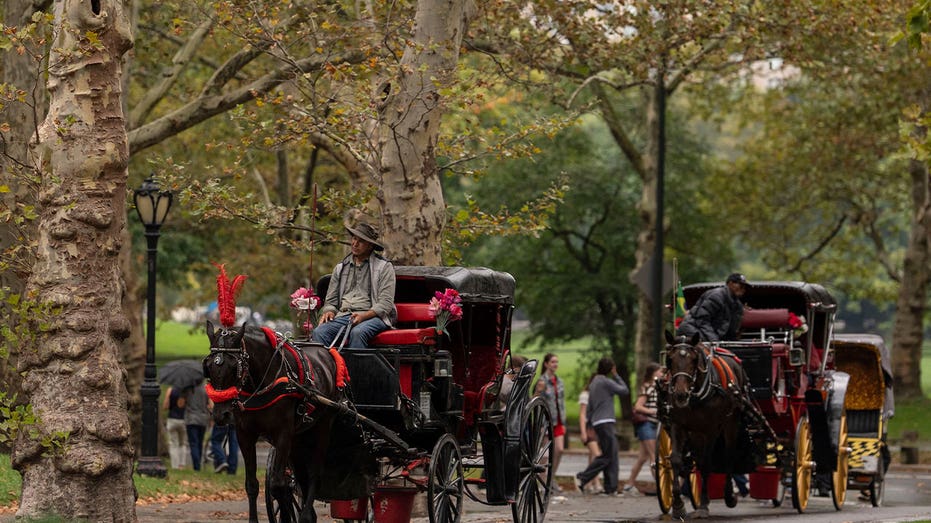
The New York City Council voted Thursday to ban horse-drawn carriages by June 2028, moving to end a nearly 170-year tradition after the death of a teenager in Central Park and prompting threats of legal action from carriage drivers.

The council voted 40-7, with two abstentions, to approve Romanch's Law, named after 18-year-old Romanch Mahajan, who died in June after being thrown from a runaway carriage in Central Park.

The legislation would phase out the industry by June 1, 2028, while requiring Mayor Zohran Mamdani's administration to develop a transition program for more than 150 active carriage drivers and other workers. 

The plan would include job training, career counseling and employment referrals, although financial compensation is not guaranteed.

MAMDANI PRAISED OVER MOVE TO DISMANTLE CONTROVERSIAL NYC INDUSTRY — BUT INSIDERS SAY THERE’S MORE TO THE STORY

President Donald Trump weighed in on the decision Thursday, criticizing the move to eliminate one of New York City's longtime tourist attractions.

"The Horse-drawn Carriage in New York City is a quintessential New York experience. So sad that, for political reasons, we will see it go!" he wrote on Truth Social.

The Transport Workers Union (TWU), which represents carriage industry workers, threatened to challenge the ban in federal court and seek a temporary restraining order. Union representatives accused City Council Speaker Julie Menin of failing to adequately consult drivers whose livelihoods are at stake.

MAN KILLED AFTER HORSE-DRAWN CARRIAGE BOLTS AND FLIPS NEAR POPULAR NEW YORK CITY TOURIST DESTINATION

Opponents argued the city had failed to establish a concrete financial plan for drivers and carriage owners. An effort to delay the phaseout until January 2030 failed before the final vote.

Menin defended the legislation Thursday, saying the council had strengthened worker protections and was prepared for a legal fight.

"We're very confident in the legislation. That's why we took the time to work over the summer on the legislation," she said at a news conference.

"We made changes to legislation to beef up worker protection. We are very confident in defending this law and will vigorously defend it. I've already talked to Steve Banks about it and our team, and we will vigorously defend this law."

Animal rights group PETA also celebrated the vote, pledging $50,000 to help carriage horses retire as the industry winds down.

The Central Park Conservancy celebrated the decision, arguing that horse-drawn carriages pose growing safety risks in a park that welcomes roughly 40 million visits annually.

MAMDANI, CITY COUNCIL MOVE TO END ICONIC NYC HORSE-DRAWN CARRIAGE INDUSTRY AS WORKERS FACE UNCERTAIN FUTURE

"In the modern era, carriages pose a serious — and even fatal — safety risk to park visitors, carriage drivers and the horses themselves. Our hearts break for the family of Romanch Mahajan, who stepped into a carriage earlier this summer and never thought he might lose his life," the organization wrote in a press release.

The Conservancy said Mahajan's death was the ninth carriage-related incident in just over a year.

The legislation also includes protections intended to prevent retired carriage horses from being sold for slaughter, while allowing owners to keep their animals.

CLICK HERE TO DOWNLOAD THE FOX NEWS APP

The bill now heads to Mamdani, who has expressed support for ending the industry. If signed, it would bring an end to a decades-long political battle over one of New York City's most recognizable tourist attractions.
  •  

Gavin Newsom’s legislative minions just got a lesson in constitutional supremacy

It is no surprise that a unanimous three-judge panel of the Ninth Circuit just enjoined the blatantly unconstitutional attempt by the "No-Longer-So-Golden State" to impose restrictions on the ability of ICE and other federal agents to enforce federal immigration law. That panel was doing exactly what federal courts are supposed to do — uphold the U.S. Constitution.

On October 14 in U.S. v. California, the court tossed the so-called "No Vigilantes Act" (NVA) onto the ash heap. This law was part of the state’s continuing effort to obstruct federal immigration enforcement, which has included relentless public attacks by the governor and state officials on federal agents just trying to do their job of enforcing the law. That includes noxious claims like Newsom likening them to the thuggish "secret police" of an "authoritarian" state.

The NVA required any non-uniformed "federal law enforcement officer" operating in California to "visibly display identification" when carrying out federal law enforcement duties. A federal agent violating this requirement could be criminally prosecuted by the state.

FEDERAL JUDGE BLOCKS NEW YORK LAW BANNING ICE AGENTS FROM WEARING MASKS

As the Ninth Circuit pointed out, the Supremacy Clause in Article VI makes the "Constitution, and the Laws of the United States … the Supreme Law of the Land." In other words, federal law not only overrides any state law to the contrary, but it requires what is called "intergovernmental immunity." Under "the intergovernmental immunity component of the Supremacy Clause … states may not directly regulate the Federal Government’s operations or property." The panel cites to a 1996 Ninth Circuit decision, Blackburn v. U.S., on this issue, but then points out that this basic legal principle — that states cannot interfere in federal functions — goes all the way back to one of the most seminal Supreme Court cases in our history, McCulloch v. Maryland (1819). "It is the very essence of Supremacy," said the Court in McCulloch, "to remove all obstacles to its action within its own sphere, and so to modify every power vested in subordinate governments, as to exempt its own operations from their own influence." That is why "States have no power … to retard, impede, burden, or in any manner control the operations of the constitutional laws enacted by Congress to carry into execution the powers vested in the General Government."

California tried to argue that the NVA was constitutional because it did not "substantially burden" federal law enforcement. But the Ninth Circuit shot that down, too, saying any attempt by a state law to directly regulate "the conduct of the United States … is void irrespective of whether the regulated activities are essential to federal functions or operations, and irrespective of the degree to which the state law interferes with such functions or operations."

What made this law even worse was its threat to criminally prosecute federal agents. This is especially ironic because California attempted to do with the NVA what the Supreme Court specifically told the state it couldn’t do 136 years ago in another seminal case, In re Neagle (1890), also cited by the Ninth Circuit panel. That decision reads like a Hollywood movie but also demonstrates just how bizarre state officials have acted in California for a long time, not just in today’s heated political arena.

In re Neagle involved the state of California trying to prosecute a U.S. Marshal for murder. Marshal David Neagle was acting as a bodyguard for Supreme Court Justice Stephen Field, a job the U.S. Marshal’s Service still carries out today. He shot and killed the former chief justice of California’s state supreme court, David Terry, at a railway station in the San Joaquin Valley, after Terry tried to assassinate Field. Terry was known for his violent temper and apparently had a grudge against Field for a court decision involving the prior divorce of Terry’s current wife.

DOJ DEMANDS SANCTUARY STATES END 'BLATANTLY UNLAWFUL' ANTI-ICE POLICY AS A MATTER OF LIFE AND DEATH

The Ninth Circuit quoted the Supreme Court’s opinion in Neagle that even the "most unquestionable and most universally applicable of state laws, such as those concerning murder, will not be allowed to control the conduct a marshal of the United States acting under and in pursuance of the laws of the United States." California couldn’t prosecute a U.S. Marshal then for doing his job, and it cannot criminally prosecute federal agents now who are "acting under and in pursuance of the [immigration] laws of the United States." End of story, end of case, end of unconstitutional state law.

By the way, a second law enacted by California’s constitutionally ignorant legislators, the "No Secret Police Act," was already enjoined by a lower court for the same reason. That law made it a criminal offense for federal agents to wear "a facial covering that conceals or obscures their facial identity." You know, the same agents who have been villainized, doxxed, followed home, harassed, run down by cars, and shot at by thugs who masquerade as protesters.

CLICK HERE TO DOWNLOAD THE FOX NEWS APP

As the Ninth Circuit correctly recognized, the lawlessness occurring in California is not limited to thugs. Perhaps some remedial courses on the Constitution for Governor Newsom and the California legislature may be in order.

  •  
❌